



Experience and Needs
Content of today’s presentation Motivations behind particular leisure activities Types of motivations Psychological theories and concepts
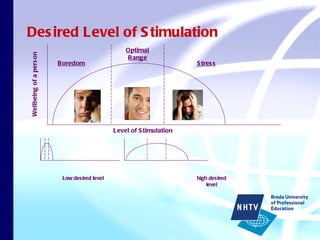
Needs Leisure behavior is aimed in realization of an  optimal level of stimulation The two opposite possible sides are: Overdose stimulation: stressful, unpleasant  Under stimulation: boredom, apathy
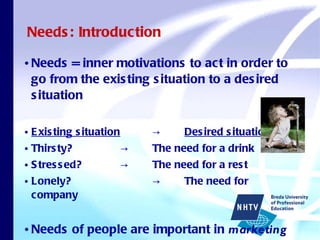
Needs: Introduction Needs = inner motivations to act in order to go from the existing situation to a desired situation Existing situation   -> Desired situation Thirsty?    ->  The need for a drink Stressed? ->  The need for a rest Lonely? ->  The need for company Needs of people are important in  marketing
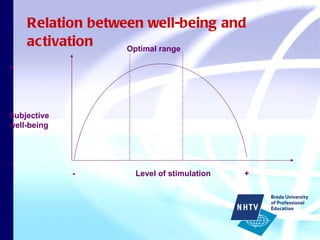
Relation between well-being and activation + Subjective  well-being - Optimal range -  Level of stimulation  +
Desired Level of Stimulation Low desired level high desired level Optimal Range Boredom Stress Level of Stimulation Wellbeing of a person
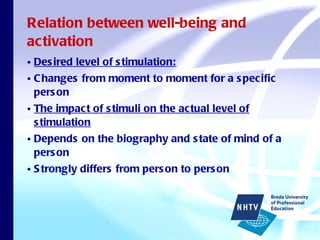
Relation between well-being and activation Desired level of stimulation: Changes from moment to moment for a specific person The impact of stimuli on the actual level of stimulation Depends on the biography and state of mind of a person Strongly differs from person to person
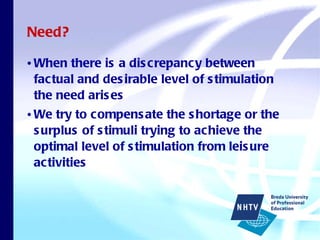
Need? When there is a discrepancy between factual and desirable level of stimulation the need arises We try to compensate the shortage or the surplus of stimuli trying to achieve the optimal level of stimulation from leisure activities
The optimal range Varies from moment to moment Varies with each individual
When need arises? When the factual and desired situation disagree The wish that moves us to the desired situation is  NEED  (need for…something) The need is what make us act
Leisure Needs Need – inner motivation act Push and pull factors The desire to escape and the appeal of the new situation
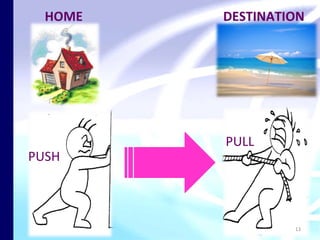
Iso-Ahola The escape and seek dimension of the need Our leisure behavior is avoiding something (escape) as well as looking for something (seeking) Factors that  push  people towards a holiday Why did you travel? Factors that  pull  them towards a particular destination  Why did you go to that destination?
HOME DESTINATION PUSH PULL
Think!  Write down the push and pull factors when you went on holiday.  Discuss them.
4 aspects of the needs Escaping personal environments Escaping interpersonal environments Seeking personal rewards Seeking interpersonal rewards
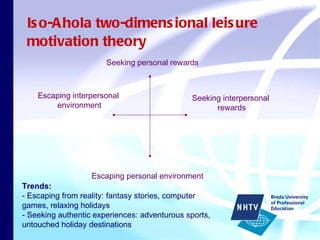
Iso-Ahola two-dimensional leisure motivation theory Seeking personal rewards Escaping personal environment Escaping interpersonal  environment Seeking interpersonal rewards Trends:  - Escaping from reality: fantasy stories, computer games, relaxing holidays - Seeking authentic experiences: adventurous sports, untouched holiday destinations
Consider… Need: an internal desire to be satisfied Want: A means to fulfill a need Motive: Energy arising from need, lacking or wanting of something, leading towards the satisfaction of need/ fulfillment of want. Motivation: Goal directed behavior Incentive: A stimulus that can influence the behavior
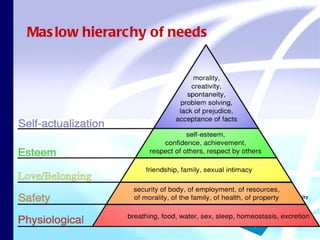
Maslow hierarchy of needs
Maslow theory The needs are ranged hierarchically Concerns human behavior in general
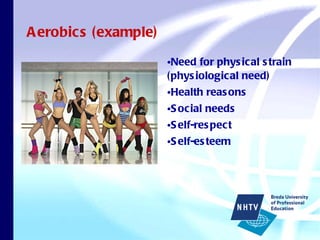
Aerobics (example) Need for physical strain (physiological need) Health reasons  Social needs Self-respect Self-esteem
Experience and needs are interrelated The intensity of the experience depends on: The number of needs to be satisfied The importance the individual attaches to the various needs
Ragheb and Beard motivation scale The intellectual dimension The social dimension The competence mastery dimension The stimulus avoidance dimension
Leisure motivation scale (Ragheb and Beard) Intellectual dimension : learn, discover, think imagine Social dimension : friendships, relationships, appreciation Competence mastery dimension : achievements, challenge, competition Stimulus avoidance dimension : mental and physical relaxation, tranquil environment
The intellectual dimension The individual “will to know”, need to learn, explore, discover, think and imagine Equivalent to what need from Maslow’s hierarchy of needs it is? Think. Self-actualization
The social dimension The need for social contact – friendship, relationship, need for appreciation, sense of belonging Equivalent to what need from Maslow’s hierarchy of needs it is? Think. The social needs
The competence mastery dimension The need to achieve or master something- challenge, competition, based on need to prove oneself. Equivalent to what need from Maslow’s hierarchy of needs it is? Think The need of esteem
The stimulus avoidance dimension Need of escaping from too high level of stimulation What is important is relaxation, tranquility Equivalent to what need from Maslow’s hierarchy of needs it is? Think Physiological need for esteem
Think. What in the theory of Ragheb and Beard is missing if compared to the Maslow’s five categories of needs? The need of safety
The most important results Social dimension and competence mastery dimension are the strongest motivations factors for holidaymakers (UK)
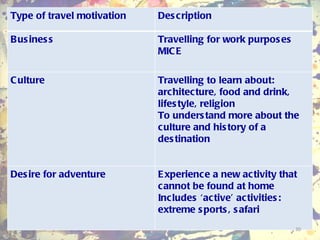
Type of travel motivation Description  Business  Travelling for work purposes MICE Culture Travelling to learn about: architecture, food and drink, lifestyle, religion To understand more about the culture and history of a destination Desire for adventure Experience a new activity that cannot be found at home Includes ‘active’ activities: extreme sports, safari
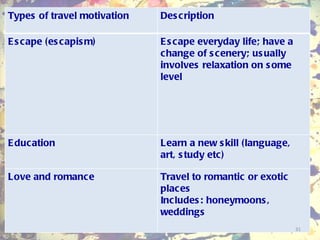
Types of travel motivation Description  Escape (escapism) Escape everyday life; have a change of scenery; usually involves relaxation on some level Education Learn a new skill (language, art, study etc) Love and romance Travel to romantic or exotic places Includes: honeymoons, weddings
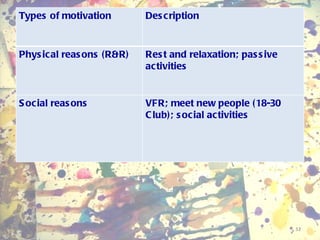
Types of motivation Description Physical reasons (R&R) Rest and relaxation; passive activities Social reasons VFR; meet new people (18-30 Club); social activities
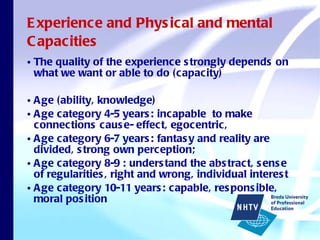
Experience and Physical and mental Capacities The quality of the experience strongly depends on what we want or able to do (capacity) Age (ability, knowledge) Age category 4-5 years: incapable  to make connections cause- effect, egocentric,  Age category 6-7 years: fantasy and reality are divided, strong own perception; Age category 8-9 : understand the abstract, sense of regularities, right and wrong, individual interest Age category 10-11 years: capable, responsible, moral position
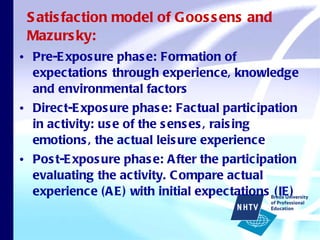
Satisfaction model of Goossens and Mazursky: Pre-Exposure phase: Formation of expectations through experience, knowledge and environmental factors Direct-Exposure phase: Factual participation in activity: use of the senses, raising emotions, the actual leisure experience Post-Exposure phase: After the participation evaluating the activity. Compare actual experience (AE) with initial expectations (IE)
Satisfaction model of Goossens and Mazursky (2) Possible outcomes: AE = IE (as expected) -> CONFIRMATION AE > IE (better than expected) -> POSITIVE DISCONFIRMATION AE < IE (disappointing) -> NEGATIVE DISCONFIRMATION
High expectations, low expectations High expectations  can easily lead to disappointment BUT: Low expectations  can lead to NO participation at all FURTHERMORE: High expectations  lead to more commitment, which leads to more  focus and a tendency to have a positive attitude towards an activity BEWARE THAT: The  level of performance  has to be in accordance with these  high expectations
Experience, expectations, satisfaction 3 phases: Pre-exposure – forming expectations Direct exposure – factual participation (experience) Post exposure – evaluation  Satisfaction – repeat visitors, word of mouth
The Cultural definition of experience The experience is largely culturally determined The time, society and environment in which we live determine the experience and the way we evaluate it
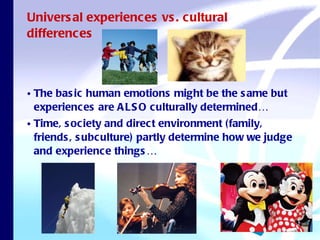
Universal experiences vs. cultural differences The basic human emotions might be the same but experiences are ALSO culturally determined… Time, society and direct environment (family, friends, subculture) partly determine how we judge and experience things…
Thank you for attention. Q & A ?

Experience and needs

  • 1.
  • 2.
    Content of today’spresentation Motivations behind particular leisure activities Types of motivations Psychological theories and concepts
  • 3.
    Needs Leisure behavioris aimed in realization of an optimal level of stimulation The two opposite possible sides are: Overdose stimulation: stressful, unpleasant Under stimulation: boredom, apathy
  • 4.
    Needs: Introduction Needs= inner motivations to act in order to go from the existing situation to a desired situation Existing situation -> Desired situation Thirsty? -> The need for a drink Stressed? -> The need for a rest Lonely? -> The need for company Needs of people are important in marketing
  • 5.
    Relation between well-beingand activation + Subjective well-being - Optimal range - Level of stimulation +
  • 6.
    Desired Level ofStimulation Low desired level high desired level Optimal Range Boredom Stress Level of Stimulation Wellbeing of a person
  • 7.
    Relation between well-beingand activation Desired level of stimulation: Changes from moment to moment for a specific person The impact of stimuli on the actual level of stimulation Depends on the biography and state of mind of a person Strongly differs from person to person
  • 8.
    Need? When thereis a discrepancy between factual and desirable level of stimulation the need arises We try to compensate the shortage or the surplus of stimuli trying to achieve the optimal level of stimulation from leisure activities
  • 9.
    The optimal rangeVaries from moment to moment Varies with each individual
  • 10.
    When need arises?When the factual and desired situation disagree The wish that moves us to the desired situation is NEED (need for…something) The need is what make us act
  • 11.
    Leisure Needs Need– inner motivation act Push and pull factors The desire to escape and the appeal of the new situation
  • 12.
    Iso-Ahola The escapeand seek dimension of the need Our leisure behavior is avoiding something (escape) as well as looking for something (seeking) Factors that push people towards a holiday Why did you travel? Factors that pull them towards a particular destination Why did you go to that destination?
  • 13.
  • 14.
    Think! Writedown the push and pull factors when you went on holiday. Discuss them.
  • 15.
    4 aspects ofthe needs Escaping personal environments Escaping interpersonal environments Seeking personal rewards Seeking interpersonal rewards
  • 16.
    Iso-Ahola two-dimensional leisuremotivation theory Seeking personal rewards Escaping personal environment Escaping interpersonal environment Seeking interpersonal rewards Trends: - Escaping from reality: fantasy stories, computer games, relaxing holidays - Seeking authentic experiences: adventurous sports, untouched holiday destinations
  • 17.
    Consider… Need: aninternal desire to be satisfied Want: A means to fulfill a need Motive: Energy arising from need, lacking or wanting of something, leading towards the satisfaction of need/ fulfillment of want. Motivation: Goal directed behavior Incentive: A stimulus that can influence the behavior
  • 18.
  • 19.
    Maslow theory Theneeds are ranged hierarchically Concerns human behavior in general
  • 20.
    Aerobics (example) Needfor physical strain (physiological need) Health reasons Social needs Self-respect Self-esteem
  • 21.
    Experience and needsare interrelated The intensity of the experience depends on: The number of needs to be satisfied The importance the individual attaches to the various needs
  • 22.
    Ragheb and Beardmotivation scale The intellectual dimension The social dimension The competence mastery dimension The stimulus avoidance dimension
  • 23.
    Leisure motivation scale(Ragheb and Beard) Intellectual dimension : learn, discover, think imagine Social dimension : friendships, relationships, appreciation Competence mastery dimension : achievements, challenge, competition Stimulus avoidance dimension : mental and physical relaxation, tranquil environment
  • 24.
    The intellectual dimensionThe individual “will to know”, need to learn, explore, discover, think and imagine Equivalent to what need from Maslow’s hierarchy of needs it is? Think. Self-actualization
  • 25.
    The social dimensionThe need for social contact – friendship, relationship, need for appreciation, sense of belonging Equivalent to what need from Maslow’s hierarchy of needs it is? Think. The social needs
  • 26.
    The competence masterydimension The need to achieve or master something- challenge, competition, based on need to prove oneself. Equivalent to what need from Maslow’s hierarchy of needs it is? Think The need of esteem
  • 27.
    The stimulus avoidancedimension Need of escaping from too high level of stimulation What is important is relaxation, tranquility Equivalent to what need from Maslow’s hierarchy of needs it is? Think Physiological need for esteem
  • 28.
    Think. What inthe theory of Ragheb and Beard is missing if compared to the Maslow’s five categories of needs? The need of safety
  • 29.
    The most importantresults Social dimension and competence mastery dimension are the strongest motivations factors for holidaymakers (UK)
  • 30.
    Type of travelmotivation Description Business Travelling for work purposes MICE Culture Travelling to learn about: architecture, food and drink, lifestyle, religion To understand more about the culture and history of a destination Desire for adventure Experience a new activity that cannot be found at home Includes ‘active’ activities: extreme sports, safari
  • 31.
    Types of travelmotivation Description Escape (escapism) Escape everyday life; have a change of scenery; usually involves relaxation on some level Education Learn a new skill (language, art, study etc) Love and romance Travel to romantic or exotic places Includes: honeymoons, weddings
  • 32.
    Types of motivationDescription Physical reasons (R&R) Rest and relaxation; passive activities Social reasons VFR; meet new people (18-30 Club); social activities
  • 33.
    Experience and Physicaland mental Capacities The quality of the experience strongly depends on what we want or able to do (capacity) Age (ability, knowledge) Age category 4-5 years: incapable to make connections cause- effect, egocentric, Age category 6-7 years: fantasy and reality are divided, strong own perception; Age category 8-9 : understand the abstract, sense of regularities, right and wrong, individual interest Age category 10-11 years: capable, responsible, moral position
  • 34.
    Satisfaction model ofGoossens and Mazursky: Pre-Exposure phase: Formation of expectations through experience, knowledge and environmental factors Direct-Exposure phase: Factual participation in activity: use of the senses, raising emotions, the actual leisure experience Post-Exposure phase: After the participation evaluating the activity. Compare actual experience (AE) with initial expectations (IE)
  • 35.
    Satisfaction model ofGoossens and Mazursky (2) Possible outcomes: AE = IE (as expected) -> CONFIRMATION AE > IE (better than expected) -> POSITIVE DISCONFIRMATION AE < IE (disappointing) -> NEGATIVE DISCONFIRMATION
  • 36.
    High expectations, lowexpectations High expectations can easily lead to disappointment BUT: Low expectations can lead to NO participation at all FURTHERMORE: High expectations lead to more commitment, which leads to more focus and a tendency to have a positive attitude towards an activity BEWARE THAT: The level of performance has to be in accordance with these high expectations
  • 37.
    Experience, expectations, satisfaction3 phases: Pre-exposure – forming expectations Direct exposure – factual participation (experience) Post exposure – evaluation Satisfaction – repeat visitors, word of mouth
  • 38.
    The Cultural definitionof experience The experience is largely culturally determined The time, society and environment in which we live determine the experience and the way we evaluate it
  • 39.
    Universal experiences vs.cultural differences The basic human emotions might be the same but experiences are ALSO culturally determined… Time, society and direct environment (family, friends, subculture) partly determine how we judge and experience things…
  • 40.
    Thank you forattention. Q & A ?