Leisure experience
Emotion What determines the emotion we are going through? Motives and needs Physical and mental capabilities and their influence on the experience Expectations preceding the participation in leisure activity The environment
Emotions Always there: in our brain Reactions to physiological changes – inners selves (adrenaline, estrogen or testosterone) Reaction to external stimuli
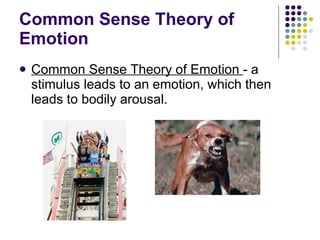
Common Sense Theory of Emotion Common Sense Theory of Emotion  - a stimulus leads to an emotion, which then leads to bodily arousal.
 
Emotions in World of Leisure Leisure: time to compensate certain shortcomings in everyday life Stress needs to be counterbalanced  Leisure offers surrogate solutions (artificial)
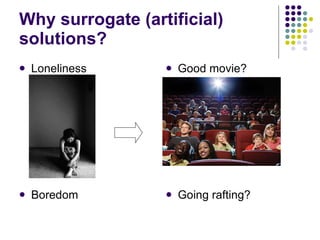
Why surrogate (artificial) solutions? Loneliness Boredom Good movie? Going rafting?
Leisure Artificial surroundings Controlled adventure No real, natural emotions  - artificial emotions We do display emotions in cinema, but these emotions are  different from real emotions
Artificial emotions Temporary elimination of the disbelief Leisure manipulates the awareness of simulation situation trying to induce real emotions Is this desirable? There is a boundary up to which we have our emotions under control
Emotions in Leisure  Leisure needs to ensure that, particularly when negative emotions are concerned, boundaries are not crossed and are well controlled.
Optimal Leisure Experience Flow Leisure emotion generated during the consumption of a leisure product is called  leisure experience
Leisure experience The emotions evoked by participation may vary in intensity (flow) The intensity of emotions differs with each leisure activity and also differs throughout the participation in one and the same activity Flow: experience in which you forget everything around and you became ecstatic.
Characteristics of optimal leisure experience Enriched perception Observation of the surroundings in intense manner – the assumption is colorful and sparking
Characteristics of optimal leisure experience Disturbance in the same sense Time sense gets utterly disturbed, Hours pass as they are minutes, and time “flies”
Characteristics of optimal leisure experience Strong personal involvement and total absorption People totally lose themselves in the activity and are not aware about other things that are happening around them
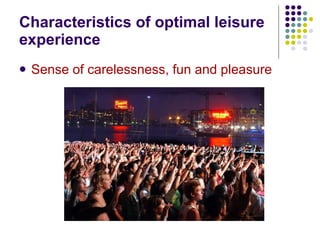
Characteristics of optimal leisure experience Sense of carelessness, fun and pleasure
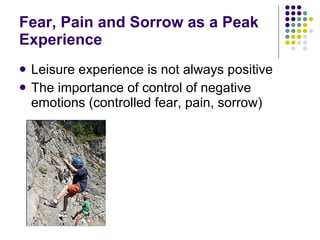
Fear, Pain and Sorrow as a Peak Experience Leisure experience is not always positive The importance of control of negative emotions (controlled fear, pain, sorrow)
Leisure experience Experience: emotional frame of mind when taking part in a leisure activity Leisure experience vary in intensity and it is strongly individual High experience value is usually associated with positive emotions but could derived from negative (controlled) emotions
Optimal leisure experience The experience flow:  pleasure, carelessness, intense perception, full concentration,  disturbance of one’s time sense.
Conditions for Optimal Leisure experience Neulinger’s Leisure Paradigm Csikzentmihalyi’s Optimal Leisure experience
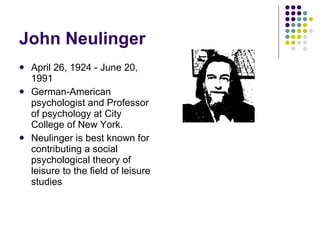
John Neulinger  April 26, 1924 - June 20, 1991 German-American psychologist and Professor of psychology at City College of New York.  Neulinger is best known for contributing a social psychological theory of leisure to the field of leisure studies
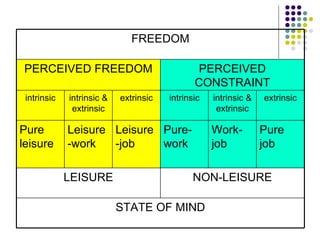
Neulinger’s paradigm (1) Two qualities of leisure (perceived freedom of choice/perceived constraints intrinsic motivation) offer the explanation.
Neulinger’s paradigm (2) All activities could be divided into 2 categories: Leisure: perceived freedom Non- leisure: perceived constraint
Classification of Leisure & Non-leisure activities by motivation type Intrinsic (internal) Motivation comes form rewards inherent to an activity itself Extrinsic (external) Motivation comes from rewards outside of the performer All activities can be intrinsically, extrinsically or both motivated
Leisure categories
PURE LEISURE freely engaged in, doing an activity for its own sake, no external awards Please give examples …..
LEISURE WORK: freely engaged in & combine both intrinsic & extrinsic motivation The rewards/ incentives for doing the activities come form within & outside the performer Please give examples
LEISURE JOB Activities that are freely engaged in & are totally extrinsically motivated The reward / incentives for participation in an activity come solely form outside the performer Please give examples
Non leisure categories
PURE WORK Activities that are participated in under some kind of constraint & are totally intrinsically motivated
WORK JOB Activities that are participated in under some kind of constraint & combine both intrinsic& extrinsic motivation Please give example…
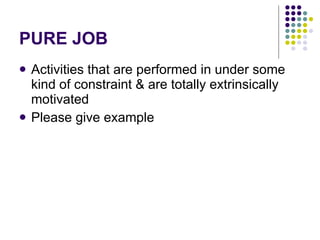
PURE JOB Activities that are performed in under some kind of constraint & are totally extrinsically motivated Please give example
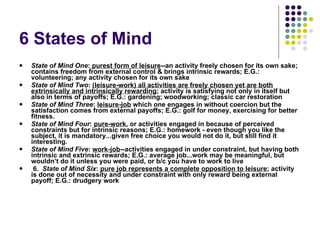
6 States of Mind  State of Mind One :  purest form of leisure --an activity freely chosen for its own sake; contains freedom from external control & brings intrinsic rewards; E.G.: volunteering; any activity chosen for its own sake State of Mind Two :  (leisure-work) all activities are freely chosen yet are both extrinsically and intrinsically rewarding ; activity is satisfying not only in itself but also in terms of payoffs; E.G.: gardening; woodworking; classic car restoration State of Mind Three :  leisure-job  which one engages in without coercion but the satisfaction comes from external payoffs; E.G.: golf for money, exercising for better fitness. State of Mind Four :  pure-work , or activities engaged in because of perceived constraints but for intrinsic reasons; E.G.: homework - even though you like the subject, it is mandatory...given free choice you would not do it, but still find it interesting. State of Mind Five :  work-job --activities engaged in under constraint, but having both intrinsic and extrinsic rewards; E.G.: average job...work may be meaningful, but wouldn’t do it unless you were paid, or b/c you have to work to live   6.   State of Mind Six :  pure job represents a complete opposition to leisure ; activity is done out of necessity and under constraint with only reward being external payoff; E.G.: drudgery work
STATE OF MIND NON-LEISURE LEISURE Pure job Work-job Pure-work Leisure-job Leisure-work Pure leisure extrinsic intrinsic & extrinsic intrinsic extrinsic intrinsic & extrinsic intrinsic PERCEIVED CONSTRAINT PERCEIVED FREEDOM FREEDOM
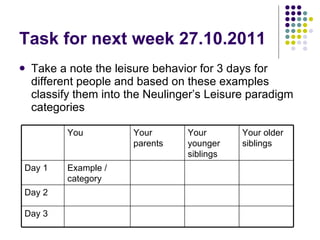
Task for next week 27.10.2011 Take a note the leisure behavior for 3 days for different people and based on these examples classify them into the Neulinger’s Leisure paradigm categories Day 2 Day 3 Example / category Day 1 Your older siblings Your younger siblings Your parents You
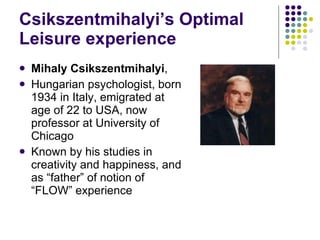
Csikszentmihalyi’s Optimal Leisure experience Mihaly Csikszentmihalyi ,  Hungarian psychologist, born 1934 in Italy, emigrated at age of 22 to USA, now professor at University of Chicago Known by his studies in creativity and happiness, and as “father” of notion of “FLOW” experience
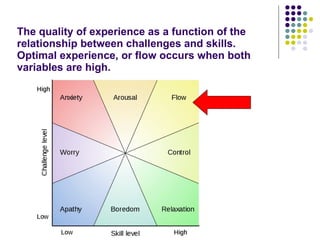
Csikszentmihalyi’s Optimal Leisure experience When the peak experience occur, regardless of whether occur – in work or leisure time.  As a result of his studies and interviews of  creative people  he concluded that 2 matters are crucial: COMMITMENT (skills) CHALLENGE ! One side
The quality of experience as a function of the relationship between challenges and skills. Optimal experience, or flow occurs when both variables are high.

Leisure experience02

  • 1.
  • 2.
    Emotion What determinesthe emotion we are going through? Motives and needs Physical and mental capabilities and their influence on the experience Expectations preceding the participation in leisure activity The environment
  • 3.
    Emotions Always there:in our brain Reactions to physiological changes – inners selves (adrenaline, estrogen or testosterone) Reaction to external stimuli
  • 4.
    Common Sense Theoryof Emotion Common Sense Theory of Emotion - a stimulus leads to an emotion, which then leads to bodily arousal.
  • 5.
  • 6.
    Emotions in Worldof Leisure Leisure: time to compensate certain shortcomings in everyday life Stress needs to be counterbalanced Leisure offers surrogate solutions (artificial)
  • 7.
    Why surrogate (artificial)solutions? Loneliness Boredom Good movie? Going rafting?
  • 8.
    Leisure Artificial surroundingsControlled adventure No real, natural emotions - artificial emotions We do display emotions in cinema, but these emotions are different from real emotions
  • 9.
    Artificial emotions Temporaryelimination of the disbelief Leisure manipulates the awareness of simulation situation trying to induce real emotions Is this desirable? There is a boundary up to which we have our emotions under control
  • 10.
    Emotions in Leisure Leisure needs to ensure that, particularly when negative emotions are concerned, boundaries are not crossed and are well controlled.
  • 11.
    Optimal Leisure ExperienceFlow Leisure emotion generated during the consumption of a leisure product is called leisure experience
  • 12.
    Leisure experience Theemotions evoked by participation may vary in intensity (flow) The intensity of emotions differs with each leisure activity and also differs throughout the participation in one and the same activity Flow: experience in which you forget everything around and you became ecstatic.
  • 13.
    Characteristics of optimalleisure experience Enriched perception Observation of the surroundings in intense manner – the assumption is colorful and sparking
  • 14.
    Characteristics of optimalleisure experience Disturbance in the same sense Time sense gets utterly disturbed, Hours pass as they are minutes, and time “flies”
  • 15.
    Characteristics of optimalleisure experience Strong personal involvement and total absorption People totally lose themselves in the activity and are not aware about other things that are happening around them
  • 16.
    Characteristics of optimalleisure experience Sense of carelessness, fun and pleasure
  • 17.
    Fear, Pain andSorrow as a Peak Experience Leisure experience is not always positive The importance of control of negative emotions (controlled fear, pain, sorrow)
  • 18.
    Leisure experience Experience:emotional frame of mind when taking part in a leisure activity Leisure experience vary in intensity and it is strongly individual High experience value is usually associated with positive emotions but could derived from negative (controlled) emotions
  • 19.
    Optimal leisure experienceThe experience flow: pleasure, carelessness, intense perception, full concentration, disturbance of one’s time sense.
  • 20.
    Conditions for OptimalLeisure experience Neulinger’s Leisure Paradigm Csikzentmihalyi’s Optimal Leisure experience
  • 21.
    John Neulinger April 26, 1924 - June 20, 1991 German-American psychologist and Professor of psychology at City College of New York. Neulinger is best known for contributing a social psychological theory of leisure to the field of leisure studies
  • 22.
    Neulinger’s paradigm (1)Two qualities of leisure (perceived freedom of choice/perceived constraints intrinsic motivation) offer the explanation.
  • 23.
    Neulinger’s paradigm (2)All activities could be divided into 2 categories: Leisure: perceived freedom Non- leisure: perceived constraint
  • 24.
    Classification of Leisure& Non-leisure activities by motivation type Intrinsic (internal) Motivation comes form rewards inherent to an activity itself Extrinsic (external) Motivation comes from rewards outside of the performer All activities can be intrinsically, extrinsically or both motivated
  • 25.
  • 26.
    PURE LEISURE freelyengaged in, doing an activity for its own sake, no external awards Please give examples …..
  • 27.
    LEISURE WORK: freelyengaged in & combine both intrinsic & extrinsic motivation The rewards/ incentives for doing the activities come form within & outside the performer Please give examples
  • 28.
    LEISURE JOB Activitiesthat are freely engaged in & are totally extrinsically motivated The reward / incentives for participation in an activity come solely form outside the performer Please give examples
  • 29.
  • 30.
    PURE WORK Activitiesthat are participated in under some kind of constraint & are totally intrinsically motivated
  • 31.
    WORK JOB Activitiesthat are participated in under some kind of constraint & combine both intrinsic& extrinsic motivation Please give example…
  • 32.
    PURE JOB Activitiesthat are performed in under some kind of constraint & are totally extrinsically motivated Please give example
  • 33.
    6 States ofMind State of Mind One : purest form of leisure --an activity freely chosen for its own sake; contains freedom from external control & brings intrinsic rewards; E.G.: volunteering; any activity chosen for its own sake State of Mind Two : (leisure-work) all activities are freely chosen yet are both extrinsically and intrinsically rewarding ; activity is satisfying not only in itself but also in terms of payoffs; E.G.: gardening; woodworking; classic car restoration State of Mind Three : leisure-job which one engages in without coercion but the satisfaction comes from external payoffs; E.G.: golf for money, exercising for better fitness. State of Mind Four : pure-work , or activities engaged in because of perceived constraints but for intrinsic reasons; E.G.: homework - even though you like the subject, it is mandatory...given free choice you would not do it, but still find it interesting. State of Mind Five : work-job --activities engaged in under constraint, but having both intrinsic and extrinsic rewards; E.G.: average job...work may be meaningful, but wouldn’t do it unless you were paid, or b/c you have to work to live   6.   State of Mind Six : pure job represents a complete opposition to leisure ; activity is done out of necessity and under constraint with only reward being external payoff; E.G.: drudgery work
  • 34.
    STATE OF MINDNON-LEISURE LEISURE Pure job Work-job Pure-work Leisure-job Leisure-work Pure leisure extrinsic intrinsic & extrinsic intrinsic extrinsic intrinsic & extrinsic intrinsic PERCEIVED CONSTRAINT PERCEIVED FREEDOM FREEDOM
  • 35.
    Task for nextweek 27.10.2011 Take a note the leisure behavior for 3 days for different people and based on these examples classify them into the Neulinger’s Leisure paradigm categories Day 2 Day 3 Example / category Day 1 Your older siblings Your younger siblings Your parents You
  • 36.
    Csikszentmihalyi’s Optimal Leisureexperience Mihaly Csikszentmihalyi , Hungarian psychologist, born 1934 in Italy, emigrated at age of 22 to USA, now professor at University of Chicago Known by his studies in creativity and happiness, and as “father” of notion of “FLOW” experience
  • 37.
    Csikszentmihalyi’s Optimal Leisureexperience When the peak experience occur, regardless of whether occur – in work or leisure time. As a result of his studies and interviews of creative people he concluded that 2 matters are crucial: COMMITMENT (skills) CHALLENGE ! One side
  • 38.
    The quality ofexperience as a function of the relationship between challenges and skills. Optimal experience, or flow occurs when both variables are high.