BUSINESS EXIT &
SUCCESSION PLANNING:
A VALUABLE SERVICE TO ADD TO YOUR CPA PRACTICE
B U S I N E S S E X I T A N D S U C C E S S I O N
P L A N N I N G C O M M I T T E E
S E P T 2 0 1 3
SUCCESSION VS. ESTATE VS. EXIT
PLANNING
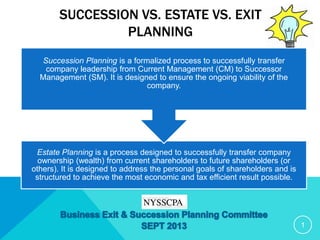
Estate Planning is a process designed to successfully transfer company
ownership (wealth) from current shareholders to future shareholders (or
others). It is designed to address the personal goals of shareholders and is
structured to achieve the most economic and tax efficient result possible.
Succession Planning is a formalized process to successfully transfer
company leadership from Current Management (CM) to Successor
Management (SM). It is designed to ensure the ongoing viability of the
company.
1
SUCCESSION VS. ESTATE VS. EXIT (CONT’D)
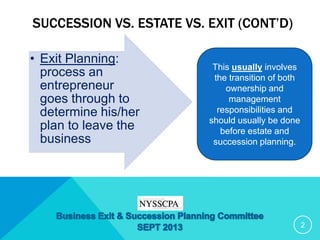
• Exit Planning:
process an
entrepreneur
goes through to
determine his/her
plan to leave the
business
2
This usually involves
the transition of both
ownership and
management
responsibilities and
should usually be done
before estate and
succession planning.
WHY SUCCESSION PLANNING?
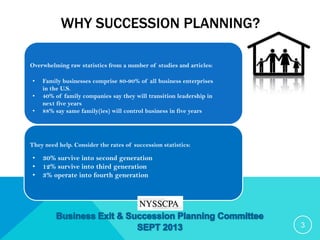
Overwhelming raw statistics from a number of studies and articles:
They need help. Consider the rates of succession statistics:
3
• Family businesses comprise 80-90% of all business enterprises
in the U.S.
• 40% of family companies say they will transition leadership in
next five years
• 88% say same family(ies) will control business in five years
• 30% survive into second generation
• 12% survive into third generation
• 3% operate into fourth generation
WHY SUCCESSION PLANNING? (CONT’D)
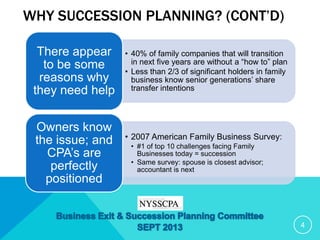
• 40% of family companies that will transition
in next five years are without a “how to” plan
• Less than 2/3 of significant holders in family
business know senior generations’ share
transfer intentions
There appear
to be some
reasons why
they need help
• 2007 American Family Business Survey:
• #1 of top 10 challenges facing Family
Businesses today = succession
• Same survey: spouse is closest advisor;
accountant is next
Owners know
the issue; and
CPA’s are
perfectly
positioned
4
WHY SUCCESSION PLANNING? (CONT’D)
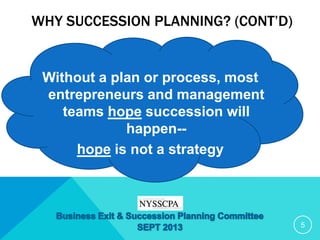
Without a plan or process, most
entrepreneurs and management
teams hope succession will
happen--
hope is not a strategy
5
WHY EXIT PLANNING?
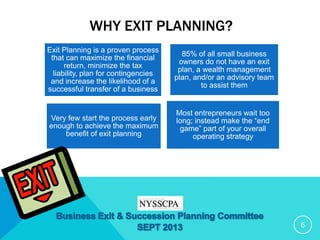
Exit Planning is a proven process
that can maximize the financial
return, minimize the tax
liability, plan for contingencies
and increase the likelihood of a
successful transfer of a business
85% of all small business
owners do not have an exit
plan, a wealth management
plan, and/or an advisory team
to assist them
Very few start the process early
enough to achieve the maximum
benefit of exit planning
Most entrepreneurs wait too
long; instead make the “end
game” part of your overall
operating strategy
6
WHY EXIT PLANNING? (CONT’D)
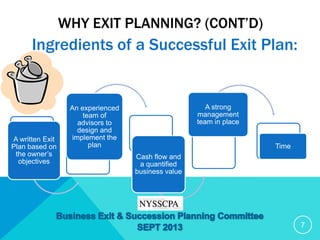
A written Exit
Plan based on
the owner’s
objectives
An experienced
team of
advisors to
design and
implement the
plan
Cash flow and
a quantified
business value
A strong
management
team in place
Time
Ingredients of a Successful Exit Plan:
7
WHY EXIT PLANNING? (CONT’D)
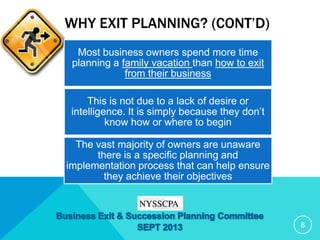
Most business owners spend more time
planning a family vacation than how to exit
from their business
This is not due to a lack of desire or
intelligence. It is simply because they don’t
know how or where to begin
The vast majority of owners are unaware
there is a specific planning and
implementation process that can help ensure
they achieve their objectives
8
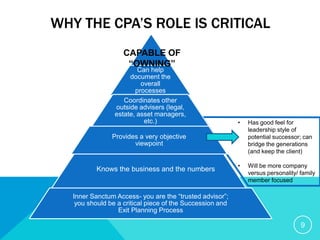
• Has good feel for
leadership style of
potential successor; can
bridge the generations
(and keep the client)
• Will be more company
versus personality/ family
member focused
WHY THE CPA’S ROLE IS CRITICAL
Can help
document the
overall
processes
Coordinates other
outside advisers (legal,
estate, asset managers,
etc.)
Provides a very objective
viewpoint
Inner Sanctum Access- you are the “trusted advisor”;
you should be a critical piece of the Succession and
Exit Planning Process
CAPABLE OF
“OWNING”
Knows the business and the numbers
9
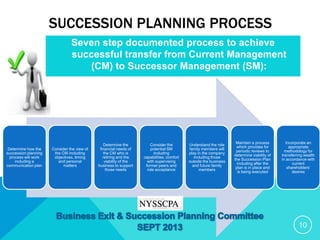
SUCCESSION PLANNING PROCESS
Seven step documented process to achieve
successful transfer from Current Management
(CM) to Successor Management (SM):
Determine how the
succession planning
process will work
including a
communication plan
Consider the view of
the CM including
objectives, timing
and personal
matters
Determine the
financial needs of
the CM who is
retiring and the
viability of the
business to support
those needs
Consider the
potential SM
including
capabilities, comfort
with supervising
former peers and
role acceptance
Understand the role
family members will
play in the company
including those
outside the business
and future family
members
Maintain a process
which provides for
periodic reviews to
determine viability of
the Succession Plan
including after the
plan is in place and
is being executed
Incorporate an
appropriate
methodology for
transferring wealth
in accordance with
current
shareholders’
desires
10
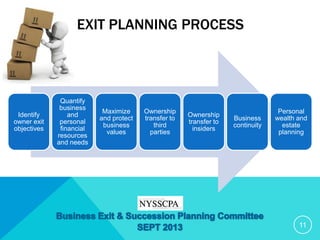
EXIT PLANNING PROCESS
Identify
owner exit
objectives
Quantify
business
and
personal
financial
resources
and needs
Maximize
and protect
business
values
Ownership
transfer to
third
parties
Ownership
transfer to
insiders
Business
continuity
Personal
wealth and
estate
planning
11
NEXT STEPS?
Business Exit & Succession Planning involves many skillsets and
capabilities; some of which just come from experience. The best and
easiest thing to do is to join the Business Exit & Succession Planning
Committee of the NYSSCPA. The purpose of this Committee is to
educate CPA’s on these subjects.
If you are interested, please reach out to the Chairman, Bernie Leone or any
committee member listed on the NYSSCPA website.
bleone@withum.com
212-829-3207
12
13

business exist

  • 1.
    BUSINESS EXIT & SUCCESSIONPLANNING: A VALUABLE SERVICE TO ADD TO YOUR CPA PRACTICE B U S I N E S S E X I T A N D S U C C E S S I O N P L A N N I N G C O M M I T T E E S E P T 2 0 1 3
  • 2.
    SUCCESSION VS. ESTATEVS. EXIT PLANNING Estate Planning is a process designed to successfully transfer company ownership (wealth) from current shareholders to future shareholders (or others). It is designed to address the personal goals of shareholders and is structured to achieve the most economic and tax efficient result possible. Succession Planning is a formalized process to successfully transfer company leadership from Current Management (CM) to Successor Management (SM). It is designed to ensure the ongoing viability of the company. 1
  • 3.
    SUCCESSION VS. ESTATEVS. EXIT (CONT’D) • Exit Planning: process an entrepreneur goes through to determine his/her plan to leave the business 2 This usually involves the transition of both ownership and management responsibilities and should usually be done before estate and succession planning.
  • 4.
    WHY SUCCESSION PLANNING? Overwhelmingraw statistics from a number of studies and articles: They need help. Consider the rates of succession statistics: 3 • Family businesses comprise 80-90% of all business enterprises in the U.S. • 40% of family companies say they will transition leadership in next five years • 88% say same family(ies) will control business in five years • 30% survive into second generation • 12% survive into third generation • 3% operate into fourth generation
  • 5.
    WHY SUCCESSION PLANNING?(CONT’D) • 40% of family companies that will transition in next five years are without a “how to” plan • Less than 2/3 of significant holders in family business know senior generations’ share transfer intentions There appear to be some reasons why they need help • 2007 American Family Business Survey: • #1 of top 10 challenges facing Family Businesses today = succession • Same survey: spouse is closest advisor; accountant is next Owners know the issue; and CPA’s are perfectly positioned 4
  • 6.
    WHY SUCCESSION PLANNING?(CONT’D) Without a plan or process, most entrepreneurs and management teams hope succession will happen-- hope is not a strategy 5
  • 7.
    WHY EXIT PLANNING? ExitPlanning is a proven process that can maximize the financial return, minimize the tax liability, plan for contingencies and increase the likelihood of a successful transfer of a business 85% of all small business owners do not have an exit plan, a wealth management plan, and/or an advisory team to assist them Very few start the process early enough to achieve the maximum benefit of exit planning Most entrepreneurs wait too long; instead make the “end game” part of your overall operating strategy 6
  • 8.
    WHY EXIT PLANNING?(CONT’D) A written Exit Plan based on the owner’s objectives An experienced team of advisors to design and implement the plan Cash flow and a quantified business value A strong management team in place Time Ingredients of a Successful Exit Plan: 7
  • 9.
    WHY EXIT PLANNING?(CONT’D) Most business owners spend more time planning a family vacation than how to exit from their business This is not due to a lack of desire or intelligence. It is simply because they don’t know how or where to begin The vast majority of owners are unaware there is a specific planning and implementation process that can help ensure they achieve their objectives 8
  • 10.
    • Has goodfeel for leadership style of potential successor; can bridge the generations (and keep the client) • Will be more company versus personality/ family member focused WHY THE CPA’S ROLE IS CRITICAL Can help document the overall processes Coordinates other outside advisers (legal, estate, asset managers, etc.) Provides a very objective viewpoint Inner Sanctum Access- you are the “trusted advisor”; you should be a critical piece of the Succession and Exit Planning Process CAPABLE OF “OWNING” Knows the business and the numbers 9
  • 11.
    SUCCESSION PLANNING PROCESS Sevenstep documented process to achieve successful transfer from Current Management (CM) to Successor Management (SM): Determine how the succession planning process will work including a communication plan Consider the view of the CM including objectives, timing and personal matters Determine the financial needs of the CM who is retiring and the viability of the business to support those needs Consider the potential SM including capabilities, comfort with supervising former peers and role acceptance Understand the role family members will play in the company including those outside the business and future family members Maintain a process which provides for periodic reviews to determine viability of the Succession Plan including after the plan is in place and is being executed Incorporate an appropriate methodology for transferring wealth in accordance with current shareholders’ desires 10
  • 12.
    EXIT PLANNING PROCESS Identify ownerexit objectives Quantify business and personal financial resources and needs Maximize and protect business values Ownership transfer to third parties Ownership transfer to insiders Business continuity Personal wealth and estate planning 11
  • 13.
    NEXT STEPS? Business Exit& Succession Planning involves many skillsets and capabilities; some of which just come from experience. The best and easiest thing to do is to join the Business Exit & Succession Planning Committee of the NYSSCPA. The purpose of this Committee is to educate CPA’s on these subjects. If you are interested, please reach out to the Chairman, Bernie Leone or any committee member listed on the NYSSCPA website. bleone@withum.com 212-829-3207 12
  • 14.