
To Be or Not To Be:
Existentialism in
Shakespeare’s Hamlet
Marco D. Meduranda, MAEd
MLQU-SPACE
October 08, 2016
“both are linked
by how human
beings live in the
world; how they
experience
themselves; how
they interact
with and
respond to other
people. “
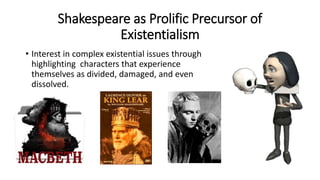
Shakespeare as Prolific Precursor of
Existentialism
• Interest in complex existential issues through
highlighting characters that experience
themselves as divided, damaged, and even
dissolved.
• In Shakespearean tragedy, the idea
that human beings have an intimate,
inward self-experience broadens
into a wider consideration of ethics
and politics of human existence.
• His plays do not establish ethical
boundaries in a prescriptive or
didactic way, but they imply that
ethical limits and feelings of
inwardness are connected.
Shakespeare as Prolific Precursor of
Existentialism
Existentialism
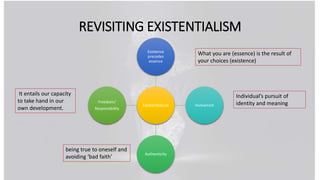
Existence
precedes
essence
Humanism
Authenticity
Freedom/
Responsibility
REVISITING EXISTENTIALISM
What you are (essence) is the result of
your choices (existence)
Individual’s pursuit of
identity and meaning
It entails our capacity
to take hand in our
own development.
being true to oneself and
avoiding ‘bad faith’
REVISITING EXISTENTIALISM
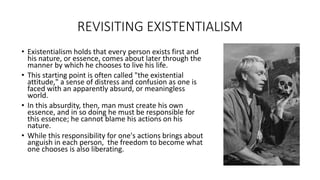
• Existentialism holds that every person exists first and
his nature, or essence, comes about later through the
manner by which he chooses to live his life.
• This starting point is often called "the existential
attitude," a sense of distress and confusion as one is
faced with an apparently absurd, or meaningless
world.
• In this absurdity, then, man must create his own
essence, and in so doing he must be responsible for
this essence; he cannot blame his actions on his
nature.
• While this responsibility for one's actions brings about
anguish in each person, the freedom to become what
one chooses is also liberating.
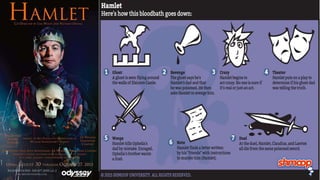
HAMLET: A SUMMARY
HAMLET: THE EXISTENTIAL ATTITUDE
• Hamlet displays "the existential
attitude" throughout the play,
especially in his soliloquies.
• In his first soliloquy of Act I, he
contemplates the absurdity of
the world,
• How weary, stale, flat and
unprofitable
Seem to me all the uses of
this world! (1.2.136-137)
EXISTENTIAL CREATION OF SELF
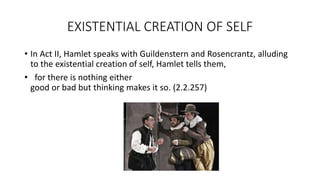
• In Act II, Hamlet speaks with Guildenstern and Rosencrantz, alluding
to the existential creation of self, Hamlet tells them,
• for there is nothing either
good or bad but thinking makes it so. (2.2.257)
ESSENCE OF MAN
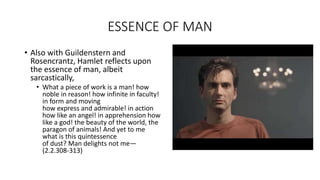
• Also with Guildenstern and
Rosencrantz, Hamlet reflects upon
the essence of man, albeit
sarcastically,
• What a piece of work is a man! how
noble in reason! how infinite in faculty!
in form and moving
how express and admirable! in action
how like an angel! in apprehension how
like a god! the beauty of the world, the
paragon of animals! And yet to me
what is this quintessence
of dust? Man delights not me—
(2.2.308-313)
ALIENATION AND HIS DISAPPOINTMENT
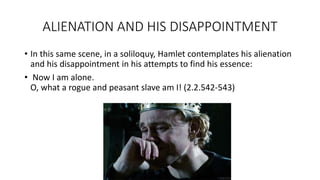
• In this same scene, in a soliloquy, Hamlet contemplates his alienation
and his disappointment in his attempts to find his essence:
• Now I am alone.
O, what a rogue and peasant slave am I! (2.2.542-543)
MEANING OF EXISTENCE
• His famous "to be or not to be" soliloquy
is quintessentially existential as he
contemplates the very meaning of
existence,
To be, or not to be – that is the question;
Whether ’tis nobler in the mind to suffer
The slings and arrows of outrageous fortune
Or to take arms against a sea of troubles
And by opposing end them; to die: to sleep –
No more, and by a sleep to say we end.
(III.i.55-60)
• Hamlet comes to realize that he exists in a
crudely basic sense of the word: as a
material being, he has a fundamental and
irreducible corporeality.
• Hamlet reasons that people do not end their woes and
tribulations because they do not know if they may have to face worse
burdens in the next life after death. And, thus, Hamlet concludes,
• Thus conscience does make cowards of us all;
And thus the native hue of resolution
Is sicklied o'er with the pale cast of thought,
And enterprises of great pith and moment
With this regard their currents turn awry,
And lose the name of action. (III, i, 83-88).
MEANING OF EXISTENCE
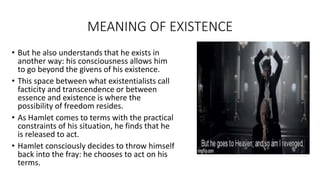
• But he also understands that he exists in
another way: his consciousness allows him
to go beyond the givens of his existence.
• This space between what existentialists call
facticity and transcendence or between
essence and existence is where the
possibility of freedom resides.
• As Hamlet comes to terms with the practical
constraints of his situation, he finds that he
is released to act.
• Hamlet consciously decides to throw himself
back into the fray: he chooses to act on his
terms.
RESPONSIBILITY
• Throughout the play, Hamlet
essays to define man and his
essence and to act with
deliberation and responsibility
as a man. Jean-Paul Sartre, a
leading Existentialist declared,
"Etre homme, etre
responsable" [to be man is to
be responsible], and Hamlet
truly becomes responsible after
he observes Fortinbras in Act IV,
• ...a delicate and tender prince,
Whose spirit with divine ambition
puff'd,
Makes mouths at the invisible event,
Exposing what is mortal and unsure
To all that fortune, death, and danger
dare,
Even for an eggshell. (4.4.50-55)
AUTHENTICITY
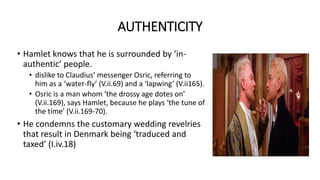
• Hamlet knows that he is surrounded by ‘in-
authentic’ people.
• dislike to Claudius’ messenger Osric, referring to
him as a ‘water-fly’ (V.ii.69) and a ‘lapwing’ (V.ii165).
• Osric is a man whom ‘the drossy age dotes on’
(V.ii.169), says Hamlet, because he plays ‘the tune of
the time’ (V.ii.169-70).
• He condemns the customary wedding revelries
that result in Denmark being ‘traduced and
taxed’ (I.iv.18)
• Hamlet, on the other hand, struggles to remain ‘authentic’, not to conform
to fatuous habits or customs—the habits or customs demand him not to
mourn for his dead father; they demand that he rejoices at the marriage of
his late father’s widow, even though he found it temerarious. Hamlet
believes it is more honorable to break these feigned customs than to abide
by them:
• Horatio “Is it a custom?
• Hamlet Ay, marry, it is,
But to my mind, though I am native here
And to the manner born, it is a custom
More honored in the breach than the observance. (I. iv. 12-
16)
• He finds it difficult to avenge his
father’s murder because this
action has been prescribed for him
rather than authentically chosen.
Yet he feels an obligation to fulfill
such expectations.
• Most existentialists concur that a
large portion of human existence
is lived in-authentically or in bad
faith.
• Human beings find self-truth
difficult, perhaps even impossible.
AUTHENTICITY
AUTHENTICITY
• Authenticity, for existentialists,
involves recognition of the
unavoidably inauthentic quality of
life, awareness that men are all
drawn into the world and cannot
disassociate themselves from it.
• Hamlet becomes the person he is
by defining himself in the heat of
action; he engages in the process
of self-becoming.
Conclusion
• The play, Hamlet functions as a terrifying reminder of
our own existential fragility and vulnerability.
• The speeches and sayings of Hamlet are ‘as real as our
own thoughts. Their reality is in the reader’s mind. It is
we who are Hamlet’
• “We need to assert ourselves and read Shakespeare as
strenuously as we can, while knowing that his plays will
read us more energetically still. They read us
definitively” (Bloom, 1999)
• Shakespeare’s interest in existential concerns is a
fundamental aspect of his continuing appeal. His plays
have something to say about the experience of being
human, and we have something to learn from such
existential explorations.
Existentialism in shakespeare

Existentialism in shakespeare

  • 1.
    To Be orNot To Be: Existentialism in Shakespeare’s Hamlet Marco D. Meduranda, MAEd MLQU-SPACE October 08, 2016
  • 4.
    “both are linked byhow human beings live in the world; how they experience themselves; how they interact with and respond to other people. “
  • 5.
    Shakespeare as ProlificPrecursor of Existentialism • Interest in complex existential issues through highlighting characters that experience themselves as divided, damaged, and even dissolved.
  • 6.
    • In Shakespeareantragedy, the idea that human beings have an intimate, inward self-experience broadens into a wider consideration of ethics and politics of human existence. • His plays do not establish ethical boundaries in a prescriptive or didactic way, but they imply that ethical limits and feelings of inwardness are connected. Shakespeare as Prolific Precursor of Existentialism
  • 7.
    Existentialism Existence precedes essence Humanism Authenticity Freedom/ Responsibility REVISITING EXISTENTIALISM What youare (essence) is the result of your choices (existence) Individual’s pursuit of identity and meaning It entails our capacity to take hand in our own development. being true to oneself and avoiding ‘bad faith’
  • 8.
    REVISITING EXISTENTIALISM • Existentialismholds that every person exists first and his nature, or essence, comes about later through the manner by which he chooses to live his life. • This starting point is often called "the existential attitude," a sense of distress and confusion as one is faced with an apparently absurd, or meaningless world. • In this absurdity, then, man must create his own essence, and in so doing he must be responsible for this essence; he cannot blame his actions on his nature. • While this responsibility for one's actions brings about anguish in each person, the freedom to become what one chooses is also liberating.
  • 9.
  • 10.
    HAMLET: THE EXISTENTIALATTITUDE • Hamlet displays "the existential attitude" throughout the play, especially in his soliloquies. • In his first soliloquy of Act I, he contemplates the absurdity of the world, • How weary, stale, flat and unprofitable Seem to me all the uses of this world! (1.2.136-137)
  • 11.
    EXISTENTIAL CREATION OFSELF • In Act II, Hamlet speaks with Guildenstern and Rosencrantz, alluding to the existential creation of self, Hamlet tells them, • for there is nothing either good or bad but thinking makes it so. (2.2.257)
  • 12.
    ESSENCE OF MAN •Also with Guildenstern and Rosencrantz, Hamlet reflects upon the essence of man, albeit sarcastically, • What a piece of work is a man! how noble in reason! how infinite in faculty! in form and moving how express and admirable! in action how like an angel! in apprehension how like a god! the beauty of the world, the paragon of animals! And yet to me what is this quintessence of dust? Man delights not me— (2.2.308-313)
  • 13.
    ALIENATION AND HISDISAPPOINTMENT • In this same scene, in a soliloquy, Hamlet contemplates his alienation and his disappointment in his attempts to find his essence: • Now I am alone. O, what a rogue and peasant slave am I! (2.2.542-543)
  • 14.
    MEANING OF EXISTENCE •His famous "to be or not to be" soliloquy is quintessentially existential as he contemplates the very meaning of existence, To be, or not to be – that is the question; Whether ’tis nobler in the mind to suffer The slings and arrows of outrageous fortune Or to take arms against a sea of troubles And by opposing end them; to die: to sleep – No more, and by a sleep to say we end. (III.i.55-60) • Hamlet comes to realize that he exists in a crudely basic sense of the word: as a material being, he has a fundamental and irreducible corporeality.
  • 15.
    • Hamlet reasonsthat people do not end their woes and tribulations because they do not know if they may have to face worse burdens in the next life after death. And, thus, Hamlet concludes, • Thus conscience does make cowards of us all; And thus the native hue of resolution Is sicklied o'er with the pale cast of thought, And enterprises of great pith and moment With this regard their currents turn awry, And lose the name of action. (III, i, 83-88). MEANING OF EXISTENCE
  • 16.
    MEANING OF EXISTENCE •But he also understands that he exists in another way: his consciousness allows him to go beyond the givens of his existence. • This space between what existentialists call facticity and transcendence or between essence and existence is where the possibility of freedom resides. • As Hamlet comes to terms with the practical constraints of his situation, he finds that he is released to act. • Hamlet consciously decides to throw himself back into the fray: he chooses to act on his terms.
  • 17.
    RESPONSIBILITY • Throughout theplay, Hamlet essays to define man and his essence and to act with deliberation and responsibility as a man. Jean-Paul Sartre, a leading Existentialist declared, "Etre homme, etre responsable" [to be man is to be responsible], and Hamlet truly becomes responsible after he observes Fortinbras in Act IV, • ...a delicate and tender prince, Whose spirit with divine ambition puff'd, Makes mouths at the invisible event, Exposing what is mortal and unsure To all that fortune, death, and danger dare, Even for an eggshell. (4.4.50-55)
  • 18.
    AUTHENTICITY • Hamlet knowsthat he is surrounded by ‘in- authentic’ people. • dislike to Claudius’ messenger Osric, referring to him as a ‘water-fly’ (V.ii.69) and a ‘lapwing’ (V.ii165). • Osric is a man whom ‘the drossy age dotes on’ (V.ii.169), says Hamlet, because he plays ‘the tune of the time’ (V.ii.169-70). • He condemns the customary wedding revelries that result in Denmark being ‘traduced and taxed’ (I.iv.18)
  • 19.
    • Hamlet, onthe other hand, struggles to remain ‘authentic’, not to conform to fatuous habits or customs—the habits or customs demand him not to mourn for his dead father; they demand that he rejoices at the marriage of his late father’s widow, even though he found it temerarious. Hamlet believes it is more honorable to break these feigned customs than to abide by them: • Horatio “Is it a custom? • Hamlet Ay, marry, it is, But to my mind, though I am native here And to the manner born, it is a custom More honored in the breach than the observance. (I. iv. 12- 16)
  • 20.
    • He findsit difficult to avenge his father’s murder because this action has been prescribed for him rather than authentically chosen. Yet he feels an obligation to fulfill such expectations. • Most existentialists concur that a large portion of human existence is lived in-authentically or in bad faith. • Human beings find self-truth difficult, perhaps even impossible. AUTHENTICITY
  • 21.
    AUTHENTICITY • Authenticity, forexistentialists, involves recognition of the unavoidably inauthentic quality of life, awareness that men are all drawn into the world and cannot disassociate themselves from it. • Hamlet becomes the person he is by defining himself in the heat of action; he engages in the process of self-becoming.
  • 22.
    Conclusion • The play,Hamlet functions as a terrifying reminder of our own existential fragility and vulnerability. • The speeches and sayings of Hamlet are ‘as real as our own thoughts. Their reality is in the reader’s mind. It is we who are Hamlet’ • “We need to assert ourselves and read Shakespeare as strenuously as we can, while knowing that his plays will read us more energetically still. They read us definitively” (Bloom, 1999) • Shakespeare’s interest in existential concerns is a fundamental aspect of his continuing appeal. His plays have something to say about the experience of being human, and we have something to learn from such existential explorations.

Editor's Notes

  • #3 as a writer who focuses on existentialist ideas in his own distinctive theatrical and poetic terms long before they were fully developed in the philosophical and literary terms of the 20th century.
  • #8 Existence precedes essence: “What you are (your essence) is the result of your choices (your existence) rather than the reverse. Essence is not destiny. You are what you make yourself to be” (8). Humanism: “Existentialism is a person-centered philosophy. Though not anti-science, its focus is on the human individual’s pursuit of identity and meaning ...” (Ibid.). Freedom/Responsibility: “Existentialism is a philosophy of freedom. Its basis is the fact that we can stand back from our lives and reflect on what we have been doing. In this sense, we are always ‘more’ than ourselves. But we are as responsible as we are free” (Ibid. 8-10). Authenticity: being true to oneself and avoiding ‘bad faith’ (mauvaisefoi). It is the way human beings come to know themselves. Bad faith is self-deception. In Hamlet, Polonius advises his son “This above all: to thine own self be true / And it must follow, as the night the day / Thou canst not then be false to any man” (I. iii. 78-80). Authenticity (eigentlich) is reflected in the integrity of character—the very thing Hamlet strives to maintain. For Hedayat, this authenticity is only possible when people constantly remind themselves that they will die someday and there is no escape from it; then, they can be true to themselves. As the narrator in The Blind Owl says, “Only death does not lie. [...] It is death that rescues us from the deceptions of life” (Hedayat, 2010 [1937]: 84).
  • #17 Man is free because he is not himself but presence to himself. The being which is what it is can not be free. Freedom is precisely the nothingness which is made-to-be at the heart of man and which forces human-reality to make itself instead of to be.
  • #18 You can divide the soliloquy into five thematic sections: The first section identifies Hamlet's mission: revenge. Hamlet says that everything he encounters prompts him to revenge: "How all occasions do inform against me / And spur my dull revenge!" The second section exhorts him to act. Hamlet must stop over-thinking events and recognize in himself the strength, and means to complete the required act The third section sets Fortinbras' example of how Hamlet should act. "Led by this army of such mass and charge, / Led by a delicate and tender Prince . . . to all that fortune, death and danger dare, / Even for an eggshell." Once again Fortinbras holds up a mirror to his Danish counterpart. The fourth section specifies Hamlet's perplexity over the Poles' and Norwegians' willingness to die for so little in contrast to his own inability to act on so much. The fifth section provides resolution. Hamlet resolves to avenge his father at last.
  • #21 n existentialist philosophy, authenticity is the extent to which we are true to our personalities, character, and values, despite external pressures.