INHERITANCE IN JAVA
WHAT IS INHERITANCE?
• Inheritance is a core concept in object-oriented
programming (OOP).
• It allows one class (subclass or child class) to inherit
properties and behaviors from another class (superclass or
parent class).
• This concept encourages code reusability and helps create
a structured and organized codebase.
WHY DO WE USE INHERITANCE IN JAVA?
• Code Reusability
• Extensibility
• Polymorphism
• Maintainability
• Simplifying Complex Systems
SYNTAX OF JAVA INHERITANCE
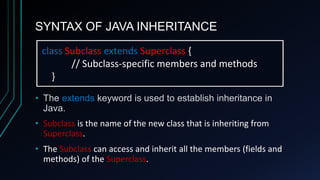
• The extends keyword is used to establish inheritance in
Java.
• Subclass is the name of the new class that is inheriting from
Superclass.
• The Subclass can access and inherit all the members (fields and
methods) of the Superclass.
class Subclass extends Superclass {
// Subclass-specific members and methods
}
EXAMPLE OF INHERITANCE:
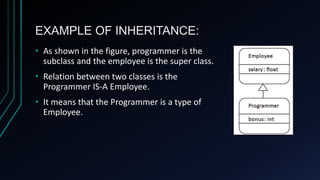
• As shown in the figure, programmer is the
subclass and the employee is the super class.
• Relation between two classes is the
Programmer IS-A Employee.
• It means that the Programmer is a type of
Employee.
EXAMPLE OF INHERITANCE:
class Employee {
float salary=40000; }
class Programmer extends Employee {
int bonus=10000;
public static void main (String args[]) {
Programmer p=new Programmer();
System.out.println("Programmer salary is:"+p.salary);
System.out.println("Bonus of Programmer is:"+p.bonus);
} }
TYPES OF INHERITANCE:
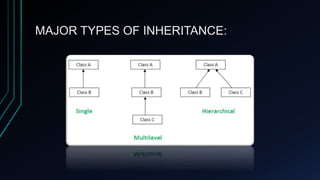
1. Single Inheritance.
2. Multilevel Inheritance.
3. Multiple Inheritance.
4. Hierarchical Inheritance.
5. Hybrid Inheritance.
MAJOR TYPES OF INHERITANCE:
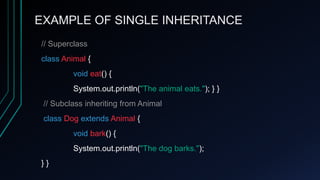
EXAMPLE OF SINGLE INHERITANCE
// Superclass
class Animal {
void eat() {
System.out.println("The animal eats."); } }
// Subclass inheriting from Animal
class Dog extends Animal {
void bark() {
System.out.println("The dog barks.");
} }
EXAMPLE OF SINGLE INHERITANCE
public class SingleInheritanceExample {
public static void main(String[] args) {
// Create an instance of Dog
Dog myDog = new Dog();
// Call methods from both Animal and Dog
classes
myDog.eat(); // Inherited from Animal
myDog.bark(); // Specific to Dog
}
}
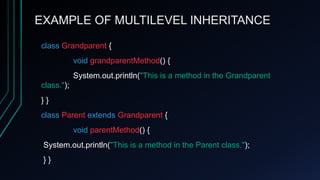
EXAMPLE OF MULTILEVEL INHERITANCE
class Grandparent {
void grandparentMethod() {
System.out.println("This is a method in the Grandparent
class.");
} }
class Parent extends Grandparent {
void parentMethod() {
System.out.println("This is a method in the Parent class.");
} }
EXAMPLE OF MULTILEVEL INHERITANCE
class Child extends Parent {
void childMethod() {
System.out.println("This is a method in the Child class."); } }
public class MultilevelInheritanceExample {
public static void main(String[] args) {
Child child = new Child(); // Calling methods from
each class
child.grandparentMethod(); // Inherited from Grandparent
child.parentMethod(); // Inherited from Parent
child.childMethod(); // Method in Child class
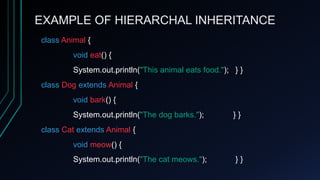
EXAMPLE OF HIERARCHAL INHERITANCE
class Animal {
void eat() {
System.out.println("This animal eats food."); } }
class Dog extends Animal {
void bark() {
System.out.println("The dog barks."); } }
class Cat extends Animal {
void meow() {
System.out.println("The cat meows."); } }
EXAMPLE OF HIERARCHAL INHERITANCE
public class HierarchicalInheritanceExample {
public static void main(String[] args) {
Dog dog = new Dog();
Cat cat = new Cat();
System.out.println("Dog:");
Dog.eat(); // Inherited from Animal
dog.bark();
System.out.println("nCat:");
cat.eat(); // Inherited from Animal
cat.meow();
} }
WHY MULTIPLE INHERITANCE IS NOT SUPPORTED
IN JAVA?
• Multiple inheritance is not supported in Java primarily to avoid
the "diamond problem," which is a situation where ambiguity
arises when a class inherits from multiple classes that have a
common superclass.
• This problem can make code unpredictable and hard to
maintain.
• Java uses interfaces to achieve some benefits of multiple
inheritance while avoiding the complexities and ambiguities
associated with inheriting from multiple classes directly.
THANK YOU..

INHERITANCE IN JAVA.pptx

  • 1.
  • 2.
    WHAT IS INHERITANCE? •Inheritance is a core concept in object-oriented programming (OOP). • It allows one class (subclass or child class) to inherit properties and behaviors from another class (superclass or parent class). • This concept encourages code reusability and helps create a structured and organized codebase.
  • 3.
    WHY DO WEUSE INHERITANCE IN JAVA? • Code Reusability • Extensibility • Polymorphism • Maintainability • Simplifying Complex Systems
  • 4.
    SYNTAX OF JAVAINHERITANCE • The extends keyword is used to establish inheritance in Java. • Subclass is the name of the new class that is inheriting from Superclass. • The Subclass can access and inherit all the members (fields and methods) of the Superclass. class Subclass extends Superclass { // Subclass-specific members and methods }
  • 5.
    EXAMPLE OF INHERITANCE: •As shown in the figure, programmer is the subclass and the employee is the super class. • Relation between two classes is the Programmer IS-A Employee. • It means that the Programmer is a type of Employee.
  • 6.
    EXAMPLE OF INHERITANCE: classEmployee { float salary=40000; } class Programmer extends Employee { int bonus=10000; public static void main (String args[]) { Programmer p=new Programmer(); System.out.println("Programmer salary is:"+p.salary); System.out.println("Bonus of Programmer is:"+p.bonus); } }
  • 7.
    TYPES OF INHERITANCE: 1.Single Inheritance. 2. Multilevel Inheritance. 3. Multiple Inheritance. 4. Hierarchical Inheritance. 5. Hybrid Inheritance.
  • 8.
    MAJOR TYPES OFINHERITANCE:
  • 9.
    EXAMPLE OF SINGLEINHERITANCE // Superclass class Animal { void eat() { System.out.println("The animal eats."); } } // Subclass inheriting from Animal class Dog extends Animal { void bark() { System.out.println("The dog barks."); } }
  • 10.
    EXAMPLE OF SINGLEINHERITANCE public class SingleInheritanceExample { public static void main(String[] args) { // Create an instance of Dog Dog myDog = new Dog(); // Call methods from both Animal and Dog classes myDog.eat(); // Inherited from Animal myDog.bark(); // Specific to Dog } }
  • 11.
    EXAMPLE OF MULTILEVELINHERITANCE class Grandparent { void grandparentMethod() { System.out.println("This is a method in the Grandparent class."); } } class Parent extends Grandparent { void parentMethod() { System.out.println("This is a method in the Parent class."); } }
  • 12.
    EXAMPLE OF MULTILEVELINHERITANCE class Child extends Parent { void childMethod() { System.out.println("This is a method in the Child class."); } } public class MultilevelInheritanceExample { public static void main(String[] args) { Child child = new Child(); // Calling methods from each class child.grandparentMethod(); // Inherited from Grandparent child.parentMethod(); // Inherited from Parent child.childMethod(); // Method in Child class
  • 13.
    EXAMPLE OF HIERARCHALINHERITANCE class Animal { void eat() { System.out.println("This animal eats food."); } } class Dog extends Animal { void bark() { System.out.println("The dog barks."); } } class Cat extends Animal { void meow() { System.out.println("The cat meows."); } }
  • 14.
    EXAMPLE OF HIERARCHALINHERITANCE public class HierarchicalInheritanceExample { public static void main(String[] args) { Dog dog = new Dog(); Cat cat = new Cat(); System.out.println("Dog:"); Dog.eat(); // Inherited from Animal dog.bark(); System.out.println("nCat:"); cat.eat(); // Inherited from Animal cat.meow(); } }
  • 15.
    WHY MULTIPLE INHERITANCEIS NOT SUPPORTED IN JAVA? • Multiple inheritance is not supported in Java primarily to avoid the "diamond problem," which is a situation where ambiguity arises when a class inherits from multiple classes that have a common superclass. • This problem can make code unpredictable and hard to maintain. • Java uses interfaces to achieve some benefits of multiple inheritance while avoiding the complexities and ambiguities associated with inheriting from multiple classes directly.
  • 16.