


ENGL 3104
Prof. Mara Luna, M.Ed.
The Power of Culture and Language
 Both the culture we live in and the first language we
 learn to speak are powerful forces in shaping our
 behavior and worldview.

 From them we determine how to act in the world and
 how to make sense of it.

 Usually, we are unaware of the power of language until
 we experience firsthand a different culture or learn to
 speak a different language.
The Power of Culture and Language
 These activities help us to gain a perspective of our own
  culture and to see some of its unspoken but powerful rules.
 They also make us aware that, when two cultures meet, one
  culture can misunderstand or misinterpret the other.
    What kind of rules do we follow every day without thinking
     about them? Do these rules help us to live in society or do
     they cause problems?
    What problems can happen when two cultures have different
     ideas about what kind of behavior is acceptable? What can
     happen when mistranslations of words and concepts occur?
    How has your culture shaped your behavior?
Building Vocabulary
 Connotations – implications, suggestions, or
 emotional associations of words from the point of view
 of the speaker. These associations can be favorable or
 unfavorable.

 Denotations – are the established, or dictionary,
 meanings of words. They do not imply or suggest
 favorable or unfavorable meanings.
Number of Examples
 The way you develop your topic depends on what the topic is
 and on what you want to say.

 Some topics require numerous examples, whereas
  other can be effectively developed with three or
  four extended examples (illustrations).
 Other topics require numerous examples for
  adequate development.
 A generalization based on an insufficient number
  of examples is a type of poor reasoning called a
  hasty generalization.
Choosing Fair Examples
 Because an example is a “representative member” of a
  class or category, the examples you use to develop the
  thesis statement should be representative examples,
  examples that fairly support the thesis.
 If all your examples were items of only one type, the
  examples would be unfairly chosen.
 You would need to either change your thesis to focus
  on your topic or chose examples that support the
  thesis as written.
Making Examples Complete
 In order to effectively support your thesis, you must
  make sure that the information that you give about
  each example is complete.

 This means you must also give some facts that relate to
  and support the controlling idea.
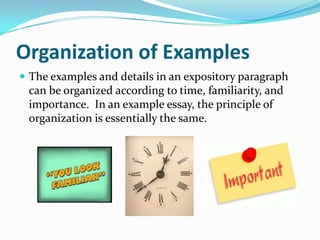
Organization of Examples
 The examples and details in an expository paragraph
 can be organized according to time, familiarity, and
 importance. In an example essay, the principle of
 organization is essentially the same.
Transitions Between Paragraphs
 Developmental paragraphs in the example essay must
  be connected so that they flow smoothly.
 This helps the reader understand clearly the
  progression of thought.
 An essay is incoherent if the paragraphs can be
  switched without significant change.
 There are two ways to connect paragraphs in an essay:
   with transitional expressions
   with the repetition of key words and phrases
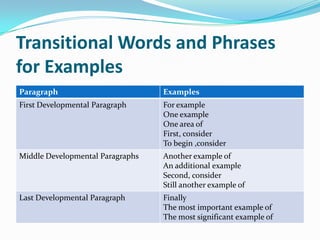
Transitional Words and Phrases
for Examples
Paragraph                         Examples
First Developmental Paragraph     For example
                                  One example
                                  One area of
                                  First, consider
                                  To begin ,consider
Middle Developmental Paragraphs   Another example of
                                  An additional example
                                  Second, consider
                                  Still another example of
Last Developmental Paragraph      Finally
                                  The most important example of
                                  The most significant example of
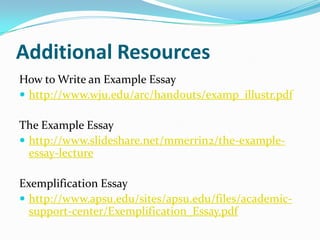
Additional Resources
How to Write an Example Essay
 http://www.wju.edu/arc/handouts/examp_illustr.pdf

The Example Essay
 http://www.slideshare.net/mmerrin2/the-example-
  essay-lecture

Exemplification Essay
 http://www.apsu.edu/sites/apsu.edu/files/academic-
  support-center/Exemplification_Essay.pdf

Example essay

  • 1.
  • 2.
    The Power ofCulture and Language  Both the culture we live in and the first language we learn to speak are powerful forces in shaping our behavior and worldview.  From them we determine how to act in the world and how to make sense of it.  Usually, we are unaware of the power of language until we experience firsthand a different culture or learn to speak a different language.
  • 3.
    The Power ofCulture and Language  These activities help us to gain a perspective of our own culture and to see some of its unspoken but powerful rules.  They also make us aware that, when two cultures meet, one culture can misunderstand or misinterpret the other.  What kind of rules do we follow every day without thinking about them? Do these rules help us to live in society or do they cause problems?  What problems can happen when two cultures have different ideas about what kind of behavior is acceptable? What can happen when mistranslations of words and concepts occur?  How has your culture shaped your behavior?
  • 4.
    Building Vocabulary  Connotations– implications, suggestions, or emotional associations of words from the point of view of the speaker. These associations can be favorable or unfavorable.  Denotations – are the established, or dictionary, meanings of words. They do not imply or suggest favorable or unfavorable meanings.
  • 5.
    Number of Examples The way you develop your topic depends on what the topic is and on what you want to say.  Some topics require numerous examples, whereas other can be effectively developed with three or four extended examples (illustrations).  Other topics require numerous examples for adequate development.  A generalization based on an insufficient number of examples is a type of poor reasoning called a hasty generalization.
  • 6.
    Choosing Fair Examples Because an example is a “representative member” of a class or category, the examples you use to develop the thesis statement should be representative examples, examples that fairly support the thesis.  If all your examples were items of only one type, the examples would be unfairly chosen.  You would need to either change your thesis to focus on your topic or chose examples that support the thesis as written.
  • 7.
    Making Examples Complete In order to effectively support your thesis, you must make sure that the information that you give about each example is complete.  This means you must also give some facts that relate to and support the controlling idea.
  • 8.
    Organization of Examples The examples and details in an expository paragraph can be organized according to time, familiarity, and importance. In an example essay, the principle of organization is essentially the same.
  • 9.
    Transitions Between Paragraphs Developmental paragraphs in the example essay must be connected so that they flow smoothly.  This helps the reader understand clearly the progression of thought.  An essay is incoherent if the paragraphs can be switched without significant change.  There are two ways to connect paragraphs in an essay:  with transitional expressions  with the repetition of key words and phrases
  • 10.
    Transitional Words andPhrases for Examples Paragraph Examples First Developmental Paragraph For example One example One area of First, consider To begin ,consider Middle Developmental Paragraphs Another example of An additional example Second, consider Still another example of Last Developmental Paragraph Finally The most important example of The most significant example of
  • 11.
    Additional Resources How toWrite an Example Essay  http://www.wju.edu/arc/handouts/examp_illustr.pdf The Example Essay  http://www.slideshare.net/mmerrin2/the-example- essay-lecture Exemplification Essay  http://www.apsu.edu/sites/apsu.edu/files/academic- support-center/Exemplification_Essay.pdf