


• How do I organize
  my message so that
  readers can follow
  my line of thinking?
• A developmental paragraph is a unit
  of meaning, a group of sentences all
  focusing on one main organizing point.
How to develop a
        paragraph
Explain and/ or expand each of your
 support points


To clarify the central ideas that you
 have articulated in your topic
 sentence.
What will I write about?
• Knowledge of the topic taken from:
• books, magazines, newspapers, and
  most especially, observations and
  experience.
Adequate development
        means…
1. Explaining your support points in a
   concrete and specific manner
2. Providing enough factual details to
   satisfy your reader
3. Answering any question that has been
   posed in the paragraph
4. Drawing a conclusion from the fact that
   have been presented.
• An adequately developed paragraph is
  as long as it has to be, and no longer.
  So when the main idea has been
  sufficiently explained, it is time to
  end the paragraph.
• Thought organization is the key to
  paragraph development.
Major Development
       Strategies
• A development strategy is simply a
  plan for achieving a goal.
• Specifically, it is a plan for coming up
  with the details, events, examples,
  explanations and readers that enable
  readers to grasp your exact meaning.
Four major strategies
       for developing a
          message:
•   1. description
•   2. narration
•   3. exposition
•   4. argumentation
DESCRIPTION
Description
• Concentrates on creating a picture
  with words.


          You help your readers
          You help your readers
             visualize details!
             visualize details!
Description
• can either be:
1. objective
- provides factual picture of something
- observable facts: not colored by writer’s
   emotions

2. subjective
- contains observable details colored by
  impressions or feelings
-creates a mood or shares a feeling
Questions to ask:
• What is it?
• What does it look like?
• What does it make you feel?
• What is your impression of it?
• How could I recognize it?
Examples…
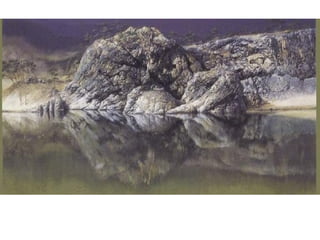
• Share with a friend your sensations about vacationing
  in the Chocolate Hills
• Describe with a friend the geology of Chocolate Hills
• All day, we had a temperature of 20 degrees Celsius
  and heavy rains were driven by winds at 180 kph.
• All day, the weather was dismal.
• The freezing rain and forceful winds made our first
  day of vacation dismal.
• Now, as I write to you, it is raining in torrents and
  we have closed the house against the thunder and
  lightning. It is an unusual April, I told you; we
  didn’t have a dry season at all and everything is
  fresh and green. The pink shower has never been
  so lovely with its red and white blossoms as
  anything tropical can be. The golden shower is
  covered with bright yellow sprays. Like the
  tamarind, it is a tree of character, and will not
  yield to the blandishments of a capricious
  weather. It will bide its time, and when that
  comes, and no sooner; it will burst into bloom.
                          Virginia Benitez Licuanan,
                          from “Introduction”
                          in Paz Marquez Benitez(1995)
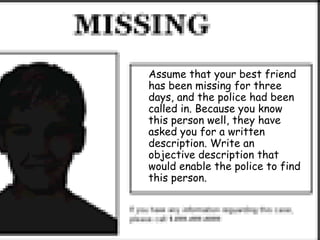
Assume that your best friend
has been missing for three
days, and the police had been
called in. Because you know
this person well, they have
asked you for a written
description. Write an
objective description that
would enable the police to find
this person.
p.249-253
                                           p.257
                                           p.261-263
            Guidelines..
• 1. Although some descriptions have no
  topic statement, they always begin with
  some kind of orienting statement.
• 2. The choice of details in a description
  depends precisely on the writer’s purpose
  and reader’s need.
• 3. All details are at a level that is concrete
  and specific enough to convey an
  unmistakable picture
NARRATION
Narration
• Unfolds a series of related events as they
  happen
• Is usually in chronological order in order to
  tell a story.
• Also relies on descriptive details to make
  the story vivid but it’s central function is
  to enable readers to follow events
May either be factual or
       fictitious
• Novels or fictional stories – stimulate
  our imagination and entertains us
• Newspaper stories – report
  newsworthy events objectively
• Essays- make a definite point
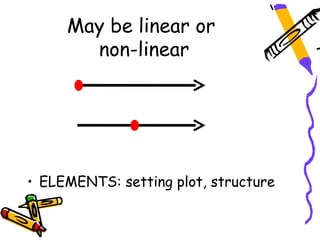
May be linear or
       non-linear


• ELEMENTS: setting plot, structure
• A paragraph of narration is often
  found in articles and essays.
• In this case, the paragraph would
  explain, emphasize, confirm, or
  illustrate a main idea.
• Narration relies heavily on details to
  make the event vivid
Example:


• Yesterday, I got home from school at around 4
  o'clock.  My mother prepared dinner which we ate
  as soon as Dad came home from work. After eating,
  I helped mother clear the table and clean the
  dishes. After we got the kitchen cleaned, I had to
  sit and do my homework as I remembered my
  mother say, "No television until your homework is
  done.”  And so, I had my chemistry homework
  finished first before turning on the television. I
  was watching Walang Hanggan when the phone rang.
  It was my best friend, Amy. I talked to her for
  awhile; then, it was time for bed. I put on my
  pajamas and turned on my favorite cd. I finally
  started to get sleepy around 9:30, and the next
  thing I knew, mother was calling me to get ready
  for school.
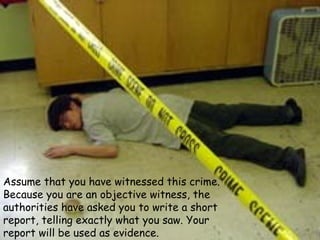
Assume that you have witnessed this crime.
Because you are an objective witness, the
authorities have asked you to write a short
report, telling exactly what you saw. Your
report will be used as evidence.
EXPOSITION
Exposition
• most common strategy for developing a message
• explains the writer’s viewpoint
• Although exposition contains description and
  narration, its role is not merely to paint a word
  picture or to tell a story, but to clarify the
  writer’s exact meaning as this question is
  answered:

  “ What do you mean?”
Exposition:
• Exposition is explanatory writing


• Exposition can be an incidental part of a
  description or a narration, or it can be the heart
  of an article


• The purpose of an expository essay is to present,
  completely and fairly, other people's views or to
  report about an event or a situation.
Exposition
• Expository writing, or exposition, presents a
  subject in detail.


• The writer elucidates a subject by analyzing it.


• Such writing is discourse designed to convey
  information or explain what is difficult to
  understand.
Expository strategies:
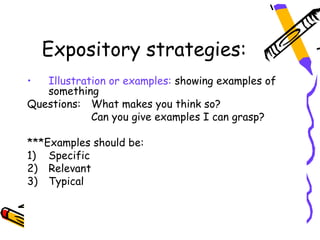
•  Illustration or examples: showing examples of
   something
Questions: What makes you think so?
            Can you give examples I can grasp?

***Examples should be:
1) Specific
2) Relevant
3) Typical
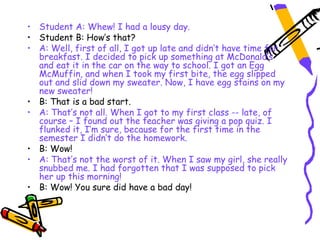
• Student A: Whew! I had a lousy day.
• Student B: How’s that?
• A: Well, first of all, I got up late and didn’t have time for
  breakfast. I decided to pick up something at McDonald’s
  and eat it in the car on the way to school. I got an Egg
  McMuffin, and when I took my first bite, the egg slipped
  out and slid down my sweater. Now, I have egg stains on my
  new sweater!
• B: That is a bad start.
• A: That’s not all. When I got to my first class -- late, of
  course – I found out the teacher was giving a pop quiz. I
  flunked it, I’m sure, because for the first time in the
  semester I didn’t do the homework.
• B: Wow!
• A: That’s not the worst of it. When I saw my girl, she really
  snubbed me. I had forgotten that I was supposed to pick
  her up this morning!
• B: Wow! You sure did have a bad day!
Expository strategies:

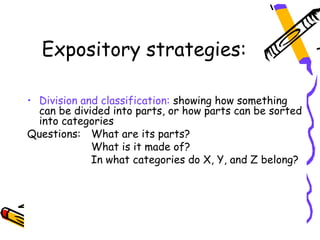
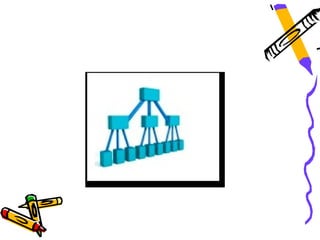
• Division and classification: showing how something
  can be divided into parts, or how parts can be sorted
  into categories
Questions: What are its parts?
             What is it made of?
             In what categories do X, Y, and Z belong?
Expository strategies:
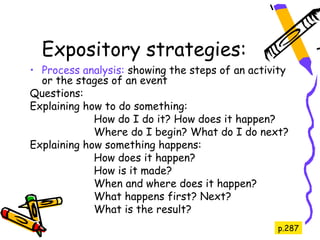
• Process analysis: showing the steps of an activity
  or the stages of an event
Questions:
Explaining how to do something:
             How do I do it? How does it happen?
             Where do I begin? What do I do next?
Explaining how something happens:
             How does it happen?
             How is it made?
             When and where does it happen?
             What happens first? Next?
             What is the result?
                                                 p.287
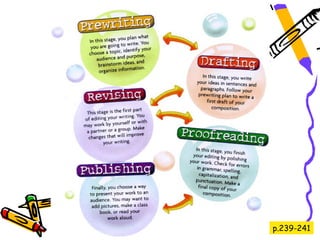
p.239-241
Expository strategies:
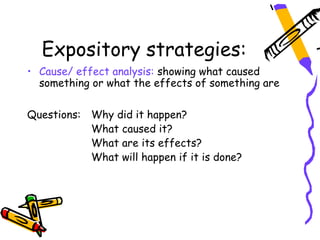
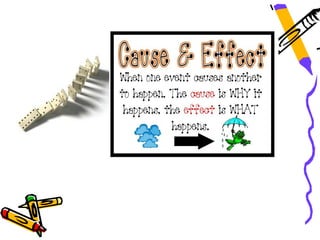
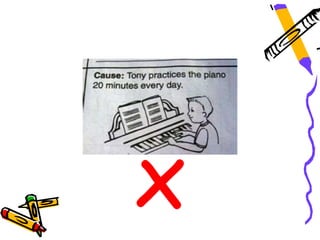
• Cause/ effect analysis: showing what caused
  something or what the effects of something are

Questions: Why did it happen?
           What caused it?
           What are its effects?
           What will happen if it is done?
Writing Suggestions
                CAUSE AND EFFECT

1. The popularity of some modern singer or other
    celebrity
2. The popularity of some fad of clothing or hairstyle
3. The widespread enjoyment of texting
4. Student cheating
5. The decision of some close acquaintance to enter
    the religious life


                                                         p.291-292
x
Expository strategies:
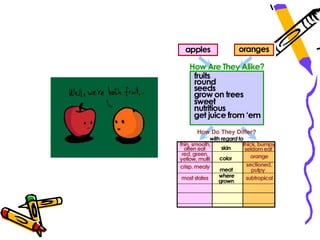
•  Comparison/ contrast: showing how two things
   are similar or different
Questions: How are X and Y similar or alike?
             How are X and Y different?

Two methods:
1) Block method – subject is tackled one at a time
2) Point-by-point/ alternating – moves from first
   object to second object as it makes a
   comparison
Writing Suggestions
               COMPARISON AND CONTRAST


1. Two politicians with different leadership styles
2. Careers versus jobs
3. Two courses on the same subject: one in high school and one
   in college
4. Two recent movies or music videos
5. The “rewards” of two different kinds of jobs
Expository strategies:
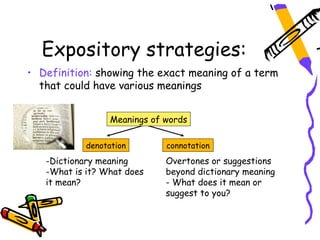
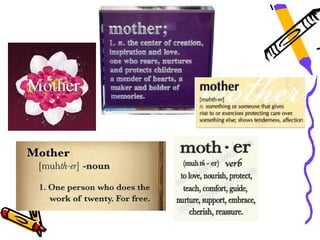
• Definition: showing the exact meaning of a term
  that could have various meanings


                  Meanings of words

            denotation        connotation
   -Dictionary meaning        Overtones or suggestions
   -What is it? What does     beyond dictionary meaning
   it mean?                   - What does it mean or
                              suggest to you?
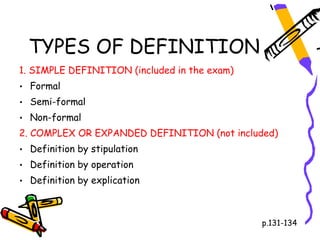
TYPES OF DEFINITION
1. SIMPLE DEFINITION (included in the exam)
• Formal
• Semi-formal
• Non-formal
2. COMPLEX OR EXPANDED DEFINITION (not included)
• Definition by stipulation
• Definition by operation
• Definition by explication


                                              p.131-134
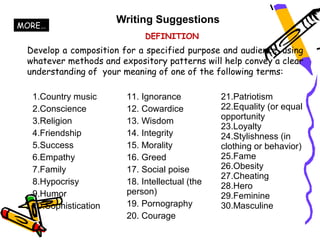
Writing Suggestions
MORE…
                             DEFINITION
 Develop a composition for a specified purpose and audience, using
 whatever methods and expository patterns will help convey a clear
 understanding of your meaning of one of the following terms:

  1.Country music       11. Ignorance           21.Patriotism
  2.Conscience          12. Cowardice           22.Equality (or equal
                                                opportunity
  3.Religion            13. Wisdom
                                                23.Loyalty
  4.Friendship          14. Integrity           24.Stylishness (in
  5.Success             15. Morality            clothing or behavior)
  6.Empathy             16. Greed               25.Fame
  7.Family              17. Social poise        26.Obesity
                                                27.Cheating
  8.Hypocrisy           18. Intellectual (the   28.Hero
  9.Humor               person)                 29.Feminine
  10.Sophistication     19. Pornography         30.Masculine
                        20. Courage
NARRATION AND
 EXPOSITION
   EXERCISE
     p.189

Paragraphdevelopment2012[1]

  • 2.
    • How doI organize my message so that readers can follow my line of thinking?
  • 4.
    • A developmentalparagraph is a unit of meaning, a group of sentences all focusing on one main organizing point.
  • 5.
    How to developa paragraph Explain and/ or expand each of your support points To clarify the central ideas that you have articulated in your topic sentence.
  • 6.
    What will Iwrite about? • Knowledge of the topic taken from: • books, magazines, newspapers, and most especially, observations and experience.
  • 7.
    Adequate development means… 1. Explaining your support points in a concrete and specific manner 2. Providing enough factual details to satisfy your reader 3. Answering any question that has been posed in the paragraph 4. Drawing a conclusion from the fact that have been presented.
  • 8.
    • An adequatelydeveloped paragraph is as long as it has to be, and no longer. So when the main idea has been sufficiently explained, it is time to end the paragraph. • Thought organization is the key to paragraph development.
  • 9.
    Major Development Strategies • A development strategy is simply a plan for achieving a goal. • Specifically, it is a plan for coming up with the details, events, examples, explanations and readers that enable readers to grasp your exact meaning.
  • 10.
    Four major strategies for developing a message: • 1. description • 2. narration • 3. exposition • 4. argumentation
  • 11.
  • 12.
    Description • Concentrates oncreating a picture with words. You help your readers You help your readers visualize details! visualize details!
  • 14.
    Description • can eitherbe: 1. objective - provides factual picture of something - observable facts: not colored by writer’s emotions 2. subjective - contains observable details colored by impressions or feelings -creates a mood or shares a feeling
  • 19.
    Questions to ask: •What is it? • What does it look like? • What does it make you feel? • What is your impression of it? • How could I recognize it?
  • 20.
    Examples… • Share witha friend your sensations about vacationing in the Chocolate Hills • Describe with a friend the geology of Chocolate Hills • All day, we had a temperature of 20 degrees Celsius and heavy rains were driven by winds at 180 kph. • All day, the weather was dismal. • The freezing rain and forceful winds made our first day of vacation dismal.
  • 21.
    • Now, asI write to you, it is raining in torrents and we have closed the house against the thunder and lightning. It is an unusual April, I told you; we didn’t have a dry season at all and everything is fresh and green. The pink shower has never been so lovely with its red and white blossoms as anything tropical can be. The golden shower is covered with bright yellow sprays. Like the tamarind, it is a tree of character, and will not yield to the blandishments of a capricious weather. It will bide its time, and when that comes, and no sooner; it will burst into bloom. Virginia Benitez Licuanan, from “Introduction” in Paz Marquez Benitez(1995)
  • 22.
    Assume that yourbest friend has been missing for three days, and the police had been called in. Because you know this person well, they have asked you for a written description. Write an objective description that would enable the police to find this person.
  • 23.
    p.249-253 p.257 p.261-263 Guidelines.. • 1. Although some descriptions have no topic statement, they always begin with some kind of orienting statement. • 2. The choice of details in a description depends precisely on the writer’s purpose and reader’s need. • 3. All details are at a level that is concrete and specific enough to convey an unmistakable picture
  • 24.
  • 25.
    Narration • Unfolds aseries of related events as they happen • Is usually in chronological order in order to tell a story. • Also relies on descriptive details to make the story vivid but it’s central function is to enable readers to follow events
  • 27.
    May either befactual or fictitious • Novels or fictional stories – stimulate our imagination and entertains us • Newspaper stories – report newsworthy events objectively • Essays- make a definite point
  • 28.
    May be linearor non-linear • ELEMENTS: setting plot, structure
  • 29.
    • A paragraphof narration is often found in articles and essays. • In this case, the paragraph would explain, emphasize, confirm, or illustrate a main idea. • Narration relies heavily on details to make the event vivid
  • 30.
    Example: • Yesterday, Igot home from school at around 4 o'clock.  My mother prepared dinner which we ate as soon as Dad came home from work. After eating, I helped mother clear the table and clean the dishes. After we got the kitchen cleaned, I had to sit and do my homework as I remembered my mother say, "No television until your homework is done.”  And so, I had my chemistry homework finished first before turning on the television. I was watching Walang Hanggan when the phone rang. It was my best friend, Amy. I talked to her for awhile; then, it was time for bed. I put on my pajamas and turned on my favorite cd. I finally started to get sleepy around 9:30, and the next thing I knew, mother was calling me to get ready for school.
  • 31.
    Assume that youhave witnessed this crime. Because you are an objective witness, the authorities have asked you to write a short report, telling exactly what you saw. Your report will be used as evidence.
  • 32.
  • 33.
    Exposition • most commonstrategy for developing a message • explains the writer’s viewpoint • Although exposition contains description and narration, its role is not merely to paint a word picture or to tell a story, but to clarify the writer’s exact meaning as this question is answered: “ What do you mean?”
  • 34.
    Exposition: • Exposition isexplanatory writing • Exposition can be an incidental part of a description or a narration, or it can be the heart of an article • The purpose of an expository essay is to present, completely and fairly, other people's views or to report about an event or a situation.
  • 35.
    Exposition • Expository writing,or exposition, presents a subject in detail. • The writer elucidates a subject by analyzing it. • Such writing is discourse designed to convey information or explain what is difficult to understand.
  • 36.
    Expository strategies: • Illustration or examples: showing examples of something Questions: What makes you think so? Can you give examples I can grasp? ***Examples should be: 1) Specific 2) Relevant 3) Typical
  • 37.
    • Student A:Whew! I had a lousy day. • Student B: How’s that? • A: Well, first of all, I got up late and didn’t have time for breakfast. I decided to pick up something at McDonald’s and eat it in the car on the way to school. I got an Egg McMuffin, and when I took my first bite, the egg slipped out and slid down my sweater. Now, I have egg stains on my new sweater! • B: That is a bad start. • A: That’s not all. When I got to my first class -- late, of course – I found out the teacher was giving a pop quiz. I flunked it, I’m sure, because for the first time in the semester I didn’t do the homework. • B: Wow! • A: That’s not the worst of it. When I saw my girl, she really snubbed me. I had forgotten that I was supposed to pick her up this morning! • B: Wow! You sure did have a bad day!
  • 38.
    Expository strategies: • Divisionand classification: showing how something can be divided into parts, or how parts can be sorted into categories Questions: What are its parts? What is it made of? In what categories do X, Y, and Z belong?
  • 40.
    Expository strategies: • Processanalysis: showing the steps of an activity or the stages of an event Questions: Explaining how to do something: How do I do it? How does it happen? Where do I begin? What do I do next? Explaining how something happens: How does it happen? How is it made? When and where does it happen? What happens first? Next? What is the result? p.287
  • 41.
  • 42.
    Expository strategies: • Cause/effect analysis: showing what caused something or what the effects of something are Questions: Why did it happen? What caused it? What are its effects? What will happen if it is done?
  • 44.
    Writing Suggestions CAUSE AND EFFECT 1. The popularity of some modern singer or other celebrity 2. The popularity of some fad of clothing or hairstyle 3. The widespread enjoyment of texting 4. Student cheating 5. The decision of some close acquaintance to enter the religious life p.291-292
  • 45.
  • 46.
    Expository strategies: • Comparison/ contrast: showing how two things are similar or different Questions: How are X and Y similar or alike? How are X and Y different? Two methods: 1) Block method – subject is tackled one at a time 2) Point-by-point/ alternating – moves from first object to second object as it makes a comparison
  • 47.
    Writing Suggestions COMPARISON AND CONTRAST 1. Two politicians with different leadership styles 2. Careers versus jobs 3. Two courses on the same subject: one in high school and one in college 4. Two recent movies or music videos 5. The “rewards” of two different kinds of jobs
  • 49.
    Expository strategies: • Definition:showing the exact meaning of a term that could have various meanings Meanings of words denotation connotation -Dictionary meaning Overtones or suggestions -What is it? What does beyond dictionary meaning it mean? - What does it mean or suggest to you?
  • 50.
    TYPES OF DEFINITION 1.SIMPLE DEFINITION (included in the exam) • Formal • Semi-formal • Non-formal 2. COMPLEX OR EXPANDED DEFINITION (not included) • Definition by stipulation • Definition by operation • Definition by explication p.131-134
  • 52.
    Writing Suggestions MORE… DEFINITION Develop a composition for a specified purpose and audience, using whatever methods and expository patterns will help convey a clear understanding of your meaning of one of the following terms: 1.Country music 11. Ignorance 21.Patriotism 2.Conscience 12. Cowardice 22.Equality (or equal opportunity 3.Religion 13. Wisdom 23.Loyalty 4.Friendship 14. Integrity 24.Stylishness (in 5.Success 15. Morality clothing or behavior) 6.Empathy 16. Greed 25.Fame 7.Family 17. Social poise 26.Obesity 27.Cheating 8.Hypocrisy 18. Intellectual (the 28.Hero 9.Humor person) 29.Feminine 10.Sophistication 19. Pornography 30.Masculine 20. Courage
  • 53.