VIRTUAL SOCIAL NETWORKS
AND OPEN INNOVATION/
KNOWLEDGE SHARING:
QUESTIONING THE RBV
Tesi di laurea specialistica di Caccamo Gianluca
Matricola 1184746
Milano, 26 Marzo 2009
“To find something comparable, you have to go back 500 years to the
printing press and the birth of mass media...” Rupert Murdoch
 RESEARCH OBJECTIVES
 THEORETICAL IMPLICATIONS
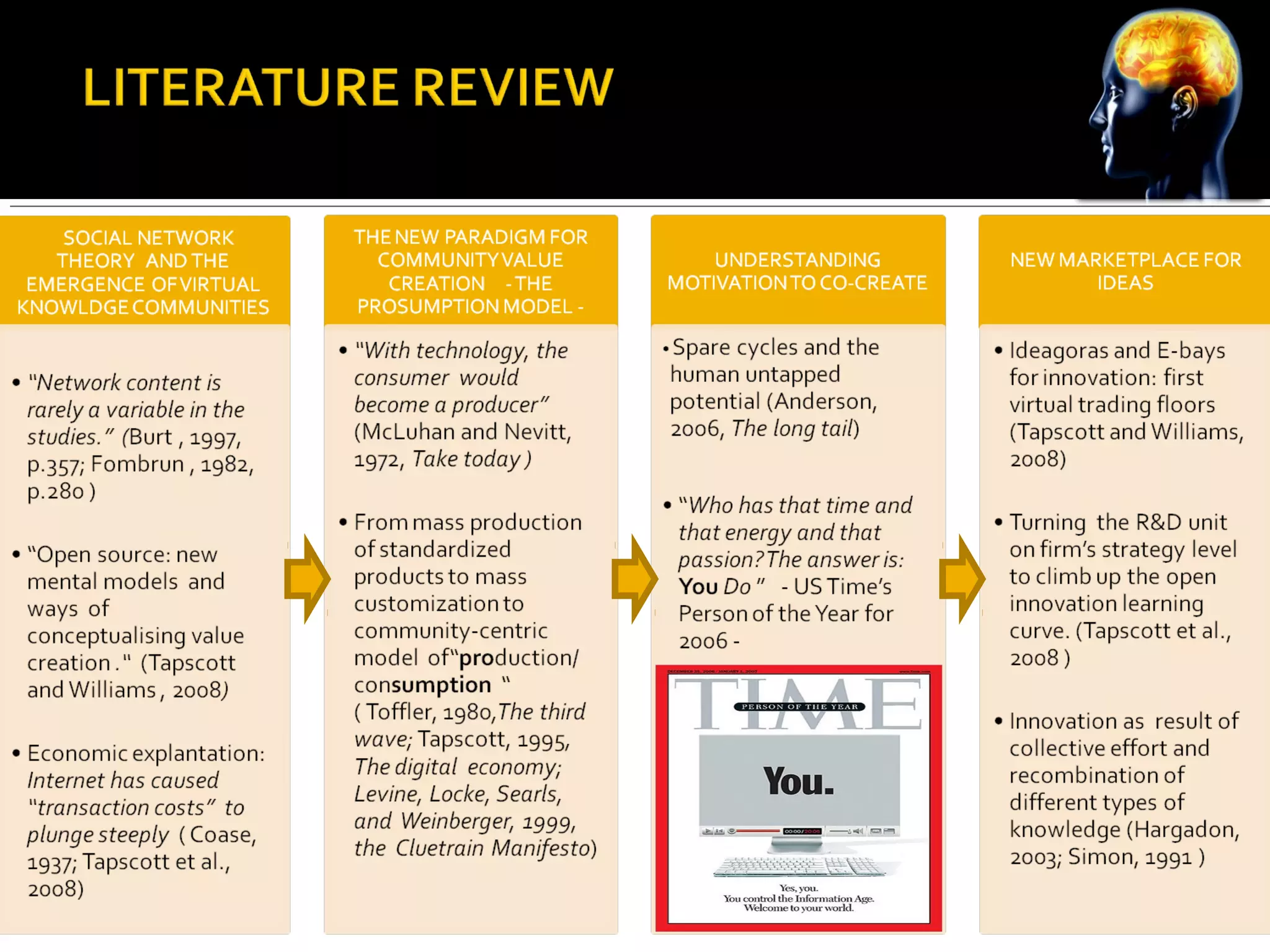
 LITERATURE REVIEW
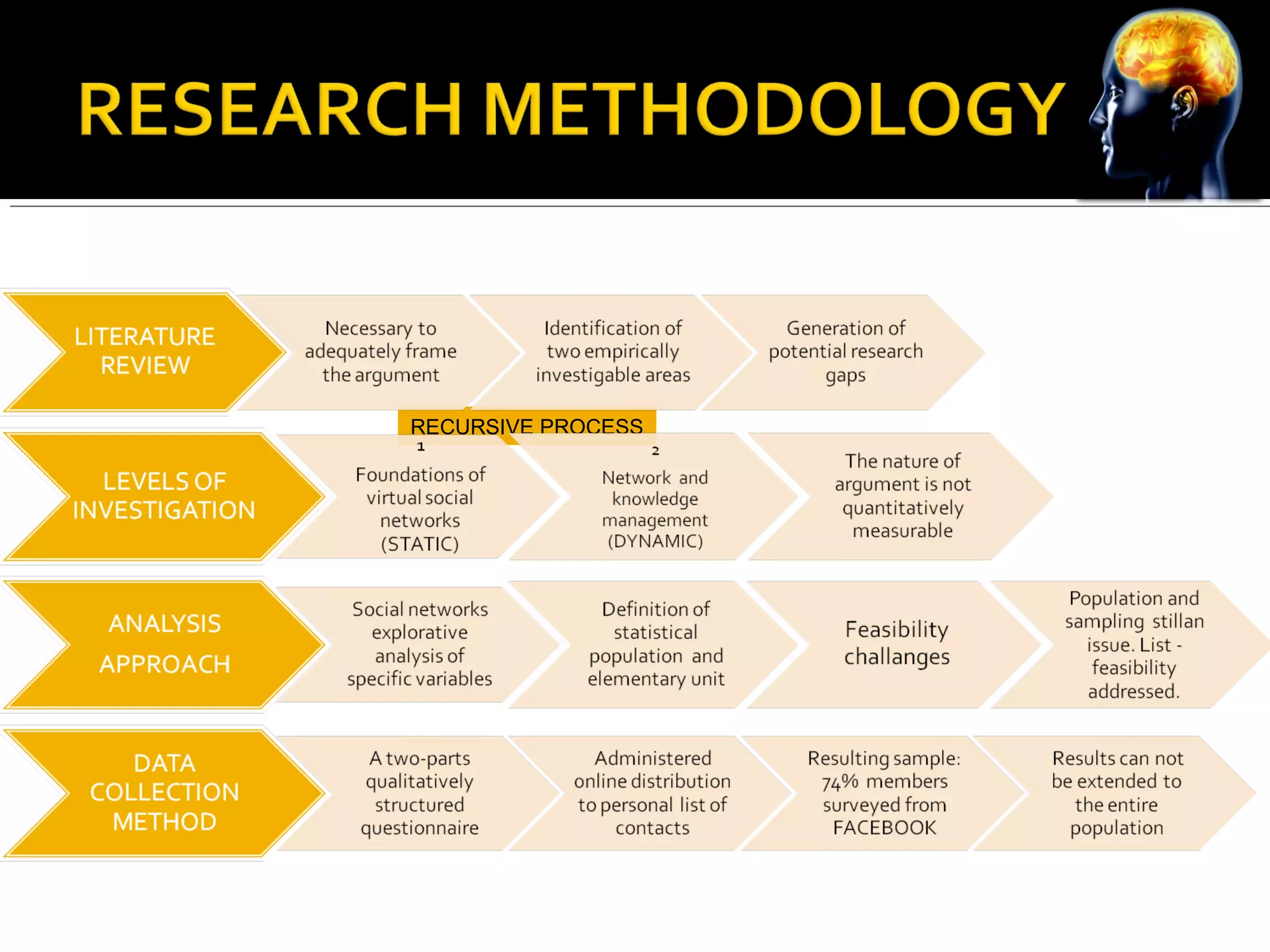
 RESEARCH METHODOLOGY
 DATA
 CONCLUSIONS
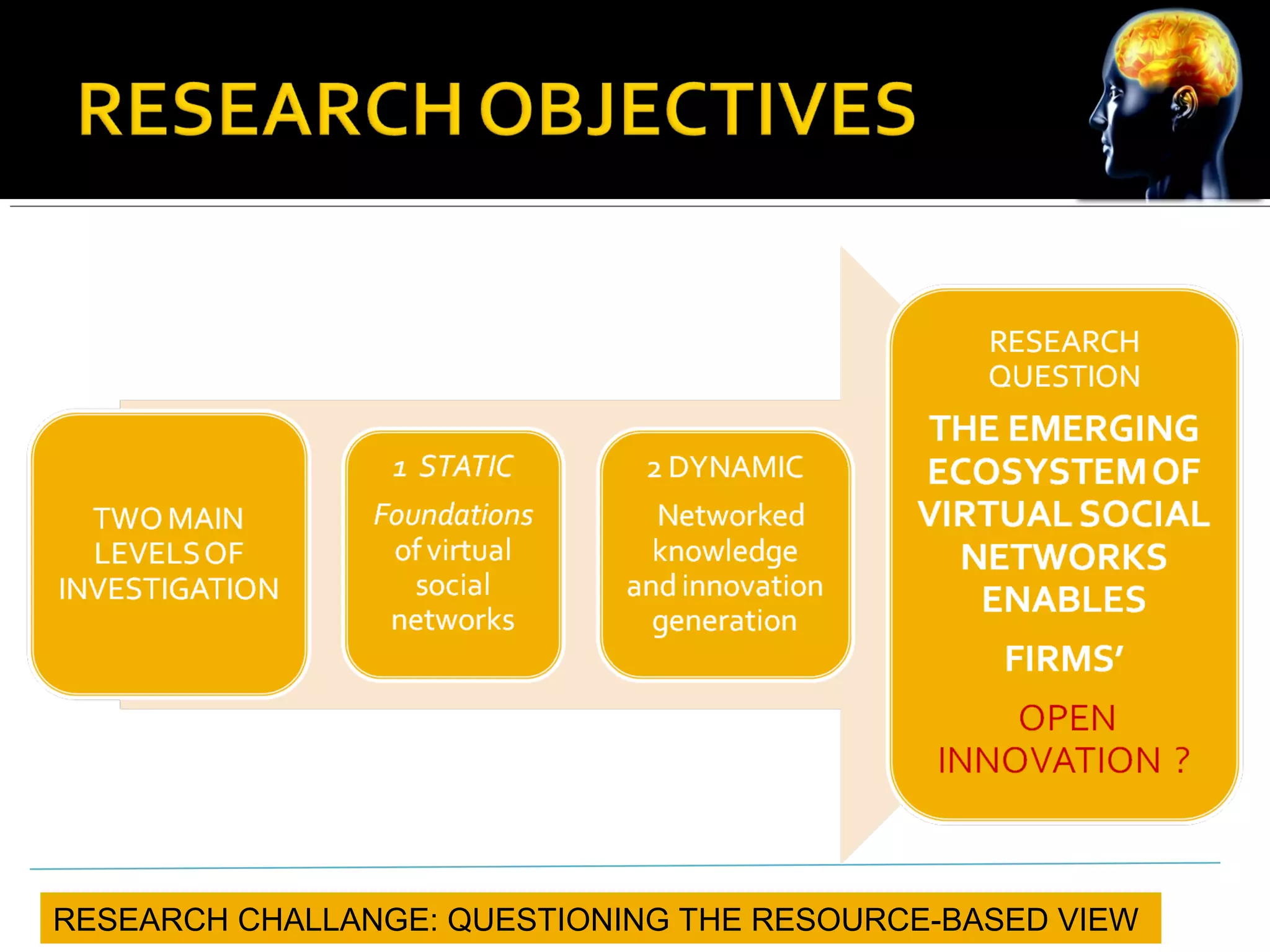
RESEARCH CHALLANGE: QUESTIONING THE RESOURCE-BASED VIEW
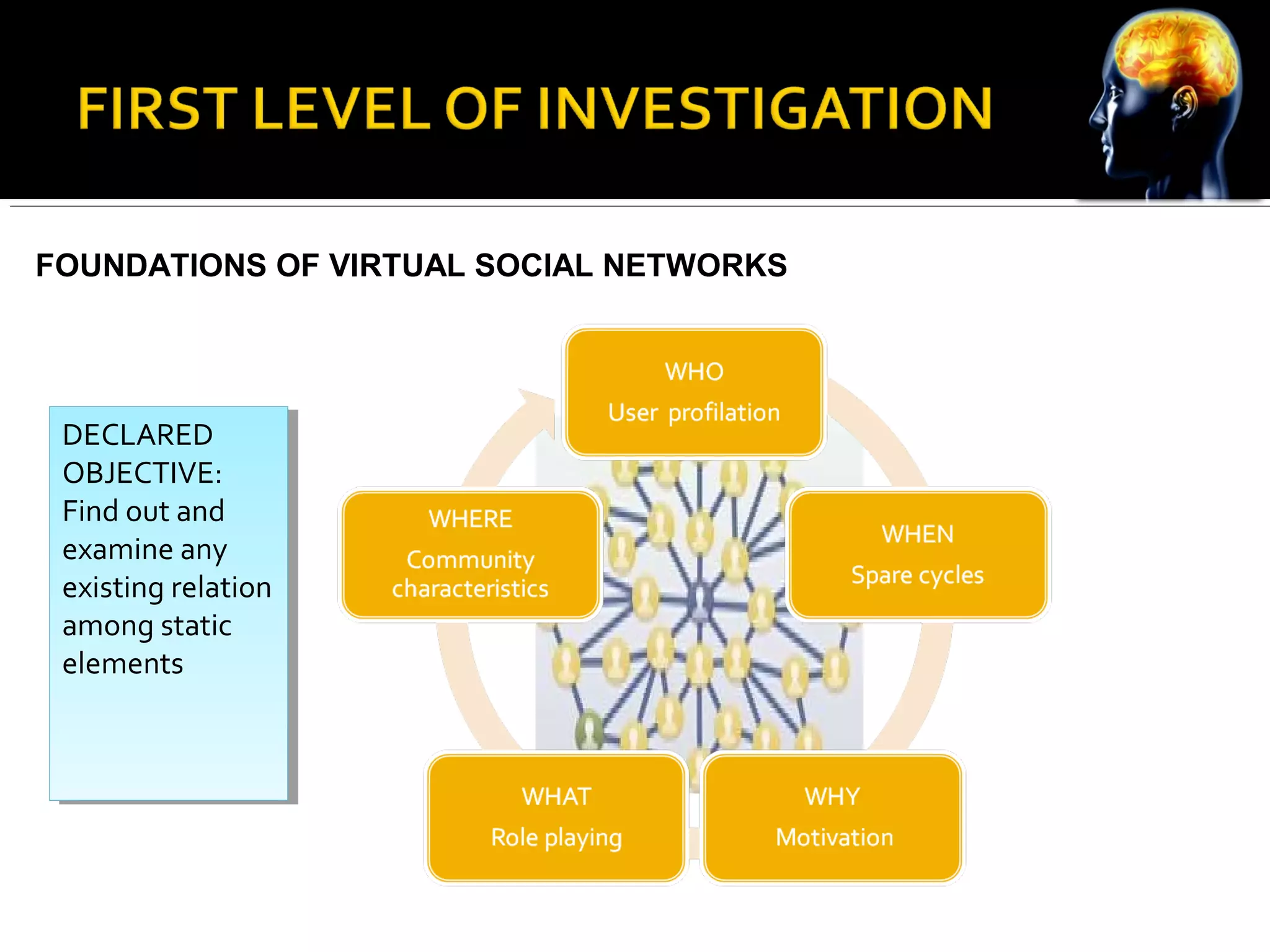
DECLARED
OBJECTIVE:
Find out and
examine any
existing relation
among static
elements
DECLARED
OBJECTIVE:
Find out and
examine any
existing relation
among static
elements
FOUNDATIONS OF VIRTUAL SOCIAL NETWORKS
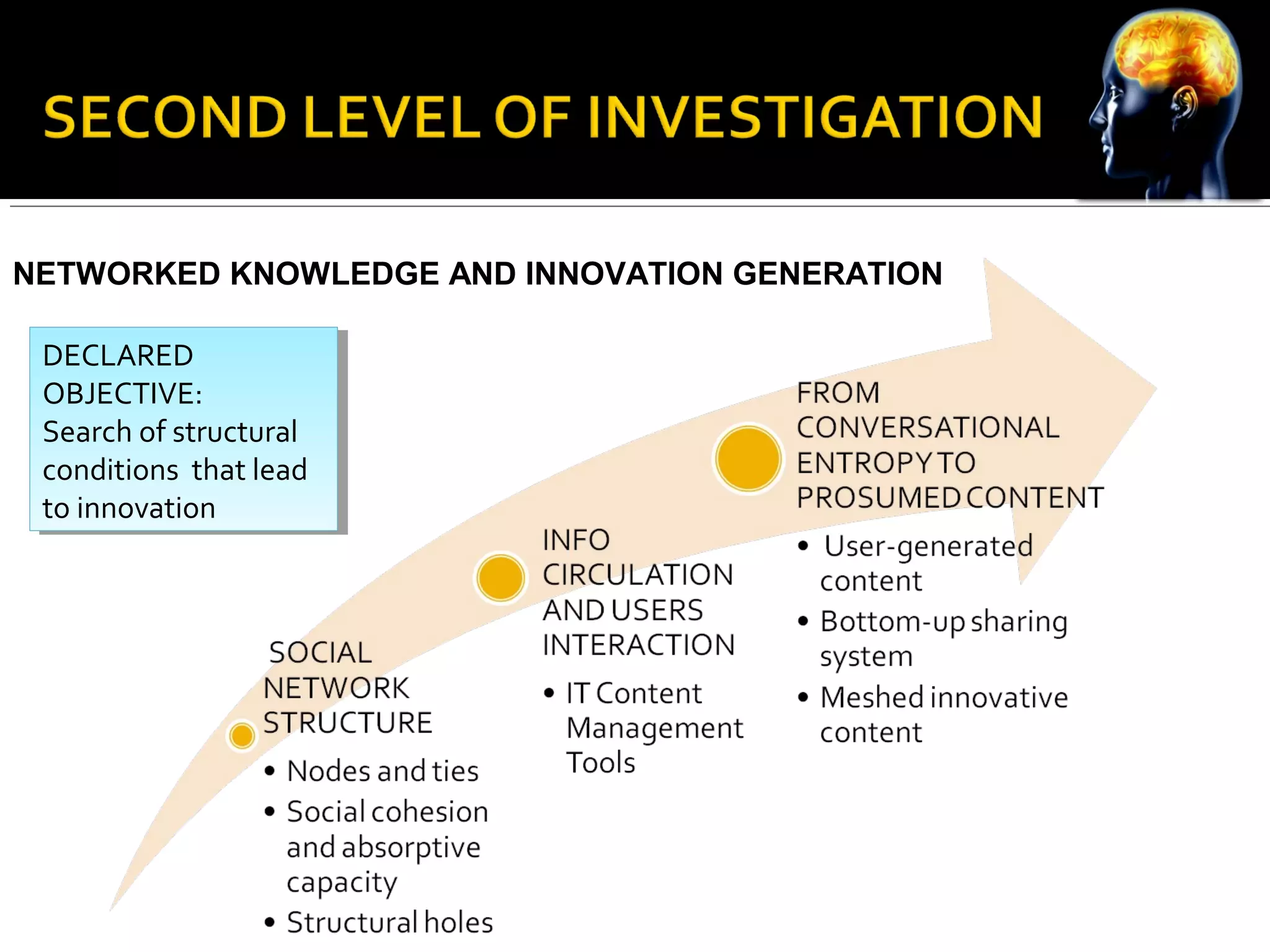
NETWORKED KNOWLEDGE AND INNOVATION GENERATION
DECLARED
OBJECTIVE:
Search of structural
conditions that lead
to innovation
DECLARED
OBJECTIVE:
Search of structural
conditions that lead
to innovation
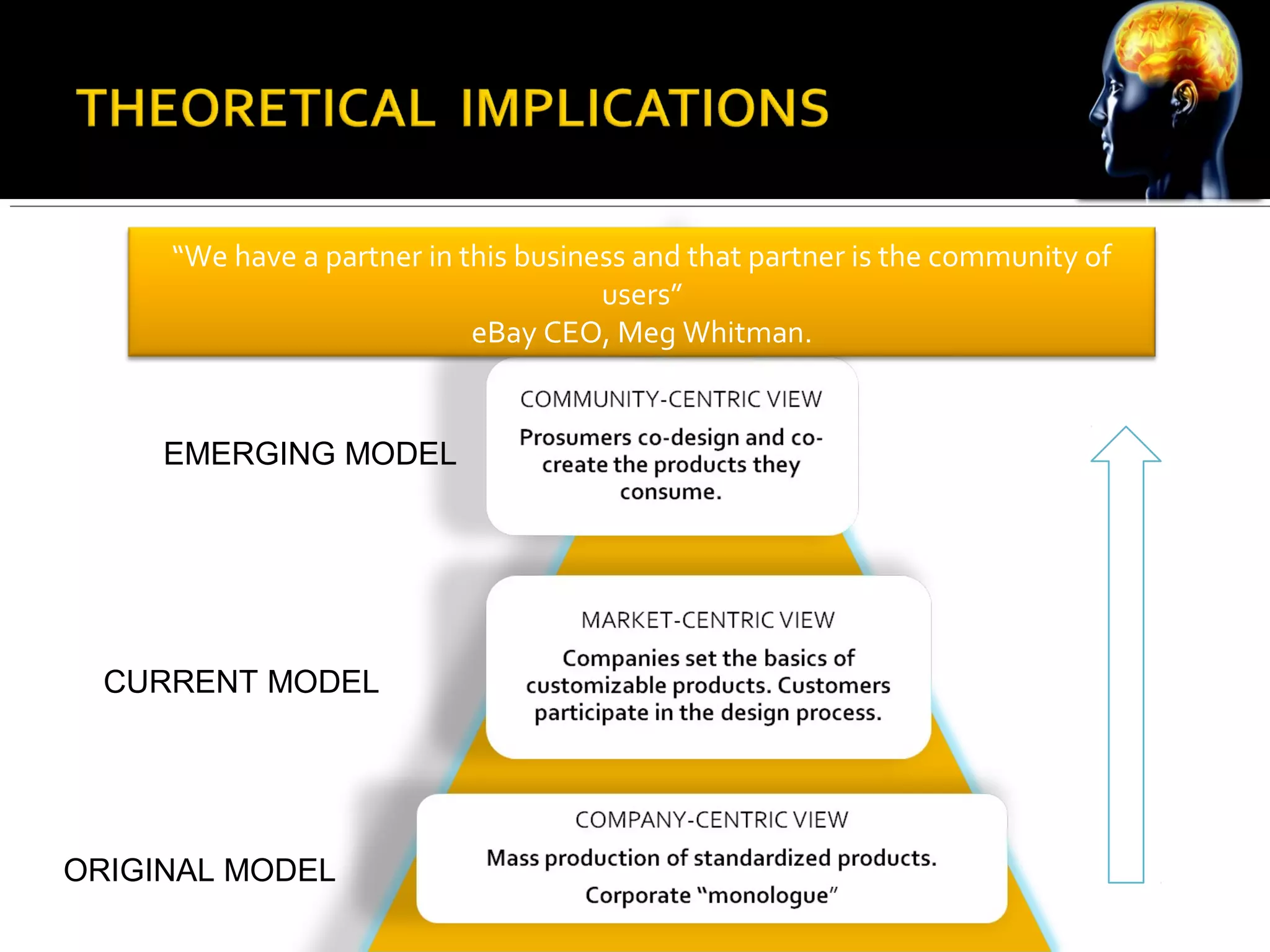
“We have a partner in this business and that partner is the community of
users”
eBay CEO, Meg Whitman.
EMERGING MODEL
CURRENT MODEL
ORIGINAL MODEL
7
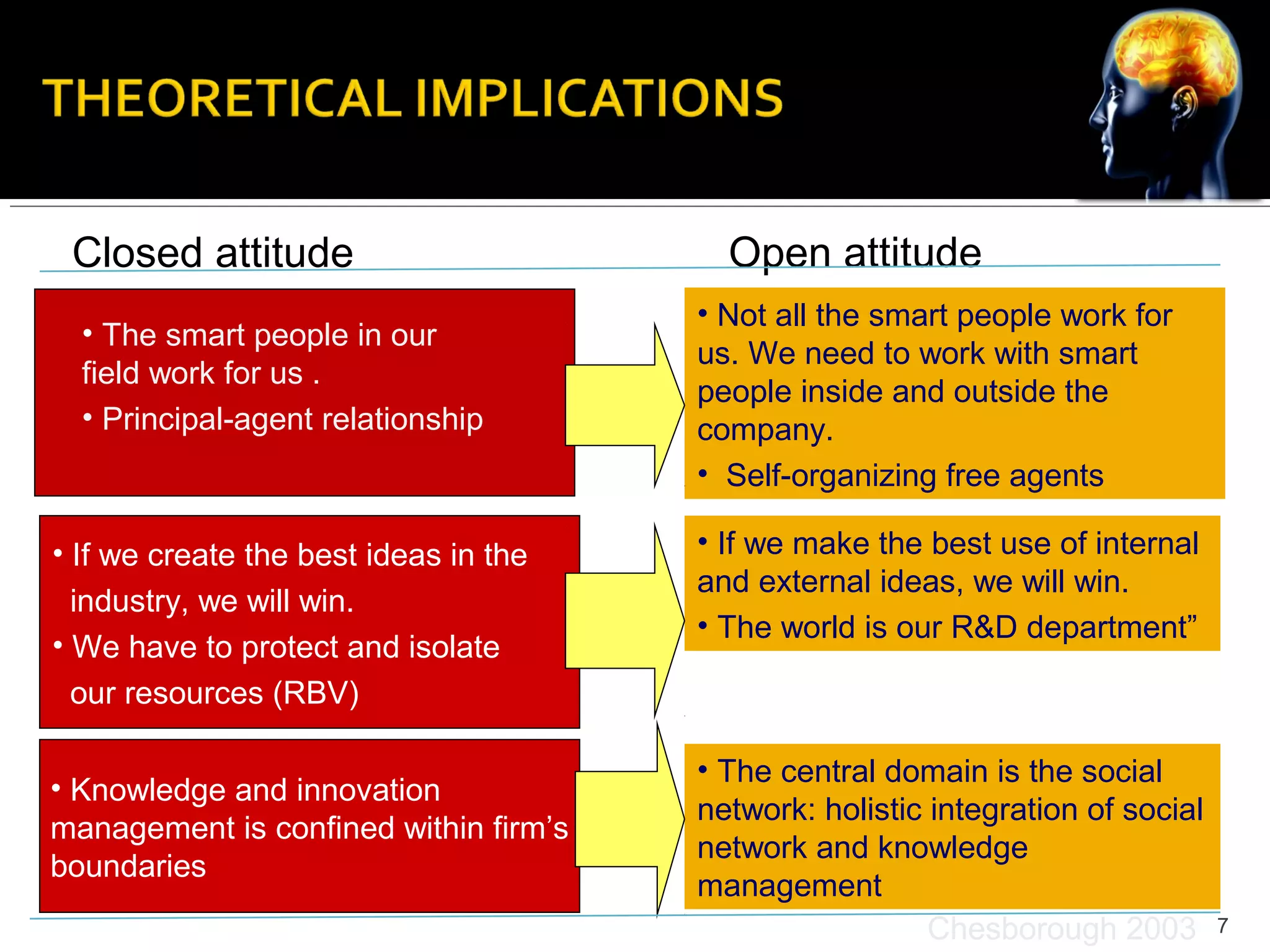
• If we create the best ideas in the
industry, we will win.
• We have to protect and isolate
our resources (RBV)
• Not all the smart people work for
us. We need to work with smart
people inside and outside the
company.
• Self-organizing free agents
• The smart people in our
field work for us .
• Principal-agent relationship
• If we make the best use of internal
and external ideas, we will win.
• The world is our R&D department”
Chesborough 2003
Closed attitude Open attitude
• Knowledge and innovation
management is confined within firm’s
boundaries
• The central domain is the social
network: holistic integration of social
network and knowledge
management
RECURSIVE PROCESS
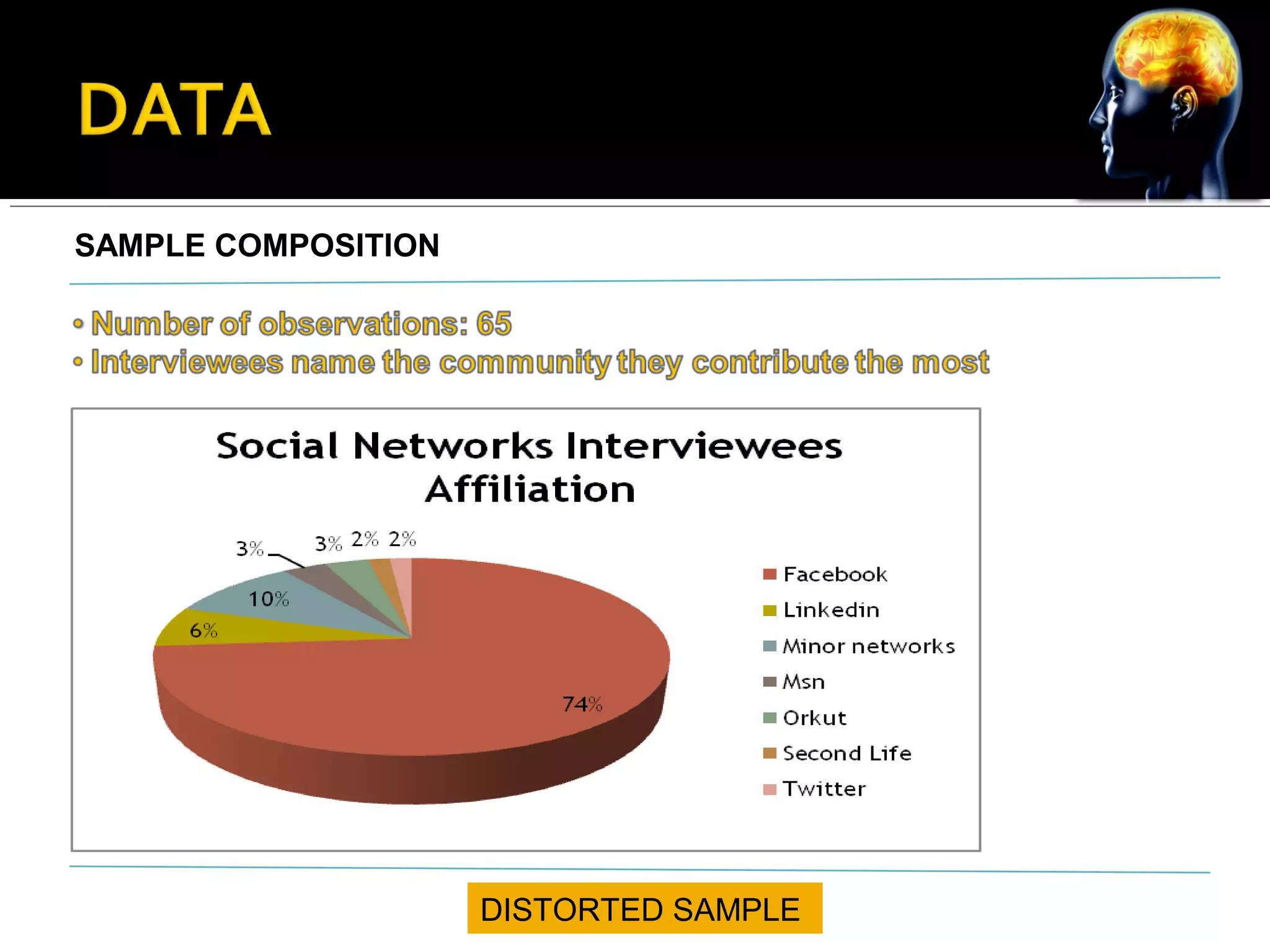
SAMPLE COMPOSITION
DISTORTED SAMPLE
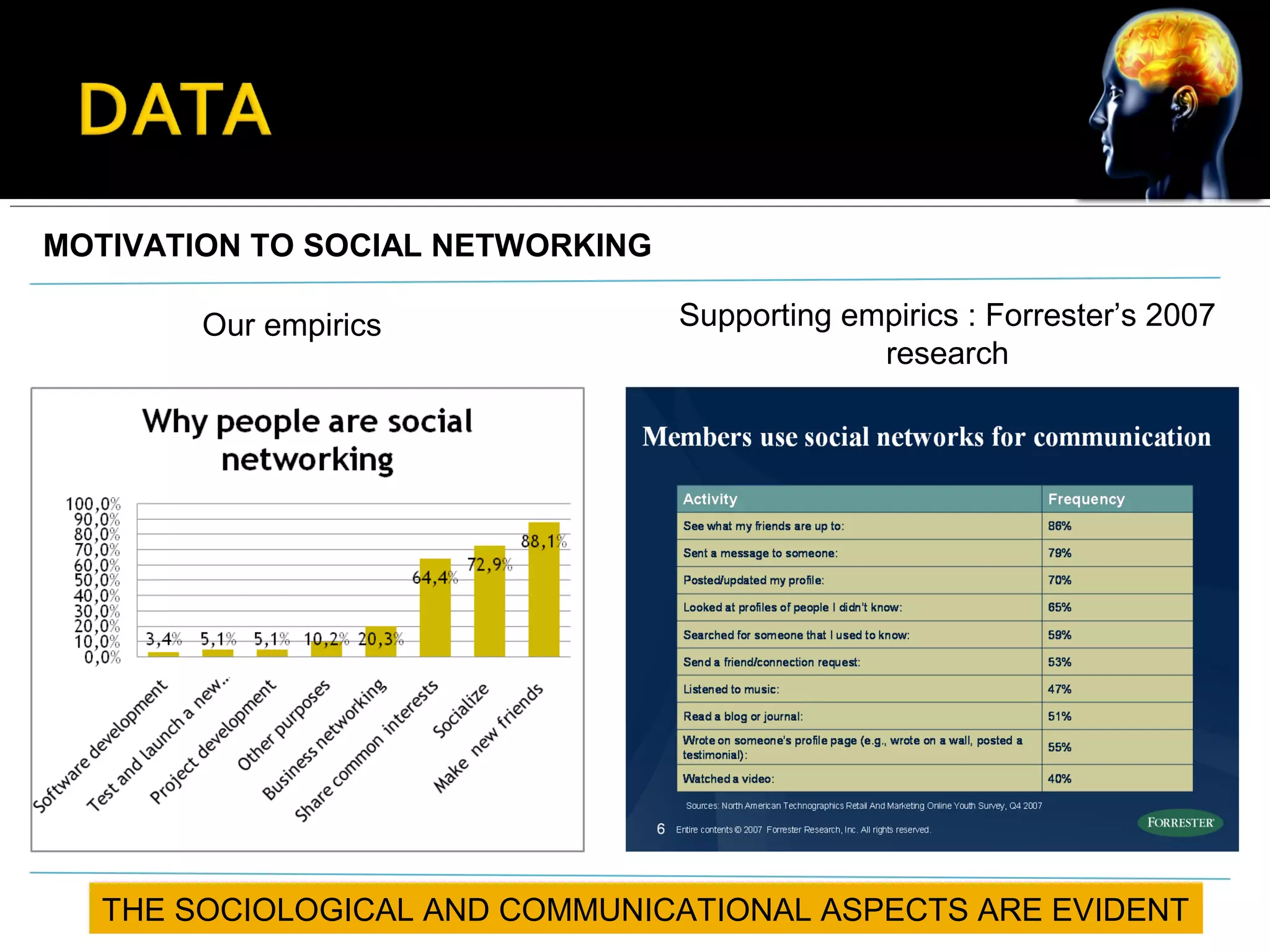
MOTIVATION TO SOCIAL NETWORKING
Supporting empirics : Forrester’s 2007
research
Our empirics
THE SOCIOLOGICAL AND COMMUNICATIONAL ASPECTS ARE EVIDENT
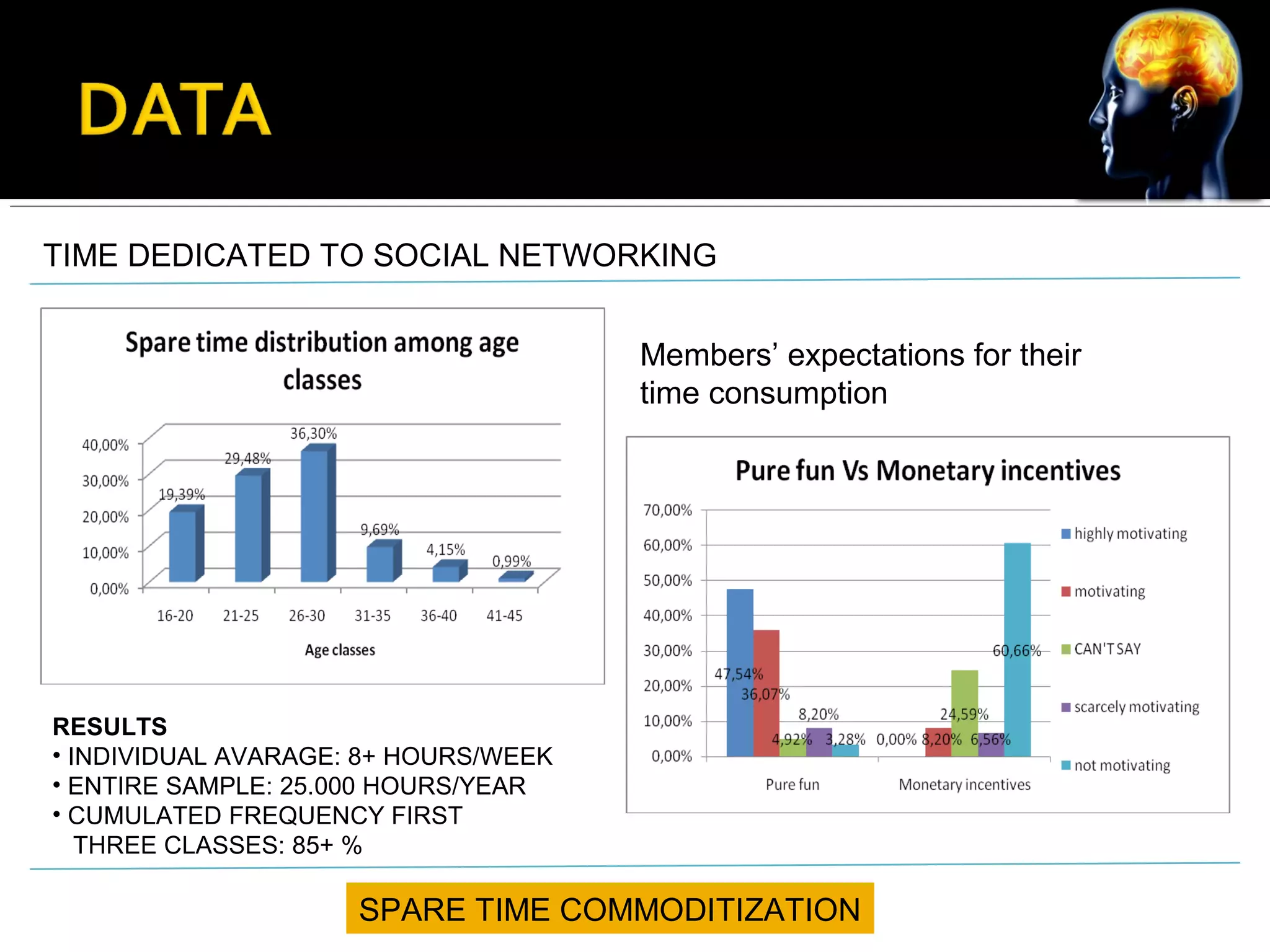
TIME DEDICATED TO SOCIAL NETWORKING
RESULTS
• INDIVIDUAL AVARAGE: 8+ HOURS/WEEK
• ENTIRE SAMPLE: 25.000 HOURS/YEAR
• CUMULATED FREQUENCY FIRST
THREE CLASSES: 85+ %
SPARE TIME COMMODITIZATION
Members’ expectations for their
time consumption
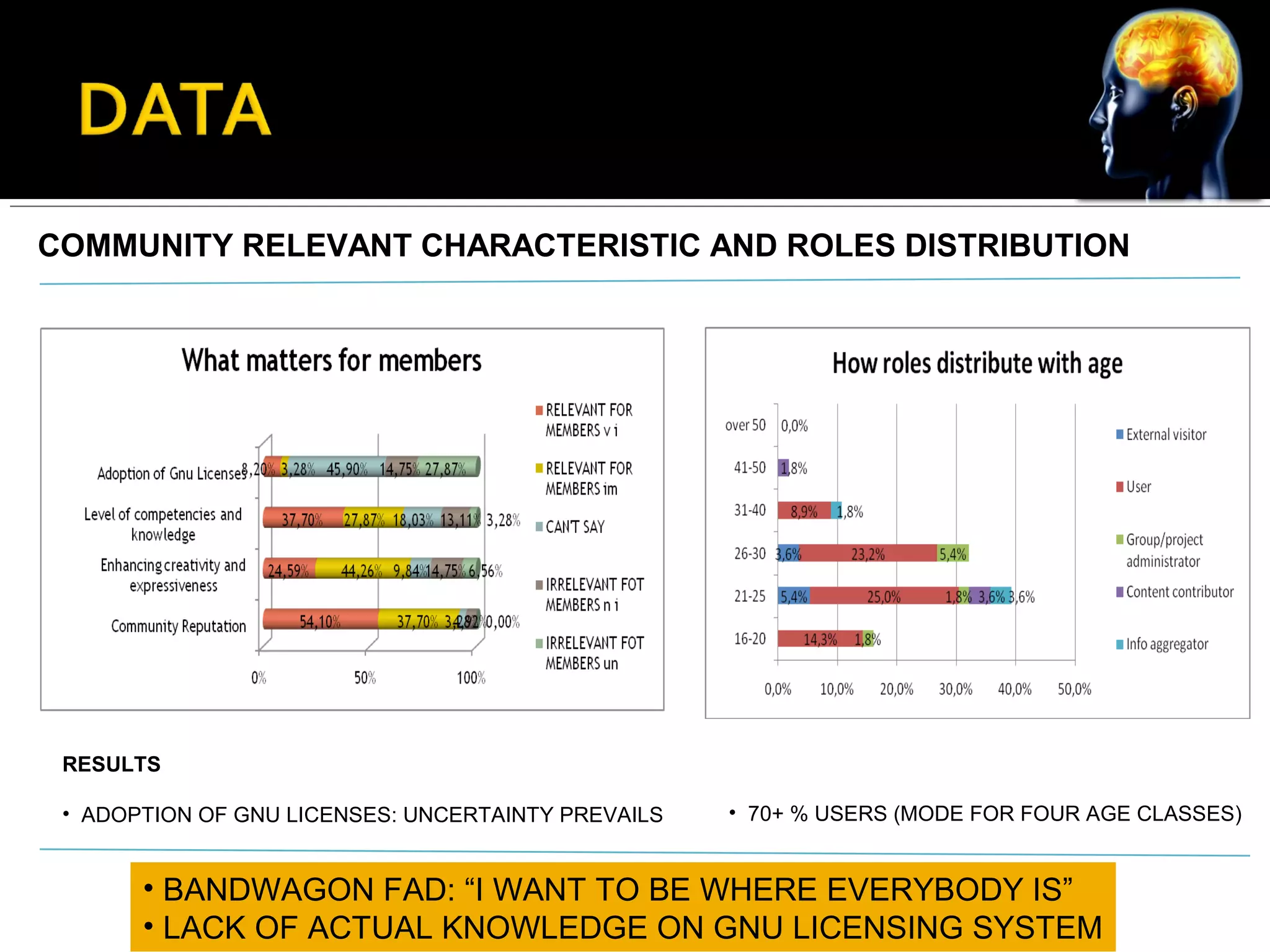
COMMUNITY RELEVANT CHARACTERISTIC AND ROLES DISTRIBUTION
• 70+ % USERS (MODE FOR FOUR AGE CLASSES)
RESULTS
• ADOPTION OF GNU LICENSES: UNCERTAINTY PREVAILS
• BANDWAGON FAD: “I WANT TO BE WHERE EVERYBODY IS”
• LACK OF ACTUAL KNOWLEDGE ON GNU LICENSING SYSTEM
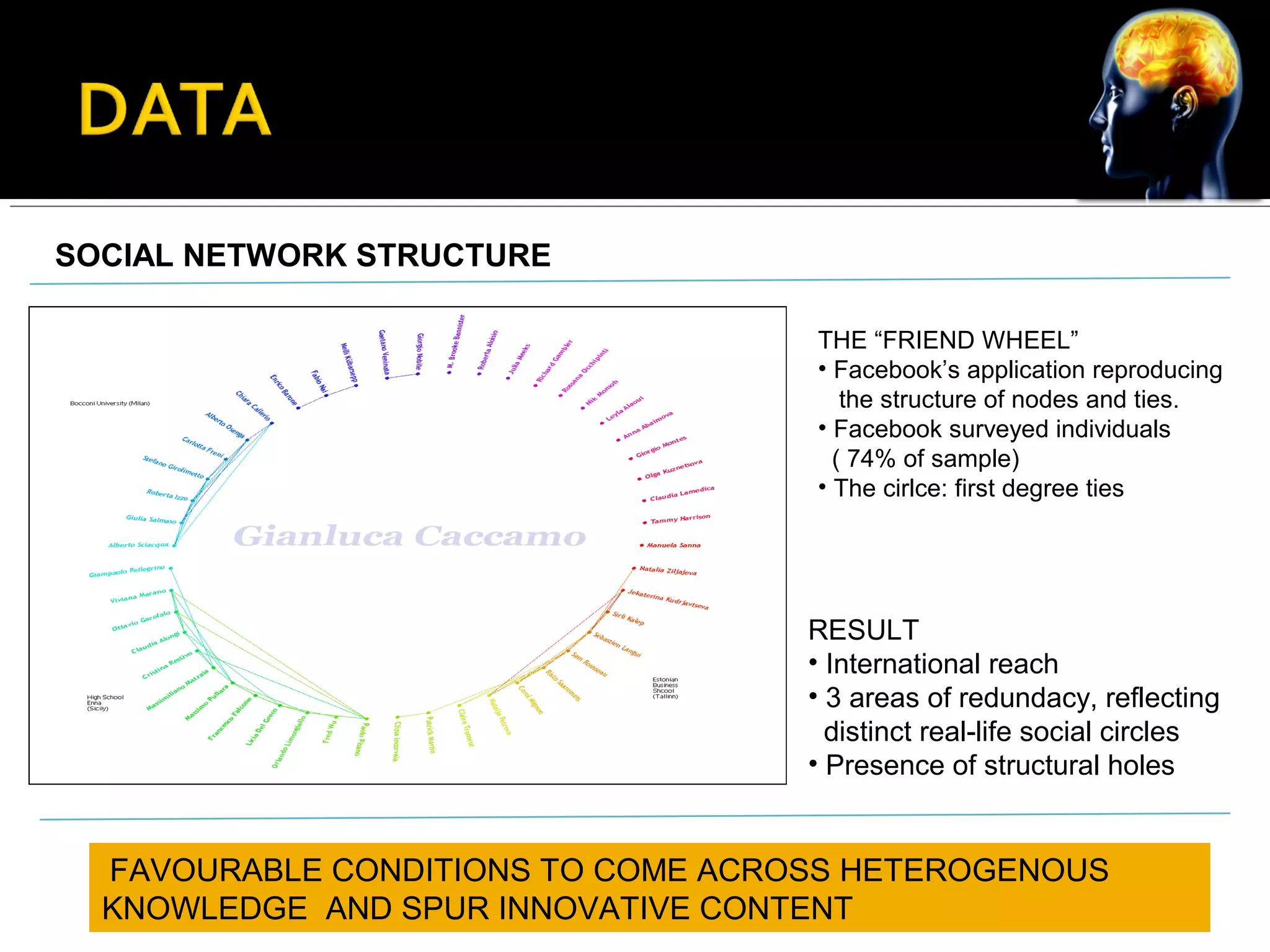
SOCIAL NETWORK STRUCTURE
THE “FRIEND WHEEL”
• Facebook’s application reproducing
the structure of nodes and ties.
• Facebook surveyed individuals
( 74% of sample)
• The cirlce: first degree ties
RESULT
• International reach
• 3 areas of redundacy, reflecting
distinct real-life social circles
• Presence of structural holes
FAVOURABLE CONDITIONS TO COME ACROSS HETEROGENOUS
KNOWLEDGE AND SPUR INNOVATIVE CONTENT
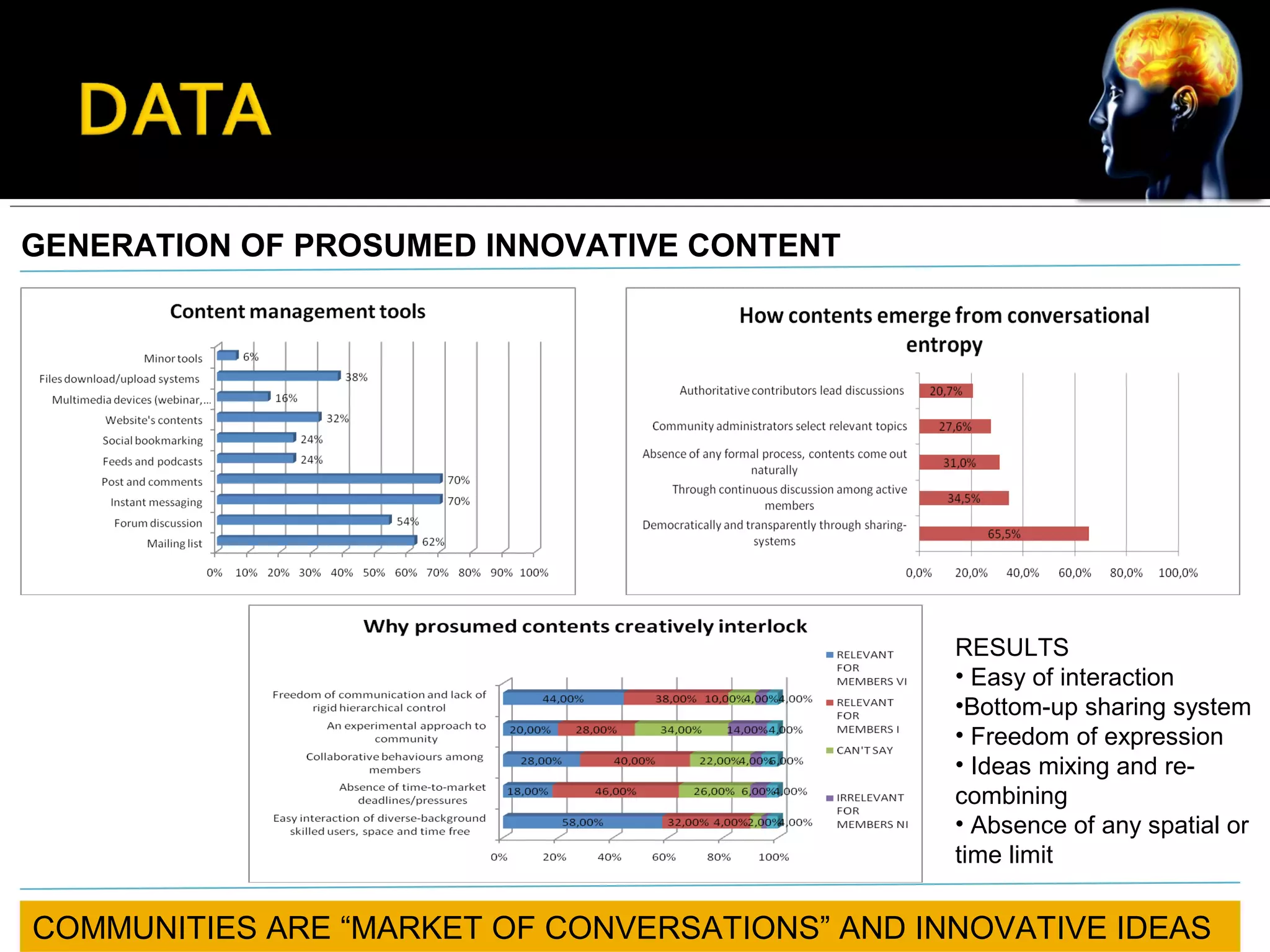
GENERATION OF PROSUMED INNOVATIVE CONTENT
COMMUNITIES ARE “MARKET OF CONVERSATIONS” AND INNOVATIVE IDEAS
RESULTS
• Easy of interaction
•Bottom-up sharing system
• Freedom of expression
• Ideas mixing and re-
combining
• Absence of any spatial or
time limit
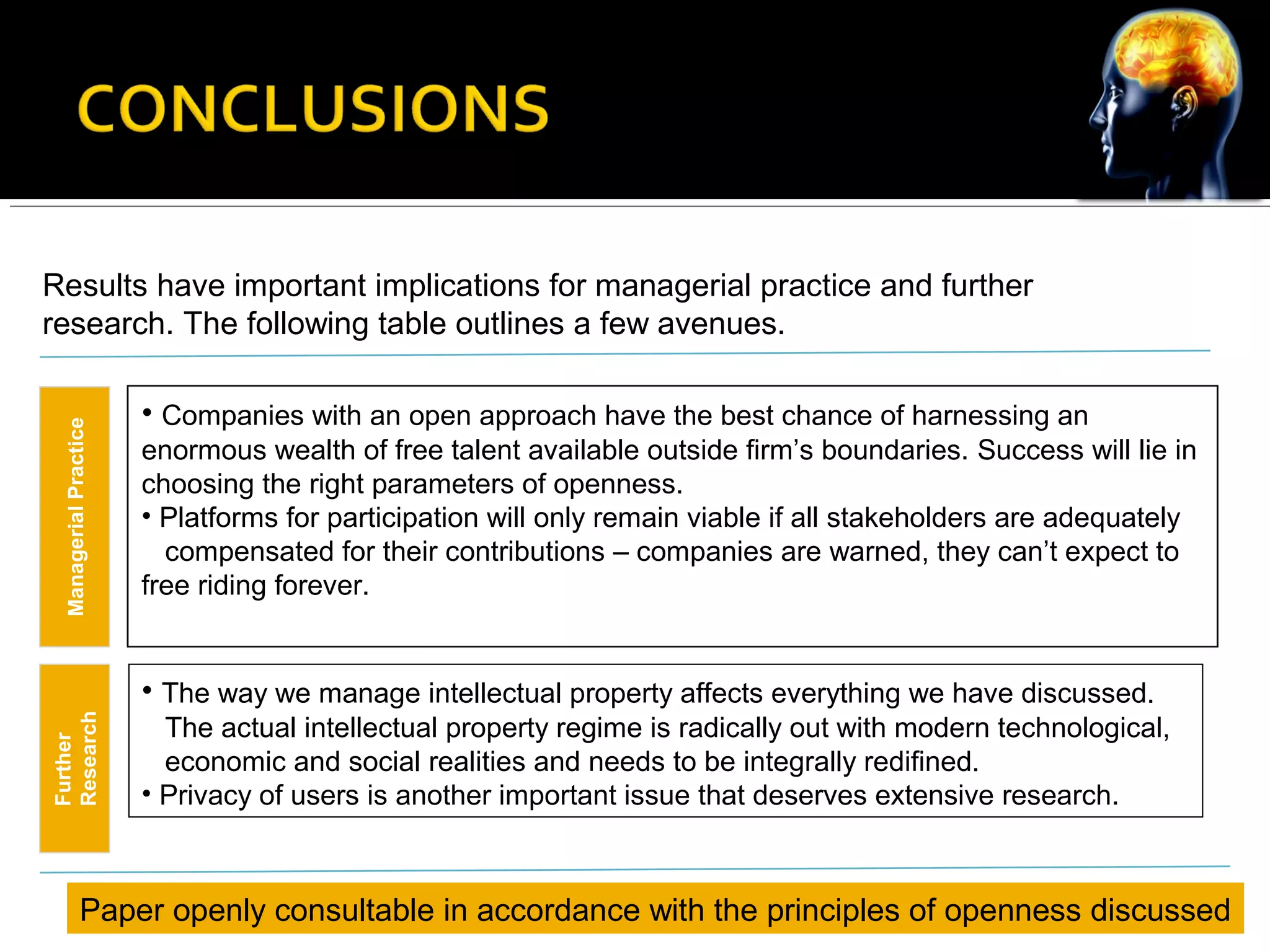
Results have important implications for managerial practice and further
research. The following table outlines a few avenues.
ManagerialPractice
Further
Research
• Companies with an open approach have the best chance of harnessing an
enormous wealth of free talent available outside firm’s boundaries. Success will lie in
choosing the right parameters of openness.
• Platforms for participation will only remain viable if all stakeholders are adequately
compensated for their contributions – companies are warned, they can’t expect to
free riding forever.
• The way we manage intellectual property affects everything we have discussed.
The actual intellectual property regime is radically out with modern technological,
economic and social realities and needs to be integrally redifined.
• Privacy of users is another important issue that deserves extensive research.
Paper openly consultable in accordance with the principles of openness discussed
My book: "Virtual Social Networks and Open Innovation: Questioning the RBV"

My book: "Virtual Social Networks and Open Innovation: Questioning the RBV"

  • 1.
    VIRTUAL SOCIAL NETWORKS ANDOPEN INNOVATION/ KNOWLEDGE SHARING: QUESTIONING THE RBV Tesi di laurea specialistica di Caccamo Gianluca Matricola 1184746 Milano, 26 Marzo 2009 “To find something comparable, you have to go back 500 years to the printing press and the birth of mass media...” Rupert Murdoch
  • 2.
     RESEARCH OBJECTIVES THEORETICAL IMPLICATIONS  LITERATURE REVIEW  RESEARCH METHODOLOGY  DATA  CONCLUSIONS
  • 3.
    RESEARCH CHALLANGE: QUESTIONINGTHE RESOURCE-BASED VIEW
  • 4.
    DECLARED OBJECTIVE: Find out and examineany existing relation among static elements DECLARED OBJECTIVE: Find out and examine any existing relation among static elements FOUNDATIONS OF VIRTUAL SOCIAL NETWORKS
  • 5.
    NETWORKED KNOWLEDGE ANDINNOVATION GENERATION DECLARED OBJECTIVE: Search of structural conditions that lead to innovation DECLARED OBJECTIVE: Search of structural conditions that lead to innovation
  • 6.
    “We have apartner in this business and that partner is the community of users” eBay CEO, Meg Whitman. EMERGING MODEL CURRENT MODEL ORIGINAL MODEL
  • 7.
    7 • If wecreate the best ideas in the industry, we will win. • We have to protect and isolate our resources (RBV) • Not all the smart people work for us. We need to work with smart people inside and outside the company. • Self-organizing free agents • The smart people in our field work for us . • Principal-agent relationship • If we make the best use of internal and external ideas, we will win. • The world is our R&D department” Chesborough 2003 Closed attitude Open attitude • Knowledge and innovation management is confined within firm’s boundaries • The central domain is the social network: holistic integration of social network and knowledge management
  • 9.
  • 10.
  • 11.
    MOTIVATION TO SOCIALNETWORKING Supporting empirics : Forrester’s 2007 research Our empirics THE SOCIOLOGICAL AND COMMUNICATIONAL ASPECTS ARE EVIDENT
  • 12.
    TIME DEDICATED TOSOCIAL NETWORKING RESULTS • INDIVIDUAL AVARAGE: 8+ HOURS/WEEK • ENTIRE SAMPLE: 25.000 HOURS/YEAR • CUMULATED FREQUENCY FIRST THREE CLASSES: 85+ % SPARE TIME COMMODITIZATION Members’ expectations for their time consumption
  • 13.
    COMMUNITY RELEVANT CHARACTERISTICAND ROLES DISTRIBUTION • 70+ % USERS (MODE FOR FOUR AGE CLASSES) RESULTS • ADOPTION OF GNU LICENSES: UNCERTAINTY PREVAILS • BANDWAGON FAD: “I WANT TO BE WHERE EVERYBODY IS” • LACK OF ACTUAL KNOWLEDGE ON GNU LICENSING SYSTEM
  • 14.
    SOCIAL NETWORK STRUCTURE THE“FRIEND WHEEL” • Facebook’s application reproducing the structure of nodes and ties. • Facebook surveyed individuals ( 74% of sample) • The cirlce: first degree ties RESULT • International reach • 3 areas of redundacy, reflecting distinct real-life social circles • Presence of structural holes FAVOURABLE CONDITIONS TO COME ACROSS HETEROGENOUS KNOWLEDGE AND SPUR INNOVATIVE CONTENT
  • 15.
    GENERATION OF PROSUMEDINNOVATIVE CONTENT COMMUNITIES ARE “MARKET OF CONVERSATIONS” AND INNOVATIVE IDEAS RESULTS • Easy of interaction •Bottom-up sharing system • Freedom of expression • Ideas mixing and re- combining • Absence of any spatial or time limit
  • 16.
    Results have importantimplications for managerial practice and further research. The following table outlines a few avenues. ManagerialPractice Further Research • Companies with an open approach have the best chance of harnessing an enormous wealth of free talent available outside firm’s boundaries. Success will lie in choosing the right parameters of openness. • Platforms for participation will only remain viable if all stakeholders are adequately compensated for their contributions – companies are warned, they can’t expect to free riding forever. • The way we manage intellectual property affects everything we have discussed. The actual intellectual property regime is radically out with modern technological, economic and social realities and needs to be integrally redifined. • Privacy of users is another important issue that deserves extensive research. Paper openly consultable in accordance with the principles of openness discussed

Editor's Notes

  • #8 Alliances - In addition, they found that successful collaboration between university and industry was often the result of emergent personal relationships. Kreiner & Schulz RD - 40% of potential solutions and opportunities derived from personal external contacts powell et al - interorganizational networks in biotech industry provide knowledge critical to innovation mgt unaware of what going on - 10 vs 57 ongoing efforts at partnering in multinational telecom company.