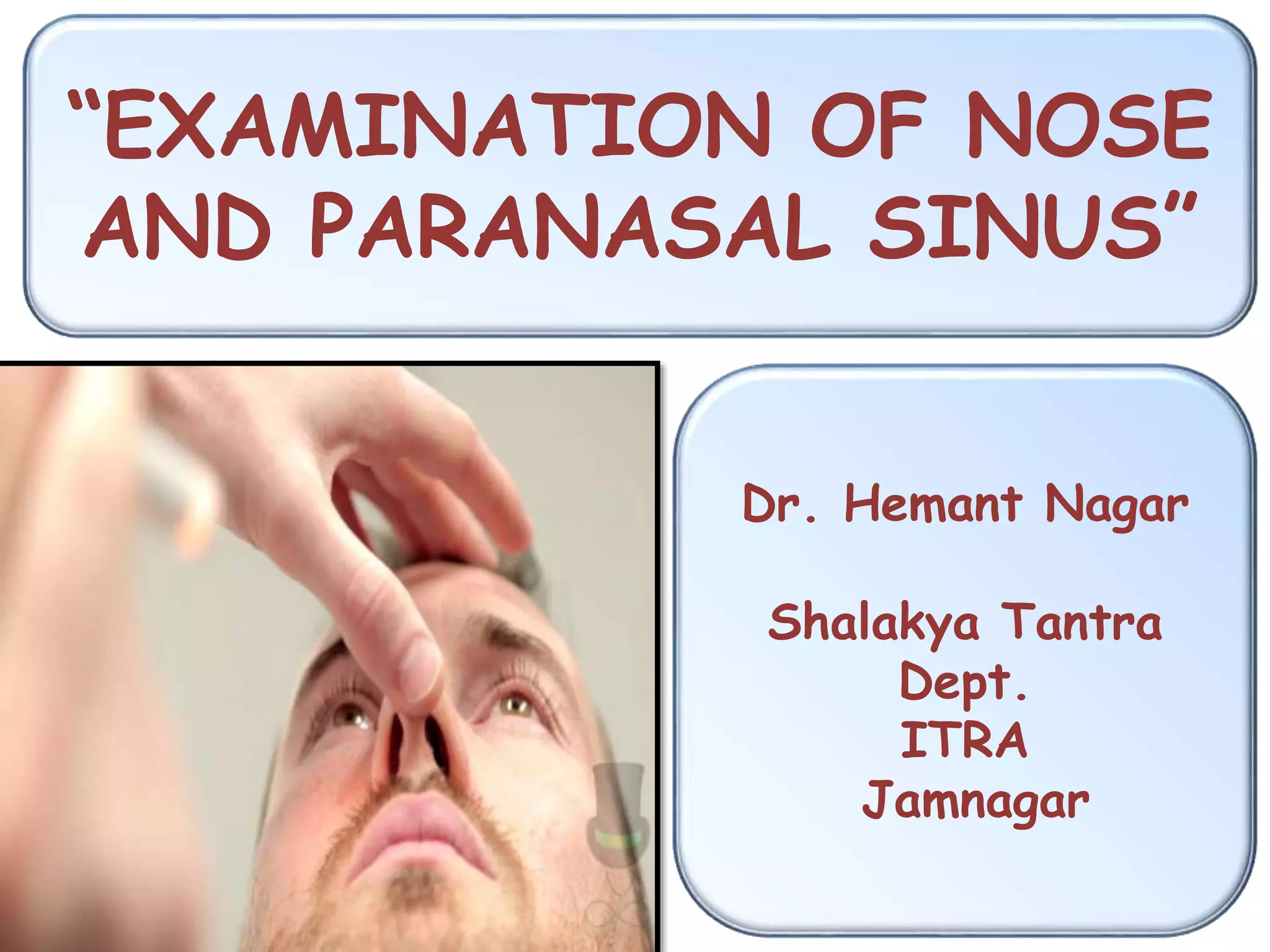
“EXAMINATION OF NOSE
AND PARANASAL SINUS”
Dr. Hemant Nagar
Shalakya Tantra
Dept.
ITRA
Jamnagar
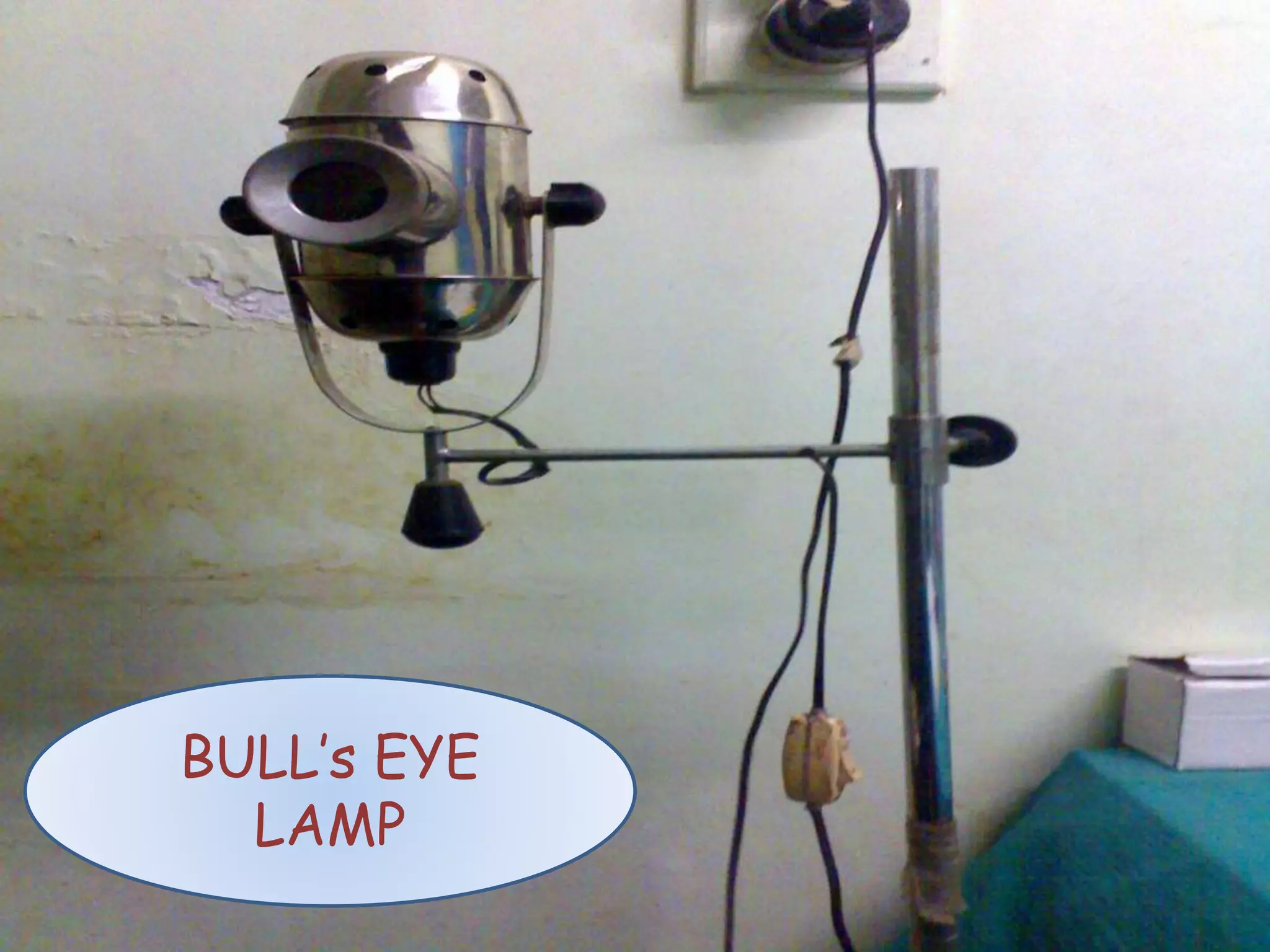
BULL’s EYE
LAMP
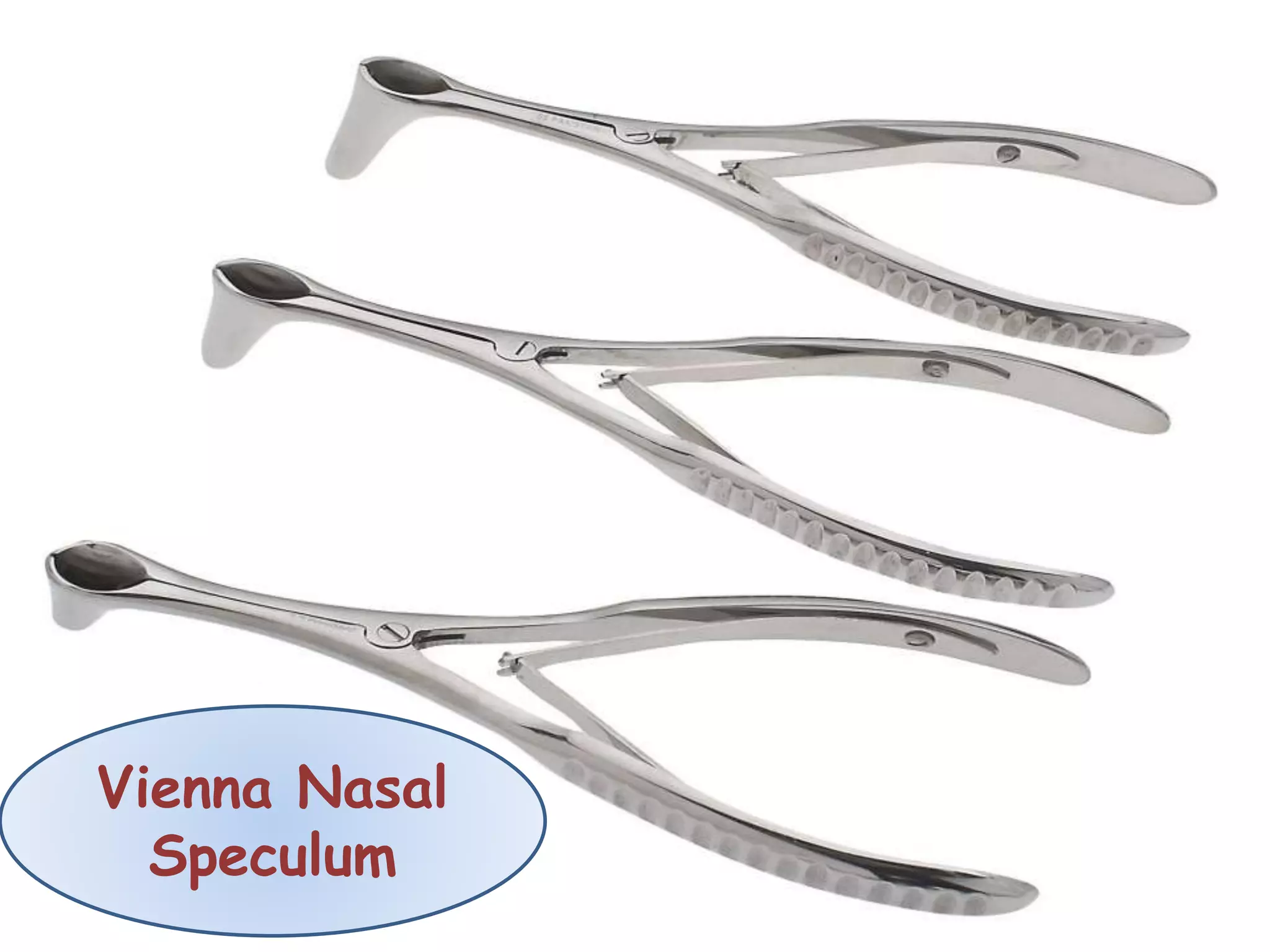
Vienna Nasal
Speculum
Thudicum
Nasal
Speculum
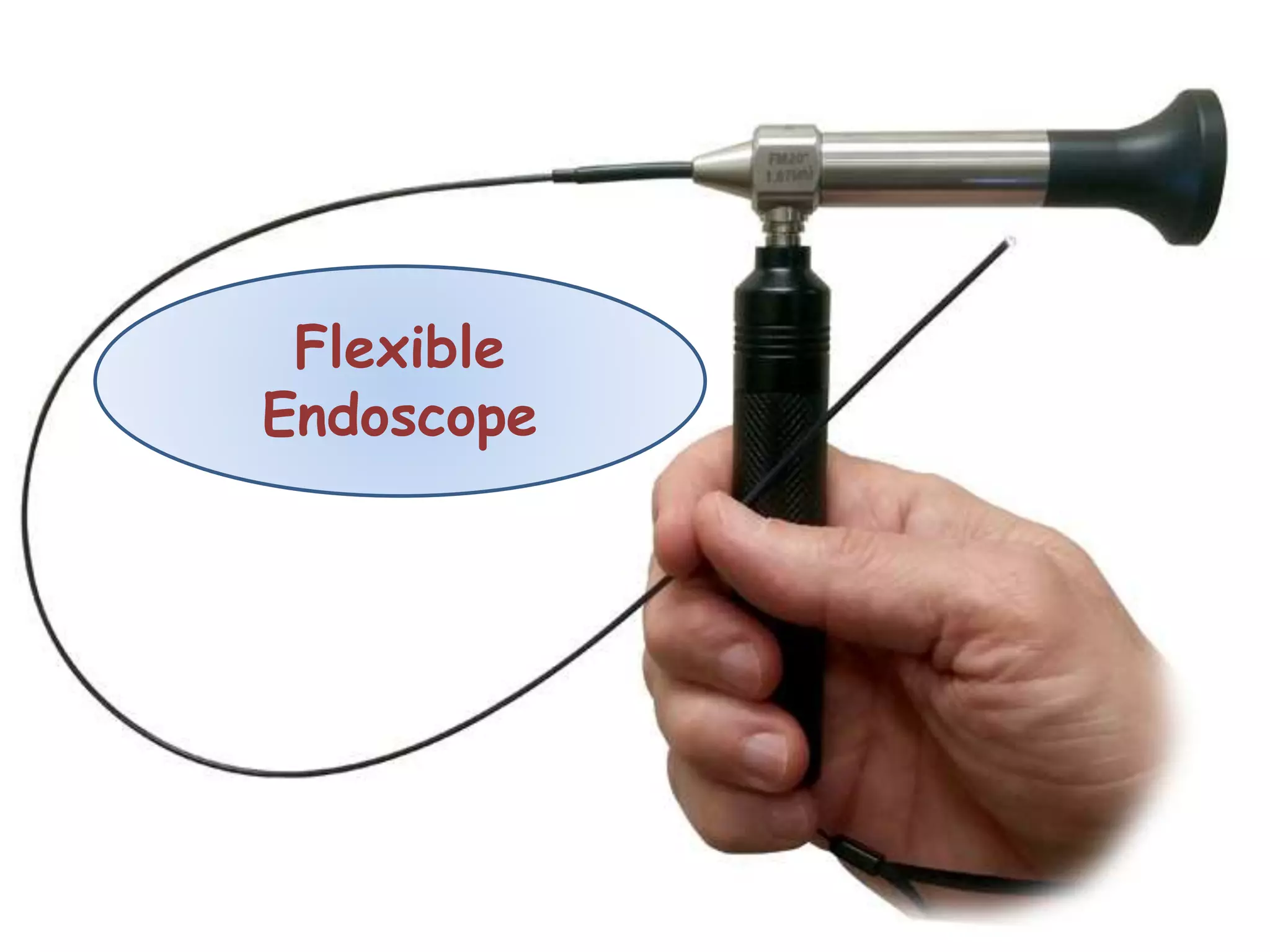
Flexible
Endoscope
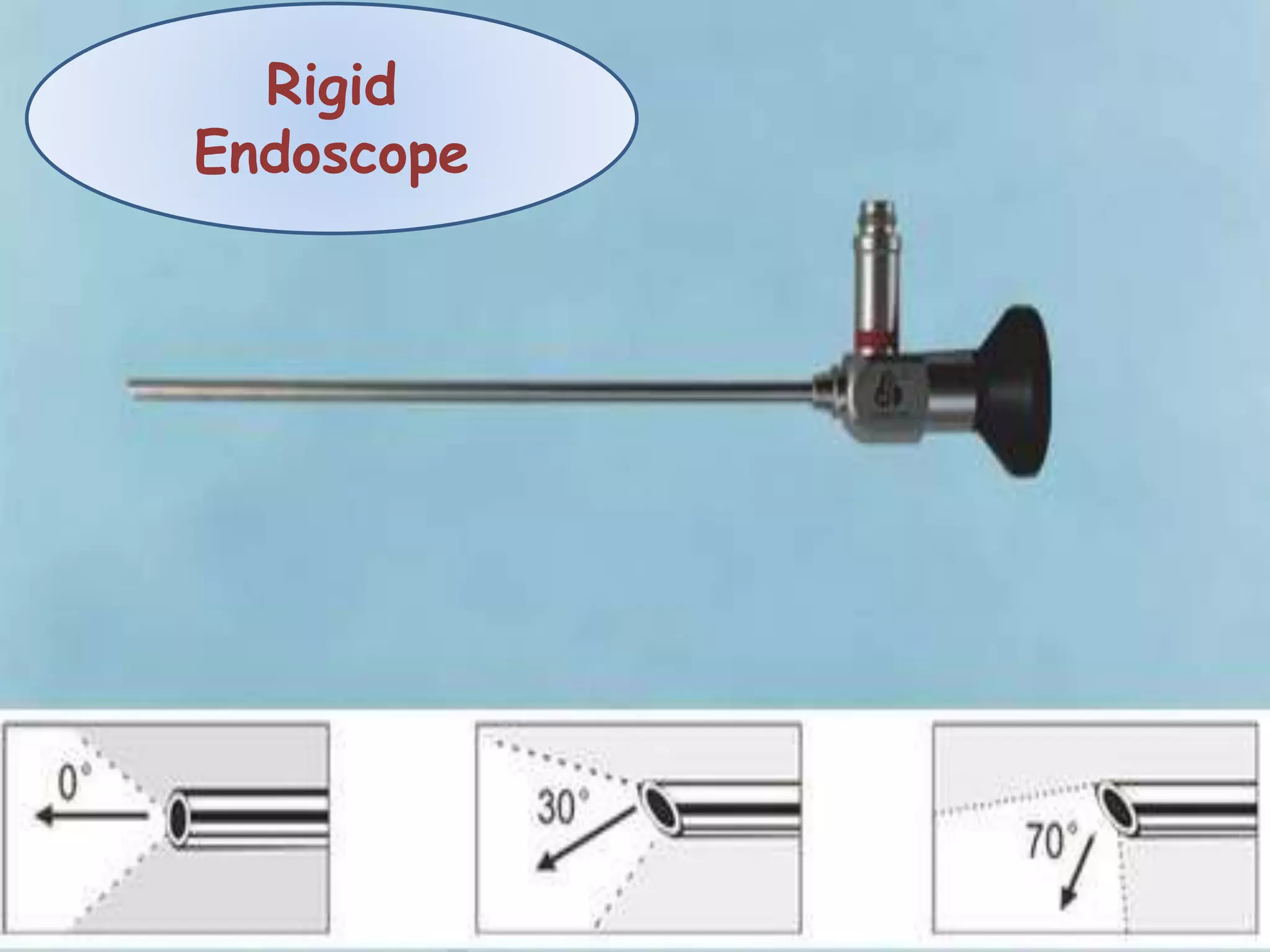
Rigid
Endoscope
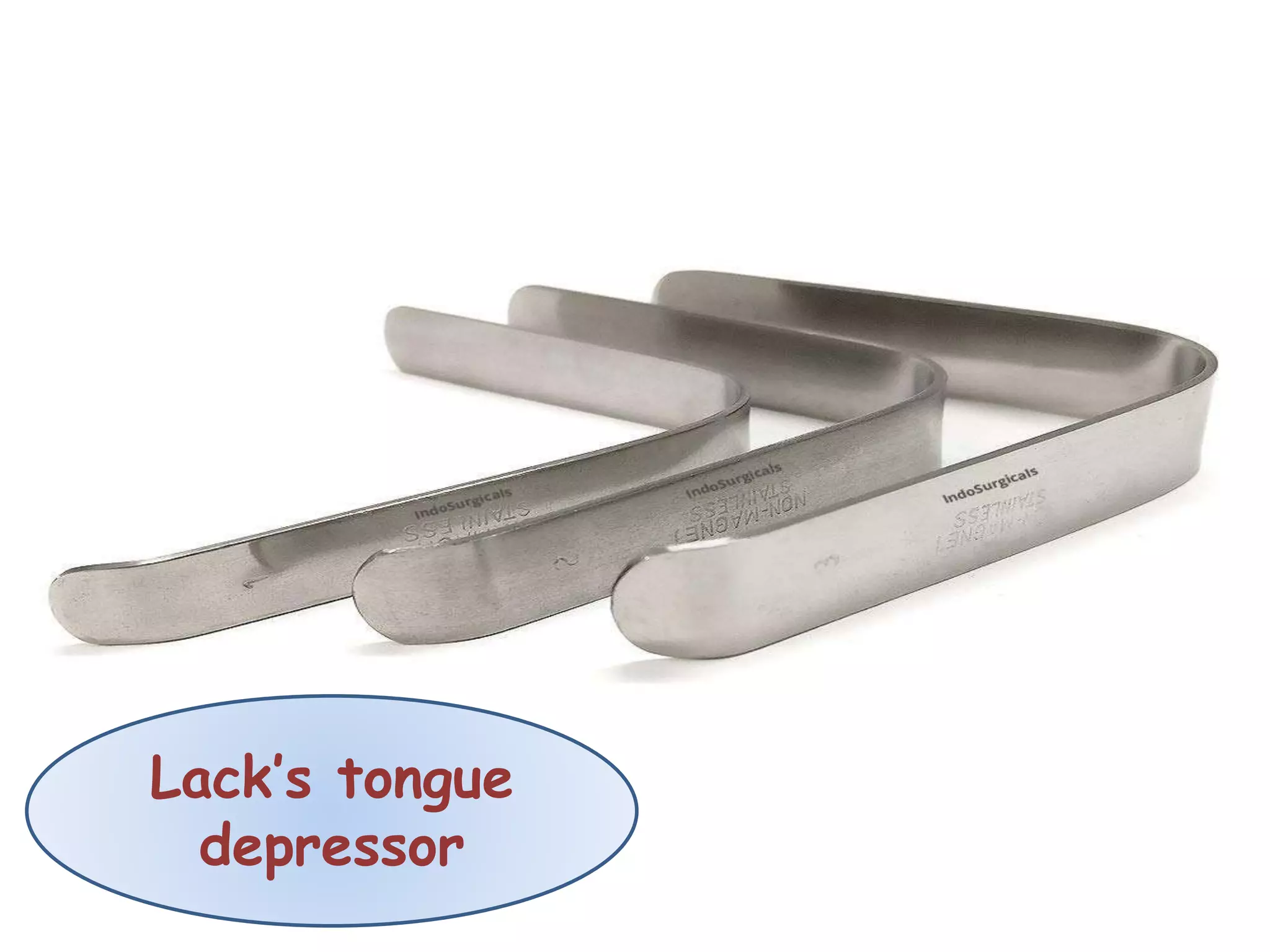
Lack’s tongue
depressor
Hartman’s
Forcep
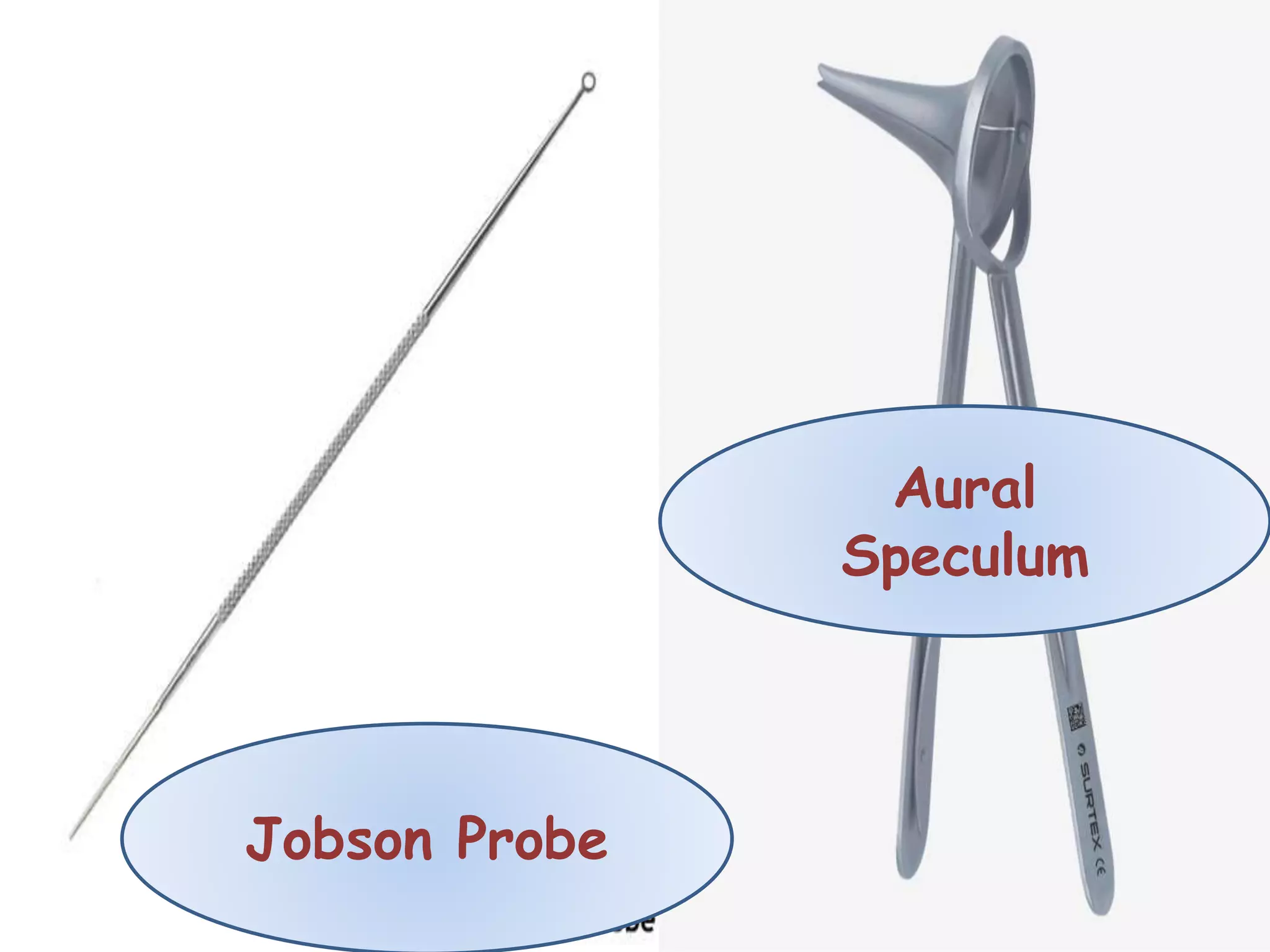
Jobson Probe
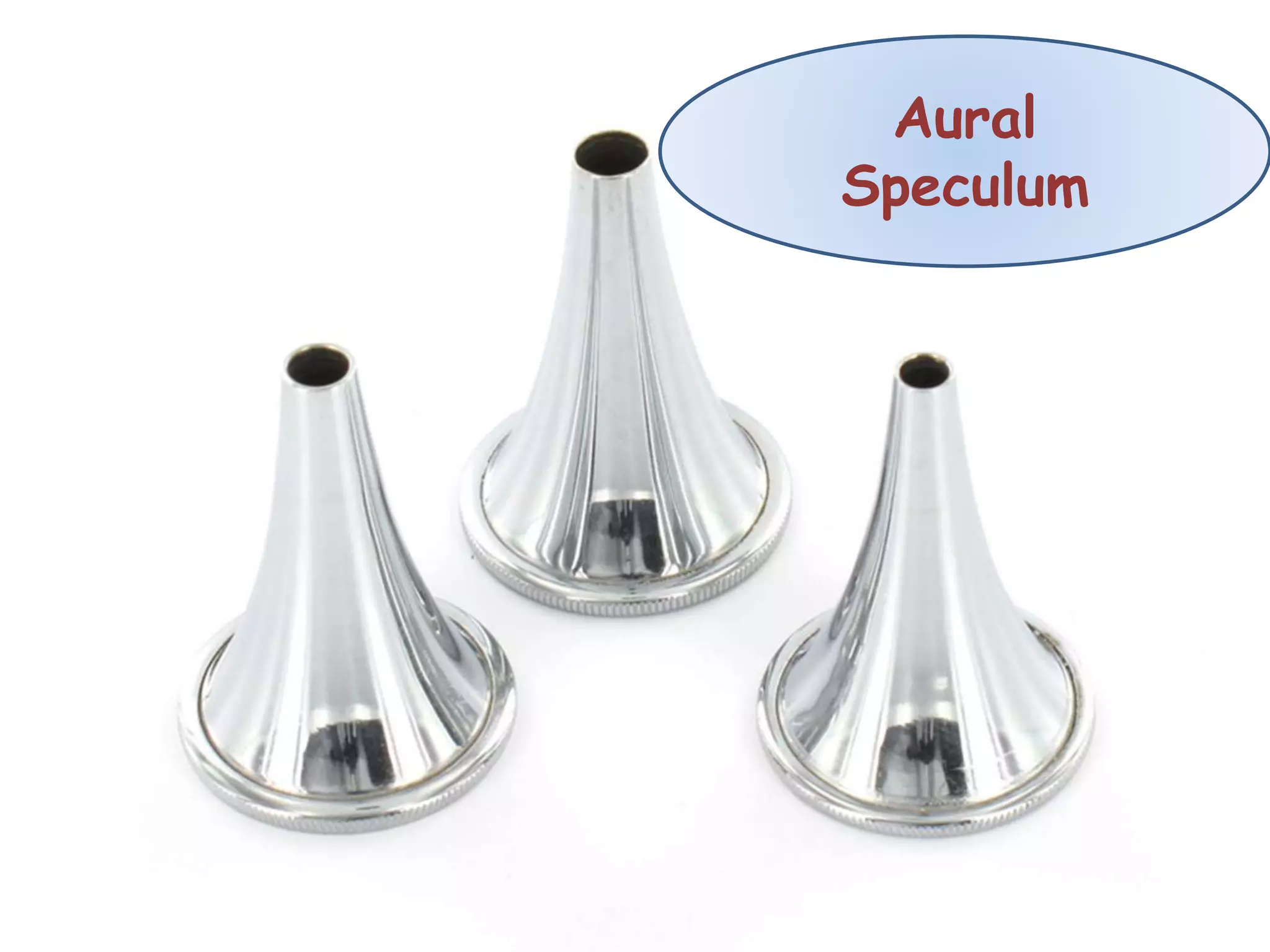
Aural
Speculum
Aural
Speculum
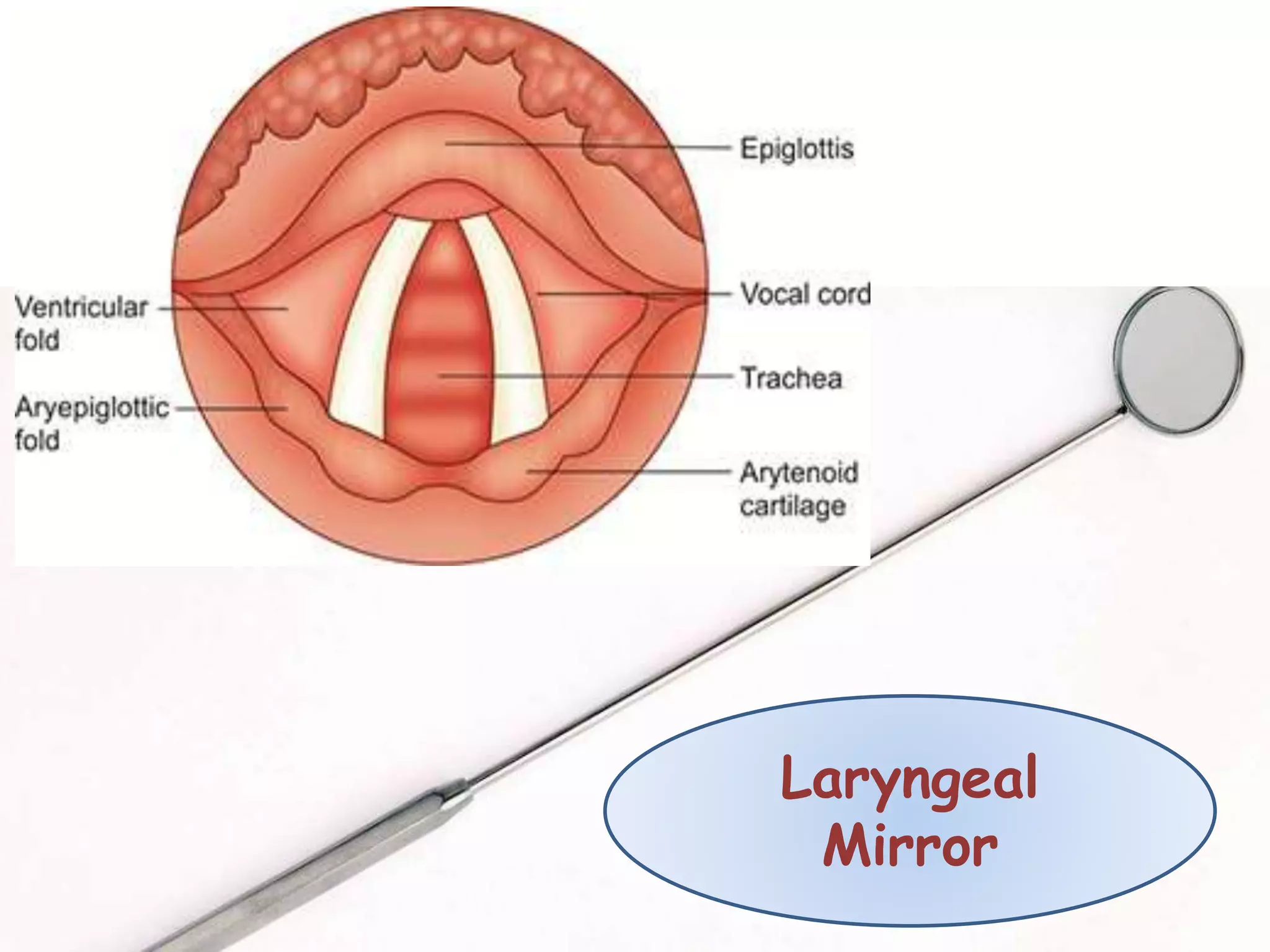
Laryngeal
Mirror
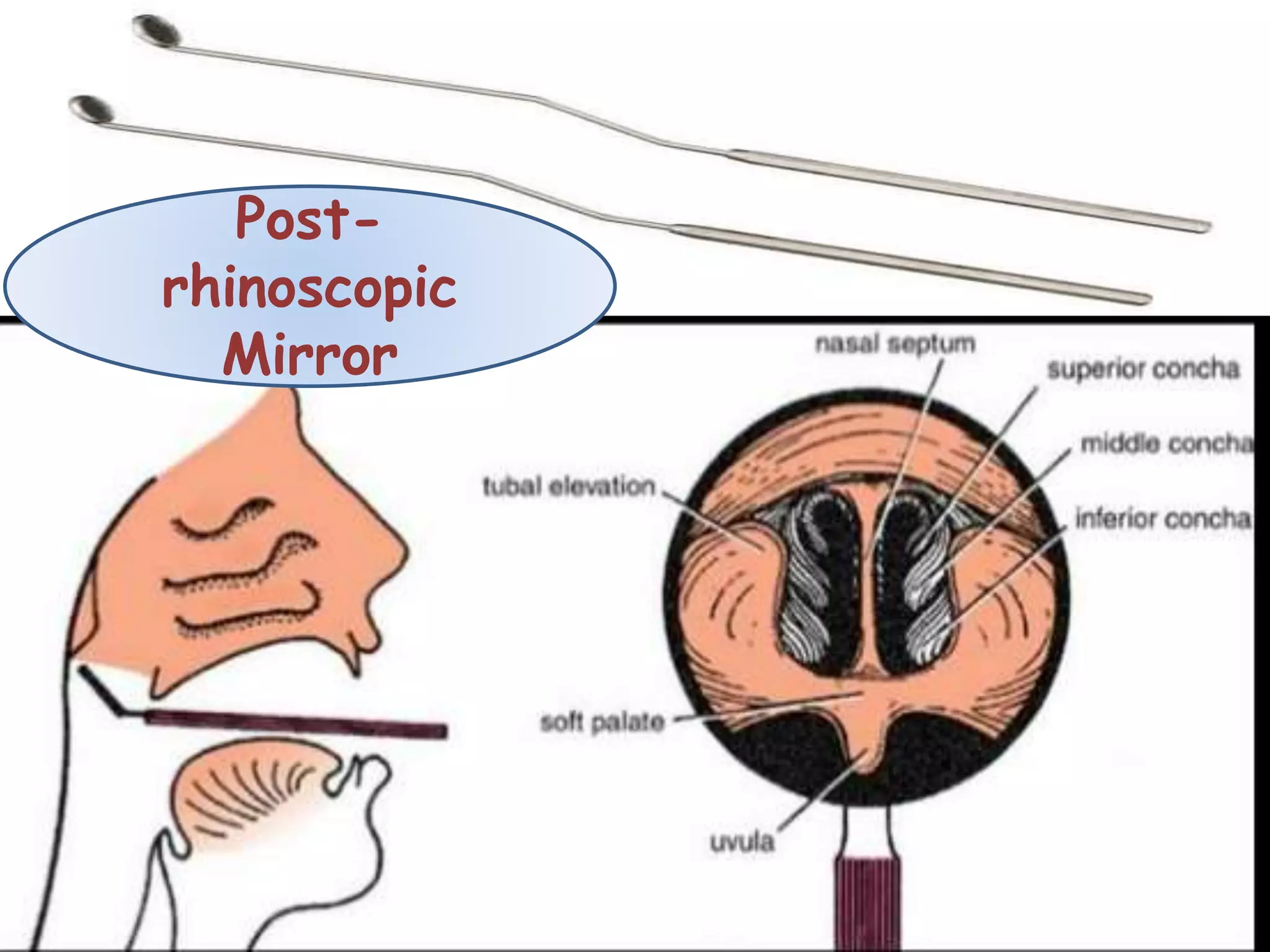
Post-
rhinoscopic
Mirror
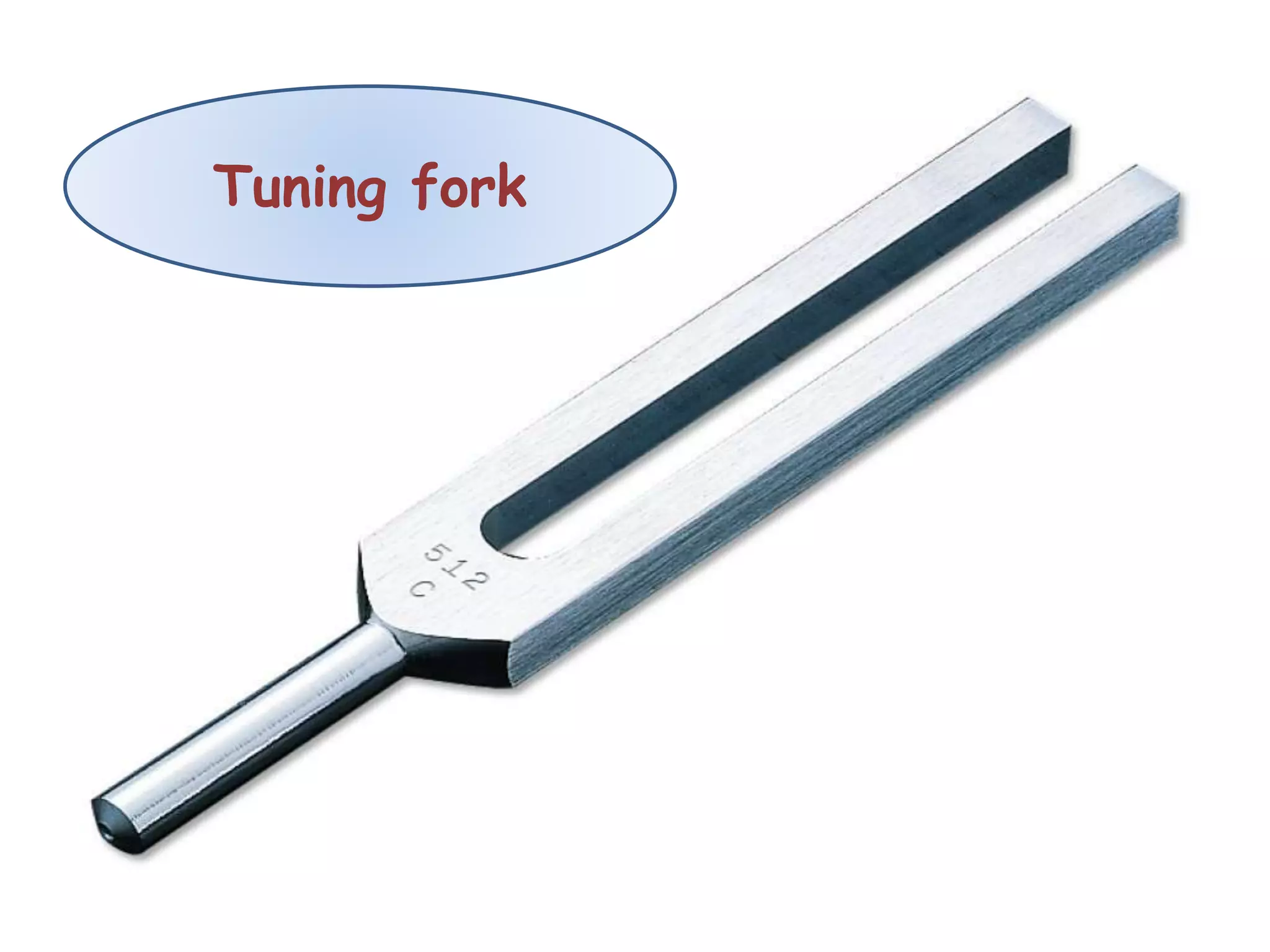
Tuning fork
Main complaints
• Nasal stuffiness/ obstruction
• Nasal discharge: anterior/
postnasal drip
• Sneezing
• Itching
• Nose bleed (epistaxis)
• Nasal crusting
• Disturb smell
• Emitting foul smell to others
• Swelling nose and paranasal
sinuses
• Nose deformities: congenital or
acquired
• Injury/foreign body (FB)
Associated complaints
• Headache
• Vomiting
• Fever
• Facial fullness/pain
• Exophthalmos
• Change in voice
(hypernasal/hyponasal)
• Snoring/obstructive
sleep apnea (OSA)
• Cough
• Epiphora
• Deafness(conductive)
Nasal examination usually includes
physical examination of external nose,
vestibule, anterior rhinoscopy, posterior
rhinoscopy and functional examination
of nose.
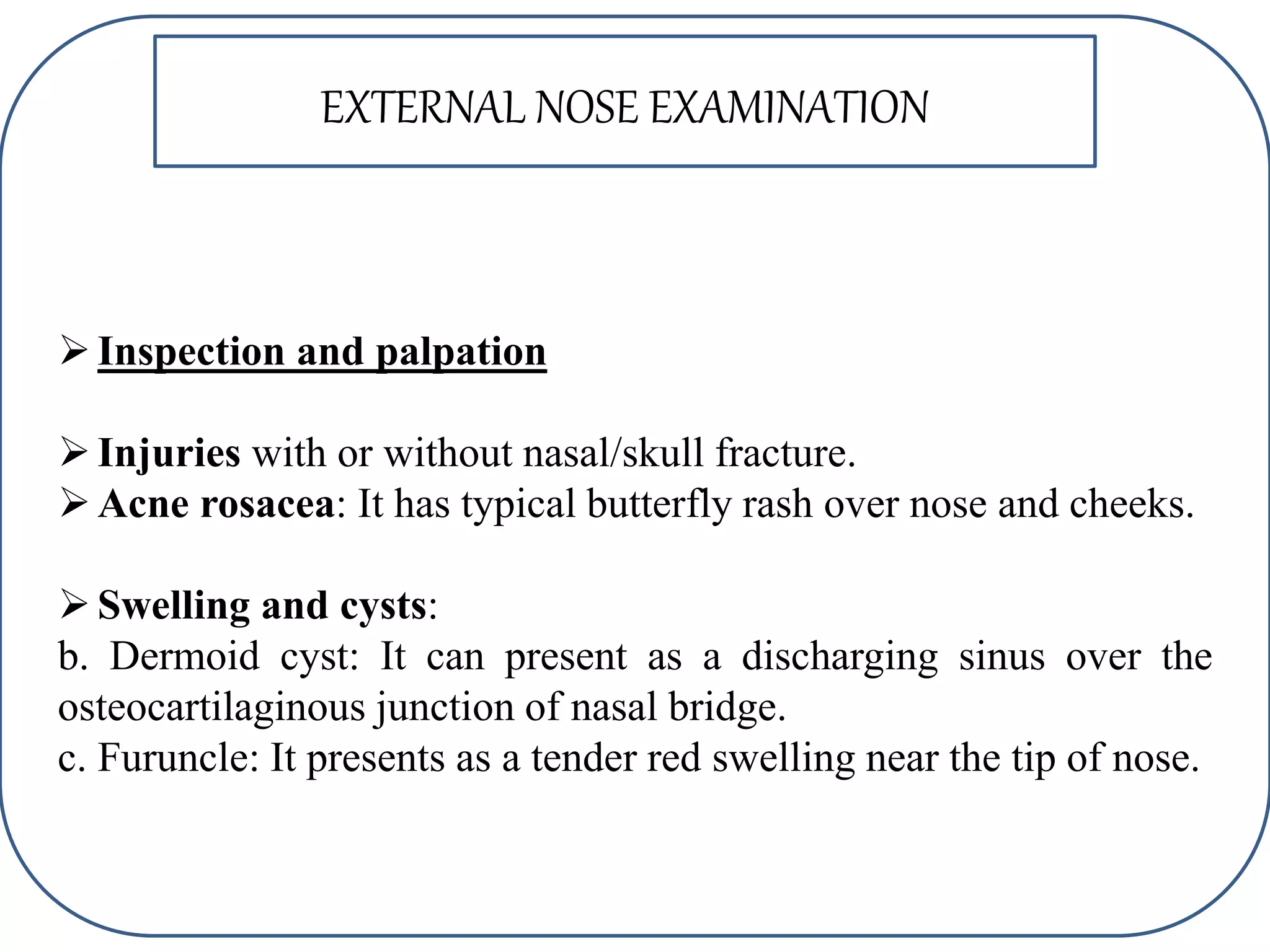
Inspection and palpation
Injuries with or without nasal/skull fracture.
Acne rosacea: It has typical butterfly rash over nose and cheeks.
Swelling and cysts:
b. Dermoid cyst: It can present as a discharging sinus over the
osteocartilaginous junction of nasal bridge.
c. Furuncle: It presents as a tender red swelling near the tip of nose.
EXTERNAL NOSE EXAMINATION
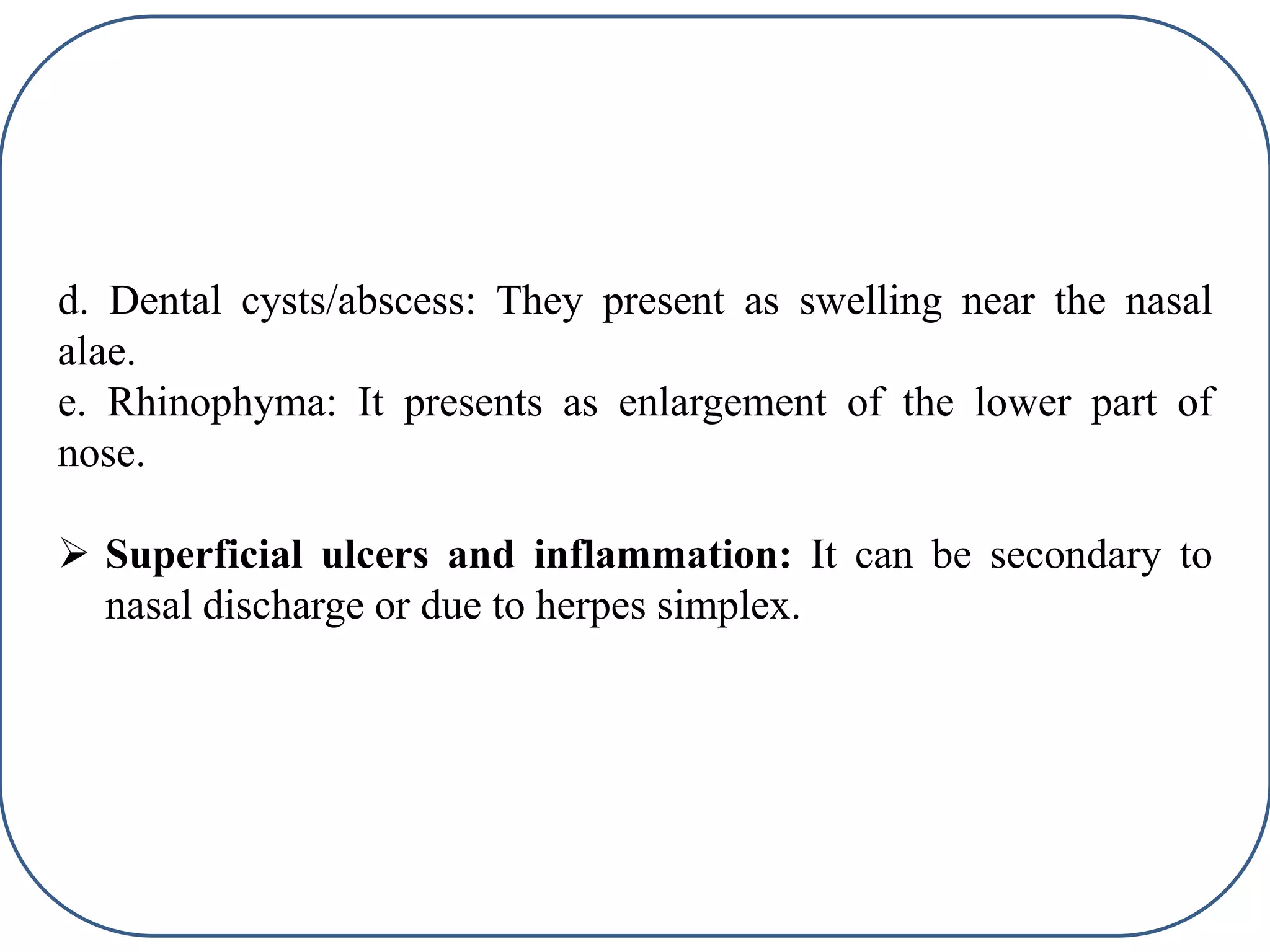
d. Dental cysts/abscess: They present as swelling near the nasal
alae.
e. Rhinophyma: It presents as enlargement of the lower part of
nose.
 Superficial ulcers and inflammation: It can be secondary to
nasal discharge or due to herpes simplex.
Vestibule is an anterior skin lined part of nasal cavity having
vibrissae (hairs in nasal vestibule).
It can be easily evaluated by lifting the tip of nose.
Examine for the following components:
 Metaplasia: Frequent picking of nose produces metaplasia that
stands out as whitish dry areas.
 Ulcerations and perforation: Septal perforations can be due to
frequent picking and industrial dusts and fumes especially nickel
and chrome.
VESTIBULE EXAMINATION
Patient’s head needs to be tilted in different directions to examine
different sites in the nose: septum, inferior turbinate and meatus,
middle turbinate and meatus and floor of the nose.
• Septum: straight / deviations /perforations / granulations
• Inferior and middle turbinates: Compensatory hypertrophy/
hypertrophy
ANTERIOR RHINOSCOPY EXAMINATION
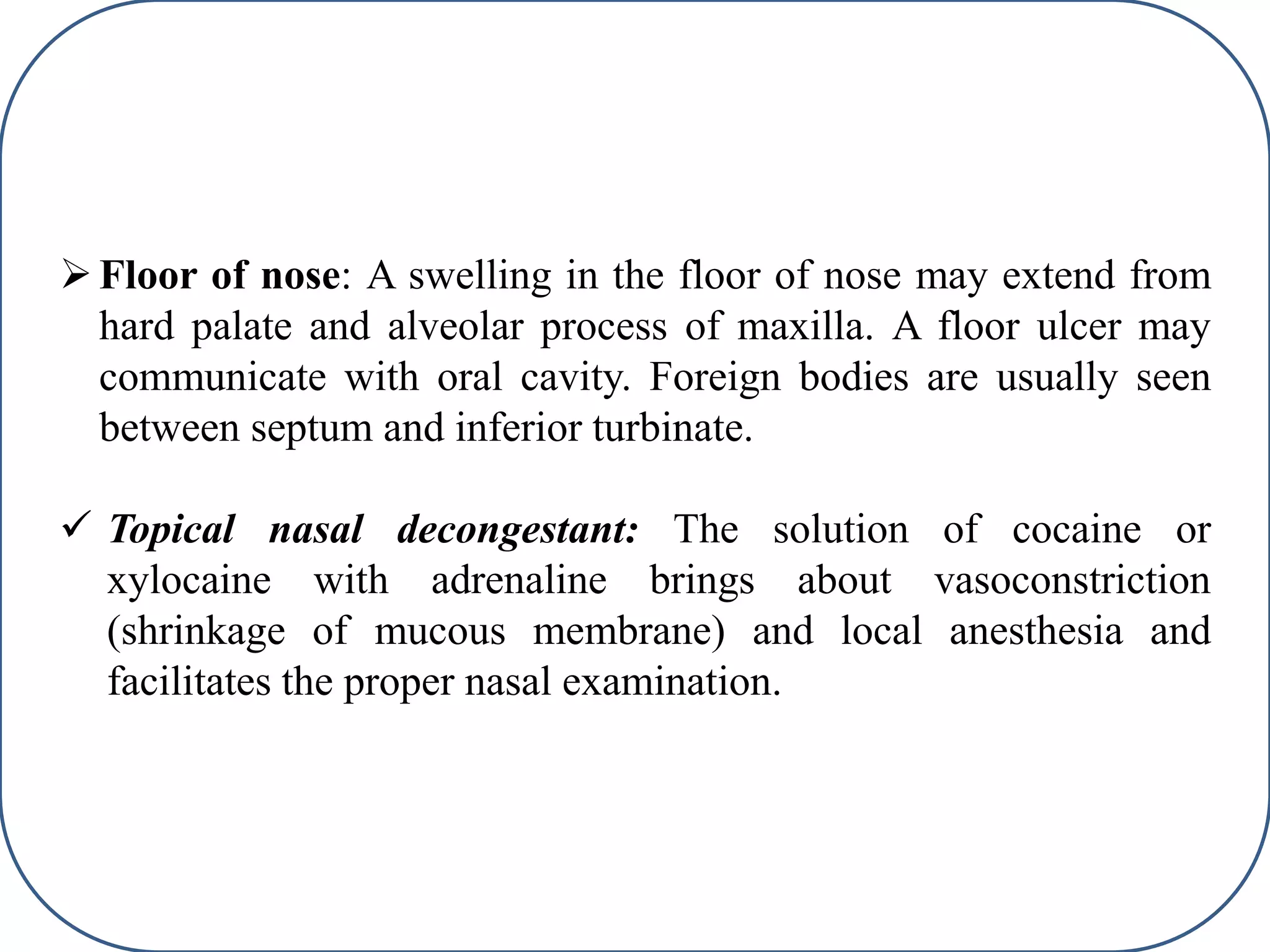
Floor of nose: A swelling in the floor of nose may extend from
hard palate and alveolar process of maxilla. A floor ulcer may
communicate with oral cavity. Foreign bodies are usually seen
between septum and inferior turbinate.
 Topical nasal decongestant: The solution of cocaine or
xylocaine with adrenaline brings about vasoconstriction
(shrinkage of mucous membrane) and local anesthesia and
facilitates the proper nasal examination.
 Probe test:
• It is done under topical anesthesia.
• A probe is passed on all surfaces of mass and helps in
ascertaining the site of attachment, consistency, mobility,
vascular nature and sensitivity of the growth.
• Ulcers should be probed to know the exposed underlying bone.
• Probing of an ulcer in the floor of nose can exclude or confirm
its oral cavity communication.
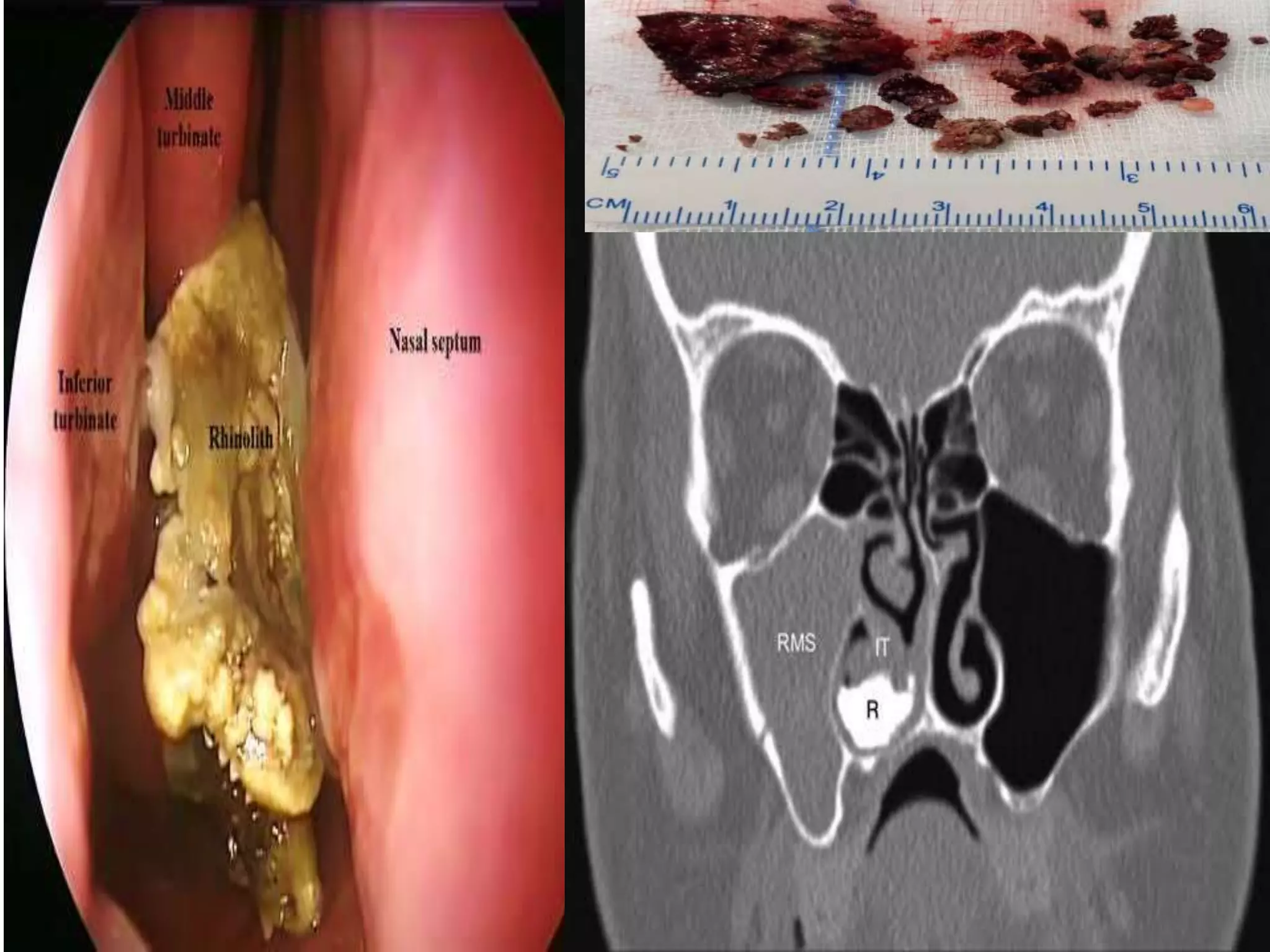
• Rhinolith gives a grating sensation on probing.
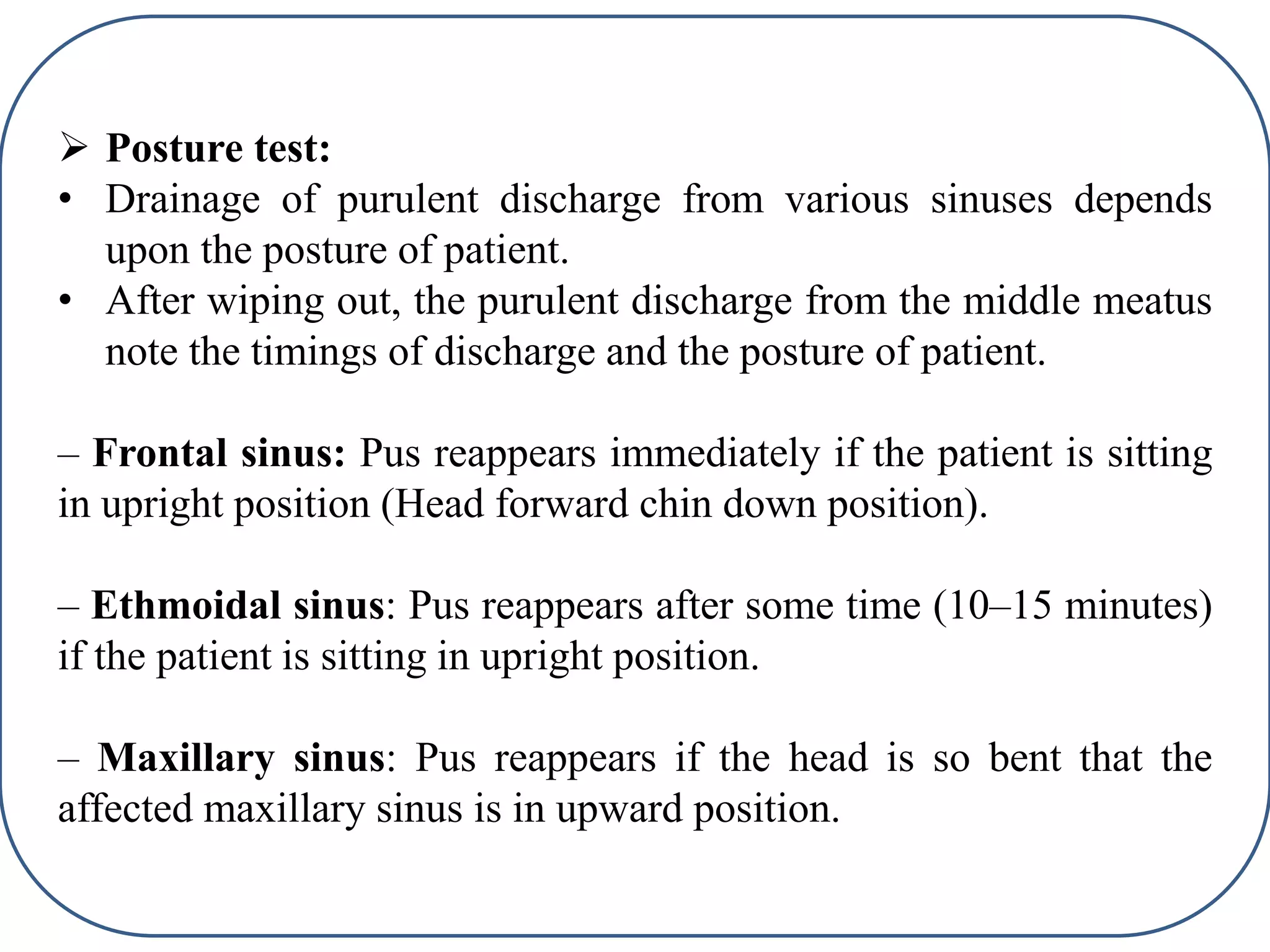
 Posture test:
• Drainage of purulent discharge from various sinuses depends
upon the posture of patient.
• After wiping out, the purulent discharge from the middle meatus
note the timings of discharge and the posture of patient.
– Frontal sinus: Pus reappears immediately if the patient is sitting
in upright position (Head forward chin down position).
– Ethmoidal sinus: Pus reappears after some time (10–15 minutes)
if the patient is sitting in upright position.
– Maxillary sinus: Pus reappears if the head is so bent that the
affected maxillary sinus is in upward position.
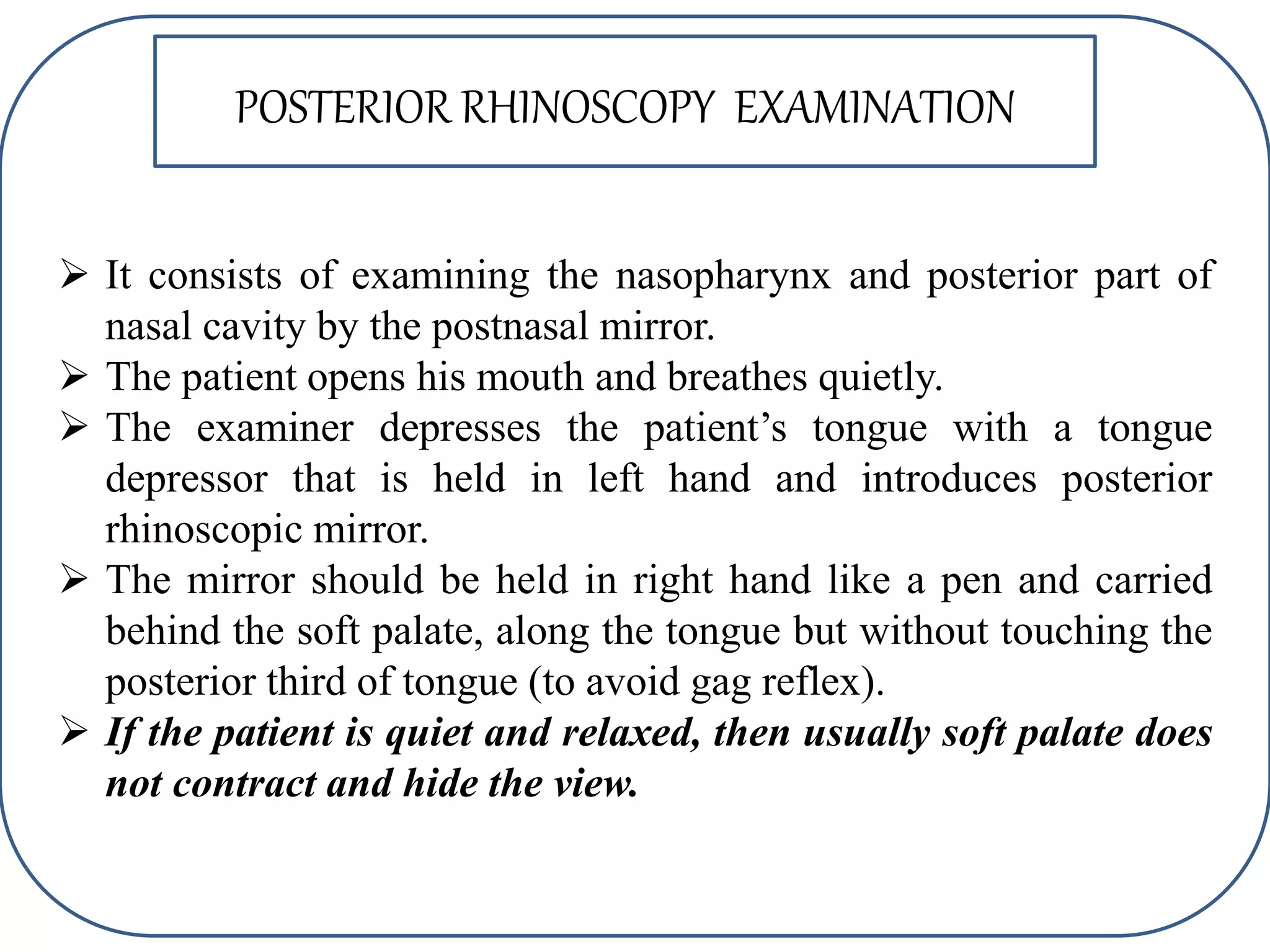
 It consists of examining the nasopharynx and posterior part of
nasal cavity by the postnasal mirror.
 The patient opens his mouth and breathes quietly.
 The examiner depresses the patient’s tongue with a tongue
depressor that is held in left hand and introduces posterior
rhinoscopic mirror.
 The mirror should be held in right hand like a pen and carried
behind the soft palate, along the tongue but without touching the
posterior third of tongue (to avoid gag reflex).
 If the patient is quiet and relaxed, then usually soft palate does
not contract and hide the view.
POSTERIOR RHINOSCOPY EXAMINATION
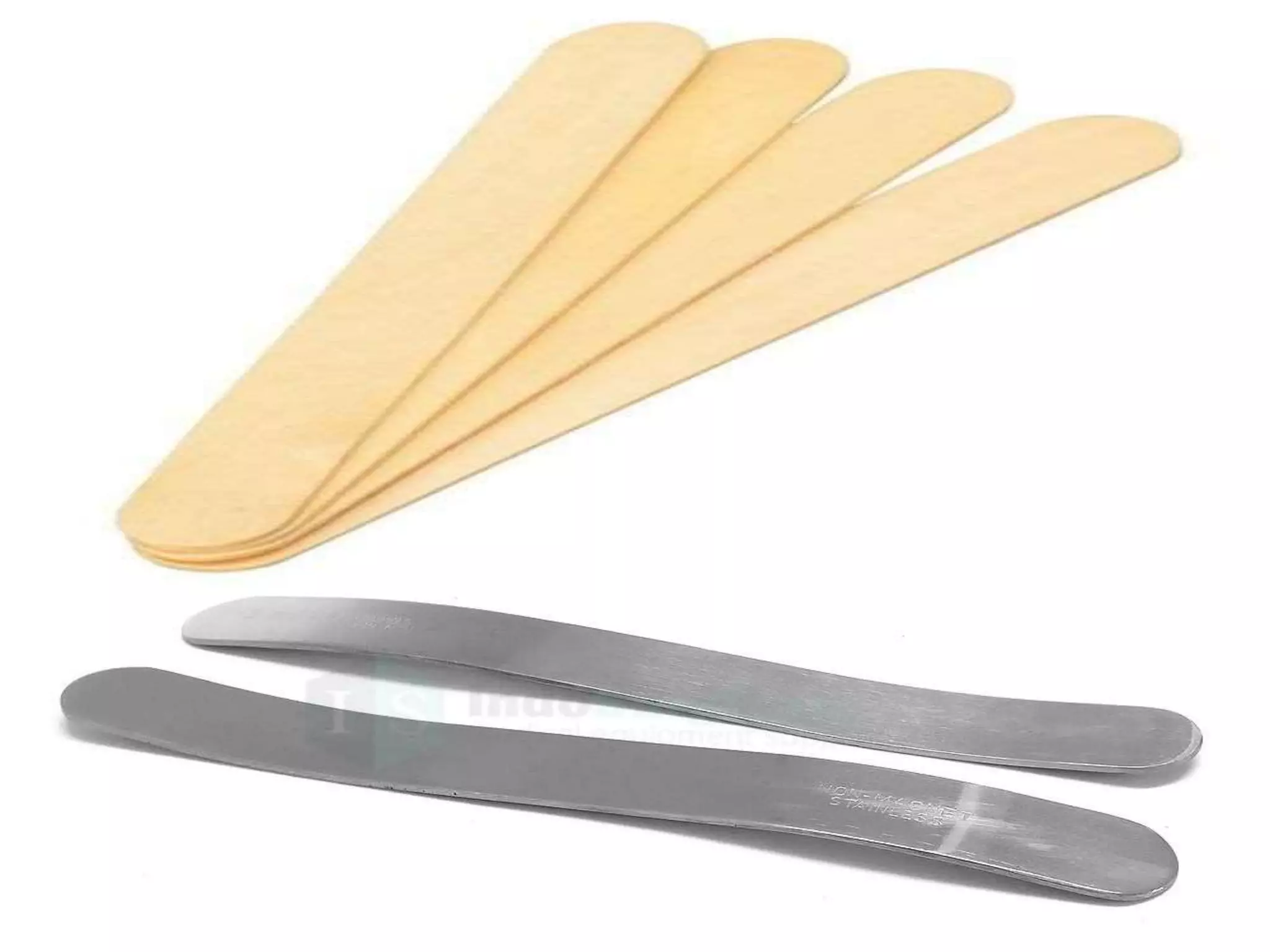
 Spatula test: A clean cold tongue depressor is held below the
nose while patient exhales. Each area of mist formation on either
side is compared. „
 Cotton-wool test: A fluff of cotton is held against each nostril
and its movements indicate the nasal blow of air while the
patient inhales or exhales. „
 Alae nasi movements: In cases of inspiratory obstruction, alae
nasi collapse onto the septum. „
 Cottle test:
PATENCY OF NASAL CAVITY
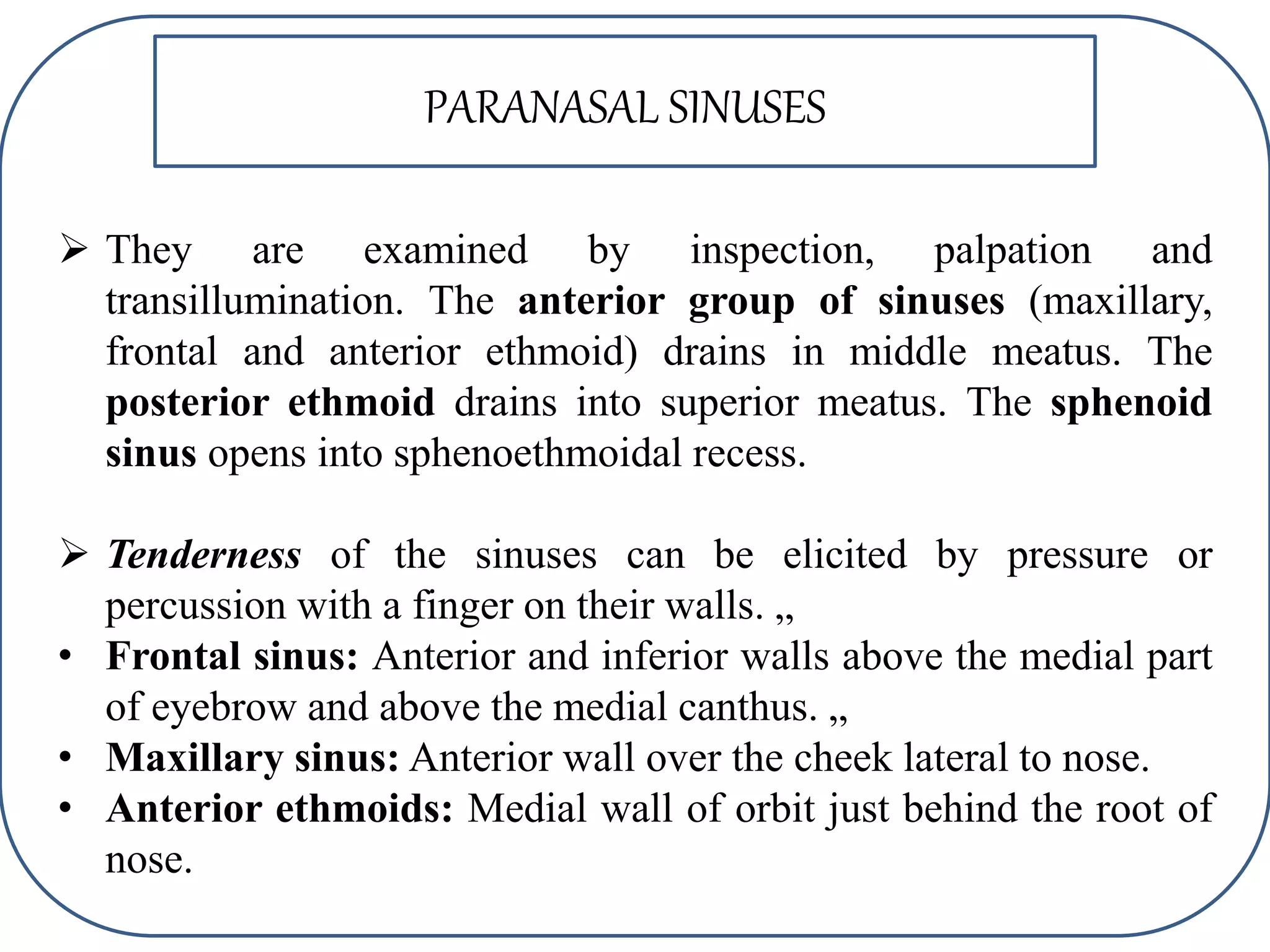
PARANASAL SINUSES
 They are examined by inspection, palpation and
transillumination. The anterior group of sinuses (maxillary,
frontal and anterior ethmoid) drains in middle meatus. The
posterior ethmoid drains into superior meatus. The sphenoid
sinus opens into sphenoethmoidal recess.
 Tenderness of the sinuses can be elicited by pressure or
percussion with a finger on their walls. „
• Frontal sinus: Anterior and inferior walls above the medial part
of eyebrow and above the medial canthus. „
• Maxillary sinus: Anterior wall over the cheek lateral to nose.
• Anterior ethmoids: Medial wall of orbit just behind the root of
nose.
 Transillumination Test:
 Maxillary sinus: A specially made light source is placed in the
mouth and the mouth is closed. Normally, a crescent of light in
the inferior fornix and glow in the pupil, which are equally
bright on either side can be seen. The affected side maxillary
sinus will not transmit light if there is pus, thickened mucosa or a
neoplasm.
„
 Frontal sinus: A small light source is placed in the
superomedial angle of the orbit. The transmission of light from
the anterior wall of the both side frontal sinuses is compared.
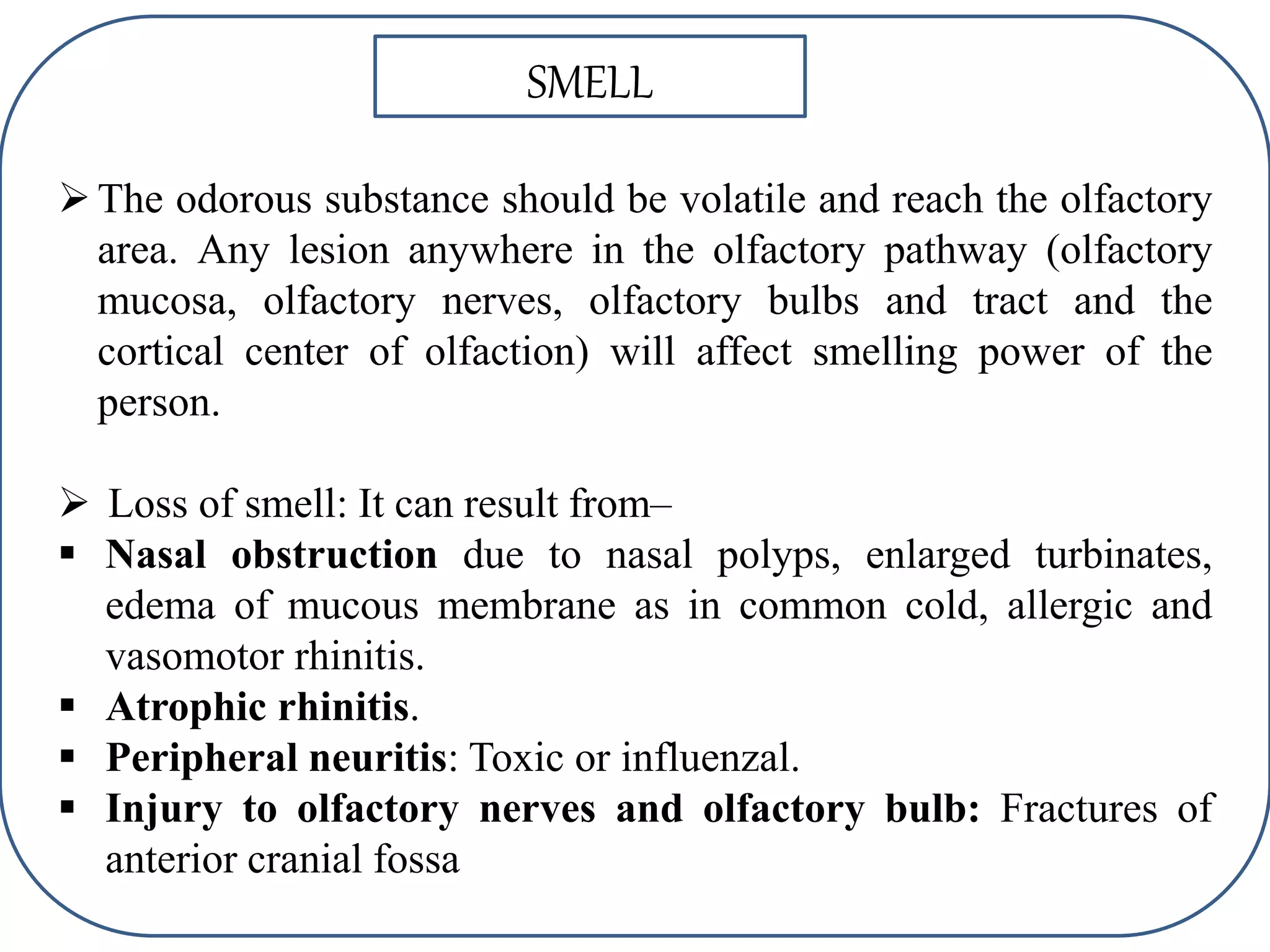
SMELL
The odorous substance should be volatile and reach the olfactory
area. Any lesion anywhere in the olfactory pathway (olfactory
mucosa, olfactory nerves, olfactory bulbs and tract and the
cortical center of olfaction) will affect smelling power of the
person.
 Loss of smell: It can result from–
 Nasal obstruction due to nasal polyps, enlarged turbinates,
edema of mucous membrane as in common cold, allergic and
vasomotor rhinitis.
 Atrophic rhinitis.
 Peripheral neuritis: Toxic or influenzal.
 Injury to olfactory nerves and olfactory bulb: Fractures of
anterior cranial fossa
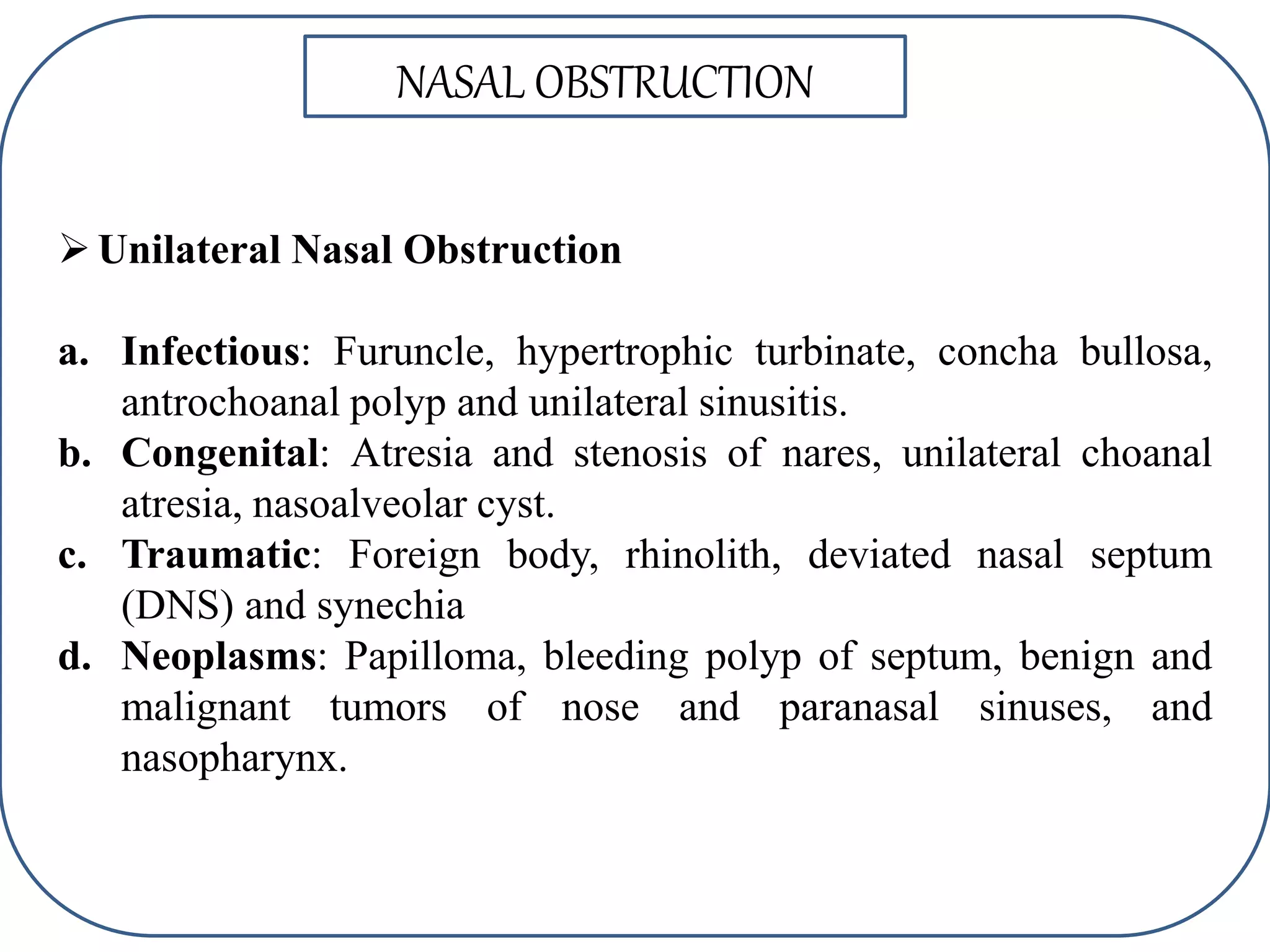
Unilateral Nasal Obstruction
a. Infectious: Furuncle, hypertrophic turbinate, concha bullosa,
antrochoanal polyp and unilateral sinusitis.
b. Congenital: Atresia and stenosis of nares, unilateral choanal
atresia, nasoalveolar cyst.
c. Traumatic: Foreign body, rhinolith, deviated nasal septum
(DNS) and synechia
d. Neoplasms: Papilloma, bleeding polyp of septum, benign and
malignant tumors of nose and paranasal sinuses, and
nasopharynx.
NASAL OBSTRUCTION
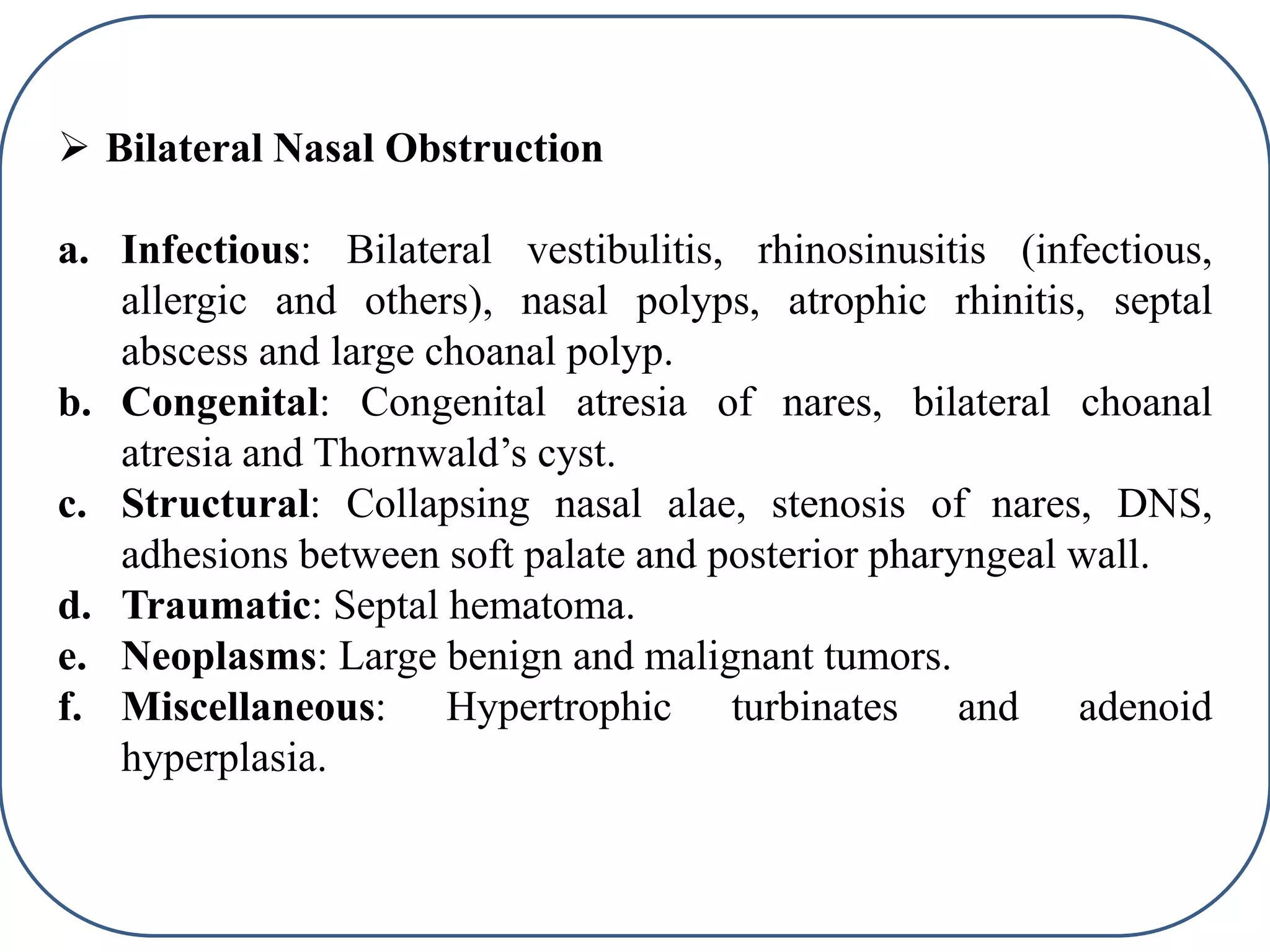
 Bilateral Nasal Obstruction
a. Infectious: Bilateral vestibulitis, rhinosinusitis (infectious,
allergic and others), nasal polyps, atrophic rhinitis, septal
abscess and large choanal polyp.
b. Congenital: Congenital atresia of nares, bilateral choanal
atresia and Thornwald’s cyst.
c. Structural: Collapsing nasal alae, stenosis of nares, DNS,
adhesions between soft palate and posterior pharyngeal wall.
d. Traumatic: Septal hematoma.
e. Neoplasms: Large benign and malignant tumors.
f. Miscellaneous: Hypertrophic turbinates and adenoid
hyperplasia.
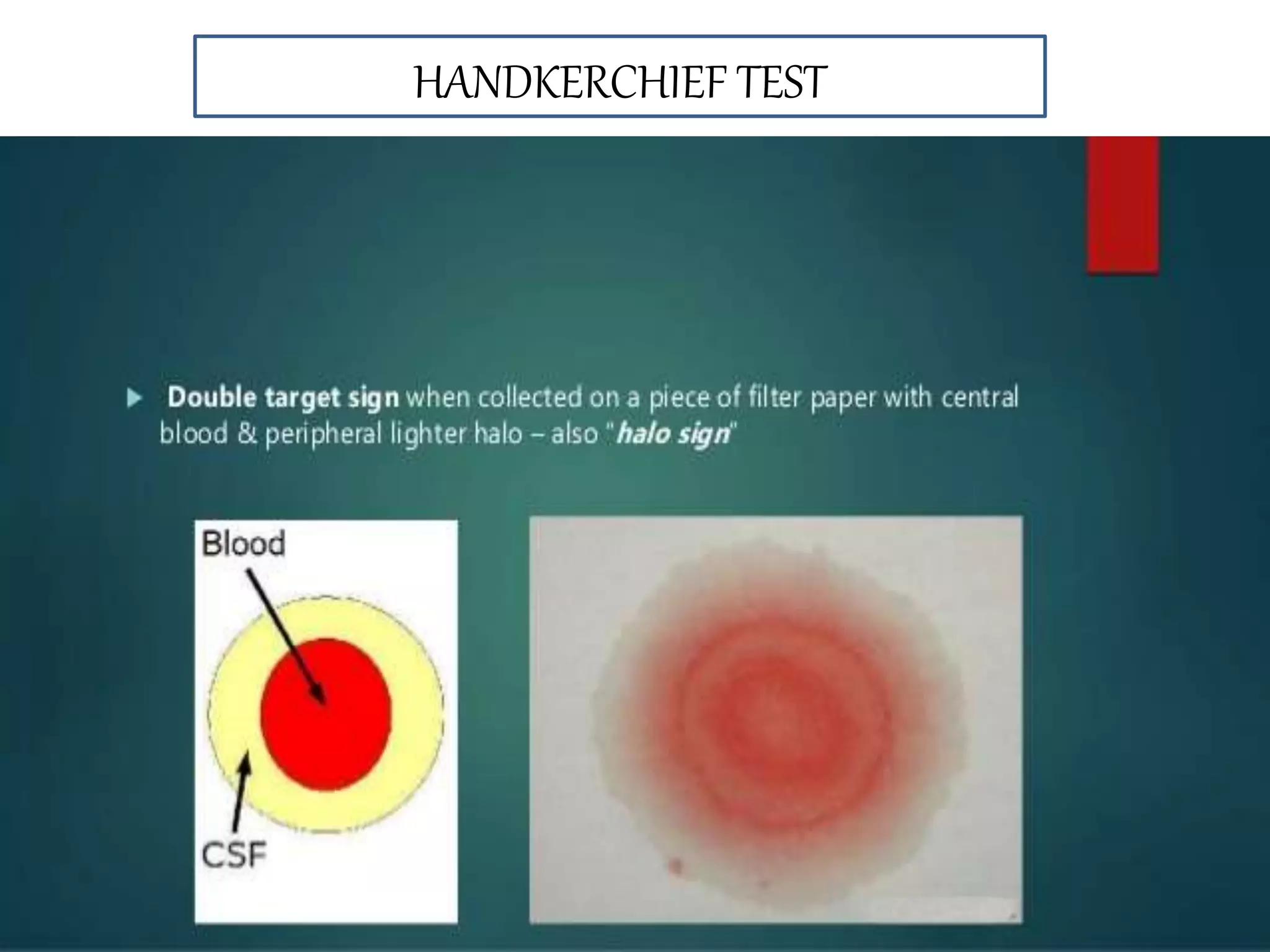
HANDKERCHIEF TEST
examination of nose.pptx

examination of nose.pptx

  • 1.
    “EXAMINATION OF NOSE ANDPARANASAL SINUS” Dr. Hemant Nagar Shalakya Tantra Dept. ITRA Jamnagar
  • 2.
  • 3.
  • 4.
  • 5.
  • 6.
  • 7.
  • 9.
  • 10.
  • 11.
  • 12.
  • 13.
  • 14.
  • 15.
    Main complaints • Nasalstuffiness/ obstruction • Nasal discharge: anterior/ postnasal drip • Sneezing • Itching • Nose bleed (epistaxis) • Nasal crusting • Disturb smell • Emitting foul smell to others • Swelling nose and paranasal sinuses • Nose deformities: congenital or acquired • Injury/foreign body (FB) Associated complaints • Headache • Vomiting • Fever • Facial fullness/pain • Exophthalmos • Change in voice (hypernasal/hyponasal) • Snoring/obstructive sleep apnea (OSA) • Cough • Epiphora • Deafness(conductive)
  • 16.
    Nasal examination usuallyincludes physical examination of external nose, vestibule, anterior rhinoscopy, posterior rhinoscopy and functional examination of nose.
  • 17.
    Inspection and palpation Injurieswith or without nasal/skull fracture. Acne rosacea: It has typical butterfly rash over nose and cheeks. Swelling and cysts: b. Dermoid cyst: It can present as a discharging sinus over the osteocartilaginous junction of nasal bridge. c. Furuncle: It presents as a tender red swelling near the tip of nose. EXTERNAL NOSE EXAMINATION
  • 18.
    d. Dental cysts/abscess:They present as swelling near the nasal alae. e. Rhinophyma: It presents as enlargement of the lower part of nose.  Superficial ulcers and inflammation: It can be secondary to nasal discharge or due to herpes simplex.
  • 19.
    Vestibule is ananterior skin lined part of nasal cavity having vibrissae (hairs in nasal vestibule). It can be easily evaluated by lifting the tip of nose. Examine for the following components:  Metaplasia: Frequent picking of nose produces metaplasia that stands out as whitish dry areas.  Ulcerations and perforation: Septal perforations can be due to frequent picking and industrial dusts and fumes especially nickel and chrome. VESTIBULE EXAMINATION
  • 20.
    Patient’s head needsto be tilted in different directions to examine different sites in the nose: septum, inferior turbinate and meatus, middle turbinate and meatus and floor of the nose. • Septum: straight / deviations /perforations / granulations • Inferior and middle turbinates: Compensatory hypertrophy/ hypertrophy ANTERIOR RHINOSCOPY EXAMINATION
  • 21.
    Floor of nose:A swelling in the floor of nose may extend from hard palate and alveolar process of maxilla. A floor ulcer may communicate with oral cavity. Foreign bodies are usually seen between septum and inferior turbinate.  Topical nasal decongestant: The solution of cocaine or xylocaine with adrenaline brings about vasoconstriction (shrinkage of mucous membrane) and local anesthesia and facilitates the proper nasal examination.
  • 22.
     Probe test: •It is done under topical anesthesia. • A probe is passed on all surfaces of mass and helps in ascertaining the site of attachment, consistency, mobility, vascular nature and sensitivity of the growth. • Ulcers should be probed to know the exposed underlying bone. • Probing of an ulcer in the floor of nose can exclude or confirm its oral cavity communication. • Rhinolith gives a grating sensation on probing.
  • 24.
     Posture test: •Drainage of purulent discharge from various sinuses depends upon the posture of patient. • After wiping out, the purulent discharge from the middle meatus note the timings of discharge and the posture of patient. – Frontal sinus: Pus reappears immediately if the patient is sitting in upright position (Head forward chin down position). – Ethmoidal sinus: Pus reappears after some time (10–15 minutes) if the patient is sitting in upright position. – Maxillary sinus: Pus reappears if the head is so bent that the affected maxillary sinus is in upward position.
  • 25.
     It consistsof examining the nasopharynx and posterior part of nasal cavity by the postnasal mirror.  The patient opens his mouth and breathes quietly.  The examiner depresses the patient’s tongue with a tongue depressor that is held in left hand and introduces posterior rhinoscopic mirror.  The mirror should be held in right hand like a pen and carried behind the soft palate, along the tongue but without touching the posterior third of tongue (to avoid gag reflex).  If the patient is quiet and relaxed, then usually soft palate does not contract and hide the view. POSTERIOR RHINOSCOPY EXAMINATION
  • 26.
     Spatula test:A clean cold tongue depressor is held below the nose while patient exhales. Each area of mist formation on either side is compared. „  Cotton-wool test: A fluff of cotton is held against each nostril and its movements indicate the nasal blow of air while the patient inhales or exhales. „  Alae nasi movements: In cases of inspiratory obstruction, alae nasi collapse onto the septum. „  Cottle test: PATENCY OF NASAL CAVITY
  • 27.
    PARANASAL SINUSES  Theyare examined by inspection, palpation and transillumination. The anterior group of sinuses (maxillary, frontal and anterior ethmoid) drains in middle meatus. The posterior ethmoid drains into superior meatus. The sphenoid sinus opens into sphenoethmoidal recess.  Tenderness of the sinuses can be elicited by pressure or percussion with a finger on their walls. „ • Frontal sinus: Anterior and inferior walls above the medial part of eyebrow and above the medial canthus. „ • Maxillary sinus: Anterior wall over the cheek lateral to nose. • Anterior ethmoids: Medial wall of orbit just behind the root of nose.
  • 28.
     Transillumination Test: Maxillary sinus: A specially made light source is placed in the mouth and the mouth is closed. Normally, a crescent of light in the inferior fornix and glow in the pupil, which are equally bright on either side can be seen. The affected side maxillary sinus will not transmit light if there is pus, thickened mucosa or a neoplasm. „  Frontal sinus: A small light source is placed in the superomedial angle of the orbit. The transmission of light from the anterior wall of the both side frontal sinuses is compared.
  • 29.
    SMELL The odorous substanceshould be volatile and reach the olfactory area. Any lesion anywhere in the olfactory pathway (olfactory mucosa, olfactory nerves, olfactory bulbs and tract and the cortical center of olfaction) will affect smelling power of the person.  Loss of smell: It can result from–  Nasal obstruction due to nasal polyps, enlarged turbinates, edema of mucous membrane as in common cold, allergic and vasomotor rhinitis.  Atrophic rhinitis.  Peripheral neuritis: Toxic or influenzal.  Injury to olfactory nerves and olfactory bulb: Fractures of anterior cranial fossa
  • 30.
    Unilateral Nasal Obstruction a.Infectious: Furuncle, hypertrophic turbinate, concha bullosa, antrochoanal polyp and unilateral sinusitis. b. Congenital: Atresia and stenosis of nares, unilateral choanal atresia, nasoalveolar cyst. c. Traumatic: Foreign body, rhinolith, deviated nasal septum (DNS) and synechia d. Neoplasms: Papilloma, bleeding polyp of septum, benign and malignant tumors of nose and paranasal sinuses, and nasopharynx. NASAL OBSTRUCTION
  • 31.
     Bilateral NasalObstruction a. Infectious: Bilateral vestibulitis, rhinosinusitis (infectious, allergic and others), nasal polyps, atrophic rhinitis, septal abscess and large choanal polyp. b. Congenital: Congenital atresia of nares, bilateral choanal atresia and Thornwald’s cyst. c. Structural: Collapsing nasal alae, stenosis of nares, DNS, adhesions between soft palate and posterior pharyngeal wall. d. Traumatic: Septal hematoma. e. Neoplasms: Large benign and malignant tumors. f. Miscellaneous: Hypertrophic turbinates and adenoid hyperplasia.
  • 32.