Francis
                                                                                            Bacon


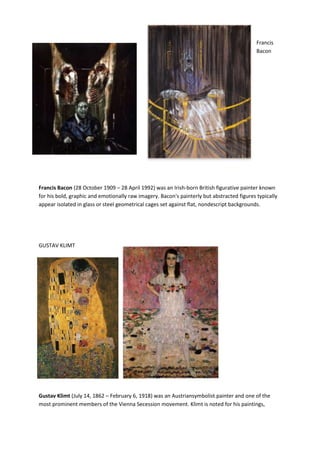
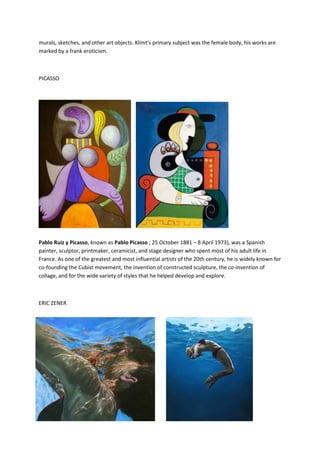
Francis Bacon (28 October 1909 – 28 April 1992) was an Irish-born British figurative painter known
for his bold, graphic and emotionally raw imagery. Bacon's painterly but abstracted figures typically
appear isolated in glass or steel geometrical cages set against flat, nondescript backgrounds.


GUSTAV KLIMT


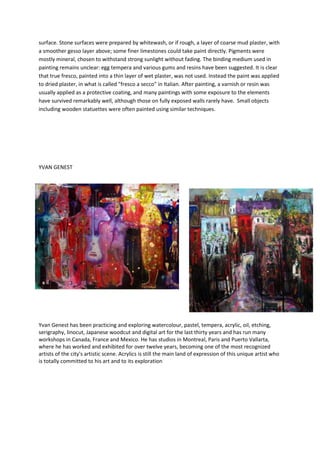
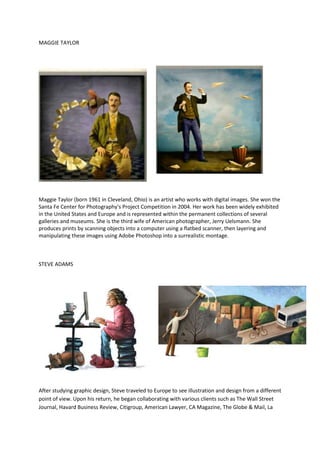
Gustav Klimt (July 14, 1862 – February 6, 1918) was an Austriansymbolist painter and one of the
most prominent members of the Vienna Secession movement. Klimt is noted for his paintings,
murals, sketches, and other art objects. Klimt's primary subject was the female body, his works are
marked by a frank eroticism.


PICASSO


Pablo Ruiz y Picasso, known as Pablo Picasso ; 25 October 1881 – 8 April 1973), was a Spanish
painter, sculptor, printmaker, ceramicist, and stage designer who spent most of his adult life in
France. As one of the greatest and most influential artists of the 20th century, he is widely known for
co-founding the Cubist movement, the invention of constructed sculpture, the co-invention of
collage, and for the wide variety of styles that he helped develop and explore.


ERIC ZENER
Eric Zener (b. 1966, Astoria, Oregon) is an American photorealist artist best known for
figure paintings of lone subjects, often in or about swimming pools.


Jason deCaires Taylor


Jason deCaires Taylor (born 12 August 1974) is an Englishsculptor specializing in the creation of
contemporary underwater sculptures which over time develop into artificial coral reefs. Taylor
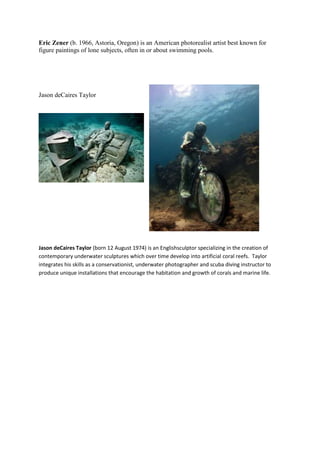
integrates his skills as a conservationist, underwater photographer and scuba diving instructor to
produce unique installations that encourage the habitation and growth of corals and marine life.
SIGMUND ABELES


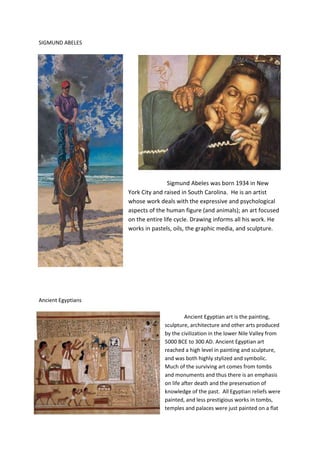
                                    Sigmund Abeles was born 1934 in New
                    York City and raised in South Carolina. He is an artist
                    whose work deals with the expressive and psychological
                    aspects of the human figure (and animals); an art focused
                    on the entire life cycle. Drawing informs all his work. He
                    works in pastels, oils, the graphic media, and sculpture.


Ancient Egyptians

                                           Ancient Egyptian art is the painting,
                                  sculpture, architecture and other arts produced
                                  by the civilization in the lower Nile Valley from
                                  5000 BCE to 300 AD. Ancient Egyptian art
                                  reached a high level in painting and sculpture,
                                  and was both highly stylized and symbolic.
                                  Much of the surviving art comes from tombs
                                  and monuments and thus there is an emphasis
                                  on life after death and the preservation of
                                  knowledge of the past. All Egyptian reliefs were
                                  painted, and less prestigious works in tombs,
                                  temples and palaces were just painted on a flat
surface. Stone surfaces were prepared by whitewash, or if rough, a layer of coarse mud plaster, with
a smoother gesso layer above; some finer limestones could take paint directly. Pigments were
mostly mineral, chosen to withstand strong sunlight without fading. The binding medium used in
painting remains unclear: egg tempera and various gums and resins have been suggested. It is clear
that true fresco, painted into a thin layer of wet plaster, was not used. Instead the paint was applied
to dried plaster, in what is called "fresco a secco" in Italian. After painting, a varnish or resin was
usually applied as a protective coating, and many paintings with some exposure to the elements
have survived remarkably well, although those on fully exposed walls rarely have. Small objects
including wooden statuettes were often painted using similar techniques.


YVAN GENEST


Yvan Genest has been practicing and exploring watercolour, pastel, tempera, acrylic, oil, etching,
serigraphy, linocut, Japanese woodcut and digital art for the last thirty years and has run many
workshops in Canada, France and Mexico. He has studios in Montreal, Paris and Puerto Vallarta,
where he has worked and exhibited for over twelve years, becoming one of the most recognized
artists of the city's artistic scene. Acrylics is still the main land of expression of this unique artist who
is totally committed to his art and to its exploration
MAGGIE TAYLOR


Maggie Taylor (born 1961 in Cleveland, Ohio) is an artist who works with digital images. She won the
Santa Fe Center for Photography's Project Competition in 2004. Her work has been widely exhibited
in the United States and Europe and is represented within the permanent collections of several
galleries and museums. She is the third wife of American photographer, Jerry Uelsmann. She
produces prints by scanning objects into a computer using a flatbed scanner, then layering and
manipulating these images using Adobe Photoshop into a surrealistic montage.


STEVE ADAMS


After studying graphic design, Steve traveled to Europe to see illustration and design from a different
point of view. Upon his return, he began collaborating with various clients such as The Wall Street
Journal, Havard Business Review, Citigroup, American Lawyer, CA Magazine, The Globe & Mail, La
Presse, L’actualité, Barefoot Books, Penguins Books, Dominique et compagnie. He also teaches
illustration at Université du Québec à Montréal.

Figurative artist

  • 1.
    Francis Bacon Francis Bacon (28 October 1909 – 28 April 1992) was an Irish-born British figurative painter known for his bold, graphic and emotionally raw imagery. Bacon's painterly but abstracted figures typically appear isolated in glass or steel geometrical cages set against flat, nondescript backgrounds. GUSTAV KLIMT Gustav Klimt (July 14, 1862 – February 6, 1918) was an Austriansymbolist painter and one of the most prominent members of the Vienna Secession movement. Klimt is noted for his paintings,
  • 2.
    murals, sketches, andother art objects. Klimt's primary subject was the female body, his works are marked by a frank eroticism. PICASSO Pablo Ruiz y Picasso, known as Pablo Picasso ; 25 October 1881 – 8 April 1973), was a Spanish painter, sculptor, printmaker, ceramicist, and stage designer who spent most of his adult life in France. As one of the greatest and most influential artists of the 20th century, he is widely known for co-founding the Cubist movement, the invention of constructed sculpture, the co-invention of collage, and for the wide variety of styles that he helped develop and explore. ERIC ZENER
  • 3.
    Eric Zener (b.1966, Astoria, Oregon) is an American photorealist artist best known for figure paintings of lone subjects, often in or about swimming pools. Jason deCaires Taylor Jason deCaires Taylor (born 12 August 1974) is an Englishsculptor specializing in the creation of contemporary underwater sculptures which over time develop into artificial coral reefs. Taylor integrates his skills as a conservationist, underwater photographer and scuba diving instructor to produce unique installations that encourage the habitation and growth of corals and marine life.
  • 4.
    SIGMUND ABELES Sigmund Abeles was born 1934 in New York City and raised in South Carolina. He is an artist whose work deals with the expressive and psychological aspects of the human figure (and animals); an art focused on the entire life cycle. Drawing informs all his work. He works in pastels, oils, the graphic media, and sculpture. Ancient Egyptians Ancient Egyptian art is the painting, sculpture, architecture and other arts produced by the civilization in the lower Nile Valley from 5000 BCE to 300 AD. Ancient Egyptian art reached a high level in painting and sculpture, and was both highly stylized and symbolic. Much of the surviving art comes from tombs and monuments and thus there is an emphasis on life after death and the preservation of knowledge of the past. All Egyptian reliefs were painted, and less prestigious works in tombs, temples and palaces were just painted on a flat
  • 5.
    surface. Stone surfaceswere prepared by whitewash, or if rough, a layer of coarse mud plaster, with a smoother gesso layer above; some finer limestones could take paint directly. Pigments were mostly mineral, chosen to withstand strong sunlight without fading. The binding medium used in painting remains unclear: egg tempera and various gums and resins have been suggested. It is clear that true fresco, painted into a thin layer of wet plaster, was not used. Instead the paint was applied to dried plaster, in what is called "fresco a secco" in Italian. After painting, a varnish or resin was usually applied as a protective coating, and many paintings with some exposure to the elements have survived remarkably well, although those on fully exposed walls rarely have. Small objects including wooden statuettes were often painted using similar techniques. YVAN GENEST Yvan Genest has been practicing and exploring watercolour, pastel, tempera, acrylic, oil, etching, serigraphy, linocut, Japanese woodcut and digital art for the last thirty years and has run many workshops in Canada, France and Mexico. He has studios in Montreal, Paris and Puerto Vallarta, where he has worked and exhibited for over twelve years, becoming one of the most recognized artists of the city's artistic scene. Acrylics is still the main land of expression of this unique artist who is totally committed to his art and to its exploration
  • 6.
    MAGGIE TAYLOR Maggie Taylor(born 1961 in Cleveland, Ohio) is an artist who works with digital images. She won the Santa Fe Center for Photography's Project Competition in 2004. Her work has been widely exhibited in the United States and Europe and is represented within the permanent collections of several galleries and museums. She is the third wife of American photographer, Jerry Uelsmann. She produces prints by scanning objects into a computer using a flatbed scanner, then layering and manipulating these images using Adobe Photoshop into a surrealistic montage. STEVE ADAMS After studying graphic design, Steve traveled to Europe to see illustration and design from a different point of view. Upon his return, he began collaborating with various clients such as The Wall Street Journal, Havard Business Review, Citigroup, American Lawyer, CA Magazine, The Globe & Mail, La
  • 7.
    Presse, L’actualité, BarefootBooks, Penguins Books, Dominique et compagnie. He also teaches illustration at Université du Québec à Montréal.