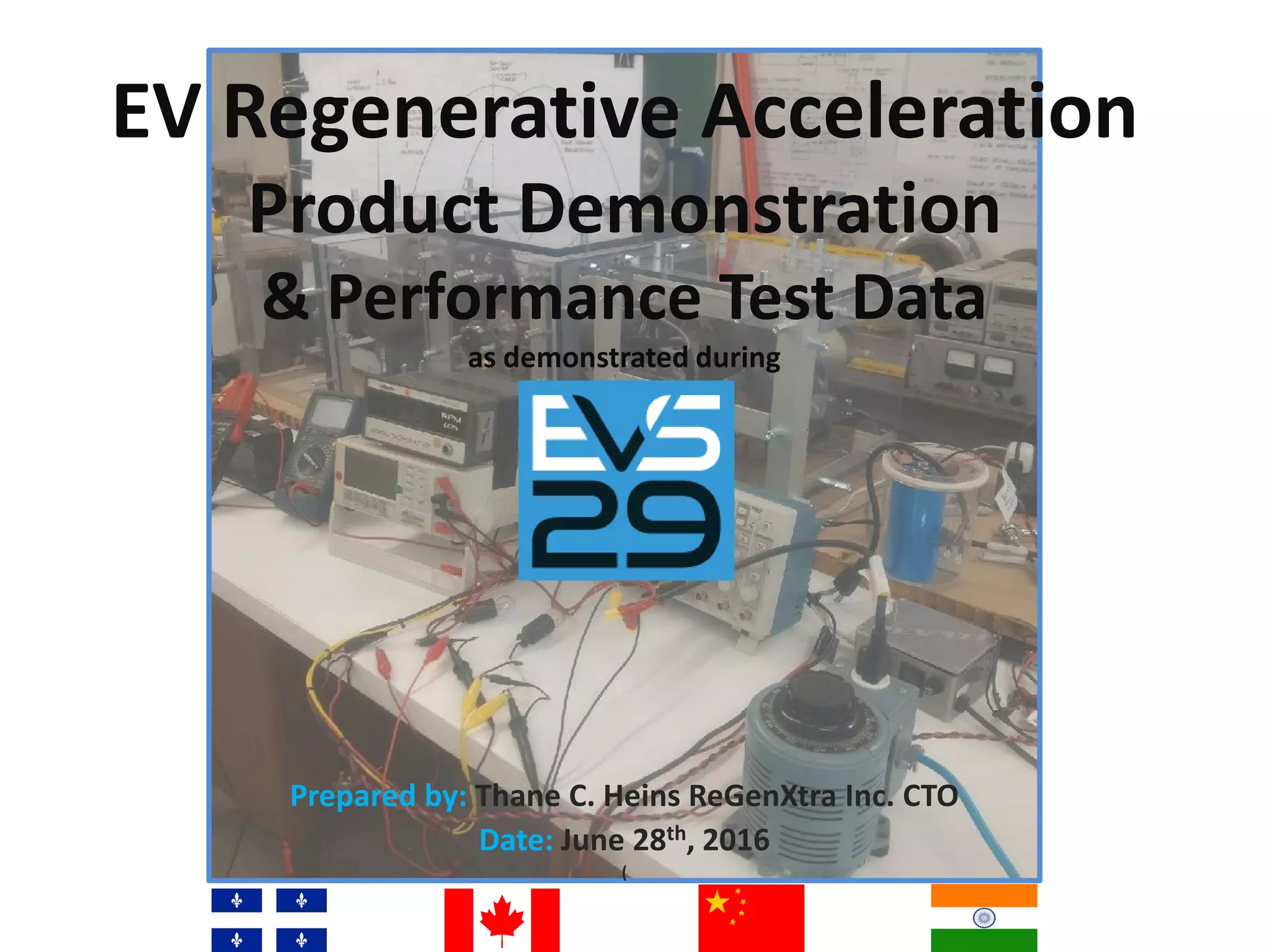
EV Regenerative Acceleration
Product Demonstration
& Performance Test Data
as demonstrated during
Prepared by: Thane C. Heins ReGenXtra Inc. CTO
Date: June 28th, 2016
(
ReGenXtra Inc. ReGenX Demonstration
during EVS 29 June 2016
• The electric vehicle (EV) Regenerative Acceleration (ReGenX)
innovation employs a Load Current Delay in order to reverse the
electric vehicle regenerative braking paradigm and allow for
continuous battery recharging during all modes of EV operation.
• ReGenXtra has conducted significant R&D on the ReGenX
innovation since the original Regenerative Acceleration discovery in
2007.
• This demonstration incorporates two different prototypes.
• Each one has been built to showcase the various aspects of the
Regenerative Acceleration innovation.
ReGenXtra Inc. ReGenX Product Demonstration
during EVS 29 June 2016
The three demonstration prototypes include the following:
1. ReGenX Generator Prototype #1:
• Incorporating a conventional generator coil and a ReGenX
Generator coil placed on the same core,
• highlighting the Load Current Sine Waves of each coil .
• Conventional generator coil regenerative braking,
• and Regenerative Acceleration as caused by the ReGenX
Generator’s Load Current Delay.
2. ReGenX Generator Prototype #2:
• Operating above and below the ReGenX coil’s Critical Minimum
Frequency.
Demonstration Prototype #1
EV Regenerative Acceleration Generator
Load Current Delay
ReGenX Generator prototype #1 incorporates :
• a conventional generator coil and a ReGenX Generator coil
• Both coils are placed on the same core and influenced by the
same rotor magnets at the same time.
• This prototype showcases how and why the Regenerative
Acceleration phenomenon is produced.
• The ReGenX coil Load Current is delayed by approximately 45
degrees.
• This Load Current Delay as demonstrated on the oscilloscope is
responsible for EV Regenerative Acceleration because delaying the
coil’s load current also delays the coil’s induced magnetic field and
how and when this induced magnetic field affects the rotor.
Demonstration Prototype #1
EV Regenerative Acceleration Generator
Load Current Delay
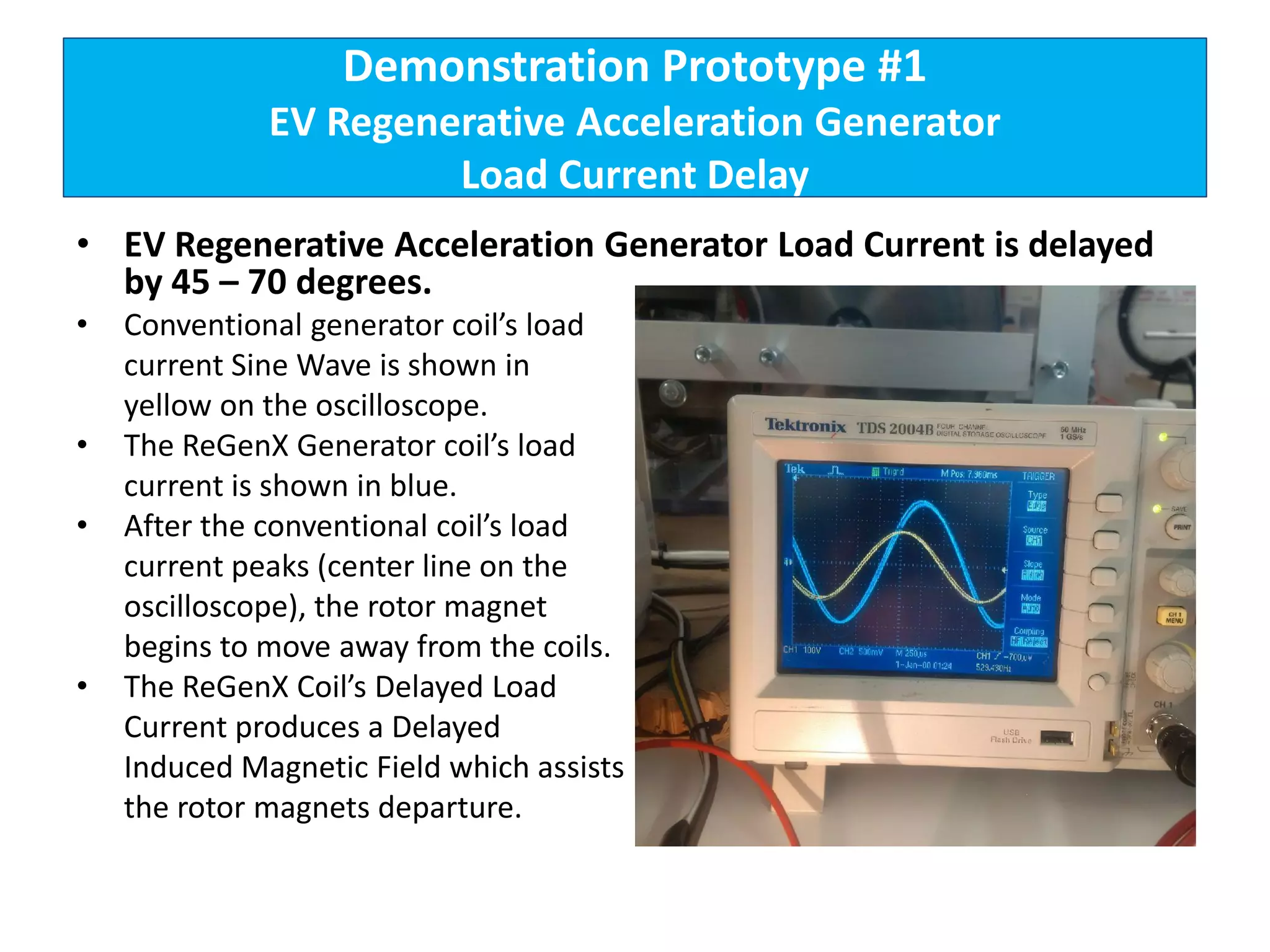
• EV Regenerative Acceleration Generator Load Current is delayed
by 45 – 70 degrees.
• Conventional generator coil’s load
current Sine Wave is shown in
yellow on the oscilloscope.
• The ReGenX Generator coil’s load
current is shown in blue.
• After the conventional coil’s load
current peaks (center line on the
oscilloscope), the rotor magnet
begins to move away from the coils.
• The ReGenX Coil’s Delayed Load
Current produces a Delayed
Induced Magnetic Field which assists
the rotor magnets departure.
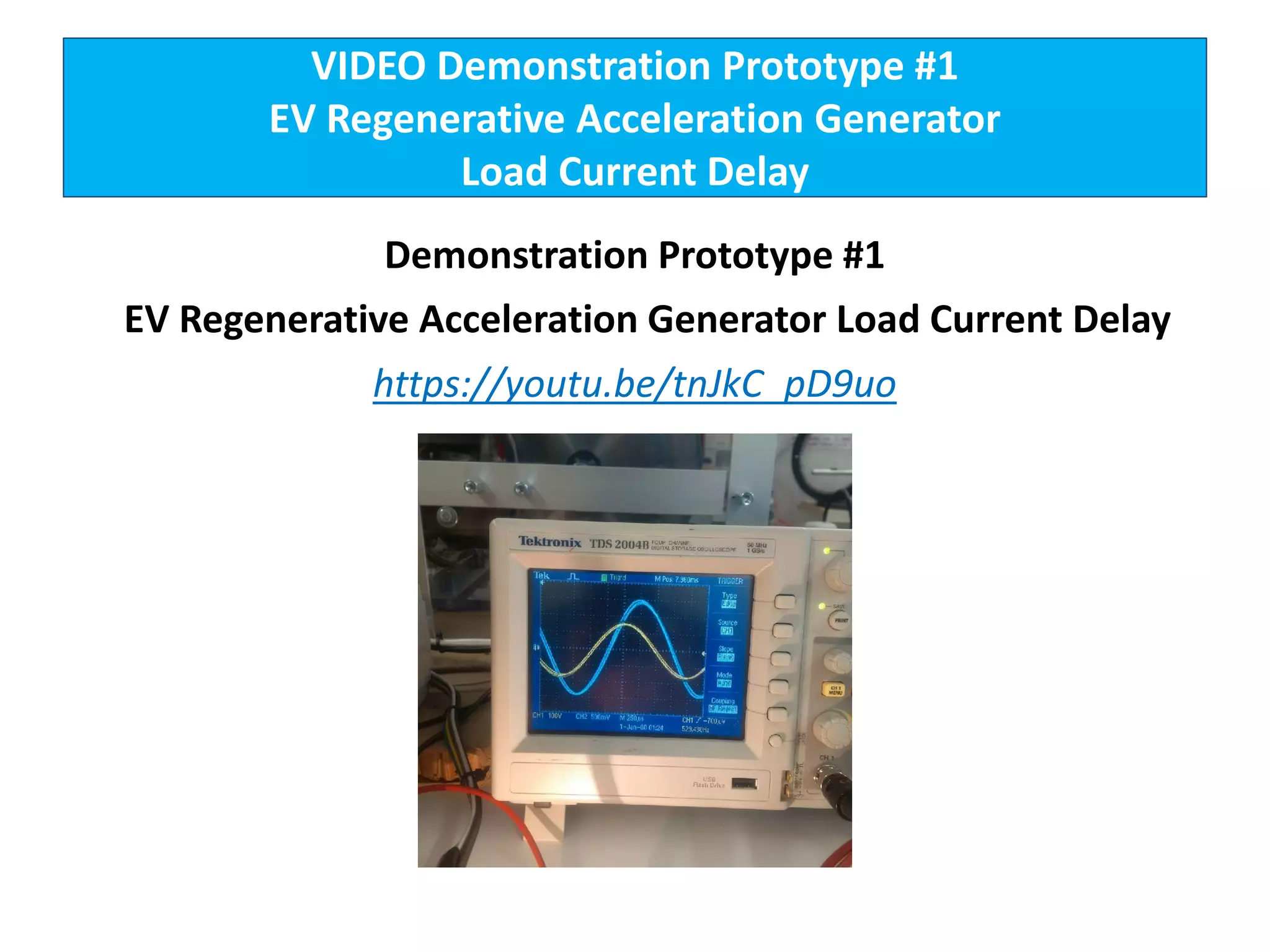
VIDEO Demonstration Prototype #1
EV Regenerative Acceleration Generator
Load Current Delay
Demonstration Prototype #1
EV Regenerative Acceleration Generator Load Current Delay
https://youtu.be/tnJkC_pD9uo
PERFORMANCE DATA
EV Regenerative Acceleration Generator
Demonstration Prototype #1
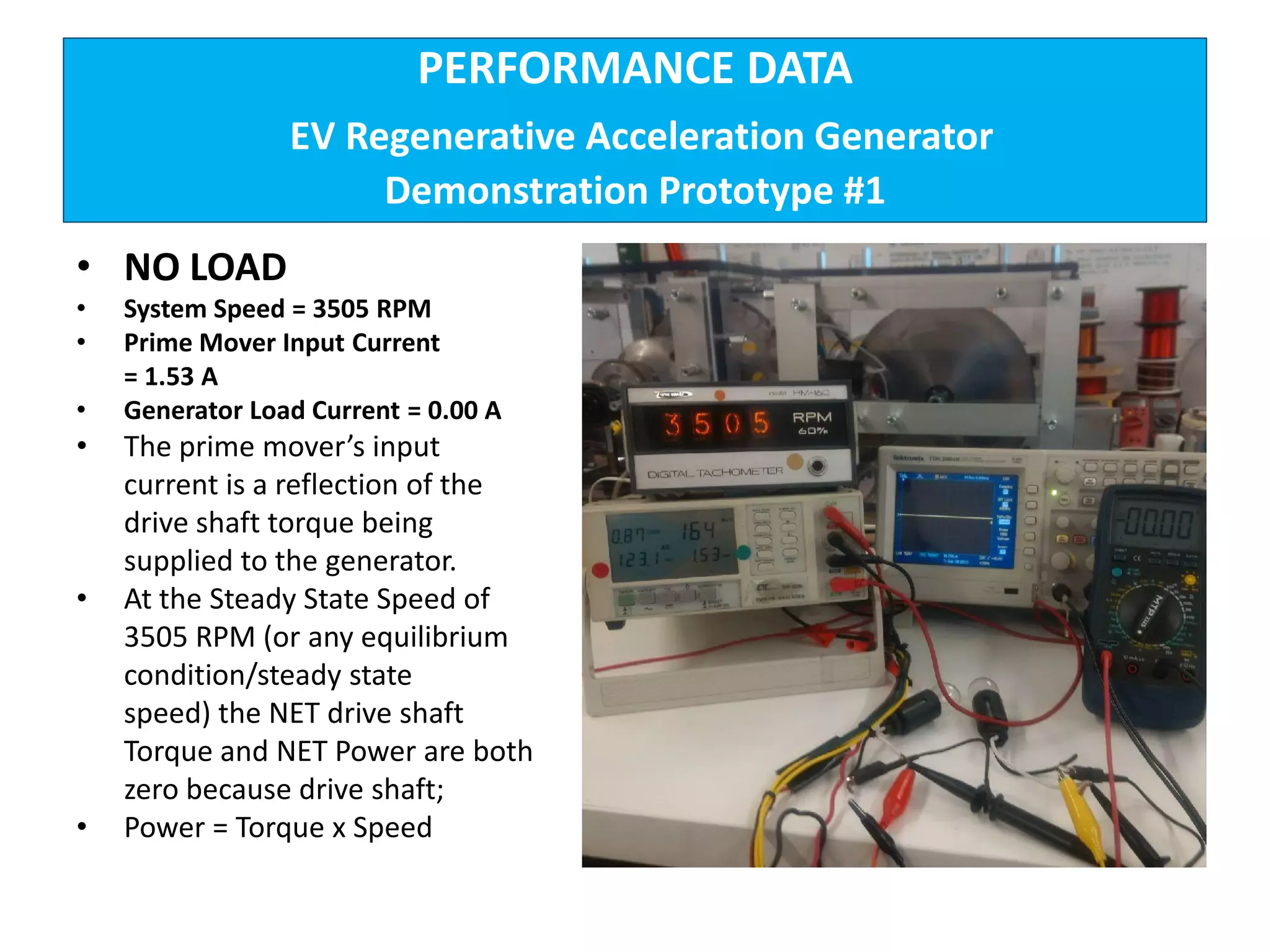
• NO LOAD
• System Speed = 3505 RPM
• Prime Mover Input Current
= 1.53 A
• Generator Load Current = 0.00 A
• The prime mover’s input
current is a reflection of the
drive shaft torque being
supplied to the generator.
• At the Steady State Speed of
3505 RPM (or any equilibrium
condition/steady state
speed) the NET drive shaft
Torque and NET Power are both
zero because drive shaft;
• Power = Torque x Speed
PERFORMANCE DATA
EV Regenerative Acceleration Generator
Demonstration Prototype #1
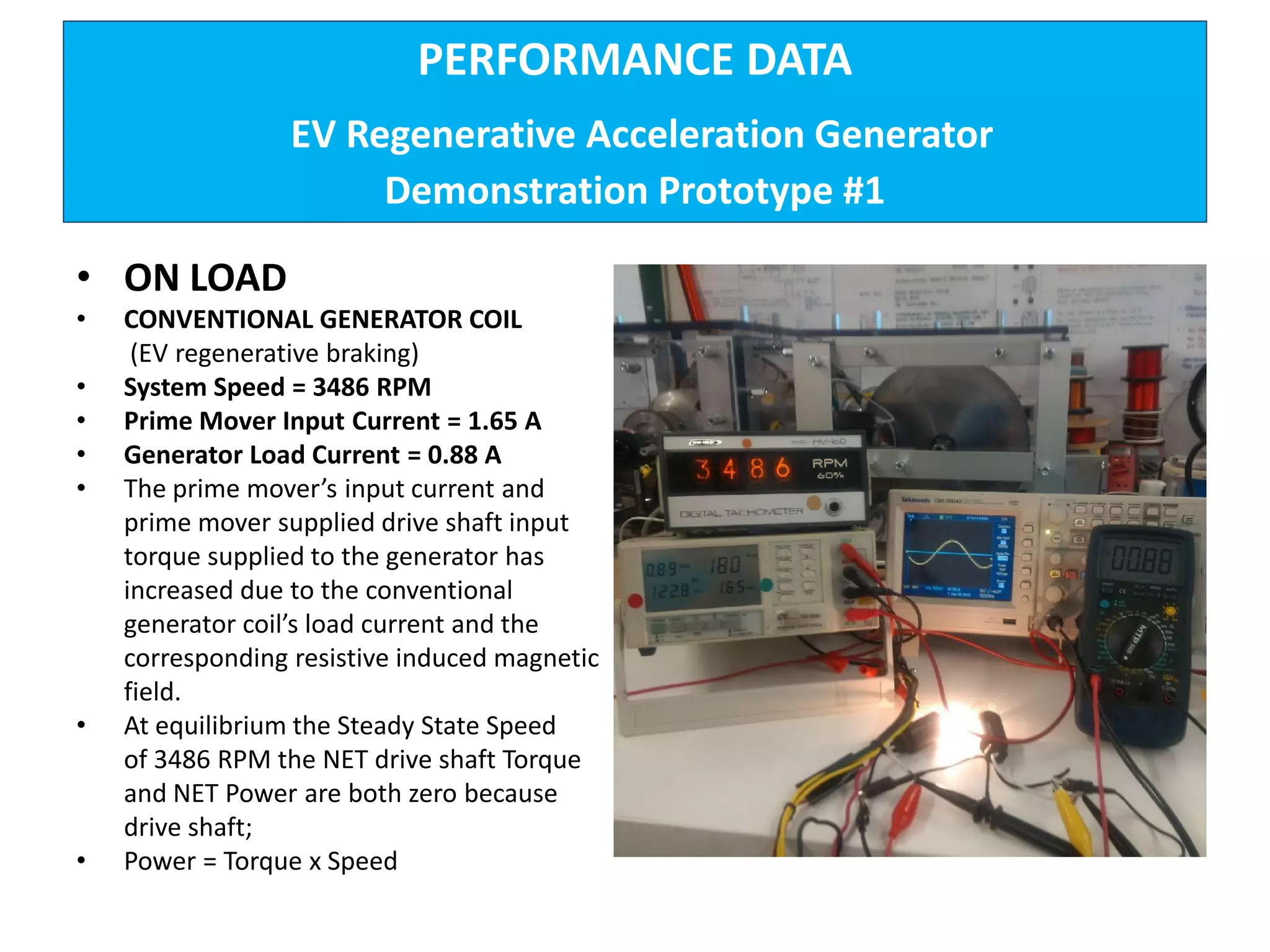
• ON LOAD
• CONVENTIONAL GENERATOR COIL
(EV regenerative braking)
• System Speed = 3486 RPM
• Prime Mover Input Current = 1.65 A
• Generator Load Current = 0.88 A
• The prime mover’s input current and
prime mover supplied drive shaft input
torque supplied to the generator has
increased due to the conventional
generator coil’s load current and the
corresponding resistive induced magnetic
field.
• At equilibrium the Steady State Speed
of 3486 RPM the NET drive shaft Torque
and NET Power are both zero because
drive shaft;
• Power = Torque x Speed
PERFORMANCE DATA
EV Regenerative Acceleration Generator
Demonstration Prototype #1
• ON LOAD
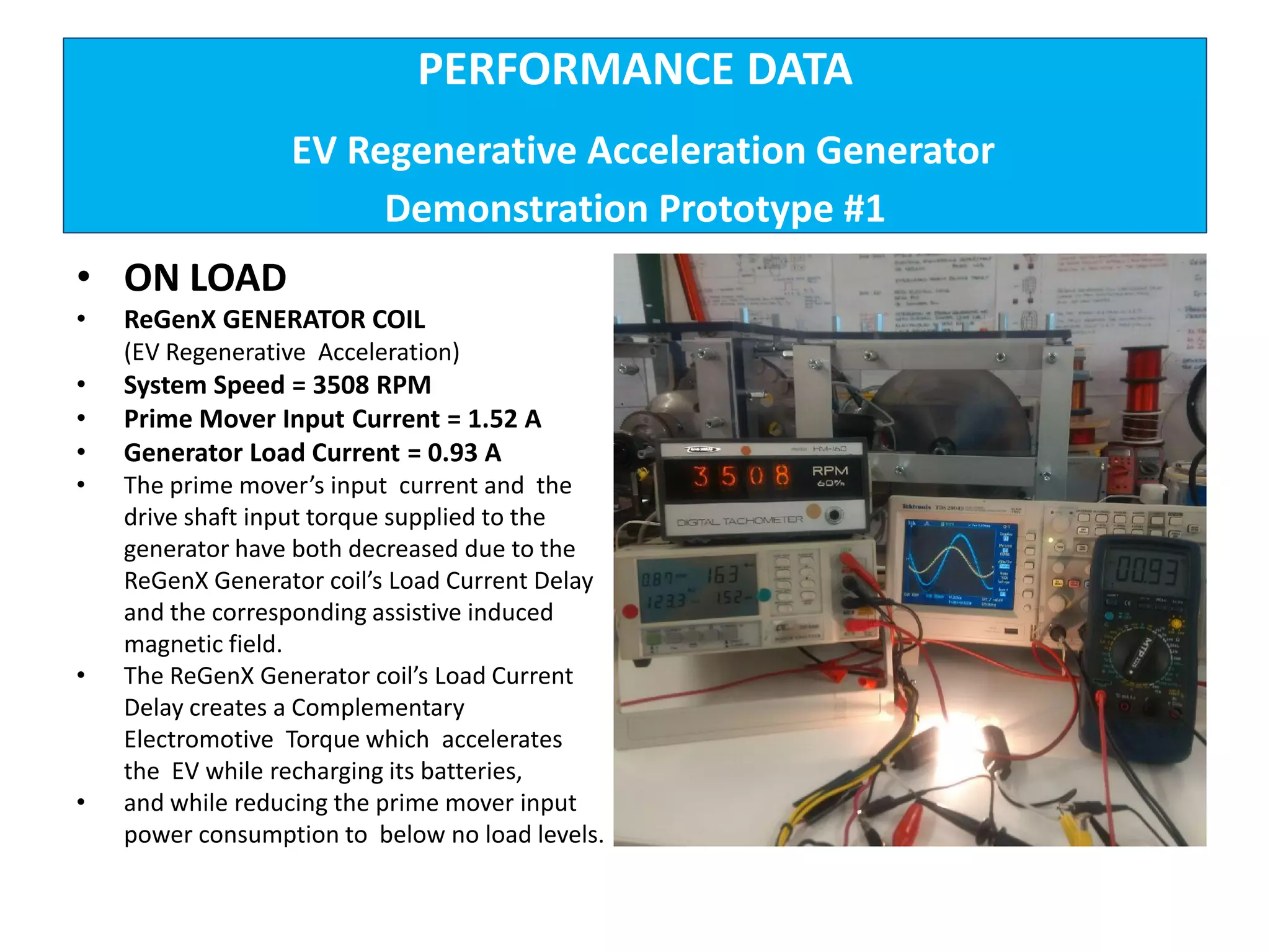
• ReGenX GENERATOR COIL
(EV Regenerative Acceleration)
• System Speed = 3508 RPM
• Prime Mover Input Current = 1.52 A
• Generator Load Current = 0.93 A
• The prime mover’s input current and the
drive shaft input torque supplied to the
generator have both decreased due to the
ReGenX Generator coil’s Load Current Delay
and the corresponding assistive induced
magnetic field.
• The ReGenX Generator coil’s Load Current
Delay creates a Complementary
Electromotive Torque which accelerates
the EV while recharging its batteries,
• and while reducing the prime mover input
power consumption to below no load levels.
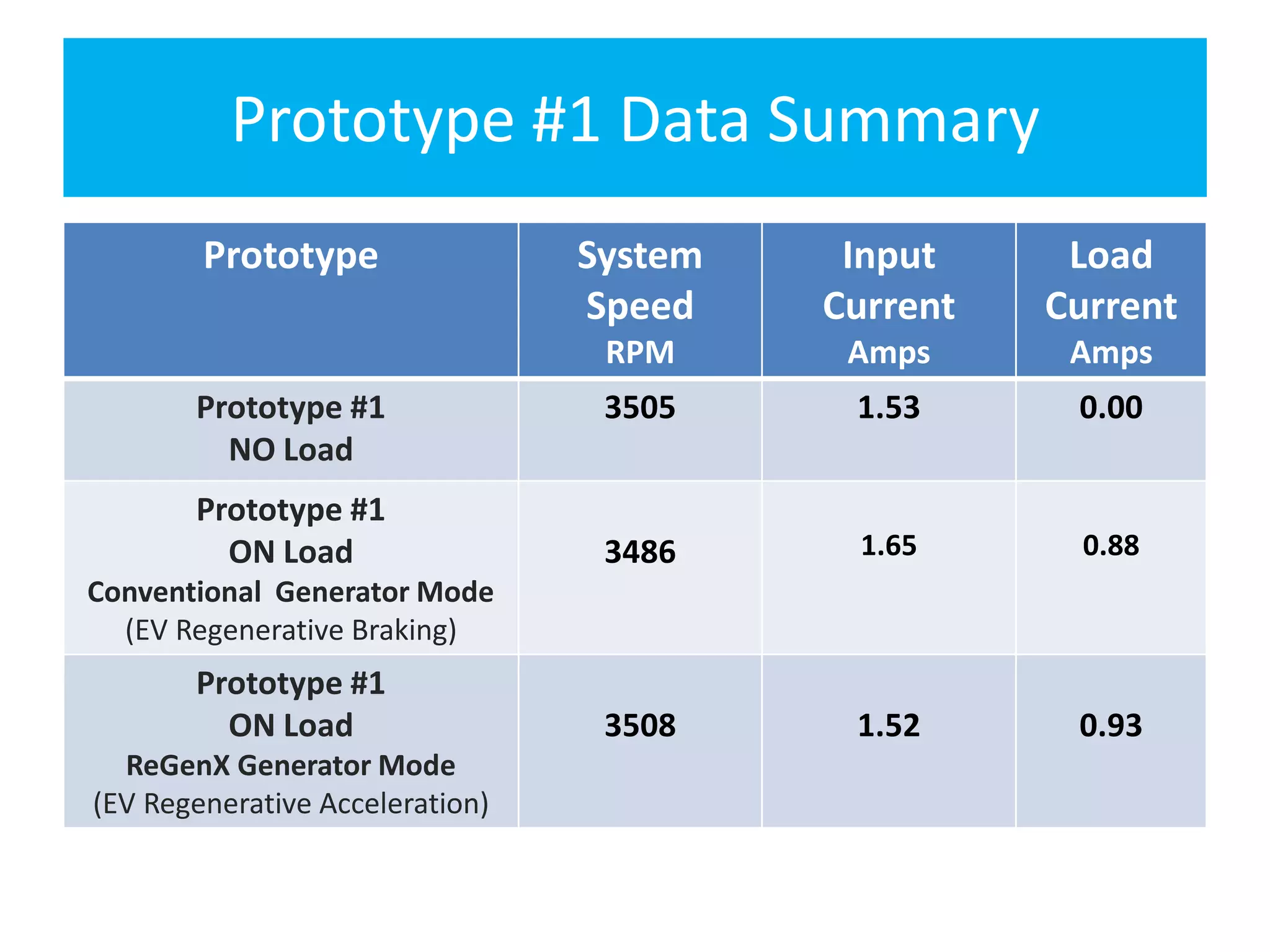
Prototype #1 Data Summary
Prototype System
Speed
RPM
Input
Current
Amps
Load
Current
Amps
Prototype #1
NO Load
3505 1.53 0.00
Prototype #1
ON Load
Conventional Generator Mode
(EV Regenerative Braking)
3486 1.65 0.88
Prototype #1
ON Load
ReGenX Generator Mode
(EV Regenerative Acceleration)
3508 1.52 0.93
Prototype #1 Data Analysis
ReGenX Generator Mode
EV Regenerative Acceleration Operation
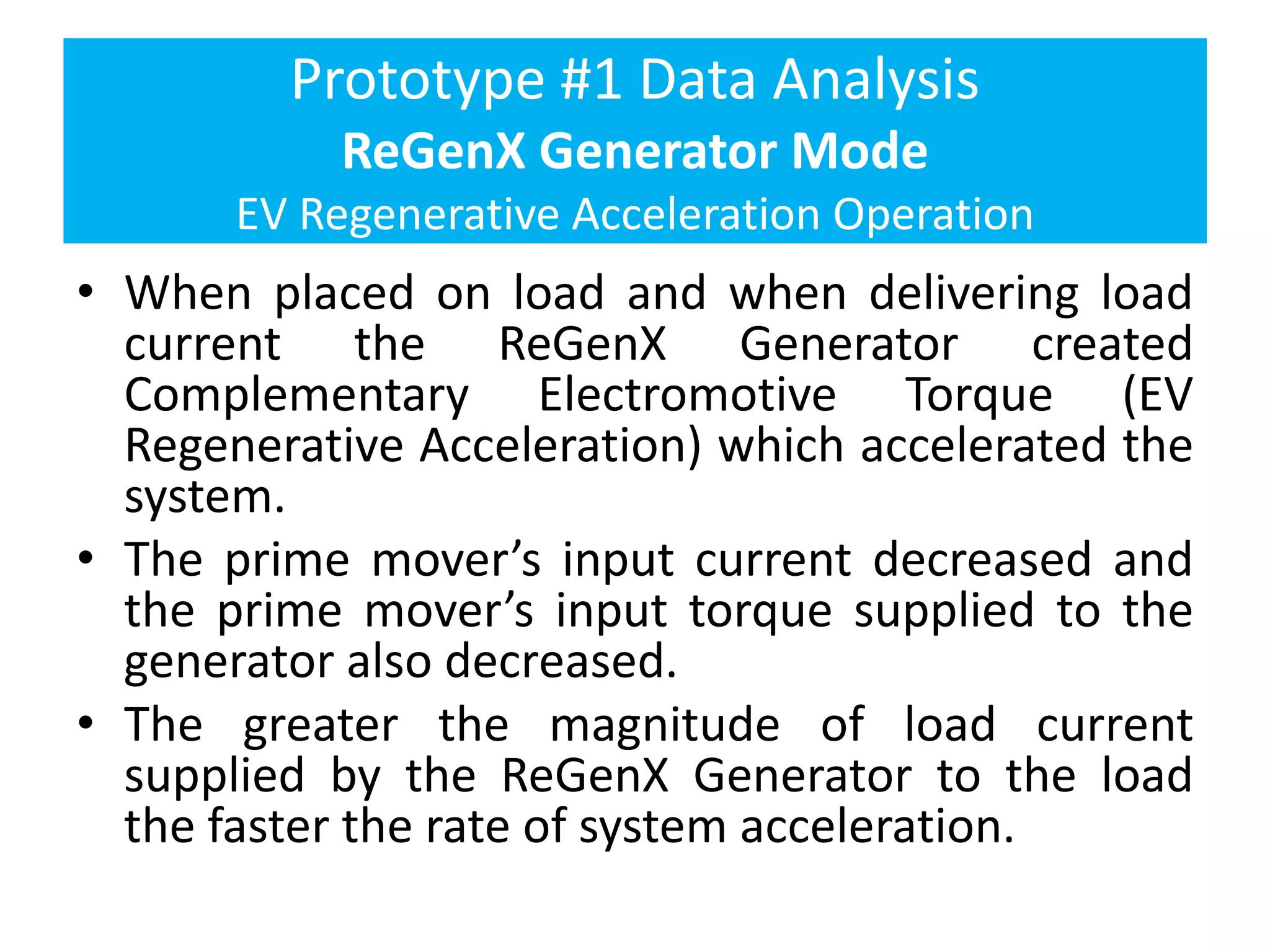
• When placed on load and when delivering load
current the ReGenX Generator created
Complementary Electromotive Torque (EV
Regenerative Acceleration) which accelerated the
system.
• The prime mover’s input current decreased and
the prime mover’s input torque supplied to the
generator also decreased.
• The greater the magnitude of load current
supplied by the ReGenX Generator to the load
the faster the rate of system acceleration.
Demonstration Prototype #2
EV Regenerative Acceleration Generator
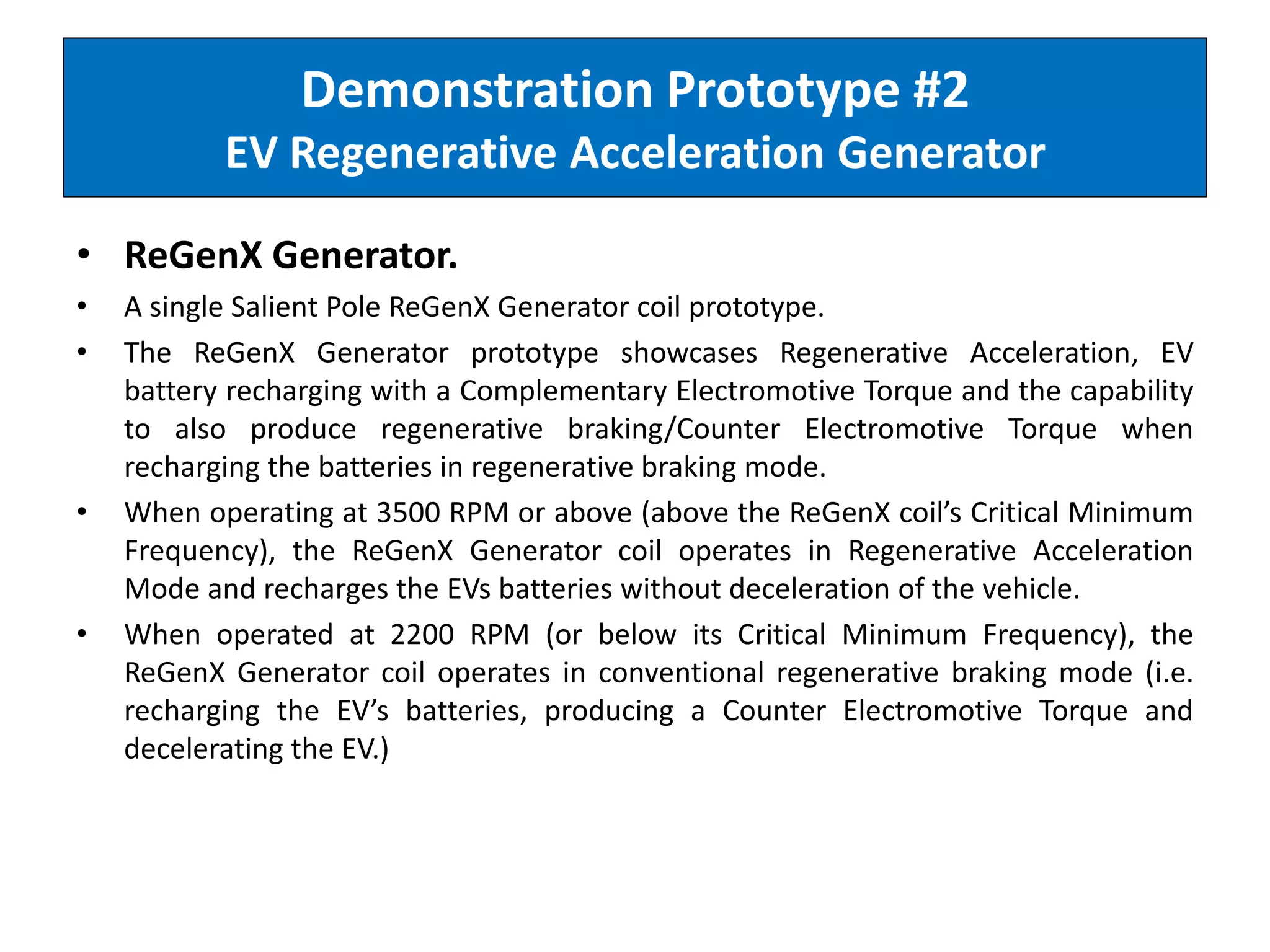
• ReGenX Generator.
• A single Salient Pole ReGenX Generator coil prototype.
• The ReGenX Generator prototype showcases Regenerative Acceleration, EV
battery recharging with a Complementary Electromotive Torque and the capability
to also produce regenerative braking/Counter Electromotive Torque when
recharging the batteries in regenerative braking mode.
• When operating at 3500 RPM or above (above the ReGenX coil’s Critical Minimum
Frequency), the ReGenX Generator coil operates in Regenerative Acceleration
Mode and recharges the EVs batteries without deceleration of the vehicle.
• When operated at 2200 RPM (or below its Critical Minimum Frequency), the
ReGenX Generator coil operates in conventional regenerative braking mode (i.e.
recharging the EV’s batteries, producing a Counter Electromotive Torque and
decelerating the EV.)
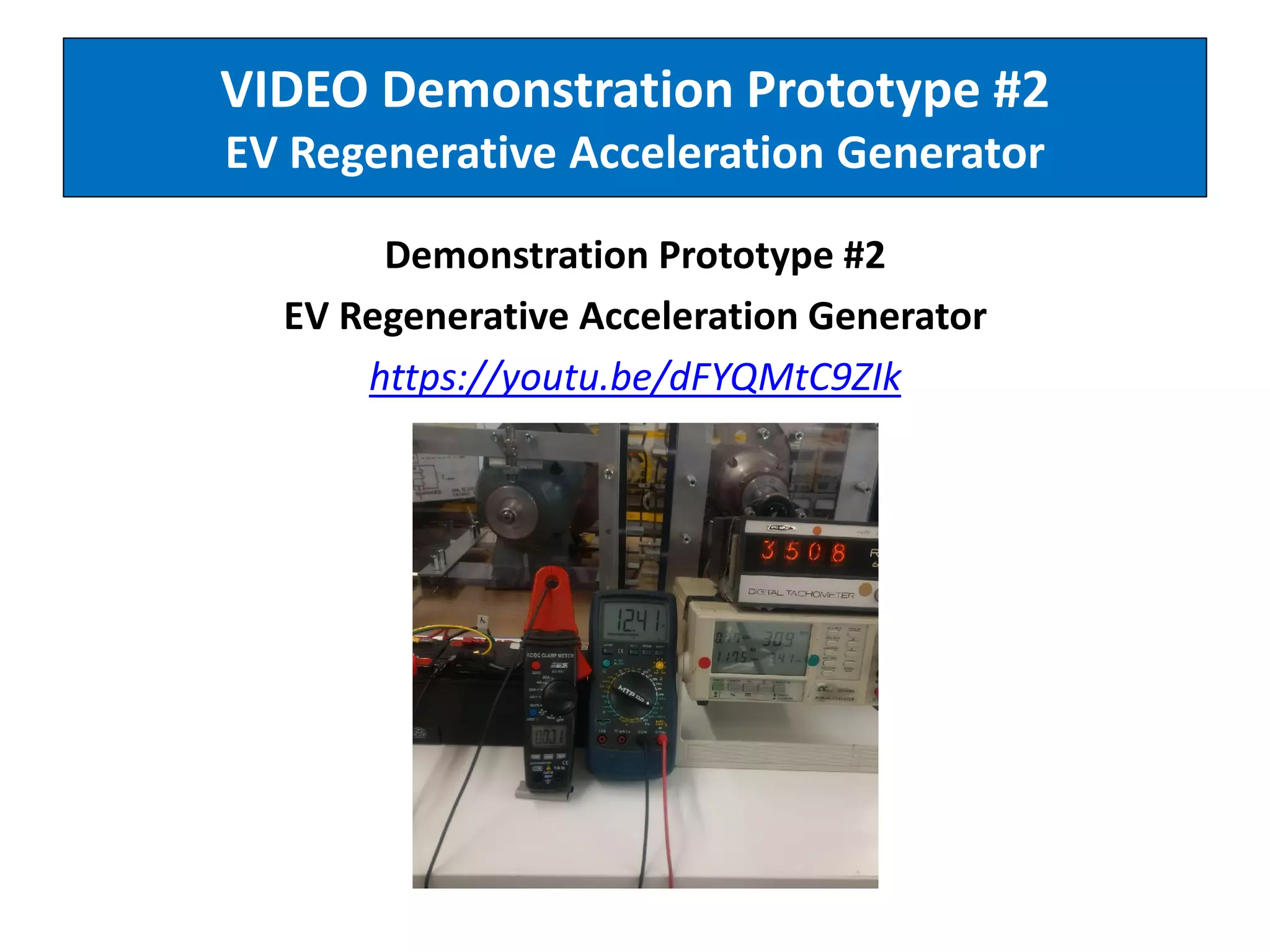
VIDEO Demonstration Prototype #2
EV Regenerative Acceleration Generator
Demonstration Prototype #2
EV Regenerative Acceleration Generator
https://youtu.be/dFYQMtC9ZIk
PERFORMANCE DATA
EV Regenerative Acceleration Generator
Demonstration Prototype #2
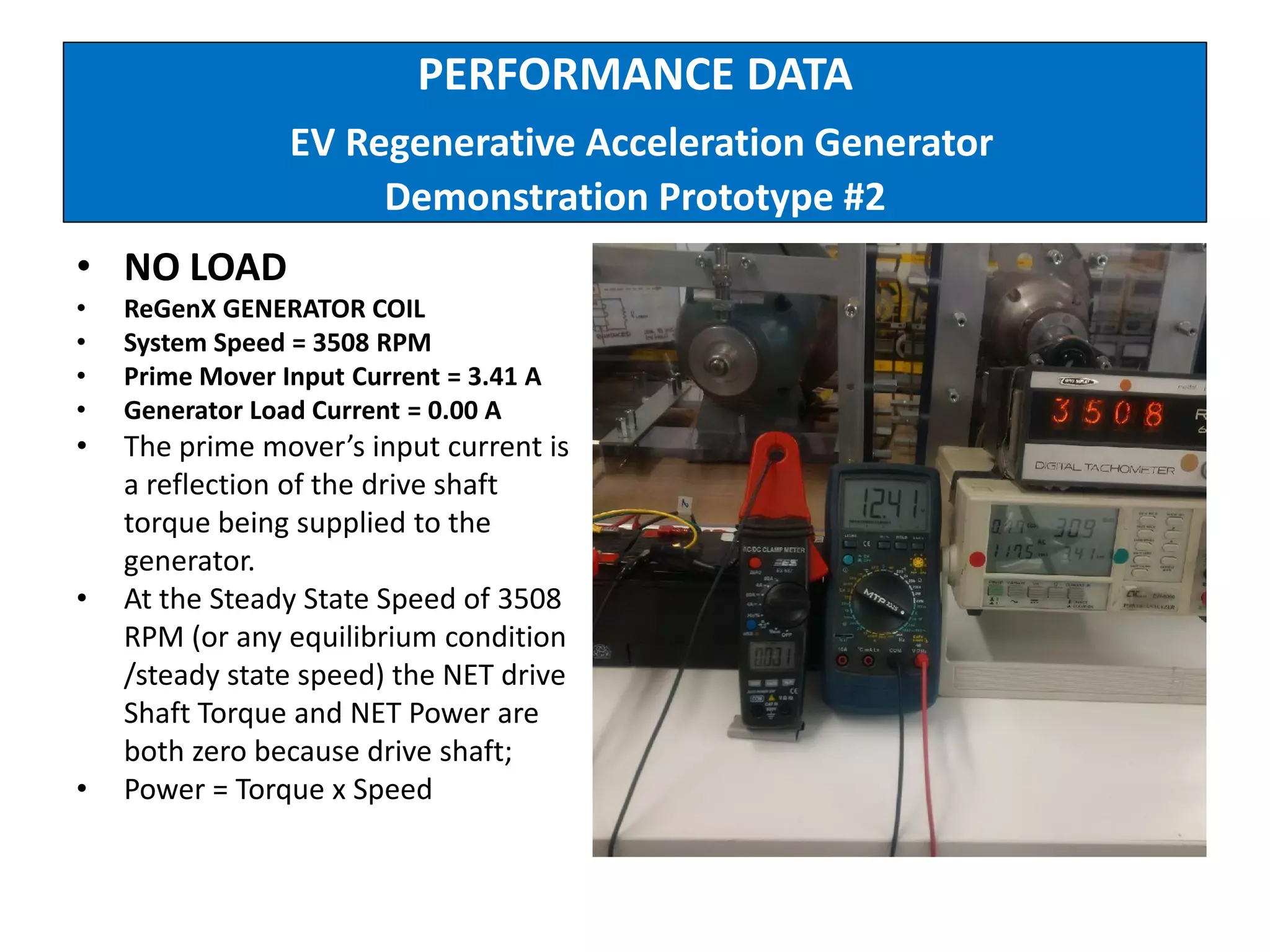
• NO LOAD
• ReGenX GENERATOR COIL
• System Speed = 3508 RPM
• Prime Mover Input Current = 3.41 A
• Generator Load Current = 0.00 A
• The prime mover’s input current is
a reflection of the drive shaft
torque being supplied to the
generator.
• At the Steady State Speed of 3508
RPM (or any equilibrium condition
/steady state speed) the NET drive
Shaft Torque and NET Power are
both zero because drive shaft;
• Power = Torque x Speed
PERFORMANCE DATA
EV Regenerative Acceleration Generator
Demonstration Prototype #2
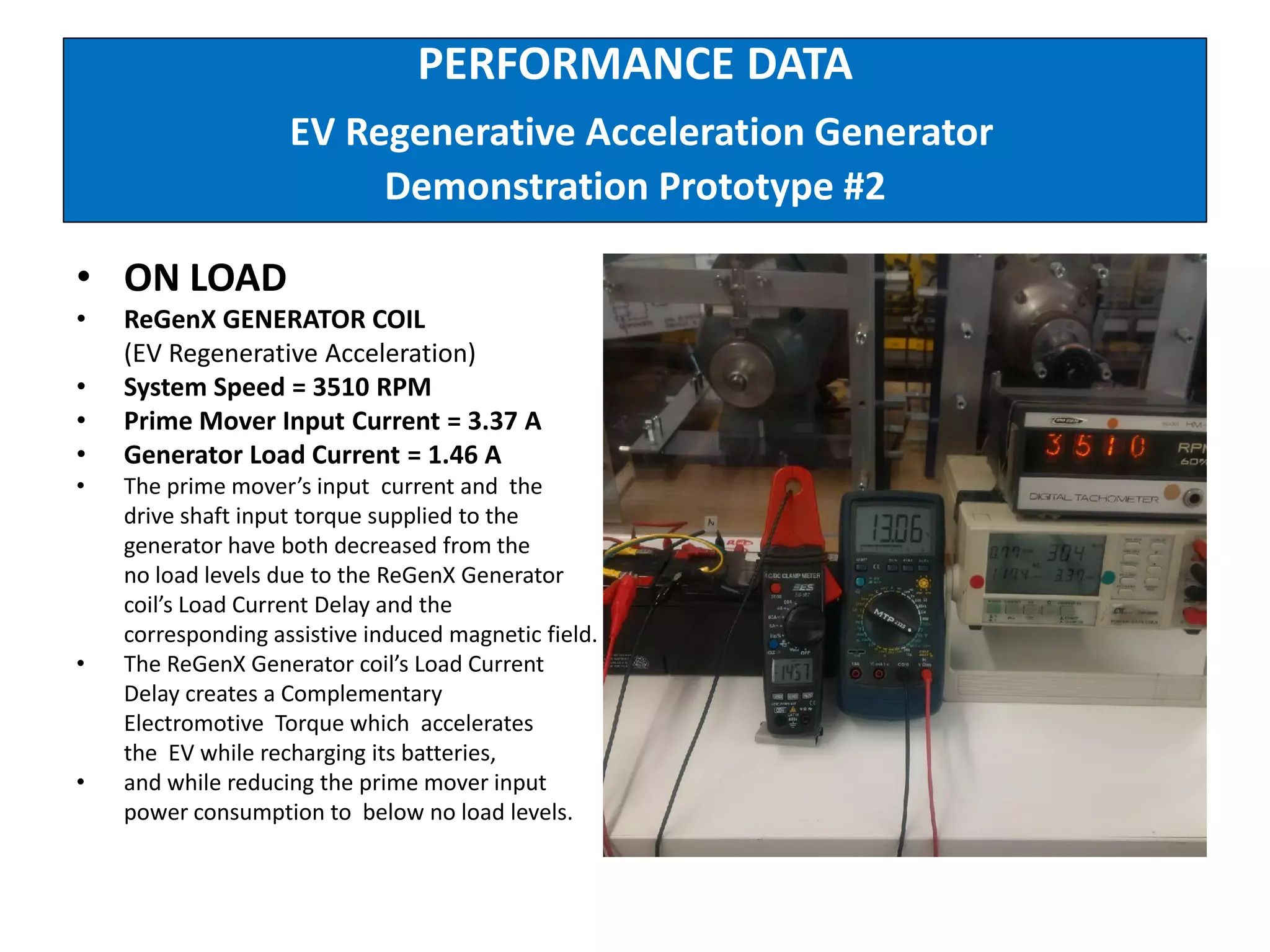
• ON LOAD
• ReGenX GENERATOR COIL
(EV Regenerative Acceleration)
• System Speed = 3510 RPM
• Prime Mover Input Current = 3.37 A
• Generator Load Current = 1.46 A
• The prime mover’s input current and the
drive shaft input torque supplied to the
generator have both decreased from the
no load levels due to the ReGenX Generator
coil’s Load Current Delay and the
corresponding assistive induced magnetic field.
• The ReGenX Generator coil’s Load Current
Delay creates a Complementary
Electromotive Torque which accelerates
the EV while recharging its batteries,
• and while reducing the prime mover input
power consumption to below no load levels.
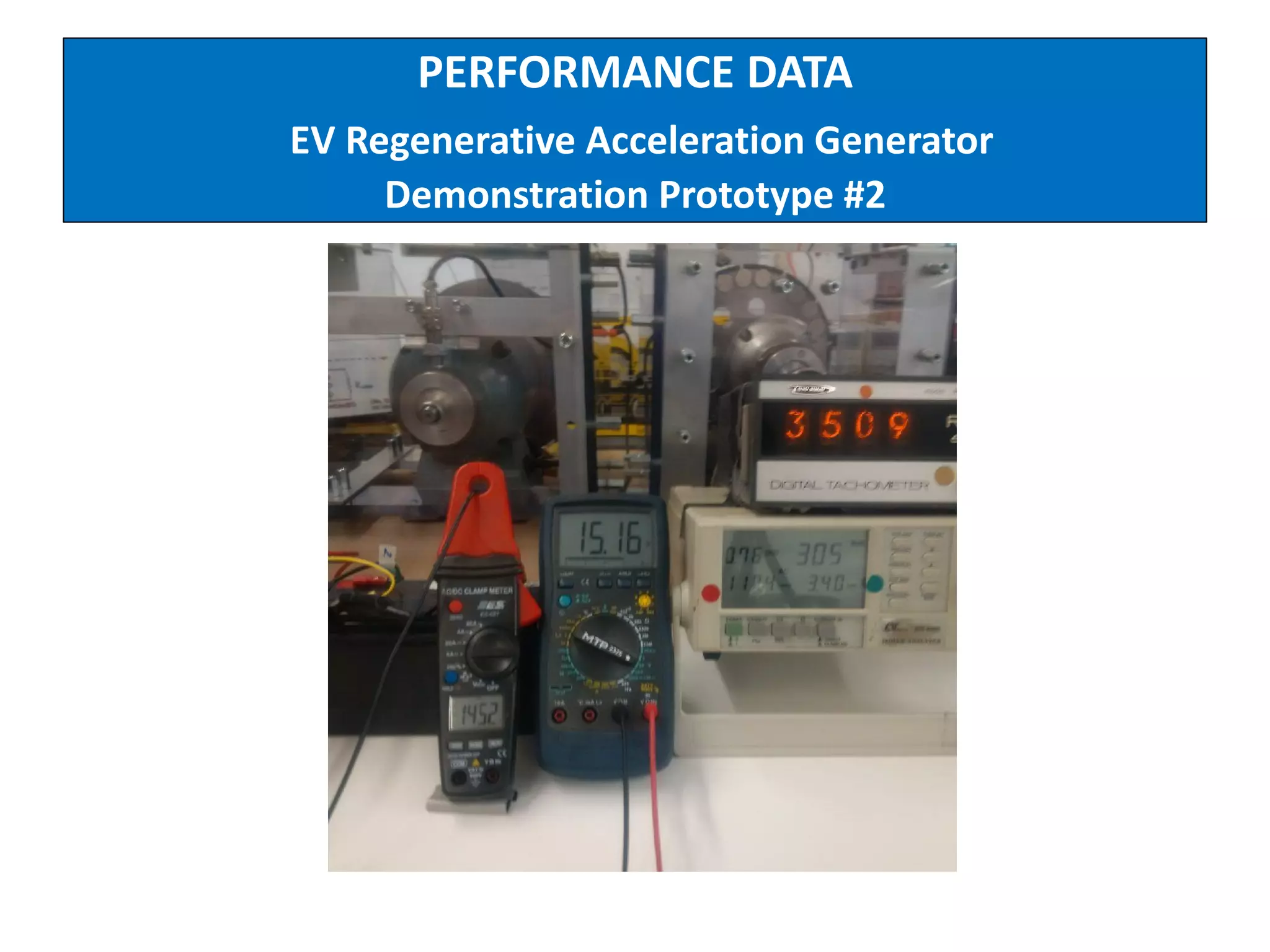
PERFORMANCE DATA
EV Regenerative Acceleration Generator
Demonstration Prototype #2
PERFORMANCE DATA
EV Regenerative Acceleration Generator
Demonstration Prototype #2
• Operating Below the Critical Minimum Frequency
• The primary factor dictating Regenerative Acceleration performance is frequency of operation
because frequency of operation dictates the coil’s Impedence from the equation:
ZT = XL + RDC
where the coil’s Inductive Reactance is:
XL = 2 π F L
such that:
ZT = 2 π F L + RDC
• When the coils operational frequency (F) is increased the coil’s impedence (ZT) also increases.
• When impedence increases load current flow decreases and if ZT is high enough load current flow ceases
altogether.
• When load current flow ceases the ReGenX coil cannot store energy in the Electromagnetic Field around
the coil as an inductor and is forced to store energy Electrostatically inside the coil as a capacitor.
• When the induced voltage in the ReGenX coil exceeds the dielectric's ability to store it – the dielectric
breaks down and load current begins to flow - but the delay has already occurred and the ReGenX coil’s
Delayed Load Current peaks when the rotor magnet is now moving away from the coil.
• The result is the receding rotor magnet ‘s departure and the approaching rotor magnet’s approach are
both accelerated in the process while load current is delivered to the EV’s batteries without deceleration
of the EV.
VIDEO Demonstration Prototype #2
EV Regenerative Acceleration Generator
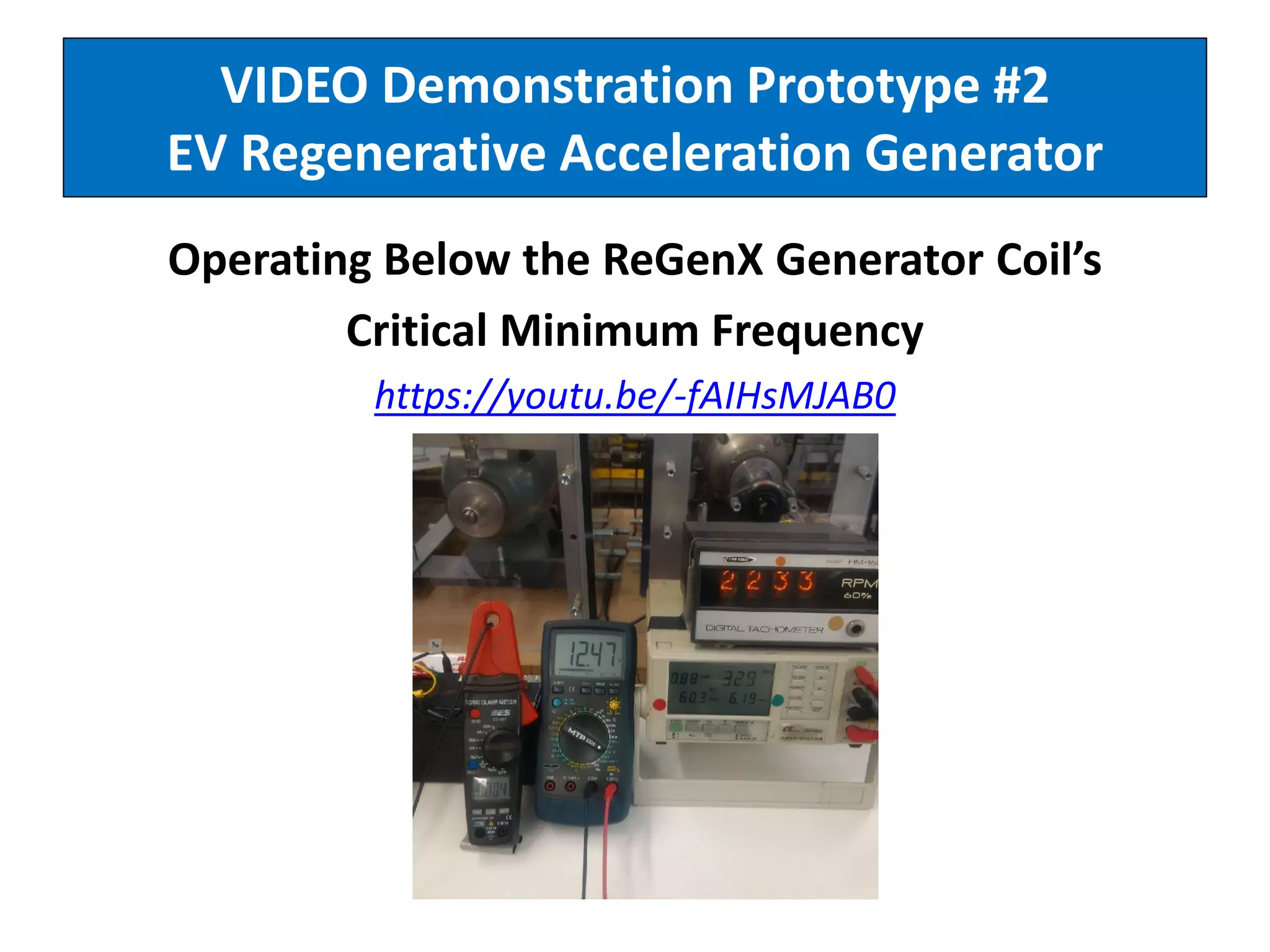
Operating Below the ReGenX Generator Coil’s
Critical Minimum Frequency
https://youtu.be/-fAIHsMJAB0
PERFORMANCE DATA
EV Regenerative Acceleration Generator
Demonstration Prototype #2
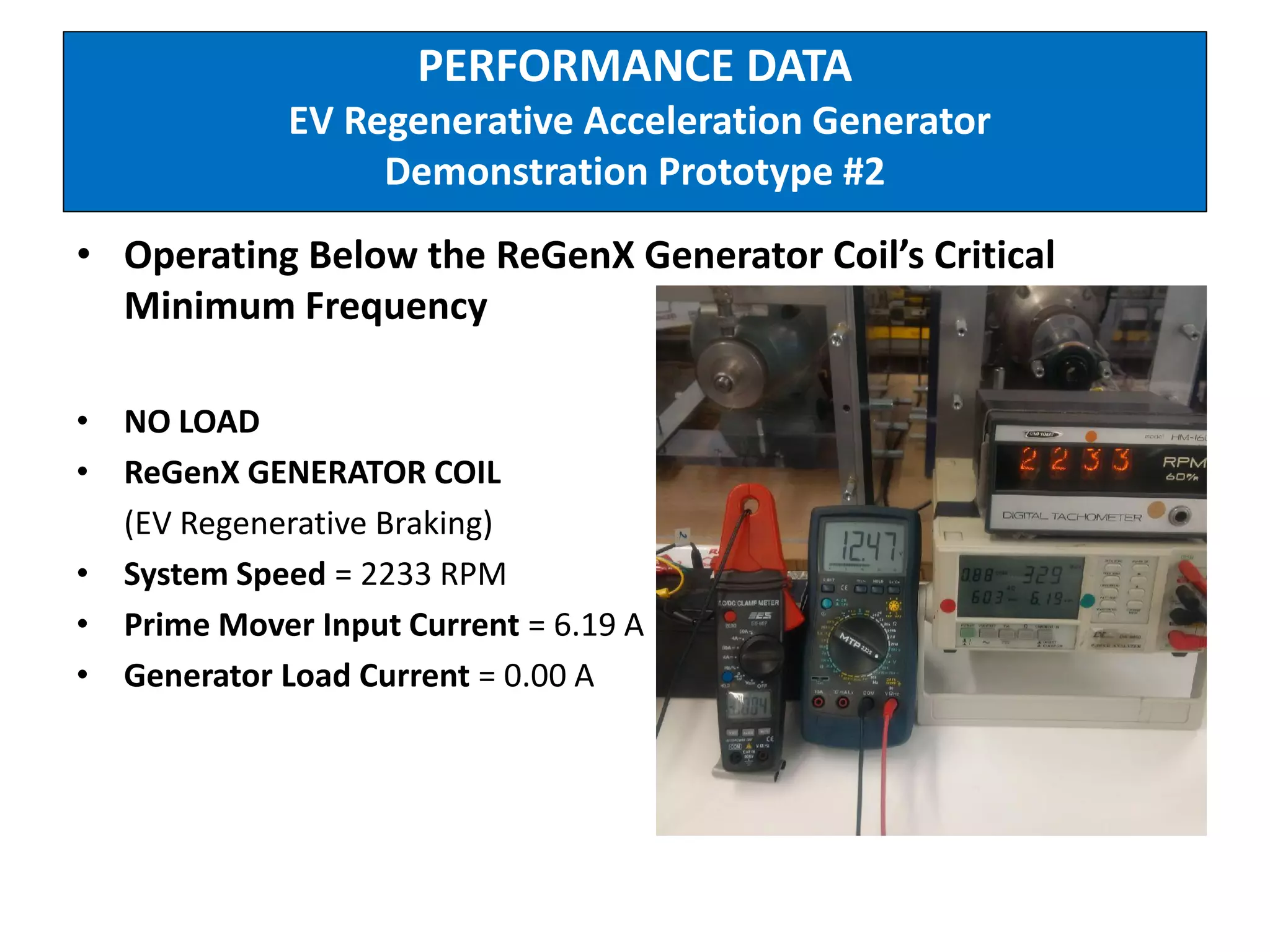
• Operating Below the ReGenX Generator Coil’s Critical
Minimum Frequency
• NO LOAD
• ReGenX GENERATOR COIL
(EV Regenerative Braking)
• System Speed = 2233 RPM
• Prime Mover Input Current = 6.19 A
• Generator Load Current = 0.00 A
PERFORMANCE DATA
EV Regenerative Acceleration Generator
Demonstration Prototype #2
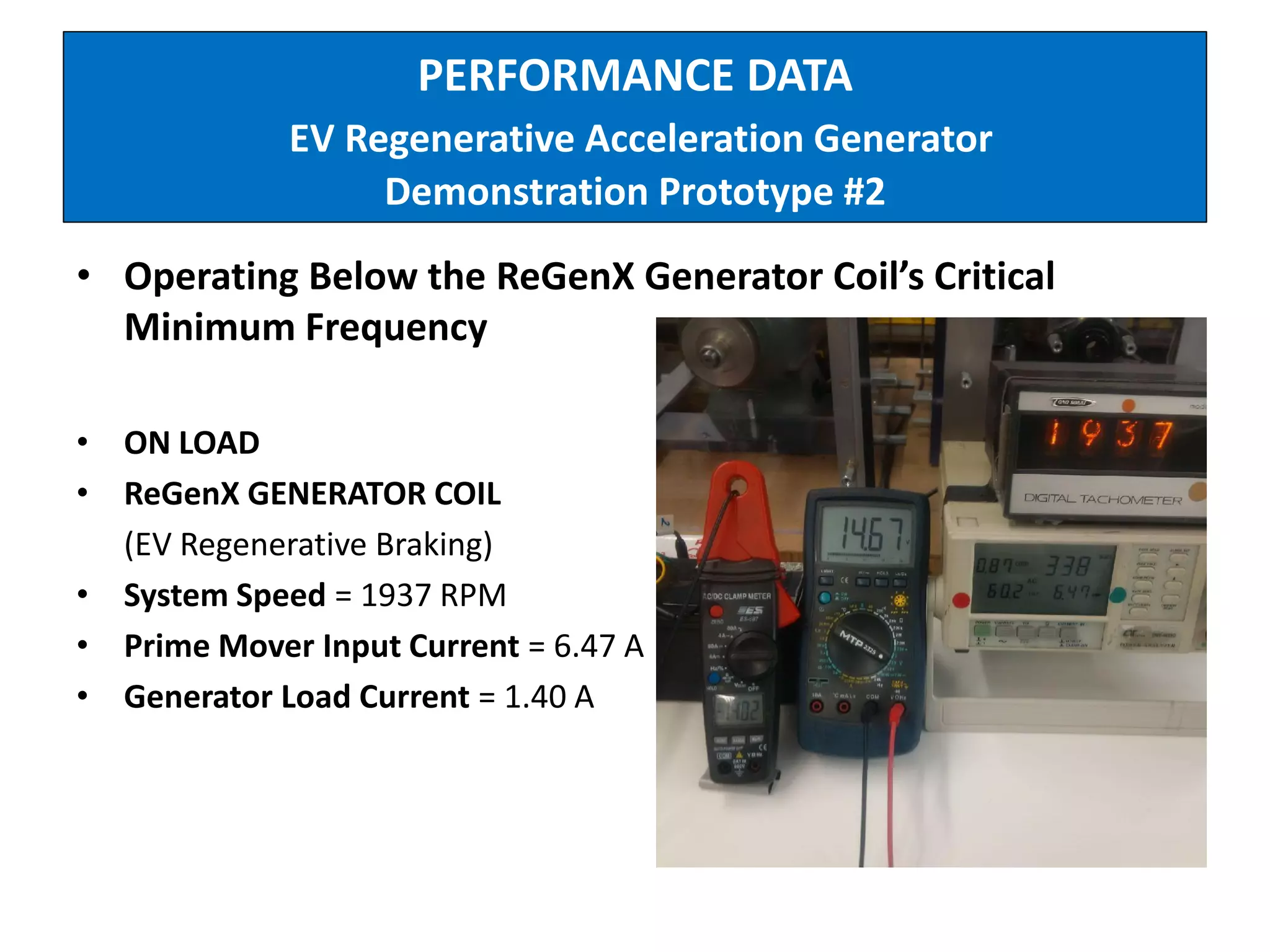
• Operating Below the ReGenX Generator Coil’s Critical
Minimum Frequency
• ON LOAD
• ReGenX GENERATOR COIL
(EV Regenerative Braking)
• System Speed = 1937 RPM
• Prime Mover Input Current = 6.47 A
• Generator Load Current = 1.40 A
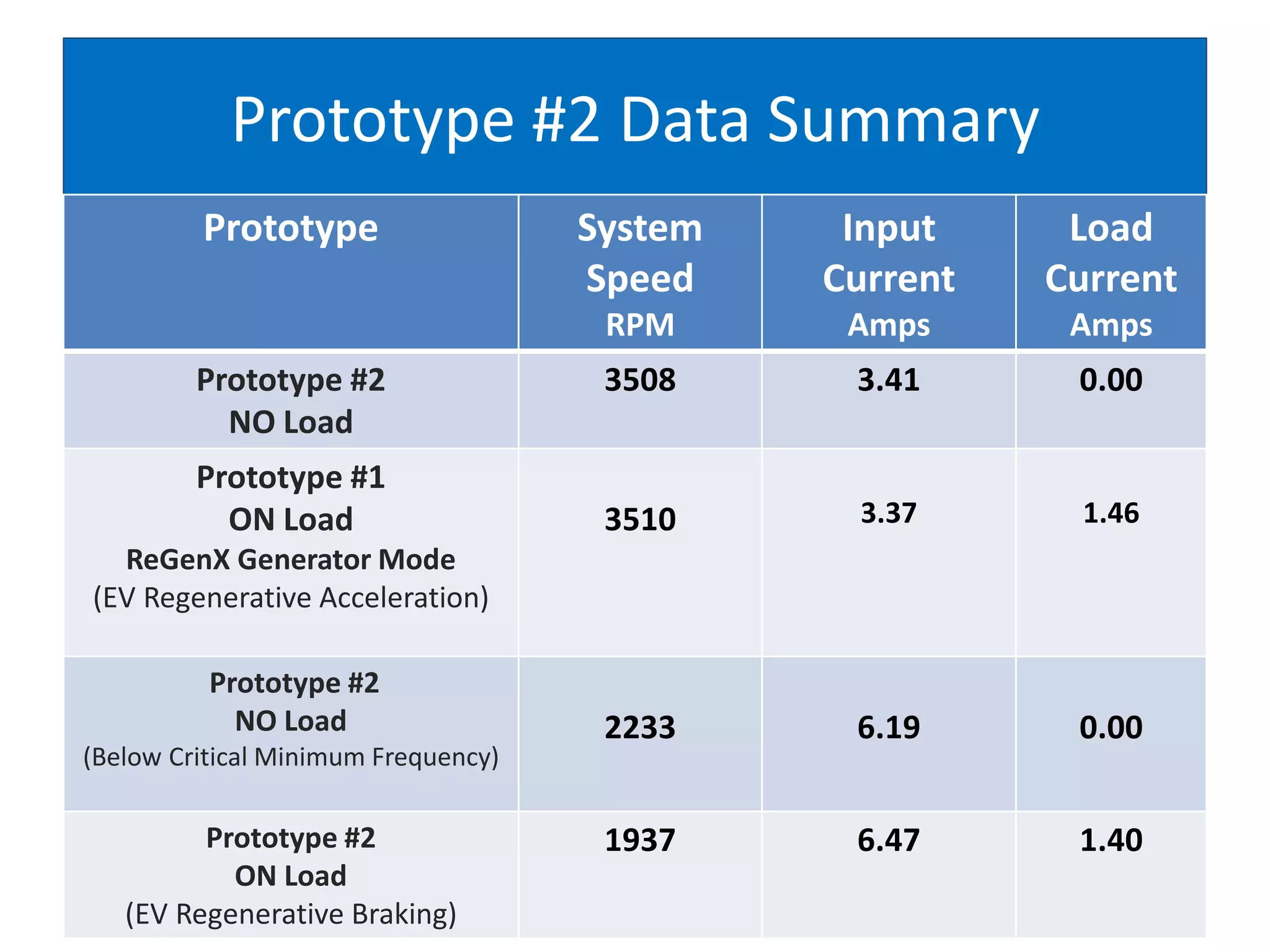
Prototype #2 Data Summary
Prototype System
Speed
RPM
Input
Current
Amps
Load
Current
Amps
Prototype #2
NO Load
3508 3.41 0.00
Prototype #1
ON Load
ReGenX Generator Mode
(EV Regenerative Acceleration)
3510 3.37 1.46
Prototype #2
NO Load
(Below Critical Minimum Frequency)
2233 6.19 0.00
Prototype #2
ON Load
(EV Regenerative Braking)
1937 6.47 1.40
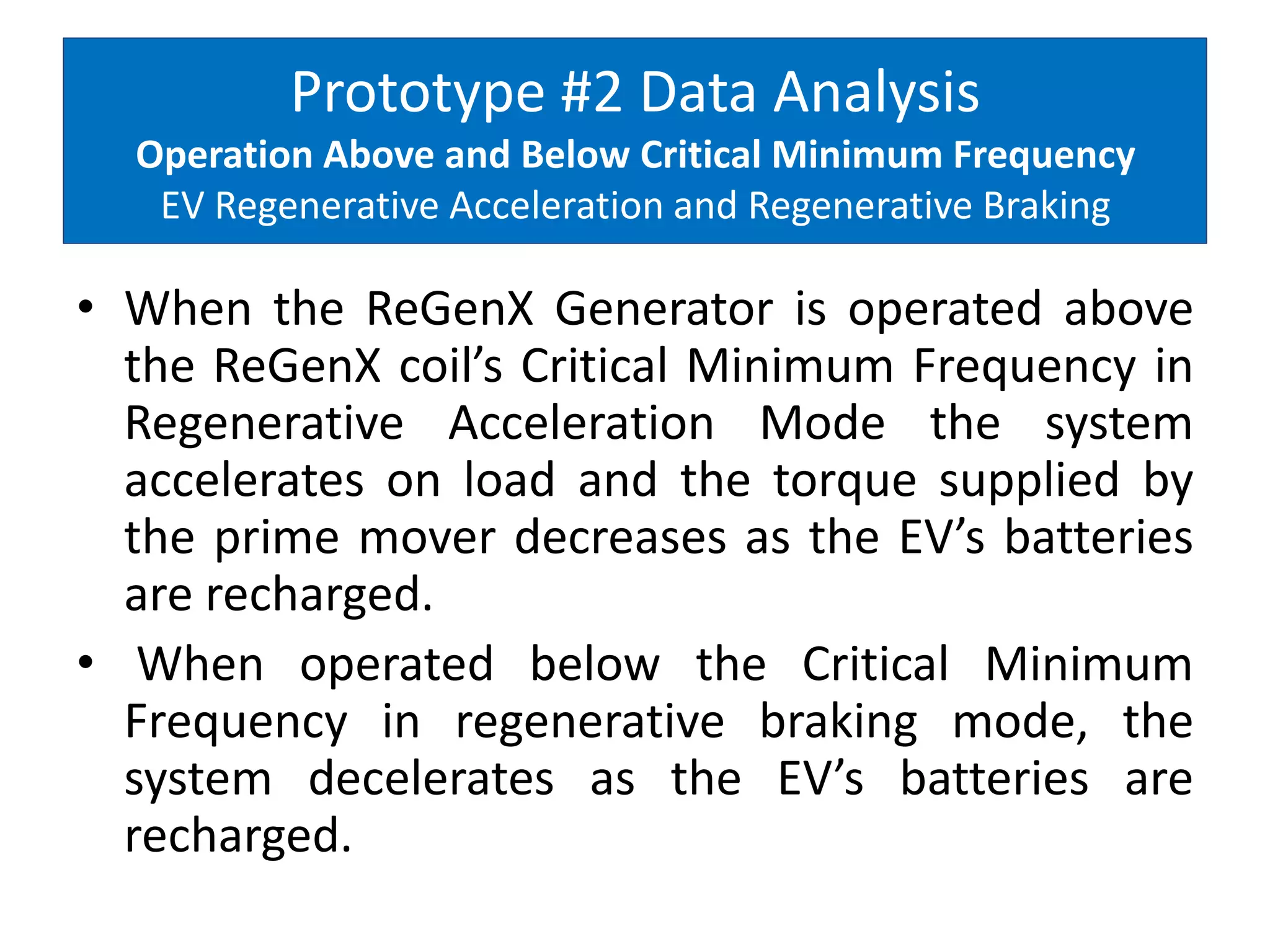
Prototype #2 Data Analysis
Operation Above and Below Critical Minimum Frequency
EV Regenerative Acceleration and Regenerative Braking
• When the ReGenX Generator is operated above
the ReGenX coil’s Critical Minimum Frequency in
Regenerative Acceleration Mode the system
accelerates on load and the torque supplied by
the prime mover decreases as the EV’s batteries
are recharged.
• When operated below the Critical Minimum
Frequency in regenerative braking mode, the
system decelerates as the EV’s batteries are
recharged.
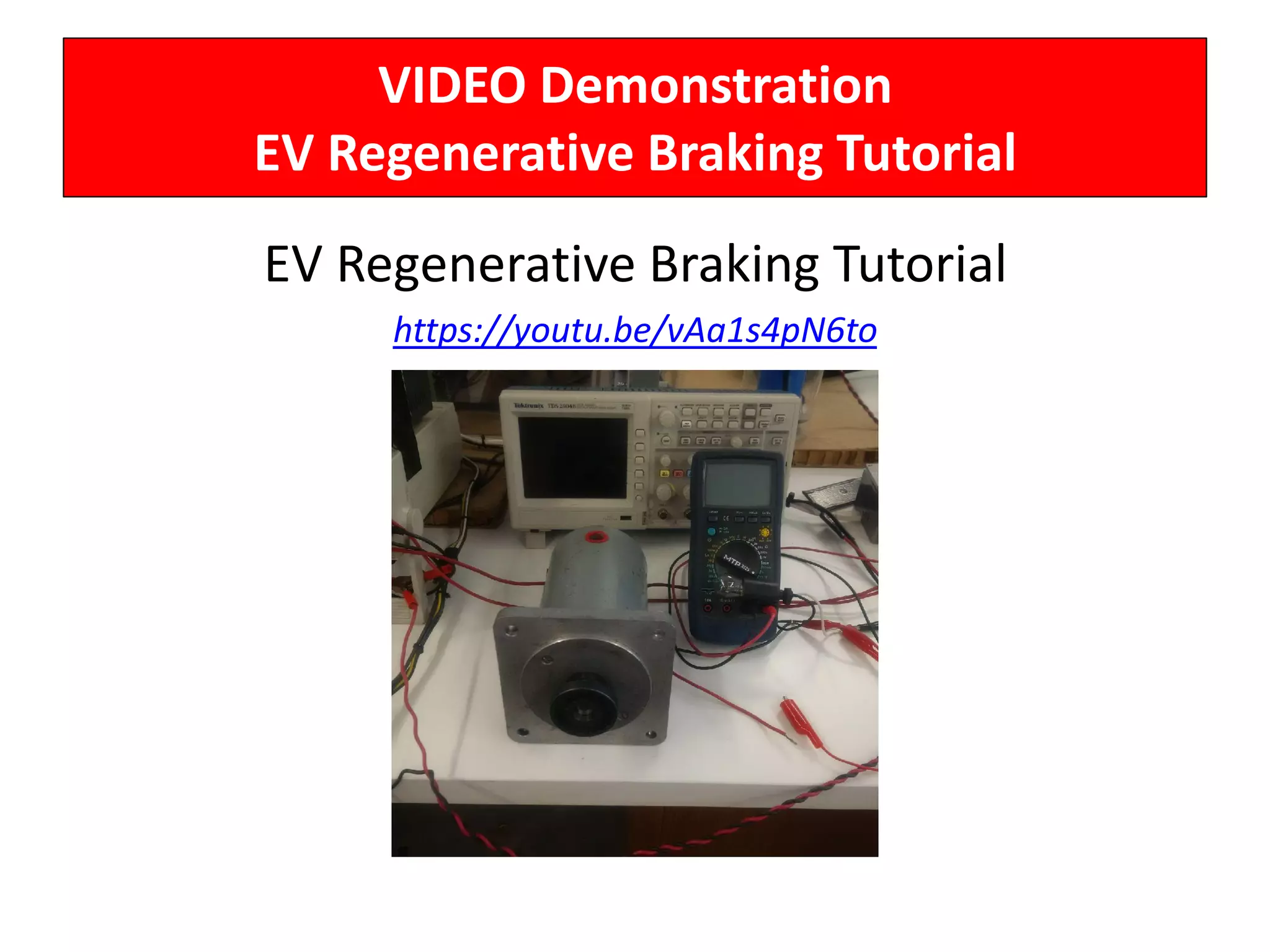
VIDEO Demonstration
EV Regenerative Braking Tutorial
https://youtu.be/vAa1s4pN6to
VIDEO Demonstration
EV Regenerative Braking Tutorial
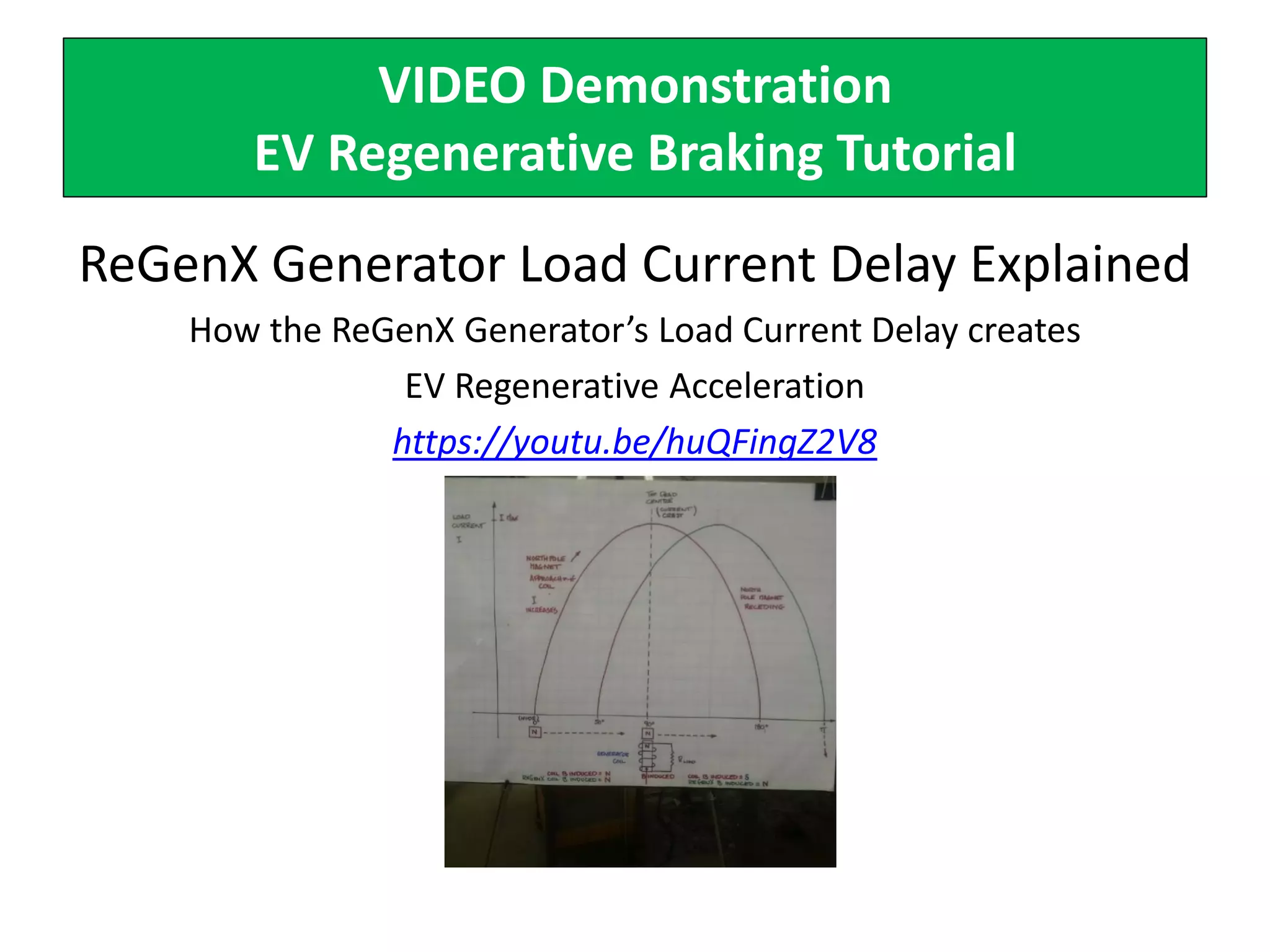
ReGenX Generator Load Current Delay Explained
How the ReGenX Generator’s Load Current Delay creates
EV Regenerative Acceleration
https://youtu.be/huQFingZ2V8
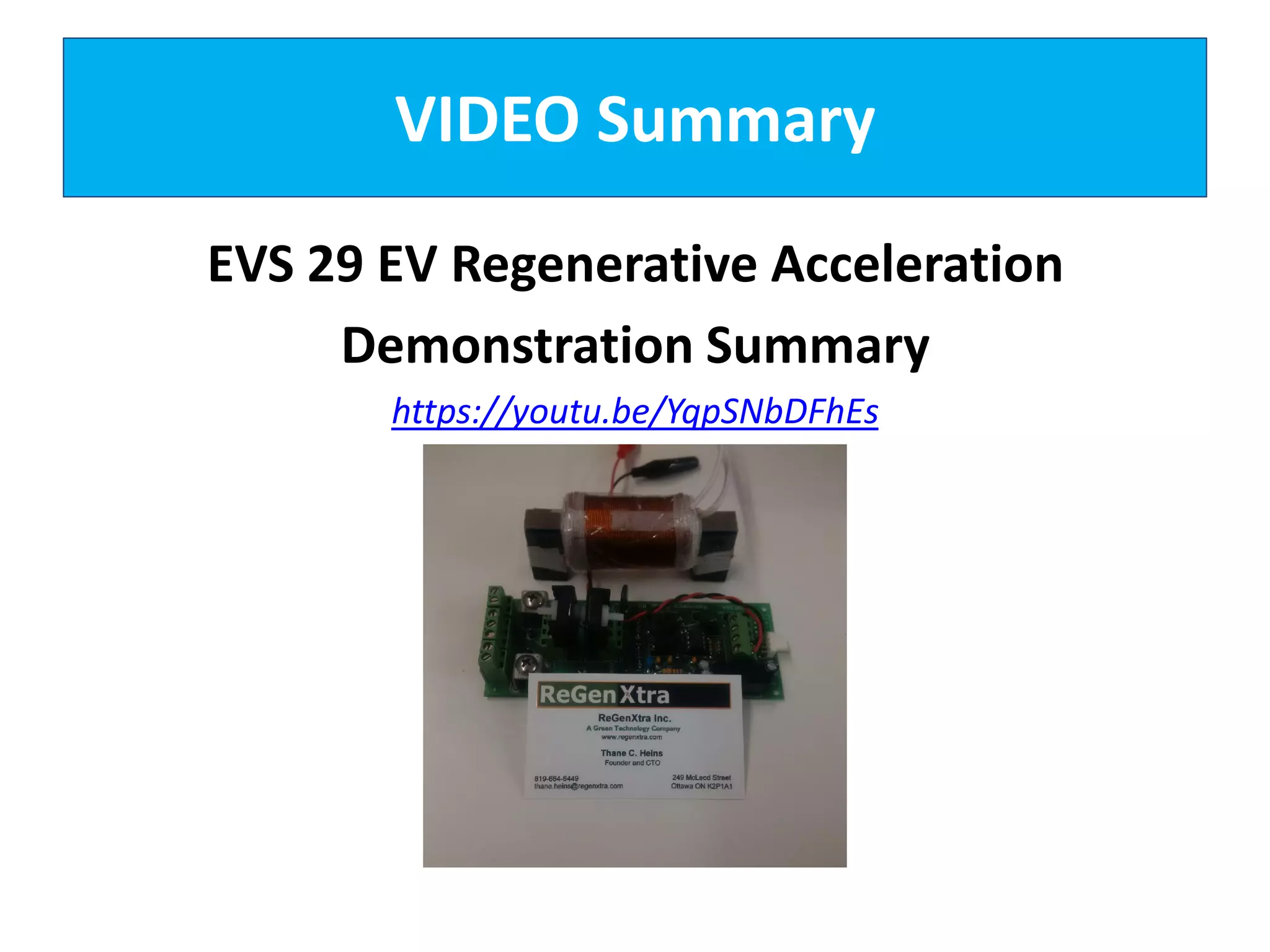
VIDEO Summary
EVS 29 EV Regenerative Acceleration
Demonstration Summary
https://youtu.be/YqpSNbDFhEs
Conclusions
• The EV Regenerative Acceleration (ReGenX)
innovation now allows for continuous EV battery
recharging during all modes of EV operation.
• During EV acceleration, coasting, and during braking.
• EV range extension is dictated by the magnitude of
Regenerative Acceleration recharge current supplied
by the ReGenX unit.
• EV battery size and storage capacity is no longer a
determining factor with regards to EV range.
Contact ReGenXtra Inc.
Thane C. Heins
Co-founder and CTO
819.664.6449
thane.heins@regenxtra.com

EVS 29 EV Regenerative Acceleration (ReGenX) Generator Demonstration Performance Test Data

  • 1.
    EV Regenerative Acceleration ProductDemonstration & Performance Test Data as demonstrated during Prepared by: Thane C. Heins ReGenXtra Inc. CTO Date: June 28th, 2016 (
  • 2.
    ReGenXtra Inc. ReGenXDemonstration during EVS 29 June 2016 • The electric vehicle (EV) Regenerative Acceleration (ReGenX) innovation employs a Load Current Delay in order to reverse the electric vehicle regenerative braking paradigm and allow for continuous battery recharging during all modes of EV operation. • ReGenXtra has conducted significant R&D on the ReGenX innovation since the original Regenerative Acceleration discovery in 2007. • This demonstration incorporates two different prototypes. • Each one has been built to showcase the various aspects of the Regenerative Acceleration innovation.
  • 3.
    ReGenXtra Inc. ReGenXProduct Demonstration during EVS 29 June 2016 The three demonstration prototypes include the following: 1. ReGenX Generator Prototype #1: • Incorporating a conventional generator coil and a ReGenX Generator coil placed on the same core, • highlighting the Load Current Sine Waves of each coil . • Conventional generator coil regenerative braking, • and Regenerative Acceleration as caused by the ReGenX Generator’s Load Current Delay. 2. ReGenX Generator Prototype #2: • Operating above and below the ReGenX coil’s Critical Minimum Frequency.
  • 4.
    Demonstration Prototype #1 EVRegenerative Acceleration Generator Load Current Delay ReGenX Generator prototype #1 incorporates : • a conventional generator coil and a ReGenX Generator coil • Both coils are placed on the same core and influenced by the same rotor magnets at the same time. • This prototype showcases how and why the Regenerative Acceleration phenomenon is produced. • The ReGenX coil Load Current is delayed by approximately 45 degrees. • This Load Current Delay as demonstrated on the oscilloscope is responsible for EV Regenerative Acceleration because delaying the coil’s load current also delays the coil’s induced magnetic field and how and when this induced magnetic field affects the rotor.
  • 5.
    Demonstration Prototype #1 EVRegenerative Acceleration Generator Load Current Delay • EV Regenerative Acceleration Generator Load Current is delayed by 45 – 70 degrees. • Conventional generator coil’s load current Sine Wave is shown in yellow on the oscilloscope. • The ReGenX Generator coil’s load current is shown in blue. • After the conventional coil’s load current peaks (center line on the oscilloscope), the rotor magnet begins to move away from the coils. • The ReGenX Coil’s Delayed Load Current produces a Delayed Induced Magnetic Field which assists the rotor magnets departure.
  • 6.
    VIDEO Demonstration Prototype#1 EV Regenerative Acceleration Generator Load Current Delay Demonstration Prototype #1 EV Regenerative Acceleration Generator Load Current Delay https://youtu.be/tnJkC_pD9uo
  • 7.
    PERFORMANCE DATA EV RegenerativeAcceleration Generator Demonstration Prototype #1 • NO LOAD • System Speed = 3505 RPM • Prime Mover Input Current = 1.53 A • Generator Load Current = 0.00 A • The prime mover’s input current is a reflection of the drive shaft torque being supplied to the generator. • At the Steady State Speed of 3505 RPM (or any equilibrium condition/steady state speed) the NET drive shaft Torque and NET Power are both zero because drive shaft; • Power = Torque x Speed
  • 8.
    PERFORMANCE DATA EV RegenerativeAcceleration Generator Demonstration Prototype #1 • ON LOAD • CONVENTIONAL GENERATOR COIL (EV regenerative braking) • System Speed = 3486 RPM • Prime Mover Input Current = 1.65 A • Generator Load Current = 0.88 A • The prime mover’s input current and prime mover supplied drive shaft input torque supplied to the generator has increased due to the conventional generator coil’s load current and the corresponding resistive induced magnetic field. • At equilibrium the Steady State Speed of 3486 RPM the NET drive shaft Torque and NET Power are both zero because drive shaft; • Power = Torque x Speed
  • 9.
    PERFORMANCE DATA EV RegenerativeAcceleration Generator Demonstration Prototype #1 • ON LOAD • ReGenX GENERATOR COIL (EV Regenerative Acceleration) • System Speed = 3508 RPM • Prime Mover Input Current = 1.52 A • Generator Load Current = 0.93 A • The prime mover’s input current and the drive shaft input torque supplied to the generator have both decreased due to the ReGenX Generator coil’s Load Current Delay and the corresponding assistive induced magnetic field. • The ReGenX Generator coil’s Load Current Delay creates a Complementary Electromotive Torque which accelerates the EV while recharging its batteries, • and while reducing the prime mover input power consumption to below no load levels.
  • 10.
    Prototype #1 DataSummary Prototype System Speed RPM Input Current Amps Load Current Amps Prototype #1 NO Load 3505 1.53 0.00 Prototype #1 ON Load Conventional Generator Mode (EV Regenerative Braking) 3486 1.65 0.88 Prototype #1 ON Load ReGenX Generator Mode (EV Regenerative Acceleration) 3508 1.52 0.93
  • 11.
    Prototype #1 DataAnalysis ReGenX Generator Mode EV Regenerative Acceleration Operation • When placed on load and when delivering load current the ReGenX Generator created Complementary Electromotive Torque (EV Regenerative Acceleration) which accelerated the system. • The prime mover’s input current decreased and the prime mover’s input torque supplied to the generator also decreased. • The greater the magnitude of load current supplied by the ReGenX Generator to the load the faster the rate of system acceleration.
  • 12.
    Demonstration Prototype #2 EVRegenerative Acceleration Generator • ReGenX Generator. • A single Salient Pole ReGenX Generator coil prototype. • The ReGenX Generator prototype showcases Regenerative Acceleration, EV battery recharging with a Complementary Electromotive Torque and the capability to also produce regenerative braking/Counter Electromotive Torque when recharging the batteries in regenerative braking mode. • When operating at 3500 RPM or above (above the ReGenX coil’s Critical Minimum Frequency), the ReGenX Generator coil operates in Regenerative Acceleration Mode and recharges the EVs batteries without deceleration of the vehicle. • When operated at 2200 RPM (or below its Critical Minimum Frequency), the ReGenX Generator coil operates in conventional regenerative braking mode (i.e. recharging the EV’s batteries, producing a Counter Electromotive Torque and decelerating the EV.)
  • 13.
    VIDEO Demonstration Prototype#2 EV Regenerative Acceleration Generator Demonstration Prototype #2 EV Regenerative Acceleration Generator https://youtu.be/dFYQMtC9ZIk
  • 14.
    PERFORMANCE DATA EV RegenerativeAcceleration Generator Demonstration Prototype #2 • NO LOAD • ReGenX GENERATOR COIL • System Speed = 3508 RPM • Prime Mover Input Current = 3.41 A • Generator Load Current = 0.00 A • The prime mover’s input current is a reflection of the drive shaft torque being supplied to the generator. • At the Steady State Speed of 3508 RPM (or any equilibrium condition /steady state speed) the NET drive Shaft Torque and NET Power are both zero because drive shaft; • Power = Torque x Speed
  • 15.
    PERFORMANCE DATA EV RegenerativeAcceleration Generator Demonstration Prototype #2 • ON LOAD • ReGenX GENERATOR COIL (EV Regenerative Acceleration) • System Speed = 3510 RPM • Prime Mover Input Current = 3.37 A • Generator Load Current = 1.46 A • The prime mover’s input current and the drive shaft input torque supplied to the generator have both decreased from the no load levels due to the ReGenX Generator coil’s Load Current Delay and the corresponding assistive induced magnetic field. • The ReGenX Generator coil’s Load Current Delay creates a Complementary Electromotive Torque which accelerates the EV while recharging its batteries, • and while reducing the prime mover input power consumption to below no load levels.
  • 16.
    PERFORMANCE DATA EV RegenerativeAcceleration Generator Demonstration Prototype #2
  • 17.
    PERFORMANCE DATA EV RegenerativeAcceleration Generator Demonstration Prototype #2 • Operating Below the Critical Minimum Frequency • The primary factor dictating Regenerative Acceleration performance is frequency of operation because frequency of operation dictates the coil’s Impedence from the equation: ZT = XL + RDC where the coil’s Inductive Reactance is: XL = 2 π F L such that: ZT = 2 π F L + RDC • When the coils operational frequency (F) is increased the coil’s impedence (ZT) also increases. • When impedence increases load current flow decreases and if ZT is high enough load current flow ceases altogether. • When load current flow ceases the ReGenX coil cannot store energy in the Electromagnetic Field around the coil as an inductor and is forced to store energy Electrostatically inside the coil as a capacitor. • When the induced voltage in the ReGenX coil exceeds the dielectric's ability to store it – the dielectric breaks down and load current begins to flow - but the delay has already occurred and the ReGenX coil’s Delayed Load Current peaks when the rotor magnet is now moving away from the coil. • The result is the receding rotor magnet ‘s departure and the approaching rotor magnet’s approach are both accelerated in the process while load current is delivered to the EV’s batteries without deceleration of the EV.
  • 18.
    VIDEO Demonstration Prototype#2 EV Regenerative Acceleration Generator Operating Below the ReGenX Generator Coil’s Critical Minimum Frequency https://youtu.be/-fAIHsMJAB0
  • 19.
    PERFORMANCE DATA EV RegenerativeAcceleration Generator Demonstration Prototype #2 • Operating Below the ReGenX Generator Coil’s Critical Minimum Frequency • NO LOAD • ReGenX GENERATOR COIL (EV Regenerative Braking) • System Speed = 2233 RPM • Prime Mover Input Current = 6.19 A • Generator Load Current = 0.00 A
  • 20.
    PERFORMANCE DATA EV RegenerativeAcceleration Generator Demonstration Prototype #2 • Operating Below the ReGenX Generator Coil’s Critical Minimum Frequency • ON LOAD • ReGenX GENERATOR COIL (EV Regenerative Braking) • System Speed = 1937 RPM • Prime Mover Input Current = 6.47 A • Generator Load Current = 1.40 A
  • 21.
    Prototype #2 DataSummary Prototype System Speed RPM Input Current Amps Load Current Amps Prototype #2 NO Load 3508 3.41 0.00 Prototype #1 ON Load ReGenX Generator Mode (EV Regenerative Acceleration) 3510 3.37 1.46 Prototype #2 NO Load (Below Critical Minimum Frequency) 2233 6.19 0.00 Prototype #2 ON Load (EV Regenerative Braking) 1937 6.47 1.40
  • 22.
    Prototype #2 DataAnalysis Operation Above and Below Critical Minimum Frequency EV Regenerative Acceleration and Regenerative Braking • When the ReGenX Generator is operated above the ReGenX coil’s Critical Minimum Frequency in Regenerative Acceleration Mode the system accelerates on load and the torque supplied by the prime mover decreases as the EV’s batteries are recharged. • When operated below the Critical Minimum Frequency in regenerative braking mode, the system decelerates as the EV’s batteries are recharged.
  • 23.
    VIDEO Demonstration EV RegenerativeBraking Tutorial EV Regenerative Braking Tutorial https://youtu.be/vAa1s4pN6to
  • 24.
    VIDEO Demonstration EV RegenerativeBraking Tutorial ReGenX Generator Load Current Delay Explained How the ReGenX Generator’s Load Current Delay creates EV Regenerative Acceleration https://youtu.be/huQFingZ2V8
  • 25.
    VIDEO Summary EVS 29EV Regenerative Acceleration Demonstration Summary https://youtu.be/YqpSNbDFhEs
  • 26.
    Conclusions • The EVRegenerative Acceleration (ReGenX) innovation now allows for continuous EV battery recharging during all modes of EV operation. • During EV acceleration, coasting, and during braking. • EV range extension is dictated by the magnitude of Regenerative Acceleration recharge current supplied by the ReGenX unit. • EV battery size and storage capacity is no longer a determining factor with regards to EV range.
  • 27.
    Contact ReGenXtra Inc. ThaneC. Heins Co-founder and CTO 819.664.6449 thane.heins@regenxtra.com