Potential +/-Difference Inc.
Introduction
Electric Vehicle Regenerative Acceleration and ReGenX Generator Innovations
August 14th
, 2018
1
Introduction
Electric Vehicle Regenerative Acceleration and ReGenX Generator Technology
• What are the innovations?
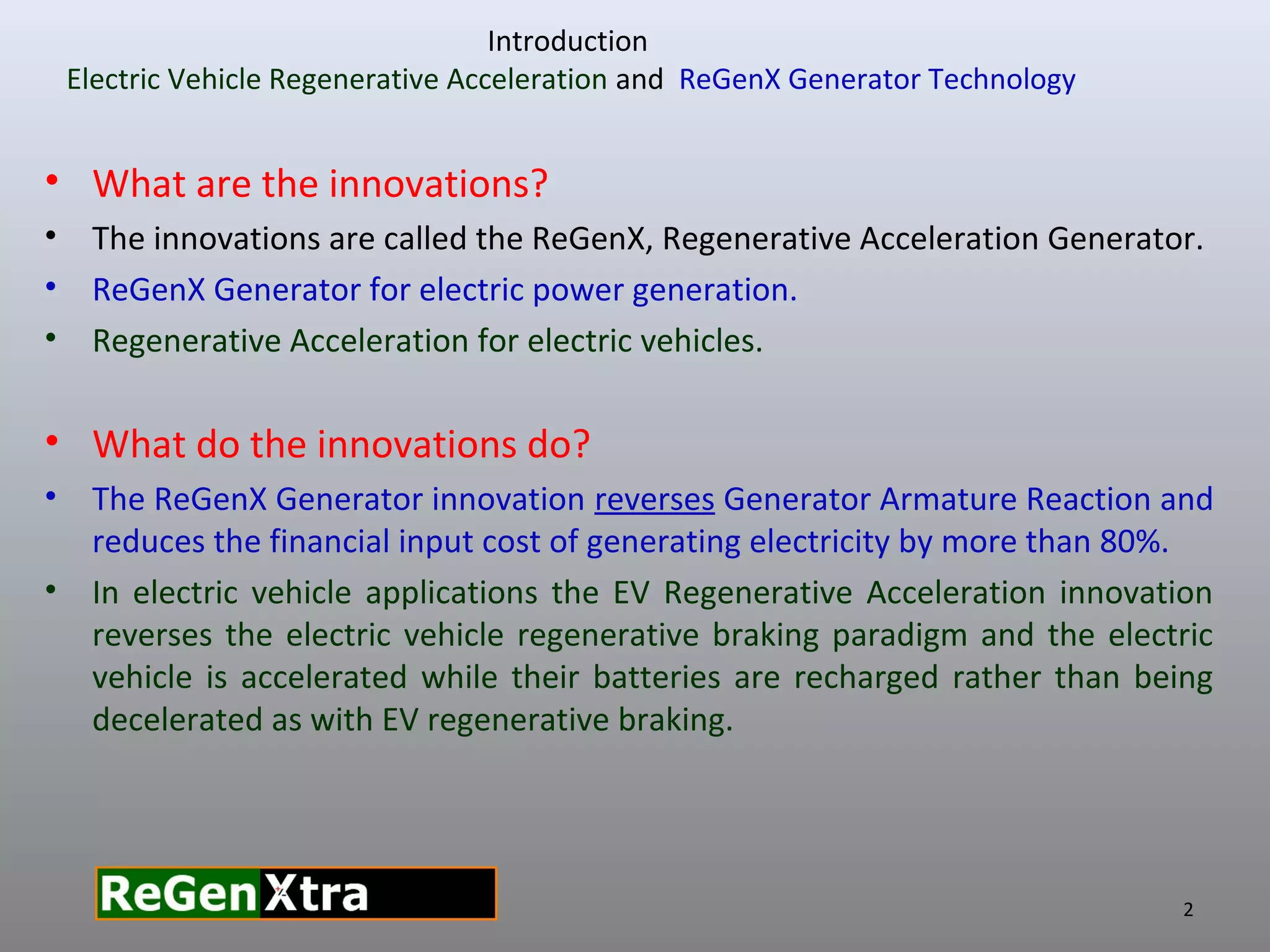
• The innovations are called the ReGenX, Regenerative Acceleration Generator.
• ReGenX Generator for electric power generation.
• Regenerative Acceleration for electric vehicles.
• What do the innovations do?
• The ReGenX Generator innovation reverses Generator Armature Reaction and
reduces the financial input cost of generating electricity by more than 80%.
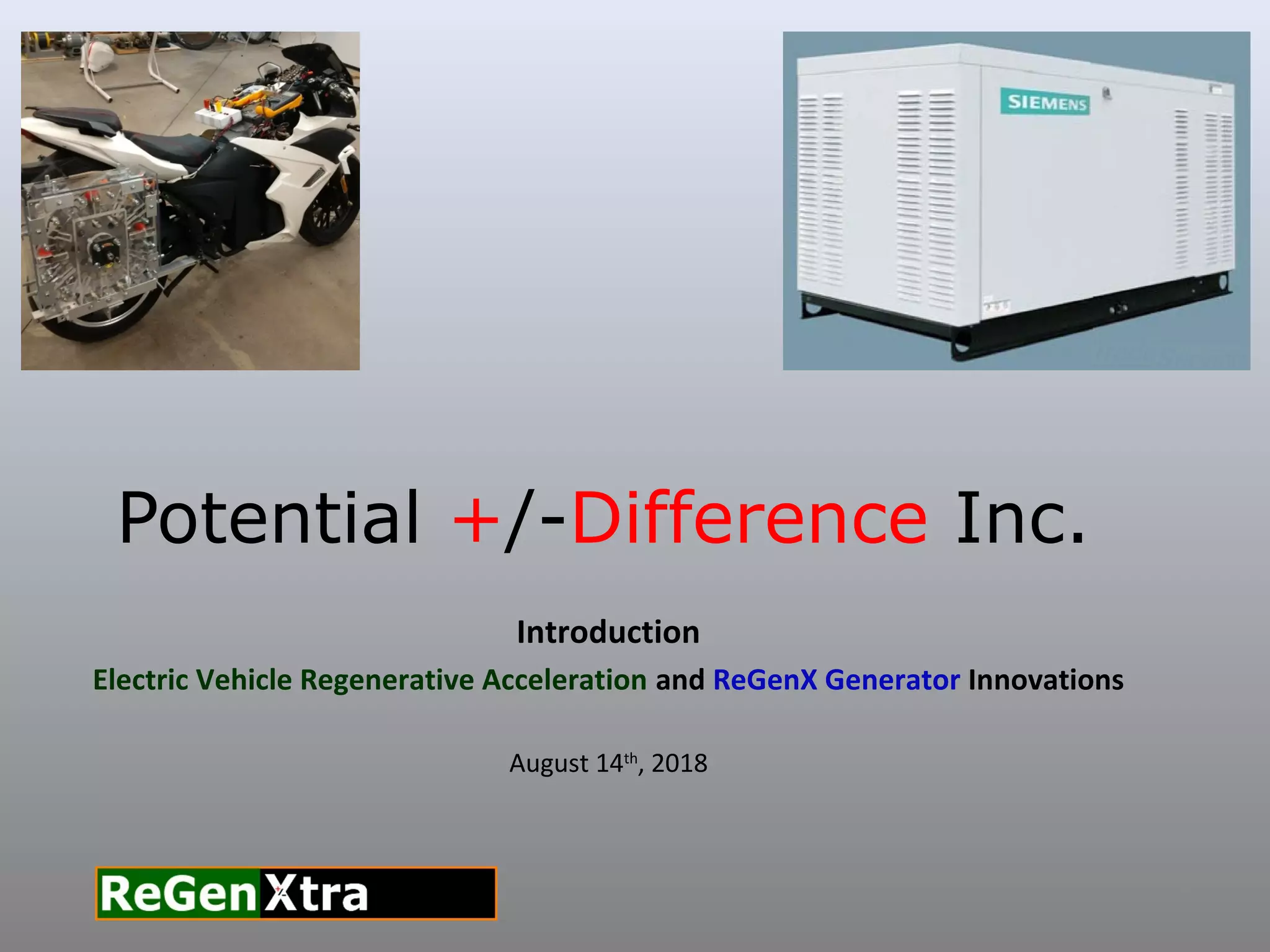
• In electric vehicle applications the EV Regenerative Acceleration innovation
reverses the electric vehicle regenerative braking paradigm and the electric
vehicle is accelerated while their batteries are recharged rather than being
decelerated as with EV regenerative braking.
2
• What is Generator Armature Reaction?
• Generator Armature Reaction is a Counter Electromagnetic Torque which is
produced inside all electric generators by the magnetic fields that are created
around the current bearing wires that make up the generator coils.
• The magnitude of the counter torque produced is directly related to the
magnitude of the load current.
• The counter torque performs negative work and works against the torque
supplied by the prime mover – reducing the net torque in the drive shaft.
• The prime mover must consume additional input energy in order increase the
torque and mechanical power in the driveshaft to overcome the generator’s
counter torque or the generator will stall the prime mover.
• Over 80% of the cost of generating electricity is due to the input energy cost
required to overcome Generator Armature Reaction.
• Environmentally over 80% of the Greenhouse Gasses and Nuclear waste
produced globally are due to Generator Armature Reaction.
3
Introduction
Electric Vehicle Regenerative Acceleration and ReGenX Generator Technology
Introduction
Electric Vehicle Regenerative Acceleration and ReGenX Generator Technology
• How can Generator Armature Reaction be reversed?
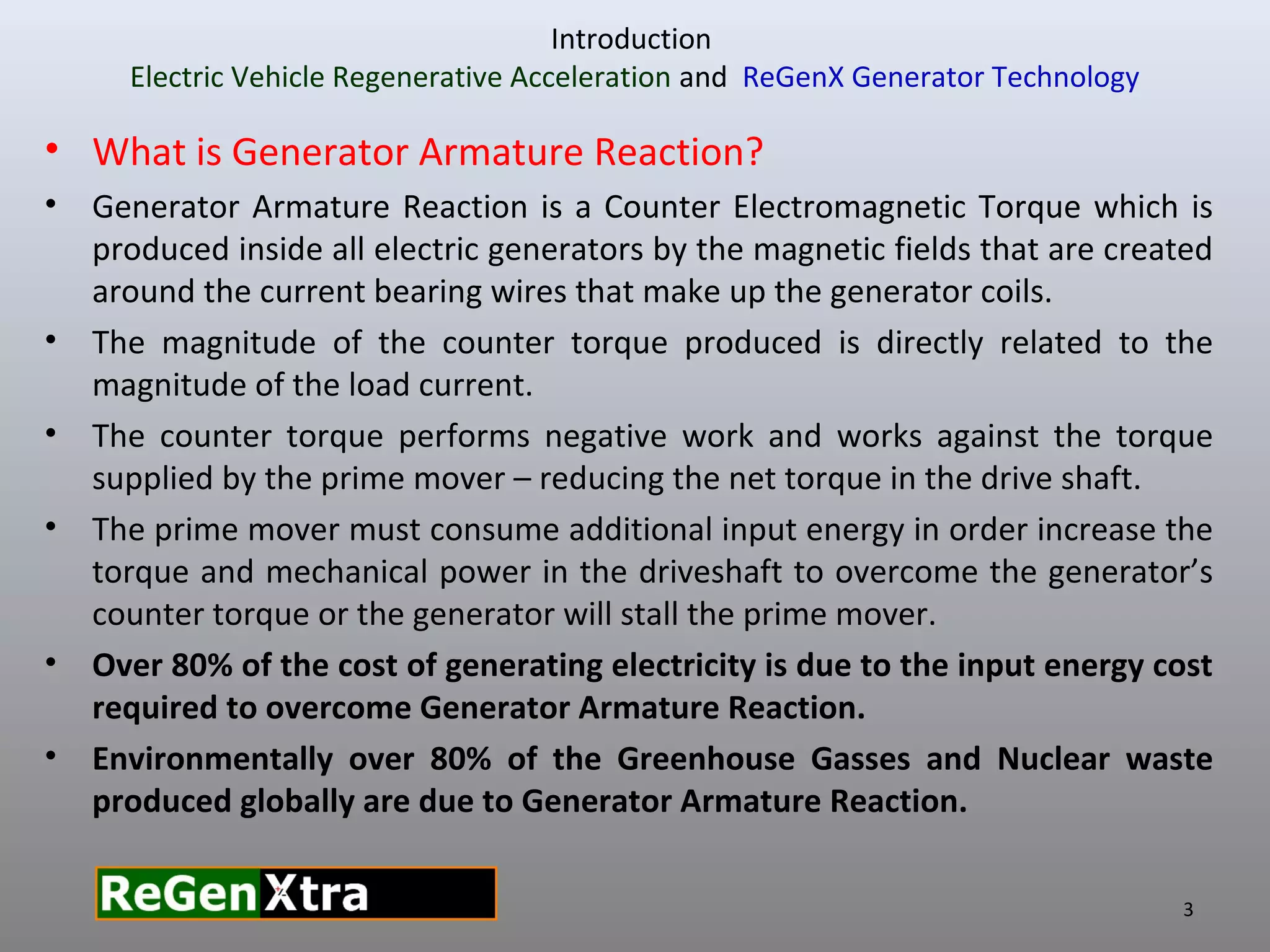
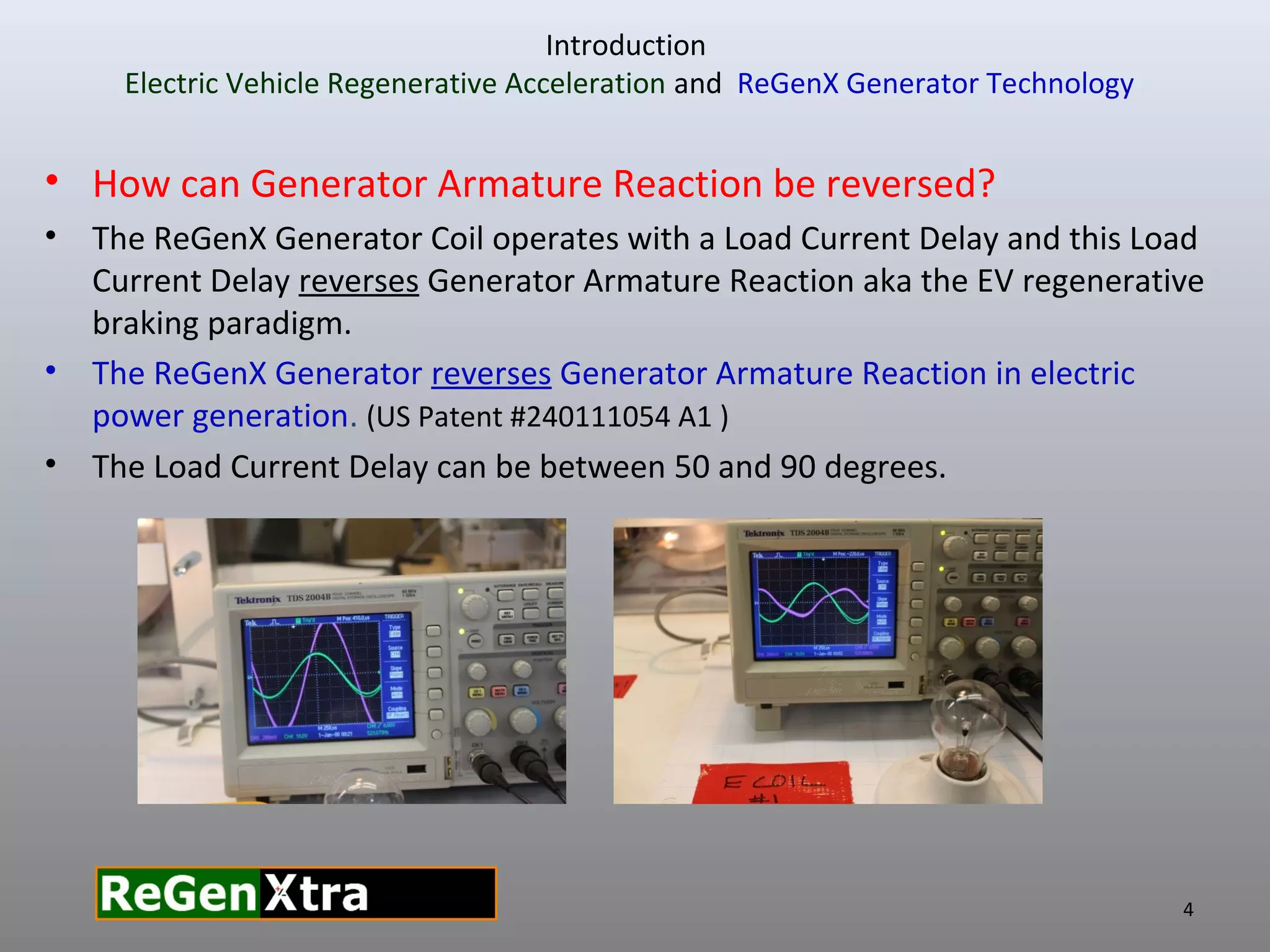
• The ReGenX Generator Coil operates with a Load Current Delay and this Load
Current Delay reverses Generator Armature Reaction aka the EV regenerative
braking paradigm.
• The ReGenX Generator reverses Generator Armature Reaction in electric
power generation. (US Patent #240111054 A1 )
• The Load Current Delay can be between 50 and 90 degrees.
4
5
Effects of Reversing Generator Armature Reaction in Electric Power Generation
1 MW Conventional Generator and 1 MW ReGenX Generator Comparison
Effects of Reversing Generator Armature Reaction in Electric Power Generation
Generator
Type
No-Load
Mechanical
Drive Shaft
INPUT
Power
(Watts)
No-Load
System
Equilibrium
Speed
(RPM)
On-Load
Generator
OUTPUT
Power
(Watts)
On-Load
Mechanical
Drive Shaft
INPUT
Power
Increase
(Watts)
On-Load
System
Equilibrium
Speed
(RPM)
On-Load
Total Drive
Shaft
Mechanical
Input Power
Requirement
Conventional
Generator
0.5MW 3500 1MW 1MW 3500 >1.5MW
ReGenX
Generator
0.5MW 3500 1MW 0.00W 3500 <0.5MW
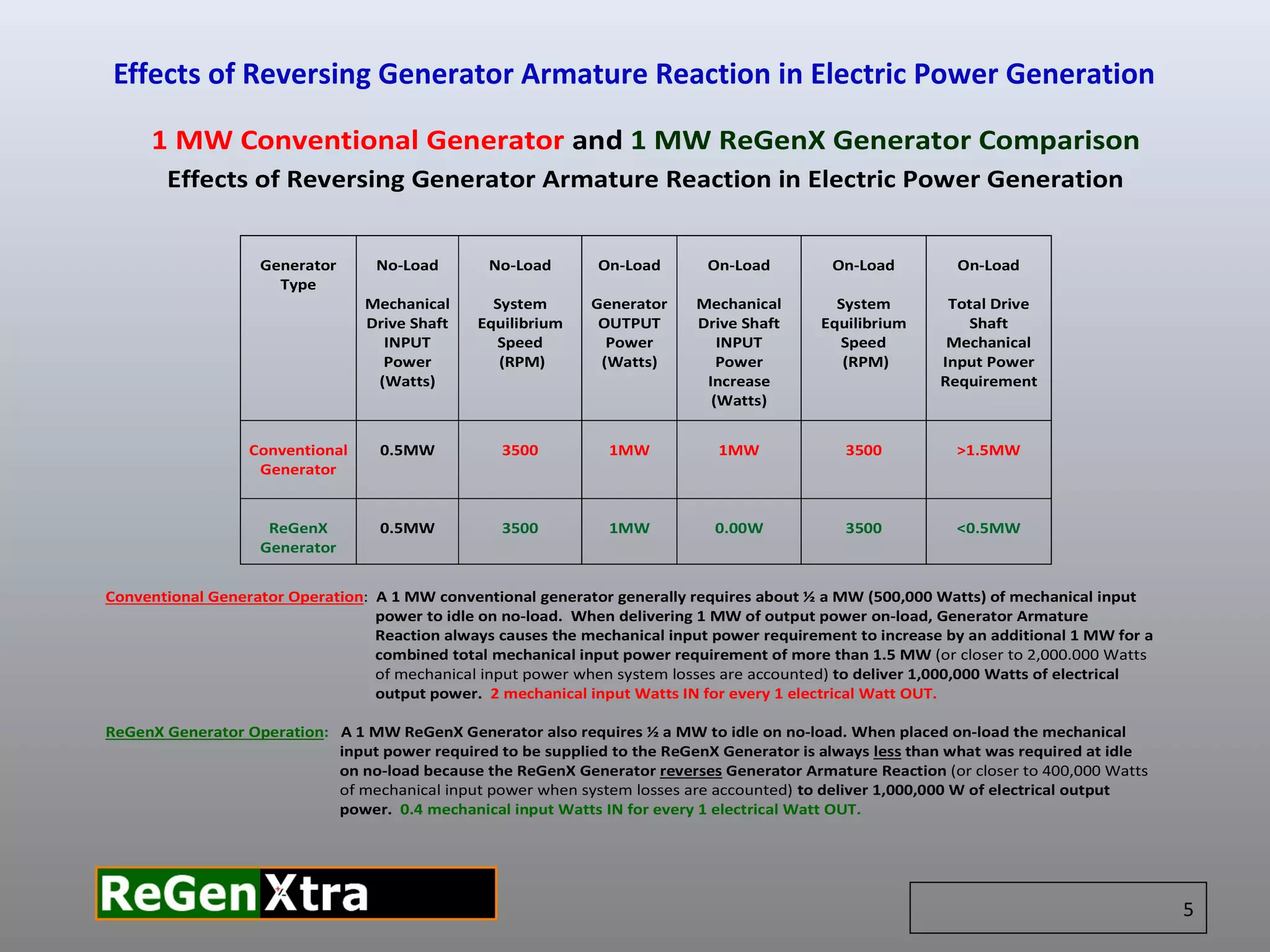
Conventional Generator Operation: A 1 MW conventional generator generally requires about ½ a MW (500,000 Watts) of mechanical input
power to idle on no-load. When delivering 1 MW of output power on-load, Generator Armature
Reaction always causes the mechanical input power requirement to increase by an additional 1 MW for a
combined total mechanical input power requirement of more than 1.5 MW (or closer to 2,000.000 Watts
of mechanical input power when system losses are accounted) to deliver 1,000,000 Watts of electrical
output power. 2 mechanical input Watts IN for every 1 electrical Watt OUT.
ReGenX Generator Operation: A 1 MW ReGenX Generator also requires ½ a MW to idle on no-load. When placed on-load the mechanical
input power required to be supplied to the ReGenX Generator is always less than what was required at idle
on no-load because the ReGenX Generator reverses Generator Armature Reaction (or closer to 400,000 Watts
of mechanical input power when system losses are accounted) to deliver 1,000,000 W of electrical output
power. 0.4 mechanical input Watts IN for every 1 electrical Watt OUT.
Conventional Generator Operation with Generator Armature Reaction :
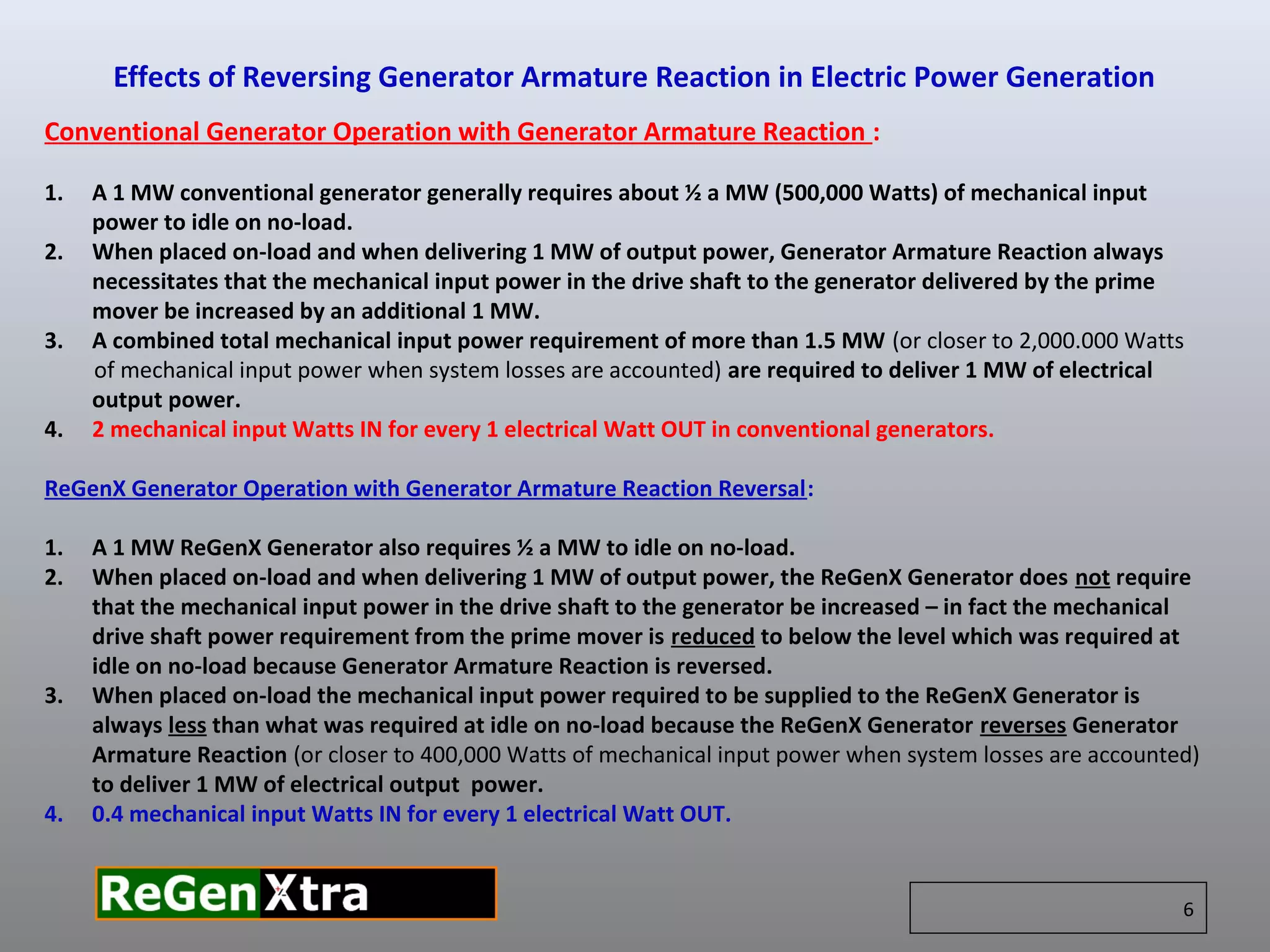
1. A 1 MW conventional generator generally requires about ½ a MW (500,000 Watts) of mechanical input
power to idle on no-load.
2. When placed on-load and when delivering 1 MW of output power, Generator Armature Reaction always
necessitates that the mechanical input power in the drive shaft to the generator delivered by the prime
mover be increased by an additional 1 MW.
3. A combined total mechanical input power requirement of more than 1.5 MW (or closer to 2,000.000 Watts
of mechanical input power when system losses are accounted) are required to deliver 1 MW of electrical
output power.
4. 2 mechanical input Watts IN for every 1 electrical Watt OUT in conventional generators.
ReGenX Generator Operation with Generator Armature Reaction Reversal:
1. A 1 MW ReGenX Generator also requires ½ a MW to idle on no-load.
2. When placed on-load and when delivering 1 MW of output power, the ReGenX Generator does not require
that the mechanical input power in the drive shaft to the generator be increased – in fact the mechanical
drive shaft power requirement from the prime mover is reduced to below the level which was required at
idle on no-load because Generator Armature Reaction is reversed.
3. When placed on-load the mechanical input power required to be supplied to the ReGenX Generator is
always less than what was required at idle on no-load because the ReGenX Generator reverses Generator
Armature Reaction (or closer to 400,000 Watts of mechanical input power when system losses are accounted)
to deliver 1 MW of electrical output power.
4. 0.4 mechanical input Watts IN for every 1 electrical Watt OUT.
Effects of Reversing Generator Armature Reaction in Electric Power Generation
6
• Why is this innovation important?
• EV Regenerative Acceleration increases the range of the EV significantly and
decreases plug-in recharging requirements because it allows the EV’s
batteries to be continuously recharged in all driving modes; during vehicle
acceleration, coasting and during deceleration.
• In electric power generation, reversing Generator Armature Reaction reduces
the input costs by more than 80% while also reducing the pollution produced
by more than 80% as well.
• The physical size of the prime mover required
in electric power generation can be reduced by
more than 80%.
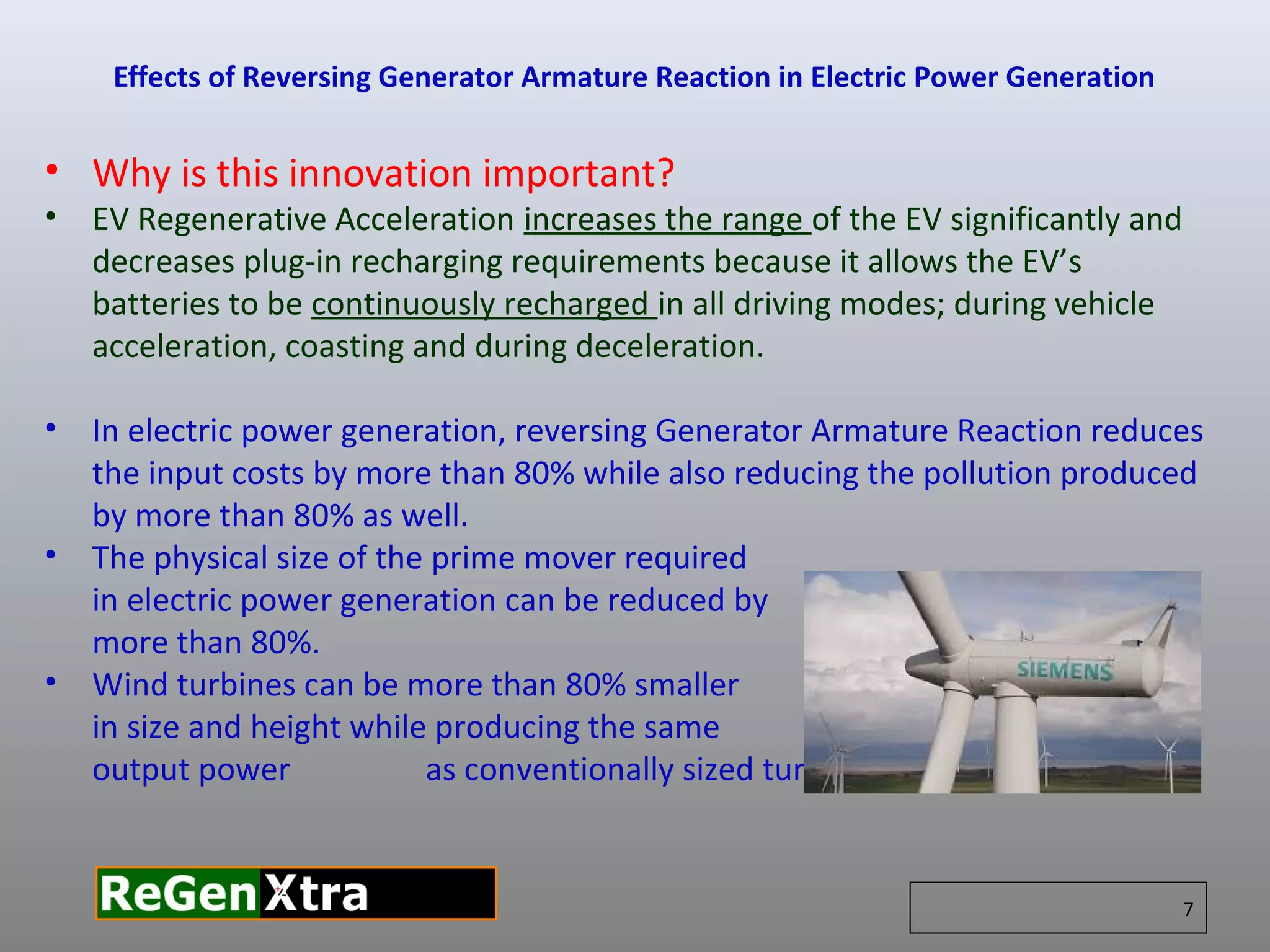
• Wind turbines can be more than 80% smaller
in size and height while producing the same
output power as conventionally sized turbines.
Effects of Reversing Generator Armature Reaction in Electric Power Generation
7
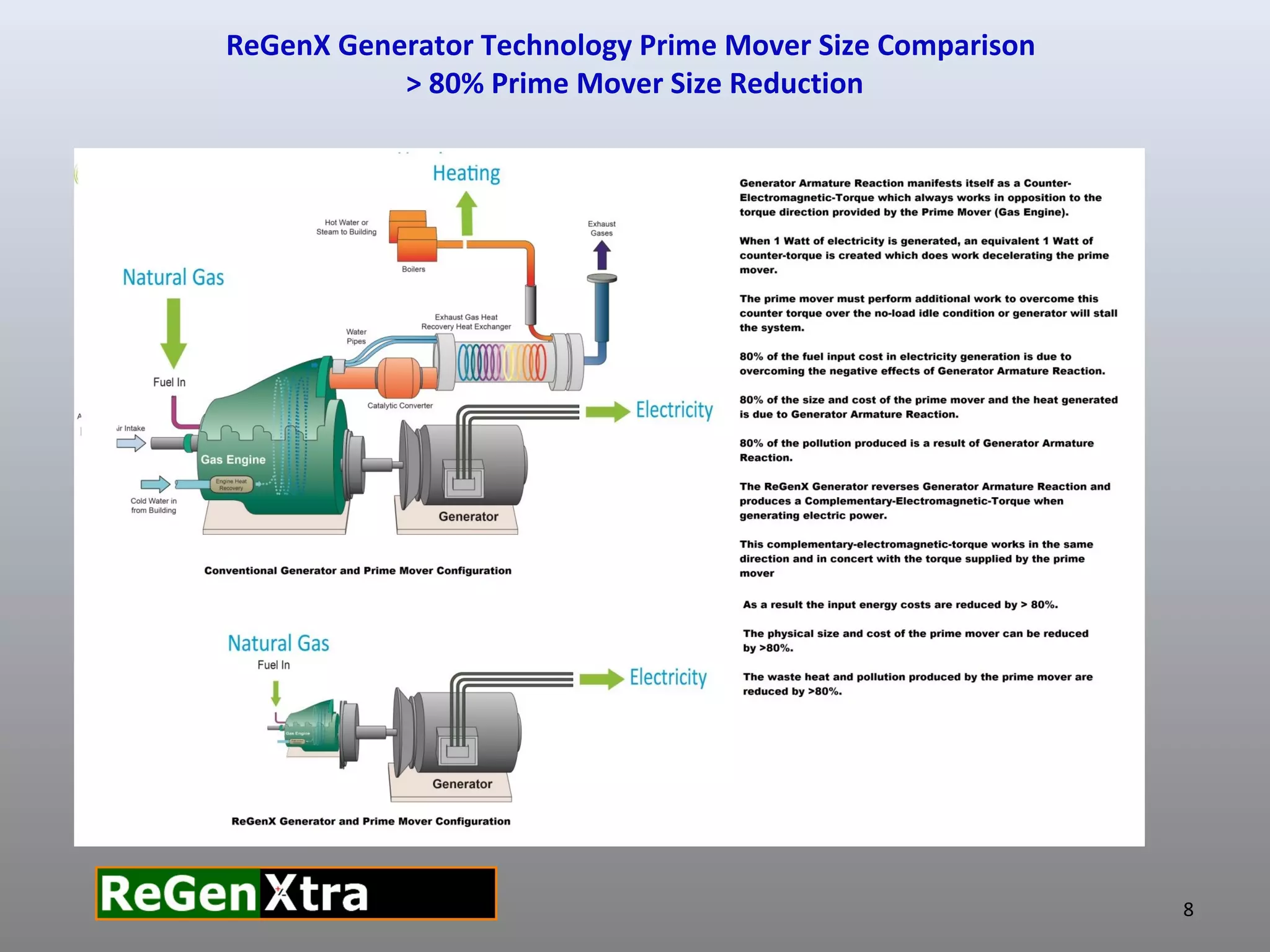
ReGenX Generator Technology Prime Mover Size Comparison
> 80% Prime Mover Size Reduction
8
• Commercialization Next Steps /Manufacturing, Sales, IP Licensing
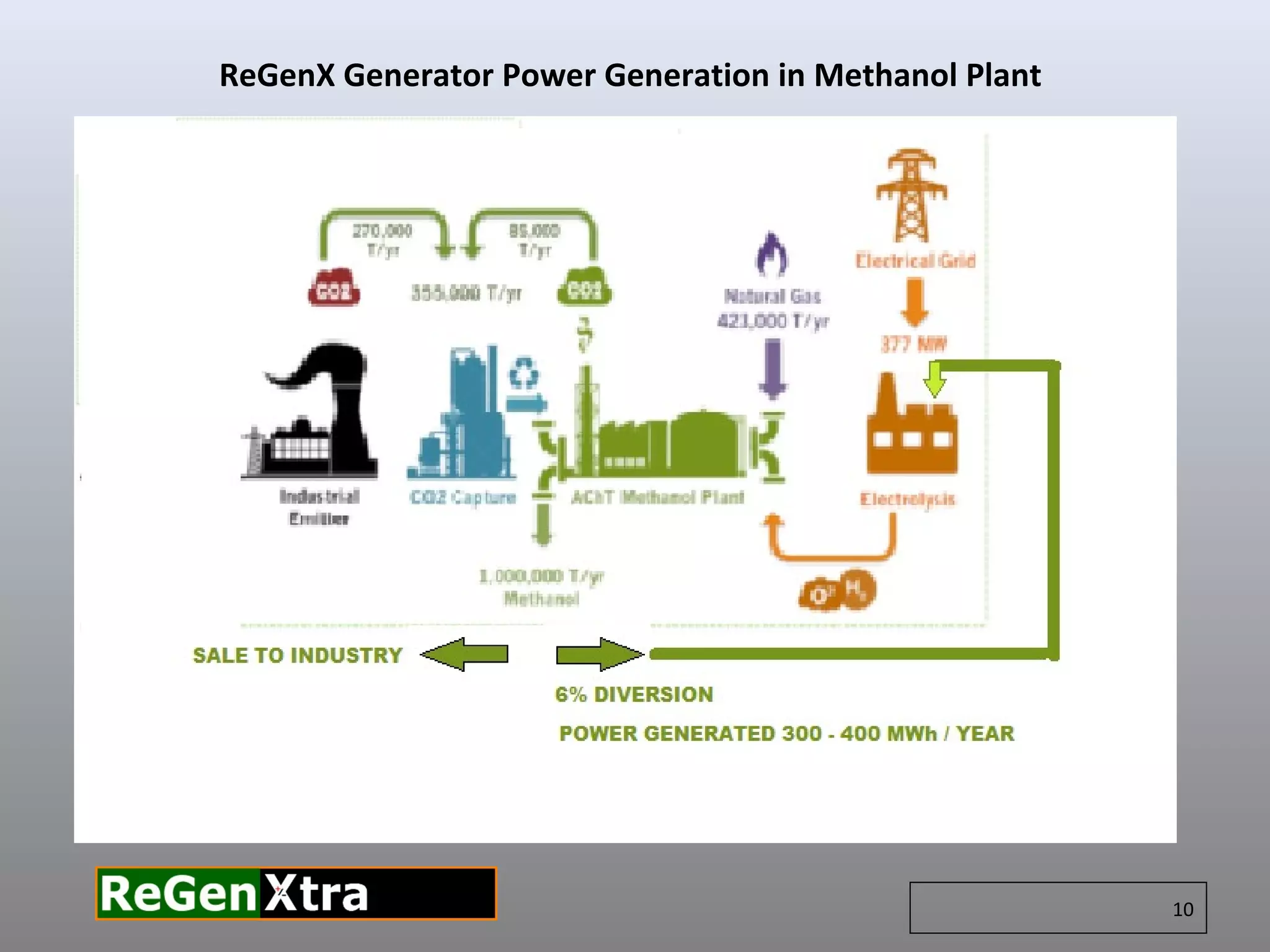
• Advanced Chemical Technologies (AChT) has approached Potential
Difference Inc. (PDi) and has requested 30 MW ReGenX Generators for their
new methanol plant in Sudbury which goes on-line in 2021.
• AChT wants to use some of its methanol produced to generate electricity to
mitigate its electricity consumption costs.
• PDi and AChT have an MOU under development which provides AChT with
global exclusivity on the development of a new electricity generating platform
for the entire global methanol industry using ReGenX Generators.
• AChT has also requested the scale-up of ReGenX Generators to 800 MW by
2030.
• In order for AChT to generate 400 MW of electricity using conventional
generator technology; 227,000 tones of methanol would be required or 23%
of their yearly 1 million tones of production.
• Using ReGenX Generator Technology only 60,000 tones of methanol would be
required to generate 400 MW or 6% of their yearly production.
ReGenX Generator Commercialization Next Steps /Manufacturing, Sales, IP
Licensing
9
ReGenX Generator Power Generation in Methanol Plant
10
• Estimated Generator Development Cost and Financing Plan
• Current market purchase price for a 800 MW generator is about $275M.
• Scale-up and development of ReGenX Generators to 800 MW by 2030 is
estimated to be > $1B.
• Scale-up financing includes the incremental development and sales of
ReGenX Generators from 1 kW, 3 kW, 5 kW, 10 kW and so on in every
conceivable size and variation possible over the next decade.
• AChT, PDi and GAL Power Systems intend to develop a 5 kW methanol
powered ReGenX Generator prototype as a demonstration unit for the
methanol industry which will allow for electricity generation with more than
80% less input methanol – and to use this new power generation benchmark
to generate revenue through preorders.
• California Diesel and Power (CD&P) are currently requesting 50 HP diesel
gensets for use in AT&T cell phone towers in California.
• PDi and CD&P provided AT&T with a ReGenX Generator demonstration in
2008.
ReGenX Generator Commercialization Business Plan Sales and Revenue Generation
11
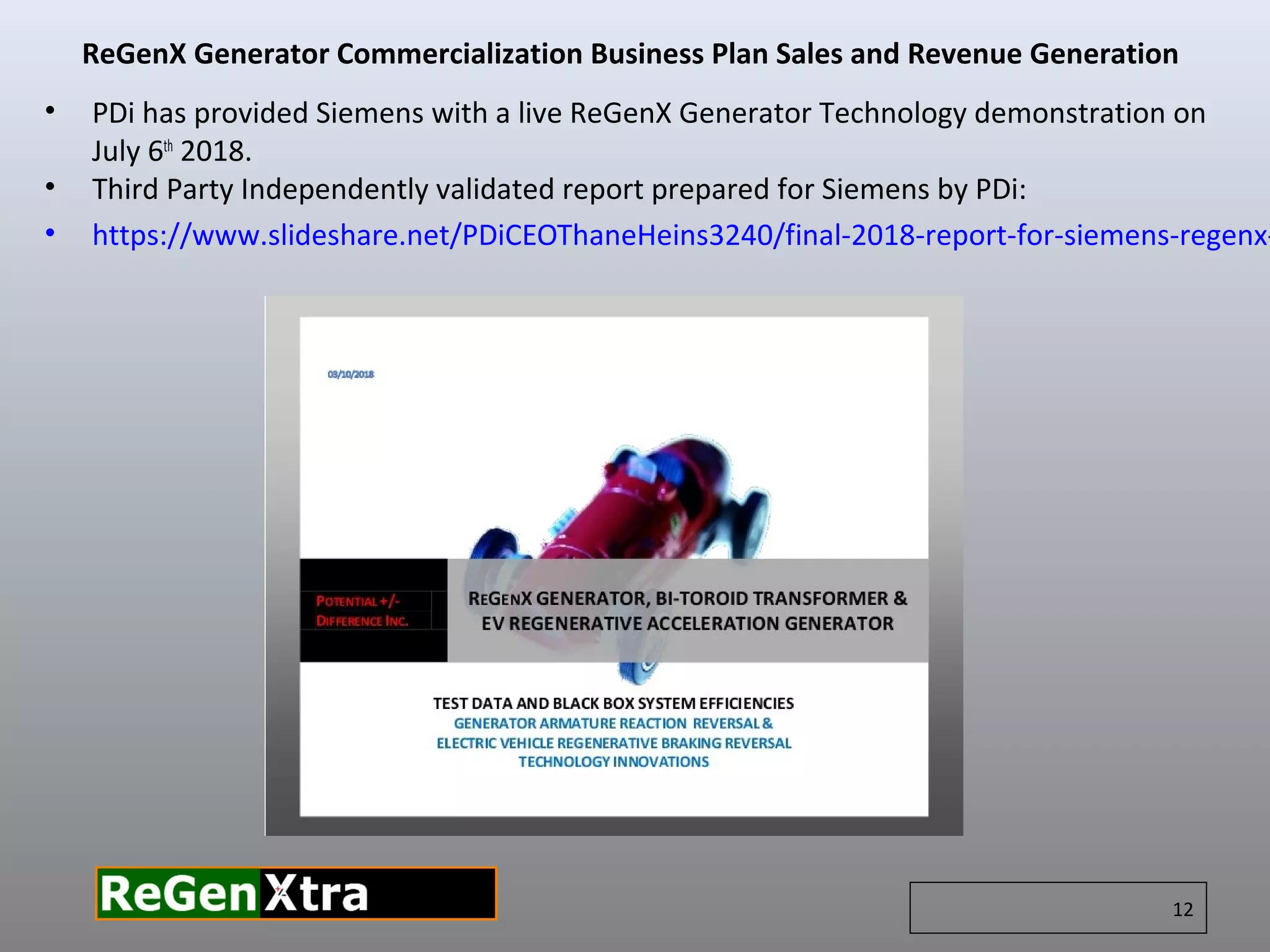
• PDi has provided Siemens with a live ReGenX Generator Technology demonstration on
July 6th
2018.
• Third Party Independently validated report prepared for Siemens by PDi:
• https://www.slideshare.net/PDiCEOThaneHeins3240/final-2018-report-for-siemens-regenx-
ReGenX Generator Commercialization Business Plan Sales and Revenue Generation
12
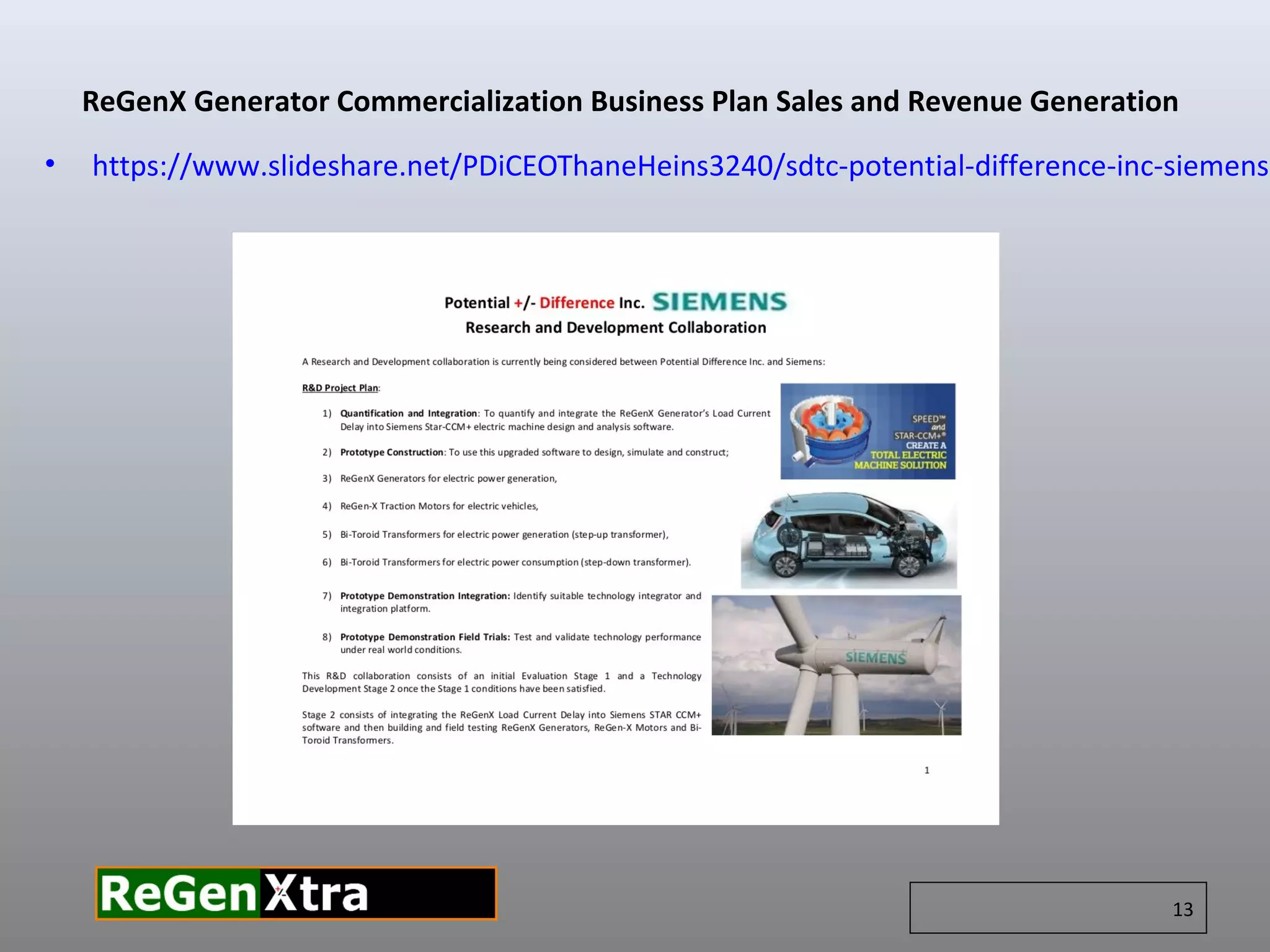
• https://www.slideshare.net/PDiCEOThaneHeins3240/sdtc-potential-difference-inc-siemens-
ReGenX Generator Commercialization Business Plan Sales and Revenue Generation
13
• SEM Drásov Siemens Electric Machines in Czechoslovakia and Siemens AG Process
Industries and Drives (Wind) Division Large Drives in Germany are currently evaluating
the scale up opportunity to 50 MW under a Services Contract Agreement.
• GE and Westinghouse have also been invited to bid on the ReGenX Generator 100 kW
– 30 MW – 800 MW development.
• PDi intends to initiate ReGenX Generator manufacturing in the 1st
quarter of 2019 and
to produce and retail gensets up to 100 kW in collaboration with GAL Power Systems.
• PDi has applied to Sustainable Development Technologies Canada for funding
assistance.
• PDi has commercially manufactured components and suppliers standing by who are
ready to deliver the required generator rotors and ReGenX Generator coils.
• PDi’s coil supplier, Toroid Technologies and rotor supplier, Electron Energy Corporation
have been participating directly in ReGenX Generator development since 2008.
ReGenX Generator Commercialization Business Plan Sales and Revenue Generation
14
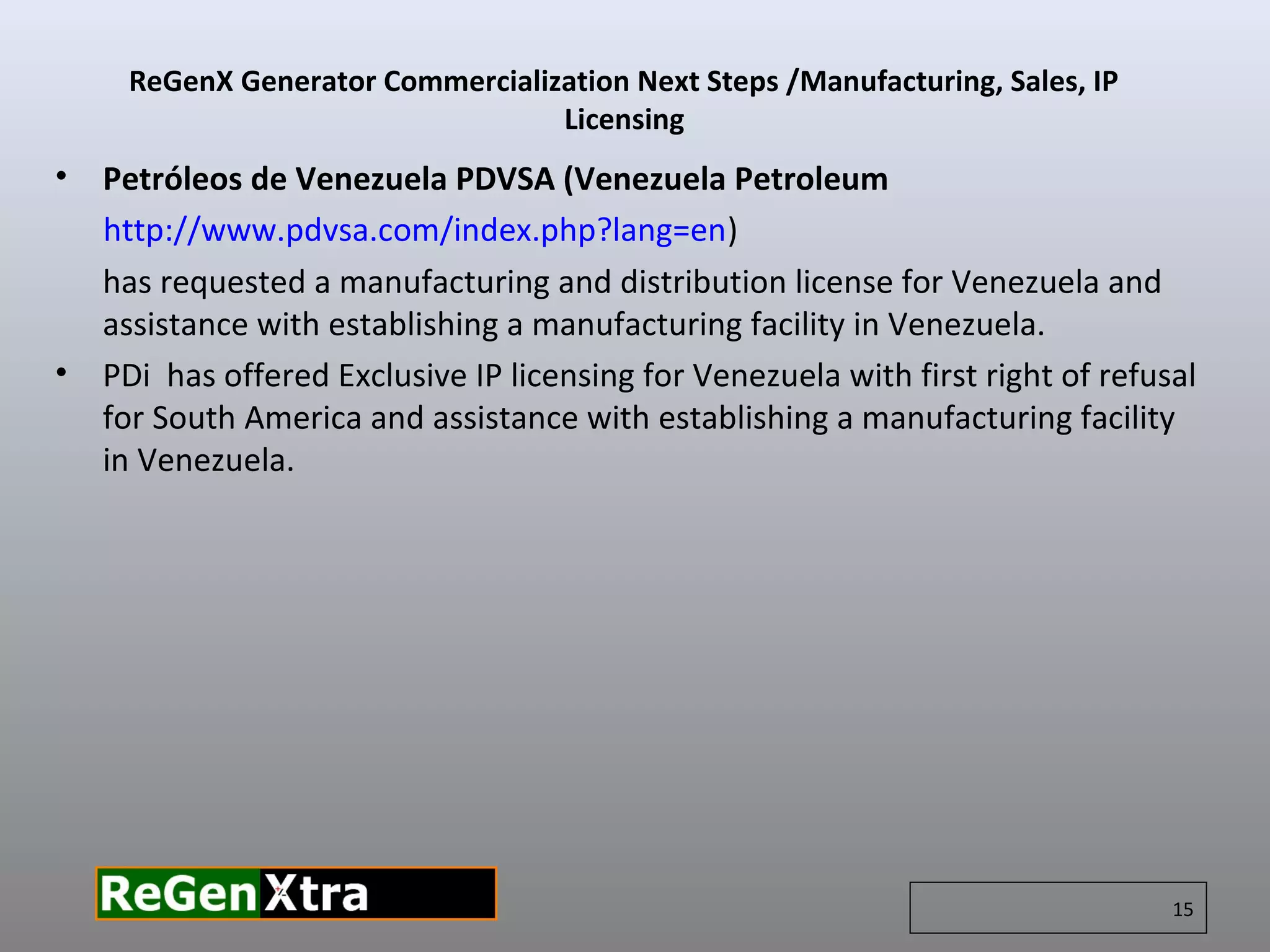
• Petróleos de Venezuela PDVSA (Venezuela Petroleum
http://www.pdvsa.com/index.php?lang=en)
has requested a manufacturing and distribution license for Venezuela and
assistance with establishing a manufacturing facility in Venezuela.
• PDi has offered Exclusive IP licensing for Venezuela with first right of refusal
for South America and assistance with establishing a manufacturing facility
in Venezuela.
ReGenX Generator Commercialization Next Steps /Manufacturing, Sales, IP
Licensing
15
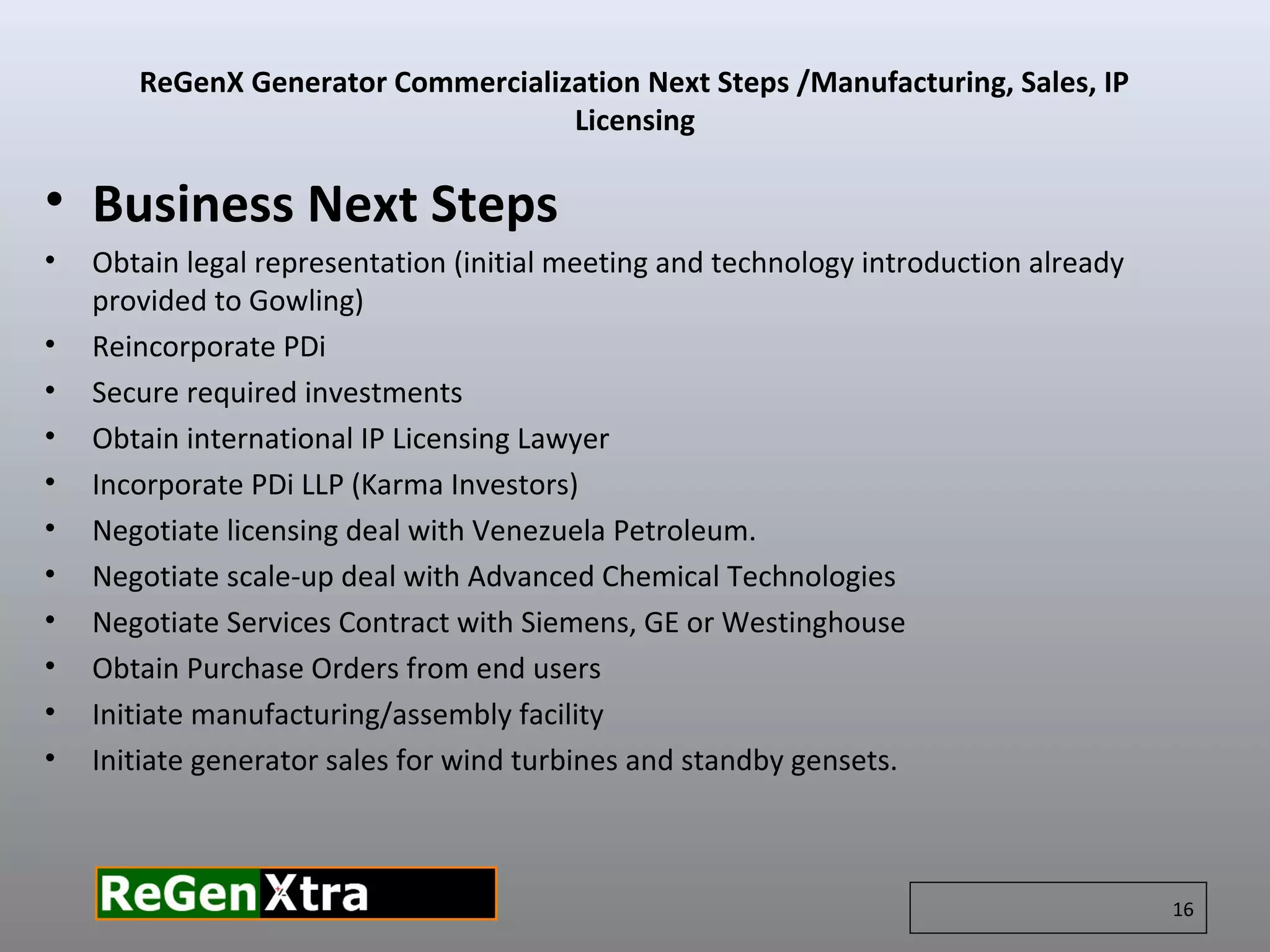
• Business Next Steps
• Obtain legal representation (initial meeting and technology introduction already
provided to Gowling)
• Reincorporate PDi
• Secure required investments
• Obtain international IP Licensing Lawyer
• Incorporate PDi LLP (Karma Investors)
• Negotiate licensing deal with Venezuela Petroleum.
• Negotiate scale-up deal with Advanced Chemical Technologies
• Negotiate Services Contract with Siemens, GE or Westinghouse
• Obtain Purchase Orders from end users
• Initiate manufacturing/assembly facility
• Initiate generator sales for wind turbines and standby gensets.
16
ReGenX Generator Commercialization Next Steps /Manufacturing, Sales, IP
Licensing
Raquel Hamraqi
Vice President International Business Development,
Potential +/- Difference Inc.
Email: raquel@potentialdifference.ca
Mobile: 613-859-8688
​
Potential +/- Difference Inc. Electric Vehicle Regenerative Acceleration Technology
Charging Ahead
17

Introduction to ReGenX Generator Innovations & Commercialization Overview 2018-2030

  • 1.
    Potential +/-Difference Inc. Introduction ElectricVehicle Regenerative Acceleration and ReGenX Generator Innovations August 14th , 2018 1
  • 2.
    Introduction Electric Vehicle RegenerativeAcceleration and ReGenX Generator Technology • What are the innovations? • The innovations are called the ReGenX, Regenerative Acceleration Generator. • ReGenX Generator for electric power generation. • Regenerative Acceleration for electric vehicles. • What do the innovations do? • The ReGenX Generator innovation reverses Generator Armature Reaction and reduces the financial input cost of generating electricity by more than 80%. • In electric vehicle applications the EV Regenerative Acceleration innovation reverses the electric vehicle regenerative braking paradigm and the electric vehicle is accelerated while their batteries are recharged rather than being decelerated as with EV regenerative braking. 2
  • 3.
    • What isGenerator Armature Reaction? • Generator Armature Reaction is a Counter Electromagnetic Torque which is produced inside all electric generators by the magnetic fields that are created around the current bearing wires that make up the generator coils. • The magnitude of the counter torque produced is directly related to the magnitude of the load current. • The counter torque performs negative work and works against the torque supplied by the prime mover – reducing the net torque in the drive shaft. • The prime mover must consume additional input energy in order increase the torque and mechanical power in the driveshaft to overcome the generator’s counter torque or the generator will stall the prime mover. • Over 80% of the cost of generating electricity is due to the input energy cost required to overcome Generator Armature Reaction. • Environmentally over 80% of the Greenhouse Gasses and Nuclear waste produced globally are due to Generator Armature Reaction. 3 Introduction Electric Vehicle Regenerative Acceleration and ReGenX Generator Technology
  • 4.
    Introduction Electric Vehicle RegenerativeAcceleration and ReGenX Generator Technology • How can Generator Armature Reaction be reversed? • The ReGenX Generator Coil operates with a Load Current Delay and this Load Current Delay reverses Generator Armature Reaction aka the EV regenerative braking paradigm. • The ReGenX Generator reverses Generator Armature Reaction in electric power generation. (US Patent #240111054 A1 ) • The Load Current Delay can be between 50 and 90 degrees. 4
  • 5.
    5 Effects of ReversingGenerator Armature Reaction in Electric Power Generation 1 MW Conventional Generator and 1 MW ReGenX Generator Comparison Effects of Reversing Generator Armature Reaction in Electric Power Generation Generator Type No-Load Mechanical Drive Shaft INPUT Power (Watts) No-Load System Equilibrium Speed (RPM) On-Load Generator OUTPUT Power (Watts) On-Load Mechanical Drive Shaft INPUT Power Increase (Watts) On-Load System Equilibrium Speed (RPM) On-Load Total Drive Shaft Mechanical Input Power Requirement Conventional Generator 0.5MW 3500 1MW 1MW 3500 >1.5MW ReGenX Generator 0.5MW 3500 1MW 0.00W 3500 <0.5MW Conventional Generator Operation: A 1 MW conventional generator generally requires about ½ a MW (500,000 Watts) of mechanical input power to idle on no-load. When delivering 1 MW of output power on-load, Generator Armature Reaction always causes the mechanical input power requirement to increase by an additional 1 MW for a combined total mechanical input power requirement of more than 1.5 MW (or closer to 2,000.000 Watts of mechanical input power when system losses are accounted) to deliver 1,000,000 Watts of electrical output power. 2 mechanical input Watts IN for every 1 electrical Watt OUT. ReGenX Generator Operation: A 1 MW ReGenX Generator also requires ½ a MW to idle on no-load. When placed on-load the mechanical input power required to be supplied to the ReGenX Generator is always less than what was required at idle on no-load because the ReGenX Generator reverses Generator Armature Reaction (or closer to 400,000 Watts of mechanical input power when system losses are accounted) to deliver 1,000,000 W of electrical output power. 0.4 mechanical input Watts IN for every 1 electrical Watt OUT.
  • 6.
    Conventional Generator Operationwith Generator Armature Reaction : 1. A 1 MW conventional generator generally requires about ½ a MW (500,000 Watts) of mechanical input power to idle on no-load. 2. When placed on-load and when delivering 1 MW of output power, Generator Armature Reaction always necessitates that the mechanical input power in the drive shaft to the generator delivered by the prime mover be increased by an additional 1 MW. 3. A combined total mechanical input power requirement of more than 1.5 MW (or closer to 2,000.000 Watts of mechanical input power when system losses are accounted) are required to deliver 1 MW of electrical output power. 4. 2 mechanical input Watts IN for every 1 electrical Watt OUT in conventional generators. ReGenX Generator Operation with Generator Armature Reaction Reversal: 1. A 1 MW ReGenX Generator also requires ½ a MW to idle on no-load. 2. When placed on-load and when delivering 1 MW of output power, the ReGenX Generator does not require that the mechanical input power in the drive shaft to the generator be increased – in fact the mechanical drive shaft power requirement from the prime mover is reduced to below the level which was required at idle on no-load because Generator Armature Reaction is reversed. 3. When placed on-load the mechanical input power required to be supplied to the ReGenX Generator is always less than what was required at idle on no-load because the ReGenX Generator reverses Generator Armature Reaction (or closer to 400,000 Watts of mechanical input power when system losses are accounted) to deliver 1 MW of electrical output power. 4. 0.4 mechanical input Watts IN for every 1 electrical Watt OUT. Effects of Reversing Generator Armature Reaction in Electric Power Generation 6
  • 7.
    • Why isthis innovation important? • EV Regenerative Acceleration increases the range of the EV significantly and decreases plug-in recharging requirements because it allows the EV’s batteries to be continuously recharged in all driving modes; during vehicle acceleration, coasting and during deceleration. • In electric power generation, reversing Generator Armature Reaction reduces the input costs by more than 80% while also reducing the pollution produced by more than 80% as well. • The physical size of the prime mover required in electric power generation can be reduced by more than 80%. • Wind turbines can be more than 80% smaller in size and height while producing the same output power as conventionally sized turbines. Effects of Reversing Generator Armature Reaction in Electric Power Generation 7
  • 8.
    ReGenX Generator TechnologyPrime Mover Size Comparison > 80% Prime Mover Size Reduction 8
  • 9.
    • Commercialization NextSteps /Manufacturing, Sales, IP Licensing • Advanced Chemical Technologies (AChT) has approached Potential Difference Inc. (PDi) and has requested 30 MW ReGenX Generators for their new methanol plant in Sudbury which goes on-line in 2021. • AChT wants to use some of its methanol produced to generate electricity to mitigate its electricity consumption costs. • PDi and AChT have an MOU under development which provides AChT with global exclusivity on the development of a new electricity generating platform for the entire global methanol industry using ReGenX Generators. • AChT has also requested the scale-up of ReGenX Generators to 800 MW by 2030. • In order for AChT to generate 400 MW of electricity using conventional generator technology; 227,000 tones of methanol would be required or 23% of their yearly 1 million tones of production. • Using ReGenX Generator Technology only 60,000 tones of methanol would be required to generate 400 MW or 6% of their yearly production. ReGenX Generator Commercialization Next Steps /Manufacturing, Sales, IP Licensing 9
  • 10.
    ReGenX Generator PowerGeneration in Methanol Plant 10
  • 11.
    • Estimated GeneratorDevelopment Cost and Financing Plan • Current market purchase price for a 800 MW generator is about $275M. • Scale-up and development of ReGenX Generators to 800 MW by 2030 is estimated to be > $1B. • Scale-up financing includes the incremental development and sales of ReGenX Generators from 1 kW, 3 kW, 5 kW, 10 kW and so on in every conceivable size and variation possible over the next decade. • AChT, PDi and GAL Power Systems intend to develop a 5 kW methanol powered ReGenX Generator prototype as a demonstration unit for the methanol industry which will allow for electricity generation with more than 80% less input methanol – and to use this new power generation benchmark to generate revenue through preorders. • California Diesel and Power (CD&P) are currently requesting 50 HP diesel gensets for use in AT&T cell phone towers in California. • PDi and CD&P provided AT&T with a ReGenX Generator demonstration in 2008. ReGenX Generator Commercialization Business Plan Sales and Revenue Generation 11
  • 12.
    • PDi hasprovided Siemens with a live ReGenX Generator Technology demonstration on July 6th 2018. • Third Party Independently validated report prepared for Siemens by PDi: • https://www.slideshare.net/PDiCEOThaneHeins3240/final-2018-report-for-siemens-regenx- ReGenX Generator Commercialization Business Plan Sales and Revenue Generation 12
  • 13.
  • 14.
    • SEM DrásovSiemens Electric Machines in Czechoslovakia and Siemens AG Process Industries and Drives (Wind) Division Large Drives in Germany are currently evaluating the scale up opportunity to 50 MW under a Services Contract Agreement. • GE and Westinghouse have also been invited to bid on the ReGenX Generator 100 kW – 30 MW – 800 MW development. • PDi intends to initiate ReGenX Generator manufacturing in the 1st quarter of 2019 and to produce and retail gensets up to 100 kW in collaboration with GAL Power Systems. • PDi has applied to Sustainable Development Technologies Canada for funding assistance. • PDi has commercially manufactured components and suppliers standing by who are ready to deliver the required generator rotors and ReGenX Generator coils. • PDi’s coil supplier, Toroid Technologies and rotor supplier, Electron Energy Corporation have been participating directly in ReGenX Generator development since 2008. ReGenX Generator Commercialization Business Plan Sales and Revenue Generation 14
  • 15.
    • Petróleos deVenezuela PDVSA (Venezuela Petroleum http://www.pdvsa.com/index.php?lang=en) has requested a manufacturing and distribution license for Venezuela and assistance with establishing a manufacturing facility in Venezuela. • PDi has offered Exclusive IP licensing for Venezuela with first right of refusal for South America and assistance with establishing a manufacturing facility in Venezuela. ReGenX Generator Commercialization Next Steps /Manufacturing, Sales, IP Licensing 15
  • 16.
    • Business NextSteps • Obtain legal representation (initial meeting and technology introduction already provided to Gowling) • Reincorporate PDi • Secure required investments • Obtain international IP Licensing Lawyer • Incorporate PDi LLP (Karma Investors) • Negotiate licensing deal with Venezuela Petroleum. • Negotiate scale-up deal with Advanced Chemical Technologies • Negotiate Services Contract with Siemens, GE or Westinghouse • Obtain Purchase Orders from end users • Initiate manufacturing/assembly facility • Initiate generator sales for wind turbines and standby gensets. 16 ReGenX Generator Commercialization Next Steps /Manufacturing, Sales, IP Licensing
  • 17.
    Raquel Hamraqi Vice PresidentInternational Business Development, Potential +/- Difference Inc. Email: raquel@potentialdifference.ca Mobile: 613-859-8688 ​ Potential +/- Difference Inc. Electric Vehicle Regenerative Acceleration Technology Charging Ahead 17