Optical Communication Systems
Lecture 1 Introduction
Dr. Omar MS Ghazal
ECE Department 4th year
Course Outline
• Introduction
– Light, ray model, and types of fibers
• Optical sources and receivers
– Semiconductor Laser, LED, photodiodes
• Signal Losses and distortions in optical networks
– Attenuation, Dispersion, Losses
• Design of Optical Link
– Link Design, Link Primary measurements
• Integrated Optics
• Wavelength Division Multiplexing WDM
– Components, WDM networks design
References and reading materials
• Gerd Keiser, Optical Fiber communications, 1991
• W. T. Silvast, Laser Fundamentals, Cambridge (2004)
• C. R. Pollock, Fundamentals of Optoelectronics, Irwin
(1995)
• S.O. Kasap, Optoelectronics and Photonics, Prentice
Hall, N.J. (2001)
• Optoelectronics - An Introduction, J. wilson ans J. F. B.
Hawkes, Prentice Hall International (1983)
• Shoichi Sudo (eds.), Optical Fiber Amplifiers : Material,
devices and applications, artech House Inc. (1997)
• K. Grobe, M. Eiselt, Wavelength Division Multiplexing: A
Practical Engineering Guide, John Wiley and Sons Inc.
(2013)
Lecture Outline
• Brief history of communications
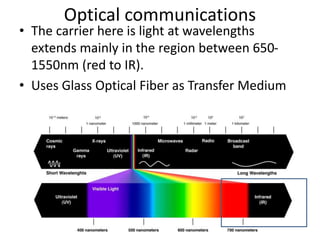
• EM spectrum and where Optical fibers lies
• Windows of Optical fibers throughout the time.
• Spherical and plane waves
– Ray model
• Basic fiber structure
– Types of optical fibers
Communications History
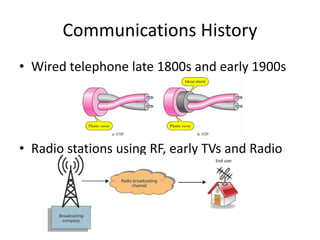
• Wired telephone late 1800s and early 1900s
• Radio stations using RF, early TVs and Radio
Communications History (Contd.)
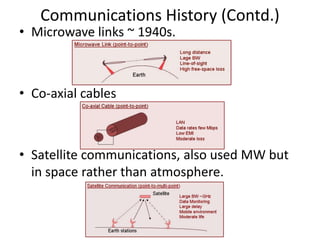
• Microwave links ~ 1940s.
• Co-axial cables
• Satellite communications, also used MW but
in space rather than atmosphere.
Optical Communications
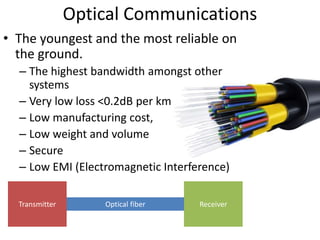
• The youngest and the most reliable on
the ground.
– The highest bandwidth amongst other
systems
– Very low loss <0.2dB per km.
– Low manufacturing cost,
– Low weight and volume
– Secure
– Low EMI (Electromagnetic Interference)
Transmitter Receiver
Optical fiber
Optical communications
• The carrier here is light at wavelengths
extends mainly in the region between 650-
1550nm (red to IR).
• Uses Glass Optical Fiber as Transfer Medium
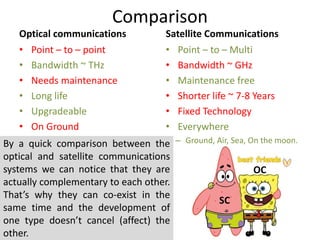
Comparison
Optical communications
• Point – to – point
• Bandwidth ~ THz
• Needs maintenance
• Long life
• Upgradeable
• On Ground
Satellite Communications
By a quick comparison between the
optical and satellite communications
systems we can notice that they are
actually complementary to each other.
That’s why they can co-exist in the
same time and the development of
one type doesn’t cancel (affect) the
other.
SC
OC
• Point – to – Multi
• Bandwidth ~ GHz
• Maintenance free
• Shorter life ~ 7-8 Years
• Fixed Technology
• Everywhere
– Ground, Air, Sea, On the moon.
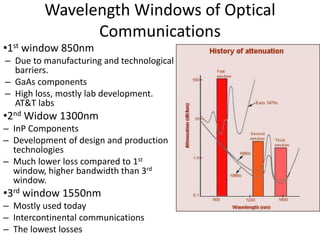
Wavelength Windows of Optical
Communications
•1st window 850nm
– Due to manufacturing and technological
barriers.
– GaAs components
– High loss, mostly lab development.
AT&T labs
•2nd Widow 1300nm
– InP Components
– Development of design and production
technologies
– Much lower loss compared to 1st
window, higher bandwidth than 3rd
window.
•3rd window 1550nm
– Mostly used today
– Intercontinental communications
– The lowest losses
Optical Bandwidth
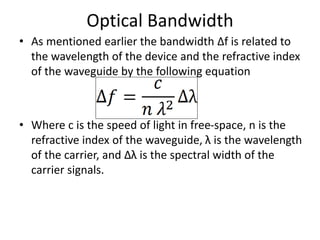
• As mentioned earlier the bandwidth ∆f is related to
the wavelength of the device and the refractive index
of the waveguide by the following equation
• Where c is the speed of light in free-space, n is the
refractive index of the waveguide, λ is the wavelength
of the carrier, and ∆λ is the spectral width of the
carrier signals.
Optical Bandwidth (cont.)
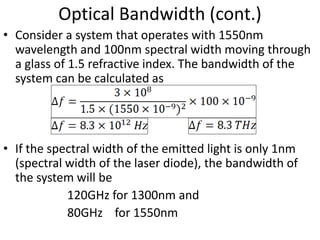
• Consider a system that operates with 1550nm
wavelength and 100nm spectral width moving through
a glass of 1.5 refractive index. The bandwidth of the
system can be calculated as
• If the spectral width of the emitted light is only 1nm
(spectral width of the laser diode), the bandwidth of
the system will be
120GHz for 1300nm and
80GHz for 1550nm
Spherical and Plane waves
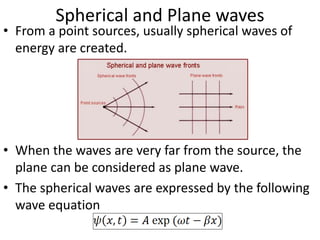
• From a point sources, usually spherical waves of
energy are created.
• When the waves are very far from the source, the
plane can be considered as plane wave.
• The spherical waves are expressed by the following
wave equation
Light Behavior at Materials Interface
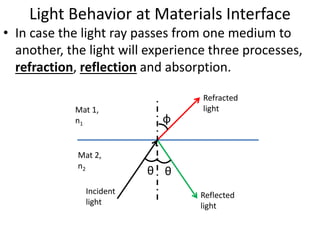
• In case the light ray passes from one medium to
another, the light will experience three processes,
refraction, reflection and absorption.
Mat 1,
n1
Mat 2,
n2
Incident
light
Reflected
light
Refracted
light
φ
θ
θ
Snell’s Law
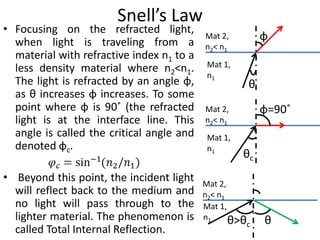
• Focusing on the refracted light,
when light is traveling from a
material with refractive index n1 to a
less density material where n2<n1.
The light is refracted by an angle φ,
as θ increases φ increases. To some
point where φ is 90˚ (the refracted
light is at the interface line. This
angle is called the critical angle and
denoted φc.
• Beyond this point, the incident light
will reflect back to the medium and
no light will pass through to the
lighter material. The phenomenon is
called Total Internal Reflection.
Mat 2,
n2< n1
Mat 1,
n1
φ
θ
Mat 2,
n2< n1
Mat 1,
n1
φ=90˚
θc
Mat 2,
n2< n1
Mat 1,
n1 θ>θc θ
Basic Fiber Optics Structure
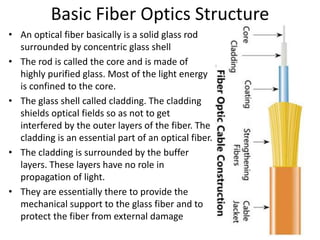
• An optical fiber basically is a solid glass rod
surrounded by concentric glass shell
• The rod is called the core and is made of
highly purified glass. Most of the light energy
is confined to the core.
• The glass shell called cladding. The cladding
shields optical fields so as not to get
interfered by the outer layers of the fiber. The
cladding is an essential part of an optical fiber.
• The cladding is surrounded by the buffer
layers. These layers have no role in
propagation of light.
• They are essentially there to provide the
mechanical support to the glass fiber and to
protect the fiber from external damage
Light propagation in optical fiber as a
ray model
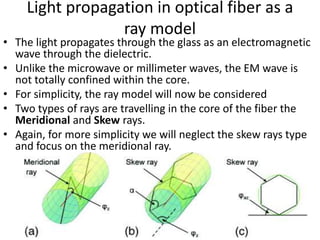
• The light propagates through the glass as an electromagnetic
wave through the dielectric.
• Unlike the microwave or millimeter waves, the EM wave is
not totally confined within the core.
• For simplicity, the ray model will now be considered
• Two types of rays are travelling in the core of the fiber the
Meridional and Skew rays.
• Again, for more simplicity we will neglect the skew rays type
and focus on the meridional ray.
Light propagation in the Optical Fiber
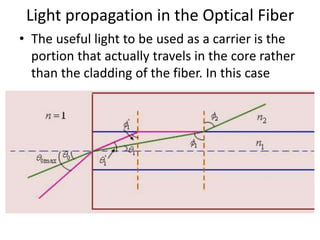
• The useful light to be used as a carrier is the
portion that actually travels in the core rather
than the cladding of the fiber. In this case
Numerical Aperture
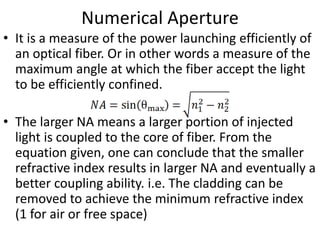
• It is a measure of the power launching efficiently of
an optical fiber. Or in other words a measure of the
maximum angle at which the fiber accept the light
to be efficiently confined.
• The larger NA means a larger portion of injected
light is coupled to the core of fiber. From the
equation given, one can conclude that the smaller
refractive index results in larger NA and eventually a
better coupling ability. i.e. The cladding can be
removed to achieve the minimum refractive index
(1 for air or free space)
Dispersion during light propagation
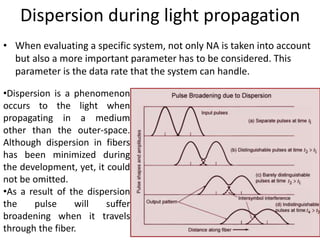
• When evaluating a specific system, not only NA is taken into account
but also a more important parameter has to be considered. This
parameter is the data rate that the system can handle.
•Dispersion is a phenomenon
occurs to the light when
propagating in a medium
other than the outer-space.
Although dispersion in fibers
has been minimized during
the development, yet, it could
not be omitted.
•As a result of the dispersion
the pulse will suffer
broadening when it travels
through the fiber.
Dispersion (cont.)
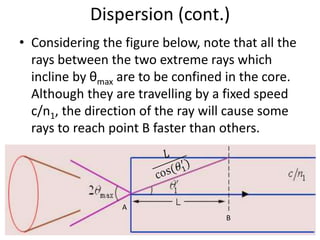
• Considering the figure below, note that all the
rays between the two extreme rays which
incline by θmax are to be confined in the core.
Although they are travelling by a fixed speed
c/n1, the direction of the ray will cause some
rays to reach point B faster than others.
A
B
Dispersion (cont.)
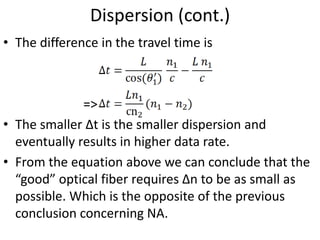
• The difference in the travel time is
=>
• The smaller ∆t is the smaller dispersion and
eventually results in higher data rate.
• From the equation above we can conclude that the
“good” optical fiber requires ∆n to be as small as
possible. Which is the opposite of the previous
conclusion concerning NA.
Dispersion-NA trade-off
• The two conclusions drawn previously when the
light propagation in the fiber was discussed show
that you have to sacrifice one of the properties to
improve the other.
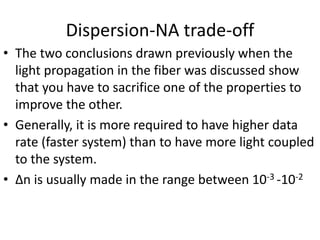
• Generally, it is more required to have higher data
rate (faster system) than to have more light coupled
to the system.
• ∆n is usually made in the range between 10-3 -10-2
Types of Optical Fiber
• The optical fiber was introduced in three
different types based on their structure.
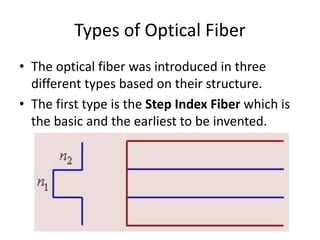
• The first type is the Step Index Fiber which is
the basic and the earliest to be invented.
• The speed of light in a medium depends on the
refractive index of that medium. For that reason to
change the speed, we can change the refractive index
of that medium for that specific wavelength.
• Since the dispersion resulted from the time difference
between the travelled rays, it is possible to vary the
refractive index in a specific pattern to cancel or
minimize this time difference
• Since the difference as seen in the Dispersion analysis
comes from the fact that the ray along the fiber axis
reaches the B slice before the inclined line, we can
“slow-down” the ray travelling along the axis by slightly
increasing the refractive index there compared to the
edge of the core.
Types of Optical Fiber (cont.)
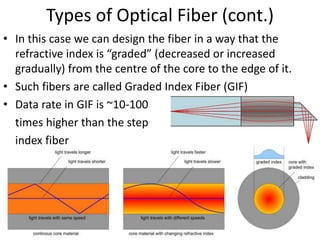
• In this case we can design the fiber in a way that the
refractive index is “graded” (decreased or increased
gradually) from the centre of the core to the edge of it.
• Such fibers are called Graded Index Fiber (GIF)
• Data rate in GIF is ~10-100
times higher than the step
index fiber
Types of Optical Fiber (cont.)
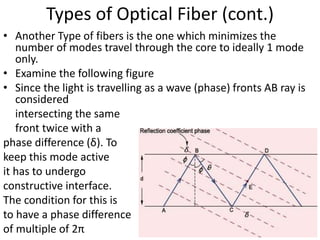
• Another Type of fibers is the one which minimizes the
number of modes travel through the core to ideally 1 mode
only.
• Examine the following figure
• Since the light is travelling as a wave (phase) fronts AB ray is
considered
intersecting the same
front twice with a
phase difference (δ). To
keep this mode active
it has to undergo
constructive interface.
The condition for this is
to have a phase difference
of multiple of 2π
Types of Optical Fiber (cont.)
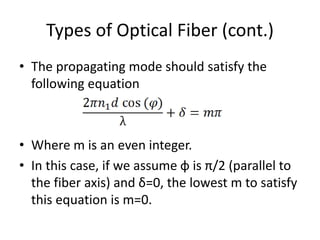
• The propagating mode should satisfy the
following equation
• Where m is an even integer.
• In this case, if we assume φ is π/2 (parallel to
the fiber axis) and δ=0, the lowest m to satisfy
this equation is m=0.
Types of Optical Fibers (cont.)
• For m=0 it means that only the fundamental mode
is passing the fiber, i.e. only one mode is travelling.
• Again examining the final equation we can notice
that decreasing the diameter of the fiber results in
decrease of m.
• From this we can draw a conclusion that if d is
decreased to a specific point were only 1 mode is
allowed to travel through the fiber, dispersion will
be minimized since it resulted from the multimode
operation in the previous types of fiber.
• This type of fibers is called Single Mode Fiber which
is used mainly in the long distance communications.
Types of Optical Fibers (cont.)
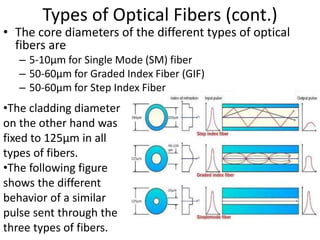
• The core diameters of the different types of optical
fibers are
– 5-10μm for Single Mode (SM) fiber
– 50-60μm for Graded Index Fiber (GIF)
– 50-60μm for Step Index Fiber
•The cladding diameter
on the other hand was
fixed to 125μm in all
types of fibers.
•The following figure
shows the different
behavior of a similar
pulse sent through the
three types of fibers.
Limitations of the Ray-model
• (1) The ray model gives an impression that during
total internal reflection the energy is confined to
the core only. However, it is not so. In reality the
optical energy spreads in cladding also.
• (2) The ray model does not speak of the discrete
field patterns for propagation inside a fiber.
• (3) The ray model breaks down when the core
size becomes comparable to the wavelength of
light. The ray model therefore is not quite
justified for a SM fiber. The limitations of the Ray
model are overcome in the wave model.

Optical Communications Systems Lecture 1(1).pptx

  • 1.
    Optical Communication Systems Lecture1 Introduction Dr. Omar MS Ghazal ECE Department 4th year
  • 2.
    Course Outline • Introduction –Light, ray model, and types of fibers • Optical sources and receivers – Semiconductor Laser, LED, photodiodes • Signal Losses and distortions in optical networks – Attenuation, Dispersion, Losses • Design of Optical Link – Link Design, Link Primary measurements • Integrated Optics • Wavelength Division Multiplexing WDM – Components, WDM networks design
  • 3.
    References and readingmaterials • Gerd Keiser, Optical Fiber communications, 1991 • W. T. Silvast, Laser Fundamentals, Cambridge (2004) • C. R. Pollock, Fundamentals of Optoelectronics, Irwin (1995) • S.O. Kasap, Optoelectronics and Photonics, Prentice Hall, N.J. (2001) • Optoelectronics - An Introduction, J. wilson ans J. F. B. Hawkes, Prentice Hall International (1983) • Shoichi Sudo (eds.), Optical Fiber Amplifiers : Material, devices and applications, artech House Inc. (1997) • K. Grobe, M. Eiselt, Wavelength Division Multiplexing: A Practical Engineering Guide, John Wiley and Sons Inc. (2013)
  • 4.
    Lecture Outline • Briefhistory of communications • EM spectrum and where Optical fibers lies • Windows of Optical fibers throughout the time. • Spherical and plane waves – Ray model • Basic fiber structure – Types of optical fibers
  • 5.
    Communications History • Wiredtelephone late 1800s and early 1900s • Radio stations using RF, early TVs and Radio
  • 6.
    Communications History (Contd.) •Microwave links ~ 1940s. • Co-axial cables • Satellite communications, also used MW but in space rather than atmosphere.
  • 7.
    Optical Communications • Theyoungest and the most reliable on the ground. – The highest bandwidth amongst other systems – Very low loss <0.2dB per km. – Low manufacturing cost, – Low weight and volume – Secure – Low EMI (Electromagnetic Interference) Transmitter Receiver Optical fiber
  • 8.
    Optical communications • Thecarrier here is light at wavelengths extends mainly in the region between 650- 1550nm (red to IR). • Uses Glass Optical Fiber as Transfer Medium
  • 9.
    Comparison Optical communications • Point– to – point • Bandwidth ~ THz • Needs maintenance • Long life • Upgradeable • On Ground Satellite Communications By a quick comparison between the optical and satellite communications systems we can notice that they are actually complementary to each other. That’s why they can co-exist in the same time and the development of one type doesn’t cancel (affect) the other. SC OC • Point – to – Multi • Bandwidth ~ GHz • Maintenance free • Shorter life ~ 7-8 Years • Fixed Technology • Everywhere – Ground, Air, Sea, On the moon.
  • 10.
    Wavelength Windows ofOptical Communications •1st window 850nm – Due to manufacturing and technological barriers. – GaAs components – High loss, mostly lab development. AT&T labs •2nd Widow 1300nm – InP Components – Development of design and production technologies – Much lower loss compared to 1st window, higher bandwidth than 3rd window. •3rd window 1550nm – Mostly used today – Intercontinental communications – The lowest losses
  • 11.
    Optical Bandwidth • Asmentioned earlier the bandwidth ∆f is related to the wavelength of the device and the refractive index of the waveguide by the following equation • Where c is the speed of light in free-space, n is the refractive index of the waveguide, λ is the wavelength of the carrier, and ∆λ is the spectral width of the carrier signals.
  • 12.
    Optical Bandwidth (cont.) •Consider a system that operates with 1550nm wavelength and 100nm spectral width moving through a glass of 1.5 refractive index. The bandwidth of the system can be calculated as • If the spectral width of the emitted light is only 1nm (spectral width of the laser diode), the bandwidth of the system will be 120GHz for 1300nm and 80GHz for 1550nm
  • 13.
    Spherical and Planewaves • From a point sources, usually spherical waves of energy are created. • When the waves are very far from the source, the plane can be considered as plane wave. • The spherical waves are expressed by the following wave equation
  • 14.
    Light Behavior atMaterials Interface • In case the light ray passes from one medium to another, the light will experience three processes, refraction, reflection and absorption. Mat 1, n1 Mat 2, n2 Incident light Reflected light Refracted light φ θ θ
  • 15.
    Snell’s Law • Focusingon the refracted light, when light is traveling from a material with refractive index n1 to a less density material where n2<n1. The light is refracted by an angle φ, as θ increases φ increases. To some point where φ is 90˚ (the refracted light is at the interface line. This angle is called the critical angle and denoted φc. • Beyond this point, the incident light will reflect back to the medium and no light will pass through to the lighter material. The phenomenon is called Total Internal Reflection. Mat 2, n2< n1 Mat 1, n1 φ θ Mat 2, n2< n1 Mat 1, n1 φ=90˚ θc Mat 2, n2< n1 Mat 1, n1 θ>θc θ
  • 16.
    Basic Fiber OpticsStructure • An optical fiber basically is a solid glass rod surrounded by concentric glass shell • The rod is called the core and is made of highly purified glass. Most of the light energy is confined to the core. • The glass shell called cladding. The cladding shields optical fields so as not to get interfered by the outer layers of the fiber. The cladding is an essential part of an optical fiber. • The cladding is surrounded by the buffer layers. These layers have no role in propagation of light. • They are essentially there to provide the mechanical support to the glass fiber and to protect the fiber from external damage
  • 17.
    Light propagation inoptical fiber as a ray model • The light propagates through the glass as an electromagnetic wave through the dielectric. • Unlike the microwave or millimeter waves, the EM wave is not totally confined within the core. • For simplicity, the ray model will now be considered • Two types of rays are travelling in the core of the fiber the Meridional and Skew rays. • Again, for more simplicity we will neglect the skew rays type and focus on the meridional ray.
  • 18.
    Light propagation inthe Optical Fiber • The useful light to be used as a carrier is the portion that actually travels in the core rather than the cladding of the fiber. In this case
  • 19.
    Numerical Aperture • Itis a measure of the power launching efficiently of an optical fiber. Or in other words a measure of the maximum angle at which the fiber accept the light to be efficiently confined. • The larger NA means a larger portion of injected light is coupled to the core of fiber. From the equation given, one can conclude that the smaller refractive index results in larger NA and eventually a better coupling ability. i.e. The cladding can be removed to achieve the minimum refractive index (1 for air or free space)
  • 20.
    Dispersion during lightpropagation • When evaluating a specific system, not only NA is taken into account but also a more important parameter has to be considered. This parameter is the data rate that the system can handle. •Dispersion is a phenomenon occurs to the light when propagating in a medium other than the outer-space. Although dispersion in fibers has been minimized during the development, yet, it could not be omitted. •As a result of the dispersion the pulse will suffer broadening when it travels through the fiber.
  • 21.
    Dispersion (cont.) • Consideringthe figure below, note that all the rays between the two extreme rays which incline by θmax are to be confined in the core. Although they are travelling by a fixed speed c/n1, the direction of the ray will cause some rays to reach point B faster than others. A B
  • 22.
    Dispersion (cont.) • Thedifference in the travel time is => • The smaller ∆t is the smaller dispersion and eventually results in higher data rate. • From the equation above we can conclude that the “good” optical fiber requires ∆n to be as small as possible. Which is the opposite of the previous conclusion concerning NA.
  • 23.
    Dispersion-NA trade-off • Thetwo conclusions drawn previously when the light propagation in the fiber was discussed show that you have to sacrifice one of the properties to improve the other. • Generally, it is more required to have higher data rate (faster system) than to have more light coupled to the system. • ∆n is usually made in the range between 10-3 -10-2
  • 24.
    Types of OpticalFiber • The optical fiber was introduced in three different types based on their structure. • The first type is the Step Index Fiber which is the basic and the earliest to be invented.
  • 25.
    • The speedof light in a medium depends on the refractive index of that medium. For that reason to change the speed, we can change the refractive index of that medium for that specific wavelength. • Since the dispersion resulted from the time difference between the travelled rays, it is possible to vary the refractive index in a specific pattern to cancel or minimize this time difference • Since the difference as seen in the Dispersion analysis comes from the fact that the ray along the fiber axis reaches the B slice before the inclined line, we can “slow-down” the ray travelling along the axis by slightly increasing the refractive index there compared to the edge of the core. Types of Optical Fiber (cont.)
  • 26.
    Types of OpticalFiber (cont.) • In this case we can design the fiber in a way that the refractive index is “graded” (decreased or increased gradually) from the centre of the core to the edge of it. • Such fibers are called Graded Index Fiber (GIF) • Data rate in GIF is ~10-100 times higher than the step index fiber
  • 27.
    Types of OpticalFiber (cont.) • Another Type of fibers is the one which minimizes the number of modes travel through the core to ideally 1 mode only. • Examine the following figure • Since the light is travelling as a wave (phase) fronts AB ray is considered intersecting the same front twice with a phase difference (δ). To keep this mode active it has to undergo constructive interface. The condition for this is to have a phase difference of multiple of 2π
  • 28.
    Types of OpticalFiber (cont.) • The propagating mode should satisfy the following equation • Where m is an even integer. • In this case, if we assume φ is π/2 (parallel to the fiber axis) and δ=0, the lowest m to satisfy this equation is m=0.
  • 29.
    Types of OpticalFibers (cont.) • For m=0 it means that only the fundamental mode is passing the fiber, i.e. only one mode is travelling. • Again examining the final equation we can notice that decreasing the diameter of the fiber results in decrease of m. • From this we can draw a conclusion that if d is decreased to a specific point were only 1 mode is allowed to travel through the fiber, dispersion will be minimized since it resulted from the multimode operation in the previous types of fiber. • This type of fibers is called Single Mode Fiber which is used mainly in the long distance communications.
  • 30.
    Types of OpticalFibers (cont.) • The core diameters of the different types of optical fibers are – 5-10μm for Single Mode (SM) fiber – 50-60μm for Graded Index Fiber (GIF) – 50-60μm for Step Index Fiber •The cladding diameter on the other hand was fixed to 125μm in all types of fibers. •The following figure shows the different behavior of a similar pulse sent through the three types of fibers.
  • 31.
    Limitations of theRay-model • (1) The ray model gives an impression that during total internal reflection the energy is confined to the core only. However, it is not so. In reality the optical energy spreads in cladding also. • (2) The ray model does not speak of the discrete field patterns for propagation inside a fiber. • (3) The ray model breaks down when the core size becomes comparable to the wavelength of light. The ray model therefore is not quite justified for a SM fiber. The limitations of the Ray model are overcome in the wave model.