10 ^PARADIGMS OF MEDIA IN 
THE DIGITAL AGE
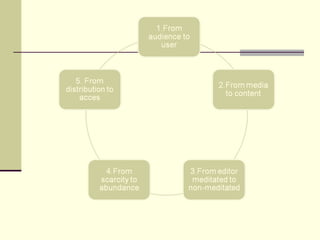
From audience to user 
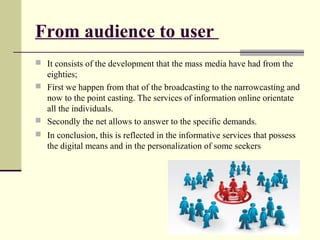
 It consists of the development that the mass media have had from the 
eighties; 
 First we happen from that of the broadcasting to the narrowcasting and 
now to the point casting. The services of information online orientate 
all the individuals. 
 Secondly the net allows to answer to the specific demands. 
 In conclusion, this is reflected in the informative services that possess 
the digital means and in the personalization of some seekers
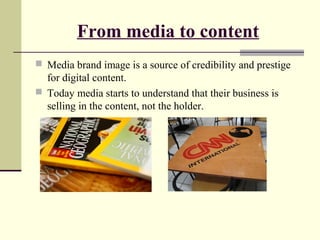
From media to content 
 Media brand image is a source of credibility and prestige 
for digital content. 
 Today media starts to understand that their business is 
selling in the content, not the holder.
From editor-mediated to non-mediated 
 The network has questioned the traditional ways. Nowadays it allow 
the public to have free access to general information. 
 From editor-mediated to non-mediated the gatekeeper paradigm was 
broadly used to explain the role of media editors and the agenda-setting 
theory and to describe the functions of media in defining the 
daily issues.
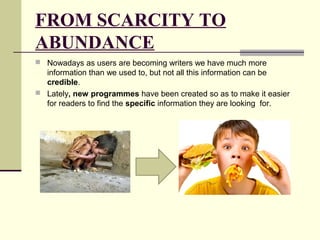
FROM SCARCITY TO 
ABUNDANCE 
 Nowadays as users are becoming writers we have much more 
information than we used to, but not all this information can be 
credible. 
 Lately, new programmes have been created so as to make it easier 
for readers to find the specific information they are looking for.
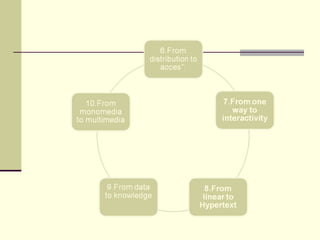
From distribution to acces 
 Nowadays a user can research for information although the 
informant does not provide it directly, the opposite of 
years ago that this was necessary.
From monomedia to multimedia 
 A long time ago people used to work with programmes that combined 
only one sort of media, and that’s why it was called monomedia. 
 
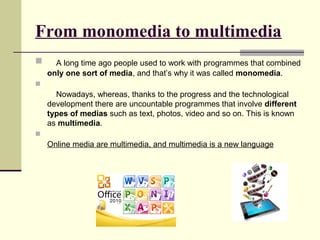
Nowadays, whereas, thanks to the progress and the technological 
development there are uncountable programmes that involve different 
types of medias such as text, photos, video and so on. This is known 
as multimedia. 
 
Online media are multimedia, and multimedia is a new language
From one way to interactivity 
 Before:Radio, TV, newspaper… was the way that the people were 
connected with the world. 
 Nowadays:The people can be reported about the things happened 
around the world, but not everybody at the specific moment. 
The technology has given us the opportunity to search about the 
information we want through internet.
From linear to Hypertext 
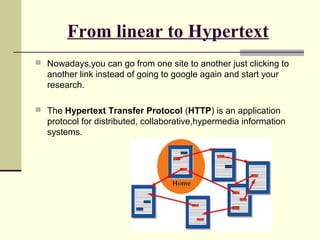
 Nowadays,you can go from one site to another just clicking to 
another link instead of going to google again and start your 
research. 
 The Hypertext Transfer Protocol (HTTP) is an application 
protocol for distributed, collaborative,hypermedia information 
systems.
From data to knowledge 
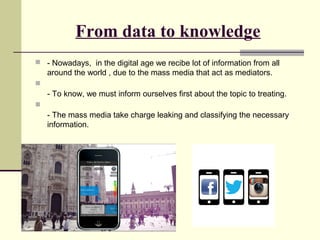
 - Nowadays, in the digital age we recibe lot of information from all 
around the world , due to the mass media that act as mediators. 
 
- To know, we must inform ourselves first about the topic to treating. 
 
- The mass media take charge leaking and classifying the necessary 
information.

Evolution of computers

  • 1.
    10 ^PARADIGMS OFMEDIA IN THE DIGITAL AGE
  • 4.
    From audience touser  It consists of the development that the mass media have had from the eighties;  First we happen from that of the broadcasting to the narrowcasting and now to the point casting. The services of information online orientate all the individuals.  Secondly the net allows to answer to the specific demands.  In conclusion, this is reflected in the informative services that possess the digital means and in the personalization of some seekers
  • 5.
    From media tocontent  Media brand image is a source of credibility and prestige for digital content.  Today media starts to understand that their business is selling in the content, not the holder.
  • 6.
    From editor-mediated tonon-mediated  The network has questioned the traditional ways. Nowadays it allow the public to have free access to general information.  From editor-mediated to non-mediated the gatekeeper paradigm was broadly used to explain the role of media editors and the agenda-setting theory and to describe the functions of media in defining the daily issues.
  • 7.
    FROM SCARCITY TO ABUNDANCE  Nowadays as users are becoming writers we have much more information than we used to, but not all this information can be credible.  Lately, new programmes have been created so as to make it easier for readers to find the specific information they are looking for.
  • 8.
    From distribution toacces  Nowadays a user can research for information although the informant does not provide it directly, the opposite of years ago that this was necessary.
  • 9.
    From monomedia tomultimedia  A long time ago people used to work with programmes that combined only one sort of media, and that’s why it was called monomedia.  Nowadays, whereas, thanks to the progress and the technological development there are uncountable programmes that involve different types of medias such as text, photos, video and so on. This is known as multimedia.  Online media are multimedia, and multimedia is a new language
  • 10.
    From one wayto interactivity  Before:Radio, TV, newspaper… was the way that the people were connected with the world.  Nowadays:The people can be reported about the things happened around the world, but not everybody at the specific moment. The technology has given us the opportunity to search about the information we want through internet.
  • 11.
    From linear toHypertext  Nowadays,you can go from one site to another just clicking to another link instead of going to google again and start your research.  The Hypertext Transfer Protocol (HTTP) is an application protocol for distributed, collaborative,hypermedia information systems.
  • 12.
    From data toknowledge  - Nowadays, in the digital age we recibe lot of information from all around the world , due to the mass media that act as mediators.  - To know, we must inform ourselves first about the topic to treating.  - The mass media take charge leaking and classifying the necessary information.