 An introduction to evolution
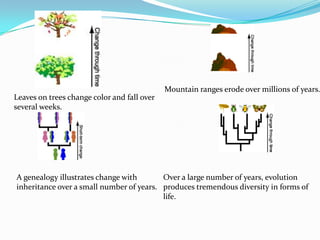
       Leaves on trees change color and fall over several weeks. Mountain
  ranges erode over millions of years. A genealogy illustrates change with
  inheritance over a small number of years. Over a large number of years,
  evolution produces tremendous diversity in forms of life.
         The definition Biological evolution, simply put, is descent with
  modification. This definition encompasses small-scale evolution (changes in
  gene frequency in a population from one generation to the next) and large-scale
  evolution (the descent of different species from a common ancestor over many
  generations). Evolution helps us to understand the history of life.
        The explanationn Biological evolution is not simply a matter of change
  over time. Lots of things change over time: trees lose their leaves, mountain
  ranges rise and erode, but they aren't examples of biological evolution because
  they don't involve descent through genetic inheritance.
 The central idea of biological evolution is that all life on Earth shares a common
  ancestor, just as you and your cousins share a common grandmother.
 Through the process of descent with modification, the common ancestor of life
  on Earth gave rise to the fantastic diversity that we see documented in the fossil
  record and around us today. Evolution means that we're all distant cousins:
  humans and oak trees, hummingbirds and whales.
Mountain ranges erode over millions of years.
Leaves on trees change color and fall over
several weeks.


A genealogy illustrates change with       Over a large number of years, evolution
inheritance over a small number of years. produces tremendous diversity in forms of
                                          life.
The history of life: looking at the patterns
The central ideas of evolution are that life has a history — it has changed over time — and that
different species share common ancestors.
Here, you can explore how evolutionary change and evolutionary relationships are represented in
"family trees," how these trees are constructed, and how this knowledge affects biological
classification. You will also find a timeline of evolutionary history and information on some specific
events in the history of life: human evolution and the origin of life.
The family tree
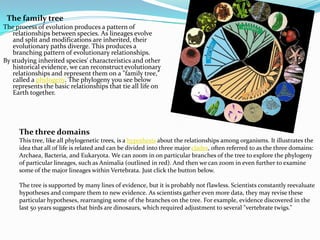
The process of evolution produces a pattern of
   relationships between species. As lineages evolve
   and split and modifications are inherited, their
   evolutionary paths diverge. This produces a
   branching pattern of evolutionary relationships.
By studying inherited species' characteristics and other
   historical evidence, we can reconstruct evolutionary
   relationships and represent them on a "family tree,"
   called a phylogeny. The phylogeny you see below
   represents the basic relationships that tie all life on
   Earth together.


     The three domains
     This tree, like all phylogenetic trees, is a hypothesis about the relationships among organisms. It illustrates the
     idea that all of life is related and can be divided into three major clades, often referred to as the three domains:
     Archaea, Bacteria, and Eukaryota. We can zoom in on particular branches of the tree to explore the phylogeny
     of particular lineages, such as Animalia (outlined in red). And then we can zoom in even further to examine
     some of the major lineages within Vertebrata. Just click the button below.

     The tree is supported by many lines of evidence, but it is probably not flawless. Scientists constantly reevaluate
     hypotheses and compare them to new evidence. As scientists gather even more data, they may revise these
     particular hypotheses, rearranging some of the branches on the tree. For example, evidence discovered in the
     last 50 years suggests that birds are dinosaurs, which required adjustment to several "vertebrate twigs."
Important events in the history of life
A timeline can provide additional information about life's history not visible on an evolutionary tree. These
include major geologic events, climate changes, radiations of organisms into new habitats, changes in
ecosystems, changes in continental positions, and widespread extinctions. Explore the timeline below to
review some of the important events in life‘ s
history.
Microbiology (
from Greek mīkros, "small"; bios, "life"; and --logia) is the study of microscopic
organisms, which are defined as any living organism that is either a single cell
(unicellular), a cell cluster, or has no cells at all (acellular).This includes eukaryotes,
such as fungi and protists, and prokaryotes. Viruses and prions, though not strictly
classed as living organisms, are also studied. Microbiology typically includes the
study of the immune system, or immunology.
Microbiology is a broad term which includes virology, mycology, parasitology,
bacteriology, immunology and other branches. A microbiologist is a specialist in
microbiology and these
Bacteria
Bacteria are of such immense importance because of their extreme flexibility,
capacity for rapid growth and reproduction, and great age - the oldest fossils known,
nearly 3.5 billion years old, are fossils of bacteria-like organisms.
• One feature that has enabled them to spread so far, and last so long is their ability
   to go dormant for an extended period.
• Bacteria were first observed by Antonie van Leeuwenhoek in 1676, using a single-
   lens microscope of his own design. He called them "animalcules" The name
   Bacterium was introduced much later, by Christian Gottfried Ehrenberg in
   1828.In fact, was a genus that contained non-spore-forming rod-shaped bacteria,
   as opposed to Bacillus, a genus of spore-forming rod-shaped bacteria defined by
   Ehrenberg in 1835.
• In 1910, Paul Ehrlich developed the first antibiotic,
• A major step forward in the study of bacteria was the recognition in 1977 by Carl
   Woese that archaea have a separate line of evolutionary descent from bacteria
Endospores
Certain genera of Gram-positive bacteria,can form highly resistant, dormant
structure.
• Properties of Bacteria
•   prokaryotic (no membrane-enclosed nucleus)
•   no mitochondria or chloroplasts
•   a single chromosome
•      a closed circle of double-stranded DNA

• have a rigid cell wall made of peptidoglycan. Link to illustrated discussion of the
  structure.
• reaction to the Gram stain.

Classification of Bacteria
• Until recently classification has done on the basis of such traits as: shape
• bacilli: rod-shaped
• cocci: spherical
• spirilla: curved walls

• The bacterial cells are first stained with a purple dye called crystal violet.
•   Then the preparation is treated with alcohol or acetone.
•   This washes the stain out of Gram-negative cells.
• Bacteria that are not decolorized by the alcohol/acetone wash are Gram-positive.
• Aerobic bacteria thrive in the presence of oxygen and require it for their continued
  growth and existence.
• Other bacteria are anaerobic, and cannot tolerate gaseous oxygen, such as those
  bacteria which live in deep underwater sediments, or those which cause bacterial
  food poisoning.
• The third group are the facultative anaerobes, which prefer growing in the
  presence of oxygen, but can continue to grow without it.

• Bacteria grow to a fixed size and then reproduce through binary fission, a form of
  asexual reproductionnder optimal conditions, bacteria can grow and divide
  extremely rapidly, and bacterial populations can double as quickly as every 9.8
  minutes.
• Bacterial growth follows three phases. The first phase of growth is the lag phase, a
  period of slow growth when the cells are adapting to the high-nutrient environment
  and preparing for fast growthThe second phase of growth is the logarithmic phase
  (log phase), also known as the exponential phase. The log phase is marked by
  rapid exponential growth.The final phase of growth is the stationary phase and is
  caused by depleted nutrients. The cells reduce their metabolic activity and consume
  non-essential cellular proteins.
Bacteriophages are viruses that infect bacteria.
Pathogens
• If bacteria form a parasitic association with other organisms, they are classed as
   pathogens. Pathogenic bacteria are a major cause of human death and disease and
   cause infections such as tetanus, typhoid fever, diphtheria, syphilis, cholera,
   foodborne illness, leprosy and tuberculosis.
• Bacterial diseases are also important in agriculture, with bacteria causing leaf spot,
   fire blight and wilts in plants, as well as Johne's disease, mastitis, salmonella and
   anthrax in farm animals.
• Bacterial infections may be treated with antibiotics, which are classified as
   bacteriocidal if they kill bacteria, or bacteriostatic if they just prevent bacterial
   growth.
Significance in technology and industry
acteria, often lactic acid bacteria such as Lactobacillus and Lactococcus, in
combination with yeasts and molds, have been used for thousands of years in the
preparation of fermented foods such as cheese, pickles,vinegar, wine and yogurt.
Virus
Archea
• are a group of single-celled microorganisms.
• A single individual or species from this domain is called an archaeon
  (sometimes spelled "archeon").
• Archaea were first classified as a separate group of prokaryotes in 1977 by
  Carl Woese and George E. Fox.


• The search for fossils of Archaea faces a number of problems. First of all,
  they're very tiny organisms and so will leave microscopic fossils.

• Archaea and Bacteria cells may be of similar sizes and shapes,Instead of
  physical features, micropaleontologists rely on chemical features.
  chemical traces have even been found in sediments from the Isua district
  of west Greenland, the oldest known sediments on Earth at about 3.8
  billion years old.
Fungi
 The English word fungus is directly adopted from the Latin
  fungus (mushroom)The use of the word mycology, which is
  derived from the Greek mushroom)to denote the scientific study
  of fungi.
 a recent (2011) estimate suggests there may be over 5 million
  species.

 The living body of the fungus is a mycelium made out of a web of
  tiny filaments called hyphae, which are cylindrical, thread-like
  structures 2–10 µm in diameter and up to several centimeters in
  length.
 Fungi feed by absorbing nutrients from the organic material in
  which they live.
 You probably use fungal products every day without being aware
  of it. Other fungi provide numerous drugs (such as penicillin
  and other antibiotics), foods like mushrooms. Fungi also cause a
  number of plant and animal diseases: in humans, ringworm,
  athlete's foot, and several more serious diseases are caused by
  fungi.
 Another feature of fungi is the presence of chitin in their
  cell walls. This is a long carbohydrate polymer that also
  occurs in the exoskeletons of insects, spiders, and other
  arthropods. The chitin adds rigidity and structural support
  to the thin cells of the fungus, and makes fresh mushrooms
  crisp. ]
Unique features:
 Some species grow as single-celled               yeasts that
  reproduce by budding or binary fission.
 Shared features:
 With other eukaryotes: As other eukaryotes, fungal cells
  contain membrane-bound nuclei with chromosomes that
  contain DNA
 With plants: Fungi possess a cell wall and vacuoles.They
  reproduce by both sexual and asexual.
 In common with some plant and animal species, more
  than 60 fungal species display the phenomenon of
  bioluminescence.
 grow in a wide range of habitats, including extreme
  environments such as deserts or areas with high salt
  concentrations or ionizing radiation, as well as in deep
  sea sediments. Some can survive the intense UV and
  cosmic radiation encountered during space travel.
A protist is any organism that is not
a plant, animal or fungus.
Characteristics of Protists
 mostly unicellular, some are multicellular (algae)
    can be heterotrophic or autotrophic
    most live in water (though some live in moist soil or even the human body)
    ALL are eukaryotic (have a nucleus)
Classification of Protists
    how they obtain nutrition
    how they move

   Animallike Protists - also called protozoa (means "first animal") - heterotrophs
   Plantlike Protists - also called algae - autotrophs
   Funguslike Protists - heterotrophs, decomposers, external digestion

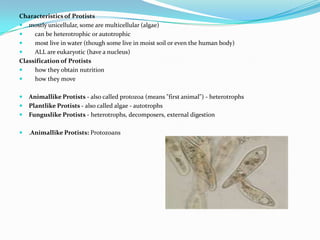
   .Animallike Protists: Protozoans
Four Phyla of Animallike Protists
 Zooflagellates
move using one or two flagella
absorb food across membrane
 Sarcodines
moves using pseudopodia ( "false feet" ), which are like extensions
of the cytoplasm --ameboid movement
ingests food by surrounding and engulfing food (endocytosis),
creating a food vacuole
 Ciliates
Parameciummove using cilia
has two nuclei: macronucleus, micronucleuseproduces asexually (binary
fission) or sexually (conjugation)
outer membrane -pellicle- is rigid and paramecia are always the same
shape, like a shoe
 Sporozoans
do not move on their own
parasitic
Malaria is a sporozoan, infects the liver and blood
Evolution

Evolution

  • 3.
     An introductionto evolution  Leaves on trees change color and fall over several weeks. Mountain ranges erode over millions of years. A genealogy illustrates change with inheritance over a small number of years. Over a large number of years, evolution produces tremendous diversity in forms of life. The definition Biological evolution, simply put, is descent with modification. This definition encompasses small-scale evolution (changes in gene frequency in a population from one generation to the next) and large-scale evolution (the descent of different species from a common ancestor over many generations). Evolution helps us to understand the history of life. The explanationn Biological evolution is not simply a matter of change over time. Lots of things change over time: trees lose their leaves, mountain ranges rise and erode, but they aren't examples of biological evolution because they don't involve descent through genetic inheritance.  The central idea of biological evolution is that all life on Earth shares a common ancestor, just as you and your cousins share a common grandmother.  Through the process of descent with modification, the common ancestor of life on Earth gave rise to the fantastic diversity that we see documented in the fossil record and around us today. Evolution means that we're all distant cousins: humans and oak trees, hummingbirds and whales.
  • 4.
    Mountain ranges erodeover millions of years. Leaves on trees change color and fall over several weeks. A genealogy illustrates change with Over a large number of years, evolution inheritance over a small number of years. produces tremendous diversity in forms of life.
  • 5.
    The history oflife: looking at the patterns The central ideas of evolution are that life has a history — it has changed over time — and that different species share common ancestors. Here, you can explore how evolutionary change and evolutionary relationships are represented in "family trees," how these trees are constructed, and how this knowledge affects biological classification. You will also find a timeline of evolutionary history and information on some specific events in the history of life: human evolution and the origin of life.
  • 6.
    The family tree Theprocess of evolution produces a pattern of relationships between species. As lineages evolve and split and modifications are inherited, their evolutionary paths diverge. This produces a branching pattern of evolutionary relationships. By studying inherited species' characteristics and other historical evidence, we can reconstruct evolutionary relationships and represent them on a "family tree," called a phylogeny. The phylogeny you see below represents the basic relationships that tie all life on Earth together. The three domains This tree, like all phylogenetic trees, is a hypothesis about the relationships among organisms. It illustrates the idea that all of life is related and can be divided into three major clades, often referred to as the three domains: Archaea, Bacteria, and Eukaryota. We can zoom in on particular branches of the tree to explore the phylogeny of particular lineages, such as Animalia (outlined in red). And then we can zoom in even further to examine some of the major lineages within Vertebrata. Just click the button below. The tree is supported by many lines of evidence, but it is probably not flawless. Scientists constantly reevaluate hypotheses and compare them to new evidence. As scientists gather even more data, they may revise these particular hypotheses, rearranging some of the branches on the tree. For example, evidence discovered in the last 50 years suggests that birds are dinosaurs, which required adjustment to several "vertebrate twigs."
  • 7.
    Important events inthe history of life A timeline can provide additional information about life's history not visible on an evolutionary tree. These include major geologic events, climate changes, radiations of organisms into new habitats, changes in ecosystems, changes in continental positions, and widespread extinctions. Explore the timeline below to review some of the important events in life‘ s history.
  • 8.
    Microbiology ( from Greekmīkros, "small"; bios, "life"; and --logia) is the study of microscopic organisms, which are defined as any living organism that is either a single cell (unicellular), a cell cluster, or has no cells at all (acellular).This includes eukaryotes, such as fungi and protists, and prokaryotes. Viruses and prions, though not strictly classed as living organisms, are also studied. Microbiology typically includes the study of the immune system, or immunology. Microbiology is a broad term which includes virology, mycology, parasitology, bacteriology, immunology and other branches. A microbiologist is a specialist in microbiology and these
  • 9.
  • 10.
    Bacteria are ofsuch immense importance because of their extreme flexibility, capacity for rapid growth and reproduction, and great age - the oldest fossils known, nearly 3.5 billion years old, are fossils of bacteria-like organisms. • One feature that has enabled them to spread so far, and last so long is their ability to go dormant for an extended period. • Bacteria were first observed by Antonie van Leeuwenhoek in 1676, using a single- lens microscope of his own design. He called them "animalcules" The name Bacterium was introduced much later, by Christian Gottfried Ehrenberg in 1828.In fact, was a genus that contained non-spore-forming rod-shaped bacteria, as opposed to Bacillus, a genus of spore-forming rod-shaped bacteria defined by Ehrenberg in 1835. • In 1910, Paul Ehrlich developed the first antibiotic, • A major step forward in the study of bacteria was the recognition in 1977 by Carl Woese that archaea have a separate line of evolutionary descent from bacteria
  • 11.
    Endospores Certain genera ofGram-positive bacteria,can form highly resistant, dormant structure.
  • 12.
    • Properties ofBacteria • prokaryotic (no membrane-enclosed nucleus) • no mitochondria or chloroplasts • a single chromosome • a closed circle of double-stranded DNA • have a rigid cell wall made of peptidoglycan. Link to illustrated discussion of the structure. • reaction to the Gram stain. Classification of Bacteria • Until recently classification has done on the basis of such traits as: shape • bacilli: rod-shaped • cocci: spherical • spirilla: curved walls • The bacterial cells are first stained with a purple dye called crystal violet. • Then the preparation is treated with alcohol or acetone. • This washes the stain out of Gram-negative cells. • Bacteria that are not decolorized by the alcohol/acetone wash are Gram-positive.
  • 13.
    • Aerobic bacteriathrive in the presence of oxygen and require it for their continued growth and existence. • Other bacteria are anaerobic, and cannot tolerate gaseous oxygen, such as those bacteria which live in deep underwater sediments, or those which cause bacterial food poisoning. • The third group are the facultative anaerobes, which prefer growing in the presence of oxygen, but can continue to grow without it. • Bacteria grow to a fixed size and then reproduce through binary fission, a form of asexual reproductionnder optimal conditions, bacteria can grow and divide extremely rapidly, and bacterial populations can double as quickly as every 9.8 minutes. • Bacterial growth follows three phases. The first phase of growth is the lag phase, a period of slow growth when the cells are adapting to the high-nutrient environment and preparing for fast growthThe second phase of growth is the logarithmic phase (log phase), also known as the exponential phase. The log phase is marked by rapid exponential growth.The final phase of growth is the stationary phase and is caused by depleted nutrients. The cells reduce their metabolic activity and consume non-essential cellular proteins.
  • 14.
    Bacteriophages are virusesthat infect bacteria. Pathogens • If bacteria form a parasitic association with other organisms, they are classed as pathogens. Pathogenic bacteria are a major cause of human death and disease and cause infections such as tetanus, typhoid fever, diphtheria, syphilis, cholera, foodborne illness, leprosy and tuberculosis. • Bacterial diseases are also important in agriculture, with bacteria causing leaf spot, fire blight and wilts in plants, as well as Johne's disease, mastitis, salmonella and anthrax in farm animals. • Bacterial infections may be treated with antibiotics, which are classified as bacteriocidal if they kill bacteria, or bacteriostatic if they just prevent bacterial growth. Significance in technology and industry acteria, often lactic acid bacteria such as Lactobacillus and Lactococcus, in combination with yeasts and molds, have been used for thousands of years in the preparation of fermented foods such as cheese, pickles,vinegar, wine and yogurt.
  • 15.
  • 16.
  • 17.
    • are agroup of single-celled microorganisms. • A single individual or species from this domain is called an archaeon (sometimes spelled "archeon"). • Archaea were first classified as a separate group of prokaryotes in 1977 by Carl Woese and George E. Fox. • The search for fossils of Archaea faces a number of problems. First of all, they're very tiny organisms and so will leave microscopic fossils. • Archaea and Bacteria cells may be of similar sizes and shapes,Instead of physical features, micropaleontologists rely on chemical features. chemical traces have even been found in sediments from the Isua district of west Greenland, the oldest known sediments on Earth at about 3.8 billion years old.
  • 18.
  • 19.
     The Englishword fungus is directly adopted from the Latin fungus (mushroom)The use of the word mycology, which is derived from the Greek mushroom)to denote the scientific study of fungi.  a recent (2011) estimate suggests there may be over 5 million species.  The living body of the fungus is a mycelium made out of a web of tiny filaments called hyphae, which are cylindrical, thread-like structures 2–10 µm in diameter and up to several centimeters in length.  Fungi feed by absorbing nutrients from the organic material in which they live.  You probably use fungal products every day without being aware of it. Other fungi provide numerous drugs (such as penicillin and other antibiotics), foods like mushrooms. Fungi also cause a number of plant and animal diseases: in humans, ringworm, athlete's foot, and several more serious diseases are caused by fungi.
  • 20.
     Another featureof fungi is the presence of chitin in their cell walls. This is a long carbohydrate polymer that also occurs in the exoskeletons of insects, spiders, and other arthropods. The chitin adds rigidity and structural support to the thin cells of the fungus, and makes fresh mushrooms crisp. ] Unique features:  Some species grow as single-celled yeasts that reproduce by budding or binary fission.  Shared features:  With other eukaryotes: As other eukaryotes, fungal cells contain membrane-bound nuclei with chromosomes that contain DNA  With plants: Fungi possess a cell wall and vacuoles.They reproduce by both sexual and asexual.
  • 21.
     In commonwith some plant and animal species, more than 60 fungal species display the phenomenon of bioluminescence.  grow in a wide range of habitats, including extreme environments such as deserts or areas with high salt concentrations or ionizing radiation, as well as in deep sea sediments. Some can survive the intense UV and cosmic radiation encountered during space travel.
  • 22.
    A protist isany organism that is not a plant, animal or fungus.
  • 23.
    Characteristics of Protists mostly unicellular, some are multicellular (algae)  can be heterotrophic or autotrophic  most live in water (though some live in moist soil or even the human body)  ALL are eukaryotic (have a nucleus) Classification of Protists  how they obtain nutrition  how they move  Animallike Protists - also called protozoa (means "first animal") - heterotrophs  Plantlike Protists - also called algae - autotrophs  Funguslike Protists - heterotrophs, decomposers, external digestion  .Animallike Protists: Protozoans
  • 24.
    Four Phyla ofAnimallike Protists  Zooflagellates move using one or two flagella absorb food across membrane  Sarcodines moves using pseudopodia ( "false feet" ), which are like extensions of the cytoplasm --ameboid movement ingests food by surrounding and engulfing food (endocytosis), creating a food vacuole  Ciliates Parameciummove using cilia has two nuclei: macronucleus, micronucleuseproduces asexually (binary fission) or sexually (conjugation) outer membrane -pellicle- is rigid and paramecia are always the same shape, like a shoe  Sporozoans do not move on their own parasitic Malaria is a sporozoan, infects the liver and blood

Editor's Notes

  • #11 Louis Pasteur demonstrated in 1859 that the fermentation process is caused by the growth of microorganisms,In 1910, Paul Ehrlich developed the first antibiotic, by changing dyes that selectively stained Treponemapallidum — the spirochaete that causes syphilis — into compounds that selectively killed the pathogen
  • #21 fungi possess membrane-bound cytoplasmic organelles such as mitochondria, sterol-containing membranes, and ribosomes