IMPLEMENTATION OF
EVIDENCE BASED PRACTICE
IN THE FIELD OF
PROSTHETICS AND
ORTHOTICS
BY
YASHIKA KUMAR
BPO, MPO, Phd(pursuing)
ASSISTANT PROFESSOR(P&O)
ISIC-INSTITUTE OF REHABILITATION SCIENCES
VASANT KUNJ , NEW DELHI-110070
HOW DO YOU DECIDE WHICH
ORTHOTIC TREATMENT WILL YOU
GIVE TO THE PATIENT WITH
MUSCULAR DYSTROPHY ?
HOW DO WE CHOOSE TREATMENT
WHICH WORKS ?
• BECAUSE WE HAVE READ ABOUT THEM IN
BOOKS?
• BECAUSE WE HAVE USED THAT BEFORE
AND IT WORKS BASED ON OUR CLINICAL
EXPERTISE?
• BECAUSE THE RESEARCH PROVES THAT
THIS TREATMENT WORKS?
• WHAT PATIENT TELL YOU WORKS THE
BEST?
To find the answer we will read :-
• What is evidence based practice ?
• Goals of evidence based practice
• Process of evidence based practice :- STEP 1
STEP 2
STEP 3
STEP 4
• Skills required for evidence based practice
• Advantages of evidence based practice
• Barriers of evidence based practice
• How to overcome those barriers ?
• Research evidences
• Why Should Prosthetist and Orthotist be Concerned About
EBP?
What is evidence based practice ?
David Sackett, MD, the father of evidence-
based medicine, he founded this at Mc Master
University, in 1990’s .
Evidence based practice is an approach that
enables clinicians to provide the highest
quality of care in meeting the multiphase
needs to their parents and family.
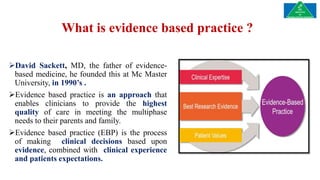
Evidence based practice (EBP) is the process
of making clinical decisions based upon
evidence, combined with clinical experience
and patients expectations.
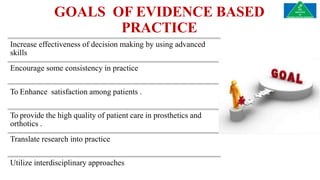
GOALS OF EVIDENCE BASED
PRACTICE
Increase effectiveness of decision making by using advanced
skills
Encourage some consistency in practice
To Enhance satisfaction among patients .
To provide the high quality of patient care in prosthetics and
orthotics .
Translate research into practice
Utilize interdisciplinary approaches
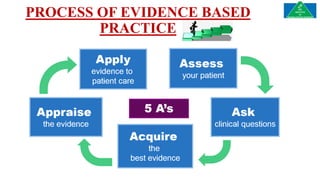
PROCESS OF EVIDENCE BASED
PRACTICE
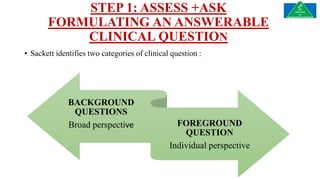
STEP 1: ASSESS +ASK
FORMULATING AN ANSWERABLE
CLINICAL QUESTION
• Sackett identifies two categories of clinical question :
BACKGROUND
QUESTIONS
Broad perspective FOREGROUND
QUESTION
Individual perspective
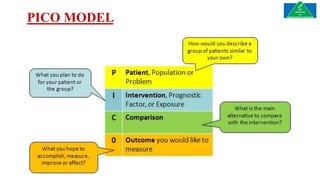
PICO MODEL
STEP-2: LOCATING AND ACCESSING THE
BEST EVIDENCE(ACQUIRE)
PRIMARY SOURCES
ORIGINAL RESEARCH
ARTICLES
EXPERIMENTAL
RESEARCHES
SECONDARY SOURCES
TEXT BOOKS
SYSTEMATIC REVIEW
/METANALYSIS
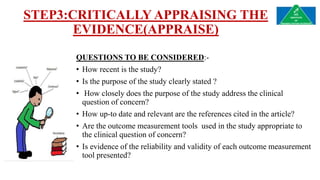
STEP3:CRITICALLY APPRAISING THE
EVIDENCE(APPRAISE)
QUESTIONS TO BE CONSIDERED:-
• How recent is the study?
• Is the purpose of the study clearly stated ?
• How closely does the purpose of the study address the clinical
question of concern?
• How up-to date and relevant are the references cited in the article?
• Are the outcome measurement tools used in the study appropriate to
the clinical question of concern?
• Is evidence of the reliability and validity of each outcome measurement
tool presented?
STEP-4: APPLICABILITY TO PATIENTS
AND CLINICAL PRACTICE(APPLY)
• In this step the clinicians will apply the findings which
is based on their professional judgment and clinical
expertise .
• Evaluating the outcomes and follow -ups if required .
• It should be considered that what the pathology ,
impairment , functional limitations or disability means to
the particular individual with respect to self concept
and sociocultural roles .
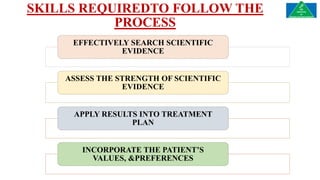
SKILLS REQUIREDTO FOLLOW THE
PROCESS
EFFECTIVELY SEARCH SCIENTIFIC
EVIDENCE
ASSESS THE STRENGTH OF SCIENTIFIC
EVIDENCE
APPLY RESULTS INTO TREATMENT
PLAN
INCORPORATE THE PATIENT’S
VALUES, &PREFERENCES
ADVANTAGES OF EVIDENCE BASED
PRACTICE
• Increased efficiency
• Better patient outcome
• It keeps practice current
• Better decision making
ADVANTAGES
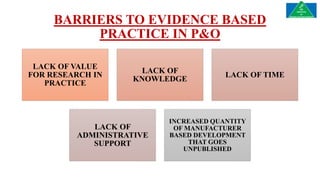
BARRIERS TO EVIDENCE BASED
PRACTICE IN P&O
LACK OF VALUE
FOR RESEARCH IN
PRACTICE
LACK OF
KNOWLEDGE
LACK OF TIME
LACK OF
ADMINISTRATIVE
SUPPORT
INCREASED QUANTITY
OF MANUFACTURER
BASED DEVELOPMENT
THAT GOES
UNPUBLISHED
OVERCOMING BARRIERS OF EVIDENCE
BASED PRACTICE IN P&O
Educating the
practitioners
about the
effectiveness
of EBP.
Making EBP
compulsory in
educational
institute
Participation
in study
groups and
journal
clubs.
Encourage
researches
and its use
Incorporating
research
findings
into
curriculum
RESEARCH FINDINGS
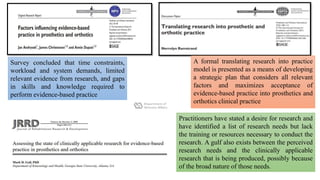
Survey concluded that time constraints,
workload and system demands, limited
relevant evidence from research, and gaps
in skills and knowledge required to
perform evidence-based practice
A formal translating research into practice
model is presented as a means of developing
a strategic plan that considers all relevant
factors and maximizes acceptance of
evidence-based practice into prosthetics and
orthotics clinical practice
Practitioners have stated a desire for research and
have identified a list of research needs but lack
the training or resources necessary to conduct the
research. A gulf also exists between the perceived
research needs and the clinically applicable
research that is being produced, possibly because
of the broad nature of those needs.
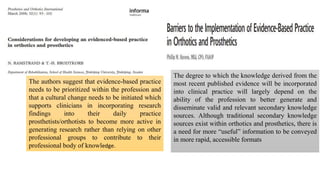
The authors suggest that evidence-based practice
needs to be prioritized within the profession and
that a cultural change needs to be initiated which
supports clinicians in incorporating research
findings into their daily practice
prosthetists/orthotists to become more active in
generating research rather than relying on other
professional groups to contribute to their
professional body of knowledge.
The degree to which the knowledge derived from the
most recent published evidence will be incorporated
into clinical practice will largely depend on the
ability of the profession to better generate and
disseminate valid and relevant secondary knowledge
sources. Although traditional secondary knowledge
sources exist within orthotics and prosthetics, there is
a need for more “useful” information to be conveyed
in more rapid, accessible formats
Why Should Prosthetist and Orthotist be
Concerned About EBP?
• The principles of EBP have been well developed in many areas of medicine but to date a minimal
amount of literature specific to the prosthetics and orthotics profession is available.
• It is time for change so that primary goal of the prosthetics and orthotics profession should be well
founded treatment decisions based on best evidence.
• This will, of course, lead to an increasing need for the prosthetic and orthotic profession to prove
the efficiency of their treatment in comparison to other areas of health care.
• A further reason for the prosthetics and orthotics profession to embrace EBP is raising competition
from other professional groups who are competing for markets previously held by prosthetist/orthotists
• It is not surprising that the majority of prosthetics and orthotics research has been conducted by
representatives from other professional groups.
TAKE HOME MESSAGE
Evidence based practice is the integration of the best available scientific
evidence ; clinical expertise and judgment; and the concerns, values, and
expectations of the individual clinicians care that determines the
effectiveness of clinical decision making
"Things will really start moving when people realize that researching
and using evidence isn't a big hairy monster—it determines the
effectiveness of clinical decision making, something that we can all do
every day." (MULLER)
REFERENCES
• Wong A R , Lusardi M M , An Evidence-based Approach to Orthotic and Prosthetic
Rehabilitation; Orthotics and Prosthetics in rehabilitation;(2);109-134
• Geil M D;2009;Assessing the state of clinically applicable research for evidence
based practice in prosthetics & orthotics ; Journal of Rehabilitation Research &
Development;(46);num3;305-314
• Jerrel M L;2008;Outcome Research and Evidence based Practice in O& P:Forging
Ahead ; O&P Business News
• Lusardi c M M ; Levengie P K;A Problem Based Learning Approach to Facilitate
Evidence-Based Practice in Entry Level Health Professional Education ; Education
Forum
• Stanfield Morgan ;2010; Developing Evidence-Based Care Protocols ; The O&P Edge
• Evidence –Based Practice ;Wikipedia , the free encyclopedia . mht
Evidence based practice in prosthetics and orthotics

Evidence based practice in prosthetics and orthotics

  • 1.
    IMPLEMENTATION OF EVIDENCE BASEDPRACTICE IN THE FIELD OF PROSTHETICS AND ORTHOTICS BY YASHIKA KUMAR BPO, MPO, Phd(pursuing) ASSISTANT PROFESSOR(P&O) ISIC-INSTITUTE OF REHABILITATION SCIENCES VASANT KUNJ , NEW DELHI-110070
  • 2.
    HOW DO YOUDECIDE WHICH ORTHOTIC TREATMENT WILL YOU GIVE TO THE PATIENT WITH MUSCULAR DYSTROPHY ?
  • 3.
    HOW DO WECHOOSE TREATMENT WHICH WORKS ? • BECAUSE WE HAVE READ ABOUT THEM IN BOOKS? • BECAUSE WE HAVE USED THAT BEFORE AND IT WORKS BASED ON OUR CLINICAL EXPERTISE? • BECAUSE THE RESEARCH PROVES THAT THIS TREATMENT WORKS? • WHAT PATIENT TELL YOU WORKS THE BEST?
  • 4.
    To find theanswer we will read :- • What is evidence based practice ? • Goals of evidence based practice • Process of evidence based practice :- STEP 1 STEP 2 STEP 3 STEP 4 • Skills required for evidence based practice • Advantages of evidence based practice • Barriers of evidence based practice • How to overcome those barriers ? • Research evidences • Why Should Prosthetist and Orthotist be Concerned About EBP?
  • 5.
    What is evidencebased practice ? David Sackett, MD, the father of evidence- based medicine, he founded this at Mc Master University, in 1990’s . Evidence based practice is an approach that enables clinicians to provide the highest quality of care in meeting the multiphase needs to their parents and family. Evidence based practice (EBP) is the process of making clinical decisions based upon evidence, combined with clinical experience and patients expectations.
  • 6.
    GOALS OF EVIDENCEBASED PRACTICE Increase effectiveness of decision making by using advanced skills Encourage some consistency in practice To Enhance satisfaction among patients . To provide the high quality of patient care in prosthetics and orthotics . Translate research into practice Utilize interdisciplinary approaches
  • 7.
    PROCESS OF EVIDENCEBASED PRACTICE
  • 8.
    STEP 1: ASSESS+ASK FORMULATING AN ANSWERABLE CLINICAL QUESTION • Sackett identifies two categories of clinical question : BACKGROUND QUESTIONS Broad perspective FOREGROUND QUESTION Individual perspective
  • 9.
  • 10.
    STEP-2: LOCATING ANDACCESSING THE BEST EVIDENCE(ACQUIRE) PRIMARY SOURCES ORIGINAL RESEARCH ARTICLES EXPERIMENTAL RESEARCHES SECONDARY SOURCES TEXT BOOKS SYSTEMATIC REVIEW /METANALYSIS
  • 11.
    STEP3:CRITICALLY APPRAISING THE EVIDENCE(APPRAISE) QUESTIONSTO BE CONSIDERED:- • How recent is the study? • Is the purpose of the study clearly stated ? • How closely does the purpose of the study address the clinical question of concern? • How up-to date and relevant are the references cited in the article? • Are the outcome measurement tools used in the study appropriate to the clinical question of concern? • Is evidence of the reliability and validity of each outcome measurement tool presented?
  • 12.
    STEP-4: APPLICABILITY TOPATIENTS AND CLINICAL PRACTICE(APPLY) • In this step the clinicians will apply the findings which is based on their professional judgment and clinical expertise . • Evaluating the outcomes and follow -ups if required . • It should be considered that what the pathology , impairment , functional limitations or disability means to the particular individual with respect to self concept and sociocultural roles .
  • 13.
    SKILLS REQUIREDTO FOLLOWTHE PROCESS EFFECTIVELY SEARCH SCIENTIFIC EVIDENCE ASSESS THE STRENGTH OF SCIENTIFIC EVIDENCE APPLY RESULTS INTO TREATMENT PLAN INCORPORATE THE PATIENT’S VALUES, &PREFERENCES
  • 14.
    ADVANTAGES OF EVIDENCEBASED PRACTICE • Increased efficiency • Better patient outcome • It keeps practice current • Better decision making ADVANTAGES
  • 15.
    BARRIERS TO EVIDENCEBASED PRACTICE IN P&O LACK OF VALUE FOR RESEARCH IN PRACTICE LACK OF KNOWLEDGE LACK OF TIME LACK OF ADMINISTRATIVE SUPPORT INCREASED QUANTITY OF MANUFACTURER BASED DEVELOPMENT THAT GOES UNPUBLISHED
  • 16.
    OVERCOMING BARRIERS OFEVIDENCE BASED PRACTICE IN P&O Educating the practitioners about the effectiveness of EBP. Making EBP compulsory in educational institute Participation in study groups and journal clubs. Encourage researches and its use Incorporating research findings into curriculum
  • 17.
  • 18.
    Survey concluded thattime constraints, workload and system demands, limited relevant evidence from research, and gaps in skills and knowledge required to perform evidence-based practice A formal translating research into practice model is presented as a means of developing a strategic plan that considers all relevant factors and maximizes acceptance of evidence-based practice into prosthetics and orthotics clinical practice Practitioners have stated a desire for research and have identified a list of research needs but lack the training or resources necessary to conduct the research. A gulf also exists between the perceived research needs and the clinically applicable research that is being produced, possibly because of the broad nature of those needs.
  • 19.
    The authors suggestthat evidence-based practice needs to be prioritized within the profession and that a cultural change needs to be initiated which supports clinicians in incorporating research findings into their daily practice prosthetists/orthotists to become more active in generating research rather than relying on other professional groups to contribute to their professional body of knowledge. The degree to which the knowledge derived from the most recent published evidence will be incorporated into clinical practice will largely depend on the ability of the profession to better generate and disseminate valid and relevant secondary knowledge sources. Although traditional secondary knowledge sources exist within orthotics and prosthetics, there is a need for more “useful” information to be conveyed in more rapid, accessible formats
  • 20.
    Why Should Prosthetistand Orthotist be Concerned About EBP? • The principles of EBP have been well developed in many areas of medicine but to date a minimal amount of literature specific to the prosthetics and orthotics profession is available. • It is time for change so that primary goal of the prosthetics and orthotics profession should be well founded treatment decisions based on best evidence. • This will, of course, lead to an increasing need for the prosthetic and orthotic profession to prove the efficiency of their treatment in comparison to other areas of health care. • A further reason for the prosthetics and orthotics profession to embrace EBP is raising competition from other professional groups who are competing for markets previously held by prosthetist/orthotists • It is not surprising that the majority of prosthetics and orthotics research has been conducted by representatives from other professional groups.
  • 21.
    TAKE HOME MESSAGE Evidencebased practice is the integration of the best available scientific evidence ; clinical expertise and judgment; and the concerns, values, and expectations of the individual clinicians care that determines the effectiveness of clinical decision making "Things will really start moving when people realize that researching and using evidence isn't a big hairy monster—it determines the effectiveness of clinical decision making, something that we can all do every day." (MULLER)
  • 22.
    REFERENCES • Wong AR , Lusardi M M , An Evidence-based Approach to Orthotic and Prosthetic Rehabilitation; Orthotics and Prosthetics in rehabilitation;(2);109-134 • Geil M D;2009;Assessing the state of clinically applicable research for evidence based practice in prosthetics & orthotics ; Journal of Rehabilitation Research & Development;(46);num3;305-314 • Jerrel M L;2008;Outcome Research and Evidence based Practice in O& P:Forging Ahead ; O&P Business News • Lusardi c M M ; Levengie P K;A Problem Based Learning Approach to Facilitate Evidence-Based Practice in Entry Level Health Professional Education ; Education Forum • Stanfield Morgan ;2010; Developing Evidence-Based Care Protocols ; The O&P Edge • Evidence –Based Practice ;Wikipedia , the free encyclopedia . mht