






Everything You Wanted to
Know about Optimization
(and some you didn’t)
Madison May
madison@indico.io
Madison May
Machine Learning Architect @ Indico Data Solutions
Solve big problems with small data.
Email: madison@indico.io
Twitter: @pragmaticml
Github: @madisonmay
Ancient History
(an optimization primer)
Definitions:
● Loss: differentiable measure
of model error
● Gradient: direction of
steepest descent at point on
error surface
● Loss surface: how loss varies
with parameter value
● Learning rate: how far to
move params in direction of
gradient
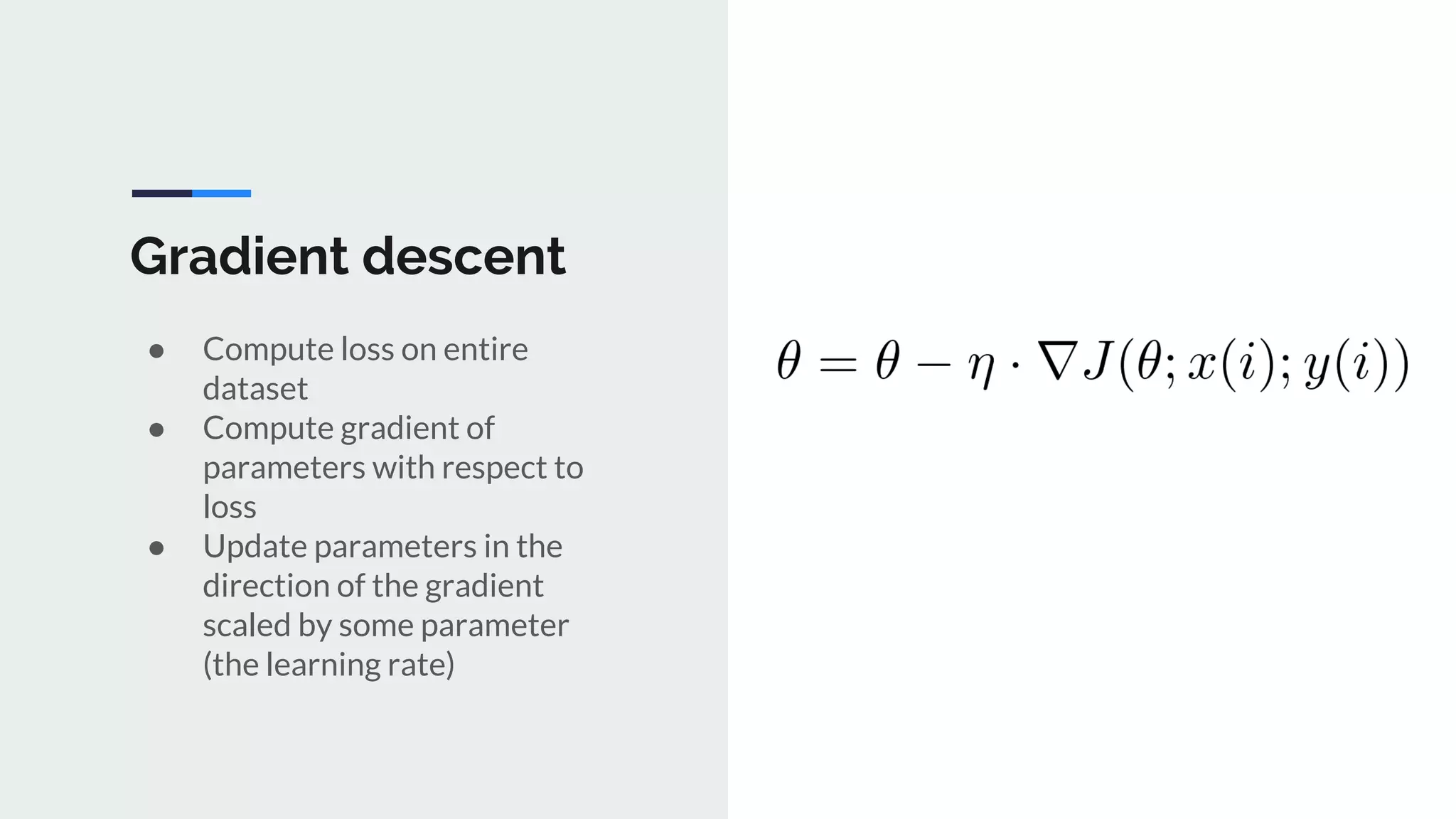
Gradient descent
● Compute loss on entire
dataset
● Compute gradient of
parameters with respect to
loss
● Update parameters in the
direction of the gradient
scaled by some parameter
(the learning rate)
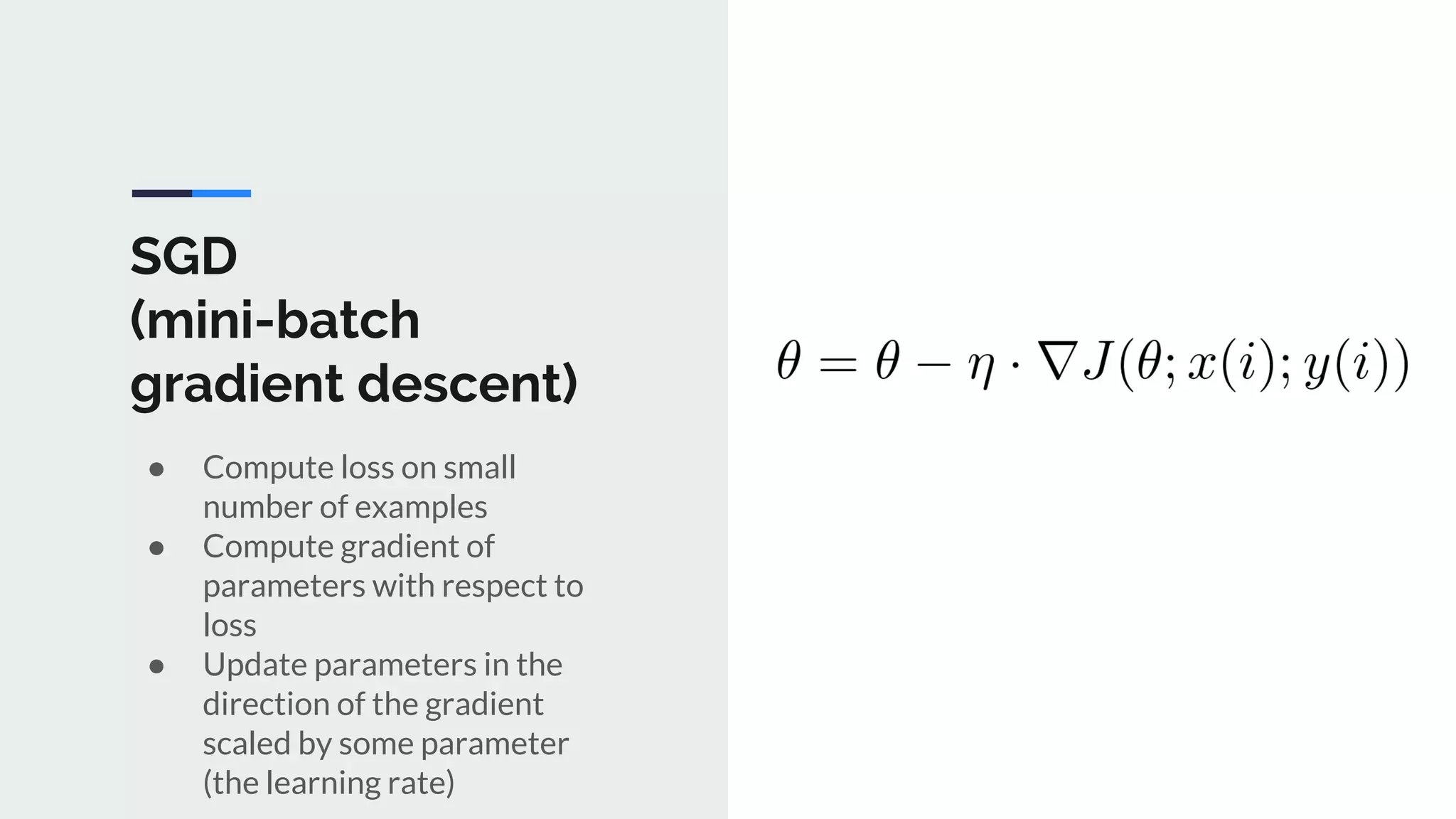
SGD
(mini-batch
gradient descent)
● Compute loss on small
number of examples
● Compute gradient of
parameters with respect to
loss
● Update parameters in the
direction of the gradient
scaled by some parameter
(the learning rate)
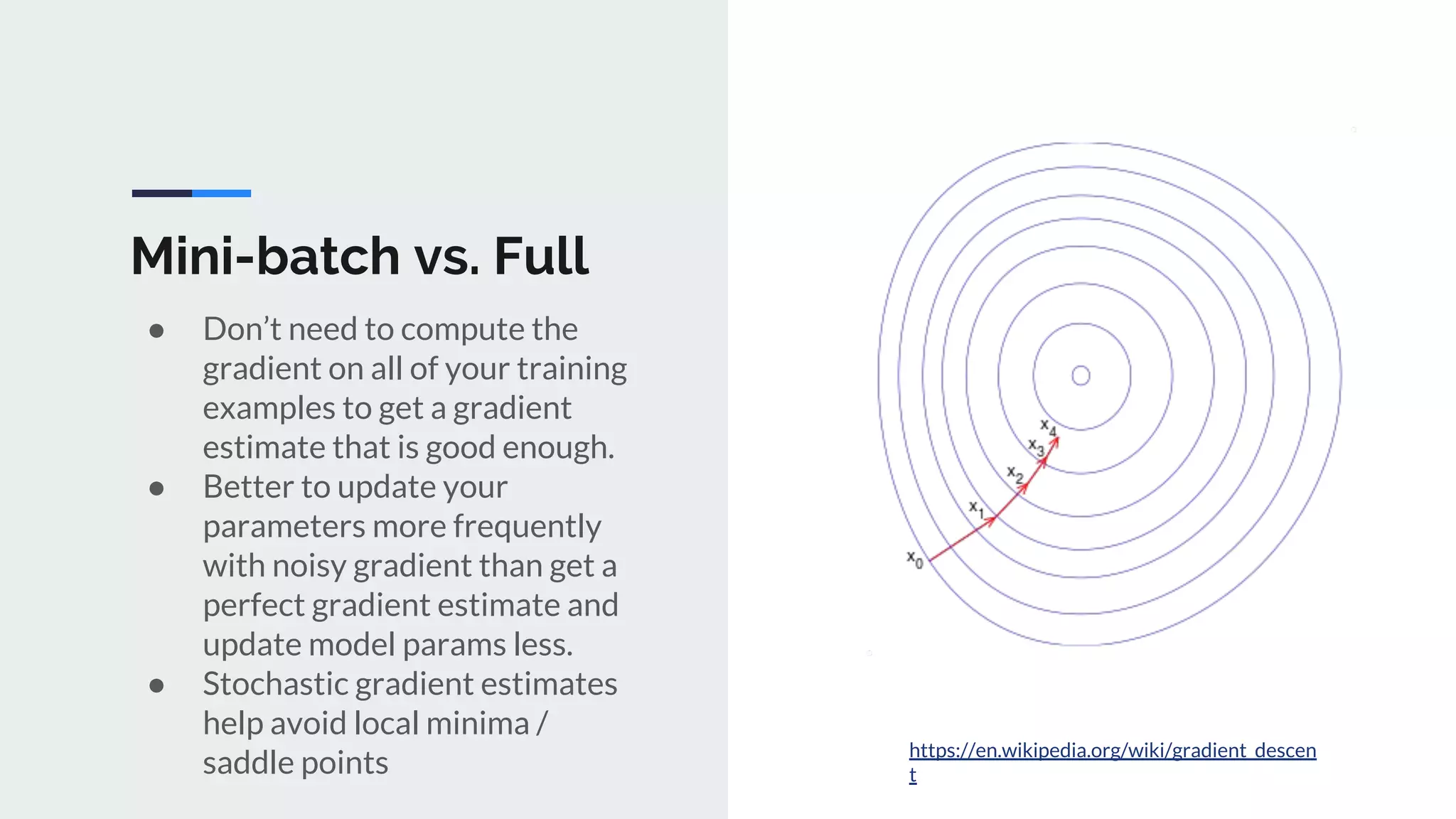
Mini-batch vs. Full
● Don’t need to compute the
gradient on all of your training
examples to get a gradient
estimate that is good enough.
● Better to update your
parameters more frequently
with noisy gradient than get a
perfect gradient estimate and
update model params less.
● Stochastic gradient estimates
help avoid local minima /
saddle points
https://en.wikipedia.org/wiki/gradient_descen
t
SGD with
Momentum
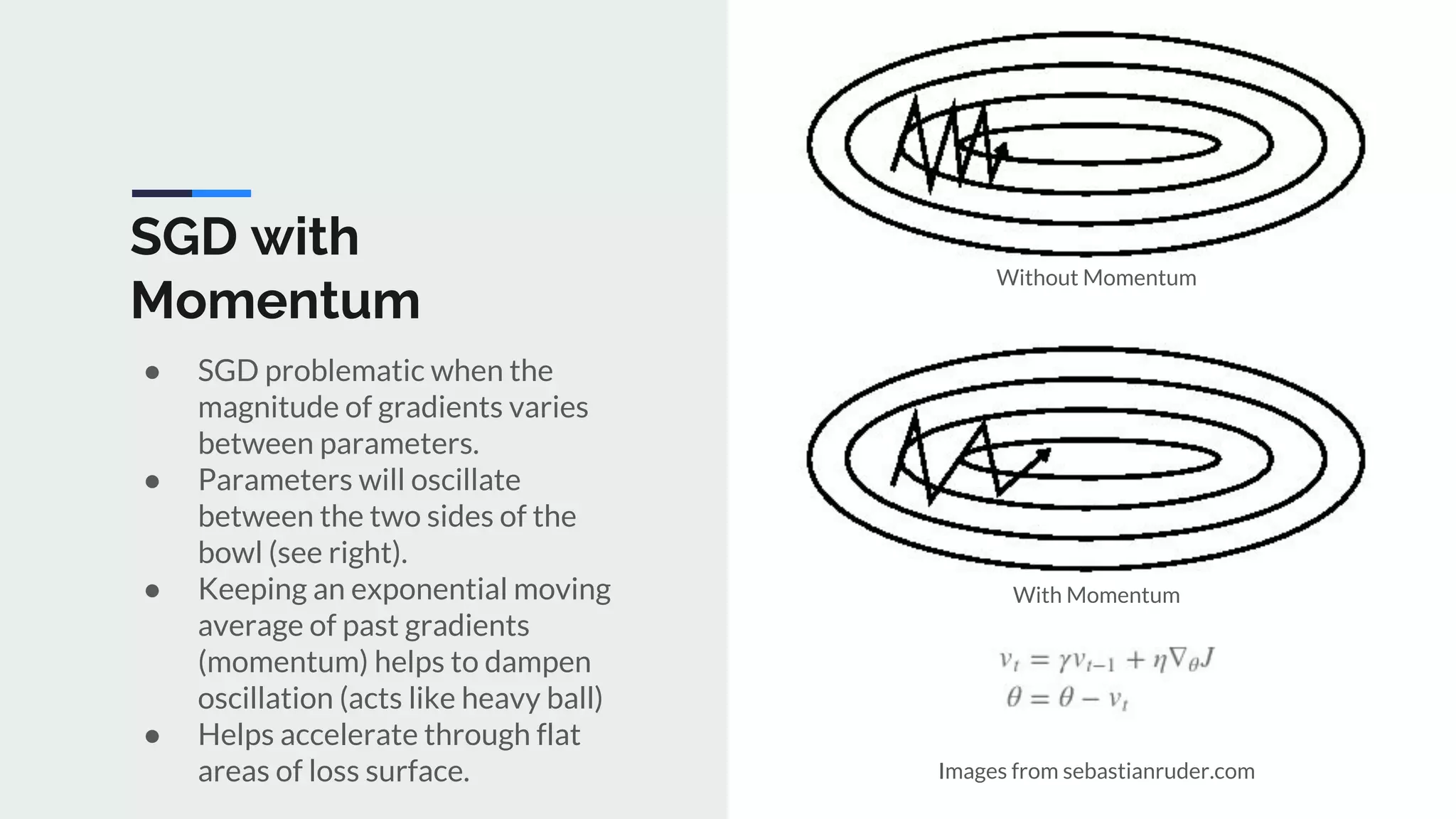
● SGD problematic when the
magnitude of gradients varies
between parameters.
● Parameters will oscillate
between the two sides of the
bowl (see right).
● Keeping an exponential moving
average of past gradients
(momentum) helps to dampen
oscillation (acts like heavy ball)
● Helps accelerate through flat
areas of loss surface. Images from sebastianruder.com
With Momentum
Without Momentum
SGD with Nesterov
Momentum (NAG)
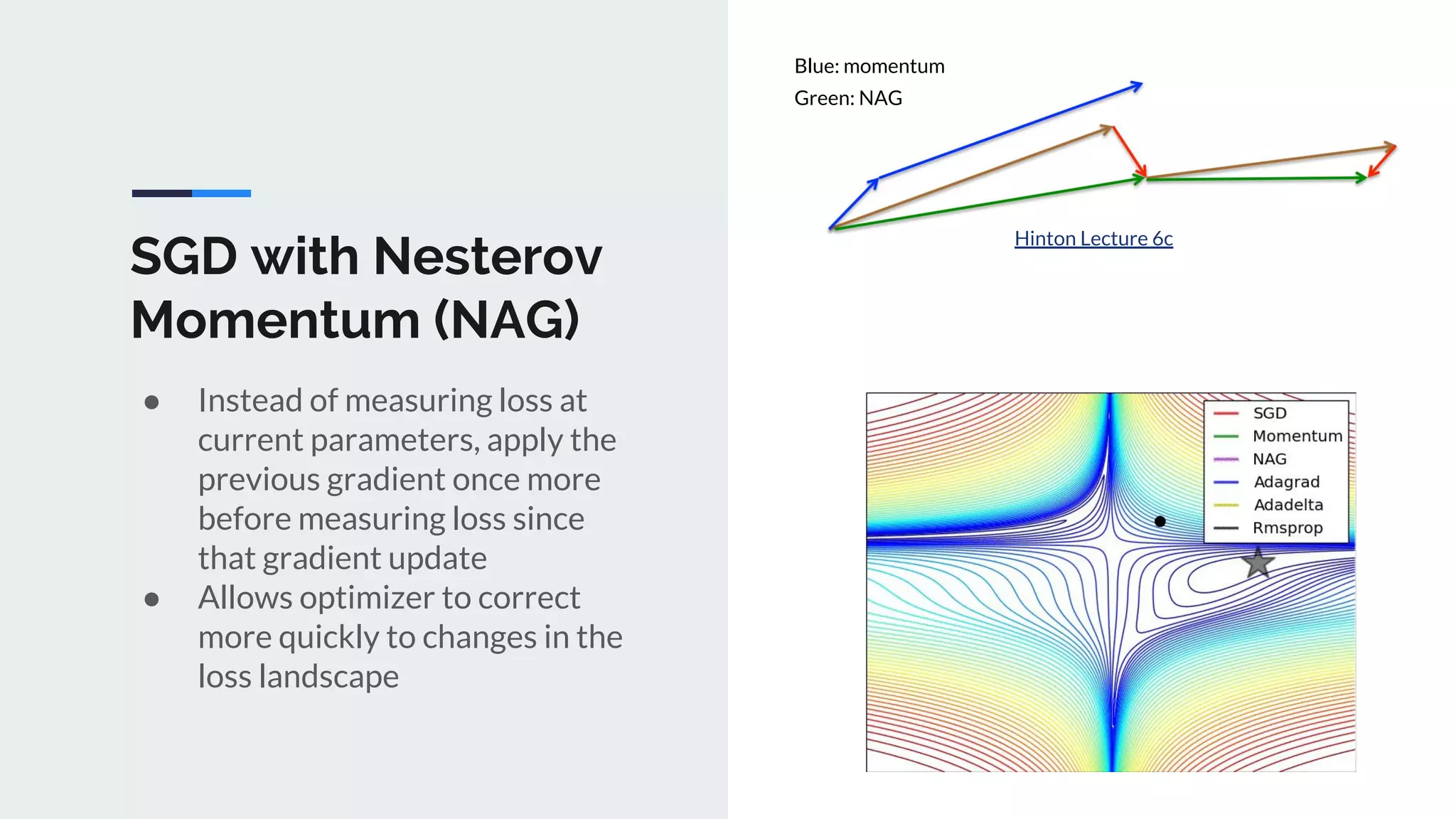
● Instead of measuring loss at
current parameters, apply the
previous gradient once more
before measuring loss since
that gradient update
● Allows optimizer to correct
more quickly to changes in the
loss landscape
Hinton Lecture 6c
Blue: momentum
Green: NAG
Adagrad, Adadelta,
And RMSProp
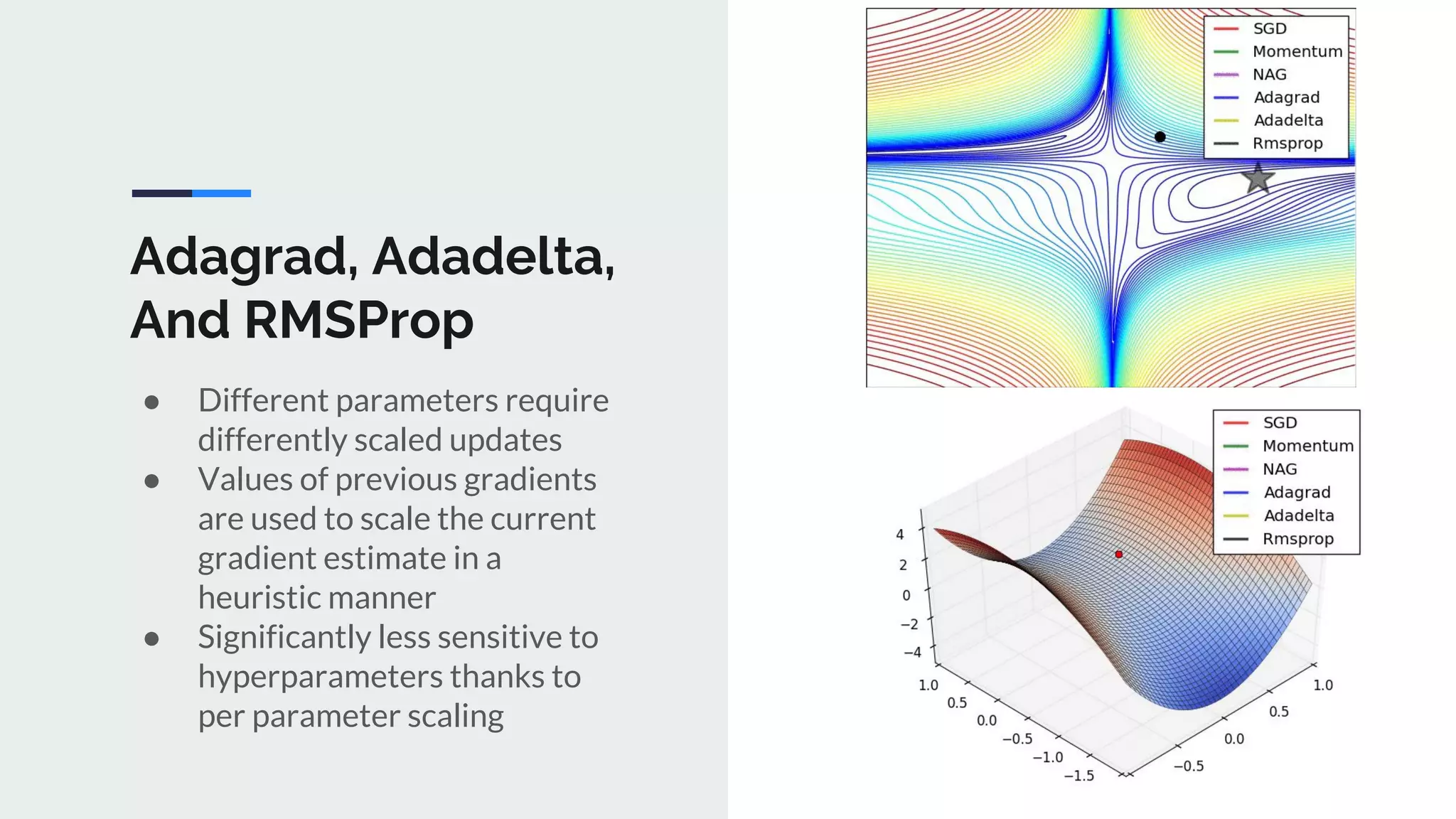
● Different parameters require
differently scaled updates
● Values of previous gradients
are used to scale the current
gradient estimate in a
heuristic manner
● Significantly less sensitive to
hyperparameters thanks to
per parameter scaling
Adam
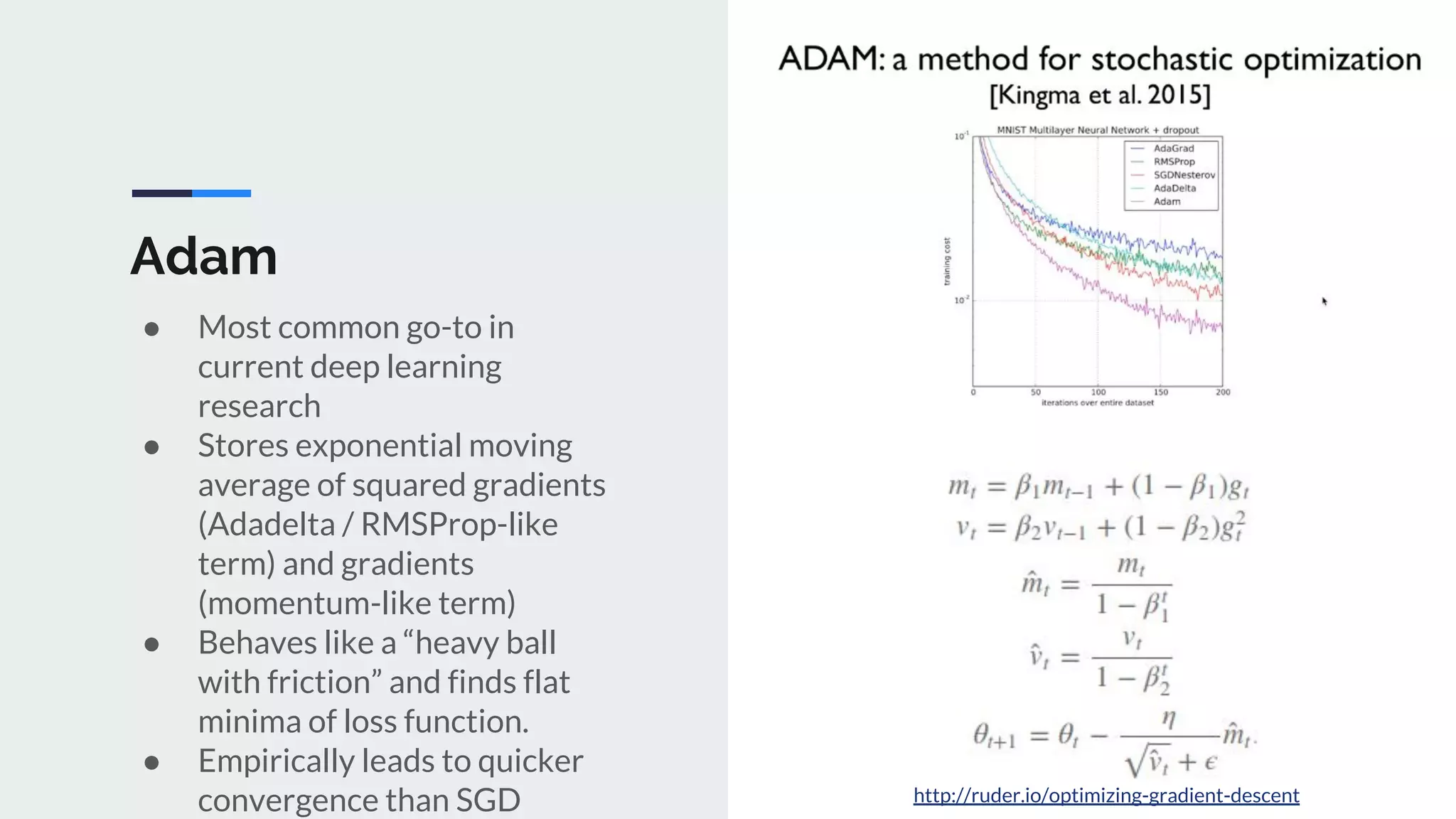
● Most common go-to in
current deep learning
research
● Stores exponential moving
average of squared gradients
(Adadelta / RMSProp-like
term) and gradients
(momentum-like term)
● Behaves like a “heavy ball
with friction” and finds flat
minima of loss function.
● Empirically leads to quicker
convergence than SGD http://ruder.io/optimizing-gradient-descent
Takeaways
● SGD: update params by scaling gradient
● Momentum: incorporating exponential moving
averages of gradient value allow for SGD to escape
saddle points. Acts like acceleration of ball on surface
due to mass.
● Adadelta / RMSprop: inverse scaling by exponential
moving average of square of gradient to help with
sensitivity to hyperparameters
● Adam: incorporates elements of momentum and
Adadelta / RMSprop
Async Training, Batch Size,
and Regularization Affect
Learning Rate Dynamics
Batch Size +
Learning Rate
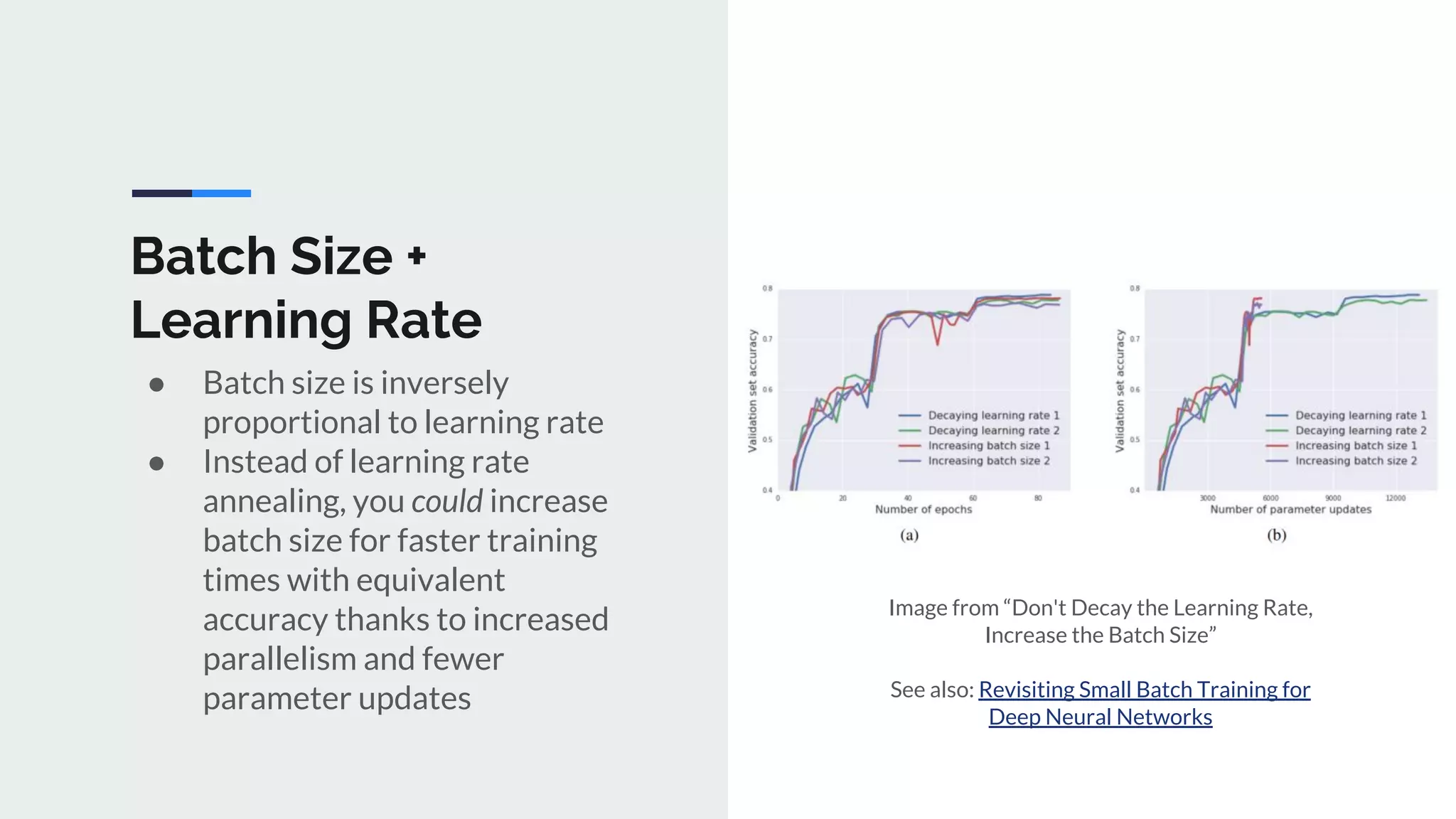
● Batch size is inversely
proportional to learning rate
● Instead of learning rate
annealing, you could increase
batch size for faster training
times with equivalent
accuracy thanks to increased
parallelism and fewer
parameter updates
Image from “Don't Decay the Learning Rate,
Increase the Batch Size”
See also: Revisiting Small Batch Training for
Deep Neural Networks
Batch Size +
Learning Rate
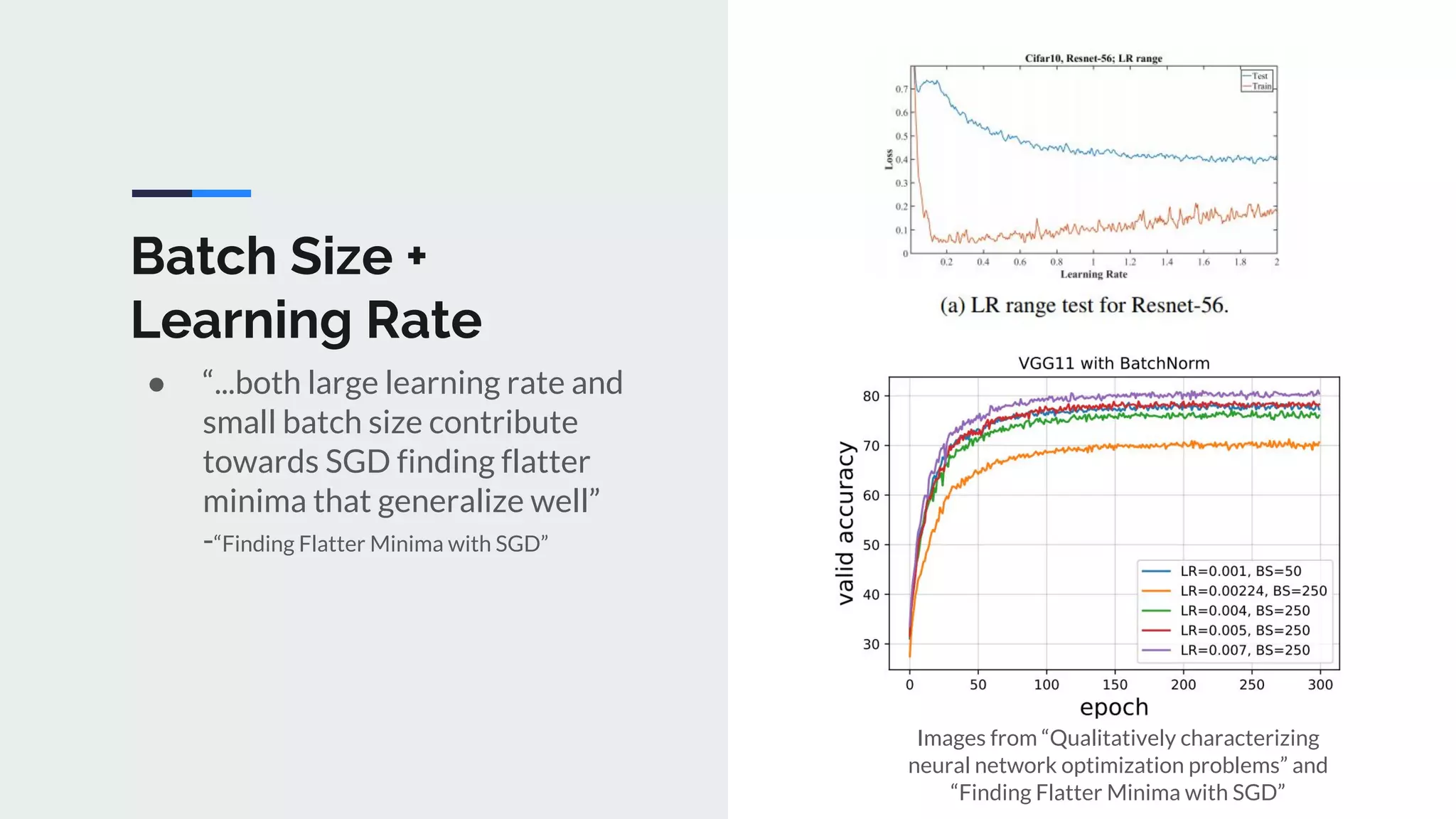
● “...both large learning rate and
small batch size contribute
towards SGD finding flatter
minima that generalize well”
-“Finding Flatter Minima with SGD”
Images from “Qualitatively characterizing
neural network optimization problems” and
“Finding Flatter Minima with SGD”
Async Training &
Momentum
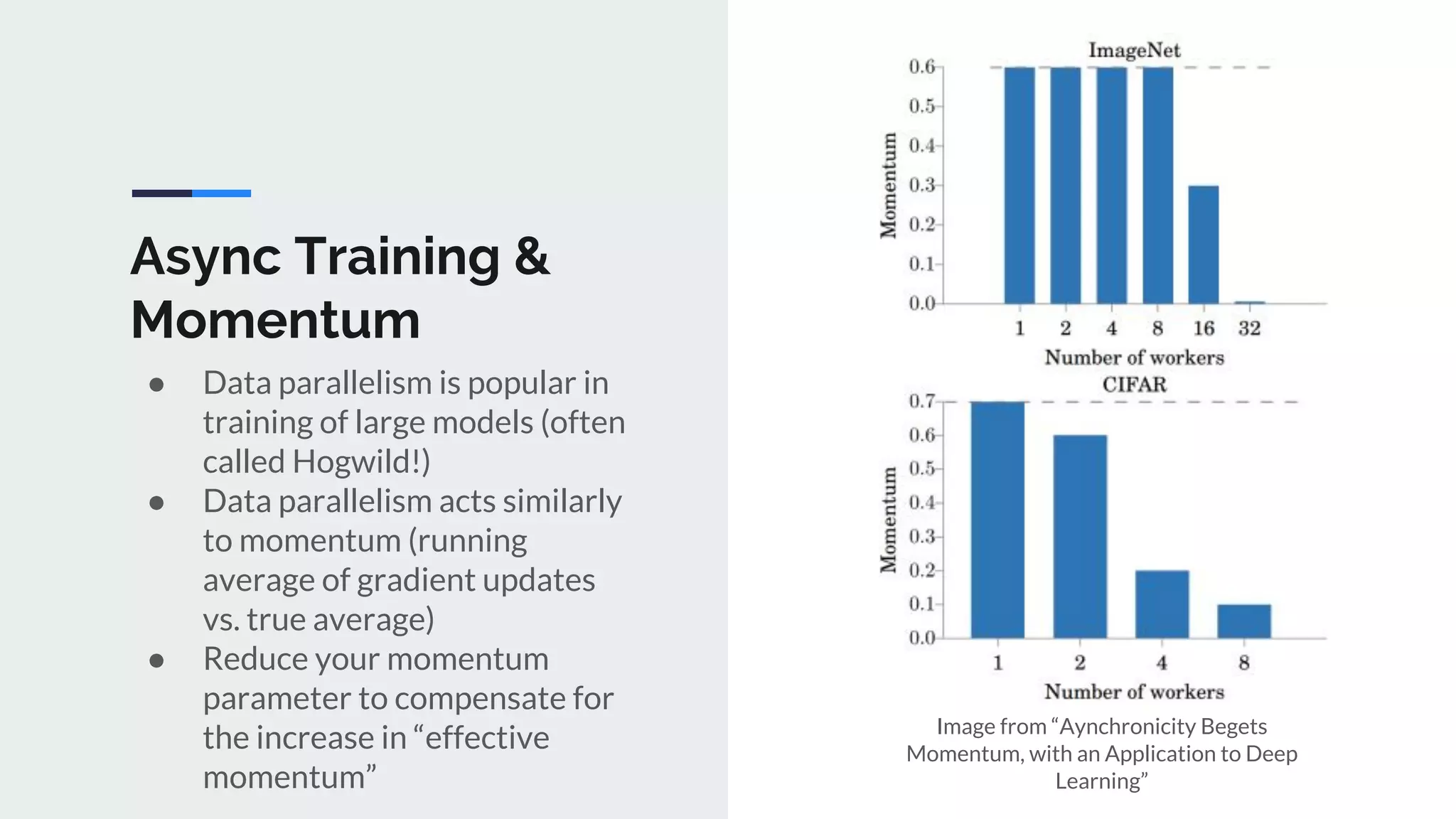
● Data parallelism is popular in
training of large models (often
called Hogwild!)
● Data parallelism acts similarly
to momentum (running
average of gradient updates
vs. true average)
● Reduce your momentum
parameter to compensate for
the increase in “effective
momentum”
Image from “Aynchronicity Begets
Momentum, with an Application to Deep
Learning”
Regularization +
Learning Rate
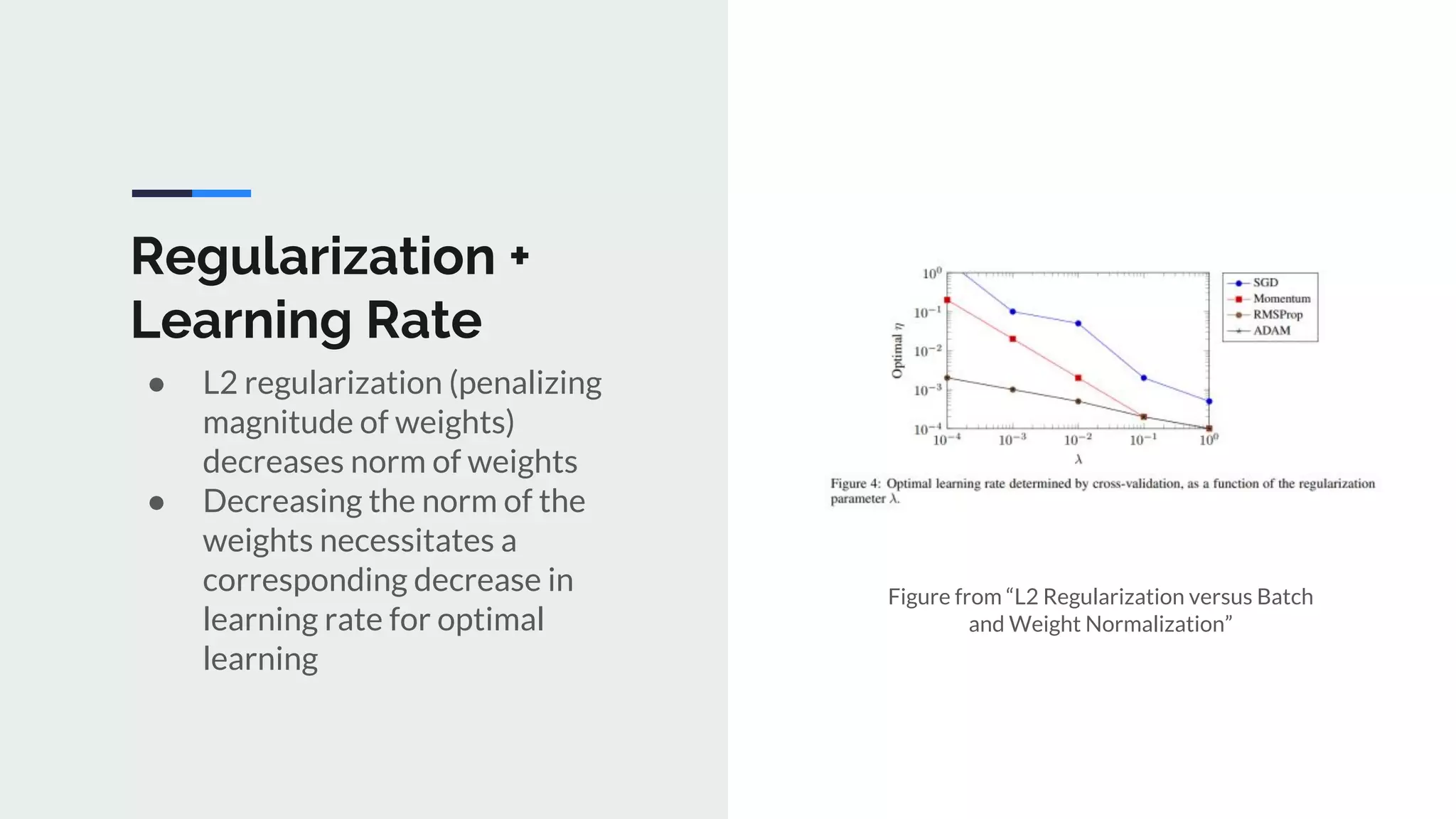
● L2 regularization (penalizing
magnitude of weights)
decreases norm of weights
● Decreasing the norm of the
weights necessitates a
corresponding decrease in
learning rate for optimal
learning
Figure from “L2 Regularization versus Batch
and Weight Normalization”
Takeaways
● There’s a difference between the learning rate
parameter and the effective learning rate of models
● Understand how batch size, async training, and the
norm of model parameters interact with learning rate
for best results.
Learning Rate Scheduling
Learning Rate
Annealing
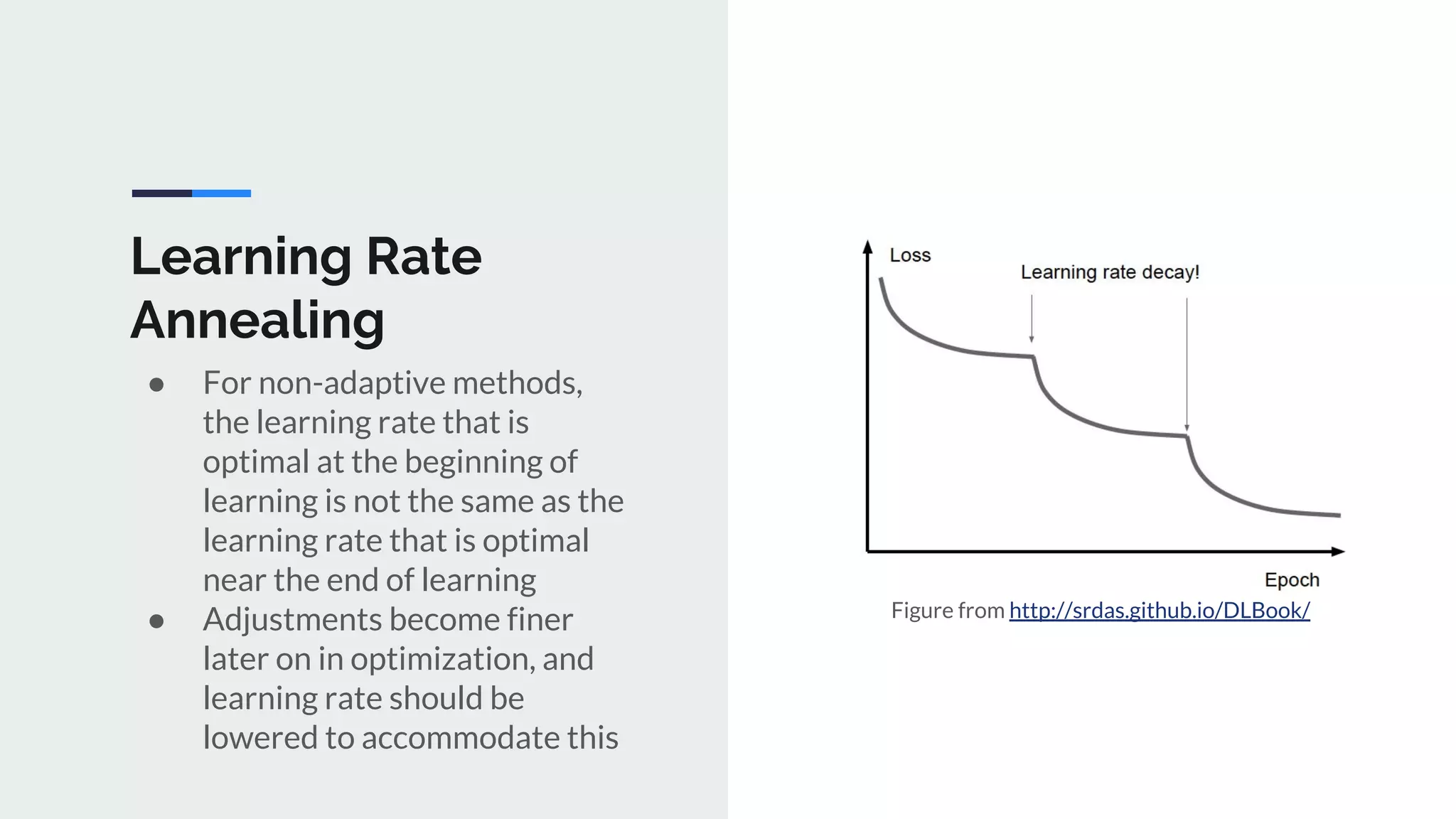
● For non-adaptive methods,
the learning rate that is
optimal at the beginning of
learning is not the same as the
learning rate that is optimal
near the end of learning
● Adjustments become finer
later on in optimization, and
learning rate should be
lowered to accommodate this
Figure from http://srdas.github.io/DLBook/
Cyclic Learning
Rates + Snapshot
Ensembling
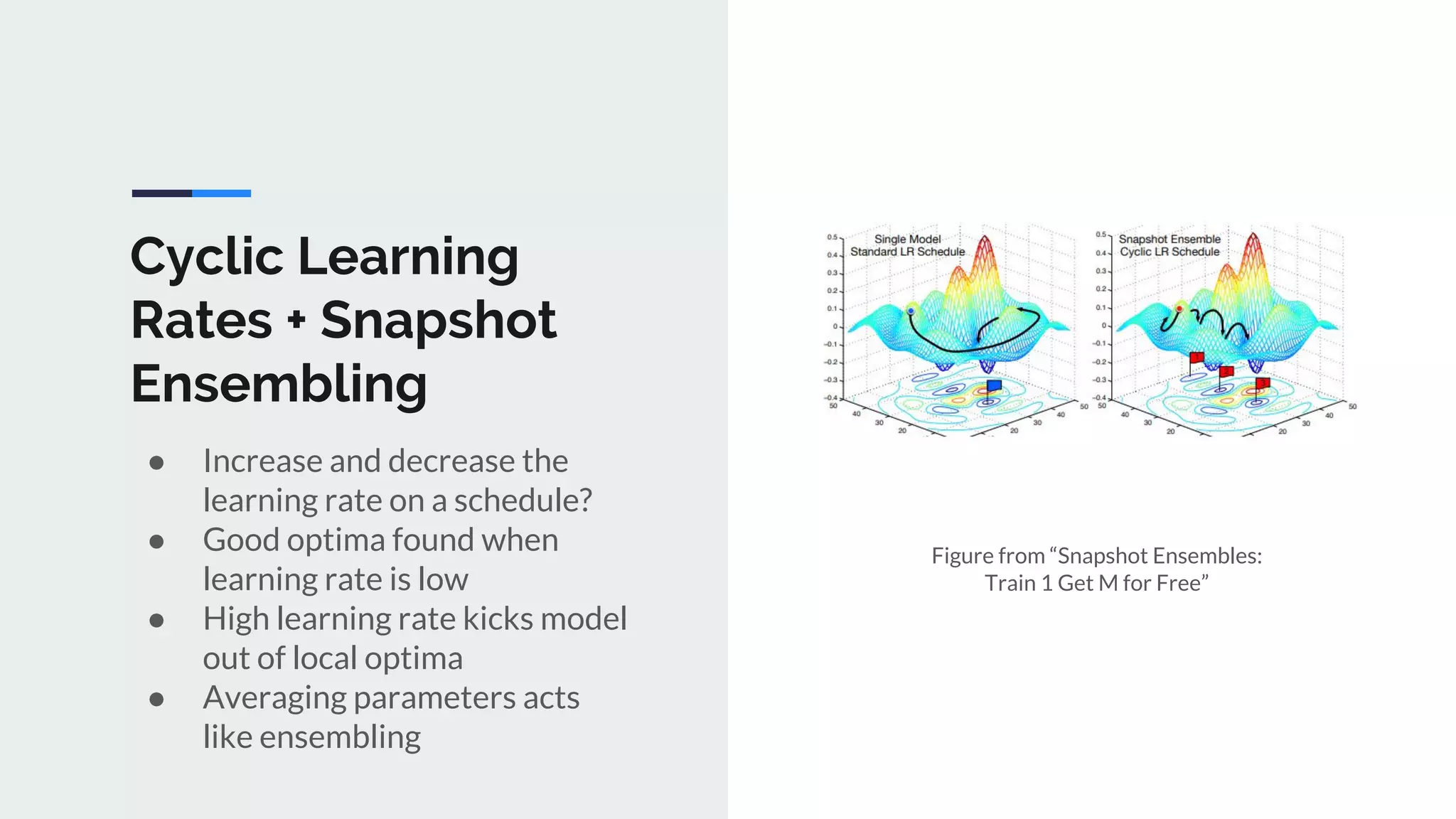
● Increase and decrease the
learning rate on a schedule?
● Good optima found when
learning rate is low
● High learning rate kicks model
out of local optima
● Averaging parameters acts
like ensembling
Figure from “Snapshot Ensembles:
Train 1 Get M for Free”
Takeaways
● Use learning rate annealing when using vanilla SGD or
SGD w/ momentum
● Consider snapshot ensembling for easy incremental
model performance improvements.
Improving Adam
ICLR 2018 Optimization Papers
● On the convergence of Adam and beyond (Sashank J. Reddi, Satyen Kale, Sanjiv Kumar)
● Normalized, direction-preserving Adam (Zijun Zhang, Lin Ma, Zongpeng Li, Chuan Wu)
● Fixing Weight Decay Regularization in Adam (Ilya Loshchilov, Frank Hutter)
● Dissecting Adam: The Sign, Magnitude and Variance of Stochastic Gradients (Lukas Balles, Philipp
Hennig)
● YellowFin and the Art of Momentum Tuning (Jian Zhang, Ioannis Mitliagkas, Christopher Re)
What can we
improve about
Adam?
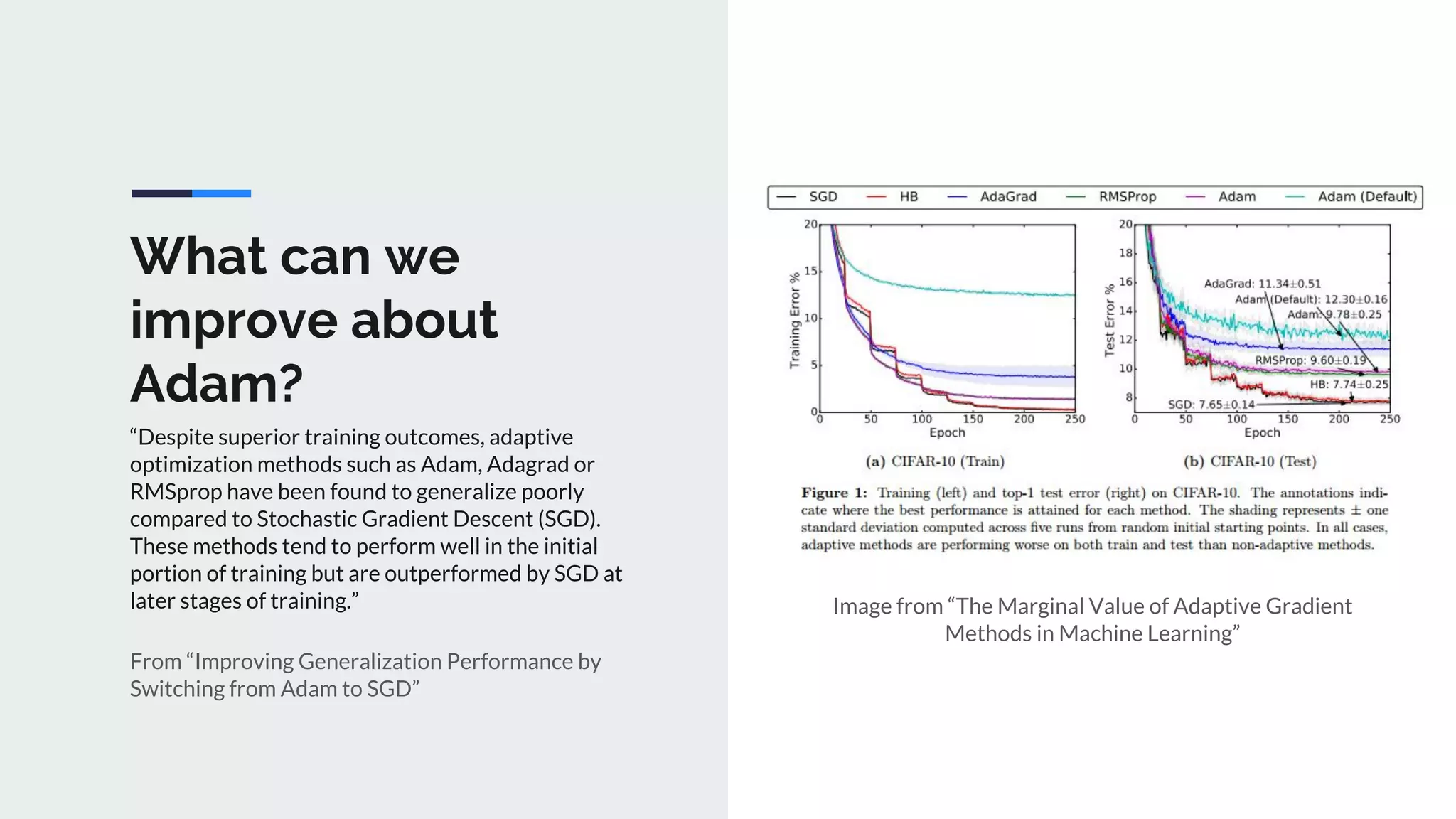
“Despite superior training outcomes, adaptive
optimization methods such as Adam, Adagrad or
RMSprop have been found to generalize poorly
compared to Stochastic Gradient Descent (SGD).
These methods tend to perform well in the initial
portion of training but are outperformed by SGD at
later stages of training.”
From “Improving Generalization Performance by
Switching from Adam to SGD”
Image from “The Marginal Value of Adaptive Gradient
Methods in Machine Learning”
Problems with
Exponential Moving
Averages
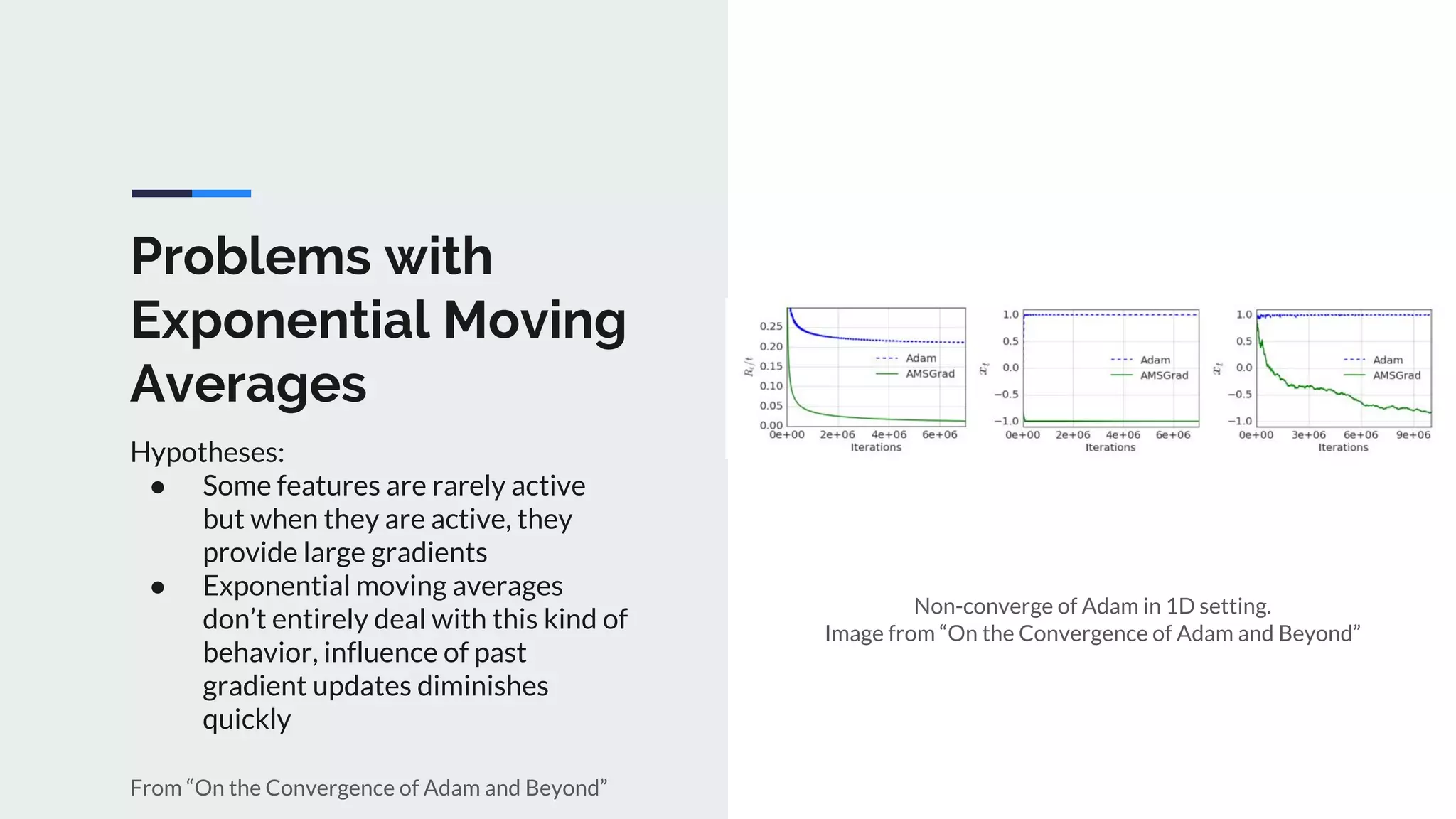
Hypotheses:
● Some features are rarely active
but when they are active, they
provide large gradients
● Exponential moving averages
don’t entirely deal with this kind of
behavior, influence of past
gradient updates diminishes
quickly
From “On the Convergence of Adam and Beyond”
Non-converge of Adam in 1D setting.
Image from “On the Convergence of Adam and Beyond”
How do we fix it?
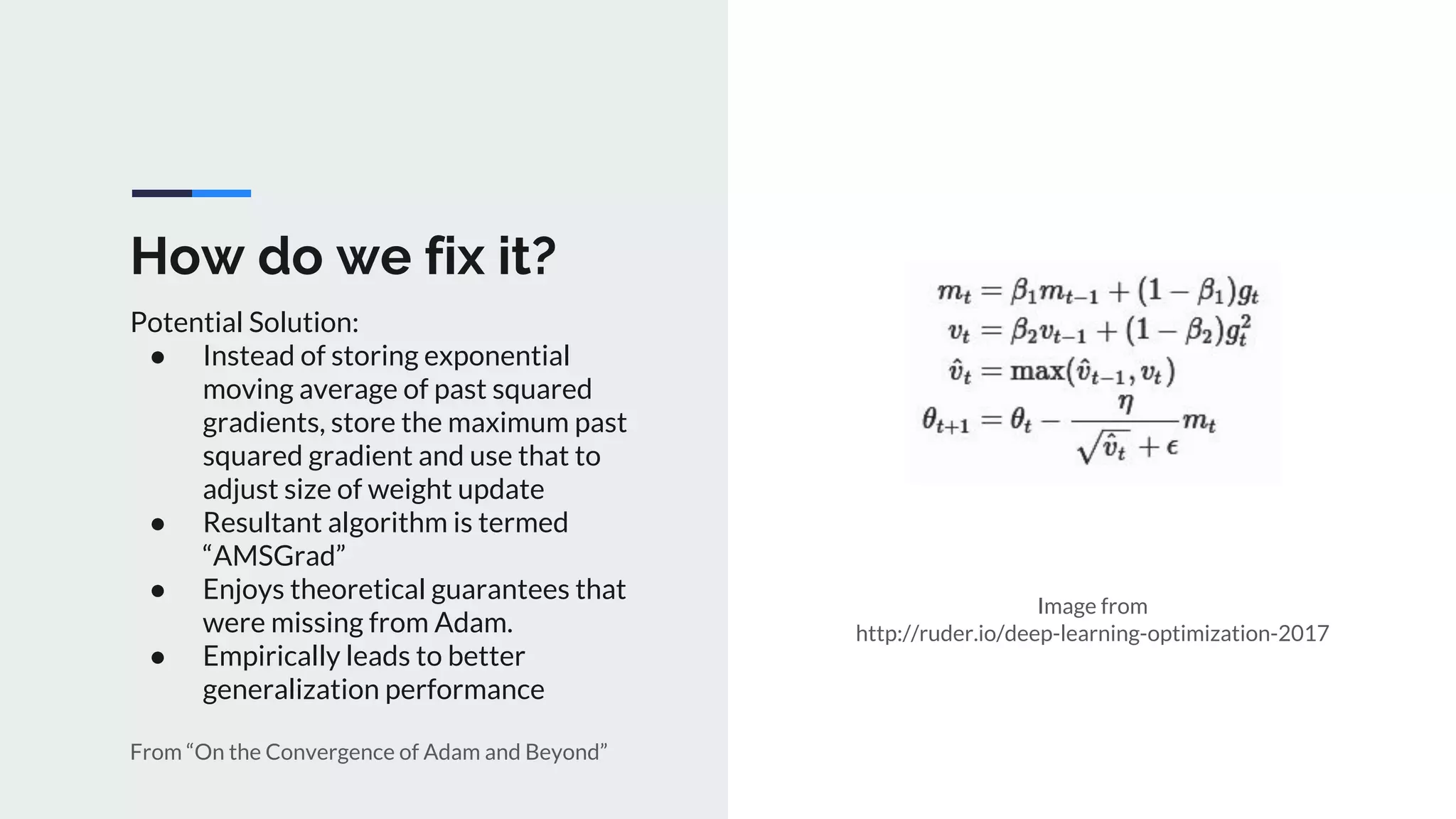
Potential Solution:
● Instead of storing exponential
moving average of past squared
gradients, store the maximum past
squared gradient and use that to
adjust size of weight update
● Resultant algorithm is termed
“AMSGrad”
● Enjoys theoretical guarantees that
were missing from Adam.
● Empirically leads to better
generalization performance
From “On the Convergence of Adam and Beyond”
Image from
http://ruder.io/deep-learning-optimization-2017
Other potential
problems
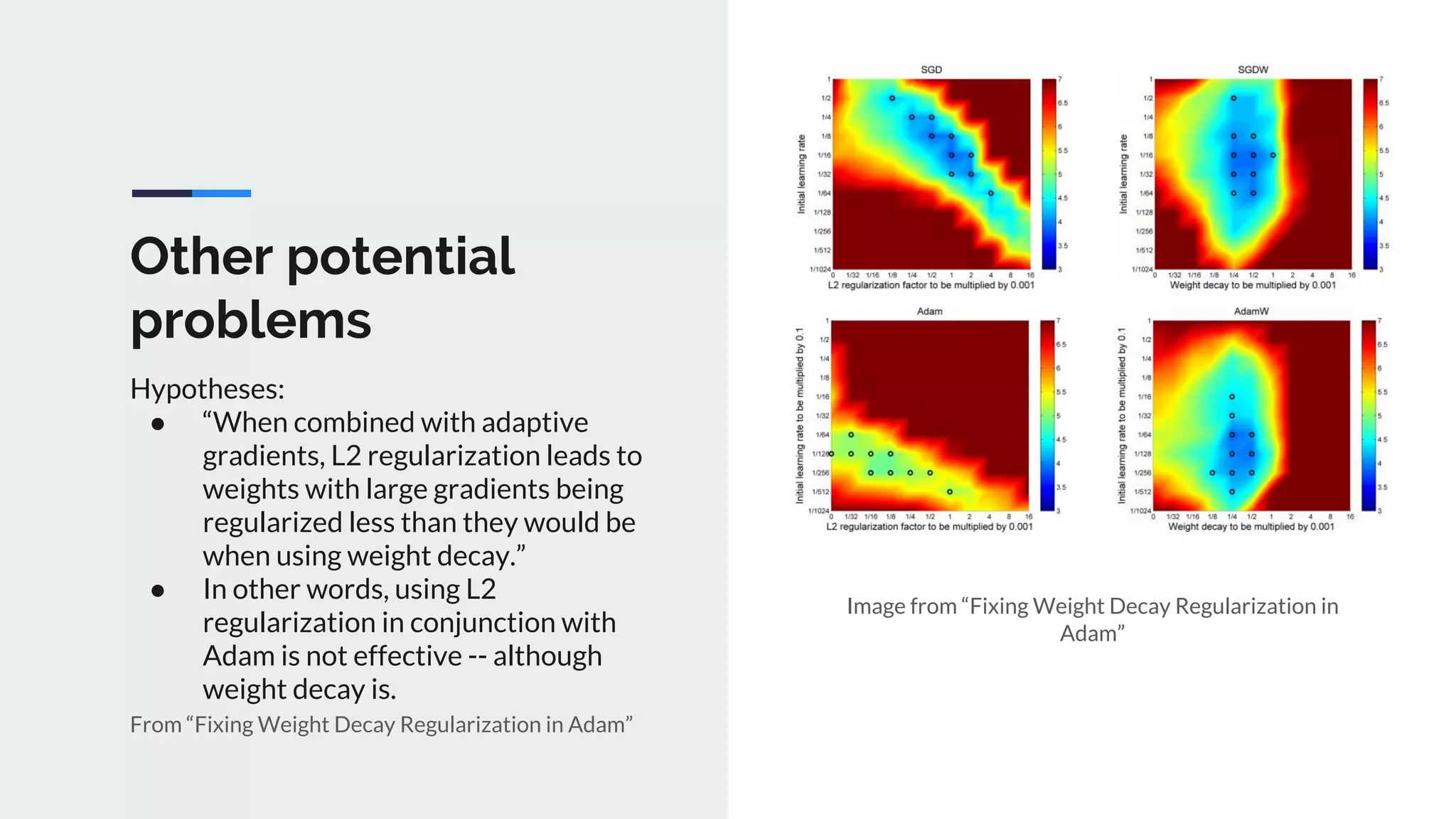
Hypotheses:
● “When combined with adaptive
gradients, L2 regularization leads to
weights with large gradients being
regularized less than they would be
when using weight decay.”
● In other words, using L2
regularization in conjunction with
Adam is not effective -- although
weight decay is.
From “Fixing Weight Decay Regularization in Adam”
Image from “Fixing Weight Decay Regularization in
Adam”
How do we fix it?
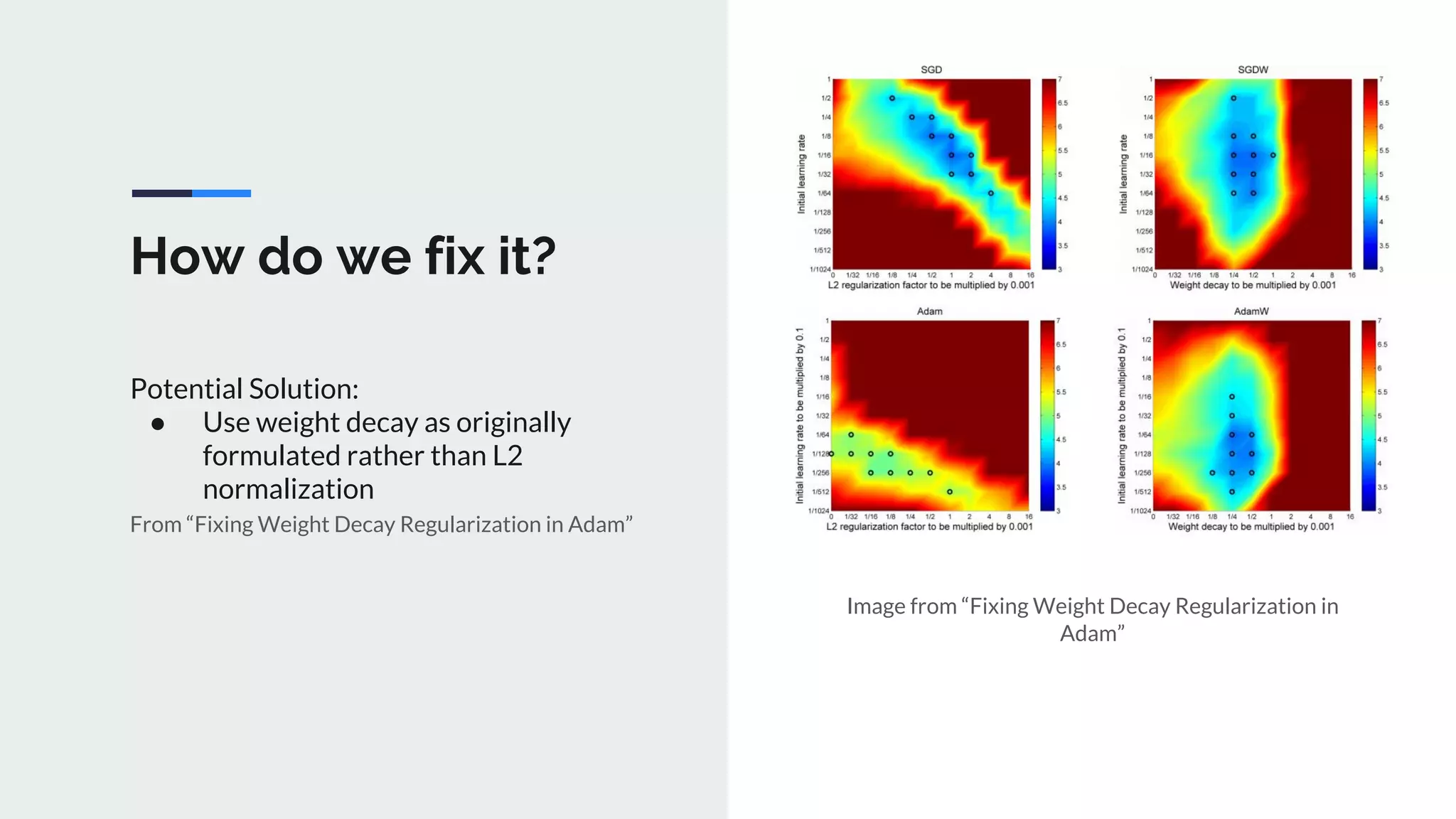
Potential Solution:
● Use weight decay as originally
formulated rather than L2
normalization
From “Fixing Weight Decay Regularization in Adam”
Image from “Fixing Weight Decay Regularization in
Adam”
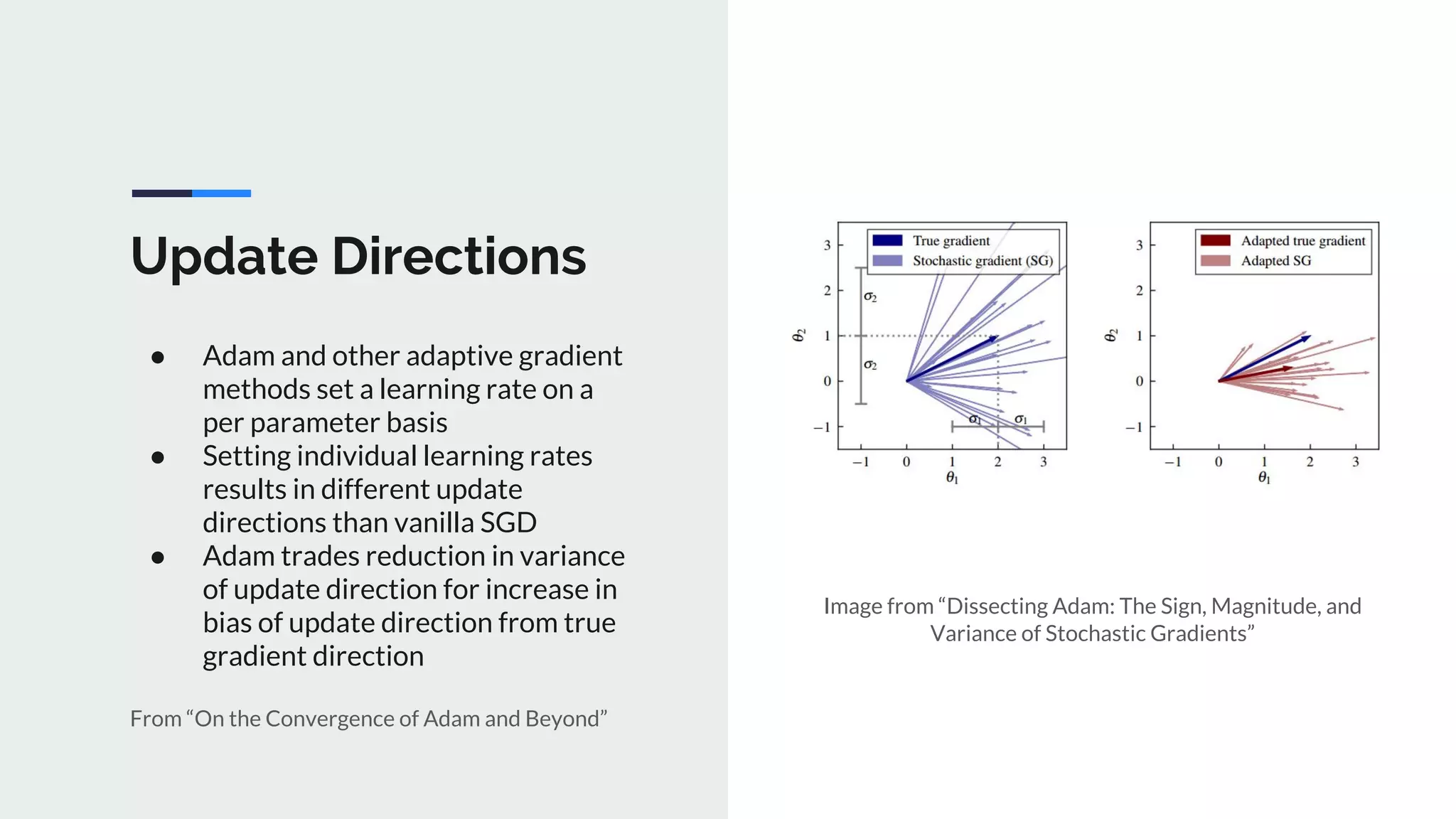
Update Directions
● Adam and other adaptive gradient
methods set a learning rate on a
per parameter basis
● Setting individual learning rates
results in different update
directions than vanilla SGD
● Adam trades reduction in variance
of update direction for increase in
bias of update direction from true
gradient direction
From “On the Convergence of Adam and Beyond”
Image from “Dissecting Adam: The Sign, Magnitude, and
Variance of Stochastic Gradients”
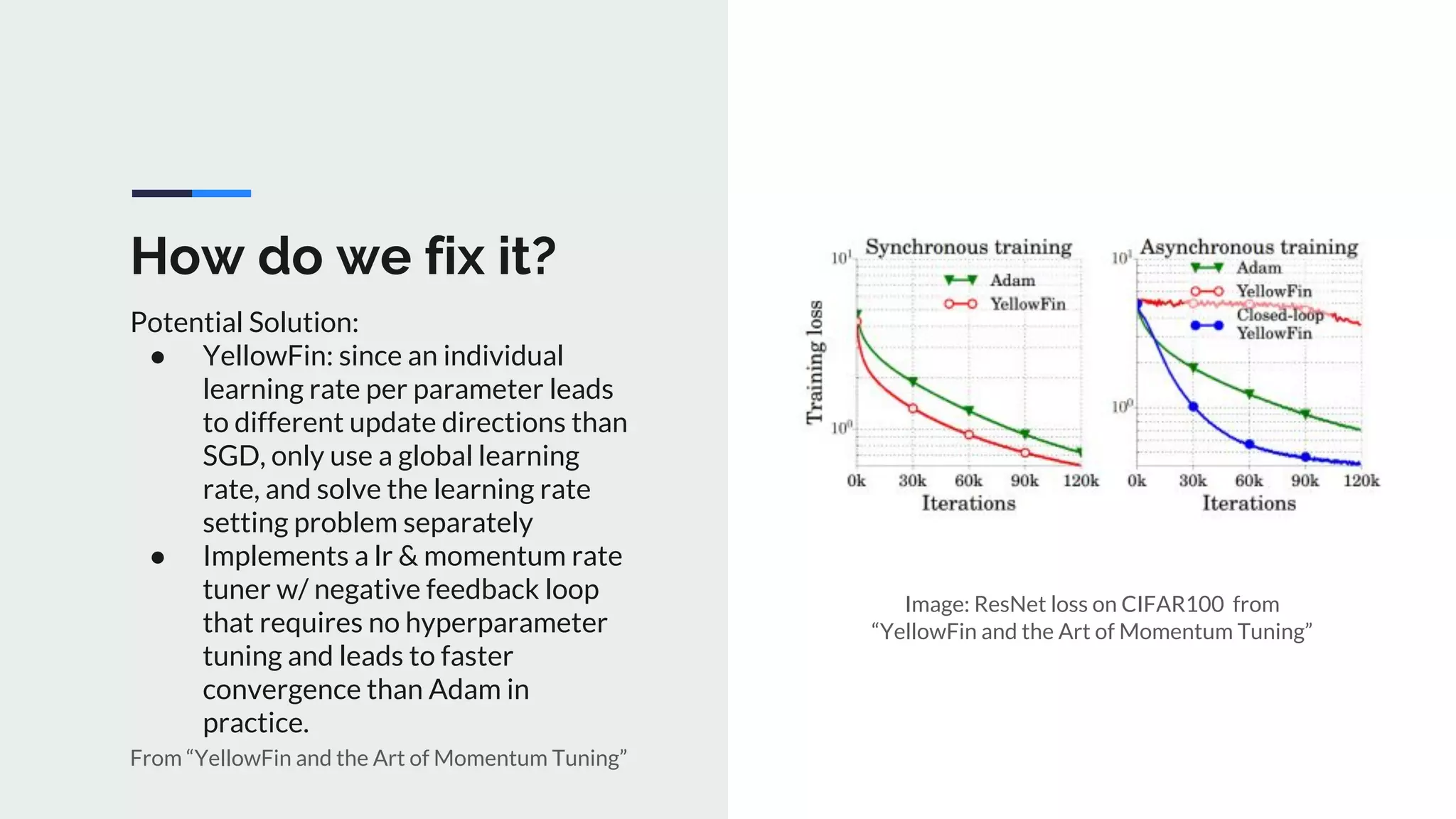
How do we fix it?
Potential Solution:
● YellowFin: since an individual
learning rate per parameter leads
to different update directions than
SGD, only use a global learning
rate, and solve the learning rate
setting problem separately
● Implements a lr & momentum rate
tuner w/ negative feedback loop
that requires no hyperparameter
tuning and leads to faster
convergence than Adam in
practice.
From “YellowFin and the Art of Momentum Tuning”
Image: ResNet loss on CIFAR100 from
“YellowFin and the Art of Momentum Tuning”
Takeaways
● Adam generally performs well but has its limits
● Use with weight decay rather than L2 regularization
● At the upper extremes of training data availability try
SGD + nesterov momentum + learning rate annealing
or YellowFin.
● Compare against AMSGrad
● Monitor arxiv.org and wait 6 months -- academia is still
deciding on whether it’s time to move past Adam.
Other considerations
● Weight initialization
● Batch norm / Layer norm
Shoutouts
● Sebastian Ruder has blogged extensively about
optimization -- his content forms the basis for much of
this talk
○ http://ruder.io/optimizing-gradient-descent/
○ http://ruder.io/deep-learning-optimization-2017
/
● Chapter 8 of “Deep Learning” by Goodfellow, Bengio,
and Courville was a useful supplement
○ https://www.deeplearningbook.com
● Fei Fei Li’s CS231N course at Stanford:
○ http://cs231n.github.io/neural-networks-3
Questions?
Appendix
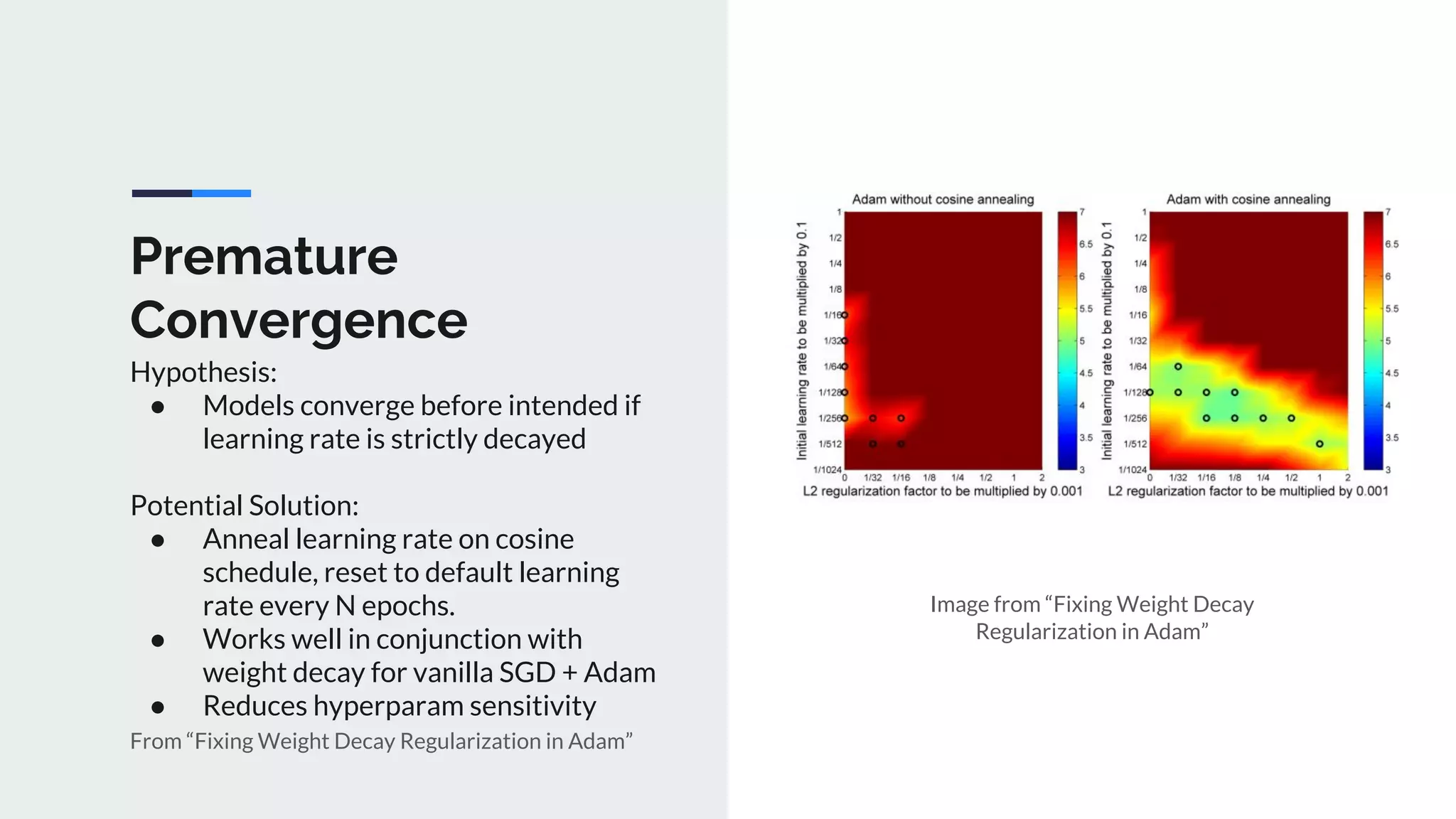
Premature
Convergence
Hypothesis:
● Models converge before intended if
learning rate is strictly decayed
Potential Solution:
● Anneal learning rate on cosine
schedule, reset to default learning
rate every N epochs.
● Works well in conjunction with
weight decay for vanilla SGD + Adam
● Reduces hyperparam sensitivity
From “Fixing Weight Decay Regularization in Adam”
Image from “Fixing Weight Decay
Regularization in Adam”
Weight Initialization
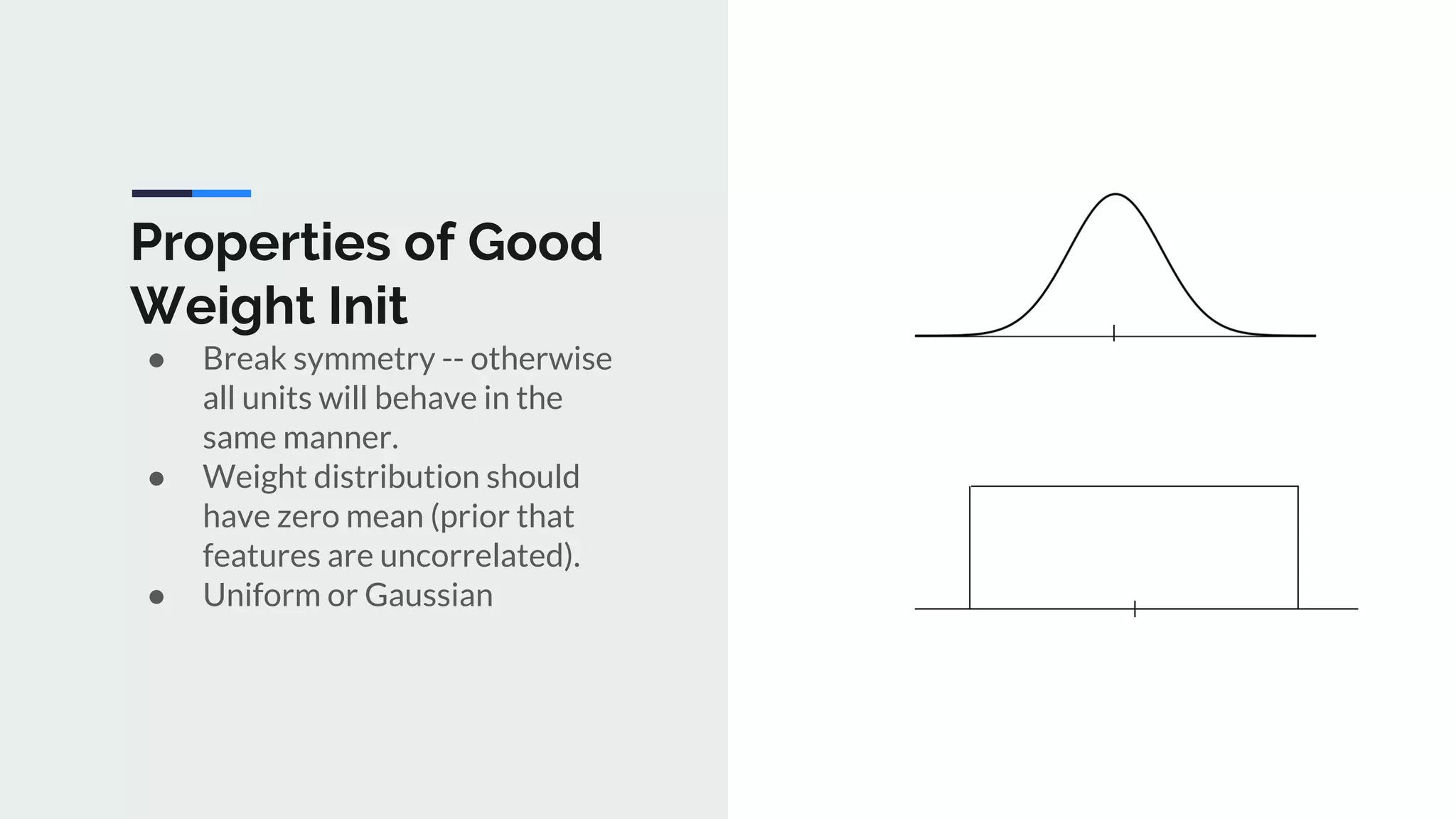
Properties of Good
Weight Init
● Break symmetry -- otherwise
all units will behave in the
same manner.
● Weight distribution should
have zero mean (prior that
features are uncorrelated).
● Uniform or Gaussian
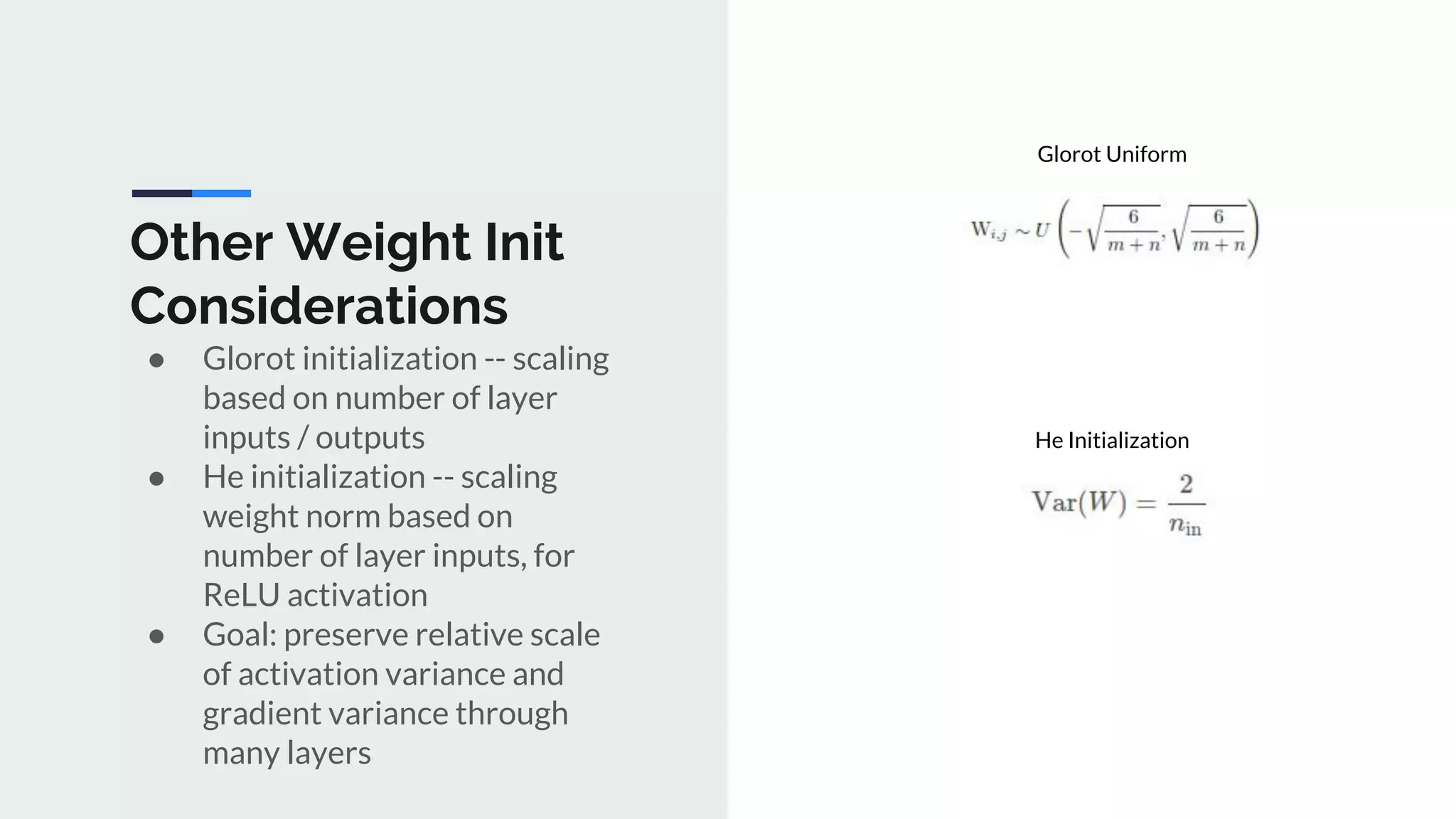
Other Weight Init
Considerations
● Glorot initialization -- scaling
based on number of layer
inputs / outputs
● He initialization -- scaling
weight norm based on
number of layer inputs, for
ReLU activation
● Goal: preserve relative scale
of activation variance and
gradient variance through
many layers
Glorot Uniform
He Initialization
Takeaways
● Parameter initialization matters (more than you might
think)
● Take care to ensure that activation and gradient
variances stay roughly constant throughout layers
when training deep networks (consider visualization)

Everything You Wanted to Know About Optimization

  • 1.
    Everything You Wantedto Know about Optimization (and some you didn’t) Madison May madison@indico.io
  • 2.
    Madison May Machine LearningArchitect @ Indico Data Solutions Solve big problems with small data. Email: madison@indico.io Twitter: @pragmaticml Github: @madisonmay
  • 3.
  • 4.
    Definitions: ● Loss: differentiablemeasure of model error ● Gradient: direction of steepest descent at point on error surface ● Loss surface: how loss varies with parameter value ● Learning rate: how far to move params in direction of gradient
  • 5.
    Gradient descent ● Computeloss on entire dataset ● Compute gradient of parameters with respect to loss ● Update parameters in the direction of the gradient scaled by some parameter (the learning rate)
  • 6.
    SGD (mini-batch gradient descent) ● Computeloss on small number of examples ● Compute gradient of parameters with respect to loss ● Update parameters in the direction of the gradient scaled by some parameter (the learning rate)
  • 7.
    Mini-batch vs. Full ●Don’t need to compute the gradient on all of your training examples to get a gradient estimate that is good enough. ● Better to update your parameters more frequently with noisy gradient than get a perfect gradient estimate and update model params less. ● Stochastic gradient estimates help avoid local minima / saddle points https://en.wikipedia.org/wiki/gradient_descen t
  • 8.
    SGD with Momentum ● SGDproblematic when the magnitude of gradients varies between parameters. ● Parameters will oscillate between the two sides of the bowl (see right). ● Keeping an exponential moving average of past gradients (momentum) helps to dampen oscillation (acts like heavy ball) ● Helps accelerate through flat areas of loss surface. Images from sebastianruder.com With Momentum Without Momentum
  • 9.
    SGD with Nesterov Momentum(NAG) ● Instead of measuring loss at current parameters, apply the previous gradient once more before measuring loss since that gradient update ● Allows optimizer to correct more quickly to changes in the loss landscape Hinton Lecture 6c Blue: momentum Green: NAG
  • 10.
    Adagrad, Adadelta, And RMSProp ●Different parameters require differently scaled updates ● Values of previous gradients are used to scale the current gradient estimate in a heuristic manner ● Significantly less sensitive to hyperparameters thanks to per parameter scaling
  • 11.
    Adam ● Most commongo-to in current deep learning research ● Stores exponential moving average of squared gradients (Adadelta / RMSProp-like term) and gradients (momentum-like term) ● Behaves like a “heavy ball with friction” and finds flat minima of loss function. ● Empirically leads to quicker convergence than SGD http://ruder.io/optimizing-gradient-descent
  • 12.
    Takeaways ● SGD: updateparams by scaling gradient ● Momentum: incorporating exponential moving averages of gradient value allow for SGD to escape saddle points. Acts like acceleration of ball on surface due to mass. ● Adadelta / RMSprop: inverse scaling by exponential moving average of square of gradient to help with sensitivity to hyperparameters ● Adam: incorporates elements of momentum and Adadelta / RMSprop
  • 13.
    Async Training, BatchSize, and Regularization Affect Learning Rate Dynamics
  • 14.
    Batch Size + LearningRate ● Batch size is inversely proportional to learning rate ● Instead of learning rate annealing, you could increase batch size for faster training times with equivalent accuracy thanks to increased parallelism and fewer parameter updates Image from “Don't Decay the Learning Rate, Increase the Batch Size” See also: Revisiting Small Batch Training for Deep Neural Networks
  • 15.
    Batch Size + LearningRate ● “...both large learning rate and small batch size contribute towards SGD finding flatter minima that generalize well” -“Finding Flatter Minima with SGD” Images from “Qualitatively characterizing neural network optimization problems” and “Finding Flatter Minima with SGD”
  • 16.
    Async Training & Momentum ●Data parallelism is popular in training of large models (often called Hogwild!) ● Data parallelism acts similarly to momentum (running average of gradient updates vs. true average) ● Reduce your momentum parameter to compensate for the increase in “effective momentum” Image from “Aynchronicity Begets Momentum, with an Application to Deep Learning”
  • 17.
    Regularization + Learning Rate ●L2 regularization (penalizing magnitude of weights) decreases norm of weights ● Decreasing the norm of the weights necessitates a corresponding decrease in learning rate for optimal learning Figure from “L2 Regularization versus Batch and Weight Normalization”
  • 18.
    Takeaways ● There’s adifference between the learning rate parameter and the effective learning rate of models ● Understand how batch size, async training, and the norm of model parameters interact with learning rate for best results.
  • 19.
  • 20.
    Learning Rate Annealing ● Fornon-adaptive methods, the learning rate that is optimal at the beginning of learning is not the same as the learning rate that is optimal near the end of learning ● Adjustments become finer later on in optimization, and learning rate should be lowered to accommodate this Figure from http://srdas.github.io/DLBook/
  • 21.
    Cyclic Learning Rates +Snapshot Ensembling ● Increase and decrease the learning rate on a schedule? ● Good optima found when learning rate is low ● High learning rate kicks model out of local optima ● Averaging parameters acts like ensembling Figure from “Snapshot Ensembles: Train 1 Get M for Free”
  • 22.
    Takeaways ● Use learningrate annealing when using vanilla SGD or SGD w/ momentum ● Consider snapshot ensembling for easy incremental model performance improvements.
  • 23.
  • 24.
    ICLR 2018 OptimizationPapers ● On the convergence of Adam and beyond (Sashank J. Reddi, Satyen Kale, Sanjiv Kumar) ● Normalized, direction-preserving Adam (Zijun Zhang, Lin Ma, Zongpeng Li, Chuan Wu) ● Fixing Weight Decay Regularization in Adam (Ilya Loshchilov, Frank Hutter) ● Dissecting Adam: The Sign, Magnitude and Variance of Stochastic Gradients (Lukas Balles, Philipp Hennig) ● YellowFin and the Art of Momentum Tuning (Jian Zhang, Ioannis Mitliagkas, Christopher Re)
  • 25.
    What can we improveabout Adam? “Despite superior training outcomes, adaptive optimization methods such as Adam, Adagrad or RMSprop have been found to generalize poorly compared to Stochastic Gradient Descent (SGD). These methods tend to perform well in the initial portion of training but are outperformed by SGD at later stages of training.” From “Improving Generalization Performance by Switching from Adam to SGD” Image from “The Marginal Value of Adaptive Gradient Methods in Machine Learning”
  • 26.
    Problems with Exponential Moving Averages Hypotheses: ●Some features are rarely active but when they are active, they provide large gradients ● Exponential moving averages don’t entirely deal with this kind of behavior, influence of past gradient updates diminishes quickly From “On the Convergence of Adam and Beyond” Non-converge of Adam in 1D setting. Image from “On the Convergence of Adam and Beyond”
  • 27.
    How do wefix it? Potential Solution: ● Instead of storing exponential moving average of past squared gradients, store the maximum past squared gradient and use that to adjust size of weight update ● Resultant algorithm is termed “AMSGrad” ● Enjoys theoretical guarantees that were missing from Adam. ● Empirically leads to better generalization performance From “On the Convergence of Adam and Beyond” Image from http://ruder.io/deep-learning-optimization-2017
  • 28.
    Other potential problems Hypotheses: ● “Whencombined with adaptive gradients, L2 regularization leads to weights with large gradients being regularized less than they would be when using weight decay.” ● In other words, using L2 regularization in conjunction with Adam is not effective -- although weight decay is. From “Fixing Weight Decay Regularization in Adam” Image from “Fixing Weight Decay Regularization in Adam”
  • 29.
    How do wefix it? Potential Solution: ● Use weight decay as originally formulated rather than L2 normalization From “Fixing Weight Decay Regularization in Adam” Image from “Fixing Weight Decay Regularization in Adam”
  • 30.
    Update Directions ● Adamand other adaptive gradient methods set a learning rate on a per parameter basis ● Setting individual learning rates results in different update directions than vanilla SGD ● Adam trades reduction in variance of update direction for increase in bias of update direction from true gradient direction From “On the Convergence of Adam and Beyond” Image from “Dissecting Adam: The Sign, Magnitude, and Variance of Stochastic Gradients”
  • 31.
    How do wefix it? Potential Solution: ● YellowFin: since an individual learning rate per parameter leads to different update directions than SGD, only use a global learning rate, and solve the learning rate setting problem separately ● Implements a lr & momentum rate tuner w/ negative feedback loop that requires no hyperparameter tuning and leads to faster convergence than Adam in practice. From “YellowFin and the Art of Momentum Tuning” Image: ResNet loss on CIFAR100 from “YellowFin and the Art of Momentum Tuning”
  • 32.
    Takeaways ● Adam generallyperforms well but has its limits ● Use with weight decay rather than L2 regularization ● At the upper extremes of training data availability try SGD + nesterov momentum + learning rate annealing or YellowFin. ● Compare against AMSGrad ● Monitor arxiv.org and wait 6 months -- academia is still deciding on whether it’s time to move past Adam.
  • 33.
    Other considerations ● Weightinitialization ● Batch norm / Layer norm
  • 34.
    Shoutouts ● Sebastian Ruderhas blogged extensively about optimization -- his content forms the basis for much of this talk ○ http://ruder.io/optimizing-gradient-descent/ ○ http://ruder.io/deep-learning-optimization-2017 / ● Chapter 8 of “Deep Learning” by Goodfellow, Bengio, and Courville was a useful supplement ○ https://www.deeplearningbook.com ● Fei Fei Li’s CS231N course at Stanford: ○ http://cs231n.github.io/neural-networks-3
  • 35.
  • 36.
  • 37.
    Premature Convergence Hypothesis: ● Models convergebefore intended if learning rate is strictly decayed Potential Solution: ● Anneal learning rate on cosine schedule, reset to default learning rate every N epochs. ● Works well in conjunction with weight decay for vanilla SGD + Adam ● Reduces hyperparam sensitivity From “Fixing Weight Decay Regularization in Adam” Image from “Fixing Weight Decay Regularization in Adam”
  • 38.
  • 39.
    Properties of Good WeightInit ● Break symmetry -- otherwise all units will behave in the same manner. ● Weight distribution should have zero mean (prior that features are uncorrelated). ● Uniform or Gaussian
  • 40.
    Other Weight Init Considerations ●Glorot initialization -- scaling based on number of layer inputs / outputs ● He initialization -- scaling weight norm based on number of layer inputs, for ReLU activation ● Goal: preserve relative scale of activation variance and gradient variance through many layers Glorot Uniform He Initialization
  • 41.
    Takeaways ● Parameter initializationmatters (more than you might think) ● Take care to ensure that activation and gradient variances stay roughly constant throughout layers when training deep networks (consider visualization)