Activation
Function
Controls Neuron’s Output Controls Neuron’s Learning
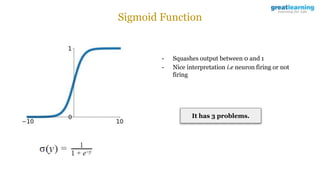
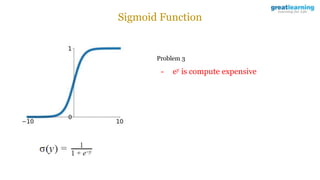
Sigmoid Function
- Squashes output between 0 and 1
- Nice interpretation i.e neuron firing or not
firing
It has 3 problems.
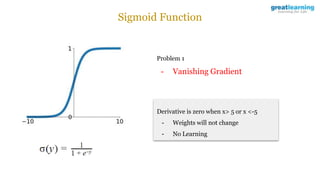
Sigmoid Function
Problem 1
- Vanishing Gradient
Derivative is zero when x> 5 or x <-5
- Weights will not change
- No Learning
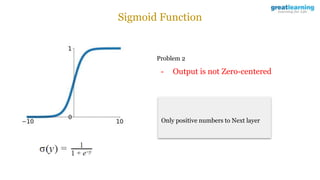
Sigmoid Function
Problem 2
- Output is not Zero-centered
Only positive numbers to Next layer
Sigmoid Function
Problem 3
- ey is compute expensive
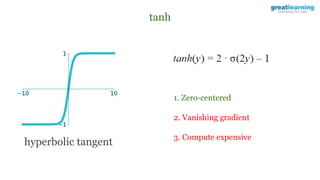
tanh
1. Zero-centered
2. Vanishing gradient
3. Compute expensive
hyperbolic tangent
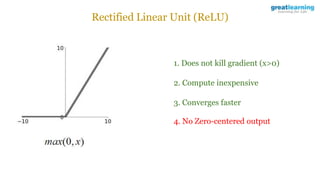
Rectified Linear Unit (ReLU)
1. Does not kill gradient (x>0)
2. Compute inexpensive
3. Converges faster
4. No Zero-centered output
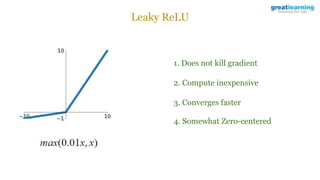
Leaky ReLU
1. Does not kill gradient
2. Compute inexpensive
3. Converges faster
4. Somewhat Zero-centered
Which activation function we should
use?
- Use ReLU
- Try out Leaky ReLU
- Try out tanh but don’t expect much
- Minimize use of Sigmoid
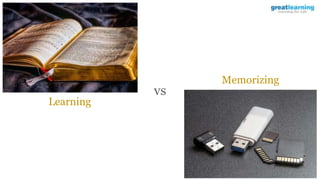
Learning
vs
Memorizing
How do we know machine is really
learning or memorizing?
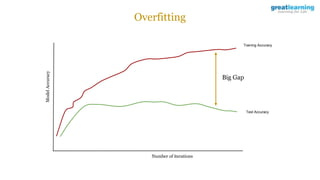
By looking at test accuracy (or loss) and
comparing it with training accuracy/loss.
Overfitting
Training Accuracy
Number of iterations
Model
Accuracy
Test Accuracy
Big Gap
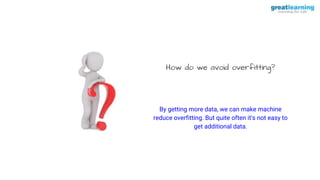
How do we avoid overfitting?
By getting more data, we can make machine
reduce overfitting. But quite often it's not easy to
get additional data.
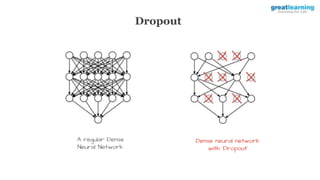
Dropout
...refers to dropping or ignoring
neurons at random to reduce
overfitting.
Dropout
A regular Dense
Neural Network
Dense neural network
with ‘Dropout’
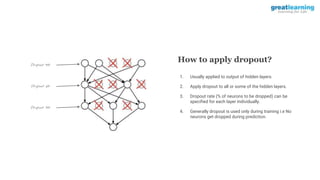
How to apply dropout?
Dropout 50%
Dropout 60%
Dropout 40%
1. Usually applied to output of hidden layers.
2. Apply dropout to all or some of the hidden layers.
3. Dropout rate (% of neurons to be dropped) can be
specified for each layer individually.
4. Generally dropout is used only during training i.e No
neurons get dropped during prediction.
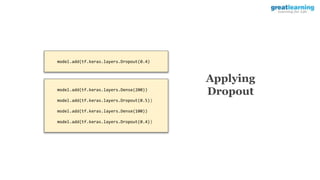
Applying
Dropout
model.add(tf.keras.layers.Dropout(0.4)
model.add(tf.keras.layers.Dense(200))
model.add(tf.keras.layers.Dropout(0.5))
model.add(tf.keras.layers.Dense(100))
model.add(tf.keras.layers.Dropout(0.4))
Batch
Normalization
How do we normalize data?
There are two approaches which are
common in Machine Learning
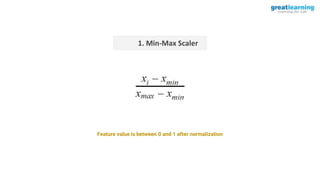
1. Min-Max Scaler
Feature value is between 0 and 1 after normalization
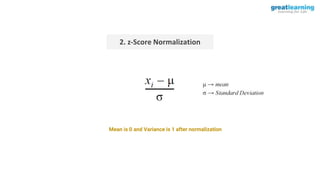
2. z-Score Normalization
Mean is 0 and Variance is 1 after normalization
When do we normalize data in ML?
We usually normalize the data and
then feed it to the model for training.
Deep Learning models have multiple trainable layers
Normalizing data before model
training allows 1st hidden layer to
get normalized inputs, but ...
Other trainable layers may not get
normalized input
How do we allow different trainable layers in Deep
Learning model to get normalized data?
Batch Normalization
Implementing data normalization for deeper trainable layers
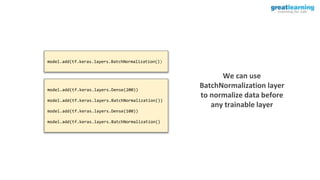
We can use
BatchNormalization layer
to normalize data before
any trainable layer
model.add(tf.keras.layers.BatchNormalization())
model.add(tf.keras.layers.Dense(200))
model.add(tf.keras.layers.BatchNormalization())
model.add(tf.keras.layers.Dense(100))
model.add(tf.keras.layers.BatchNormalization()
What type of normalization will
BatchNorm layer do?
z-Score Normalization
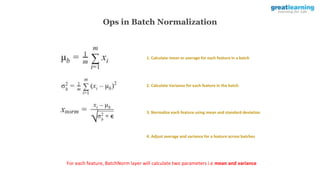
Ops in Batch Normalization
1. Calculate mean or average for each feature in a batch
2. Calculate Variance for each feature in the batch
3. Normalize each feature using mean and standard deviation
4. Adjust average and variance for a feature across batches
For each feature, BatchNorm layer will calculate two parameters i.e mean and variance
So BatchNorm layer works exactly like
a z-Score normalization?
Well, not exactly!
It also allows machine to further modify the normalized
feature value using two learnable parameters.
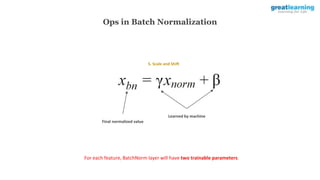
5. Scale and Shift
Ops in Batch Normalization
Learned by machine
Final normalized value
For each feature, BatchNorm layer will have two trainable parameters.
Where to use BatchNorm?
1. Apply it before a trainable layer.
2. Apply it to all or some of the trainable layers.
3. Significant impact on reducing overfitting.
4. Can be used with or inplace of Dropout
Use BatchNorm as much as possible to improve
your Deep neural networks.
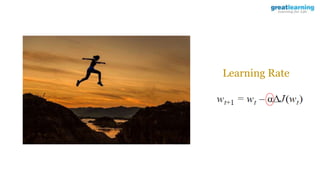
Learning Rate
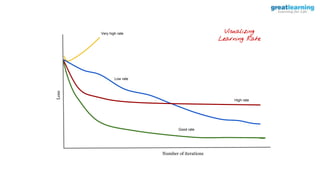
What is a good learning rate?
Very high rate
Low rate
High rate
Good rate
Number of iterations
Loss
Visualizing
Learning Rate
Learning
rate decay
We usually reduce learning rate as model training progresses to reduce chances of missing minima.
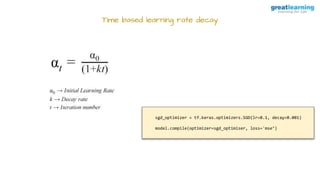
Time based learning rate decay
sgd_optimizer = tf.keras.optimizers.SGD(lr=0.1, decay=0.001)
model.compile(optimizer=sgd_optimiser, loss='mse’)
Optimizers
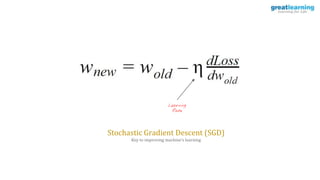
Stochastic Gradient Descent (SGD)
Key to improving machine’s learning
Learning
Rate
Sometimes
it may not
work well...
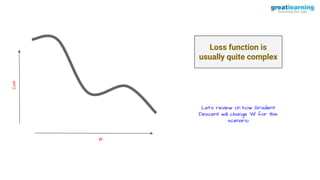
Loss function is
usually quite complex
W
Loss
Let’s review on how Gradient
Descent will change ‘W’ for this
scenario
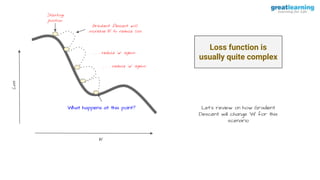
Loss function is
usually quite complex
W
Loss
Let’s review on how Gradient
Descent will change ‘W’ for this
scenario
Starting
position
Gradient Descent will
increase W to reduce loss
. . . reduce ‘w’ again
What happens at this point?
Loss function is
usually quite complex
W
Loss
Let’s review on how Gradient
Descent will change ‘W’ for this
scenario
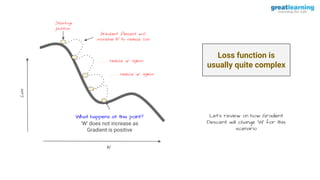
Starting
position
Gradient Descent will
increase W to reduce loss
. . . reduce ‘w’ again
What happens at this point?
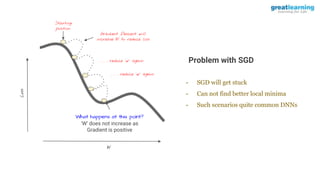
‘W’ does not increase as
Gradient is positive
W
Loss Starting
position
Gradient Descent will
increase W to reduce loss
. . . reduce ‘w’ again
What happens at this point?
‘W’ does not increase as
Gradient is positive
Problem with SGD
- SGD will get stuck
- Can not find better local minima
- Such scenarios quite common DNNs
W
Loss
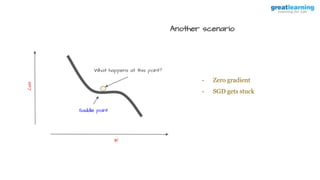
What happens at this point?
- Zero gradient
- SGD gets stuck
Another scenario
Saddle point
How do we overcome local minima &
saddle points?
Bringing Physics to ML
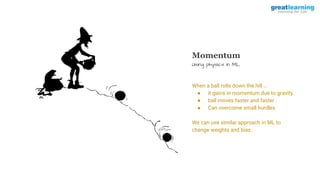
Momentum
Using physics in ML
When a ball rolls down the hill …
● it gains in momentum due to gravity.
● ball moves faster and faster .
● Can overcome small hurdles
We can use similar approach in ML to
change weights and bias.
How do we use momentum with
weight changes?
W
Loss
Starting
position
GD will increase W to
reduce loss
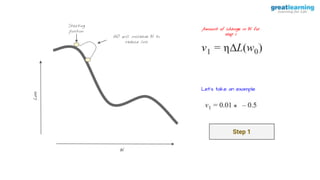
Amount of change in W for
step 1
Step 1
Let’s take an example
W
Loss
Starting
position
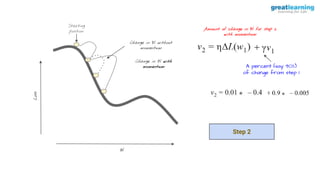
Change in W without
momentum
Amount of change in W for step 2
with momentum
Step 2
A percent (say 90%)
of change from step 1
Change in W with
momentum
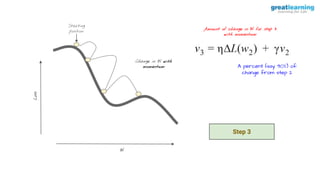
W
Loss
Starting
position Amount of change in W for step 3
with momentum
Step 3
A percent (say 90%) of
change from step 2
Change in W with
momentum
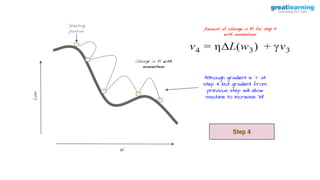
W
Loss
Starting
position Amount of change in W for step 4
with momentum
Step 4
Although gradient is ‘+’ at
step 4 but gradient from
previous step will allow
machine to increase ‘W’
Change in W with
momentum
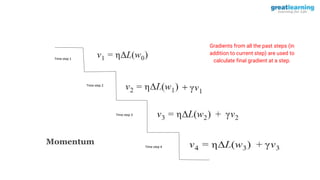
Momentum
Time step 1
Time step 2
Time step 3
Time step 4
Gradients from all the past steps (in
addition to current step) are used to
calculate final gradient at a step.
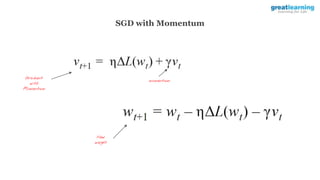
SGD with Momentum
Gradient
with
Momentum
New
weight
momentum
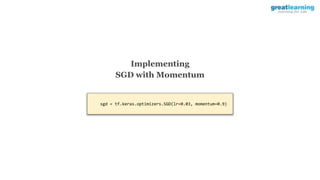
sgd = tf.keras.optimizers.SGD(lr=0.03, momentum=0.9)
Implementing
SGD with Momentum
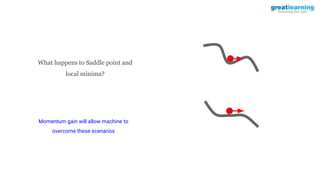
What happens to Saddle point and
local minima?
Momentum gain will allow machine to
overcome these scenarios
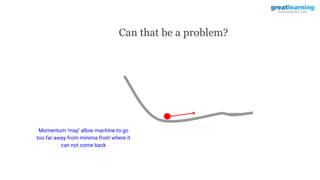
Can that be a problem?
Momentum ‘may’ allow machine to go
too far away from minima from where it
can not come back
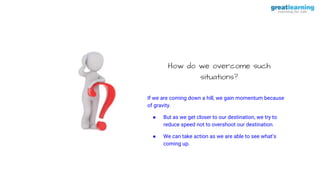
How do we overcome such
situations?
If we are coming down a hill, we gain momentum because
of gravity.
● But as we get closer to our destination, we try to
reduce speed not to overshoot our destination.
● We can take action as we are able to see what’s
coming up.
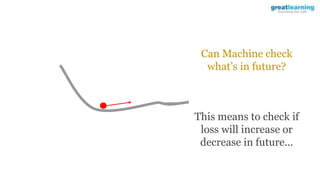
Can Machine check
what’s in future?
This means to check if
loss will increase or
decrease in future...
How do Check change in loss in
future?
By calculating Loss gradient w.r.t to future
weight
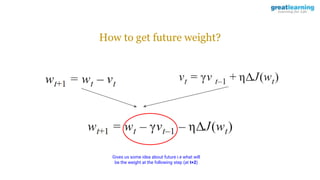
How to get future weight?
Gives us some idea about future i.e what will
be the weight at the following step (at t+2)
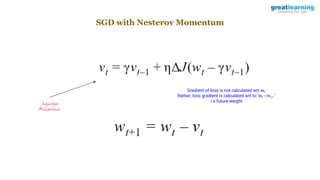
SGD with Nesterov Momentum
Adjusted
Momentum
Gradient of loss is not calculated wrt wt.
Rather, loss gradient is calculated wrt to ‘wt - ४vt-1 ’
i.e future weight
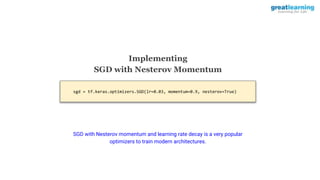
sgd = tf.keras.optimizers.SGD(lr=0.03, momentum=0.9, nesterov=True)
Implementing
SGD with Nesterov Momentum
SGD with Nesterov momentum and learning rate decay is a very popular
optimizers to train modern architectures.
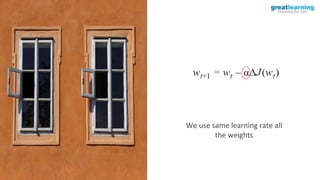
We use same learning rate all
the weights
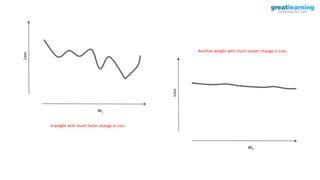
W1
Loss
W2
Loss
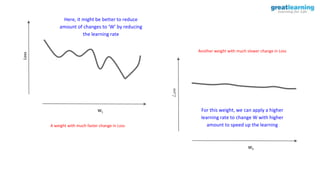
A weight with much faster change in Loss
Another weight with much slower change in Loss
W1
Loss
W2
Loss
A weight with much faster change in Loss
Another weight with much slower change in Loss
For this weight, we can apply a higher
learning rate to change W with higher
amount to speed up the learning
Here, it might be better to reduce
amount of changes to ‘W’ by reducing
the learning rate
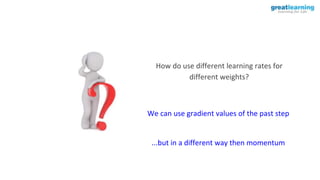
How do use different learning rates for
different weights?
We can use gradient values of the past step
...but in a different way then momentum
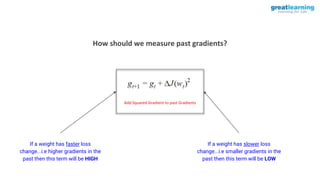
How should we measure past gradients?
Add Squared Gradient to past Gradients
If a weight has faster loss
change...i.e higher gradients in the
past then this term will be HIGH
If a weight has slower loss
change...i.e smaller gradients in the
past then this term will be LOW
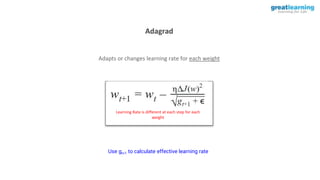
Adagrad
Adapts or changes learning rate for each weight
Learning Rate is different at each step for each
weight
Use gt+1 to calculate effective learning rate
model.compile(optimizer=’adagrad’, loss=. . ., metrics=[‘accuracy’])
Implementing Adagrad
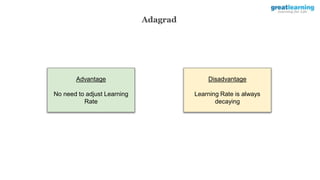
Adagrad
Advantage
No need to adjust Learning
Rate
Disadvantage
Learning Rate is always
decaying
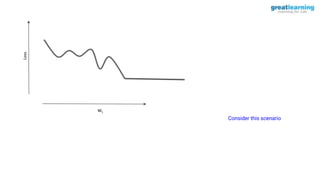
W1
Loss
Consider this scenario
How do we avoid always decaying
learning rate in Adagrad?
Do not consider gradients for all the past steps… rather
focus more on recent ones. ..
● If in the recent past gradients were high then
learning rate will be low
● If later, the gradients reduce then we can use
higher learning rate (for the same weight)
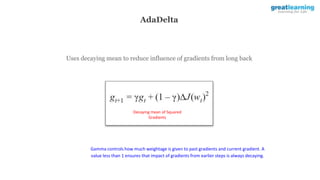
AdaDelta
Uses decaying mean to reduce influence of gradients from long back
Decaying mean of Squared
Gradients
Gamma controls how much weightage is given to past gradients and current gradient. A
value less than 1 ensures that impact of gradients from earlier steps is always decaying.
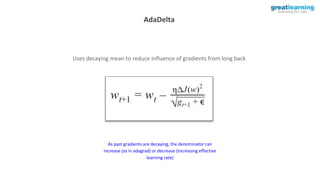
AdaDelta
Uses decaying mean to reduce influence of gradients from long back
As past gradients are decaying, the denominator can
increase (as in adagrad) or decrease (increasing effective
learning rate)
Anything else we can do?
Using approach of both momentum and
Adadelta together . . .
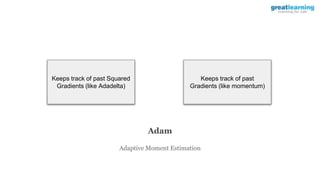
Adam
Adaptive Moment Estimation
Keeps track of past Squared
Gradients (like Adadelta)
Keeps track of past
Gradients (like momentum)
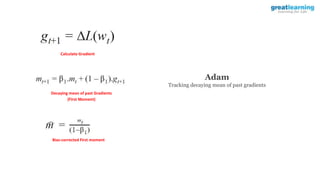
Calculate Gradient
Decaying mean of past Gradients
(First Moment)
Bias-corrected First moment
Adam
Tracking decaying mean of past gradients
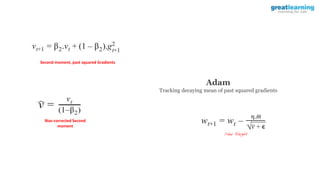
Second moment, past squared Gradients
Bias-corrected Second
moment
New Weight
Adam
Tracking decaying mean of past squared gradients
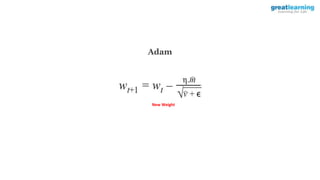
New Weight
Adam
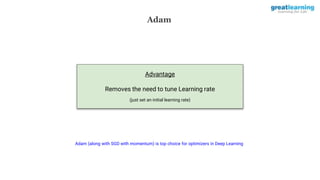
Adam
Advantage
Removes the need to tune Learning rate
(just set an initial learning rate)
Adam (along with SGD with momentum) is top choice for optimizers in Deep Learning
model.compile(optimizer=’adam’, loss=’categorical_crossentropy’, metrics=[‘accuracy’])
Implementing Adam
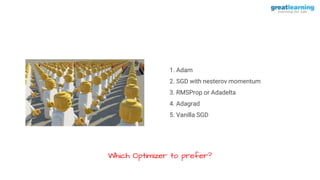
1. Adam
2. SGD with nesterov momentum
3. RMSProp or Adadelta
4. Adagrad
5. Vanilla SGD
Which Optimizer to prefer?
Hyperparameters
in
Deep Learning
# of iterations Batch Size Learning Rate
# of Hidden Layers # of Neurons in each Layer Activation functions
Learning
rate decay
Dropout Optimizers
Batch Normalization

3. Training Artificial Neural Networks.pptx

  • 1.
  • 2.
    Controls Neuron’s OutputControls Neuron’s Learning
  • 3.
    Sigmoid Function - Squashesoutput between 0 and 1 - Nice interpretation i.e neuron firing or not firing It has 3 problems.
  • 4.
    Sigmoid Function Problem 1 -Vanishing Gradient Derivative is zero when x> 5 or x <-5 - Weights will not change - No Learning
  • 5.
    Sigmoid Function Problem 2 -Output is not Zero-centered Only positive numbers to Next layer
  • 6.
    Sigmoid Function Problem 3 -ey is compute expensive
  • 7.
    tanh 1. Zero-centered 2. Vanishinggradient 3. Compute expensive hyperbolic tangent
  • 8.
    Rectified Linear Unit(ReLU) 1. Does not kill gradient (x>0) 2. Compute inexpensive 3. Converges faster 4. No Zero-centered output
  • 9.
    Leaky ReLU 1. Doesnot kill gradient 2. Compute inexpensive 3. Converges faster 4. Somewhat Zero-centered
  • 10.
  • 11.
    - Use ReLU -Try out Leaky ReLU - Try out tanh but don’t expect much - Minimize use of Sigmoid
  • 12.
  • 13.
    How do weknow machine is really learning or memorizing? By looking at test accuracy (or loss) and comparing it with training accuracy/loss.
  • 14.
    Overfitting Training Accuracy Number ofiterations Model Accuracy Test Accuracy Big Gap
  • 15.
    How do weavoid overfitting? By getting more data, we can make machine reduce overfitting. But quite often it's not easy to get additional data.
  • 16.
    Dropout ...refers to droppingor ignoring neurons at random to reduce overfitting.
  • 17.
    Dropout A regular Dense NeuralNetwork Dense neural network with ‘Dropout’
  • 18.
    How to applydropout? Dropout 50% Dropout 60% Dropout 40% 1. Usually applied to output of hidden layers. 2. Apply dropout to all or some of the hidden layers. 3. Dropout rate (% of neurons to be dropped) can be specified for each layer individually. 4. Generally dropout is used only during training i.e No neurons get dropped during prediction.
  • 19.
  • 20.
  • 21.
    How do wenormalize data? There are two approaches which are common in Machine Learning
  • 22.
    1. Min-Max Scaler Featurevalue is between 0 and 1 after normalization
  • 23.
    2. z-Score Normalization Meanis 0 and Variance is 1 after normalization
  • 24.
    When do wenormalize data in ML? We usually normalize the data and then feed it to the model for training.

  • 25.
    Deep Learning modelshave multiple trainable layers Normalizing data before model training allows 1st hidden layer to get normalized inputs, but ... Other trainable layers may not get normalized input How do we allow different trainable layers in Deep Learning model to get normalized data?
  • 26.
    Batch Normalization Implementing datanormalization for deeper trainable layers
  • 27.
    We can use BatchNormalizationlayer to normalize data before any trainable layer model.add(tf.keras.layers.BatchNormalization()) model.add(tf.keras.layers.Dense(200)) model.add(tf.keras.layers.BatchNormalization()) model.add(tf.keras.layers.Dense(100)) model.add(tf.keras.layers.BatchNormalization()
  • 28.
    What type ofnormalization will BatchNorm layer do? z-Score Normalization
  • 29.
    Ops in BatchNormalization 1. Calculate mean or average for each feature in a batch 2. Calculate Variance for each feature in the batch 3. Normalize each feature using mean and standard deviation 4. Adjust average and variance for a feature across batches For each feature, BatchNorm layer will calculate two parameters i.e mean and variance
  • 30.
    So BatchNorm layerworks exactly like a z-Score normalization? Well, not exactly! It also allows machine to further modify the normalized feature value using two learnable parameters.
  • 31.
    5. Scale andShift Ops in Batch Normalization Learned by machine Final normalized value For each feature, BatchNorm layer will have two trainable parameters.
  • 32.
    Where to useBatchNorm? 1. Apply it before a trainable layer. 2. Apply it to all or some of the trainable layers. 3. Significant impact on reducing overfitting. 4. Can be used with or inplace of Dropout Use BatchNorm as much as possible to improve your Deep neural networks.
  • 33.
  • 34.
    What is agood learning rate?
  • 35.
    Very high rate Lowrate High rate Good rate Number of iterations Loss Visualizing Learning Rate
  • 36.
  • 37.
    We usually reducelearning rate as model training progresses to reduce chances of missing minima.
  • 38.
    Time based learningrate decay sgd_optimizer = tf.keras.optimizers.SGD(lr=0.1, decay=0.001) model.compile(optimizer=sgd_optimiser, loss='mse’)
  • 39.
  • 40.
    Stochastic Gradient Descent(SGD) Key to improving machine’s learning Learning Rate
  • 41.
  • 42.
    Loss function is usuallyquite complex W Loss Let’s review on how Gradient Descent will change ‘W’ for this scenario
  • 43.
    Loss function is usuallyquite complex W Loss Let’s review on how Gradient Descent will change ‘W’ for this scenario Starting position Gradient Descent will increase W to reduce loss . . . reduce ‘w’ again . . . reduce ‘w’ again What happens at this point?
  • 44.
    Loss function is usuallyquite complex W Loss Let’s review on how Gradient Descent will change ‘W’ for this scenario Starting position Gradient Descent will increase W to reduce loss . . . reduce ‘w’ again . . . reduce ‘w’ again What happens at this point? ‘W’ does not increase as Gradient is positive
  • 45.
    W Loss Starting position Gradient Descentwill increase W to reduce loss . . . reduce ‘w’ again . . . reduce ‘w’ again What happens at this point? ‘W’ does not increase as Gradient is positive Problem with SGD - SGD will get stuck - Can not find better local minima - Such scenarios quite common DNNs
  • 46.
    W Loss What happens atthis point? - Zero gradient - SGD gets stuck Another scenario Saddle point
  • 47.
    How do weovercome local minima & saddle points? Bringing Physics to ML
  • 48.
    Momentum Using physics inML When a ball rolls down the hill … ● it gains in momentum due to gravity. ● ball moves faster and faster . ● Can overcome small hurdles We can use similar approach in ML to change weights and bias.
  • 49.
    How do weuse momentum with weight changes?
  • 50.
    W Loss Starting position GD will increaseW to reduce loss Amount of change in W for step 1 Step 1 Let’s take an example
  • 51.
    W Loss Starting position Change in Wwithout momentum Amount of change in W for step 2 with momentum Step 2 A percent (say 90%) of change from step 1 Change in W with momentum
  • 52.
    W Loss Starting position Amount ofchange in W for step 3 with momentum Step 3 A percent (say 90%) of change from step 2 Change in W with momentum
  • 53.
    W Loss Starting position Amount ofchange in W for step 4 with momentum Step 4 Although gradient is ‘+’ at step 4 but gradient from previous step will allow machine to increase ‘W’ Change in W with momentum
  • 54.
    Momentum Time step 1 Timestep 2 Time step 3 Time step 4 Gradients from all the past steps (in addition to current step) are used to calculate final gradient at a step.
  • 55.
  • 56.
    sgd = tf.keras.optimizers.SGD(lr=0.03,momentum=0.9) Implementing SGD with Momentum
  • 57.
    What happens toSaddle point and local minima? Momentum gain will allow machine to overcome these scenarios
  • 58.
    Can that bea problem? Momentum ‘may’ allow machine to go too far away from minima from where it can not come back
  • 59.
    How do weovercome such situations? If we are coming down a hill, we gain momentum because of gravity. ● But as we get closer to our destination, we try to reduce speed not to overshoot our destination. ● We can take action as we are able to see what’s coming up.
  • 60.
    Can Machine check what’sin future? This means to check if loss will increase or decrease in future...
  • 61.
    How do Checkchange in loss in future? By calculating Loss gradient w.r.t to future weight
  • 62.
    How to getfuture weight? Gives us some idea about future i.e what will be the weight at the following step (at t+2)
  • 63.
    SGD with NesterovMomentum Adjusted Momentum Gradient of loss is not calculated wrt wt. Rather, loss gradient is calculated wrt to ‘wt - ४vt-1 ’ i.e future weight
  • 64.
    sgd = tf.keras.optimizers.SGD(lr=0.03,momentum=0.9, nesterov=True) Implementing SGD with Nesterov Momentum SGD with Nesterov momentum and learning rate decay is a very popular optimizers to train modern architectures.
  • 65.
    We use samelearning rate all the weights
  • 66.
    W1 Loss W2 Loss A weight withmuch faster change in Loss Another weight with much slower change in Loss
  • 67.
    W1 Loss W2 Loss A weight withmuch faster change in Loss Another weight with much slower change in Loss For this weight, we can apply a higher learning rate to change W with higher amount to speed up the learning Here, it might be better to reduce amount of changes to ‘W’ by reducing the learning rate
  • 68.
    How do usedifferent learning rates for different weights? We can use gradient values of the past step ...but in a different way then momentum
  • 69.
    How should wemeasure past gradients? Add Squared Gradient to past Gradients If a weight has faster loss change...i.e higher gradients in the past then this term will be HIGH If a weight has slower loss change...i.e smaller gradients in the past then this term will be LOW
  • 70.
    Adagrad Adapts or changeslearning rate for each weight Learning Rate is different at each step for each weight Use gt+1 to calculate effective learning rate
  • 71.
    model.compile(optimizer=’adagrad’, loss=. .., metrics=[‘accuracy’]) Implementing Adagrad
  • 72.
    Adagrad Advantage No need toadjust Learning Rate Disadvantage Learning Rate is always decaying
  • 73.
  • 74.
    How do weavoid always decaying learning rate in Adagrad? Do not consider gradients for all the past steps… rather focus more on recent ones. .. ● If in the recent past gradients were high then learning rate will be low ● If later, the gradients reduce then we can use higher learning rate (for the same weight)
  • 75.
    AdaDelta Uses decaying meanto reduce influence of gradients from long back Decaying mean of Squared Gradients Gamma controls how much weightage is given to past gradients and current gradient. A value less than 1 ensures that impact of gradients from earlier steps is always decaying.
  • 76.
    AdaDelta Uses decaying meanto reduce influence of gradients from long back As past gradients are decaying, the denominator can increase (as in adagrad) or decrease (increasing effective learning rate)
  • 77.
    Anything else wecan do? Using approach of both momentum and Adadelta together . . .
  • 78.
    Adam Adaptive Moment Estimation Keepstrack of past Squared Gradients (like Adadelta) Keeps track of past Gradients (like momentum)
  • 79.
    Calculate Gradient Decaying meanof past Gradients (First Moment) Bias-corrected First moment Adam Tracking decaying mean of past gradients
  • 80.
    Second moment, pastsquared Gradients Bias-corrected Second moment New Weight Adam Tracking decaying mean of past squared gradients
  • 81.
  • 82.
    Adam Advantage Removes the needto tune Learning rate (just set an initial learning rate) Adam (along with SGD with momentum) is top choice for optimizers in Deep Learning
  • 83.
  • 84.
    1. Adam 2. SGDwith nesterov momentum 3. RMSProp or Adadelta 4. Adagrad 5. Vanilla SGD Which Optimizer to prefer?
  • 85.
  • 86.
    # of iterationsBatch Size Learning Rate # of Hidden Layers # of Neurons in each Layer Activation functions Learning rate decay Dropout Optimizers Batch Normalization