Campus Safety for 2011:
Moving Beyond the Clery Act
.
Robert C. Chandler, Ph.D.
Director, Nicholson School of Communication
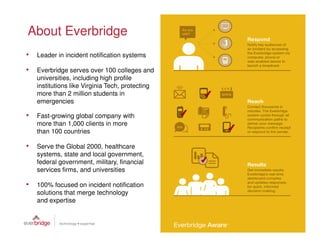
About Everbridge
•   Leader in incident notification systems

•   Everbridge serves over 100 colleges and
    universities, including high profile
    institutions like Virginia Tech, protecting
    more than 2 million students in
    emergencies

•   Fast-growing global company with
    more than 1,000 clients in more
    than 100 countries

•   Serve the Global 2000, healthcare
    systems, state and local government,
    federal government, military, financial
    services firms, and universities

•   100% focused on incident notification
    solutions that merge technology
    and expertise


                                                  2
Agenda

Part 1: Presentation
• Campus Safety Snapshot
• Developing Clery Act compliant protocols
• Timeliness and response
• Addressing annual testing requirements


Part 2: Q&A


                                             3
Campus Safety for 2011:
Bracing for the 2010the Clery Act
      Moving Beyond
Hurricane Season
        Dr. Robert Chandler
        University of Central Florida
Campus Safety Snapshot

• Students, Staff & faculty rely on safe & engaging learning environments

• 1 in 8 U.S. students will be effected by some sort of campus crime

• Parents claim ‘Campus Safety’ is a major concern for selecting a higher
education institution for their child

• Faculty feels less than knowledgeable about campus safety procedures
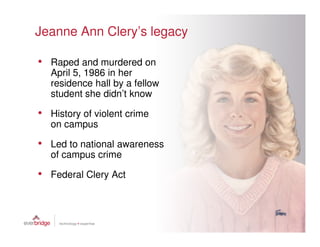
Jeanne Ann Clery’s legacy

• Raped and murdered on
   April 5, 1986 in her
   residence hall by a fellow
   student she didn’t know

• History of violent crime
   on campus

• Led to national awareness
   of campus crime

• Federal Clery Act
The Clery Act
• The Clery Act requires all colleges and universities that
  participate in federal financial aid programs to keep and
  disclose information about crime on and near their
  respective campuses.

• The US Department of Education can impose up to
  $27,500 per violation, against institutions for each
  infraction and can suspend institutions from participating
  in federal funding programs.
Insights for the Campus Safety Team
• Maintaining a daily crime log that is timely and easily
  accessible for public viewing
• An annual statistics report including three calendar years
  of crimes, liquor law violations and illegal weapons
  violations
• Expanded reporting of hate crimes including larceny,
  theft, assault, intimidation and vandalism
• Timely reports and emergency notifications
Insights to serve your students, staff &
faculty
• Procedures that encourage pastoral and professional
  mental health counselors to refer persons they are
  counseling to report crimes on a voluntary, confidential
  basis for inclusion in the annual crime statistics
• Policies regarding campus sexual assault programs to
  prevent sex offenses and procedures to follow when a
  sex offense occurs
Is your organization in compliance?

• Clear protocol and procedure for various levels of
  campus crime & incidents
• Official channel/s for communicating
• Emergency ‘Playbook’ available for responders
• Crime log availability to public
• Details of incidents- nature, date, time and general
  location of each crime
How to prepare

 •   Scenarios & drills of small-to-mid scale incidents
 •   Plan out annual testing schedules
 •   Review all reporting tools and procedures
 •   Collaborate with campus stakeholders
 •   Campus awareness & opt-in campaigns
A focus on communication

•   Emergency notification- a key component
•   The right message, the right modality
•   Support the lifecycle of an incident
•   Different messages for different segments
•   Reporting tools that provide insight & confirmations
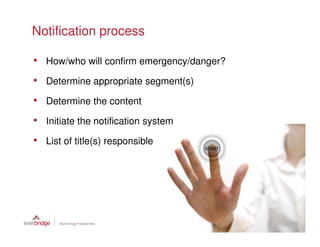
Notification process

• How/who will confirm emergency/danger?
• Determine appropriate segment(s)
• Determine the content
• Initiate the notification system
• List of title(s) responsible
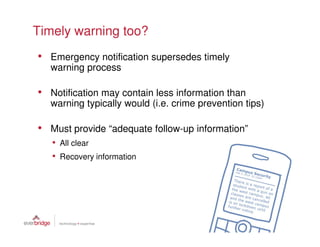
Timely warning too?
• Emergency notification supersedes timely
  warning process

• Notification may contain less information than
  warning typically would (i.e. crime prevention tips)

• Must provide “adequate follow-up information”
   • All clear
   • Recovery information
Without delay

• Must state in policy
• Notification will be issued “without delay”
• Upon confirmation of emergency
• “Taking into account the safety
   of the community”
Exceptions

• Compromise efforts
   •   To assist a victim
   •   Contain
   •   Respond to
   •   Otherwise mitigate


• Professional judgment of responsible authorities
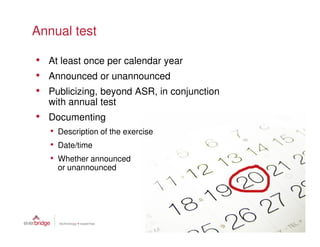
Annual test

• At least once per calendar year
• Announced or unannounced
• Publicizing, beyond ASR, in conjunction
  with annual test
• Documenting
   • Description of the exercise
   • Date/time
   • Whether announced
     or unannounced
What is a test?

• Regularly scheduled drills, exercises, and appropriate
  follow-through activities, designed for assessment and
  evaluation of emergency plans and capabilities.
Tips on moving forward

• Full campus awareness of policy & procedure
• New staff & faculty are trained and aware
• Students understand the importance of accurate contact
  information
• Learn from drills & tests
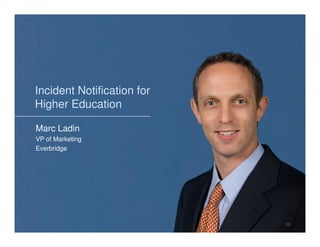
Incident Notification for
Higher Education

Marc Ladin
VP of Marketing
Everbridge


                            20
Incident notification solutions address common
higher education communication challenges
• Communicate quickly, easily, and      • Free key personnel to perform
 efficiently with large numbers of       critical tasks or staff incident
 people in minutes, not hours, making    response teams by automating
 sure that campus safety issues are      manual, time-intensive,
 communicated quickly                    error-prone processes

• Use all contact paths to reach        • Satisfy regulatory requirements
 everyone, using the most popular        for the Clery Act and U.S.
 methods, no matter where they may       Department of Education’s Higher
 be, on or off-campus                    Education Opportunity Act of 2008
                                         (HEOA) with extensive and complete
• Ensure two-way communications          reporting of delivery attempts and
 to know who may need immediate          two-way acknowledgements from
 assistance                              recipients


                                                                            21
The Everbridge difference

       technology + expertise = empowerment
       technology + expertise = confidence

       technology + expertise = solution
       technology + expertise = your success

Everbridge, the world’s recognized leader in incident notification
systems, merges technology with industry expertise to help
millions of people communicate in a crisis, manage operational
incidents, and connect on a daily basis.


                                                                     22
Key evaluation criteria for an incident
notification system

• Experience and expertise
• Ease of use
• Ability to reach all contact paths,
  including voice, email, native SMS
  (over SMPP and SMTP), IM, and more

• Ease of integration


                                          23
Missed anything?

Never fear, the recording and slides from
today’s webinar are just a click away.

blog.everbridge.com


                                 Reminder
                                 Everbridge Insights webinars
                                 qualify for Continuing Education
                                 Activity Points (CEAPs) for DRI
                                 certifications. Visit www.drii.org
                                 to register your credit.
                                 Item Number (Schedule II): 26.1
                                 Activity Group: A
                                 1 Point for each webinar


                                                                      24
Communication
Contact information         resources

                            Everbridge Aware for Higher
                            Education
                            everbridge.com/education
Dr. Robert Chandler
                            White papers, case studies,
Robert.chandler@ucf.edu     literature
                            everbridge.com/resources

Marc Ladin                  Upcoming webinars
                            everbridge.com/webinars
marc.ladin@everbridge.com


                            blog.everbridge.com
                            twitter.com/everbridge
                            facebook.com/everbridgeinc


                                                  25

Everbridge Webinar - Campus Safety 2011

  • 1.
    Campus Safety for2011: Moving Beyond the Clery Act . Robert C. Chandler, Ph.D. Director, Nicholson School of Communication
  • 2.
    About Everbridge • Leader in incident notification systems • Everbridge serves over 100 colleges and universities, including high profile institutions like Virginia Tech, protecting more than 2 million students in emergencies • Fast-growing global company with more than 1,000 clients in more than 100 countries • Serve the Global 2000, healthcare systems, state and local government, federal government, military, financial services firms, and universities • 100% focused on incident notification solutions that merge technology and expertise 2
  • 3.
    Agenda Part 1: Presentation •Campus Safety Snapshot • Developing Clery Act compliant protocols • Timeliness and response • Addressing annual testing requirements Part 2: Q&A 3
  • 4.
    Campus Safety for2011: Bracing for the 2010the Clery Act Moving Beyond Hurricane Season Dr. Robert Chandler University of Central Florida
  • 5.
    Campus Safety Snapshot •Students, Staff & faculty rely on safe & engaging learning environments • 1 in 8 U.S. students will be effected by some sort of campus crime • Parents claim ‘Campus Safety’ is a major concern for selecting a higher education institution for their child • Faculty feels less than knowledgeable about campus safety procedures
  • 6.
    Jeanne Ann Clery’slegacy • Raped and murdered on April 5, 1986 in her residence hall by a fellow student she didn’t know • History of violent crime on campus • Led to national awareness of campus crime • Federal Clery Act
  • 7.
    The Clery Act •The Clery Act requires all colleges and universities that participate in federal financial aid programs to keep and disclose information about crime on and near their respective campuses. • The US Department of Education can impose up to $27,500 per violation, against institutions for each infraction and can suspend institutions from participating in federal funding programs.
  • 8.
    Insights for theCampus Safety Team • Maintaining a daily crime log that is timely and easily accessible for public viewing • An annual statistics report including three calendar years of crimes, liquor law violations and illegal weapons violations • Expanded reporting of hate crimes including larceny, theft, assault, intimidation and vandalism • Timely reports and emergency notifications
  • 9.
    Insights to serveyour students, staff & faculty • Procedures that encourage pastoral and professional mental health counselors to refer persons they are counseling to report crimes on a voluntary, confidential basis for inclusion in the annual crime statistics • Policies regarding campus sexual assault programs to prevent sex offenses and procedures to follow when a sex offense occurs
  • 10.
    Is your organizationin compliance? • Clear protocol and procedure for various levels of campus crime & incidents • Official channel/s for communicating • Emergency ‘Playbook’ available for responders • Crime log availability to public • Details of incidents- nature, date, time and general location of each crime
  • 11.
    How to prepare • Scenarios & drills of small-to-mid scale incidents • Plan out annual testing schedules • Review all reporting tools and procedures • Collaborate with campus stakeholders • Campus awareness & opt-in campaigns
  • 12.
    A focus oncommunication • Emergency notification- a key component • The right message, the right modality • Support the lifecycle of an incident • Different messages for different segments • Reporting tools that provide insight & confirmations
  • 13.
    Notification process • How/whowill confirm emergency/danger? • Determine appropriate segment(s) • Determine the content • Initiate the notification system • List of title(s) responsible
  • 14.
    Timely warning too? •Emergency notification supersedes timely warning process • Notification may contain less information than warning typically would (i.e. crime prevention tips) • Must provide “adequate follow-up information” • All clear • Recovery information
  • 15.
    Without delay • Muststate in policy • Notification will be issued “without delay” • Upon confirmation of emergency • “Taking into account the safety of the community”
  • 16.
    Exceptions • Compromise efforts • To assist a victim • Contain • Respond to • Otherwise mitigate • Professional judgment of responsible authorities
  • 17.
    Annual test • Atleast once per calendar year • Announced or unannounced • Publicizing, beyond ASR, in conjunction with annual test • Documenting • Description of the exercise • Date/time • Whether announced or unannounced
  • 18.
    What is atest? • Regularly scheduled drills, exercises, and appropriate follow-through activities, designed for assessment and evaluation of emergency plans and capabilities.
  • 19.
    Tips on movingforward • Full campus awareness of policy & procedure • New staff & faculty are trained and aware • Students understand the importance of accurate contact information • Learn from drills & tests
  • 20.
    Incident Notification for HigherEducation Marc Ladin VP of Marketing Everbridge 20
  • 21.
    Incident notification solutionsaddress common higher education communication challenges • Communicate quickly, easily, and • Free key personnel to perform efficiently with large numbers of critical tasks or staff incident people in minutes, not hours, making response teams by automating sure that campus safety issues are manual, time-intensive, communicated quickly error-prone processes • Use all contact paths to reach • Satisfy regulatory requirements everyone, using the most popular for the Clery Act and U.S. methods, no matter where they may Department of Education’s Higher be, on or off-campus Education Opportunity Act of 2008 (HEOA) with extensive and complete • Ensure two-way communications reporting of delivery attempts and to know who may need immediate two-way acknowledgements from assistance recipients 21
  • 22.
    The Everbridge difference technology + expertise = empowerment technology + expertise = confidence technology + expertise = solution technology + expertise = your success Everbridge, the world’s recognized leader in incident notification systems, merges technology with industry expertise to help millions of people communicate in a crisis, manage operational incidents, and connect on a daily basis. 22
  • 23.
    Key evaluation criteriafor an incident notification system • Experience and expertise • Ease of use • Ability to reach all contact paths, including voice, email, native SMS (over SMPP and SMTP), IM, and more • Ease of integration 23
  • 24.
    Missed anything? Never fear,the recording and slides from today’s webinar are just a click away. blog.everbridge.com Reminder Everbridge Insights webinars qualify for Continuing Education Activity Points (CEAPs) for DRI certifications. Visit www.drii.org to register your credit. Item Number (Schedule II): 26.1 Activity Group: A 1 Point for each webinar 24
  • 25.
    Communication Contact information resources Everbridge Aware for Higher Education everbridge.com/education Dr. Robert Chandler White papers, case studies, Robert.chandler@ucf.edu literature everbridge.com/resources Marc Ladin Upcoming webinars everbridge.com/webinars marc.ladin@everbridge.com blog.everbridge.com twitter.com/everbridge facebook.com/everbridgeinc 25