ELECTRIC VEHICLE
PowerPoint Presentation Template
Introduction
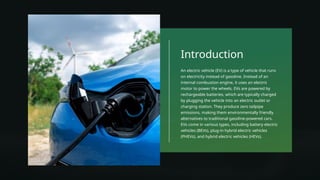
An electric vehicle (EV) is a type of vehicle that runs
on electricity instead of gasoline. Instead of an
internal combustion engine, it uses an electric
motor to power the wheels. EVs are powered by
rechargeable batteries, which are typically charged
by plugging the vehicle into an electric outlet or
charging station. They produce zero tailpipe
emissions, making them environmentally friendly
alternatives to traditional gasoline-powered cars.
EVs come in various types, including battery electric
vehicles (BEVs), plug-in hybrid electric vehicles
(PHEVs), and hybrid electric vehicles (HEVs).
History Of Electric Vehicle
Competition with gasoline cars: Electric vehicles faced competition from gasoline-powered cars, which offered longer
range and quicker refuelling times. The mass production of gasoline cars by companies further marginalized electric
vehicles
Early experiments: The concept of electric vehicles date back to the 19th century, with inventors like Thomas Davenport
and Robert Anderson creating some of the earliest electric-powered vehicles in the 1830s and 1840s.
Rise of electric cars: Electric vehicles gained popularity in the late 19th and early 20th centuries due to their simplicity
and quiet operation. They were especially favoured for urban use and by affluent individuals.
Current landscape: Today, electric vehicles are experiencing a surge in popularity, with numerous automakers offering
electric models and significant investments being made in charging infrastructure and battery technology.
Revival in the late 20th century: Concerns over air pollution and oil dependency sparked renewed interest in electric
vehicles in the late 20th century. Companies like General Motors introduced modern electric vehicles, such as the EV1, in
the 1990s.
Advancements in battery technology: The development of more efficient batteries, particularly lithium-ion batteries,
helped improve the performance and range of electric vehicles, making them more practical for everyday use.
Government incentives: Governments around the world introduced incentives and regulations to promote electric
vehicles, such as tax credits, subsidies, and emissions standards, further driving their adoption.
Benefits Of Electric Vehicles
Environmental Friendliness
They produce zero emissions, reducing
air pollution and combating climate
change.
It have lower operating costs due to
cheaper electricity and reduced
maintenance needs.
Cost Savings
Electric motors are more efficient than
internal combustion engines, converting
more energy into propulsion.
Energy Efficiency
Quiet And Smooth Operation
They provide a quieter and smoother
driving experience compared to
traditional cars.
Government Incentives
Governments offer incentives and tax
credits to encourage electric vehicle
adoption, making them more affordable
for consumers.
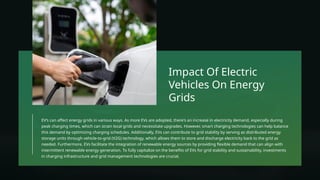
EV’s can affect energy grids in various ways. As more EVs are adopted, there's an increase in electricity demand, especially during
peak charging times, which can strain local grids and necessitate upgrades. However, smart charging technologies can help balance
this demand by optimizing charging schedules. Additionally, EVs can contribute to grid stability by serving as distributed energy
storage units through vehicle-to-grid (V2G) technology, which allows them to store and discharge electricity back to the grid as
needed. Furthermore, EVs facilitate the integration of renewable energy sources by providing flexible demand that can align with
intermittent renewable energy generation. To fully capitalize on the benefits of EVs for grid stability and sustainability, investments
in charging infrastructure and grid management technologies are crucial.
Impact Of Electric
Vehicles On Energy
Grids
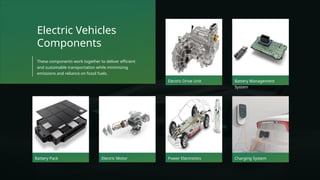
Electric Vehicles
Components
Battery Pack Electric Motor Power Electronics Charging System
Electric Drive Unit Battery Management
System
These components work together to deliver efficient
and sustainable transportation while minimizing
emissions and reliance on fossil fuels.
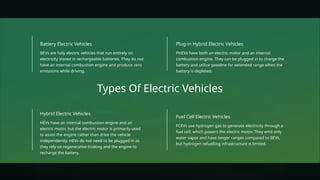
Types Of Electric Vehicles
Battery Electric Vehicles
BEVs are fully electric vehicles that run entirely on
electricity stored in rechargeable batteries. They do not
have an internal combustion engine and produce zero
emissions while driving.
Plug-in Hybrid Electric Vehicles
PHEVs have both an electric motor and an internal
combustion engine. They can be plugged in to charge the
battery and utilize gasoline for extended range when the
battery is depleted.
HEVs have an internal combustion engine and an
electric motor, but the electric motor is primarily used
to assist the engine rather than drive the vehicle
independently. HEVs do not need to be plugged in as
they rely on regenerative braking and the engine to
recharge the battery.
Hybrid Electric Vehicles
FCEVs use hydrogen gas to generate electricity through a
fuel cell, which powers the electric motor. They emit only
water vapor and have longer ranges compared to BEVs,
but hydrogen refuelling infrastructure is limited.
Fuel Cell Electric Vehicles
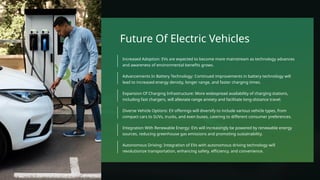
Future Of Electric Vehicles
Autonomous Driving: Integration of EVs with autonomous driving technology will
revolutionize transportation, enhancing safety, efficiency, and convenience.
Integration With Renewable Energy: EVs will increasingly be powered by renewable energy
sources, reducing greenhouse gas emissions and promoting sustainability.
Diverse Vehicle Options: EV offerings will diversify to include various vehicle types, from
compact cars to SUVs, trucks, and even buses, catering to different consumer preferences.
Expansion Of Charging Infrastructure: More widespread availability of charging stations,
including fast chargers, will alleviate range anxiety and facilitate long-distance travel.
Advancements In Battery Technology: Continued improvements in battery technology will
lead to increased energy density, longer range, and faster charging times.
Increased Adoption: EVs are expected to become more mainstream as technology advances
and awareness of environmental benefits grows.
Government Policies And
Incentives For Electric
Vehicles
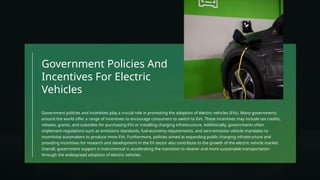
Government policies and incentives play a crucial role in promoting the adoption of electric vehicles (EVs). Many governments
around the world offer a range of incentives to encourage consumers to switch to EVs. These incentives may include tax credits,
rebates, grants, and subsidies for purchasing EVs or installing charging infrastructure. Additionally, governments often
implement regulations such as emissions standards, fuel economy requirements, and zero-emission vehicle mandates to
incentivize automakers to produce more EVs. Furthermore, policies aimed at expanding public charging infrastructure and
providing incentives for research and development in the EV sector also contribute to the growth of the electric vehicle market.
Overall, government support is instrumental in accelerating the transition to cleaner and more sustainable transportation
through the widespread adoption of electric vehicles.
Challenges Facing
Electric Vehicles
Adoption
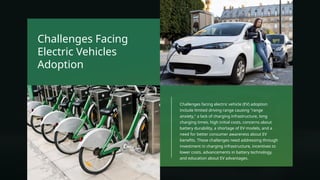
Challenges facing electric vehicle (EV) adoption
include limited driving range causing "range
anxiety," a lack of charging infrastructure, long
charging times, high initial costs, concerns about
battery durability, a shortage of EV models, and a
need for better consumer awareness about EV
benefits. These challenges need addressing through
investment in charging infrastructure, incentives to
lower costs, advancements in battery technology,
and education about EV advantages.
Electric Vehicle
Maintenance And
Repair
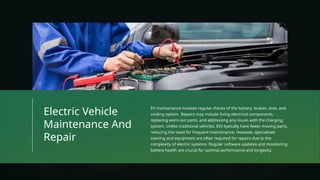
EV maintenance involves regular checks of the battery, brakes, tires, and
cooling system. Repairs may include fixing electrical components,
replacing worn-out parts, and addressing any issues with the charging
system. Unlike traditional vehicles, EVs typically have fewer moving parts,
reducing the need for frequent maintenance. However, specialized
training and equipment are often required for repairs due to the
complexity of electric systems. Regular software updates and monitoring
battery health are crucial for optimal performance and longevity.
Environmental Impact Of
Electric Vehicles
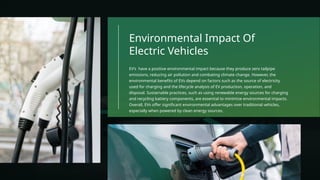
EV’s have a positive environmental impact because they produce zero tailpipe
emissions, reducing air pollution and combating climate change. However, the
environmental benefits of EVs depend on factors such as the source of electricity
used for charging and the lifecycle analysis of EV production, operation, and
disposal. Sustainable practices, such as using renewable energy sources for charging
and recycling battery components, are essential to minimize environmental impacts.
Overall, EVs offer significant environmental advantages over traditional vehicles,
especially when powered by clean energy sources.
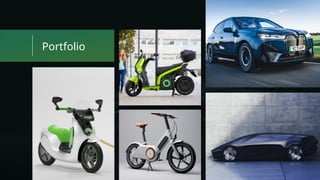
Portfolio
THANK YOU
Instructions for use
What you are allowed to do :
Modify this template
Use it for personal or commercial projects
You must credit Slidechef in order to use this template
What you are not allowed to do :
Offer Slidechef templates for download
Sublicense, sell or rent any Slidechef content
Distribute Slidechef content unless it has been authorized
Include Slidechef content in an online or offline file
Acquire the copyright of Slidechef content
Slide Chef

EV Presentation Template plantilla coche.pptx

  • 1.
  • 2.
    Introduction An electric vehicle(EV) is a type of vehicle that runs on electricity instead of gasoline. Instead of an internal combustion engine, it uses an electric motor to power the wheels. EVs are powered by rechargeable batteries, which are typically charged by plugging the vehicle into an electric outlet or charging station. They produce zero tailpipe emissions, making them environmentally friendly alternatives to traditional gasoline-powered cars. EVs come in various types, including battery electric vehicles (BEVs), plug-in hybrid electric vehicles (PHEVs), and hybrid electric vehicles (HEVs).
  • 3.
    History Of ElectricVehicle Competition with gasoline cars: Electric vehicles faced competition from gasoline-powered cars, which offered longer range and quicker refuelling times. The mass production of gasoline cars by companies further marginalized electric vehicles Early experiments: The concept of electric vehicles date back to the 19th century, with inventors like Thomas Davenport and Robert Anderson creating some of the earliest electric-powered vehicles in the 1830s and 1840s. Rise of electric cars: Electric vehicles gained popularity in the late 19th and early 20th centuries due to their simplicity and quiet operation. They were especially favoured for urban use and by affluent individuals.
  • 4.
    Current landscape: Today,electric vehicles are experiencing a surge in popularity, with numerous automakers offering electric models and significant investments being made in charging infrastructure and battery technology. Revival in the late 20th century: Concerns over air pollution and oil dependency sparked renewed interest in electric vehicles in the late 20th century. Companies like General Motors introduced modern electric vehicles, such as the EV1, in the 1990s. Advancements in battery technology: The development of more efficient batteries, particularly lithium-ion batteries, helped improve the performance and range of electric vehicles, making them more practical for everyday use. Government incentives: Governments around the world introduced incentives and regulations to promote electric vehicles, such as tax credits, subsidies, and emissions standards, further driving their adoption.
  • 5.
    Benefits Of ElectricVehicles Environmental Friendliness They produce zero emissions, reducing air pollution and combating climate change. It have lower operating costs due to cheaper electricity and reduced maintenance needs. Cost Savings Electric motors are more efficient than internal combustion engines, converting more energy into propulsion. Energy Efficiency Quiet And Smooth Operation They provide a quieter and smoother driving experience compared to traditional cars. Government Incentives Governments offer incentives and tax credits to encourage electric vehicle adoption, making them more affordable for consumers.
  • 6.
    EV’s can affectenergy grids in various ways. As more EVs are adopted, there's an increase in electricity demand, especially during peak charging times, which can strain local grids and necessitate upgrades. However, smart charging technologies can help balance this demand by optimizing charging schedules. Additionally, EVs can contribute to grid stability by serving as distributed energy storage units through vehicle-to-grid (V2G) technology, which allows them to store and discharge electricity back to the grid as needed. Furthermore, EVs facilitate the integration of renewable energy sources by providing flexible demand that can align with intermittent renewable energy generation. To fully capitalize on the benefits of EVs for grid stability and sustainability, investments in charging infrastructure and grid management technologies are crucial. Impact Of Electric Vehicles On Energy Grids
  • 7.
    Electric Vehicles Components Battery PackElectric Motor Power Electronics Charging System Electric Drive Unit Battery Management System These components work together to deliver efficient and sustainable transportation while minimizing emissions and reliance on fossil fuels.
  • 8.
    Types Of ElectricVehicles Battery Electric Vehicles BEVs are fully electric vehicles that run entirely on electricity stored in rechargeable batteries. They do not have an internal combustion engine and produce zero emissions while driving. Plug-in Hybrid Electric Vehicles PHEVs have both an electric motor and an internal combustion engine. They can be plugged in to charge the battery and utilize gasoline for extended range when the battery is depleted. HEVs have an internal combustion engine and an electric motor, but the electric motor is primarily used to assist the engine rather than drive the vehicle independently. HEVs do not need to be plugged in as they rely on regenerative braking and the engine to recharge the battery. Hybrid Electric Vehicles FCEVs use hydrogen gas to generate electricity through a fuel cell, which powers the electric motor. They emit only water vapor and have longer ranges compared to BEVs, but hydrogen refuelling infrastructure is limited. Fuel Cell Electric Vehicles
  • 9.
    Future Of ElectricVehicles Autonomous Driving: Integration of EVs with autonomous driving technology will revolutionize transportation, enhancing safety, efficiency, and convenience. Integration With Renewable Energy: EVs will increasingly be powered by renewable energy sources, reducing greenhouse gas emissions and promoting sustainability. Diverse Vehicle Options: EV offerings will diversify to include various vehicle types, from compact cars to SUVs, trucks, and even buses, catering to different consumer preferences. Expansion Of Charging Infrastructure: More widespread availability of charging stations, including fast chargers, will alleviate range anxiety and facilitate long-distance travel. Advancements In Battery Technology: Continued improvements in battery technology will lead to increased energy density, longer range, and faster charging times. Increased Adoption: EVs are expected to become more mainstream as technology advances and awareness of environmental benefits grows.
  • 10.
    Government Policies And IncentivesFor Electric Vehicles Government policies and incentives play a crucial role in promoting the adoption of electric vehicles (EVs). Many governments around the world offer a range of incentives to encourage consumers to switch to EVs. These incentives may include tax credits, rebates, grants, and subsidies for purchasing EVs or installing charging infrastructure. Additionally, governments often implement regulations such as emissions standards, fuel economy requirements, and zero-emission vehicle mandates to incentivize automakers to produce more EVs. Furthermore, policies aimed at expanding public charging infrastructure and providing incentives for research and development in the EV sector also contribute to the growth of the electric vehicle market. Overall, government support is instrumental in accelerating the transition to cleaner and more sustainable transportation through the widespread adoption of electric vehicles.
  • 11.
    Challenges Facing Electric Vehicles Adoption Challengesfacing electric vehicle (EV) adoption include limited driving range causing "range anxiety," a lack of charging infrastructure, long charging times, high initial costs, concerns about battery durability, a shortage of EV models, and a need for better consumer awareness about EV benefits. These challenges need addressing through investment in charging infrastructure, incentives to lower costs, advancements in battery technology, and education about EV advantages.
  • 12.
    Electric Vehicle Maintenance And Repair EVmaintenance involves regular checks of the battery, brakes, tires, and cooling system. Repairs may include fixing electrical components, replacing worn-out parts, and addressing any issues with the charging system. Unlike traditional vehicles, EVs typically have fewer moving parts, reducing the need for frequent maintenance. However, specialized training and equipment are often required for repairs due to the complexity of electric systems. Regular software updates and monitoring battery health are crucial for optimal performance and longevity.
  • 13.
    Environmental Impact Of ElectricVehicles EV’s have a positive environmental impact because they produce zero tailpipe emissions, reducing air pollution and combating climate change. However, the environmental benefits of EVs depend on factors such as the source of electricity used for charging and the lifecycle analysis of EV production, operation, and disposal. Sustainable practices, such as using renewable energy sources for charging and recycling battery components, are essential to minimize environmental impacts. Overall, EVs offer significant environmental advantages over traditional vehicles, especially when powered by clean energy sources.
  • 14.
  • 15.
  • 16.
    Instructions for use Whatyou are allowed to do : Modify this template Use it for personal or commercial projects You must credit Slidechef in order to use this template What you are not allowed to do : Offer Slidechef templates for download Sublicense, sell or rent any Slidechef content Distribute Slidechef content unless it has been authorized Include Slidechef content in an online or offline file Acquire the copyright of Slidechef content
  • 17.