Electric Vehicle Service Lead Technician
Sector: Automotive
Sub-Sector: Automotive Vehicle Service
Occupation: Technical Service & Repair
QP Code: ASC/Q1424
NSQF Level: 5
In 1800, Alessandro Volta invented the voltaic pile. This was the first true battery because
the combination of zinc and silver could hold a charge even when not in use. Gaston
Plante developed the first lead-acid rechargeable battery in 1859, and in 1880, Camille
Alphonse Faure improved upon Plante’s work, using lead sulfates to expand electrical
storage capacity.
Two more important battery technologies followed. First, was the nickel-cadmium battery
in 1899. The NiCad, as we call it today, was the first truly functional rechargeable battery.
It was also the first alkaline battery, swapping out lead acids for an alkaline (basic, or high
pH) electrolyte. Today’s modern lithium-ion batteries first arrived in 1912. Li-ion has the
advantage of holding more electricity while having low weight, compared to other battery
products. In 1991, SONY released the first rechargeable Li-ion battery. More advanced
versions of Li-ion batteries are the current international standard for EV and AV vehicles
as they better tolerate discharge-charge cycles.
First Small-Scale Electric Cars
1828 — 1835
Horse and buggies are the primary mode of transportation, but
innovators in Hungary, the Netherlands and the U.S. think to the
future, creating some of the first small-scale electric cars.
First Crude Electric Vehicle Is
Developed
1832
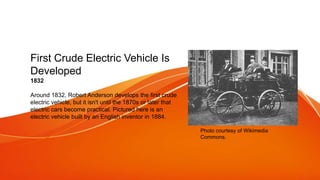
Around 1832, Robert Anderson develops the first crude
electric vehicle, but it isn't until the 1870s or later that
electric cars become practical. Pictured here is an
electric vehicle built by an English inventor in 1884.
Photo courtesy of Wikimedia
Commons.
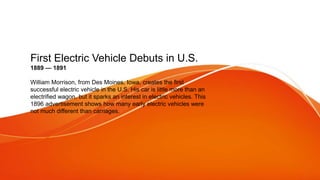
First Electric Vehicle Debuts in U.S.
1889 — 1891
William Morrison, from Des Moines, Iowa, creates the first
successful electric vehicle in the U.S. His car is little more than an
electrified wagon, but it sparks an interest in electric vehicles. This
1896 advertisement shows how many early electric vehicles were
not much different than carriages.
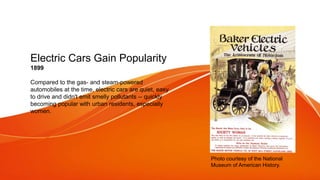
Electric Cars Gain Popularity
1899
Compared to the gas- and steam-powered
automobiles at the time, electric cars are quiet, easy
to drive and didn't emit smelly pollutants -- quickly
becoming popular with urban residents, especially
women.
Photo courtesy of the National
Museum of American History.
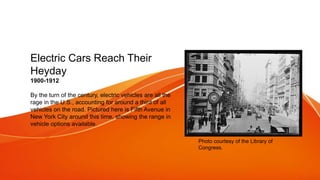
Electric Cars Reach Their
Heyday
1900-1912
By the turn of the century, electric vehicles are all the
rage in the U.S., accounting for around a third of all
vehicles on the road. Pictured here is Fifth Avenue in
New York City around this time, showing the range in
vehicle options available.
Photo courtesy of the Library of
Congress.
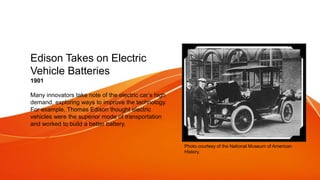
Edison Takes on Electric
Vehicle Batteries
1901
Many innovators take note of the electric car’s high
demand, exploring ways to improve the technology.
For example, Thomas Edison thought electric
vehicles were the superior mode of transportation
and worked to build a better battery.
Photo courtesy of the National Museum of American
History.
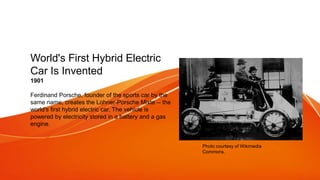
World's First Hybrid Electric
Car Is Invented
1901
Ferdinand Porsche, founder of the sports car by the
same name, creates the Lohner-Porsche Mixte -- the
world's first hybrid electric car. The vehicle is
powered by electricity stored in a battery and a gas
engine.
Photo courtesy of Wikimedia
Commons.
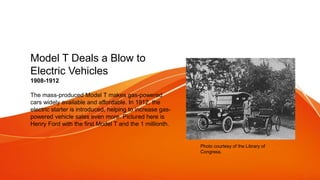
Model T Deals a Blow to
Electric Vehicles
1908-1912
The mass-produced Model T makes gas-powered
cars widely available and affordable. In 1912, the
electric starter is introduced, helping to increase gas-
powered vehicle sales even more. Pictured here is
Henry Ford with the first Model T and the 1 millionth.
Photo courtesy of the Library of
Congress.
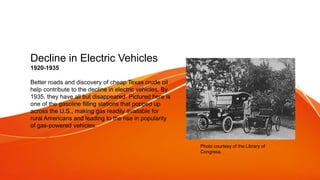
Decline in Electric Vehicles
1920-1935
Better roads and discovery of cheap Texas crude oil
help contribute to the decline in electric vehicles. By
1935, they have all but disappeared. Pictured here is
one of the gasoline filling stations that popped up
across the U.S., making gas readily available for
rural Americans and leading to the rise in popularity
of gas-powered vehicles.
Photo courtesy of the Library of
Congress.
Gas Prices Soar
1968 — 1973
Over the next 30 years or so, cheap, abundant
gasoline and continued improvement in the internal
combustion engine created little need for alternative
fuel vehicles. But in the 1960s and 1970s, gas prices
soar through the roof, creating interest in electric
vehicles again.
Photo courtesy of EPA, U.S. National
Archives.
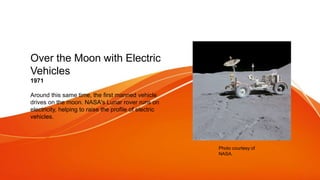
Over the Moon with Electric
Vehicles
1971
Around this same time, the first manned vehicle
drives on the moon. NASA's Lunar rover runs on
electricity, helping to raise the profile of electric
vehicles.
Photo courtesy of
NASA.
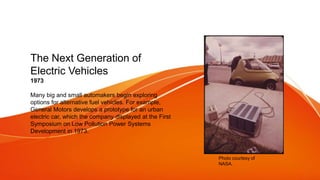
The Next Generation of
Electric Vehicles
1973
Many big and small automakers begin exploring
options for alternative fuel vehicles. For example,
General Motors develops a prototype for an urban
electric car, which the company displayed at the First
Symposium on Low Pollution Power Systems
Development in 1973.
Photo courtesy of
NASA.
A Modern EV Production Line
Introduction to Automotive
Sector
What is an Electric
Vehicle?
Electric vehicles (EVs) are a revolutionary mode of transportation that differs from traditional internal
combustion engine (ICE) vehicles in several ways:
Electric Power
EVs are propelled by electric power
rather than traditional ICE engines. They
use electricity stored in rechargeable
batteries to drive electric motors.
Zero Emissions
EVs produce no tailpipe emissions,
contributing significantly to reducing air
pollution and greenhouse gas emissions.
This aligns with efforts to promote
environmental sustainability and combat
climate change.
Charging Infrastructure
EVs require regular charging of their
onboard batteries.
Owners can use charging stations in
public locations or install home charging
units for added convenience and
flexibility.
Range Variability
The range of EVs varies based on the
model and battery capacity.
Advances in battery technology continue
to improve overall range and
performance, making EVs more practical
for longer journeys.
Types of Evs
EVs come in various forms, including All-
Electric Vehicles (AEVs) which rely solely
on electric power and have no IC engine
and Plug-in Hybrid Electric Vehicles
(PHEVs) which combines electric motors
with an IC engine.
Lower Operating Costs
EVs typically have lower operating costs
compared to conventional vehicles.
Electricity is often
gasoline, and EVs
cheaper than
require less
maintenance due to fewer moving parts,
reducing long-term ownership expenses.
History of Electric
Vehicles
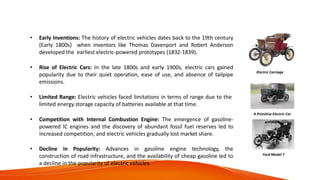
• Early Inventions: The history of electric vehicles dates back to the 19th century
(Early 1800s) when inventors like Thomas Davenport and Robert Anderson
developed the earliest electric-powered prototypes (1832-1839).
• Rise of Electric Cars: In the late 1800s and early 1900s, electric cars gained
popularity due to their quiet operation, ease of use, and absence of tailpipe
emissions.
• Limited Range: Electric vehicles faced limitations in terms of range due to the
limited energy storage capacity of batteries available at that time.
• Competition with Internal Combustion Engine: The emergence of gasoline-
powered IC engines and the discovery of abundant fossil fuel reserves led to
increased competition, and electric vehicles gradually lost market share.
• Decline in Popularity: Advances in gasoline engine technology, the
construction of road infrastructure, and the availability of cheap gasoline led to
a decline in the popularity of electric vehicles.
Electric Carriage
A Primitive Electric Car
Ford Model T
History of Electric
Vehicles
• Niche Applications: Electric vehicles initially found limited use in niche applications like forklifts, golf
carts, and small-scale urban transportation.
• Resurgence in the Late 20th Century: The late 20th century witnessed a renewed interest in electric
vehicles due to concerns about pollution and dependence on fossil fuels.
• Battery Breakthrough: Breakthroughs in battery technology, particularly
the development of lithium-ion batteries, improved the range and
energy storage capabilities of electric vehicles.
• Environmental Awareness: Growing environmental awareness further fueled
the development and commercialization of modern electric vehicles.
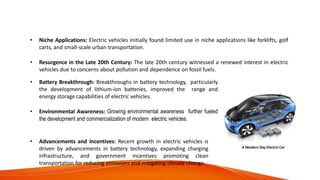
A Modern Day Electric Car
• Advancements and Incentives: Recent growth in electric vehicles is
driven by advancements in battery technology, expanding charging
infrastructure, and government incentives promoting clean
transportation for reducing emissions and mitigating climate change.
Categories of Electric
Vehicles
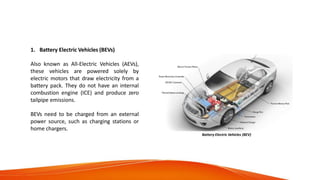
1. Battery Electric Vehicles (BEVs)
Also known as All-Electric Vehicles (AEVs),
these vehicles are powered solely by
electric motors that draw electricity from a
battery pack. They do not have an internal
combustion engine (ICE) and produce zero
tailpipe emissions.
BEVs need to be charged from an external
power source, such as charging stations or
home chargers.
Battery Electric Vehicles (BEV)
Categories of Electric
Vehicles
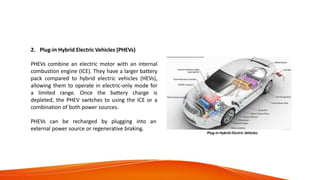
2. Plug-in Hybrid Electric Vehicles (PHEVs)
PHEVs combine an electric motor with an internal
combustion engine (ICE). They have a larger battery
pack compared to hybrid electric vehicles (HEVs),
allowing them to operate in electric-only mode for
a limited range. Once the battery charge is
depleted, the PHEV switches to using the ICE or a
combination of both power sources.
PHEVs can be recharged by plugging into an
external power source or regenerative braking.
Plug-in Hybrid Electric Vehicles
Categories of Electric
Vehicles
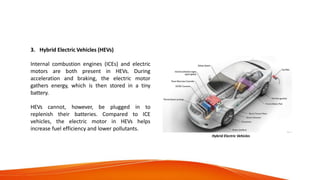
3. Hybrid Electric Vehicles (HEVs)
Internal combustion engines (ICEs) and electric
motors are both present in HEVs. During
acceleration and braking, the electric motor
gathers energy, which is then stored in a tiny
battery.
HEVs cannot, however, be plugged in to
replenish their batteries. Compared to ICE
vehicles, the electric motor in HEVs helps
increase fuel efficiency and lower pollutants.
Hybrid Electric Vehicles
Categories of Electric
Vehicles
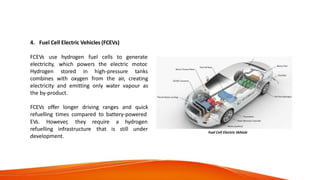
4. Fuel Cell Electric Vehicles (FCEVs)
hydrogen fuel cells to generate
which powers the electric motor
.
FCEVs use
electricity,
Hydrogen stored in high-pressure tanks
combines with oxygen from the air, creating
electricity and emitting only water vapour as
the by-product.
FCEVs offer longer driving ranges and quick
refuelling times compared to battery-powered
EVs. However, they
refuelling infrastructure
require a hydrogen
that is still under
development.
Fuel Cell Electric Vehicle
Advantages of Electric
Vehicles
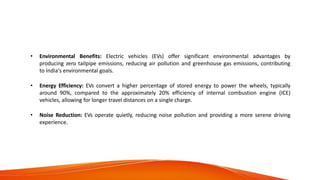
• Environmental Benefits: Electric vehicles (EVs) offer significant environmental advantages by
producing zero tailpipe emissions, reducing air pollution and greenhouse gas emissions, contributing
to India's environmental goals.
• Energy Efficiency: EVs convert a higher percentage of stored energy to power the wheels, typically
around 90%, compared to the approximately 20% efficiency of internal combustion engine (ICE)
vehicles, allowing for longer travel distances on a single charge.
• Noise Reduction: EVs operate quietly, reducing noise pollution and providing a more serene driving
experience.
Advantages of Electric
Vehicles
• Lower Operating Costs: EVs have lower operating costs
due to fewer mechanical parts, resulting in
• reduced maintenance requirements. Also, electricity costs
are often lower than traditional fuel costs.
• Energy Independence: EVs contribute to energy
independence and diversification by reducing reliance on
fossil fuels, aligning with India's energy security objectives.
• Enhanced Performance: EVs provide instant torque for quick
acceleration, a smooth and quiet driving experience, and
Hindrances to Widespread Adoption of Electric Vehicles in India
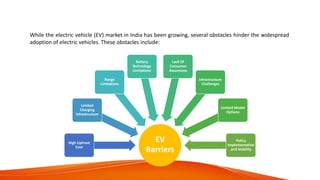
While the electric vehicle (EV) market in India has been growing, several obstacles hinder the widespread
adoption of electric vehicles. These obstacles include:
EV
Barriers
High Upfront
Cost
Limited
Charging
Infrastructure
Range
Limitations
Battery
Technology
Limitations
Lack Of
Consumer
Awareness
Infrastructure
Challenges
Limited Model
Options
Policy
Implementation
and Stability
Technical Specifications of Various
Components/Aggregates
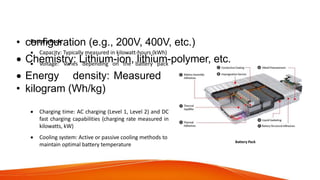
Battery Pack:
 Capacity: Typically measured in kilowatt-hours (kWh)
 Voltage: Varies depending on the battery pack
• configuration (e.g., 200V, 400V, etc.)
 Chemistry: Lithium-ion, lithium-polymer, etc.
 Energy density: Measured in watt-hours per
• kilogram (Wh/kg)
 Charging time: AC charging (Level 1, Level 2) and DC
fast charging capabilities (charging rate measured in
kilowatts, kW)
 Cooling system: Active or passive cooling methods to
maintain optimal battery temperature
Battery Pack
Technical Specifications of Various
Components/Aggregates
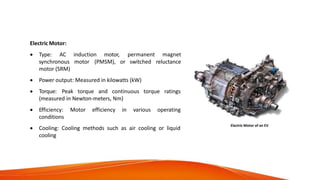
Electric Motor:
 Type: AC induction motor, permanent magnet
(PMSM), or switched reluctance
synchronous motor
motor (SRM)
 Power output: Measured in kilowatts (kW)
 Torque: Peak torque and continuous torque ratings
(measured in Newton-meters, Nm)
 Efficiency: Motor efficiency in various operating
conditions
 Cooling: Cooling methods such as air cooling or liquid
cooling
Electric Motor of an EV
Technical Specifications of Various
Components/Aggregates
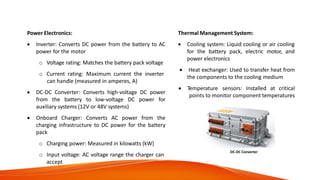
Power Electronics:
 Inverter: Converts DC power from the battery to AC
power for the motor
o Voltage rating: Matches the battery pack voltage
o Current rating: Maximum current the inverter
can handle (measured in amperes, A)
 DC-DC Converter: Converts high-voltage DC power
from the battery to low-voltage DC power for
auxiliary systems (12V or 48V systems)
 Onboard Charger: Converts AC power from the
charging infrastructure to DC power for the battery
pack
o Charging power: Measured in kilowatts (kW)
o Input voltage: AC voltage range the charger can
accept
Thermal Management System:
 Cooling system: Liquid cooling or air cooling
for the battery pack, electric motor, and
power electronics
 Heat exchanger: Used to transfer heat from
the components to the cooling medium
 Temperature sensors: Installed at critical
points to monitor component temperatures
DC-DC Converter
Technical Specifications of Various
Components/Aggregates
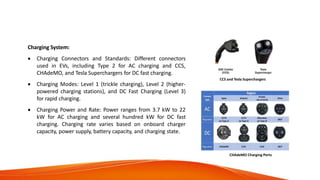
Charging System:
 Charging Connectors and Standards: Different connectors
used in EVs, including Type 2 for AC charging and CCS,
CHAdeMO, and Tesla Superchargers for DC fast charging.
 Charging Modes: Level 1 (trickle charging), Level 2 (higher-
powered charging stations), and DC Fast Charging (Level 3)
for rapid charging.
 Charging Power and Rate: Power ranges from 3.7 kW to 22
kW for AC charging and several hundred kW for DC fast
charging. Charging rate varies based on onboard charger
capacity, power supply, battery capacity, and charging state.
CCS and Tesla Superchargers
CHAdeMO Charging Ports
Technical Specifications of Various
Components/Aggregates
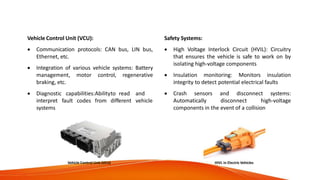
Vehicle Control Unit (VCU):
 Communication protocols: CAN bus, LIN bus,
Ethernet, etc.
 Integration of various vehicle systems: Battery
management, motor control, regenerative
braking, etc.
capabilities:Abilityto read and
fault codes from different vehicle
 Diagnostic
interpret
systems
Safety Systems:
 High Voltage Interlock Circuit (HVIL): Circuitry
that ensures the vehicle is safe to work on by
isolating high-voltage components
 Insulation monitoring: Monitors insulation
integrity to detect potential electrical faults
 Crash sensors and disconnect systems:
Automatically disconnect high-voltage
components in the event of a collision
HIVL in Electric Vehicles
Vehicle Control Unit (VCU)
Electric Vehicle Market in
India
The electric vehicle (EV) market in India is experiencing rapid growth due to its potential to address air
pollution, energy security, and climate change challenges. Government initiatives like the FAME scheme
provide incentives for EV adoption and charging infrastructure development, driving market expansion.
Technological advancements, particularly in battery technology, are enhancing the range and performance
of electric vehicles, boosting their appeal to consumers. The EV industry presents manufacturing and job
opportunities, particularly in research and development (R&D) and maintenance, contributing to the
country's economic growth.
The Indian EV market is projected to grow at a Compound Annual Growth Rate (CAGR) of 94.4% between
2021 and 2030, reaching a value of USD 152.21 billion.
EVs provide instant torque for quick acceleration, a smooth and quiet driving experience, and improved
handling due to a lower center of gravity.
Thank
You

INTRODUCTION TO EV - Full Modified.pptx

  • 1.
    Electric Vehicle ServiceLead Technician Sector: Automotive Sub-Sector: Automotive Vehicle Service Occupation: Technical Service & Repair QP Code: ASC/Q1424 NSQF Level: 5
  • 3.
    In 1800, AlessandroVolta invented the voltaic pile. This was the first true battery because the combination of zinc and silver could hold a charge even when not in use. Gaston Plante developed the first lead-acid rechargeable battery in 1859, and in 1880, Camille Alphonse Faure improved upon Plante’s work, using lead sulfates to expand electrical storage capacity. Two more important battery technologies followed. First, was the nickel-cadmium battery in 1899. The NiCad, as we call it today, was the first truly functional rechargeable battery. It was also the first alkaline battery, swapping out lead acids for an alkaline (basic, or high pH) electrolyte. Today’s modern lithium-ion batteries first arrived in 1912. Li-ion has the advantage of holding more electricity while having low weight, compared to other battery products. In 1991, SONY released the first rechargeable Li-ion battery. More advanced versions of Li-ion batteries are the current international standard for EV and AV vehicles as they better tolerate discharge-charge cycles.
  • 4.
    First Small-Scale ElectricCars 1828 — 1835 Horse and buggies are the primary mode of transportation, but innovators in Hungary, the Netherlands and the U.S. think to the future, creating some of the first small-scale electric cars.
  • 5.
    First Crude ElectricVehicle Is Developed 1832 Around 1832, Robert Anderson develops the first crude electric vehicle, but it isn't until the 1870s or later that electric cars become practical. Pictured here is an electric vehicle built by an English inventor in 1884. Photo courtesy of Wikimedia Commons.
  • 6.
    First Electric VehicleDebuts in U.S. 1889 — 1891 William Morrison, from Des Moines, Iowa, creates the first successful electric vehicle in the U.S. His car is little more than an electrified wagon, but it sparks an interest in electric vehicles. This 1896 advertisement shows how many early electric vehicles were not much different than carriages.
  • 7.
    Electric Cars GainPopularity 1899 Compared to the gas- and steam-powered automobiles at the time, electric cars are quiet, easy to drive and didn't emit smelly pollutants -- quickly becoming popular with urban residents, especially women. Photo courtesy of the National Museum of American History.
  • 8.
    Electric Cars ReachTheir Heyday 1900-1912 By the turn of the century, electric vehicles are all the rage in the U.S., accounting for around a third of all vehicles on the road. Pictured here is Fifth Avenue in New York City around this time, showing the range in vehicle options available. Photo courtesy of the Library of Congress.
  • 9.
    Edison Takes onElectric Vehicle Batteries 1901 Many innovators take note of the electric car’s high demand, exploring ways to improve the technology. For example, Thomas Edison thought electric vehicles were the superior mode of transportation and worked to build a better battery. Photo courtesy of the National Museum of American History.
  • 10.
    World's First HybridElectric Car Is Invented 1901 Ferdinand Porsche, founder of the sports car by the same name, creates the Lohner-Porsche Mixte -- the world's first hybrid electric car. The vehicle is powered by electricity stored in a battery and a gas engine. Photo courtesy of Wikimedia Commons.
  • 11.
    Model T Dealsa Blow to Electric Vehicles 1908-1912 The mass-produced Model T makes gas-powered cars widely available and affordable. In 1912, the electric starter is introduced, helping to increase gas- powered vehicle sales even more. Pictured here is Henry Ford with the first Model T and the 1 millionth. Photo courtesy of the Library of Congress.
  • 12.
    Decline in ElectricVehicles 1920-1935 Better roads and discovery of cheap Texas crude oil help contribute to the decline in electric vehicles. By 1935, they have all but disappeared. Pictured here is one of the gasoline filling stations that popped up across the U.S., making gas readily available for rural Americans and leading to the rise in popularity of gas-powered vehicles. Photo courtesy of the Library of Congress.
  • 13.
    Gas Prices Soar 1968— 1973 Over the next 30 years or so, cheap, abundant gasoline and continued improvement in the internal combustion engine created little need for alternative fuel vehicles. But in the 1960s and 1970s, gas prices soar through the roof, creating interest in electric vehicles again. Photo courtesy of EPA, U.S. National Archives.
  • 14.
    Over the Moonwith Electric Vehicles 1971 Around this same time, the first manned vehicle drives on the moon. NASA's Lunar rover runs on electricity, helping to raise the profile of electric vehicles. Photo courtesy of NASA.
  • 15.
    The Next Generationof Electric Vehicles 1973 Many big and small automakers begin exploring options for alternative fuel vehicles. For example, General Motors develops a prototype for an urban electric car, which the company displayed at the First Symposium on Low Pollution Power Systems Development in 1973. Photo courtesy of NASA.
  • 16.
    A Modern EVProduction Line Introduction to Automotive Sector
  • 17.
    What is anElectric Vehicle? Electric vehicles (EVs) are a revolutionary mode of transportation that differs from traditional internal combustion engine (ICE) vehicles in several ways: Electric Power EVs are propelled by electric power rather than traditional ICE engines. They use electricity stored in rechargeable batteries to drive electric motors. Zero Emissions EVs produce no tailpipe emissions, contributing significantly to reducing air pollution and greenhouse gas emissions. This aligns with efforts to promote environmental sustainability and combat climate change. Charging Infrastructure EVs require regular charging of their onboard batteries. Owners can use charging stations in public locations or install home charging units for added convenience and flexibility. Range Variability The range of EVs varies based on the model and battery capacity. Advances in battery technology continue to improve overall range and performance, making EVs more practical for longer journeys. Types of Evs EVs come in various forms, including All- Electric Vehicles (AEVs) which rely solely on electric power and have no IC engine and Plug-in Hybrid Electric Vehicles (PHEVs) which combines electric motors with an IC engine. Lower Operating Costs EVs typically have lower operating costs compared to conventional vehicles. Electricity is often gasoline, and EVs cheaper than require less maintenance due to fewer moving parts, reducing long-term ownership expenses.
  • 19.
    History of Electric Vehicles •Early Inventions: The history of electric vehicles dates back to the 19th century (Early 1800s) when inventors like Thomas Davenport and Robert Anderson developed the earliest electric-powered prototypes (1832-1839). • Rise of Electric Cars: In the late 1800s and early 1900s, electric cars gained popularity due to their quiet operation, ease of use, and absence of tailpipe emissions. • Limited Range: Electric vehicles faced limitations in terms of range due to the limited energy storage capacity of batteries available at that time. • Competition with Internal Combustion Engine: The emergence of gasoline- powered IC engines and the discovery of abundant fossil fuel reserves led to increased competition, and electric vehicles gradually lost market share. • Decline in Popularity: Advances in gasoline engine technology, the construction of road infrastructure, and the availability of cheap gasoline led to a decline in the popularity of electric vehicles. Electric Carriage A Primitive Electric Car Ford Model T
  • 20.
    History of Electric Vehicles •Niche Applications: Electric vehicles initially found limited use in niche applications like forklifts, golf carts, and small-scale urban transportation. • Resurgence in the Late 20th Century: The late 20th century witnessed a renewed interest in electric vehicles due to concerns about pollution and dependence on fossil fuels. • Battery Breakthrough: Breakthroughs in battery technology, particularly the development of lithium-ion batteries, improved the range and energy storage capabilities of electric vehicles. • Environmental Awareness: Growing environmental awareness further fueled the development and commercialization of modern electric vehicles. A Modern Day Electric Car • Advancements and Incentives: Recent growth in electric vehicles is driven by advancements in battery technology, expanding charging infrastructure, and government incentives promoting clean transportation for reducing emissions and mitigating climate change.
  • 21.
    Categories of Electric Vehicles 1.Battery Electric Vehicles (BEVs) Also known as All-Electric Vehicles (AEVs), these vehicles are powered solely by electric motors that draw electricity from a battery pack. They do not have an internal combustion engine (ICE) and produce zero tailpipe emissions. BEVs need to be charged from an external power source, such as charging stations or home chargers. Battery Electric Vehicles (BEV)
  • 22.
    Categories of Electric Vehicles 2.Plug-in Hybrid Electric Vehicles (PHEVs) PHEVs combine an electric motor with an internal combustion engine (ICE). They have a larger battery pack compared to hybrid electric vehicles (HEVs), allowing them to operate in electric-only mode for a limited range. Once the battery charge is depleted, the PHEV switches to using the ICE or a combination of both power sources. PHEVs can be recharged by plugging into an external power source or regenerative braking. Plug-in Hybrid Electric Vehicles
  • 23.
    Categories of Electric Vehicles 3.Hybrid Electric Vehicles (HEVs) Internal combustion engines (ICEs) and electric motors are both present in HEVs. During acceleration and braking, the electric motor gathers energy, which is then stored in a tiny battery. HEVs cannot, however, be plugged in to replenish their batteries. Compared to ICE vehicles, the electric motor in HEVs helps increase fuel efficiency and lower pollutants. Hybrid Electric Vehicles
  • 24.
    Categories of Electric Vehicles 4.Fuel Cell Electric Vehicles (FCEVs) hydrogen fuel cells to generate which powers the electric motor . FCEVs use electricity, Hydrogen stored in high-pressure tanks combines with oxygen from the air, creating electricity and emitting only water vapour as the by-product. FCEVs offer longer driving ranges and quick refuelling times compared to battery-powered EVs. However, they refuelling infrastructure require a hydrogen that is still under development. Fuel Cell Electric Vehicle
  • 25.
    Advantages of Electric Vehicles •Environmental Benefits: Electric vehicles (EVs) offer significant environmental advantages by producing zero tailpipe emissions, reducing air pollution and greenhouse gas emissions, contributing to India's environmental goals. • Energy Efficiency: EVs convert a higher percentage of stored energy to power the wheels, typically around 90%, compared to the approximately 20% efficiency of internal combustion engine (ICE) vehicles, allowing for longer travel distances on a single charge. • Noise Reduction: EVs operate quietly, reducing noise pollution and providing a more serene driving experience.
  • 26.
    Advantages of Electric Vehicles •Lower Operating Costs: EVs have lower operating costs due to fewer mechanical parts, resulting in • reduced maintenance requirements. Also, electricity costs are often lower than traditional fuel costs. • Energy Independence: EVs contribute to energy independence and diversification by reducing reliance on fossil fuels, aligning with India's energy security objectives. • Enhanced Performance: EVs provide instant torque for quick acceleration, a smooth and quiet driving experience, and
  • 27.
    Hindrances to WidespreadAdoption of Electric Vehicles in India While the electric vehicle (EV) market in India has been growing, several obstacles hinder the widespread adoption of electric vehicles. These obstacles include: EV Barriers High Upfront Cost Limited Charging Infrastructure Range Limitations Battery Technology Limitations Lack Of Consumer Awareness Infrastructure Challenges Limited Model Options Policy Implementation and Stability
  • 28.
    Technical Specifications ofVarious Components/Aggregates Battery Pack:  Capacity: Typically measured in kilowatt-hours (kWh)  Voltage: Varies depending on the battery pack • configuration (e.g., 200V, 400V, etc.)  Chemistry: Lithium-ion, lithium-polymer, etc.  Energy density: Measured in watt-hours per • kilogram (Wh/kg)  Charging time: AC charging (Level 1, Level 2) and DC fast charging capabilities (charging rate measured in kilowatts, kW)  Cooling system: Active or passive cooling methods to maintain optimal battery temperature Battery Pack
  • 29.
    Technical Specifications ofVarious Components/Aggregates Electric Motor:  Type: AC induction motor, permanent magnet (PMSM), or switched reluctance synchronous motor motor (SRM)  Power output: Measured in kilowatts (kW)  Torque: Peak torque and continuous torque ratings (measured in Newton-meters, Nm)  Efficiency: Motor efficiency in various operating conditions  Cooling: Cooling methods such as air cooling or liquid cooling Electric Motor of an EV
  • 30.
    Technical Specifications ofVarious Components/Aggregates Power Electronics:  Inverter: Converts DC power from the battery to AC power for the motor o Voltage rating: Matches the battery pack voltage o Current rating: Maximum current the inverter can handle (measured in amperes, A)  DC-DC Converter: Converts high-voltage DC power from the battery to low-voltage DC power for auxiliary systems (12V or 48V systems)  Onboard Charger: Converts AC power from the charging infrastructure to DC power for the battery pack o Charging power: Measured in kilowatts (kW) o Input voltage: AC voltage range the charger can accept Thermal Management System:  Cooling system: Liquid cooling or air cooling for the battery pack, electric motor, and power electronics  Heat exchanger: Used to transfer heat from the components to the cooling medium  Temperature sensors: Installed at critical points to monitor component temperatures DC-DC Converter
  • 31.
    Technical Specifications ofVarious Components/Aggregates Charging System:  Charging Connectors and Standards: Different connectors used in EVs, including Type 2 for AC charging and CCS, CHAdeMO, and Tesla Superchargers for DC fast charging.  Charging Modes: Level 1 (trickle charging), Level 2 (higher- powered charging stations), and DC Fast Charging (Level 3) for rapid charging.  Charging Power and Rate: Power ranges from 3.7 kW to 22 kW for AC charging and several hundred kW for DC fast charging. Charging rate varies based on onboard charger capacity, power supply, battery capacity, and charging state. CCS and Tesla Superchargers CHAdeMO Charging Ports
  • 32.
    Technical Specifications ofVarious Components/Aggregates Vehicle Control Unit (VCU):  Communication protocols: CAN bus, LIN bus, Ethernet, etc.  Integration of various vehicle systems: Battery management, motor control, regenerative braking, etc. capabilities:Abilityto read and fault codes from different vehicle  Diagnostic interpret systems Safety Systems:  High Voltage Interlock Circuit (HVIL): Circuitry that ensures the vehicle is safe to work on by isolating high-voltage components  Insulation monitoring: Monitors insulation integrity to detect potential electrical faults  Crash sensors and disconnect systems: Automatically disconnect high-voltage components in the event of a collision HIVL in Electric Vehicles Vehicle Control Unit (VCU)
  • 33.
    Electric Vehicle Marketin India The electric vehicle (EV) market in India is experiencing rapid growth due to its potential to address air pollution, energy security, and climate change challenges. Government initiatives like the FAME scheme provide incentives for EV adoption and charging infrastructure development, driving market expansion. Technological advancements, particularly in battery technology, are enhancing the range and performance of electric vehicles, boosting their appeal to consumers. The EV industry presents manufacturing and job opportunities, particularly in research and development (R&D) and maintenance, contributing to the country's economic growth. The Indian EV market is projected to grow at a Compound Annual Growth Rate (CAGR) of 94.4% between 2021 and 2030, reaching a value of USD 152.21 billion. EVs provide instant torque for quick acceleration, a smooth and quiet driving experience, and improved handling due to a lower center of gravity.
  • 34.