




EVE 161:

Microbial Phylogenomics
Class #6:
The Tree of Life, Example Paper
UC Davis, Winter 2018
Instructor: Jonathan Eisen
Teaching Assistant: Cassie Ettinger
!1
Where we are going and where we have been
• Previous Class:
!5. Phylogeny
• Current Class:
!6. Phylogeny example
• Next Class:
!7. rRNA Sequencing from uncultured
!2
Eisen Office Hours
• Today 10:30-11:30 Storer 5331
• Monday 10:00-11:00 GBSF 5311
Class Participation Sign Up
• Task: Summarize one figure from one of the papers for
class, ~ 5 minutes.
! There will be 2-3 presenters per class.
! Each person needs to do a different figure so you need
to contact the other person to coordinate.
! Can meet with Eisen, Ettinger before hand to discuss.
• Sign up for date on Google Sheet goo.gl/bmxCDw -
include your name & email address.
Paper Analysis Project
• Select 1-2 papers on one of the topics of the course
(approval needed)
• Review the paper and write up a summary of your
assessment of the paper (more detail on this later)
• Present a short summary of what you did to the class
• Ask and answer questions about your and other people’s
reviews in the discussion forum on Canvas
Palfrey et al.
Syst. Biol. 59(5):518–533, 2010
c⃝ The Author(s) 2010. Published by Oxford University Press, on behalf of the Society of Systematic Biologists. All rights reserved.
For Permissions, please email: journals.permissions@oxfordjournals.org
DOI:10.1093/sysbio/syq037
Advance Access publication on July 23, 2010
Broadly Sampled Multigene Analyses Yield a Well-Resolved Eukaryotic Tree of Life
LAURA WEGENER PARFREY1
, JESSICA GRANT2
, YONAS I. TEKLE2,6
, ERICA LASEK-NESSELQUIST3,4
,
HILARY G. MORRISON3
, MITCHELL L. SOGIN3
, DAVID J. PATTERSON5
, AND LAURA A. KATZ1,2,∗
1Program in Organismic and Evolutionary Biology, University of Massachusetts, 611 North Pleasant Street, Amherst,
MA 01003, USA; 2Department of Biological Sciences, Smith College, 44 College Lane, Northampton, MA 01063, USA; 3Bay Paul Center for
Comparative Molecular Biology and Evolution, Marine Biological Laboratory, 7 MBL Street, Woods Hole, MA 02543, USA; 4Department of Ecology and
Evolutionary Biology, Brown University, 80 Waterman Street, Providence, RI 02912, USA; 5Biodiversity Informatics Group, Marine Biological
Laboratory, 7 MBL Street, Woods Hole, MA 02543, USA; 6Present address: Department of Epidemiology and Public Health, Yale University School of
Medicine, New Haven, CT 06520, USA;
∗Correspondence to be sent to: Laura A. Katz, 44 College Lane, Northampton, MA 01003, USA; E-mail: lkatz@smith.edu.
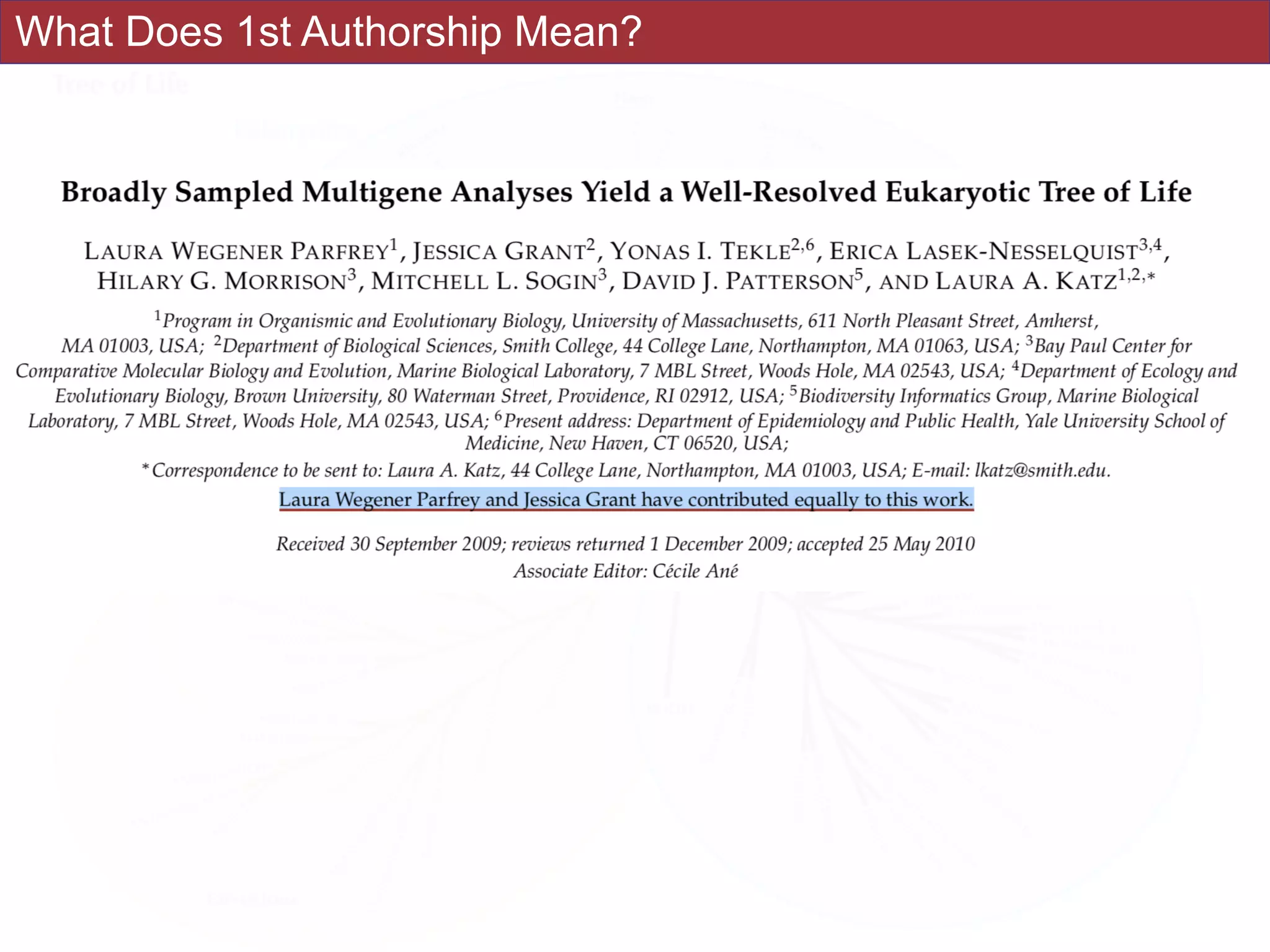
Laura Wegener Parfrey and Jessica Grant have contributed equally to this work.
Received 30 September 2009; reviews returned 1 December 2009; accepted 25 May 2010
Associate Editor: C´ecile An´e
Abstract.—An accurate reconstruction of the eukaryotic tree of life is essential to identify the innovations underlying the
diversity of microbial and macroscopic (e.g., plants and animals) eukaryotes. Previous work has divided eukaryotic diver-
sity into a small number of high-level “supergroups,” many of which receive strong support in phylogenomic analyses.
However, the abundance of data in phylogenomic analyses can lead to highly supported but incorrect relationships due
to systematic phylogenetic error. Furthermore, the paucity of major eukaryotic lineages (19 or fewer) included in these
genomic studies may exaggerate systematic error and reduce power to evaluate hypotheses. Here, we use a taxon-rich
strategy to assess eukaryotic relationships. We show that analyses emphasizing broad taxonomic sampling (up to 451 taxa
representing 72 major lineages) combined with a moderate number of genes yield a well-resolved eukaryotic tree of life.
The consistency across analyses with varying numbers of taxa (88–451) and levels of missing data (17–69%) supports the
accuracy of the resulting topologies. The resulting stable topology emerges without the removal of rapidly evolving genes
or taxa, a practice common to phylogenomic analyses. Several major groups are stable and strongly supported in these
analyses (e.g., SAR, Rhizaria, Excavata), whereas the proposed supergroup “Chromalveolata” is rejected. Furthermore, ex-
tensive instability among photosynthetic lineages suggests the presence of systematic biases including endosymbiotic gene
transfer from symbiont (nucleus or plastid) to host. Our analyses demonstrate that stable topologies of ancient evolutionary
!6
• Key Things You Want to Know More About?
• Why did I select this paper?
Palfrey et al.
Syst. Biol. 59(5):518–533, 2010
c⃝ The Author(s) 2010. Published by Oxford University Press, on behalf of the Society of Systematic Biologists. All rights reserved.
For Permissions, please email: journals.permissions@oxfordjournals.org
DOI:10.1093/sysbio/syq037
Advance Access publication on July 23, 2010
Broadly Sampled Multigene Analyses Yield a Well-Resolved Eukaryotic Tree of Life
LAURA WEGENER PARFREY1
, JESSICA GRANT2
, YONAS I. TEKLE2,6
, ERICA LASEK-NESSELQUIST3,4
,
HILARY G. MORRISON3
, MITCHELL L. SOGIN3
, DAVID J. PATTERSON5
, AND LAURA A. KATZ1,2,∗
1Program in Organismic and Evolutionary Biology, University of Massachusetts, 611 North Pleasant Street, Amherst,
MA 01003, USA; 2Department of Biological Sciences, Smith College, 44 College Lane, Northampton, MA 01063, USA; 3Bay Paul Center for
Comparative Molecular Biology and Evolution, Marine Biological Laboratory, 7 MBL Street, Woods Hole, MA 02543, USA; 4Department of Ecology and
Evolutionary Biology, Brown University, 80 Waterman Street, Providence, RI 02912, USA; 5Biodiversity Informatics Group, Marine Biological
Laboratory, 7 MBL Street, Woods Hole, MA 02543, USA; 6Present address: Department of Epidemiology and Public Health, Yale University School of
Medicine, New Haven, CT 06520, USA;
∗Correspondence to be sent to: Laura A. Katz, 44 College Lane, Northampton, MA 01003, USA; E-mail: lkatz@smith.edu.
Laura Wegener Parfrey and Jessica Grant have contributed equally to this work.
Received 30 September 2009; reviews returned 1 December 2009; accepted 25 May 2010
Associate Editor: C´ecile An´e
Abstract.—An accurate reconstruction of the eukaryotic tree of life is essential to identify the innovations underlying the
diversity of microbial and macroscopic (e.g., plants and animals) eukaryotes. Previous work has divided eukaryotic diver-
sity into a small number of high-level “supergroups,” many of which receive strong support in phylogenomic analyses.
However, the abundance of data in phylogenomic analyses can lead to highly supported but incorrect relationships due
to systematic phylogenetic error. Furthermore, the paucity of major eukaryotic lineages (19 or fewer) included in these
genomic studies may exaggerate systematic error and reduce power to evaluate hypotheses. Here, we use a taxon-rich
strategy to assess eukaryotic relationships. We show that analyses emphasizing broad taxonomic sampling (up to 451 taxa
representing 72 major lineages) combined with a moderate number of genes yield a well-resolved eukaryotic tree of life.
The consistency across analyses with varying numbers of taxa (88–451) and levels of missing data (17–69%) supports the
accuracy of the resulting topologies. The resulting stable topology emerges without the removal of rapidly evolving genes
or taxa, a practice common to phylogenomic analyses. Several major groups are stable and strongly supported in these
analyses (e.g., SAR, Rhizaria, Excavata), whereas the proposed supergroup “Chromalveolata” is rejected. Furthermore, ex-
tensive instability among photosynthetic lineages suggests the presence of systematic biases including endosymbiotic gene
transfer from symbiont (nucleus or plastid) to host. Our analyses demonstrate that stable topologies of ancient evolutionary
!9
What Does 1st Authorship Mean?
Abstract
An accurate reconstruction of the eukaryotic tree of life is essential to identify the
innovations underlying the diversity of microbial and macroscopic (e.g., plants and animals)
eukaryotes. Previous work has divided eukaryotic diversity into a small number of high-level
“supergroups,” many of which receive strong support in phylogenomic analyses. However,
the abundance of data in phylogenomic analyses can lead to highly supported but incorrect
relationships due to systematic phylogenetic error. Furthermore, the paucity of major
eukaryotic lineages (19 or fewer) included in these genomic studies may exaggerate
systematic error and reduce power to evaluate hypotheses. Here, we use a taxon-rich
strategy to assess eukaryotic relationships. We show that analyses emphasizing broad
taxonomic sampling (up to 451 taxa representing 72 major lineages) combined with a
moderate number of genes yield a well-resolved eukaryotic tree of life. The consistency
across analyses with varying numbers of taxa (88–451) and levels of missing data (17–69%)
supports the accuracy of the resulting topologies. The resulting stable topology emerges
without the removal of rapidly evolving genes or taxa, a practice common to phylogenomic
analyses. Several major groups are stable and strongly supported in these analyses (e.g.,
SAR, Rhizaria, Excavata), whereas the proposed supergroup “Chromalveolata” is rejected.
Furthermore, ex- tensive instability among photosynthetic lineages suggests the presence of
systematic biases including endosymbiotic gene transfer from symbiont (nucleus or plastid)
to host. Our analyses demonstrate that stable topologies of ancient evolutionary
relationships can be achieved with broad taxonomic sampling and a moderate number of
genes. Finally, taxon-rich analyses such as presented here provide a method for testing the
accuracy of relationships that receive high bootstrap support (BS) in phylogenomic analyses
and enable placement of the multitude of lineages that lack genome scale data. [Excavata;
microbial eukaryotes; Rhizaria; supergroups; systematic error; taxon sampling.]
!11
Abstract
An accurate reconstruction of the eukaryotic tree of life is essential to identify the
innovations underlying the diversity of microbial and macroscopic (e.g., plants and animals)
eukaryotes. Previous work has divided eukaryotic diversity into a small number of high-level
“supergroups,” many of which receive strong support in phylogenomic analyses. However,
the abundance of data in phylogenomic analyses can lead to highly supported but incorrect
relationships due to systematic phylogenetic error. Furthermore, the paucity of major
eukaryotic lineages (19 or fewer) included in these genomic studies may exaggerate
systematic error and reduce power to evaluate hypotheses. Here, we use a taxon-rich
strategy to assess eukaryotic relationships. We show that analyses emphasizing broad
taxonomic sampling (up to 451 taxa representing 72 major lineages) combined with a
moderate number of genes yield a well-resolved eukaryotic tree of life. The consistency
across analyses with varying numbers of taxa (88–451) and levels of missing data (17–69%)
supports the accuracy of the resulting topologies. The resulting stable topology emerges
without the removal of rapidly evolving genes or taxa, a practice common to phylogenomic
analyses. Several major groups are stable and strongly supported in these analyses (e.g.,
SAR, Rhizaria, Excavata), whereas the proposed supergroup “Chromalveolata” is rejected.
Furthermore, ex- tensive instability among photosynthetic lineages suggests the presence of
systematic biases including endosymbiotic gene transfer from symbiont (nucleus or plastid)
to host. Our analyses demonstrate that stable topologies of ancient evolutionary
relationships can be achieved with broad taxonomic sampling and a moderate number of
genes. Finally, taxon-rich analyses such as presented here provide a method for testing the
accuracy of relationships that receive high bootstrap support (BS) in phylogenomic analyses
and enable placement of the multitude of lineages that lack genome scale data. [Excavata;
microbial eukaryotes; Rhizaria; supergroups; systematic error; taxon sampling.]
!12
Abstract
An accurate reconstruction of the eukaryotic tree of life is essential to identify the
innovations underlying the diversity of microbial and macroscopic (e.g., plants and animals)
eukaryotes. Previous work has divided eukaryotic diversity into a small number of high-level
“supergroups,” many of which receive strong support in phylogenomic analyses. However,
the abundance of data in phylogenomic analyses can lead to highly supported but incorrect
relationships due to systematic phylogenetic error. Furthermore, the paucity of major
eukaryotic lineages (19 or fewer) included in these genomic studies may exaggerate
systematic error and reduce power to evaluate hypotheses. Here, we use a taxon-rich
strategy to assess eukaryotic relationships. We show that analyses emphasizing broad
taxonomic sampling (up to 451 taxa representing 72 major lineages) combined with a
moderate number of genes yield a well-resolved eukaryotic tree of life. The consistency
across analyses with varying numbers of taxa (88–451) and levels of missing data (17–69%)
supports the accuracy of the resulting topologies. The resulting stable topology emerges
without the removal of rapidly evolving genes or taxa, a practice common to phylogenomic
analyses. Several major groups are stable and strongly supported in these analyses (e.g.,
SAR, Rhizaria, Excavata), whereas the proposed supergroup “Chromalveolata” is rejected.
Furthermore, ex- tensive instability among photosynthetic lineages suggests the presence of
systematic biases including endosymbiotic gene transfer from symbiont (nucleus or plastid)
to host. Our analyses demonstrate that stable topologies of ancient evolutionary
relationships can be achieved with broad taxonomic sampling and a moderate number of
genes. Finally, taxon-rich analyses such as presented here provide a method for testing the
accuracy of relationships that receive high bootstrap support (BS) in phylogenomic analyses
and enable placement of the multitude of lineages that lack genome scale data. [Excavata;
microbial eukaryotes; Rhizaria; supergroups; systematic error; taxon sampling.]
!13
Abstract
An accurate reconstruction of the eukaryotic tree of life is essential to identify the
innovations underlying the diversity of microbial and macroscopic (e.g., plants and animals)
eukaryotes. Previous work has divided eukaryotic diversity into a small number of high-level
“supergroups,” many of which receive strong support in phylogenomic analyses. However,
the abundance of data in phylogenomic analyses can lead to highly supported but incorrect
relationships due to systematic phylogenetic error. Furthermore, the paucity of major
eukaryotic lineages (19 or fewer) included in these genomic studies may exaggerate
systematic error and reduce power to evaluate hypotheses. Here, we use a taxon-rich
strategy to assess eukaryotic relationships. We show that analyses emphasizing broad
taxonomic sampling (up to 451 taxa representing 72 major lineages) combined with a
moderate number of genes yield a well-resolved eukaryotic tree of life. The consistency
across analyses with varying numbers of taxa (88–451) and levels of missing data (17–69%)
supports the accuracy of the resulting topologies. The resulting stable topology emerges
without the removal of rapidly evolving genes or taxa, a practice common to phylogenomic
analyses. Several major groups are stable and strongly supported in these analyses (e.g.,
SAR, Rhizaria, Excavata), whereas the proposed supergroup “Chromalveolata” is rejected.
Furthermore, ex- tensive instability among photosynthetic lineages suggests the presence of
systematic biases including endosymbiotic gene transfer from symbiont (nucleus or plastid)
to host. Our analyses demonstrate that stable topologies of ancient evolutionary
relationships can be achieved with broad taxonomic sampling and a moderate number of
genes. Finally, taxon-rich analyses such as presented here provide a method for testing the
accuracy of relationships that receive high bootstrap support (BS) in phylogenomic analyses
and enable placement of the multitude of lineages that lack genome scale data. [Excavata;
microbial eukaryotes; Rhizaria; supergroups; systematic error; taxon sampling.]
!14
Introduction
!15
Intro Paragraph 1
Perspectives on the structure of the eukaryotic tree of life have shifted in the past decade as
molecular analyses provide hypotheses for relationships among the approximately 75 robust
lineages of eukaryotes. These lineages are de ned by ultrastructural identities (Patterson 1999)
—patterns of cellular and subcellular organization revealed by electron microscopy—and are
strongly supported in molecular analyses (Parfrey et al. 2006; Yoon et al. 2008). Most of these
lineages now fall within a small number of higher level clades, the supergroups of eukaryotes
(Simpson and Roger 2004; Adl et al. 2005; Keeling et al. 2005). Several of these clades—
Opisthokonta, Rhizaria, and Amoebozoa— are increasingly well supported by phylogenomic
(Rodŕıguez-Ezpeleta et al. 2007a; Burki et al. 2008; Hampl et al. 2009) and phylogenetic
(Parfrey et al. 2006; Pawlowski and Burki 2009), analyses, whereas support for
“Archaeplastida” predominantly comes from some phylogenomic studies (Rodŕıguez-
Ezpeleta et al. 2005; Burki et al. 2007) or analyses of plastid genes (Yoon et al. 2002; Parfrey
et al. 2006). In con- trast, support for “Chromalveolata” and Excavata is mixed, often
dependent on the selection of taxa in- cluded in analyses (Rodŕıguez-Ezpeleta et al. 2005;
Parfrey et al. 2006; Rodŕıguez-Ezpeleta et al. 2007a; Burki et al. 2008; Hampl et al. 2009).
We use quotation marks throughout to note groups where uncertainties remain. Moreover, it is
dif cult to evaluate the overall stability of major clades of eukaryotes because phyloge- nomic
analyses have 19 or fewer of the major lineages and hence do not suf ciently sample
eukaryotic diver- sity(Rodŕıguez-Ezpeletaetal.2007b;Burkietal.2008; Hampl et al. 2009),
whereas taxon-rich analyses with 4 or fewer genes yield topologies with poor support at deep
nodes (Cavalier-Smith 2004; Parfrey et al. 2006; Yoon et al. 2008).
Perspectives on the structure of the eukaryotic tree of life have shifted in the past decade as
molecular analyses provide hypotheses for relationships among the approximately 75 robust
lineages of eukaryotes. These lineages are de ned by ultrastructural identities (Patterson 1999)
—patterns of cellular and subcellular organization revealed by electron microscopy—and are
strongly supported in molecular analyses (Parfrey et al. 2006; Yoon et al. 2008). Most of these
lineages now fall within a small number of higher level clades, the supergroups of eukaryotes
(Simpson and Roger 2004; Adl et al. 2005; Keeling et al. 2005). Several of these clades—
Opisthokonta, Rhizaria, and Amoebozoa— are increasingly well supported by phylogenomic
(Rodŕıguez-Ezpeleta et al. 2007a; Burki et al. 2008; Hampl et al. 2009) and phylogenetic
(Parfrey et al. 2006; Pawlowski and Burki 2009), analyses, whereas support for
“Archaeplastida” predominantly comes from some phylogenomic studies (Rodŕıguez-
Ezpeleta et al. 2005; Burki et al. 2007) or analyses of plastid genes (Yoon et al. 2002; Parfrey
et al. 2006). In con- trast, support for “Chromalveolata” and Excavata is mixed, often
dependent on the selection of taxa in- cluded in analyses (Rodŕıguez-Ezpeleta et al. 2005;
Parfrey et al. 2006; Rodŕıguez-Ezpeleta et al. 2007a; Burki et al. 2008; Hampl et al. 2009).
We use quotation marks throughout to note groups where uncertainties remain. Moreover, it is
dif cult to evaluate the overall stability of major clades of eukaryotes because phyloge- nomic
analyses have 19 or fewer of the major lineages and hence do not suf ciently sample
eukaryotic diver- sity(Rodŕıguez-Ezpeletaetal.2007b;Burkietal.2008; Hampl et al. 2009),
whereas taxon-rich analyses with 4 or fewer genes yield topologies with poor support at deep
nodes (Cavalier-Smith 2004; Parfrey et al. 2006; Yoon et al. 2008).
Intro Paragraph 1
w
e
4;
e
—
c
8;
l.
s
s
a
d
n-
s
n-
5;
a;
n
deep nodes (Cavalier-Smith 2004; Parfrey et al. 2006;
Yoon et al. 2008).
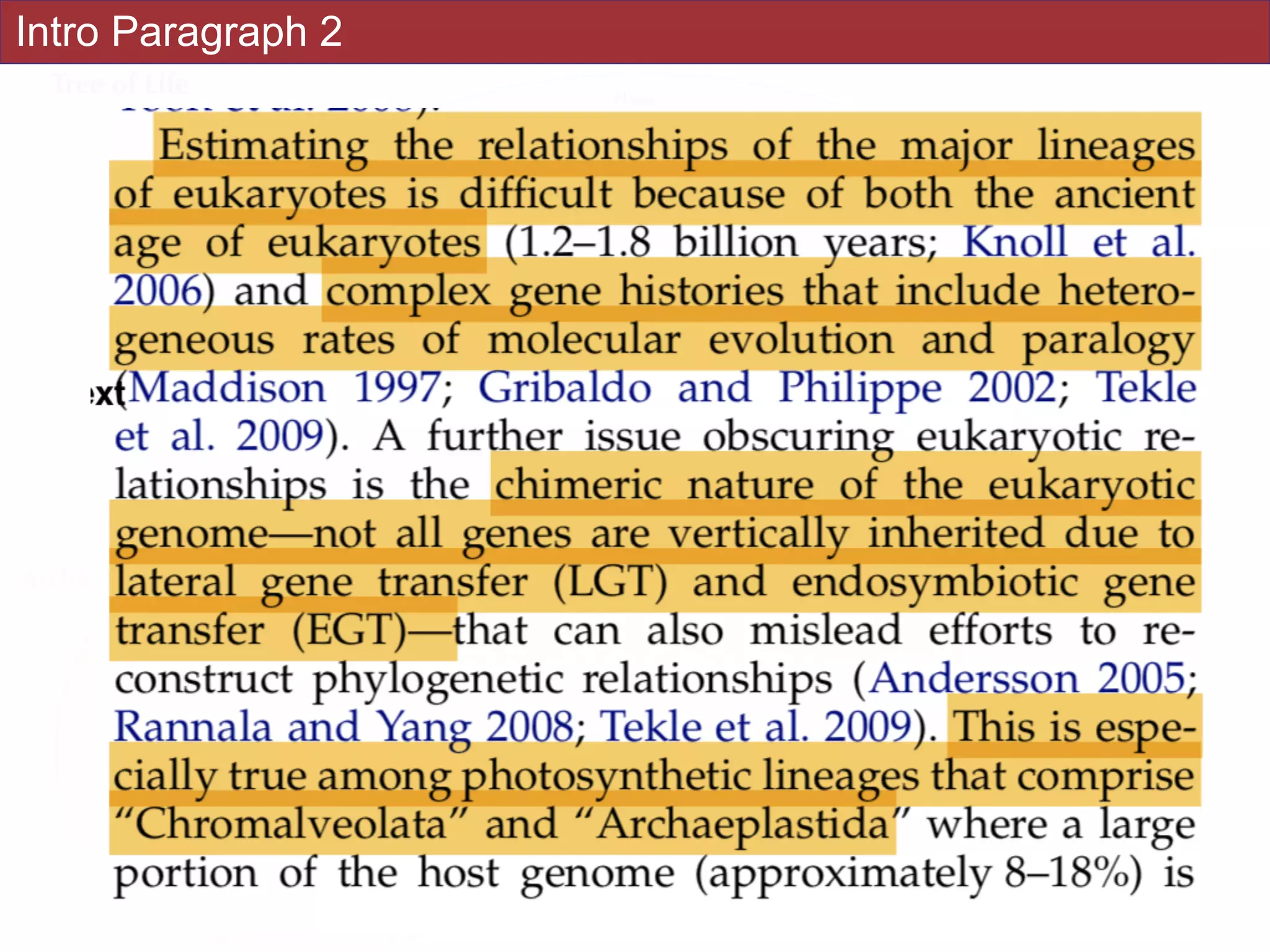
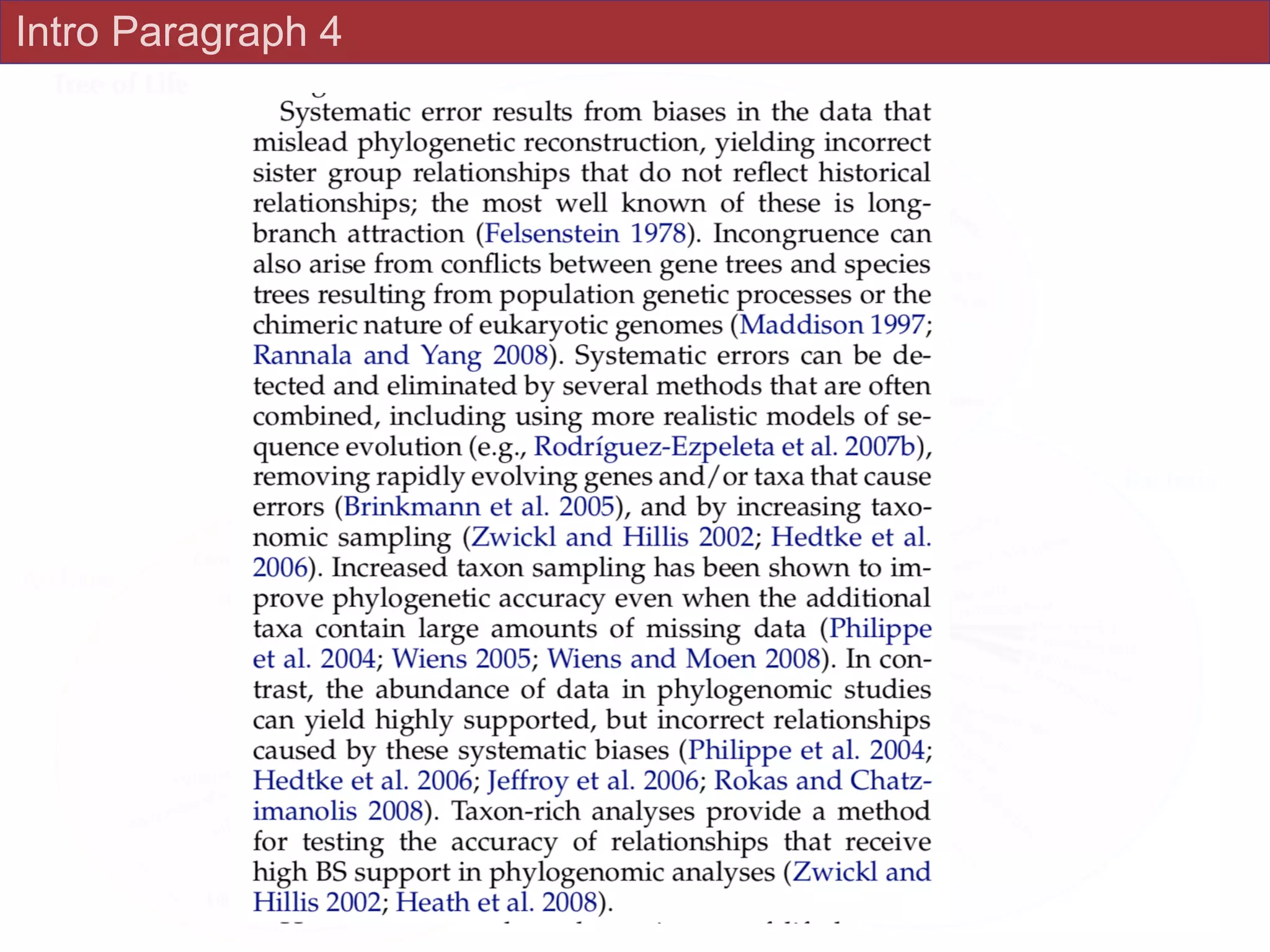
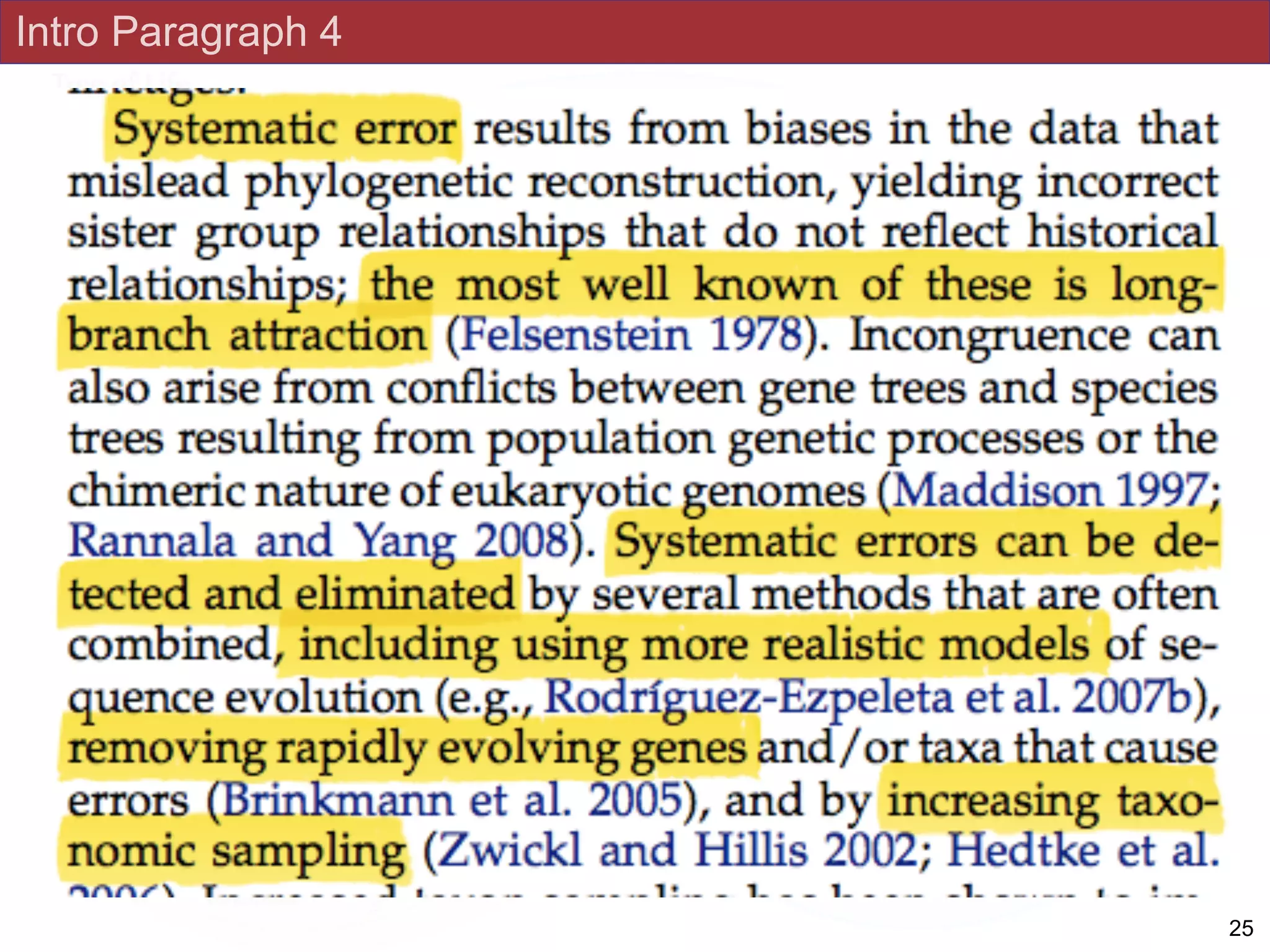
Estimating the relationships of the major lineages
of eukaryotes is difficult because of both the ancient
age of eukaryotes (1.2–1.8 billion years; Knoll et al.
2006) and complex gene histories that include hetero-
geneous rates of molecular evolution and paralogy
(Maddison 1997; Gribaldo and Philippe 2002; Tekle
et al. 2009). A further issue obscuring eukaryotic re-
lationships is the chimeric nature of the eukaryotic
genome—not all genes are vertically inherited due to
lateral gene transfer (LGT) and endosymbiotic gene
transfer (EGT)—that can also mislead efforts to re-
construct phylogenetic relationships (Andersson 2005;
Rannala and Yang 2008; Tekle et al. 2009). This is espe-
cially true among photosynthetic lineages that comprise
“Chromalveolata” and “Archaeplastida” where a large
portion of the host genome (approximately 8–18%) is
Intro Paragraph 2
Intro Paragraph 2
Intro Paragraph 2
LGT and Endosymbiosis
!22
Intro Paragraph 3
!23
Intro Paragraph 3
Intro Paragraph 4
!25
Intro Paragraph 4
• LBA
Introduction
• Questions about Introduction?
Methods
• What data did they use?
• What genes?
• What taxa?
• How did they get the data?
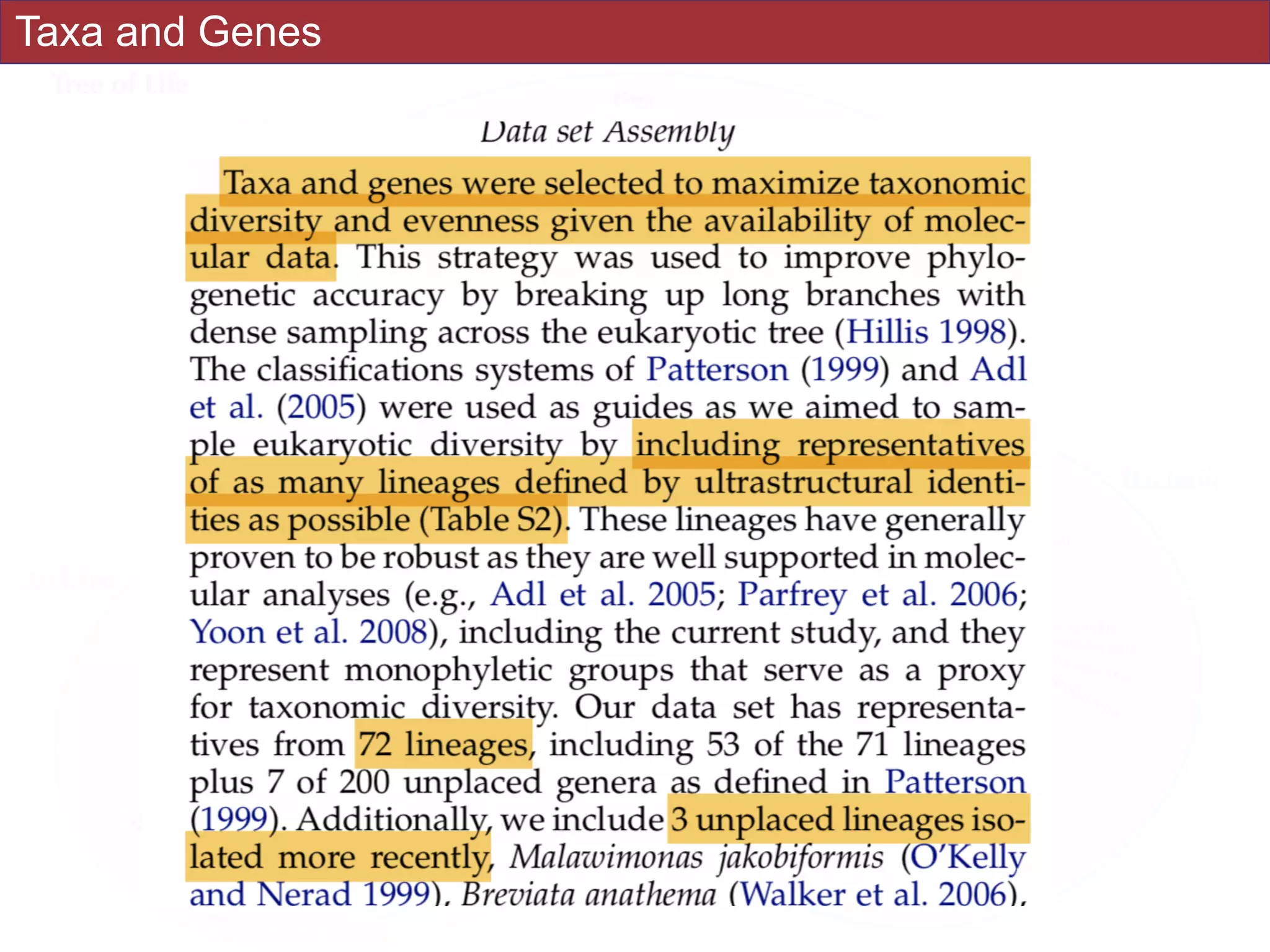
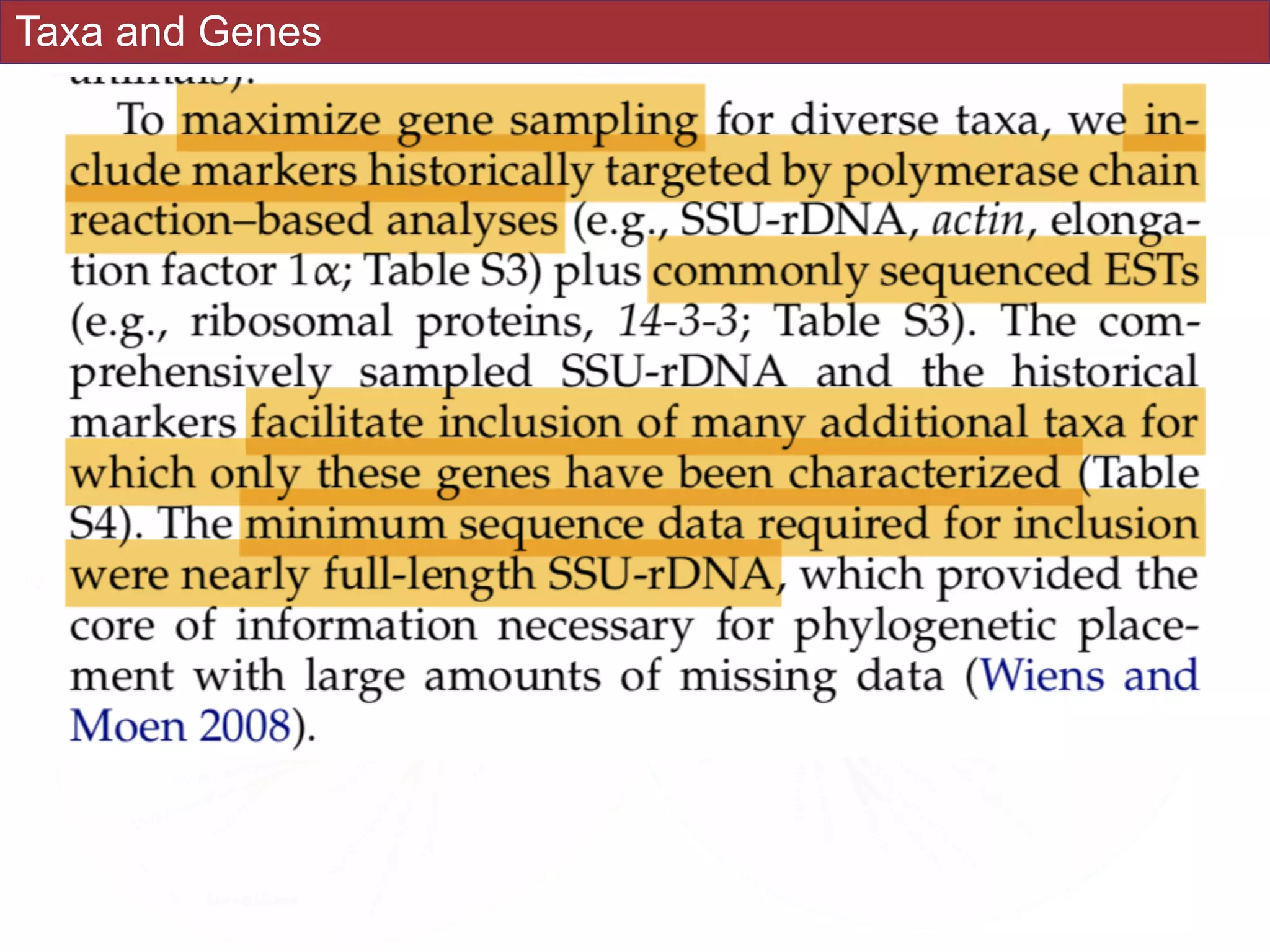
Taxa and Genes
Taxa and Genes
• ESTs
• PCR
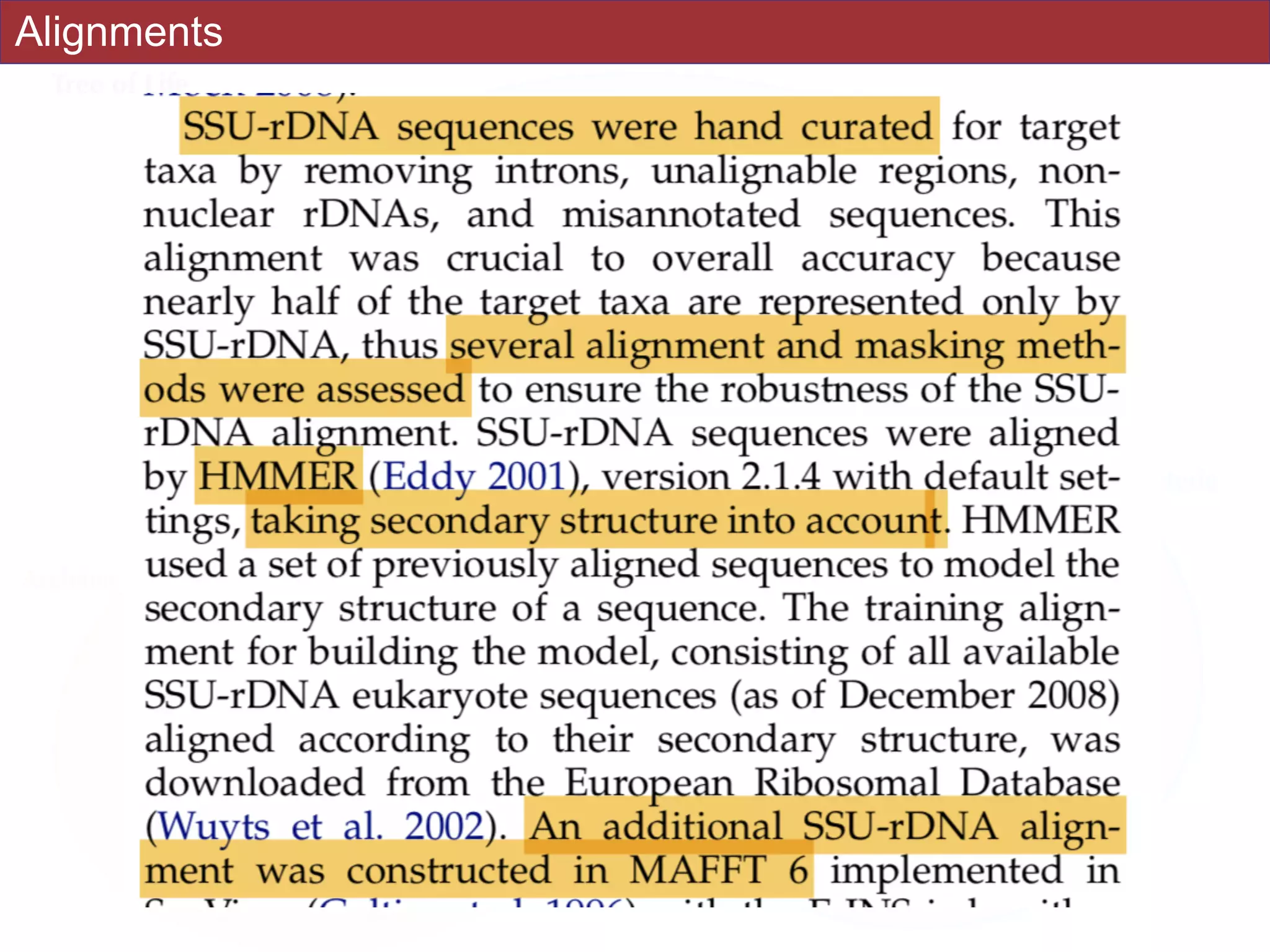
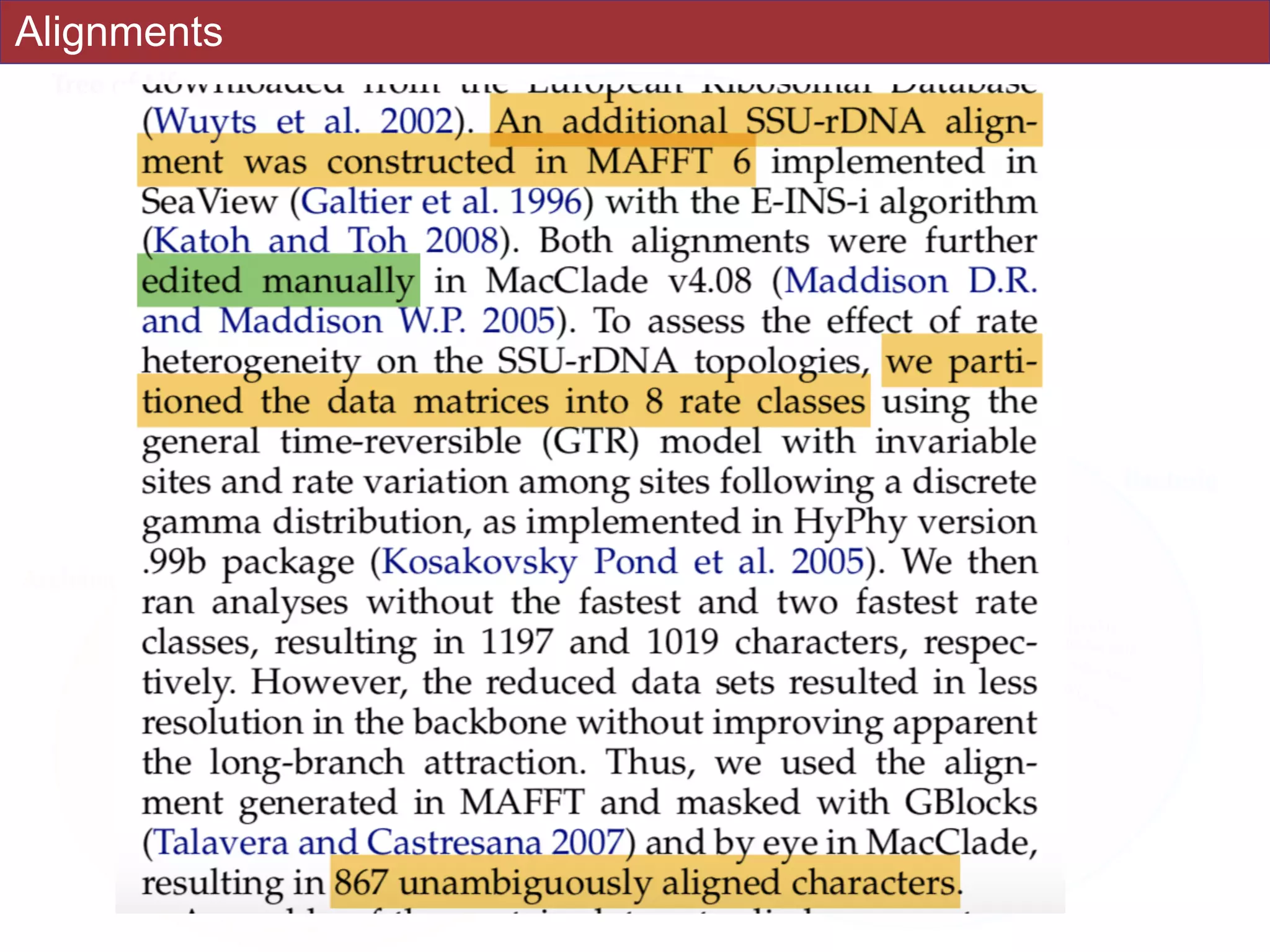
Alignments
Alignments
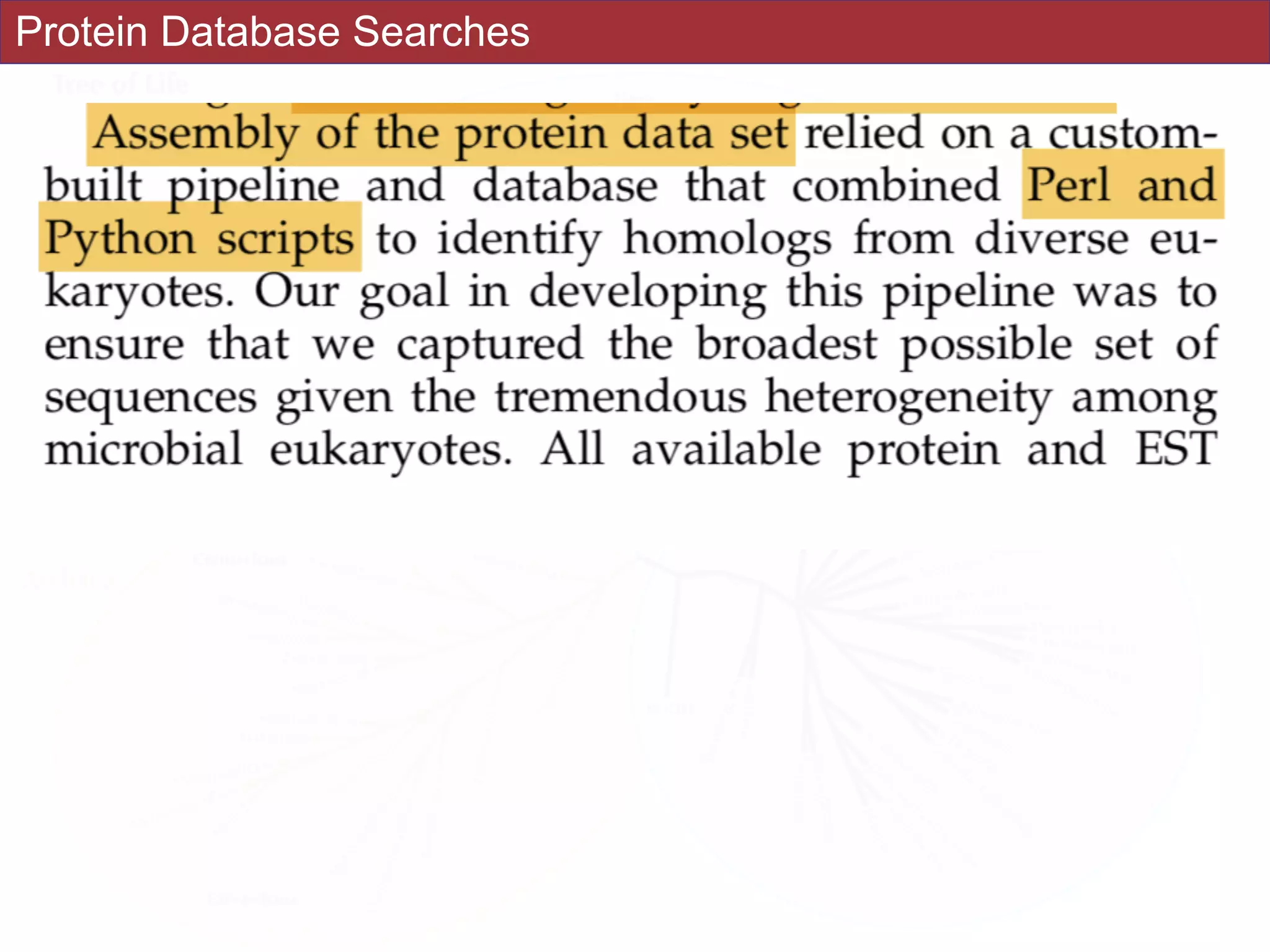
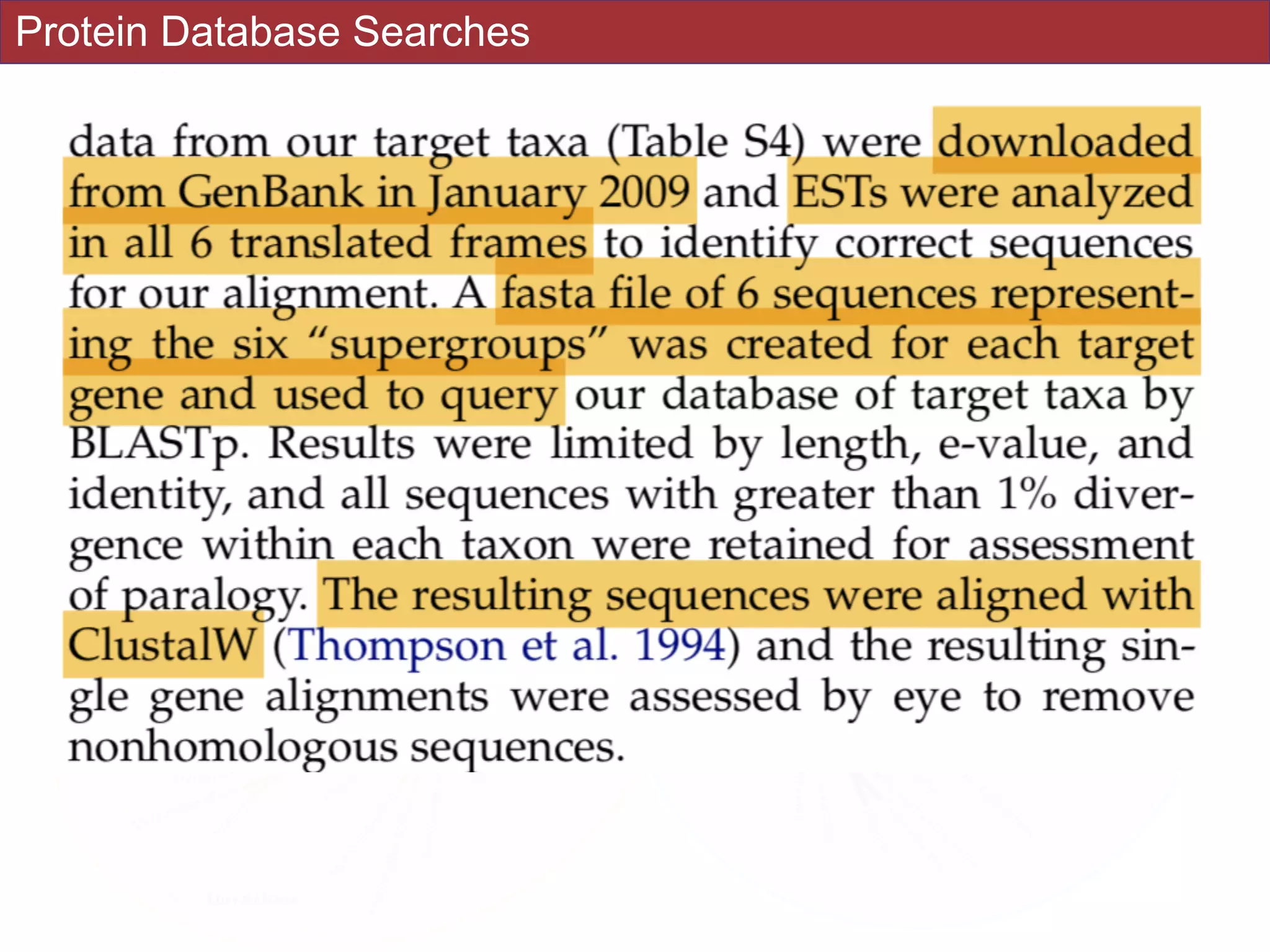
Protein Database Searches
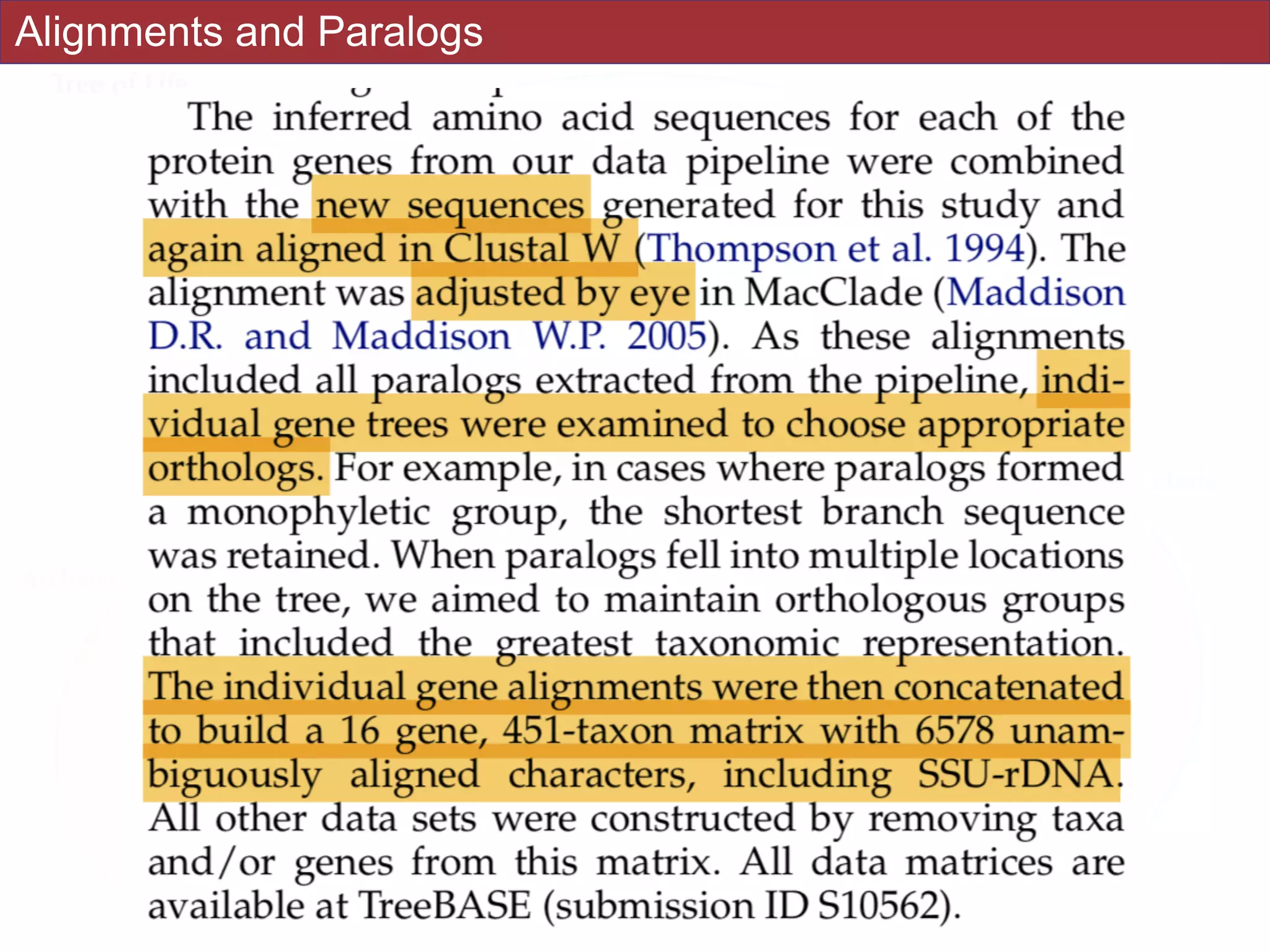
Alignments and Paralogs
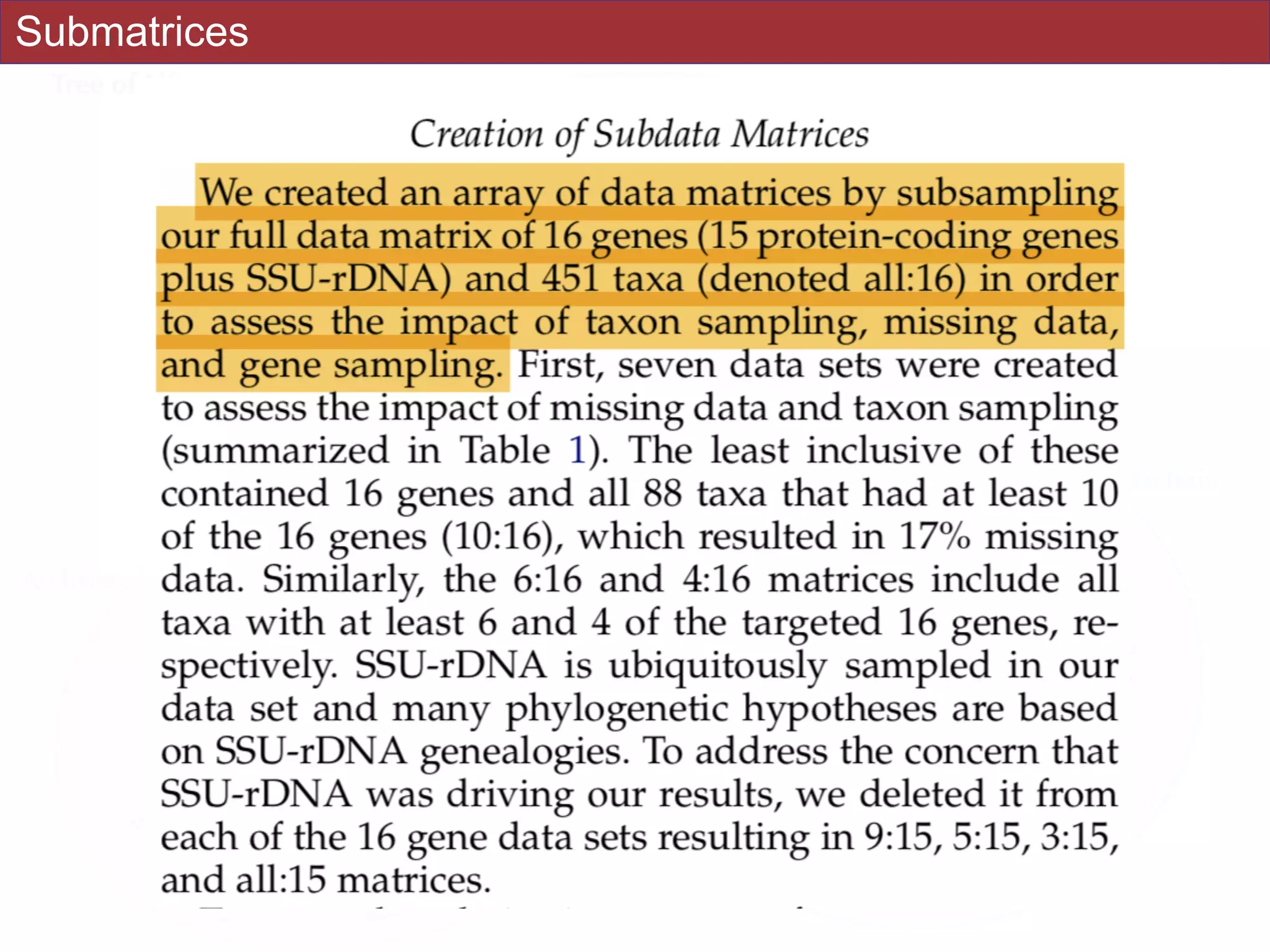
Submatrices
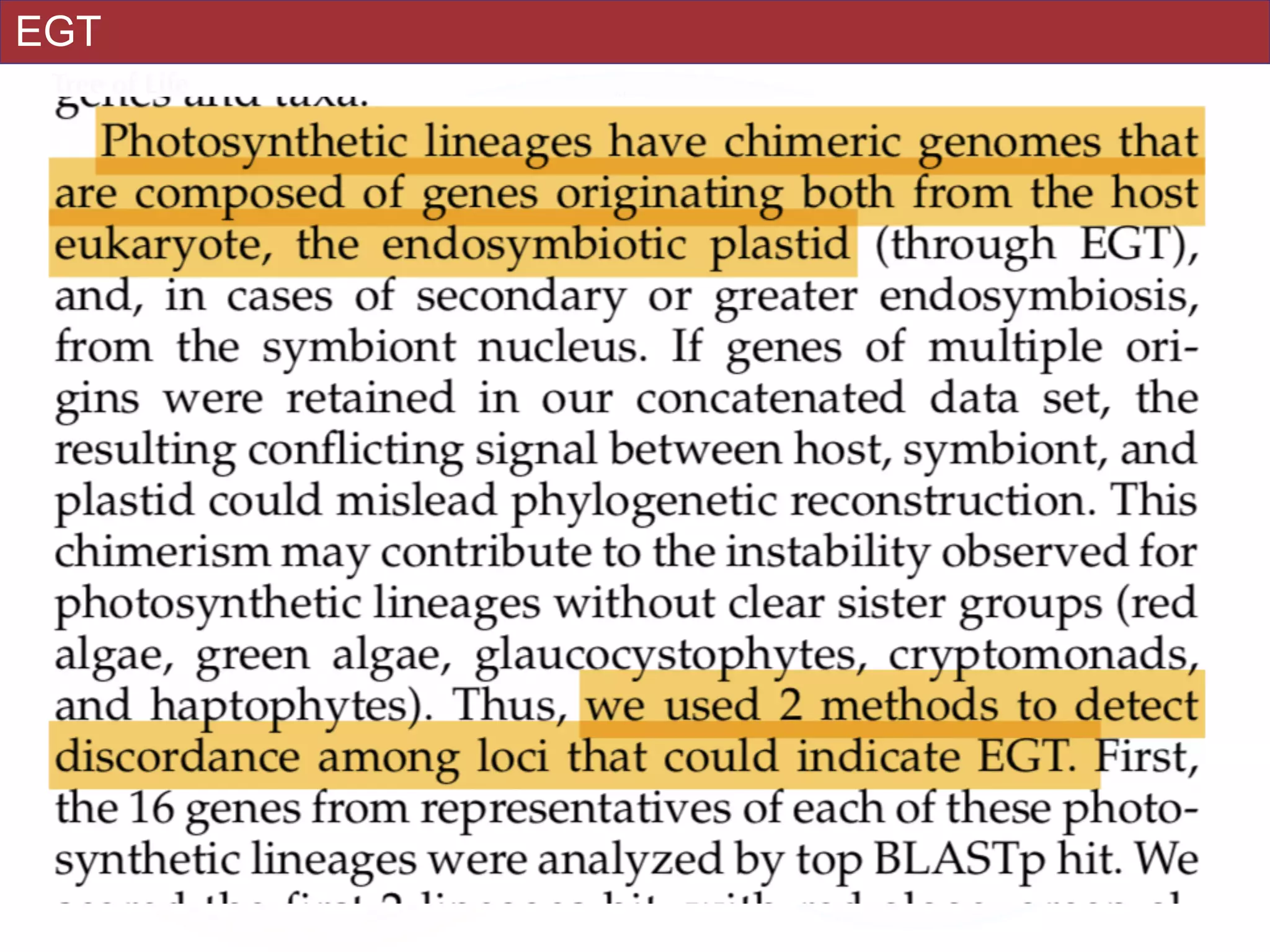
EGT
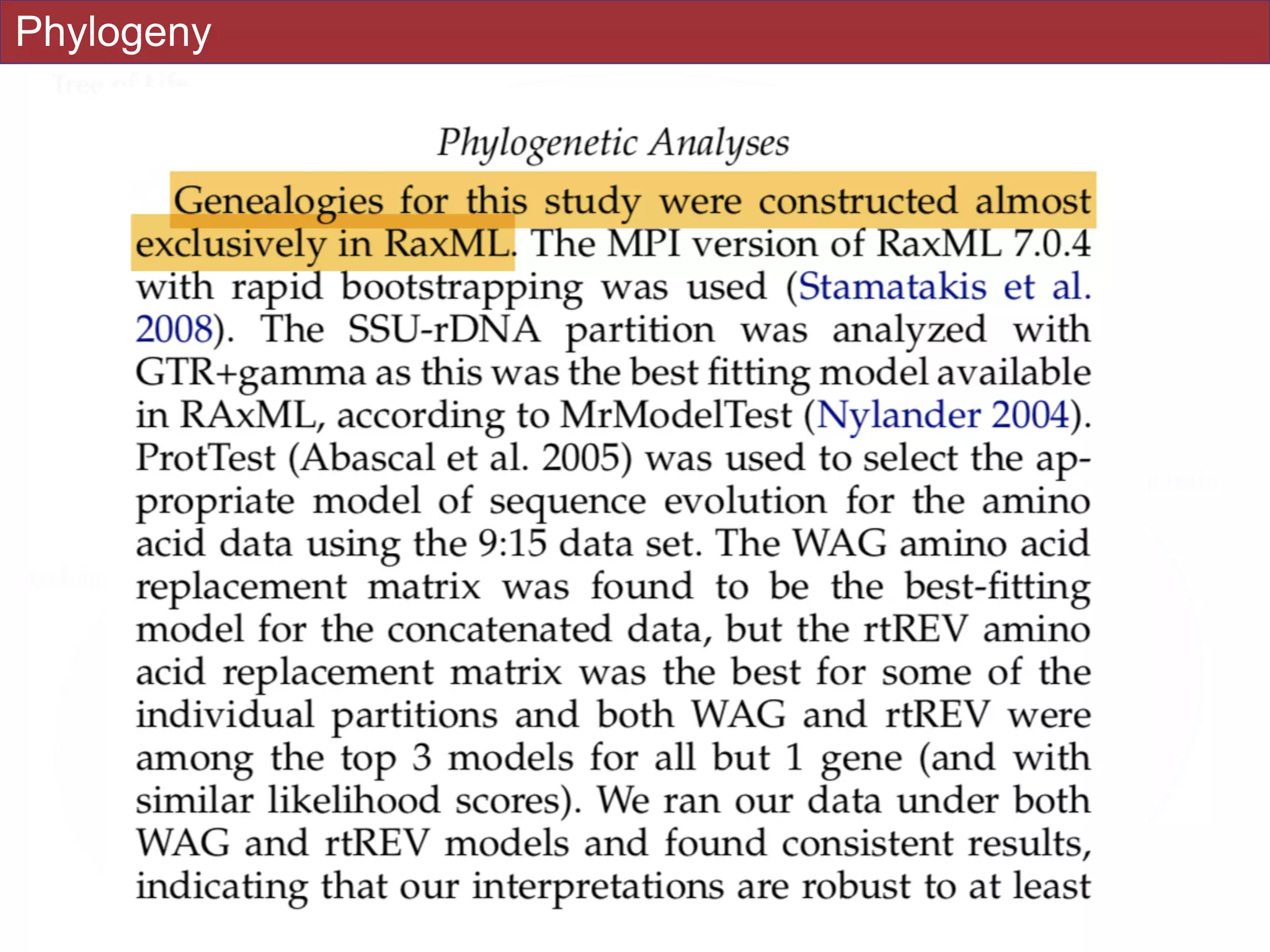
Phylogeny
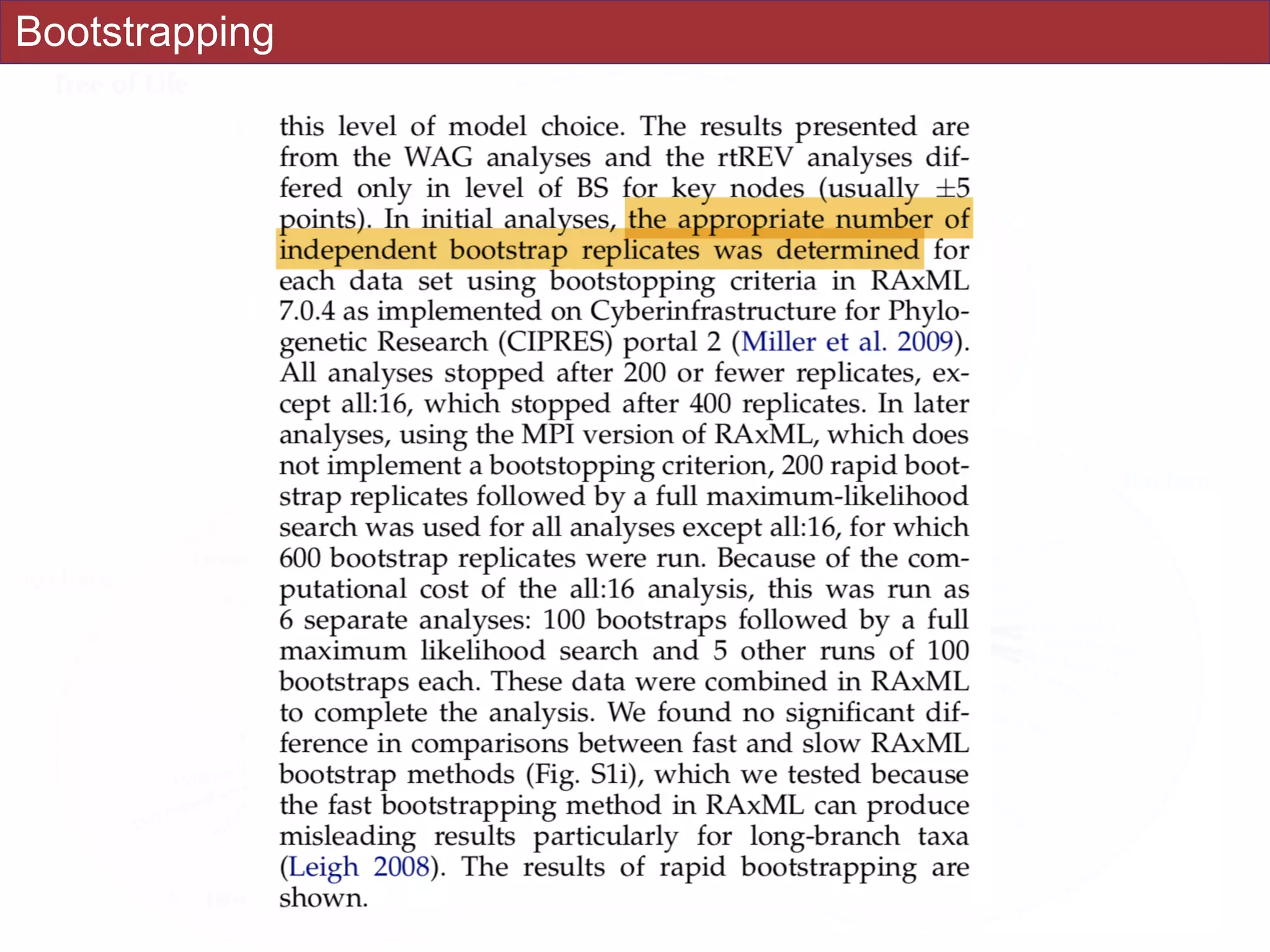
Bootstrapping
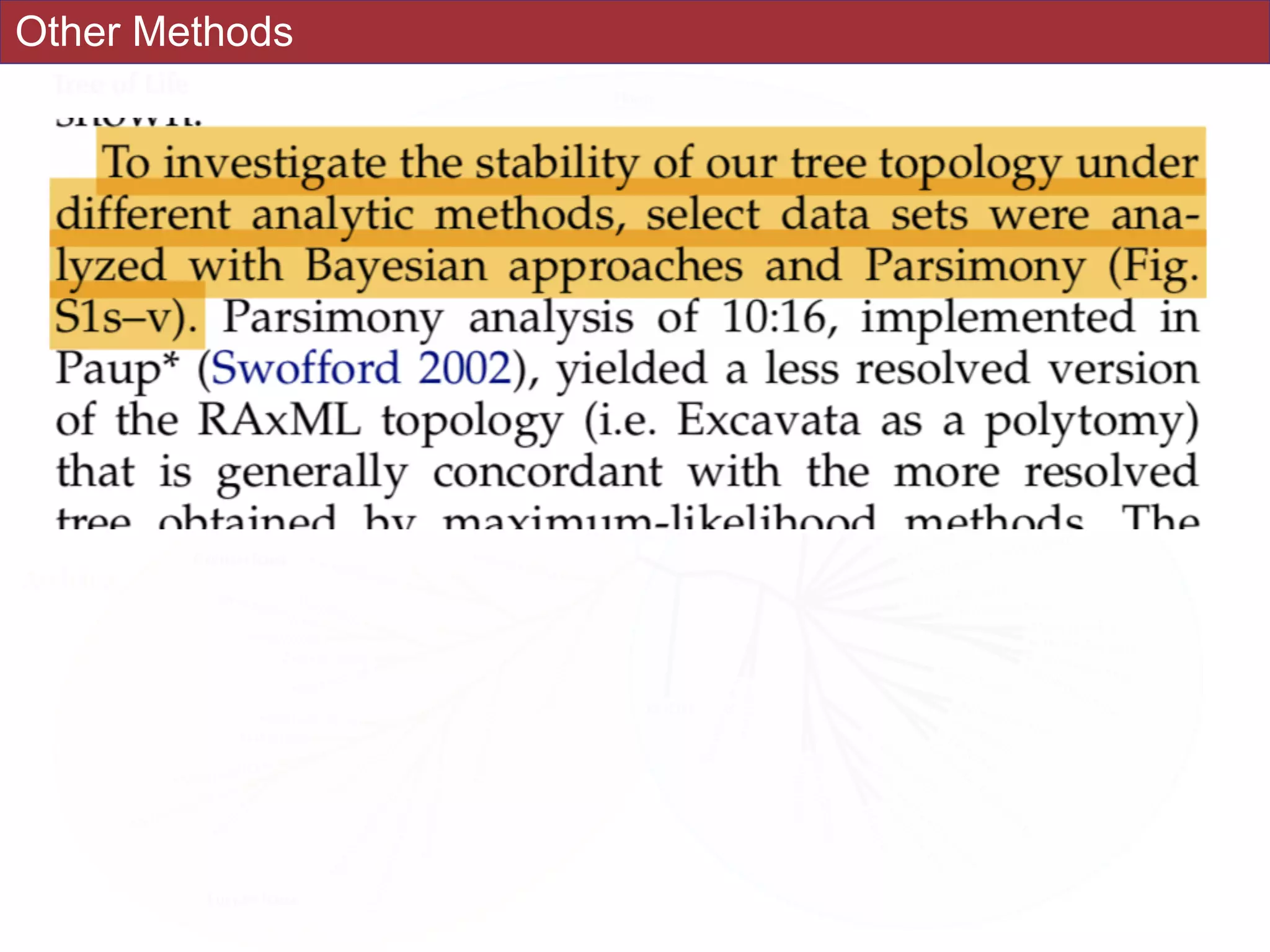
Other Methods
Methods
• Questions about Methods?
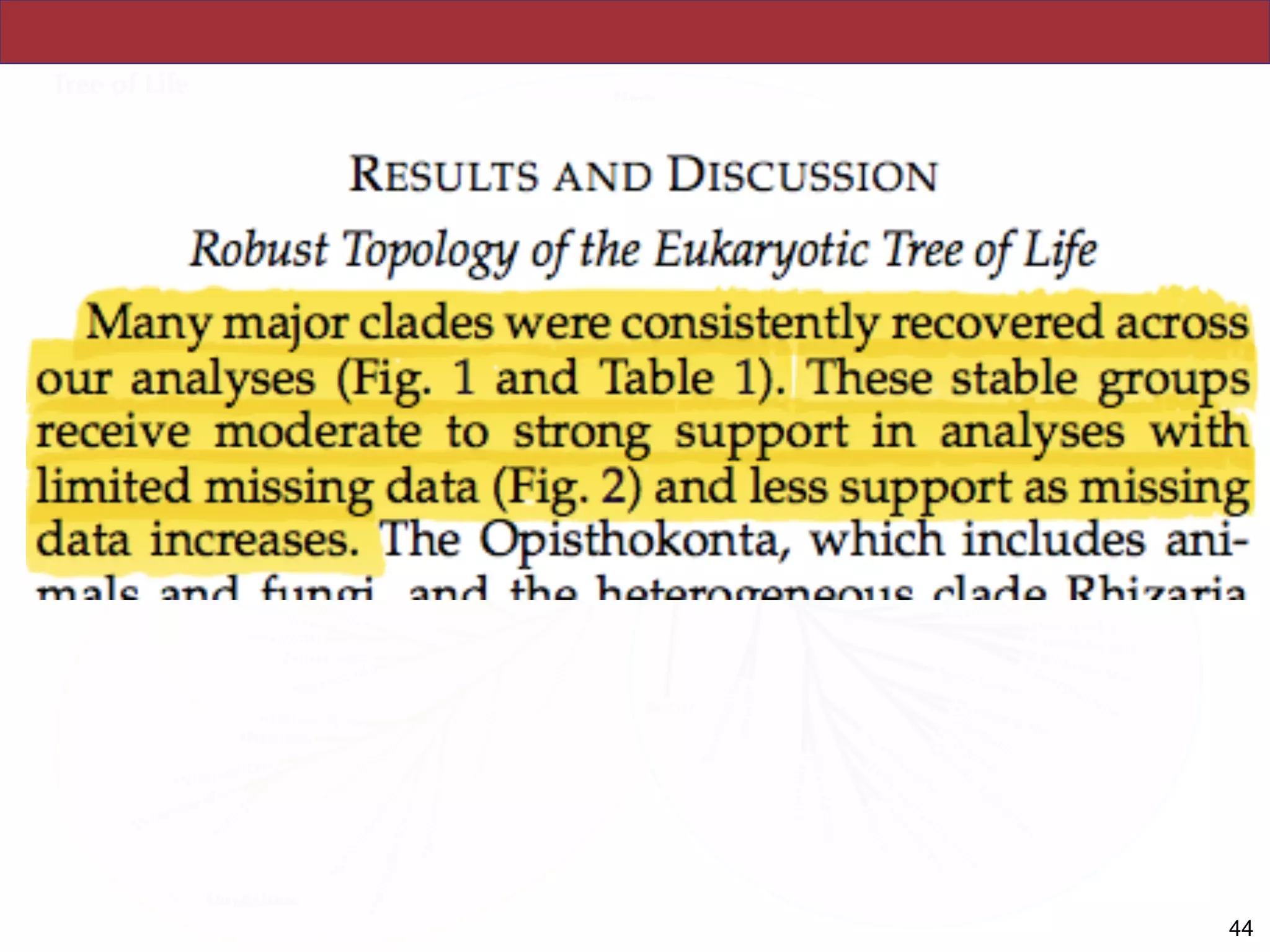
Results and Discussion
!44
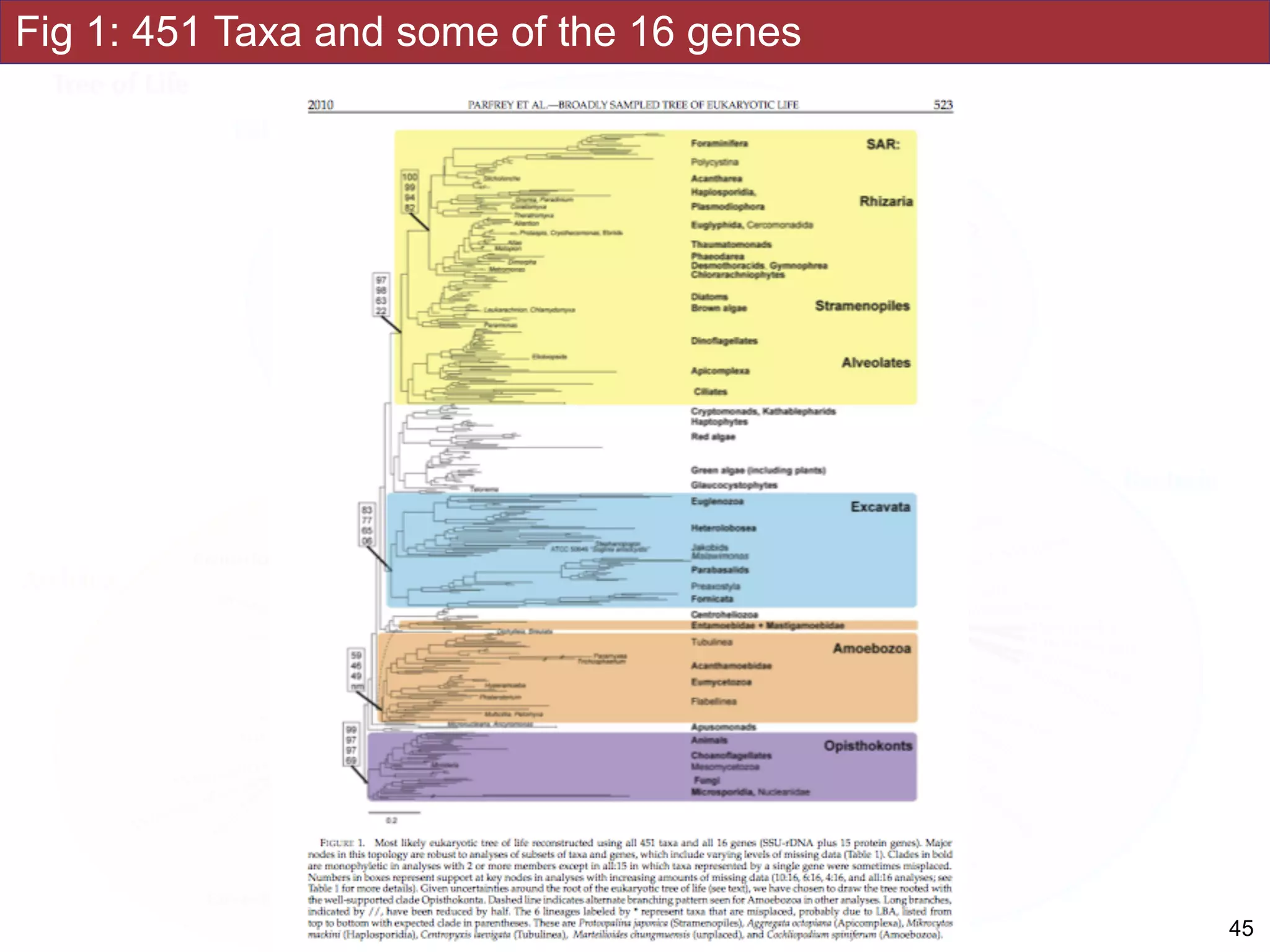
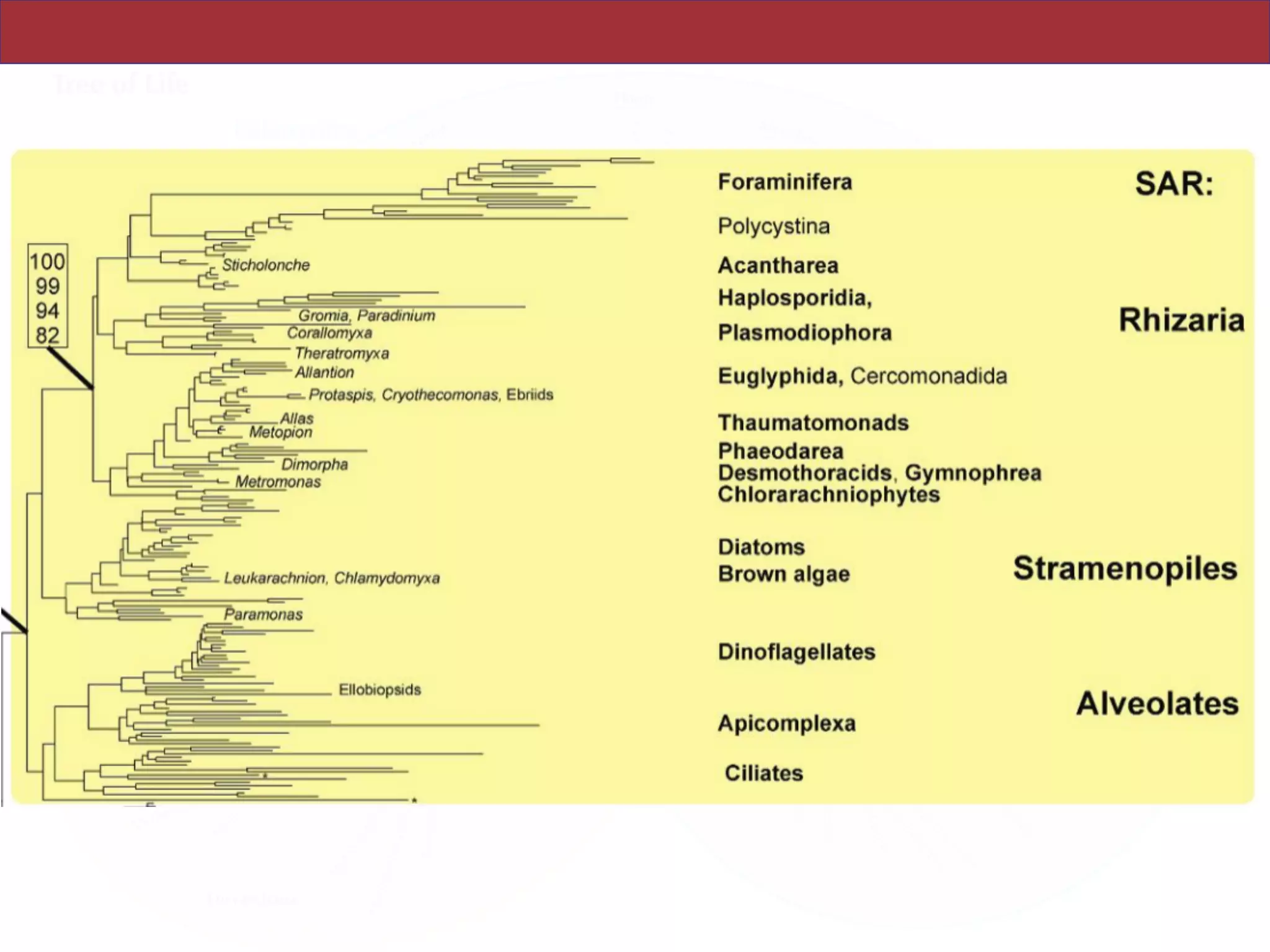
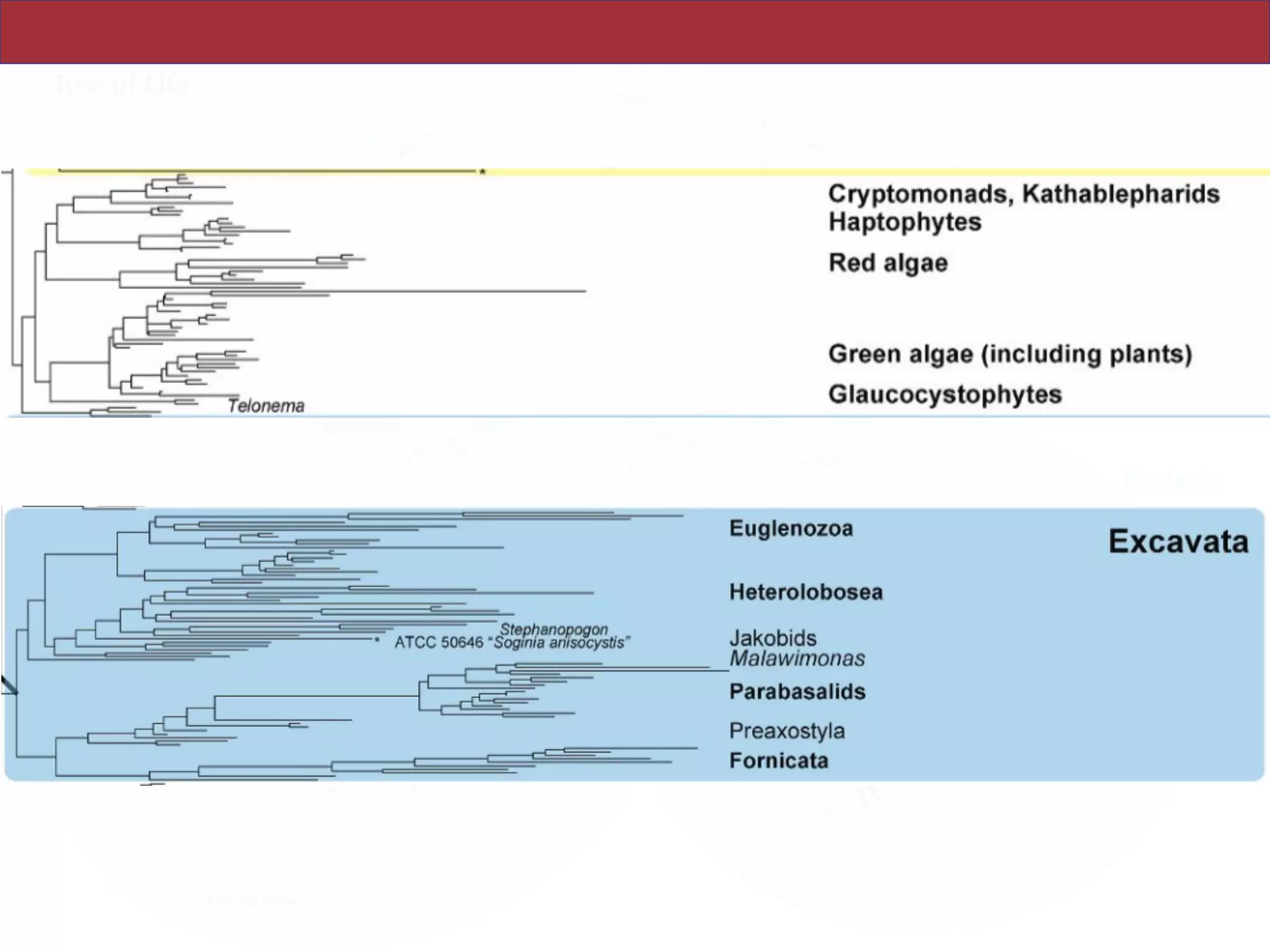
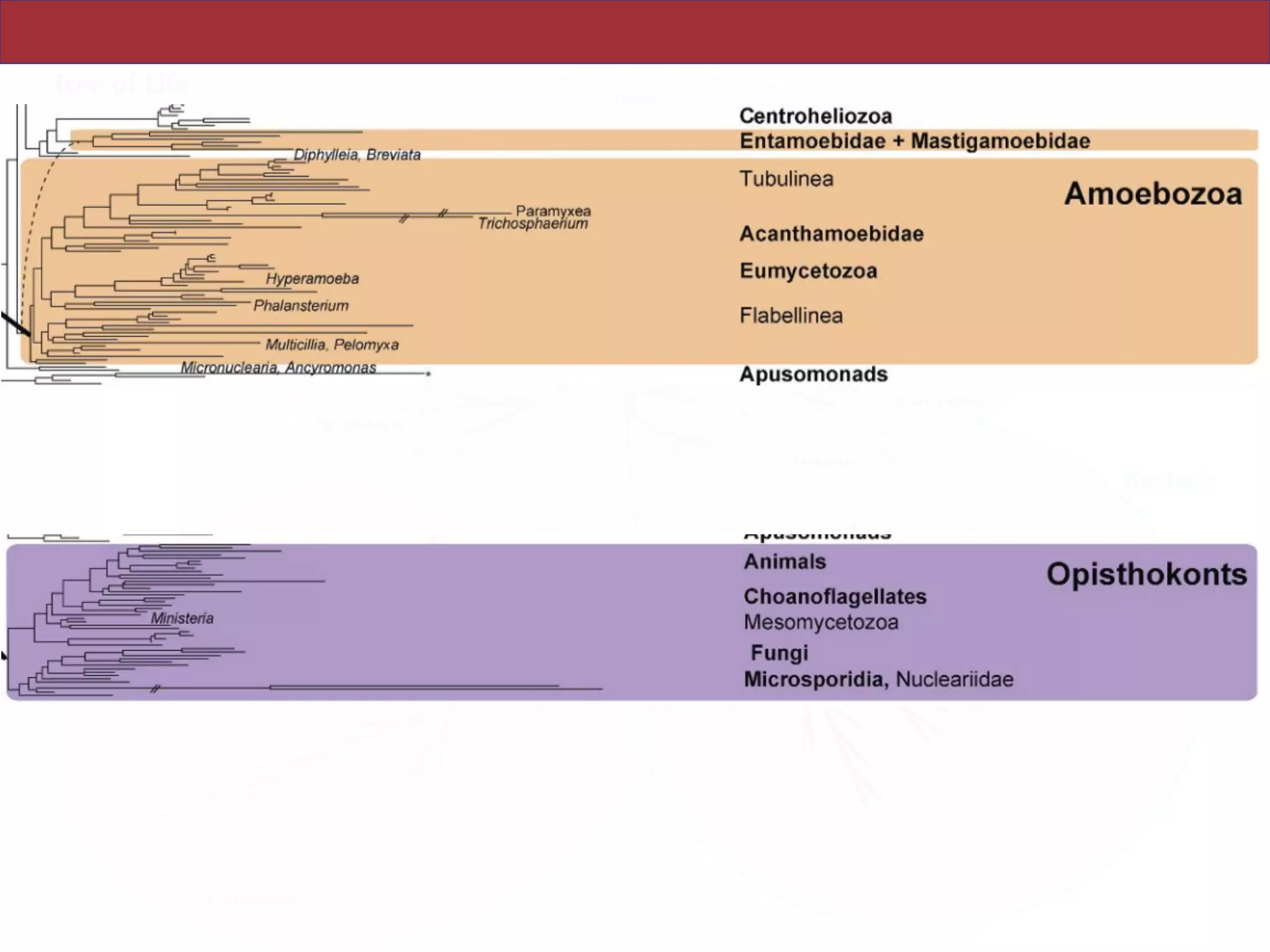
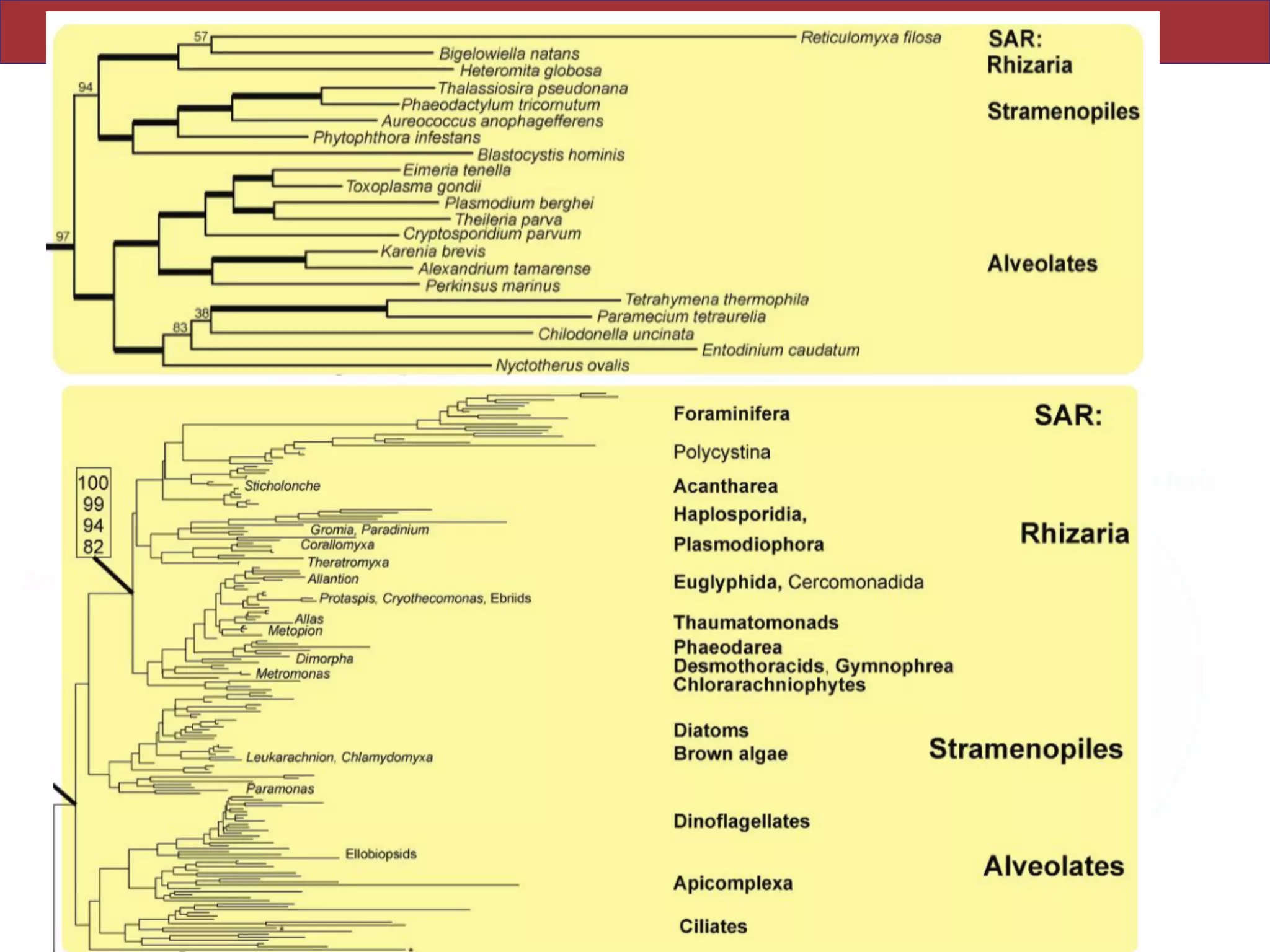
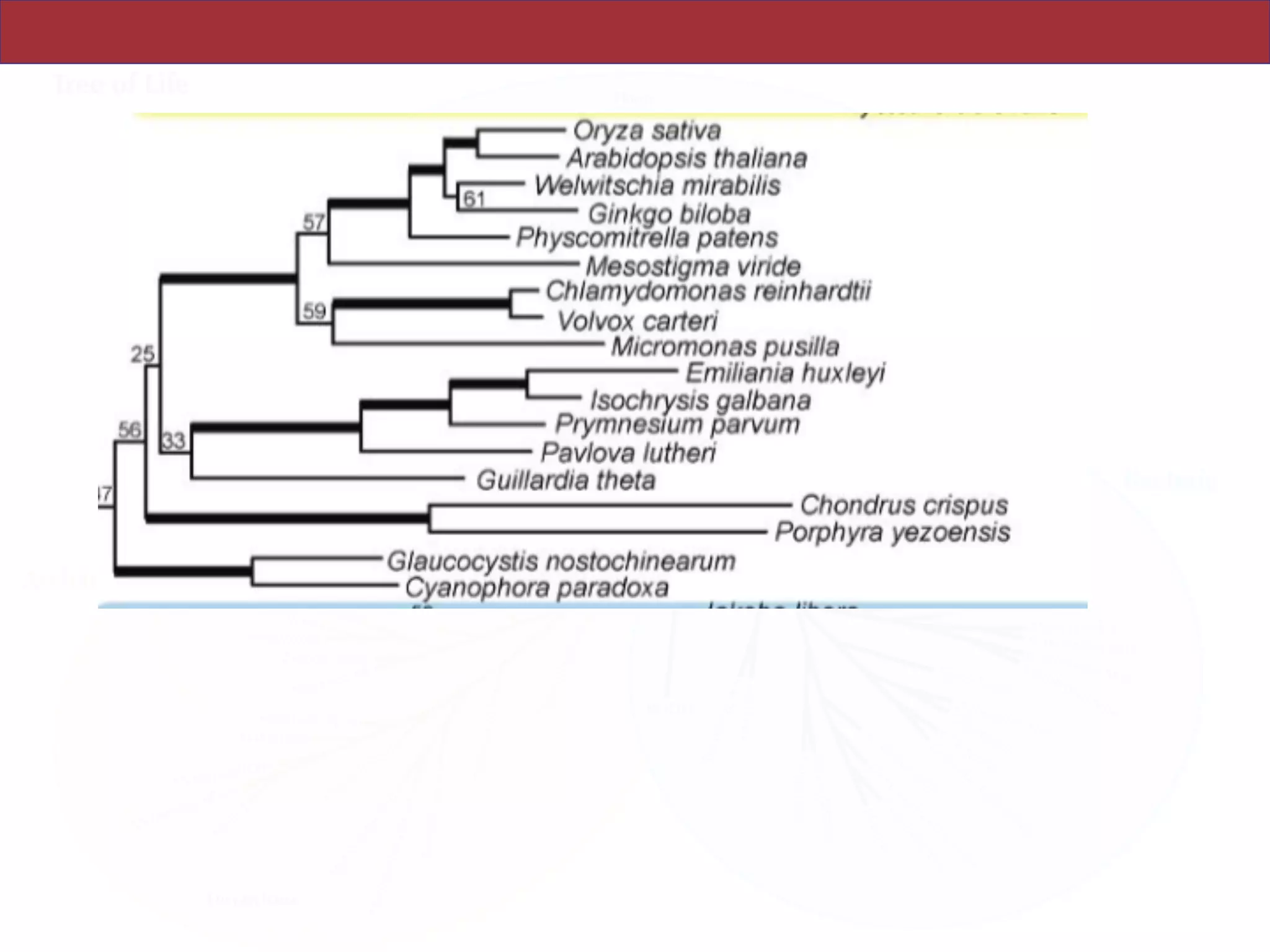
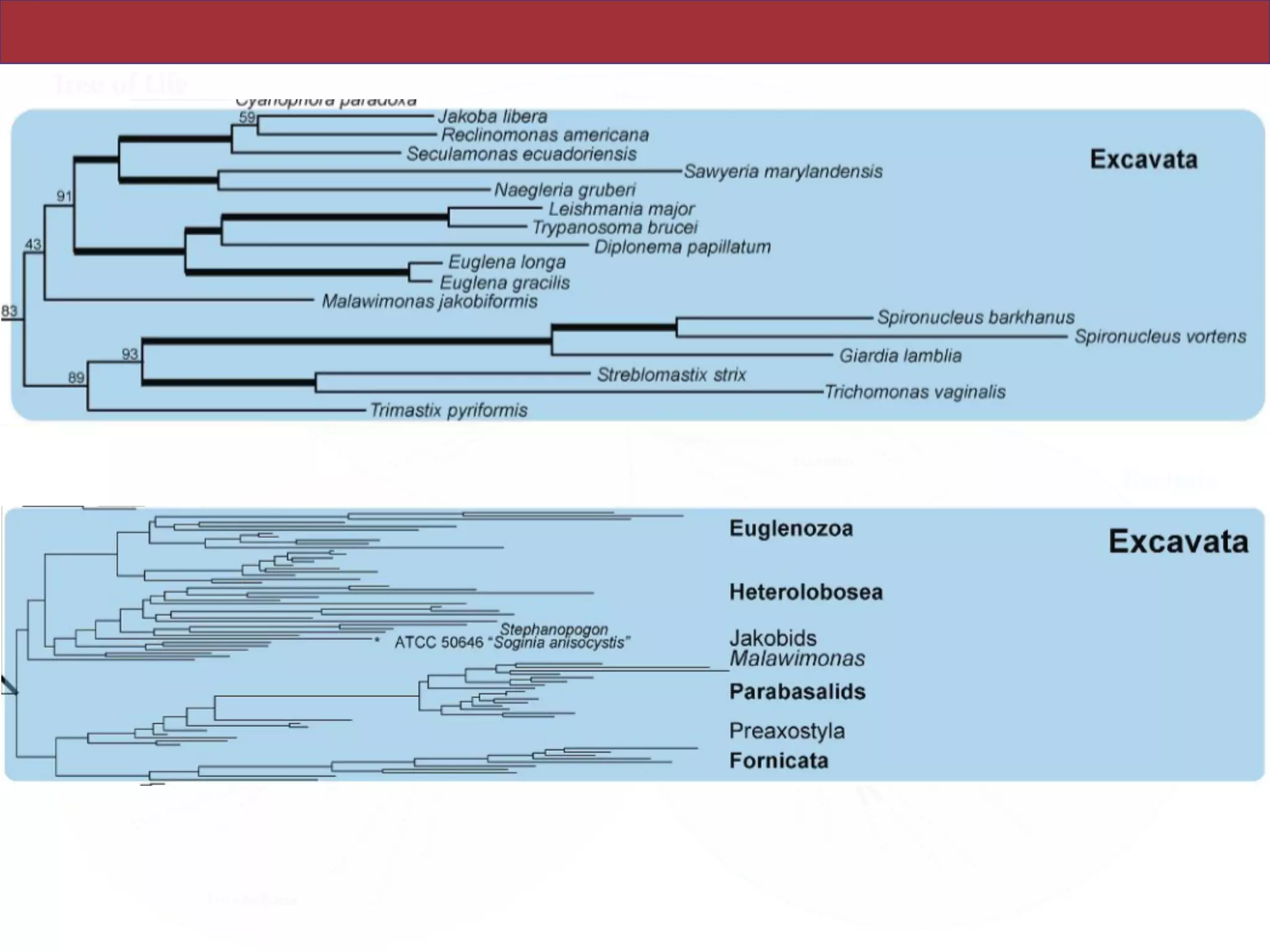
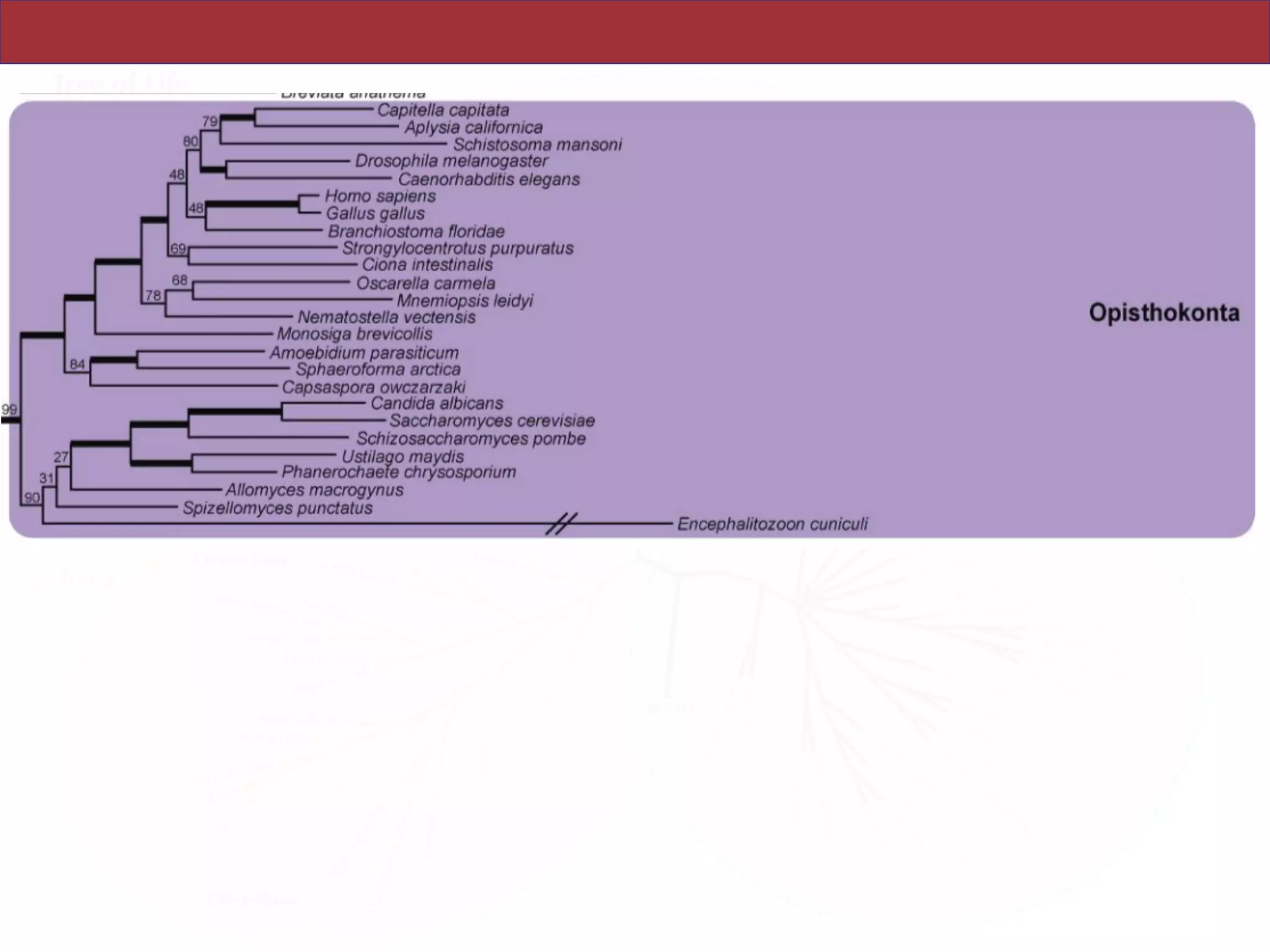
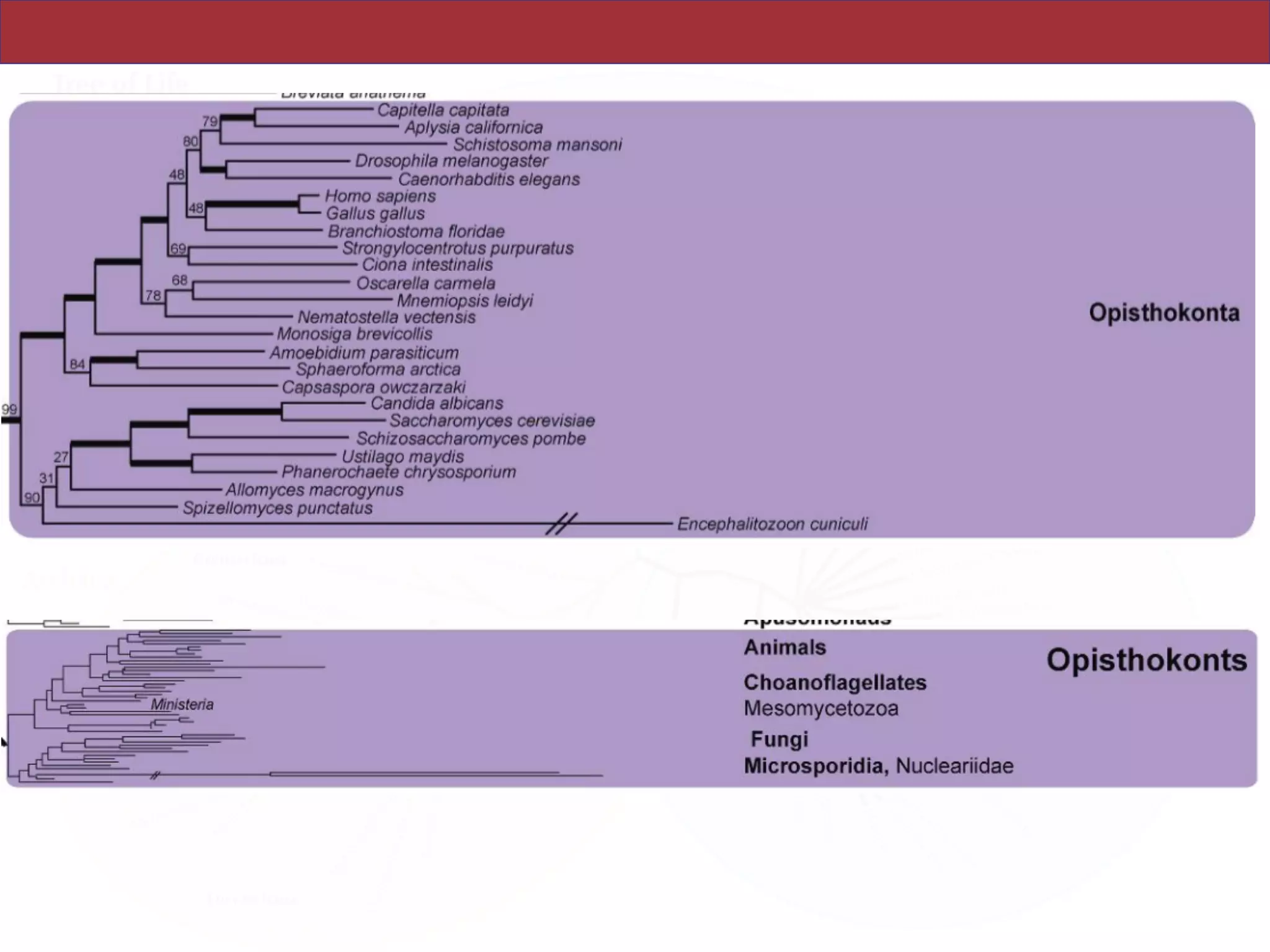
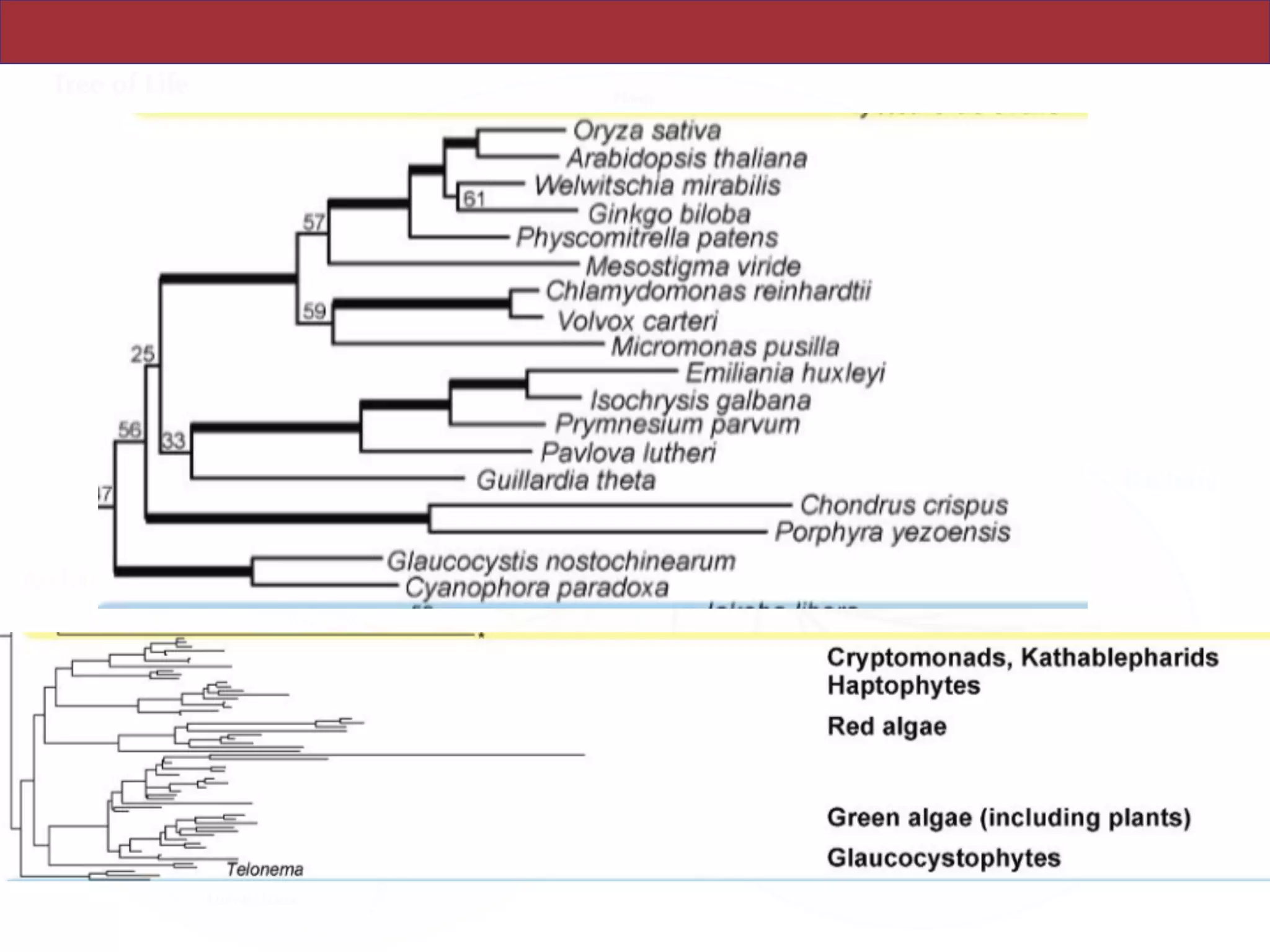
Fig 1: 451 Taxa and some of the 16 genes
!45
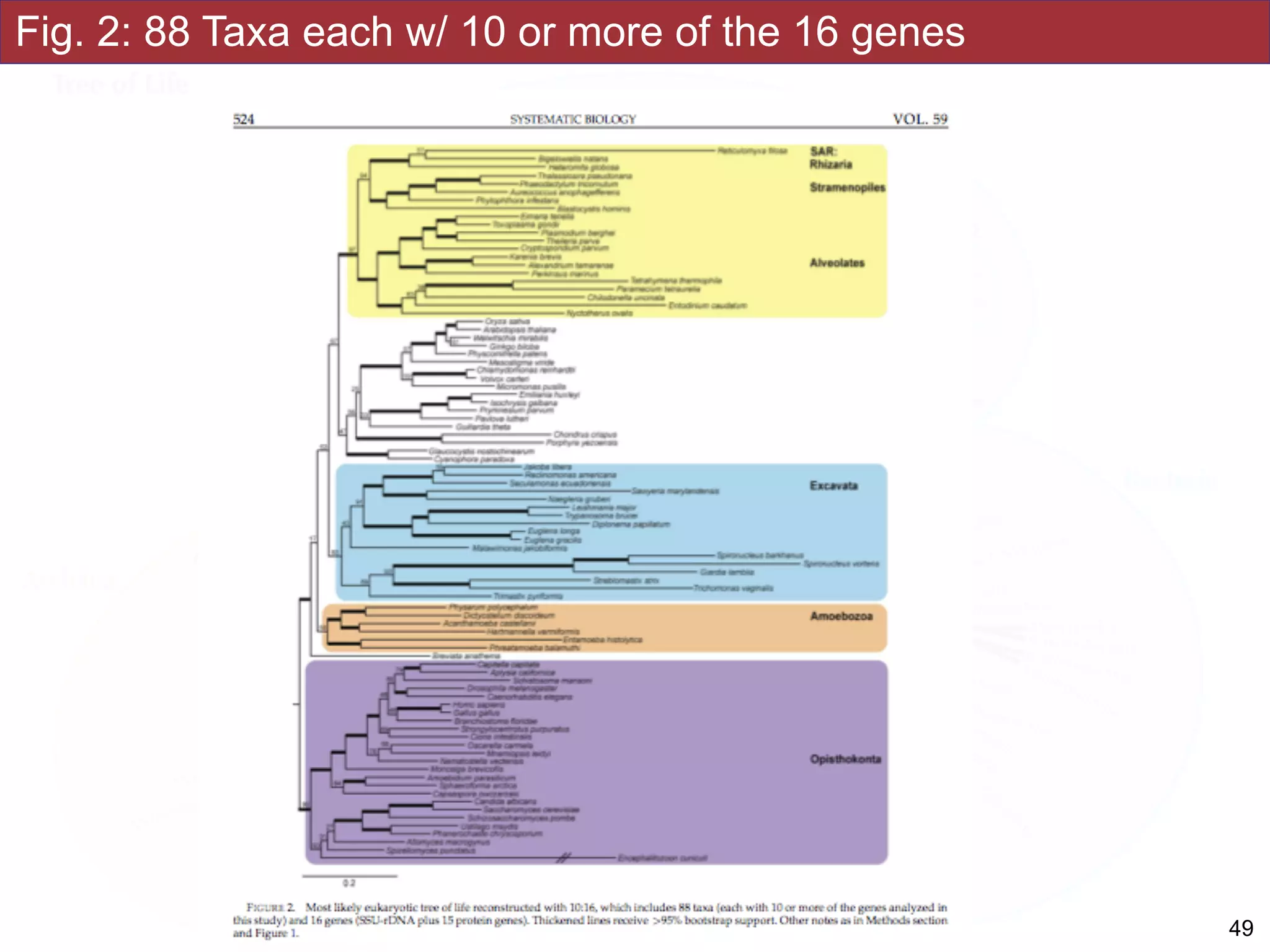
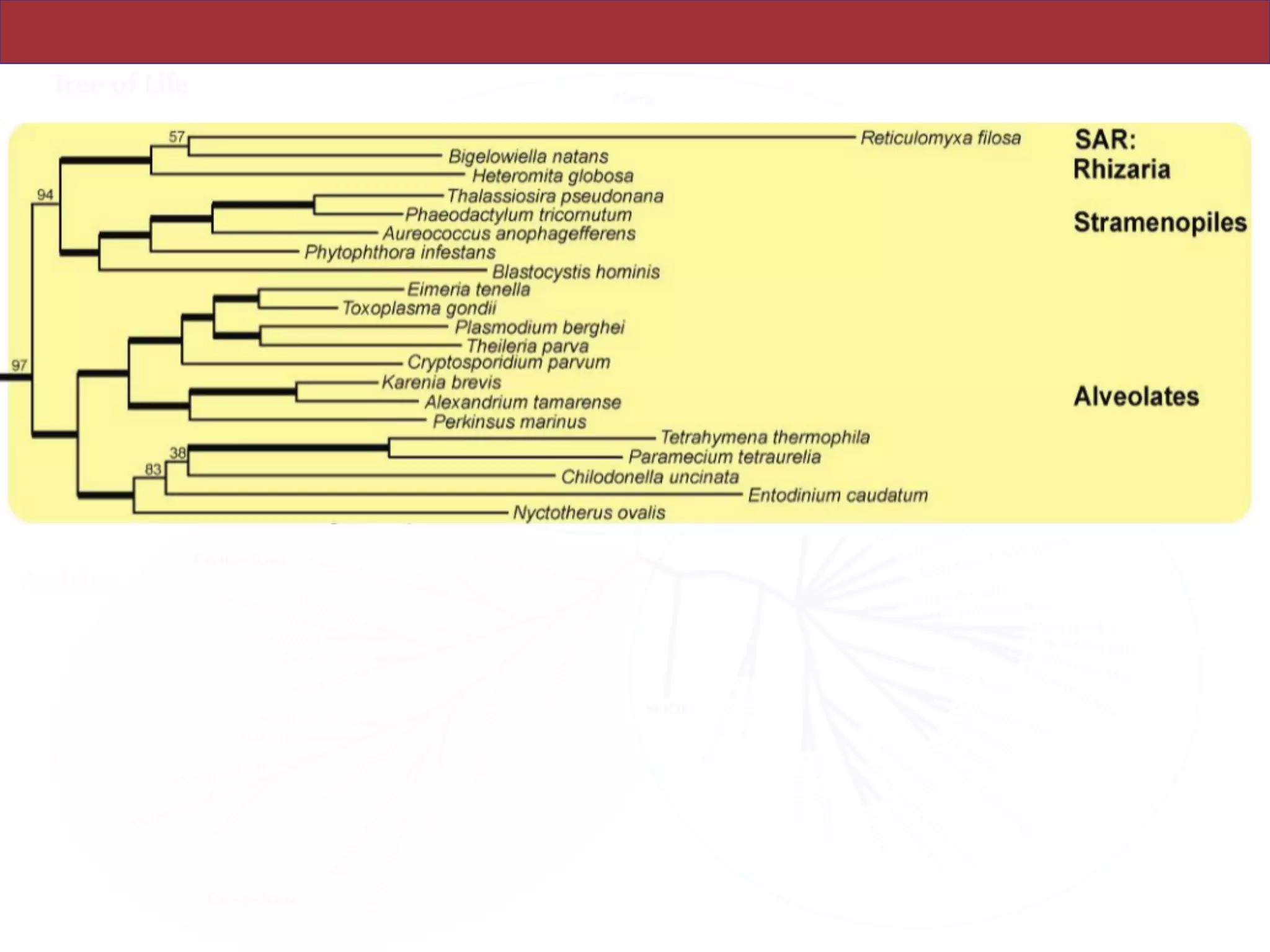
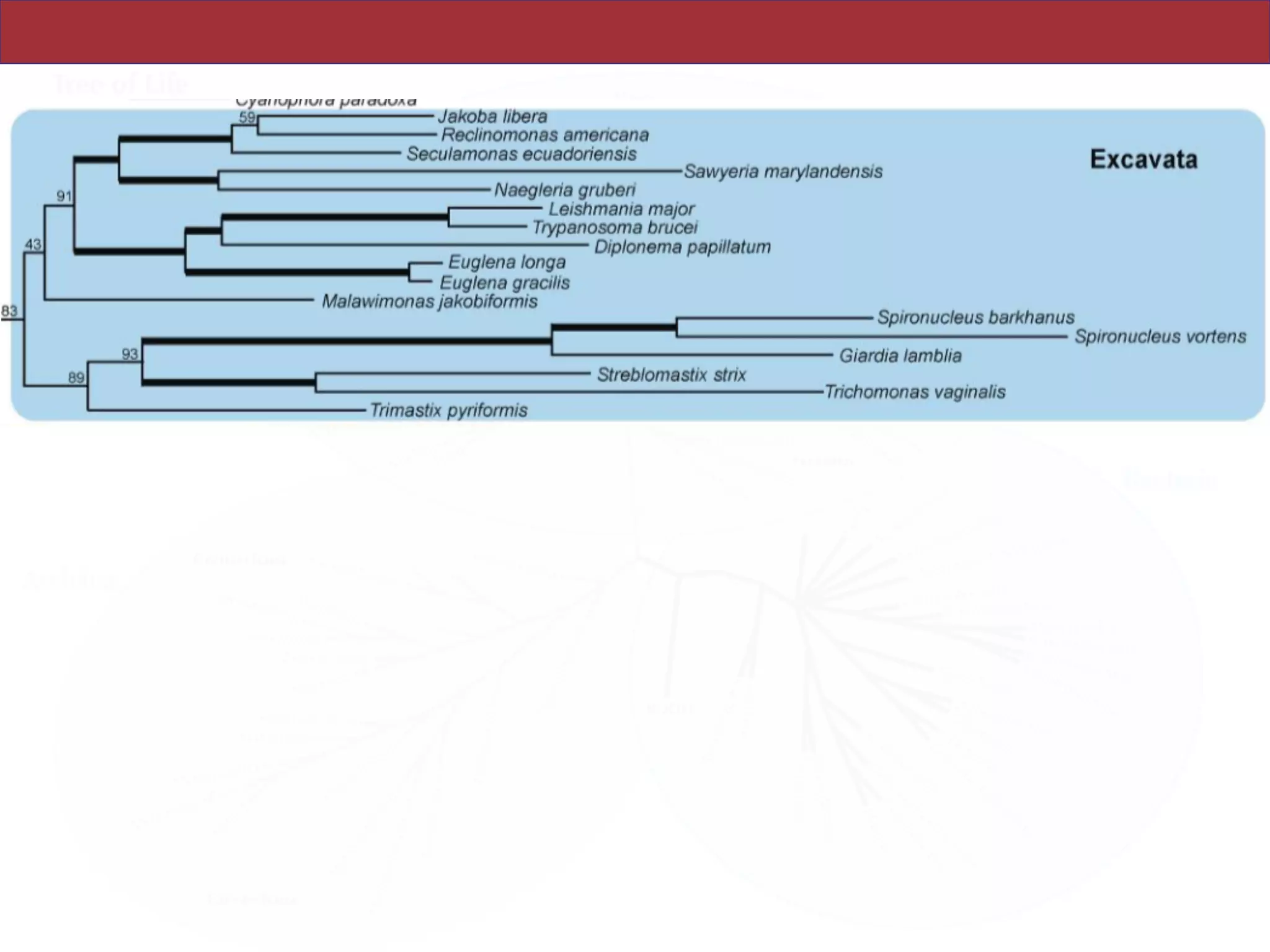
Fig. 2: 88 Taxa each w/ 10 or more of the 16 genes
!49
!58
!59
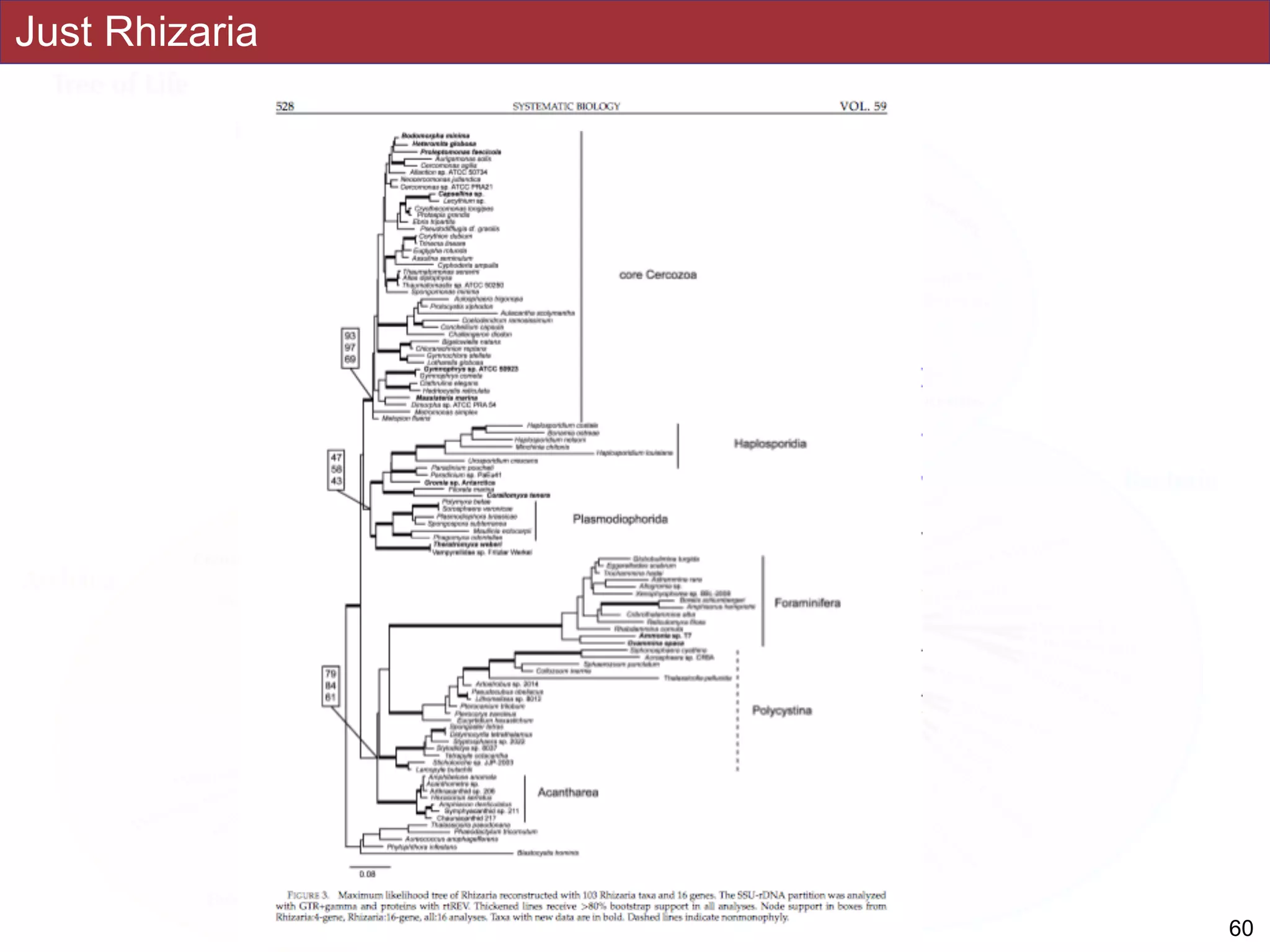
Just Rhizaria
!60
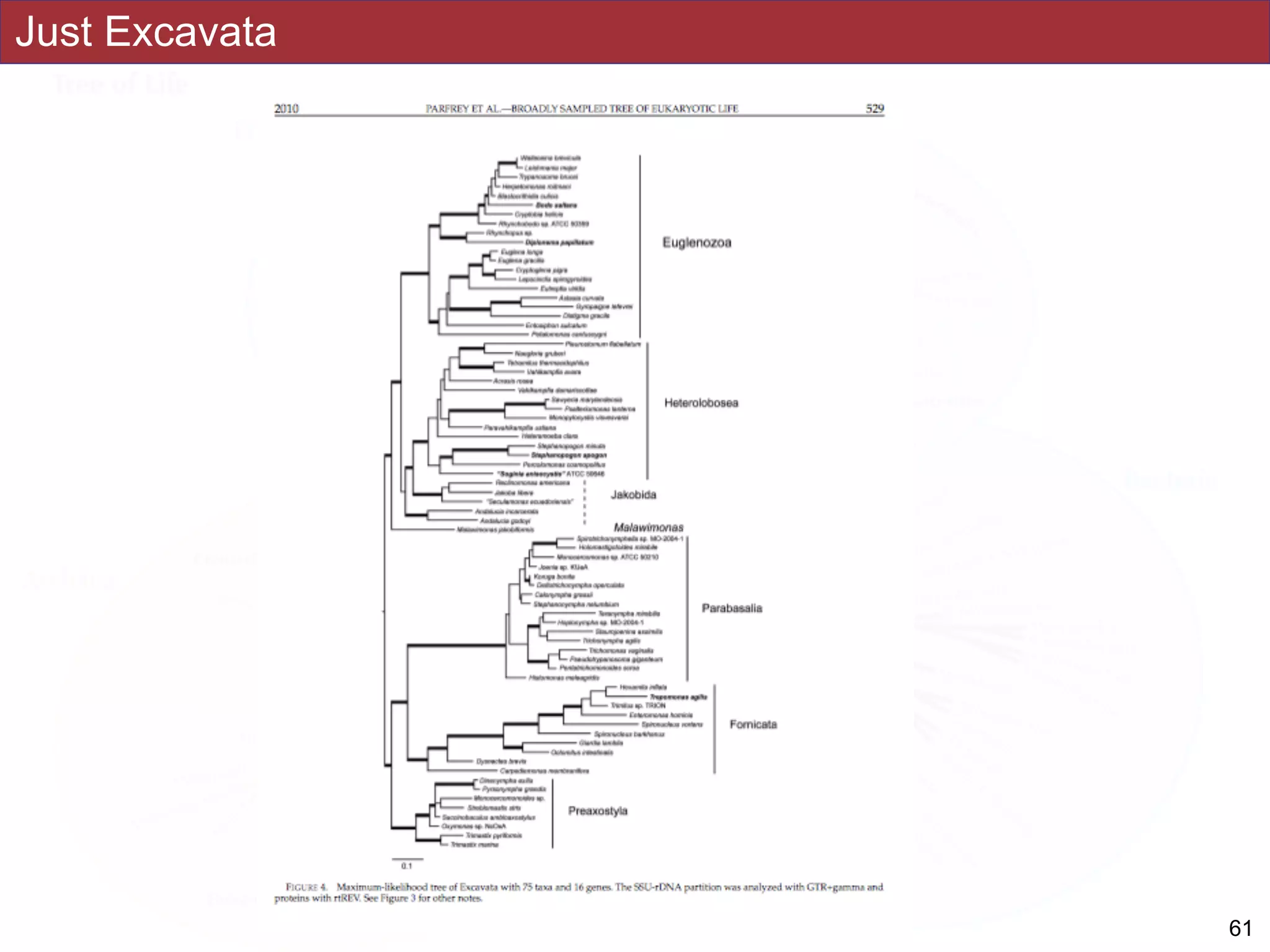
Just Excavata
!61
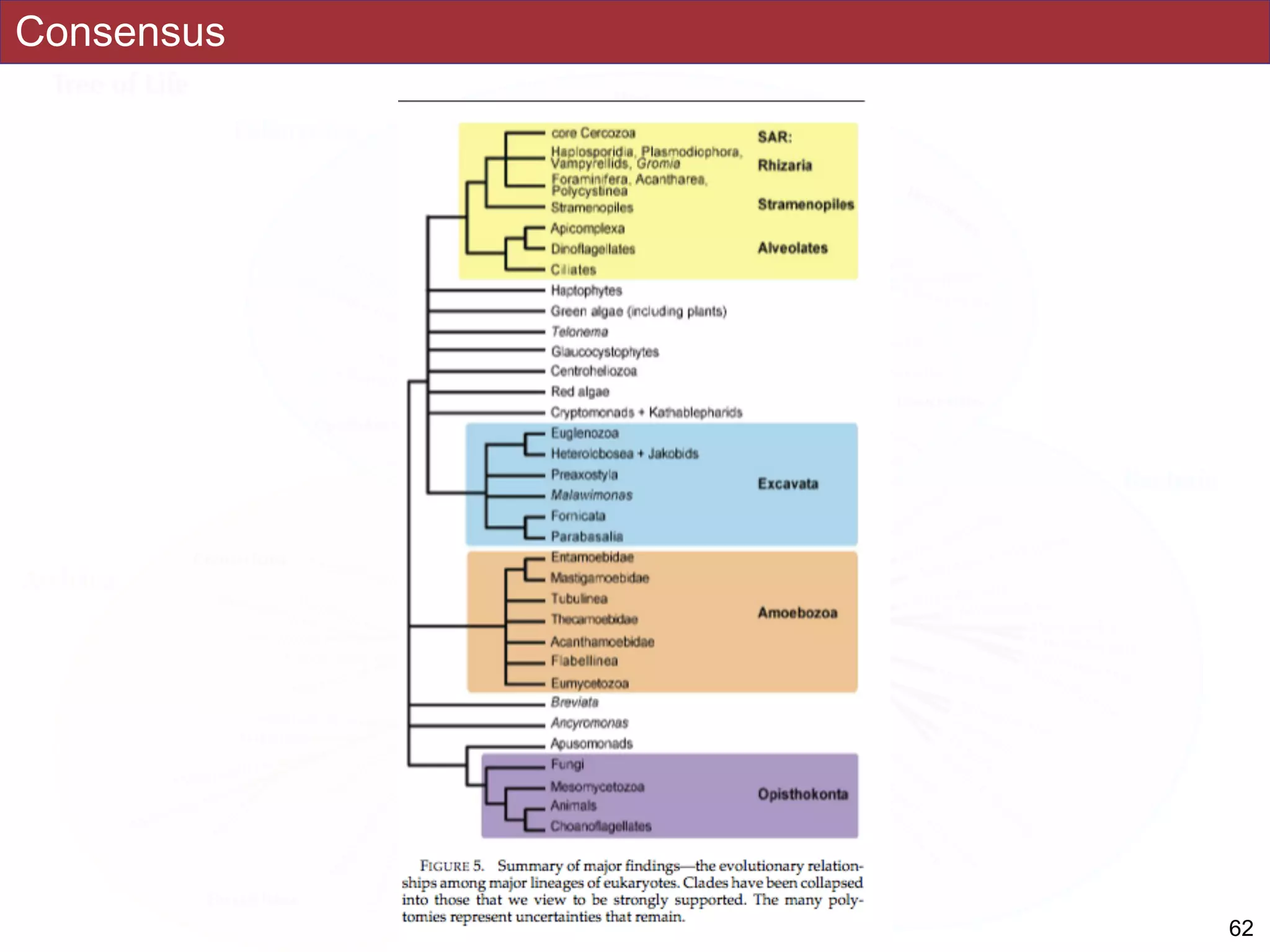
Consensus
!62
Results and Discussions
• Questions
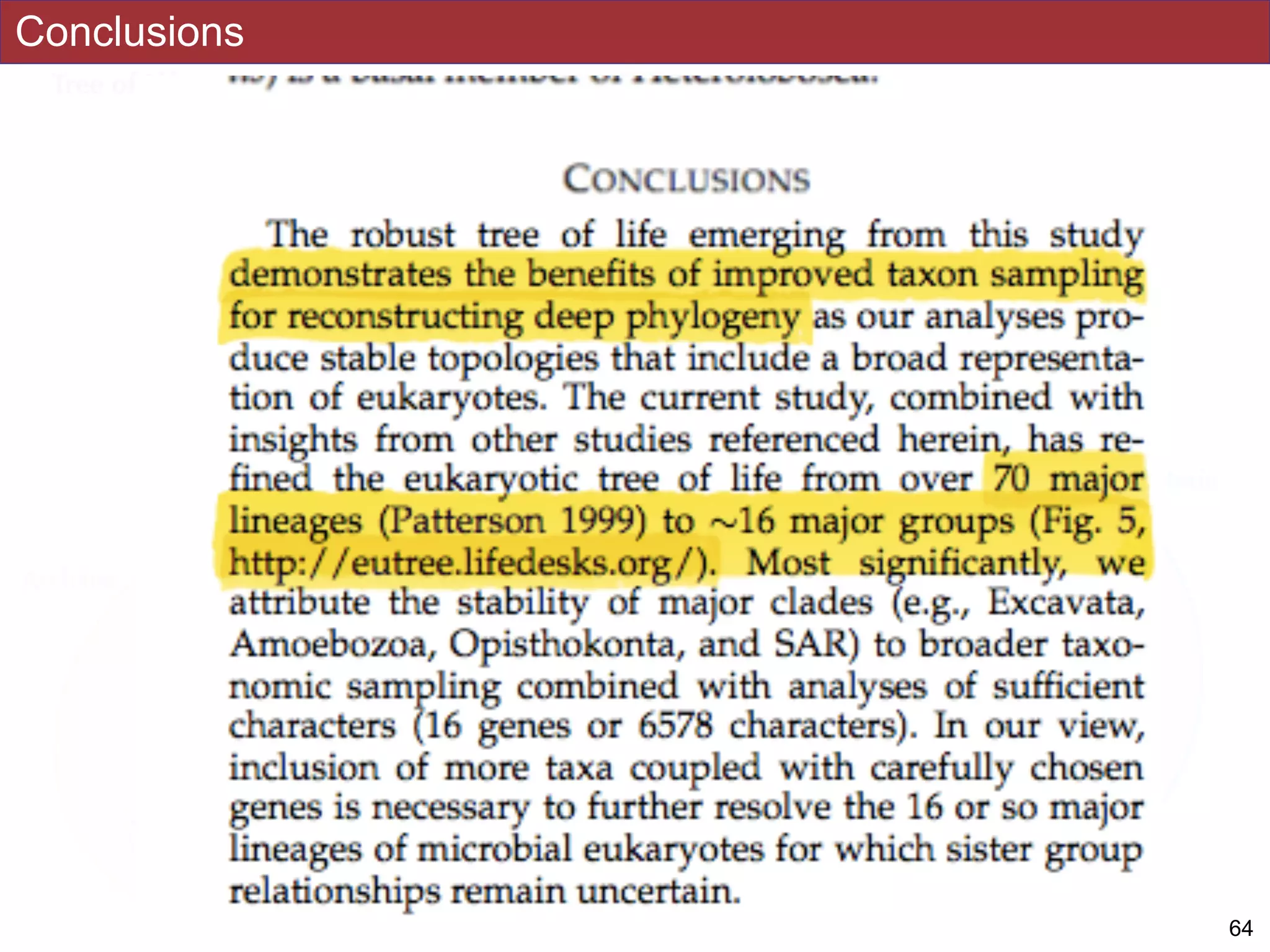
Conclusions
!64
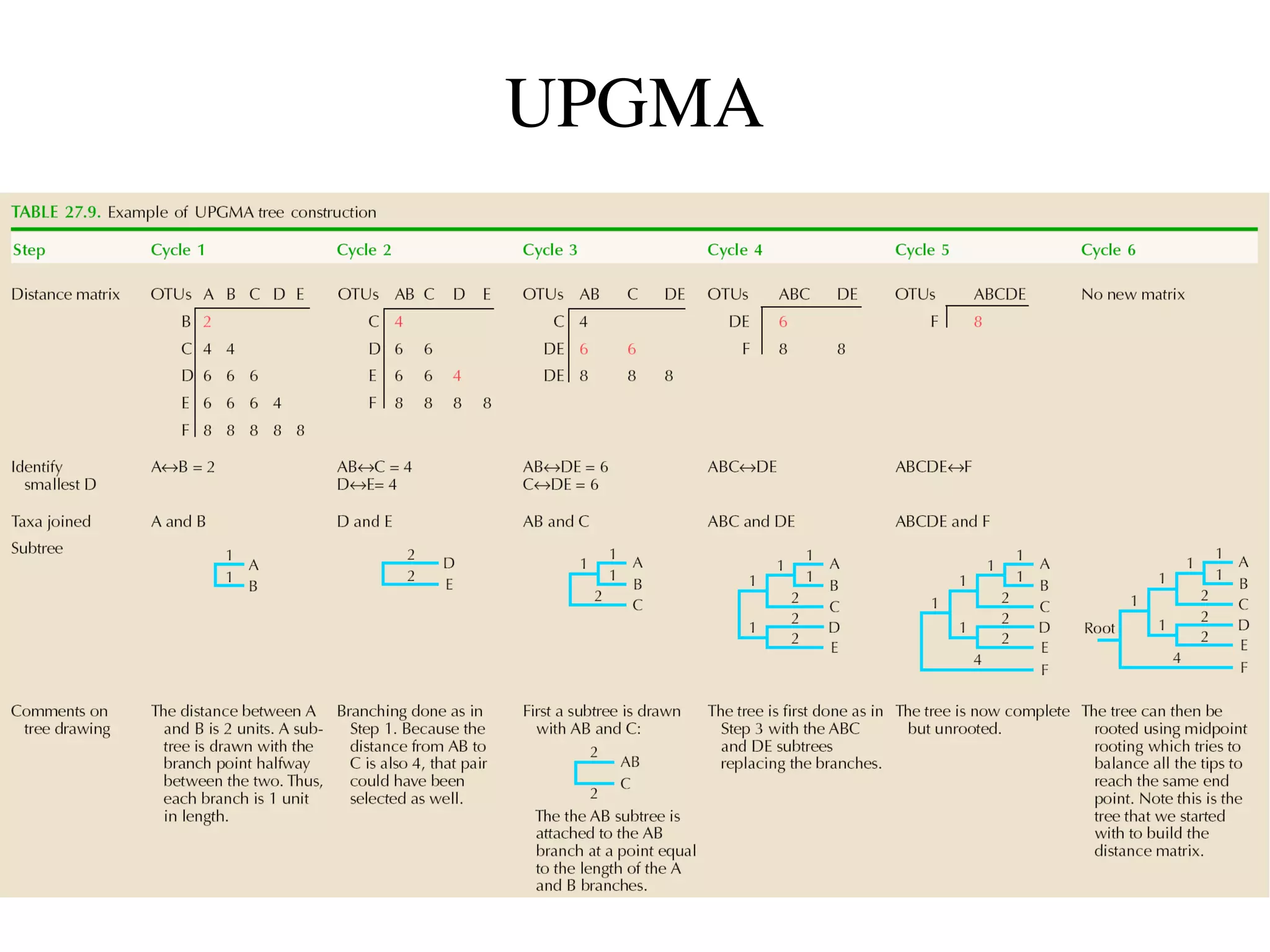
UPGMA
Unweighted Pair Group Method with
Arithmetic mean (UPGMA) algorithm
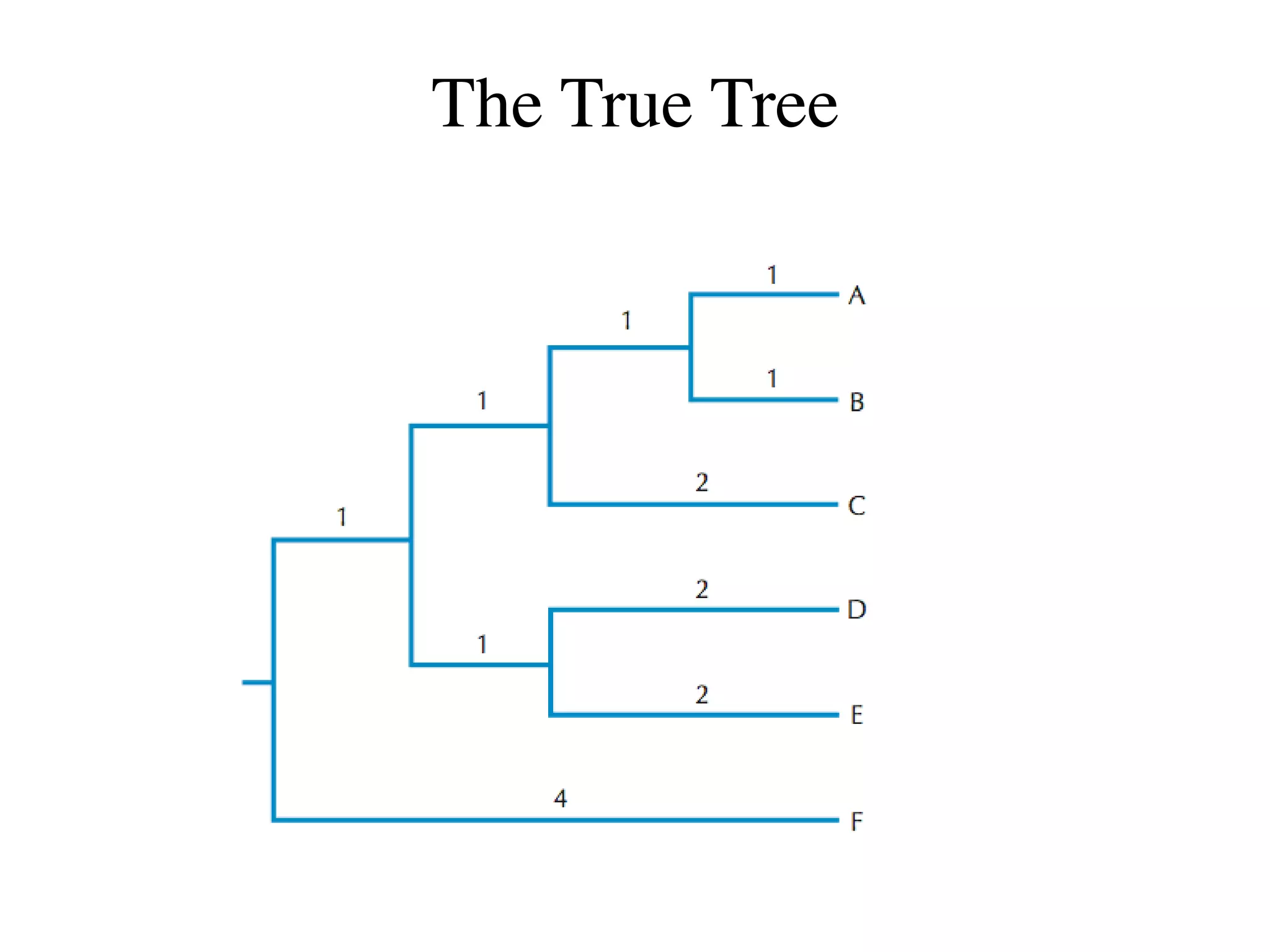
The True Tree
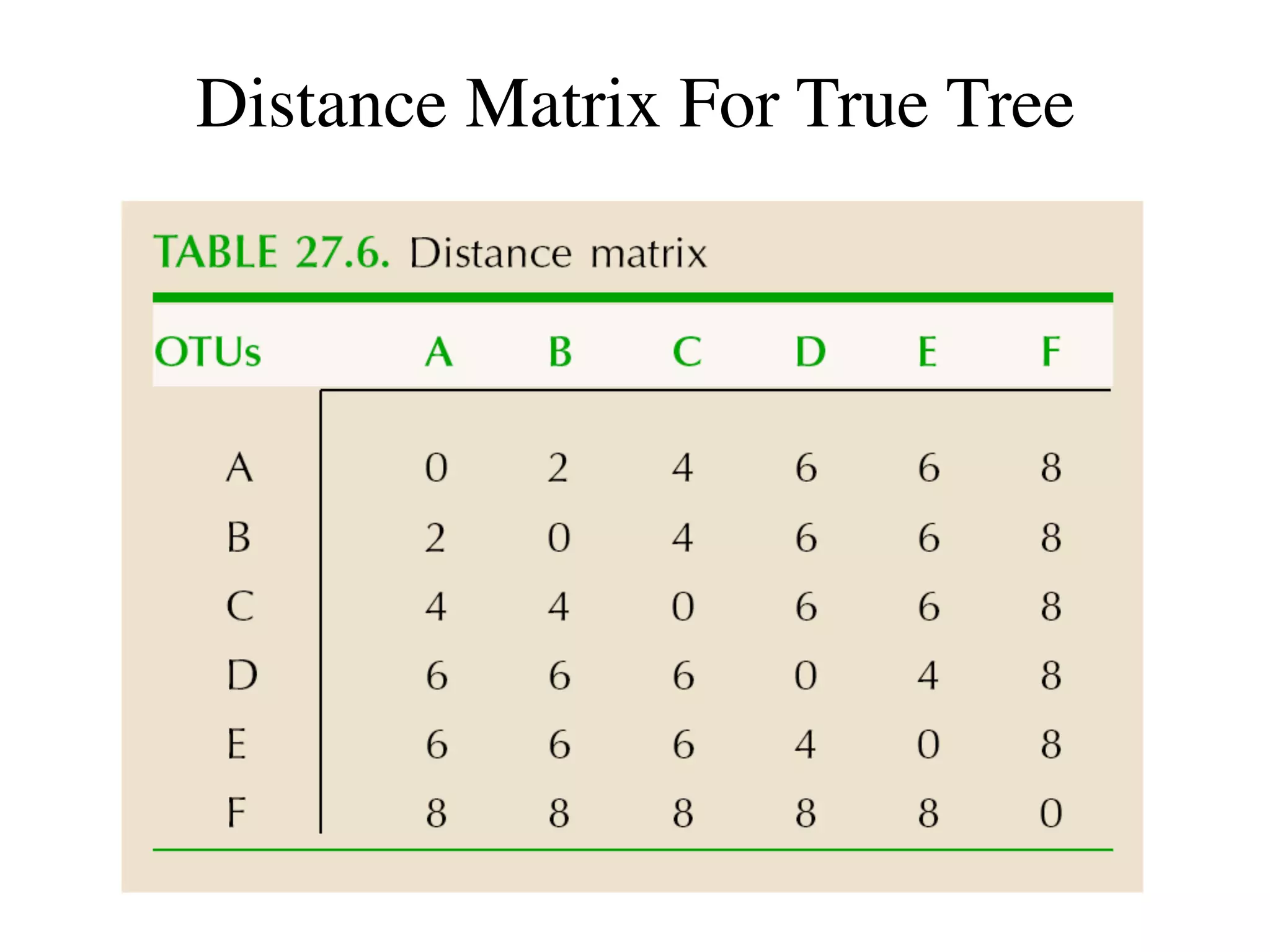
Distance Matrix For True Tree
Collapse Diagonal
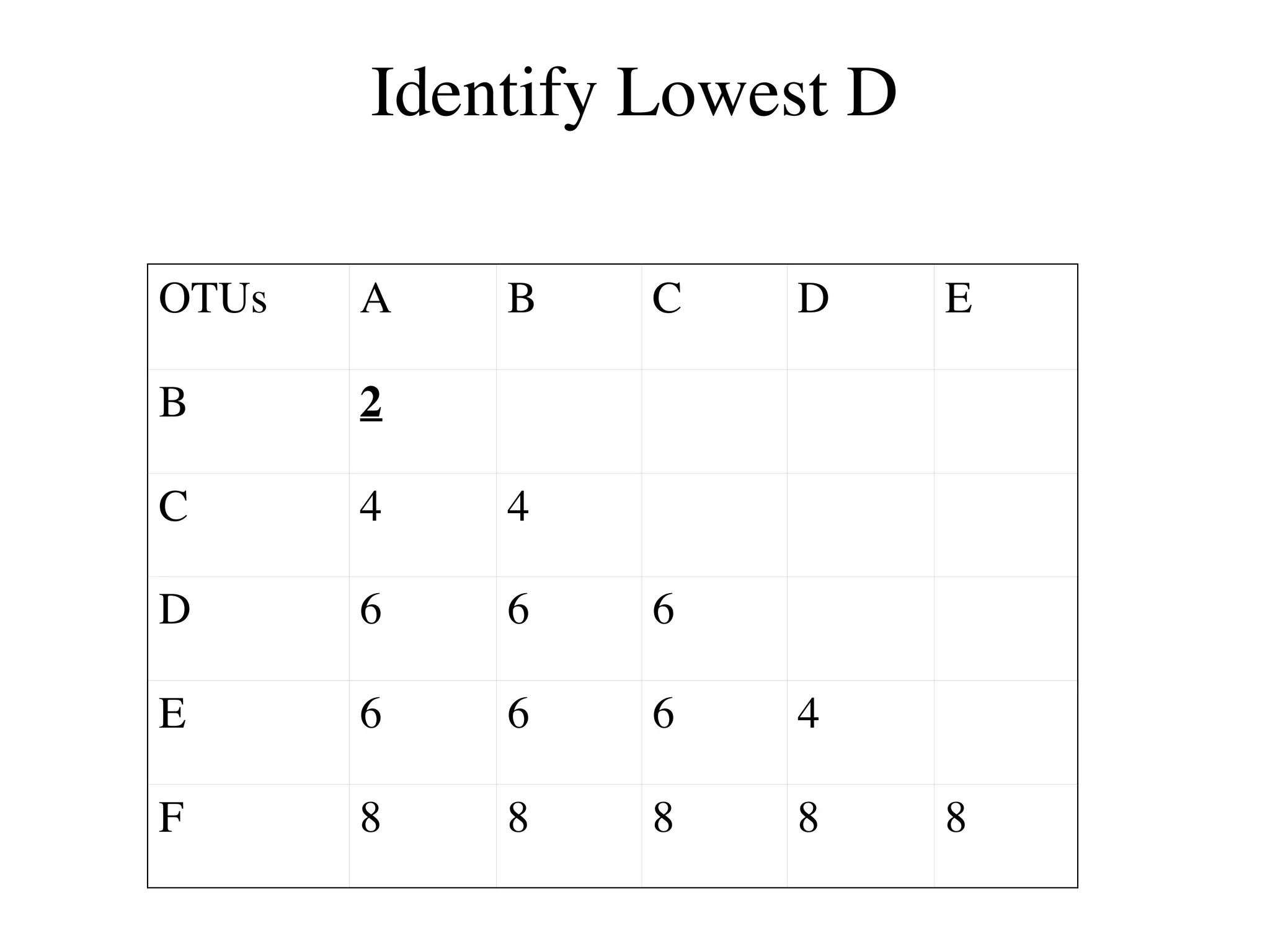
Identify Lowest D
OTUs A B C D E
B 2
C 4 4
D 6 6 6
E 6 6 6 4
F 8 8 8 8 8
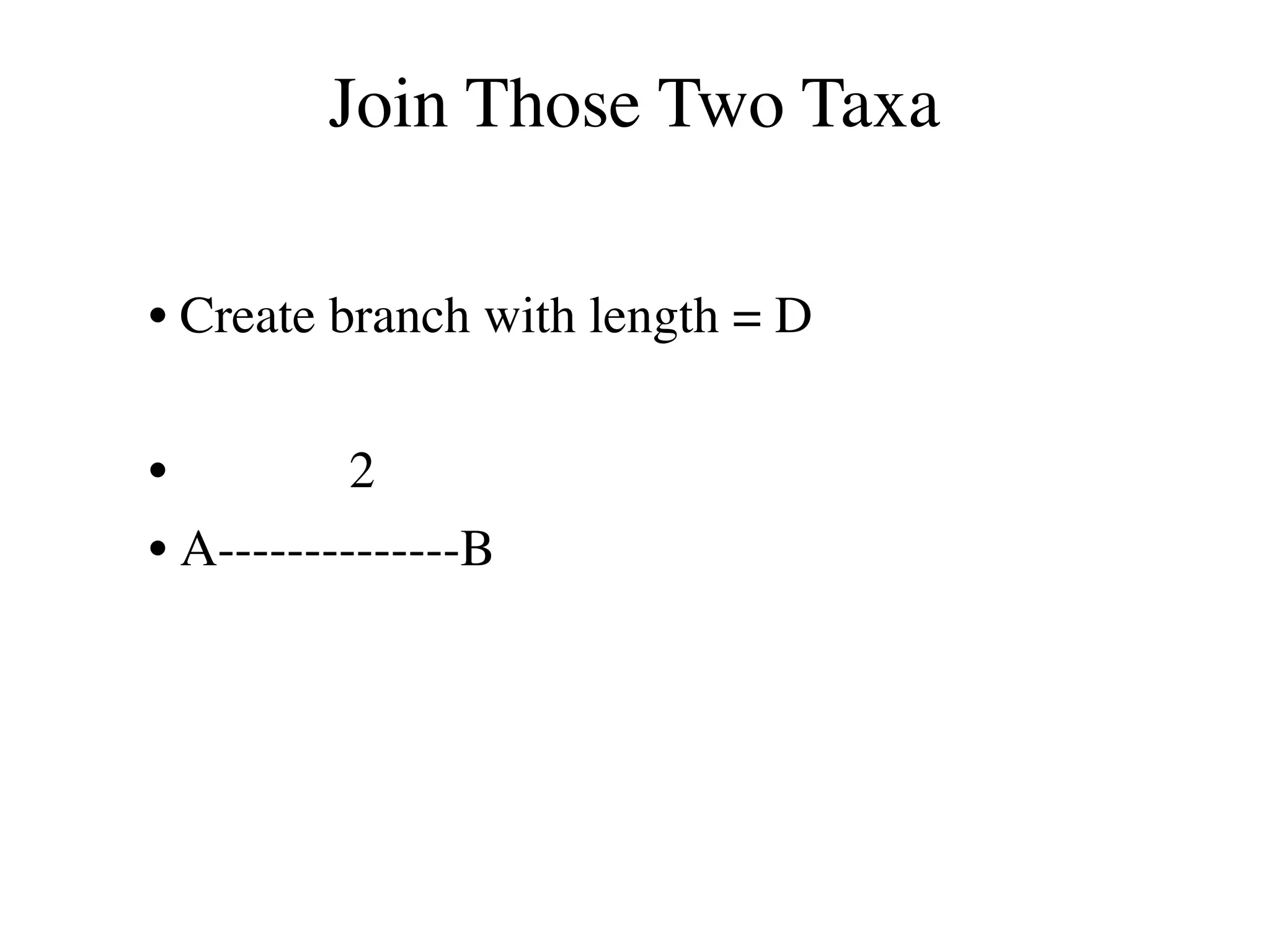
Join Those Two Taxa
• Create branch with length = D
• 2
• A--------------B
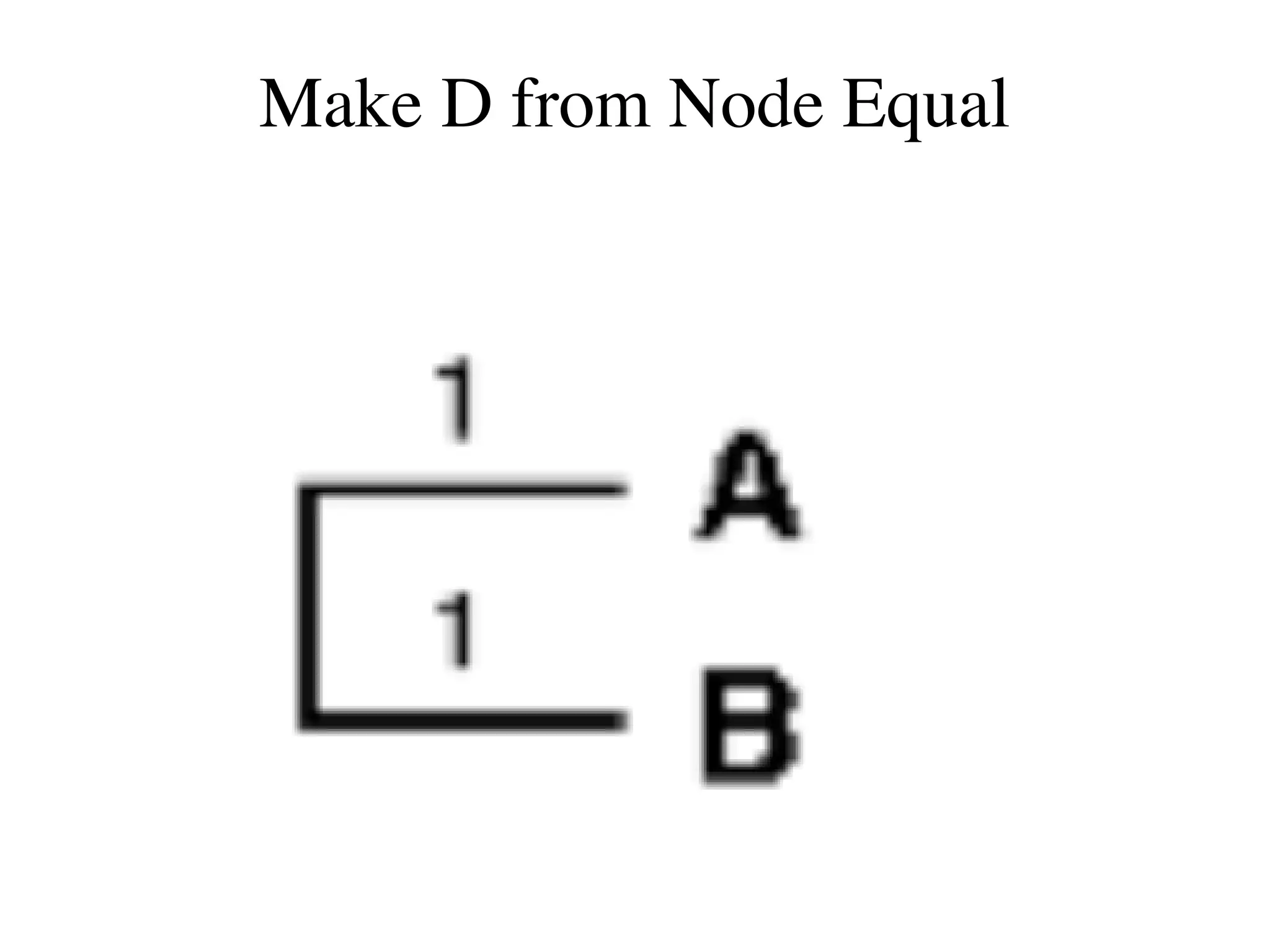
Make D from Node Equal
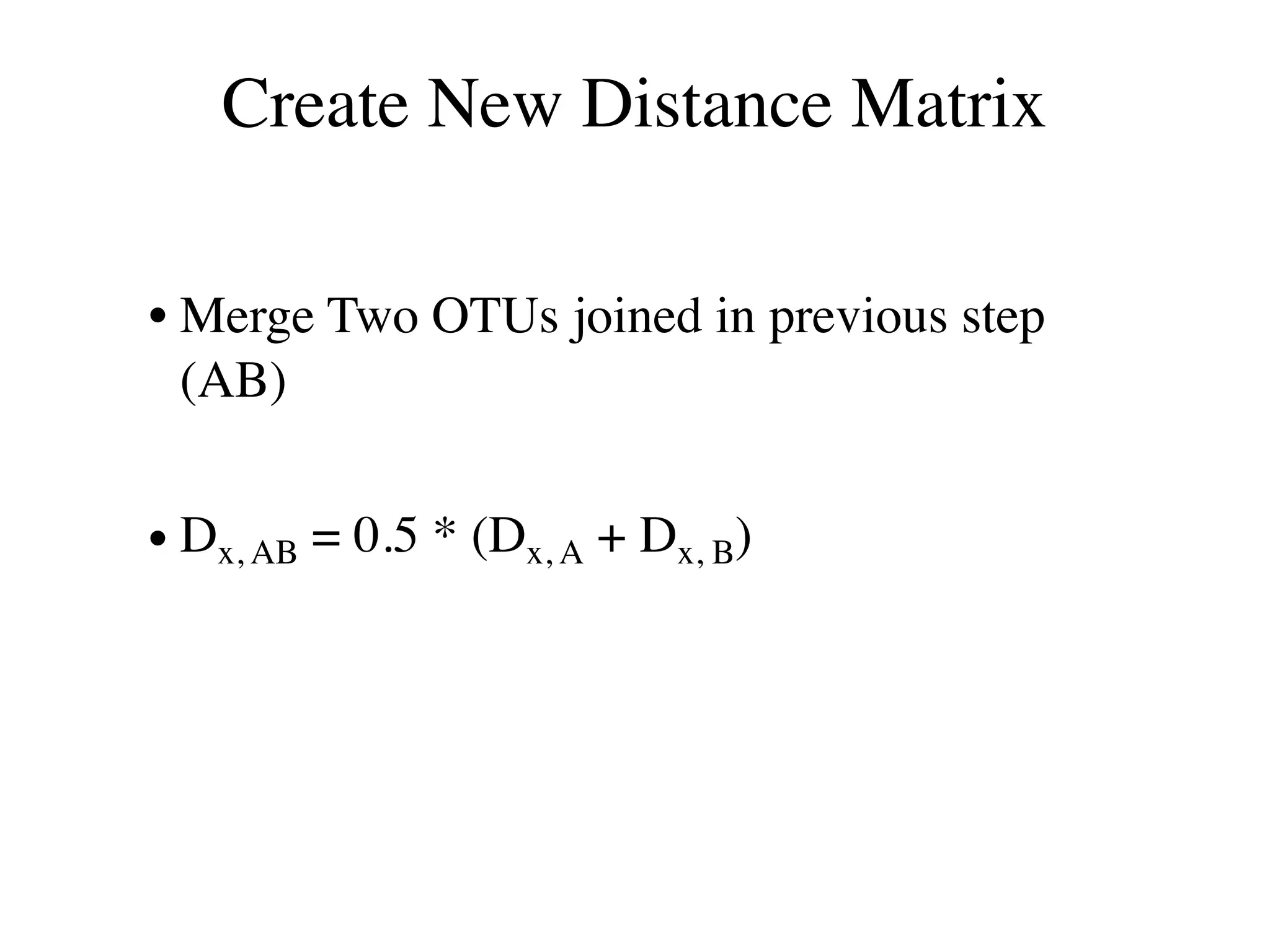
Create New Distance Matrix
• Merge Two OTUs joined in previous step
(AB)
• Dx, AB = 0.5 * (Dx, A + Dx, B)
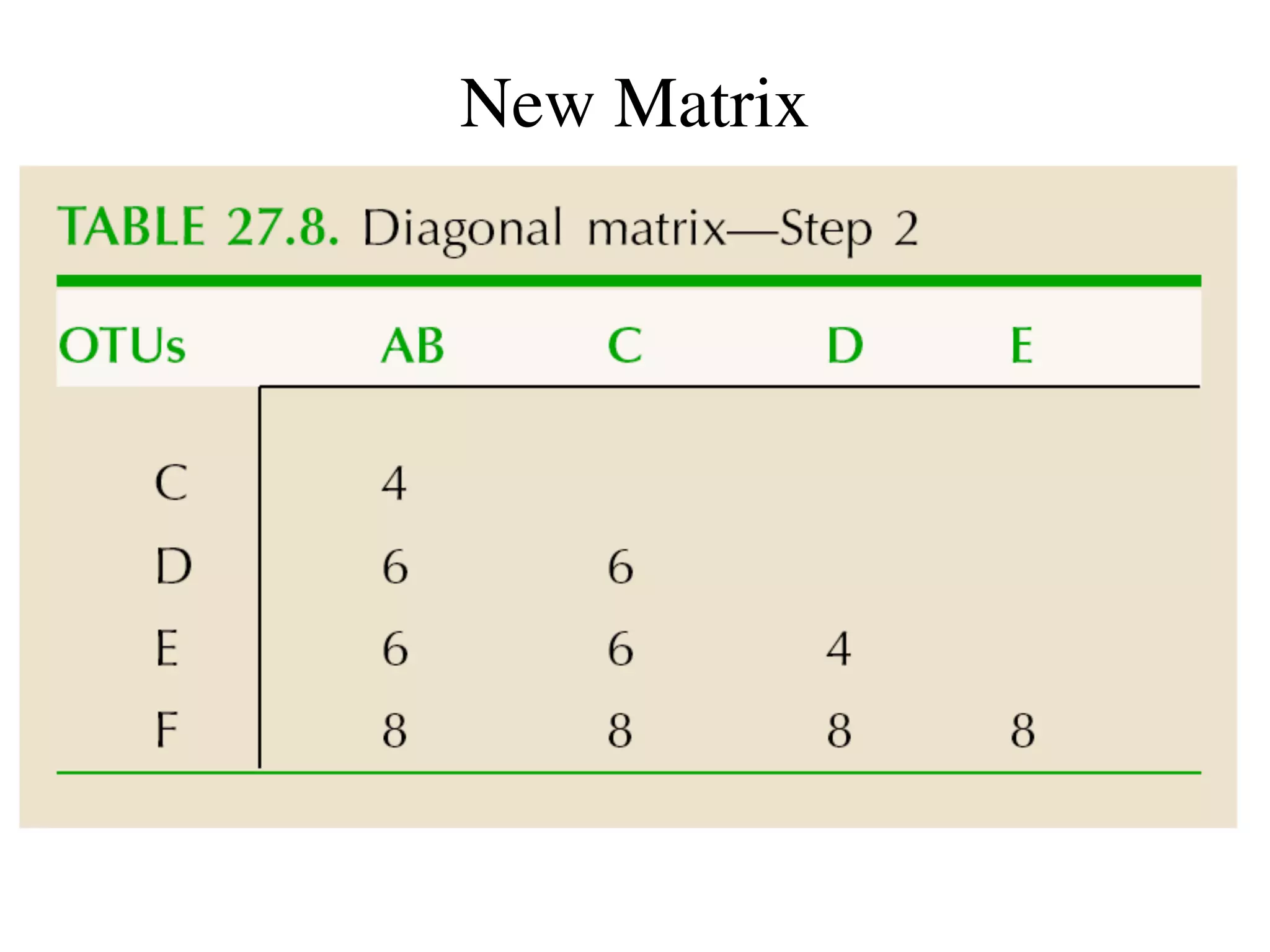
New Matrix
UPGMA
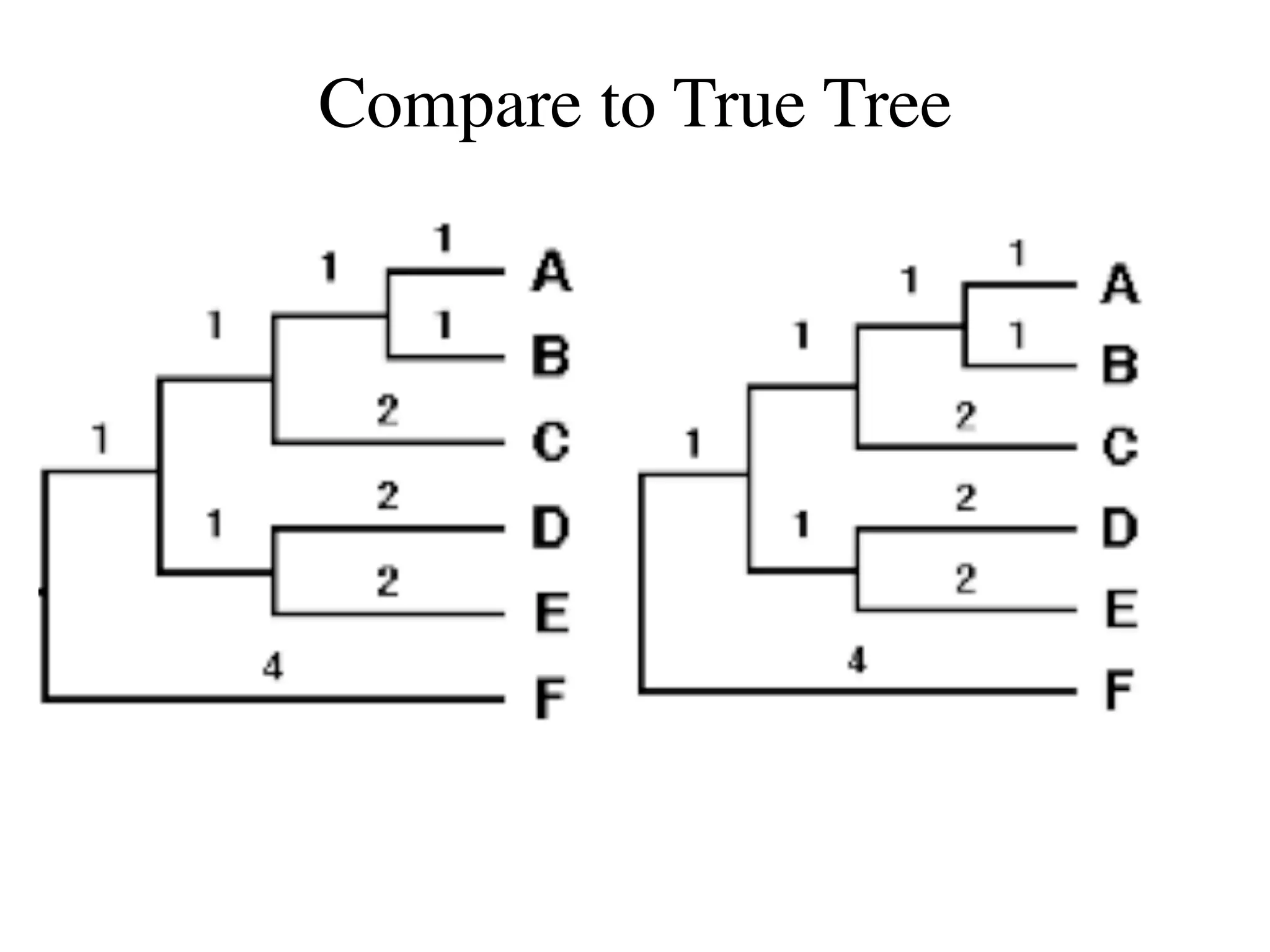
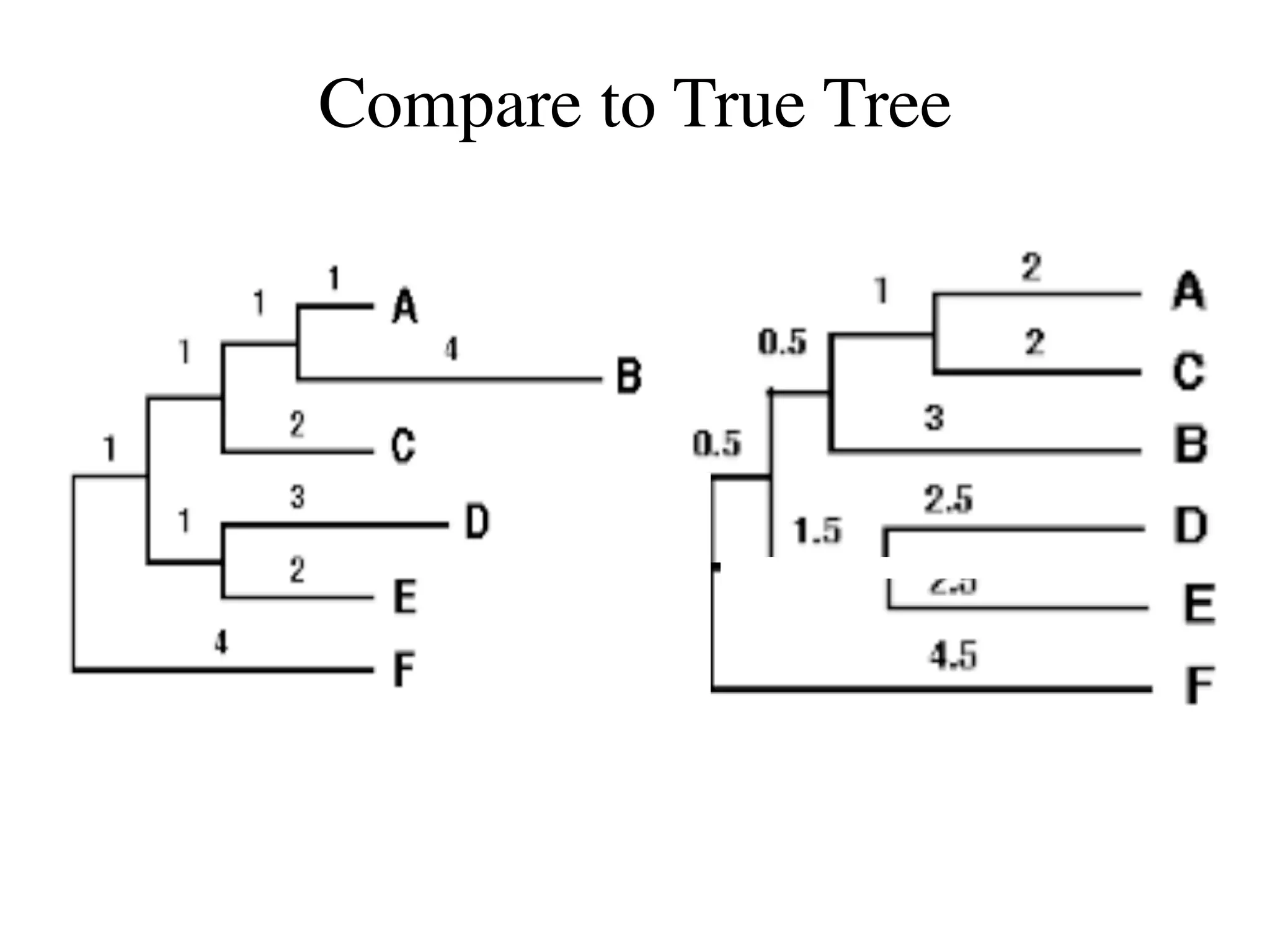
Compare to True Tree
But …
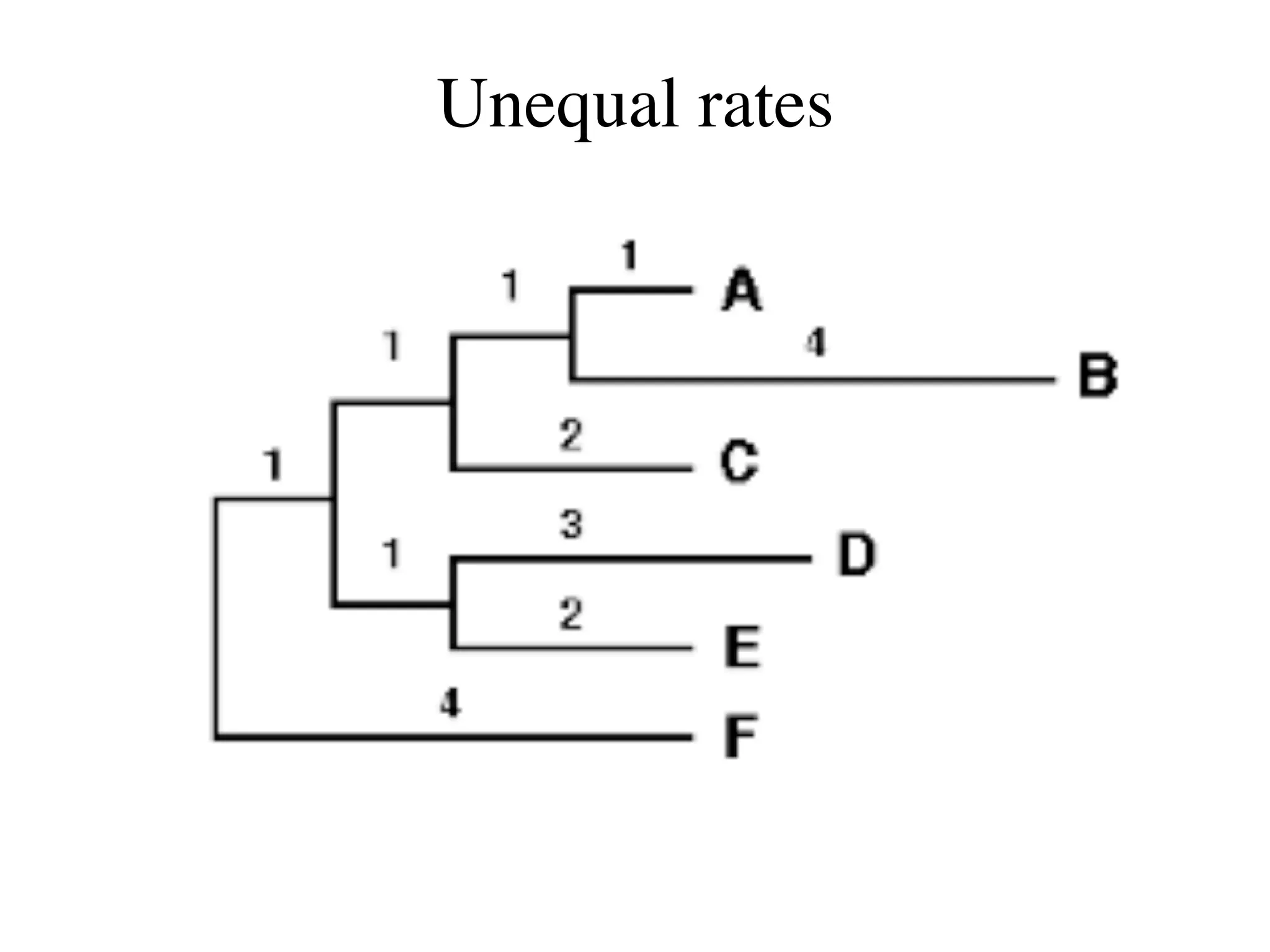
• What is evolutionary rates not equal
Unequal rates
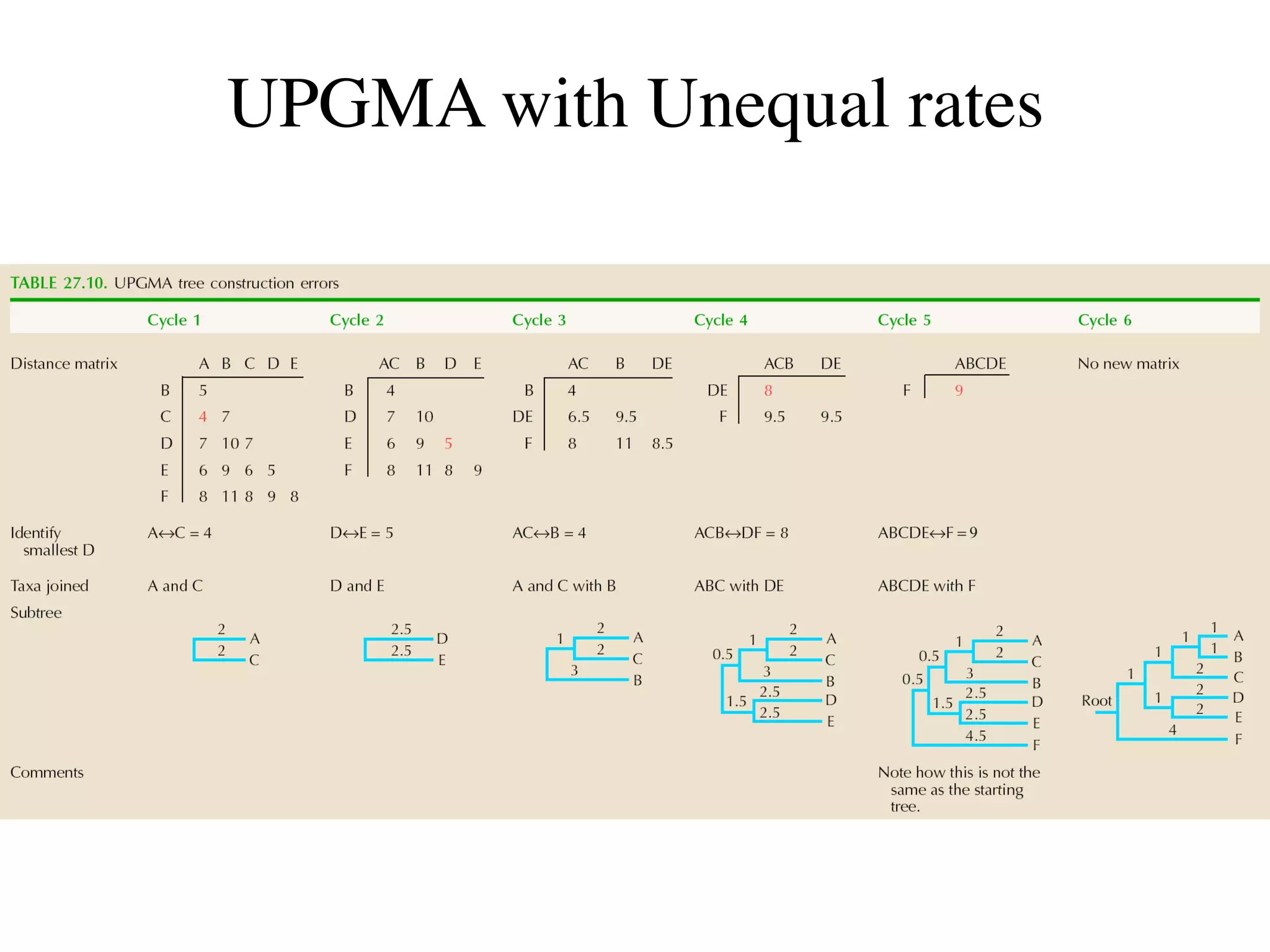
UPGMA with Unequal rates
Compare to True Tree
Neighbor Joining
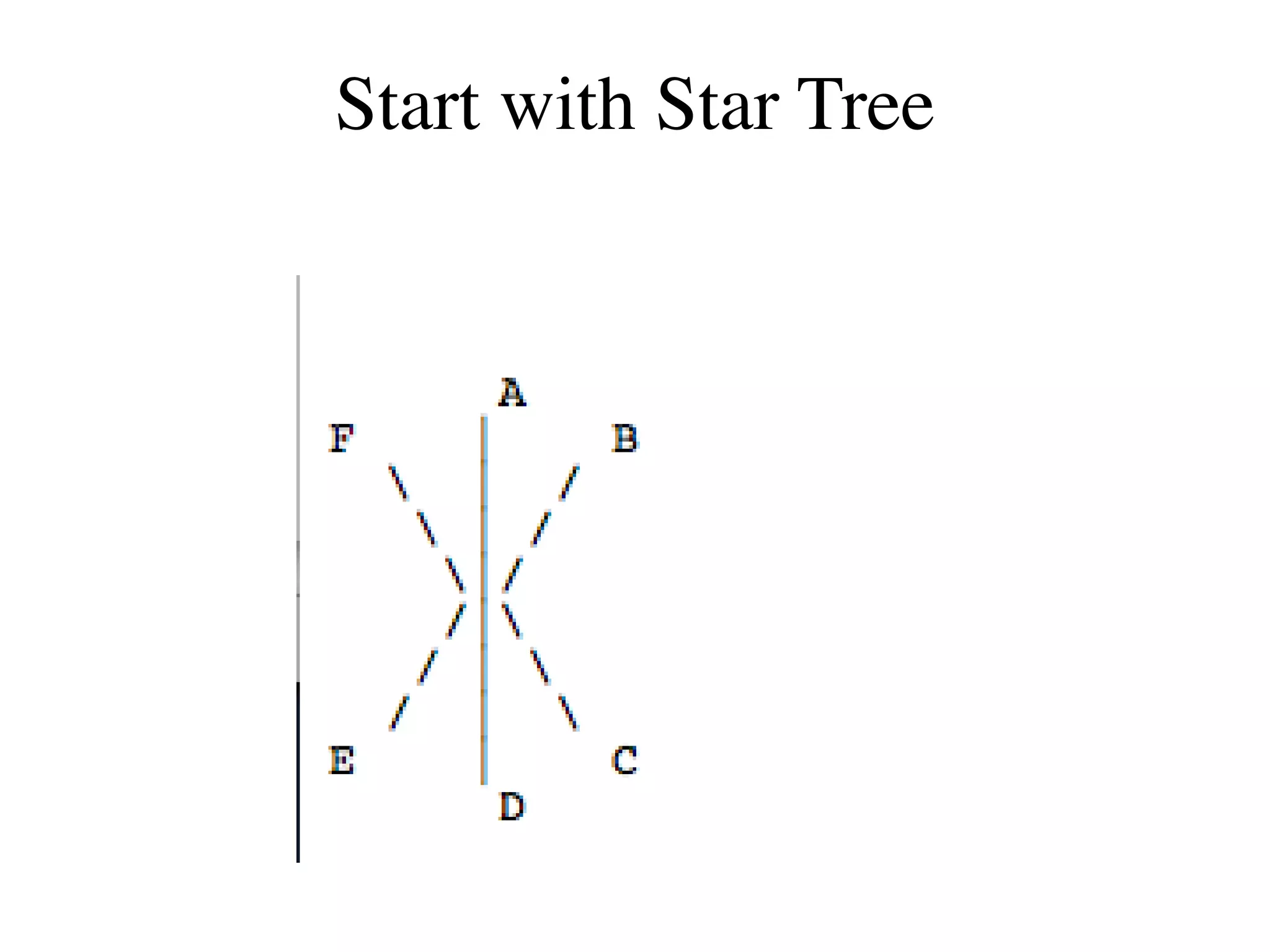
Start with Star Tree
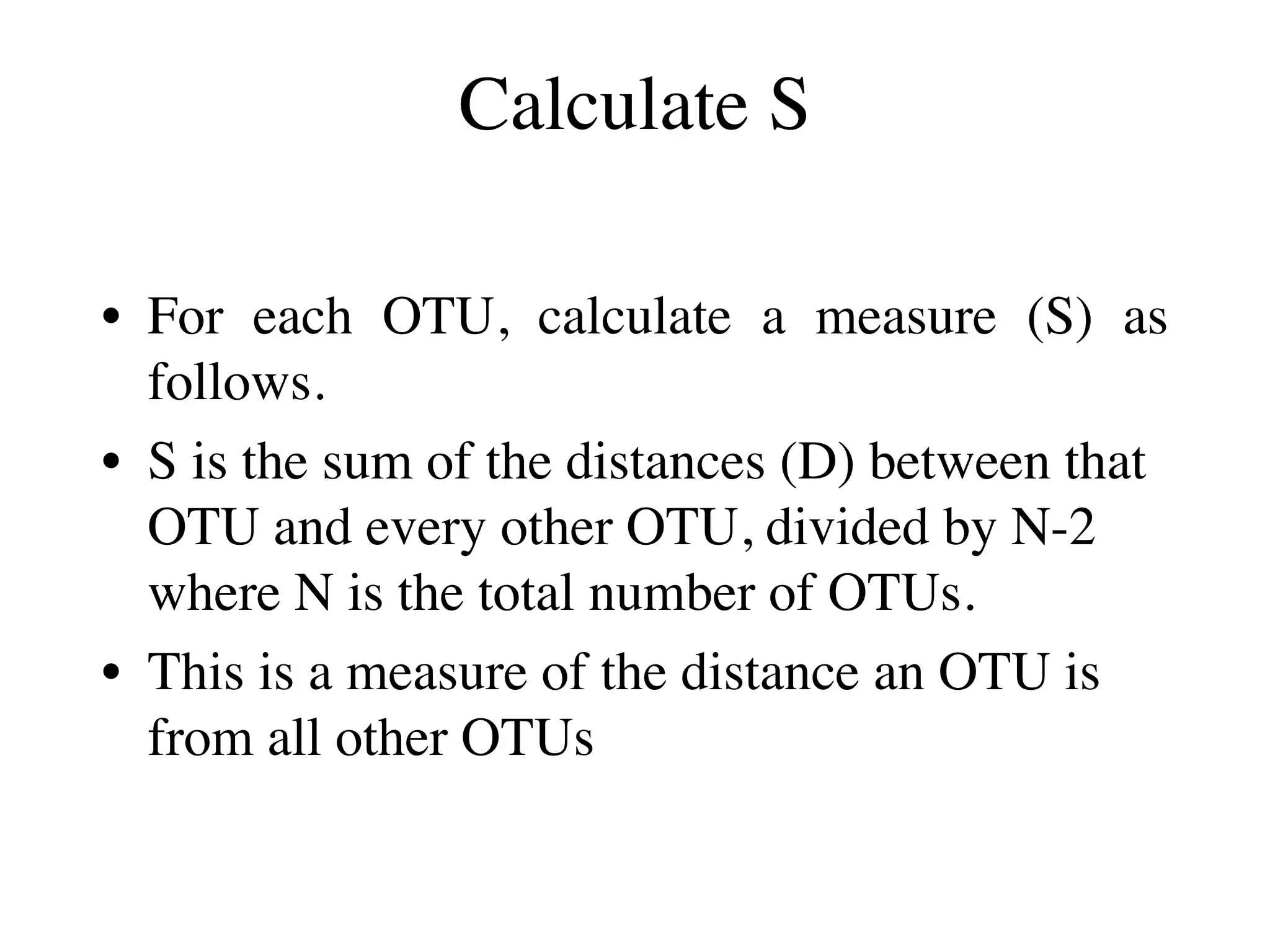
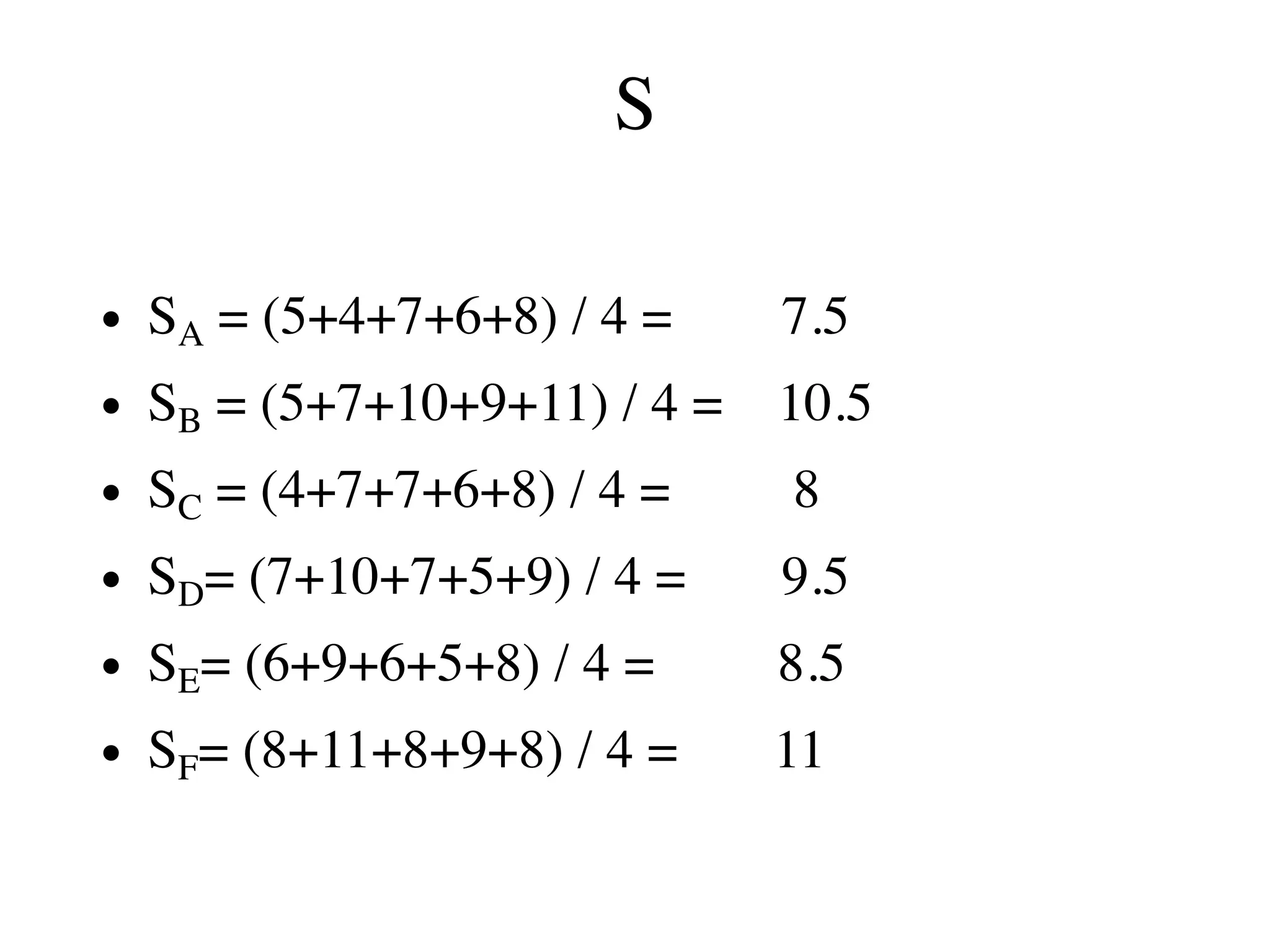
Calculate S
• For each OTU, calculate a measure (S) as
follows.
• S is the sum of the distances (D) between that
OTU and every other OTU, divided by N-2
where N is the total number of OTUs.
• This is a measure of the distance an OTU is
from all other OTUs
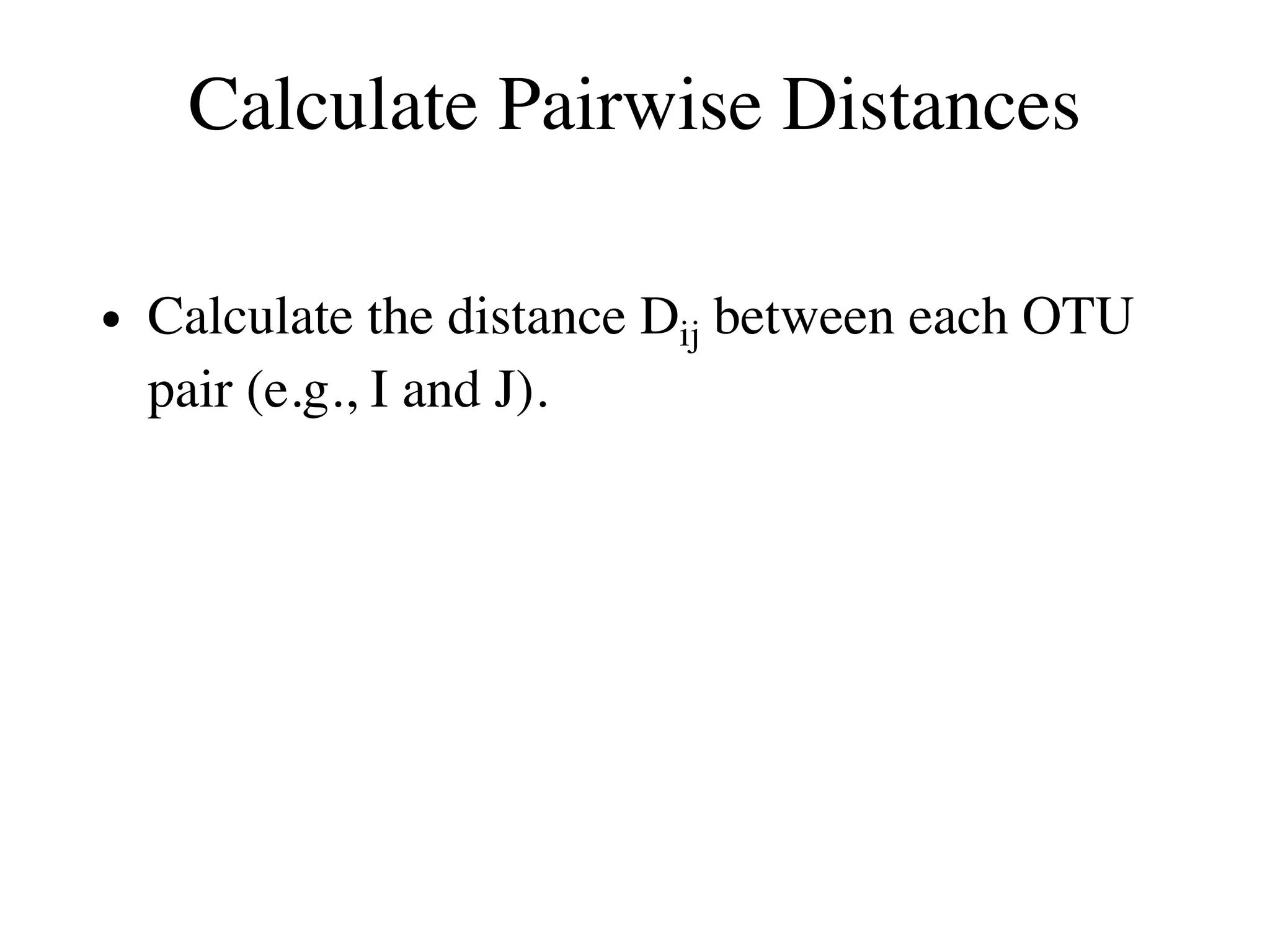
Calculate Pairwise Distances
• Calculate the distance Dij between each OTU
pair (e.g., I and J).
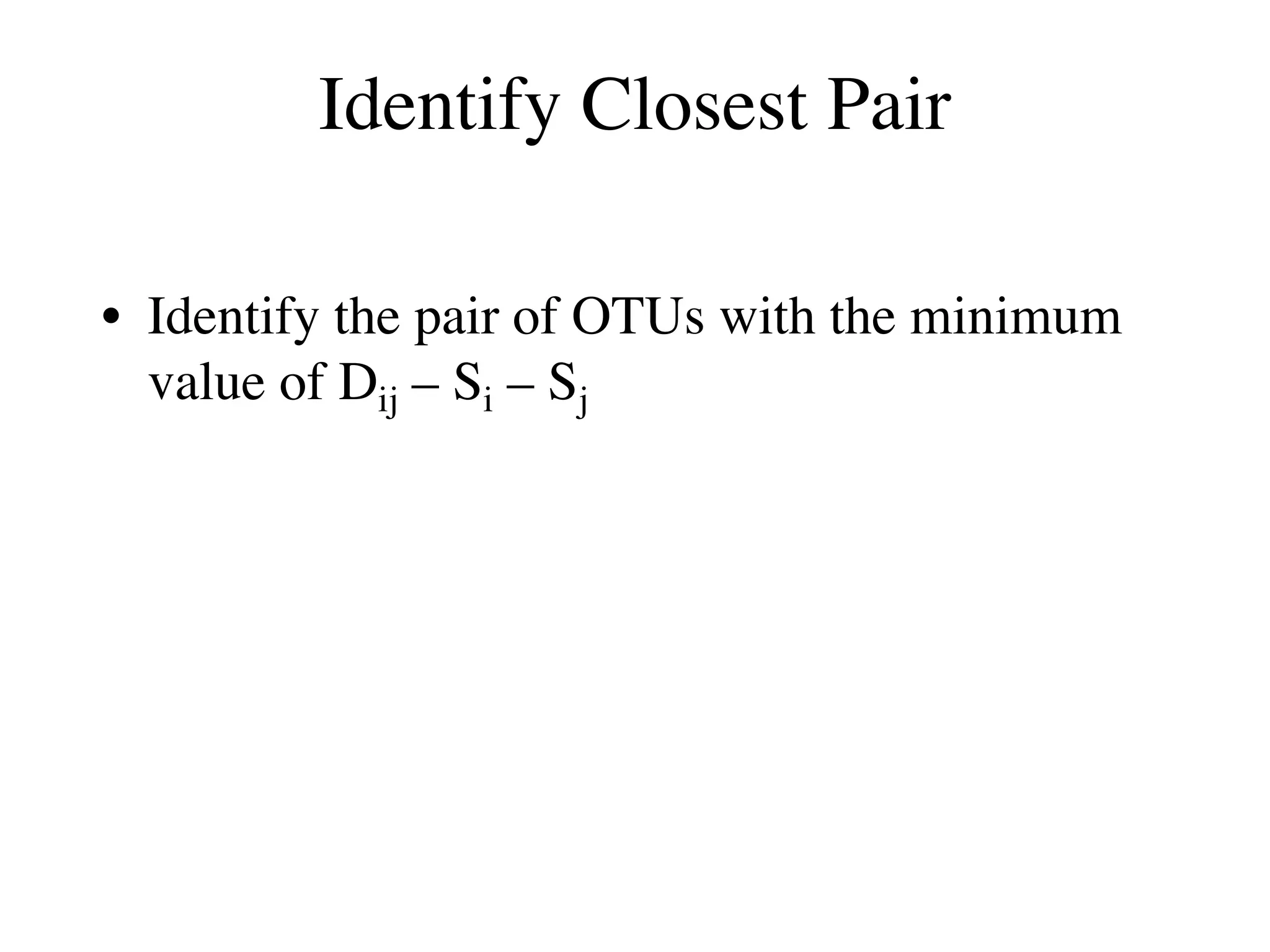
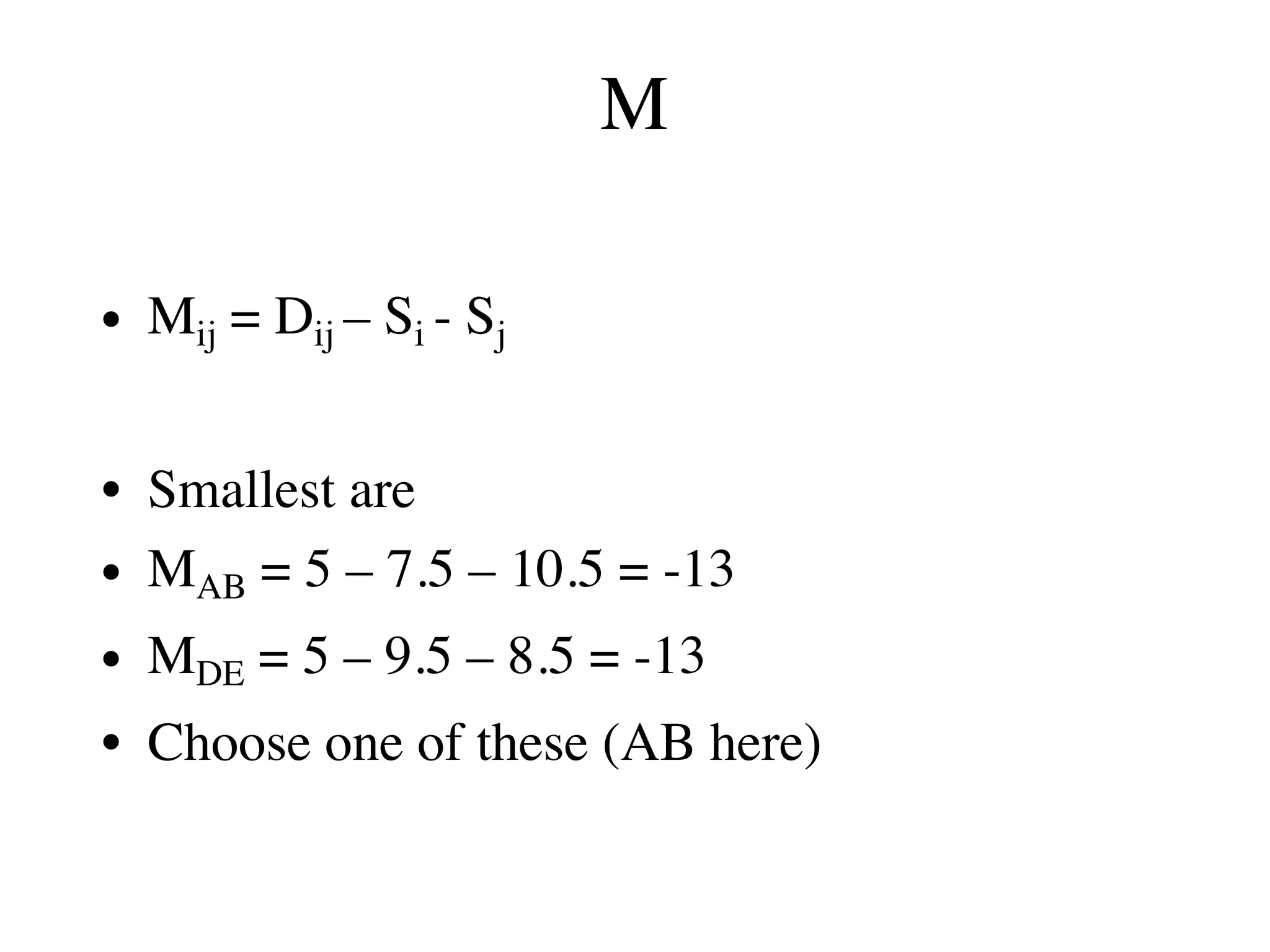
Identify Closest Pair
• Identify the pair of OTUs with the minimum
value of Dij – Si – Sj
Joining Taxa
• As in UPGMA, join these two taxa at a node
in a subtree.
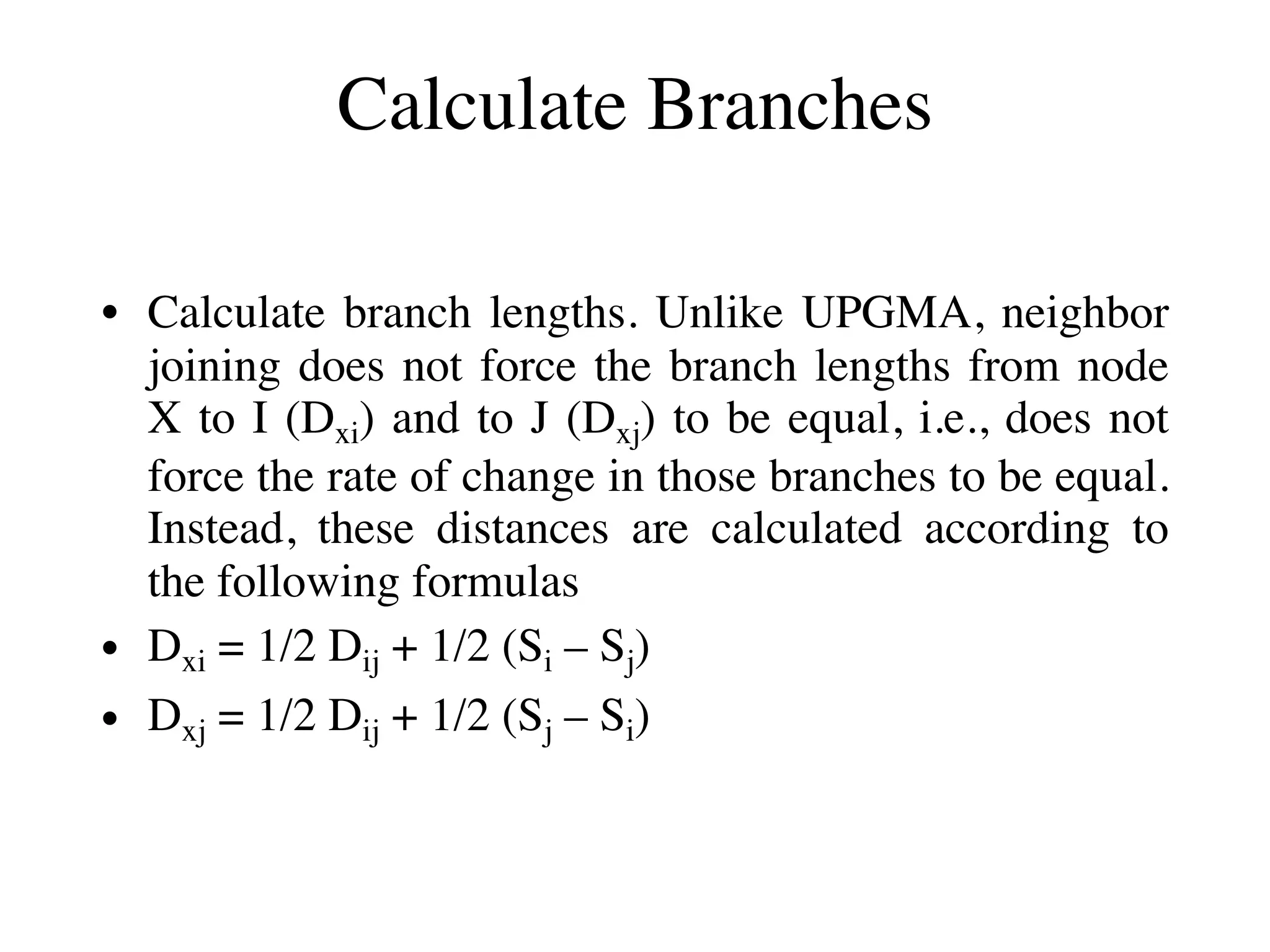
Calculate Branches
• Calculate branch lengths. Unlike UPGMA, neighbor
joining does not force the branch lengths from node
X to I (Dxi) and to J (Dxj) to be equal, i.e., does not
force the rate of change in those branches to be equal.
Instead, these distances are calculated according to
the following formulas
• Dxi = 1/2 Dij + 1/2 (Si – Sj)
• Dxj = 1/2 Dij + 1/2 (Sj – Si)
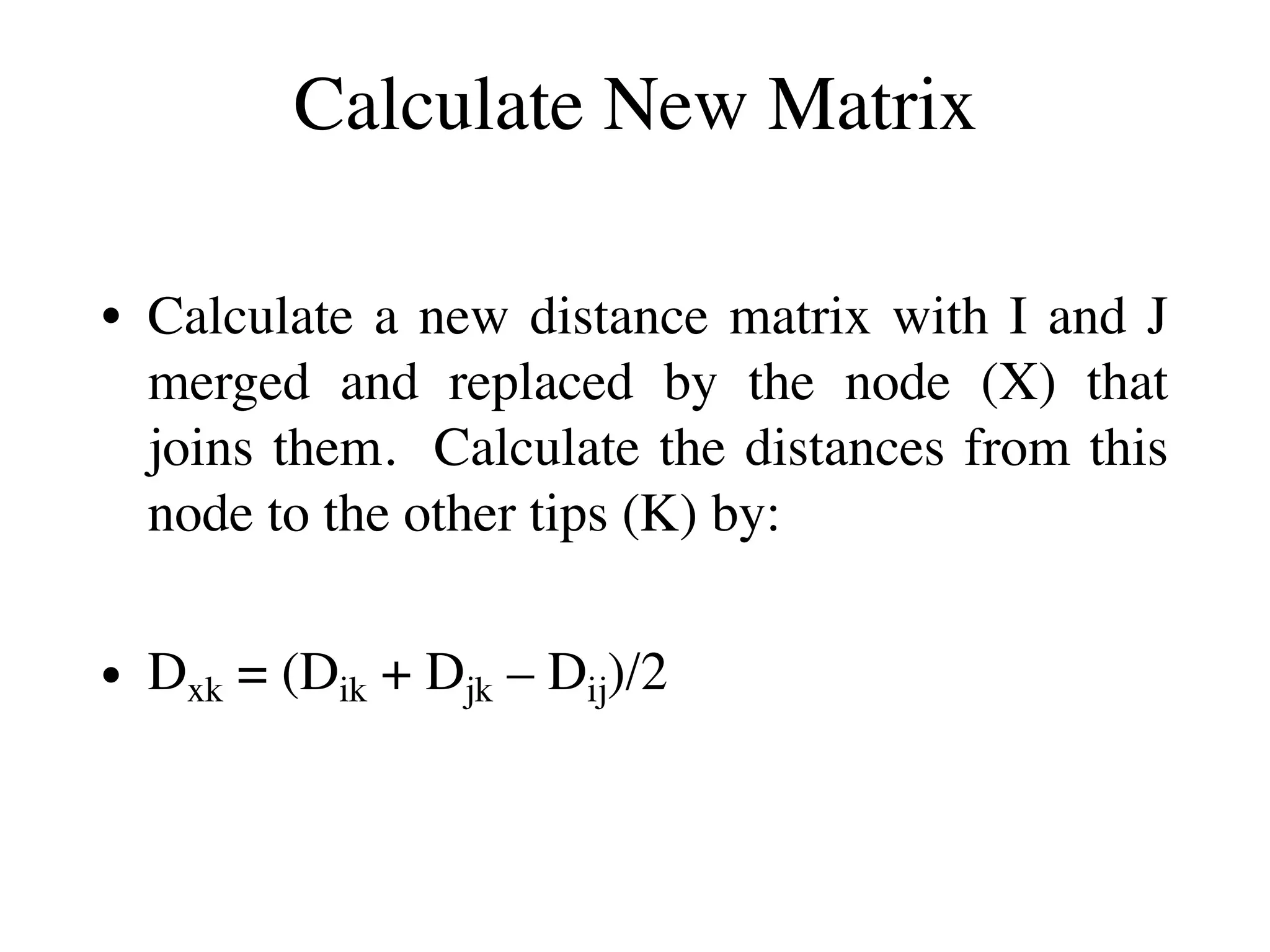
Calculate New Matrix
• Calculate a new distance matrix with I and J
merged and replaced by the node (X) that
joins them. Calculate the distances from this
node to the other tips (K) by:
• Dxk = (Dik + Djk – Dij)/2
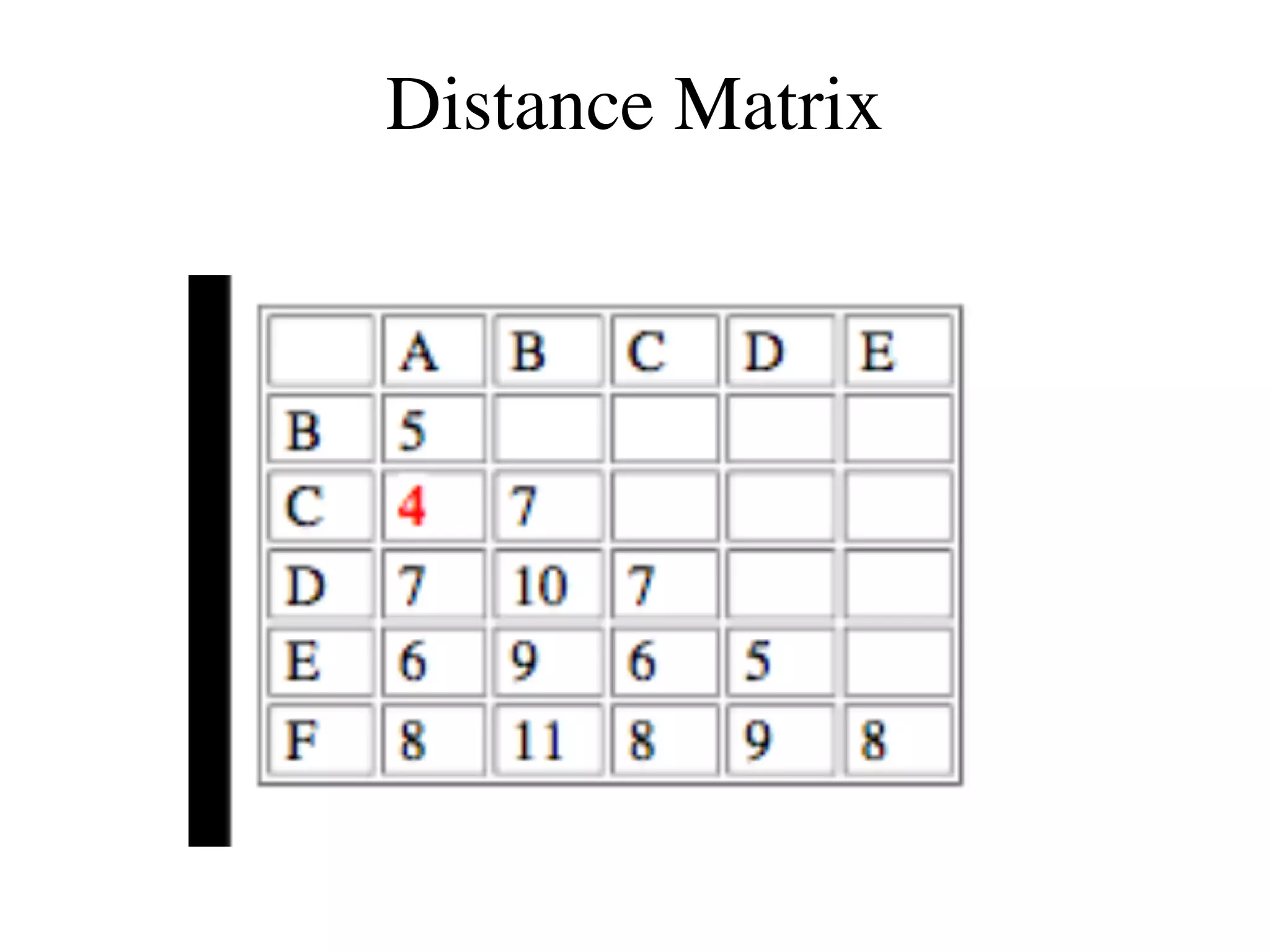
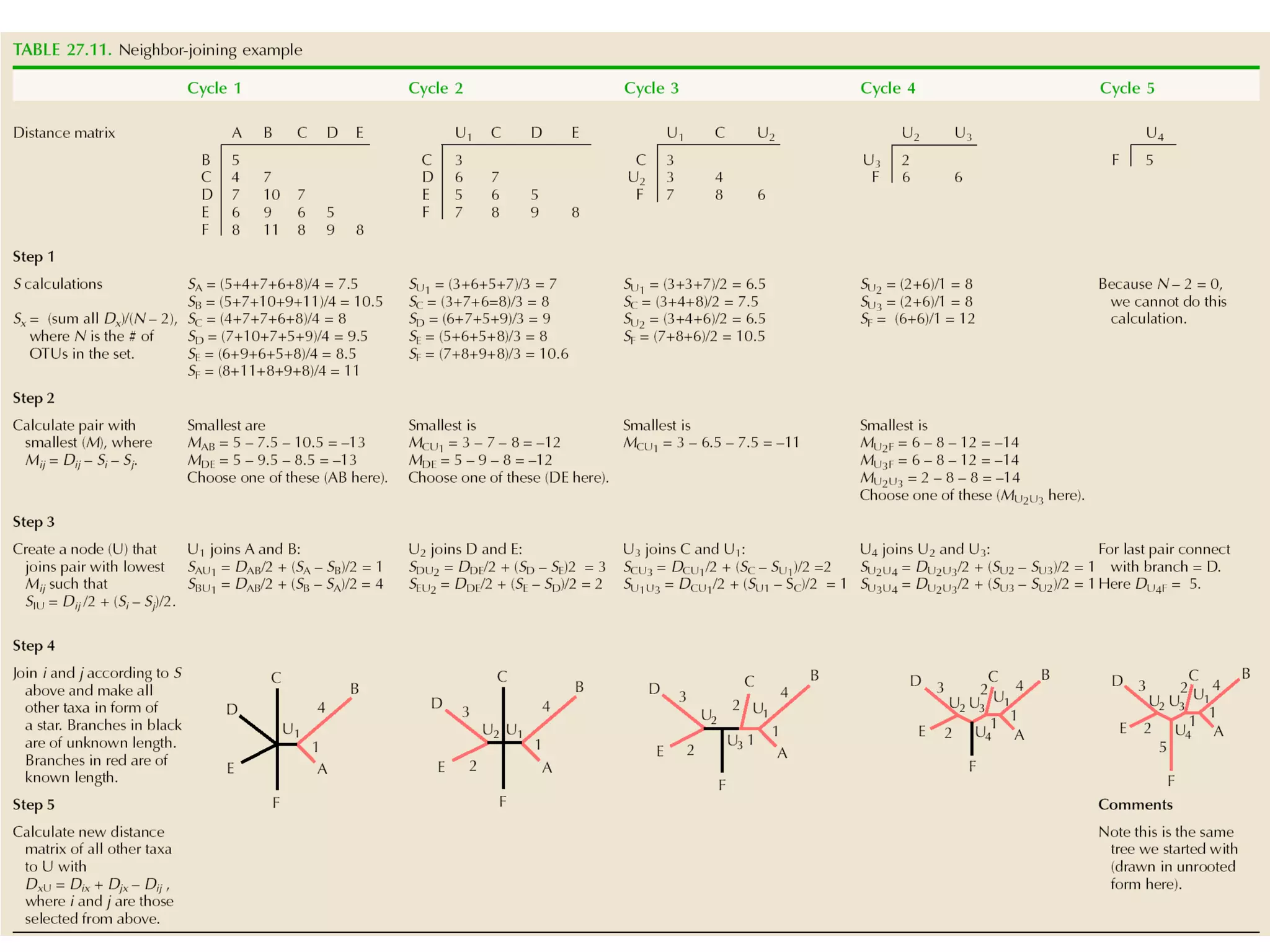
Distance Matrix
S
• SA = (5+4+7+6+8) / 4 = 7.5
• SB = (5+7+10+9+11) / 4 = 10.5
• SC = (4+7+7+6+8) / 4 = 8
• SD= (7+10+7+5+9) / 4 = 9.5
• SE= (6+9+6+5+8) / 4 = 8.5
• SF= (8+11+8+9+8) / 4 = 11
M
• Mij = Dij – Si - Sj
• Smallest are
• MAB = 5 – 7.5 – 10.5 = -13
• MDE = 5 – 9.5 – 8.5 = -13
• Choose one of these (AB here)
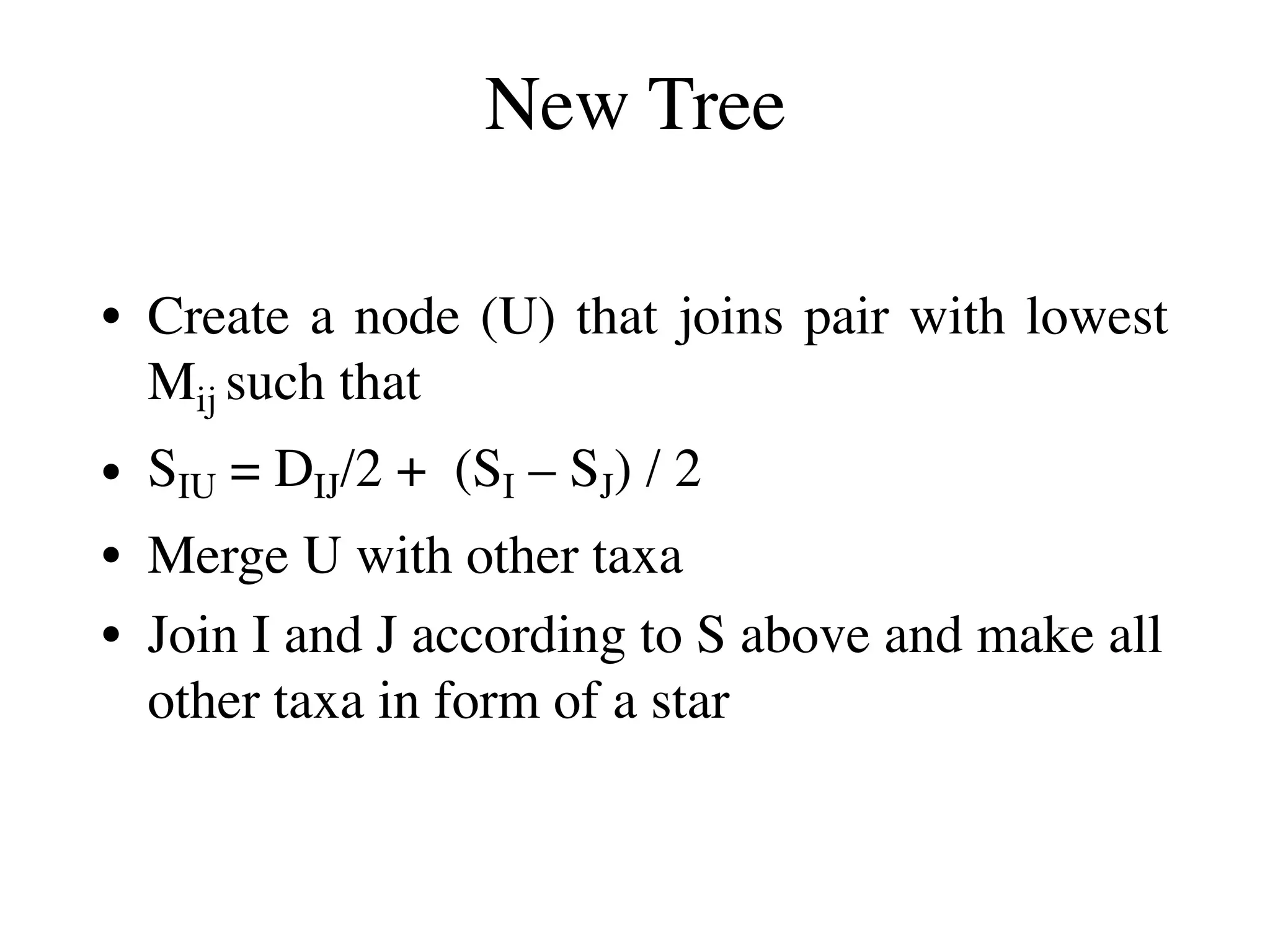
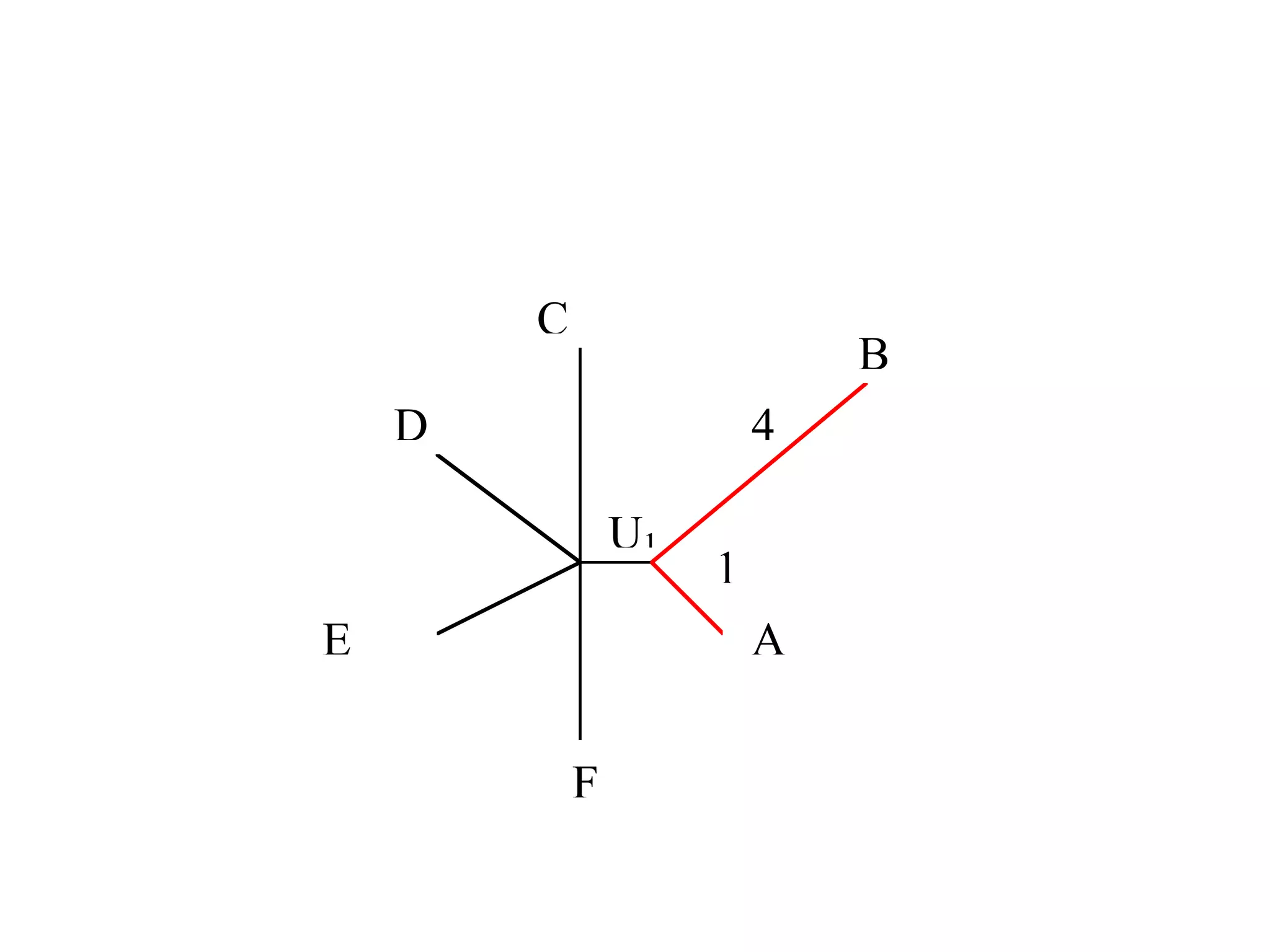
New Tree
• Create a node (U) that joins pair with lowest
Mij such that
• SIU = DIJ/2 + (SI – SJ) / 2
• Merge U with other taxa
• Join I and J according to S above and make all
other taxa in form of a star
C
D
E
F
U1
B
A
4
1
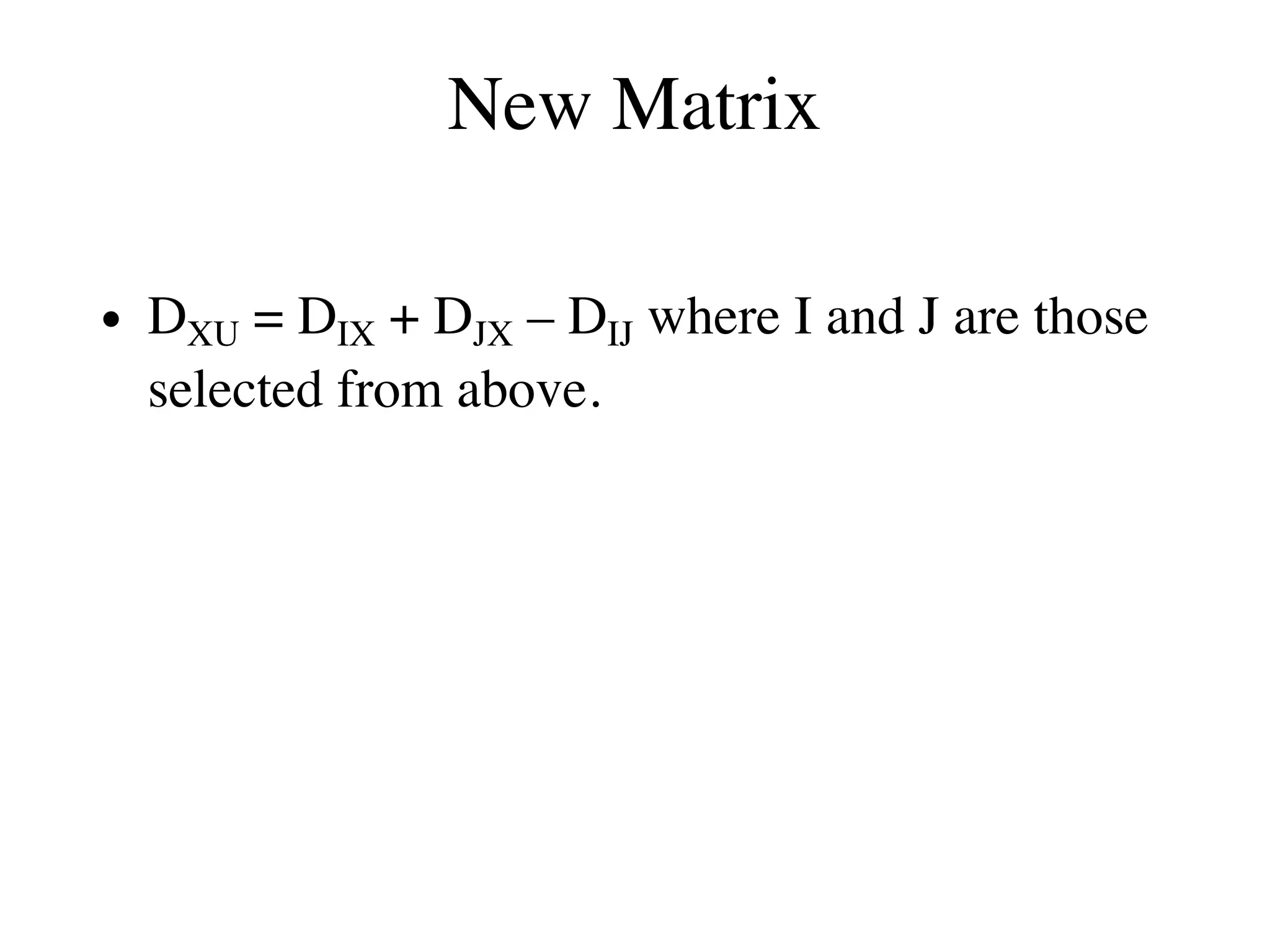
New Matrix
• DXU = DIX + DJX – DIJ where I and J are those
selected from above.
Table 11
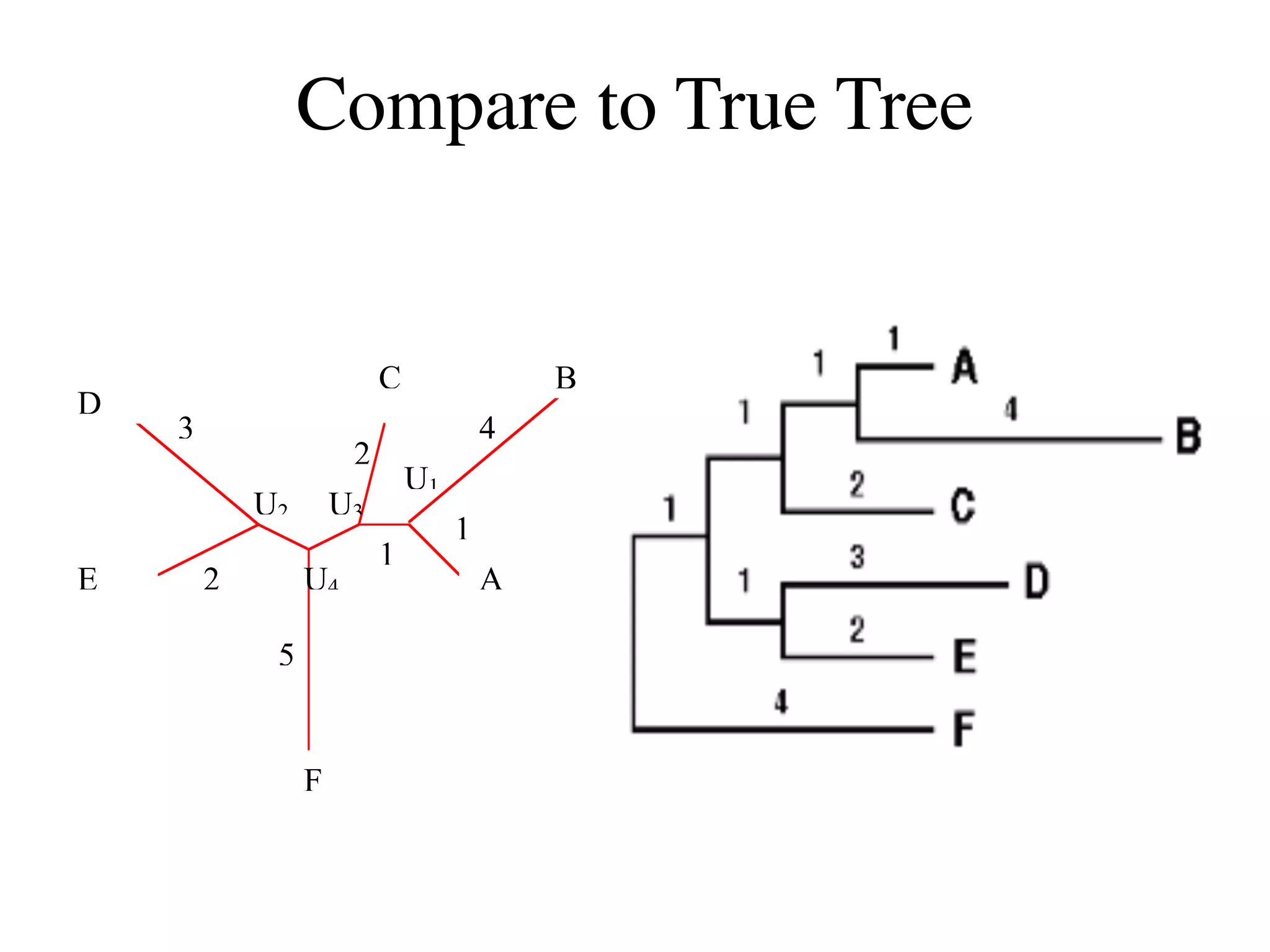
Compare to True Tree
C
D
E
F
U1
B
A
4
1
U2
3
2
2
1
U3
U4
5

EVE161: Microbial Phylogenomics - Class 6 - Tree of Life Example

  • 1.
    EVE 161:
 Microbial Phylogenomics Class#6: The Tree of Life, Example Paper UC Davis, Winter 2018 Instructor: Jonathan Eisen Teaching Assistant: Cassie Ettinger !1
  • 2.
    Where we aregoing and where we have been • Previous Class: !5. Phylogeny • Current Class: !6. Phylogeny example • Next Class: !7. rRNA Sequencing from uncultured !2
  • 3.
    Eisen Office Hours •Today 10:30-11:30 Storer 5331 • Monday 10:00-11:00 GBSF 5311
  • 4.
    Class Participation SignUp • Task: Summarize one figure from one of the papers for class, ~ 5 minutes. ! There will be 2-3 presenters per class. ! Each person needs to do a different figure so you need to contact the other person to coordinate. ! Can meet with Eisen, Ettinger before hand to discuss. • Sign up for date on Google Sheet goo.gl/bmxCDw - include your name & email address.
  • 5.
    Paper Analysis Project •Select 1-2 papers on one of the topics of the course (approval needed) • Review the paper and write up a summary of your assessment of the paper (more detail on this later) • Present a short summary of what you did to the class • Ask and answer questions about your and other people’s reviews in the discussion forum on Canvas
  • 6.
    Palfrey et al. Syst.Biol. 59(5):518–533, 2010 c⃝ The Author(s) 2010. Published by Oxford University Press, on behalf of the Society of Systematic Biologists. All rights reserved. For Permissions, please email: journals.permissions@oxfordjournals.org DOI:10.1093/sysbio/syq037 Advance Access publication on July 23, 2010 Broadly Sampled Multigene Analyses Yield a Well-Resolved Eukaryotic Tree of Life LAURA WEGENER PARFREY1 , JESSICA GRANT2 , YONAS I. TEKLE2,6 , ERICA LASEK-NESSELQUIST3,4 , HILARY G. MORRISON3 , MITCHELL L. SOGIN3 , DAVID J. PATTERSON5 , AND LAURA A. KATZ1,2,∗ 1Program in Organismic and Evolutionary Biology, University of Massachusetts, 611 North Pleasant Street, Amherst, MA 01003, USA; 2Department of Biological Sciences, Smith College, 44 College Lane, Northampton, MA 01063, USA; 3Bay Paul Center for Comparative Molecular Biology and Evolution, Marine Biological Laboratory, 7 MBL Street, Woods Hole, MA 02543, USA; 4Department of Ecology and Evolutionary Biology, Brown University, 80 Waterman Street, Providence, RI 02912, USA; 5Biodiversity Informatics Group, Marine Biological Laboratory, 7 MBL Street, Woods Hole, MA 02543, USA; 6Present address: Department of Epidemiology and Public Health, Yale University School of Medicine, New Haven, CT 06520, USA; ∗Correspondence to be sent to: Laura A. Katz, 44 College Lane, Northampton, MA 01003, USA; E-mail: lkatz@smith.edu. Laura Wegener Parfrey and Jessica Grant have contributed equally to this work. Received 30 September 2009; reviews returned 1 December 2009; accepted 25 May 2010 Associate Editor: C´ecile An´e Abstract.—An accurate reconstruction of the eukaryotic tree of life is essential to identify the innovations underlying the diversity of microbial and macroscopic (e.g., plants and animals) eukaryotes. Previous work has divided eukaryotic diver- sity into a small number of high-level “supergroups,” many of which receive strong support in phylogenomic analyses. However, the abundance of data in phylogenomic analyses can lead to highly supported but incorrect relationships due to systematic phylogenetic error. Furthermore, the paucity of major eukaryotic lineages (19 or fewer) included in these genomic studies may exaggerate systematic error and reduce power to evaluate hypotheses. Here, we use a taxon-rich strategy to assess eukaryotic relationships. We show that analyses emphasizing broad taxonomic sampling (up to 451 taxa representing 72 major lineages) combined with a moderate number of genes yield a well-resolved eukaryotic tree of life. The consistency across analyses with varying numbers of taxa (88–451) and levels of missing data (17–69%) supports the accuracy of the resulting topologies. The resulting stable topology emerges without the removal of rapidly evolving genes or taxa, a practice common to phylogenomic analyses. Several major groups are stable and strongly supported in these analyses (e.g., SAR, Rhizaria, Excavata), whereas the proposed supergroup “Chromalveolata” is rejected. Furthermore, ex- tensive instability among photosynthetic lineages suggests the presence of systematic biases including endosymbiotic gene transfer from symbiont (nucleus or plastid) to host. Our analyses demonstrate that stable topologies of ancient evolutionary !6
  • 7.
    • Key ThingsYou Want to Know More About?
  • 8.
    • Why didI select this paper?
  • 9.
    Palfrey et al. Syst.Biol. 59(5):518–533, 2010 c⃝ The Author(s) 2010. Published by Oxford University Press, on behalf of the Society of Systematic Biologists. All rights reserved. For Permissions, please email: journals.permissions@oxfordjournals.org DOI:10.1093/sysbio/syq037 Advance Access publication on July 23, 2010 Broadly Sampled Multigene Analyses Yield a Well-Resolved Eukaryotic Tree of Life LAURA WEGENER PARFREY1 , JESSICA GRANT2 , YONAS I. TEKLE2,6 , ERICA LASEK-NESSELQUIST3,4 , HILARY G. MORRISON3 , MITCHELL L. SOGIN3 , DAVID J. PATTERSON5 , AND LAURA A. KATZ1,2,∗ 1Program in Organismic and Evolutionary Biology, University of Massachusetts, 611 North Pleasant Street, Amherst, MA 01003, USA; 2Department of Biological Sciences, Smith College, 44 College Lane, Northampton, MA 01063, USA; 3Bay Paul Center for Comparative Molecular Biology and Evolution, Marine Biological Laboratory, 7 MBL Street, Woods Hole, MA 02543, USA; 4Department of Ecology and Evolutionary Biology, Brown University, 80 Waterman Street, Providence, RI 02912, USA; 5Biodiversity Informatics Group, Marine Biological Laboratory, 7 MBL Street, Woods Hole, MA 02543, USA; 6Present address: Department of Epidemiology and Public Health, Yale University School of Medicine, New Haven, CT 06520, USA; ∗Correspondence to be sent to: Laura A. Katz, 44 College Lane, Northampton, MA 01003, USA; E-mail: lkatz@smith.edu. Laura Wegener Parfrey and Jessica Grant have contributed equally to this work. Received 30 September 2009; reviews returned 1 December 2009; accepted 25 May 2010 Associate Editor: C´ecile An´e Abstract.—An accurate reconstruction of the eukaryotic tree of life is essential to identify the innovations underlying the diversity of microbial and macroscopic (e.g., plants and animals) eukaryotes. Previous work has divided eukaryotic diver- sity into a small number of high-level “supergroups,” many of which receive strong support in phylogenomic analyses. However, the abundance of data in phylogenomic analyses can lead to highly supported but incorrect relationships due to systematic phylogenetic error. Furthermore, the paucity of major eukaryotic lineages (19 or fewer) included in these genomic studies may exaggerate systematic error and reduce power to evaluate hypotheses. Here, we use a taxon-rich strategy to assess eukaryotic relationships. We show that analyses emphasizing broad taxonomic sampling (up to 451 taxa representing 72 major lineages) combined with a moderate number of genes yield a well-resolved eukaryotic tree of life. The consistency across analyses with varying numbers of taxa (88–451) and levels of missing data (17–69%) supports the accuracy of the resulting topologies. The resulting stable topology emerges without the removal of rapidly evolving genes or taxa, a practice common to phylogenomic analyses. Several major groups are stable and strongly supported in these analyses (e.g., SAR, Rhizaria, Excavata), whereas the proposed supergroup “Chromalveolata” is rejected. Furthermore, ex- tensive instability among photosynthetic lineages suggests the presence of systematic biases including endosymbiotic gene transfer from symbiont (nucleus or plastid) to host. Our analyses demonstrate that stable topologies of ancient evolutionary !9
  • 10.
    What Does 1stAuthorship Mean?
  • 11.
    Abstract An accurate reconstructionof the eukaryotic tree of life is essential to identify the innovations underlying the diversity of microbial and macroscopic (e.g., plants and animals) eukaryotes. Previous work has divided eukaryotic diversity into a small number of high-level “supergroups,” many of which receive strong support in phylogenomic analyses. However, the abundance of data in phylogenomic analyses can lead to highly supported but incorrect relationships due to systematic phylogenetic error. Furthermore, the paucity of major eukaryotic lineages (19 or fewer) included in these genomic studies may exaggerate systematic error and reduce power to evaluate hypotheses. Here, we use a taxon-rich strategy to assess eukaryotic relationships. We show that analyses emphasizing broad taxonomic sampling (up to 451 taxa representing 72 major lineages) combined with a moderate number of genes yield a well-resolved eukaryotic tree of life. The consistency across analyses with varying numbers of taxa (88–451) and levels of missing data (17–69%) supports the accuracy of the resulting topologies. The resulting stable topology emerges without the removal of rapidly evolving genes or taxa, a practice common to phylogenomic analyses. Several major groups are stable and strongly supported in these analyses (e.g., SAR, Rhizaria, Excavata), whereas the proposed supergroup “Chromalveolata” is rejected. Furthermore, ex- tensive instability among photosynthetic lineages suggests the presence of systematic biases including endosymbiotic gene transfer from symbiont (nucleus or plastid) to host. Our analyses demonstrate that stable topologies of ancient evolutionary relationships can be achieved with broad taxonomic sampling and a moderate number of genes. Finally, taxon-rich analyses such as presented here provide a method for testing the accuracy of relationships that receive high bootstrap support (BS) in phylogenomic analyses and enable placement of the multitude of lineages that lack genome scale data. [Excavata; microbial eukaryotes; Rhizaria; supergroups; systematic error; taxon sampling.] !11
  • 12.
    Abstract An accurate reconstructionof the eukaryotic tree of life is essential to identify the innovations underlying the diversity of microbial and macroscopic (e.g., plants and animals) eukaryotes. Previous work has divided eukaryotic diversity into a small number of high-level “supergroups,” many of which receive strong support in phylogenomic analyses. However, the abundance of data in phylogenomic analyses can lead to highly supported but incorrect relationships due to systematic phylogenetic error. Furthermore, the paucity of major eukaryotic lineages (19 or fewer) included in these genomic studies may exaggerate systematic error and reduce power to evaluate hypotheses. Here, we use a taxon-rich strategy to assess eukaryotic relationships. We show that analyses emphasizing broad taxonomic sampling (up to 451 taxa representing 72 major lineages) combined with a moderate number of genes yield a well-resolved eukaryotic tree of life. The consistency across analyses with varying numbers of taxa (88–451) and levels of missing data (17–69%) supports the accuracy of the resulting topologies. The resulting stable topology emerges without the removal of rapidly evolving genes or taxa, a practice common to phylogenomic analyses. Several major groups are stable and strongly supported in these analyses (e.g., SAR, Rhizaria, Excavata), whereas the proposed supergroup “Chromalveolata” is rejected. Furthermore, ex- tensive instability among photosynthetic lineages suggests the presence of systematic biases including endosymbiotic gene transfer from symbiont (nucleus or plastid) to host. Our analyses demonstrate that stable topologies of ancient evolutionary relationships can be achieved with broad taxonomic sampling and a moderate number of genes. Finally, taxon-rich analyses such as presented here provide a method for testing the accuracy of relationships that receive high bootstrap support (BS) in phylogenomic analyses and enable placement of the multitude of lineages that lack genome scale data. [Excavata; microbial eukaryotes; Rhizaria; supergroups; systematic error; taxon sampling.] !12
  • 13.
    Abstract An accurate reconstructionof the eukaryotic tree of life is essential to identify the innovations underlying the diversity of microbial and macroscopic (e.g., plants and animals) eukaryotes. Previous work has divided eukaryotic diversity into a small number of high-level “supergroups,” many of which receive strong support in phylogenomic analyses. However, the abundance of data in phylogenomic analyses can lead to highly supported but incorrect relationships due to systematic phylogenetic error. Furthermore, the paucity of major eukaryotic lineages (19 or fewer) included in these genomic studies may exaggerate systematic error and reduce power to evaluate hypotheses. Here, we use a taxon-rich strategy to assess eukaryotic relationships. We show that analyses emphasizing broad taxonomic sampling (up to 451 taxa representing 72 major lineages) combined with a moderate number of genes yield a well-resolved eukaryotic tree of life. The consistency across analyses with varying numbers of taxa (88–451) and levels of missing data (17–69%) supports the accuracy of the resulting topologies. The resulting stable topology emerges without the removal of rapidly evolving genes or taxa, a practice common to phylogenomic analyses. Several major groups are stable and strongly supported in these analyses (e.g., SAR, Rhizaria, Excavata), whereas the proposed supergroup “Chromalveolata” is rejected. Furthermore, ex- tensive instability among photosynthetic lineages suggests the presence of systematic biases including endosymbiotic gene transfer from symbiont (nucleus or plastid) to host. Our analyses demonstrate that stable topologies of ancient evolutionary relationships can be achieved with broad taxonomic sampling and a moderate number of genes. Finally, taxon-rich analyses such as presented here provide a method for testing the accuracy of relationships that receive high bootstrap support (BS) in phylogenomic analyses and enable placement of the multitude of lineages that lack genome scale data. [Excavata; microbial eukaryotes; Rhizaria; supergroups; systematic error; taxon sampling.] !13
  • 14.
    Abstract An accurate reconstructionof the eukaryotic tree of life is essential to identify the innovations underlying the diversity of microbial and macroscopic (e.g., plants and animals) eukaryotes. Previous work has divided eukaryotic diversity into a small number of high-level “supergroups,” many of which receive strong support in phylogenomic analyses. However, the abundance of data in phylogenomic analyses can lead to highly supported but incorrect relationships due to systematic phylogenetic error. Furthermore, the paucity of major eukaryotic lineages (19 or fewer) included in these genomic studies may exaggerate systematic error and reduce power to evaluate hypotheses. Here, we use a taxon-rich strategy to assess eukaryotic relationships. We show that analyses emphasizing broad taxonomic sampling (up to 451 taxa representing 72 major lineages) combined with a moderate number of genes yield a well-resolved eukaryotic tree of life. The consistency across analyses with varying numbers of taxa (88–451) and levels of missing data (17–69%) supports the accuracy of the resulting topologies. The resulting stable topology emerges without the removal of rapidly evolving genes or taxa, a practice common to phylogenomic analyses. Several major groups are stable and strongly supported in these analyses (e.g., SAR, Rhizaria, Excavata), whereas the proposed supergroup “Chromalveolata” is rejected. Furthermore, ex- tensive instability among photosynthetic lineages suggests the presence of systematic biases including endosymbiotic gene transfer from symbiont (nucleus or plastid) to host. Our analyses demonstrate that stable topologies of ancient evolutionary relationships can be achieved with broad taxonomic sampling and a moderate number of genes. Finally, taxon-rich analyses such as presented here provide a method for testing the accuracy of relationships that receive high bootstrap support (BS) in phylogenomic analyses and enable placement of the multitude of lineages that lack genome scale data. [Excavata; microbial eukaryotes; Rhizaria; supergroups; systematic error; taxon sampling.] !14
  • 15.
  • 16.
    Intro Paragraph 1 Perspectiveson the structure of the eukaryotic tree of life have shifted in the past decade as molecular analyses provide hypotheses for relationships among the approximately 75 robust lineages of eukaryotes. These lineages are de ned by ultrastructural identities (Patterson 1999) —patterns of cellular and subcellular organization revealed by electron microscopy—and are strongly supported in molecular analyses (Parfrey et al. 2006; Yoon et al. 2008). Most of these lineages now fall within a small number of higher level clades, the supergroups of eukaryotes (Simpson and Roger 2004; Adl et al. 2005; Keeling et al. 2005). Several of these clades— Opisthokonta, Rhizaria, and Amoebozoa— are increasingly well supported by phylogenomic (Rodŕıguez-Ezpeleta et al. 2007a; Burki et al. 2008; Hampl et al. 2009) and phylogenetic (Parfrey et al. 2006; Pawlowski and Burki 2009), analyses, whereas support for “Archaeplastida” predominantly comes from some phylogenomic studies (Rodŕıguez- Ezpeleta et al. 2005; Burki et al. 2007) or analyses of plastid genes (Yoon et al. 2002; Parfrey et al. 2006). In con- trast, support for “Chromalveolata” and Excavata is mixed, often dependent on the selection of taxa in- cluded in analyses (Rodŕıguez-Ezpeleta et al. 2005; Parfrey et al. 2006; Rodŕıguez-Ezpeleta et al. 2007a; Burki et al. 2008; Hampl et al. 2009). We use quotation marks throughout to note groups where uncertainties remain. Moreover, it is dif cult to evaluate the overall stability of major clades of eukaryotes because phyloge- nomic analyses have 19 or fewer of the major lineages and hence do not suf ciently sample eukaryotic diver- sity(Rodŕıguez-Ezpeletaetal.2007b;Burkietal.2008; Hampl et al. 2009), whereas taxon-rich analyses with 4 or fewer genes yield topologies with poor support at deep nodes (Cavalier-Smith 2004; Parfrey et al. 2006; Yoon et al. 2008).
  • 17.
    Perspectives on thestructure of the eukaryotic tree of life have shifted in the past decade as molecular analyses provide hypotheses for relationships among the approximately 75 robust lineages of eukaryotes. These lineages are de ned by ultrastructural identities (Patterson 1999) —patterns of cellular and subcellular organization revealed by electron microscopy—and are strongly supported in molecular analyses (Parfrey et al. 2006; Yoon et al. 2008). Most of these lineages now fall within a small number of higher level clades, the supergroups of eukaryotes (Simpson and Roger 2004; Adl et al. 2005; Keeling et al. 2005). Several of these clades— Opisthokonta, Rhizaria, and Amoebozoa— are increasingly well supported by phylogenomic (Rodŕıguez-Ezpeleta et al. 2007a; Burki et al. 2008; Hampl et al. 2009) and phylogenetic (Parfrey et al. 2006; Pawlowski and Burki 2009), analyses, whereas support for “Archaeplastida” predominantly comes from some phylogenomic studies (Rodŕıguez- Ezpeleta et al. 2005; Burki et al. 2007) or analyses of plastid genes (Yoon et al. 2002; Parfrey et al. 2006). In con- trast, support for “Chromalveolata” and Excavata is mixed, often dependent on the selection of taxa in- cluded in analyses (Rodŕıguez-Ezpeleta et al. 2005; Parfrey et al. 2006; Rodŕıguez-Ezpeleta et al. 2007a; Burki et al. 2008; Hampl et al. 2009). We use quotation marks throughout to note groups where uncertainties remain. Moreover, it is dif cult to evaluate the overall stability of major clades of eukaryotes because phyloge- nomic analyses have 19 or fewer of the major lineages and hence do not suf ciently sample eukaryotic diver- sity(Rodŕıguez-Ezpeletaetal.2007b;Burkietal.2008; Hampl et al. 2009), whereas taxon-rich analyses with 4 or fewer genes yield topologies with poor support at deep nodes (Cavalier-Smith 2004; Parfrey et al. 2006; Yoon et al. 2008). Intro Paragraph 1
  • 18.
    w e 4; e — c 8; l. s s a d n- s n- 5; a; n deep nodes (Cavalier-Smith2004; Parfrey et al. 2006; Yoon et al. 2008). Estimating the relationships of the major lineages of eukaryotes is difficult because of both the ancient age of eukaryotes (1.2–1.8 billion years; Knoll et al. 2006) and complex gene histories that include hetero- geneous rates of molecular evolution and paralogy (Maddison 1997; Gribaldo and Philippe 2002; Tekle et al. 2009). A further issue obscuring eukaryotic re- lationships is the chimeric nature of the eukaryotic genome—not all genes are vertically inherited due to lateral gene transfer (LGT) and endosymbiotic gene transfer (EGT)—that can also mislead efforts to re- construct phylogenetic relationships (Andersson 2005; Rannala and Yang 2008; Tekle et al. 2009). This is espe- cially true among photosynthetic lineages that comprise “Chromalveolata” and “Archaeplastida” where a large portion of the host genome (approximately 8–18%) is Intro Paragraph 2
  • 19.
  • 20.
  • 21.
  • 22.
  • 23.
  • 24.
  • 25.
  • 26.
  • 27.
  • 28.
    Methods • What datadid they use? • What genes? • What taxa? • How did they get the data?
  • 29.
  • 30.
  • 31.
  • 32.
  • 33.
  • 34.
  • 35.
  • 36.
  • 37.
  • 38.
  • 39.
  • 40.
  • 41.
  • 42.
  • 43.
  • 44.
  • 45.
    Fig 1: 451Taxa and some of the 16 genes !45
  • 49.
    Fig. 2: 88Taxa each w/ 10 or more of the 16 genes !49
  • 58.
  • 59.
  • 60.
  • 61.
  • 62.
  • 63.
  • 64.
  • 65.
    UPGMA Unweighted Pair GroupMethod with Arithmetic mean (UPGMA) algorithm
  • 66.
  • 67.
  • 68.
  • 69.
    Identify Lowest D OTUsA B C D E B 2 C 4 4 D 6 6 6 E 6 6 6 4 F 8 8 8 8 8
  • 70.
    Join Those TwoTaxa • Create branch with length = D • 2 • A--------------B
  • 71.
    Make D fromNode Equal
  • 72.
    Create New DistanceMatrix • Merge Two OTUs joined in previous step (AB) • Dx, AB = 0.5 * (Dx, A + Dx, B)
  • 73.
  • 74.
  • 75.
  • 76.
    But … • Whatis evolutionary rates not equal
  • 77.
  • 78.
  • 79.
  • 80.
  • 81.
  • 82.
    Calculate S • Foreach OTU, calculate a measure (S) as follows. • S is the sum of the distances (D) between that OTU and every other OTU, divided by N-2 where N is the total number of OTUs. • This is a measure of the distance an OTU is from all other OTUs
  • 83.
    Calculate Pairwise Distances •Calculate the distance Dij between each OTU pair (e.g., I and J).
  • 84.
    Identify Closest Pair •Identify the pair of OTUs with the minimum value of Dij – Si – Sj
  • 85.
    Joining Taxa • Asin UPGMA, join these two taxa at a node in a subtree.
  • 86.
    Calculate Branches • Calculatebranch lengths. Unlike UPGMA, neighbor joining does not force the branch lengths from node X to I (Dxi) and to J (Dxj) to be equal, i.e., does not force the rate of change in those branches to be equal. Instead, these distances are calculated according to the following formulas • Dxi = 1/2 Dij + 1/2 (Si – Sj) • Dxj = 1/2 Dij + 1/2 (Sj – Si)
  • 87.
    Calculate New Matrix •Calculate a new distance matrix with I and J merged and replaced by the node (X) that joins them. Calculate the distances from this node to the other tips (K) by: • Dxk = (Dik + Djk – Dij)/2
  • 88.
  • 89.
    S • SA =(5+4+7+6+8) / 4 = 7.5 • SB = (5+7+10+9+11) / 4 = 10.5 • SC = (4+7+7+6+8) / 4 = 8 • SD= (7+10+7+5+9) / 4 = 9.5 • SE= (6+9+6+5+8) / 4 = 8.5 • SF= (8+11+8+9+8) / 4 = 11
  • 90.
    M • Mij =Dij – Si - Sj • Smallest are • MAB = 5 – 7.5 – 10.5 = -13 • MDE = 5 – 9.5 – 8.5 = -13 • Choose one of these (AB here)
  • 91.
    New Tree • Createa node (U) that joins pair with lowest Mij such that • SIU = DIJ/2 + (SI – SJ) / 2 • Merge U with other taxa • Join I and J according to S above and make all other taxa in form of a star
  • 92.
  • 93.
    New Matrix • DXU= DIX + DJX – DIJ where I and J are those selected from above.
  • 94.
  • 95.
    Compare to TrueTree C D E F U1 B A 4 1 U2 3 2 2 1 U3 U4 5