Lecture 4

EVE 161:

Microbial Phylogenomics
!

Lecture #4:
Era I: Modern View of the Tree of Life
!
UC Davis, Winter 2014
Instructor: Jonathan Eisen

Slides for UC Davis EVE161 Course Taught by Jonathan Eisen Winter 2014
Where we are going and where we have been

• Previous lecture:
! 3. Woese and the Tree of Life
• Current Lecture:
! 4. Modern view of Tree of Life
• Next Lecture:
! 5. Era II: rRNA from environment

Slides for UC Davis EVE161 Course Taught by Jonathan Eisen Winter 2014

!2
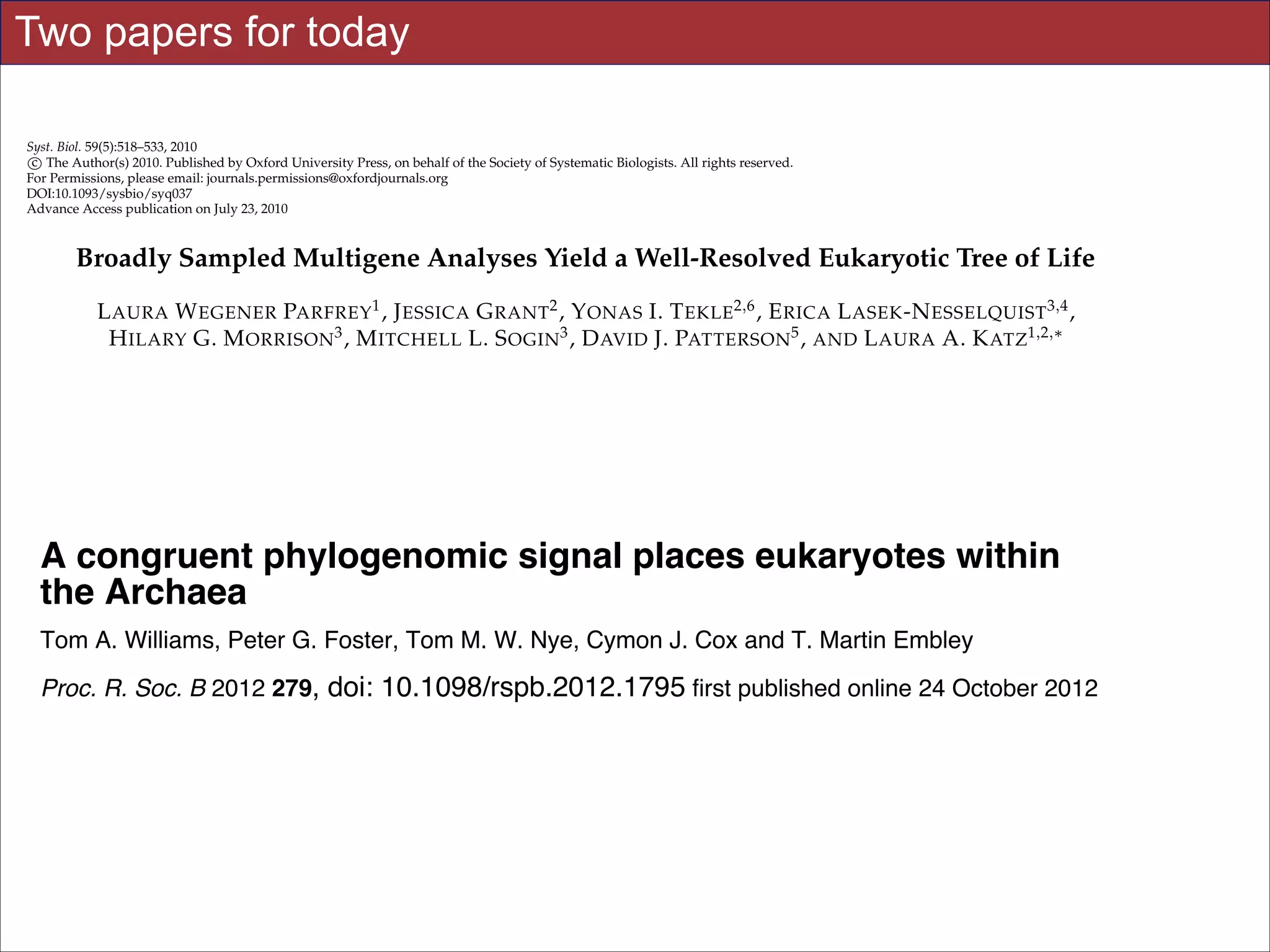
Two papers for today
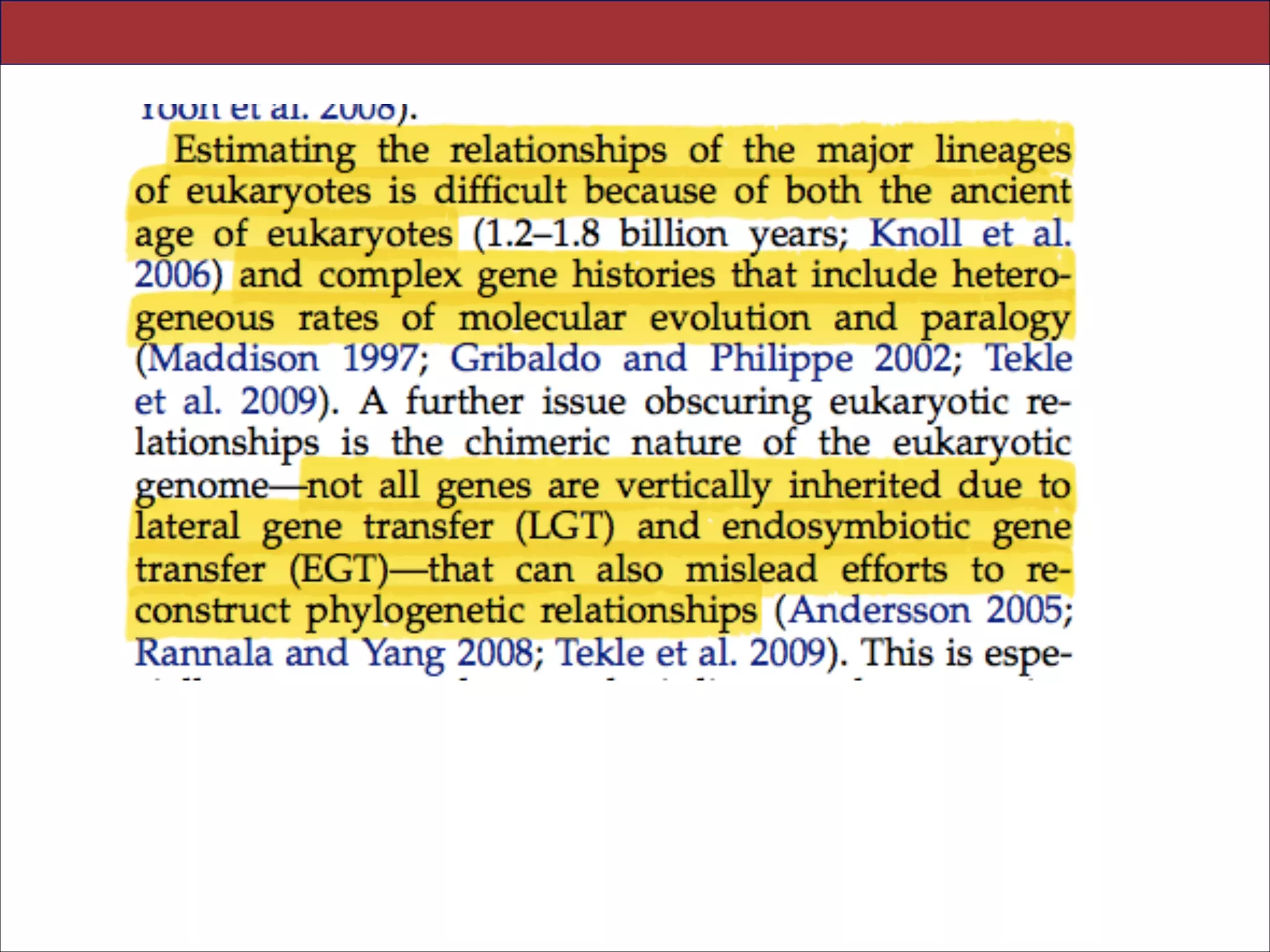
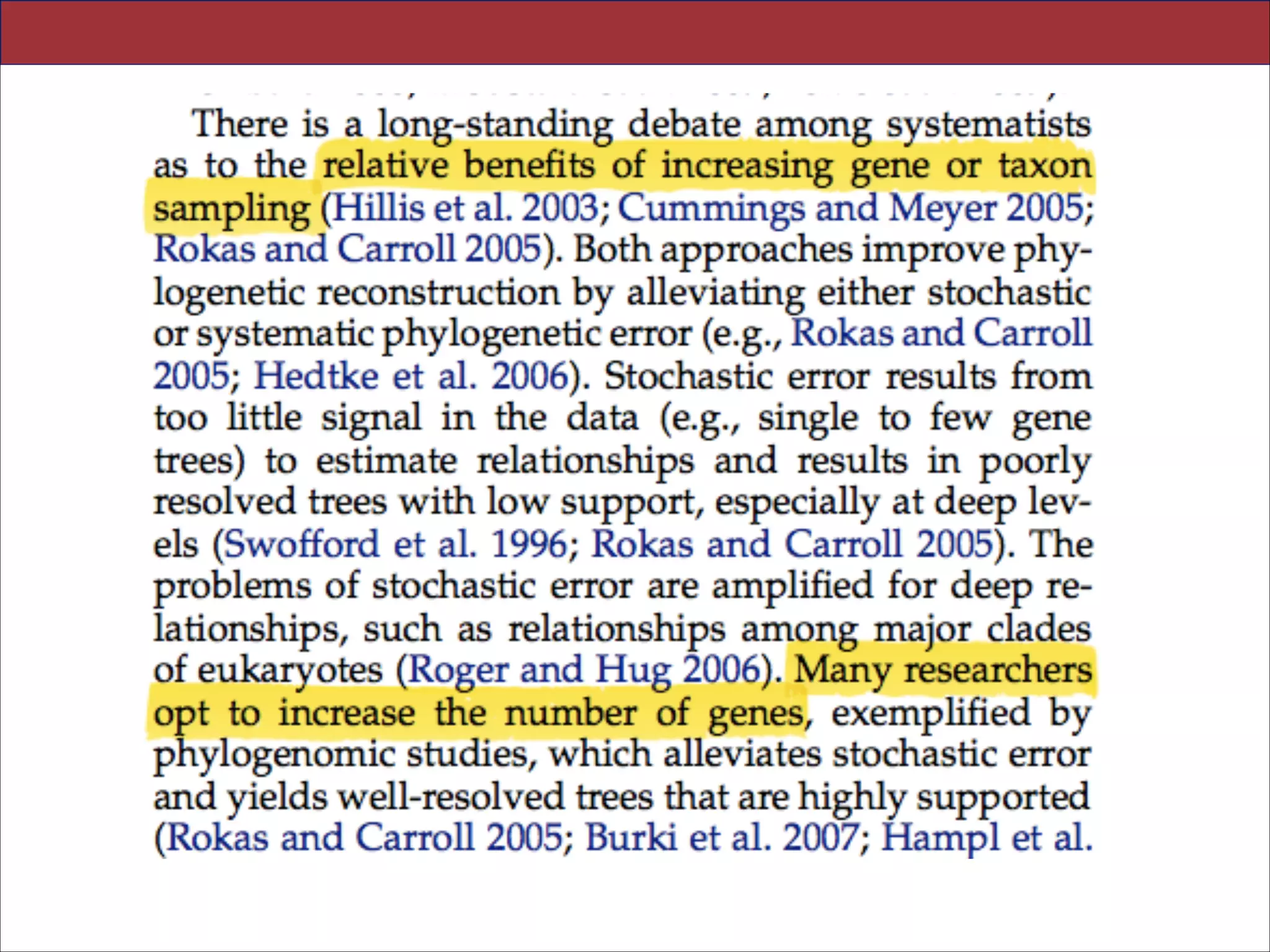
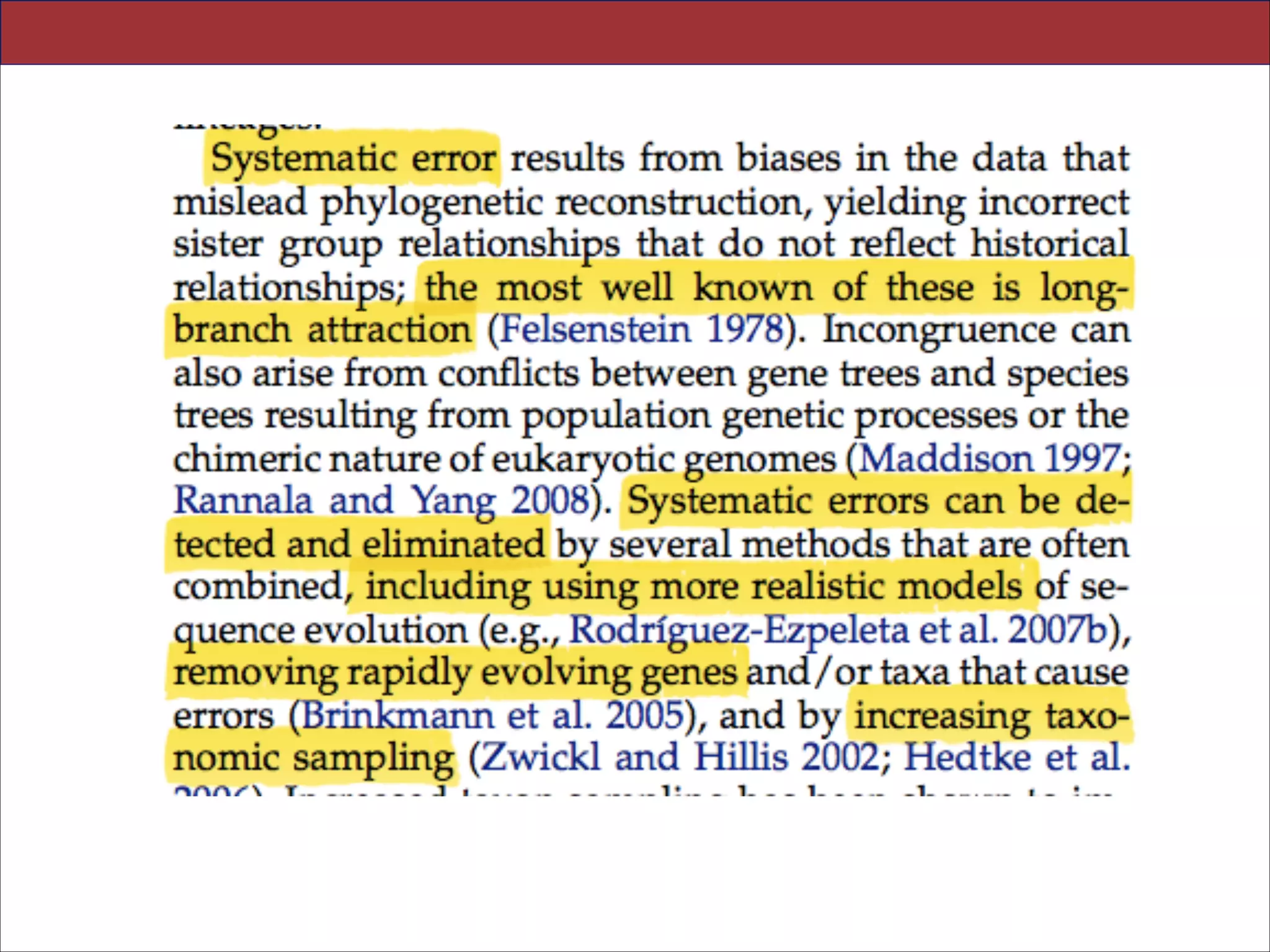
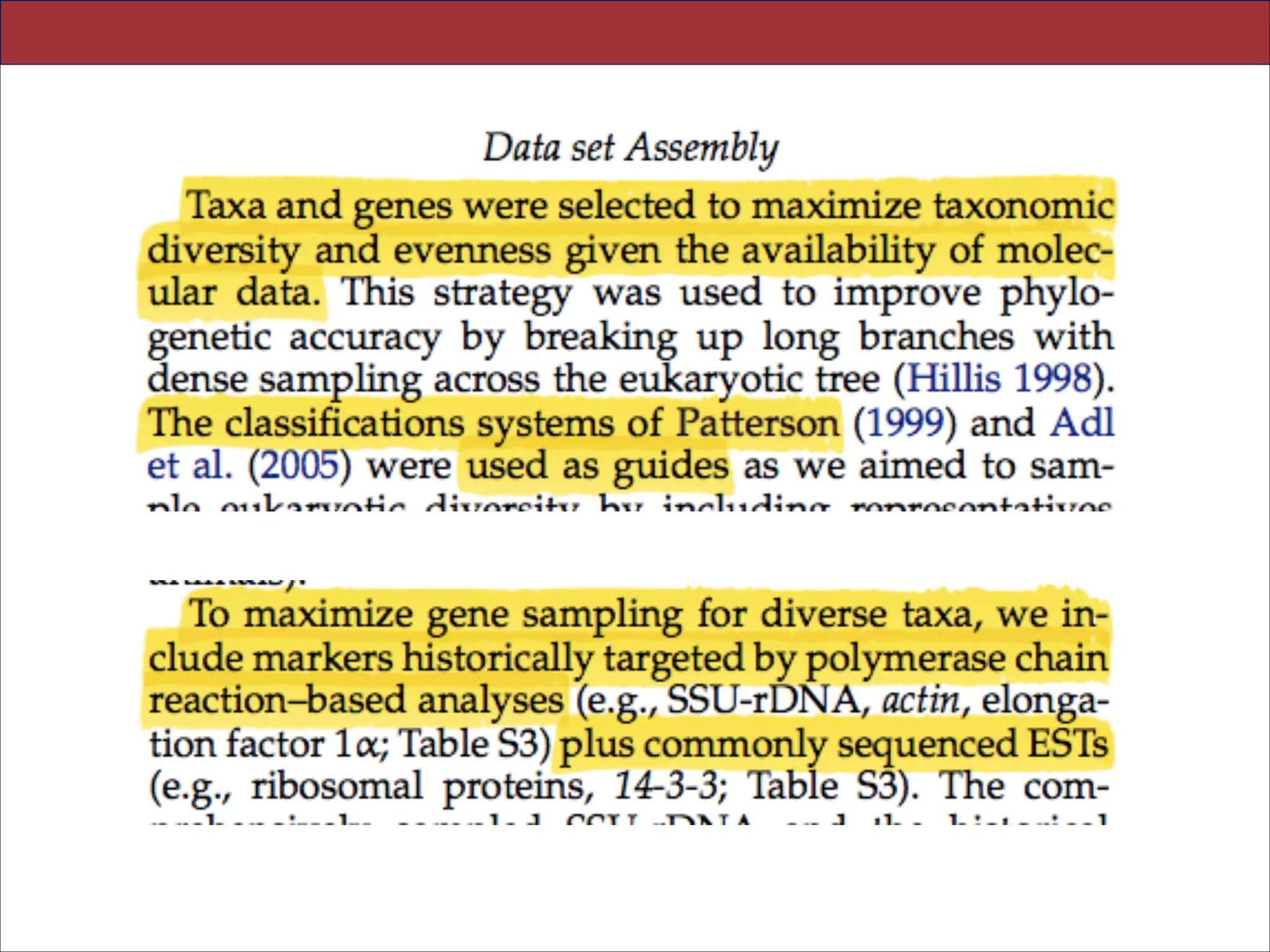
Syst. Biol. 59(5):518–533, 2010
c
⃝ The Author(s) 2010. Published by Oxford University Press, on behalf of the Society of Systematic Biologists. All rights reserved.
For Permissions, please email: journals.permissions@oxfordjournals.org
DOI:10.1093/sysbio/syq037
Advance Access publication on July 23, 2010

Broadly Sampled Multigene Analyses Yield a Well-Resolved Eukaryotic Tree of Life
Downloaded from rspb.royalsocietypublishing.org on January 16, 2014
1
2
2,6

L AURA W EGENER PARFREY , J ESSICA G RANT , Y ONAS I. T EKLE , E RICA L ASEK -N ESSELQUIST 3,4 ,
H ILARY G. M ORRISON 3 , M ITCHELL L. S OGIN3 , D AVID J. PATTERSON 5 , AND L AURA A. K ATZ1,2,∗
1 Program

in Organismic and Evolutionary Biology, University of Massachusetts, 611 North Pleasant Street, Amherst,
of Biological Sciences, Smith College, 44 College Lane, Northampton, MA 01063, USA; 3 Bay Paul Center for
MA 01003, USA;
Comparative Molecular Biology and Evolution, Marine Biological Laboratory, 7 MBL Street, Woods Hole, MA 02543, USA; 4 Department of Ecology and
Evolutionary Biology, Brown University, 80 Waterman Street, Providence, RI 02912, USA; 5 Biodiversity Informatics Group, Marine Biological
Laboratory, 7 MBL Street, Woods Hole, MA 02543, USA; 6 Present address: Department of Epidemiology and Public Health, Yale University School of
Medicine, New Haven, CT 06520, USA;
∗ Correspondence to be sent to: Laura A. Katz, 44 College Lane, Northampton, MA 01003, USA; E-mail: lkatz@smith.edu.
2 Department

A congruent phylogenomic signalDecember 2009; accepted 25 May 2010
places eukaryotes within
Received 30 September 2009; reviews returned 1
the Archaea
Associate Editor: C´cile An´
e
e
Abstract.—An Peter G. Foster, of the M. W. Nye, Cymon J. Cox identify Martin Embley
Tom A. Williams,accurate reconstruction Tom eukaryotic tree of life is essential to and T. the innovations underlying the

diversity of microbial and macroscopic (e.g., plants and animals) eukaryotes. Previous work has divided eukaryotic diversity into a small number
Proc. R. Soc. the2012 279of doi:in phylogenomic analyses can which receive strong support online 24 Octoberdue
B abundance of high-level “supergroups,” many of lead to highly supported but incorrect relationships 2012
, data 10.1098/rspb.2012.1795 first published in phylogenomic analyses.
However,
to systematic phylogenetic error. Furthermore, the paucity of major eukaryotic lineages (19 or fewer) included in these
genomic studies may exaggerate systematic error and reduce power to evaluate hypotheses. Here, we use a taxon-rich
strategy to assess eukaryotic relationships. We show that analyses emphasizing broad taxonomic sampling (up to 451 taxa
Supplementary data lineages) "Data Supplement"
representing 72 major
combined with a moderate number of genes yield a well-resolved eukaryotic tree of life.
The consistency across analyses http://rspb.royalsocietypublishing.org/content/suppl/2012/10/18/rspb.2012.1795.DC1.h
with varying numbers of taxa (88–451) and levels of missing data (17–69%) supports the
tml
accuracy of the resulting topologies. The resulting stable topology emerges without the removal of rapidly evolving genes
or taxa, a practice common to phylogenomic analyses. Several35 of which can be accessed
This article cites 56 articles, major groups are stable and strongly supported in these
References(e.g., SAR, Rhizaria, Excavata), whereas the proposed supergroup “Chromalveolata” isfree
analyses
rejected. Furthermore, exhttp://rspb.royalsocietypublishing.org/content/279/1749/4870.full.html#ref-list-1
tensive instability among photosynthetic lineages suggests the presence of systematic biases including endosymbiotic gene
transfer from symbiont (nucleus Article cited host. Our analyses demonstrate that stable topologies of ancient evolutionary
or plastid) to in:
relationships can be achieved with broad taxonomic sampling and a moderate number of genes. Finally, taxon-rich analyhttp://rspb.royalsocietypublishing.org/content/279/1749/4870.full.html#related-urls
ses such as presented Slides for UC Davis for testing the accuracy of relationships that Eisen Winter 2014 support
here provide a method EVE161 Course Taught by Jonathan receive high bootstrap

Downloaded from http://sysbio.oxfordjournals.org/ at University

Laura Wegener Parfrey and Jessica Grant have contributed equally to this work.

!3
Phylogeny Review

Slides for UC Davis EVE161 Course Taught by Jonathan Eisen Winter 2014

!4
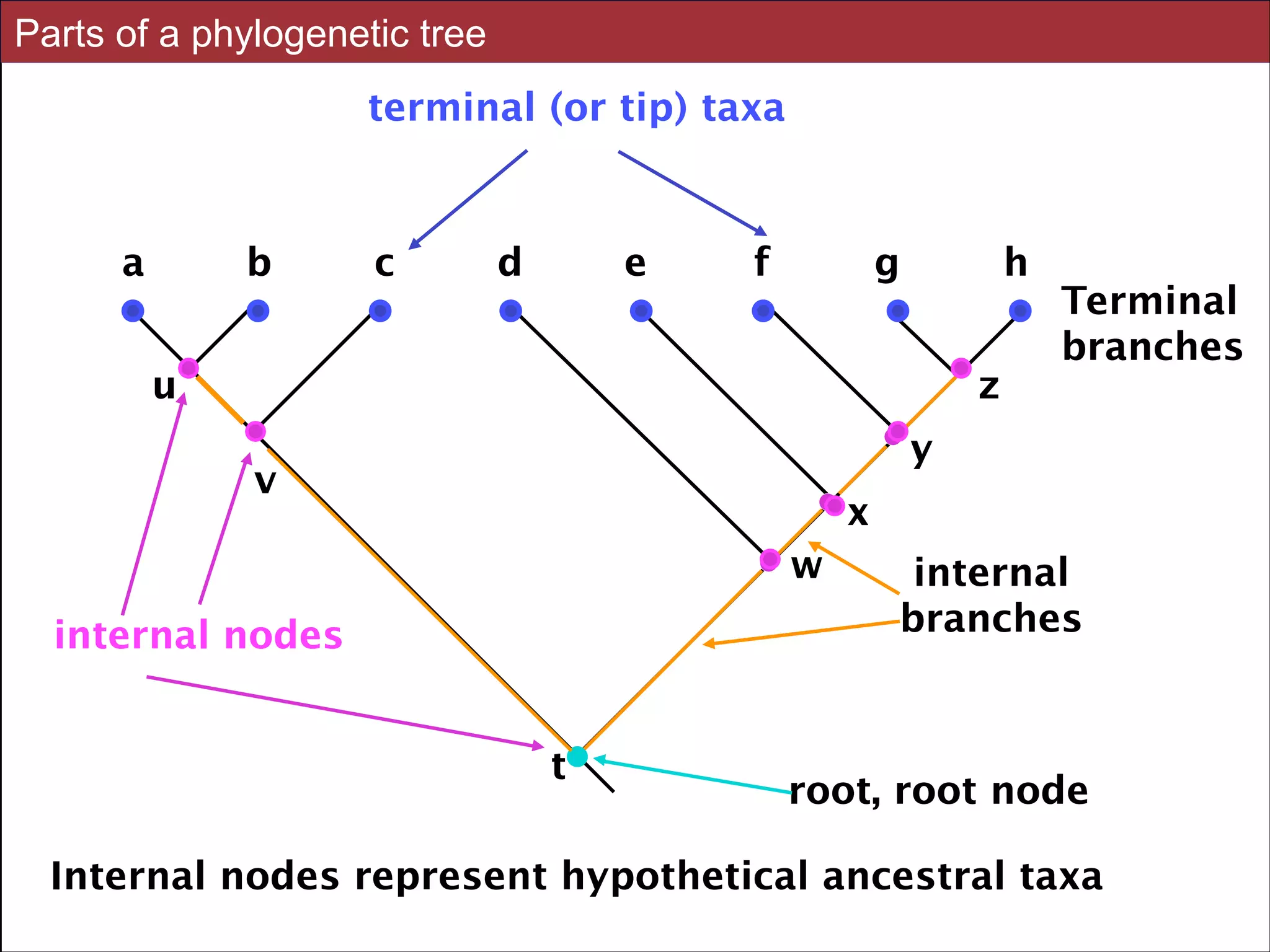
Parts of a phylogenetic tree
terminal (or tip) taxa

a

b

c

d

e

f

g

h

u

z

Terminal
branches

y

v

x
w

internal nodes
t

internal
branches

root, root node

Internal nodes represent hypothetical ancestral taxa
Slides for UC Davis EVE161 Course Taught by Jonathan Eisen Winter 2014

!5
Characters
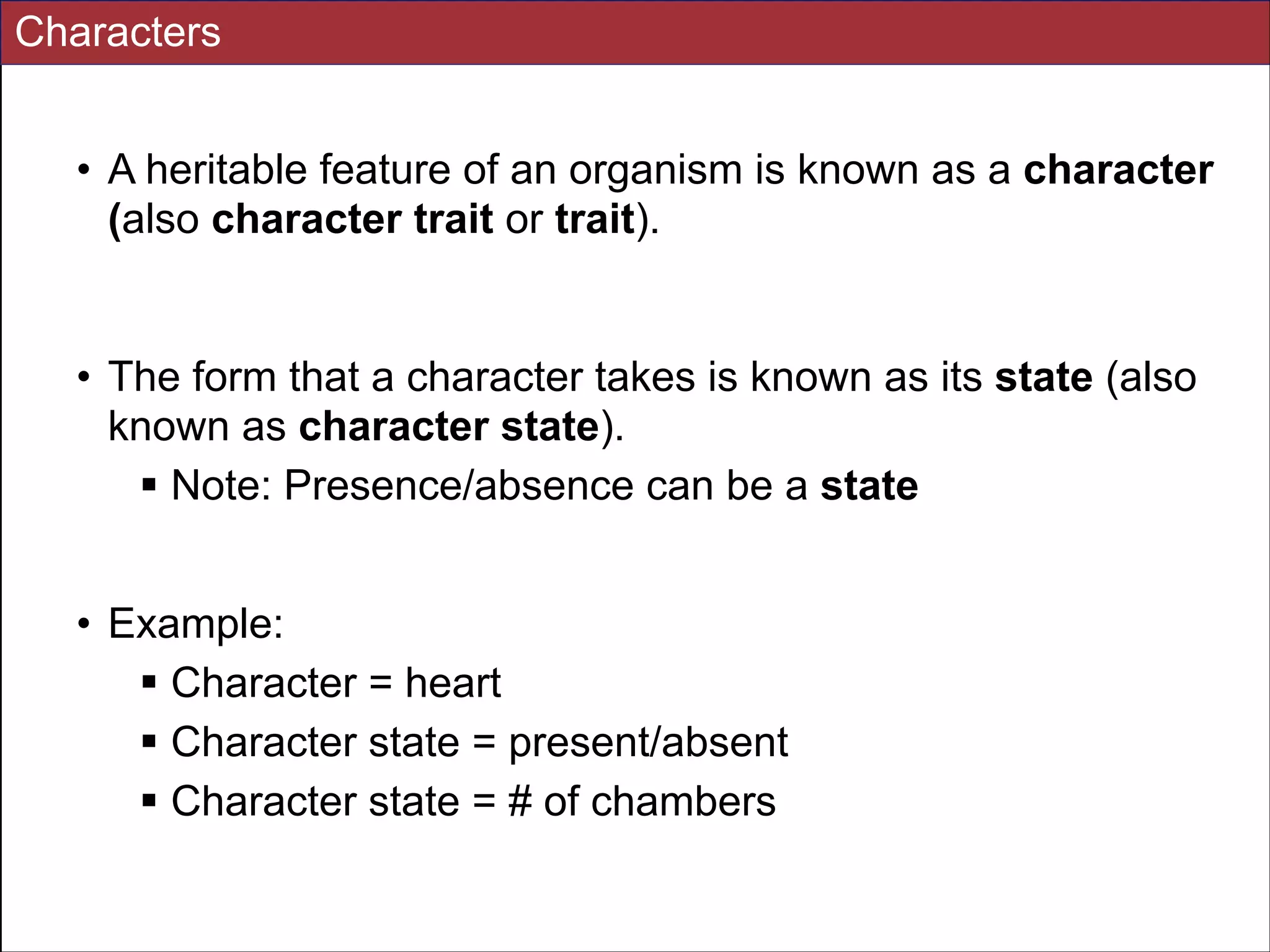
• A heritable feature of an organism is known as a character
(also character trait or trait).

!
• The form that a character takes is known as its state (also
known as character state).
! Note: Presence/absence can be a state
!
• Example:
! Character = heart
! Character state = present/absent
! Character state = # of chambers
Slides for UC Davis EVE161 Course Taught by Jonathan Eisen Winter 2014

!6
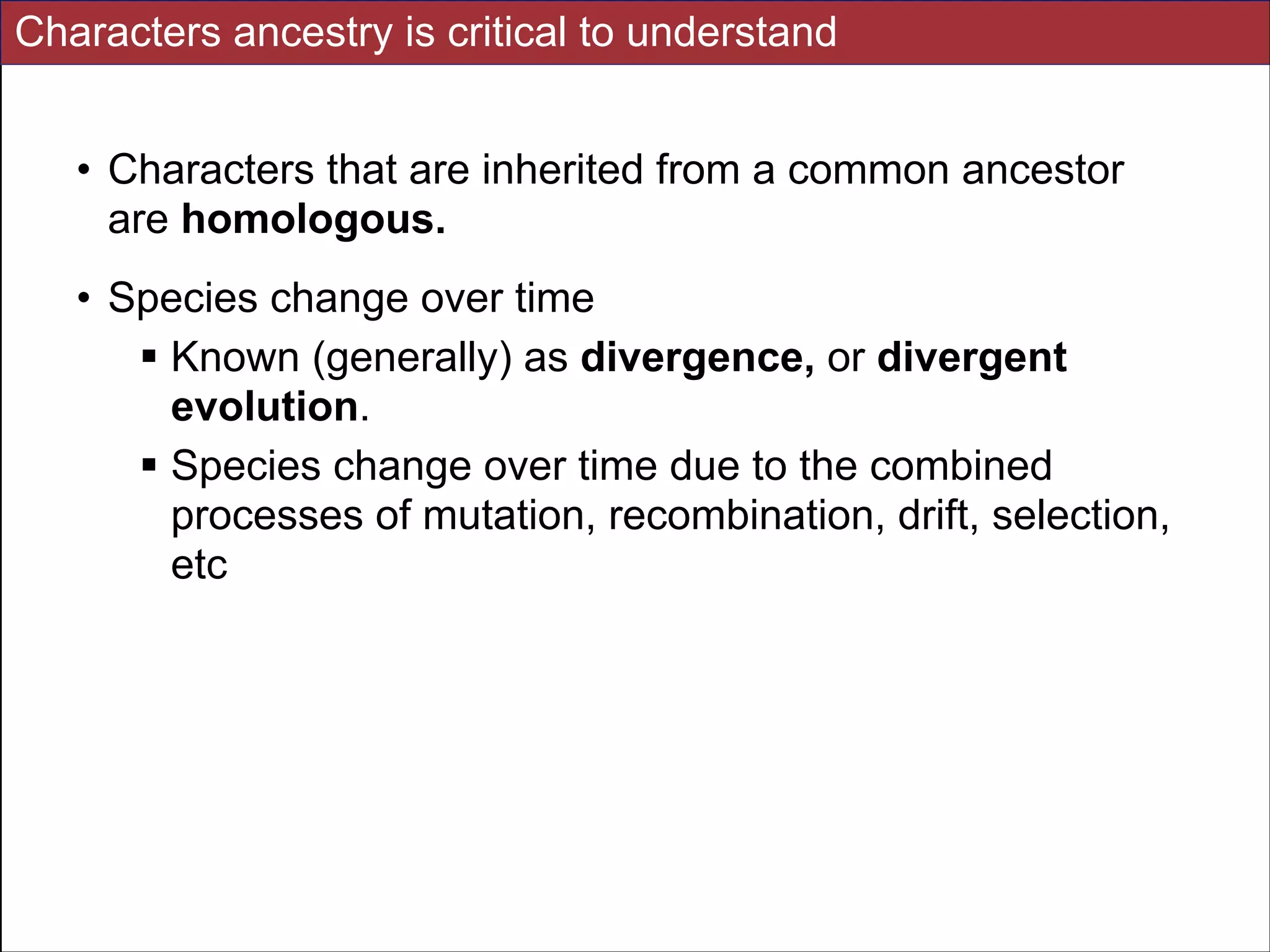
Characters ancestry is critical to understand
• Characters that are inherited from a common ancestor
are homologous.
• Species change over time
! Known (generally) as divergence, or divergent
evolution.
! Species change over time due to the combined
processes of mutation, recombination, drift, selection,
etc

Slides for UC Davis EVE161 Course Taught by Jonathan Eisen Winter 2014

!7
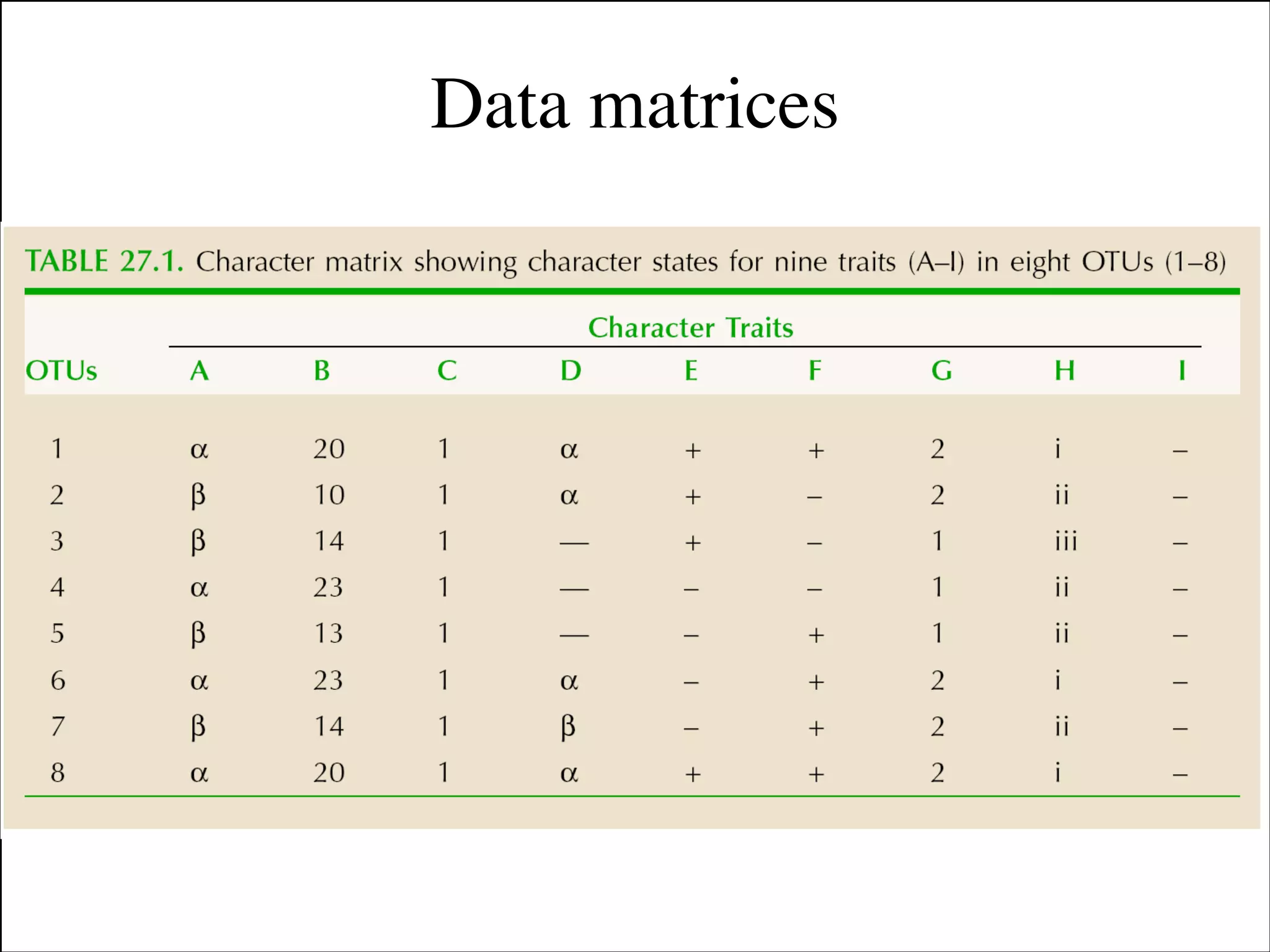
Data matrices

Slides for UC Davis EVE161 Course Taught by Jonathan Eisen Winter 2014

!8
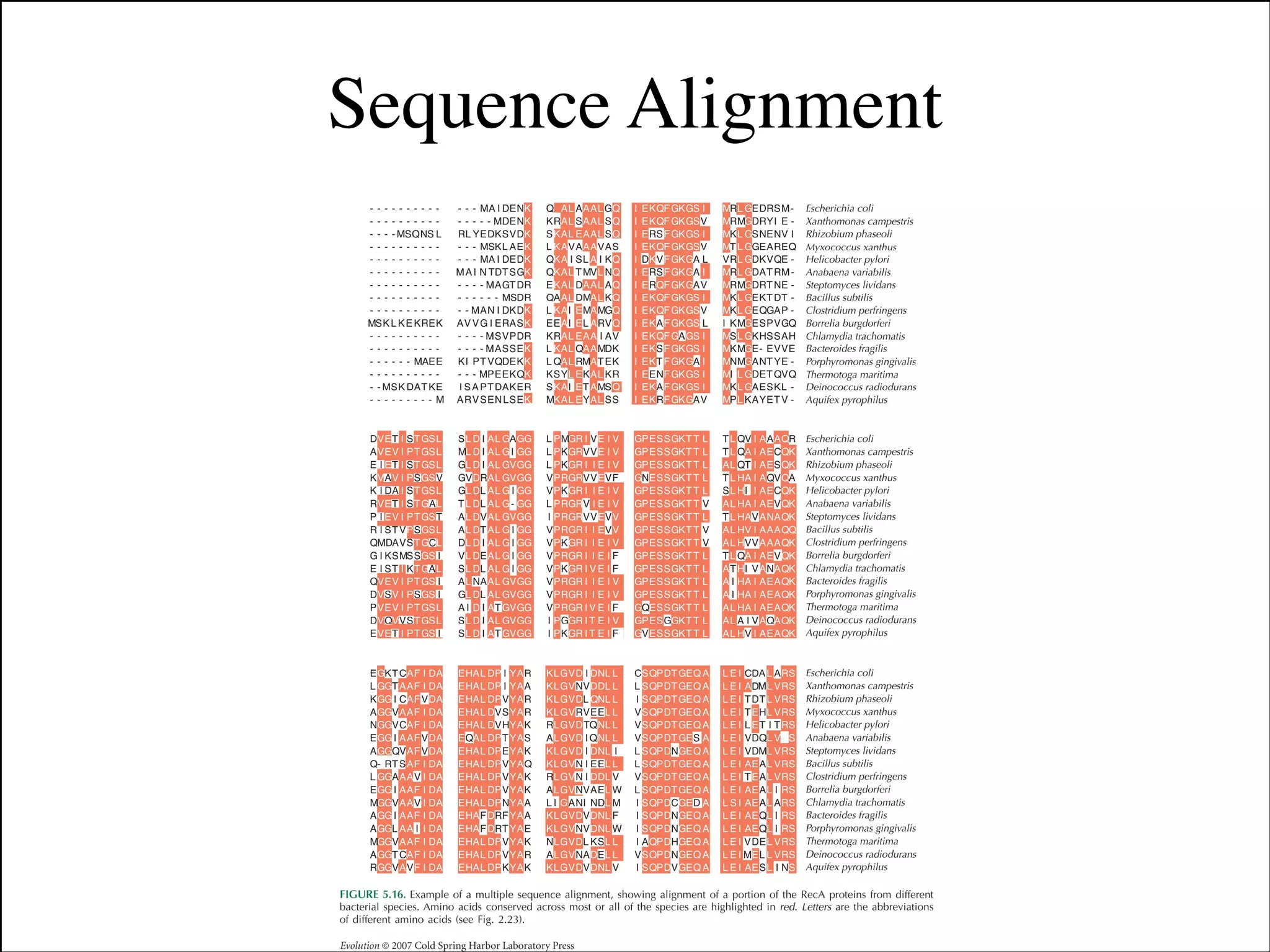
Sequence Alignment

Slides for UC Davis EVE161 Course Taught by Jonathan Eisen Winter 2014

!9
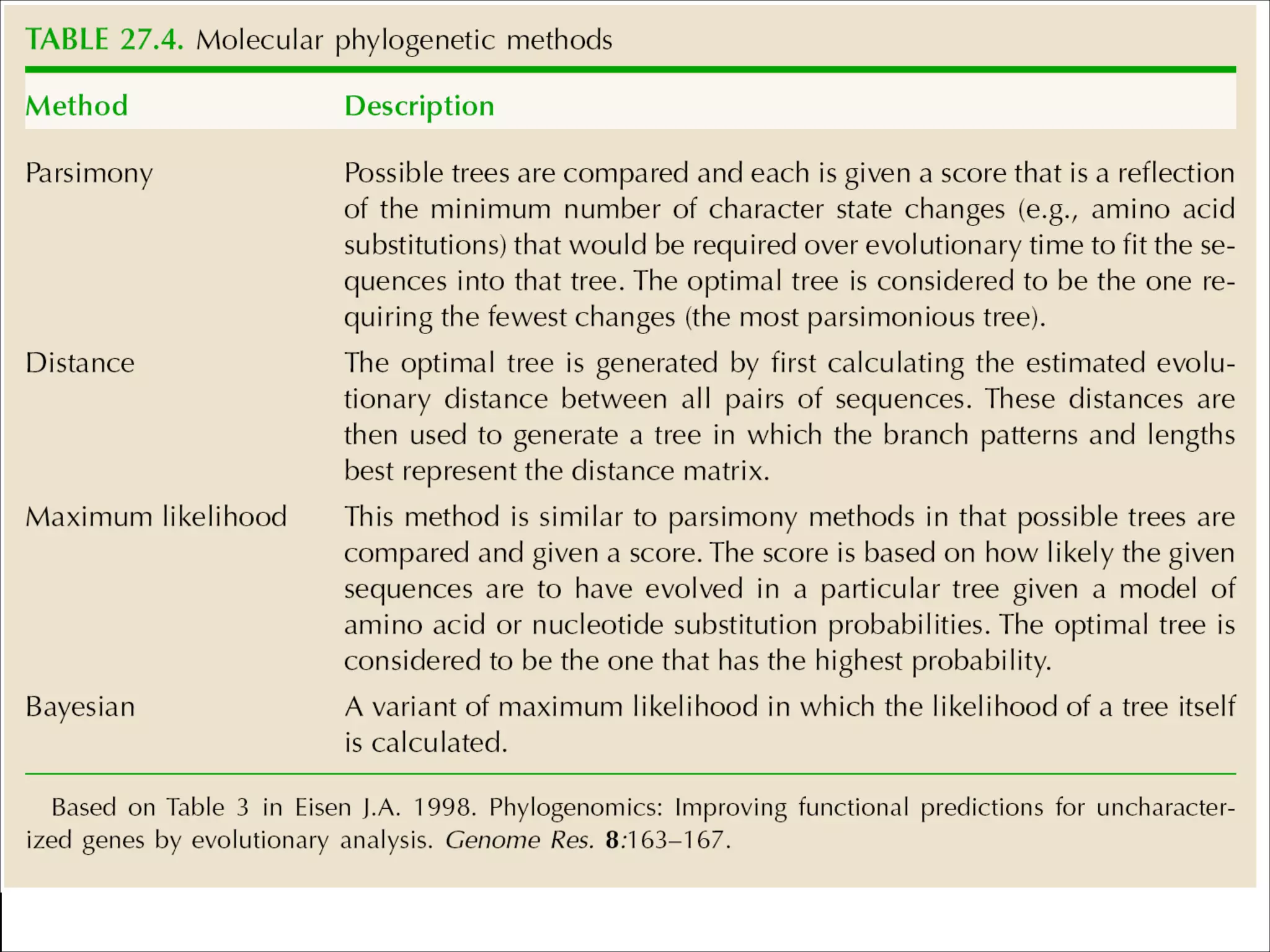
Tree reconstruction methods

Slides for UC Davis EVE161 Course Taught by Jonathan Eisen Winter 2014

!10
Some other bells and whistles

Slides for UC Davis EVE161 Course Taught by Jonathan Eisen Winter 2014

!11
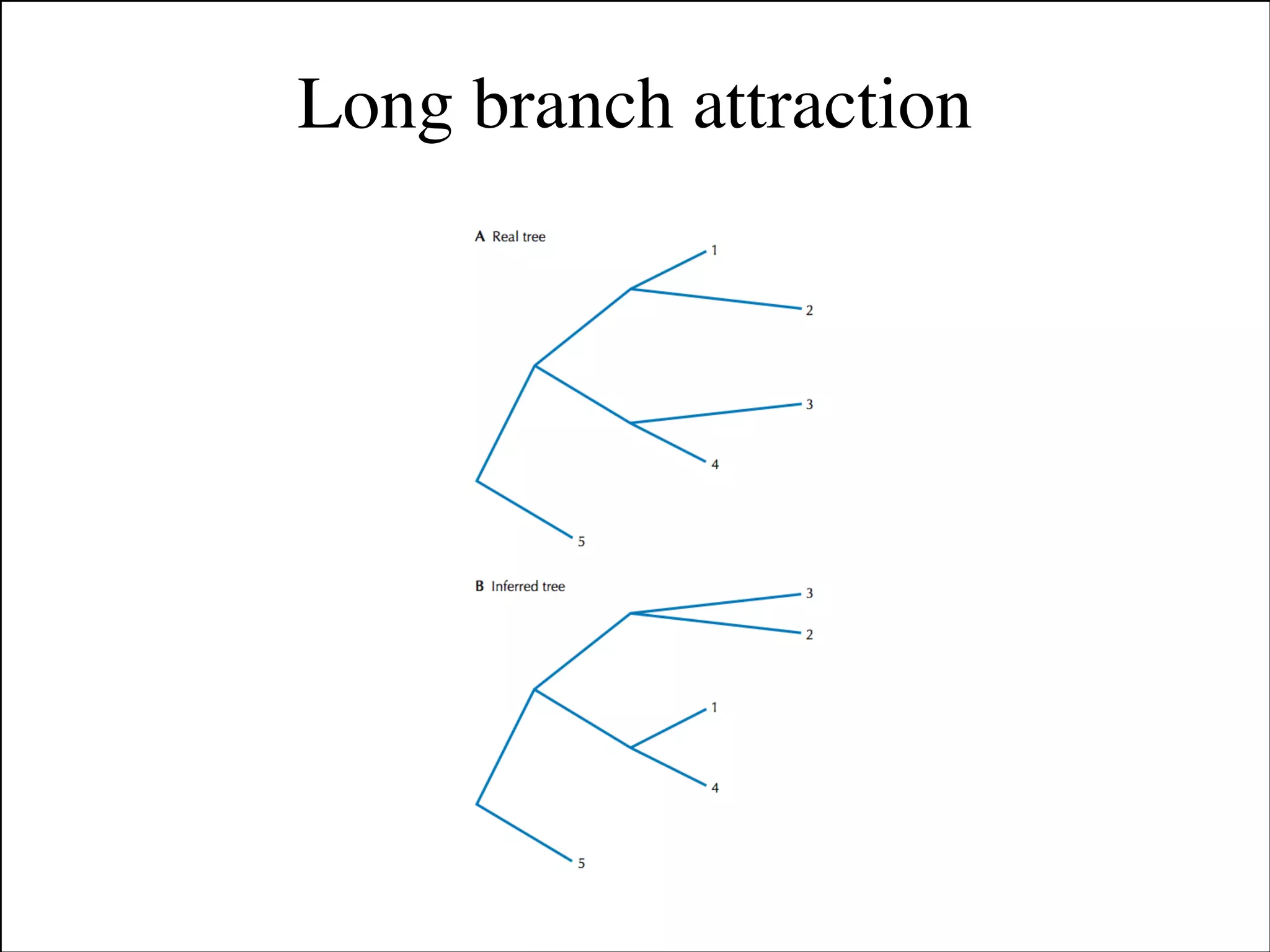
Long branch attraction

Slides for UC Davis EVE161 Course Taught by Jonathan Eisen Winter 2014

!12
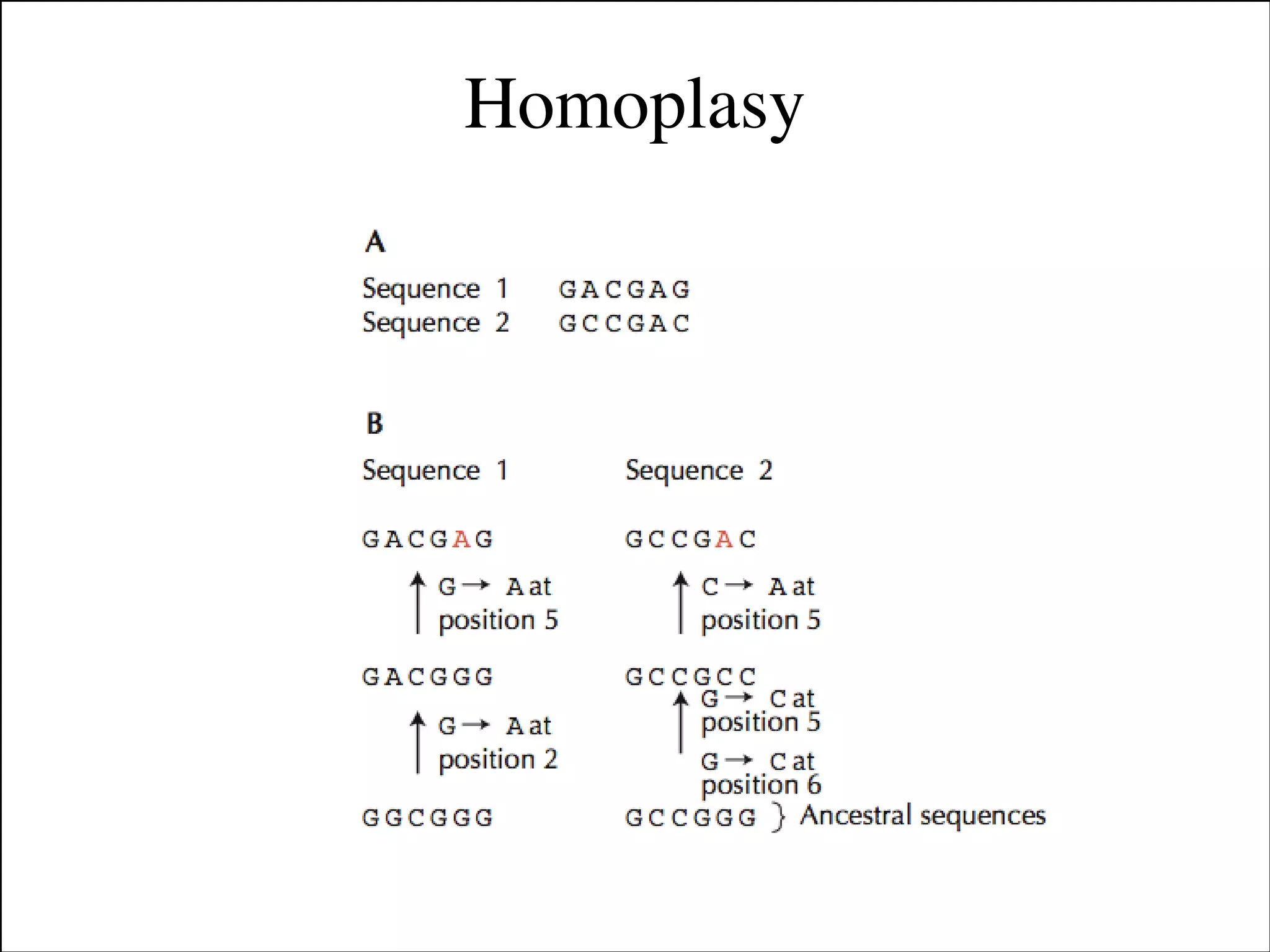
Homoplasy

Slides for UC Davis EVE161 Course Taught by Jonathan Eisen Winter 2014

!13
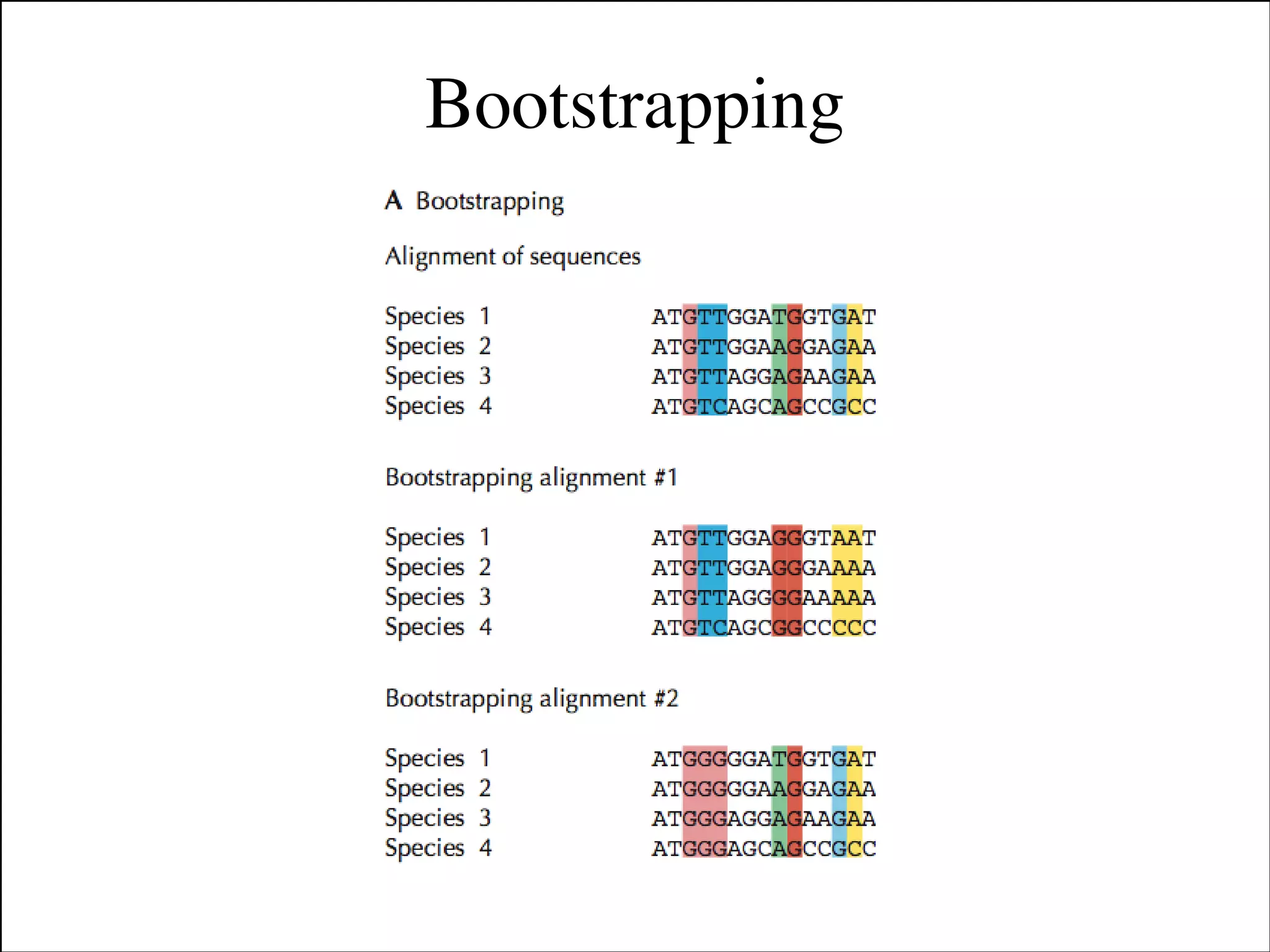
Bootstrapping

Slides for UC Davis EVE161 Course Taught by Jonathan Eisen Winter 2014

!14
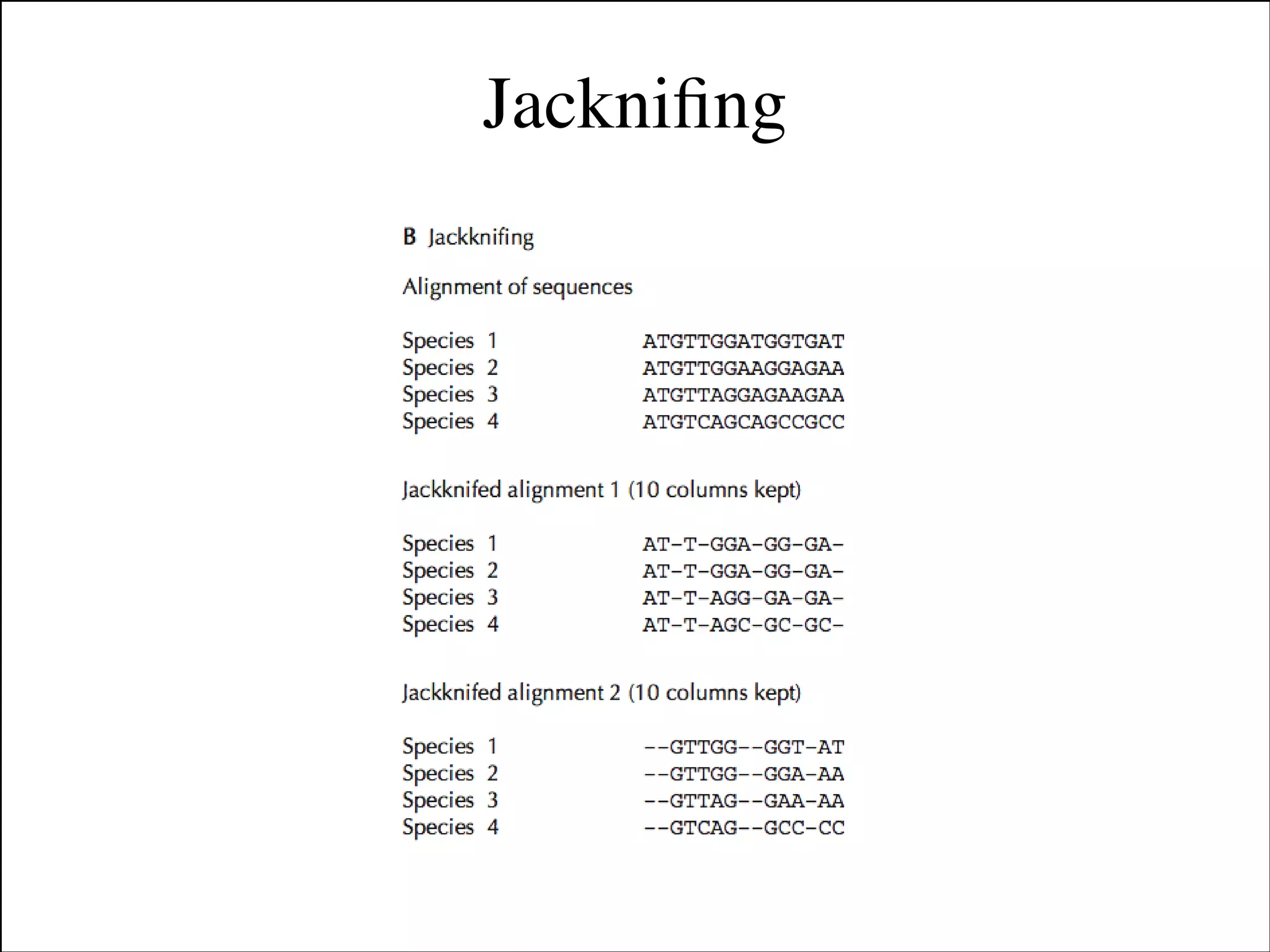
Jacknifing

Slides for UC Davis EVE161 Course Taught by Jonathan Eisen Winter 2014

!15
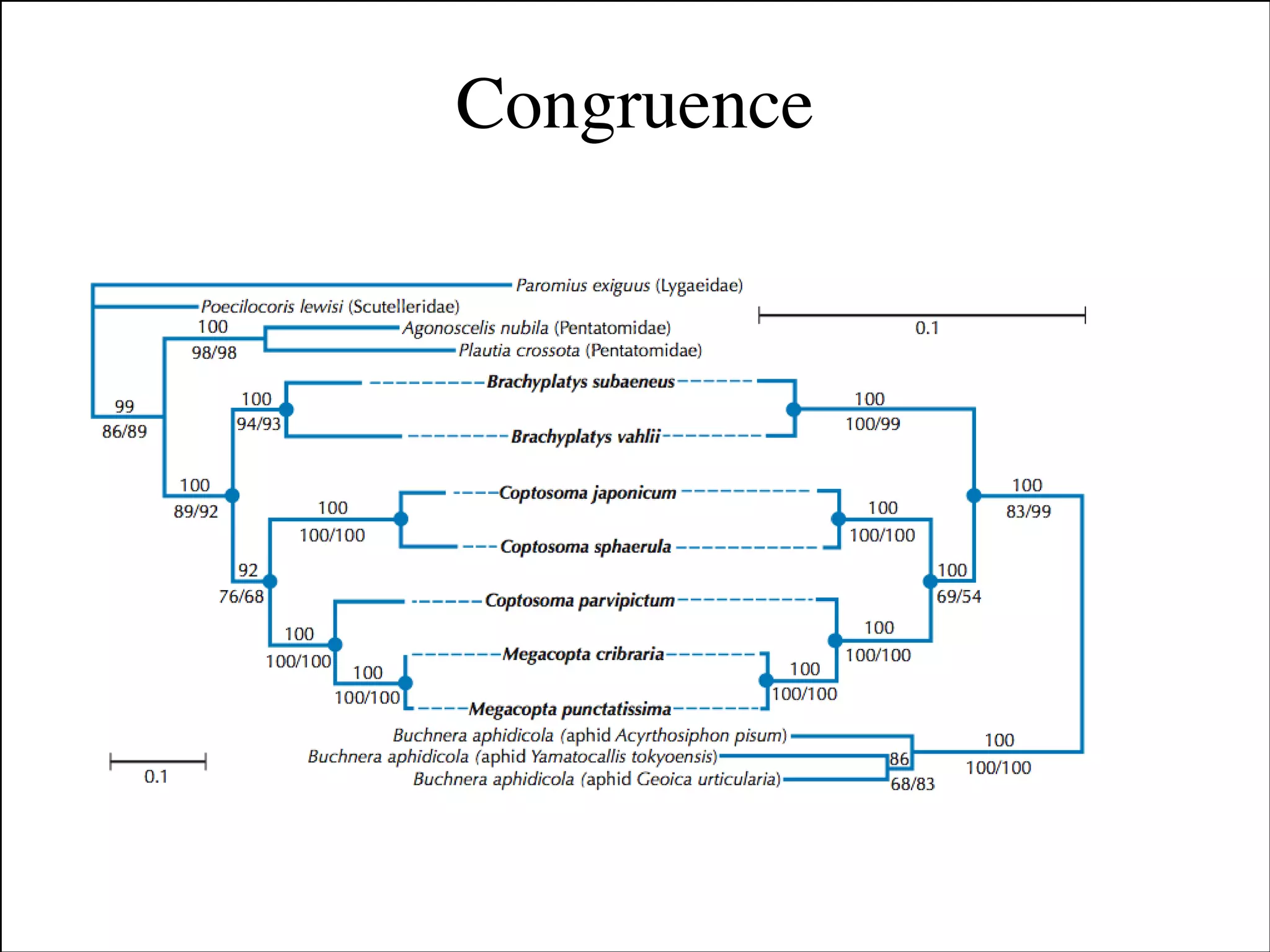
Congruence

Slides for UC Davis EVE161 Course Taught by Jonathan Eisen Winter 2014

!16
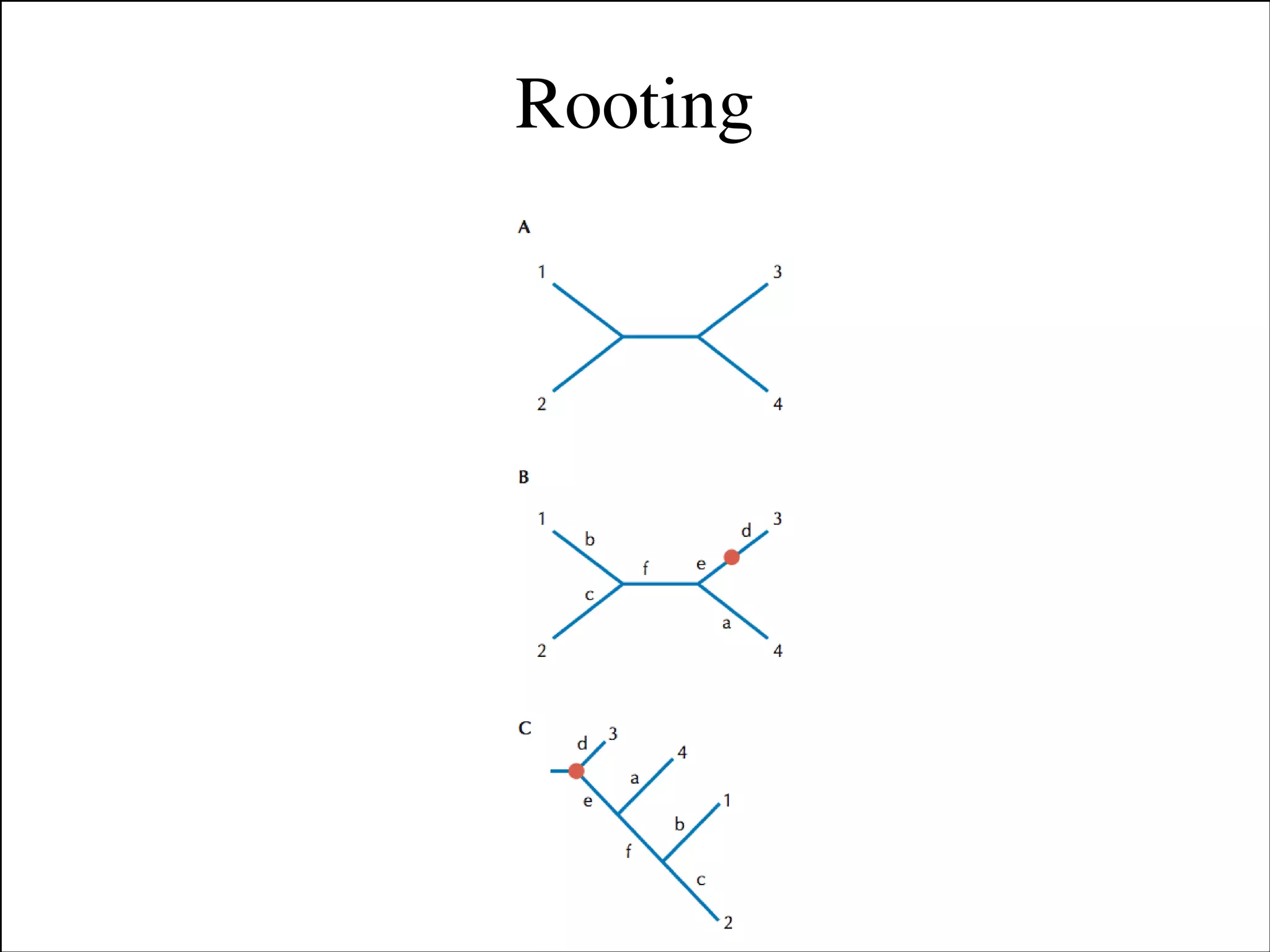
Rooting

Slides for UC Davis EVE161 Course Taught by Jonathan Eisen Winter 2014

!17
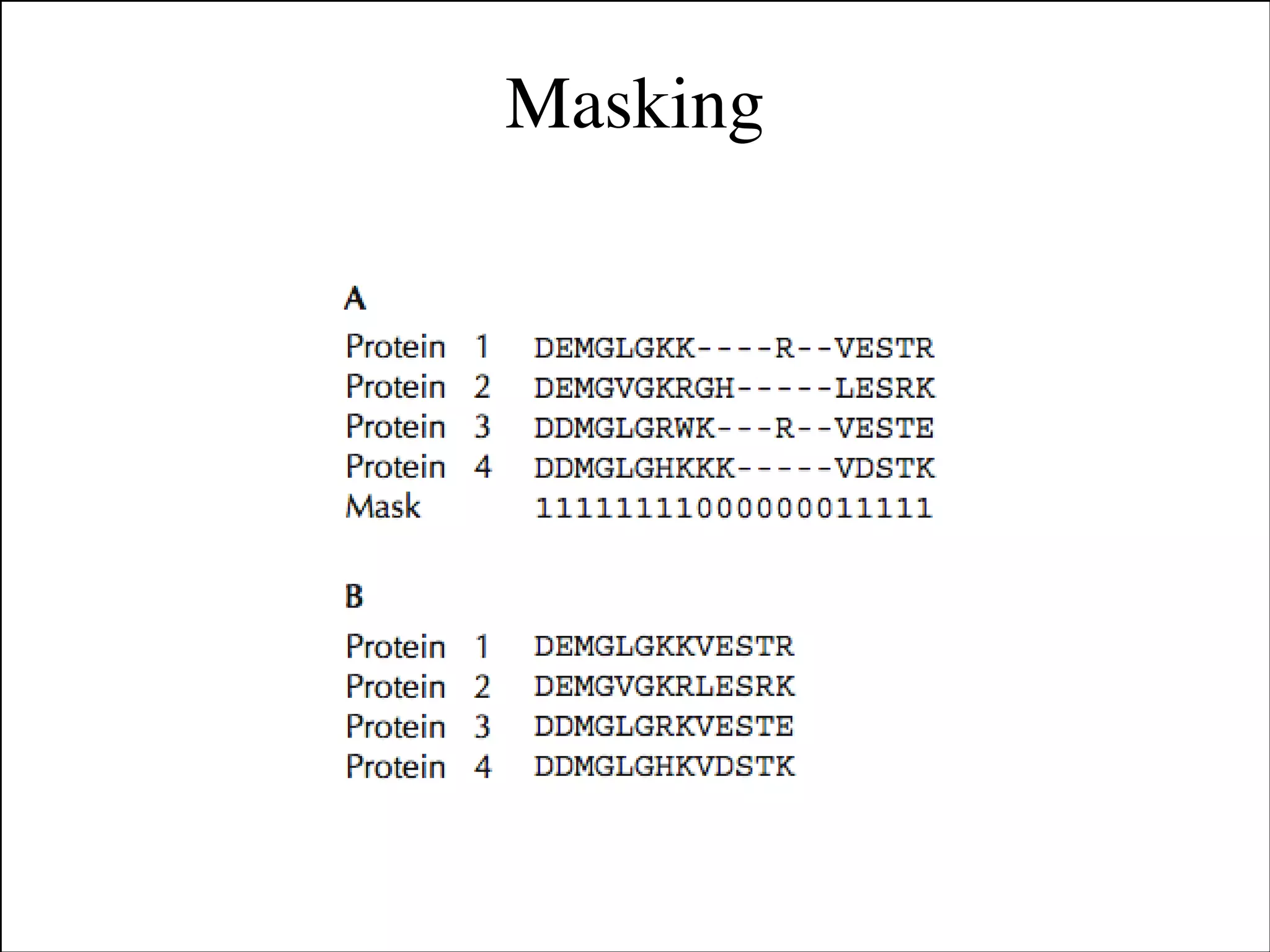
Masking

Slides for UC Davis EVE161 Course Taught by Jonathan Eisen Winter 2014

!18
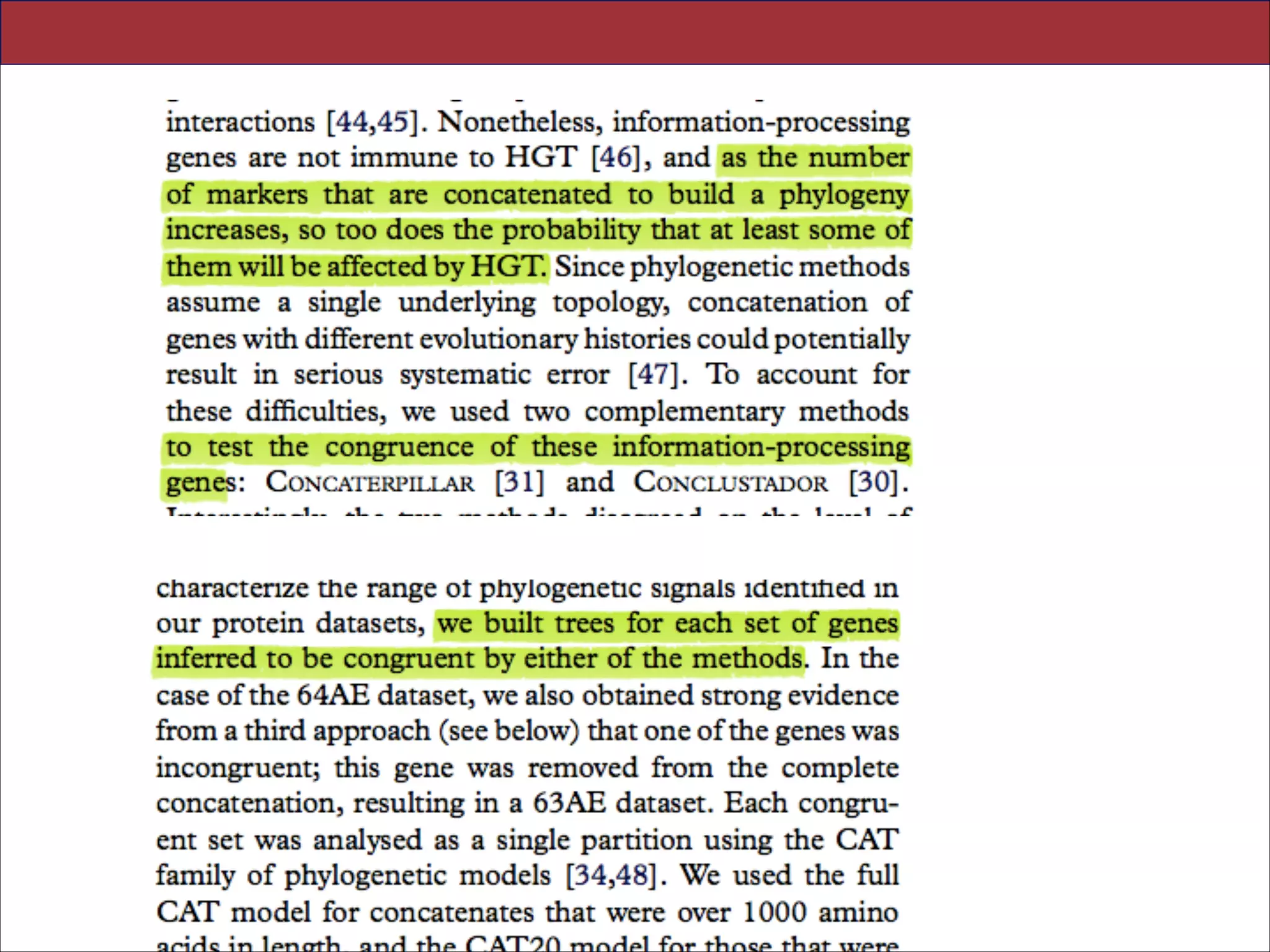
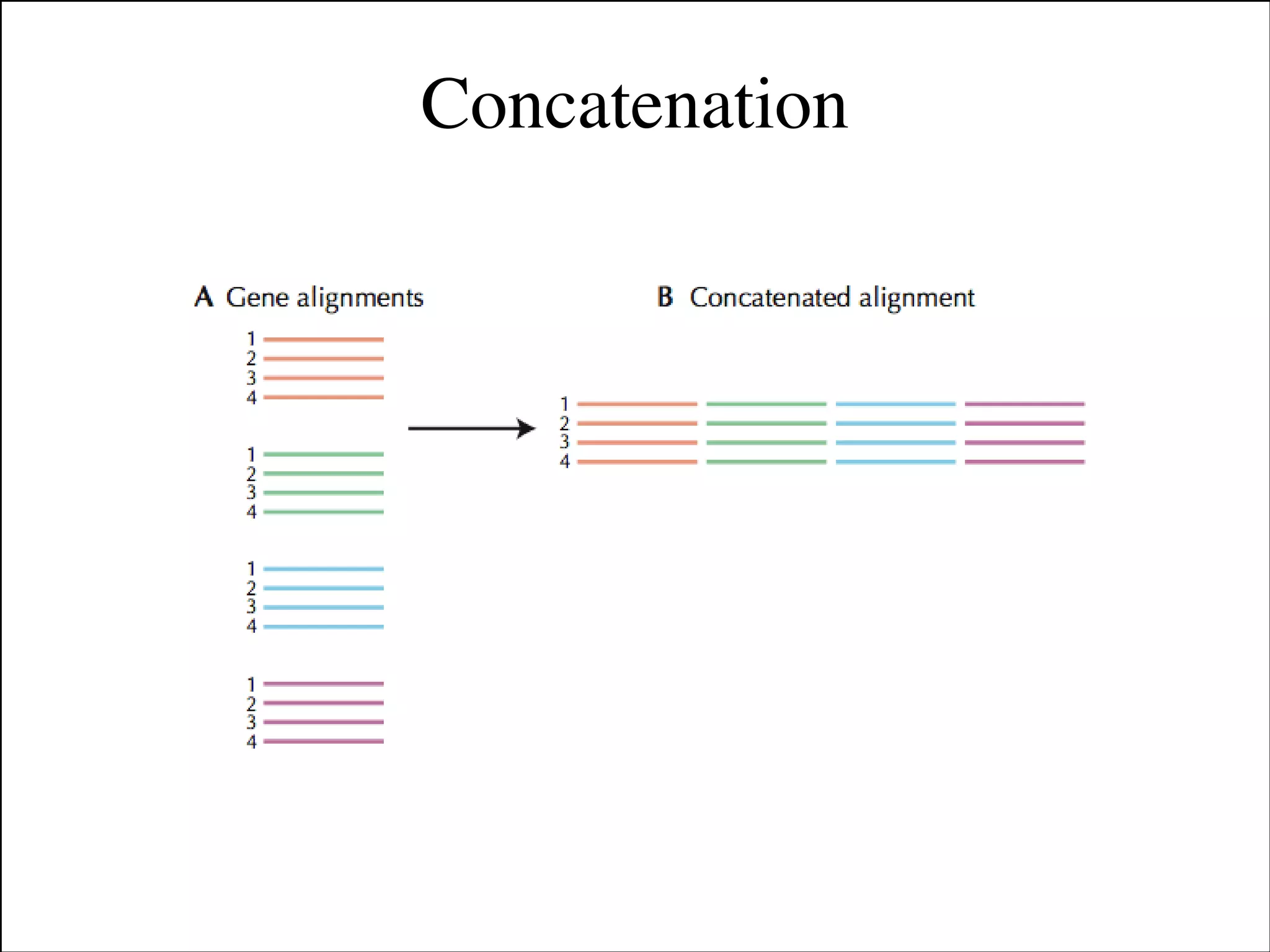
Concatenation

Slides for UC Davis EVE161 Course Taught by Jonathan Eisen Winter 2014

!19
Two papers for today
Syst. Biol. 59(5):518–533, 2010
c
⃝ The Author(s) 2010. Published by Oxford University Press, on behalf of the Society of Systematic Biologists. All rights reserved.
For Permissions, please email: journals.permissions@oxfordjournals.org
DOI:10.1093/sysbio/syq037
Advance Access publication on July 23, 2010

Broadly Sampled Multigene Analyses Yield a Well-Resolved Eukaryotic Tree of Life
L AURA W EGENER PARFREY1 , J ESSICA G RANT2 , Y ONAS I. T EKLE2,6 , E RICA L ASEK -N ESSELQUIST 3,4 ,
H ILARY G. M ORRISON 3 , M ITCHELL L. S OGIN3 , D AVID J. PATTERSON 5 , AND L AURA A. K ATZ1,2,∗
1 Program

in Organismic and Evolutionary Biology, University of Massachusetts, 611 North Pleasant Street, Amherst,
of Biological Sciences, Smith College, 44 College Lane, Northampton, MA 01063, USA; 3 Bay Paul Center for
MA 01003, USA;
Comparative Molecular Biology and Evolution, Marine Biological Laboratory, 7 MBL Street, Woods Hole, MA 02543, USA; 4 Department of Ecology and
Evolutionary Biology, Brown University, 80 Waterman Street, Providence, RI 02912, USA; 5 Biodiversity Informatics Group, Marine Biological
Laboratory, 7 MBL Street, Woods Hole, MA 02543, USA; 6 Present address: Department of Epidemiology and Public Health, Yale University School of
Medicine, New Haven, CT 06520, USA;
∗ Correspondence to be sent to: Laura A. Katz, 44 College Lane, Northampton, MA 01003, USA; E-mail: lkatz@smith.edu.
Laura Wegener Parfrey and Jessica Grant have contributed equally to this work.
2 Department

Received 30 September 2009; reviews returned 1 December 2009; accepted 25 May 2010
Associate Editor: C´cile An´
e
e
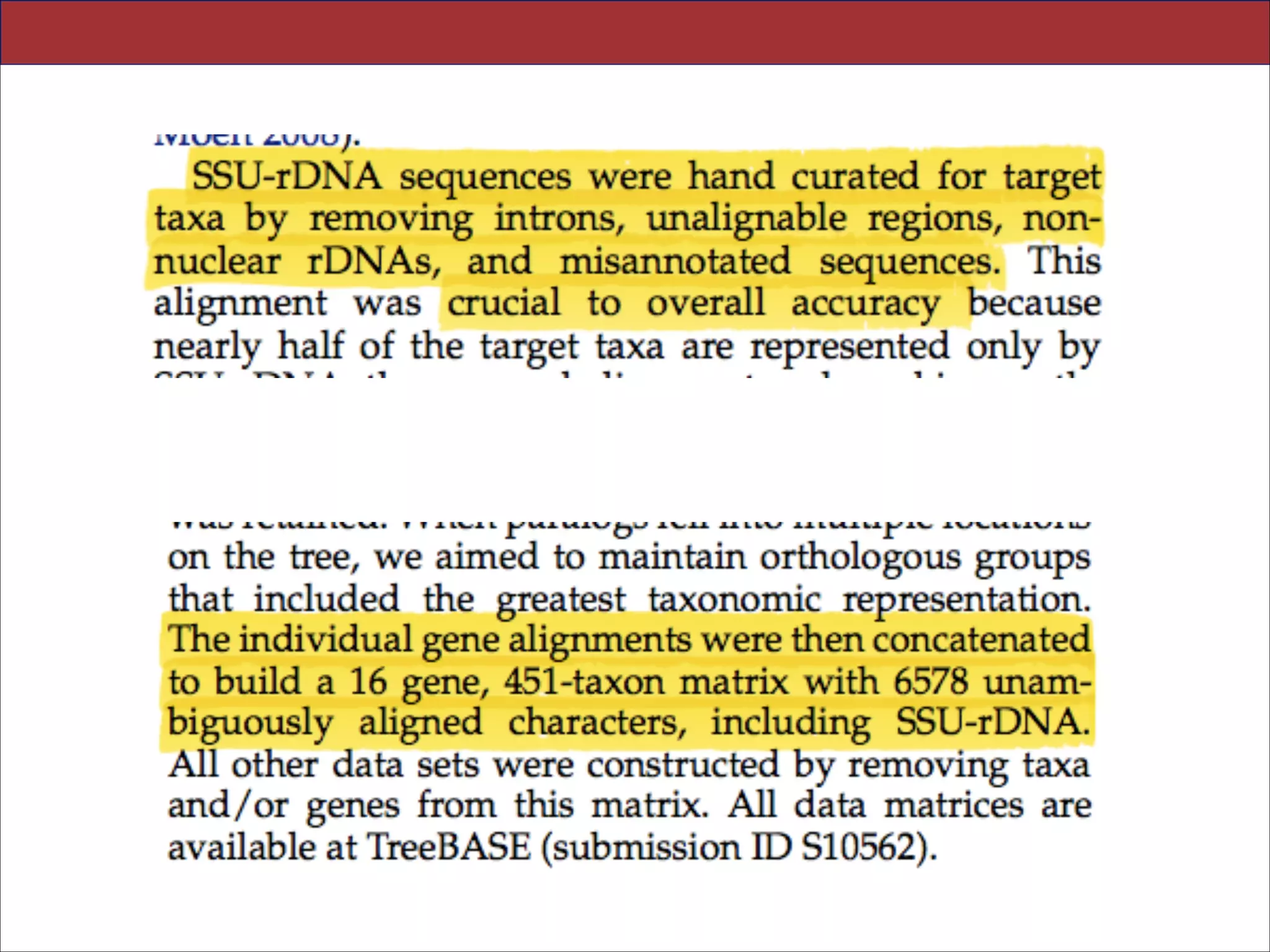
Abstract.—An accurate reconstruction of the eukaryotic tree of life is essential to identify the innovations underlying the
diversity of microbial and macroscopic (e.g., plants and animals) eukaryotes. Previous work has divided eukaryotic diversity into a small number of high-level “supergroups,” many of which receive strong support in phylogenomic analyses.
However, the abundance of data in phylogenomic analyses can lead to highly supported but incorrect relationships due
to systematic phylogenetic error. Furthermore, the paucity of major eukaryotic lineages (19 or fewer) included in these
genomic studies may exaggerate systematic error and reduce power to evaluate hypotheses. Here, we use a taxon-rich
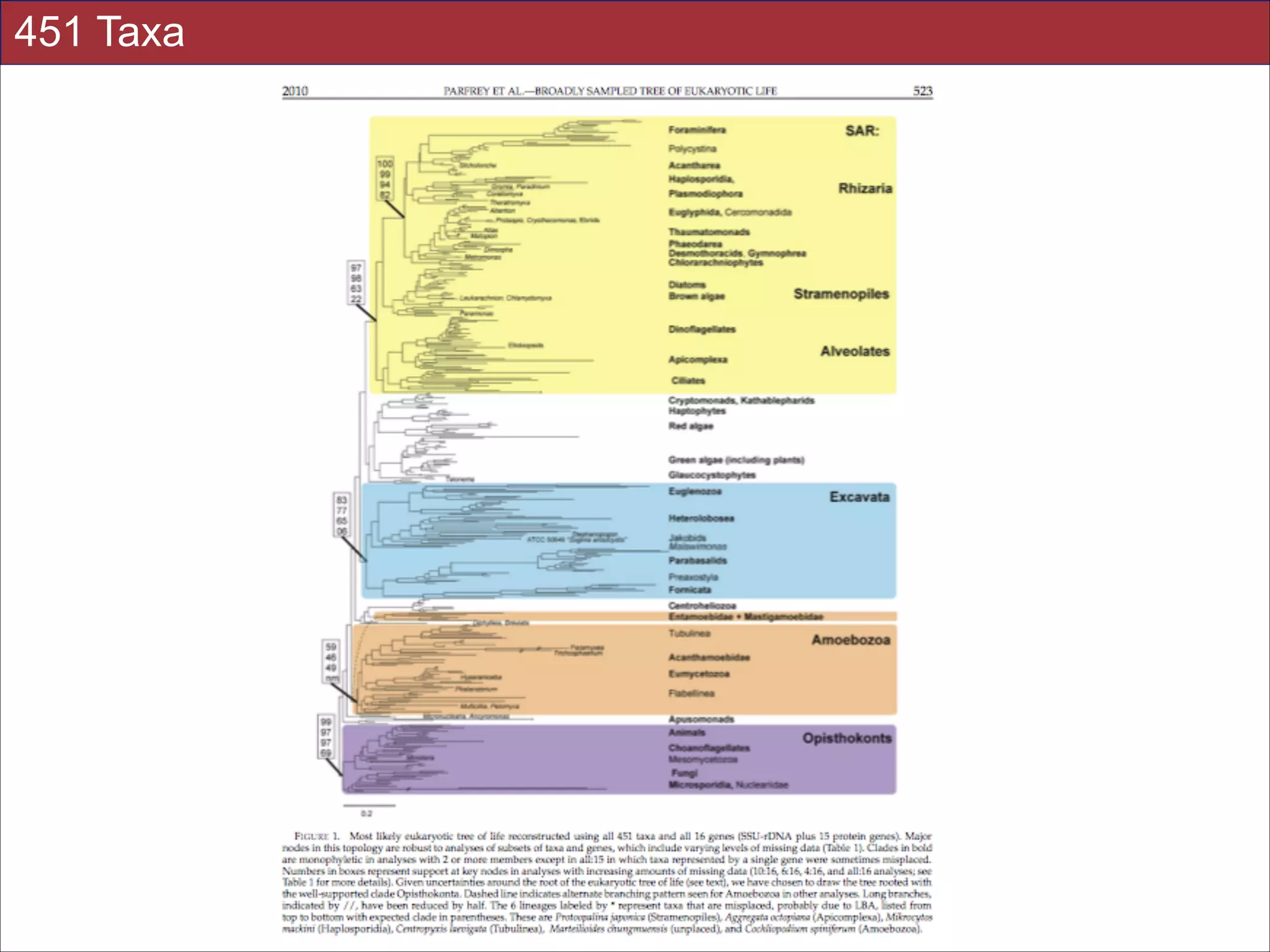
strategy to assess eukaryotic relationships. We show that analyses emphasizing broad taxonomic sampling (up to 451 taxa
representing 72 major lineages) combined with a moderate number of genes yield a well-resolved eukaryotic tree of life.
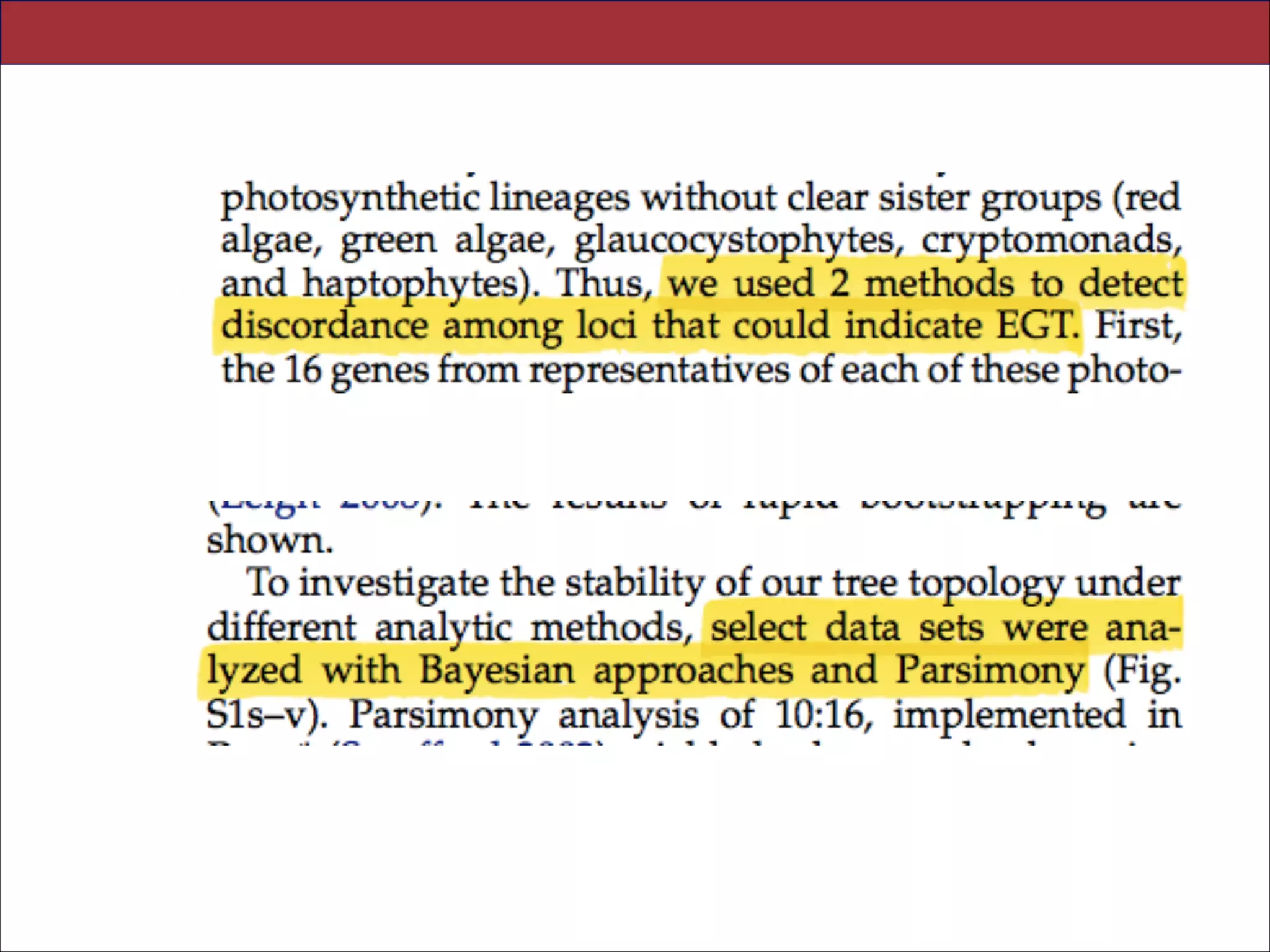
The consistency across analyses with varying numbers of taxa (88–451) and levels of missing data (17–69%) supports the
accuracy of the resulting topologies. The resulting stable topology emerges without the removal of rapidly evolving genes
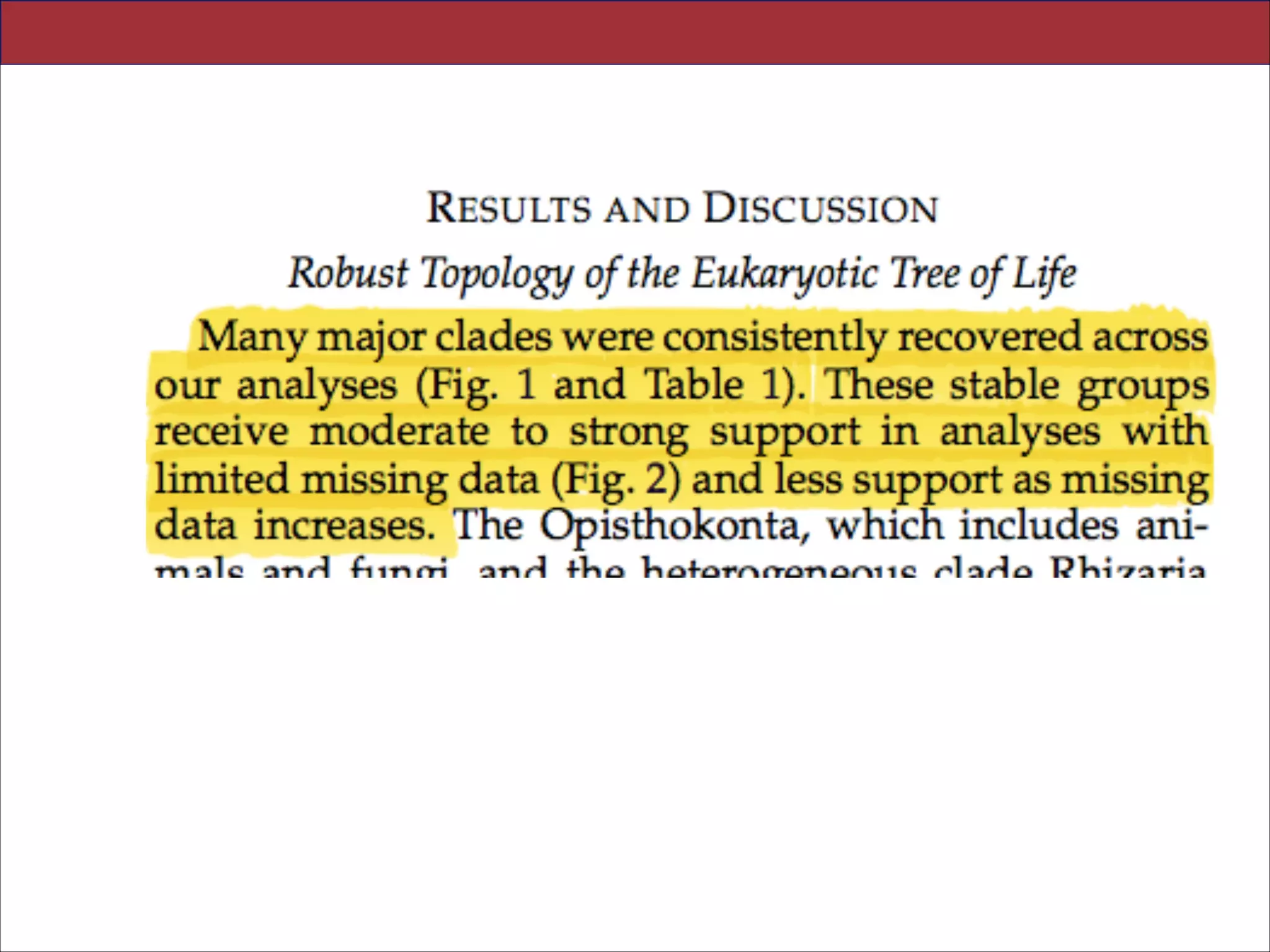
or taxa, a practice common to phylogenomic analyses. Several major groups are stable and strongly supported in these
analyses (e.g., SAR, Rhizaria, Excavata), whereas the proposed supergroup “Chromalveolata” is rejected. Furthermore, extensive instability among photosynthetic lineages suggests the Taught by Jonathan Eisen including endosymbiotic gene
Slides for UC Davis EVE161 Course presence of systematic biases Winter 2014
transfer from symbiont (nucleus or plastid) to host. Our analyses demonstrate that stable topologies of ancient evolutionary

!20
Abstract.—An accurate reconstruction of the eukaryotic tree of life is essential to identify the
innovations underlying the diversity of microbial and macroscopic (e.g., plants and animals)
eukaryotes. Previous work has divided eukaryotic diver- sity into a small number of high-level
“supergroups,” many of which receive strong support in phylogenomic analyses. However, the
abundance of data in phylogenomic analyses can lead to highly supported but incorrect
relationships due to systematic phylogenetic error. Furthermore, the paucity of major eukaryotic
lineages (19 or fewer) included in these genomic studies may exaggerate systematic error and
reduce power to evaluate hypotheses. Here, we use a taxon-rich strategy to assess eukaryotic
relationships. We show that analyses emphasizing broad taxonomic sampling (up to 451 taxa
representing 72 major lineages) combined with a moderate number of genes yield a wellresolved eukaryotic tree of life. The consistency across analyses with varying numbers of taxa
(88–451) and levels of missing data (17–69%) supports the accuracy of the resulting topologies.
The resulting stable topology emerges without the removal of rapidly evolving genes or taxa, a
practice common to phylogenomic analyses. Several major groups are stable and strongly
supported in these analyses (e.g., SAR, Rhizaria, Excavata), whereas the proposed supergroup
“Chromalveolata” is rejected. Furthermore, ex- tensive instability among photosynthetic lineages
suggests the presence of systematic biases including endosymbiotic gene transfer from
symbiont (nucleus or plastid) to host. Our analyses demonstrate that stable topologies of
ancient evolutionary relationships can be achieved with broad taxonomic sampling and a
moderate number of genes. Finally, taxon-rich analy- ses such as presented here provide a
method for testing the accuracy of relationships that receive high bootstrap support (BS) in
phylogenomic analyses and enable placement of the multitude of lineages that lack genome
scale data. [Excavata; microbial eukaryotes; Rhizaria; supergroups; systematic error; taxon
sampling.]
Slides for UC Davis EVE161 Course Taught by Jonathan Eisen Winter 2014

!21
Slides for UC Davis EVE161 Course Taught by Jonathan Eisen Winter 2014

!22
Slides for UC Davis EVE161 Course Taught by Jonathan Eisen Winter 2014

!23
Slides for UC Davis EVE161 Course Taught by Jonathan Eisen Winter 2014

!24
Slides for UC Davis EVE161 Course Taught by Jonathan Eisen Winter 2014

!25
Slides for UC Davis EVE161 Course Taught by Jonathan Eisen Winter 2014

!26
Slides for UC Davis EVE161 Course Taught by Jonathan Eisen Winter 2014

!27
Slides for UC Davis EVE161 Course Taught by Jonathan Eisen Winter 2014

!28
451 Taxa

Slides for UC Davis EVE161 Course Taught by Jonathan Eisen Winter 2014

!29
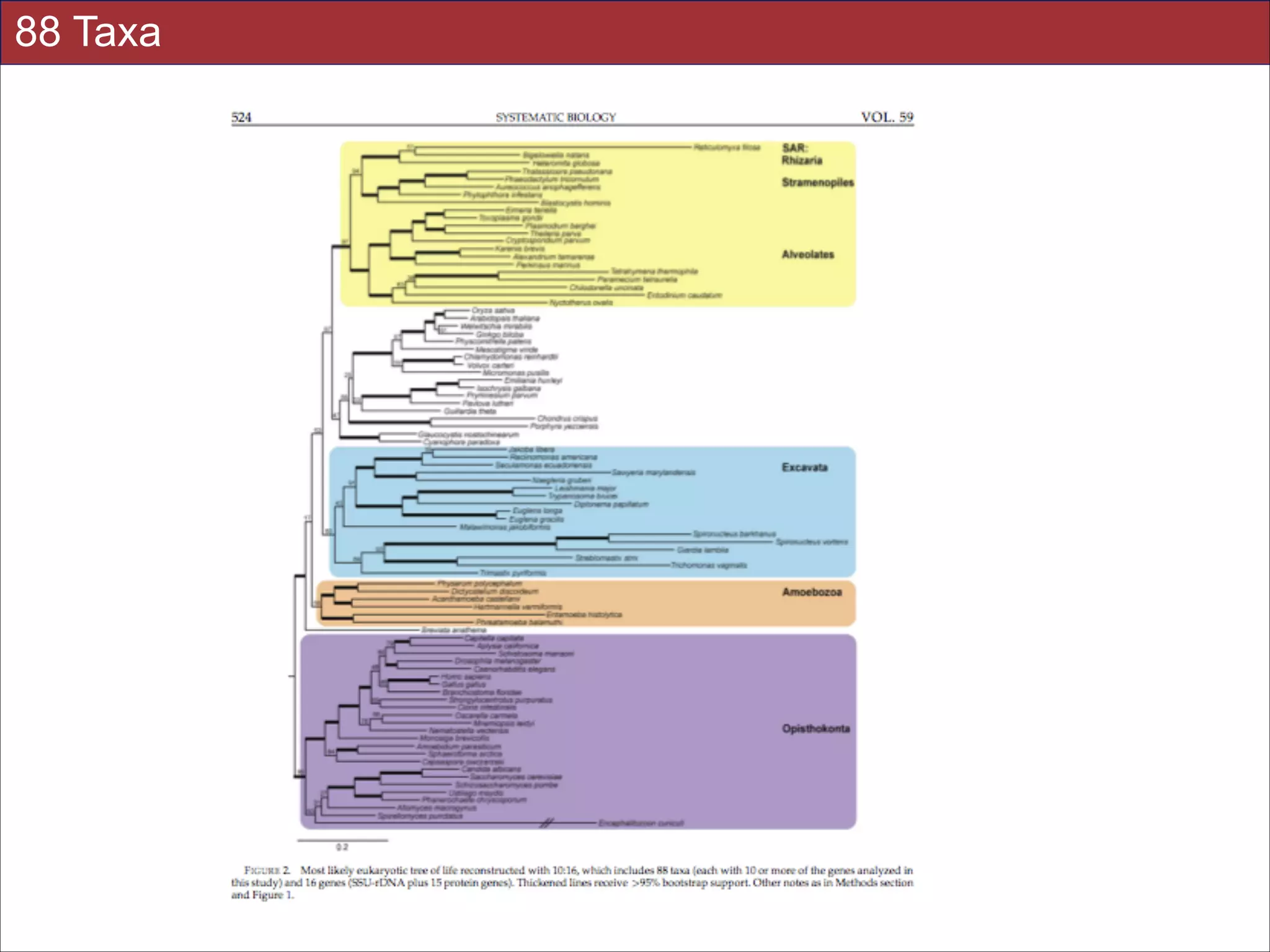
88 Taxa

Slides for UC Davis EVE161 Course Taught by Jonathan Eisen Winter 2014

!30
Slides for UC Davis EVE161 Course Taught by Jonathan Eisen Winter 2014

!31
Slides for UC Davis EVE161 Course Taught by Jonathan Eisen Winter 2014

!32
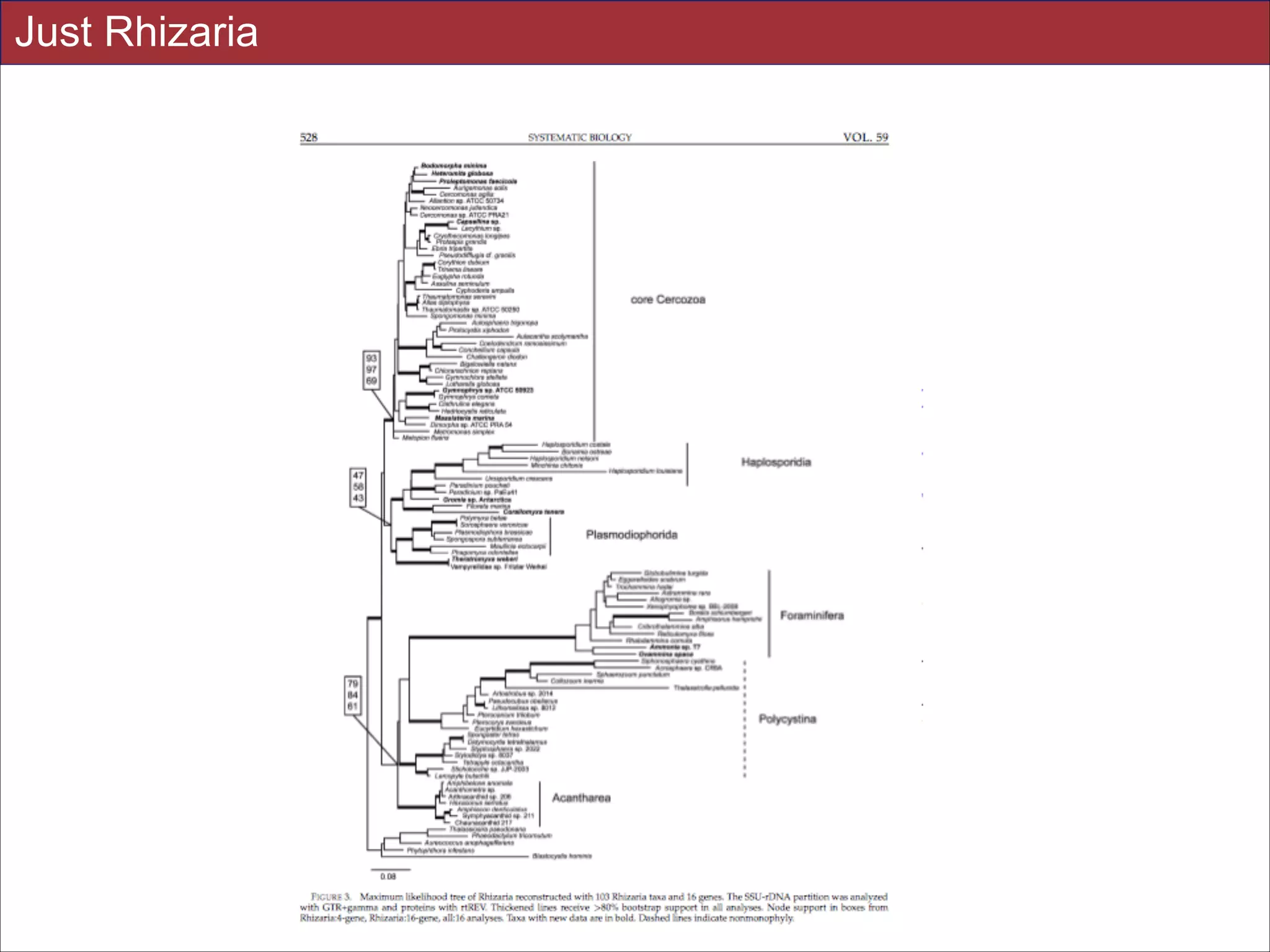
Just Rhizaria

Slides for UC Davis EVE161 Course Taught by Jonathan Eisen Winter 2014

!33
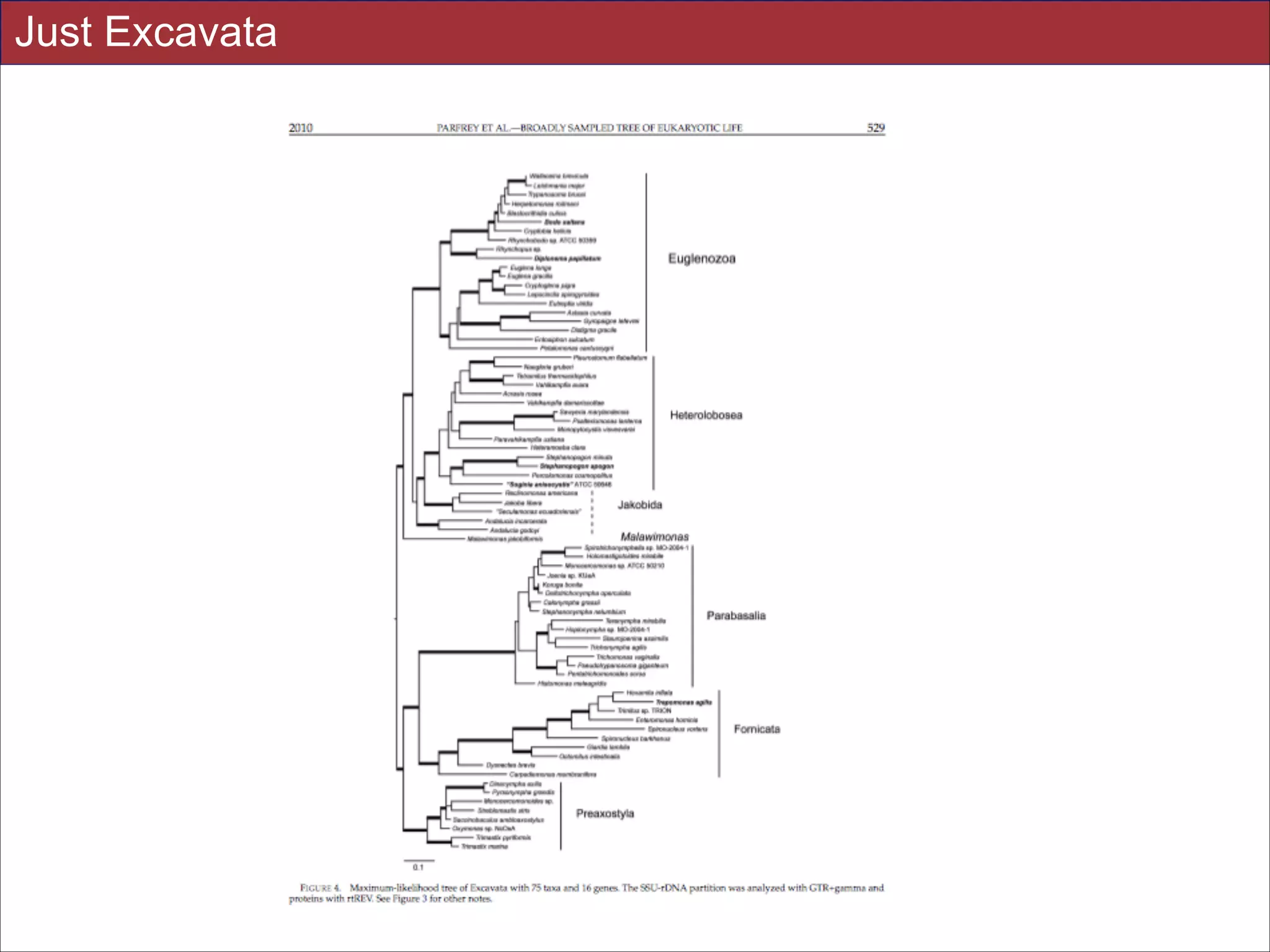
Just Excavata

Slides for UC Davis EVE161 Course Taught by Jonathan Eisen Winter 2014

!34
Slides for UC Davis EVE161 Course Taught by Jonathan Eisen Winter 2014

!35
Slides for UC Davis EVE161 Course Taught by Jonathan Eisen Winter 2014

!36
Two papers for today
A congruent phylogenomic signal places eukaryotes within
the Archaea
Tom A. Williams, Peter G. Foster, Tom M. W. Nye, Cymon J. Cox and T. Martin Embley
Proc. R. Soc. B 2012 279, doi: 10.1098/rspb.2012.1795 first published online 24 October 2012
Supplementary data

"Data Supplement"
http://rspb.royalsocietypublishing.org/content/suppl/2012/10/18/rspb.2012.1795.DC1.h
tml

References

This article cites 56 articles, 35 of which can be accessed free

http://rspb.royalsocietypublishing.org/content/279/1749/4870.full.html#ref-list-1
Article cited in:
http://rspb.royalsocietypublishing.org/content/279/1749/4870.full.html#related-urls

This article is free to access

Subject collections

Articles on similar topics can be found in the following collections
bioinformatics (25 articles)
evolution (1595 articles)
taxonomy and systematics (178 articles)

Email alerting service

Receive free email alerts when new articles cite this article - sign up in the box at the top
right-hand corner of the article or click here

Slides for UC Davis EVE161 Course Taught by Jonathan Eisen Winter 2014

!37
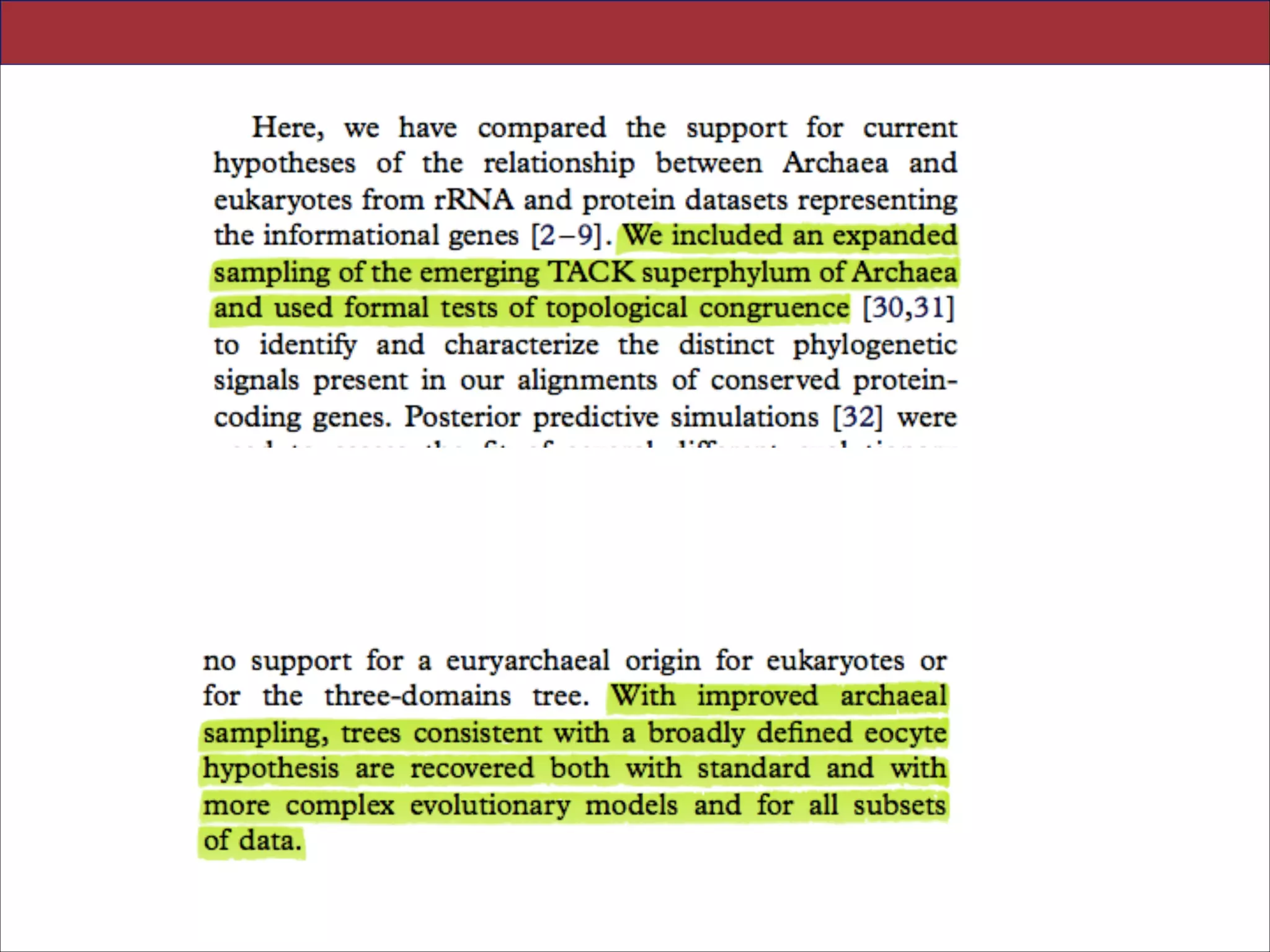
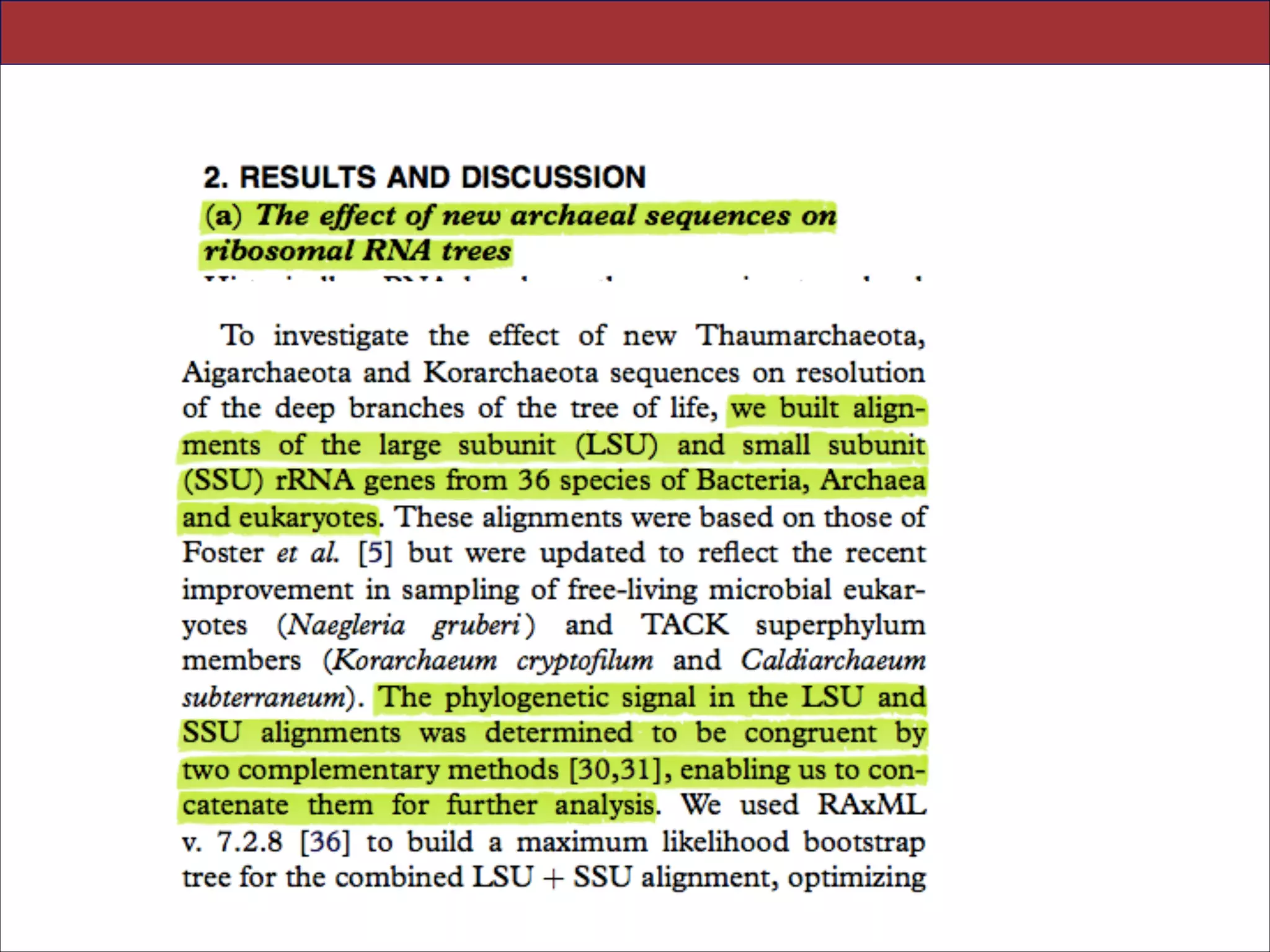
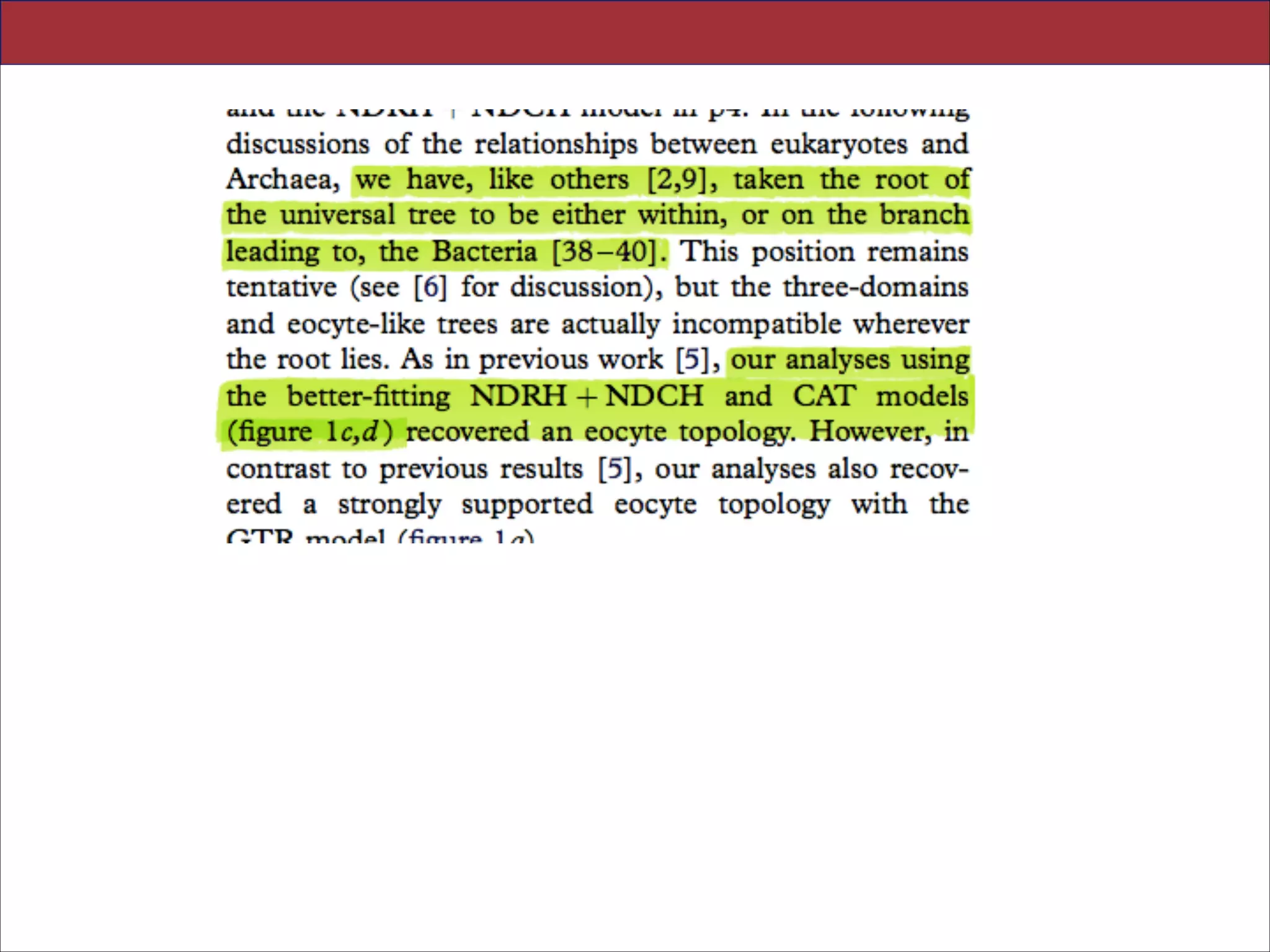
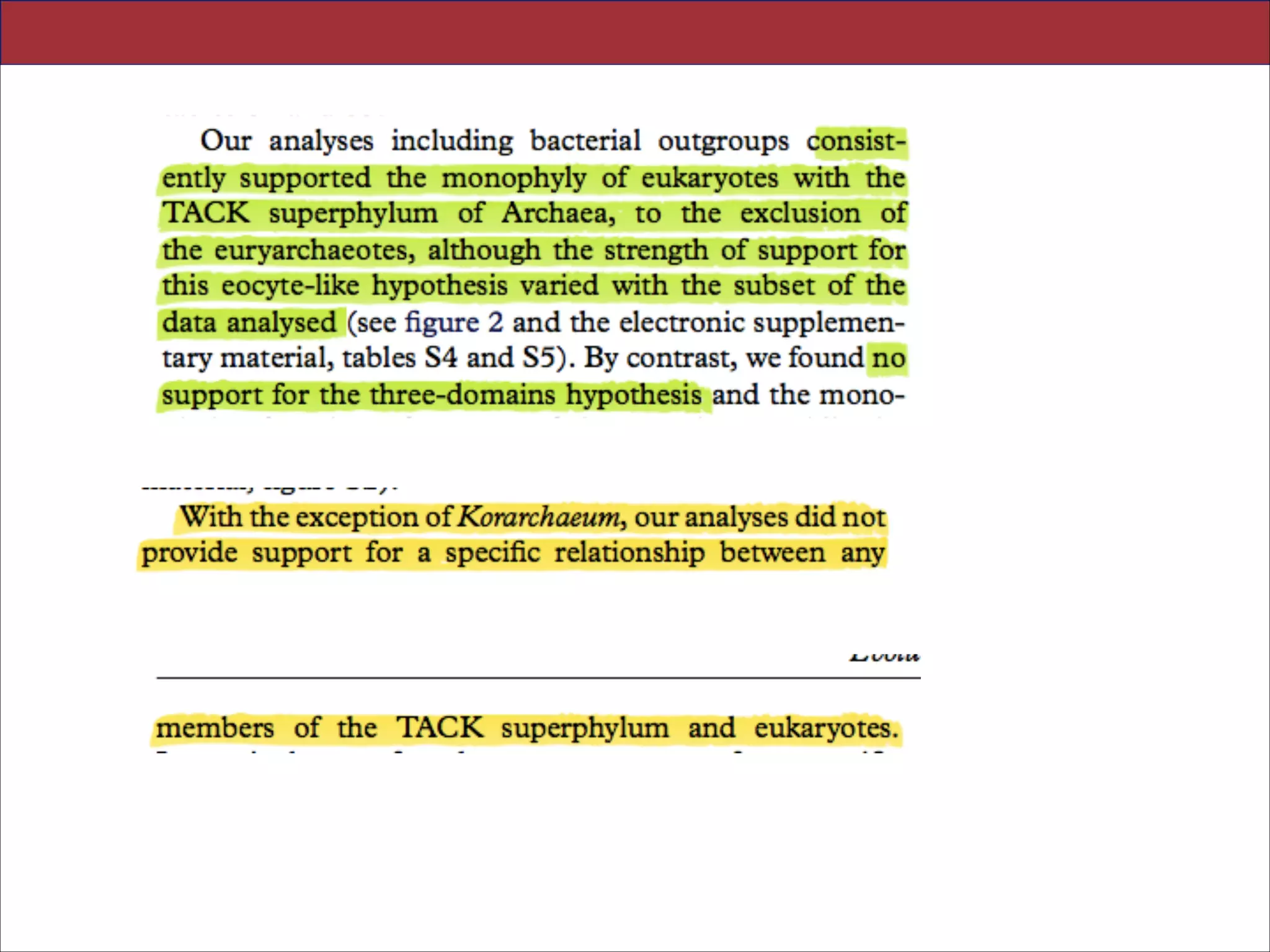
Determining the relationships among the major groups of cellular life is
important for understanding the evolution of biological diversity, but is difficult
given the enormous time spans involved. In the textbook ‘three domains’ tree
based on informational genes, eukaryotes and Archaea share a common
ancestor to the exclusion of Bacteria. However, some phylogenetic analyses
of the same data have placed eukaryotes within the Archaea, as the nearest
relatives of different archaeal lineages. We compared the support for these
competing hypotheses using sophisticated phylogenetic methods and an
improved sampling of archaeal biodiversity. We also employed both new and
existing tests of phylogenetic congruence to explore the level of uncertainty
and conflict in the data. Our analyses suggested that much of the observed
incongruence is weakly supported or associated with poorly fitting
evolutionary models. All of our phylogenetic analyses, whether on small
subunit and large subunit ribosomal RNA or concatenated protein-coding
genes, recovered a monophyletic group containing eukaryotes and the TACK
archaeal superphylum comprising the Thaumarchaeota, Aigarchaeota,
Crenarchaeota and Korarchaeota. Hence, while our results provide no
support for the iconic three-domain tree of life, they are consistent with an
extended eocyte hypothesis whereby vital components of the eukaryotic
nuclear lineage originated from within the archaeal radiation
Slides for UC Davis EVE161 Course Taught by Jonathan Eisen Winter 2014

!38
Slides for UC Davis EVE161 Course Taught by Jonathan Eisen Winter 2014

!39
Slides for UC Davis EVE161 Course Taught by Jonathan Eisen Winter 2014

!40
Slides for UC Davis EVE161 Course Taught by Jonathan Eisen Winter 2014

!41
Slides for UC Davis EVE161 Course Taught by Jonathan Eisen Winter 2014

!42
Slides for UC Davis EVE161 Course Taught by Jonathan Eisen Winter 2014

!43
Slides for UC Davis EVE161 Course Taught by Jonathan Eisen Winter 2014

!44
Downloaded from rspb.royalsocietypublishing.org on January 16, 2014

Evolution of eukaryotes from Archaea
(a)

Methanococcus jannaschii
Methanothermobacter thermautotrophicus

1

Pyrococcus furiosus

Arabidopsis thaliana
Giardia lamblia

Thermoplasma volcanium
Giardia lamblia
1

Homo sapiens

1

Saccharomyces cerevisiae

Trichomonas vaginalis
Naegleria gruberi
Homo sapiens
Saccharomyces cerevisiae

Dictyostelium discoideum
Trypanosoma brucei
Entamoeba histolytica

Eukaryota

Naegleria gruberi

1

Thalassiosira pseudonana

1

Archaeoglobus fulgidus

Dictyostelium discoideum

Methanosarcina mazei

Trypanosoma brucei

Thermoplasma volcanium

1

Entamoeba histolytica
Cenarchaeum symbiosum

Methanothermobacter thermautotrophicus

Thaumarchaeota

Pyrococcus furiosus

1

Caldivirga maquilingensis

Caldiarchaeum subterraneum Aigarchaeota

Pyrobaculum aerophilum

Caldivirga maquilingensis

1

Pyrobaculum aerophilum
Thermofilum pendens

Thermofilum pendens
Sulfolobus solfataricus

Crenarchaeota

Hyperthermus butylicus

Sulfolobus solfataricus
Staphylothermus marinus

Euryarchaeota

Methanococcus jannaschii

Nitrosopumilus maritimus
Korarchaeum cryptofilum Korarchaeota

1

Eukaryota

Thalassiosira pseudonana

Arabidopsis thaliana

0.83

4873

Trichomonas vaginalis

Euryarchaeota

Methanosarcina mazei

1

T. A. Williams et al.

(b)

Archaeoglobus fulgidus

Staphylothermus marinus

Crenarchaeota

Ignicoccus hospitalis

Hyperthermus butylicus

Aeropyrum pernix

Ignicoccus hospitalis

Clostridium acetobutylicum

Aeropyrum pernix

Synechocystis sp.

Campylobacter jejuni

Campylobacter jejuni

Escherichia coli

Escherichia coli

Rhodopseudomonas palustris

Bacteria

Rhodopseudomonas palustris

Clostridium acetobutylicum

Treponema pallidum

Bacteria

Synechocystis sp.

Chlamydia trachomatis

Treponema pallidum

Rhodopirellula baltica

Chlamydia trachomatis

0.2

Rhodopirellula baltica

0.2

Archaeoglobus fulgidus

(c)

Methanococcus jannaschii
Thermoplasma volcanium

(d )

Methanococcus jannaschii
Methanothermobacter thermautotrophicus

1

Pyrococcus furiosus

1

Euryarchaeota

Methanosarcina mazei
Methanothermobacter thermautotrophicus
Pyrococcus furiosus

Thermoplasma volcanium

Korarchaeum cryptofilum Korarchaeota
Nitrosopumilus maritimus

Trichomonas vaginalis

1

1

Giardia lamblia
Naegleria gruberi

Cenarchaeum symbiosum
0.57

Entamoeba histolytica
Dictyostelium discoideum
Trypanosoma brucei

Eukaryota

1

Homo sapiens
Thalassiosira pseudonana
Saccharomyces cerevisiae

Homo sapiens

Trypanosoma brucei

Saccharomyces cerevisiae
Thalassiosira pseudonana
Cenarchaeum symbiosum
Nitrosopumilus maritimus

Naegleria gruberi

1

Trichomonas vaginalis
Dictyostelium discoideum

Caldiarchaeum subterraneum Aigarchaeota
Caldivirga maquilingensis

Arabidopsis thaliana
Thermofilum pendens

Pyrobaculum aerophilum
1

Pyrobaculum aerophilum

Thermofilum pendens
Sulfolobus solfataricus
Hyperthermus butylicus

0.97

Crenarchaeota

Caldivirga maquilingensis
Sulfolobus solfataricus
Staphylothermus marinus

Ignicoccus hospitalis

Crenarchaeota

Aeropyrum pernix
Ignicoccus hospitalis

Staphylothermus marinus
Aeropyrum pernix

Hyperthermus butylicus

Campylobacter jejuni

Rhodopirellula baltica

Escherichia coli

Synechocystis sp.

Rhodopseudomonas palustris
Clostridium acetobutylicum
Synechocystis sp.

Clostridium acetobutylicum
Treponema pallidum
Chlamydia trachomatis

Bacteria

Treponema pallidum

Bacteria

Rhodopseudomonas palustris
Escherichia coli

Chlamydia trachomatis

Campylobacter jejuni

Rhodopirellula baltica

0.2

Eukaryota

Entamoeba histolytica

Thaumarchaeota

Korarchaeum cryptofilum Korarchaeota

1

Thaumarchaeota

Caldiarchaeum subterraneum Aigarchaeota
Giardia lamblia

Arabidopsis thaliana

1

Euryarchaeota

Archaeoglobus fulgidus

Methanosarcina mazei

0.2

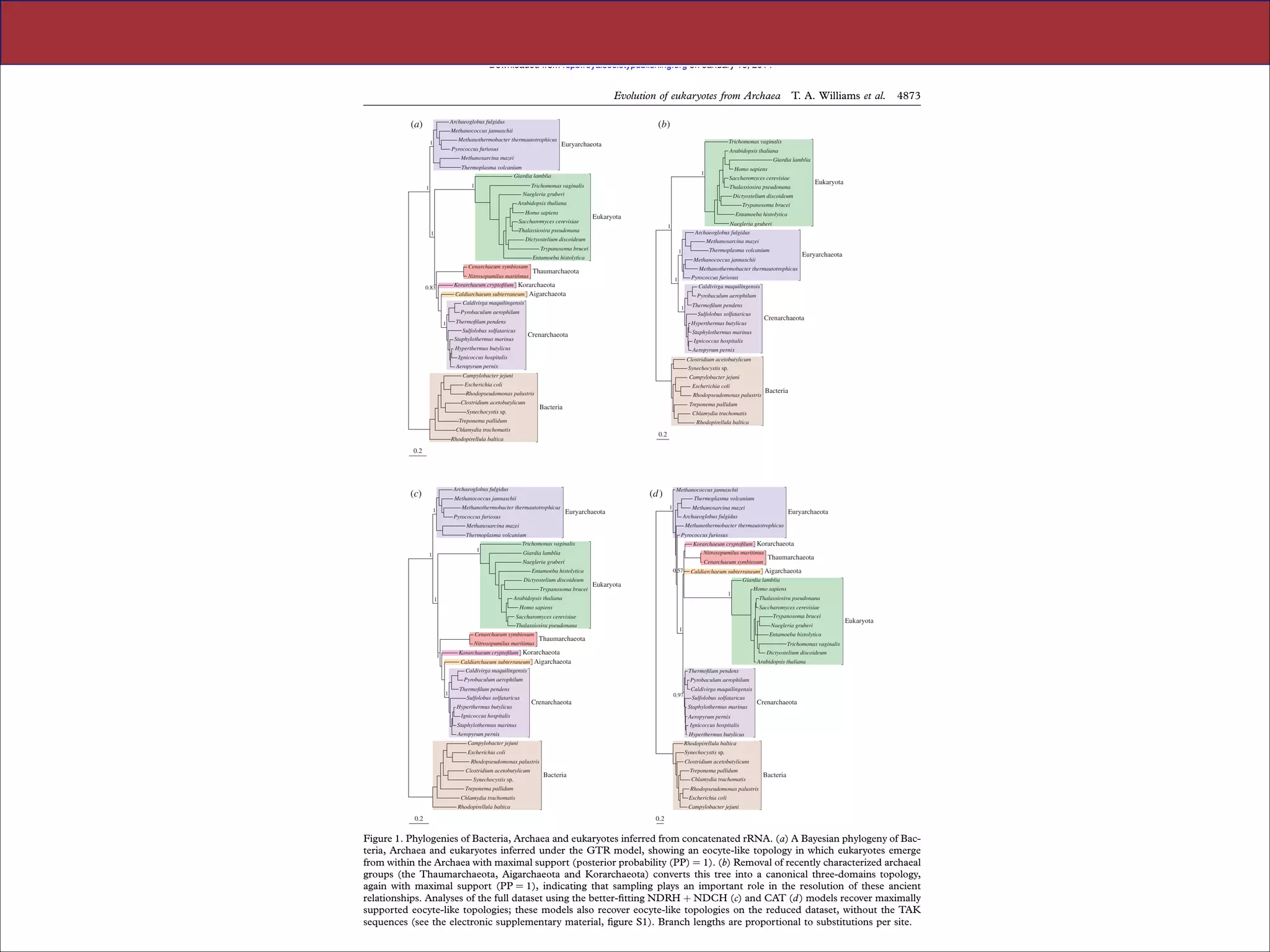
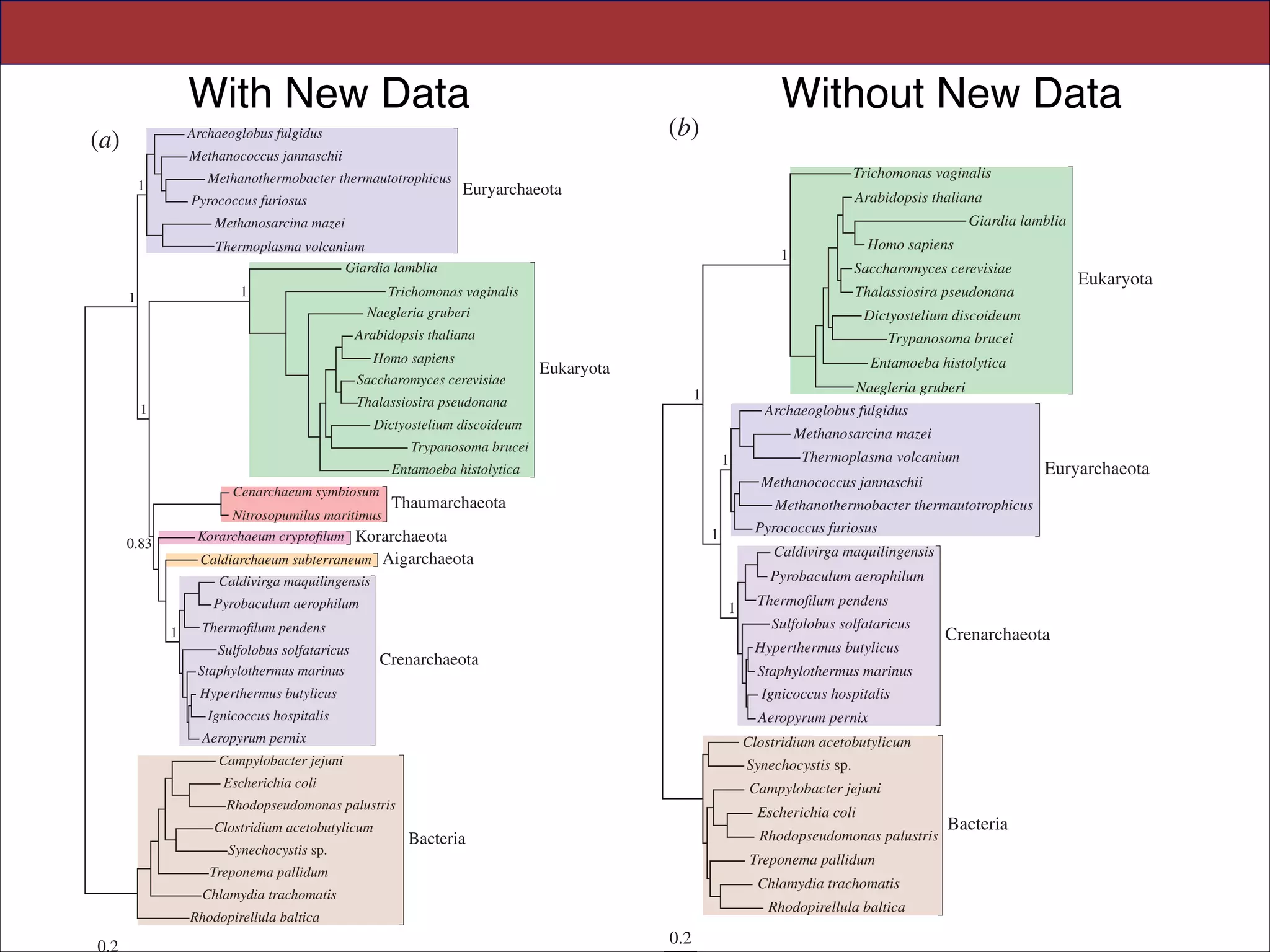
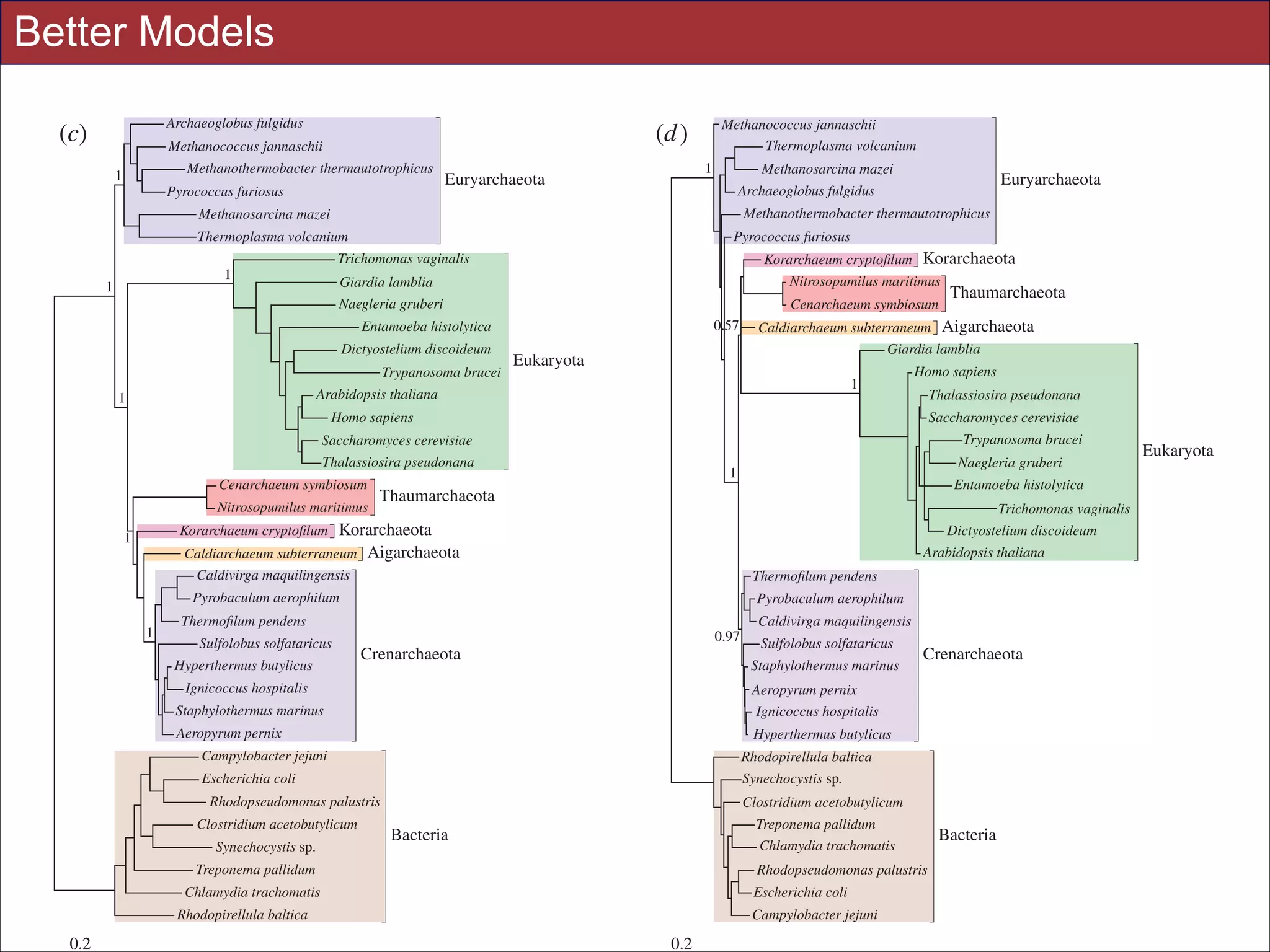
Figure 1. Phylogenies of Bacteria, Archaea and eukaryotes inferred from concatenated rRNA. (a) A Bayesian phylogeny of Bacteria, Archaea and eukaryotes inferred under the GTR model, showing an eocyte-like topology in which eukaryotes emerge
from within the Archaea with maximal support (posterior probability (PP) ¼ 1). (b) Removal of recently characterized archaeal
groups (the Thaumarchaeota, Aigarchaeota and Korarchaeota) converts this tree into a canonical three-domains topology,
again with maximal support (PP ¼ 1), indicating that sampling plays an important role in the resolution of these ancient
relationships. Analyses of the full dataset using the better-fitting NDRH þ NDCH (c) and CAT (d ) models recover maximally
supported eocyte-like topologies; these models also recover eocyte-like topologies on the reduced dataset, without the TAK
sequences (see the electronic supplementary material, figure S1). Branch lengths are proportional to substitutions per site.

Slides for UC Davis EVE161 Course Taught by Jonathan Eisen Winter 2014

!45
Downloaded from rspb.royalsocietypublishing.org on January 16, 2014

Evolution of eukaryotes from Archaea

With New Data

(a)

Evolution of eukaryotes from Archaea

Archaeoglobus fulgidus

Archaeoglobus fulgidus
(a) Methanococcus jannaschii

Methanococcus jannaschii

(b) (b)

Trichomonas vaginalis

Methanothermobacter thermautotrophicus
Euryarchaeota

1
Pyrococcus furiosus

Trichomonas vaginalis

Euryarchaeota

Pyrococcus furiosus

Arabidopsis thaliana

Arabidopsis thaliana

Methanosarcina mazei mazei
Methanosarcina

Giardia lamblia
Giardia lamblia

Thermoplasma volcanium
Giardia lamblia lamblia
Giardia
1

1

1

1

Trichomonas vaginalis
Naegleria gruberi gruberi
Naegleria

1

1

Homo sapiens
Homo sapiens
Saccharomyces cerevisiae

Thalassiosira pseudonana

1

1

Dictyostelium discoideum
Trypanosoma brucei
Trypanosoma brucei
Entamoeba histolytica

1

Entamoeba histolytica

Entamoeba histolytica

Cenarchaeum symbiosum

0.83
Korarchaeum cryptofilum Korarchaeota
Caldiarchaeum subterraneum Aigarchaeota

1

Pyrobaculum aerophilum

Pyrobaculum aerophilum
Thermofilum pendens

Pyrobaculum aerophilum

1

Pyrobaculum aerophilum

Thermofilum pendens

Ignicoccus hospitalis
Aeropyrum pernix

Ignicoccus hospitalis
Aeropyrum pernix

Synechocystis sp.
Clostridium acetobutylicum
Campylobacter
Synechocystis sp. jejuni

Escherichia
Campylobacter jejuni coli

Escherichia coli
Campylobacter jejuni

Rhodopseudomonas palustris
Escherichia coli
Clostridium palustris
Rhodopseudomonasacetobutylicum

Rhodopirellula baltica

0.2

Chlamydia trachomatisSlides

Crenarchaeota

Crenarchaeota

Aeropyrum pernix
Clostridium acetobutylicum

Campylobacter jejuni
Aeropyrum pernix

Treponema pallidum

Sulfolobus solfataricus

Sulfolobus solfataricus
Hyperthermus butylicus
Staphylothermus marinus
Ignicoccus hospitalis

Hyperthermus butylicus
Ignicoccus hospitalis

Chlamydia trachomatis

1
Thermofilum pendens

Hyperthermus butylicus
Staphylothermus marinus

Crenarchaeota

Sulfolobus solfataricus marinus
Staphylothermus
Crenarchaeota
Staphylothermus marinus
Hyperthermus butylicus

Treponema
Synechocystis sp. pallidum

Euryarchaeota
Euryarchaeota

Caldivirga maquilingensis

Caldivirga maquilingensis

Clostridium Synechocystis sp.
acetobutylicum

Methanococcus jannaschii

Methanothermobacter thermautotrophicus

Caldivirga maquilingensis

1

Thermoplasma volcanium

Pyrococcus furiosus
1 Pyrococcus furiosus
Caldivirga maquilingensis

Caldiarchaeum subterraneum Aigarchaeota

Thermofilum Sulfolobus solfataricus
pendens

1

Methanothermobacter thermautotrophicus

Thaumarchaeota

Thaumarchaeota
Nitrosopumilus maritimus
Korarchaeum cryptofilum Korarchaeota

1

Archaeoglobus fulgidus
Methanosarcina mazei

Trypanosoma
Trypanosoma brucei brucei

0.83

Naegleria gruberi
Naegleria gruberi

1

1

Dictyostelium discoideum

Cenarchaeum symbiosum

Eukaryota
Eukaryota

Thalassiosira pseudonana

Arabidopsis thalianathaliana
Arabidopsis
Homo
Homo sapiens sapiens
Eukaryota
Eukaryota
Saccharomyces cerevisiae

T. A. Williams et al.

Without New Data

Methanothermobacter thermautotrophicus

1

T. A. Williams et al.

Rhodopseudomonas palustris
Escherichia coli
Treponema pallidum
Rhodopseudomonas palustris

Bacteria

Bacteria

Bacteria

Chlamydia trachomatis
Treponema pallidum

Bacteria

Rhodopirellula baltica
Chlamydia trachomatis

0.2

Rhodopirellula baltica

for UC Davis EVE161 Course Taught by Jonathan Eisen Winter 2014
0.2

!46
Rhodopirellula baltica

0.2
Better Models

Archaeoglobus fulgidus

(c)

Methanothermobacter thermautotrophicus

1

Methanococcus jannaschii
Thermoplasma volcanium

(d )

Methanococcus jannaschii
Pyrococcus furiosus

1

Euryarchaeota

Methanosarcina mazei
Methanothermobacter thermautotrophicus

Methanosarcina mazei

Pyrococcus furiosus

Thermoplasma volcanium

Korarchaeum cryptofilum Korarchaeota
Nitrosopumilus maritimus

Trichomonas vaginalis

1

1

Giardia lamblia
Naegleria gruberi

Cenarchaeum symbiosum
0.57

Entamoeba histolytica
Dictyostelium discoideum
Trypanosoma brucei

Eukaryota

1

Homo sapiens
Thalassiosira pseudonana
Saccharomyces cerevisiae

Homo sapiens

Trypanosoma brucei

Saccharomyces cerevisiae
Thalassiosira pseudonana
Cenarchaeum symbiosum
Nitrosopumilus maritimus

Naegleria gruberi

1

Trichomonas vaginalis
Dictyostelium discoideum

Caldiarchaeum subterraneum Aigarchaeota
Caldivirga maquilingensis

Arabidopsis thaliana
Thermofilum pendens

Pyrobaculum aerophilum
1

Pyrobaculum aerophilum

Thermofilum pendens
Sulfolobus solfataricus
Hyperthermus butylicus

0.97

Crenarchaeota

Caldivirga maquilingensis
Sulfolobus solfataricus
Staphylothermus marinus

Ignicoccus hospitalis

Crenarchaeota

Aeropyrum pernix
Ignicoccus hospitalis

Staphylothermus marinus
Aeropyrum pernix

Hyperthermus butylicus

Campylobacter jejuni

Rhodopirellula baltica

Escherichia coli

Synechocystis sp.

Rhodopseudomonas palustris
Clostridium acetobutylicum
Synechocystis sp.

Clostridium acetobutylicum
Treponema pallidum
Chlamydia trachomatis

Bacteria

Treponema pallidum

Bacteria

Rhodopseudomonas palustris
Escherichia coli

Chlamydia trachomatis

Campylobacter jejuni

Rhodopirellula baltica

0.2

Eukaryota

Entamoeba histolytica

Thaumarchaeota

Korarchaeum cryptofilum Korarchaeota

1

Thaumarchaeota

Caldiarchaeum subterraneum Aigarchaeota
Giardia lamblia

Arabidopsis thaliana

1

Euryarchaeota

Archaeoglobus fulgidus

Slides for UC Davis EVE161 Course Taught by Jonathan Eisen Winter 2014
0.2

!47
Slides for UC Davis EVE161 Course Taught by Jonathan Eisen Winter 2014

!48
Slides for UC Davis EVE161 Course Taught by Jonathan Eisen Winter 2014

!49
Slides for UC Davis EVE161 Course Taught by Jonathan Eisen Winter 2014

!50
Concatenated Proteins

Downloaded from rspb.royalsocietypublishing.org on January 16, 2014

4874

T. A. Williams et al.
(a)

Evolution of eukaryotes from Archaea

Methanothermobacter thermautotrophicus
Thermoplasma volcanium

Pyrococcus furiosus

(b)

Methanococcus jannaschii

0.51

Methanococcus jannaschii
Methanothermobacter thermautotrophicus

Euryarchaeota

Methanosarcina mazei

Thermoplasma acidophilum

Archaeoglobus fulgidus

Archaeoglobus fulgidus

Pyrococcus furiosus

Methanosarcina mazei

1

Trichomonas vaginalis

Giardia lamblia
1

Giardia lamblia

Trichomonas vaginalis

1

Thalassiosira pseudonana
Phytophthora ramorum
Saccharomyces cerevisiae
Homo sapiens

0.81 0.99

Entamoeba histolytica
Naegleria gruberi
Leishmania major

Eukaryota

Dictyostelium discoideum
Homo sapiens

Dictyostelium discoideum
Leishmania major

Arabidopsis thaliana

1

Thalassiosira pseudonana

Arabidopsis thaliana
Korarchaeum cryptofilum Korarchaeota
Nitrosopumilus maritimus
1

Cenarchaeum symbiosum
Caldiarchaeum subterraneum

Phytophthora ramorum
Korarchaeum cryptofilum

Thaumarchaeota

Nitrosoarchaeum limnia

Aigarchaeota

1
1
0.99

Sulfolobus solfataricus

Crenarchaeota

1

Ignicoccus hospitalis

Crenarchaeota

Staphylothermus marinus

Aeropyrum pernix

Hyperthermus butylicus

Hyperthermus butylicus

Aeropyrum pernix

Rhodopseudomonas palustris
Escherichia coli

0.5

Treponema pallidum
Rhodopirellula baltica

Caldivirga maquilingensis
Sulfolobus solfataricus

Ignicoccus hospitalis

Chlamydia trachomatis

Thaumarchaeota

Thermofilum pendens
Pyrobaculum aerophilum

Caldivirga maquilingensis
Staphylothermus marinus

Cenarchaeum symbiosum
Nitrosoarchaeum limnia

Pyrobaculum aerophilum
1

Korarchaeota
Aigarchaeota

Caldiarchaeum subterraneum

Nitrosopumilus maritimus

Thermofilum pendens
0.99

Eukaryota

Saccharomyces cerevisiae

Entamoeba histolytica

0.99

Euryarchaeota

Bacteria

Synechocystis sp.
Clostridium acetobutylicum
Campylobacter jejuni

0.2

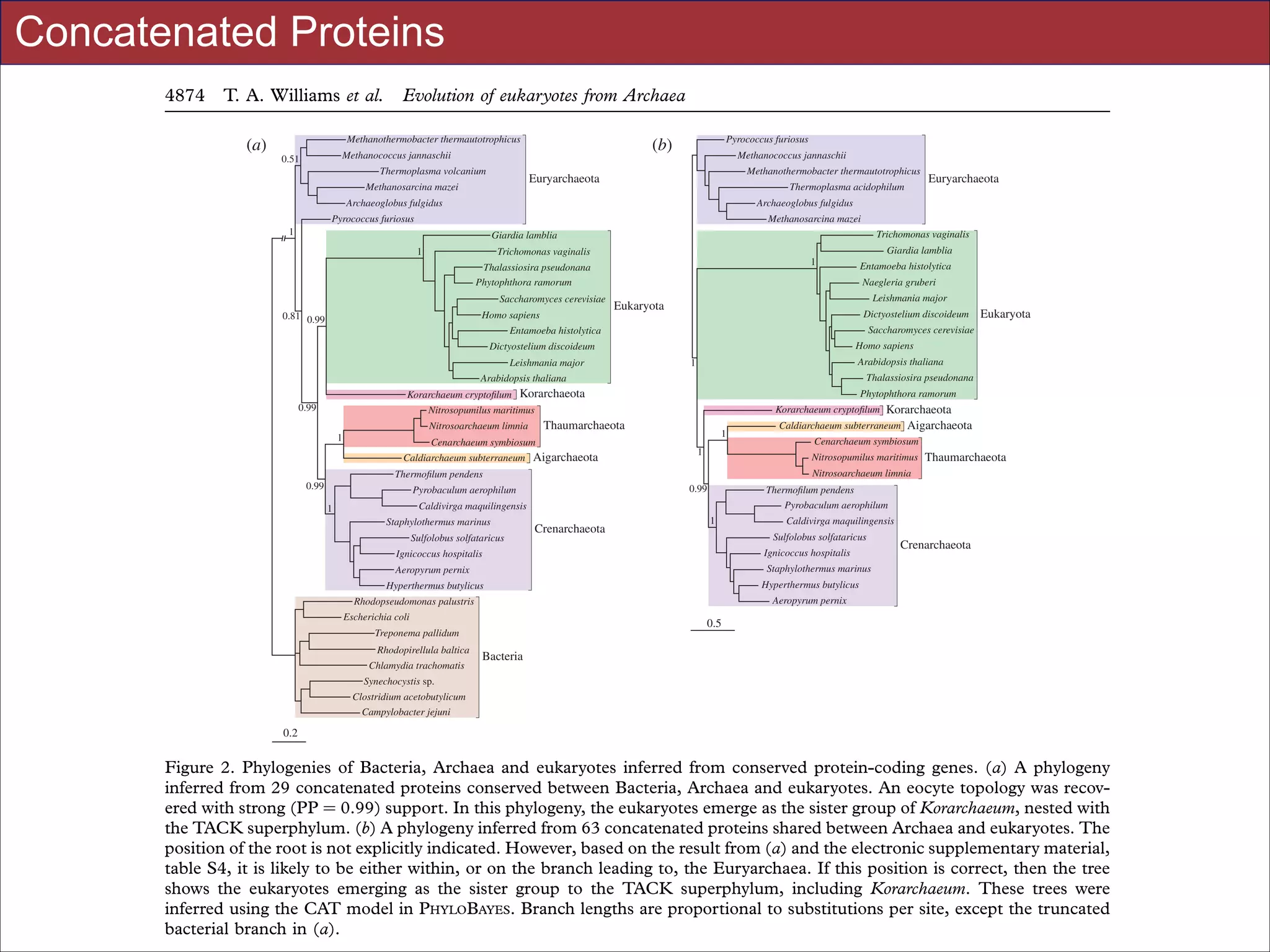
Figure 2. Phylogenies of Bacteria, Archaea and eukaryotes inferred from conserved protein-coding genes. (a) A phylogeny
inferred from 29 concatenated proteins conserved between Bacteria, Archaea and eukaryotes. An eocyte topology was recovered with strong (PP ¼ 0.99) support. In this phylogeny, the eukaryotes emerge as the sister group of Korarchaeum, nested with
the TACK superphylum. (b) A phylogeny inferred from 63 concatenated proteins shared between Archaea and eukaryotes. The
position of the root is not explicitly indicated. However, based on the result from (a) and the electronic supplementary material,
table S4, it is likely to be either within, or on the branch leading to, the Euryarchaea. If this position is correct, then the tree
shows the eukaryotes emerging as the sister group to the TACK superphylum, including Korarchaeum. These trees were
inferred using the CAT model in PHYLOBAYES. Branch lengths are proportional to substitutions per site, except the truncated
bacterial branch in (a). for UC Davis EVE161 Course Taught by Jonathan Eisen Winter 2014
Slides

!51
Slides for UC Davis EVE161 Course Taught by Jonathan Eisen Winter 2014

!52
Slides for UC Davis EVE161 Course Taught by Jonathan Eisen Winter 2014

!53
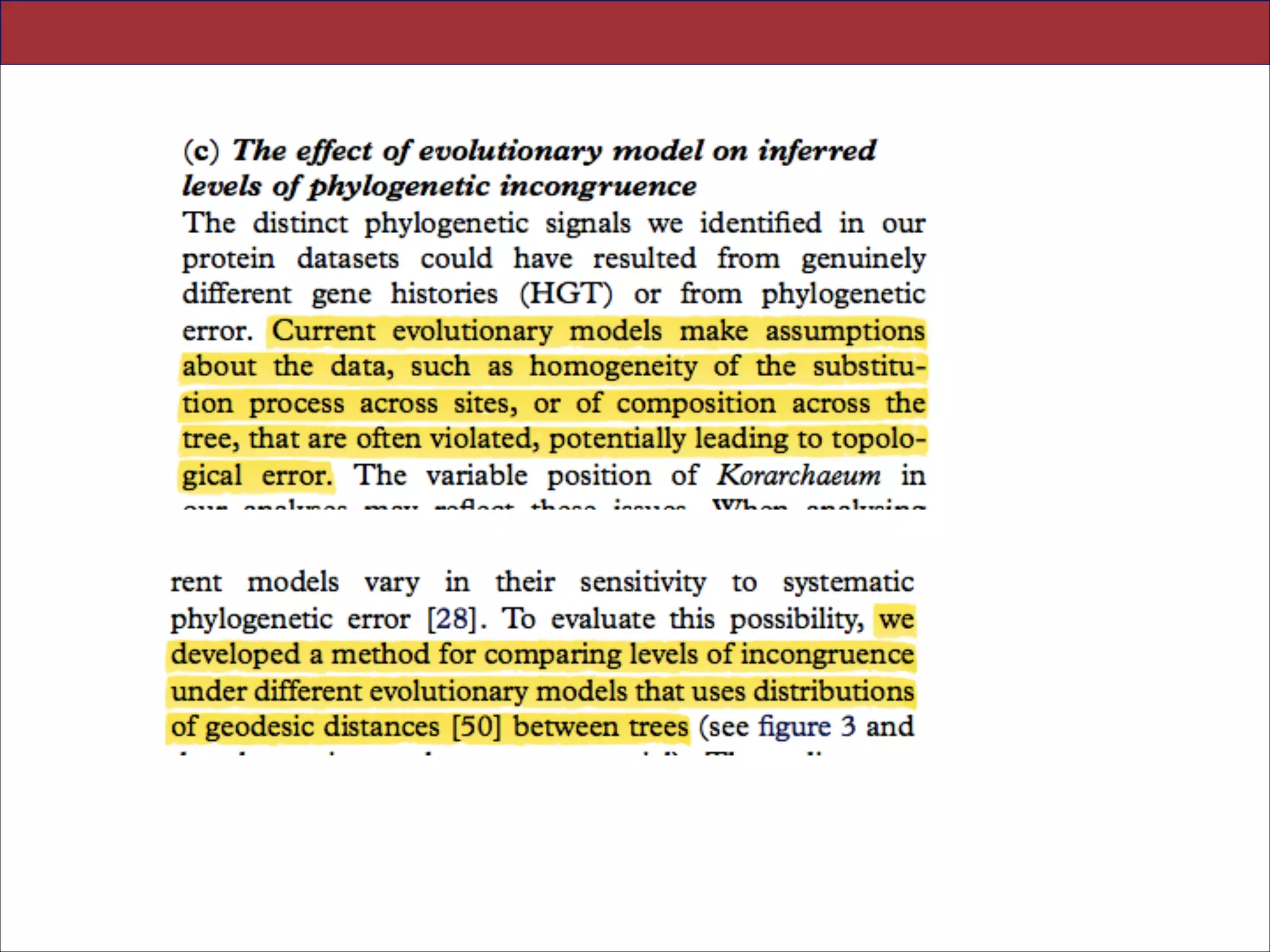
Tree Congruence
Downloaded from rspb.royalsocietypublishing.org on January 16, 2014

4876

T. A. Williams et al.

Evolution of eukaryotes from Archaea
(b)

(a)

no. tests passed (P > 0.05)

250
frequency

model
CAT20
LG

60

300

200
150
100

50
40
30
20
10

50

0

0
1

2

3
distance

4

saturation and
site-specific
compositional
homoplasy biochemical diversity heterogeneity

5

(c)

model
CAT20
LG

1.2
1.0

density

0.8
0.6
0.4
0.2
0
1.0

1.5

2.0
distance

2.5

3.0

Figure 3. Analysing incongruence using a novel measure of distance between gene trees. We used distributions of pairwise geodesic distances between gene trees to compare levels of incongruence inferred under different evolutionary models. (a) The
distribution of distances under a single model (CAT20) can be used to identify obvious outliers corresponding to highly incongruent gene trees; a single gene was responsible for the peak highlighted in red, and was removed from subsequent analyses.
(b) Overview of model-fitting tests (posterior predictive simulations) for each gene in the 64AE dataset. The height of the bars
indicates the proportion of genes that ‘passed’ a test under a particular model; we said that a test was passed when the value of
the test statistic on the real data fell within the central 95% of the distribution of values produced by posterior predictive simulation. The results suggest that CAT20 fits better than LG, successfully accounting for the observed levels of saturation and
homoplasy in all but one of the alignments. Both models do a poor job of modelling the site-specific selective constraints in
our dataset, although again CAT20 performs better than LG (13 passes as opposed to 0). (c) Comparison of the distance distributions inferred under the CAT20 and LG models. The trees inferred under the better-fitting CAT20 model are significantly
more congruent than those inferred under LG (mean distance: 2.68 versus 3.22, p , 0.0001). The significance of this difference was assessed using a permutation test that took the correlations between pairwise distances into account (see §4). These
results suggest that a significant portion of the incongruence in this dataset of informational genes can be attributed to model
misspecification, rather than genuinely distinct evolutionary histories.

Slides for UC Davis EVE161 Course Taught by Jonathan Eisen Winter 2014
3. CONCLUSIONS

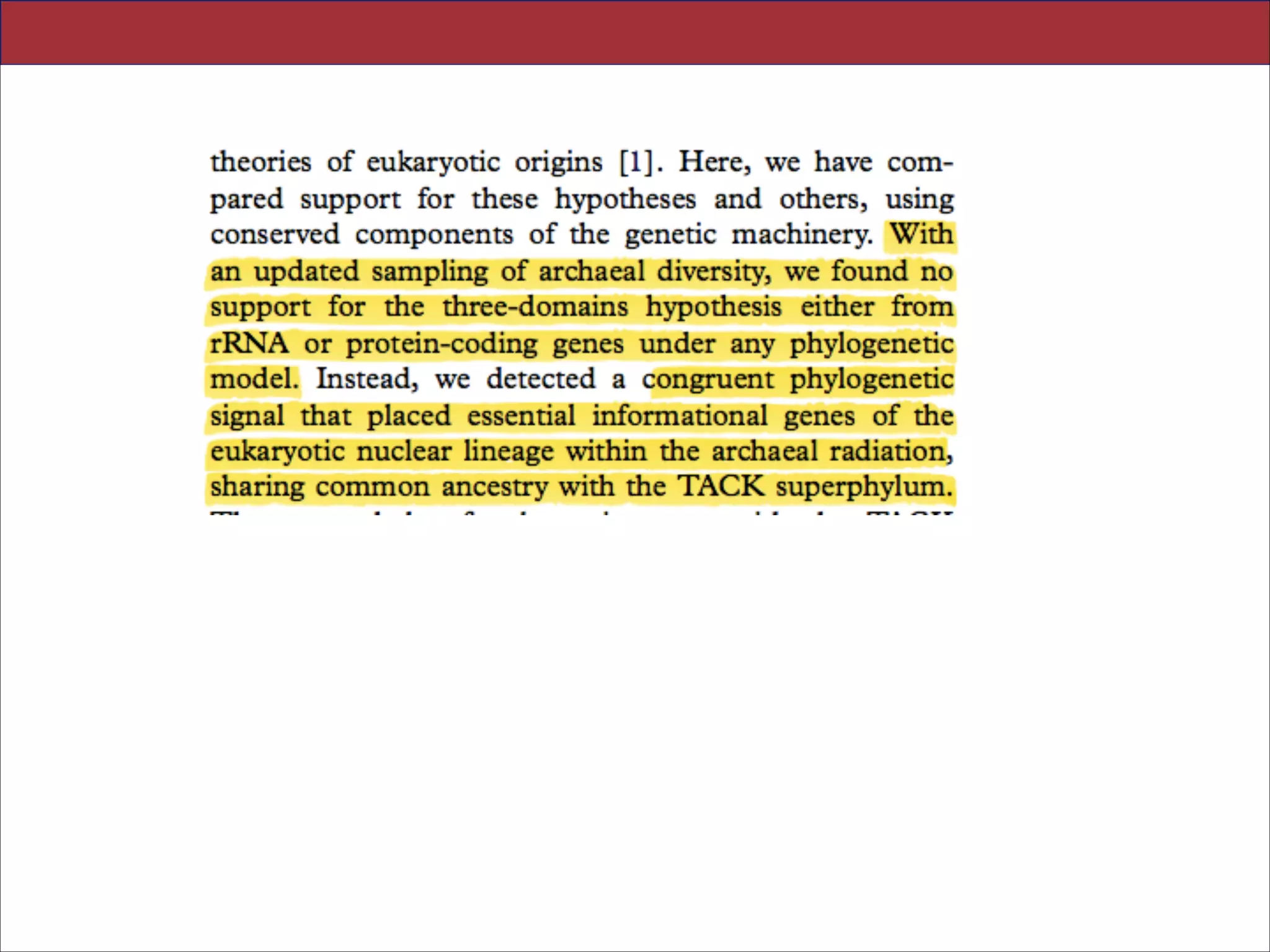
theories of eukaryotic origins [1]. Here, we have com-

!54
Slides for UC Davis EVE161 Course Taught by Jonathan Eisen Winter 2014

!55
Slides for UC Davis EVE161 Course Taught by Jonathan Eisen Winter 2014

!56

EVE 161 Lecture 4

  • 1.
    Lecture 4 EVE 161:
 MicrobialPhylogenomics ! Lecture #4: Era I: Modern View of the Tree of Life ! UC Davis, Winter 2014 Instructor: Jonathan Eisen Slides for UC Davis EVE161 Course Taught by Jonathan Eisen Winter 2014
  • 2.
    Where we aregoing and where we have been • Previous lecture: ! 3. Woese and the Tree of Life • Current Lecture: ! 4. Modern view of Tree of Life • Next Lecture: ! 5. Era II: rRNA from environment Slides for UC Davis EVE161 Course Taught by Jonathan Eisen Winter 2014 !2
  • 3.
    Two papers fortoday Syst. Biol. 59(5):518–533, 2010 c ⃝ The Author(s) 2010. Published by Oxford University Press, on behalf of the Society of Systematic Biologists. All rights reserved. For Permissions, please email: journals.permissions@oxfordjournals.org DOI:10.1093/sysbio/syq037 Advance Access publication on July 23, 2010 Broadly Sampled Multigene Analyses Yield a Well-Resolved Eukaryotic Tree of Life Downloaded from rspb.royalsocietypublishing.org on January 16, 2014 1 2 2,6 L AURA W EGENER PARFREY , J ESSICA G RANT , Y ONAS I. T EKLE , E RICA L ASEK -N ESSELQUIST 3,4 , H ILARY G. M ORRISON 3 , M ITCHELL L. S OGIN3 , D AVID J. PATTERSON 5 , AND L AURA A. K ATZ1,2,∗ 1 Program in Organismic and Evolutionary Biology, University of Massachusetts, 611 North Pleasant Street, Amherst, of Biological Sciences, Smith College, 44 College Lane, Northampton, MA 01063, USA; 3 Bay Paul Center for MA 01003, USA; Comparative Molecular Biology and Evolution, Marine Biological Laboratory, 7 MBL Street, Woods Hole, MA 02543, USA; 4 Department of Ecology and Evolutionary Biology, Brown University, 80 Waterman Street, Providence, RI 02912, USA; 5 Biodiversity Informatics Group, Marine Biological Laboratory, 7 MBL Street, Woods Hole, MA 02543, USA; 6 Present address: Department of Epidemiology and Public Health, Yale University School of Medicine, New Haven, CT 06520, USA; ∗ Correspondence to be sent to: Laura A. Katz, 44 College Lane, Northampton, MA 01003, USA; E-mail: lkatz@smith.edu. 2 Department A congruent phylogenomic signalDecember 2009; accepted 25 May 2010 places eukaryotes within Received 30 September 2009; reviews returned 1 the Archaea Associate Editor: C´cile An´ e e Abstract.—An Peter G. Foster, of the M. W. Nye, Cymon J. Cox identify Martin Embley Tom A. Williams,accurate reconstruction Tom eukaryotic tree of life is essential to and T. the innovations underlying the diversity of microbial and macroscopic (e.g., plants and animals) eukaryotes. Previous work has divided eukaryotic diversity into a small number Proc. R. Soc. the2012 279of doi:in phylogenomic analyses can which receive strong support online 24 Octoberdue B abundance of high-level “supergroups,” many of lead to highly supported but incorrect relationships 2012 , data 10.1098/rspb.2012.1795 first published in phylogenomic analyses. However, to systematic phylogenetic error. Furthermore, the paucity of major eukaryotic lineages (19 or fewer) included in these genomic studies may exaggerate systematic error and reduce power to evaluate hypotheses. Here, we use a taxon-rich strategy to assess eukaryotic relationships. We show that analyses emphasizing broad taxonomic sampling (up to 451 taxa Supplementary data lineages) "Data Supplement" representing 72 major combined with a moderate number of genes yield a well-resolved eukaryotic tree of life. The consistency across analyses http://rspb.royalsocietypublishing.org/content/suppl/2012/10/18/rspb.2012.1795.DC1.h with varying numbers of taxa (88–451) and levels of missing data (17–69%) supports the tml accuracy of the resulting topologies. The resulting stable topology emerges without the removal of rapidly evolving genes or taxa, a practice common to phylogenomic analyses. Several35 of which can be accessed This article cites 56 articles, major groups are stable and strongly supported in these References(e.g., SAR, Rhizaria, Excavata), whereas the proposed supergroup “Chromalveolata” isfree analyses rejected. Furthermore, exhttp://rspb.royalsocietypublishing.org/content/279/1749/4870.full.html#ref-list-1 tensive instability among photosynthetic lineages suggests the presence of systematic biases including endosymbiotic gene transfer from symbiont (nucleus Article cited host. Our analyses demonstrate that stable topologies of ancient evolutionary or plastid) to in: relationships can be achieved with broad taxonomic sampling and a moderate number of genes. Finally, taxon-rich analyhttp://rspb.royalsocietypublishing.org/content/279/1749/4870.full.html#related-urls ses such as presented Slides for UC Davis for testing the accuracy of relationships that Eisen Winter 2014 support here provide a method EVE161 Course Taught by Jonathan receive high bootstrap Downloaded from http://sysbio.oxfordjournals.org/ at University Laura Wegener Parfrey and Jessica Grant have contributed equally to this work. !3
  • 4.
    Phylogeny Review Slides forUC Davis EVE161 Course Taught by Jonathan Eisen Winter 2014 !4
  • 5.
    Parts of aphylogenetic tree terminal (or tip) taxa a b c d e f g h u z Terminal branches y v x w internal nodes t internal branches root, root node Internal nodes represent hypothetical ancestral taxa Slides for UC Davis EVE161 Course Taught by Jonathan Eisen Winter 2014 !5
  • 6.
    Characters • A heritablefeature of an organism is known as a character (also character trait or trait). ! • The form that a character takes is known as its state (also known as character state). ! Note: Presence/absence can be a state ! • Example: ! Character = heart ! Character state = present/absent ! Character state = # of chambers Slides for UC Davis EVE161 Course Taught by Jonathan Eisen Winter 2014 !6
  • 7.
    Characters ancestry iscritical to understand • Characters that are inherited from a common ancestor are homologous. • Species change over time ! Known (generally) as divergence, or divergent evolution. ! Species change over time due to the combined processes of mutation, recombination, drift, selection, etc Slides for UC Davis EVE161 Course Taught by Jonathan Eisen Winter 2014 !7
  • 8.
    Data matrices Slides forUC Davis EVE161 Course Taught by Jonathan Eisen Winter 2014 !8
  • 9.
    Sequence Alignment Slides forUC Davis EVE161 Course Taught by Jonathan Eisen Winter 2014 !9
  • 10.
    Tree reconstruction methods Slidesfor UC Davis EVE161 Course Taught by Jonathan Eisen Winter 2014 !10
  • 11.
    Some other bellsand whistles Slides for UC Davis EVE161 Course Taught by Jonathan Eisen Winter 2014 !11
  • 12.
    Long branch attraction Slidesfor UC Davis EVE161 Course Taught by Jonathan Eisen Winter 2014 !12
  • 13.
    Homoplasy Slides for UCDavis EVE161 Course Taught by Jonathan Eisen Winter 2014 !13
  • 14.
    Bootstrapping Slides for UCDavis EVE161 Course Taught by Jonathan Eisen Winter 2014 !14
  • 15.
    Jacknifing Slides for UCDavis EVE161 Course Taught by Jonathan Eisen Winter 2014 !15
  • 16.
    Congruence Slides for UCDavis EVE161 Course Taught by Jonathan Eisen Winter 2014 !16
  • 17.
    Rooting Slides for UCDavis EVE161 Course Taught by Jonathan Eisen Winter 2014 !17
  • 18.
    Masking Slides for UCDavis EVE161 Course Taught by Jonathan Eisen Winter 2014 !18
  • 19.
    Concatenation Slides for UCDavis EVE161 Course Taught by Jonathan Eisen Winter 2014 !19
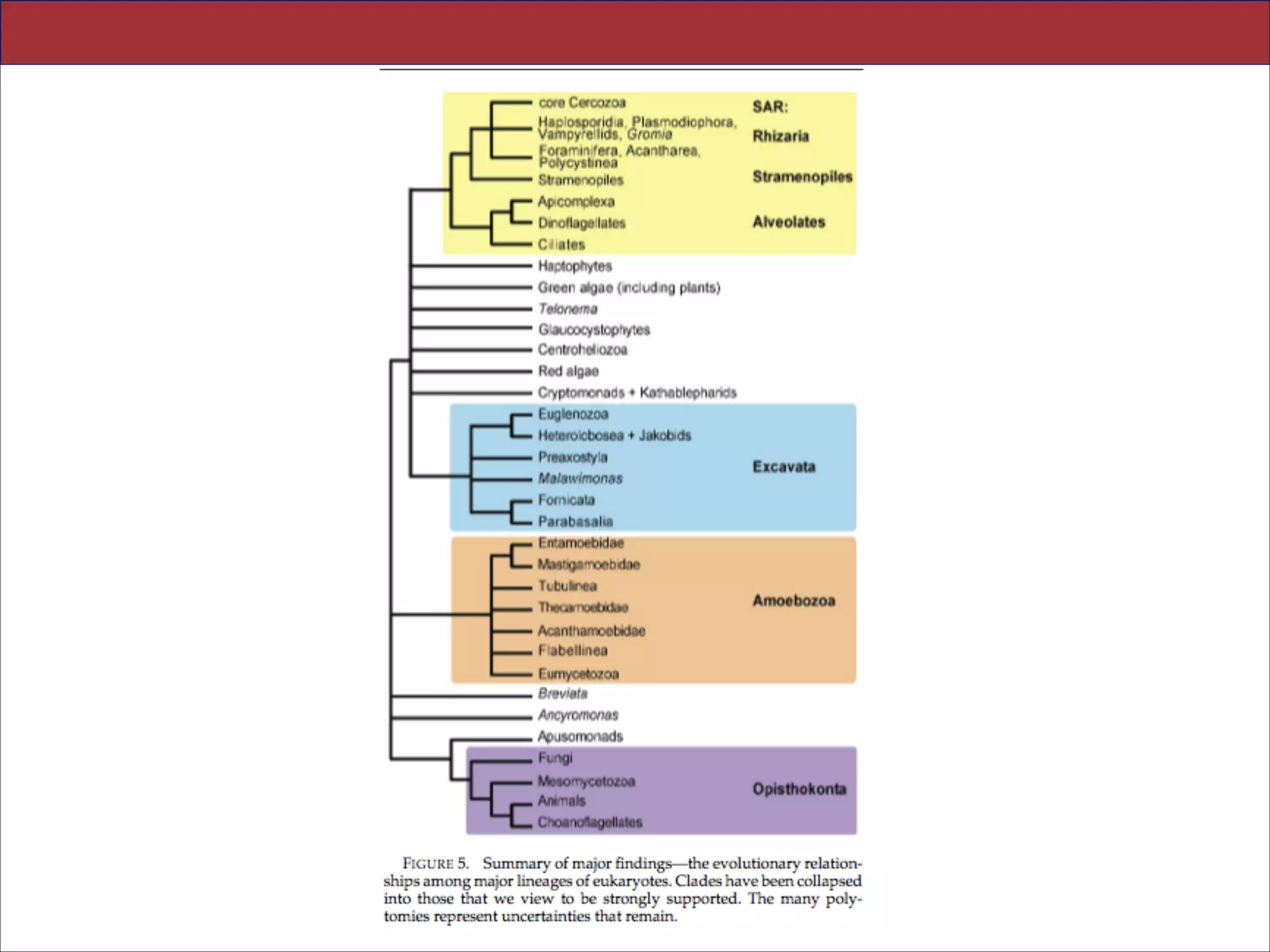
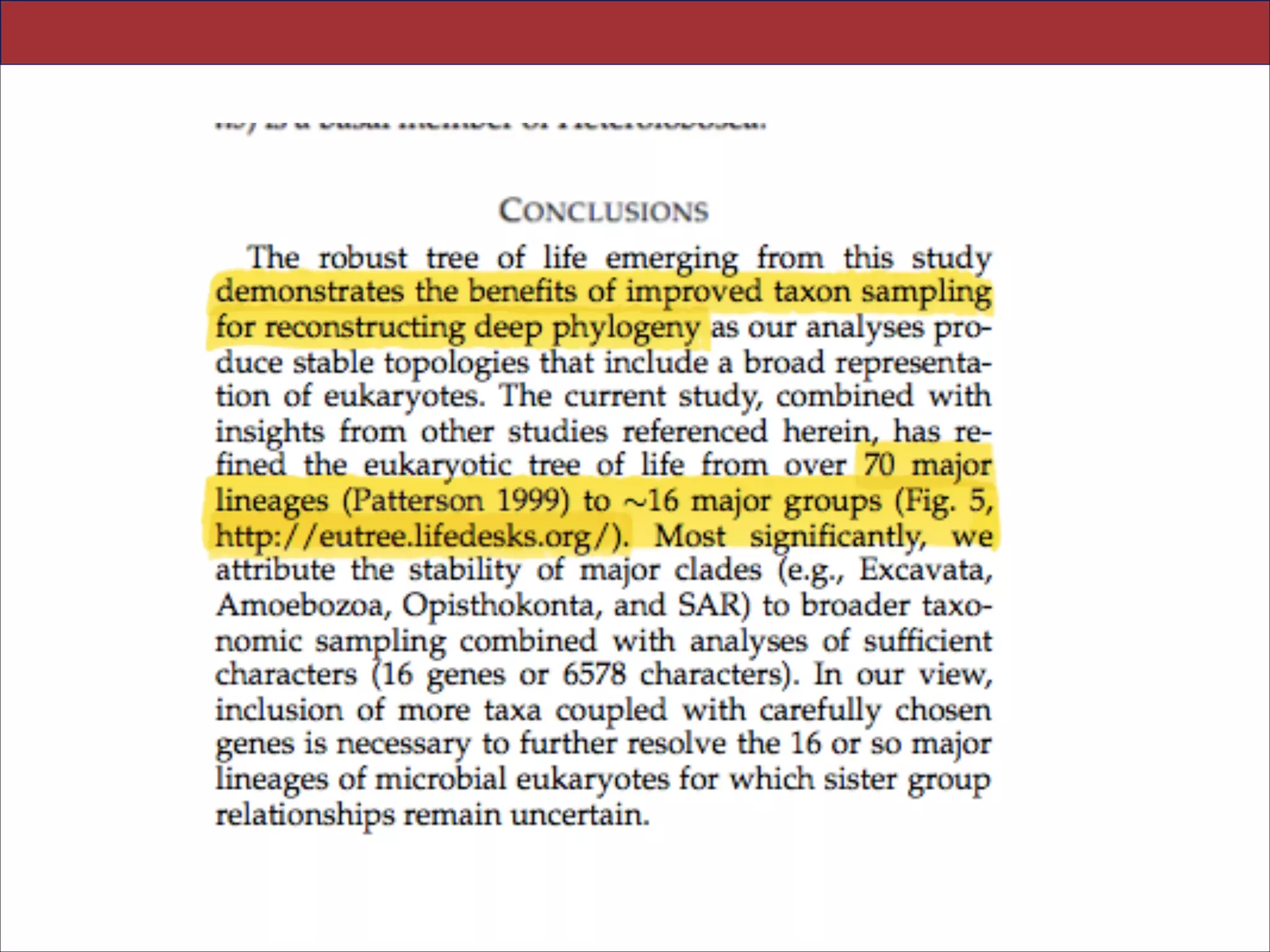
  • 20.
    Two papers fortoday Syst. Biol. 59(5):518–533, 2010 c ⃝ The Author(s) 2010. Published by Oxford University Press, on behalf of the Society of Systematic Biologists. All rights reserved. For Permissions, please email: journals.permissions@oxfordjournals.org DOI:10.1093/sysbio/syq037 Advance Access publication on July 23, 2010 Broadly Sampled Multigene Analyses Yield a Well-Resolved Eukaryotic Tree of Life L AURA W EGENER PARFREY1 , J ESSICA G RANT2 , Y ONAS I. T EKLE2,6 , E RICA L ASEK -N ESSELQUIST 3,4 , H ILARY G. M ORRISON 3 , M ITCHELL L. S OGIN3 , D AVID J. PATTERSON 5 , AND L AURA A. K ATZ1,2,∗ 1 Program in Organismic and Evolutionary Biology, University of Massachusetts, 611 North Pleasant Street, Amherst, of Biological Sciences, Smith College, 44 College Lane, Northampton, MA 01063, USA; 3 Bay Paul Center for MA 01003, USA; Comparative Molecular Biology and Evolution, Marine Biological Laboratory, 7 MBL Street, Woods Hole, MA 02543, USA; 4 Department of Ecology and Evolutionary Biology, Brown University, 80 Waterman Street, Providence, RI 02912, USA; 5 Biodiversity Informatics Group, Marine Biological Laboratory, 7 MBL Street, Woods Hole, MA 02543, USA; 6 Present address: Department of Epidemiology and Public Health, Yale University School of Medicine, New Haven, CT 06520, USA; ∗ Correspondence to be sent to: Laura A. Katz, 44 College Lane, Northampton, MA 01003, USA; E-mail: lkatz@smith.edu. Laura Wegener Parfrey and Jessica Grant have contributed equally to this work. 2 Department Received 30 September 2009; reviews returned 1 December 2009; accepted 25 May 2010 Associate Editor: C´cile An´ e e Abstract.—An accurate reconstruction of the eukaryotic tree of life is essential to identify the innovations underlying the diversity of microbial and macroscopic (e.g., plants and animals) eukaryotes. Previous work has divided eukaryotic diversity into a small number of high-level “supergroups,” many of which receive strong support in phylogenomic analyses. However, the abundance of data in phylogenomic analyses can lead to highly supported but incorrect relationships due to systematic phylogenetic error. Furthermore, the paucity of major eukaryotic lineages (19 or fewer) included in these genomic studies may exaggerate systematic error and reduce power to evaluate hypotheses. Here, we use a taxon-rich strategy to assess eukaryotic relationships. We show that analyses emphasizing broad taxonomic sampling (up to 451 taxa representing 72 major lineages) combined with a moderate number of genes yield a well-resolved eukaryotic tree of life. The consistency across analyses with varying numbers of taxa (88–451) and levels of missing data (17–69%) supports the accuracy of the resulting topologies. The resulting stable topology emerges without the removal of rapidly evolving genes or taxa, a practice common to phylogenomic analyses. Several major groups are stable and strongly supported in these analyses (e.g., SAR, Rhizaria, Excavata), whereas the proposed supergroup “Chromalveolata” is rejected. Furthermore, extensive instability among photosynthetic lineages suggests the Taught by Jonathan Eisen including endosymbiotic gene Slides for UC Davis EVE161 Course presence of systematic biases Winter 2014 transfer from symbiont (nucleus or plastid) to host. Our analyses demonstrate that stable topologies of ancient evolutionary !20
  • 21.
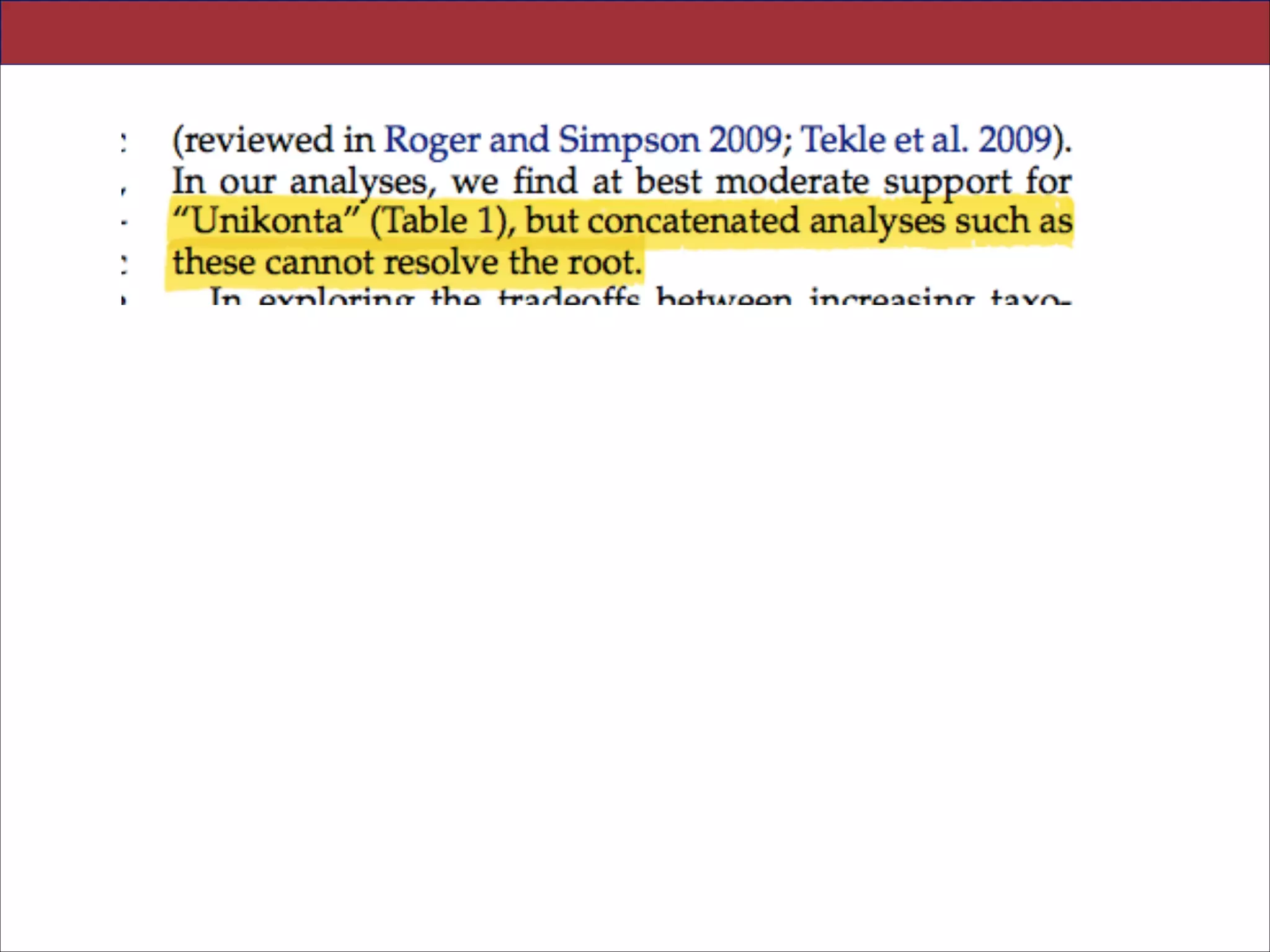
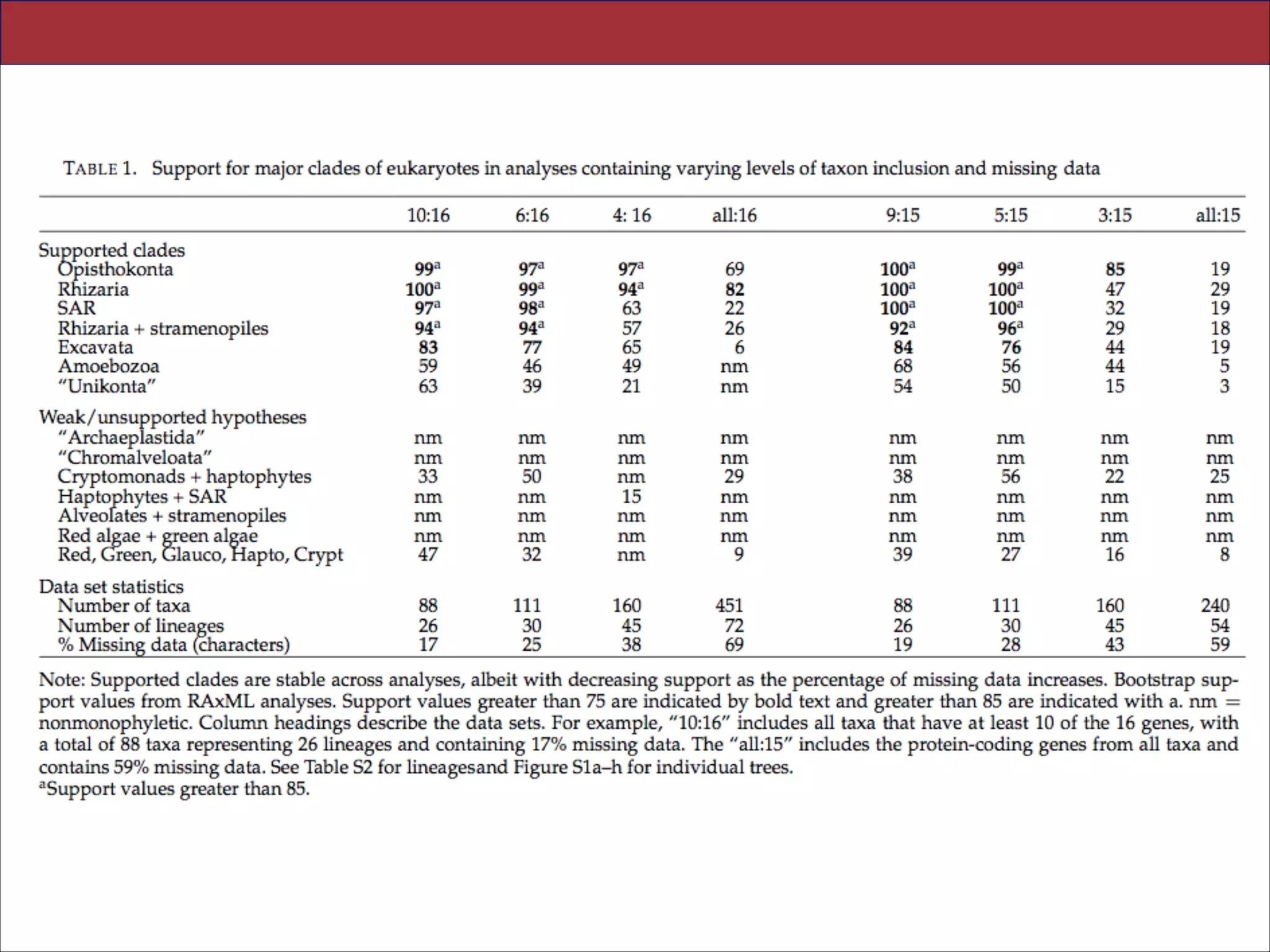
    Abstract.—An accurate reconstructionof the eukaryotic tree of life is essential to identify the innovations underlying the diversity of microbial and macroscopic (e.g., plants and animals) eukaryotes. Previous work has divided eukaryotic diver- sity into a small number of high-level “supergroups,” many of which receive strong support in phylogenomic analyses. However, the abundance of data in phylogenomic analyses can lead to highly supported but incorrect relationships due to systematic phylogenetic error. Furthermore, the paucity of major eukaryotic lineages (19 or fewer) included in these genomic studies may exaggerate systematic error and reduce power to evaluate hypotheses. Here, we use a taxon-rich strategy to assess eukaryotic relationships. We show that analyses emphasizing broad taxonomic sampling (up to 451 taxa representing 72 major lineages) combined with a moderate number of genes yield a wellresolved eukaryotic tree of life. The consistency across analyses with varying numbers of taxa (88–451) and levels of missing data (17–69%) supports the accuracy of the resulting topologies. The resulting stable topology emerges without the removal of rapidly evolving genes or taxa, a practice common to phylogenomic analyses. Several major groups are stable and strongly supported in these analyses (e.g., SAR, Rhizaria, Excavata), whereas the proposed supergroup “Chromalveolata” is rejected. Furthermore, ex- tensive instability among photosynthetic lineages suggests the presence of systematic biases including endosymbiotic gene transfer from symbiont (nucleus or plastid) to host. Our analyses demonstrate that stable topologies of ancient evolutionary relationships can be achieved with broad taxonomic sampling and a moderate number of genes. Finally, taxon-rich analy- ses such as presented here provide a method for testing the accuracy of relationships that receive high bootstrap support (BS) in phylogenomic analyses and enable placement of the multitude of lineages that lack genome scale data. [Excavata; microbial eukaryotes; Rhizaria; supergroups; systematic error; taxon sampling.] Slides for UC Davis EVE161 Course Taught by Jonathan Eisen Winter 2014 !21
  • 22.
    Slides for UCDavis EVE161 Course Taught by Jonathan Eisen Winter 2014 !22
  • 23.
    Slides for UCDavis EVE161 Course Taught by Jonathan Eisen Winter 2014 !23
  • 24.
    Slides for UCDavis EVE161 Course Taught by Jonathan Eisen Winter 2014 !24
  • 25.
    Slides for UCDavis EVE161 Course Taught by Jonathan Eisen Winter 2014 !25
  • 26.
    Slides for UCDavis EVE161 Course Taught by Jonathan Eisen Winter 2014 !26
  • 27.
    Slides for UCDavis EVE161 Course Taught by Jonathan Eisen Winter 2014 !27
  • 28.
    Slides for UCDavis EVE161 Course Taught by Jonathan Eisen Winter 2014 !28
  • 29.
    451 Taxa Slides forUC Davis EVE161 Course Taught by Jonathan Eisen Winter 2014 !29
  • 30.
    88 Taxa Slides forUC Davis EVE161 Course Taught by Jonathan Eisen Winter 2014 !30
  • 31.
    Slides for UCDavis EVE161 Course Taught by Jonathan Eisen Winter 2014 !31
  • 32.
    Slides for UCDavis EVE161 Course Taught by Jonathan Eisen Winter 2014 !32
  • 33.
    Just Rhizaria Slides forUC Davis EVE161 Course Taught by Jonathan Eisen Winter 2014 !33
  • 34.
    Just Excavata Slides forUC Davis EVE161 Course Taught by Jonathan Eisen Winter 2014 !34
  • 35.
    Slides for UCDavis EVE161 Course Taught by Jonathan Eisen Winter 2014 !35
  • 36.
    Slides for UCDavis EVE161 Course Taught by Jonathan Eisen Winter 2014 !36
  • 37.
    Two papers fortoday A congruent phylogenomic signal places eukaryotes within the Archaea Tom A. Williams, Peter G. Foster, Tom M. W. Nye, Cymon J. Cox and T. Martin Embley Proc. R. Soc. B 2012 279, doi: 10.1098/rspb.2012.1795 first published online 24 October 2012 Supplementary data "Data Supplement" http://rspb.royalsocietypublishing.org/content/suppl/2012/10/18/rspb.2012.1795.DC1.h tml References This article cites 56 articles, 35 of which can be accessed free http://rspb.royalsocietypublishing.org/content/279/1749/4870.full.html#ref-list-1 Article cited in: http://rspb.royalsocietypublishing.org/content/279/1749/4870.full.html#related-urls This article is free to access Subject collections Articles on similar topics can be found in the following collections bioinformatics (25 articles) evolution (1595 articles) taxonomy and systematics (178 articles) Email alerting service Receive free email alerts when new articles cite this article - sign up in the box at the top right-hand corner of the article or click here Slides for UC Davis EVE161 Course Taught by Jonathan Eisen Winter 2014 !37
  • 38.
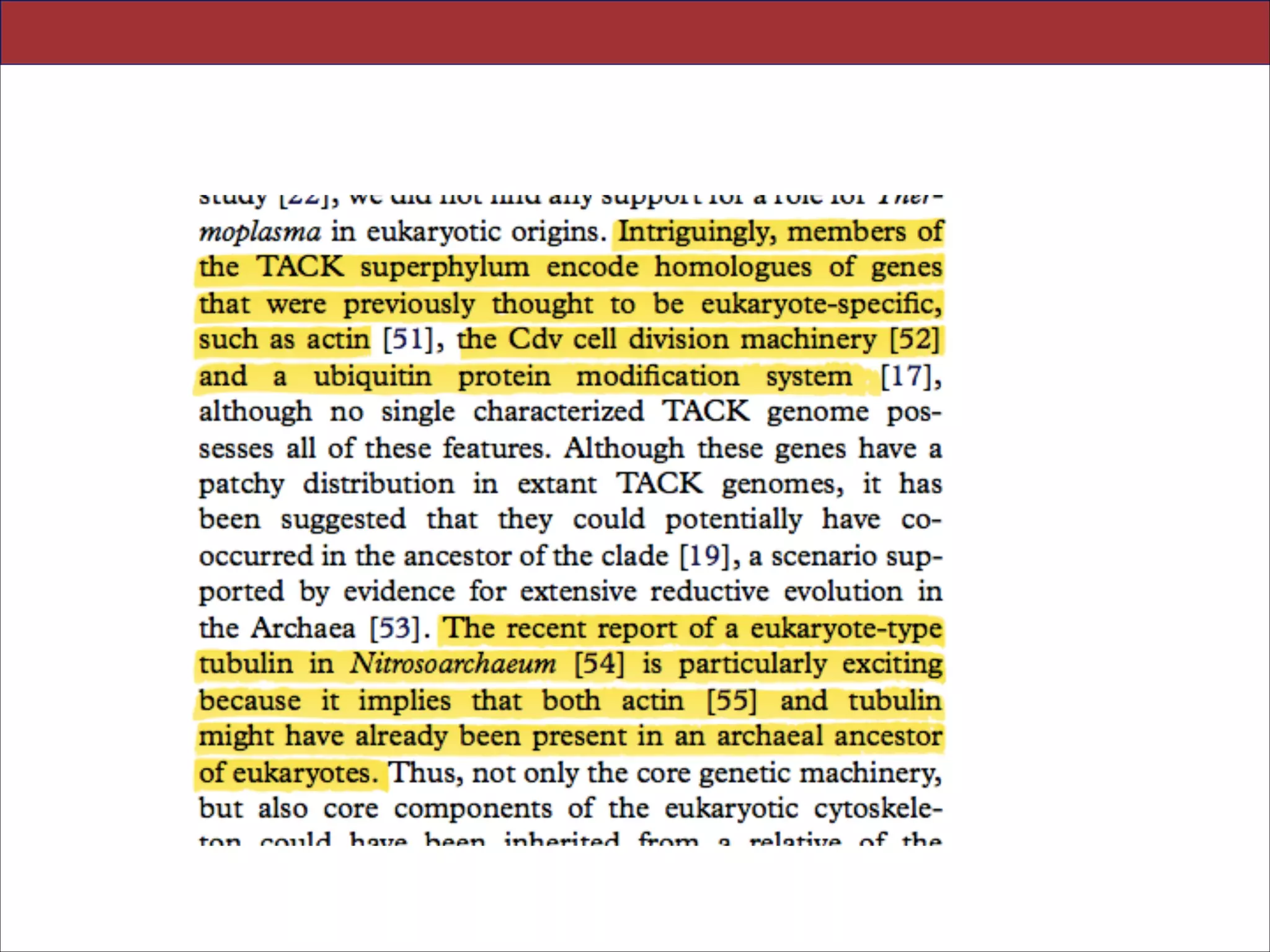
    Determining the relationshipsamong the major groups of cellular life is important for understanding the evolution of biological diversity, but is difficult given the enormous time spans involved. In the textbook ‘three domains’ tree based on informational genes, eukaryotes and Archaea share a common ancestor to the exclusion of Bacteria. However, some phylogenetic analyses of the same data have placed eukaryotes within the Archaea, as the nearest relatives of different archaeal lineages. We compared the support for these competing hypotheses using sophisticated phylogenetic methods and an improved sampling of archaeal biodiversity. We also employed both new and existing tests of phylogenetic congruence to explore the level of uncertainty and conflict in the data. Our analyses suggested that much of the observed incongruence is weakly supported or associated with poorly fitting evolutionary models. All of our phylogenetic analyses, whether on small subunit and large subunit ribosomal RNA or concatenated protein-coding genes, recovered a monophyletic group containing eukaryotes and the TACK archaeal superphylum comprising the Thaumarchaeota, Aigarchaeota, Crenarchaeota and Korarchaeota. Hence, while our results provide no support for the iconic three-domain tree of life, they are consistent with an extended eocyte hypothesis whereby vital components of the eukaryotic nuclear lineage originated from within the archaeal radiation Slides for UC Davis EVE161 Course Taught by Jonathan Eisen Winter 2014 !38
  • 39.
    Slides for UCDavis EVE161 Course Taught by Jonathan Eisen Winter 2014 !39
  • 40.
    Slides for UCDavis EVE161 Course Taught by Jonathan Eisen Winter 2014 !40
  • 41.
    Slides for UCDavis EVE161 Course Taught by Jonathan Eisen Winter 2014 !41
  • 42.
    Slides for UCDavis EVE161 Course Taught by Jonathan Eisen Winter 2014 !42
  • 43.
    Slides for UCDavis EVE161 Course Taught by Jonathan Eisen Winter 2014 !43
  • 44.
    Slides for UCDavis EVE161 Course Taught by Jonathan Eisen Winter 2014 !44
  • 45.
    Downloaded from rspb.royalsocietypublishing.orgon January 16, 2014 Evolution of eukaryotes from Archaea (a) Methanococcus jannaschii Methanothermobacter thermautotrophicus 1 Pyrococcus furiosus Arabidopsis thaliana Giardia lamblia Thermoplasma volcanium Giardia lamblia 1 Homo sapiens 1 Saccharomyces cerevisiae Trichomonas vaginalis Naegleria gruberi Homo sapiens Saccharomyces cerevisiae Dictyostelium discoideum Trypanosoma brucei Entamoeba histolytica Eukaryota Naegleria gruberi 1 Thalassiosira pseudonana 1 Archaeoglobus fulgidus Dictyostelium discoideum Methanosarcina mazei Trypanosoma brucei Thermoplasma volcanium 1 Entamoeba histolytica Cenarchaeum symbiosum Methanothermobacter thermautotrophicus Thaumarchaeota Pyrococcus furiosus 1 Caldivirga maquilingensis Caldiarchaeum subterraneum Aigarchaeota Pyrobaculum aerophilum Caldivirga maquilingensis 1 Pyrobaculum aerophilum Thermofilum pendens Thermofilum pendens Sulfolobus solfataricus Crenarchaeota Hyperthermus butylicus Sulfolobus solfataricus Staphylothermus marinus Euryarchaeota Methanococcus jannaschii Nitrosopumilus maritimus Korarchaeum cryptofilum Korarchaeota 1 Eukaryota Thalassiosira pseudonana Arabidopsis thaliana 0.83 4873 Trichomonas vaginalis Euryarchaeota Methanosarcina mazei 1 T. A. Williams et al. (b) Archaeoglobus fulgidus Staphylothermus marinus Crenarchaeota Ignicoccus hospitalis Hyperthermus butylicus Aeropyrum pernix Ignicoccus hospitalis Clostridium acetobutylicum Aeropyrum pernix Synechocystis sp. Campylobacter jejuni Campylobacter jejuni Escherichia coli Escherichia coli Rhodopseudomonas palustris Bacteria Rhodopseudomonas palustris Clostridium acetobutylicum Treponema pallidum Bacteria Synechocystis sp. Chlamydia trachomatis Treponema pallidum Rhodopirellula baltica Chlamydia trachomatis 0.2 Rhodopirellula baltica 0.2 Archaeoglobus fulgidus (c) Methanococcus jannaschii Thermoplasma volcanium (d ) Methanococcus jannaschii Methanothermobacter thermautotrophicus 1 Pyrococcus furiosus 1 Euryarchaeota Methanosarcina mazei Methanothermobacter thermautotrophicus Pyrococcus furiosus Thermoplasma volcanium Korarchaeum cryptofilum Korarchaeota Nitrosopumilus maritimus Trichomonas vaginalis 1 1 Giardia lamblia Naegleria gruberi Cenarchaeum symbiosum 0.57 Entamoeba histolytica Dictyostelium discoideum Trypanosoma brucei Eukaryota 1 Homo sapiens Thalassiosira pseudonana Saccharomyces cerevisiae Homo sapiens Trypanosoma brucei Saccharomyces cerevisiae Thalassiosira pseudonana Cenarchaeum symbiosum Nitrosopumilus maritimus Naegleria gruberi 1 Trichomonas vaginalis Dictyostelium discoideum Caldiarchaeum subterraneum Aigarchaeota Caldivirga maquilingensis Arabidopsis thaliana Thermofilum pendens Pyrobaculum aerophilum 1 Pyrobaculum aerophilum Thermofilum pendens Sulfolobus solfataricus Hyperthermus butylicus 0.97 Crenarchaeota Caldivirga maquilingensis Sulfolobus solfataricus Staphylothermus marinus Ignicoccus hospitalis Crenarchaeota Aeropyrum pernix Ignicoccus hospitalis Staphylothermus marinus Aeropyrum pernix Hyperthermus butylicus Campylobacter jejuni Rhodopirellula baltica Escherichia coli Synechocystis sp. Rhodopseudomonas palustris Clostridium acetobutylicum Synechocystis sp. Clostridium acetobutylicum Treponema pallidum Chlamydia trachomatis Bacteria Treponema pallidum Bacteria Rhodopseudomonas palustris Escherichia coli Chlamydia trachomatis Campylobacter jejuni Rhodopirellula baltica 0.2 Eukaryota Entamoeba histolytica Thaumarchaeota Korarchaeum cryptofilum Korarchaeota 1 Thaumarchaeota Caldiarchaeum subterraneum Aigarchaeota Giardia lamblia Arabidopsis thaliana 1 Euryarchaeota Archaeoglobus fulgidus Methanosarcina mazei 0.2 Figure 1. Phylogenies of Bacteria, Archaea and eukaryotes inferred from concatenated rRNA. (a) A Bayesian phylogeny of Bacteria, Archaea and eukaryotes inferred under the GTR model, showing an eocyte-like topology in which eukaryotes emerge from within the Archaea with maximal support (posterior probability (PP) ¼ 1). (b) Removal of recently characterized archaeal groups (the Thaumarchaeota, Aigarchaeota and Korarchaeota) converts this tree into a canonical three-domains topology, again with maximal support (PP ¼ 1), indicating that sampling plays an important role in the resolution of these ancient relationships. Analyses of the full dataset using the better-fitting NDRH þ NDCH (c) and CAT (d ) models recover maximally supported eocyte-like topologies; these models also recover eocyte-like topologies on the reduced dataset, without the TAK sequences (see the electronic supplementary material, figure S1). Branch lengths are proportional to substitutions per site. Slides for UC Davis EVE161 Course Taught by Jonathan Eisen Winter 2014 !45
  • 46.
    Downloaded from rspb.royalsocietypublishing.orgon January 16, 2014 Evolution of eukaryotes from Archaea With New Data (a) Evolution of eukaryotes from Archaea Archaeoglobus fulgidus Archaeoglobus fulgidus (a) Methanococcus jannaschii Methanococcus jannaschii (b) (b) Trichomonas vaginalis Methanothermobacter thermautotrophicus Euryarchaeota 1 Pyrococcus furiosus Trichomonas vaginalis Euryarchaeota Pyrococcus furiosus Arabidopsis thaliana Arabidopsis thaliana Methanosarcina mazei mazei Methanosarcina Giardia lamblia Giardia lamblia Thermoplasma volcanium Thermoplasma volcanium Giardia lamblia lamblia Giardia 1 1 1 1 Trichomonas vaginalis Trichomonas vaginalis Naegleria gruberi gruberi Naegleria 1 1 Homo sapiens Homo sapiens Saccharomyces cerevisiae Saccharomyces cerevisiae Thalassiosira pseudonana Thalassiosira pseudonana 1 1 Dictyostelium discoideum Dictyostelium discoideum Trypanosoma brucei Trypanosoma brucei Entamoeba histolytica Entamoeba histolytica 1 Entamoeba histolytica Entamoeba histolytica Cenarchaeum symbiosum 0.83 Korarchaeum cryptofilum Korarchaeota Caldiarchaeum subterraneum Aigarchaeota 1 Pyrobaculum aerophilum Pyrobaculum aerophilum Thermofilum pendens Pyrobaculum aerophilum 1 Pyrobaculum aerophilum Thermofilum pendens Ignicoccus hospitalis Aeropyrum pernix Ignicoccus hospitalis Aeropyrum pernix Synechocystis sp. Clostridium acetobutylicum Campylobacter Synechocystis sp. jejuni Escherichia Campylobacter jejuni coli Escherichia coli Campylobacter jejuni Rhodopseudomonas palustris Escherichia coli Clostridium palustris Rhodopseudomonasacetobutylicum Rhodopirellula baltica 0.2 Chlamydia trachomatisSlides Crenarchaeota Crenarchaeota Aeropyrum pernix Clostridium acetobutylicum Campylobacter jejuni Aeropyrum pernix Treponema pallidum Sulfolobus solfataricus Sulfolobus solfataricus Hyperthermus butylicus Staphylothermus marinus Ignicoccus hospitalis Hyperthermus butylicus Ignicoccus hospitalis Chlamydia trachomatis 1 Thermofilum pendens Hyperthermus butylicus Staphylothermus marinus Crenarchaeota Sulfolobus solfataricus marinus Staphylothermus Crenarchaeota Staphylothermus marinus Hyperthermus butylicus Treponema Synechocystis sp. pallidum Euryarchaeota Euryarchaeota Caldivirga maquilingensis Caldivirga maquilingensis Clostridium Synechocystis sp. acetobutylicum Methanococcus jannaschii Methanococcus jannaschii Methanothermobacter thermautotrophicus Caldivirga maquilingensis 1 Thermoplasma volcanium Thermoplasma volcanium Pyrococcus furiosus 1 Pyrococcus furiosus Caldivirga maquilingensis Caldiarchaeum subterraneum Aigarchaeota Thermofilum Sulfolobus solfataricus pendens 1 Methanothermobacter thermautotrophicus Thaumarchaeota Thaumarchaeota Nitrosopumilus maritimus Nitrosopumilus maritimus Korarchaeum cryptofilum Korarchaeota 1 Archaeoglobus fulgidus Archaeoglobus fulgidus Methanosarcina mazei Methanosarcina mazei Trypanosoma Trypanosoma brucei brucei 0.83 Naegleria gruberi Naegleria gruberi 1 1 Dictyostelium discoideum Dictyostelium discoideum Cenarchaeum symbiosum Eukaryota Eukaryota Thalassiosira pseudonana Thalassiosira pseudonana Arabidopsis thalianathaliana Arabidopsis Homo Homo sapiens sapiens Eukaryota Eukaryota Saccharomyces cerevisiae Saccharomyces cerevisiae T. A. Williams et al. Without New Data Methanothermobacter thermautotrophicus 1 T. A. Williams et al. Rhodopseudomonas palustris Escherichia coli Treponema pallidum Rhodopseudomonas palustris Bacteria Bacteria Bacteria Chlamydia trachomatis Treponema pallidum Bacteria Rhodopirellula baltica Chlamydia trachomatis 0.2 Rhodopirellula baltica for UC Davis EVE161 Course Taught by Jonathan Eisen Winter 2014 0.2 !46
  • 47.
    Rhodopirellula baltica 0.2 Better Models Archaeoglobusfulgidus (c) Methanothermobacter thermautotrophicus 1 Methanococcus jannaschii Thermoplasma volcanium (d ) Methanococcus jannaschii Pyrococcus furiosus 1 Euryarchaeota Methanosarcina mazei Methanothermobacter thermautotrophicus Methanosarcina mazei Pyrococcus furiosus Thermoplasma volcanium Korarchaeum cryptofilum Korarchaeota Nitrosopumilus maritimus Trichomonas vaginalis 1 1 Giardia lamblia Naegleria gruberi Cenarchaeum symbiosum 0.57 Entamoeba histolytica Dictyostelium discoideum Trypanosoma brucei Eukaryota 1 Homo sapiens Thalassiosira pseudonana Saccharomyces cerevisiae Homo sapiens Trypanosoma brucei Saccharomyces cerevisiae Thalassiosira pseudonana Cenarchaeum symbiosum Nitrosopumilus maritimus Naegleria gruberi 1 Trichomonas vaginalis Dictyostelium discoideum Caldiarchaeum subterraneum Aigarchaeota Caldivirga maquilingensis Arabidopsis thaliana Thermofilum pendens Pyrobaculum aerophilum 1 Pyrobaculum aerophilum Thermofilum pendens Sulfolobus solfataricus Hyperthermus butylicus 0.97 Crenarchaeota Caldivirga maquilingensis Sulfolobus solfataricus Staphylothermus marinus Ignicoccus hospitalis Crenarchaeota Aeropyrum pernix Ignicoccus hospitalis Staphylothermus marinus Aeropyrum pernix Hyperthermus butylicus Campylobacter jejuni Rhodopirellula baltica Escherichia coli Synechocystis sp. Rhodopseudomonas palustris Clostridium acetobutylicum Synechocystis sp. Clostridium acetobutylicum Treponema pallidum Chlamydia trachomatis Bacteria Treponema pallidum Bacteria Rhodopseudomonas palustris Escherichia coli Chlamydia trachomatis Campylobacter jejuni Rhodopirellula baltica 0.2 Eukaryota Entamoeba histolytica Thaumarchaeota Korarchaeum cryptofilum Korarchaeota 1 Thaumarchaeota Caldiarchaeum subterraneum Aigarchaeota Giardia lamblia Arabidopsis thaliana 1 Euryarchaeota Archaeoglobus fulgidus Slides for UC Davis EVE161 Course Taught by Jonathan Eisen Winter 2014 0.2 !47
  • 48.
    Slides for UCDavis EVE161 Course Taught by Jonathan Eisen Winter 2014 !48
  • 49.
    Slides for UCDavis EVE161 Course Taught by Jonathan Eisen Winter 2014 !49
  • 50.
    Slides for UCDavis EVE161 Course Taught by Jonathan Eisen Winter 2014 !50
  • 51.
    Concatenated Proteins Downloaded fromrspb.royalsocietypublishing.org on January 16, 2014 4874 T. A. Williams et al. (a) Evolution of eukaryotes from Archaea Methanothermobacter thermautotrophicus Thermoplasma volcanium Pyrococcus furiosus (b) Methanococcus jannaschii 0.51 Methanococcus jannaschii Methanothermobacter thermautotrophicus Euryarchaeota Methanosarcina mazei Thermoplasma acidophilum Archaeoglobus fulgidus Archaeoglobus fulgidus Pyrococcus furiosus Methanosarcina mazei 1 Trichomonas vaginalis Giardia lamblia 1 Giardia lamblia Trichomonas vaginalis 1 Thalassiosira pseudonana Phytophthora ramorum Saccharomyces cerevisiae Homo sapiens 0.81 0.99 Entamoeba histolytica Naegleria gruberi Leishmania major Eukaryota Dictyostelium discoideum Homo sapiens Dictyostelium discoideum Leishmania major Arabidopsis thaliana 1 Thalassiosira pseudonana Arabidopsis thaliana Korarchaeum cryptofilum Korarchaeota Nitrosopumilus maritimus 1 Cenarchaeum symbiosum Caldiarchaeum subterraneum Phytophthora ramorum Korarchaeum cryptofilum Thaumarchaeota Nitrosoarchaeum limnia Aigarchaeota 1 1 0.99 Sulfolobus solfataricus Crenarchaeota 1 Ignicoccus hospitalis Crenarchaeota Staphylothermus marinus Aeropyrum pernix Hyperthermus butylicus Hyperthermus butylicus Aeropyrum pernix Rhodopseudomonas palustris Escherichia coli 0.5 Treponema pallidum Rhodopirellula baltica Caldivirga maquilingensis Sulfolobus solfataricus Ignicoccus hospitalis Chlamydia trachomatis Thaumarchaeota Thermofilum pendens Pyrobaculum aerophilum Caldivirga maquilingensis Staphylothermus marinus Cenarchaeum symbiosum Nitrosoarchaeum limnia Pyrobaculum aerophilum 1 Korarchaeota Aigarchaeota Caldiarchaeum subterraneum Nitrosopumilus maritimus Thermofilum pendens 0.99 Eukaryota Saccharomyces cerevisiae Entamoeba histolytica 0.99 Euryarchaeota Bacteria Synechocystis sp. Clostridium acetobutylicum Campylobacter jejuni 0.2 Figure 2. Phylogenies of Bacteria, Archaea and eukaryotes inferred from conserved protein-coding genes. (a) A phylogeny inferred from 29 concatenated proteins conserved between Bacteria, Archaea and eukaryotes. An eocyte topology was recovered with strong (PP ¼ 0.99) support. In this phylogeny, the eukaryotes emerge as the sister group of Korarchaeum, nested with the TACK superphylum. (b) A phylogeny inferred from 63 concatenated proteins shared between Archaea and eukaryotes. The position of the root is not explicitly indicated. However, based on the result from (a) and the electronic supplementary material, table S4, it is likely to be either within, or on the branch leading to, the Euryarchaea. If this position is correct, then the tree shows the eukaryotes emerging as the sister group to the TACK superphylum, including Korarchaeum. These trees were inferred using the CAT model in PHYLOBAYES. Branch lengths are proportional to substitutions per site, except the truncated bacterial branch in (a). for UC Davis EVE161 Course Taught by Jonathan Eisen Winter 2014 Slides !51
  • 52.
    Slides for UCDavis EVE161 Course Taught by Jonathan Eisen Winter 2014 !52
  • 53.
    Slides for UCDavis EVE161 Course Taught by Jonathan Eisen Winter 2014 !53
  • 54.
    Tree Congruence Downloaded fromrspb.royalsocietypublishing.org on January 16, 2014 4876 T. A. Williams et al. Evolution of eukaryotes from Archaea (b) (a) no. tests passed (P > 0.05) 250 frequency model CAT20 LG 60 300 200 150 100 50 40 30 20 10 50 0 0 1 2 3 distance 4 saturation and site-specific compositional homoplasy biochemical diversity heterogeneity 5 (c) model CAT20 LG 1.2 1.0 density 0.8 0.6 0.4 0.2 0 1.0 1.5 2.0 distance 2.5 3.0 Figure 3. Analysing incongruence using a novel measure of distance between gene trees. We used distributions of pairwise geodesic distances between gene trees to compare levels of incongruence inferred under different evolutionary models. (a) The distribution of distances under a single model (CAT20) can be used to identify obvious outliers corresponding to highly incongruent gene trees; a single gene was responsible for the peak highlighted in red, and was removed from subsequent analyses. (b) Overview of model-fitting tests (posterior predictive simulations) for each gene in the 64AE dataset. The height of the bars indicates the proportion of genes that ‘passed’ a test under a particular model; we said that a test was passed when the value of the test statistic on the real data fell within the central 95% of the distribution of values produced by posterior predictive simulation. The results suggest that CAT20 fits better than LG, successfully accounting for the observed levels of saturation and homoplasy in all but one of the alignments. Both models do a poor job of modelling the site-specific selective constraints in our dataset, although again CAT20 performs better than LG (13 passes as opposed to 0). (c) Comparison of the distance distributions inferred under the CAT20 and LG models. The trees inferred under the better-fitting CAT20 model are significantly more congruent than those inferred under LG (mean distance: 2.68 versus 3.22, p , 0.0001). The significance of this difference was assessed using a permutation test that took the correlations between pairwise distances into account (see §4). These results suggest that a significant portion of the incongruence in this dataset of informational genes can be attributed to model misspecification, rather than genuinely distinct evolutionary histories. Slides for UC Davis EVE161 Course Taught by Jonathan Eisen Winter 2014 3. CONCLUSIONS theories of eukaryotic origins [1]. Here, we have com- !54
  • 55.
    Slides for UCDavis EVE161 Course Taught by Jonathan Eisen Winter 2014 !55
  • 56.
    Slides for UCDavis EVE161 Course Taught by Jonathan Eisen Winter 2014 !56