EVALUATIONEVALUATION
MINATI DASMINATI DAS
ASST.PROFFASST.PROFF
NURSING COLLEGENURSING COLLEGE
KIIT UNIVERSITY
evaluatingevaluating
• Measure how well the patient
has achieved desired outcome.
• Identify factors
• Modify the plan of care, if
indicated
Contd…Contd…
Elements orElements or
Contd…Contd…
1-1-
2-Collecting Evaluative Data2-Collecting Evaluative Data
• To determine whether or not
the patient has met the desired
outcomes.
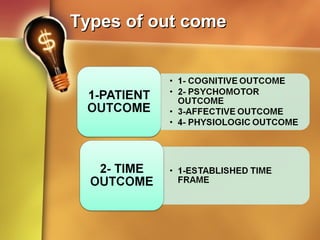
Types of out comeTypes of out come
3-3-
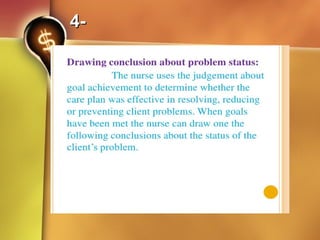
4-4-
CONTD..CONTD..
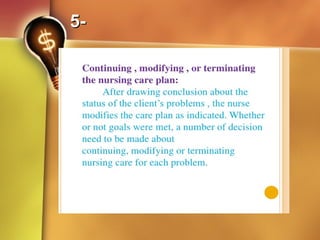
5-5-
1-1-
2-2-
3-3-
4-4-
5-5-
Contd…Contd…
COMMON PROBLEMSCOMMON PROBLEMS
DURING EVALUATIONDURING EVALUATION
CRITICAL THINKING ANDCRITICAL THINKING AND
EVALUATIONEVALUATION
Contd…Contd…
EVALUATING QUALITYEVALUATING QUALITY
CARECARE
• Performance Improvement in
everyday clinical practice.
• Establishing and Sustaining
Healthy Work Environment.
• Quality assurance
• Quality improvement
• Patient satisfaction
• Nursing Audit
FOR EXAMPLE – IN CLASSFOR EXAMPLE – IN CLASS
FOR EXAMPLE- IN CLINICALFOR EXAMPLE- IN CLINICAL
SIDESIDE
Critical Thinking andCritical Thinking and
Nursing JudgmentNursing Judgment
• How do we
make
decisions?
• How do nurses
make decisions
about patient
care?
• What do we rely
on to help us in
decision
making?
Critical Thinking andCritical Thinking and
Nursing JudgmentNursing Judgment
• Not a linear step by step
process
• Process acquired through hard
work, commitment, and an
active curiosity toward
learning
• Decision making is the skill
that separates the professional
nurse from technical or
Critical Thinking andCritical Thinking and
Nursing JudgmentNursing Judgment
• Good problem
solving skills
• Not always a
clear textbook
answer
• Nurse must
learn to
question, look
at alternatives
How do nurse's accomplishHow do nurse's accomplish
this?this?
• Learns to be flexible in clinical
decision making
• Reflect on past experiences
and previous knowledge
• Listen to others point of view
• Identify the nature of the
problem
• Select the best solution for
improving client’s health
Definition of CriticalDefinition of Critical
ThinkingThinking
• Cognitive process during which an
individual reviews data and considers
potential explanations and outcomes
before forming an opinion or making a
decision
• “Critical thinking in nursing practice is a
discipline specific, reflective reasoning
process that guides the nurse in
generating, implementing, and evaluating
approaches for dealing with client care
and professional concerns.” NLN 2000
Critical Thinking in NursingCritical Thinking in Nursing
• Purposeful, outcome-directed
• Essential to safe, competent,
skillful nursing practice
• Based on principles of nursing
process and the scientific
method
• Requires specific knowledge,
skills, and experience
• New nurses must question
Critical Thinking in NursingCritical Thinking in Nursing
• Guided by professional
standards and ethic codes
• Requires strategies that
maximize potential and
compensate for problems
• Constantly reevaluating, self-
correcting, and striving to
improve
Formula for Critical ThinkingFormula for Critical Thinking
• Start Thinking
• Why Ask Why
• Ask the Right Questions
• Are you an expert?
Aspects of Critical ThinkingAspects of Critical Thinking
• Reflection
• Language
• Intuition
Levels of Critical ThinkingLevels of Critical Thinking
• Basic
• Complex
• Commitment
Critical ThinkingCritical Thinking
CompetenciesCompetencies
• Scientific method
• Problem Solving
• Decision Making
• Diagnostic Reasoning and
Inferences
• Clinical Decision Making
• Nursing Process
Developing Critical ThinkingDeveloping Critical Thinking
Attitudes/SkillsAttitudes/Skills
• Not easy
• Not “either or”
• Self-assessment
• Tolerating dissonance and
ambiguity
• Seeking situations where good
thinking practiced
• Creating environments that
support critical thinking
Nursing ProcessNursing Process
• Systematic approach that is used by
all nurses to gather data, critically
examine and analyze the data,
identify client responses, design
outcomes, take appropriate action,
then evaluate the effectiveness of
action
• Involves the use of critical thinking
skills
• Common language for nurses to
“think through” clinical problems
Nursing ProcessNursing Process
Thinking and LearningThinking and Learning
• Lifelong process
• Flexible, open process
• Learn to think and to ANTICIPATE
• What, why, how questions
• Look beyond the obvious
• Reflect on past experience
• New knowledge challenges the
traditional way
Components Of CriticalComponents Of Critical
ThinkingThinking
• Scientific Knowledge Base
• Experience
• Competencies
• Attitudes
• Standards
Attitudes That FosterAttitudes That Foster
Critical ThinkingCritical Thinking
• Independence
• Fair-mindedness
• Insight into ethnocentricity
• Intellectual humility
• Intellectual courage to challenge
status quo
• Integrity
• Preserverance
• Confidence
• Curiosity
Professional StandardsProfessional Standards
• Ethical criteria for Nursing
judgment- Code of Ethics
• Criteria for evaluation-
Standards of care
• Standards of professional
responsibility that nurses
strive to achieve are cited in
Nurse Practice Acts, TJC
guidelines, institutional policy
and procedure, ANA Standards
of Nursing Practice
Critical Thinking SynthesisCritical Thinking Synthesis
• Reasoning process by which
individuals reflect on and
analyze their own thoughts,
actions, & decisions and those
of others
• Not a step by step process
Nursing ProcessNursing Process
• Traditional critical thinking
competency
• 5 Step circular, ongoing
process
• Continuous until clients health
is improved, restored or
maintained
• Must involve assessment and
changes in condition
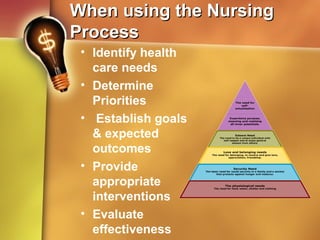
When using the NursingWhen using the Nursing
ProcessProcess
• Identify health
care needs
• Determine
Priorities
• Establish goals
& expected
outcomes
• Provide
appropriate
interventions
• Evaluate
effectiveness
Nursing ProcessNursing Process
• Assessment
• Diagnosis
• Planning
• Implementation
• Evaluation
AssessmentAssessment
• Systemically collects, verifies,
analyzes and communicates
data
• Two step process- Collection
and Verification of data &
Analysis of data
• Establishes a data base about
client needs, health problems,
responses, related
experiences, health practices,
values. lifestyle, &
expectations
Critical Thinking andCritical Thinking and
Assessment ProcessAssessment Process
• Brings knowledge from
biological, physical, & social
sciences as basis for the nurse
to ask relevant questions. Need
knowledge of communication
skills
• Prior clinical experience
contributes to assessment skills
• Apply Standards of Practice
• Personal Attitudes
Assessment DataAssessment Data
• Subjective Data
• Objective Data
• Sources of Data
• Methods of Data Collection-
Interview
• Interview initiates nurse-client
relationship
• Use open-ended questions
• Nursing health history
Nursing DiagnosisNursing Diagnosis
• Statement that describes the
client’s actual or potential
response to a health problem
• Focuses on client-centered
problems
• First introduced in the 1950’s
• NANDA established in 1982
• Step of the nursing process
that allows nurse to
individualize care
Planning for Nursing CarePlanning for Nursing Care
• Client-centered goals and
expected outcomes are
established
• Priorities are set relating to
unmet needs
• Maslow’s Hierarchy of Needs is
a useful method for setting
priorities
• Priorities are classifies as high,
intermediate, or low
Purpose of Goals andPurpose of Goals and
OutcomesOutcomes
• Provides direction for
individualized nursing
interventions
• Sets standards of determining
the effectiveness of
interventions
• Indicates anticipated client
behavior or response to
nursing care
• End point of nursing care
Goals of CareGoals of Care
• Goal: Guideposts to the
selection of nursing
interventions and criteria in the
evaluation of interventions
• What you want to achieve with
your patient and in what time
frame
• Short term vs. Long term
• Outcome Of Care: What was
actually achieved, was goal
met or not met
Nursing InterventionsNursing Interventions
• Interventions are selected after
goals and outcomes are determined
• Actions designed to assist client in
moving from the present level of
health to that which is described in
the goal and measured with
outcome criteria
• Utilizes critical thinking by applying
attitudes and standards and
synthesizing data
Types of InterventionsTypes of Interventions
• Nurse-Initiated
• Physician-
Initiated
• Collaborative
Interventions
Selection Of InterventionSelection Of Intervention
• Using clinical decision making
skills, the nurse deliberates 6
factors:
• Diagnosis, expected outcomes,
research base, feasibility,
acceptability to client,
competency of nurse
Nursing Care PlansNursing Care Plans
• Written guidelines for client
care
• Organized so nurse can
quickly identify nursing
actions to be delivered
• Coordinates resources for care
• Enhances the continuity of
care
• Organizes information for
change of shift report
Nursing Care Plans vs ConceptNursing Care Plans vs Concept
MapsMaps
NCP Concept/Mind Map
Implementation of NursingImplementation of Nursing
InterventionsInterventions
• Describes a category of
nursing behaviors in which the
actions necessary for
achieving the goals and
outcomes are initiated and
completed
• Action taken by nurse
Types of NursingTypes of Nursing
InterventionsInterventions
• Standing Orders: Document
containing orders for the use of
routine therapies, monitoring
guidelines, and/or diagnostic
procedure for specific condition
• Protocols: Written plan specifying
the procedures to be followed
during care of a client with a select
clinical condition or situation
(Pneumonia, MI, CVA)
Implementation ProcessImplementation Process
involves:involves:
• Reassessing the client
• Reviewing and revising the
existing care plan
• Organizing resources and care
delivery (equipment,
personnel, environment)
EvaluationEvaluation
• Step of the nursing process that
measures the client’s response to
nursing actions and the client’s
progress toward achieving goals
• Data collected on an on-going basis
• Supports the basis of the
usefulness and effectiveness of
nursing practice
• Involves measurement of Quality of
Care
Evaluation of GoalEvaluation of Goal
AchievementAchievement
• Measures and Sources:
Assessment skills and
techniques
• As goals are evaluated,
adjustments of the care plan are
made
• If the goal was met, that part of
the care plan is discontinued
• Redefines priorities

Evaluation ppt 1

  • 1.
  • 2.
    evaluatingevaluating • Measure howwell the patient has achieved desired outcome. • Identify factors • Modify the plan of care, if indicated
  • 5.
  • 6.
  • 7.
  • 8.
  • 9.
    2-Collecting Evaluative Data2-CollectingEvaluative Data • To determine whether or not the patient has met the desired outcomes.
  • 10.
    Types of outcomeTypes of out come
  • 11.
  • 12.
  • 13.
  • 14.
  • 16.
  • 17.
  • 18.
  • 19.
  • 20.
  • 21.
  • 24.
    COMMON PROBLEMSCOMMON PROBLEMS DURINGEVALUATIONDURING EVALUATION
  • 25.
    CRITICAL THINKING ANDCRITICALTHINKING AND EVALUATIONEVALUATION
  • 27.
  • 30.
    EVALUATING QUALITYEVALUATING QUALITY CARECARE •Performance Improvement in everyday clinical practice. • Establishing and Sustaining Healthy Work Environment. • Quality assurance • Quality improvement • Patient satisfaction • Nursing Audit
  • 31.
    FOR EXAMPLE –IN CLASSFOR EXAMPLE – IN CLASS
  • 32.
    FOR EXAMPLE- INCLINICALFOR EXAMPLE- IN CLINICAL SIDESIDE
  • 37.
    Critical Thinking andCriticalThinking and Nursing JudgmentNursing Judgment • How do we make decisions? • How do nurses make decisions about patient care? • What do we rely on to help us in decision making?
  • 38.
    Critical Thinking andCriticalThinking and Nursing JudgmentNursing Judgment • Not a linear step by step process • Process acquired through hard work, commitment, and an active curiosity toward learning • Decision making is the skill that separates the professional nurse from technical or
  • 39.
    Critical Thinking andCriticalThinking and Nursing JudgmentNursing Judgment • Good problem solving skills • Not always a clear textbook answer • Nurse must learn to question, look at alternatives
  • 40.
    How do nurse'saccomplishHow do nurse's accomplish this?this? • Learns to be flexible in clinical decision making • Reflect on past experiences and previous knowledge • Listen to others point of view • Identify the nature of the problem • Select the best solution for improving client’s health
  • 41.
    Definition of CriticalDefinitionof Critical ThinkingThinking • Cognitive process during which an individual reviews data and considers potential explanations and outcomes before forming an opinion or making a decision • “Critical thinking in nursing practice is a discipline specific, reflective reasoning process that guides the nurse in generating, implementing, and evaluating approaches for dealing with client care and professional concerns.” NLN 2000
  • 42.
    Critical Thinking inNursingCritical Thinking in Nursing • Purposeful, outcome-directed • Essential to safe, competent, skillful nursing practice • Based on principles of nursing process and the scientific method • Requires specific knowledge, skills, and experience • New nurses must question
  • 43.
    Critical Thinking inNursingCritical Thinking in Nursing • Guided by professional standards and ethic codes • Requires strategies that maximize potential and compensate for problems • Constantly reevaluating, self- correcting, and striving to improve
  • 44.
    Formula for CriticalThinkingFormula for Critical Thinking • Start Thinking • Why Ask Why • Ask the Right Questions • Are you an expert?
  • 45.
    Aspects of CriticalThinkingAspects of Critical Thinking • Reflection • Language • Intuition
  • 46.
    Levels of CriticalThinkingLevels of Critical Thinking • Basic • Complex • Commitment
  • 47.
    Critical ThinkingCritical Thinking CompetenciesCompetencies •Scientific method • Problem Solving • Decision Making • Diagnostic Reasoning and Inferences • Clinical Decision Making • Nursing Process
  • 48.
    Developing Critical ThinkingDevelopingCritical Thinking Attitudes/SkillsAttitudes/Skills • Not easy • Not “either or” • Self-assessment • Tolerating dissonance and ambiguity • Seeking situations where good thinking practiced • Creating environments that support critical thinking
  • 49.
    Nursing ProcessNursing Process •Systematic approach that is used by all nurses to gather data, critically examine and analyze the data, identify client responses, design outcomes, take appropriate action, then evaluate the effectiveness of action • Involves the use of critical thinking skills • Common language for nurses to “think through” clinical problems
  • 50.
  • 51.
    Thinking and LearningThinkingand Learning • Lifelong process • Flexible, open process • Learn to think and to ANTICIPATE • What, why, how questions • Look beyond the obvious • Reflect on past experience • New knowledge challenges the traditional way
  • 52.
    Components Of CriticalComponentsOf Critical ThinkingThinking • Scientific Knowledge Base • Experience • Competencies • Attitudes • Standards
  • 53.
    Attitudes That FosterAttitudesThat Foster Critical ThinkingCritical Thinking • Independence • Fair-mindedness • Insight into ethnocentricity • Intellectual humility • Intellectual courage to challenge status quo • Integrity • Preserverance • Confidence • Curiosity
  • 54.
    Professional StandardsProfessional Standards •Ethical criteria for Nursing judgment- Code of Ethics • Criteria for evaluation- Standards of care • Standards of professional responsibility that nurses strive to achieve are cited in Nurse Practice Acts, TJC guidelines, institutional policy and procedure, ANA Standards of Nursing Practice
  • 55.
    Critical Thinking SynthesisCriticalThinking Synthesis • Reasoning process by which individuals reflect on and analyze their own thoughts, actions, & decisions and those of others • Not a step by step process
  • 56.
    Nursing ProcessNursing Process •Traditional critical thinking competency • 5 Step circular, ongoing process • Continuous until clients health is improved, restored or maintained • Must involve assessment and changes in condition
  • 57.
    When using theNursingWhen using the Nursing ProcessProcess • Identify health care needs • Determine Priorities • Establish goals & expected outcomes • Provide appropriate interventions • Evaluate effectiveness
  • 58.
    Nursing ProcessNursing Process •Assessment • Diagnosis • Planning • Implementation • Evaluation
  • 59.
    AssessmentAssessment • Systemically collects,verifies, analyzes and communicates data • Two step process- Collection and Verification of data & Analysis of data • Establishes a data base about client needs, health problems, responses, related experiences, health practices, values. lifestyle, & expectations
  • 60.
    Critical Thinking andCriticalThinking and Assessment ProcessAssessment Process • Brings knowledge from biological, physical, & social sciences as basis for the nurse to ask relevant questions. Need knowledge of communication skills • Prior clinical experience contributes to assessment skills • Apply Standards of Practice • Personal Attitudes
  • 61.
    Assessment DataAssessment Data •Subjective Data • Objective Data • Sources of Data • Methods of Data Collection- Interview • Interview initiates nurse-client relationship • Use open-ended questions • Nursing health history
  • 65.
    Nursing DiagnosisNursing Diagnosis •Statement that describes the client’s actual or potential response to a health problem • Focuses on client-centered problems • First introduced in the 1950’s • NANDA established in 1982 • Step of the nursing process that allows nurse to individualize care
  • 68.
    Planning for NursingCarePlanning for Nursing Care • Client-centered goals and expected outcomes are established • Priorities are set relating to unmet needs • Maslow’s Hierarchy of Needs is a useful method for setting priorities • Priorities are classifies as high, intermediate, or low
  • 71.
    Purpose of GoalsandPurpose of Goals and OutcomesOutcomes • Provides direction for individualized nursing interventions • Sets standards of determining the effectiveness of interventions • Indicates anticipated client behavior or response to nursing care • End point of nursing care
  • 72.
    Goals of CareGoalsof Care • Goal: Guideposts to the selection of nursing interventions and criteria in the evaluation of interventions • What you want to achieve with your patient and in what time frame • Short term vs. Long term • Outcome Of Care: What was actually achieved, was goal met or not met
  • 73.
    Nursing InterventionsNursing Interventions •Interventions are selected after goals and outcomes are determined • Actions designed to assist client in moving from the present level of health to that which is described in the goal and measured with outcome criteria • Utilizes critical thinking by applying attitudes and standards and synthesizing data
  • 74.
    Types of InterventionsTypesof Interventions • Nurse-Initiated • Physician- Initiated • Collaborative Interventions
  • 75.
    Selection Of InterventionSelectionOf Intervention • Using clinical decision making skills, the nurse deliberates 6 factors: • Diagnosis, expected outcomes, research base, feasibility, acceptability to client, competency of nurse
  • 76.
    Nursing Care PlansNursingCare Plans • Written guidelines for client care • Organized so nurse can quickly identify nursing actions to be delivered • Coordinates resources for care • Enhances the continuity of care • Organizes information for change of shift report
  • 77.
    Nursing Care Plansvs ConceptNursing Care Plans vs Concept MapsMaps NCP Concept/Mind Map
  • 78.
    Implementation of NursingImplementationof Nursing InterventionsInterventions • Describes a category of nursing behaviors in which the actions necessary for achieving the goals and outcomes are initiated and completed • Action taken by nurse
  • 79.
    Types of NursingTypesof Nursing InterventionsInterventions • Standing Orders: Document containing orders for the use of routine therapies, monitoring guidelines, and/or diagnostic procedure for specific condition • Protocols: Written plan specifying the procedures to be followed during care of a client with a select clinical condition or situation (Pneumonia, MI, CVA)
  • 81.
    Implementation ProcessImplementation Process involves:involves: •Reassessing the client • Reviewing and revising the existing care plan • Organizing resources and care delivery (equipment, personnel, environment)
  • 82.
    EvaluationEvaluation • Step ofthe nursing process that measures the client’s response to nursing actions and the client’s progress toward achieving goals • Data collected on an on-going basis • Supports the basis of the usefulness and effectiveness of nursing practice • Involves measurement of Quality of Care
  • 83.
    Evaluation of GoalEvaluationof Goal AchievementAchievement • Measures and Sources: Assessment skills and techniques • As goals are evaluated, adjustments of the care plan are made • If the goal was met, that part of the care plan is discontinued • Redefines priorities