Competencies for Professional Nursing Practice
Chapter 4
Overview Competencies
American Association of Colleges of Nursing (AACN)
Essentials
Quality and Safety Education for Nurses (QSEN)
Technology Informatics Guiding Education Reform (TIGER)
Initiative
Nurse of the Future (NOF): Nursing Core Competencies
Figure 4-1 The Nurse of the Future: Nursing Core Competencies
graphic.
Reproduced from Massachusetts Department of Higher
Education. (2016). Nurse of the future: Nursing core
competencies:
Registered nurse. Retrieved from
http://www.mass.edu/nahi/documents/NOFRNCompetencies_up
dated_March2016.pdf
Nurse of the Future:
Nursing Core Competency Graphic
Illustrates, through use of broken lines, the reciprocal and
continuous relationship between each competency and nursing
knowledge, that the competencies may overlap and are not
mutually exclusive, and that all competencies are of equal
importance.
Nursing knowledge is placed as the core in the graphic to
illustrate that nursing knowledge reflects the overarching art
and science of professional nursing practice.
NOF Core Competency Model
(1 of 3)
Essential knowledge, attitudes, and skills (KAS), reflecting
cognitive, affective, and psychomotor learning domains, are
specified for each competency.
The KAS identified in the model reflect the expectations for
initial nursing practice following the completion of a
prelicensure professional nursing education program.
NOF Core Competency Model
(2 of 3)
Human beings/patients: Recipients of nursing care or services;
may be individuals, families, groups, communities, or
populations
Environment: The atmosphere, milieu, or conditions in which
one lives, works, or plays
Health: Experience, often expressed in terms of wellness and
illness, that may occur in the presence or absence of disease or
injury
NOF Core Competency Model
(3 of 3)
Nursing: The protection, promotion, and optimization of health
and abilities; prevention of illness and injury; alleviation of
suffering through the diagnosis and treatment of human
response; and advocacy in the care of individuals, families,
groups, communities, and populations
The NOF Core Competencies
Patient-centered care
Professionalism
Leadership
Systems-based practice
Informatics and technology
Communication
Teamwork and collaboration
Safety
Quality improvement
Evidence-based practice
Why Is Critical Thinking Important in Nursing Practice?
Essential to providing safe, competent, and skillful nursing
care.
The inability of a nurse to set priorities and work safely,
effectively, and efficiently may delay patient treatment in a
critical situation and result in serious life-threatening
consequences.
9
Thinking Like a Nurse
Clinical judgment
Clinical reasoning
Mindfulness
Clinical Judgment
(1 of 2)
Clinical judgments are more influenced by what nurses bring to
the situation than the objective data about the situation at hand.
Sound clinical judgment rests to some degree on knowing the
patient and his or her typical pattern of responses, as well as
engagement with the patient and his or her concerns.
Clinical Judgment
(2 of 2)
Clinical judgments are influenced by the context in which the
situation occurs and the culture of the nursing unit.
Nurses use a variety of reasoning patterns alone or in
combination.
Reflection on practice is often triggered by a breakdown in
clinical judgment and is critical for the development of clinical
knowledge and improvement in clinical reasoning.
Critical Thinking and Clinical Judgment in Nursing
Purposeful, informed, outcome-focused thinking
Carefully identifies key problems, issues, and risks
Based on principles of the nursing process, problem solving,
and the scientific method
Applies logic, intuition, and creativity
Driven by patient, family, and community needs
Calls for strategies that make the most of human potential
Requires constant reevaluating
Characteristics of Critical Thinking
Rational and reasonable
Involves conceptualization
Requires reflection
Includes cognitive skills and attitudes
Involves creative thinki ng
Requires knowledge
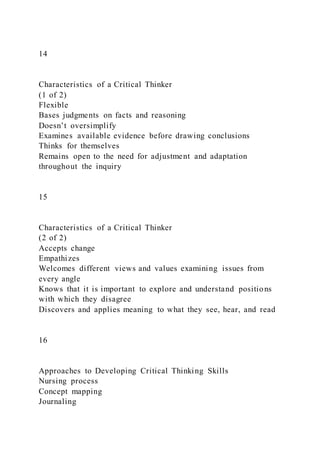
14
Characteristics of a Critical Thinker
(1 of 2)
Flexible
Bases judgments on facts and reasoning
Doesn’t oversimplify
Examines available evidence before drawing conclusions
Thinks for themselves
Remains open to the need for adjustment and adaptation
throughout the inquiry
15
Characteristics of a Critical Thinker
(2 of 2)
Accepts change
Empathizes
Welcomes different views and values examining issues from
every angle
Knows that it is important to explore and understand positions
with which they disagree
Discovers and applies meaning to what they see, hear, and read
16
Approaches to Developing Critical Thinking Skills
Nursing process
Concept mapping
Journaling
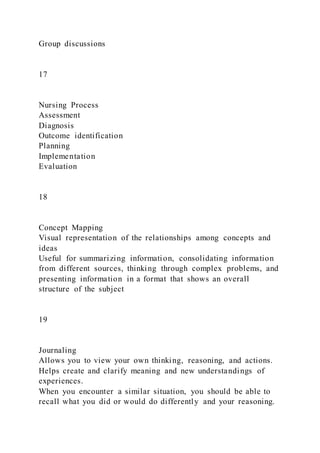
Group discussions
17
Nursing Process
Assessment
Diagnosis
Outcome identification
Planning
Implementation
Evaluation
18
Concept Mapping
Visual representation of the relationships among concepts and
ideas
Useful for summarizing information, consolidating information
from different sources, thinking through complex problems, and
presenting information in a format that shows an overall
structure of the subject
19
Journaling
Allows you to view your own thinking, reasoning, and actions.
Helps create and clarify meaning and new understandings of
experiences.
When you encounter a similar situation, you should be able to
recall what you did or would do differently and your reasoning.
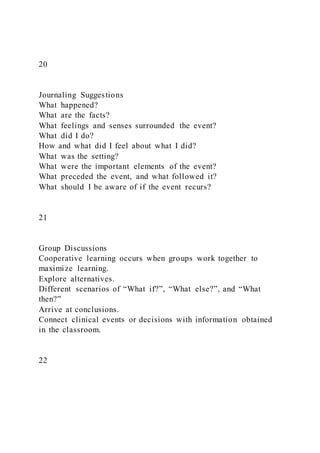
20
Journaling Suggestions
What happened?
What are the facts?
What feelings and senses surrounded the event?
What did I do?
How and what did I feel about what I did?
What was the setting?
What were the important elements of the event?
What preceded the event, and what followed it?
What should I be aware of if the event recurs?
21
Group Discussions
Cooperative learning occurs when groups work together to
maximize learning.
Explore alternatives.
Different scenarios of “What if?”, “What else?”, and “What
then?”
Arrive at conclusions.
Connect clinical events or decisions with information obtained
in the classroom.
22
Competencies for Professional Nursing PracticeChapter 4O

Competencies for Professional Nursing PracticeChapter 4O

  • 1.
    Competencies for ProfessionalNursing Practice Chapter 4 Overview Competencies American Association of Colleges of Nursing (AACN) Essentials Quality and Safety Education for Nurses (QSEN) Technology Informatics Guiding Education Reform (TIGER) Initiative Nurse of the Future (NOF): Nursing Core Competencies Figure 4-1 The Nurse of the Future: Nursing Core Competencies graphic. Reproduced from Massachusetts Department of Higher Education. (2016). Nurse of the future: Nursing core competencies: Registered nurse. Retrieved from http://www.mass.edu/nahi/documents/NOFRNCompetencies_up dated_March2016.pdf Nurse of the Future: Nursing Core Competency Graphic Illustrates, through use of broken lines, the reciprocal and continuous relationship between each competency and nursing knowledge, that the competencies may overlap and are not mutually exclusive, and that all competencies are of equal importance. Nursing knowledge is placed as the core in the graphic to illustrate that nursing knowledge reflects the overarching art
  • 2.
    and science ofprofessional nursing practice. NOF Core Competency Model (1 of 3) Essential knowledge, attitudes, and skills (KAS), reflecting cognitive, affective, and psychomotor learning domains, are specified for each competency. The KAS identified in the model reflect the expectations for initial nursing practice following the completion of a prelicensure professional nursing education program. NOF Core Competency Model (2 of 3) Human beings/patients: Recipients of nursing care or services; may be individuals, families, groups, communities, or populations Environment: The atmosphere, milieu, or conditions in which one lives, works, or plays Health: Experience, often expressed in terms of wellness and illness, that may occur in the presence or absence of disease or injury NOF Core Competency Model (3 of 3) Nursing: The protection, promotion, and optimization of health and abilities; prevention of illness and injury; alleviation of suffering through the diagnosis and treatment of human response; and advocacy in the care of individuals, families, groups, communities, and populations The NOF Core Competencies
  • 3.
    Patient-centered care Professionalism Leadership Systems-based practice Informaticsand technology Communication Teamwork and collaboration Safety Quality improvement Evidence-based practice Why Is Critical Thinking Important in Nursing Practice? Essential to providing safe, competent, and skillful nursing care. The inability of a nurse to set priorities and work safely, effectively, and efficiently may delay patient treatment in a critical situation and result in serious life-threatening consequences. 9 Thinking Like a Nurse Clinical judgment Clinical reasoning Mindfulness Clinical Judgment (1 of 2) Clinical judgments are more influenced by what nurses bring to
  • 4.
    the situation thanthe objective data about the situation at hand. Sound clinical judgment rests to some degree on knowing the patient and his or her typical pattern of responses, as well as engagement with the patient and his or her concerns. Clinical Judgment (2 of 2) Clinical judgments are influenced by the context in which the situation occurs and the culture of the nursing unit. Nurses use a variety of reasoning patterns alone or in combination. Reflection on practice is often triggered by a breakdown in clinical judgment and is critical for the development of clinical knowledge and improvement in clinical reasoning. Critical Thinking and Clinical Judgment in Nursing Purposeful, informed, outcome-focused thinking Carefully identifies key problems, issues, and risks Based on principles of the nursing process, problem solving, and the scientific method Applies logic, intuition, and creativity Driven by patient, family, and community needs Calls for strategies that make the most of human potential Requires constant reevaluating Characteristics of Critical Thinking Rational and reasonable Involves conceptualization Requires reflection Includes cognitive skills and attitudes Involves creative thinki ng Requires knowledge
  • 5.
    14 Characteristics of aCritical Thinker (1 of 2) Flexible Bases judgments on facts and reasoning Doesn’t oversimplify Examines available evidence before drawing conclusions Thinks for themselves Remains open to the need for adjustment and adaptation throughout the inquiry 15 Characteristics of a Critical Thinker (2 of 2) Accepts change Empathizes Welcomes different views and values examining issues from every angle Knows that it is important to explore and understand positions with which they disagree Discovers and applies meaning to what they see, hear, and read 16 Approaches to Developing Critical Thinking Skills Nursing process Concept mapping Journaling
  • 6.
    Group discussions 17 Nursing Process Assessment Diagnosis Outcomeidentification Planning Implementation Evaluation 18 Concept Mapping Visual representation of the relationships among concepts and ideas Useful for summarizing information, consolidating information from different sources, thinking through complex problems, and presenting information in a format that shows an overall structure of the subject 19 Journaling Allows you to view your own thinking, reasoning, and actions. Helps create and clarify meaning and new understandings of experiences. When you encounter a similar situation, you should be able to recall what you did or would do differently and your reasoning.
  • 7.
    20 Journaling Suggestions What happened? Whatare the facts? What feelings and senses surrounded the event? What did I do? How and what did I feel about what I did? What was the setting? What were the important elements of the event? What preceded the event, and what followed it? What should I be aware of if the event recurs? 21 Group Discussions Cooperative learning occurs when groups work together to maximize learning. Explore alternatives. Different scenarios of “What if?”, “What else?”, and “What then?” Arrive at conclusions. Connect clinical events or decisions with information obtained in the classroom. 22