Evaluating Information
Great! You’ve found some resources you think will help
answer your question. Now what?
You need to evaluate them to make sure they are useful,
reliable and appropriate for your topic.
Laura Sloane 2015
C.A.R.P Test
You can evaluate all types of resources—websites, journal
articles, government reports or other documents—using
the same simple test, known as the C.A.R.P test
• CURRENCY
• ACCURACY
• RELIABILITY
• PURPOSE
Let’s look at this in more detail…
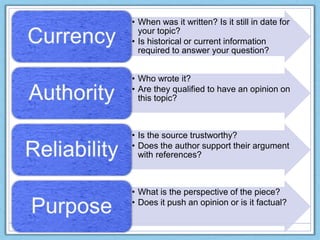
• When was it written? Is it still in date for
your topic?
• Is historical or current information
required to answer your question?
• Who wrote it?
• Are they qualified to have an opinion on
this topic?
• Is the source trustworthy?
• Does the author support their argument
with references?
• What is the perspective of the piece?
• Does it push an opinion or is it factual?
Tips for evaluating
specific resources
Websites
The internet is a fantastic
search tool which you
shouldn’t be afraid of
using. However, because
anyone can publish a
webpage and say whatever
they want, it needs to be
more carefully evaluating
than other resources.
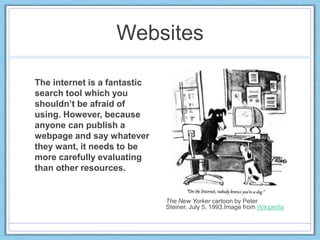
The New Yorker cartoon by Peter
Steiner, July 5, 1993.Image from Wikipedia
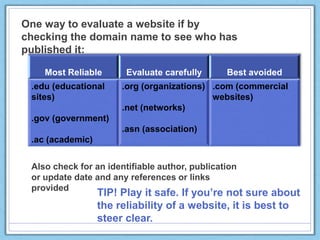
One way to evaluate a website if by
checking the domain name to see who has
published it:
Most Reliable Evaluate carefully Best avoided
.edu (educational
sites)
.gov (government)
.ac (academic)
.org (organizations)
.net (networks)
.asn (association)
.com (commercial
websites)
Also check for an identifiable author, publication
or update date and any references or links
provided
TIP! Play it safe. If you’re not sure about
the reliability of a website, it is best to
steer clear.
Government Resources
Government resources are assumed to be
reliable, given that their main role is to provide
accurate information to Parliament or the public.
In fact, they can be some of the most useful
sources as they are normally comprehensive and
up to date.
However, they still need to be evaluated. A research
report will have very different content and purpose to
a press release by a Minister. So keep in mind
C.A.R.P principles—particularly with regards to the
purpose of the information
Journal Articles
Is it peer reviewed?
A peer reviewed journal has been through a
formal process where it is evaluated by subject
specialists before publication. In this process
they check that what the journal has to say is
accurate and appropriately researched.
Most databases will have an option in advanced
search to limit your results to peer reviewed articles,
but the best way is to use the Ulrichsweb database
Using Ulrichsweb
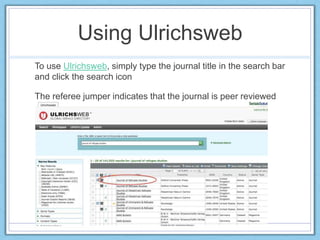
To use Ulrichsweb, simply type the journal title in the search bar
and click the search icon
The referee jumper indicates that the journal is peer reviewed
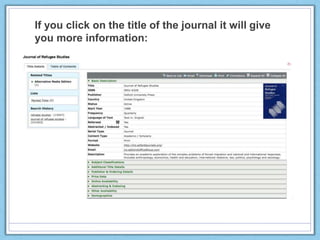
If you click on the title of the journal it will give
you more information:
Remember!
You can always ask a librarian if you need help evaluating
resources or using Ulrichsweb
This presentation was developed using
material from:
Cassell, K. A., & Hiremath, U. (2013). When and how to use the
Internet as a reference tool Reference and information services:
An introduction (3rd ed., pp. 263-284). London: Facet
Publishing.
Charles Sturt University. (2015). Information Literacy: Evaluate
Information. Retrieved from
http://libguides.csu.edu.au/c.php?g=139563&p=914396

Evaluating resources

  • 1.
    Evaluating Information Great! You’vefound some resources you think will help answer your question. Now what? You need to evaluate them to make sure they are useful, reliable and appropriate for your topic. Laura Sloane 2015
  • 2.
    C.A.R.P Test You canevaluate all types of resources—websites, journal articles, government reports or other documents—using the same simple test, known as the C.A.R.P test • CURRENCY • ACCURACY • RELIABILITY • PURPOSE Let’s look at this in more detail…
  • 3.
    • When wasit written? Is it still in date for your topic? • Is historical or current information required to answer your question? • Who wrote it? • Are they qualified to have an opinion on this topic? • Is the source trustworthy? • Does the author support their argument with references? • What is the perspective of the piece? • Does it push an opinion or is it factual?
  • 4.
  • 5.
    Websites The internet isa fantastic search tool which you shouldn’t be afraid of using. However, because anyone can publish a webpage and say whatever they want, it needs to be more carefully evaluating than other resources. The New Yorker cartoon by Peter Steiner, July 5, 1993.Image from Wikipedia
  • 6.
    One way toevaluate a website if by checking the domain name to see who has published it: Most Reliable Evaluate carefully Best avoided .edu (educational sites) .gov (government) .ac (academic) .org (organizations) .net (networks) .asn (association) .com (commercial websites) Also check for an identifiable author, publication or update date and any references or links provided TIP! Play it safe. If you’re not sure about the reliability of a website, it is best to steer clear.
  • 7.
    Government Resources Government resourcesare assumed to be reliable, given that their main role is to provide accurate information to Parliament or the public. In fact, they can be some of the most useful sources as they are normally comprehensive and up to date. However, they still need to be evaluated. A research report will have very different content and purpose to a press release by a Minister. So keep in mind C.A.R.P principles—particularly with regards to the purpose of the information
  • 8.
    Journal Articles Is itpeer reviewed? A peer reviewed journal has been through a formal process where it is evaluated by subject specialists before publication. In this process they check that what the journal has to say is accurate and appropriately researched. Most databases will have an option in advanced search to limit your results to peer reviewed articles, but the best way is to use the Ulrichsweb database
  • 9.
    Using Ulrichsweb To useUlrichsweb, simply type the journal title in the search bar and click the search icon The referee jumper indicates that the journal is peer reviewed
  • 10.
    If you clickon the title of the journal it will give you more information:
  • 11.
    Remember! You can alwaysask a librarian if you need help evaluating resources or using Ulrichsweb
  • 12.
    This presentation wasdeveloped using material from: Cassell, K. A., & Hiremath, U. (2013). When and how to use the Internet as a reference tool Reference and information services: An introduction (3rd ed., pp. 263-284). London: Facet Publishing. Charles Sturt University. (2015). Information Literacy: Evaluate Information. Retrieved from http://libguides.csu.edu.au/c.php?g=139563&p=914396