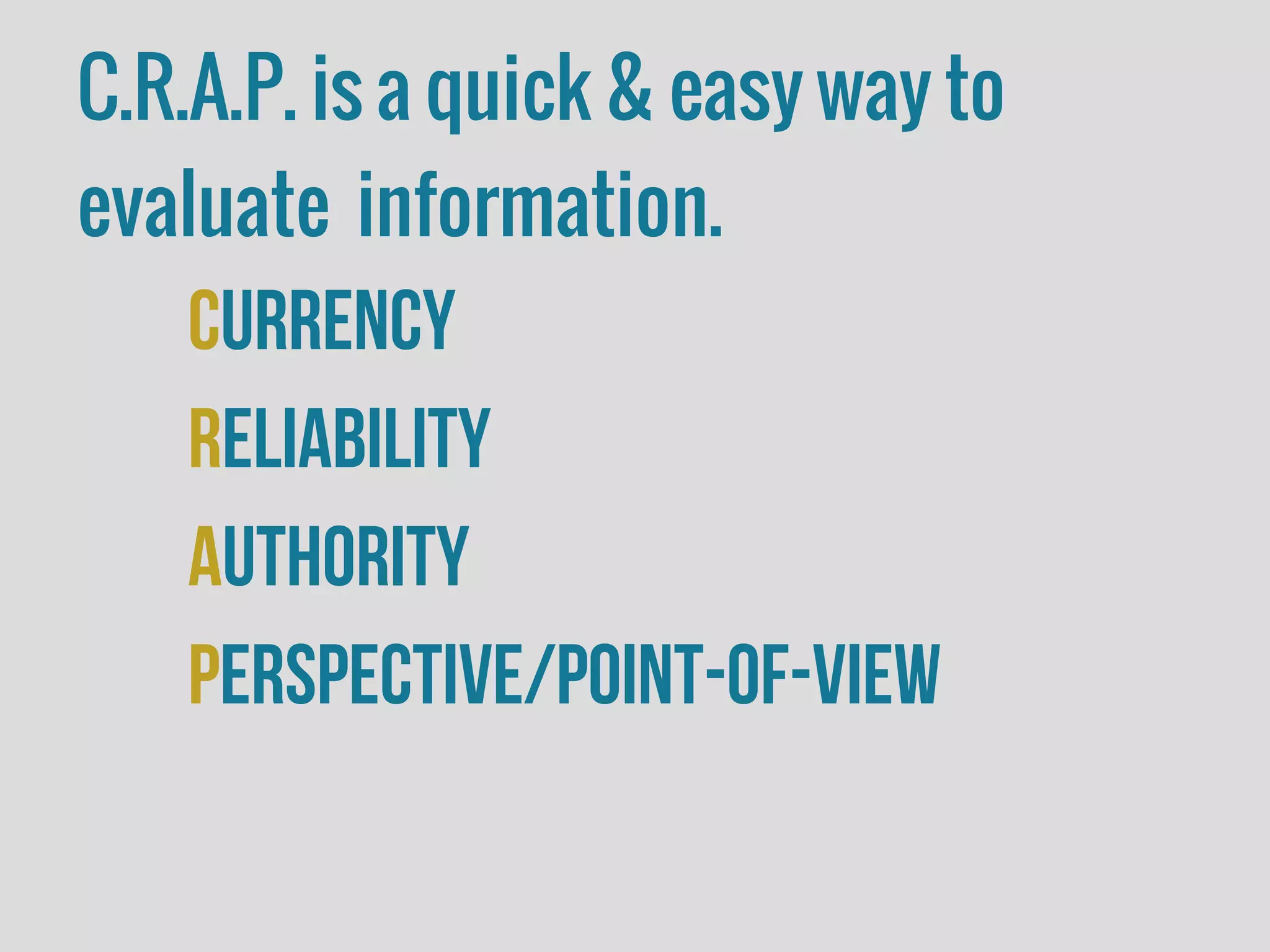
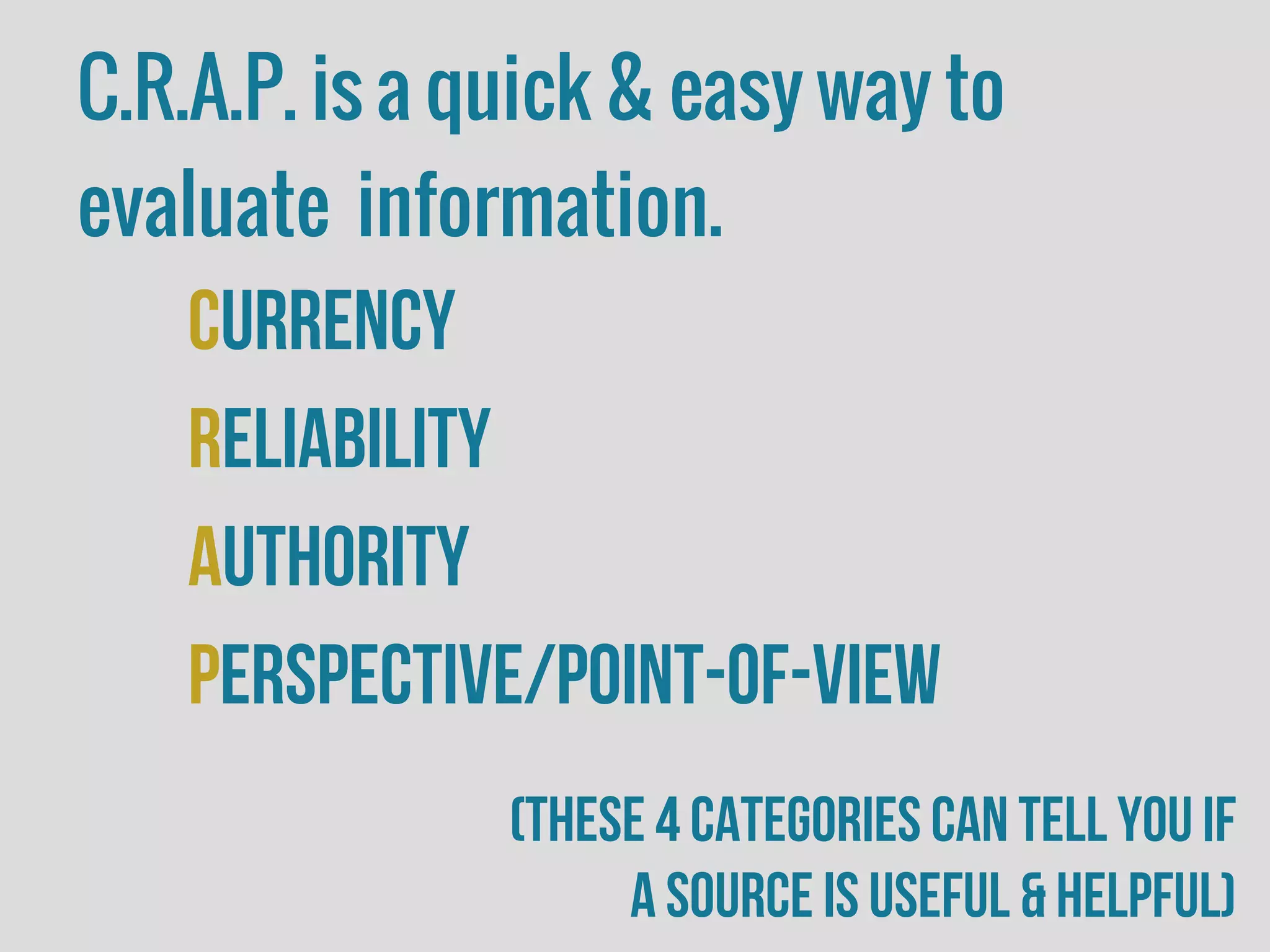
The document introduces the C.R.A.P. method for evaluating information sources. C.R.A.P. stands for Currency, Reliability, Authority, and Perspective/Point-of-view. It explains each component of C.R.A.P. and how to apply it when determining whether a source is useful and trustworthy. Checking these four aspects can help the reader evaluate the quality of a source and identify potential biases. The document recommends using C.R.A.P. as a quick and easy first step when evaluating information.
C.R.A.P. is aquick & easy way to
evaluate information.
Currency
Reliability
Authority
Perspective/Point-of-view
3.
C.R.A.P. is aquick & easy way to
evaluate information.
Currency
Reliability
Authority
Perspective/Point-of-view
(these 4 categories can tell you if
a source is useful & helpful)
4.
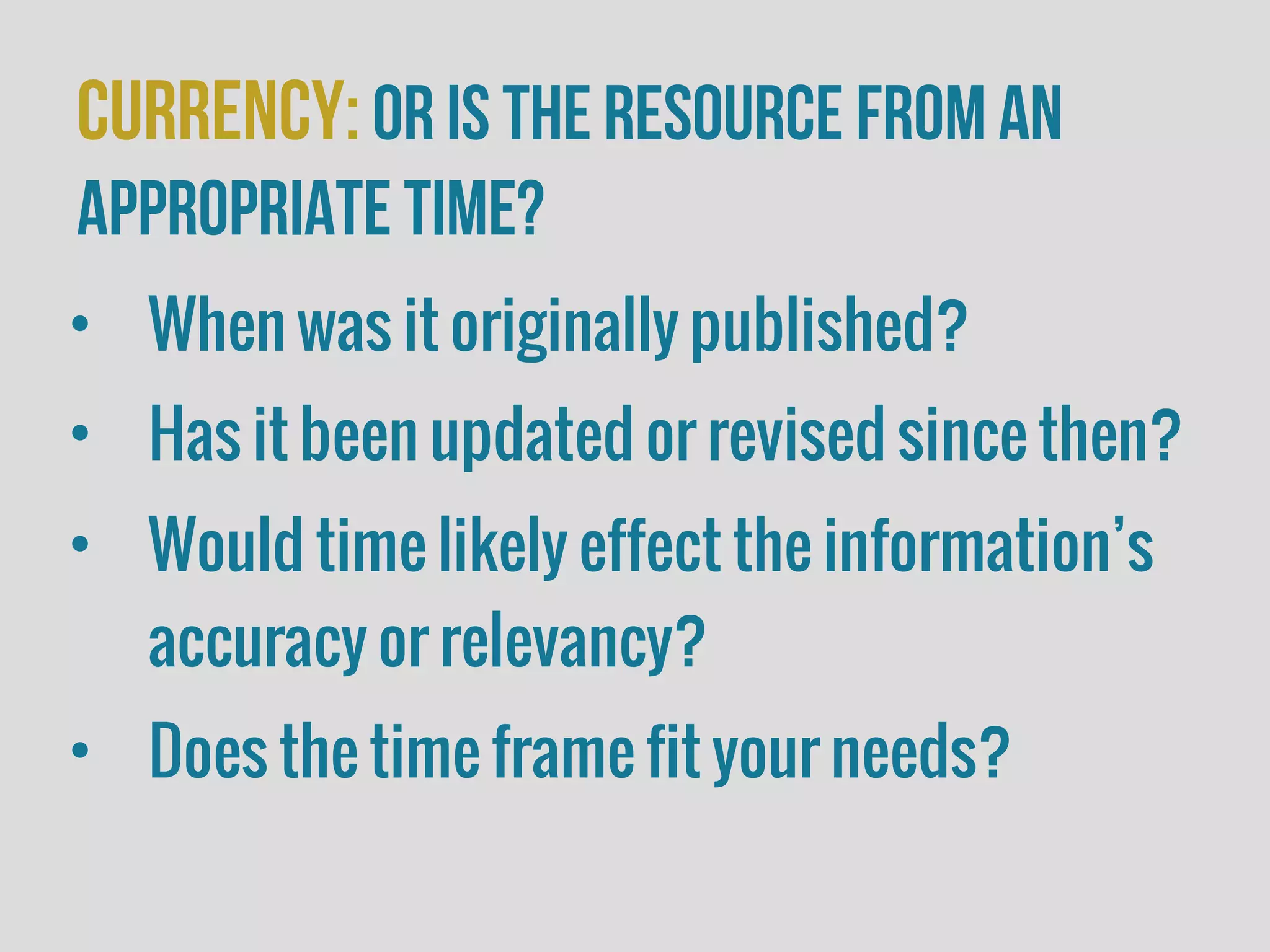
Currency:or is theresource from an
appropriate time?
• When was it originally published?
• Has it been updated or revised since then?
• Would time likely effect the information’s
accuracy or relevancy?
• Does the time frame fit your needs?
5.
Currency:time does matter
•E.g., science information changes often &
frequently, & can completely change the
content of your paper. (Remember Pluto?)
• If it’s a historical paper on the JFK
assassination, on the other hand, a 1964
news article might be very relevant.
• Ask: will time change the information & did
the professor specify a timeframe?
6.
Reliability:or Can youdepend on the
information & trust it be accurate?
• Did the author use any evidence & show
their sources with citations or references?
• Is the spelling and grammar correct? Do
you see any obvious mistakes?
• Can you verify the information from other
sources?
7.
Reliability:true or false?
•Basically, you’re looking to see if the
information is false & erroneous or
authentic & valid.
• If basic facts are wrong, the theory/
hypothesis has less merit.
8.
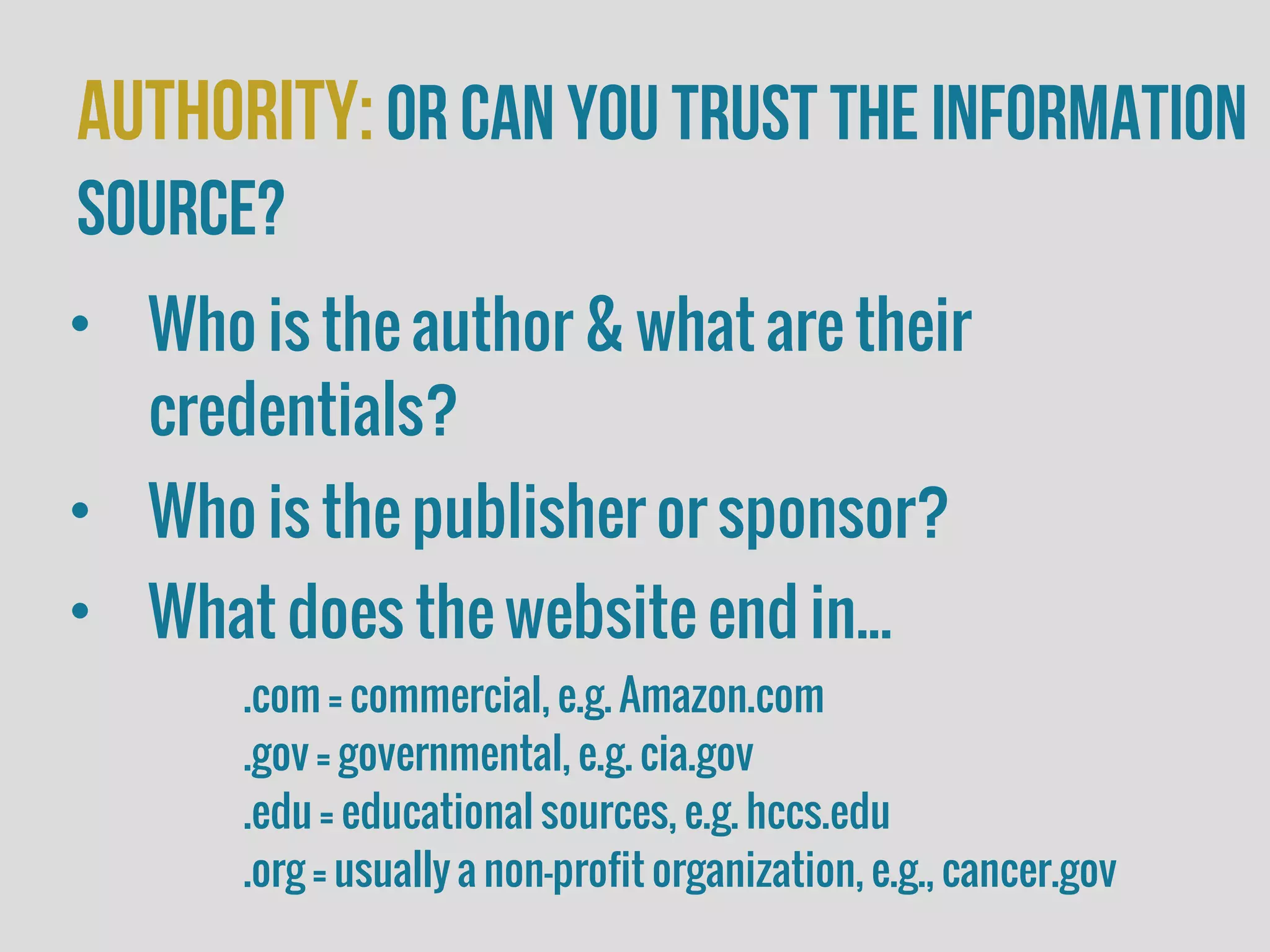
Authority:or Can youtrust the information
source?
• Who is the author & what are their
credentials?
• Who is the publisher or sponsor?
• What does the website end in...
.com = commercial, e.g. Amazon.com
.gov = governmental, e.g. cia.gov
.edu = educational sources, e.g. hccs.edu
.org = usually a non-profit organization, e.g., cancer.gov
9.
Authority:look at theQualifications
• Basically, you’re trying to determine why you
should trust the information from this source.
• Remember, if the person or organization is
qualified, they will probably list their
credentials, like what degree or job they
currently hold.
10.
perspective/Point-of-view:or What’s
the author’smotivation?
• Is the author trying to inform, persuade,
sell to, or entertain you?
• Are there advertisements or links to buy
products or subscribe to a service? Are
they clearly marked or sponsored by the
source?
• Does the author seem objective or biased?
11.
perspective/Point-of-view:look at the
author’send goal
• Try to determine the author’s (& sponsor’s)
interest in the topic & if that influences
their information.
• e.g. Are they trying to inform about different
weight loss methods or sell sell a weight
loss product?
• e.g. The Onion = satirical entertainment,
not informative.
12.
To review, CRAPis
Currency
Reliability
Authority
Perspective/Point-of-view
13.
To review, CRAPis
Currency
Reliability
Authority
Perspective/Point-of-view
* Checking to see if information is current, accurate,
unbiased, and from a trustful source can help you
judge a source’s quality.
14.
You can stilluse other types of
information; you just need to aware
of any prejudices, inaccuracies, &
time constraints before treating it
like reliable information.
(remember:
Not all information is equal.)
15.
More questions? Lookthough the
guide, ask a librarian, or Find out
more with HCC Libraries
@library.hccs.edu
16.
Thanks to MaryMeestrum & Kenneth orenic (aka
the original C.R.A.P. Inventors) at dominican
University Library & LOEX Wiki, Portland State
University Library, Academy of art University
Library, Ohio University Libraries, Vanderbilt
university Library, & Landmark College Library for
influencing this presentation. Their C.R.A.P. &
C.R.A.A.P. tutorials are linked on the subject
guide.