EV682 PGCE Primary
Safeguarding and Wellbeing
Teachers Standards
. . . establish a safe and stimulating
environment for pupils, rooted in mutual
respect
. . . maintain good relationships with pupils, exercise
appropriate authority, and act decisively when
necessary
. . . having regard for the need to safeguard pupils’ wellbeing, in accordance with statutory provisions
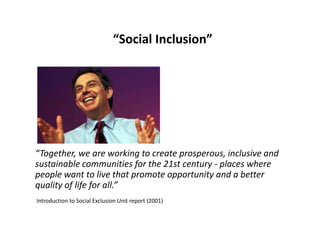
“Social Inclusion”

“Together, we are working to create prosperous, inclusive and
sustainable communities for the 21st century - places where
people want to live that promote opportunity and a better
quality of life for all.”
Introduction to Social Exclusion Unit report (2001)
Building on success
•
•
•
•
•
•

‘Sure Start’ children’s centres
development of ‘extended’ or ‘full service’ schools
and out of school activities
increased investment in child and adolescent
mental health services (CAMHS)
improved speech and language therapy
tackling homelessness
reforms to youth justice
Every Child Matters (2003)
• Increasing the focus on supporting families and
carers
• Ensuring necessary intervention takes place
before children reach crisis point
• Addressing weak accountability and poor
integration
• Ensuring that the people working with children
are valued, rewarded and trained
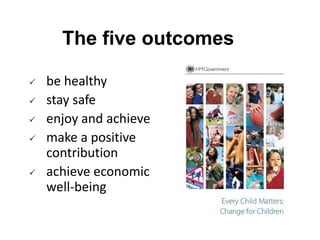
The five outcomes








be healthy
stay safe
enjoy and achieve
make a positive
contribution
achieve economic
well-being
Multi-agency working:
focus for response
• Safeguarding children and young people
• Supporting health and well being
• Responding to barriers to achieving

• Supporting children and young people in transition
• Providing “things to do and places to go to”
• Providing information, advice and guidance
New practices
•
•
•
•
•
•

Extended schools
Children’s centres
Multi-agency teams
Service co-location
Children’s Trusts and Children’s Plans
Team Around the Child (TAC)
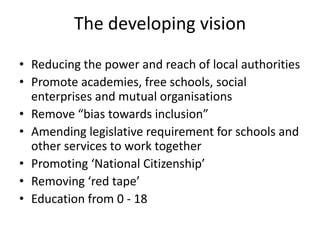
The developing vision
• Reducing the power and reach of local authorities
• Promote academies, free schools, social
enterprises and mutual organisations
• Remove “bias towards inclusion”
• Amending legislative requirement for schools and
other services to work together
• Promoting ‘National Citizenship’
• Removing ‘red tape’
• Education from 0 - 18
Moving forward
professional issues
•
•
•
•

Skills and expertise
Identity and status
Pay, conditions, and career progression
Focus and ideology of practice
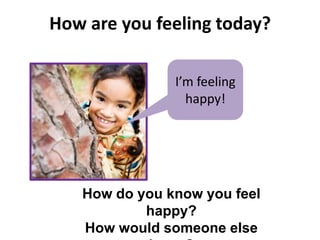
How are you feeling today?
I’m feeling
happy!

How do you know you feel
happy?
How would someone else
Let’s go back to happy
Measuring Happiness (Ofsted 2012)
What makes you happy?
being safe;
being well looked after;
being treated with respect and fairness;
being able to make own decisions;
stability, and
“money can make you happy but not
genuinely make you happy”
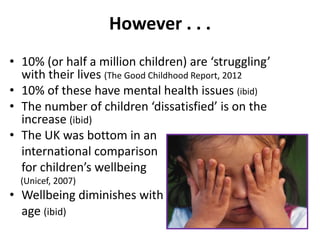
However . . .
• 10% (or half a million children) are ‘struggling’
with their lives (The Good Childhood Report, 2012
• 10% of these have mental health issues (ibid)
• The number of children ‘dissatisfied’ is on the
increase (ibid)
• The UK was bottom in an
international comparison
for children’s wellbeing
(Unicef, 2007)

• Wellbeing diminishes with
age (ibid)
What is this
thing called
wellbeing?
An indicator of the
child doing well
emotionally;
feeling comfortable
with themself
“Wellbeing is a social construct and represents a
shifting set of meanings – wellbeing is no less
than what a group or groups of people
collectively agree makes a ‘good life’.”
(Ereaut and Whiting, 2008, p1)
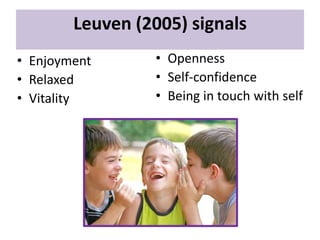
Leuven (2005) signals
• Enjoyment
• Relaxed
• Vitality

• Openness
• Self-confidence
• Being in touch with self
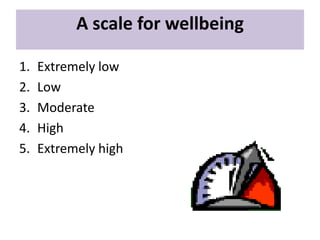
A scale for wellbeing
1.
2.
3.
4.
5.

Extremely low
Low
Moderate
High
Extremely high
What does this all mean in the
classroom?
• Validating children’s emotions; being a role model
• Encourage all children to communicate and
discuss how they feel
• Use stories, drama, role play and puppets to
develop understanding and empathy
• Prioritise opportunities to promote secure
attachments/relationships
• Take into account cultural perspectives on
emotions
• Refer to supportive materials, e.g. SEAL/SEAD
• Listen and look
The true measure of a nation’s standing is
how well it attends to its children – their
health and safety, their material security,
their education and socialization, and
their sense of being loved, valued, and
included in the families and societies into
which they are born.
(Unicef, Report card 7, 2007)
Relationships within the classroom
Teacher relationships with the children

“Never smile before Easter!”

Is this an exaggeration or is it psychological
sense? (Discuss with a partner)
Teacher relationships with the children

____________________________________________________
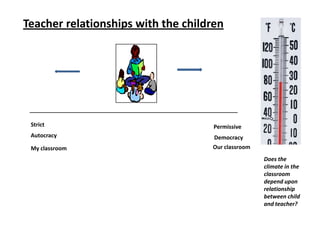
Strict

Permissive

Autocracy

Democracy

My classroom

Our classroom
Does the
climate in the
classroom
depend upon
relationship
between child
and teacher?
Good Teacher-Pupil Relationships

• Teaching standards from Sept 2012
• Teachers should maintain ‘good relationships
with pupils’
• (Standard 7 behaviour -DfE, 2011 p.7)
Good Teacher-Pupil Relationships

‘The most frequently encountered non-family, positive
role models in the lives of resilient children were
favourite teachers who took a personal interest in
them…’
Howard et al. (1999, p. 313)
The teacher is of vital importance because the teacher
will have an impact, through their emotional
responses, on the child’s regulatory abilities.
McLaughlin, 2008.
Good Teacher-Pupil Relationships

Classroom community
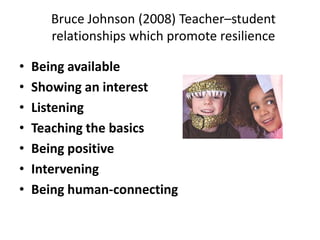
Bruce Johnson (2008) Teacher–student
relationships which promote resilience
•
•
•
•
•
•
•

Being available
Showing an interest
Listening
Teaching the basics
Being positive
Intervening
Being human-connecting
Teacher relationships with the children

“Keep smiling!”
Resilience

Ordinary Magic


We like the definition that was coined by
developmental psychologist Masten. She
describes resilience as ‘Ordinary
Magic’, meaning that in many cases, a
resilient outcome doesn’t come about as a
result of something particularly earth
shattering happening, it’s just everyday
stuff, like getting a teacher to give a bit
more attention to a particularly
disadvantaged child for example. Masten
describes it as:



‘Positive adaptation to adversity despite
serious threats to adaptation or
development’.
Link between perceived teacher support
and Pupil resilience
‘Resilience rests fundamentally on
relationships. The desire to belong is a
basic human need, and positive
connections with others lie at the very
core of psychological development; strong
supportive relationships are critical for
achieving and sustaining
adaption.‘Luthar (2006, 760)
http://www.boingboing.org.uk/
http://onlinelibrary.wiley.com.ezproxy.brighton.ac.uk/doi/10.1111/j.14679752.2009.00720.x/full;jsessionid=488DE6D7BCBF41A65646D29DEADF42EA.f02t03

No tissues or issues!
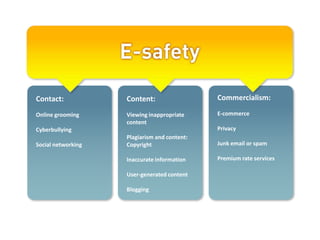
e-Safety
Contact
• Online grooming
• Cyberbullying
• Social networking
Contact:

Content:

Commercialism:

Online grooming

Viewing inappropriate
content

E-commerce
Privacy

Cyberbullying

Social networking

Plagiarism and content:
Copyright

Junk email or spam

Inaccurate information

Premium rate services

User-generated content
Blogging
Commercialism
•
•
•
•

E-commerce
Privacy
Junk/spam email
Premium rate services

By MediaPhoto.Org (mediaphoto.org Own work) [CC-BY3.0 (http://creativecommons.org/licenses/by/3.0)

By Maxi Gago (Own work) CC-BY-SA-3.0
(http://creativecommons.org/licenses/b
y-sa/3.0)
How can we empower children
to keep themselves safe online?
“Children and young people need to be empowered to keep
themselves safe – this isn’t just about a top-down approach. Children
will be children – pushing boundaries and taking risks. At a public
swimming pool we have gates, put up signs, have lifeguards and
shallow ends, but we also teach children how to swim”
(Byron, 2008, p.2).
Byron Review – Children and New Technology
Because of the changing nature of risks we need to ‘listen*ing] to
children to learn what new risks they are experiencingLivingstone et
al., 2011, p.29
Implications for teacher practice
 Whose responsibility is it to tackle issues of e-safety?

(Parents? Teacher? Whole school?)
 How do we, as teachers, address the issues through our
practice?





Responding to incidents
Pre-emptive approaches
School policy
Your own professional conduct
 confidentiality of pupil information
 your personal/professional online presence
E-Safety Resources
• CEOP - Child exploitation and online protection
http://www.ceop.police.uk/
• Childnet International
http://www.childnet-int.org/
• Thinkuknow (resources for children of all ages as well as for
parents/carers and teachers)
http://www.thinkuknow.co.uk/
• Kidsmart (resources for young children)
http://www.kidsmart.org.uk
• Jenny’s Story DVD (an Internet safety resource for KS3)
http://www.childnet-int.org/jenny/index.html
References
Bruce Johnson (2008) Teacher–student relationships which
promote resilience at school: a micro-level analysis of
students’ views, British Journal of Guidance &
Counselling, 36:4, 385-398.
Howard, S., Dryden, J. and Johnson, B. (1999) Child Resilience:
review and critique the literature, Oxford Review of
Education,25(3) 307-323.

McLaughlin, C. (2008) Emotional well-being and its
relationship to schools and classrooms: a
critical reflection, British Journal of Guidance &
Counselling, 36:4, 353-366.

Safeguarding and Wellbeing

  • 1.
  • 2.
    Teachers Standards . .. establish a safe and stimulating environment for pupils, rooted in mutual respect . . . maintain good relationships with pupils, exercise appropriate authority, and act decisively when necessary . . . having regard for the need to safeguard pupils’ wellbeing, in accordance with statutory provisions
  • 3.
    “Social Inclusion” “Together, weare working to create prosperous, inclusive and sustainable communities for the 21st century - places where people want to live that promote opportunity and a better quality of life for all.” Introduction to Social Exclusion Unit report (2001)
  • 4.
    Building on success • • • • • • ‘SureStart’ children’s centres development of ‘extended’ or ‘full service’ schools and out of school activities increased investment in child and adolescent mental health services (CAMHS) improved speech and language therapy tackling homelessness reforms to youth justice
  • 5.
    Every Child Matters(2003) • Increasing the focus on supporting families and carers • Ensuring necessary intervention takes place before children reach crisis point • Addressing weak accountability and poor integration • Ensuring that the people working with children are valued, rewarded and trained
  • 6.
    The five outcomes      behealthy stay safe enjoy and achieve make a positive contribution achieve economic well-being
  • 7.
    Multi-agency working: focus forresponse • Safeguarding children and young people • Supporting health and well being • Responding to barriers to achieving • Supporting children and young people in transition • Providing “things to do and places to go to” • Providing information, advice and guidance
  • 8.
    New practices • • • • • • Extended schools Children’scentres Multi-agency teams Service co-location Children’s Trusts and Children’s Plans Team Around the Child (TAC)
  • 9.
    The developing vision •Reducing the power and reach of local authorities • Promote academies, free schools, social enterprises and mutual organisations • Remove “bias towards inclusion” • Amending legislative requirement for schools and other services to work together • Promoting ‘National Citizenship’ • Removing ‘red tape’ • Education from 0 - 18
  • 10.
    Moving forward professional issues • • • • Skillsand expertise Identity and status Pay, conditions, and career progression Focus and ideology of practice
  • 11.
    How are youfeeling today? I’m feeling happy! How do you know you feel happy? How would someone else
  • 13.
  • 14.
    Measuring Happiness (Ofsted2012) What makes you happy? being safe; being well looked after; being treated with respect and fairness; being able to make own decisions; stability, and “money can make you happy but not genuinely make you happy”
  • 15.
    However . .. • 10% (or half a million children) are ‘struggling’ with their lives (The Good Childhood Report, 2012 • 10% of these have mental health issues (ibid) • The number of children ‘dissatisfied’ is on the increase (ibid) • The UK was bottom in an international comparison for children’s wellbeing (Unicef, 2007) • Wellbeing diminishes with age (ibid)
  • 16.
    What is this thingcalled wellbeing? An indicator of the child doing well emotionally; feeling comfortable with themself
  • 17.
    “Wellbeing is asocial construct and represents a shifting set of meanings – wellbeing is no less than what a group or groups of people collectively agree makes a ‘good life’.” (Ereaut and Whiting, 2008, p1)
  • 18.
    Leuven (2005) signals •Enjoyment • Relaxed • Vitality • Openness • Self-confidence • Being in touch with self
  • 19.
    A scale forwellbeing 1. 2. 3. 4. 5. Extremely low Low Moderate High Extremely high
  • 20.
    What does thisall mean in the classroom? • Validating children’s emotions; being a role model • Encourage all children to communicate and discuss how they feel • Use stories, drama, role play and puppets to develop understanding and empathy • Prioritise opportunities to promote secure attachments/relationships • Take into account cultural perspectives on emotions • Refer to supportive materials, e.g. SEAL/SEAD • Listen and look
  • 21.
    The true measureof a nation’s standing is how well it attends to its children – their health and safety, their material security, their education and socialization, and their sense of being loved, valued, and included in the families and societies into which they are born. (Unicef, Report card 7, 2007)
  • 22.
  • 23.
    Teacher relationships withthe children “Never smile before Easter!” Is this an exaggeration or is it psychological sense? (Discuss with a partner)
  • 24.
    Teacher relationships withthe children ____________________________________________________ Strict Permissive Autocracy Democracy My classroom Our classroom Does the climate in the classroom depend upon relationship between child and teacher?
  • 25.
    Good Teacher-Pupil Relationships •Teaching standards from Sept 2012 • Teachers should maintain ‘good relationships with pupils’ • (Standard 7 behaviour -DfE, 2011 p.7)
  • 26.
    Good Teacher-Pupil Relationships ‘Themost frequently encountered non-family, positive role models in the lives of resilient children were favourite teachers who took a personal interest in them…’ Howard et al. (1999, p. 313) The teacher is of vital importance because the teacher will have an impact, through their emotional responses, on the child’s regulatory abilities. McLaughlin, 2008.
  • 27.
  • 28.
    Bruce Johnson (2008)Teacher–student relationships which promote resilience • • • • • • • Being available Showing an interest Listening Teaching the basics Being positive Intervening Being human-connecting
  • 29.
    Teacher relationships withthe children “Keep smiling!”
  • 30.
  • 31.
     We like thedefinition that was coined by developmental psychologist Masten. She describes resilience as ‘Ordinary Magic’, meaning that in many cases, a resilient outcome doesn’t come about as a result of something particularly earth shattering happening, it’s just everyday stuff, like getting a teacher to give a bit more attention to a particularly disadvantaged child for example. Masten describes it as:  ‘Positive adaptation to adversity despite serious threats to adaptation or development’.
  • 32.
    Link between perceivedteacher support and Pupil resilience ‘Resilience rests fundamentally on relationships. The desire to belong is a basic human need, and positive connections with others lie at the very core of psychological development; strong supportive relationships are critical for achieving and sustaining adaption.‘Luthar (2006, 760)
  • 33.
  • 34.
  • 35.
  • 37.
    Contact • Online grooming •Cyberbullying • Social networking
  • 38.
    Contact: Content: Commercialism: Online grooming Viewing inappropriate content E-commerce Privacy Cyberbullying Socialnetworking Plagiarism and content: Copyright Junk email or spam Inaccurate information Premium rate services User-generated content Blogging
  • 39.
    Commercialism • • • • E-commerce Privacy Junk/spam email Premium rateservices By MediaPhoto.Org (mediaphoto.org Own work) [CC-BY3.0 (http://creativecommons.org/licenses/by/3.0) By Maxi Gago (Own work) CC-BY-SA-3.0 (http://creativecommons.org/licenses/b y-sa/3.0)
  • 40.
    How can weempower children to keep themselves safe online? “Children and young people need to be empowered to keep themselves safe – this isn’t just about a top-down approach. Children will be children – pushing boundaries and taking risks. At a public swimming pool we have gates, put up signs, have lifeguards and shallow ends, but we also teach children how to swim” (Byron, 2008, p.2). Byron Review – Children and New Technology Because of the changing nature of risks we need to ‘listen*ing] to children to learn what new risks they are experiencingLivingstone et al., 2011, p.29
  • 41.
    Implications for teacherpractice  Whose responsibility is it to tackle issues of e-safety? (Parents? Teacher? Whole school?)  How do we, as teachers, address the issues through our practice?     Responding to incidents Pre-emptive approaches School policy Your own professional conduct  confidentiality of pupil information  your personal/professional online presence
  • 42.
    E-Safety Resources • CEOP- Child exploitation and online protection http://www.ceop.police.uk/ • Childnet International http://www.childnet-int.org/ • Thinkuknow (resources for children of all ages as well as for parents/carers and teachers) http://www.thinkuknow.co.uk/ • Kidsmart (resources for young children) http://www.kidsmart.org.uk • Jenny’s Story DVD (an Internet safety resource for KS3) http://www.childnet-int.org/jenny/index.html
  • 43.
    References Bruce Johnson (2008)Teacher–student relationships which promote resilience at school: a micro-level analysis of students’ views, British Journal of Guidance & Counselling, 36:4, 385-398. Howard, S., Dryden, J. and Johnson, B. (1999) Child Resilience: review and critique the literature, Oxford Review of Education,25(3) 307-323. McLaughlin, C. (2008) Emotional well-being and its relationship to schools and classrooms: a critical reflection, British Journal of Guidance & Counselling, 36:4, 353-366.

Editor's Notes

  • #9 Since 2010: Coalition policies encouraging idea of ‘Big Society’ Re-naming of DCSF to Department for EducationBonfire of quangos – CWDC, GSCC, GTC, Audit Commission, etcAbolition of Contact Point, Child Trust Fund,, etcReforms to health and educationRestrictions to local authority expenditureMajor reviews – Allen, Field, Tickell and MunroChanges to Serious Case ReviewsDe-regulation of Children's Trusts and Children's PlansGreen and white papersChildren and Families Bill (2013)United by a strong emphasis on ‘early intervention’Framed by discourses of ‘austerity’ and ‘choice’Undermining integrated working by default?
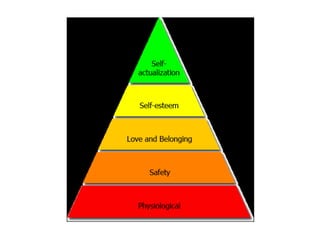
  • #13 Importance in how we might feel; to be fully functioning and fulfilledMaslow, 1943. Hierarchy of needsPhysiological: breathing, water, clothing, food, shelter, sleepSafety: feeling secure, health, property, employment, family, social stability, freedom from fearLove and belonging: family, friendship, intimacy, sense of connectionSelf-esteem: confidence, achievement/mastery, respect of others, need to be a unique individual Self-actualisation: morality, creativity, spontaneity, acceptance and inner potential
  • #14 Significance of having happy children in class?Aim for families – wanting child to be happy at schoolSign of wellbeing . . .
  • #16 Just a thought . . . .If these children were over 8 – what was happening before these years?
  • #17 Feeling at home; comfortable with oneself; like a fish in waterSense of wellbeing - what are the signs?Def. from NIHCE 2012Emot. wellbeing = being happy, confident; not anxious or depressedPsychological wellbeing = ability to be autonomous, problem solve, manage emotions, experience empathy, resilience attentiveSocial wellbeing = has good relationships with others, does not have behav. probs. – disruptive, bully, violentImportant in own right but basis for a healthy life.
  • #19 Watch two clips and look for signs – THEN look at what Laevers says (editor, 2005)Handout
  • #20 See handout
  • #21 Gender issues here and nature: nurture tensionStereotyping boys with in ability or reluctance in expressing emotions accentuated in generally slower language development
  • #23 The classroom community - a microcosm of the school community and the society that you envisage. Is there a duty in our relationships with the children? Is there a duty in their relationship with each other? How do we ensure the safeguarding and wellbeing of children in this space? What of your own safeguarding and wellbeing as a teacher? How are community relationships fostered and maintained in the classroom?
  • #24 For whose safeguarding and wellbeing? What are the strengths and limitations of this approach? What is the professional distance?As a team we take feedback.
  • #25 How do we gauge the professional distance?In your relationships with the children, which identity as teacher are you adopting, the permissive, the strict or the middle ground?As a classroom leader are you modelling the autocrat, the democraticor a combination of both styles?Who owns the classroom? Is it a community, a dictatorship or something in-between?When does myclassroom become our classroom? If this is case can our classroom ever become my classroom again?Children value consistency. They aim to understand your character, your methods, your decisions, etc. They need to know your character.
  • #26 How do we gauge this professional distance?The difference between being a friend and a professional.
  • #27 The implications for pedagogy and child teacher relationships are profound,since engagement in learning, students’ achievements and supportive relationshipswith teachers are centre stage in developing emotional well-being. Developing an ethic of care would be a priority. Teachers as the ‘caring other’ equate to ‘the pedagogy of relationships’.
  • #28 What are strong relationships between children and the teacher and what do they look like?Sharing values.Sharing ambitions.Shared motivation.Shared failures.Shared successes.Shared voice.Shared space.Clear understanding of our differences and our roles. Shared ownership.Consistency – creating an orderly and systematic classroom procedure which allows for good relationships.Trust.Individual value .
  • #29 Australian longitudinal study begun in 1997 and completed in 2005 bound up with the continuous acts of meaning making that teachers and students engage in throughout the school day. Being available/showing an interest -‘She is a really special person to me because even though I’m not in her class she invites me over sometimes to do plays.’‘As soon as I walk in the door and she says, ‘Hello’ it just makes me happy.’ ListenThey’re really nice people and they listen to most people when they’ve got problems and they help them out’ Contrast teachers who don’t listen ‘My maths teacher, I hate her. She doesn’t listen to you. She just doesn’t listen to you’Being positive My teacher is important because he’s the one that urges me on to do stuff. He says ‘comeon Christopher, you can do it, just think positive’, and if it wasn’t for him I couldn’t have done all of this that I have.Teach the basicsThey help me with my work and they help me with my reading and with my maths. I want to get ahead. I want to get my reading up, my maths and my spelling, and my handwriting up. I’ve wanted to do that since I was in Year 4Evidence that self esteem is the result of success in school. (Dryden et al., 1998,)InterveneChildren have quite firm beliefs about the relative power of teachers to ‘do something’ if a student’s wellbeing was threatenedA: Miss A., she’s really nice. She helps me with everything, she helps me with anything if I’m stuck with anything. Like, she helped me through campWhen teachers didn’t intervene for example with bullying or harassment they were criticised by their students

  • #30 For whose safeguarding and wellbeing? What are the strengths and limitations of this approach? What is the professional distance?As a team we take feedback.
  • #39 Use this slide to discuss issues around e-safety. Which areas were missed out during the students’ initial brainstorm?
  • #41 Why? Schools are finding that a blocking and banning approach, which merely limits exposure to risk, may no longer be a sustainable approach. Children will experiment online, and while their confidence and enthusiasm for using new technologies may be high, their understanding of the opportunities and risks may be low, as will their ability for responding to any issues they encounter. Schools need to focus on a model of empowerment; equipping children with the skills and knowledge they need to use technology safely and responsibly, and managing the risks, wherever and whenever they go online; to promote safe and responsible behaviours in using technology both at school and in the home and beyond. Why do I need to take action?• Schools have a duty of care and must ensure they are able to safeguard children, young people and staff. n most cases, the misuse of ICT is not serious and an be dealt with at classroom level. In rare cases children can be in serious danger. Staff are also susceptible to risks, as is the integrity of the whole school community. • The Ofsted self-evaluation form (SEF) includes a new prompt specifically relating to e-safety. Question 4b reads: To what extent do learners feel safe and adopt safe practices? or example: the extent to which learners adopt safe and responsible practices, dealing sensibly with risk, n a range of activities within and outside the classroom, including the use of new technologies and he internet. The Byron Review has called on Ofsted to take various steps to hold schools to account for their performance in e-safety. All schools will need to actively monitor the impact of their e-safety policies and provide a comprehensive response to the SEF.