BULGARIA, SOFIA
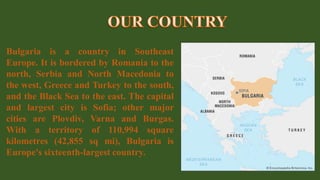
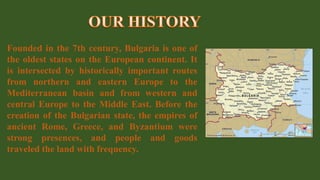
Bulgaria is a country in Southeast
Europe. It is bordered by Romania to the
north, Serbia and North Macedonia to
the west, Greece and Turkey to the south,
and the Black Sea to the east. The capital
and largest city is Sofia; other major
cities are Plovdiv, Varna and Burgas.
With a territory of 110,994 square
kilometres (42,855 sq mi), Bulgaria is
Europe's sixteenth-largest country.
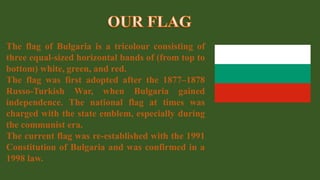
The flag of Bulgaria is a tricolour consisting of
three equal-sized horizontal bands of (from top to
bottom) white, green, and red.
The flag was first adopted after the 1877–1878
Russo-Turkish War, when Bulgaria gained
independence. The national flag at times was
charged with the state emblem, especially during
the communist era.
The current flag was re-established with the 1991
Constitution of Bulgaria and was confirmed in a
1998 law.
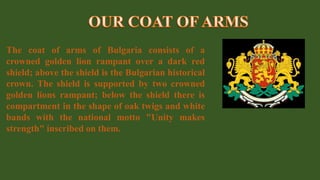
The coat of arms of Bulgaria consists of a
crowned golden lion rampant over a dark red
shield; above the shield is the Bulgarian historical
crown. The shield is supported by two crowned
golden lions rampant; below the shield there is
compartment in the shape of oak twigs and white
bands with the national motto "Unity makes
strength" inscribed on them.
Founded in the 7th century, Bulgaria is one of
the oldest states on the European continent. It
is intersected by historically important routes
from northern and eastern Europe to the
Mediterranean basin and from western and
central Europe to the Middle East. Before the
creation of the Bulgarian state, the empires of
ancient Rome, Greece, and Byzantium were
strong presences, and people and goods
traveled the land with frequency.
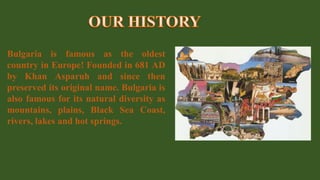
Bulgaria is famous as the oldest
country in Europe! Founded in 681 AD
by Khan Asparuh and since then
preserved its original name. Bulgaria is
also famous for its natural diversity as
mountains, plains, Black Sea Coast,
rivers, lakes and hot springs.
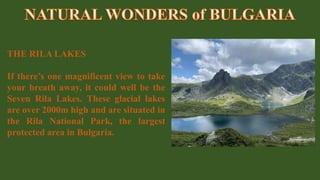
THE RILA LAKES
If there’s one magnificent view to take
your breath away, it could well be the
Seven Rila Lakes. These glacial lakes
are over 2000m high and are situated in
the Rila National Park, the largest
protected area in Bulgaria.
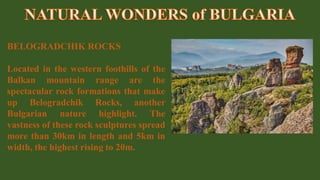
BELOGRADCHIK ROCKS
Located in the western foothills of the
Balkan mountain range are the
spectacular rock formations that make
up Belogradchik Rocks, another
Bulgarian nature highlight. The
vastness of these rock sculptures spread
more than 30km in length and 5km in
width, the highest rising to 20m.
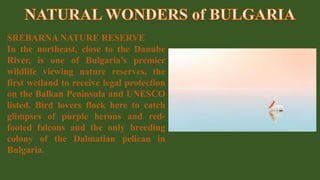
SREBARNA NATURE RESERVE
In the northeast, close to the Danube
River, is one of Bulgaria’s premier
wildlife viewing nature reserves, the
first wetland to receive legal protection
on the Balkan Peninsula and UNESCO
listed. Bird lovers flock here to catch
glimpses of purple herons and red-
footed falcons and the only breeding
colony of the Dalmatian pelican in
Bulgaria.
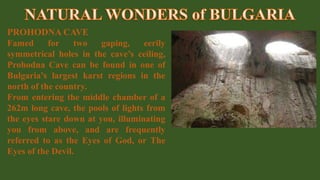
PROHODNA CAVE
Famed for two gaping, eerily
symmetrical holes in the cave’s ceiling,
Prohodna Cave can be found in one of
Bulgaria’s largest karst regions in the
north of the country.
From entering the middle chamber of a
262m long cave, the pools of lights from
the eyes stare down at you, illuminating
you from above, and are frequently
referred to as the Eyes of God, or The
Eyes of the Devil.
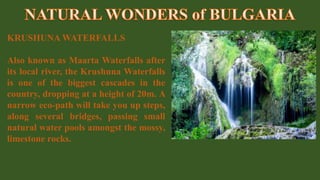
KRUSHUNA WATERFALLS
Also known as Maarta Waterfalls after
its local river, the Krushuna Waterfalls
is one of the biggest cascades in the
country, dropping at a height of 20m. A
narrow eco-path will take you up steps,
along several bridges, passing small
natural water pools amongst the mossy,
limestone rocks.
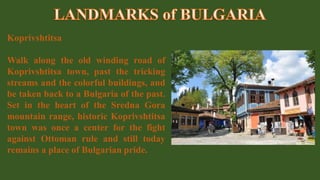
Koprivshtitsa
Walk along the old winding road of
Koprivshtitsa town, past the tricking
streams and the colorful buildings, and
be taken back to a Bulgaria of the past.
Set in the heart of the Sredna Gora
mountain range, historic Koprivshtitsa
town was once a center for the fight
against Ottoman rule and still today
remains a place of Bulgarian pride.
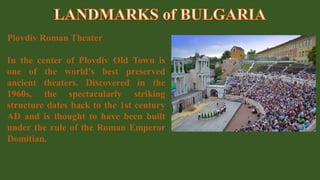
Plovdiv Roman Theater
In the center of Plovdiv Old Town is
one of the world’s best preserved
ancient theaters. Discovered in the
1960s, the spectacularly striking
structure dates back to the 1st century
AD and is thought to have been built
under the rule of the Roman Emperor
Domitian.
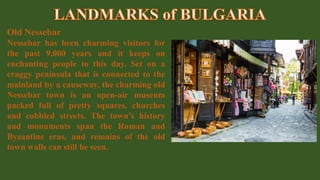
Old Nessebar
Nessebar has been charming visitors for
the past 9,000 years and it keeps on
enchanting people to this day. Set on a
craggy peninsula that is connected to the
mainland by a causeway, the charming old
Nessebar town is an open-air museum
packed full of pretty squares, churches
and cobbled streets. The town’s history
and monuments span the Roman and
Byzantine eras, and remains of the old
town walls can still be seen.
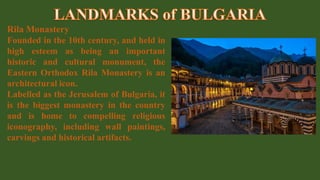
Rila Monastery
Founded in the 10th century, and held in
high esteem as being an important
historic and cultural monument, the
Eastern Orthodox Rila Monastery is an
architectural icon.
Labelled as the Jerusalem of Bulgaria, it
is the biggest monastery in the country
and is home to compelling religious
iconography, including wall paintings,
carvings and historical artifacts.
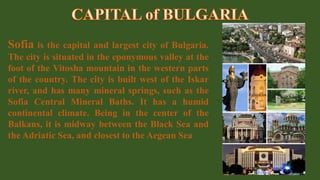
Sofia is the capital and largest city of Bulgaria.
The city is situated in the eponymous valley at the
foot of the Vitosha mountain in the western parts
of the country. The city is built west of the Iskar
river, and has many mineral springs, such as the
Sofia Central Mineral Baths. It has a humid
continental climate. Being in the center of the
Balkans, it is midway between the Black Sea and
the Adriatic Sea, and closest to the Aegean Sea
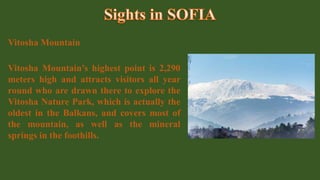
Vitosha Mountain
Vitosha Mountain’s highest point is 2,290
meters high and attracts visitors all year
round who are drawn there to explore the
Vitosha Nature Park, which is actually the
oldest in the Balkans, and covers most of
the mountain, as well as the mineral
springs in the foothills.
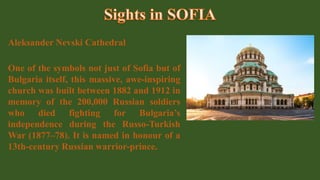
Aleksander Nevski Cathedral
One of the symbols not just of Sofia but of
Bulgaria itself, this massive, awe-inspiring
church was built between 1882 and 1912 in
memory of the 200,000 Russian soldiers
who died fighting for Bulgaria’s
independence during the Russo-Turkish
War (1877–78). It is named in honour of a
13th-century Russian warrior-prince.
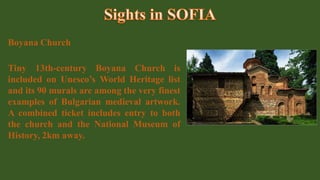
Boyana Church
Tiny 13th-century Boyana Church is
included on Unesco’s World Heritage list
and its 90 murals are among the very finest
examples of Bulgarian medieval artwork.
A combined ticket includes entry to both
the church and the National Museum of
History, 2km away.
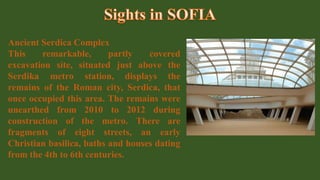
Ancient Serdica Complex
This remarkable, partly covered
excavation site, situated just above the
Serdika metro station, displays the
remains of the Roman city, Serdica, that
once occupied this area. The remains were
unearthed from 2010 to 2012 during
construction of the metro. There are
fragments of eight streets, an early
Christian basilica, baths and houses dating
from the 4th to 6th centuries.
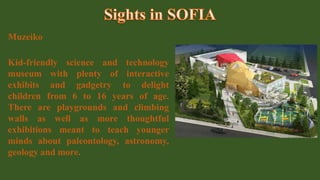
Muzeiko
Kid-friendly science and technology
museum with plenty of interactive
exhibits and gadgetry to delight
children from 6 to 16 years of age.
There are playgrounds and climbing
walls as well as more thoughtful
exhibitions meant to teach younger
minds about paleontology, astronomy,
geology and more.
Bulgaria   presentation

Bulgaria presentation

  • 1.
  • 2.
    Bulgaria is acountry in Southeast Europe. It is bordered by Romania to the north, Serbia and North Macedonia to the west, Greece and Turkey to the south, and the Black Sea to the east. The capital and largest city is Sofia; other major cities are Plovdiv, Varna and Burgas. With a territory of 110,994 square kilometres (42,855 sq mi), Bulgaria is Europe's sixteenth-largest country.
  • 3.
    The flag ofBulgaria is a tricolour consisting of three equal-sized horizontal bands of (from top to bottom) white, green, and red. The flag was first adopted after the 1877–1878 Russo-Turkish War, when Bulgaria gained independence. The national flag at times was charged with the state emblem, especially during the communist era. The current flag was re-established with the 1991 Constitution of Bulgaria and was confirmed in a 1998 law.
  • 4.
    The coat ofarms of Bulgaria consists of a crowned golden lion rampant over a dark red shield; above the shield is the Bulgarian historical crown. The shield is supported by two crowned golden lions rampant; below the shield there is compartment in the shape of oak twigs and white bands with the national motto "Unity makes strength" inscribed on them.
  • 5.
    Founded in the7th century, Bulgaria is one of the oldest states on the European continent. It is intersected by historically important routes from northern and eastern Europe to the Mediterranean basin and from western and central Europe to the Middle East. Before the creation of the Bulgarian state, the empires of ancient Rome, Greece, and Byzantium were strong presences, and people and goods traveled the land with frequency.
  • 6.
    Bulgaria is famousas the oldest country in Europe! Founded in 681 AD by Khan Asparuh and since then preserved its original name. Bulgaria is also famous for its natural diversity as mountains, plains, Black Sea Coast, rivers, lakes and hot springs.
  • 7.
    THE RILA LAKES Ifthere’s one magnificent view to take your breath away, it could well be the Seven Rila Lakes. These glacial lakes are over 2000m high and are situated in the Rila National Park, the largest protected area in Bulgaria.
  • 8.
    BELOGRADCHIK ROCKS Located inthe western foothills of the Balkan mountain range are the spectacular rock formations that make up Belogradchik Rocks, another Bulgarian nature highlight. The vastness of these rock sculptures spread more than 30km in length and 5km in width, the highest rising to 20m.
  • 9.
    SREBARNA NATURE RESERVE Inthe northeast, close to the Danube River, is one of Bulgaria’s premier wildlife viewing nature reserves, the first wetland to receive legal protection on the Balkan Peninsula and UNESCO listed. Bird lovers flock here to catch glimpses of purple herons and red- footed falcons and the only breeding colony of the Dalmatian pelican in Bulgaria.
  • 10.
    PROHODNA CAVE Famed fortwo gaping, eerily symmetrical holes in the cave’s ceiling, Prohodna Cave can be found in one of Bulgaria’s largest karst regions in the north of the country. From entering the middle chamber of a 262m long cave, the pools of lights from the eyes stare down at you, illuminating you from above, and are frequently referred to as the Eyes of God, or The Eyes of the Devil.
  • 11.
    KRUSHUNA WATERFALLS Also knownas Maarta Waterfalls after its local river, the Krushuna Waterfalls is one of the biggest cascades in the country, dropping at a height of 20m. A narrow eco-path will take you up steps, along several bridges, passing small natural water pools amongst the mossy, limestone rocks.
  • 12.
    Koprivshtitsa Walk along theold winding road of Koprivshtitsa town, past the tricking streams and the colorful buildings, and be taken back to a Bulgaria of the past. Set in the heart of the Sredna Gora mountain range, historic Koprivshtitsa town was once a center for the fight against Ottoman rule and still today remains a place of Bulgarian pride.
  • 13.
    Plovdiv Roman Theater Inthe center of Plovdiv Old Town is one of the world’s best preserved ancient theaters. Discovered in the 1960s, the spectacularly striking structure dates back to the 1st century AD and is thought to have been built under the rule of the Roman Emperor Domitian.
  • 14.
    Old Nessebar Nessebar hasbeen charming visitors for the past 9,000 years and it keeps on enchanting people to this day. Set on a craggy peninsula that is connected to the mainland by a causeway, the charming old Nessebar town is an open-air museum packed full of pretty squares, churches and cobbled streets. The town’s history and monuments span the Roman and Byzantine eras, and remains of the old town walls can still be seen.
  • 15.
    Rila Monastery Founded inthe 10th century, and held in high esteem as being an important historic and cultural monument, the Eastern Orthodox Rila Monastery is an architectural icon. Labelled as the Jerusalem of Bulgaria, it is the biggest monastery in the country and is home to compelling religious iconography, including wall paintings, carvings and historical artifacts.
  • 16.
    Sofia is thecapital and largest city of Bulgaria. The city is situated in the eponymous valley at the foot of the Vitosha mountain in the western parts of the country. The city is built west of the Iskar river, and has many mineral springs, such as the Sofia Central Mineral Baths. It has a humid continental climate. Being in the center of the Balkans, it is midway between the Black Sea and the Adriatic Sea, and closest to the Aegean Sea
  • 17.
    Vitosha Mountain Vitosha Mountain’shighest point is 2,290 meters high and attracts visitors all year round who are drawn there to explore the Vitosha Nature Park, which is actually the oldest in the Balkans, and covers most of the mountain, as well as the mineral springs in the foothills.
  • 18.
    Aleksander Nevski Cathedral Oneof the symbols not just of Sofia but of Bulgaria itself, this massive, awe-inspiring church was built between 1882 and 1912 in memory of the 200,000 Russian soldiers who died fighting for Bulgaria’s independence during the Russo-Turkish War (1877–78). It is named in honour of a 13th-century Russian warrior-prince.
  • 19.
    Boyana Church Tiny 13th-centuryBoyana Church is included on Unesco’s World Heritage list and its 90 murals are among the very finest examples of Bulgarian medieval artwork. A combined ticket includes entry to both the church and the National Museum of History, 2km away.
  • 20.
    Ancient Serdica Complex Thisremarkable, partly covered excavation site, situated just above the Serdika metro station, displays the remains of the Roman city, Serdica, that once occupied this area. The remains were unearthed from 2010 to 2012 during construction of the metro. There are fragments of eight streets, an early Christian basilica, baths and houses dating from the 4th to 6th centuries.
  • 21.
    Muzeiko Kid-friendly science andtechnology museum with plenty of interactive exhibits and gadgetry to delight children from 6 to 16 years of age. There are playgrounds and climbing walls as well as more thoughtful exhibitions meant to teach younger minds about paleontology, astronomy, geology and more.