Automating the deployment of FreeBSD & PC-BSD® systemsAutomating the deployment of FreeBSD & PC-BSD® systems
EuroBSDCon 2013EuroBSDCon 2013
Kris MooreKris Moore
PC-BSD / iXsystemsPC-BSD / iXsystems
kris@pcbsd.orgkris@pcbsd.org
The problem:The problem:
You want to (quickly) deploy multipleYou want to (quickly) deploy multiple
FreeBSD or PC-BSD systems.FreeBSD or PC-BSD systems.
You want a variety of scripted installsYou want a variety of scripted installs
There are currently two ways to accomplishThere are currently two ways to accomplish
this:this:
Solution #1Solution #1
●
Write your own installation scriptsWrite your own installation scripts
●
Configure network booting by handConfigure network booting by hand
●
Maintain as necessaryMaintain as necessary
When to consider Solution #1:When to consider Solution #1:
●
You have a very unique installationYou have a very unique installation
●
You are a FreeBSD God – Congrats!You are a FreeBSD God – Congrats!
When to not consider Solution #1:When to not consider Solution #1:
●
Manual disk partitioning isn't your thingManual disk partitioning isn't your thing
●
You work for a livingYou work for a living
Solution #2Solution #2
●
Use theUse the pc-thinclientpc-thinclient utility included withutility included with
PC-BSD & TrueOSPC-BSD & TrueOS
What you will need:What you will need:
●
A system with a network interface (2)?A system with a network interface (2)?
●
Running PC-BSD > 9.1Running PC-BSD > 9.1
oror
●
Port: sysutils/pcbsd-utilsPort: sysutils/pcbsd-utils
●
A few GB of disk spaceA few GB of disk space
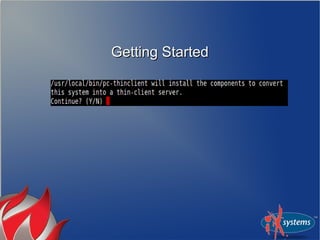
Getting StartedGetting Started
●
Install serverInstall server
●
Or desktop “Thin-Client” serverOr desktop “Thin-Client” server
Short DetourShort Detour
What is Remote Desktop?What is Remote Desktop?
●
The thin-client utility can operate bothThe thin-client utility can operate both
install server or desktop serverinstall server or desktop server
●
Allows diskless clients to boot via PXEAllows diskless clients to boot via PXE
●
Brings up GDM login on clientBrings up GDM login on client
Why would you run Remote Desktop?Why would you run Remote Desktop?
●
You have a bunch of low-end clientsYou have a bunch of low-end clients
●
You want to simplify backup, security andYou want to simplify backup, security and
managementmanagement
Why should you not run Remote Desktop?Why should you not run Remote Desktop?
●
You don't have a server with horsepowerYou don't have a server with horsepower
●
You need sound support on the clientsYou need sound support on the clients
Back to your previously scheduledBack to your previously scheduled
presentationpresentation
Getting StartedGetting Started
●
Will run DHCPDWill run DHCPD
●
Be careful which interface you plug intoBe careful which interface you plug into
Getting StartedGetting Started
Getting startedGetting started
●
You may now connect a client systemYou may now connect a client system
●
To PXE boot, you may need to checkTo PXE boot, you may need to check
BIOS on client firstBIOS on client first
Customizing the installCustomizing the install
●
Of course you will want your ownOf course you will want your own
installation options / archives, etcinstallation options / archives, etc
●
It is possible to adjust entirely on serverIt is possible to adjust entirely on server
sideside
The two key directories:The two key directories:
●
/home/thinclient/installscripts/home/thinclient/installscripts
●
/home/thinclient/installarchive/home/thinclient/installarchive
Client mounted as:Client mounted as:
●
/installscripts/installscripts
●
/installarchive/installarchive
●
pc-sysinstall.example can be used as apc-sysinstall.example can be used as a
template for other installationstemplate for other installations
Example #1Example #1
Changing to ZFSChanging to ZFS
Example disk layout:Example disk layout:
disk0-part=UFS+SUJ 1000 /disk0-part=UFS+SUJ 1000 /
disk0-part=SWAP 2000 nonedisk0-part=SWAP 2000 none
disk0-part=UFS+SUJ 0 /usrdisk0-part=UFS+SUJ 0 /usr
commitDiskLabelcommitDiskLabel
Converted to ZFS becomes:Converted to ZFS becomes:
disk0-part=ZFS 0 /,/root,/tmp,/usr,/vardisk0-part=ZFS 0 /,/root,/tmp,/usr,/var
commitDiskLabelcommitDiskLabel
Slightly more complex ZFS layout:Slightly more complex ZFS layout:
disk0-part=ZFS 0 /(atime=off)disk0-part=ZFS 0 /(atime=off), /root(compress=lz4),, /root(compress=lz4),
/tmp,/usr(canmount=off),/usr/local(compress=lz4), /var,/tmp,/usr(canmount=off),/usr/local(compress=lz4), /var,
/var/log(compress=gzip)/var/log(compress=gzip)
commitDiskLabelcommitDiskLabel
Example #2Example #2
Changing installation archiveChanging installation archive
Example install archive:Example install archive:
installMedium=localinstallMedium=local
localPath=/installarchivelocalPath=/installarchive
packageType=tarpackageType=tar
installFile=fbsd-release.txzinstallFile=fbsd-release.txz
Changed to custom archive:Changed to custom archive:
installMedium=localinstallMedium=local
localPath=/installarchivelocalPath=/installarchive
packageType=tarpackageType=tar
installFile=fbsd-8.4-amd64.txzinstallFile=fbsd-8.4-amd64.txz
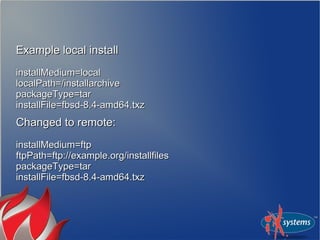
Example local installExample local install
installMedium=localinstallMedium=local
localPath=/installarchivelocalPath=/installarchive
packageType=tarpackageType=tar
installFile=fbsd-8.4-amd64.txzinstallFile=fbsd-8.4-amd64.txz
Changed to remote:Changed to remote:
installMedium=ftpinstallMedium=ftp
ftpPath=ftp://example.org/installfilesftpPath=ftp://example.org/installfiles
packageType=tarpackageType=tar
installFile=fbsd-8.4-amd64.txzinstallFile=fbsd-8.4-amd64.txz
Example #3Example #3
User ManagementUser Management
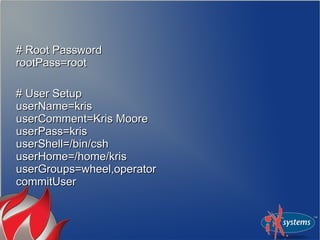
# Root Password# Root Password
rootPass=rootrootPass=root
# User Setup# User Setup
userName=krisuserName=kris
userComment=Kris MooreuserComment=Kris Moore
userPass=krisuserPass=kris
userShell=/bin/cshuserShell=/bin/csh
userHome=/home/krisuserHome=/home/kris
userGroups=wheel,operatoruserGroups=wheel,operator
commitUsercommitUser
Example #4Example #4
Advanced CommandsAdvanced Commands
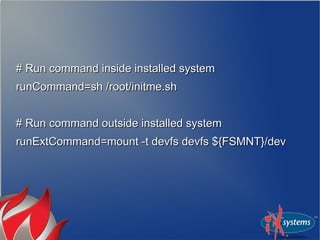
# Run command inside installed system# Run command inside installed system
runCommand=sh /root/initme.shrunCommand=sh /root/initme.sh
# Run command outside installed system# Run command outside installed system
runExtCommand=mount -t devfs devfs ${FSMNT}/devrunExtCommand=mount -t devfs devfs ${FSMNT}/dev
Example #5Example #5
Packages, oh my!Packages, oh my!
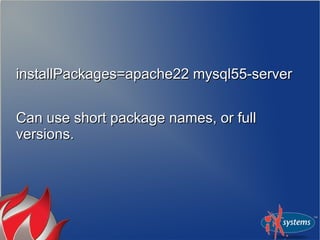
installPackages=apache22 mysql55-serverinstallPackages=apache22 mysql55-server
Can use short package names, or fullCan use short package names, or full
versions.versions.
PKGNG supportPKGNG support
●
Checks package format before installChecks package format before install
●
Will “boot-strap” PKGNG if necessaryWill “boot-strap” PKGNG if necessary
Example #6Example #6
FreeBSD dist filesFreeBSD dist files
# Install from vanilla FreeBSD dist files# Install from vanilla FreeBSD dist files
installMedium=localinstallMedium=local
localPath=/distfiles/9.1-Release/amd64/distlocalPath=/distfiles/9.1-Release/amd64/dist
packageType=distpackageType=dist
distFiles=base doc games kernel lib32distFiles=base doc games kernel lib32
Putting the Automated in “Fully Automated”Putting the Automated in “Fully Automated”
File: /home/thinclient/installscripts/unattended.cfgFile: /home/thinclient/installscripts/unattended.cfg
●
If config exists, the client will boot andIf config exists, the client will boot and
begin installation after 30 seconds.begin installation after 30 seconds.
●
System will shutdown when finishedSystem will shutdown when finished
●
USE WITH CAUTION!!USE WITH CAUTION!!
Its Demo time!Its Demo time!
ScalabilityScalability
●
All CPU instructions are run on the clientAll CPU instructions are run on the client
●
Server is in essence a large “File Server”Server is in essence a large “File Server”
●
Will be mostly disk IO / network speedWill be mostly disk IO / network speed
dependentdependent
ScalabilityScalability
●
Default DHCP server is configured for 99Default DHCP server is configured for 99
clientsclients
●
To adjust edit the file:To adjust edit the file:
●
/usr/local/etc/dhcpd.conf/usr/local/etc/dhcpd.conf
●
range 192.168.2.100 192.168.2.199;range 192.168.2.100 192.168.2.199;
Tips and TricksTips and Tricks
●
The PC-BSD GUI installer is your friendThe PC-BSD GUI installer is your friend
●
Every install is a scripted installEvery install is a scripted install
●
After installation a copy of the pc-After installation a copy of the pc-
sysinstall.cfg file is saved to:sysinstall.cfg file is saved to:
●
/root/pc-sysinstallcfg/root/pc-sysinstallcfg
Tips and TricksTips and Tricks
●
To greatly speed up installations, use ZFSTo greatly speed up installations, use ZFS
mirrored drives, SSD, or even TMPFSmirrored drives, SSD, or even TMPFS
What's next?What's next?
●
Improvements to pc-sysinstallImprovements to pc-sysinstall
●
GRUB Support!GRUB Support!
●
ZFS 4K BlockSize enable / disableZFS 4K BlockSize enable / disable
●
ZFS Pool NamingZFS Pool Naming
●
Install from ZFS replicationInstall from ZFS replication
●
Faster setup of initial thin-clientFaster setup of initial thin-client
environmentenvironment
What's next?What's next?
●
Web interface to config file managementWeb interface to config file management
●
Allow editing configsAllow editing configs
●
Creating MAC entries → Config FileCreating MAC entries → Config File
●
Text-based front-end to PC-BSDText-based front-end to PC-BSD
●
Basic at firstBasic at first
●
Will allow install / prototyping via CLIWill allow install / prototyping via CLI
What's next?What's next?
●
Enhanced Desktop Server SupportEnhanced Desktop Server Support
●
ThinClient → ThickClientThinClient → ThickClient
●
Sound SupportSound Support
●
Much more scalableMuch more scalable
Questions? Comments?Questions? Comments?
wiki.pcbsd.orgwiki.pcbsd.org
lists.pcbsd.orglists.pcbsd.org
forums.pcbsd.orgforums.pcbsd.org
Thank you!Thank you!
slideshare.net/krispcbsd/eurobsd2013slideshare.net/krispcbsd/eurobsd2013

eurobsd2013

  • 1.
    Automating the deploymentof FreeBSD & PC-BSD® systemsAutomating the deployment of FreeBSD & PC-BSD® systems EuroBSDCon 2013EuroBSDCon 2013 Kris MooreKris Moore PC-BSD / iXsystemsPC-BSD / iXsystems kris@pcbsd.orgkris@pcbsd.org
  • 2.
    The problem:The problem: Youwant to (quickly) deploy multipleYou want to (quickly) deploy multiple FreeBSD or PC-BSD systems.FreeBSD or PC-BSD systems. You want a variety of scripted installsYou want a variety of scripted installs
  • 3.
    There are currentlytwo ways to accomplishThere are currently two ways to accomplish this:this:
  • 4.
    Solution #1Solution #1 ● Writeyour own installation scriptsWrite your own installation scripts ● Configure network booting by handConfigure network booting by hand ● Maintain as necessaryMaintain as necessary
  • 5.
    When to considerSolution #1:When to consider Solution #1: ● You have a very unique installationYou have a very unique installation ● You are a FreeBSD God – Congrats!You are a FreeBSD God – Congrats!
  • 6.
    When to notconsider Solution #1:When to not consider Solution #1: ● Manual disk partitioning isn't your thingManual disk partitioning isn't your thing ● You work for a livingYou work for a living
  • 7.
    Solution #2Solution #2 ● UsetheUse the pc-thinclientpc-thinclient utility included withutility included with PC-BSD & TrueOSPC-BSD & TrueOS
  • 8.
    What you willneed:What you will need: ● A system with a network interface (2)?A system with a network interface (2)? ● Running PC-BSD > 9.1Running PC-BSD > 9.1 oror ● Port: sysutils/pcbsd-utilsPort: sysutils/pcbsd-utils ● A few GB of disk spaceA few GB of disk space
  • 9.
  • 10.
  • 11.
    Getting StartedGetting Started ● InstallserverInstall server ● Or desktop “Thin-Client” serverOr desktop “Thin-Client” server
  • 12.
  • 13.
    What is RemoteDesktop?What is Remote Desktop? ● The thin-client utility can operate bothThe thin-client utility can operate both install server or desktop serverinstall server or desktop server ● Allows diskless clients to boot via PXEAllows diskless clients to boot via PXE ● Brings up GDM login on clientBrings up GDM login on client
  • 14.
    Why would yourun Remote Desktop?Why would you run Remote Desktop? ● You have a bunch of low-end clientsYou have a bunch of low-end clients ● You want to simplify backup, security andYou want to simplify backup, security and managementmanagement
  • 15.
    Why should younot run Remote Desktop?Why should you not run Remote Desktop? ● You don't have a server with horsepowerYou don't have a server with horsepower ● You need sound support on the clientsYou need sound support on the clients
  • 16.
    Back to yourpreviously scheduledBack to your previously scheduled presentationpresentation
  • 17.
    Getting StartedGetting Started ● Willrun DHCPDWill run DHCPD ● Be careful which interface you plug intoBe careful which interface you plug into
  • 18.
  • 19.
    Getting startedGetting started ● Youmay now connect a client systemYou may now connect a client system ● To PXE boot, you may need to checkTo PXE boot, you may need to check BIOS on client firstBIOS on client first
  • 20.
    Customizing the installCustomizingthe install ● Of course you will want your ownOf course you will want your own installation options / archives, etcinstallation options / archives, etc ● It is possible to adjust entirely on serverIt is possible to adjust entirely on server sideside
  • 21.
    The two keydirectories:The two key directories: ● /home/thinclient/installscripts/home/thinclient/installscripts ● /home/thinclient/installarchive/home/thinclient/installarchive Client mounted as:Client mounted as: ● /installscripts/installscripts ● /installarchive/installarchive
  • 22.
    ● pc-sysinstall.example can beused as apc-sysinstall.example can be used as a template for other installationstemplate for other installations Example #1Example #1 Changing to ZFSChanging to ZFS
  • 23.
    Example disk layout:Exampledisk layout: disk0-part=UFS+SUJ 1000 /disk0-part=UFS+SUJ 1000 / disk0-part=SWAP 2000 nonedisk0-part=SWAP 2000 none disk0-part=UFS+SUJ 0 /usrdisk0-part=UFS+SUJ 0 /usr commitDiskLabelcommitDiskLabel Converted to ZFS becomes:Converted to ZFS becomes: disk0-part=ZFS 0 /,/root,/tmp,/usr,/vardisk0-part=ZFS 0 /,/root,/tmp,/usr,/var commitDiskLabelcommitDiskLabel
  • 24.
    Slightly more complexZFS layout:Slightly more complex ZFS layout: disk0-part=ZFS 0 /(atime=off)disk0-part=ZFS 0 /(atime=off), /root(compress=lz4),, /root(compress=lz4), /tmp,/usr(canmount=off),/usr/local(compress=lz4), /var,/tmp,/usr(canmount=off),/usr/local(compress=lz4), /var, /var/log(compress=gzip)/var/log(compress=gzip) commitDiskLabelcommitDiskLabel
  • 25.
    Example #2Example #2 Changinginstallation archiveChanging installation archive
  • 26.
    Example install archive:Exampleinstall archive: installMedium=localinstallMedium=local localPath=/installarchivelocalPath=/installarchive packageType=tarpackageType=tar installFile=fbsd-release.txzinstallFile=fbsd-release.txz Changed to custom archive:Changed to custom archive: installMedium=localinstallMedium=local localPath=/installarchivelocalPath=/installarchive packageType=tarpackageType=tar installFile=fbsd-8.4-amd64.txzinstallFile=fbsd-8.4-amd64.txz
  • 27.
    Example local installExamplelocal install installMedium=localinstallMedium=local localPath=/installarchivelocalPath=/installarchive packageType=tarpackageType=tar installFile=fbsd-8.4-amd64.txzinstallFile=fbsd-8.4-amd64.txz Changed to remote:Changed to remote: installMedium=ftpinstallMedium=ftp ftpPath=ftp://example.org/installfilesftpPath=ftp://example.org/installfiles packageType=tarpackageType=tar installFile=fbsd-8.4-amd64.txzinstallFile=fbsd-8.4-amd64.txz
  • 28.
    Example #3Example #3 UserManagementUser Management
  • 29.
    # Root Password#Root Password rootPass=rootrootPass=root # User Setup# User Setup userName=krisuserName=kris userComment=Kris MooreuserComment=Kris Moore userPass=krisuserPass=kris userShell=/bin/cshuserShell=/bin/csh userHome=/home/krisuserHome=/home/kris userGroups=wheel,operatoruserGroups=wheel,operator commitUsercommitUser
  • 30.
    Example #4Example #4 AdvancedCommandsAdvanced Commands
  • 31.
    # Run commandinside installed system# Run command inside installed system runCommand=sh /root/initme.shrunCommand=sh /root/initme.sh # Run command outside installed system# Run command outside installed system runExtCommand=mount -t devfs devfs ${FSMNT}/devrunExtCommand=mount -t devfs devfs ${FSMNT}/dev
  • 32.
    Example #5Example #5 Packages,oh my!Packages, oh my!
  • 33.
    installPackages=apache22 mysql55-serverinstallPackages=apache22 mysql55-server Canuse short package names, or fullCan use short package names, or full versions.versions.
  • 34.
    PKGNG supportPKGNG support ● Checkspackage format before installChecks package format before install ● Will “boot-strap” PKGNG if necessaryWill “boot-strap” PKGNG if necessary
  • 35.
    Example #6Example #6 FreeBSDdist filesFreeBSD dist files
  • 36.
    # Install fromvanilla FreeBSD dist files# Install from vanilla FreeBSD dist files installMedium=localinstallMedium=local localPath=/distfiles/9.1-Release/amd64/distlocalPath=/distfiles/9.1-Release/amd64/dist packageType=distpackageType=dist distFiles=base doc games kernel lib32distFiles=base doc games kernel lib32
  • 37.
    Putting the Automatedin “Fully Automated”Putting the Automated in “Fully Automated” File: /home/thinclient/installscripts/unattended.cfgFile: /home/thinclient/installscripts/unattended.cfg ● If config exists, the client will boot andIf config exists, the client will boot and begin installation after 30 seconds.begin installation after 30 seconds. ● System will shutdown when finishedSystem will shutdown when finished ● USE WITH CAUTION!!USE WITH CAUTION!!
  • 38.
  • 39.
    ScalabilityScalability ● All CPU instructionsare run on the clientAll CPU instructions are run on the client ● Server is in essence a large “File Server”Server is in essence a large “File Server” ● Will be mostly disk IO / network speedWill be mostly disk IO / network speed dependentdependent
  • 40.
    ScalabilityScalability ● Default DHCP serveris configured for 99Default DHCP server is configured for 99 clientsclients ● To adjust edit the file:To adjust edit the file: ● /usr/local/etc/dhcpd.conf/usr/local/etc/dhcpd.conf ● range 192.168.2.100 192.168.2.199;range 192.168.2.100 192.168.2.199;
  • 41.
    Tips and TricksTipsand Tricks ● The PC-BSD GUI installer is your friendThe PC-BSD GUI installer is your friend ● Every install is a scripted installEvery install is a scripted install ● After installation a copy of the pc-After installation a copy of the pc- sysinstall.cfg file is saved to:sysinstall.cfg file is saved to: ● /root/pc-sysinstallcfg/root/pc-sysinstallcfg
  • 42.
    Tips and TricksTipsand Tricks ● To greatly speed up installations, use ZFSTo greatly speed up installations, use ZFS mirrored drives, SSD, or even TMPFSmirrored drives, SSD, or even TMPFS
  • 43.
    What's next?What's next? ● Improvementsto pc-sysinstallImprovements to pc-sysinstall ● GRUB Support!GRUB Support! ● ZFS 4K BlockSize enable / disableZFS 4K BlockSize enable / disable ● ZFS Pool NamingZFS Pool Naming ● Install from ZFS replicationInstall from ZFS replication ● Faster setup of initial thin-clientFaster setup of initial thin-client environmentenvironment
  • 44.
    What's next?What's next? ● Webinterface to config file managementWeb interface to config file management ● Allow editing configsAllow editing configs ● Creating MAC entries → Config FileCreating MAC entries → Config File ● Text-based front-end to PC-BSDText-based front-end to PC-BSD ● Basic at firstBasic at first ● Will allow install / prototyping via CLIWill allow install / prototyping via CLI
  • 45.
    What's next?What's next? ● EnhancedDesktop Server SupportEnhanced Desktop Server Support ● ThinClient → ThickClientThinClient → ThickClient ● Sound SupportSound Support ● Much more scalableMuch more scalable
  • 46.
  • 47.