Modeling and Hedging the Risk in Retail
Load Contracts
Eric Meerdink, Director of Structuring & Analytics


                                                         May 3, 2011


                Hess Energy · 2010 All Rights Reserved
                                                                       1
Background on Hess Corporation


        Hess Energy · 2010 All Rights Reserved
                                                 2
Hess: Who We are Today
    A Totally Integrated Energy Company
                                                                                                     RETAIL MARKETING
                                                        ENERGY TRADING
                                                                                                     Selling motor fuels and
                       REFINING                         Hess Energy Trading
                                                                                                     convenience products at
EXPLORATION            Processing the                   Company, a joint
                                                                                                     retail stores
Discovering oil        crude oil into                   venture buying and
and gas                finished products                selling energy financial
                                                        instruments


                                                                                                          ENERGY
                                                                                                          MARKETING
                                                                                                          Marketing petroleum
                              SUPPLY, TRADING &                                                           products, natural gas
PRODUCTION &                  TRANSPORTATION                             TERMINALS                        and electricity to
DEVELOPMENT                   Buying, selling and                        Storing products and             commercial,
Getting crude oil out of      transporting crude oil and                 distributing fuels to our        industrial and utility
the ground                    finished products                          customers                        customers


                                            Hess Energy · 2010 All Rights Reserved
                                                                                                                                   3
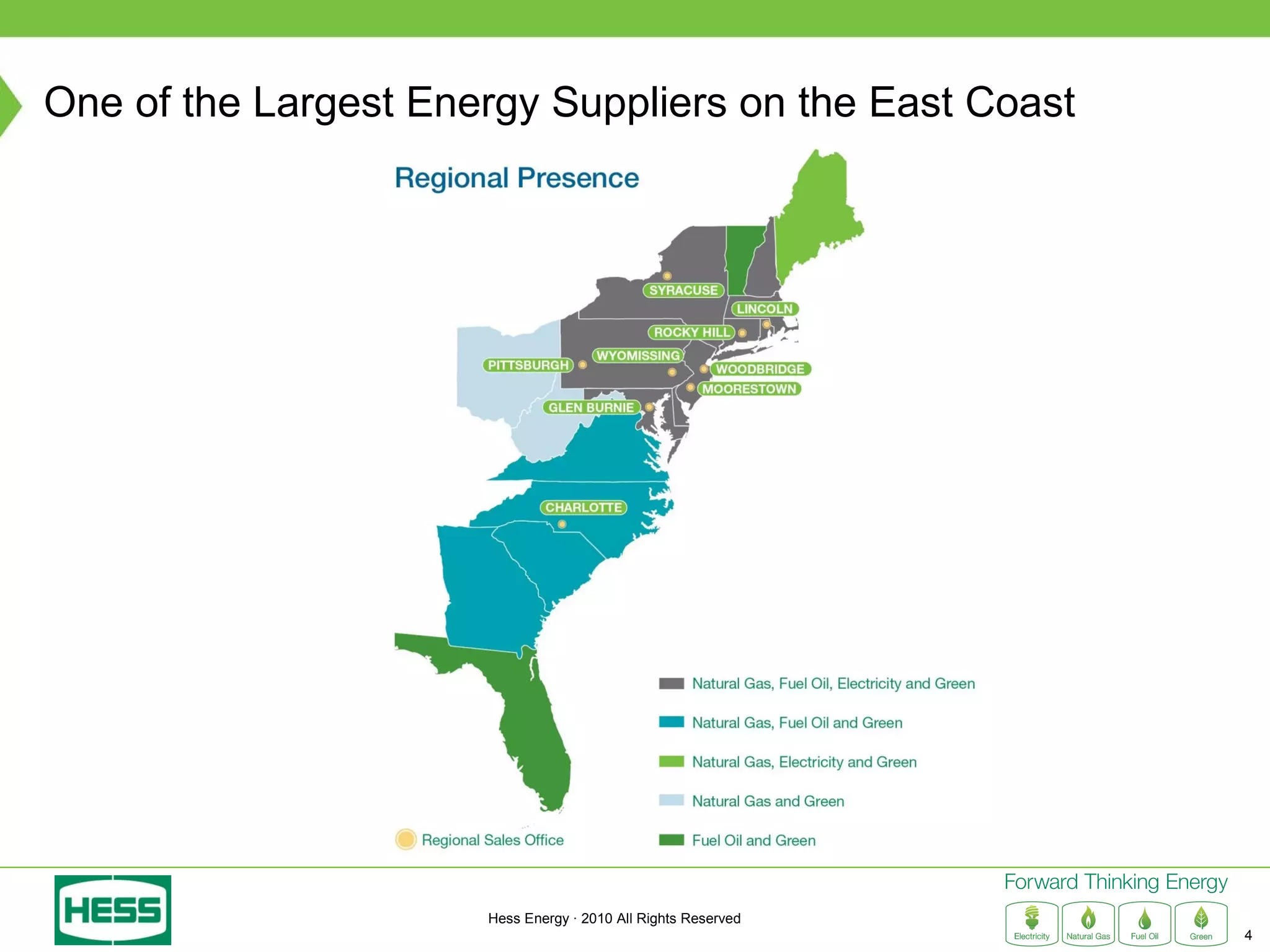
One of the Largest Energy Suppliers on the East Coast


                      Hess Energy · 2010 All Rights Reserved
                                                               4
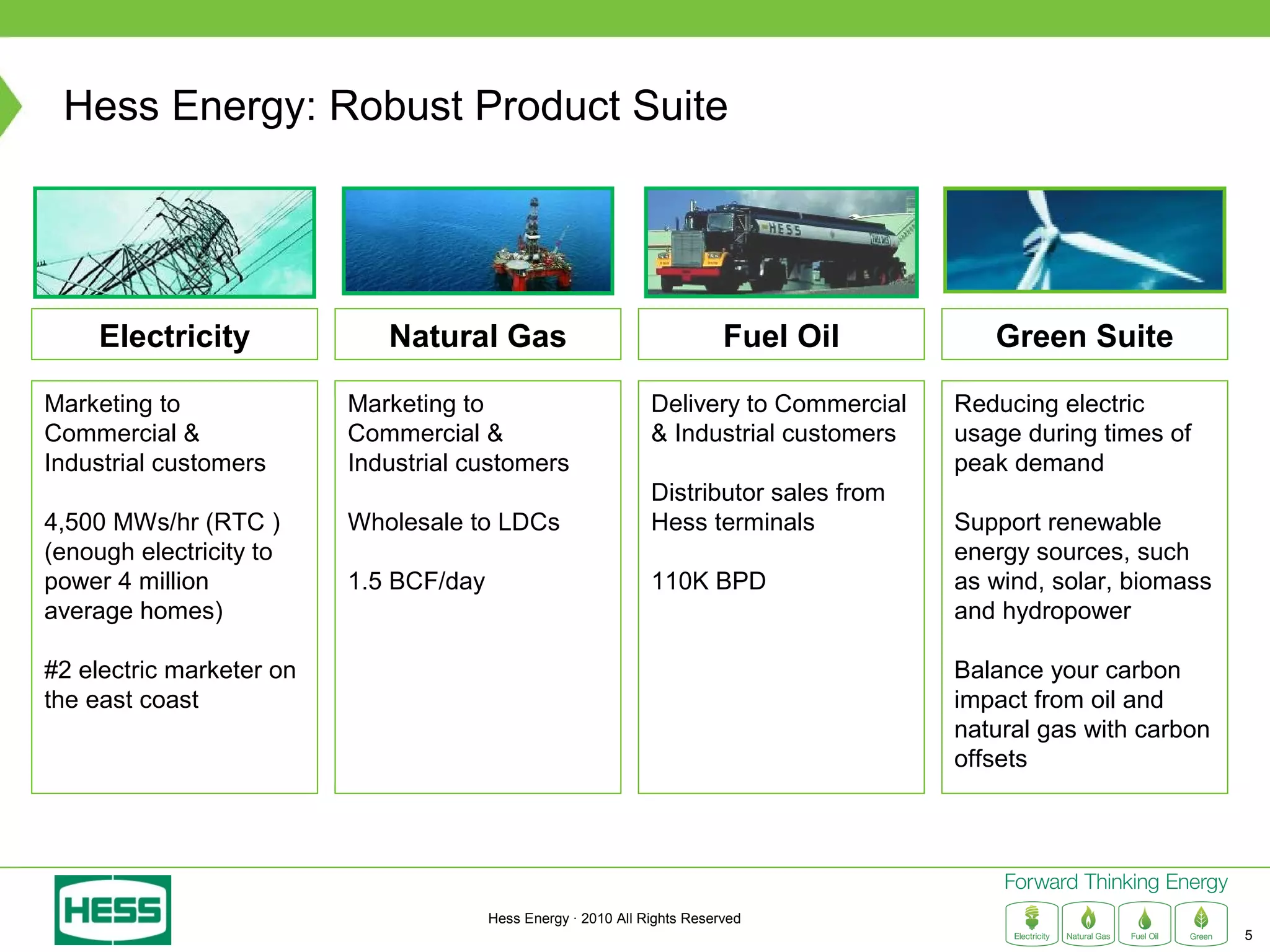
Hess Energy: Robust Product Suite


     Electricity             Natural Gas                                   Fuel Oil         Green Suite

Marketing to              Marketing to                          Delivery to Commercial   Reducing electric
Commercial &              Commercial &                          & Industrial customers   usage during times of
Industrial customers      Industrial customers                                           peak demand
                                                                Distributor sales from
4,500 MWs/hr (RTC )       Wholesale to LDCs                     Hess terminals           Support renewable
(enough electricity to                                                                   energy sources, such
power 4 million           1.5 BCF/day                           110K BPD                 as wind, solar, biomass
average homes)                                                                           and hydropower

#2 electric marketer on                                                                  Balance your carbon
the east coast                                                                           impact from oil and
                                                                                         natural gas with carbon
                                                                                         offsets


                                        Hess Energy · 2010 All Rights Reserved
                                                                                                                   5
Volumetric Risk in Retail Load Contracts


            Hess Energy · 2010 All Rights Reserved
                                                     6
What is a Full Requirements Load Following Contract

 • Full Requirements Load Following: A fixed price agreement to serve all
   the electricity load of a customer, and provide all products required to
   supply the electric load, for a pre-determined interval of time, without
   restrictions on volume. Typically served at a fixed rate per MWH.

 • Also called Full Plant Requirements Contract.

 • Typical key products to be supplied:
    ○ Load Following Energy
    ○ Capacity
    ○ Transmission
    ○ Ancillaries
    ○ RECs


                             Hess Energy · 2010 All Rights Reserved
                                                                              7
Volumetric or Swing Risk

• Volumetric or swing risk is defined as a cash flow risk caused by
  deviations in delivered volumes compared to expected volumes. The
  primary cause of these volumetric deviations is weather and economic
  conditions.
• Not enough that delivered volumes deviate from expected volumes.
    ○   These deviations in delivered volumes must be positively correlated with
        market prices.
    ○   The full requirements load following contract is delta hedged at some
        expected volume.
• Under these conditions the resulting expected cash flow position is
  negative and non-linear with respect to changes in market prices.
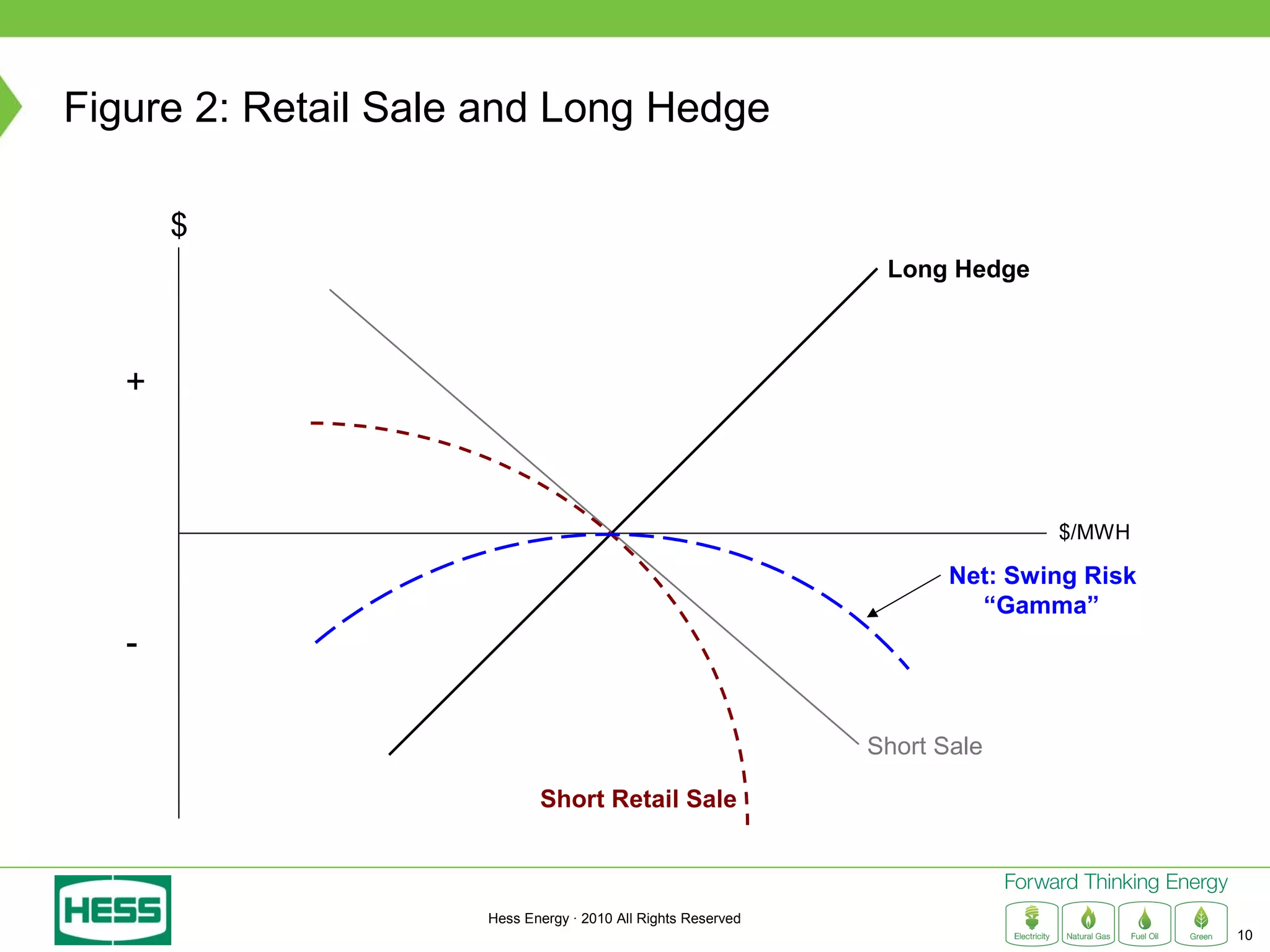
• Swing risk is similar to the gamma position of an option, as it is a second
  order price risk.


                                Hess Energy · 2010 All Rights Reserved
                                                                                   8
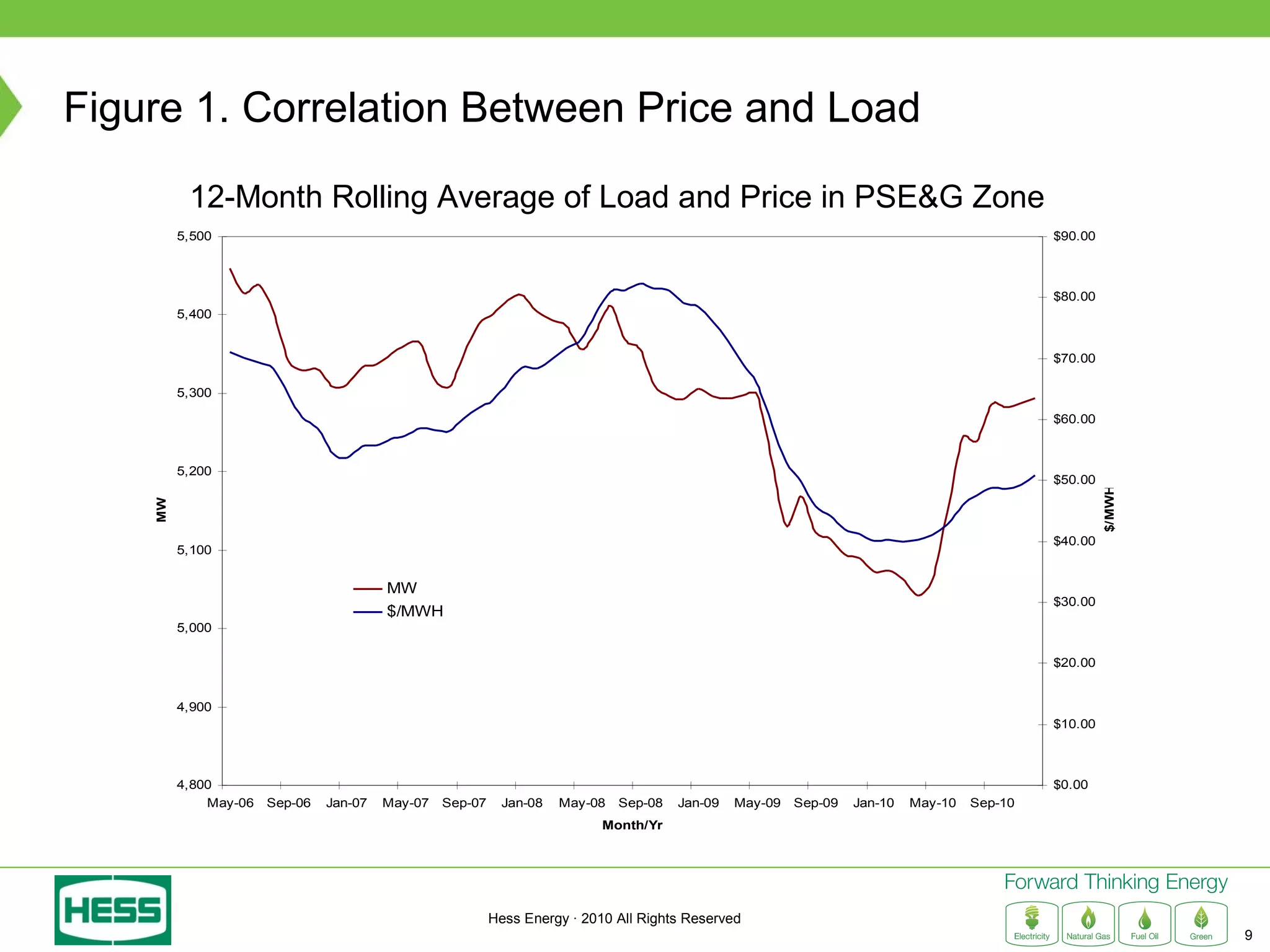
Figure 1. Correlation Between Price and Load

          12-Month Rolling Average of Load and Price in PSE&G Zone
         5,500                                                                                                                              $90.00


                                                                                                                                            $80.00
         5,400


                                                                                                                                            $70.00

         5,300

                                                                                                                                            $60.00


         5,200
                                                                                                                                            $50.00


                                                                                                                                                     $/MWH
    MW


                                                                                                                                            $40.00
         5,100


                                        MW
                                                                                                                                            $30.00
                                        $/MWH
         5,000

                                                                                                                                            $20.00


         4,900
                                                                                                                                            $10.00


         4,800                                                                                                                              $0.00
             May-06   Sep-06   Jan-07   May-07   Sep-07    Jan-08   May-08   Sep-08   Jan-09   May-09   Sep-09   Jan-10   May-10   Sep-10
                                                                           Month/Yr


                                                          Hess Energy · 2010 All Rights Reserved
                                                                                                                                                             9
Figure 2: Retail Sale and Long Hedge

       $
                                                               Long Hedge


   +


                                                                             $/MWH

                                                                     Net: Swing Risk
                                                                       “Gamma”
   -

                                                              Short Sale

                            Short Retail Sale


                     Hess Energy · 2010 All Rights Reserved
                                                                                       10
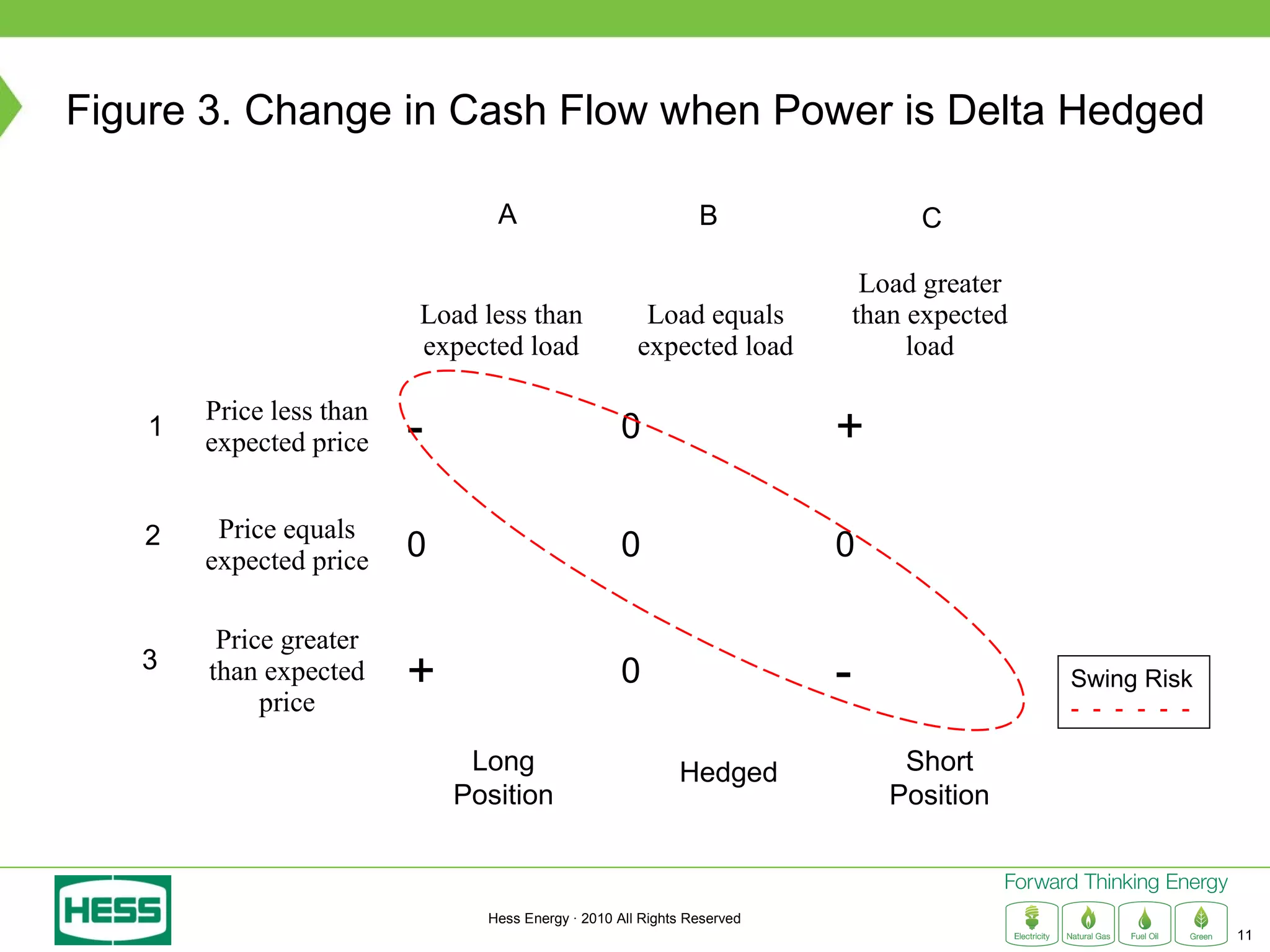
Figure 3. Change in Cash Flow when Power is Delta Hedged

                                 A                             B                  C

                                                                              Load greater
                          Load less than               Load equals           than expected
                          expected load               expected load               load

        Price less than
    1
        expected price    -                        0                     +

   2     Price equals
        expected price    0                        0                     0

         Price greater
   3    than expected
             price
                          +                        0                     -                   Swing Risk
                                                                                             - - - - - -

                               Long                         Hedged               Short
                              Position                                          Position


                                Hess Energy · 2010 All Rights Reserved
                                                                                                           11
Expected Cost to Serve Load
      and Swing Risk


       Hess Energy · 2010 All Rights Reserved
                                                12
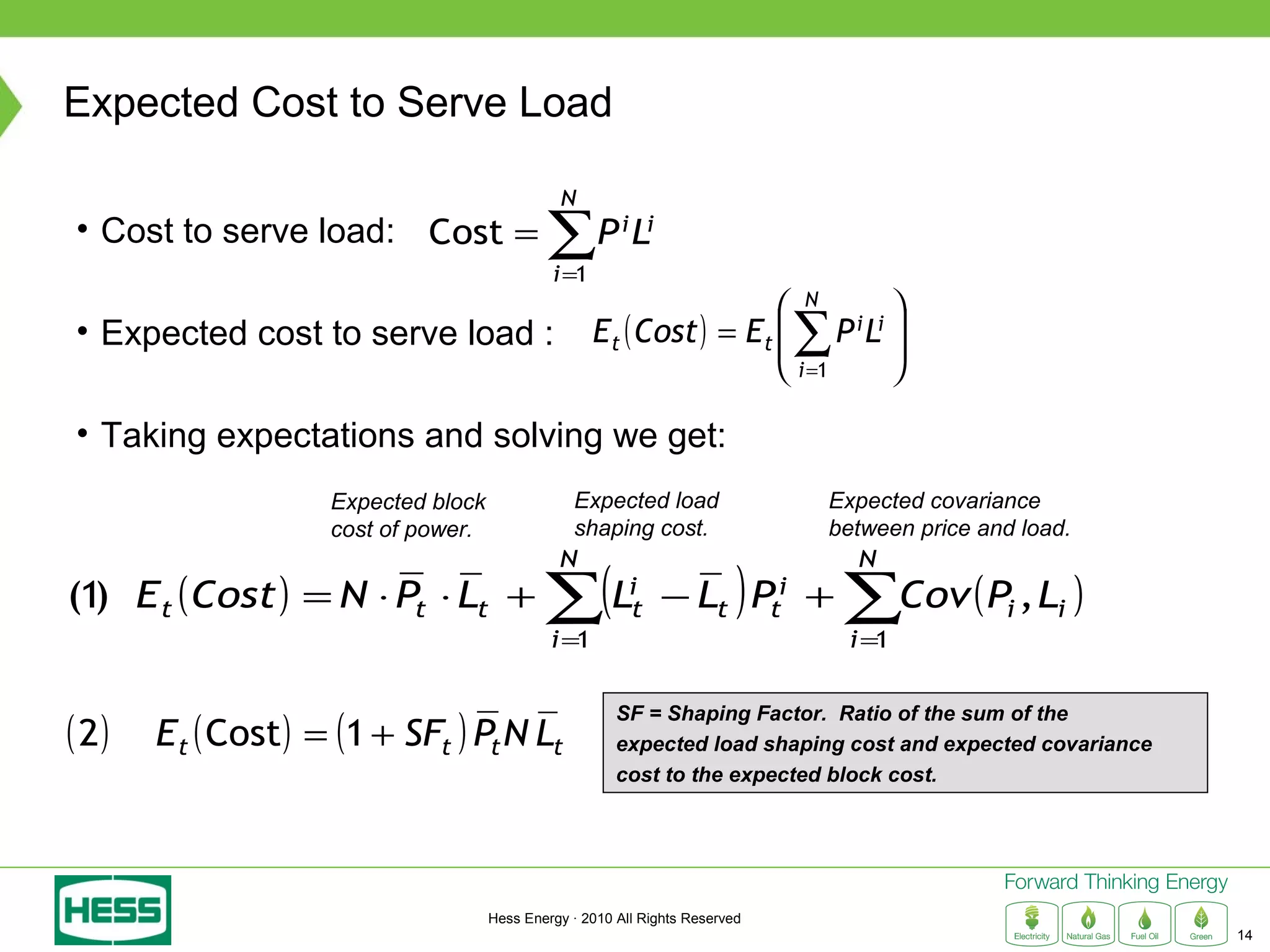
Expected Cost to Serve Load

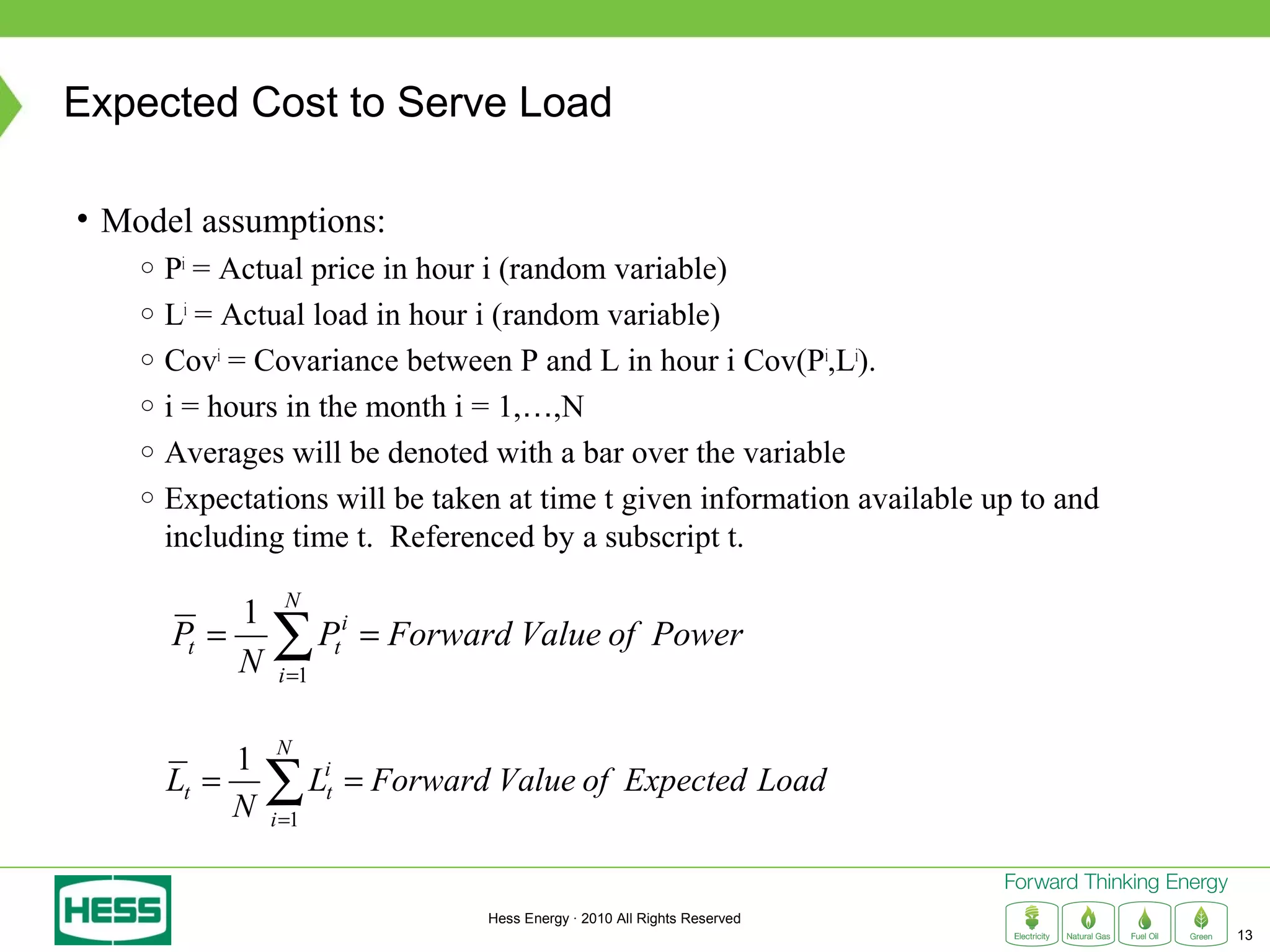
• Model assumptions:
    ○ Pi = Actual price in hour i (random variable)
    ○ Li = Actual load in hour i (random variable)
    ○ Covi = Covariance between P and L in hour i Cov(Pi,Li).
    ○ i = hours in the month i = 1,…,N
    ○ Averages will be denoted with a bar over the variable
    ○ Expectations will be taken at time t given information available up to and
      including time t. Referenced by a subscript t.
                  N
             1
        Pt =
             N
                 ∑P
                  i =1
                             t
                                 i
                                     = Forward Value of Power


                 N
             1
        Lt =
             N
                 ∑L
                 i =1
                         i
                         t       = Forward Value of Expected Load


                                             Hess Energy · 2010 All Rights Reserved
                                                                                      13
Expected Cost to Serve Load

                                               N
• Cost to serve load: Cost =                 ∑P L
                                              i =1
                                                         i i


                                                                       N i i
• Expected cost to serve load :                      Et ( Cost ) = Et  P L 
                                                                      
                                                                       i =1
                                                                             
                                                                             
                                                                              ∑
• Taking expectations and solving we get:
                    Expected block               Expected load                Expected covariance
                    cost of power.               shaping cost.                between price and load.


                                             ∑(L                          )
                                               N                                 N
(1 Et ( Cost ) = N ⋅ Pt ⋅ Lt +
  )
                                              i =1
                                                      i
                                                      t        − L Pti +
                                                               t                  ∑Cov ( P , L )
                                                                                  i =1
                                                                                              i    i


( 2)   Et ( Cost ) = (1 + SFt ) Pt N Lt
                                                        SF = Shaping Factor. Ratio of the sum of the
                                                        expected load shaping cost and expected covariance
                                                        cost to the expected block cost.


                                     Hess Energy · 2010 All Rights Reserved
                                                                                                             14
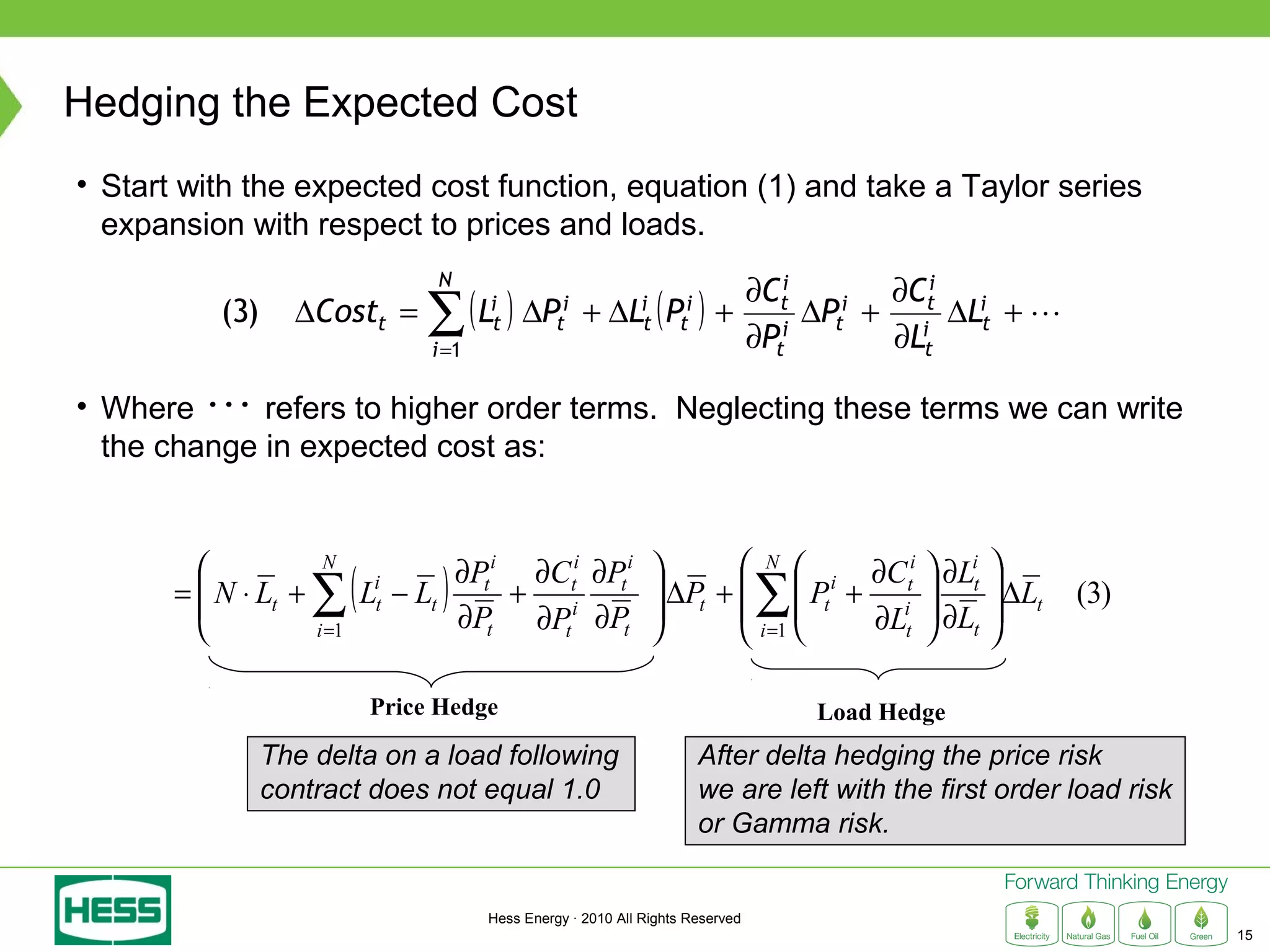
Hedging the Expected Cost
• Start with the expected cost function, equation (1) and take a Taylor series
  expansion with respect to prices and loads.
                                      N
                                                                                 ∂Cti    ∂Cti i
           (3)     ∆Costt =          ∑( )
                                      i =1
                                             Lit   ∆Pti     +   ∆Lit   ( )
                                                                        Pti     + i ∆Pt + i ∆Lt + 
                                                                                 ∂Pt
                                                                                       i
                                                                                         ∂Lt

• Where  refers to higher order terms. Neglecting these terms we can write
  the change in expected cost as:


                                       ∂Pti ∂Cti ∂Pti         N  i ∂Cti                         ∂Lit   
                      ∑(               )
                      N
       =  N ⋅ Lt +
         
         
                             Lit   − Lt     + i
                                        ∂Pt ∂Pt ∂Pt 
                                                        ∆Pt +   Pt + i
                                                       
                                                                      ∂Lt
                                                                                       ∑           
                                                                                                    ∂L
                                                                                                             ∆Lt
                                                                                                            
                                                                                                                    (3)
                      i =1                                      i =1                              t      

                              Price Hedge                                                  Load Hedge
                 The delta on a load following                                After delta hedging the price risk
                 contract does not equal 1.0                                  we are left with the first order load risk
                                                                              or Gamma risk.


                                              Hess Energy · 2010 All Rights Reserved
                                                                                                                           15
Fair Value of a Load Following Contract


• A fair price or fair value contract has an expected value of zero.
• Fair value contracts require the inclusion of the expected value of the
  covariance between price and load, not just the expected hourly shaping
  cost. Excluding this cost component biases the distribution to the left.
• But inclusion of the expected covariance in the contract price does not
  guarantee that the swing risk has been minimized or removed. It only
  guarantees that the contract is priced fairly.
• We are still left with the negative tail risk from large positively correlated
  price and load movements – Cash Flow at Risk.


                             Hess Energy · 2010 All Rights Reserved
                                                                                   16
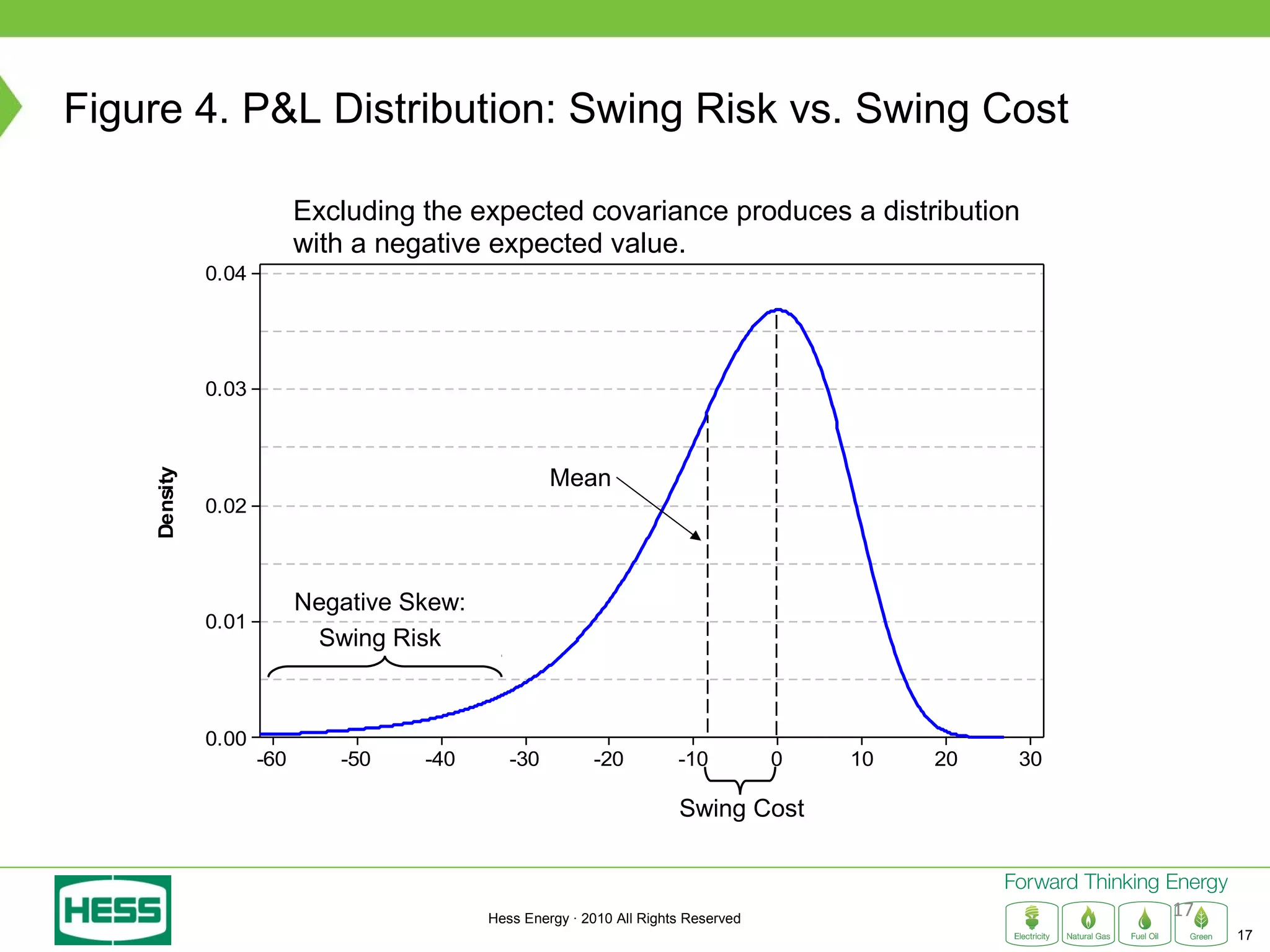
Figure 4. P&L Distribution: Swing Risk vs. Swing Cost

                           Excluding the expected covariance produces a distribution
                           with a negative expected value.
              0.04


              0.03


                                                     Mean
    Density


              0.02


                           Negative Skew:
              0.01
                            Swing Risk


              0.00
                     -60      -50    -40       -30         -20          -10           0     10   20   30

                                                              Cash Flow
                                                                    Swing            Cost


                                            Hess Energy · 2010 All Rights Reserved                         17
                                                                                                                17
Option Hedge Development


      Hess Energy · 2010 All Rights Reserved
                                               18
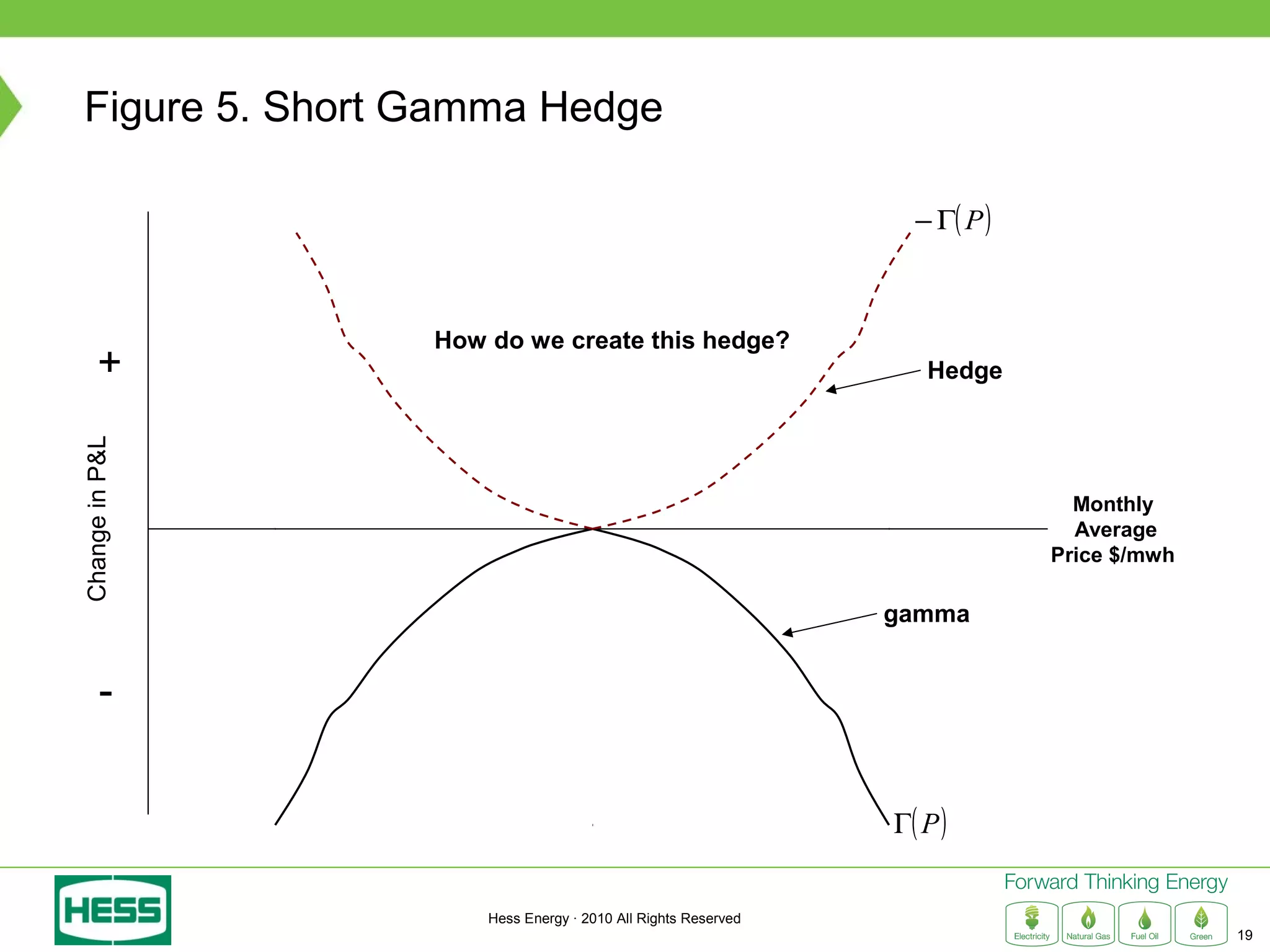
Figure 5. Short Gamma Hedge

                                                               − Γ( P )


                How do we create this hedge?
      +                                                         Hedge
Change in P&L


                                                                            Monthly
                                                                            Average
                                                                          Price $/mwh

                                                             gamma


       -


                                                             Γ( P )


                    Hess Energy · 2010 All Rights Reserved
                                                                                        19
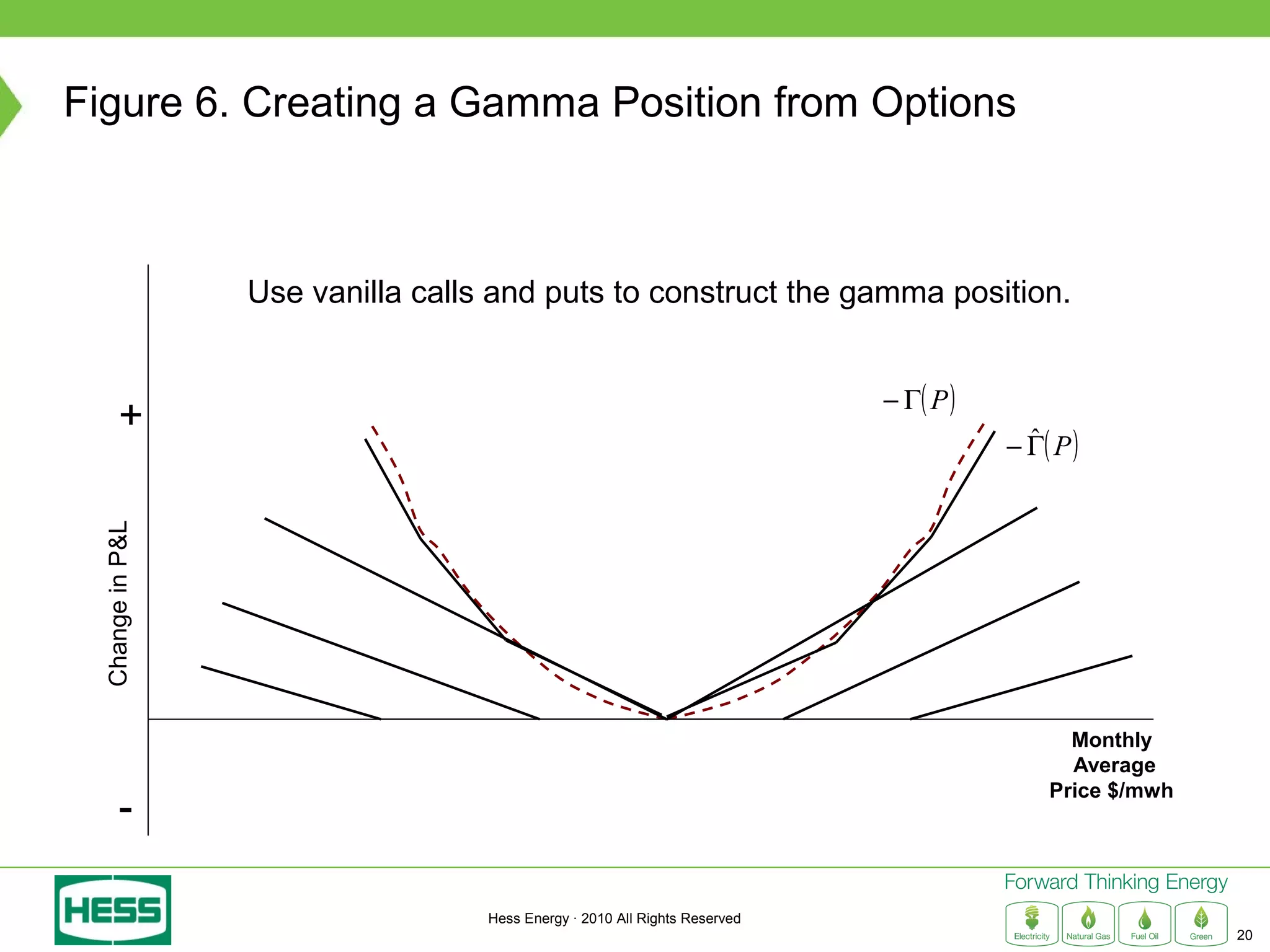
Figure 6. Creating a Gamma Position from Options


                  Use vanilla calls and puts to construct the gamma position.


                                                                            − Γ( P )
        +
                                                                                       − Γ( P )
                                                                                         ˆ
  Change in P&L


                                                                                             Monthly
                                                                                             Average
                                                                                           Price $/mwh
        -

                                   Hess Energy · 2010 All Rights Reserved
                                                                                                         20
Solving for the Estimated Gamma Function

• Select a series of strikes, Ki , and quantities, θi, to create a portfolio of
  puts and calls.
• To estimate the gamma function we need to choose the amount of
  options for each strike, θi , so as to minimize the distance between the
  estimated gamma function and the true gamma function.
• Estimated gamma function equals:
                         N                                         M
            − Γ( P ) =
              ˆ
                         ∑Max( P − K , 0) ×θ + ∑Max( K
                         i =1
                                           i               i
                                                                   i =1
                                                                             i   − P,0 ) ×θi

• Choose the optimal quantities by minimizing the sum of the squared
  errors between the true and estimated gamma function over a set of Q
  prices.                                     2

                                      ∑ [Γ( P ) − Γ( P )]
                               Q
                                min      ˆ            j                  j
                                 θ
                                       j =1


                                Hess Energy · 2010 All Rights Reserved
                                                                                               21
Theoretical Model

• It has been shown that a static hedge of plain vanilla options and
  forwards can be used to replicate any European derivative (Carr and
  Chou 2002, Carr and Madan 2001).
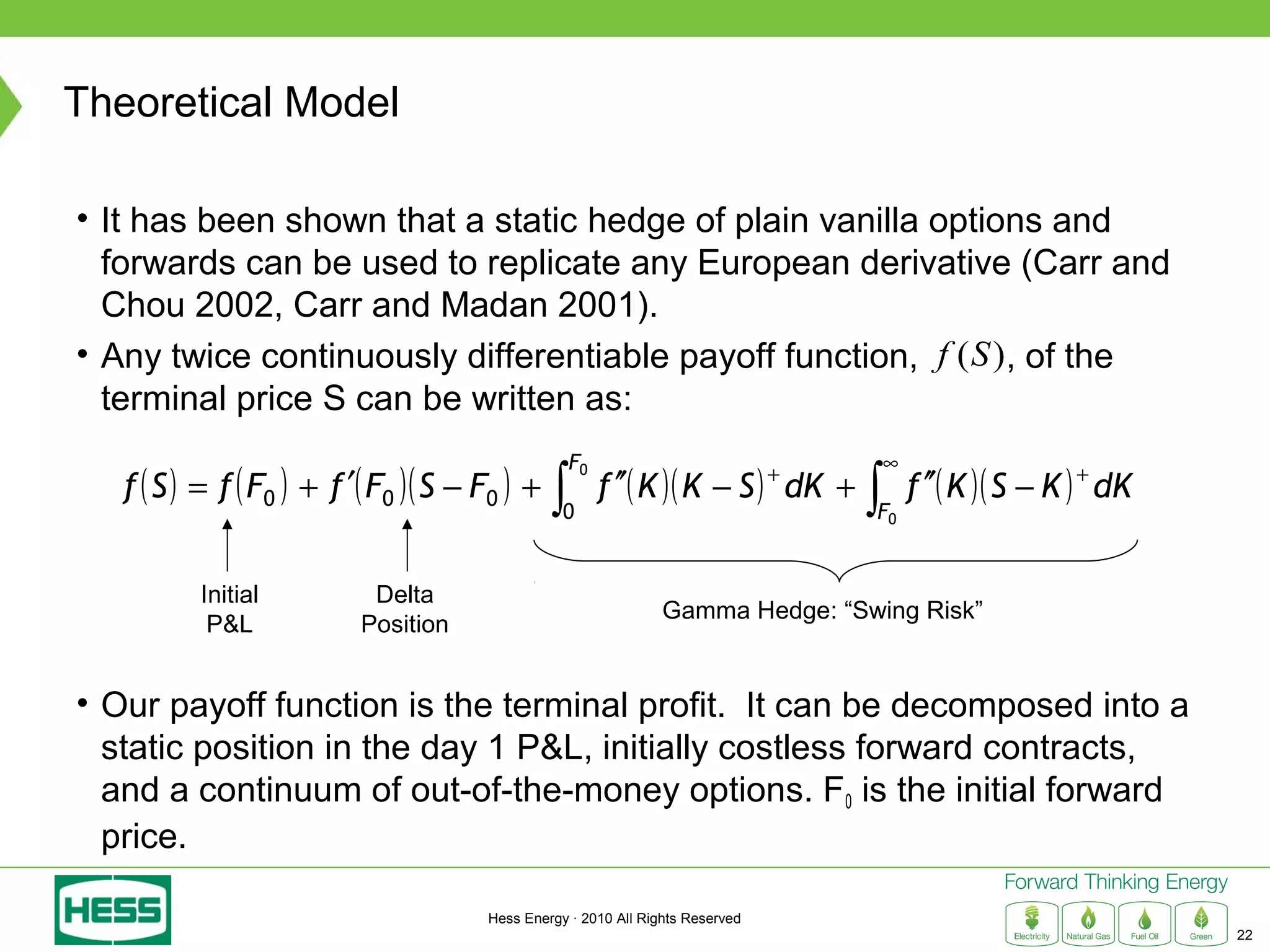
• Any twice continuously differentiable payoff function, f (S ), of the
  terminal price S can be written as:
                                                    F0                                  ∞
   f ( S ) = f ( F0 ) + f ′( F0 )( S − F0 ) +   ∫        f ′′( K )( K − S ) dK ++
                                                                                    ∫       f ′′( K )( S − K ) + dK
                                                  0                                 F0


          Initial          Delta
                                                                 Gamma Hedge: “Swing Risk”
           P&L            Position


• Our payoff function is the terminal profit. It can be decomposed into a
  static position in the day 1 P&L, initially costless forward contracts,
  and a continuum of out-of-the-money options. F0 is the initial forward
  price.

                                       Hess Energy · 2010 All Rights Reserved
                                                                                                                      22
Theoretical Model, Cont.

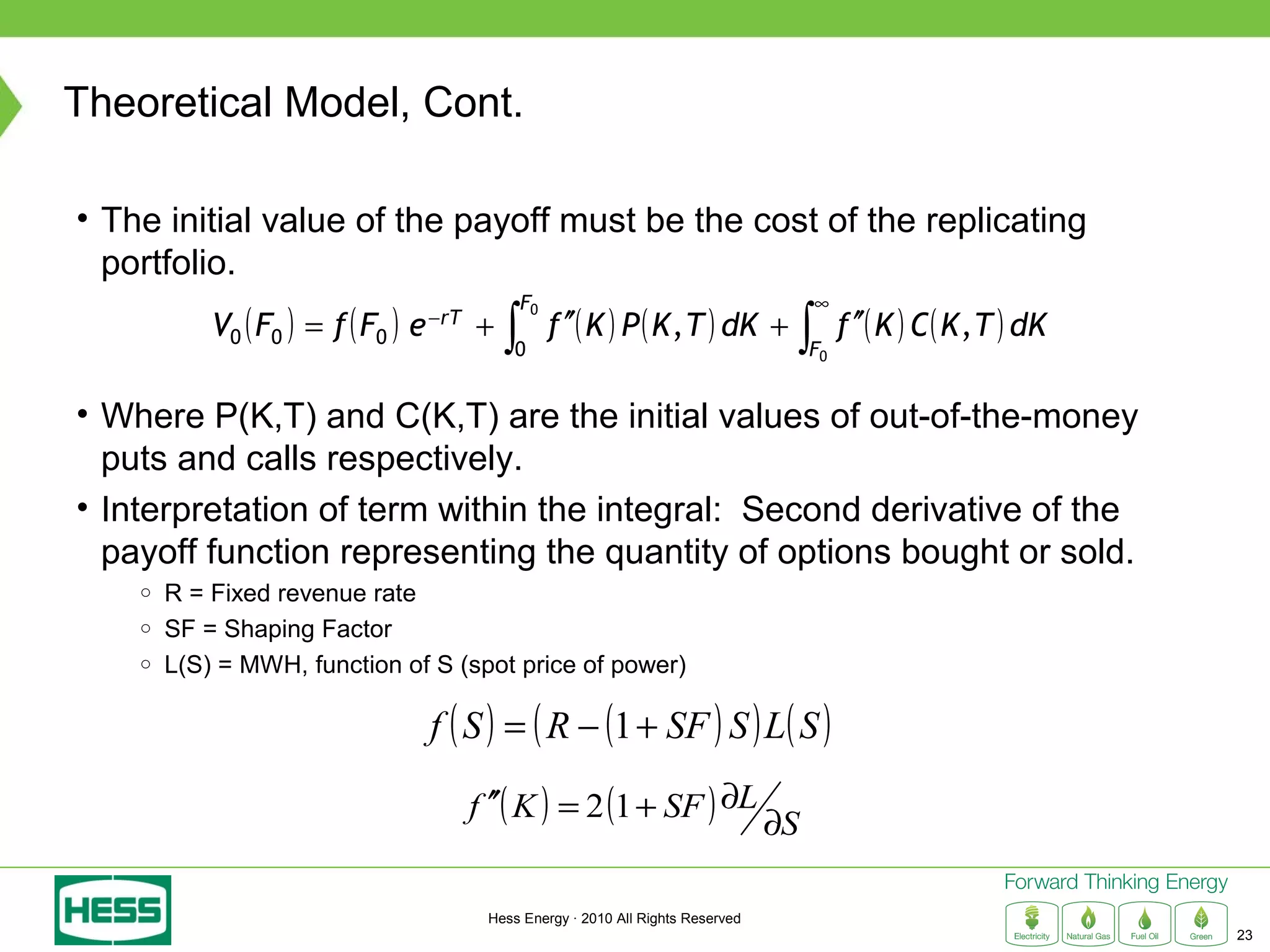
• The initial value of the payoff must be the cost of the replicating
  portfolio.
                                                   F0                                     ∞
            V0 ( F0 ) = f ( F0 ) e   −rT
                                           +   ∫        f ′′( K ) P ( K , T ) dK +    ∫        f ′′( K ) C ( K , T ) dK
                                                0                                         F0


• Where P(K,T) and C(K,T) are the initial values of out-of-the-money
  puts and calls respectively.
• Interpretation of term within the integral: Second derivative of the
  payoff function representing the quantity of options bought or sold.
    ○   R = Fixed revenue rate
    ○   SF = Shaping Factor
    ○   L(S) = MWH, function of S (spot price of power)

                                     f ( S ) = ( R − (1 + SF ) S ) L( S )

                                           f ′′( K ) = 2 (1 + SF ) ∂L
                                                                                     ∂S

                                            Hess Energy · 2010 All Rights Reserved
                                                                                                                          23
Estimating the Gamma Function


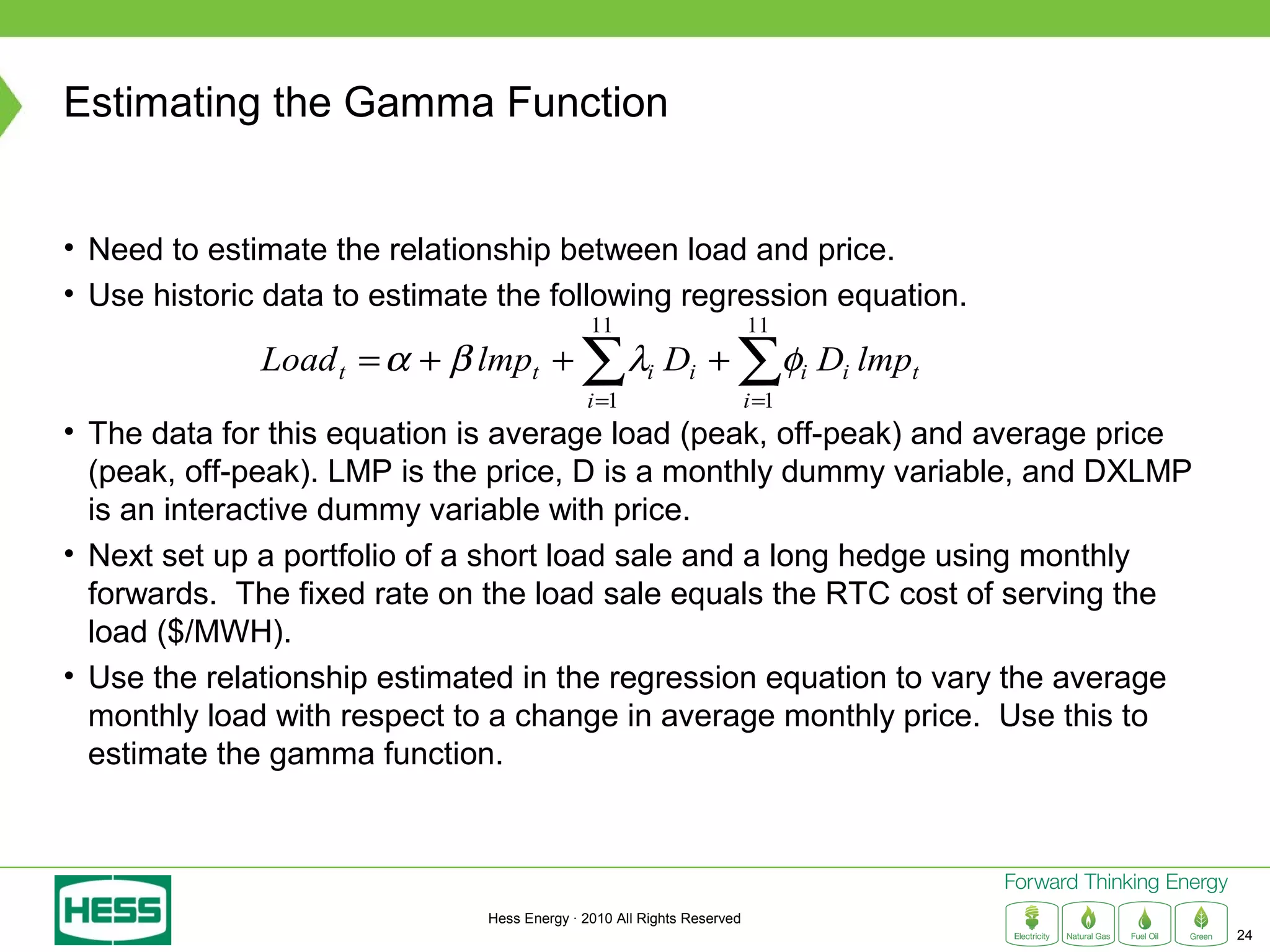
• Need to estimate the relationship between load and price.
• Use historic data to estimate the following regression equation.
                                              11                        11
              Load t = α + β lmpt +         ∑λ D + ∑φ D lmp
                                             i =1
                                                      i      i
                                                                        i =1
                                                                               i   i   t

• The data for this equation is average load (peak, off-peak) and average price
  (peak, off-peak). LMP is the price, D is a monthly dummy variable, and DXLMP
  is an interactive dummy variable with price.
• Next set up a portfolio of a short load sale and a long hedge using monthly
  forwards. The fixed rate on the load sale equals the RTC cost of serving the
  load ($/MWH).
• Use the relationship estimated in the regression equation to vary the average
  monthly load with respect to a change in average monthly price. Use this to
  estimate the gamma function.


                               Hess Energy · 2010 All Rights Reserved
                                                                                           24
Example Regression Output On-Peak PSE&G FP

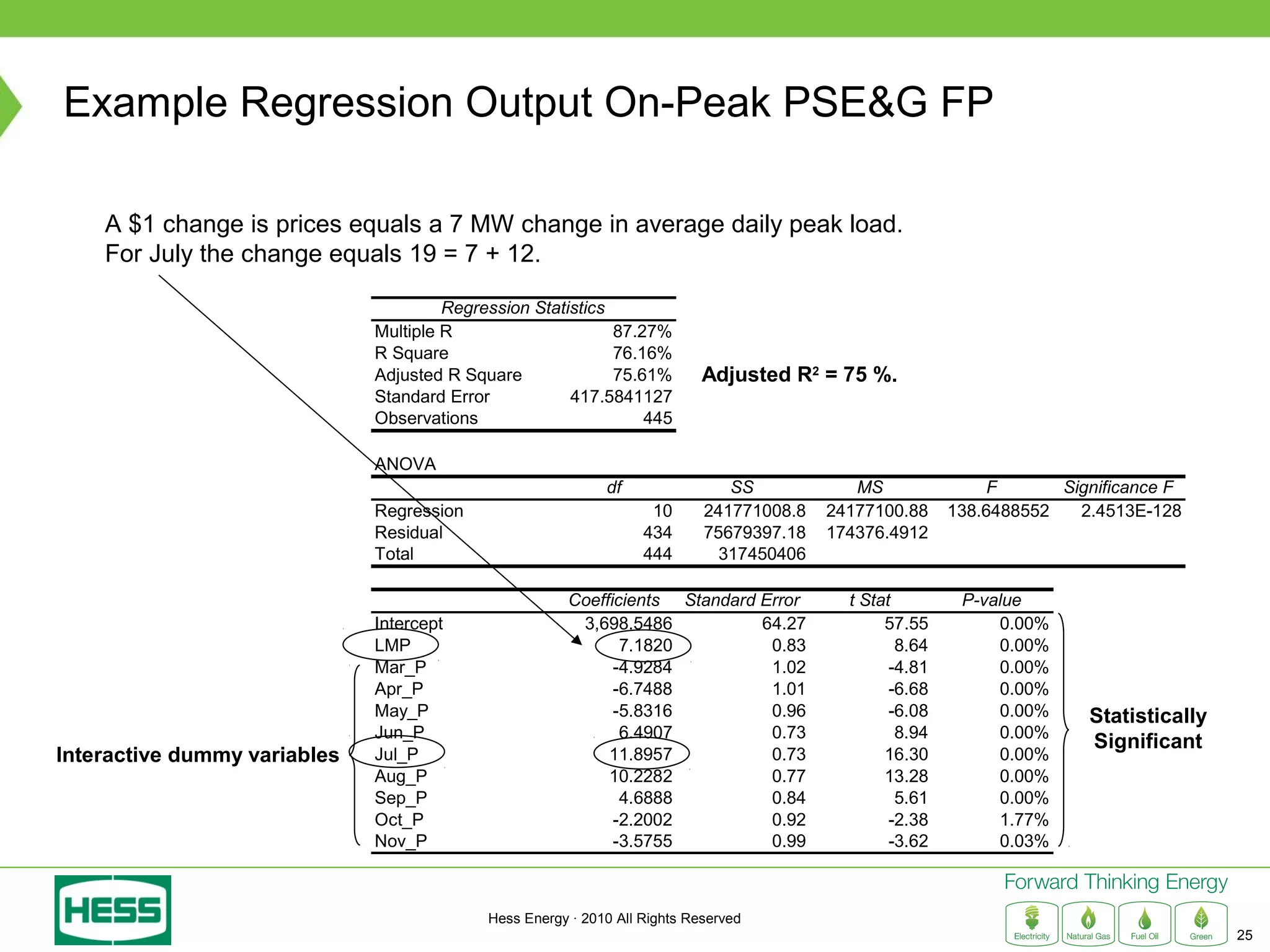
    A $1 change is prices equals a 7 MW change in average daily peak load.
    For July the change equals 19 = 7 + 12.

                                       Regression Statistics
                              Multiple R                     87.27%
                              R Square                       76.16%
                              Adjusted R Square              75.61%         Adjusted R2 = 75 %.
                              Standard Error           417.5841127
                              Observations                       445

                              ANOVA
                                                             df                SS            MS                F      Significance F
                              Regression                            10      241771008.8   24177100.88     138.6488552   2.4513E-128
                              Residual                             434      75679397.18   174376.4912
                              Total                                444        317450406

                                                        Coefficients Standard Error         t Stat         P-value
                              Intercept                  3,698.5486           64.27              57.55         0.00%
                              LMP                              7.1820          0.83                8.64        0.00%
                              Mar_P                           -4.9284          1.02               -4.81        0.00%
                              Apr_P                           -6.7488          1.01               -6.68        0.00%
                              May_P                           -5.8316          0.96               -6.08        0.00%     Statistically
                              Jun_P                            6.4907          0.73                8.94        0.00%
                                                                                                                         Significant
Interactive dummy variables   Jul_P                          11.8957           0.73              16.30         0.00%
                              Aug_P                          10.2282           0.77              13.28         0.00%
                              Sep_P                            4.6888          0.84                5.61        0.00%
                              Oct_P                           -2.2002          0.92               -2.38        1.77%
                              Nov_P                           -3.5755          0.99               -3.62        0.03%


                                            Hess Energy · 2010 All Rights Reserved
                                                                                                                                         25
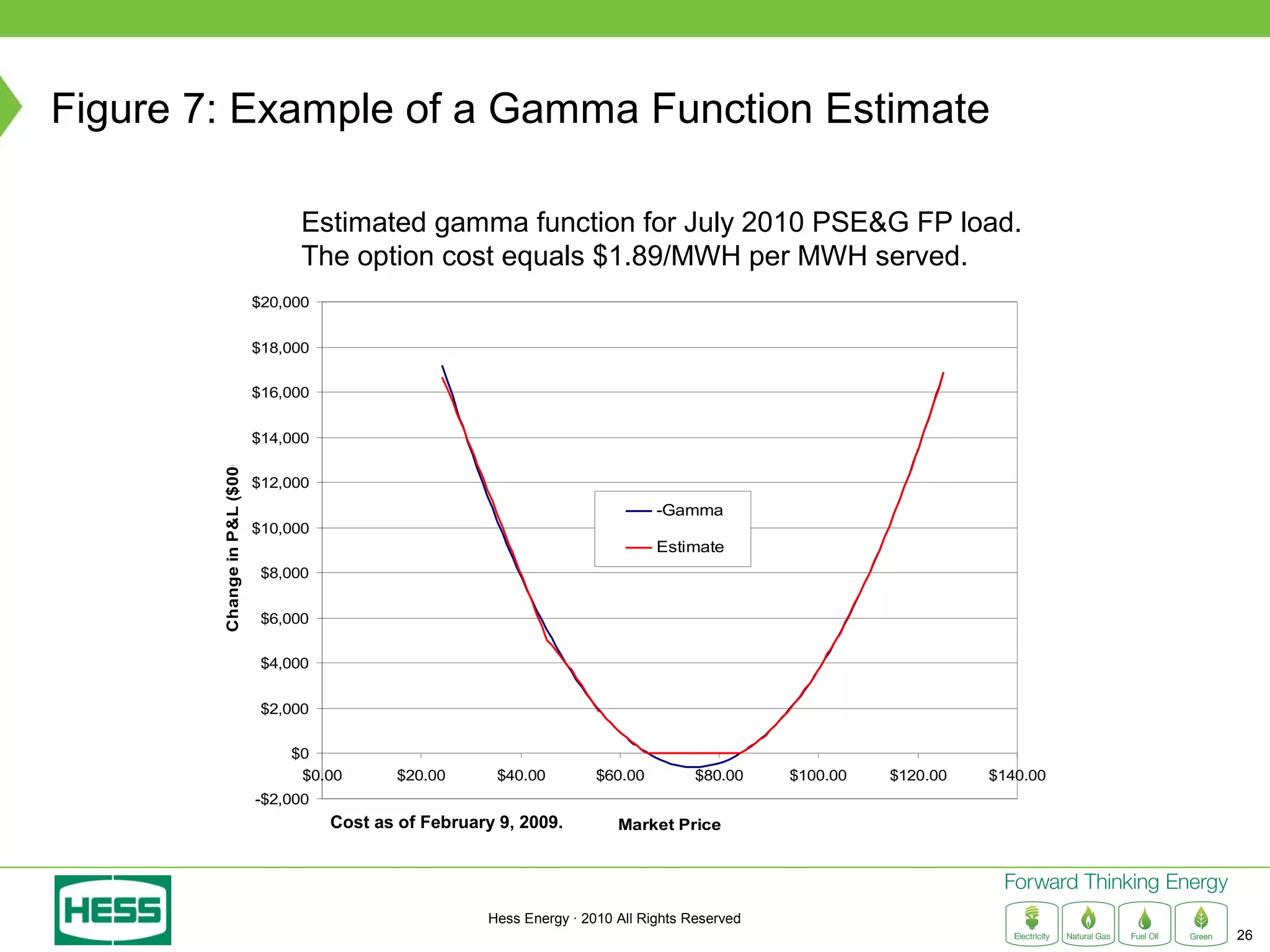
Figure 7: Example of a Gamma Function Estimate

                                     Estimated gamma function for July 2010 PSE&G FP load.
                                     The option cost equals $1.89/MWH per MWH served.
                               $20,000


                               $18,000


                               $16,000


                               $14,000
        Change in P&L ($000)


                               $12,000
                                                                                    -Gamma
                               $10,000
                                                                                    Estimate
                                $8,000


                                $6,000


                                $4,000


                                $2,000


                                   $0
                                    $0.00        $20.00      $40.00        $60.00         $80.00    $100.00   $120.00   $140.00
                               -$2,000
                                         Cost as of February 9, 2009.         Market Price


                                                           Hess Energy · 2010 All Rights Reserved
                                                                                                                                  26
Mitigating Swing Risk in Practice

“In theory there is no difference between theory and practice.
In practice there is” Yogi Berra


                  Hess Energy · 2010 All Rights Reserved
                                                                 27
Minimizing Cash Flow at Risk

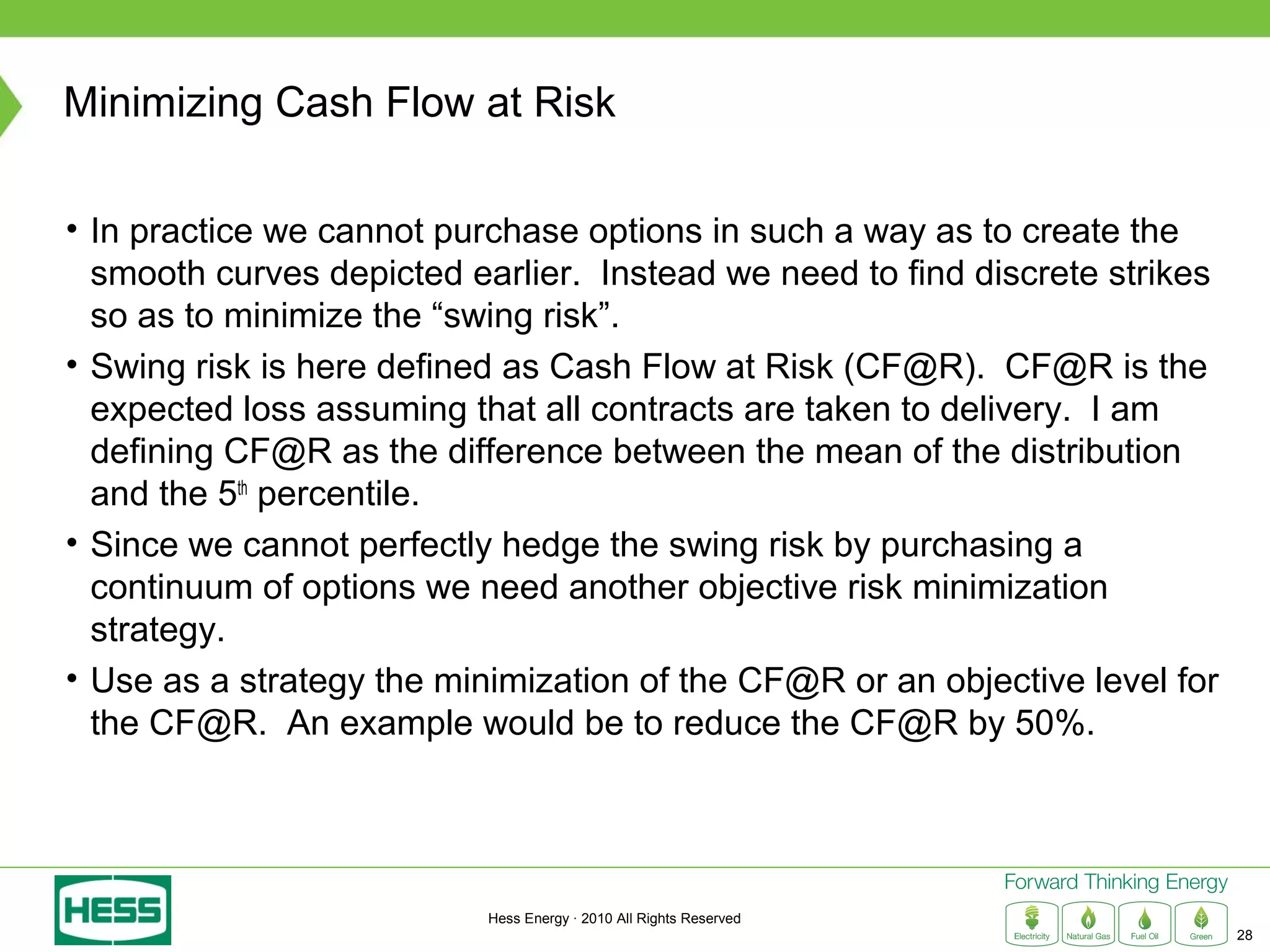
• In practice we cannot purchase options in such a way as to create the
  smooth curves depicted earlier. Instead we need to find discrete strikes
  so as to minimize the “swing risk”.
• Swing risk is here defined as Cash Flow at Risk (CF@R). CF@R is the
  expected loss assuming that all contracts are taken to delivery. I am
  defining CF@R as the difference between the mean of the distribution
  and the 5th percentile.
• Since we cannot perfectly hedge the swing risk by purchasing a
  continuum of options we need another objective risk minimization
  strategy.
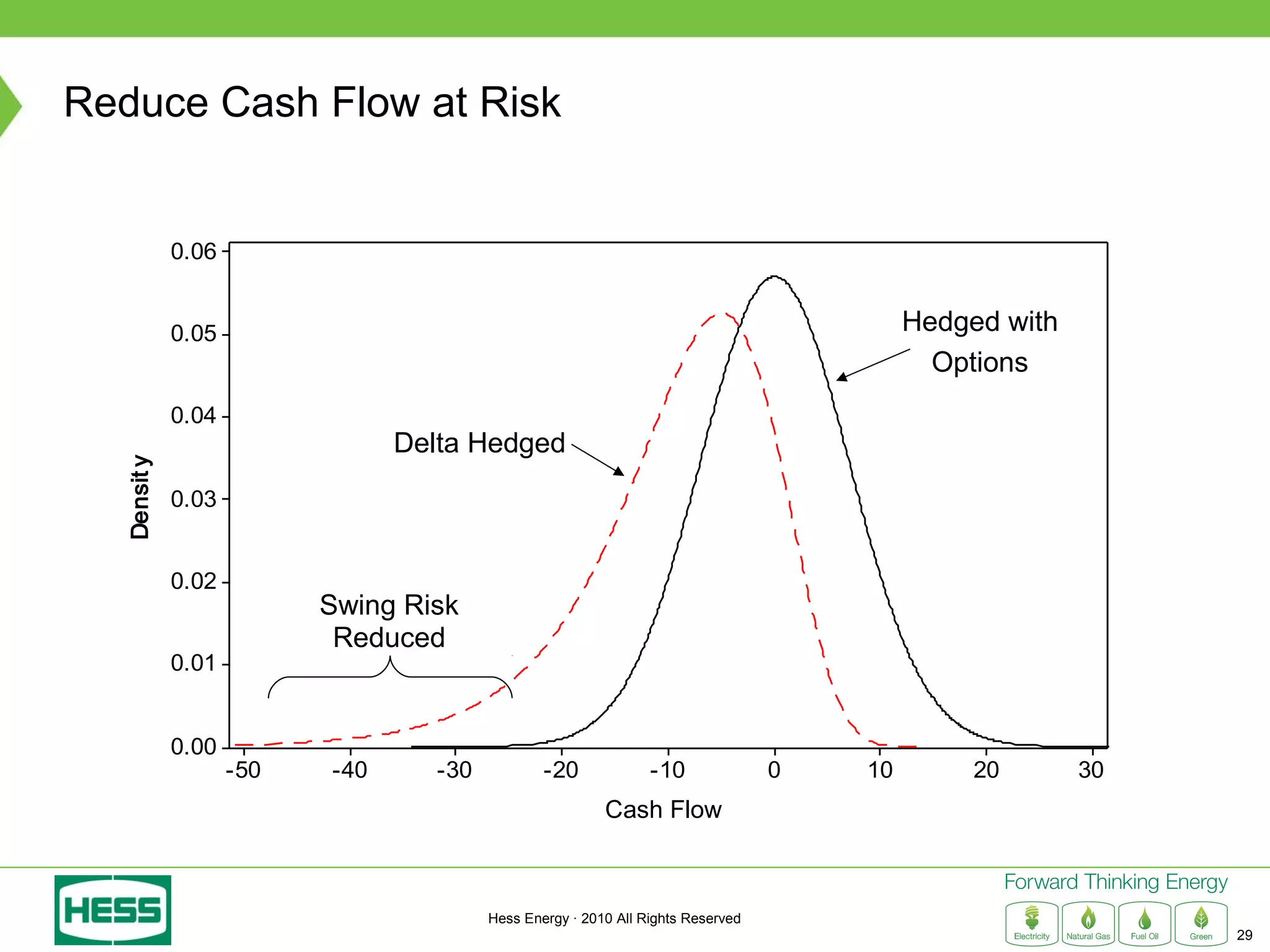
• Use as a strategy the minimization of the CF@R or an objective level for
  the CF@R. An example would be to reduce the CF@R by 50%.


                           Hess Energy · 2010 All Rights Reserved
                                                                             28
Reduce Cash Flow at Risk


             0.06
                          Accountnig or Actuarial w ith Options

             0.05
                          Accounting Model                                                    Hedged with
                                                                                                Options
             0.04
                                 Delta Hedged
  Densit y


             0.03


             0.02
                          Swing Risk
                           Reduced
             0.01


             0.00
                    -50   -40         -30           -20         -10                  0   10        20       30
                                                             CashXFlow


                                            Hess Energy · 2010 All Rights Reserved
                                                                                                                 29
Methodology

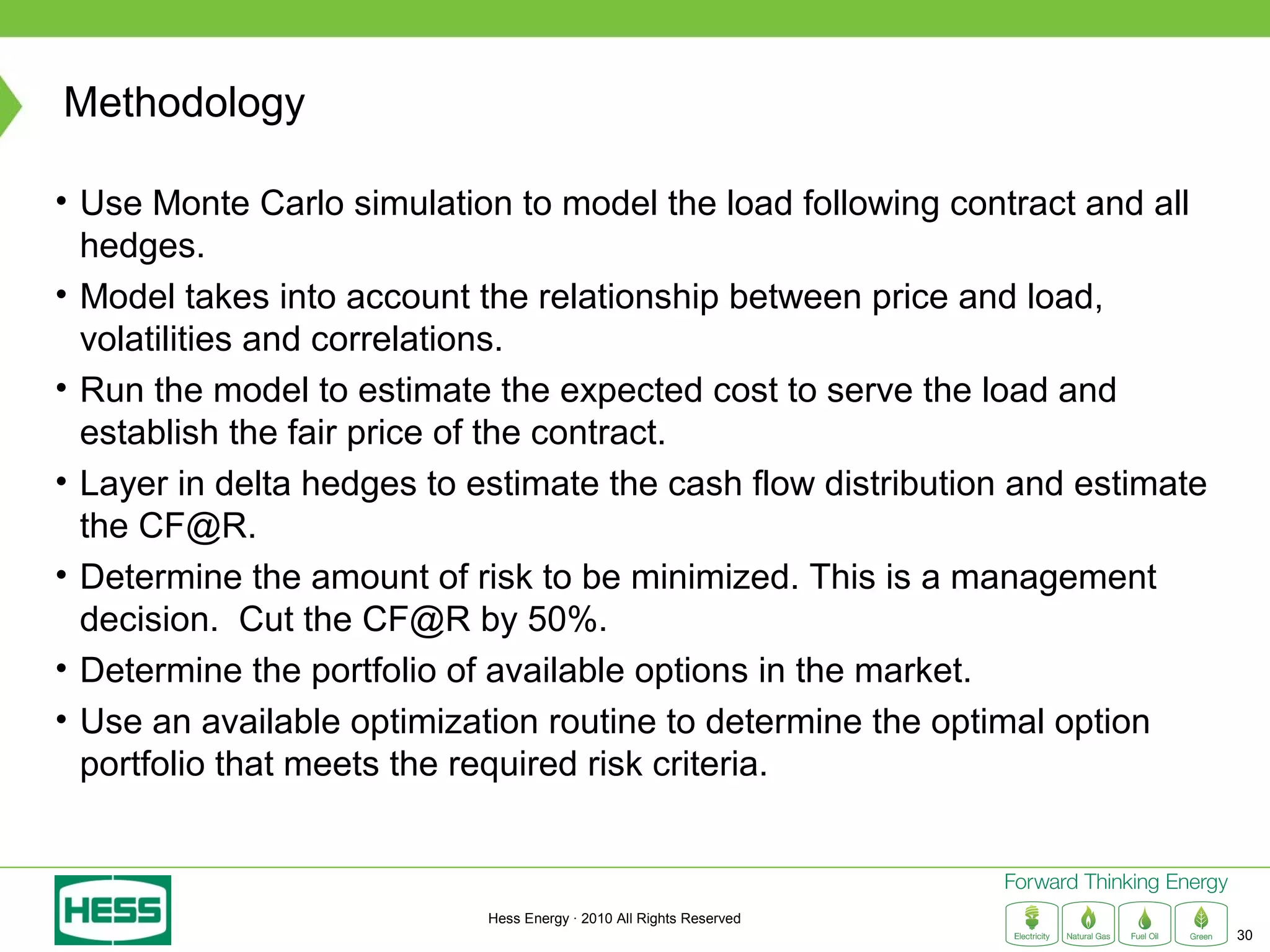
• Use Monte Carlo simulation to model the load following contract and all
  hedges.
• Model takes into account the relationship between price and load,
  volatilities and correlations.
• Run the model to estimate the expected cost to serve the load and
  establish the fair price of the contract.
• Layer in delta hedges to estimate the cash flow distribution and estimate
  the CF@R.
• Determine the amount of risk to be minimized. This is a management
  decision. Cut the CF@R by 50%.
• Determine the portfolio of available options in the market.
• Use an available optimization routine to determine the optimal option
  portfolio that meets the required risk criteria.


                            Hess Energy · 2010 All Rights Reserved
                                                                              30
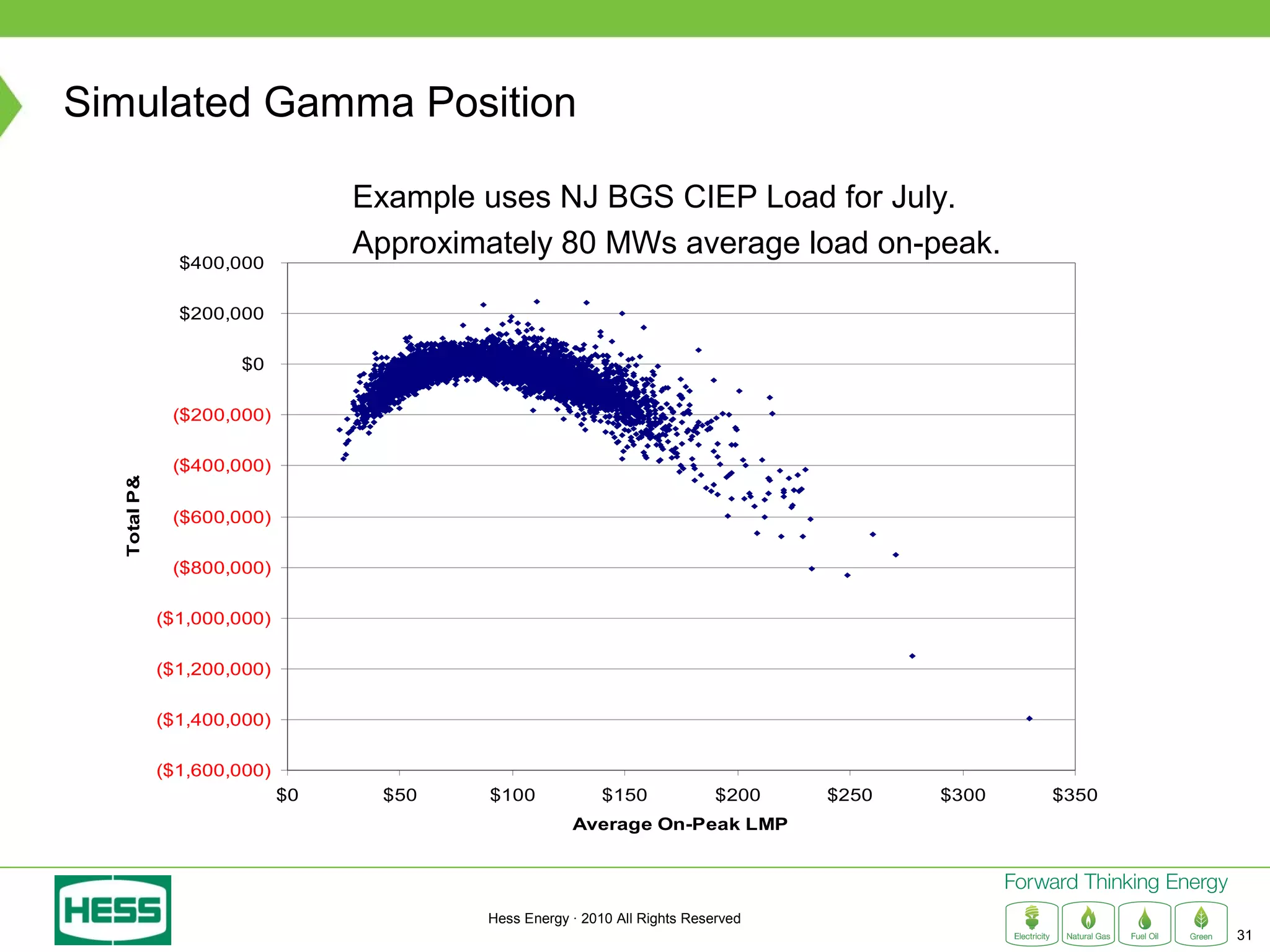
Simulated Gamma Position

                                  Example uses NJ BGS CIEP Load for July.
                $400,000
                                  Approximately 80 MWs average load on-peak.

                $200,000

                      $0

               ($200,000)

               ($400,000)
  Total P&L


               ($600,000)

               ($800,000)

              ($1,000,000)

              ($1,200,000)

              ($1,400,000)

              ($1,600,000)
                             $0    $50    $100             $150             $200   $250   $300   $350
                                                      Average On-Peak LMP


                                          Hess Energy · 2010 All Rights Reserved
                                                                                                        31
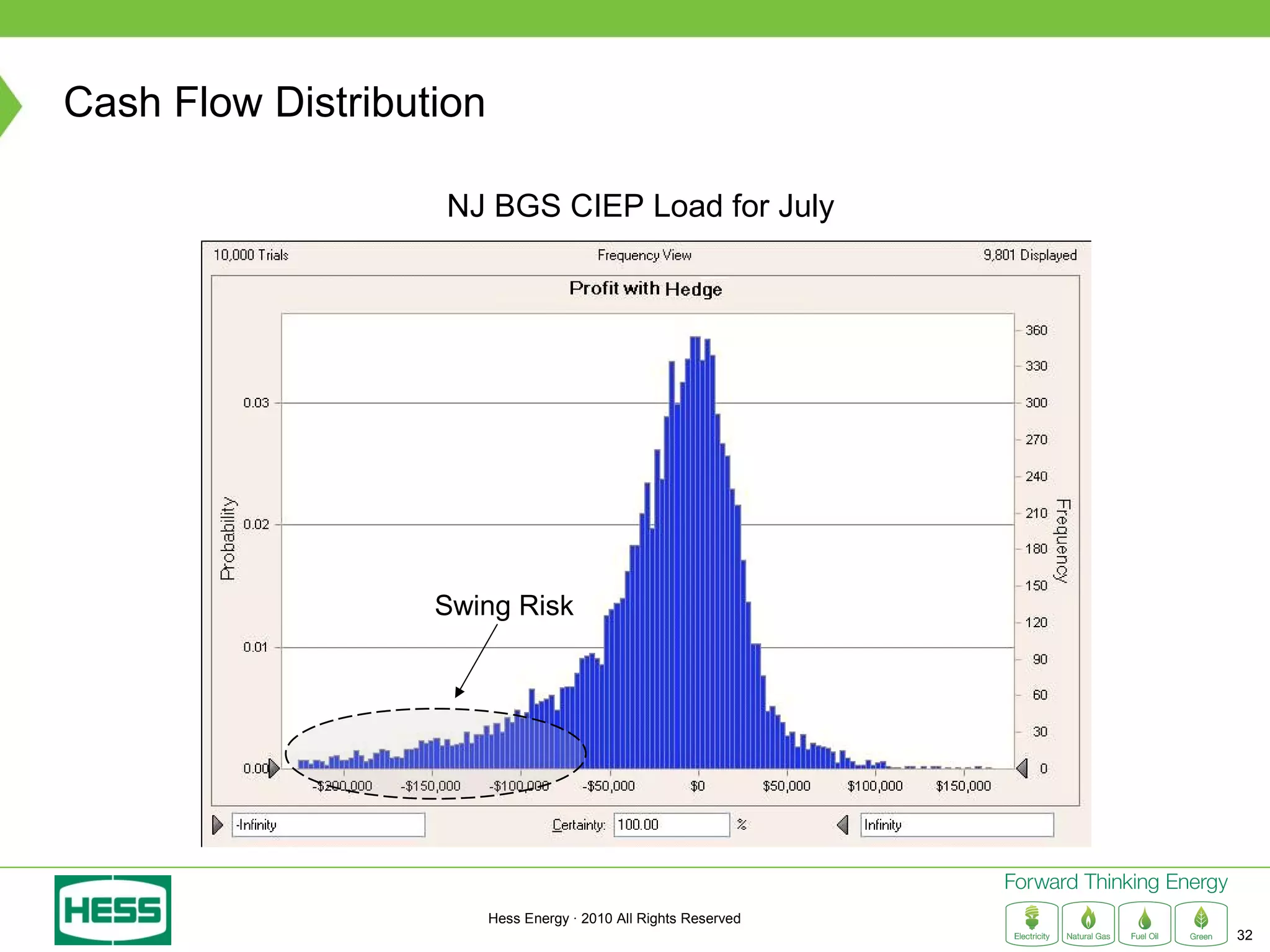
Cash Flow Distribution

                   NJ BGS CIEP Load for July


                   Swing Risk


                         Hess Energy · 2010 All Rights Reserved
                                                                  32
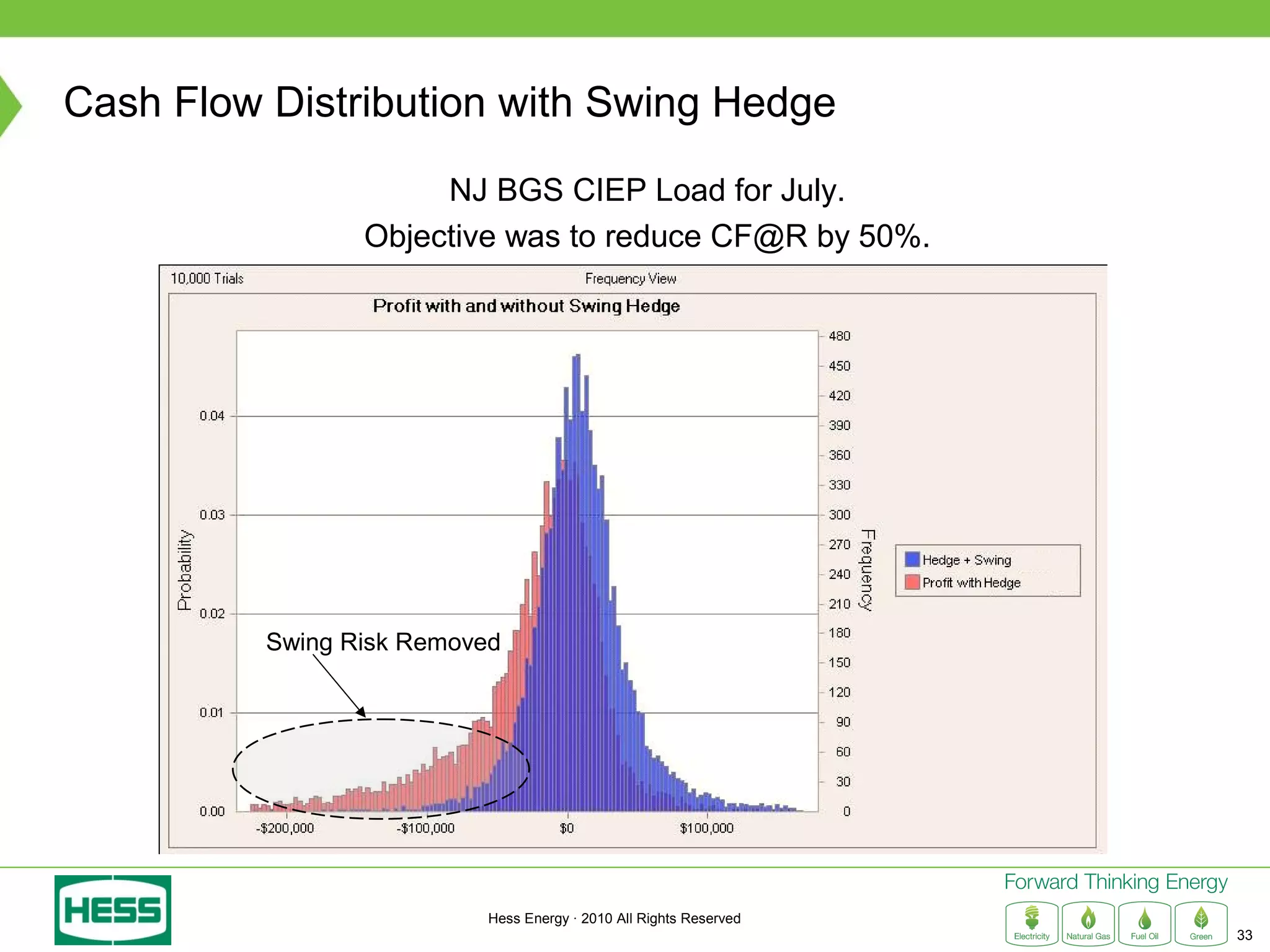
Cash Flow Distribution with Swing Hedge
                      NJ BGS CIEP Load for July.
                 Objective was to reduce CF@R by 50%.


          Swing Risk Removed


                           Hess Energy · 2010 All Rights Reserved
                                                                    33
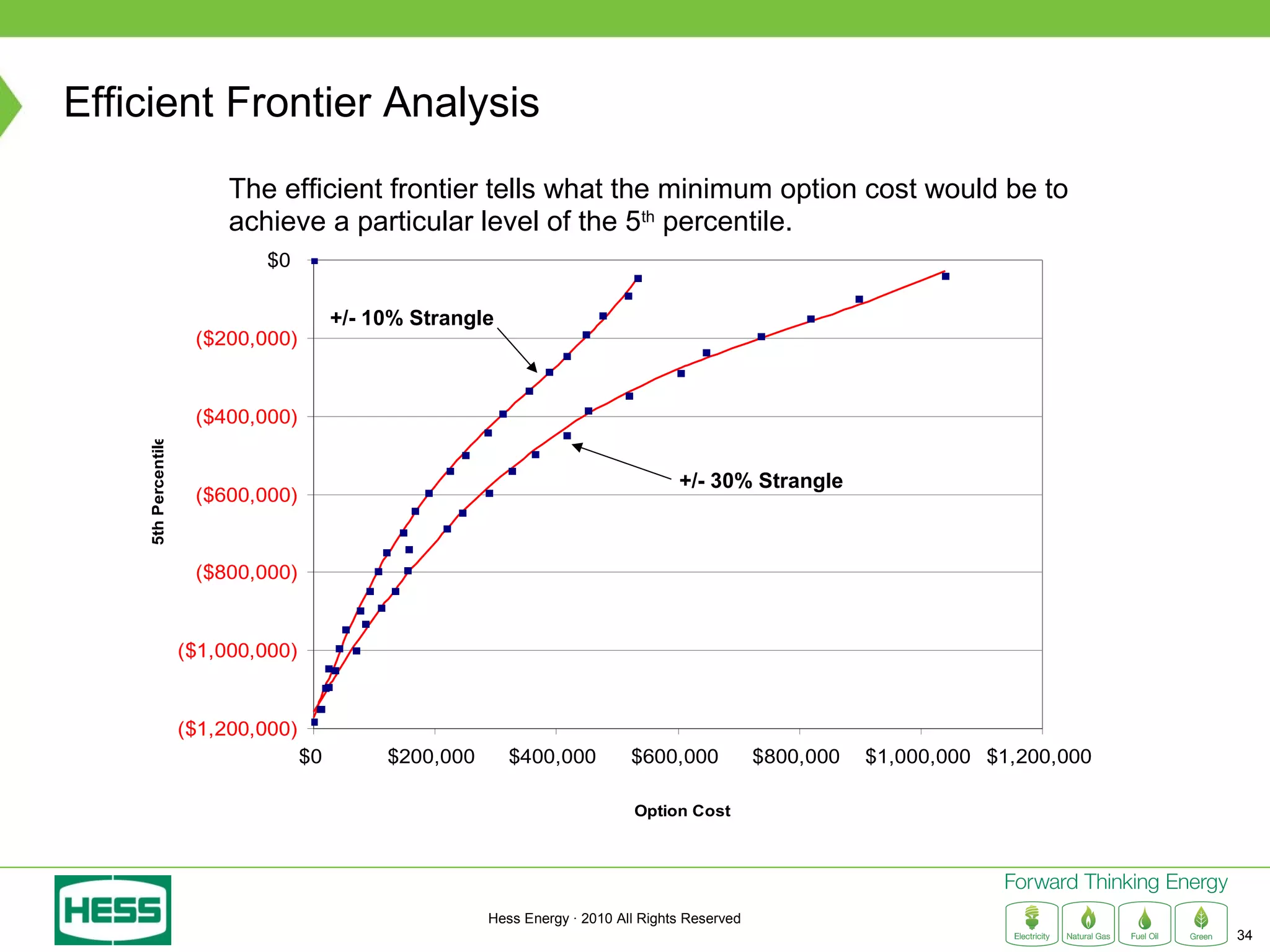
Efficient Frontier Analysis
                          The efficient frontier tells what the minimum option cost would be to
                          achieve a particular level of the 5th percentile.
                             $0

                                         +/- 10% Strangle
                      ($200,000)


                      ($400,000)
    5th Percentile


                                                                                     +/- 30% Strangle
                      ($600,000)


                      ($800,000)


                     ($1,000,000)


                     ($1,200,000)
                                    $0        $200,000      $400,000          $600,000            $800,000   $1,000,000 $1,200,000

                                                                              Option Cost


                                                         Hess Energy · 2010 All Rights Reserved
                                                                                                                                     34
Contact


          Eric Meerdink
          Director of Structuring & Analytics
          Hess Corporation
          One Hess Plaza
          Woodbridge, NJ 07095

          Office: 732-750-6591
          Cell: 732-425-4655
          Email: emeerdink@hess.com


               Hess Energy · 2010 All Rights Reserved
                                                        35

Modeling and Hedging the Risk in Retail Load Contracts

  • 1.
    Modeling and Hedgingthe Risk in Retail Load Contracts Eric Meerdink, Director of Structuring & Analytics May 3, 2011 Hess Energy · 2010 All Rights Reserved 1
  • 2.
    Background on HessCorporation Hess Energy · 2010 All Rights Reserved 2
  • 3.
    Hess: Who Weare Today A Totally Integrated Energy Company RETAIL MARKETING ENERGY TRADING Selling motor fuels and REFINING Hess Energy Trading convenience products at EXPLORATION Processing the Company, a joint retail stores Discovering oil crude oil into venture buying and and gas finished products selling energy financial instruments ENERGY MARKETING Marketing petroleum SUPPLY, TRADING & products, natural gas PRODUCTION & TRANSPORTATION TERMINALS and electricity to DEVELOPMENT Buying, selling and Storing products and commercial, Getting crude oil out of transporting crude oil and distributing fuels to our industrial and utility the ground finished products customers customers Hess Energy · 2010 All Rights Reserved 3
  • 4.
    One of theLargest Energy Suppliers on the East Coast Hess Energy · 2010 All Rights Reserved 4
  • 5.
    Hess Energy: RobustProduct Suite Electricity Natural Gas Fuel Oil Green Suite Marketing to Marketing to Delivery to Commercial Reducing electric Commercial & Commercial & & Industrial customers usage during times of Industrial customers Industrial customers peak demand Distributor sales from 4,500 MWs/hr (RTC ) Wholesale to LDCs Hess terminals Support renewable (enough electricity to energy sources, such power 4 million 1.5 BCF/day 110K BPD as wind, solar, biomass average homes) and hydropower #2 electric marketer on Balance your carbon the east coast impact from oil and natural gas with carbon offsets Hess Energy · 2010 All Rights Reserved 5
  • 6.
    Volumetric Risk inRetail Load Contracts Hess Energy · 2010 All Rights Reserved 6
  • 7.
    What is aFull Requirements Load Following Contract • Full Requirements Load Following: A fixed price agreement to serve all the electricity load of a customer, and provide all products required to supply the electric load, for a pre-determined interval of time, without restrictions on volume. Typically served at a fixed rate per MWH. • Also called Full Plant Requirements Contract. • Typical key products to be supplied: ○ Load Following Energy ○ Capacity ○ Transmission ○ Ancillaries ○ RECs Hess Energy · 2010 All Rights Reserved 7
  • 8.
    Volumetric or SwingRisk • Volumetric or swing risk is defined as a cash flow risk caused by deviations in delivered volumes compared to expected volumes. The primary cause of these volumetric deviations is weather and economic conditions. • Not enough that delivered volumes deviate from expected volumes. ○ These deviations in delivered volumes must be positively correlated with market prices. ○ The full requirements load following contract is delta hedged at some expected volume. • Under these conditions the resulting expected cash flow position is negative and non-linear with respect to changes in market prices. • Swing risk is similar to the gamma position of an option, as it is a second order price risk. Hess Energy · 2010 All Rights Reserved 8
  • 9.
    Figure 1. CorrelationBetween Price and Load 12-Month Rolling Average of Load and Price in PSE&G Zone 5,500 $90.00 $80.00 5,400 $70.00 5,300 $60.00 5,200 $50.00 $/MWH MW $40.00 5,100 MW $30.00 $/MWH 5,000 $20.00 4,900 $10.00 4,800 $0.00 May-06 Sep-06 Jan-07 May-07 Sep-07 Jan-08 May-08 Sep-08 Jan-09 May-09 Sep-09 Jan-10 May-10 Sep-10 Month/Yr Hess Energy · 2010 All Rights Reserved 9
  • 10.
    Figure 2: RetailSale and Long Hedge $ Long Hedge + $/MWH Net: Swing Risk “Gamma” - Short Sale Short Retail Sale Hess Energy · 2010 All Rights Reserved 10
  • 11.
    Figure 3. Changein Cash Flow when Power is Delta Hedged A B C Load greater Load less than Load equals than expected expected load expected load load Price less than 1 expected price - 0 + 2 Price equals expected price 0 0 0 Price greater 3 than expected price + 0 - Swing Risk - - - - - - Long Hedged Short Position Position Hess Energy · 2010 All Rights Reserved 11
  • 12.
    Expected Cost toServe Load and Swing Risk Hess Energy · 2010 All Rights Reserved 12
  • 13.
    Expected Cost toServe Load • Model assumptions: ○ Pi = Actual price in hour i (random variable) ○ Li = Actual load in hour i (random variable) ○ Covi = Covariance between P and L in hour i Cov(Pi,Li). ○ i = hours in the month i = 1,…,N ○ Averages will be denoted with a bar over the variable ○ Expectations will be taken at time t given information available up to and including time t. Referenced by a subscript t. N 1 Pt = N ∑P i =1 t i = Forward Value of Power N 1 Lt = N ∑L i =1 i t = Forward Value of Expected Load Hess Energy · 2010 All Rights Reserved 13
  • 14.
    Expected Cost toServe Load N • Cost to serve load: Cost = ∑P L i =1 i i  N i i • Expected cost to serve load : Et ( Cost ) = Et  P L    i =1   ∑ • Taking expectations and solving we get: Expected block Expected load Expected covariance cost of power. shaping cost. between price and load. ∑(L ) N N (1 Et ( Cost ) = N ⋅ Pt ⋅ Lt + ) i =1 i t − L Pti + t ∑Cov ( P , L ) i =1 i i ( 2) Et ( Cost ) = (1 + SFt ) Pt N Lt SF = Shaping Factor. Ratio of the sum of the expected load shaping cost and expected covariance cost to the expected block cost. Hess Energy · 2010 All Rights Reserved 14
  • 15.
    Hedging the ExpectedCost • Start with the expected cost function, equation (1) and take a Taylor series expansion with respect to prices and loads. N ∂Cti ∂Cti i (3) ∆Costt = ∑( ) i =1 Lit ∆Pti + ∆Lit ( ) Pti + i ∆Pt + i ∆Lt +  ∂Pt i ∂Lt • Where  refers to higher order terms. Neglecting these terms we can write the change in expected cost as:  ∂Pti ∂Cti ∂Pti   N  i ∂Cti  ∂Lit  ∑( ) N =  N ⋅ Lt +   Lit − Lt + i ∂Pt ∂Pt ∂Pt   ∆Pt +   Pt + i    ∂Lt ∑   ∂L  ∆Lt  (3) i =1  i =1   t  Price Hedge Load Hedge The delta on a load following After delta hedging the price risk contract does not equal 1.0 we are left with the first order load risk or Gamma risk. Hess Energy · 2010 All Rights Reserved 15
  • 16.
    Fair Value ofa Load Following Contract • A fair price or fair value contract has an expected value of zero. • Fair value contracts require the inclusion of the expected value of the covariance between price and load, not just the expected hourly shaping cost. Excluding this cost component biases the distribution to the left. • But inclusion of the expected covariance in the contract price does not guarantee that the swing risk has been minimized or removed. It only guarantees that the contract is priced fairly. • We are still left with the negative tail risk from large positively correlated price and load movements – Cash Flow at Risk. Hess Energy · 2010 All Rights Reserved 16
  • 17.
    Figure 4. P&LDistribution: Swing Risk vs. Swing Cost Excluding the expected covariance produces a distribution with a negative expected value. 0.04 0.03 Mean Density 0.02 Negative Skew: 0.01 Swing Risk 0.00 -60 -50 -40 -30 -20 -10 0 10 20 30 Cash Flow Swing Cost Hess Energy · 2010 All Rights Reserved 17 17
  • 18.
    Option Hedge Development Hess Energy · 2010 All Rights Reserved 18
  • 19.
    Figure 5. ShortGamma Hedge − Γ( P ) How do we create this hedge? + Hedge Change in P&L Monthly Average Price $/mwh gamma - Γ( P ) Hess Energy · 2010 All Rights Reserved 19
  • 20.
    Figure 6. Creatinga Gamma Position from Options Use vanilla calls and puts to construct the gamma position. − Γ( P ) + − Γ( P ) ˆ Change in P&L Monthly Average Price $/mwh - Hess Energy · 2010 All Rights Reserved 20
  • 21.
    Solving for theEstimated Gamma Function • Select a series of strikes, Ki , and quantities, θi, to create a portfolio of puts and calls. • To estimate the gamma function we need to choose the amount of options for each strike, θi , so as to minimize the distance between the estimated gamma function and the true gamma function. • Estimated gamma function equals: N M − Γ( P ) = ˆ ∑Max( P − K , 0) ×θ + ∑Max( K i =1 i i i =1 i − P,0 ) ×θi • Choose the optimal quantities by minimizing the sum of the squared errors between the true and estimated gamma function over a set of Q prices. 2 ∑ [Γ( P ) − Γ( P )] Q min ˆ j j θ j =1 Hess Energy · 2010 All Rights Reserved 21
  • 22.
    Theoretical Model • Ithas been shown that a static hedge of plain vanilla options and forwards can be used to replicate any European derivative (Carr and Chou 2002, Carr and Madan 2001). • Any twice continuously differentiable payoff function, f (S ), of the terminal price S can be written as: F0 ∞ f ( S ) = f ( F0 ) + f ′( F0 )( S − F0 ) + ∫ f ′′( K )( K − S ) dK ++ ∫ f ′′( K )( S − K ) + dK 0 F0 Initial Delta Gamma Hedge: “Swing Risk” P&L Position • Our payoff function is the terminal profit. It can be decomposed into a static position in the day 1 P&L, initially costless forward contracts, and a continuum of out-of-the-money options. F0 is the initial forward price. Hess Energy · 2010 All Rights Reserved 22
  • 23.
    Theoretical Model, Cont. •The initial value of the payoff must be the cost of the replicating portfolio. F0 ∞ V0 ( F0 ) = f ( F0 ) e −rT + ∫ f ′′( K ) P ( K , T ) dK + ∫ f ′′( K ) C ( K , T ) dK 0 F0 • Where P(K,T) and C(K,T) are the initial values of out-of-the-money puts and calls respectively. • Interpretation of term within the integral: Second derivative of the payoff function representing the quantity of options bought or sold. ○ R = Fixed revenue rate ○ SF = Shaping Factor ○ L(S) = MWH, function of S (spot price of power) f ( S ) = ( R − (1 + SF ) S ) L( S ) f ′′( K ) = 2 (1 + SF ) ∂L ∂S Hess Energy · 2010 All Rights Reserved 23
  • 24.
    Estimating the GammaFunction • Need to estimate the relationship between load and price. • Use historic data to estimate the following regression equation. 11 11 Load t = α + β lmpt + ∑λ D + ∑φ D lmp i =1 i i i =1 i i t • The data for this equation is average load (peak, off-peak) and average price (peak, off-peak). LMP is the price, D is a monthly dummy variable, and DXLMP is an interactive dummy variable with price. • Next set up a portfolio of a short load sale and a long hedge using monthly forwards. The fixed rate on the load sale equals the RTC cost of serving the load ($/MWH). • Use the relationship estimated in the regression equation to vary the average monthly load with respect to a change in average monthly price. Use this to estimate the gamma function. Hess Energy · 2010 All Rights Reserved 24
  • 25.
    Example Regression OutputOn-Peak PSE&G FP A $1 change is prices equals a 7 MW change in average daily peak load. For July the change equals 19 = 7 + 12. Regression Statistics Multiple R 87.27% R Square 76.16% Adjusted R Square 75.61% Adjusted R2 = 75 %. Standard Error 417.5841127 Observations 445 ANOVA df SS MS F Significance F Regression 10 241771008.8 24177100.88 138.6488552 2.4513E-128 Residual 434 75679397.18 174376.4912 Total 444 317450406 Coefficients Standard Error t Stat P-value Intercept 3,698.5486 64.27 57.55 0.00% LMP 7.1820 0.83 8.64 0.00% Mar_P -4.9284 1.02 -4.81 0.00% Apr_P -6.7488 1.01 -6.68 0.00% May_P -5.8316 0.96 -6.08 0.00% Statistically Jun_P 6.4907 0.73 8.94 0.00% Significant Interactive dummy variables Jul_P 11.8957 0.73 16.30 0.00% Aug_P 10.2282 0.77 13.28 0.00% Sep_P 4.6888 0.84 5.61 0.00% Oct_P -2.2002 0.92 -2.38 1.77% Nov_P -3.5755 0.99 -3.62 0.03% Hess Energy · 2010 All Rights Reserved 25
  • 26.
    Figure 7: Exampleof a Gamma Function Estimate Estimated gamma function for July 2010 PSE&G FP load. The option cost equals $1.89/MWH per MWH served. $20,000 $18,000 $16,000 $14,000 Change in P&L ($000) $12,000 -Gamma $10,000 Estimate $8,000 $6,000 $4,000 $2,000 $0 $0.00 $20.00 $40.00 $60.00 $80.00 $100.00 $120.00 $140.00 -$2,000 Cost as of February 9, 2009. Market Price Hess Energy · 2010 All Rights Reserved 26
  • 27.
    Mitigating Swing Riskin Practice “In theory there is no difference between theory and practice. In practice there is” Yogi Berra Hess Energy · 2010 All Rights Reserved 27
  • 28.
    Minimizing Cash Flowat Risk • In practice we cannot purchase options in such a way as to create the smooth curves depicted earlier. Instead we need to find discrete strikes so as to minimize the “swing risk”. • Swing risk is here defined as Cash Flow at Risk (CF@R). CF@R is the expected loss assuming that all contracts are taken to delivery. I am defining CF@R as the difference between the mean of the distribution and the 5th percentile. • Since we cannot perfectly hedge the swing risk by purchasing a continuum of options we need another objective risk minimization strategy. • Use as a strategy the minimization of the CF@R or an objective level for the CF@R. An example would be to reduce the CF@R by 50%. Hess Energy · 2010 All Rights Reserved 28
  • 29.
    Reduce Cash Flowat Risk 0.06 Accountnig or Actuarial w ith Options 0.05 Accounting Model Hedged with Options 0.04 Delta Hedged Densit y 0.03 0.02 Swing Risk Reduced 0.01 0.00 -50 -40 -30 -20 -10 0 10 20 30 CashXFlow Hess Energy · 2010 All Rights Reserved 29
  • 30.
    Methodology • Use MonteCarlo simulation to model the load following contract and all hedges. • Model takes into account the relationship between price and load, volatilities and correlations. • Run the model to estimate the expected cost to serve the load and establish the fair price of the contract. • Layer in delta hedges to estimate the cash flow distribution and estimate the CF@R. • Determine the amount of risk to be minimized. This is a management decision. Cut the CF@R by 50%. • Determine the portfolio of available options in the market. • Use an available optimization routine to determine the optimal option portfolio that meets the required risk criteria. Hess Energy · 2010 All Rights Reserved 30
  • 31.
    Simulated Gamma Position Example uses NJ BGS CIEP Load for July. $400,000 Approximately 80 MWs average load on-peak. $200,000 $0 ($200,000) ($400,000) Total P&L ($600,000) ($800,000) ($1,000,000) ($1,200,000) ($1,400,000) ($1,600,000) $0 $50 $100 $150 $200 $250 $300 $350 Average On-Peak LMP Hess Energy · 2010 All Rights Reserved 31
  • 32.
    Cash Flow Distribution NJ BGS CIEP Load for July Swing Risk Hess Energy · 2010 All Rights Reserved 32
  • 33.
    Cash Flow Distributionwith Swing Hedge NJ BGS CIEP Load for July. Objective was to reduce CF@R by 50%. Swing Risk Removed Hess Energy · 2010 All Rights Reserved 33
  • 34.
    Efficient Frontier Analysis The efficient frontier tells what the minimum option cost would be to achieve a particular level of the 5th percentile. $0 +/- 10% Strangle ($200,000) ($400,000) 5th Percentile +/- 30% Strangle ($600,000) ($800,000) ($1,000,000) ($1,200,000) $0 $200,000 $400,000 $600,000 $800,000 $1,000,000 $1,200,000 Option Cost Hess Energy · 2010 All Rights Reserved 34
  • 35.
    Contact Eric Meerdink Director of Structuring & Analytics Hess Corporation One Hess Plaza Woodbridge, NJ 07095 Office: 732-750-6591 Cell: 732-425-4655 Email: emeerdink@hess.com Hess Energy · 2010 All Rights Reserved 35

Editor's Notes

  • #4 Let’s talk about how all of these milestones made us into the company we are today. Hess is a totally integrated energy company. You can see the breadth and depth of our offerings and expertise. Today I’m here to talk to you about the Energy Marketing side of the business and what we can do for you.
  • #5 We are one of the largest suppliers on the east coast and can offer you service where you are in business.
  • #6 A quick glimpse at the commodities we can provide for you – we offer electricity, natural gas, fuel oil and a number of green energy solutions for your business. We will share more about our products in subsequent slides. Up to the account manager what points to highlight, based on customer he/she is meeting with