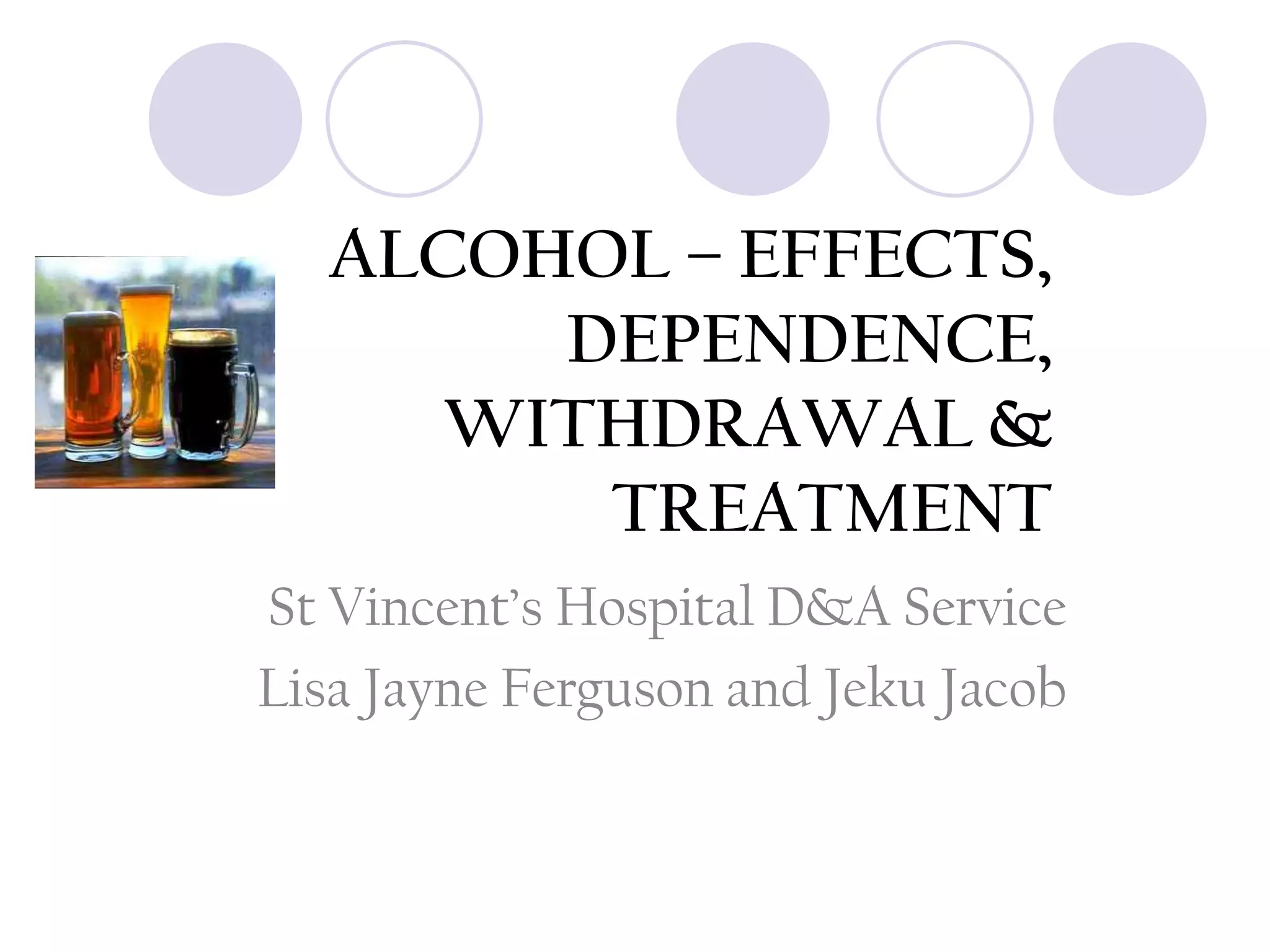
ALCOHOL – EFFECTS,
DEPENDENCE,
WITHDRAWAL &
TREATMENT
St Vincent’s Hospital D&A Service
Lisa Jayne Ferguson and Jeku Jacob
Alcohol
 CNS depressant: acting at several sites in brain
Enhances GABA activity
Stimulates serotonin receptor = pleasure & nausea
Stimulates dopamine and opioid receptors = euphoria
& reinforcement
 Provides kilojoules or energy but NO nutritional value

 Is a toxin to multiple organs
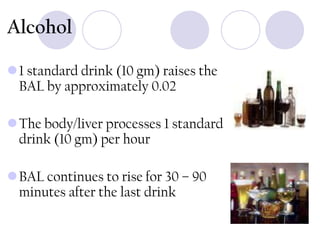
Alcohol
1 standard drink (10 gm) raises the
BAL by approximately 0.02
The body/liver processes 1 standard
drink (10 gm) per hour
BAL continues to rise for 30 – 90
minutes after the last drink
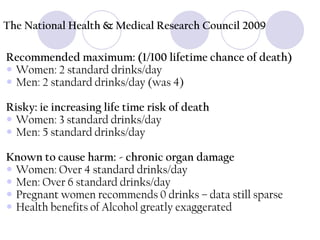
The National Health & Medical Research Council 2009

Recommended maximum: (1/100 lifetime chance of death)
 Women: 2 standard drinks/day
 Men: 2 standard drinks/day (was 4)
Risky: ie increasing life time risk of death
 Women: 3 standard drinks/day
 Men: 5 standard drinks/day
Known to cause harm: - chronic organ damage
 Women: Over 4 standard drinks/day
 Men: Over 6 standard drinks/day
 Pregnant women recommends 0 drinks – data still sparse
 Health benefits of Alcohol greatly exaggerated
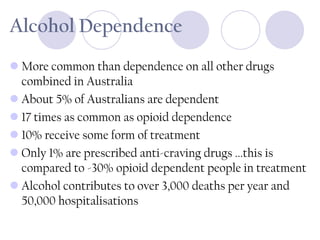
Alcohol Dependence
 More common than dependence on all other drugs
combined in Australia
 About 5% of Australians are dependent
 17 times as common as opioid dependence
 10% receive some form of treatment
 Only 1% are prescribed anti-craving drugs ...this is
compared to -30% opioid dependent people in treatment
 Alcohol contributes to over 3,000 deaths per year and
50,000 hospitalisations
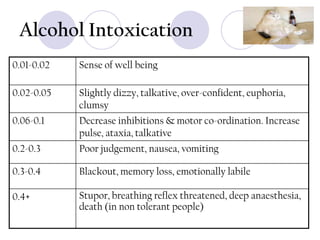
Alcohol Intoxication
0.01-0.02

Sense of well being

0.02-0.05

Slightly dizzy, talkative, over-confident, euphoria,
clumsy

0.06-0.1

Decrease inhibitions & motor co-ordination. Increase
pulse, ataxia, talkative

0.2-0.3

Poor judgement, nausea, vomiting

0.3-0.4

Blackout, memory loss, emotionally labile

0.4+

Stupor, breathing reflex threatened, deep anaesthesia,
death (in non tolerant people)
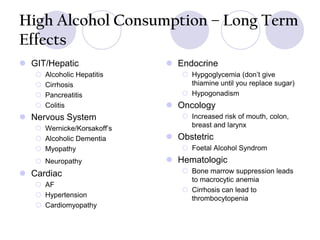
High Alcohol Consumption – Long Term
Effects
 GIT/Hepatic





Alcoholic Hepatitis
Cirrhosis
Pancreatitis
Colitis

 Nervous System

 Endocrine
 Hypgoglycemia (don’t give
thiamine until you replace sugar)
 Hypogonadism

 Oncology
 Increased risk of mouth, colon,
breast and larynx

 Wernicke/Korsakoff’s
 Alcoholic Dementia
 Myopathy

 Obstetric

 Neuropathy

 Hematologic

 Cardiac
 AF
 Hypertension
 Cardiomyopathy

 Foetal Alcohol Syndrom
 Bone marrow suppression leads
to macrocytic anemia
 Cirrhosis can lead to
thrombocytopenia
Alcohol Related
Presentations to ED
Common Presentations
 Pt can usually come in complaining of withdrawal symptoms.
 Hallucinations
 Tremors
 Sweats
 Anxiety
 Perceptual disturbances
 Seizures
 Hemetemesis
 Abdominal Pain
 Falls
 Palpitations
 Productive Cough
 Jaundice
 Feeling unwell
 Intoxication
 Trauma/ Violence
History taking
 Please take a good history
 Try to quantify alcohol use to grams/SD
 How often they drink (try to take a day history)
 Last drink?
 Age of starting drinking
 Reasons why drinking was exacerbated
 ?Depression/Suicidality
 Social Situation
 Any other substances of misuse
 Please exclude other causes of presentation
Physical Findings
 Signs of Chronic Liver Disease
 In withdrawal
Anxious
Sweaty
Tachycardic and Hypertensive
Tremulous
 Wernicke’s: confused, ataxic and opthalmoplegic
 Malnourished
 Encephalopathic if CLD
Investigations










UDS
BAC
BSL
FBC – may show macrocytic Anemia
UEC, LFTS, CMP
B12 + folate – usually deficient
INR - caogulopathy
CT brain if history of fall/seizures or ataxic
U/S abdomen if you suspect CLD
Management
Hydrate
Thiamine (BEFORE GLUCOSE) – youll
never go wrong with giving more
300 mg tds iv please to start on all intoxicated
pts
500 mg tds iv if you suspect wernicke’s

Glucose in thiamine deficiency precipitates
wernicke’s
Replace Sugar please if glycopenic
Replace Electrolytes
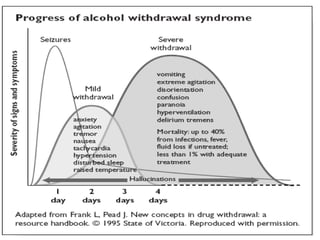
Alcohol Withdrawal
Is a syndrome of central nervous system hyperactivity
Onset
 Usually between 6-24 hours after last regular dose of
alcohol (symptoms occur as blood alcohol concentration
decreases)
Duration
 Between 2-7 days (most commonly 4-5 days)
 Residual symptoms will last longer when brain injury is
involved
Rationale
 Withdrawal symptoms can range from mildly
uncomfortable to life threatening
 Symptoms can be prevented or alleviated
 Early intervention can reduce or prevent progression to
severe withdrawal, injury, dehydration or seizures
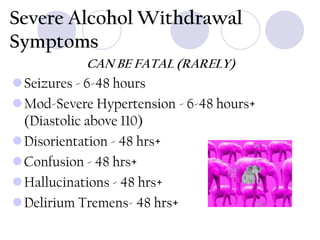
Severe Alcohol Withdrawal
Symptoms
CAN BE FATAL (RARELY)

Seizures - 6-48 hours
Mod-Severe Hypertension - 6-48 hours+
(Diastolic above 110)
Disorientation - 48 hrs+
Confusion - 48 hrs+
Hallucinations - 48 hrs+
Delirium Tremens- 48 hrs+
Alcohol Withdrawal Scales
 The most systematic & useful way to measure
the severity of withdrawal is to use a
withdrawal scale
 These provide a baseline against which changes
in withdrawal severity may be measured over
time
 Research shows that the use of scales minimises
both under-dosing & overdosing with
benzodiazepines for alcohol withdrawal
syndromes
AWS
 Please do not start AWS prematurely
 Calculate when BAC will return to normal, then start
 (Pt’s may go into withdrawal prior to this – clinical
perogative necessary)
 AWS not diagnostic...make diagnosis of withdrawal first
before instituting
 5 – 10 mg every 4 hours with a cap of 80 mg in the first
24 hours
 Can get 120 mg in first 24 hours if appropriate
Perceptual disturbances/
Hallucinations in withdrawal
Curtains/floor/furniture moving
‘Insects over skin’
Hallucinations rarer and signify severity of
withdrawal
colour changes
Animal forms
Scary

These require antipsychotics
Olanzapine
Special Considerations
Use Oxazepam (7.5-45mg) if:
Cirrhosis

Be careful with doses of BZD
Elderly
Head injury

Stay away from BZD if delerious, use
antipsychotics instead
Difficulty in encepholapathy  use
lactulose!
Gorman House
 Pts in ED who don’t require admission can be
rehydrated, given thiamine and discharged
 Gorman House is appropriate for detoxification
 Gorman House – 5/7 program
 Pts need to be discharged on weaning diazepam
 Day 1 – 10mg qid
 Day 2 – 10 mg tds
 Day 3 – 10 mg bd
 Day 4 – 10 mg daily
Wernicke-Korsakoff Syndrome
 Form of brain injury resulting from thiamine
deficiency
 If not treated early it can lead to permanent brain
damage & memory loss
 Signs & symptoms of Wernicke’s encephalopathy
(usually the first stage of the syndrome) =
1. Ophthalmoplegia (reduced eye movements) or
Nystagmus (dancing eyes)
2. Ataxia
3. Confusion
Wernicke-Korsakoff Syndrome
 This condition is reversible if recognised and treated
with parenteral vitamin B1
 Parenteral thiamine should be administered before
any form of glucose
 Glucose in the presence of thiamine deficiency risks
precipitating Wernicke’s encephalopathy
 Korsakoff’s by itself : confabulation, amnesia and apathy
 (ask: ‘do you remember me?’ Or ‘where did we meet
before’
Wernicke-Korsakoff Syndrome
 NB: Studies have shown that the absorption of PO
thiamine in alcohol dependent patients is minimal to
none!!!
 Example of dosing regime:
 Thiamine 300mg tds IVI / IMI for 3/7’s , then PO
 If WE established: Thiamine dose should be increased
Potential Problems
 High doses of Diazepam should not be used to treat
alcohol related delirium
 Diazepam can precipitate and cause delirium
 Olanzapine/Haloperidol can lower seizure threshold

 AWS should only be used for Alcohol, not opioid or
benzodiazepine withdrawal
Treatment Options for Patients
 Follow up with outpatient services / Tx –
- 1:1 counselling (public & private),
- Groups (SMART Recovery, AA’s)
- Residential Rehab,
- Pharmacotherapy‘s
* Impaired Cognition (Moderate-Severe)
1. Cognistat /Neuropsych Assessment
2. Guardianship /Inebriates Act
3. Placement?????
Take Home Messages
Take a good alcohol history
Don’t start the AWS too early
Please replace thiamine iv before glucose
(at least one dose)
 AWS not diagnostic – pt not improving,
consider alternative diagnosis
SVH A&D Service

THANK YOU 

Etoh[1]

  • 1.
    ALCOHOL – EFFECTS, DEPENDENCE, WITHDRAWAL& TREATMENT St Vincent’s Hospital D&A Service Lisa Jayne Ferguson and Jeku Jacob
  • 2.
    Alcohol  CNS depressant:acting at several sites in brain Enhances GABA activity Stimulates serotonin receptor = pleasure & nausea Stimulates dopamine and opioid receptors = euphoria & reinforcement  Provides kilojoules or energy but NO nutritional value  Is a toxin to multiple organs
  • 3.
    Alcohol 1 standard drink(10 gm) raises the BAL by approximately 0.02 The body/liver processes 1 standard drink (10 gm) per hour BAL continues to rise for 30 – 90 minutes after the last drink
  • 4.
    The National Health& Medical Research Council 2009 Recommended maximum: (1/100 lifetime chance of death)  Women: 2 standard drinks/day  Men: 2 standard drinks/day (was 4) Risky: ie increasing life time risk of death  Women: 3 standard drinks/day  Men: 5 standard drinks/day Known to cause harm: - chronic organ damage  Women: Over 4 standard drinks/day  Men: Over 6 standard drinks/day  Pregnant women recommends 0 drinks – data still sparse  Health benefits of Alcohol greatly exaggerated
  • 5.
    Alcohol Dependence  Morecommon than dependence on all other drugs combined in Australia  About 5% of Australians are dependent  17 times as common as opioid dependence  10% receive some form of treatment  Only 1% are prescribed anti-craving drugs ...this is compared to -30% opioid dependent people in treatment  Alcohol contributes to over 3,000 deaths per year and 50,000 hospitalisations
  • 6.
    Alcohol Intoxication 0.01-0.02 Sense ofwell being 0.02-0.05 Slightly dizzy, talkative, over-confident, euphoria, clumsy 0.06-0.1 Decrease inhibitions & motor co-ordination. Increase pulse, ataxia, talkative 0.2-0.3 Poor judgement, nausea, vomiting 0.3-0.4 Blackout, memory loss, emotionally labile 0.4+ Stupor, breathing reflex threatened, deep anaesthesia, death (in non tolerant people)
  • 7.
    High Alcohol Consumption– Long Term Effects  GIT/Hepatic     Alcoholic Hepatitis Cirrhosis Pancreatitis Colitis  Nervous System  Endocrine  Hypgoglycemia (don’t give thiamine until you replace sugar)  Hypogonadism  Oncology  Increased risk of mouth, colon, breast and larynx  Wernicke/Korsakoff’s  Alcoholic Dementia  Myopathy  Obstetric  Neuropathy  Hematologic  Cardiac  AF  Hypertension  Cardiomyopathy  Foetal Alcohol Syndrom  Bone marrow suppression leads to macrocytic anemia  Cirrhosis can lead to thrombocytopenia
  • 8.
  • 9.
    Common Presentations  Ptcan usually come in complaining of withdrawal symptoms.  Hallucinations  Tremors  Sweats  Anxiety  Perceptual disturbances  Seizures  Hemetemesis  Abdominal Pain  Falls  Palpitations  Productive Cough  Jaundice  Feeling unwell  Intoxication  Trauma/ Violence
  • 10.
    History taking  Pleasetake a good history  Try to quantify alcohol use to grams/SD  How often they drink (try to take a day history)  Last drink?  Age of starting drinking  Reasons why drinking was exacerbated  ?Depression/Suicidality  Social Situation  Any other substances of misuse  Please exclude other causes of presentation
  • 11.
    Physical Findings  Signsof Chronic Liver Disease  In withdrawal Anxious Sweaty Tachycardic and Hypertensive Tremulous  Wernicke’s: confused, ataxic and opthalmoplegic  Malnourished  Encephalopathic if CLD
  • 12.
    Investigations          UDS BAC BSL FBC – mayshow macrocytic Anemia UEC, LFTS, CMP B12 + folate – usually deficient INR - caogulopathy CT brain if history of fall/seizures or ataxic U/S abdomen if you suspect CLD
  • 13.
    Management Hydrate Thiamine (BEFORE GLUCOSE)– youll never go wrong with giving more 300 mg tds iv please to start on all intoxicated pts 500 mg tds iv if you suspect wernicke’s Glucose in thiamine deficiency precipitates wernicke’s Replace Sugar please if glycopenic Replace Electrolytes
  • 14.
    Alcohol Withdrawal Is asyndrome of central nervous system hyperactivity Onset  Usually between 6-24 hours after last regular dose of alcohol (symptoms occur as blood alcohol concentration decreases) Duration  Between 2-7 days (most commonly 4-5 days)  Residual symptoms will last longer when brain injury is involved
  • 15.
    Rationale  Withdrawal symptomscan range from mildly uncomfortable to life threatening  Symptoms can be prevented or alleviated  Early intervention can reduce or prevent progression to severe withdrawal, injury, dehydration or seizures
  • 17.
    Severe Alcohol Withdrawal Symptoms CANBE FATAL (RARELY) Seizures - 6-48 hours Mod-Severe Hypertension - 6-48 hours+ (Diastolic above 110) Disorientation - 48 hrs+ Confusion - 48 hrs+ Hallucinations - 48 hrs+ Delirium Tremens- 48 hrs+
  • 18.
    Alcohol Withdrawal Scales The most systematic & useful way to measure the severity of withdrawal is to use a withdrawal scale  These provide a baseline against which changes in withdrawal severity may be measured over time  Research shows that the use of scales minimises both under-dosing & overdosing with benzodiazepines for alcohol withdrawal syndromes
  • 19.
    AWS  Please donot start AWS prematurely  Calculate when BAC will return to normal, then start  (Pt’s may go into withdrawal prior to this – clinical perogative necessary)  AWS not diagnostic...make diagnosis of withdrawal first before instituting  5 – 10 mg every 4 hours with a cap of 80 mg in the first 24 hours  Can get 120 mg in first 24 hours if appropriate
  • 20.
    Perceptual disturbances/ Hallucinations inwithdrawal Curtains/floor/furniture moving ‘Insects over skin’ Hallucinations rarer and signify severity of withdrawal colour changes Animal forms Scary These require antipsychotics Olanzapine
  • 21.
    Special Considerations Use Oxazepam(7.5-45mg) if: Cirrhosis Be careful with doses of BZD Elderly Head injury Stay away from BZD if delerious, use antipsychotics instead Difficulty in encepholapathy  use lactulose!
  • 22.
    Gorman House  Ptsin ED who don’t require admission can be rehydrated, given thiamine and discharged  Gorman House is appropriate for detoxification  Gorman House – 5/7 program  Pts need to be discharged on weaning diazepam  Day 1 – 10mg qid  Day 2 – 10 mg tds  Day 3 – 10 mg bd  Day 4 – 10 mg daily
  • 23.
    Wernicke-Korsakoff Syndrome  Formof brain injury resulting from thiamine deficiency  If not treated early it can lead to permanent brain damage & memory loss  Signs & symptoms of Wernicke’s encephalopathy (usually the first stage of the syndrome) = 1. Ophthalmoplegia (reduced eye movements) or Nystagmus (dancing eyes) 2. Ataxia 3. Confusion
  • 24.
    Wernicke-Korsakoff Syndrome  Thiscondition is reversible if recognised and treated with parenteral vitamin B1  Parenteral thiamine should be administered before any form of glucose  Glucose in the presence of thiamine deficiency risks precipitating Wernicke’s encephalopathy  Korsakoff’s by itself : confabulation, amnesia and apathy  (ask: ‘do you remember me?’ Or ‘where did we meet before’
  • 25.
    Wernicke-Korsakoff Syndrome  NB:Studies have shown that the absorption of PO thiamine in alcohol dependent patients is minimal to none!!!  Example of dosing regime:  Thiamine 300mg tds IVI / IMI for 3/7’s , then PO  If WE established: Thiamine dose should be increased
  • 26.
    Potential Problems  Highdoses of Diazepam should not be used to treat alcohol related delirium  Diazepam can precipitate and cause delirium  Olanzapine/Haloperidol can lower seizure threshold  AWS should only be used for Alcohol, not opioid or benzodiazepine withdrawal
  • 27.
    Treatment Options forPatients  Follow up with outpatient services / Tx – - 1:1 counselling (public & private), - Groups (SMART Recovery, AA’s) - Residential Rehab, - Pharmacotherapy‘s * Impaired Cognition (Moderate-Severe) 1. Cognistat /Neuropsych Assessment 2. Guardianship /Inebriates Act 3. Placement?????
  • 28.
    Take Home Messages Takea good alcohol history Don’t start the AWS too early Please replace thiamine iv before glucose (at least one dose)  AWS not diagnostic – pt not improving, consider alternative diagnosis
  • 29.

Editor's Notes

  • #8 Alcohol abuse can cause the small pancreatic ducts to become clogged. It's also unclear how alcohol damages the pancreas. One theory is that excessive alcohol leads to protein plugs - precursors to small stones - that form in the pancreas and block parts of the pancreatic duct. Another theory is that alcohol directly injures pancreatic tissues