Dr Pritam Biswas
Alcohol
Dependence
As we go along
 Introduction
 History
 Problem statement
 Pharmacology of Alcohol
 Dependence - Clinical criteria
-Mechanism of dependence
 Pharmacotherapy of alcohol dependence
 Newer targets
 Non Pharmacological Management
 Conclusion
Ethanol
 Fermentation – Sugar to Alcohol and
Carbon dioxide
 C6H12O6→ 2(CH3-CH2-OH) + 2CO2
(Yeasts +sugar + water = CO2 + ethanol)
Molasses –commercial source
Alcoholic beverages
 Malted Liquors:
Fermentation of germinating cereals
Barley – Beers (3-6%)
 Wines:
Fermentation of Natural Sugars – grapes, apples
and other fruits
 No distillation, <15%
 Fortified (port) – up to 22%
 Champagne – 12-16% (effervescent wine)
 Spirits – Rum, Whisky, Brandy and Gin
 40 - 55% v/v
History of alcohol use
 Neolithic period10,000 BC
Hunan, China.
 Greeks, Egyptians. circa 3000 BC
Rome , circa 2000 B.C
 Bacchus, God of wine
India circa 2000 B.C
 Sura, (rice meal, wheat, sugar cane, grapes, and
other fruits)
 Popular among the Kshatriya warriors.
 Favorite drink of God Indira
History of Pharmacotherapy
Problem statement
Pharmacokinetics: Absorption
 Rapidly absorbed primarily from duodenum
 Rate of absorption is extremely variable
 Peak blood alcohol concentration (BAC) depends on:
 Amount and alcohol concentration of beverage
 Rate of drinking
 Food consumption and composition
 Gastric emptying and gastric metabolism
 Hepatic first pass
Effect of food on absorption
120
0
20
40
60
80
100
0
20
50
60
100
120
140
200
220
250
300
Time
BloodAlcoholConcentration Empty stomach
With food in stomach
Distribution
 Volume of distribution = Total Body Water
0.5-0.7L/kg
 Gender Differences in body composition
women – achieve higher blood alcohol levels
Metabolism
 Metabolism
 90-98% metabolized in liver
Alcohol Acetaldehyde Acetate
 Apparent zero-order kinetics at moderate BACs
 Alcohol Elimination Rate = 7 g per hr
 8-12ml/hr
Alcohol
Dehydrogenase-75%
Aldehyde
Dehydrogenase 75%
MFO -25% Aldehyde
oxidase 25%
Metabolism
 Metabolism
Alcohol Acetaldehyde Acetate
 Aldehyde dehydrogenase usually not rate-limiting
 Accumulation of acetaldehyde associated with headache,
gastritis, nausea, dizziness (hangover)
Alcohol
dehydrogenase
Aldehyde
Dehydrogenase 75%
Aldehyde
oxidase 25%
Metabolism: Genetic Variation
Genetic variation in alcohol metabolizing enzymes
 Alcohol Dehydrogenase (ADH)
 Polymorphism occurs at ADH2 and ADH3 loci
ADH2*1 ADH2*2 ADH2*3 ADH3*1 ADH3*2
White 95% <5% <5% 50% 50%
Black 85% <5% 15% 85% 15%
Asian 15% 85% <5% 95% 5%
 15% of Black have ADH2*3 allele  increased alcohol metabolic
rate
Metabolism: Genetic Variation
Genetic variation in alcohol metabolizing enzymes
 Aldehyde Dehydrogenase (ALDH)
 Polymorphism at the ALDH2 gene
 50% of Asians have ALDH2*2 allele
 decreased elimination of acetaldehyde (and
alcohol)
 flushing response
Elimination
 Elimination of alcohol from the blood:
 Follows zero-order kinetics
 Ranges from 7-10 g /hour
 Average rate of elimination is 8-12 ml/hour
• coffee
• sleep
• exercise
• eating
• showering
• fresh air
Acute Effects of alcohol consumption
 CNS: depressant – dose dependent manner
Plasma concentration Expected effects
50 – 100 mg/dl Anxiolytic, euphoria and excitation, inhibitions
are lost
Impaired judgment – mood and feelings are
altered, driving skills
100 -150 mg/dl
Gross drunkenness
Mental clouding, ataxia, disorganization of
thought and impairment of memory and
drowsiness
Slurring of speech, loss of judgment and
motor skills , drunken gait
200 – 300 mg/dl Emesis ,Stupor and unconsciousness
> 300mg/dl Coma , respiratory and cvs depression ,
>500mg/dl Death
.
 CVS:
 Small doses – cutaneous vasodilatation, flushing
 Medium dose – tachycardia and mild rise in BP
 Large dose - Vasodilatation due to direct vascular
smooth muscle dilatation and vasomotor centre
depression
 Respiration:
 Stimulation of Respiration – by irritation of pharyngeal
and buccal mucosa
 Central action – depression
Kidney: Diuresis – increased water ingestion and
inhibition of ADH
Uterus: Relaxation of uterine muscles
Endocrine:
Low dose – Adrenaline release and
hyperglycemia
High dose – Hypoglycemia
GIT:
 at low doses - stimulate GI
secretion direct action on
gastrin secretion
 Higher doses inhibit GI
secretion
 Acute consumption –
pylorospasm, gastritis,
vomiting, reflux etc
 Mallory-Weiss lesion
Effects of chronic alcohol
consumption
CVS
Dilated cardiomyopathy with
Ventricular hypertrophy
Arhrythmias
Liver GIT
Hepatitis/fibrosis
Panceratitis
Nutritional deficiencies
Blood
Moderate drinking increases
HDL- level Decrease in LDL
oxidation
Megaloblastic anemia
Iron deficiency anemia
Endocrine
Testicular atrophy
Pseudo cushings
syndrome
Neurotoxicity
Wernike korsakoff
Peripheral Neuropathies
Dementia
Decreased immune function –
pneumonias
Alters uric acid metabolism
Fetal development
Amenorrhea
Second trimester Spontaneous abortions
Fetal alcohol syndrome
Alcohol related
neurodevelopement
disorder
Neuropharmacology of alcohol
dependence
 Effects on GABA system
 Interaction with GABA-A receptor and facilitation of
GABA transmission
 Sedative and anxiolytic effects
On chronic administration
Decreased number of GABA A
 Withdrawal Rebound
hyperexitability
Neuropharmacology: NMDA, 5HT
 Effects on NMDA Glutamate system
 Blockage of NMDA receptor (allosteric effect)
 Sedative/hypnotic effects
Up-regulated in chronic use
Withdrawal-Hyperexitability
 Effects on Serotonin system
 Neuroadaptation, aversion
 Effects on stress hormones
 Stress response CRF (corticotrophin releasing
factor).
Increase dopamine in mesocorticolimbic system
Reinforcing, rewarding effects
Activation of mesocorticolimbic system
Alcohol as a Reinforcer
 Reinforcer: a substance whose pharmacological
effects drive the user to continue to use it.
 Positive reinforcing effects:
 Gain pleasure
 Altered consciousness
 Conform to behavior of peers
 Negative reinforcing effects:
 Relief of stress and negative emotions
 Relief of withdrawal symptoms
Neuropharmacology Opioids
 Effects on Opioid
peptide system
 Activation of opioid
peptide system
 Reinforcing and
rewarding effects
(Mu)
 Aversion (Kappa)
 Craving
Neuropharmacology
Experience Transmitter/Receptor
euphoria/pleasure Dopamine, Opioids
anxiolysis/ataxia  GABA
sedation/amnesia  GABA +  NMDA
nausea 5HT3
neuroadaptation NMDA, 5HT
stress CRF
withdrawal GABA, NMDA ( Ca, Mg)
Tolerance: Significance
 One of the determinants of increased alcohol
consumption
 Diagnostic criteria for alcoholism by DSM-IV
 Cross-tolerance to other depressant drugs
Cellular adaptive
Pharmacokinetic –Gastric induration ,
Mixed function oxidases
DSM 4 Criteria
DSM 5 2013 – “Alcohol use disorder”
Mild 1-2
Moderate
3-4
Severe 4-5
Any 2
Pharmacotherapy of alcohol
dependence
Management of Alcohol
dependence
Treatment of acute intoxication
Treatment of withdrawal syndrome
Approved by FDA
Treatment of Alcohol
Dependence
 Disulfiram 1949
 Naltrexone 1994
 Acamprosate 2004
 Long-Acting Naltrexone
2006
 Selective
Serotonin
Reuptake
Inhibitors (SSRIs)
 Ondansetron
 Topiramate
Others
Disulfiram
Mechanism of action
 Inhibits metabolism of alcohol
by blocking acetaldehyde
dehydrogenase Erik Jacobsen, Jens Hald
1948
Distressing Aldehyde syndrome 10 mins after
alcohol
flushing, burning sensation, throbbing
headache, perspiration, dizziness,
vomiting, visual disturbance, mental
confusion, fainting and circulatory collapse
Dose : To a motivated patient
 500 mg OD for 1-2 weeks
 Maintenance 250 mg /day- till patient regains self control
Absorption : oral ,
Metabolism Hepatic 90%
CYP2C9,CYP2E1
Elimination feces and exhaled
gases
Adverse effects
Fatigue
Headache
Metallic aftertaste
Acneform Rash
Polyneuritis
Hepatitis
Psychotic disorders
Contraindications
1.Alcohol intoxicated
2.Without patients knowledge
3.Alcohol containing products
4.Cardiac disease
5.Coronary occlusion
6. Psychosis
Other drugs causing Disulfiram like reaction
Metronidazole,tinidazole
Nitofurantoin
Cephalosporins - cefoperazone ,cefotetan
Griseofulvin,
First-generation sulfonylureas, e.g. Tolbutamide .
Research in other areas
Anticancer activity
Disulfiram copper complex
Proteosome inhibitor
NF-KB-inhibiting activity
Research in other areas
Mechanism
Inhibition of dopamine hydroxylase
Naltrexone
Opioid receptor antagonist
 There is evidence that naltrexone blocks activation by
alcohol of dopaminergic pathways in the brain that are
thought to be critical to reward
 Blunts the pleasurable “high ”
 Maintain abstinence by reducing the “ craving ” and
increasing control when a "slip" occurs.
Indicated : Alcohol dependence in patients able to
abstain from alcohol ( detoxified patients ) to maintain
abstinence
Pharmacology
 Dose : Oral 50mg OD
 IM 380 mg/4 weeks
Absorption: GI tract 40% bioavailability
Distribution 28% protein bound
Metabolism
Metabolized in liver to 6-beta-naltrexol
Excretion urine
Half life – 12hrs
Microsphere
Suspension
Once Monthly
Dosing
 Study National Institute of Health 2008
Alcoholics having a certain variant of the opioid
receptor gene (G polymorphism of SNP Rs1799971
in the gene OPRM1) demonstrated strong response
to naltrexone and were far more likely to experience
success at cutting back or discontinuing their alcohol
intake altogether.
 common in individuals of Asian descent( Japanese
,Indian ,Chinese )
Adverse effects
 Headache
 Nausea
 Vomiting
 Dizziness
 Anxiety
 Depression
 Muscle cramps
• Dose dependent
hepatocellular injury
• Severe injection site reactions
• Liver function abnormalities
• Tachycardia
Other uses
Opioid dependence
Depersonalization disorders
Self harm disorders
Impulse control disorders – kleptomania , tichotellomania ,
Acamprosate
Mechanism of action
FDA 2004,
EUROPE 1989
Reduction in glutamate
release
Facilitates GABA
 metabotropic
glutamate receptor
5 antagonist.
Opoid antagonist
Enhances serotonin
Indicated
 Maintenance of abstinence in patients with alcohol
dependence that have been detoxified
 Orphan use – Fragile x syndrome
Dosing
Formulations Oral tablet 333mg
666mg ( 2tablets ) TID
 Minimal metabolism in the liver
 excreted primarily by the kidneys
 elimination t1/2 of 18 hours after oral administration.
Side effects
 Diarrhea is the most common side effect.
 rash, itching
 nausea, vomiting, headache
 suicidal thoughts (rare)
Ondansetron
 5HT3, modulates the dopaminergic reward pathway.
 Blockers or antagonists of 5HT3 receptors reduce
dopaminergic activity, which results in reduced
alcohol drinking in animal models.
 Ondansetron , has been studied and clinical efficacy
has been shown for some doses, more so in early-
onset alcoholism (Johnson et al., 2000).
Ondansetron
Drinks / Day among EOA at Study
End
0 1 4 16
0
1
2
3
4


: p <  : p  0.01
Ondansetron doses in g/kg b.i.d
Meandrinks/day
Johnson et al., JAMA, 2000
Topiramate
Increasing GABA and reducing glutamatergic activity, has been shown to
reduce heavy drinking to promote abstinence (Johnson et al.,
2003 and 2007).
-80
-70
-60
-50
-40
-30
-20
-10
0
0 1 2 3 4 5 6 7 8 9 10 11 12
Key:
Placebo
Topiramate
Study Weeks
PercentHeavyDrinking
Days
-60.34  9.89
-32.73  11.03
)
Johnson et al., Lancet 2003
P =
0.0004
Dose : 300 mg per day for 12-week.
Side effects
•paresthesia (up to 50%),
•dizziness,
•taste perversion,
•anorexia leading to weight loss,
• and difficulty with memory or concentration.
Gabapentin and pregabalin
There is interest in both for treating alcohol dependence
because they have anticonvulsant and anxiolytic properties.
They bind to calcium channels and reduce calcium currents
resulting in reduced activity.
In relapse prevention, gabapentin has been shown to
increase time to heavy drinking and reduce alcohol craving
A small open study showed people who misused alcohol
and were given pregabalin remained abstinent longer than
those given naltrexone (Martinotti et al , 2008)
SSRI
Prior research on the use of SSRIs in patients with alcohol
dependence has been more conflicting
Sertraline 50mg OD --- Type A alcoholics (later onset, less
severe pathology) taking
Fluoxetine
Aripiprazole
partial dopamine agonist D2
 efficacious for the treatment of alcohol dependence in
patients with comorbid psychiatric disorders.
( schizophrenia,schizoaffective disorder, or bipolar
disorder.)
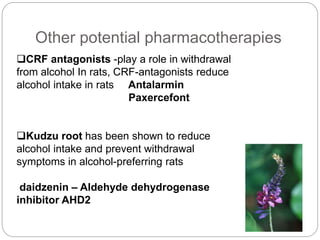
Other potential pharmacotherapies
CRF antagonists -play a role in withdrawal
from alcohol In rats, CRF-antagonists reduce
alcohol intake in rats Antalarmin
Paxercefont
Kudzu root has been shown to reduce
alcohol intake and prevent withdrawal
symptoms in alcohol-preferring rats
daidzenin – Aldehyde dehydrogenase
inhibitor AHD2
Cannabinoid CB1 Receptor antagonist
NPY is involved in feeding behavior;
NPY antagonists
Gamma hydroxy butyarate
Dose 50 mg OD
Concern has been raised regarding the risk of developing
addiction, misuse or abuse,
Treatment of acute intoxication
Maintainence of vital functions in
emergency room for
Treatment of Hypoglycemia – iv
Dextrose 10%
IV thiamine
Maintainence of electolytes and
pH .
Treatment of withdrawal syndrome
Long acting sedative – Chlordiazepoxide / diazepam
Clonidine ( alpha 2 receptor agonist ) – limit the release of
neurotransmitters
Propanolol – antagonizes the excessive sympathetic
effects
Detoxifiation takes many months
Psychosocial Interventions for the
Treatment of Alcohol Dependence
Cognitive-behavioral therapy (CBT)
focused on handling thoughts about alcohol, dealing with
urges, refusing drinks, and avoiding situations that might
lead to relapse ,cope with situations that commonly
precipitate relapse.
Motivational enhancement therapy (MET),
patients identify internal motivational strategies, It attempts
to motivate the patient's commitment to change, increase
individual responsibility, and to enlist personal resources.
Twelve-step facilitation (TSF), based on the principles of
AA,
12 steps of AA
Conclusion
Pharmacologic therapy has been found to be most
effective with some form of specialized counseling (eg,
CBT).
All medications that are currently FDA approved for the
treatment of alcohol dependence are indicated for use with
a psychosocial intervention.
Naltrexone and acamprosate are the first line drugs.
THANK YOU

Pharmacotherapy Alcohol dependence

  • 1.
  • 2.
    As we goalong  Introduction  History  Problem statement  Pharmacology of Alcohol  Dependence - Clinical criteria -Mechanism of dependence  Pharmacotherapy of alcohol dependence  Newer targets  Non Pharmacological Management  Conclusion
  • 3.
    Ethanol  Fermentation –Sugar to Alcohol and Carbon dioxide  C6H12O6→ 2(CH3-CH2-OH) + 2CO2 (Yeasts +sugar + water = CO2 + ethanol) Molasses –commercial source
  • 4.
    Alcoholic beverages  MaltedLiquors: Fermentation of germinating cereals Barley – Beers (3-6%)  Wines: Fermentation of Natural Sugars – grapes, apples and other fruits  No distillation, <15%  Fortified (port) – up to 22%  Champagne – 12-16% (effervescent wine)  Spirits – Rum, Whisky, Brandy and Gin  40 - 55% v/v
  • 5.
    History of alcoholuse  Neolithic period10,000 BC Hunan, China.  Greeks, Egyptians. circa 3000 BC
  • 6.
    Rome , circa2000 B.C  Bacchus, God of wine India circa 2000 B.C  Sura, (rice meal, wheat, sugar cane, grapes, and other fruits)  Popular among the Kshatriya warriors.  Favorite drink of God Indira
  • 7.
  • 8.
  • 9.
    Pharmacokinetics: Absorption  Rapidlyabsorbed primarily from duodenum  Rate of absorption is extremely variable  Peak blood alcohol concentration (BAC) depends on:  Amount and alcohol concentration of beverage  Rate of drinking  Food consumption and composition  Gastric emptying and gastric metabolism  Hepatic first pass
  • 10.
    Effect of foodon absorption 120 0 20 40 60 80 100 0 20 50 60 100 120 140 200 220 250 300 Time BloodAlcoholConcentration Empty stomach With food in stomach
  • 11.
    Distribution  Volume ofdistribution = Total Body Water 0.5-0.7L/kg  Gender Differences in body composition women – achieve higher blood alcohol levels
  • 12.
    Metabolism  Metabolism  90-98%metabolized in liver Alcohol Acetaldehyde Acetate  Apparent zero-order kinetics at moderate BACs  Alcohol Elimination Rate = 7 g per hr  8-12ml/hr Alcohol Dehydrogenase-75% Aldehyde Dehydrogenase 75% MFO -25% Aldehyde oxidase 25%
  • 13.
    Metabolism  Metabolism Alcohol AcetaldehydeAcetate  Aldehyde dehydrogenase usually not rate-limiting  Accumulation of acetaldehyde associated with headache, gastritis, nausea, dizziness (hangover) Alcohol dehydrogenase Aldehyde Dehydrogenase 75% Aldehyde oxidase 25%
  • 14.
    Metabolism: Genetic Variation Geneticvariation in alcohol metabolizing enzymes  Alcohol Dehydrogenase (ADH)  Polymorphism occurs at ADH2 and ADH3 loci ADH2*1 ADH2*2 ADH2*3 ADH3*1 ADH3*2 White 95% <5% <5% 50% 50% Black 85% <5% 15% 85% 15% Asian 15% 85% <5% 95% 5%  15% of Black have ADH2*3 allele  increased alcohol metabolic rate
  • 15.
    Metabolism: Genetic Variation Geneticvariation in alcohol metabolizing enzymes  Aldehyde Dehydrogenase (ALDH)  Polymorphism at the ALDH2 gene  50% of Asians have ALDH2*2 allele  decreased elimination of acetaldehyde (and alcohol)  flushing response
  • 16.
    Elimination  Elimination ofalcohol from the blood:  Follows zero-order kinetics  Ranges from 7-10 g /hour  Average rate of elimination is 8-12 ml/hour • coffee • sleep • exercise • eating • showering • fresh air
  • 17.
    Acute Effects ofalcohol consumption  CNS: depressant – dose dependent manner Plasma concentration Expected effects 50 – 100 mg/dl Anxiolytic, euphoria and excitation, inhibitions are lost Impaired judgment – mood and feelings are altered, driving skills 100 -150 mg/dl Gross drunkenness Mental clouding, ataxia, disorganization of thought and impairment of memory and drowsiness Slurring of speech, loss of judgment and motor skills , drunken gait 200 – 300 mg/dl Emesis ,Stupor and unconsciousness > 300mg/dl Coma , respiratory and cvs depression , >500mg/dl Death
  • 18.
    .  CVS:  Smalldoses – cutaneous vasodilatation, flushing  Medium dose – tachycardia and mild rise in BP  Large dose - Vasodilatation due to direct vascular smooth muscle dilatation and vasomotor centre depression  Respiration:  Stimulation of Respiration – by irritation of pharyngeal and buccal mucosa  Central action – depression
  • 19.
    Kidney: Diuresis –increased water ingestion and inhibition of ADH Uterus: Relaxation of uterine muscles Endocrine: Low dose – Adrenaline release and hyperglycemia High dose – Hypoglycemia
  • 20.
    GIT:  at lowdoses - stimulate GI secretion direct action on gastrin secretion  Higher doses inhibit GI secretion  Acute consumption – pylorospasm, gastritis, vomiting, reflux etc  Mallory-Weiss lesion
  • 21.
    Effects of chronicalcohol consumption CVS Dilated cardiomyopathy with Ventricular hypertrophy Arhrythmias Liver GIT Hepatitis/fibrosis Panceratitis Nutritional deficiencies Blood Moderate drinking increases HDL- level Decrease in LDL oxidation Megaloblastic anemia Iron deficiency anemia Endocrine Testicular atrophy Pseudo cushings syndrome
  • 22.
    Neurotoxicity Wernike korsakoff Peripheral Neuropathies Dementia Decreasedimmune function – pneumonias Alters uric acid metabolism
  • 23.
    Fetal development Amenorrhea Second trimesterSpontaneous abortions Fetal alcohol syndrome Alcohol related neurodevelopement disorder
  • 24.
    Neuropharmacology of alcohol dependence Effects on GABA system  Interaction with GABA-A receptor and facilitation of GABA transmission  Sedative and anxiolytic effects On chronic administration Decreased number of GABA A  Withdrawal Rebound hyperexitability
  • 25.
    Neuropharmacology: NMDA, 5HT Effects on NMDA Glutamate system  Blockage of NMDA receptor (allosteric effect)  Sedative/hypnotic effects Up-regulated in chronic use Withdrawal-Hyperexitability  Effects on Serotonin system  Neuroadaptation, aversion  Effects on stress hormones  Stress response CRF (corticotrophin releasing factor).
  • 26.
    Increase dopamine inmesocorticolimbic system Reinforcing, rewarding effects Activation of mesocorticolimbic system
  • 27.
    Alcohol as aReinforcer  Reinforcer: a substance whose pharmacological effects drive the user to continue to use it.  Positive reinforcing effects:  Gain pleasure  Altered consciousness  Conform to behavior of peers  Negative reinforcing effects:  Relief of stress and negative emotions  Relief of withdrawal symptoms
  • 28.
    Neuropharmacology Opioids  Effectson Opioid peptide system  Activation of opioid peptide system  Reinforcing and rewarding effects (Mu)  Aversion (Kappa)  Craving
  • 29.
    Neuropharmacology Experience Transmitter/Receptor euphoria/pleasure Dopamine,Opioids anxiolysis/ataxia  GABA sedation/amnesia  GABA +  NMDA nausea 5HT3 neuroadaptation NMDA, 5HT stress CRF withdrawal GABA, NMDA ( Ca, Mg)
  • 30.
    Tolerance: Significance  Oneof the determinants of increased alcohol consumption  Diagnostic criteria for alcoholism by DSM-IV  Cross-tolerance to other depressant drugs Cellular adaptive Pharmacokinetic –Gastric induration , Mixed function oxidases
  • 31.
  • 32.
    DSM 5 2013– “Alcohol use disorder” Mild 1-2 Moderate 3-4 Severe 4-5 Any 2
  • 33.
    Pharmacotherapy of alcohol dependence Managementof Alcohol dependence Treatment of acute intoxication Treatment of withdrawal syndrome
  • 34.
    Approved by FDA Treatmentof Alcohol Dependence  Disulfiram 1949  Naltrexone 1994  Acamprosate 2004  Long-Acting Naltrexone 2006  Selective Serotonin Reuptake Inhibitors (SSRIs)  Ondansetron  Topiramate Others
  • 35.
    Disulfiram Mechanism of action Inhibits metabolism of alcohol by blocking acetaldehyde dehydrogenase Erik Jacobsen, Jens Hald 1948 Distressing Aldehyde syndrome 10 mins after alcohol flushing, burning sensation, throbbing headache, perspiration, dizziness, vomiting, visual disturbance, mental confusion, fainting and circulatory collapse
  • 36.
    Dose : Toa motivated patient  500 mg OD for 1-2 weeks  Maintenance 250 mg /day- till patient regains self control Absorption : oral , Metabolism Hepatic 90% CYP2C9,CYP2E1 Elimination feces and exhaled gases Adverse effects Fatigue Headache Metallic aftertaste Acneform Rash Polyneuritis Hepatitis Psychotic disorders
  • 37.
    Contraindications 1.Alcohol intoxicated 2.Without patientsknowledge 3.Alcohol containing products 4.Cardiac disease 5.Coronary occlusion 6. Psychosis Other drugs causing Disulfiram like reaction Metronidazole,tinidazole Nitofurantoin Cephalosporins - cefoperazone ,cefotetan Griseofulvin, First-generation sulfonylureas, e.g. Tolbutamide .
  • 38.
    Research in otherareas Anticancer activity Disulfiram copper complex Proteosome inhibitor NF-KB-inhibiting activity
  • 39.
    Research in otherareas Mechanism Inhibition of dopamine hydroxylase
  • 40.
    Naltrexone Opioid receptor antagonist There is evidence that naltrexone blocks activation by alcohol of dopaminergic pathways in the brain that are thought to be critical to reward  Blunts the pleasurable “high ”  Maintain abstinence by reducing the “ craving ” and increasing control when a "slip" occurs. Indicated : Alcohol dependence in patients able to abstain from alcohol ( detoxified patients ) to maintain abstinence
  • 41.
    Pharmacology  Dose :Oral 50mg OD  IM 380 mg/4 weeks Absorption: GI tract 40% bioavailability Distribution 28% protein bound Metabolism Metabolized in liver to 6-beta-naltrexol Excretion urine Half life – 12hrs Microsphere Suspension Once Monthly Dosing
  • 42.
     Study NationalInstitute of Health 2008 Alcoholics having a certain variant of the opioid receptor gene (G polymorphism of SNP Rs1799971 in the gene OPRM1) demonstrated strong response to naltrexone and were far more likely to experience success at cutting back or discontinuing their alcohol intake altogether.  common in individuals of Asian descent( Japanese ,Indian ,Chinese )
  • 43.
    Adverse effects  Headache Nausea  Vomiting  Dizziness  Anxiety  Depression  Muscle cramps • Dose dependent hepatocellular injury • Severe injection site reactions • Liver function abnormalities • Tachycardia
  • 44.
    Other uses Opioid dependence Depersonalizationdisorders Self harm disorders Impulse control disorders – kleptomania , tichotellomania ,
  • 45.
    Acamprosate Mechanism of action FDA2004, EUROPE 1989 Reduction in glutamate release Facilitates GABA  metabotropic glutamate receptor 5 antagonist. Opoid antagonist Enhances serotonin
  • 46.
    Indicated  Maintenance ofabstinence in patients with alcohol dependence that have been detoxified  Orphan use – Fragile x syndrome Dosing Formulations Oral tablet 333mg 666mg ( 2tablets ) TID
  • 47.
     Minimal metabolismin the liver  excreted primarily by the kidneys  elimination t1/2 of 18 hours after oral administration. Side effects  Diarrhea is the most common side effect.  rash, itching  nausea, vomiting, headache  suicidal thoughts (rare)
  • 48.
    Ondansetron  5HT3, modulatesthe dopaminergic reward pathway.  Blockers or antagonists of 5HT3 receptors reduce dopaminergic activity, which results in reduced alcohol drinking in animal models.  Ondansetron , has been studied and clinical efficacy has been shown for some doses, more so in early- onset alcoholism (Johnson et al., 2000).
  • 49.
    Ondansetron Drinks / Dayamong EOA at Study End 0 1 4 16 0 1 2 3 4   : p <  : p  0.01 Ondansetron doses in g/kg b.i.d Meandrinks/day Johnson et al., JAMA, 2000
  • 50.
    Topiramate Increasing GABA andreducing glutamatergic activity, has been shown to reduce heavy drinking to promote abstinence (Johnson et al., 2003 and 2007). -80 -70 -60 -50 -40 -30 -20 -10 0 0 1 2 3 4 5 6 7 8 9 10 11 12 Key: Placebo Topiramate Study Weeks PercentHeavyDrinking Days -60.34  9.89 -32.73  11.03 ) Johnson et al., Lancet 2003 P = 0.0004
  • 51.
    Dose : 300mg per day for 12-week. Side effects •paresthesia (up to 50%), •dizziness, •taste perversion, •anorexia leading to weight loss, • and difficulty with memory or concentration.
  • 52.
    Gabapentin and pregabalin Thereis interest in both for treating alcohol dependence because they have anticonvulsant and anxiolytic properties. They bind to calcium channels and reduce calcium currents resulting in reduced activity. In relapse prevention, gabapentin has been shown to increase time to heavy drinking and reduce alcohol craving A small open study showed people who misused alcohol and were given pregabalin remained abstinent longer than those given naltrexone (Martinotti et al , 2008)
  • 53.
    SSRI Prior research onthe use of SSRIs in patients with alcohol dependence has been more conflicting Sertraline 50mg OD --- Type A alcoholics (later onset, less severe pathology) taking Fluoxetine Aripiprazole partial dopamine agonist D2  efficacious for the treatment of alcohol dependence in patients with comorbid psychiatric disorders. ( schizophrenia,schizoaffective disorder, or bipolar disorder.)
  • 54.
    Other potential pharmacotherapies CRFantagonists -play a role in withdrawal from alcohol In rats, CRF-antagonists reduce alcohol intake in rats Antalarmin Paxercefont Kudzu root has been shown to reduce alcohol intake and prevent withdrawal symptoms in alcohol-preferring rats daidzenin – Aldehyde dehydrogenase inhibitor AHD2
  • 55.
    Cannabinoid CB1 Receptorantagonist NPY is involved in feeding behavior; NPY antagonists
  • 56.
    Gamma hydroxy butyarate Dose50 mg OD Concern has been raised regarding the risk of developing addiction, misuse or abuse,
  • 57.
    Treatment of acuteintoxication Maintainence of vital functions in emergency room for Treatment of Hypoglycemia – iv Dextrose 10% IV thiamine Maintainence of electolytes and pH .
  • 58.
    Treatment of withdrawalsyndrome Long acting sedative – Chlordiazepoxide / diazepam Clonidine ( alpha 2 receptor agonist ) – limit the release of neurotransmitters Propanolol – antagonizes the excessive sympathetic effects Detoxifiation takes many months
  • 59.
    Psychosocial Interventions forthe Treatment of Alcohol Dependence Cognitive-behavioral therapy (CBT) focused on handling thoughts about alcohol, dealing with urges, refusing drinks, and avoiding situations that might lead to relapse ,cope with situations that commonly precipitate relapse. Motivational enhancement therapy (MET), patients identify internal motivational strategies, It attempts to motivate the patient's commitment to change, increase individual responsibility, and to enlist personal resources. Twelve-step facilitation (TSF), based on the principles of AA,
  • 60.
  • 62.
    Conclusion Pharmacologic therapy hasbeen found to be most effective with some form of specialized counseling (eg, CBT). All medications that are currently FDA approved for the treatment of alcohol dependence are indicated for use with a psychosocial intervention. Naltrexone and acamprosate are the first line drugs.
  • 63.