
Focus on the Followers Human Resource Management DepartmentUniversity of Kelaniya
Leadership behavior makes satisfied followers.Satisfied followers makes organizational citizenship behavior.Accomplishment of common goal.Relationship between Leadership, Motivation, Job satisfaction and Performance
“Motivation means a process of stimulating people to action to accomplish desired goals.”William Scott
As against this, McFarland has defined it as follows:
“ Motivation refers to the way urges, drives, desires, aspirations, strivings, needs direct, control or explain the behavior of human beings.” Definitions of Motivation
The psychological Process of Motivation    An unsatisfied need creates tension that stimulates drives with in individuals. These drives generate a search behavior to find particular goals that , if attained, will satisfy the need and lead to the reduction of tension.Motivation Process
Need TheoriesCognitive TheoriesIndividual DifferenceSituational TheoriesMotivational Approaches
Major theme is to Satisfy needs to change behavior.Maslow’s hierarchy of needsAlderfer’s ERG theoryNeed Theories
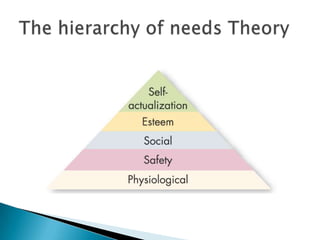
The hierarchy of needs Theory
Unsatisfied need drives towards the behaviorSatisfied need is no longer working as a motivational factorLower level needs should be fulfilled to raise the higher level needsPrinciples of needs theory
Existence NeedsRelatedness NeedsGrowth NeedsERG Theory ( By Clayton Alderfer)
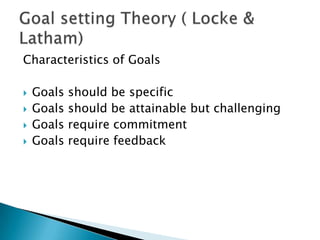
Characteristics of GoalsGoals should be specificGoals should be attainable but challengingGoals require commitmentGoals require feedbackGoal setting Theory ( Locke & Latham)
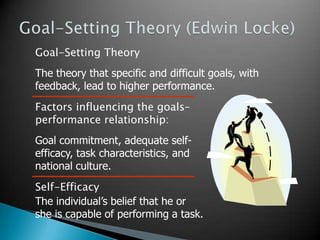
Goal-Setting Theory (Edwin Locke)Goal-Setting TheoryThe theory that specific and difficult goals, with feedback, lead to higher performance.Factors influencing the goals–performance relationship:Goal commitment, adequate self-efficacy, task characteristics, and national culture.Self-EfficacyThe individual’s belief that he or she is capable of performing a task.
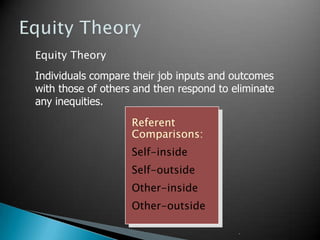
.Equity TheoryEquity TheoryIndividuals compare their job inputs and outcomes with those of others and then respond to eliminate any inequities.Referent Comparisons:Self-insideSelf-outsideOther-insideOther-outside
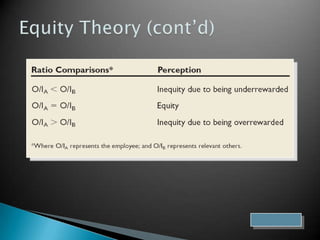
Equity Theory (cont’d)
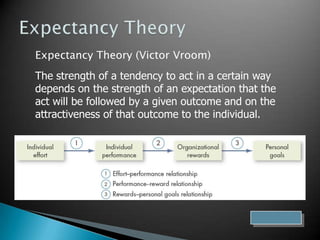
Expectancy TheoryExpectancy Theory (Victor Vroom)The strength of a tendency to act in a certain way depends on the strength of an expectation that the act will be followed by a given outcome and on the attractiveness of that outcome to the individual.
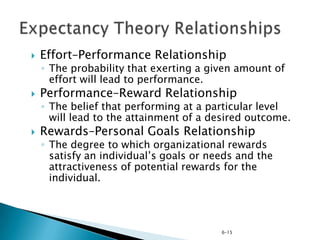
6–15Expectancy Theory RelationshipsEffort–Performance RelationshipThe probability that exerting a given amount of effort will lead to performance.Performance–Reward RelationshipThe belief that performing at a particular level will lead to the attainment of a desired outcome.Rewards–Personal Goals RelationshipThe degree to which organizational rewards satisfy an individual’s goals or needs and the attractiveness of potential rewards for the individual.
Achievement OrientationValuesIntrinsic MotivationIndividual differences in Motivation
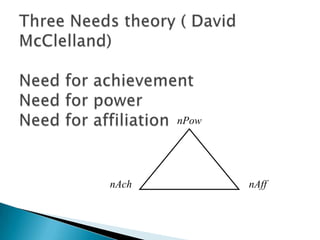
nPownAchnAffThree Needs theory ( David McClelland)Need for achievementNeed for powerNeed for affiliation
Operant ApproachRewardsPunishmentExtinctionSituational Approach
Implementation of an Operant systemLeadership practitioners need to clearly specify what behaviors are important.Leadership practitioners need to determine if those behaviors are currently being punished, rewarded or ignored.Leadership practitioners need to find out what followers actually find rewarding and punishing.Leadership practitioners need to be wary of creating perceptions of inequity when administering individually tailored rewards.Leadership practitioners should not limit themselves to administering organizationally sanctioned rewards and punishments.
Empowerment having  two key components. For leaders to truly empower employees, they must delegate leadership and decision making down to the lowest level possible.Secondly equipping followers with resources, knowledge and skills necessary to make good decisions.Empowerment
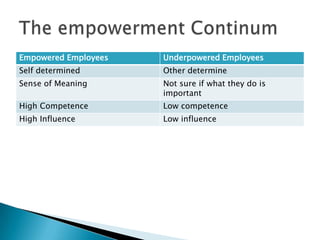
The empowerment Continum
Why do People Leave OrganizationsLimited recognition and praiseCompensationLimited AuthorityPersonal ConflictsUnderstanding and Influencing followers satisfaction
Why Do People stay with OrganizationsPromises of long-term employmentSupports training and educationHires/keeps hard-working, smart peopleEncourages fun, collegial relationships
Two factor TheoryOrganizational JusticeTheories of job Satisfaction
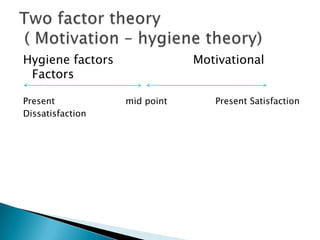
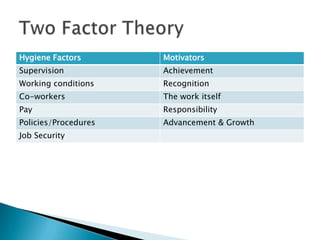
Hygiene factors                     Motivational FactorsPresent                         mid point                 Present SatisfactionDissatisfactionTwo factor theory ( Motivation – hygiene theory)
Two Factor Theory
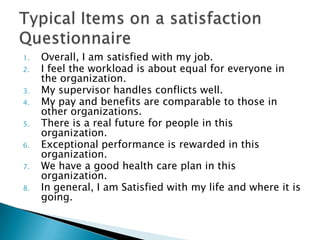
Overall, I am satisfied with my job.I feel the workload is about equal for everyone in the organization.My supervisor handles conflicts well.My pay and benefits are comparable to those in other organizations.There is a real future for people in this organization.Exceptional performance is rewarded in this organization.We have a good health care plan in this organization.In general, I am Satisfied with my life and where it is going.Typical Items on a satisfaction Questionnaire
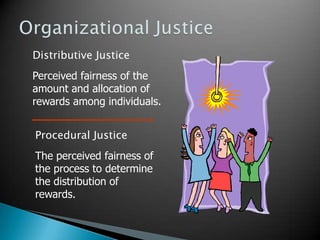
Organizational JusticeDistributive JusticePerceived fairness of the amount and allocation of rewards among individuals.Procedural JusticeThe perceived fairness of the process to determine the distribution of rewards.
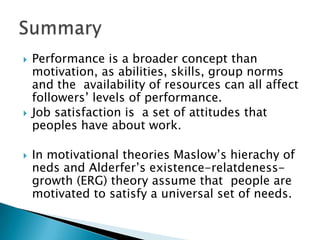
Performance is a broader concept than motivation, as abilities, skills, group norms and the  availability of resources can all affect followers’ levels of performance.Job satisfaction is  a set of attitudes that peoples have about work.In motivational theories Maslow’s hierachy of neds and Alderfer’s existence-relatdeness-growth (ERG) theory assume that  people are motivated to satisfy a universal set of needs.Summary
The other next theories examined motivation in terms of individual differences, emphasizing a person’s intrinsic motivation to perform a particular task, their personal values or a  person’s general level of achievement orientation.Other theories of Goal setting , equity theory, self efficacy and expectancy theory examined motivation from a cognitive perspective.

Led session4 presentation

  • 1.
    Focus on theFollowers Human Resource Management DepartmentUniversity of Kelaniya
  • 2.
    Leadership behavior makessatisfied followers.Satisfied followers makes organizational citizenship behavior.Accomplishment of common goal.Relationship between Leadership, Motivation, Job satisfaction and Performance
  • 3.
    “Motivation means aprocess of stimulating people to action to accomplish desired goals.”William Scott
  • 4.
    As against this,McFarland has defined it as follows:
  • 5.
    “ Motivation refersto the way urges, drives, desires, aspirations, strivings, needs direct, control or explain the behavior of human beings.” Definitions of Motivation
  • 6.
    The psychological Processof Motivation An unsatisfied need creates tension that stimulates drives with in individuals. These drives generate a search behavior to find particular goals that , if attained, will satisfy the need and lead to the reduction of tension.Motivation Process
  • 7.
    Need TheoriesCognitive TheoriesIndividualDifferenceSituational TheoriesMotivational Approaches
  • 8.
    Major theme isto Satisfy needs to change behavior.Maslow’s hierarchy of needsAlderfer’s ERG theoryNeed Theories
  • 9.
    The hierarchy ofneeds Theory
  • 10.
    Unsatisfied need drivestowards the behaviorSatisfied need is no longer working as a motivational factorLower level needs should be fulfilled to raise the higher level needsPrinciples of needs theory
  • 11.
    Existence NeedsRelatedness NeedsGrowthNeedsERG Theory ( By Clayton Alderfer)
  • 12.
    Characteristics of GoalsGoalsshould be specificGoals should be attainable but challengingGoals require commitmentGoals require feedbackGoal setting Theory ( Locke & Latham)
  • 13.
    Goal-Setting Theory (EdwinLocke)Goal-Setting TheoryThe theory that specific and difficult goals, with feedback, lead to higher performance.Factors influencing the goals–performance relationship:Goal commitment, adequate self-efficacy, task characteristics, and national culture.Self-EfficacyThe individual’s belief that he or she is capable of performing a task.
  • 14.
    .Equity TheoryEquity TheoryIndividualscompare their job inputs and outcomes with those of others and then respond to eliminate any inequities.Referent Comparisons:Self-insideSelf-outsideOther-insideOther-outside
  • 15.
  • 16.
    Expectancy TheoryExpectancy Theory(Victor Vroom)The strength of a tendency to act in a certain way depends on the strength of an expectation that the act will be followed by a given outcome and on the attractiveness of that outcome to the individual.
  • 17.
    6–15Expectancy Theory RelationshipsEffort–PerformanceRelationshipThe probability that exerting a given amount of effort will lead to performance.Performance–Reward RelationshipThe belief that performing at a particular level will lead to the attainment of a desired outcome.Rewards–Personal Goals RelationshipThe degree to which organizational rewards satisfy an individual’s goals or needs and the attractiveness of potential rewards for the individual.
  • 18.
  • 19.
    nPownAchnAffThree Needs theory( David McClelland)Need for achievementNeed for powerNeed for affiliation
  • 20.
  • 21.
    Implementation of anOperant systemLeadership practitioners need to clearly specify what behaviors are important.Leadership practitioners need to determine if those behaviors are currently being punished, rewarded or ignored.Leadership practitioners need to find out what followers actually find rewarding and punishing.Leadership practitioners need to be wary of creating perceptions of inequity when administering individually tailored rewards.Leadership practitioners should not limit themselves to administering organizationally sanctioned rewards and punishments.
  • 22.
    Empowerment having two key components. For leaders to truly empower employees, they must delegate leadership and decision making down to the lowest level possible.Secondly equipping followers with resources, knowledge and skills necessary to make good decisions.Empowerment
  • 23.
  • 24.
    Why do PeopleLeave OrganizationsLimited recognition and praiseCompensationLimited AuthorityPersonal ConflictsUnderstanding and Influencing followers satisfaction
  • 25.
    Why Do Peoplestay with OrganizationsPromises of long-term employmentSupports training and educationHires/keeps hard-working, smart peopleEncourages fun, collegial relationships
  • 26.
    Two factor TheoryOrganizationalJusticeTheories of job Satisfaction
  • 27.
    Hygiene factors Motivational FactorsPresent mid point Present SatisfactionDissatisfactionTwo factor theory ( Motivation – hygiene theory)
  • 28.
  • 29.
    Overall, I amsatisfied with my job.I feel the workload is about equal for everyone in the organization.My supervisor handles conflicts well.My pay and benefits are comparable to those in other organizations.There is a real future for people in this organization.Exceptional performance is rewarded in this organization.We have a good health care plan in this organization.In general, I am Satisfied with my life and where it is going.Typical Items on a satisfaction Questionnaire
  • 30.
    Organizational JusticeDistributive JusticePerceivedfairness of the amount and allocation of rewards among individuals.Procedural JusticeThe perceived fairness of the process to determine the distribution of rewards.
  • 31.
    Performance is abroader concept than motivation, as abilities, skills, group norms and the availability of resources can all affect followers’ levels of performance.Job satisfaction is a set of attitudes that peoples have about work.In motivational theories Maslow’s hierachy of neds and Alderfer’s existence-relatdeness-growth (ERG) theory assume that people are motivated to satisfy a universal set of needs.Summary
  • 32.
    The other nexttheories examined motivation in terms of individual differences, emphasizing a person’s intrinsic motivation to perform a particular task, their personal values or a person’s general level of achievement orientation.Other theories of Goal setting , equity theory, self efficacy and expectancy theory examined motivation from a cognitive perspective.