















While we may be producing a
smart, self-assured generation of
young people, today’s kids are
also the most self-centered and
stressed-out on record.
Culture of Hate
Thrill of Viral Bashing
Glorification of the
Vulgar
Self-Absorption
Epidemic
REALITY CHECK: Teens are now
40 percent lower in empathy levels
than three decades ago, and in the
same period, narcissism has
increased 58 percent.
Rise in Cases of Suicide
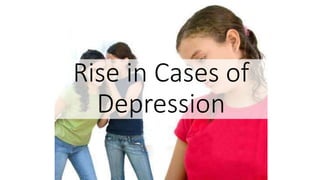
Rise in Cases of
Depression
If we really want our children
become caring people we must show
them ways to respond to another’s
concerns, distress, frustrations or
sorrow. It’s our best tactic to keep
their empathy capacities open, and
avoid the infamous Empathy Gap.
A great man shows his
greatness by the way he
treats little men.
Thomas Carlyle
Research: student achievement
increases when students feel
comfortable in their learning
environment.
Gentleness and kindness
will make our homes a
paradise upon earth.
C. A. Bartol
A caring classroom is not only
comfortable,
it allows the teacher to spend
more time teaching and less time
handling student conflicts.
18
Strategies to Win
the War
20
THE DAILY FOUR
1. Share good news (with a partner; 1 min
each).
2. Tell about someone or something you’re
grateful for (new partner; 1 min. each).
3. Affirm someone in the class.
4. Make us laugh. (Joke must be clean.)
—Hal Urban, Lessons from the Classroom: 20
Things Good Teachers Do
(www.halurban.com)
Comprehensive Character Education
BIG IDEA #1:
A high-quality, comprehensive
approach to character education is
the most effective way to develop
caring classrooms and schools—
and thereby reduce bullying.
The 12-point comprehensive approach to
character education. . .
. . . is intentional, deliberately seeking
to positively impact character
development through every phase of
school and classroom life.
School Climate Matters
Bullying is strongly related to overall school climate.
Bullying decreases when:
 school climate improves
 students have greater voice and responsibility for
solving problems and making decisions that improve
their school.
—Dr. Maurice Elias, Rutgers University (based on a study of more than 100
schools)
What Commercially Available
Bullying Prevention Programs
Work?
Educational Leadership (9/2011):
 A meta-analysis of 44 bullying prevention
programs found that fewer than half (19) were
effective.
 Vreeman & Carrroll analysis (2007):
Classroom curricula alone did not reduce bullying.
Programs found to be effective . . .
1. Work to create a school
climate where bullying is
socially unacceptable
2. Enlist the support of the
community
3. Increase supervision of
playground and other areas
Programs found to be effective . . .
4. Institute firm sanctions for
bullying
5. Use ongoing messages to
help students recognize
aggression and support and
stick up for victims.
28
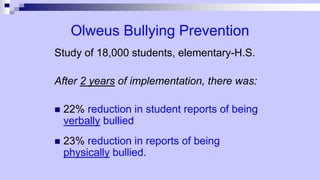
Olweus Bullying Prevention
Study of 18,000 students, elementary-H.S.
After 2 years of implementation, there was:
 22% reduction in student reports of being
verbally bullied
 23% reduction in reports of being
physically bullied.
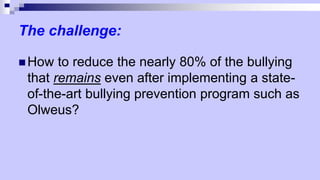
The challenge:
 How to reduce the nearly 80% of the bullying
that remains even after implementing a state-
of-the-art bullying prevention program such as
Olweus?
Answer:
A comprehensive character education
program that not only seeks to suppress the
negative behavior of bullying but also to
promote its psychological opposites:
virtues of respect, cooperation,
and kindness.
32
33
BIG IDEA #2:
Any virtue, and character as a
whole, has 3 parts:
 Knowing (habits of the mind)
 Feeling (habits of the heart)
 Behavior (habits of behavior)
34
Good Character:
You have to . . .
 know it in your head
 feel it in your heart
 show it with your hands.
All my life I have been teased.
I love you very much, but I
just couldn’t stand it any more.
—An 8th-grade girl’s suicide note to her
parents
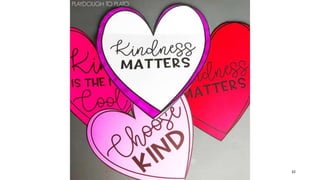
Kindness is showing
someone they
matter.
Unknown
3 Secrets of Success
1.Staff involvement
2.Student involvement
3.Parent involvement
“How to Make Your School a
School of Character”
 Ch. 11, Character Matters, p. 219
How to get staff involved
Create a Touchstone
pp. 220-221
Develop a school touchstone or
“way.”
Written by staff and students
together, the touchstone
expresses the school’s core
moral and performance values.
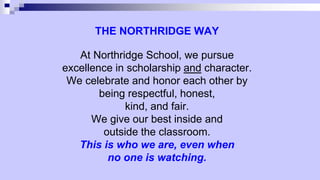
THE NORTHRIDGE WAY
At Northridge School, we pursue
excellence in scholarship and character.
We celebrate and honor each other by
being respectful, honest,
kind, and fair.
We give our best inside and
outside the classroom.
This is who we are, even when
no one is watching.
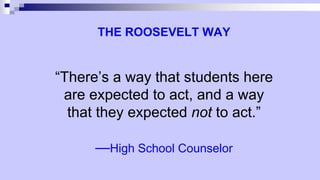
THE ROOSEVELT WAY
“There’s a way that students here
are expected to act, and a way
that they expected not to act.”
—High School Counselor
Self-Study: Touchstone Implementation
Visibility
The touchstone is displayed in all
classrooms and included in all school
documents.
Academics
Teachers make connections with the
touchstone when teaching their subject
area.
Self-Study: Touchstone Implementation
Discipline
Staff refer to the touchstone when
disciplining.
New students
There is a plan for teaching the touchstone
to students who enroll during the school
year.
Ongoing Professional Development
 Regular staff sharing of best practices (through
buddy system, faculty and dept. meetings, etc.)
 Staff training in cooperative learning, class
meetings, and other key strategies
“Involve Students in Creating a
School of Character”
 Ch. 12, Character Matters, p. 247
How to get students involved
20 Kinds of Class Meetings
 How to Get Kids To Talk in Class Meetings
Educating for Character, T. Lickona,
Ch. 8
61
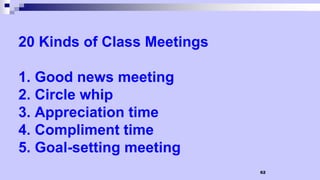
20 Kinds of Class Meetings
1. Good news meeting
2. Circle whip
3. Appreciation time
4. Compliment time
5. Goal-setting meeting
62
20 Kinds of Class Meetings
6. Rule-setting meeting
7. Rule-evaluating meeting
8. Stage-setting meeting
9. Feedback and evaluation
10. Reflections on learning
20 Kinds of Class Meetings
11. Student presentation
12. Problem-solving meeting
13. Academic issues
14. Classroom improvement meeting
15. Follow-up meeting
66
20 Kinds of Class Meetings
16. Planning meeting
17. Concept meeting
18. Sticky situations
19. Suggestion box/class business box
20. Meeting on meetings
Student Voice and Cyberbullying
 Challenge student gov’t: “What can
students, parents, and the school,
working together, do to prevent
cyberbullying?”
 Have schoolwide discussion, with delegates
from each classroom.
 Ask students to take responsibility for a
schoolwide campaign.
 Resource: www.stopcyberbullying.org
Get students to take responsibility:
 Counselors create anti-bullying
“intervention teams” at each grade level.
(Team members step in when they see
someone being picked on.)
 Students provide emotional support to
victims.
WELCOMING FRESHMEN
 Seniors plan and lead a half-day
welcome for the new freshmen.
The smallest act of kindness
is worth more than the
greatest intention.
Kahlil Gibran
FRESHMAN TRANSITION PROGRAM
 Older students are assigned as mentors to all
freshmen.
 The school trains the mentors.
 Mentors and their freshmen meet weekly.
BUDDY CLASSES
An older class is paired with a younger
class.
The buddy classes get together weekly or
bi-weekly.
The older kids read to their little buddies,
help them with their schoolwork, do a
special project together, and so on.
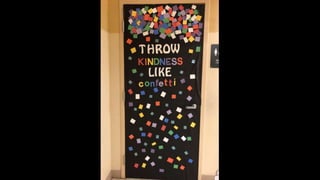
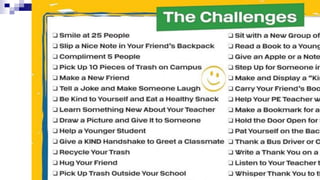
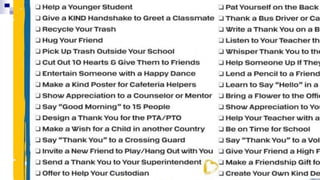
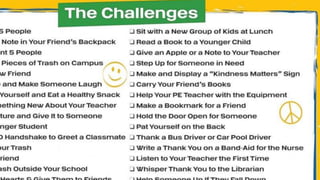
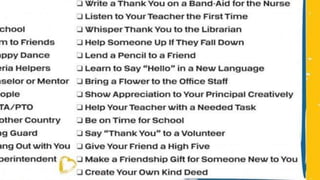
Celebrate
Kindness
Challenge
74
75
76
77
78
79
“Build a Strong Home-School
Partnership”
 Ch. 3, Character Matters, p. 60
How to get parents involved
Communicate to Parents
1. “Parents are the first and most
important character educators.”
2. “The school’s job is to reinforce
the character virtues being
taught at home.”
Expect Parents to Participate
Get the Program to the Parents
Let parents know what the
school is doing in character
education—and how they can
help.
Parents and Cyber-Bullying
Send home guidelines to help
parents monitor kids’ online
activity.
Character Education Homework
 Parent and child, independently,
each make a list:
“Who are 5 of your heroes? Why?”
 Then compare and discuss lists.
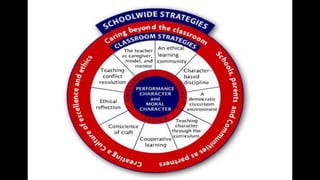
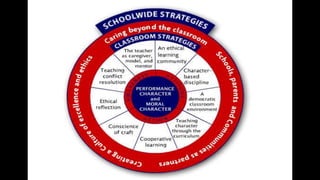
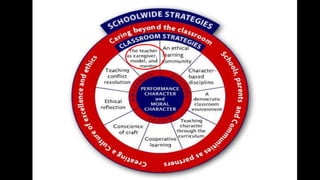
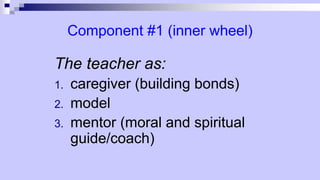
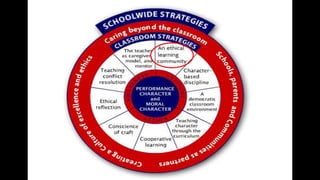
Component #1 (inner wheel)
The teacher as:
1. caregiver (building bonds)
2. model
3. mentor (moral and spiritual
guide/coach)
89
The Difference a Teacher Makes
“I was a bully before I came to this
school. I used to make little kids cry.
“When I met Mrs. Brown, I changed.
I’m not a bully anymore, because
Mrs. Brown taught me about
character.”
—a 6th-grade boy
90
Handshake at the Door
 “In the second it takes me to shake a
hand, I renew my relationship with
that student.”
 “I can tell in a heartbeat what kind of
a day a kid is having. You can nip
problems in the bud at the door.”
91
Teacher’s Corner
1. In my Teacher’s Corner, I display pictures
of my husband, children, and dog; photos
of classes I taught when I lived in
California; my college diploma; favorite
books; sports I enjoy; and other things
that reflect my interests.
92
Teacher’s Corner
2. During the first few weeks, I meet with
each of my kids in the Teachers Corner
for about 10 minutes. They bring an “All
About Me” book they’ve made. These
conversations have given me a closer
relationship with each child.
93
94
Teacher as Model: Self-Inventory
1. Do I warmly greet each student?
2. Do I seek other opportunities to connect with
each student?
3. Am I well-prepared for class? On time?
4. Do I model patience and courtesy, even
under stress?
5. Do I treat my all students impartially?
6. Do I challenge all of them to do their best
work?
96
Anonymous Compliments
1. Each student draws the name of a classmate.
2. By the week’s end, the student writes an
anonymous compliment about that person on a
strip of paper, shows it to the teacher, and puts
it in the Compliment Box.
3. On Friday, the teacher posts all the
compliments on the bulletin board.
PEERS AFFIRMING PEERS
At the end of the day:
 “Who saw kindness today?”
 “Who saw respect?”
 “Who saw determination?”
 “Who saw sharing?”
—Jenna Smith, 3rd-grade teacher
Practice Kindness
At the start of the day, all students take out
their Good Deeds Journal and write:
1. A good deed I did yesterday . . .
2. A good deed I will do today . . .
In all subjects, teachers make a connection to
the good deeds theme.
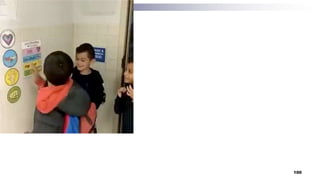
Teaching Courtesy
 I teach my kids to greet and thank the cafeteria
workers.
 The cafeteria staff say they always know when my
kids are coming through.
 My students have a very high level of self-respect—
because of the respect they show to other people.
—Molly Angelini, 5th-grade teacher
100
1. Set clear rules.
2. Teach how to recognize bullying.
3. Teach how to report bullying.
4. Teach how to respond to bullying.
5. Teach how to refuse bullying.
6. Replace current beliefs or
behavior.
The Essential 6
Rs
“Any failure to treat bullying,
abuse and violence seriously,
because it occurs between
students, within schools, is a
violation of a child’s human
rights.”
–Johnny Appleseed
“Type a quote here.”
Everything that
happens inside the
Classroom IS
Character Building.
“Character and Academics:
What Good Schools Do”
Phi Delta Kappan Magazine, 2006
Research Showed:
1. Good schools ensure a clean and secure
physical environment.
2. Good schools promote and model
fairness, equity, caring and respect.
3. In good schools, students contribute in
meaningful ways.
4. Good schools promote a caring
community and positive social relationships.
More Strategies
Compliments Game
Teach Manners and
The Golden Rule
What you accept, you teach.
What you permit, you promo
te.
If manners were an animal,
it would be an endangered
species.
- Henry Rogers
Choosing an Atmosphere
Rude Courteous
Inconsiderate Considerate
Disrespectful Respectful
Offensive Polite
The Good Deeds Bowl
The Trophy Technique
Effective Classroom Management
Be a Buddy, Not a Bully
Shirt
Stand Up to Bullying
Week
Student Justice Committee
Celebration of Service
Week
Give Recognition to:
1. Most Creative Outreach
2. Outreach with the
Greatest Impact
3. Best Organized
4. Outreach of the Year
Peer Mentoring for
Conflict Resolution
Bibliotherapy for the Victim
Teaching Empathy Through
Literature
Compact for Excellence
(Students Craft the Pledge)
Students Pledge
Some Samples
of Student
Pledges
Against Bullying
James Stenson
Children develop character by
what they see, what they hear,
and what they are repeatedly led
to do.
https://www.facebook.com/SriLankaSeminars/
TWO FREE BOOKS
https://bit.ly/CharacterLanka2
mannrentoy@gmail.com
www.characterconferences.com

02 KIND AND CARING CLASSROOM.pptx

  • 2.
    While we maybe producing a smart, self-assured generation of young people, today’s kids are also the most self-centered and stressed-out on record.
  • 3.
  • 5.
  • 6.
  • 7.
  • 8.
    REALITY CHECK: Teensare now 40 percent lower in empathy levels than three decades ago, and in the same period, narcissism has increased 58 percent.
  • 9.
    Rise in Casesof Suicide
  • 11.
    Rise in Casesof Depression
  • 12.
    If we reallywant our children become caring people we must show them ways to respond to another’s concerns, distress, frustrations or sorrow. It’s our best tactic to keep their empathy capacities open, and avoid the infamous Empathy Gap.
  • 13.
    A great manshows his greatness by the way he treats little men. Thomas Carlyle
  • 14.
    Research: student achievement increaseswhen students feel comfortable in their learning environment.
  • 15.
    Gentleness and kindness willmake our homes a paradise upon earth. C. A. Bartol
  • 17.
    A caring classroomis not only comfortable, it allows the teacher to spend more time teaching and less time handling student conflicts.
  • 18.
  • 20.
    20 THE DAILY FOUR 1.Share good news (with a partner; 1 min each). 2. Tell about someone or something you’re grateful for (new partner; 1 min. each). 3. Affirm someone in the class. 4. Make us laugh. (Joke must be clean.) —Hal Urban, Lessons from the Classroom: 20 Things Good Teachers Do (www.halurban.com)
  • 21.
    Comprehensive Character Education BIGIDEA #1: A high-quality, comprehensive approach to character education is the most effective way to develop caring classrooms and schools— and thereby reduce bullying.
  • 23.
    The 12-point comprehensiveapproach to character education. . . . . . is intentional, deliberately seeking to positively impact character development through every phase of school and classroom life.
  • 24.
    School Climate Matters Bullyingis strongly related to overall school climate. Bullying decreases when:  school climate improves  students have greater voice and responsibility for solving problems and making decisions that improve their school. —Dr. Maurice Elias, Rutgers University (based on a study of more than 100 schools)
  • 25.
    What Commercially Available BullyingPrevention Programs Work? Educational Leadership (9/2011):  A meta-analysis of 44 bullying prevention programs found that fewer than half (19) were effective.  Vreeman & Carrroll analysis (2007): Classroom curricula alone did not reduce bullying.
  • 26.
    Programs found tobe effective . . . 1. Work to create a school climate where bullying is socially unacceptable 2. Enlist the support of the community 3. Increase supervision of playground and other areas
  • 27.
    Programs found tobe effective . . . 4. Institute firm sanctions for bullying 5. Use ongoing messages to help students recognize aggression and support and stick up for victims.
  • 28.
  • 29.
    Olweus Bullying Prevention Studyof 18,000 students, elementary-H.S. After 2 years of implementation, there was:  22% reduction in student reports of being verbally bullied  23% reduction in reports of being physically bullied.
  • 30.
    The challenge:  Howto reduce the nearly 80% of the bullying that remains even after implementing a state- of-the-art bullying prevention program such as Olweus?
  • 31.
    Answer: A comprehensive charactereducation program that not only seeks to suppress the negative behavior of bullying but also to promote its psychological opposites: virtues of respect, cooperation, and kindness.
  • 32.
  • 33.
    33 BIG IDEA #2: Anyvirtue, and character as a whole, has 3 parts:  Knowing (habits of the mind)  Feeling (habits of the heart)  Behavior (habits of behavior)
  • 34.
    34 Good Character: You haveto . . .  know it in your head  feel it in your heart  show it with your hands.
  • 36.
    All my lifeI have been teased. I love you very much, but I just couldn’t stand it any more. —An 8th-grade girl’s suicide note to her parents
  • 37.
    Kindness is showing someonethey matter. Unknown
  • 38.
    3 Secrets ofSuccess 1.Staff involvement 2.Student involvement 3.Parent involvement
  • 39.
    “How to MakeYour School a School of Character”  Ch. 11, Character Matters, p. 219 How to get staff involved
  • 40.
  • 41.
    Develop a schooltouchstone or “way.” Written by staff and students together, the touchstone expresses the school’s core moral and performance values.
  • 42.
    THE NORTHRIDGE WAY AtNorthridge School, we pursue excellence in scholarship and character. We celebrate and honor each other by being respectful, honest, kind, and fair. We give our best inside and outside the classroom. This is who we are, even when no one is watching.
  • 43.
    THE ROOSEVELT WAY “There’sa way that students here are expected to act, and a way that they expected not to act.” —High School Counselor
  • 44.
    Self-Study: Touchstone Implementation Visibility Thetouchstone is displayed in all classrooms and included in all school documents. Academics Teachers make connections with the touchstone when teaching their subject area.
  • 45.
    Self-Study: Touchstone Implementation Discipline Staffrefer to the touchstone when disciplining. New students There is a plan for teaching the touchstone to students who enroll during the school year.
  • 46.
    Ongoing Professional Development Regular staff sharing of best practices (through buddy system, faculty and dept. meetings, etc.)  Staff training in cooperative learning, class meetings, and other key strategies
  • 60.
    “Involve Students inCreating a School of Character”  Ch. 12, Character Matters, p. 247 How to get students involved
  • 61.
    20 Kinds ofClass Meetings  How to Get Kids To Talk in Class Meetings Educating for Character, T. Lickona, Ch. 8 61
  • 62.
    20 Kinds ofClass Meetings 1. Good news meeting 2. Circle whip 3. Appreciation time 4. Compliment time 5. Goal-setting meeting 62
  • 64.
    20 Kinds ofClass Meetings 6. Rule-setting meeting 7. Rule-evaluating meeting 8. Stage-setting meeting 9. Feedback and evaluation 10. Reflections on learning
  • 65.
    20 Kinds ofClass Meetings 11. Student presentation 12. Problem-solving meeting 13. Academic issues 14. Classroom improvement meeting 15. Follow-up meeting
  • 66.
  • 67.
    20 Kinds ofClass Meetings 16. Planning meeting 17. Concept meeting 18. Sticky situations 19. Suggestion box/class business box 20. Meeting on meetings
  • 68.
    Student Voice andCyberbullying  Challenge student gov’t: “What can students, parents, and the school, working together, do to prevent cyberbullying?”  Have schoolwide discussion, with delegates from each classroom.  Ask students to take responsibility for a schoolwide campaign.  Resource: www.stopcyberbullying.org
  • 69.
    Get students totake responsibility:  Counselors create anti-bullying “intervention teams” at each grade level. (Team members step in when they see someone being picked on.)  Students provide emotional support to victims.
  • 70.
    WELCOMING FRESHMEN  Seniorsplan and lead a half-day welcome for the new freshmen.
  • 71.
    The smallest actof kindness is worth more than the greatest intention. Kahlil Gibran
  • 72.
    FRESHMAN TRANSITION PROGRAM Older students are assigned as mentors to all freshmen.  The school trains the mentors.  Mentors and their freshmen meet weekly.
  • 73.
    BUDDY CLASSES An olderclass is paired with a younger class. The buddy classes get together weekly or bi-weekly. The older kids read to their little buddies, help them with their schoolwork, do a special project together, and so on.
  • 74.
  • 75.
  • 76.
  • 77.
  • 78.
  • 79.
  • 80.
    “Build a StrongHome-School Partnership”  Ch. 3, Character Matters, p. 60 How to get parents involved
  • 81.
    Communicate to Parents 1.“Parents are the first and most important character educators.” 2. “The school’s job is to reinforce the character virtues being taught at home.”
  • 82.
    Expect Parents toParticipate
  • 83.
    Get the Programto the Parents Let parents know what the school is doing in character education—and how they can help.
  • 84.
    Parents and Cyber-Bullying Sendhome guidelines to help parents monitor kids’ online activity.
  • 85.
    Character Education Homework Parent and child, independently, each make a list: “Who are 5 of your heroes? Why?”  Then compare and discuss lists.
  • 88.
    Component #1 (innerwheel) The teacher as: 1. caregiver (building bonds) 2. model 3. mentor (moral and spiritual guide/coach)
  • 89.
    89 The Difference aTeacher Makes “I was a bully before I came to this school. I used to make little kids cry. “When I met Mrs. Brown, I changed. I’m not a bully anymore, because Mrs. Brown taught me about character.” —a 6th-grade boy
  • 90.
    90 Handshake at theDoor  “In the second it takes me to shake a hand, I renew my relationship with that student.”  “I can tell in a heartbeat what kind of a day a kid is having. You can nip problems in the bud at the door.”
  • 91.
    91 Teacher’s Corner 1. Inmy Teacher’s Corner, I display pictures of my husband, children, and dog; photos of classes I taught when I lived in California; my college diploma; favorite books; sports I enjoy; and other things that reflect my interests.
  • 92.
    92 Teacher’s Corner 2. Duringthe first few weeks, I meet with each of my kids in the Teachers Corner for about 10 minutes. They bring an “All About Me” book they’ve made. These conversations have given me a closer relationship with each child.
  • 93.
  • 94.
    94 Teacher as Model:Self-Inventory 1. Do I warmly greet each student? 2. Do I seek other opportunities to connect with each student? 3. Am I well-prepared for class? On time? 4. Do I model patience and courtesy, even under stress? 5. Do I treat my all students impartially? 6. Do I challenge all of them to do their best work?
  • 96.
    96 Anonymous Compliments 1. Eachstudent draws the name of a classmate. 2. By the week’s end, the student writes an anonymous compliment about that person on a strip of paper, shows it to the teacher, and puts it in the Compliment Box. 3. On Friday, the teacher posts all the compliments on the bulletin board.
  • 97.
    PEERS AFFIRMING PEERS Atthe end of the day:  “Who saw kindness today?”  “Who saw respect?”  “Who saw determination?”  “Who saw sharing?” —Jenna Smith, 3rd-grade teacher
  • 98.
    Practice Kindness At thestart of the day, all students take out their Good Deeds Journal and write: 1. A good deed I did yesterday . . . 2. A good deed I will do today . . . In all subjects, teachers make a connection to the good deeds theme.
  • 99.
    Teaching Courtesy  Iteach my kids to greet and thank the cafeteria workers.  The cafeteria staff say they always know when my kids are coming through.  My students have a very high level of self-respect— because of the respect they show to other people. —Molly Angelini, 5th-grade teacher
  • 100.
  • 102.
    1. Set clearrules. 2. Teach how to recognize bullying. 3. Teach how to report bullying. 4. Teach how to respond to bullying. 5. Teach how to refuse bullying. 6. Replace current beliefs or behavior. The Essential 6 Rs
  • 103.
    “Any failure totreat bullying, abuse and violence seriously, because it occurs between students, within schools, is a violation of a child’s human rights.”
  • 106.
  • 107.
    Everything that happens insidethe Classroom IS Character Building.
  • 108.
    “Character and Academics: WhatGood Schools Do” Phi Delta Kappan Magazine, 2006
  • 109.
    Research Showed: 1. Goodschools ensure a clean and secure physical environment. 2. Good schools promote and model fairness, equity, caring and respect. 3. In good schools, students contribute in meaningful ways. 4. Good schools promote a caring community and positive social relationships.
  • 110.
  • 111.
  • 112.
    Teach Manners and TheGolden Rule What you accept, you teach. What you permit, you promo te.
  • 113.
    If manners werean animal, it would be an endangered species. - Henry Rogers
  • 114.
    Choosing an Atmosphere RudeCourteous Inconsiderate Considerate Disrespectful Respectful Offensive Polite
  • 115.
  • 116.
  • 117.
  • 118.
    Be a Buddy,Not a Bully Shirt
  • 119.
    Stand Up toBullying Week
  • 120.
  • 121.
  • 122.
    Give Recognition to: 1.Most Creative Outreach 2. Outreach with the Greatest Impact 3. Best Organized 4. Outreach of the Year
  • 123.
  • 124.
  • 125.
  • 126.
  • 127.
  • 128.
  • 132.
    James Stenson Children developcharacter by what they see, what they hear, and what they are repeatedly led to do.
  • 134.
  • 135.
  • 136.
  • 137.