Good 
Bad 
Concern 
Philosophy
Agenda 
• Introduction 
• Ethics in Advertising 
• Laws & Regulations 
• Case Study 
Introduction Ethics in Advertising Laws & Regulations Case Study
Ethics 
• The term is derived from the Greek word ethos which can mean custom, 
habit, character or disposition. 
• Ethics covers the following dilemmas: 
• how to live a good life 
• our rights and responsibilities 
• the language of right and wrong 
• moral decisions - what is good and bad? 
Introduction Ethics in Advertising Laws & Regulations Case Study
Advertising 
Advertising is the paid, impersonal, one-way marketing of persuasive 
information from an identified sponsor disseminated through channels 
of mass communication to promote the adoption of goods, services or 
ideas. 
Newspapers Magazines 
Radio and 
television 
broadcasts 
Films Stage shows 
Websites Billboards Posters 
Wall 
paintings 
Flyers 
Introduction Ethics in Advertising Laws & Regulations Case Study
Advertising 
In the advertising communication process there are five key players: 
The Advertisers 
The Advertising Agencies 
The Support Organizations 
The Media 
The Consumers 
Introduction Ethics in Advertising Laws & Regulations Case Study
What’s illegal and what’s unethical? 
• Marketing communications has an obligation to perform legally and ethically, and with the social welfare in 
mind. 
• Advertising is routinely and legitimately attacked for many of its practices. 
• Most of these criticisms come under the heading of unethical rather than illegal practices 
• Advocacy – Advertising tries to persuade the audience to do something that is not correct. It is not objective or 
neutral. 
• Accuracy – Subtle messages trouble critics, especially when aimed at groups such as children, the elderly or the 
disabled. 
• Acquisitiveness – Consumers are continually persuaded that they continually need more and more new 
products. However, consumers make the final decision. 
Introduction Ethics in Advertising Laws & Regulations Case Study
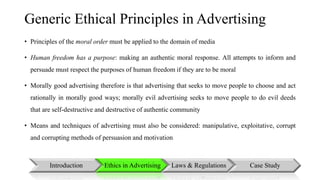
Generic Ethical Principles in Advertising 
• Principles of the moral order must be applied to the domain of media 
• Human freedom has a purpose: making an authentic moral response. All attempts to inform and 
persuade must respect the purposes of human freedom if they are to be moral 
• Morally good advertising therefore is that advertising that seeks to move people to choose and act 
rationally in morally good ways; morally evil advertising seeks to move people to do evil deeds 
that are self-destructive and destructive of authentic community 
• Means and techniques of advertising must also be considered: manipulative, exploitative, corrupt 
and corrupting methods of persuasion and motivation 
Introduction Ethics in Advertising Laws & Regulations Case Study
Specific Moral Principles in Advertising 
• Respect Truthfulness 
• Never directly intend to deceive 
• Never use simply untrue advertising 
• Do not distort the truth by implying things that are not so or withholding relevant facts 
• Respect The Dignity Of Each Human Person 
• Do not exploit our "lower inclinations" to compromise our capacity to reflect or decide either through its content or 
through its impact: using appeals to lust, vanity, envy and greed, and other human weakness. 
• Give special care to the weak and vulnerable: children, young people, the elderly, the poor, and the culturally 
disadvantaged 
• Respect Social Responsibilities 
• Example: Concern for the ecology—advertising should not favour a lavish lifestyle which wastes resources and 
despoils the environment 
Introduction Ethics in Advertising Laws & Regulations Case Study
Criticisms Concerning The Influence of Advertising on 
Society 
Puffery/ 
fraudulation 
(metaphor of 
idea) 
Untruthful or 
deceptive 
Offensive or in 
bad taste 
Creates 
materialistic 
demand 
Makes people 
buy the things 
not needed 
Comparative 
advertising 
Stereotype 
Advertising and 
sex 
Improper 
language 
Excessive 
Introduction Ethics in Advertising Laws & Regulations Case Study
Laws & Regulations 
• Government Regulation 
• Food and Drug Administration 
• Advertising Standards Council of India (ASCI) 
• Industry self-regulation 
• Consumer activism 
Introduction Ethics in Advertising Laws & Regulations Case Study
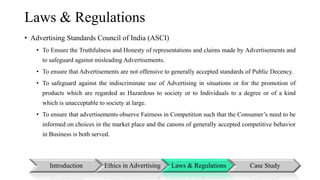
Laws & Regulations 
• Advertising Standards Council of India (ASCI) 
• To Ensure the Truthfulness and Honesty of representations and claims made by Advertisements and 
to safeguard against misleading Advertisements. 
• To ensure that Advertisements are not offensive to generally accepted standards of Public Decency. 
• To safeguard against the indiscriminate use of Advertising in situations or for the promotion of 
products which are regarded as Hazardous to society or to Individuals to a degree or of a kind 
which is unacceptable to society at large. 
• To ensure that advertisements observe Fairness in Competition such that the Consumer’s need to be 
informed on choices in the market place and the canons of generally accepted competitive behavior 
in Business is both served. 
Introduction Ethics in Advertising Laws & Regulations Case Study
Case Study 
Obscene Objectionable Misleading Sexy 
Introduction Ethics in Advertising Laws & Regulations Case Study
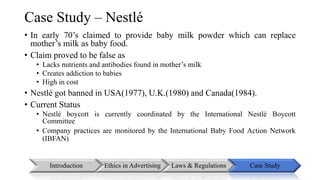
Case Study – Nestlé 
• In early 70’s claimed to provide baby milk powder which can replace 
mother’s milk as baby food. 
• Claim proved to be false as 
• Lacks nutrients and antibodies found in mother’s milk 
• Creates addiction to babies 
• High in cost 
• Nestlé got banned in USA(1977), U.K.(1980) and Canada(1984). 
• Current Status 
• Nestlé boycott is currently coordinated by the International Nestlé Boycott 
Committee 
• Company practices are monitored by the International Baby Food Action Network 
(IBFAN) 
Introduction Ethics in Advertising Laws & Regulations Case Study
References 
• http://www.bbc.co.uk/ethics/introduction/intro_1.shtml 
• http://www.foxnews.com/health/2010/12/15/dannon-settles-complaints- 
yogurt-ads/ 
• http://www.mondaq.com/india/x/192384/advertising+marketing+bran 
ding/Advertising+Law+in+India 
• https://www.carroll.edu/msmillie/busethics/ethadvertising.htm 
Introduction Ethics in Advertising Laws & Regulations Case Study
Thank You!

Ethics in Advertisement

  • 1.
    Good Bad Concern Philosophy
  • 2.
    Agenda • Introduction • Ethics in Advertising • Laws & Regulations • Case Study Introduction Ethics in Advertising Laws & Regulations Case Study
  • 3.
    Ethics • Theterm is derived from the Greek word ethos which can mean custom, habit, character or disposition. • Ethics covers the following dilemmas: • how to live a good life • our rights and responsibilities • the language of right and wrong • moral decisions - what is good and bad? Introduction Ethics in Advertising Laws & Regulations Case Study
  • 4.
    Advertising Advertising isthe paid, impersonal, one-way marketing of persuasive information from an identified sponsor disseminated through channels of mass communication to promote the adoption of goods, services or ideas. Newspapers Magazines Radio and television broadcasts Films Stage shows Websites Billboards Posters Wall paintings Flyers Introduction Ethics in Advertising Laws & Regulations Case Study
  • 5.
    Advertising In theadvertising communication process there are five key players: The Advertisers The Advertising Agencies The Support Organizations The Media The Consumers Introduction Ethics in Advertising Laws & Regulations Case Study
  • 6.
    What’s illegal andwhat’s unethical? • Marketing communications has an obligation to perform legally and ethically, and with the social welfare in mind. • Advertising is routinely and legitimately attacked for many of its practices. • Most of these criticisms come under the heading of unethical rather than illegal practices • Advocacy – Advertising tries to persuade the audience to do something that is not correct. It is not objective or neutral. • Accuracy – Subtle messages trouble critics, especially when aimed at groups such as children, the elderly or the disabled. • Acquisitiveness – Consumers are continually persuaded that they continually need more and more new products. However, consumers make the final decision. Introduction Ethics in Advertising Laws & Regulations Case Study
  • 7.
    Generic Ethical Principlesin Advertising • Principles of the moral order must be applied to the domain of media • Human freedom has a purpose: making an authentic moral response. All attempts to inform and persuade must respect the purposes of human freedom if they are to be moral • Morally good advertising therefore is that advertising that seeks to move people to choose and act rationally in morally good ways; morally evil advertising seeks to move people to do evil deeds that are self-destructive and destructive of authentic community • Means and techniques of advertising must also be considered: manipulative, exploitative, corrupt and corrupting methods of persuasion and motivation Introduction Ethics in Advertising Laws & Regulations Case Study
  • 8.
    Specific Moral Principlesin Advertising • Respect Truthfulness • Never directly intend to deceive • Never use simply untrue advertising • Do not distort the truth by implying things that are not so or withholding relevant facts • Respect The Dignity Of Each Human Person • Do not exploit our "lower inclinations" to compromise our capacity to reflect or decide either through its content or through its impact: using appeals to lust, vanity, envy and greed, and other human weakness. • Give special care to the weak and vulnerable: children, young people, the elderly, the poor, and the culturally disadvantaged • Respect Social Responsibilities • Example: Concern for the ecology—advertising should not favour a lavish lifestyle which wastes resources and despoils the environment Introduction Ethics in Advertising Laws & Regulations Case Study
  • 9.
    Criticisms Concerning TheInfluence of Advertising on Society Puffery/ fraudulation (metaphor of idea) Untruthful or deceptive Offensive or in bad taste Creates materialistic demand Makes people buy the things not needed Comparative advertising Stereotype Advertising and sex Improper language Excessive Introduction Ethics in Advertising Laws & Regulations Case Study
  • 10.
    Laws & Regulations • Government Regulation • Food and Drug Administration • Advertising Standards Council of India (ASCI) • Industry self-regulation • Consumer activism Introduction Ethics in Advertising Laws & Regulations Case Study
  • 11.
    Laws & Regulations • Advertising Standards Council of India (ASCI) • To Ensure the Truthfulness and Honesty of representations and claims made by Advertisements and to safeguard against misleading Advertisements. • To ensure that Advertisements are not offensive to generally accepted standards of Public Decency. • To safeguard against the indiscriminate use of Advertising in situations or for the promotion of products which are regarded as Hazardous to society or to Individuals to a degree or of a kind which is unacceptable to society at large. • To ensure that advertisements observe Fairness in Competition such that the Consumer’s need to be informed on choices in the market place and the canons of generally accepted competitive behavior in Business is both served. Introduction Ethics in Advertising Laws & Regulations Case Study
  • 12.
    Case Study ObsceneObjectionable Misleading Sexy Introduction Ethics in Advertising Laws & Regulations Case Study
  • 13.
    Case Study –Nestlé • In early 70’s claimed to provide baby milk powder which can replace mother’s milk as baby food. • Claim proved to be false as • Lacks nutrients and antibodies found in mother’s milk • Creates addiction to babies • High in cost • Nestlé got banned in USA(1977), U.K.(1980) and Canada(1984). • Current Status • Nestlé boycott is currently coordinated by the International Nestlé Boycott Committee • Company practices are monitored by the International Baby Food Action Network (IBFAN) Introduction Ethics in Advertising Laws & Regulations Case Study
  • 14.
    References • http://www.bbc.co.uk/ethics/introduction/intro_1.shtml • http://www.foxnews.com/health/2010/12/15/dannon-settles-complaints- yogurt-ads/ • http://www.mondaq.com/india/x/192384/advertising+marketing+bran ding/Advertising+Law+in+India • https://www.carroll.edu/msmillie/busethics/ethadvertising.htm Introduction Ethics in Advertising Laws & Regulations Case Study
  • 15.

Editor's Notes

  • #4 Refer http://www.bbc.co.uk/ethics/introduction/intro_1.shtml
  • #5 Refer http://www.bbc.co.uk/ethics/introduction/intro_1.shtml
  • #6 Refer http://www.bbc.co.uk/ethics/introduction/intro_1.shtml
  • #7 Refer http://www.mondaq.com/india/x/192384/advertising+marketing+branding/Advertising+Law+in+India And attached PPT
  • #10 Untruthful or deceptive Example: False promises, incomplete descriptive, misleading comparisons, bait and switch offers, visual distortions, false testimonials, false comparisons, partial disclosures)
  • #11 Refer http://www.mondaq.com/india/x/192384/advertising+marketing+branding/Advertising+Law+in+India And attached PPT
  • #12 Refer http://www.mondaq.com/india/x/192384/advertising+marketing+branding/Advertising+Law+in+India And attached PPT
  • #13 Read http://www.foxnews.com/health/2010/12/15/dannon-settles-complaints-yogurt-ads/
  • #14 Read http://www.foxnews.com/health/2010/12/15/dannon-settles-complaints-yogurt-ads/