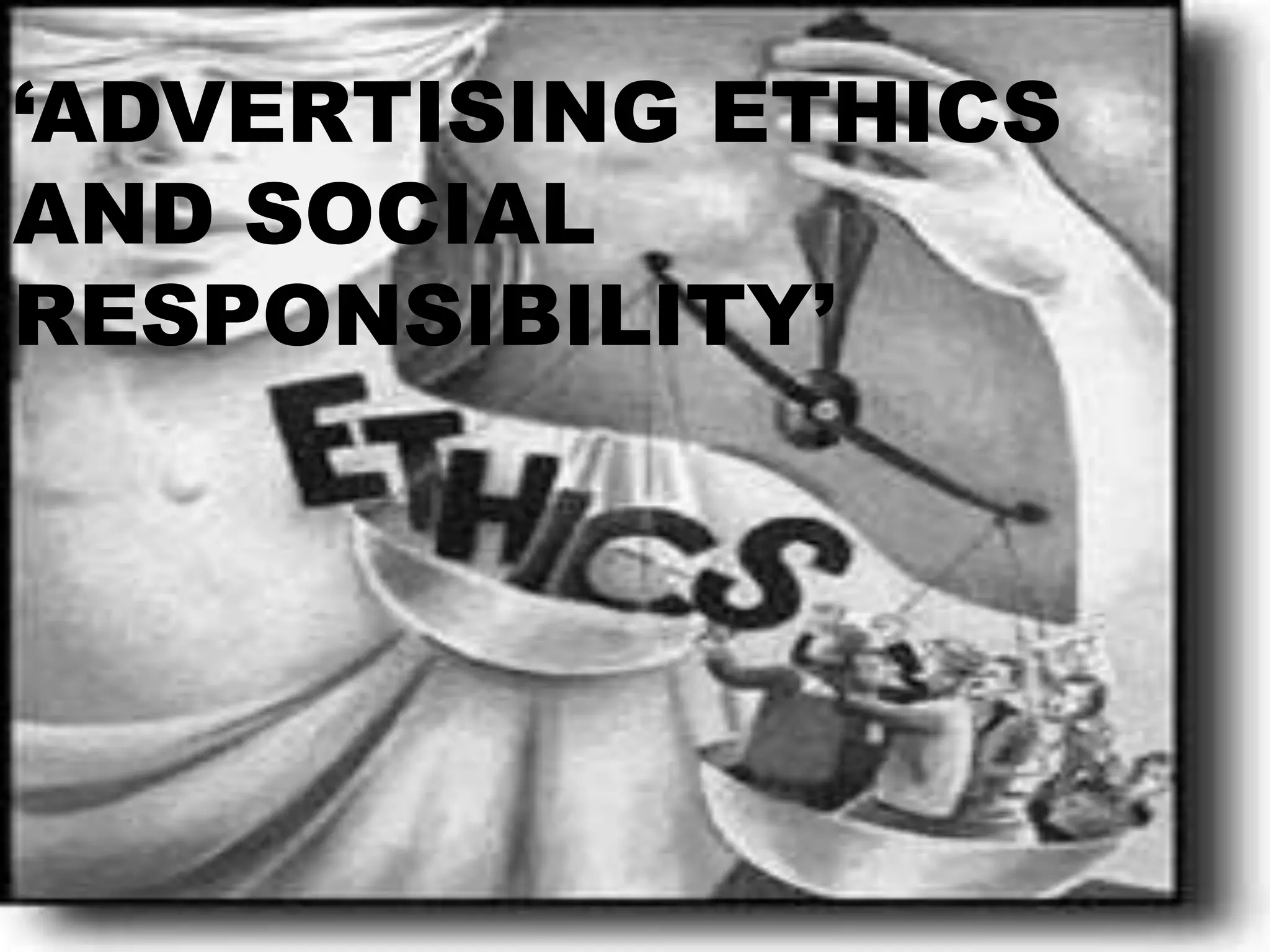
‘ADVERTISING ETHICS
AND SOCIAL
RESPONSIBILITY’
„B.L. AMLANI COLLEGE OF COMMERCE &
                ECONOMICS‟
MA MANEKBEN R. NATHWANI COLLEGE OF ARTS


            BUSINESS ETHICS
     “ADVERTISING ETHICS AND SOCIAL
            RESPONSIBILITY”
PRESESENTED TO: PROF.

        BY:
   RUKHSAR KHAN
   SHEHWAR KHAN
    SHRUTI LAMBA
SR.NO      CONTENTS
  1     Definition of Advertisement
  2     Objectives
  3     Ethical Behaviour
  4     Codes of Ethics
  5     Influences on Ethical Behaviour
  6     Advertising Strategies
  7     Features of Advertising Ethics
  8     Frame work of Advertising Ethics
  9     Purpose
  10    Benefits of Advertising
  11    Ethical an Moral Principles
  12    Social Responsibility
  13    Social Responsibility in Advertising
  15    Bibliography
Definition of Advertisement


“Advertising has been described as a mode of
  communication designed with the attempt to
  convince people to begin or increase the use
  of a product or service.”
OBJECTIVES
• Should educate the customer about the
  product, process, services offered etc.,
• It should help in identifying new customers,
  retaining existing customer and fulfilling the
  wants, needs and desires .
• Business enhancement & entering into new
  demographics.
• It should be healthy, competitive & enjoy the
  fruit of business.
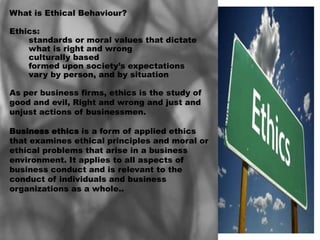
What is Ethical Behaviour?

Ethics:
    standards or moral values that dictate
    what is right and wrong
    culturally based
    formed upon society’s expectations
    vary by person, and by situation

As per business firms, ethics is the study of
good and evil, Right and wrong and just and
unjust actions of businessmen.

Business ethics is a form of applied ethics
that examines ethical principles and moral or
ethical problems that arise in a business
environment. It applies to all aspects of
business conduct and is relevant to the
conduct of individuals and business
organizations as a whole..
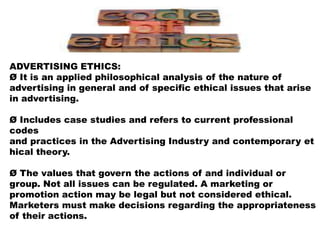
ADVERTISING ETHICS:
Ø It is an applied philosophical analysis of the nature of
advertising in general and of specific ethical issues that arise
in advertising.

Ø Includes case studies and refers to current professional
codes
and practices in the Advertising Industry and contemporary et
hical theory.

Ø The values that govern the actions of and individual or
group. Not all issues can be regulated. A marketing or
promotion action may be legal but not considered ethical.
Marketers must make decisions regarding the appropriateness
of their actions.
3-9
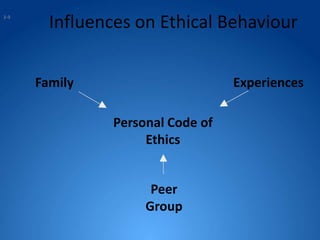
        Influences on Ethical Behaviour


      Family                       Experiences

                Personal Code of
                     Ethics


                      Peer
                     Group
Advertising Strategies

•   Celebrity endorsements
•   Product comparison
•   Price comparison
•   Selling a dream or lifestyle
•   Selling with sex
•   Selling sentiment
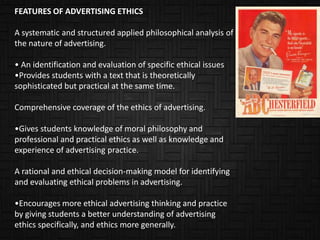
FEATURES OF ADVERTISING ETHICS

A systematic and structured applied philosophical analysis of
the nature of advertising.

• An identification and evaluation of specific ethical issues
•Provides students with a text that is theoretically
sophisticated but practical at the same time.

Comprehensive coverage of the ethics of advertising.

•Gives students knowledge of moral philosophy and
professional and practical ethics as well as knowledge and
experience of advertising practice.

A rational and ethical decision-making model for identifying
and evaluating ethical problems in advertising.

•Encourages more ethical advertising thinking and practice
by giving students a better understanding of advertising
ethics specifically, and ethics more generally.
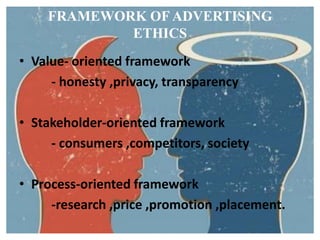
FRAMEWORK OF ADVERTISING
            ETHICS
• Value- oriented framework
     - honesty ,privacy, transparency

• Stakeholder-oriented framework
     - consumers ,competitors, society

• Process-oriented framework
     -research ,price ,promotion ,placement.
PURPOSE

• To protect consumers from economic or
  physical harm
• Introduction of something new ,or of some
  valuable improvement to an existing service
  or product
BENEFITS OF ADVTG ETHICS

• Communication
• To make market competitive
• Product differentiation
ETHICAL AND MORAL PRINCIPLES

Ø If the media are to be correctly employed, it is essential that all who use them
know the principles of the moral order and apply them faithfully in this domain.

Ø The media of social communications have two options, and only two. Either
they help human persons to grow in their understanding and practice of what is
true and good, or they are destructive forces in conflict with human well being.
That is entirely true of advertising.

Ø Those who commission, prepare or disseminate advertising — are morally
responsible for what they seek to move people to do; and this is a responsibility
also shared by publishers, broadcasting executives, and others in the
communications world.

Ø Those who give commercial or political endorsements, to the extent that they
are involved in the advertising process.
Ø It is morally wrong to use manipulative, exploitative, corrupt
and corrupting methods of persuasion and motivation.

Ø The techniques involved here include showing certain
products or forms of behaviour in superficially glamorous
settings associated with superficially glamorous people; in
extreme cases, it may even involve the use of subliminal
messages.
Social responsibility is an ethical ideology or theory that an entity, be it
an organization or individual, has an obligation to act to benefit society
at large. Social responsibility is a duty every individual or organization
has to perform so as to maintain a balance between the economy and
the ecosystem. A trade-off always[ exists between economic
development, in the material sense, and the welfare of the society and
environment. Social responsibility means sustaining the equilibrium
between the two.
 This responsibility can be passive, by avoiding engaging in socially
harmful acts, or active, by performing activities that directly advance
social goals
Social Responsibility in Advertising


Many corporations strive to appeal to
audiences in any way that works within the
limits of the law. Some corporations and
advertisement agencies feel this is justified.
However, other corporations and audiences
feel advertisers should have a deeper sense
of social responsibility, developing their
own sets of ethics that take into
consideration the values of their society.
Many questions about social responsibility
in advertising don't have a clear answer,
but depend on the beliefs of the corporation
and its audience
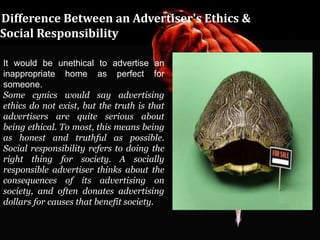
Difference Between an Advertiser's Ethics &
Social Responsibility

It would be unethical to advertise an
inappropriate home as perfect for
someone.
Some cynics would say advertising
ethics do not exist, but the truth is that
advertisers are quite serious about
being ethical. To most, this means being
as honest and truthful as possible.
Social responsibility refers to doing the
right thing for society. A socially
responsible advertiser thinks about the
consequences of its advertising on
society, and often donates advertising
dollars for causes that benefit society.
BIBLIOGRAPHY


www.wikipedia.com
www.google.com
Business Ethics text book
Newspapers
Magazines

Business ethics fi

  • 1.
  • 2.
    „B.L. AMLANI COLLEGEOF COMMERCE & ECONOMICS‟ MA MANEKBEN R. NATHWANI COLLEGE OF ARTS BUSINESS ETHICS “ADVERTISING ETHICS AND SOCIAL RESPONSIBILITY”
  • 3.
    PRESESENTED TO: PROF. BY: RUKHSAR KHAN SHEHWAR KHAN SHRUTI LAMBA
  • 4.
    SR.NO CONTENTS 1 Definition of Advertisement 2 Objectives 3 Ethical Behaviour 4 Codes of Ethics 5 Influences on Ethical Behaviour 6 Advertising Strategies 7 Features of Advertising Ethics 8 Frame work of Advertising Ethics 9 Purpose 10 Benefits of Advertising 11 Ethical an Moral Principles 12 Social Responsibility 13 Social Responsibility in Advertising 15 Bibliography
  • 5.
    Definition of Advertisement “Advertisinghas been described as a mode of communication designed with the attempt to convince people to begin or increase the use of a product or service.”
  • 6.
    OBJECTIVES • Should educatethe customer about the product, process, services offered etc., • It should help in identifying new customers, retaining existing customer and fulfilling the wants, needs and desires . • Business enhancement & entering into new demographics. • It should be healthy, competitive & enjoy the fruit of business.
  • 7.
    What is EthicalBehaviour? Ethics: standards or moral values that dictate what is right and wrong culturally based formed upon society’s expectations vary by person, and by situation As per business firms, ethics is the study of good and evil, Right and wrong and just and unjust actions of businessmen. Business ethics is a form of applied ethics that examines ethical principles and moral or ethical problems that arise in a business environment. It applies to all aspects of business conduct and is relevant to the conduct of individuals and business organizations as a whole..
  • 8.
    ADVERTISING ETHICS: Ø Itis an applied philosophical analysis of the nature of advertising in general and of specific ethical issues that arise in advertising. Ø Includes case studies and refers to current professional codes and practices in the Advertising Industry and contemporary et hical theory. Ø The values that govern the actions of and individual or group. Not all issues can be regulated. A marketing or promotion action may be legal but not considered ethical. Marketers must make decisions regarding the appropriateness of their actions.
  • 9.
    3-9 Influences on Ethical Behaviour Family Experiences Personal Code of Ethics Peer Group
  • 10.
    Advertising Strategies • Celebrity endorsements • Product comparison • Price comparison • Selling a dream or lifestyle • Selling with sex • Selling sentiment
  • 11.
    FEATURES OF ADVERTISINGETHICS A systematic and structured applied philosophical analysis of the nature of advertising. • An identification and evaluation of specific ethical issues •Provides students with a text that is theoretically sophisticated but practical at the same time. Comprehensive coverage of the ethics of advertising. •Gives students knowledge of moral philosophy and professional and practical ethics as well as knowledge and experience of advertising practice. A rational and ethical decision-making model for identifying and evaluating ethical problems in advertising. •Encourages more ethical advertising thinking and practice by giving students a better understanding of advertising ethics specifically, and ethics more generally.
  • 12.
    FRAMEWORK OF ADVERTISING ETHICS • Value- oriented framework - honesty ,privacy, transparency • Stakeholder-oriented framework - consumers ,competitors, society • Process-oriented framework -research ,price ,promotion ,placement.
  • 13.
    PURPOSE • To protectconsumers from economic or physical harm • Introduction of something new ,or of some valuable improvement to an existing service or product
  • 14.
    BENEFITS OF ADVTGETHICS • Communication • To make market competitive • Product differentiation
  • 15.
    ETHICAL AND MORALPRINCIPLES Ø If the media are to be correctly employed, it is essential that all who use them know the principles of the moral order and apply them faithfully in this domain. Ø The media of social communications have two options, and only two. Either they help human persons to grow in their understanding and practice of what is true and good, or they are destructive forces in conflict with human well being. That is entirely true of advertising. Ø Those who commission, prepare or disseminate advertising — are morally responsible for what they seek to move people to do; and this is a responsibility also shared by publishers, broadcasting executives, and others in the communications world. Ø Those who give commercial or political endorsements, to the extent that they are involved in the advertising process.
  • 16.
    Ø It ismorally wrong to use manipulative, exploitative, corrupt and corrupting methods of persuasion and motivation. Ø The techniques involved here include showing certain products or forms of behaviour in superficially glamorous settings associated with superficially glamorous people; in extreme cases, it may even involve the use of subliminal messages.
  • 18.
    Social responsibility isan ethical ideology or theory that an entity, be it an organization or individual, has an obligation to act to benefit society at large. Social responsibility is a duty every individual or organization has to perform so as to maintain a balance between the economy and the ecosystem. A trade-off always[ exists between economic development, in the material sense, and the welfare of the society and environment. Social responsibility means sustaining the equilibrium between the two. This responsibility can be passive, by avoiding engaging in socially harmful acts, or active, by performing activities that directly advance social goals
  • 19.
    Social Responsibility inAdvertising Many corporations strive to appeal to audiences in any way that works within the limits of the law. Some corporations and advertisement agencies feel this is justified. However, other corporations and audiences feel advertisers should have a deeper sense of social responsibility, developing their own sets of ethics that take into consideration the values of their society. Many questions about social responsibility in advertising don't have a clear answer, but depend on the beliefs of the corporation and its audience
  • 20.
    Difference Between anAdvertiser's Ethics & Social Responsibility It would be unethical to advertise an inappropriate home as perfect for someone. Some cynics would say advertising ethics do not exist, but the truth is that advertisers are quite serious about being ethical. To most, this means being as honest and truthful as possible. Social responsibility refers to doing the right thing for society. A socially responsible advertiser thinks about the consequences of its advertising on society, and often donates advertising dollars for causes that benefit society.
  • 21.