Introduction Ethics inAdvertising Laws & Regulations Case Study
Agenda
• Introduction
• Ethics inAdvertising
• Laws & Regulations
• Case Study
Introduction Ethics inAdvertising Laws & Regulations Case Study
Ethics
• The term is derived from the Greek word ethos which can mean custom,
habit, character or disposition.
• Ethics covers the following dilemmas:
• how to live a good life
• our rights and responsibilities
• the language of right and wrong
• moral decisions - what is good and bad?
Introduction Ethics inAdvertising Laws & Regulations Case Study
Business in ethical perspective Ethics
• Business ethics is the behavior that a business adheres to in its daily dealings with
the world. The ethics of a particular business can be diverse. They apply not only
to how the business interacts with the world at large, but also to their one-on-one
dealings with a single customer.
• Many businesses have gained a bad reputation just by being in business. To some
people, businesses are interested in making money, and that is the bottom line.
Making money is not wrong in itself. It is the manner in which some businesses
conduct themselves that brings up the question of ethical behaviour
Introduction Ethics inAdvertising Laws & Regulations Case Study
Advertising
Advertising is the paid, impersonal, one-way marketing of persuasive
information from an identified sponsor disseminated through channels
of mass communication to promote the adoption of goods, services or
ideas.
Newspapers Magazines
Radio and
television
broadcasts
Films Stage shows
Websites Billboards Posters
Wall
paintings Flyers
Introduction Ethics inAdvertising Laws & Regulations Case Study
Advertising
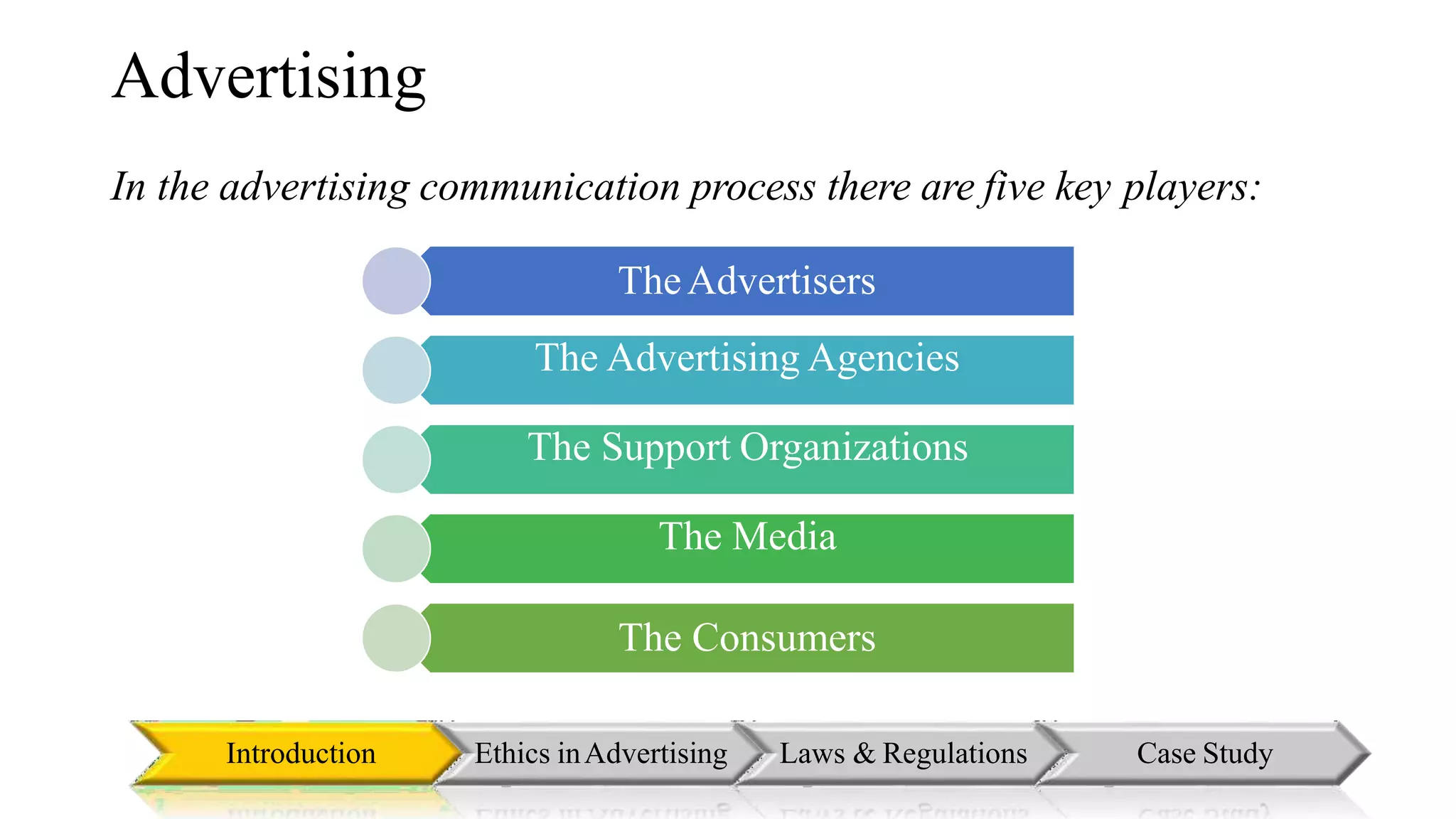
In the advertising communication process there are five key players:
TheAdvertisers
The Advertising Agencies
The Support Organizations
The Media
The Consumers
Introduction Ethics inAdvertising Laws & Regulations Case Study
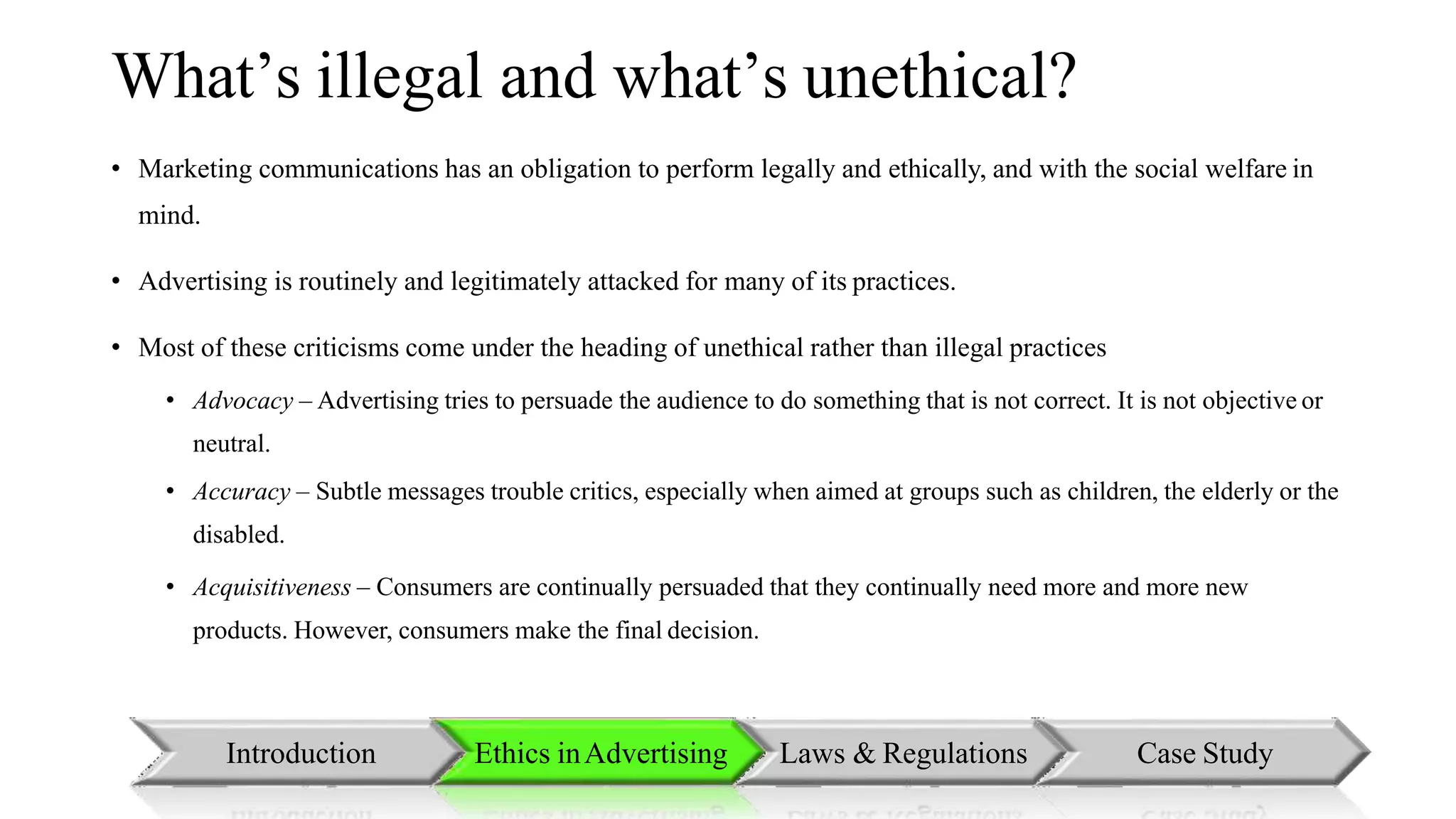
What’s illegal and what’s unethical?
• Marketing communications has an obligation to perform legally and ethically, and with the social welfare in
mind.
• Advertising is routinely and legitimately attacked for many of its practices.
• Most of these criticisms come under the heading of unethical rather than illegal practices
• Advocacy – Advertising tries to persuade the audience to do something that is not correct. It is not objective or
neutral.
• Accuracy – Subtle messages trouble critics, especially when aimed at groups such as children, the elderly or the
disabled.
• Acquisitiveness – Consumers are continually persuaded that they continually need more and more new
products. However, consumers make the final decision.
Introduction Ethics inAdvertising Laws & Regulations Case Study
Ethics in Advertising
 Ethics means a set of moral principles which govern a person’s behavior or how
the activity is conducted. And advertising means a mode of communication
between a seller and a buyer.
 Thus ethics in advertising means a set of well defined principles which govern the
ways of communication taking place between the seller and the buyer.
 Ethics is the most important feature of the advertising industry. Though there are
many benefits of advertising but then there are some points which don’t match the
ethical norms of advertising. An ethical ad is the one which doesn’t lie, doesn’t
make fake or false claims and is in the limit of decency.
Introduction Ethics inAdvertising Laws & Regulations Case Study
Ethics in Advertising
 Nowadays, ads are more exaggerated and a lot of puffing is used. It seems like the
advertisers lack knowledge of ethical norms and principles. They just don’t
understand and are unable to decide what is correct and what is wrong.
 The main area of interest for advertisers is to increase their sales, gain more and
more customers, and increase the demand for the product by presenting a well
decorated, puffed and colourful ad. They claim that their product is the best,
having unique qualities than the competitors, more cost effective, and more
beneficial. But most of these ads are found to be false, misleading customers and
unethical.
Introduction Ethics inAdvertising Laws & Regulations Case Study
Advertisers should start taking responsibility of self regulating their ads by:
1. Design self regulatory codes in their companies including ethical norms,
truth, decency, and legal points
2. Keep tracking the activities and remove ads which don’t fulfil the codes.
3. Inform the consumers about the self regulatory codes of the company
4. Pay attention on the complaints coming from consumers about the product
ads.
5. Maintain transparency throughout the company and system.
When all the above points are implemented, they will result in:
1. Making the company answerable for all its activities
2. Will reduce the chances of getting pointed out by the critics or any
regulatory body.
3. Will help gain confidence of the customers; make them trust the company
and their products
Generic Ethical Principles in Advertising
• Principles of the moral order must be applied to the domain of media
• Human freedom has a purpose: making an authentic moral response. All attempts to inform and
persuade must respect the purposes of human freedom if they are to bemoral
• Morally good advertising therefore is that advertising that seeks to move people to choose and act
rationally in morally good ways; morally evil advertising seeks to move people to do evil deeds
that are self-destructive and destructive of authenticcommunity
• Means and techniques of advertising must also be considered: manipulative, exploitative, corrupt
and corrupting methods of persuasion and motivation
Introduction Ethics inAdvertising Laws & Regulations Case Study
Specific Moral Principles in Advertising
• Respect Truthfulness
• Never directly intend to deceive
• Never use simply untrue advertising
• Do not distort the truth by implying things that are not so or withholding relevant facts
• Respect The Dignity Of Each Human Person
• Do not exploit our "lower inclinations" to compromise our capacity to reflect or decide either through its content or
through its impact: using appeals to lust, vanity, envy and greed, and other human weakness.
• Give special care to the weak and vulnerable: children, young people, the elderly, the poor, and the culturally
disadvantaged
• Respect Social Responsibilities
• Example: Concern for the ecology—advertising should not favour a lavish lifestyle which wastes resources and
despoils the environment
Introduction Ethics inAdvertising Laws & Regulations Case Study
Criticisms Concerning The Influence of Advertising on
Society
Puffery/
fraudulation
(metaphor of
idea)
Untruthful or
deceptive
Offensive or in
bad taste
Creates
materialistic
demand
Makes people
buy the things
not needed
Comparative
advertising Stereotype
Advertising and
sex
Improper
language
Excessive
Introduction Ethics inAdvertising Laws & Regulations Case Study
Some of the common examples of ethical issues in advertising are given
below:-
Vulgarity / sexually suggestive used to gain consumers’ attention
Misleading information and deception
Puffery
Stereotypes
Racial issues
Controversial products (e.g. alcohol, gambling, tobacco etc)
Use of women
Targeting kids
Subliminal advertising
Targeting health
Hitting vulnerable minds – youth
Laws & Regulations
• Government Regulation
• Food and DrugAdministration
• Advertising Standards Council of India (ASCI)
• Industry self-regulation
• Consumer activism
Introduction Ethics inAdvertising Laws & Regulations Case Study
Laws & Regulations
• Advertising Standards Council of India (ASCI)
• To Ensure the Truthfulness and Honesty of representations and claims made by Advertisements and
to safeguard against misleading Advertisements.
• To ensure that Advertisements are not offensive to generally accepted standards of Public Decency.
• To safeguard against the indiscriminate use of Advertising in situations or for the promotion of
products which are regarded as Hazardous to society or to Individuals to a degree or of a kind
which is unacceptable to society at large.
• To ensure that advertisements observe Fairness in Competition such that the Consumer’s need to be
informed on choices in the market place and the canons of generally accepted competitive behavior
in Business is both served.
Introduction Ethics inAdvertising Laws & Regulations Case Study
The Following are the statutory provisions which regulate
advertisements in India
1. Indian penal Code 1860 –
As per the provisions of Indian Penal Code, 1860 certain advertisements are
considered as criminal offences. Sec. 292(2) (d) of Indian Penal Code, 1860,
makes it a punishable offence to publish, distribute, sell, hire or circulate any
obscene advertisement. Sec. 294-A of Indian Penal Code, 1860 says
publication of any advertisement related to any lottery other than a state
lottery is a punishable offence.
2. The Young Persons (Harmful Publications) Act 1956
makes it a punishable offence to advertise a harmful publication. To be more
précised harmful publication indicates such publications which would tend to
corrupt a young person whether by inciting or encouraging him to commit
offences. The Act also proclaims that whoever advertises or makes known by
any means that any harmful publication can be procured from or through any
person, and then he shall be punished with imprisonment or with fine, or with
both.
3. The Emblems and Names (Prevention of Improper Use) Act, 1950
prohibits the use of certain emblems and names of national or international
significance for commercial purposes.
4. The Drugs and Magic Remedies (Objectionable Advertisements) Act, 1954
prohibits advertisements of drugs for certain purposes and of treatment of
certain diseases. The Act also prohibits misleading advertisements related to
drugs and of magical remedies for treatment of certain diseases.
5. The Indecent Representation of Women (Prohibition) Act 1986
prohibits the publication of advertisements containing an indecent
representation of women or in publications, writings, paintings, figures or in
any other manner and for matters connected therewith or incidental thereto.
6. The Prenatal Diagnostic Techniques (Regulation and Prevention of
Misuse) Act 1994
prohibits advertisements related to prenatal determination of sex. The Act
provides for the prohibition of advertisements of any kind for anybody or
person pertaining to facilities for pre-natal diagnosis of sex available at any
centre or place
7. The Transplantation of Human Organ Act 1994
makes it a punishable offence to issue advertisements inviting persons to
supply human organs for payment.
8. The Drugs and Cosmetics Act 1940
makes it an offence to use any report of a test or analysis made by central
drugs laboratory for the purpose of advertising any drug or cosmetics. The
Act gives similar restrictions to advertisements for traditional drugs such as
Ayurvedic, Siddha and Unani.
9. The Prize Competition Act 1955
prohibits the publication or distribution of advertisements of prize
competition where the prize offered exceeds Rs1000/- in any month.
10.The Motor Vehicles Act 1998
entitles the State Government to empower police to remove advertisements
which can obscure a traffic sign or misleading advertisements which appears
to be a traffic sign or which distract the concentration or attention of a driver.
11.The Prize Chits and Money Circulation Schemes (Banning) Act 1978
prohibits the printing or publication of advertisements of prize chits and
money circulation schemes
12.The Cigarettes and other Tobacco Products (Prohibition of Advertisement
and Regulation of Trade and Commerce, Production, Supply and
Distribution) Act 2003 prohibits the advertisements of cigarettes and other
tobacco products. The Act states that no person shall advertise for the
distribution, sale or supply of cigarettes, and also shall not take part in the
publication of such advertisement, unless the specified warning is included in
such advertisement
13.The Representation of People Act 1951 prohibits political advertising 48
hours prior to polling time.
14.The Cable Television Networks (Regulation) Act 1995 prohibits the
transmission of advertisements on the cable network which are not in
conformity with the Advertisement Code.
15.In the exercise of the powers conferred by section 30 of the Securities and
Exchange Board of India (SEBI) Act 1992 the Board makes the regulations
on the code of conduct for Stock-brokers to be known as SEBI Stock-brokers
and Sub-brokers Rules in 1992. The provisions of the Rules specified that a
stock-broker or sub-broker is prohibited from advertising his business
publicly unless permitted by the stock exchange, including in their internet
sites, by its subsidiaries, group companies etc.
16.The Lotteries (Regulation) Act 1998 it is seen that a State Government has
the discretionary powers to organize, conduct or promote a lottery, including
advertising thereof subject to some conditions specified in the Statute. It is
also provided that the State Government may prohibit within itself the sale of
tickets of a lottery organized, conducted or promoted by every other state
17.The Competition Act 2002 provides prohibition of certain agreements in
respect of production, supply, distribution, storage, acquisition or control of
goods or provision of services, which causes or is likely to cause an
appreciable adverse effect on competition within India.
18.The provisions of Trademarks Act 1999 clearly emphasize that the
following are considered as trademark infringement if it is advertised in such
a way as to:- a) Take unfair advantage of and is contrary to honest practices in
industrial or commercial matters; or b) is detrimental to its distinctive
character; or c) is against the reputation of the trade mark.
Case Study
Obscene Objectionable Misleading Sexy
Introduction Ethics inAdvertising Laws & Regulations Case Study
Case Study – Nestlé
• In early 70’s claimed to provide baby milk powder which can replace
mother’s milk as baby food.
• Claim proved to be false as
• Lacks nutrients and antibodies found in mother’s milk
• Creates addiction to babies
• High in cost
• Nestlé got banned in USA(1977), U.K.(1980) and Canada(1984).
• Current Status
• Nestlé boycott is currently coordinated by the International Nestlé Boycott
Committee
• Company practices are monitored by the International Baby Food Action Network
(IBFAN)
Introduction Ethics inAdvertising Laws & Regulations Case Study
ThankYou!

Ethics in advt

  • 1.
    Introduction Ethics inAdvertisingLaws & Regulations Case Study
  • 2.
    Agenda • Introduction • EthicsinAdvertising • Laws & Regulations • Case Study Introduction Ethics inAdvertising Laws & Regulations Case Study
  • 3.
    Ethics • The termis derived from the Greek word ethos which can mean custom, habit, character or disposition. • Ethics covers the following dilemmas: • how to live a good life • our rights and responsibilities • the language of right and wrong • moral decisions - what is good and bad? Introduction Ethics inAdvertising Laws & Regulations Case Study
  • 4.
    Business in ethicalperspective Ethics • Business ethics is the behavior that a business adheres to in its daily dealings with the world. The ethics of a particular business can be diverse. They apply not only to how the business interacts with the world at large, but also to their one-on-one dealings with a single customer. • Many businesses have gained a bad reputation just by being in business. To some people, businesses are interested in making money, and that is the bottom line. Making money is not wrong in itself. It is the manner in which some businesses conduct themselves that brings up the question of ethical behaviour Introduction Ethics inAdvertising Laws & Regulations Case Study
  • 5.
    Advertising Advertising is thepaid, impersonal, one-way marketing of persuasive information from an identified sponsor disseminated through channels of mass communication to promote the adoption of goods, services or ideas. Newspapers Magazines Radio and television broadcasts Films Stage shows Websites Billboards Posters Wall paintings Flyers Introduction Ethics inAdvertising Laws & Regulations Case Study
  • 6.
    Advertising In the advertisingcommunication process there are five key players: TheAdvertisers The Advertising Agencies The Support Organizations The Media The Consumers Introduction Ethics inAdvertising Laws & Regulations Case Study
  • 7.
    What’s illegal andwhat’s unethical? • Marketing communications has an obligation to perform legally and ethically, and with the social welfare in mind. • Advertising is routinely and legitimately attacked for many of its practices. • Most of these criticisms come under the heading of unethical rather than illegal practices • Advocacy – Advertising tries to persuade the audience to do something that is not correct. It is not objective or neutral. • Accuracy – Subtle messages trouble critics, especially when aimed at groups such as children, the elderly or the disabled. • Acquisitiveness – Consumers are continually persuaded that they continually need more and more new products. However, consumers make the final decision. Introduction Ethics inAdvertising Laws & Regulations Case Study
  • 8.
    Ethics in Advertising Ethics means a set of moral principles which govern a person’s behavior or how the activity is conducted. And advertising means a mode of communication between a seller and a buyer.  Thus ethics in advertising means a set of well defined principles which govern the ways of communication taking place between the seller and the buyer.  Ethics is the most important feature of the advertising industry. Though there are many benefits of advertising but then there are some points which don’t match the ethical norms of advertising. An ethical ad is the one which doesn’t lie, doesn’t make fake or false claims and is in the limit of decency. Introduction Ethics inAdvertising Laws & Regulations Case Study
  • 9.
    Ethics in Advertising Nowadays, ads are more exaggerated and a lot of puffing is used. It seems like the advertisers lack knowledge of ethical norms and principles. They just don’t understand and are unable to decide what is correct and what is wrong.  The main area of interest for advertisers is to increase their sales, gain more and more customers, and increase the demand for the product by presenting a well decorated, puffed and colourful ad. They claim that their product is the best, having unique qualities than the competitors, more cost effective, and more beneficial. But most of these ads are found to be false, misleading customers and unethical. Introduction Ethics inAdvertising Laws & Regulations Case Study
  • 10.
    Advertisers should starttaking responsibility of self regulating their ads by: 1. Design self regulatory codes in their companies including ethical norms, truth, decency, and legal points 2. Keep tracking the activities and remove ads which don’t fulfil the codes. 3. Inform the consumers about the self regulatory codes of the company 4. Pay attention on the complaints coming from consumers about the product ads. 5. Maintain transparency throughout the company and system. When all the above points are implemented, they will result in: 1. Making the company answerable for all its activities 2. Will reduce the chances of getting pointed out by the critics or any regulatory body. 3. Will help gain confidence of the customers; make them trust the company and their products
  • 11.
    Generic Ethical Principlesin Advertising • Principles of the moral order must be applied to the domain of media • Human freedom has a purpose: making an authentic moral response. All attempts to inform and persuade must respect the purposes of human freedom if they are to bemoral • Morally good advertising therefore is that advertising that seeks to move people to choose and act rationally in morally good ways; morally evil advertising seeks to move people to do evil deeds that are self-destructive and destructive of authenticcommunity • Means and techniques of advertising must also be considered: manipulative, exploitative, corrupt and corrupting methods of persuasion and motivation Introduction Ethics inAdvertising Laws & Regulations Case Study
  • 12.
    Specific Moral Principlesin Advertising • Respect Truthfulness • Never directly intend to deceive • Never use simply untrue advertising • Do not distort the truth by implying things that are not so or withholding relevant facts • Respect The Dignity Of Each Human Person • Do not exploit our "lower inclinations" to compromise our capacity to reflect or decide either through its content or through its impact: using appeals to lust, vanity, envy and greed, and other human weakness. • Give special care to the weak and vulnerable: children, young people, the elderly, the poor, and the culturally disadvantaged • Respect Social Responsibilities • Example: Concern for the ecology—advertising should not favour a lavish lifestyle which wastes resources and despoils the environment Introduction Ethics inAdvertising Laws & Regulations Case Study
  • 13.
    Criticisms Concerning TheInfluence of Advertising on Society Puffery/ fraudulation (metaphor of idea) Untruthful or deceptive Offensive or in bad taste Creates materialistic demand Makes people buy the things not needed Comparative advertising Stereotype Advertising and sex Improper language Excessive Introduction Ethics inAdvertising Laws & Regulations Case Study
  • 14.
    Some of thecommon examples of ethical issues in advertising are given below:- Vulgarity / sexually suggestive used to gain consumers’ attention Misleading information and deception Puffery Stereotypes Racial issues Controversial products (e.g. alcohol, gambling, tobacco etc) Use of women Targeting kids Subliminal advertising Targeting health Hitting vulnerable minds – youth
  • 15.
    Laws & Regulations •Government Regulation • Food and DrugAdministration • Advertising Standards Council of India (ASCI) • Industry self-regulation • Consumer activism Introduction Ethics inAdvertising Laws & Regulations Case Study
  • 17.
    Laws & Regulations •Advertising Standards Council of India (ASCI) • To Ensure the Truthfulness and Honesty of representations and claims made by Advertisements and to safeguard against misleading Advertisements. • To ensure that Advertisements are not offensive to generally accepted standards of Public Decency. • To safeguard against the indiscriminate use of Advertising in situations or for the promotion of products which are regarded as Hazardous to society or to Individuals to a degree or of a kind which is unacceptable to society at large. • To ensure that advertisements observe Fairness in Competition such that the Consumer’s need to be informed on choices in the market place and the canons of generally accepted competitive behavior in Business is both served. Introduction Ethics inAdvertising Laws & Regulations Case Study
  • 18.
    The Following arethe statutory provisions which regulate advertisements in India 1. Indian penal Code 1860 – As per the provisions of Indian Penal Code, 1860 certain advertisements are considered as criminal offences. Sec. 292(2) (d) of Indian Penal Code, 1860, makes it a punishable offence to publish, distribute, sell, hire or circulate any obscene advertisement. Sec. 294-A of Indian Penal Code, 1860 says publication of any advertisement related to any lottery other than a state lottery is a punishable offence.
  • 19.
    2. The YoungPersons (Harmful Publications) Act 1956 makes it a punishable offence to advertise a harmful publication. To be more précised harmful publication indicates such publications which would tend to corrupt a young person whether by inciting or encouraging him to commit offences. The Act also proclaims that whoever advertises or makes known by any means that any harmful publication can be procured from or through any person, and then he shall be punished with imprisonment or with fine, or with both.
  • 20.
    3. The Emblemsand Names (Prevention of Improper Use) Act, 1950 prohibits the use of certain emblems and names of national or international significance for commercial purposes.
  • 21.
    4. The Drugsand Magic Remedies (Objectionable Advertisements) Act, 1954 prohibits advertisements of drugs for certain purposes and of treatment of certain diseases. The Act also prohibits misleading advertisements related to drugs and of magical remedies for treatment of certain diseases.
  • 22.
    5. The IndecentRepresentation of Women (Prohibition) Act 1986 prohibits the publication of advertisements containing an indecent representation of women or in publications, writings, paintings, figures or in any other manner and for matters connected therewith or incidental thereto.
  • 23.
    6. The PrenatalDiagnostic Techniques (Regulation and Prevention of Misuse) Act 1994 prohibits advertisements related to prenatal determination of sex. The Act provides for the prohibition of advertisements of any kind for anybody or person pertaining to facilities for pre-natal diagnosis of sex available at any centre or place
  • 24.
    7. The Transplantationof Human Organ Act 1994 makes it a punishable offence to issue advertisements inviting persons to supply human organs for payment.
  • 25.
    8. The Drugsand Cosmetics Act 1940 makes it an offence to use any report of a test or analysis made by central drugs laboratory for the purpose of advertising any drug or cosmetics. The Act gives similar restrictions to advertisements for traditional drugs such as Ayurvedic, Siddha and Unani.
  • 26.
    9. The PrizeCompetition Act 1955 prohibits the publication or distribution of advertisements of prize competition where the prize offered exceeds Rs1000/- in any month.
  • 27.
    10.The Motor VehiclesAct 1998 entitles the State Government to empower police to remove advertisements which can obscure a traffic sign or misleading advertisements which appears to be a traffic sign or which distract the concentration or attention of a driver.
  • 28.
    11.The Prize Chitsand Money Circulation Schemes (Banning) Act 1978 prohibits the printing or publication of advertisements of prize chits and money circulation schemes
  • 29.
    12.The Cigarettes andother Tobacco Products (Prohibition of Advertisement and Regulation of Trade and Commerce, Production, Supply and Distribution) Act 2003 prohibits the advertisements of cigarettes and other tobacco products. The Act states that no person shall advertise for the distribution, sale or supply of cigarettes, and also shall not take part in the publication of such advertisement, unless the specified warning is included in such advertisement
  • 30.
    13.The Representation ofPeople Act 1951 prohibits political advertising 48 hours prior to polling time.
  • 31.
    14.The Cable TelevisionNetworks (Regulation) Act 1995 prohibits the transmission of advertisements on the cable network which are not in conformity with the Advertisement Code.
  • 32.
    15.In the exerciseof the powers conferred by section 30 of the Securities and Exchange Board of India (SEBI) Act 1992 the Board makes the regulations on the code of conduct for Stock-brokers to be known as SEBI Stock-brokers and Sub-brokers Rules in 1992. The provisions of the Rules specified that a stock-broker or sub-broker is prohibited from advertising his business publicly unless permitted by the stock exchange, including in their internet sites, by its subsidiaries, group companies etc.
  • 33.
    16.The Lotteries (Regulation)Act 1998 it is seen that a State Government has the discretionary powers to organize, conduct or promote a lottery, including advertising thereof subject to some conditions specified in the Statute. It is also provided that the State Government may prohibit within itself the sale of tickets of a lottery organized, conducted or promoted by every other state
  • 34.
    17.The Competition Act2002 provides prohibition of certain agreements in respect of production, supply, distribution, storage, acquisition or control of goods or provision of services, which causes or is likely to cause an appreciable adverse effect on competition within India.
  • 35.
    18.The provisions ofTrademarks Act 1999 clearly emphasize that the following are considered as trademark infringement if it is advertised in such a way as to:- a) Take unfair advantage of and is contrary to honest practices in industrial or commercial matters; or b) is detrimental to its distinctive character; or c) is against the reputation of the trade mark.
  • 36.
    Case Study Obscene ObjectionableMisleading Sexy Introduction Ethics inAdvertising Laws & Regulations Case Study
  • 37.
    Case Study –Nestlé • In early 70’s claimed to provide baby milk powder which can replace mother’s milk as baby food. • Claim proved to be false as • Lacks nutrients and antibodies found in mother’s milk • Creates addiction to babies • High in cost • Nestlé got banned in USA(1977), U.K.(1980) and Canada(1984). • Current Status • Nestlé boycott is currently coordinated by the International Nestlé Boycott Committee • Company practices are monitored by the International Baby Food Action Network (IBFAN) Introduction Ethics inAdvertising Laws & Regulations Case Study
  • 38.