ACCOUNTING
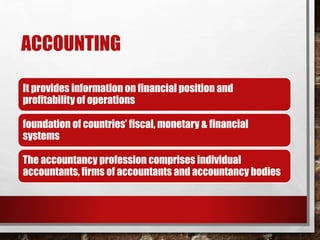
It provides information on financial position and
profitability of operations
foundation of countries’ fiscal, monetary & financial
systems
The accountancy profession comprises individual
accountants, firms of accountants and accountancy bodies
ROLES OF ACCOUNTING
PROFESSIONALS
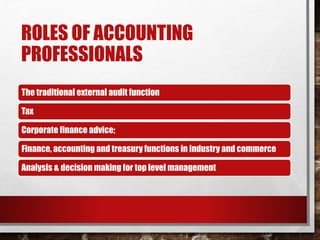
The traditional external audit function
Tax
Corporate finance advice;
Finance, accounting and treasury functions in industry and commerce
Analysis & decision making for top level management
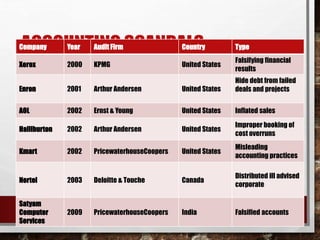
ACCOUNTING SCANDALSCompany Year Audit Firm Country Type
Xerox 2000 KPMG United States
Falsifying financial
results
Enron 2001 Arthur Andersen United States
Hide debt from failed
deals and projects
AOL 2002 Ernst & Young United States Inflated sales
Halliburton 2002 Arthur Andersen United States
Improper booking of
cost overruns
Kmart 2002 PricewaterhouseCoopers United States
Misleading
accounting practices
Nortel 2003 Deloitte & Touche Canada
Distributed ill advised
corporate
Satyam
Computer
Services
2009 PricewaterhouseCoopers India Falsified accounts
ETHICS
Ethics can be defined broadly as a set of moral principles or values
That many commonly held ethical values are incorporated into laws
It is practical to have laws that deal with cheating, stealing, lying or
deceiving others
It is far more difficult to establish meaningful laws that deal with integrity,
loyalty and the pursuit of excellence
ETHICS FOR PROFESSIONALS
Professionals are expected to conduct themselves at a higher
level than most other members of society
The term professional implies a responsibility for conduct that
extends beyond satisfying people's responsibilities to
themselves and beyond the requirements of our society's laws
and regulations
ETHICS FOR ACCOUNTANTS
CPAs and chartered accountants, as professionals, Must a
responsibility to the public, to clients and to fellow practitioners
that includes honorable behavior, even if that means personal
sacrifice
Management and external financial statement users must have
the confidence in the quality of the services from a CPA or
chartered accountant
TROUBLES IN RECENT YEAR
Increased competition made the public accounting firms
more concerned about keeping clients and maintaining
profits than with providing high quality audits for users
Public accounting firms are implementing philosophies
and practices that are frequently referred to as improved
business practices
REGULATORY BODY
International Federation of Accountants (IFAC) on International Standards of
Auditing (ISA);
International Accounting Standards Committee (IASC);
In line with the instructions of professional accounting body of the country;
and
In compliance with requirements of corporate laws and relevant regulatory
bodies and legislation.
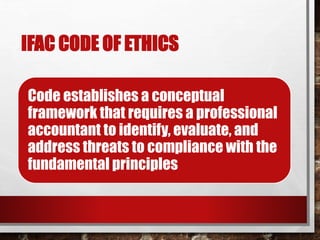
IFAC CODE OF ETHICS
Code establishes a conceptual
framework that requires a professional
accountant to identify, evaluate, and
address threats to compliance with the
fundamental principles
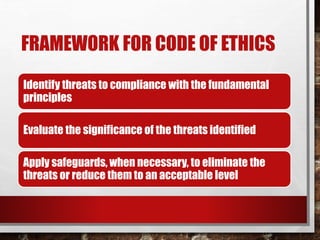
FRAMEWORK FOR CODE OF ETHICS
Identify threats to compliance with the fundamental
principles
Evaluate the significance of the threats identified
Apply safeguards, when necessary, to eliminate the
threats or reduce them to an acceptable level
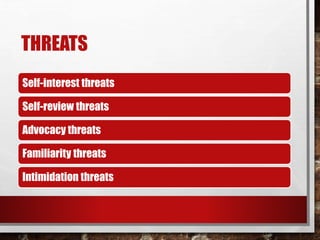
THREATS
Self-interest threats
Self-review threats
Advocacy threats
Familiarity threats
Intimidation threats
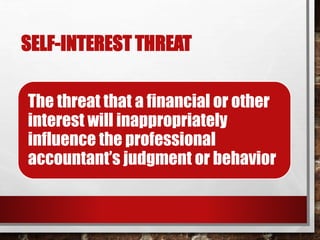
SELF-INTEREST THREAT
The threat that a financial or other
interest will inappropriately
influence the professional
accountant’s judgment or behavior
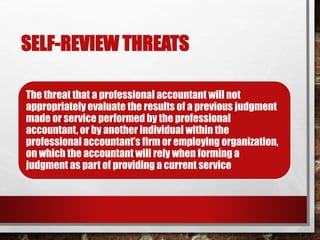
SELF-REVIEW THREATS
The threat that a professional accountant will not
appropriately evaluate the results of a previous judgment
made or service performed by the professional
accountant, or by another individual within the
professional accountant’s firm or employing organization,
on which the accountant will rely when forming a
judgment as part of providing a current service
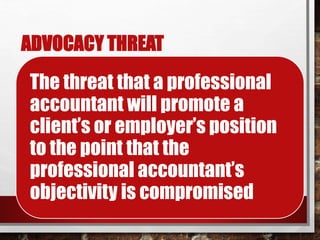
ADVOCACY THREAT
The threat that a professional
accountant will promote a
client’s or employer’s position
to the point that the
professional accountant’s
objectivity is compromised
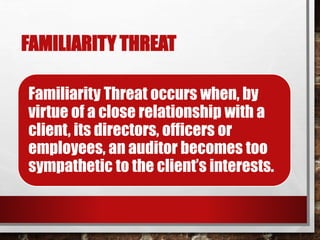
FAMILIARITY THREAT
Familiarity Threat occurs when, by
virtue of a close relationship with a
client, its directors, officers or
employees, an auditor becomes too
sympathetic to the client’s interests.
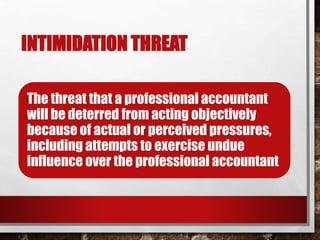
INTIMIDATION THREAT
The threat that a professional accountant
will be deterred from acting objectively
because of actual or perceived pressures,
including attempts to exercise undue
influence over the professional accountant
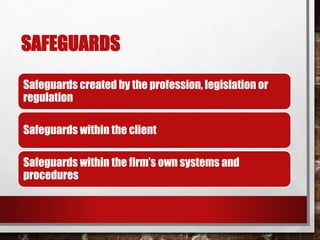
SAFEGUARDS
Safeguards created by the profession, legislation or
regulation
Safeguards within the client
Safeguards within the firm’s own systems and
procedures
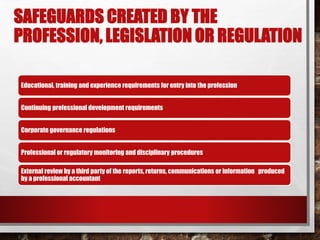
SAFEGUARDS CREATED BY THE
PROFESSION, LEGISLATION OR REGULATION
Educational, training and experience requirements for entry into the profession
Continuing professional development requirements
Corporate governance regulations
Professional or regulatory monitoring and disciplinary procedures
External review by a third party of the reports, returns, communications or information produced
by a professional accountant
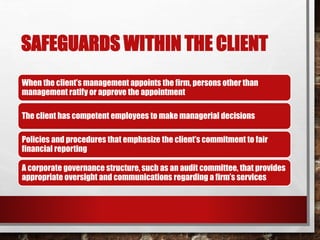
SAFEGUARDS WITHIN THE CLIENT
When the client’s management appoints the firm, persons other than
management ratify or approve the appointment
The client has competent employees to make managerial decisions
Policies and procedures that emphasize the client’s commitment to fair
financial reporting
A corporate governance structure, such as an audit committee, that provides
appropriate oversight and communications regarding a firm’s services
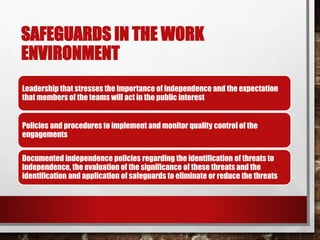
SAFEGUARDS IN THE WORK
ENVIRONMENT
Leadership that stresses the importance of independence and the expectation
that members of the teams will act in the public interest
Policies and procedures to implement and monitor quality control of the
engagements
Documented independence policies regarding the identification of threats to
independence, the evaluation of the significance of these threats and the
identification and application of safeguards to eliminate or reduce the threats
CONCLUSION
Reasonable trade-off between the degrees of responsibility and the audit
cost to society
A regular monitoring of the accounting firms
Relying on the law-or a set of professional codes may not be always
adequate
It is in the profession's self-interest to maintain public trust in the
competent performance of the accounting profession
Q & A
THANK YOU

Ethics in Accounting

  • 2.
    ACCOUNTING It provides informationon financial position and profitability of operations foundation of countries’ fiscal, monetary & financial systems The accountancy profession comprises individual accountants, firms of accountants and accountancy bodies
  • 3.
    ROLES OF ACCOUNTING PROFESSIONALS Thetraditional external audit function Tax Corporate finance advice; Finance, accounting and treasury functions in industry and commerce Analysis & decision making for top level management
  • 4.
    ACCOUNTING SCANDALSCompany YearAudit Firm Country Type Xerox 2000 KPMG United States Falsifying financial results Enron 2001 Arthur Andersen United States Hide debt from failed deals and projects AOL 2002 Ernst & Young United States Inflated sales Halliburton 2002 Arthur Andersen United States Improper booking of cost overruns Kmart 2002 PricewaterhouseCoopers United States Misleading accounting practices Nortel 2003 Deloitte & Touche Canada Distributed ill advised corporate Satyam Computer Services 2009 PricewaterhouseCoopers India Falsified accounts
  • 5.
    ETHICS Ethics can bedefined broadly as a set of moral principles or values That many commonly held ethical values are incorporated into laws It is practical to have laws that deal with cheating, stealing, lying or deceiving others It is far more difficult to establish meaningful laws that deal with integrity, loyalty and the pursuit of excellence
  • 6.
    ETHICS FOR PROFESSIONALS Professionalsare expected to conduct themselves at a higher level than most other members of society The term professional implies a responsibility for conduct that extends beyond satisfying people's responsibilities to themselves and beyond the requirements of our society's laws and regulations
  • 7.
    ETHICS FOR ACCOUNTANTS CPAsand chartered accountants, as professionals, Must a responsibility to the public, to clients and to fellow practitioners that includes honorable behavior, even if that means personal sacrifice Management and external financial statement users must have the confidence in the quality of the services from a CPA or chartered accountant
  • 8.
    TROUBLES IN RECENTYEAR Increased competition made the public accounting firms more concerned about keeping clients and maintaining profits than with providing high quality audits for users Public accounting firms are implementing philosophies and practices that are frequently referred to as improved business practices
  • 9.
    REGULATORY BODY International Federationof Accountants (IFAC) on International Standards of Auditing (ISA); International Accounting Standards Committee (IASC); In line with the instructions of professional accounting body of the country; and In compliance with requirements of corporate laws and relevant regulatory bodies and legislation.
  • 10.
    IFAC CODE OFETHICS Code establishes a conceptual framework that requires a professional accountant to identify, evaluate, and address threats to compliance with the fundamental principles
  • 11.
    FRAMEWORK FOR CODEOF ETHICS Identify threats to compliance with the fundamental principles Evaluate the significance of the threats identified Apply safeguards, when necessary, to eliminate the threats or reduce them to an acceptable level
  • 12.
    THREATS Self-interest threats Self-review threats Advocacythreats Familiarity threats Intimidation threats
  • 13.
    SELF-INTEREST THREAT The threatthat a financial or other interest will inappropriately influence the professional accountant’s judgment or behavior
  • 14.
    SELF-REVIEW THREATS The threatthat a professional accountant will not appropriately evaluate the results of a previous judgment made or service performed by the professional accountant, or by another individual within the professional accountant’s firm or employing organization, on which the accountant will rely when forming a judgment as part of providing a current service
  • 15.
    ADVOCACY THREAT The threatthat a professional accountant will promote a client’s or employer’s position to the point that the professional accountant’s objectivity is compromised
  • 16.
    FAMILIARITY THREAT Familiarity Threatoccurs when, by virtue of a close relationship with a client, its directors, officers or employees, an auditor becomes too sympathetic to the client’s interests.
  • 17.
    INTIMIDATION THREAT The threatthat a professional accountant will be deterred from acting objectively because of actual or perceived pressures, including attempts to exercise undue influence over the professional accountant
  • 18.
    SAFEGUARDS Safeguards created bythe profession, legislation or regulation Safeguards within the client Safeguards within the firm’s own systems and procedures
  • 19.
    SAFEGUARDS CREATED BYTHE PROFESSION, LEGISLATION OR REGULATION Educational, training and experience requirements for entry into the profession Continuing professional development requirements Corporate governance regulations Professional or regulatory monitoring and disciplinary procedures External review by a third party of the reports, returns, communications or information produced by a professional accountant
  • 20.
    SAFEGUARDS WITHIN THECLIENT When the client’s management appoints the firm, persons other than management ratify or approve the appointment The client has competent employees to make managerial decisions Policies and procedures that emphasize the client’s commitment to fair financial reporting A corporate governance structure, such as an audit committee, that provides appropriate oversight and communications regarding a firm’s services
  • 21.
    SAFEGUARDS IN THEWORK ENVIRONMENT Leadership that stresses the importance of independence and the expectation that members of the teams will act in the public interest Policies and procedures to implement and monitor quality control of the engagements Documented independence policies regarding the identification of threats to independence, the evaluation of the significance of these threats and the identification and application of safeguards to eliminate or reduce the threats
  • 22.
    CONCLUSION Reasonable trade-off betweenthe degrees of responsibility and the audit cost to society A regular monitoring of the accounting firms Relying on the law-or a set of professional codes may not be always adequate It is in the profession's self-interest to maintain public trust in the competent performance of the accounting profession
  • 23.
  • 24.