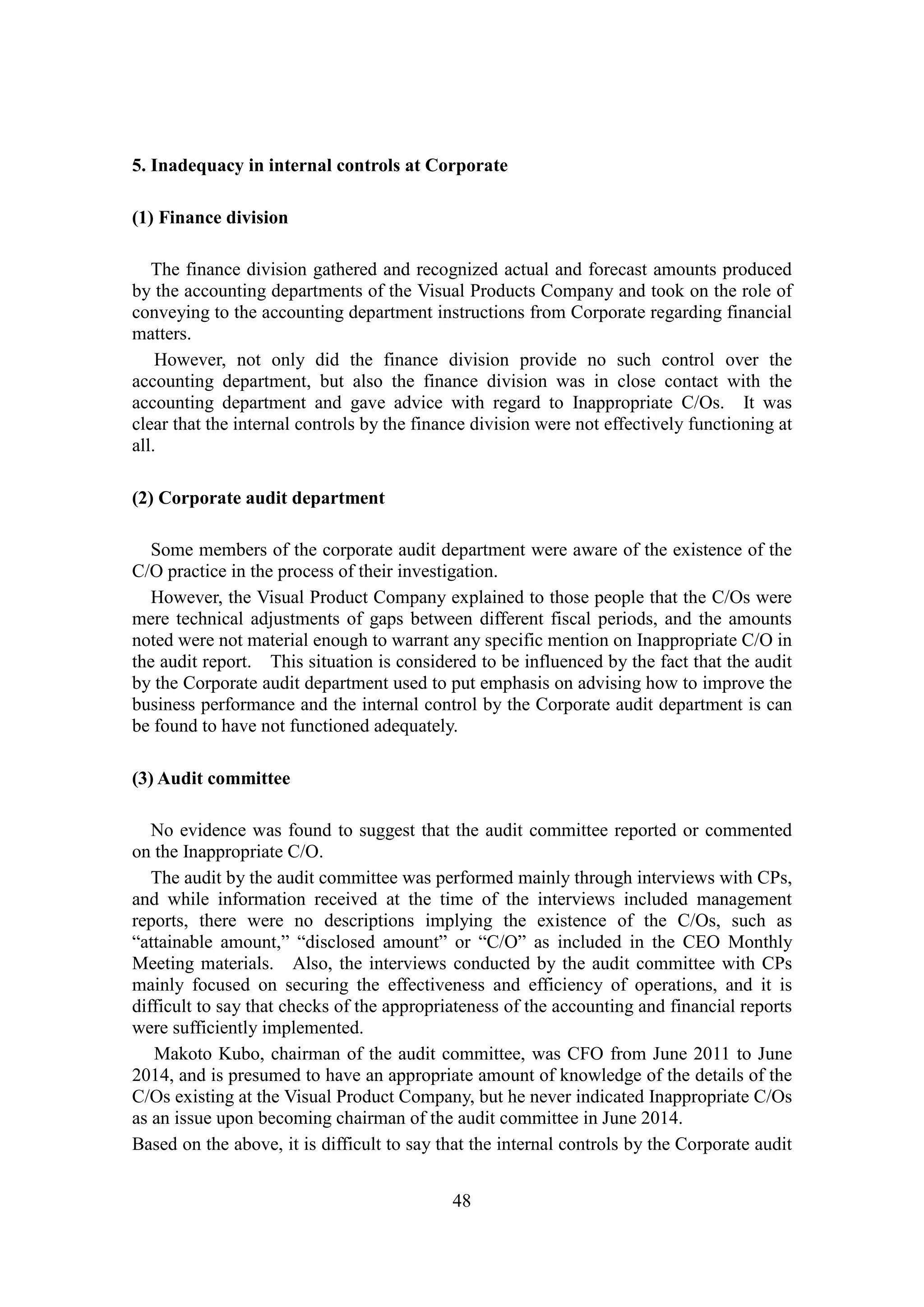
[Tentative Translation]
Investigation Report
Summary Version
20 July 2015
Independent Investigation Committee
For Toshiba Corporation
TRANSLATION FOR REFERENCE PURPOSE ONLY
This document is an English language translation of a document originally prepared in the
Japanese language and is prepared for reference purpose only. If there is any discrepancy
between the content of this translation and the content of the original Japanese document, the
content of the original Japanese document will prevail.
2
To Toshiba Corporation
Independent Investigation Committee
For Toshiba Corporation
Committee Chairman Koichi Ueda
Committee Member Hideki Matsui
Committee Member Taigi Ito
Committee Member Kazuyasu Yamada
3
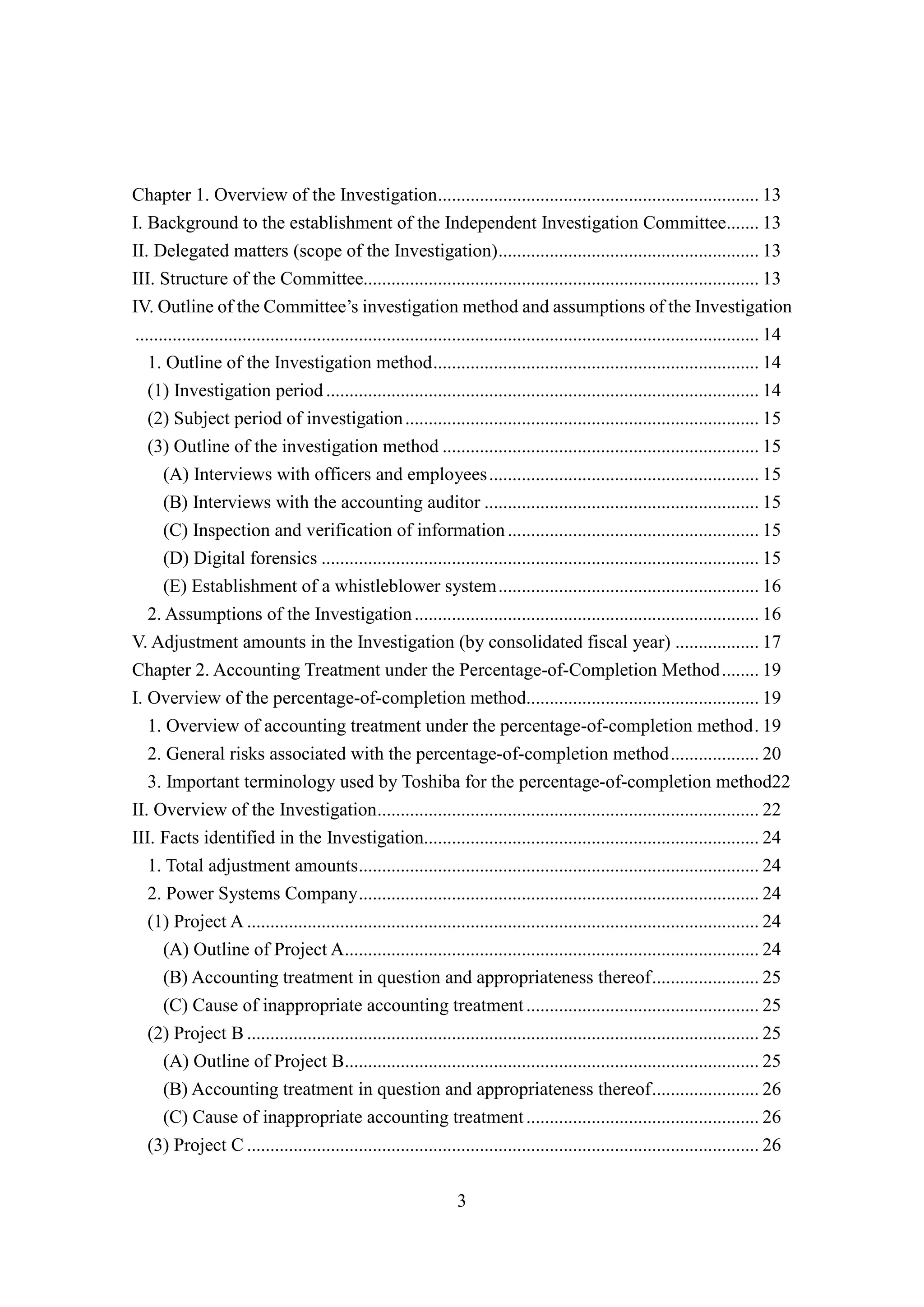
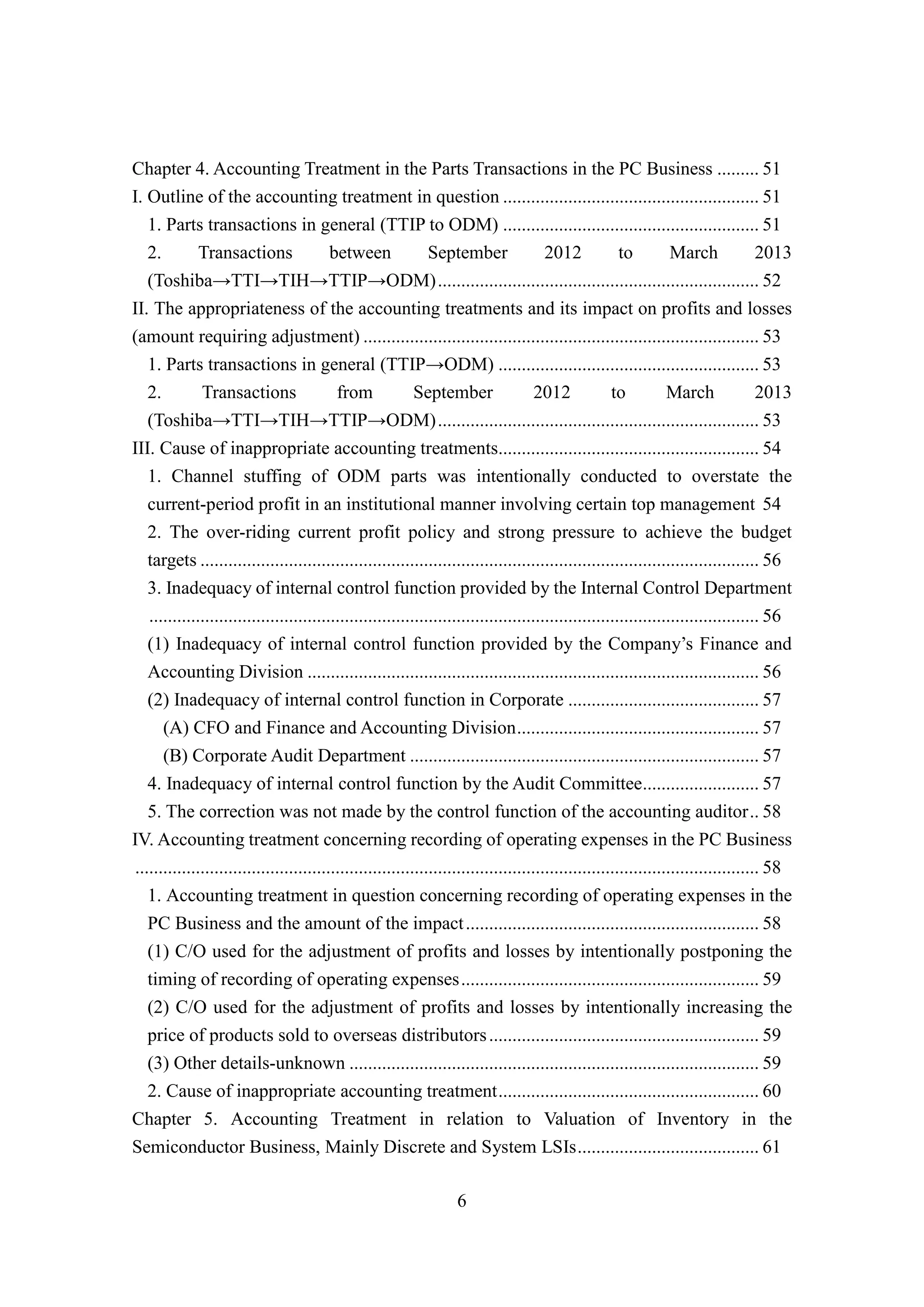
Chapter 1. Overview of the Investigation..................................................................... 13
I. Background to the establishment of the Independent Investigation Committee....... 13
II. Delegated matters (scope of the Investigation)........................................................ 13
III. Structure of the Committee..................................................................................... 13
IV. Outline of the Committee’s investigation method and assumptions of the Investigation
...................................................................................................................................... 14
1. Outline of the Investigation method...................................................................... 14
(1) Investigation period............................................................................................. 14
(2) Subject period of investigation............................................................................ 15
(3) Outline of the investigation method .................................................................... 15
(A) Interviews with officers and employees.......................................................... 15
(B) Interviews with the accounting auditor ........................................................... 15
(C) Inspection and verification of information...................................................... 15
(D) Digital forensics .............................................................................................. 15
(E) Establishment of a whistleblower system........................................................ 16
2. Assumptions of the Investigation.......................................................................... 16
V. Adjustment amounts in the Investigation (by consolidated fiscal year) .................. 17
Chapter 2. Accounting Treatment under the Percentage-of-Completion Method........ 19
I. Overview of the percentage-of-completion method.................................................. 19
1. Overview of accounting treatment under the percentage-of-completion method. 19
2. General risks associated with the percentage-of-completion method................... 20
3. Important terminology used by Toshiba for the percentage-of-completion method22
II. Overview of the Investigation.................................................................................. 22
III. Facts identified in the Investigation........................................................................ 24
1. Total adjustment amounts...................................................................................... 24
2. Power Systems Company...................................................................................... 24
(1) Project A .............................................................................................................. 24
(A) Outline of Project A......................................................................................... 24
(B) Accounting treatment in question and appropriateness thereof....................... 25
(C) Cause of inappropriate accounting treatment.................................................. 25
(2) Project B .............................................................................................................. 25
(A) Outline of Project B......................................................................................... 25
(B) Accounting treatment in question and appropriateness thereof....................... 26
(C) Cause of inappropriate accounting treatment.................................................. 26
(3) Project C .............................................................................................................. 26
4
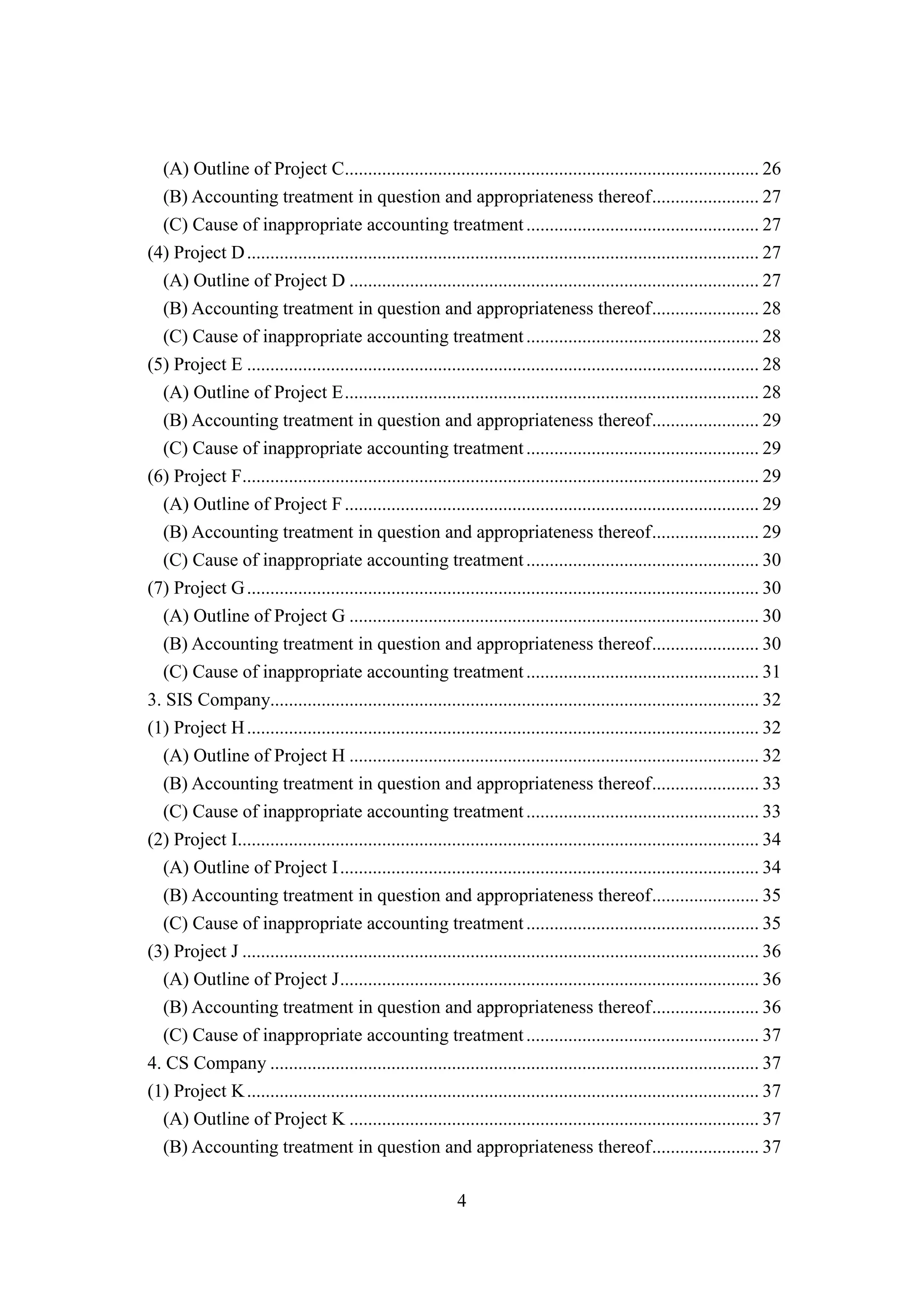
(A) Outline of Project C......................................................................................... 26
(B) Accounting treatment in question and appropriateness thereof....................... 27
(C) Cause of inappropriate accounting treatment.................................................. 27
(4) Project D.............................................................................................................. 27
(A) Outline of Project D ........................................................................................ 27
(B) Accounting treatment in question and appropriateness thereof....................... 28
(C) Cause of inappropriate accounting treatment.................................................. 28
(5) Project E .............................................................................................................. 28
(A) Outline of Project E......................................................................................... 28
(B) Accounting treatment in question and appropriateness thereof....................... 29
(C) Cause of inappropriate accounting treatment.................................................. 29
(6) Project F............................................................................................................... 29
(A) Outline of Project F......................................................................................... 29
(B) Accounting treatment in question and appropriateness thereof....................... 29
(C) Cause of inappropriate accounting treatment.................................................. 30
(7) Project G.............................................................................................................. 30
(A) Outline of Project G ........................................................................................ 30
(B) Accounting treatment in question and appropriateness thereof....................... 30
(C) Cause of inappropriate accounting treatment.................................................. 31
3. SIS Company......................................................................................................... 32
(1) Project H.............................................................................................................. 32
(A) Outline of Project H ........................................................................................ 32
(B) Accounting treatment in question and appropriateness thereof....................... 33
(C) Cause of inappropriate accounting treatment.................................................. 33
(2) Project I................................................................................................................ 34
(A) Outline of Project I.......................................................................................... 34
(B) Accounting treatment in question and appropriateness thereof....................... 35
(C) Cause of inappropriate accounting treatment.................................................. 35
(3) Project J ............................................................................................................... 36
(A) Outline of Project J.......................................................................................... 36
(B) Accounting treatment in question and appropriateness thereof....................... 36
(C) Cause of inappropriate accounting treatment.................................................. 37
4. CS Company ......................................................................................................... 37
(1) Project K.............................................................................................................. 37
(A) Outline of Project K ........................................................................................ 37
(B) Accounting treatment in question and appropriateness thereof....................... 37
5
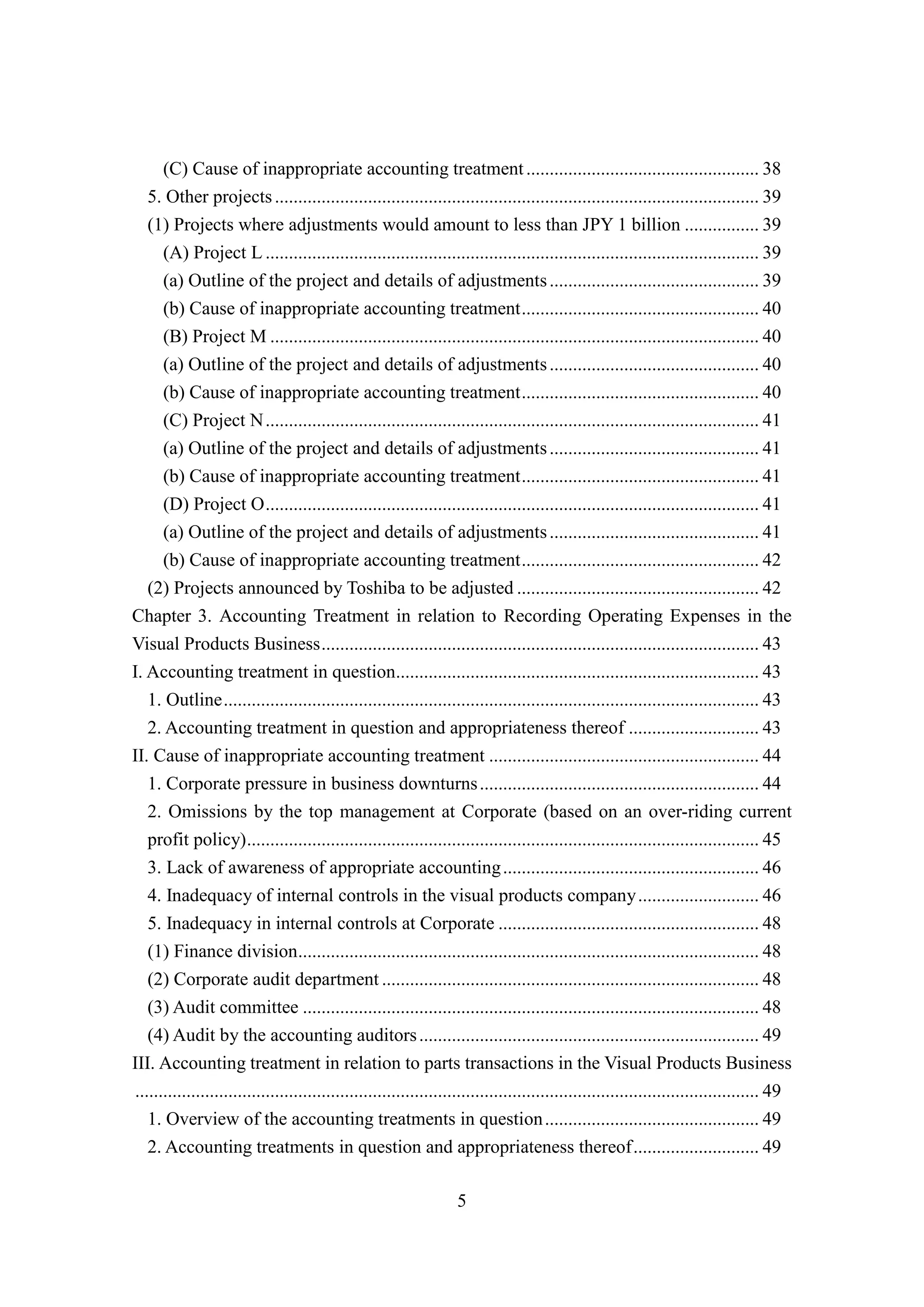
(C) Cause of inappropriate accounting treatment.................................................. 38
5. Other projects........................................................................................................ 39
(1) Projects where adjustments would amount to less than JPY 1 billion ................ 39
(A) Project L .......................................................................................................... 39
(a) Outline of the project and details of adjustments............................................. 39
(b) Cause of inappropriate accounting treatment................................................... 40
(B) Project M ......................................................................................................... 40
(a) Outline of the project and details of adjustments............................................. 40
(b) Cause of inappropriate accounting treatment................................................... 40
(C) Project N.......................................................................................................... 41
(a) Outline of the project and details of adjustments............................................. 41
(b) Cause of inappropriate accounting treatment................................................... 41
(D) Project O.......................................................................................................... 41
(a) Outline of the project and details of adjustments............................................. 41
(b) Cause of inappropriate accounting treatment................................................... 42
(2) Projects announced by Toshiba to be adjusted .................................................... 42
Chapter 3. Accounting Treatment in relation to Recording Operating Expenses in the
Visual Products Business.............................................................................................. 43
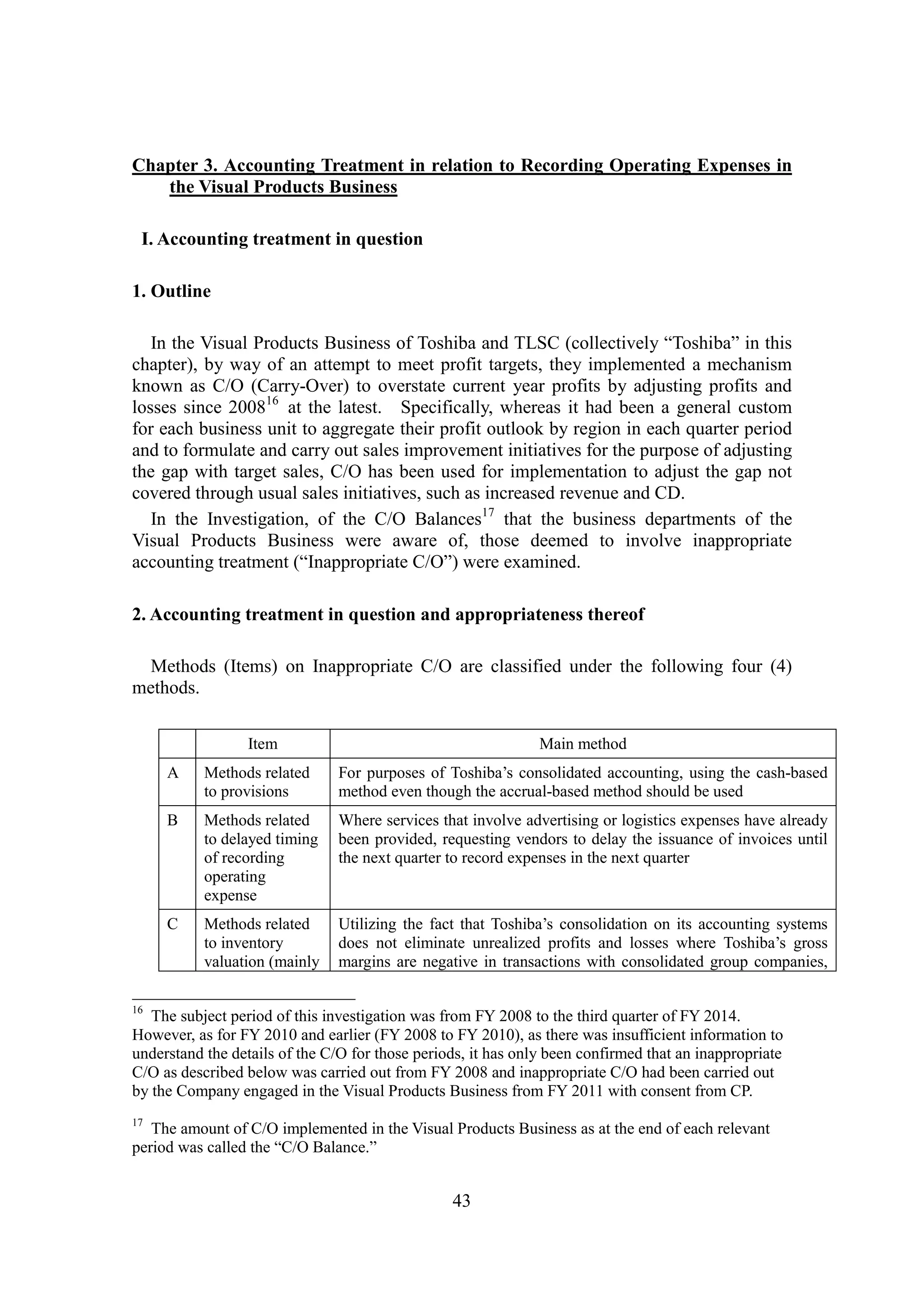
I. Accounting treatment in question.............................................................................. 43
1. Outline................................................................................................................... 43
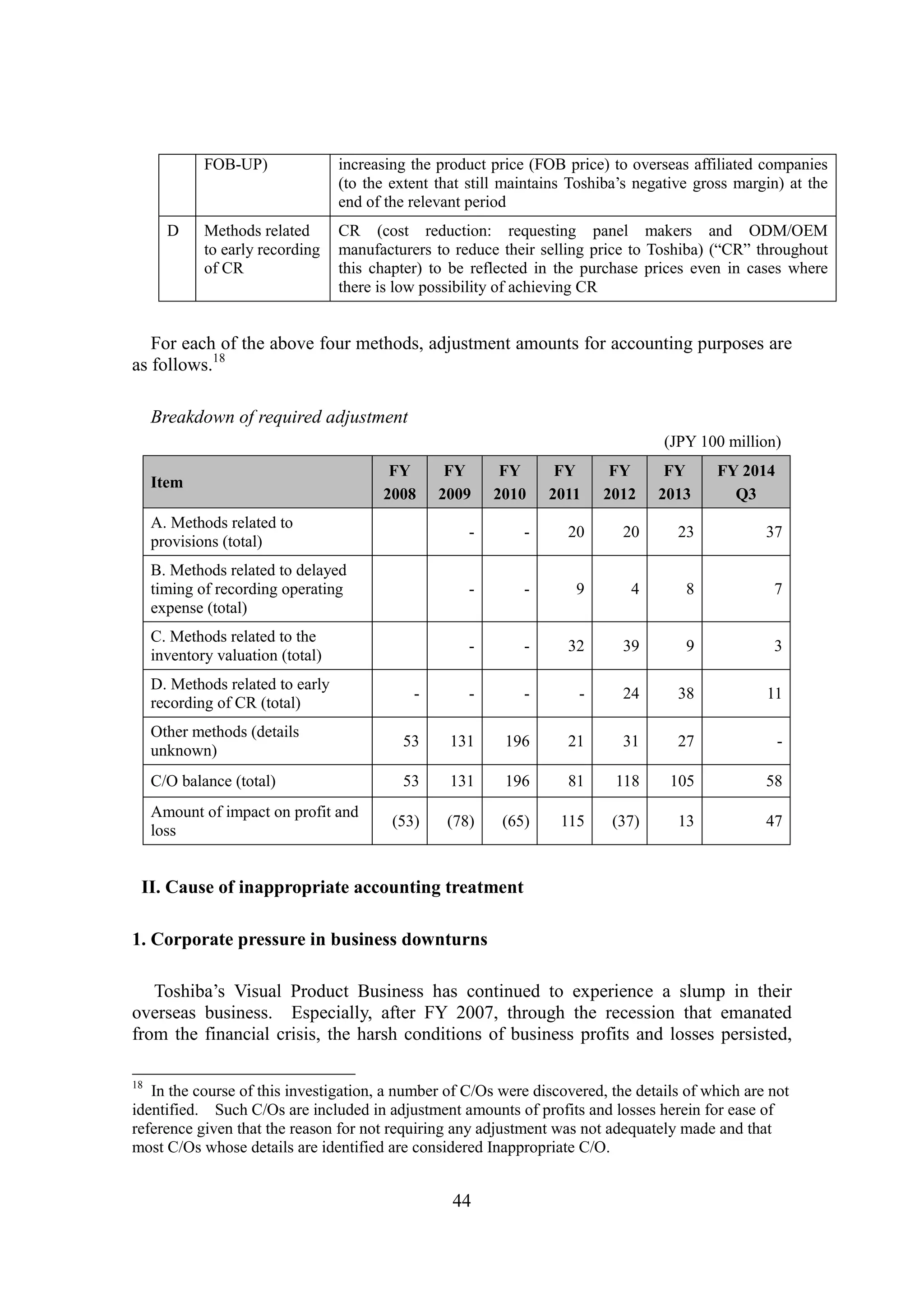
2. Accounting treatment in question and appropriateness thereof ............................ 43
II. Cause of inappropriate accounting treatment .......................................................... 44
1. Corporate pressure in business downturns............................................................ 44
2. Omissions by the top management at Corporate (based on an over-riding current
profit policy).............................................................................................................. 45
3. Lack of awareness of appropriate accounting....................................................... 46
4. Inadequacy of internal controls in the visual products company.......................... 46
5. Inadequacy in internal controls at Corporate ........................................................ 48
(1) Finance division................................................................................................... 48
(2) Corporate audit department ................................................................................. 48
(3) Audit committee .................................................................................................. 48
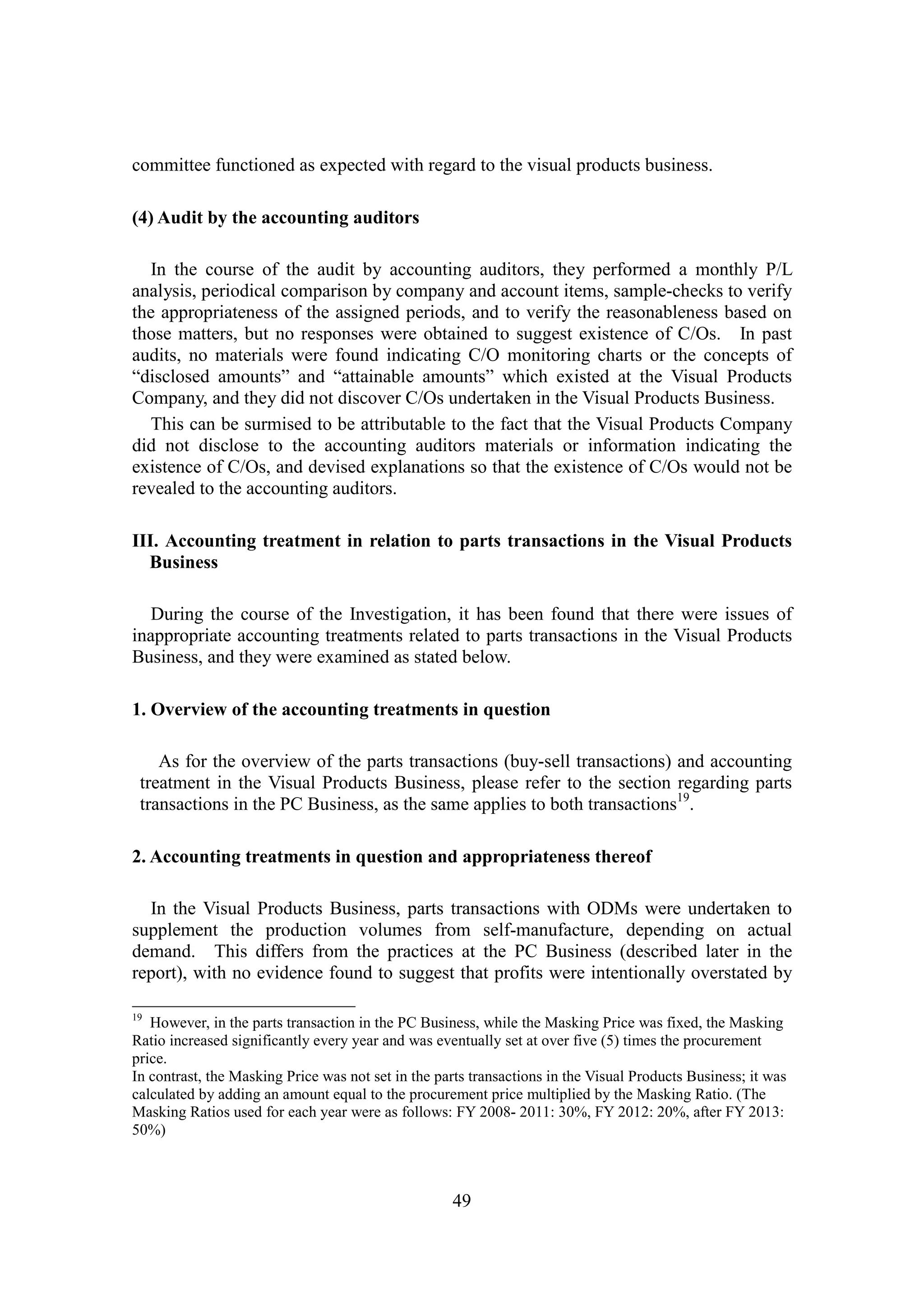
(4) Audit by the accounting auditors......................................................................... 49
III. Accounting treatment in relation to parts transactions in the Visual Products Business
...................................................................................................................................... 49
1. Overview of the accounting treatments in question.............................................. 49
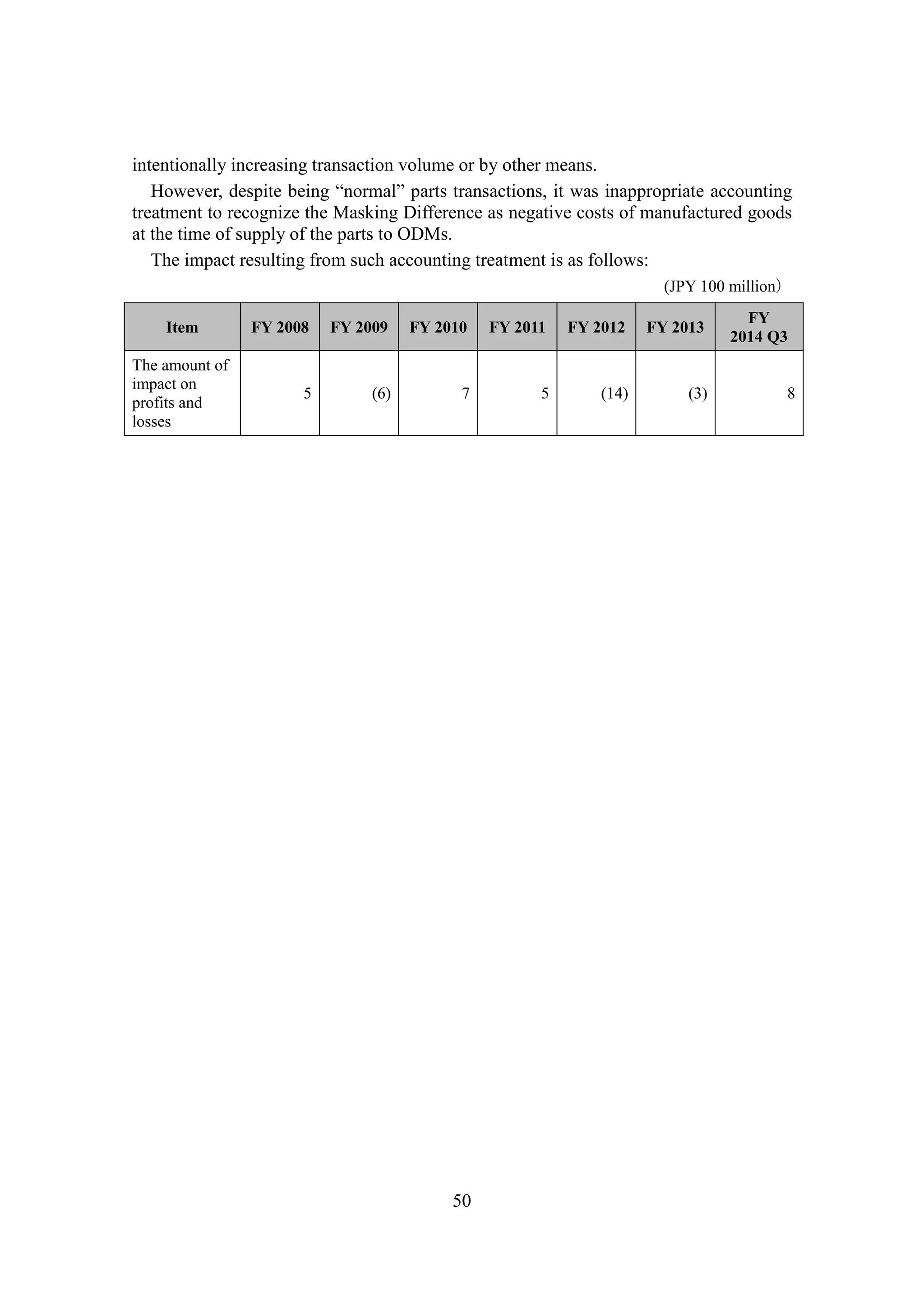
2. Accounting treatments in question and appropriateness thereof........................... 49
6
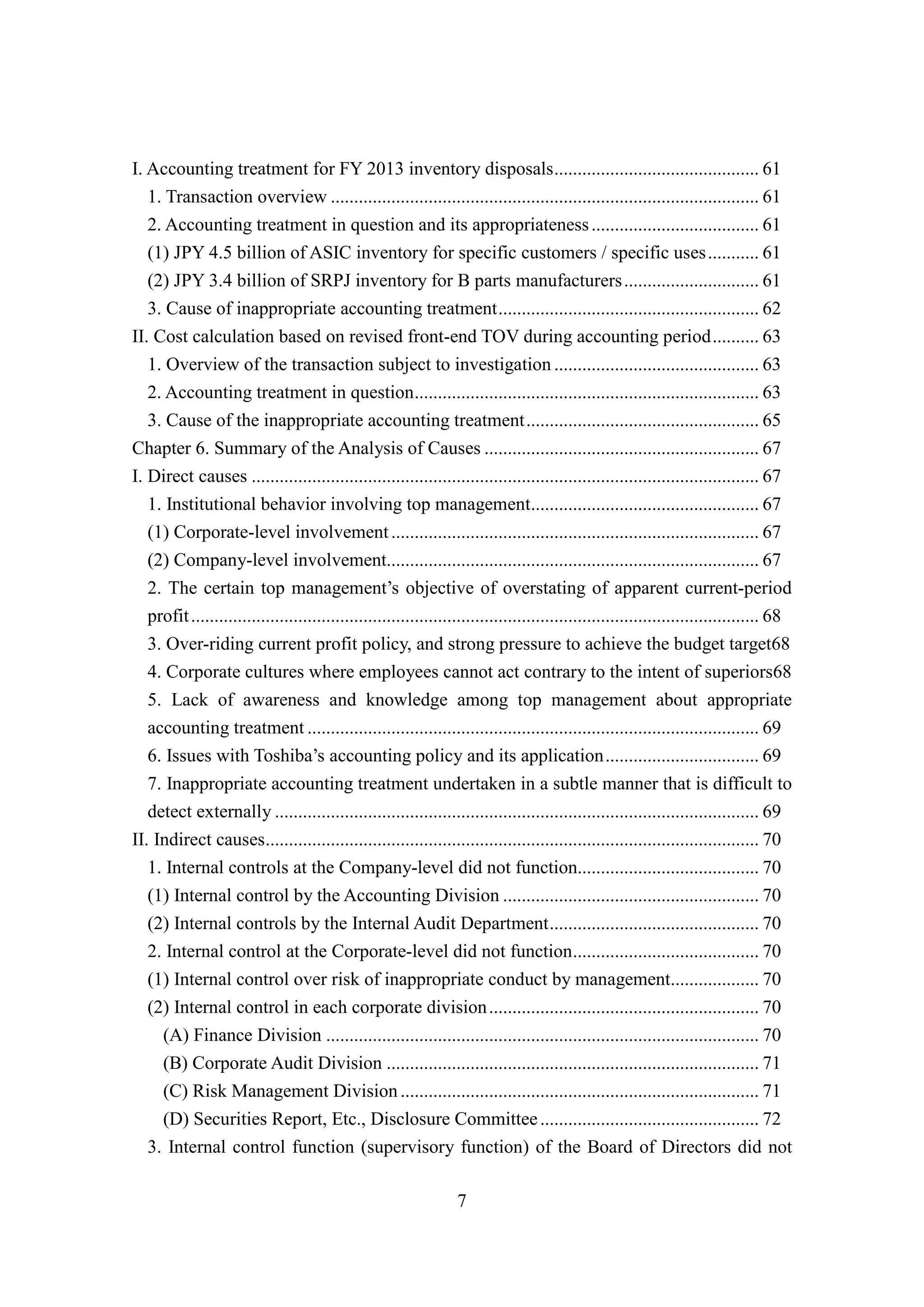
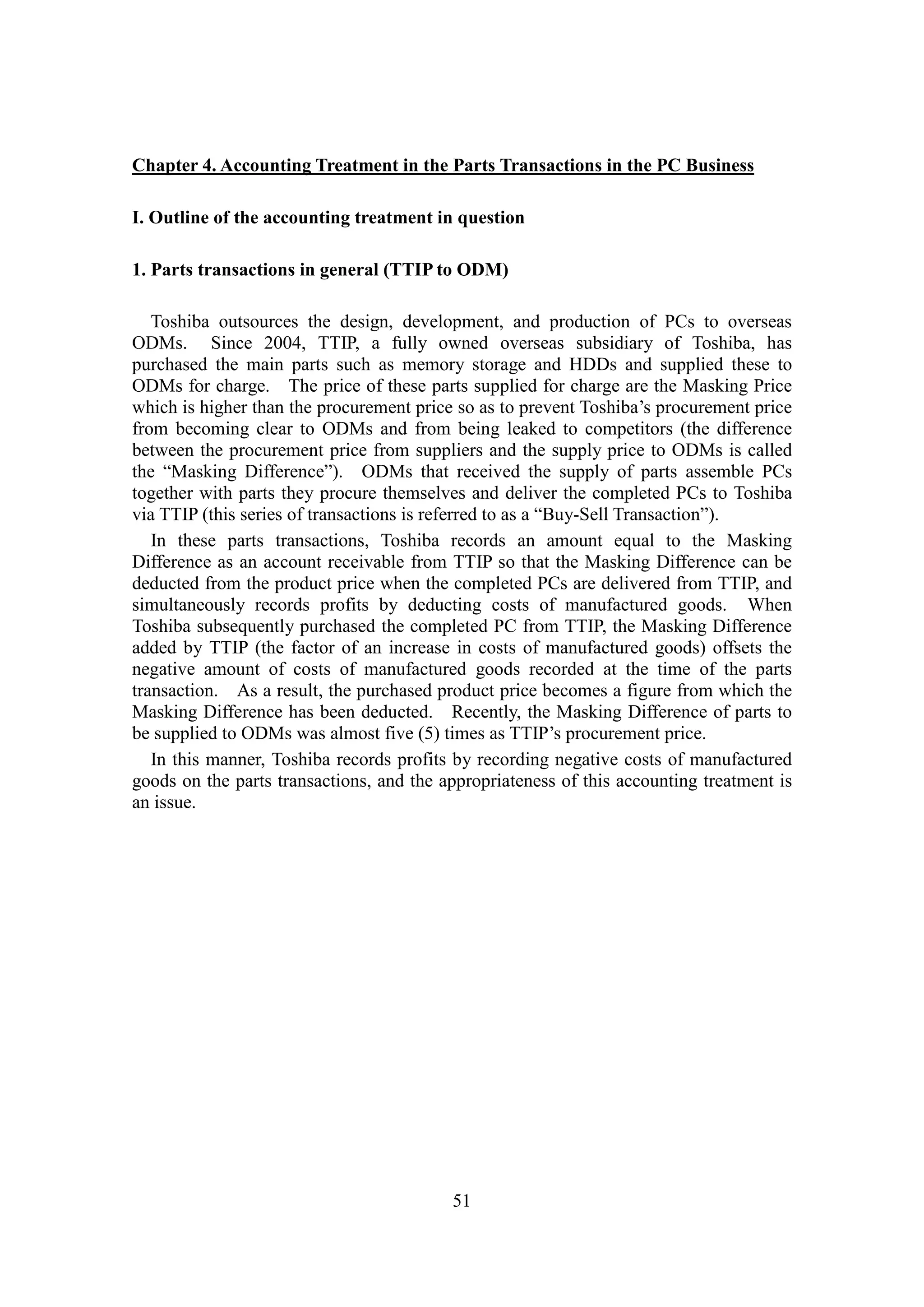
Chapter 4. Accounting Treatment in the Parts Transactions in the PC Business ......... 51
I. Outline of the accounting treatment in question ....................................................... 51
1. Parts transactions in general (TTIP to ODM) ....................................................... 51
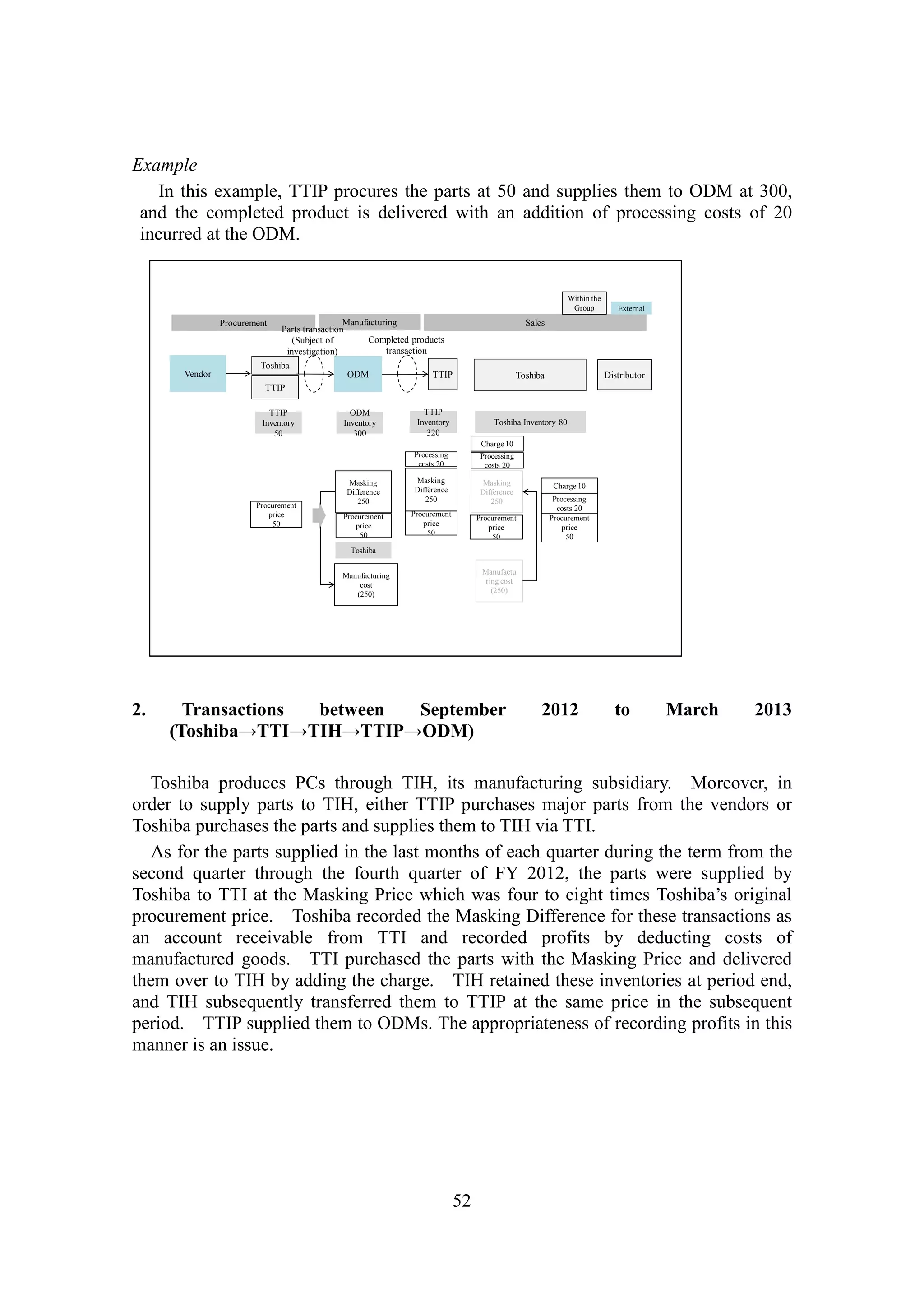
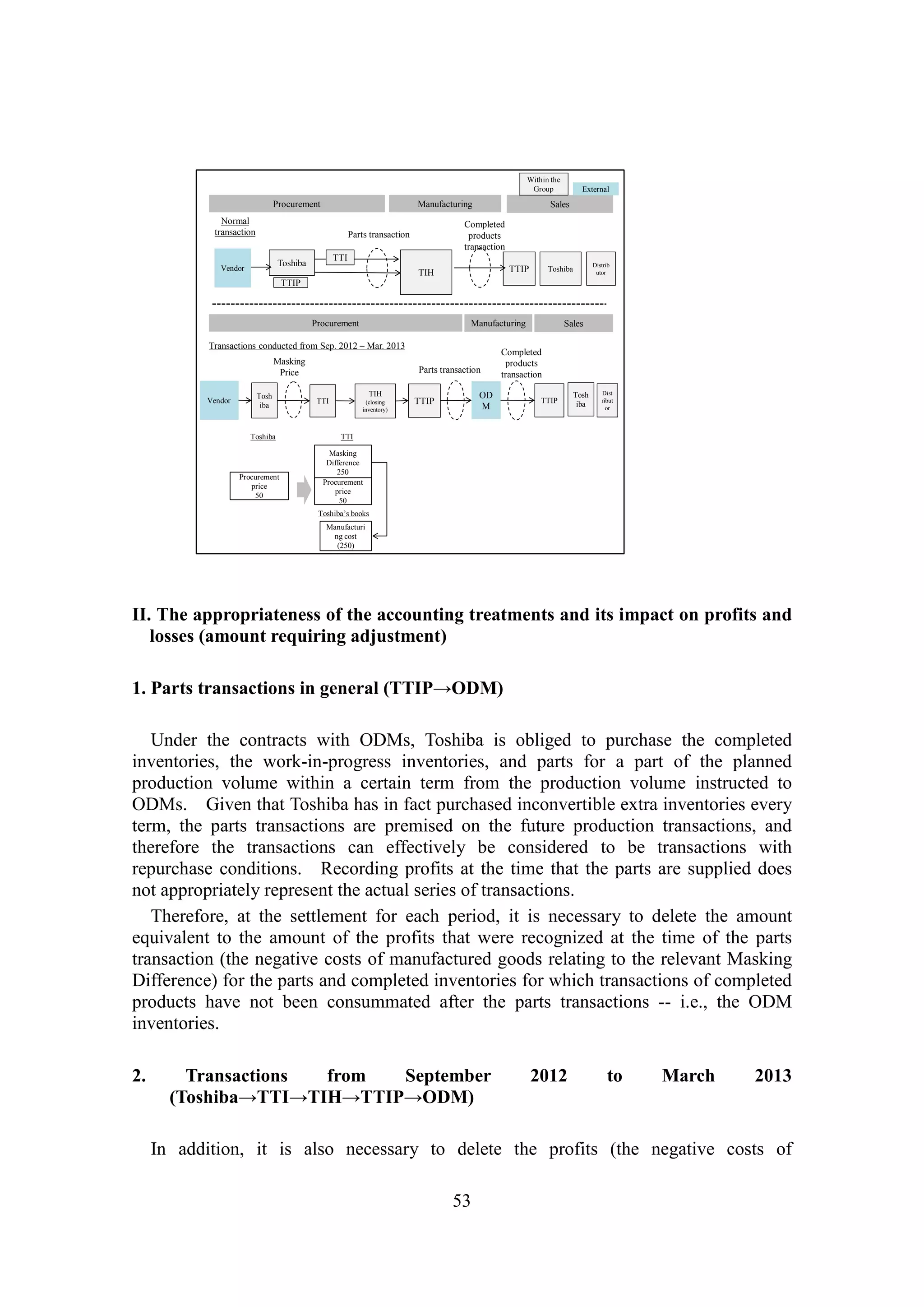
2. Transactions between September 2012 to March 2013
(Toshiba→TTI→TIH→TTIP→ODM)..................................................................... 52
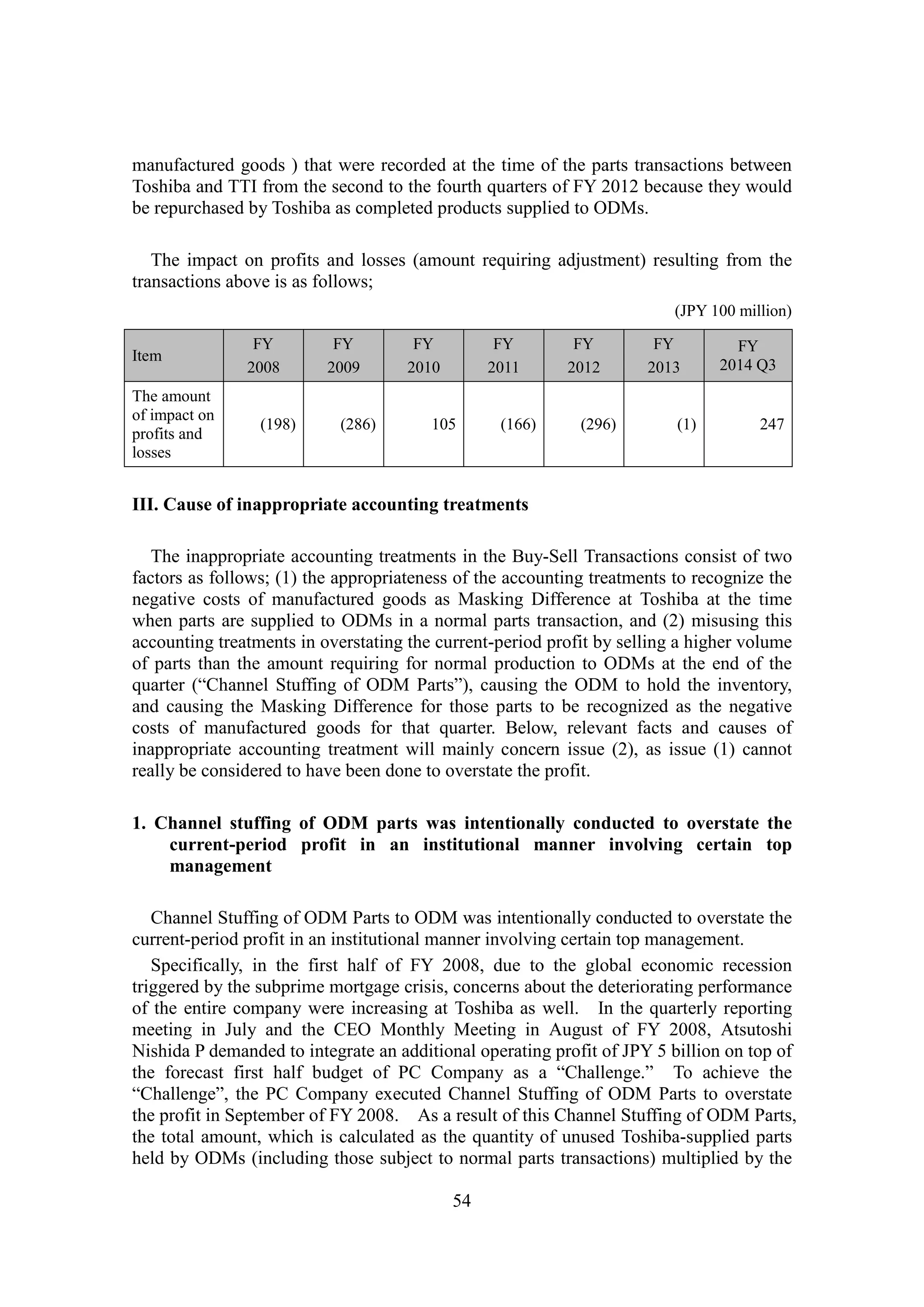
II. The appropriateness of the accounting treatments and its impact on profits and losses
(amount requiring adjustment) ..................................................................................... 53
1. Parts transactions in general (TTIP→ODM) ........................................................ 53
2. Transactions from September 2012 to March 2013
(Toshiba→TTI→TIH→TTIP→ODM)..................................................................... 53
III. Cause of inappropriate accounting treatments........................................................ 54
1. Channel stuffing of ODM parts was intentionally conducted to overstate the
current-period profit in an institutional manner involving certain top management 54
2. The over-riding current profit policy and strong pressure to achieve the budget
targets ........................................................................................................................ 56
3. Inadequacy of internal control function provided by the Internal Control Department
................................................................................................................................... 56
(1) Inadequacy of internal control function provided by the Company’s Finance and
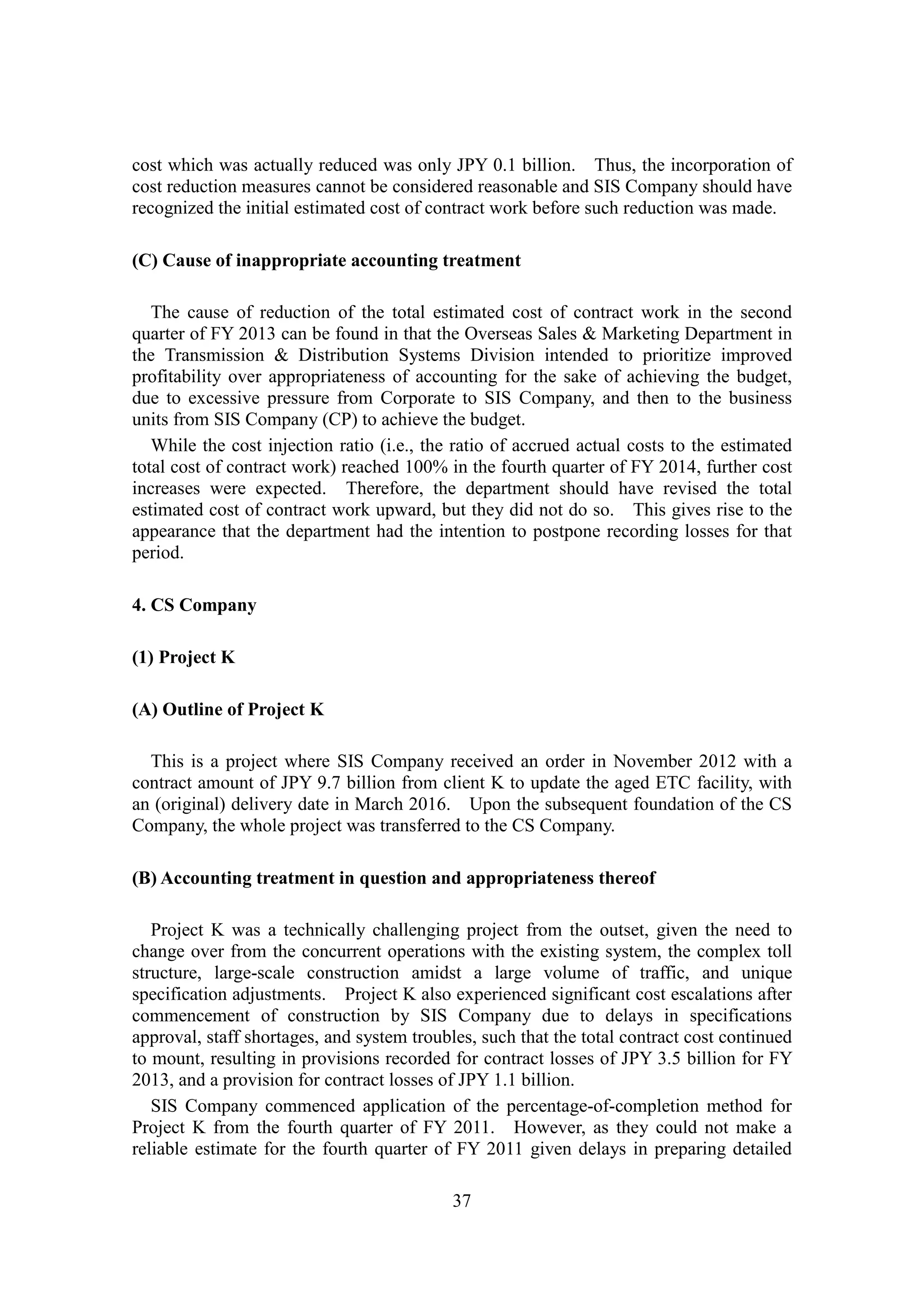
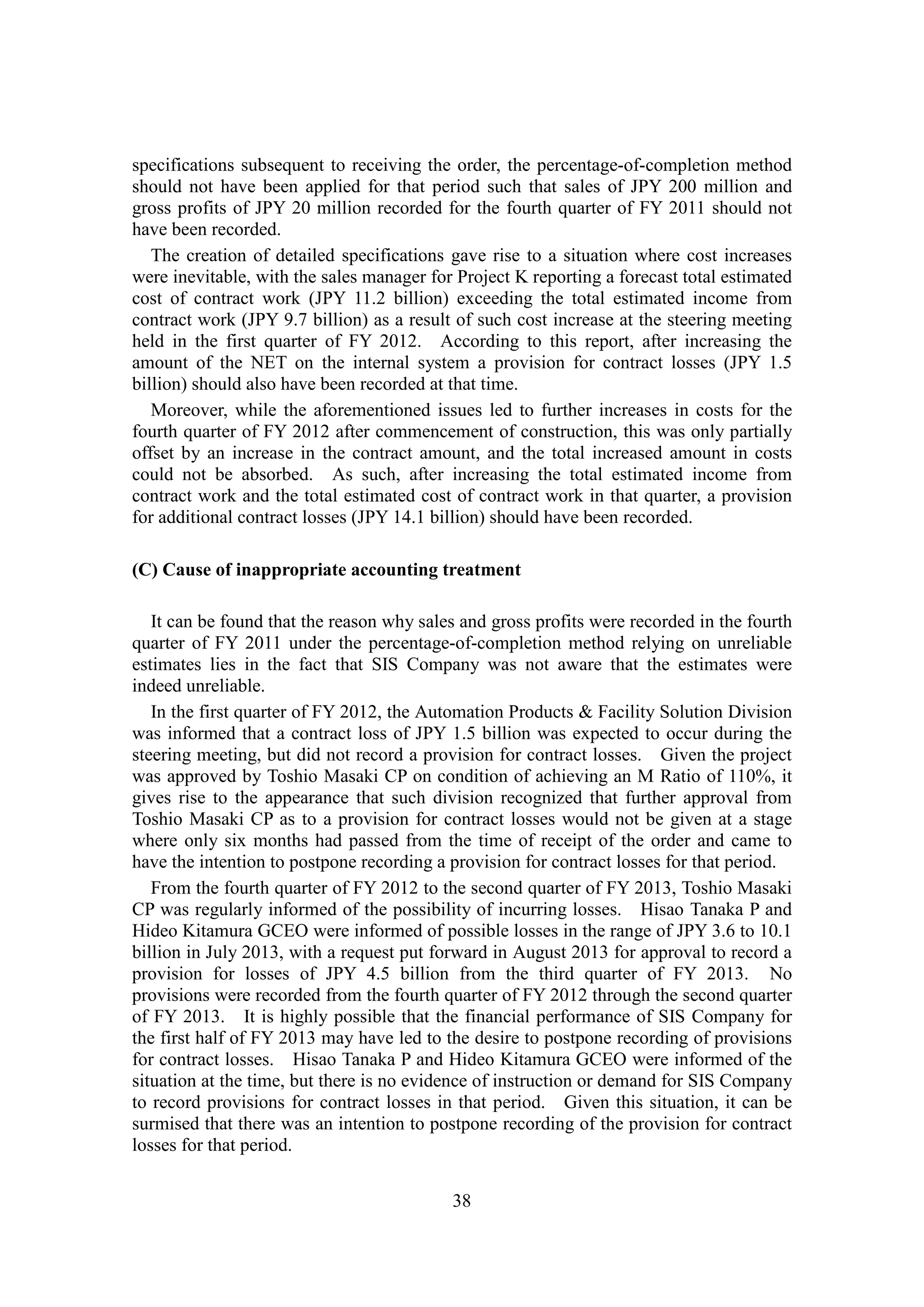
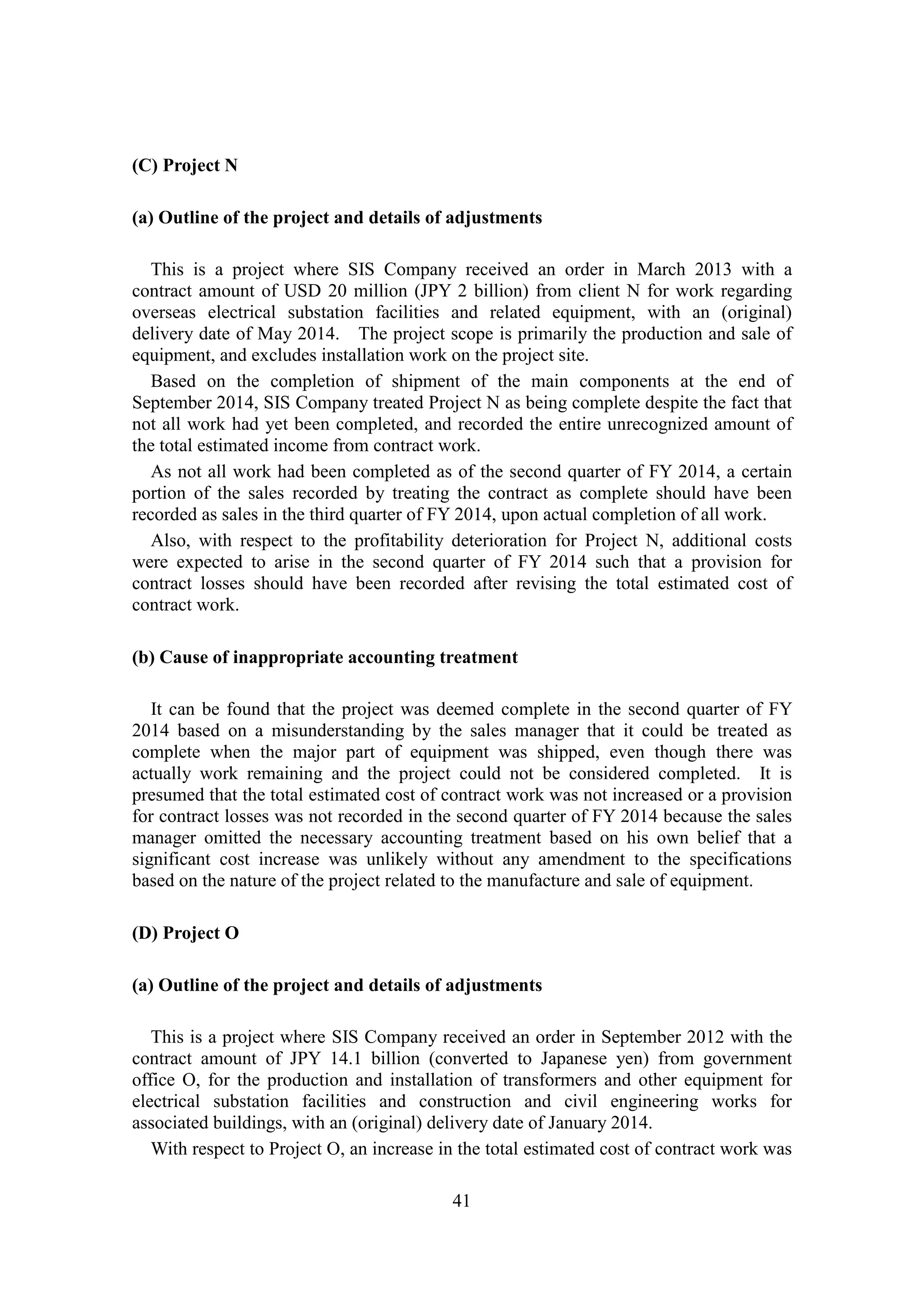
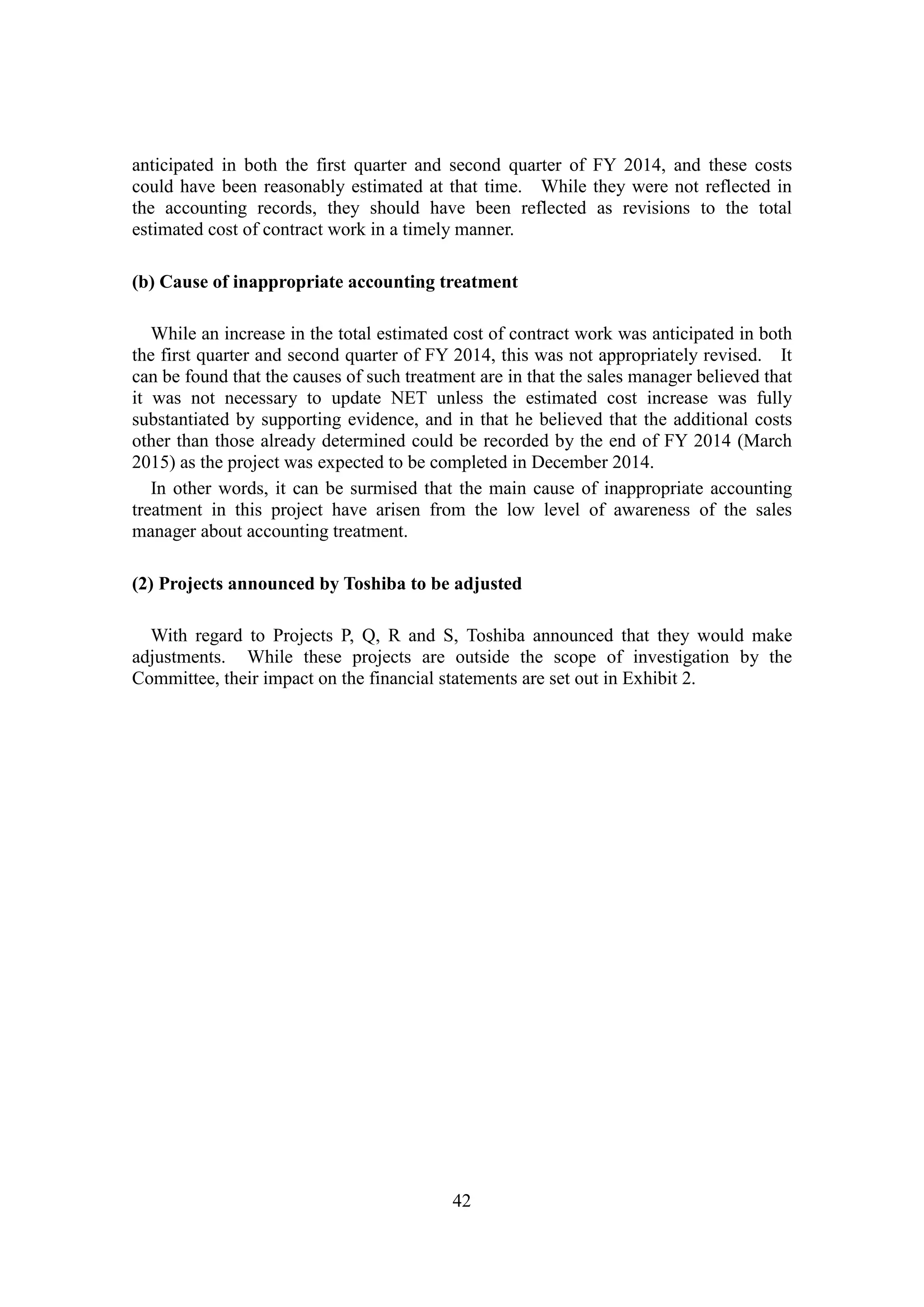
Accounting Division ................................................................................................. 56
(2) Inadequacy of internal control function in Corporate ......................................... 57
(A) CFO and Finance and Accounting Division.................................................... 57
(B) Corporate Audit Department ........................................................................... 57
4. Inadequacy of internal control function by the Audit Committee......................... 57
5. The correction was not made by the control function of the accounting auditor.. 58
IV. Accounting treatment concerning recording of operating expenses in the PC Business
...................................................................................................................................... 58
1. Accounting treatment in question concerning recording of operating expenses in the
PC Business and the amount of the impact............................................................... 58
(1) C/O used for the adjustment of profits and losses by intentionally postponing the
timing of recording of operating expenses................................................................ 59
(2) C/O used for the adjustment of profits and losses by intentionally increasing the
price of products sold to overseas distributors.......................................................... 59
(3) Other details-unknown ........................................................................................ 59
2. Cause of inappropriate accounting treatment........................................................ 60
Chapter 5. Accounting Treatment in relation to Valuation of Inventory in the
Semiconductor Business, Mainly Discrete and System LSIs....................................... 61
7
I. Accounting treatment for FY 2013 inventory disposals............................................ 61
1. Transaction overview ............................................................................................ 61
2. Accounting treatment in question and its appropriateness.................................... 61
(1) JPY 4.5 billion of ASIC inventory for specific customers / specific uses........... 61
(2) JPY 3.4 billion of SRPJ inventory for B parts manufacturers............................. 61
3. Cause of inappropriate accounting treatment........................................................ 62
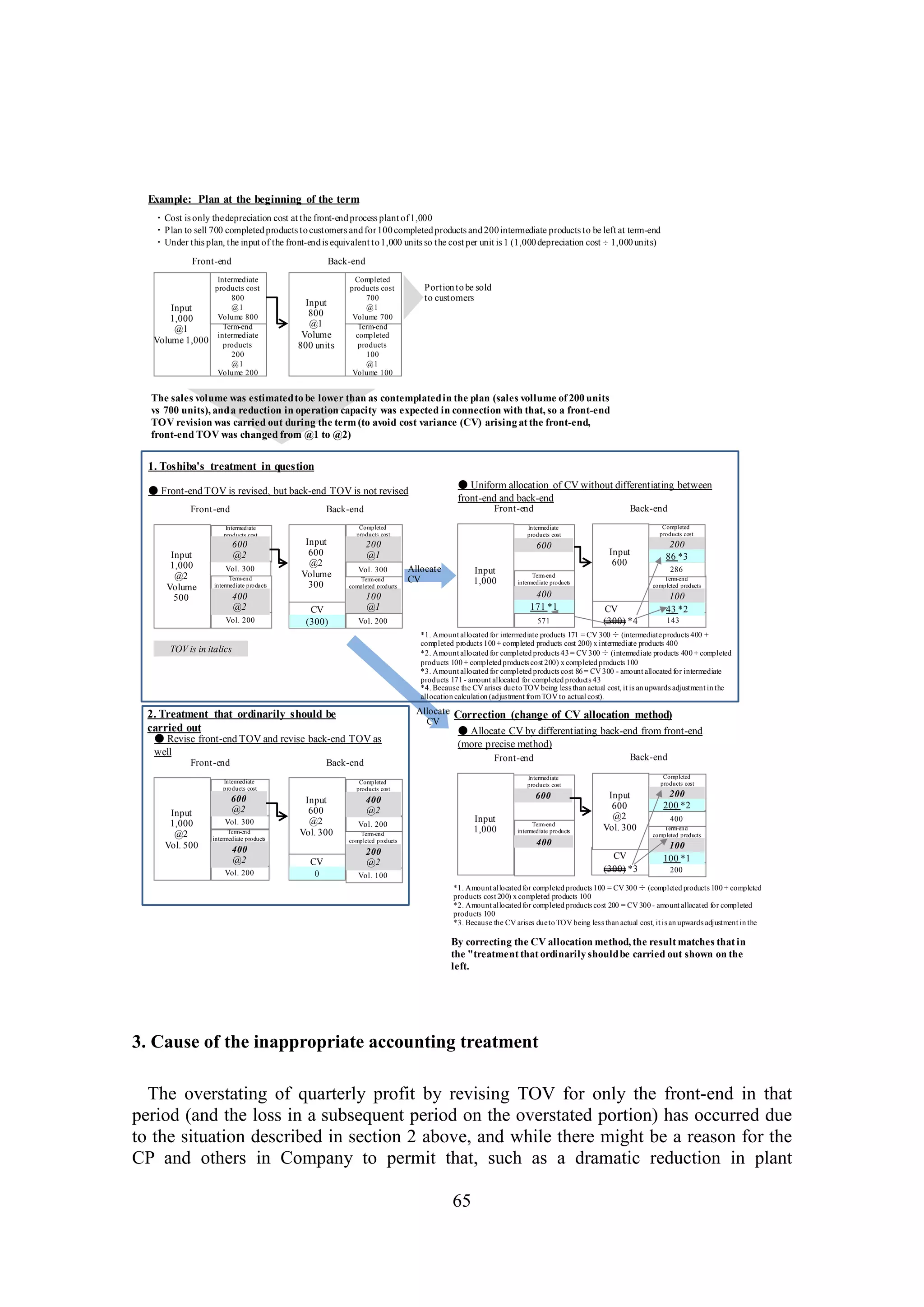
II. Cost calculation based on revised front-end TOV during accounting period.......... 63
1. Overview of the transaction subject to investigation ............................................ 63
2. Accounting treatment in question.......................................................................... 63
3. Cause of the inappropriate accounting treatment.................................................. 65
Chapter 6. Summary of the Analysis of Causes ........................................................... 67
I. Direct causes ............................................................................................................. 67
1. Institutional behavior involving top management................................................. 67
(1) Corporate-level involvement............................................................................... 67
(2) Company-level involvement................................................................................ 67
2. The certain top management’s objective of overstating of apparent current-period
profit.......................................................................................................................... 68
3. Over-riding current profit policy, and strong pressure to achieve the budget target68
4. Corporate cultures where employees cannot act contrary to the intent of superiors68
5. Lack of awareness and knowledge among top management about appropriate
accounting treatment ................................................................................................. 69
6. Issues with Toshiba’s accounting policy and its application................................. 69
7. Inappropriate accounting treatment undertaken in a subtle manner that is difficult to
detect externally ........................................................................................................ 69
II. Indirect causes.......................................................................................................... 70
1. Internal controls at the Company-level did not function....................................... 70
(1) Internal control by the Accounting Division ....................................................... 70
(2) Internal controls by the Internal Audit Department............................................. 70
2. Internal control at the Corporate-level did not function........................................ 70
(1) Internal control over risk of inappropriate conduct by management................... 70
(2) Internal control in each corporate division.......................................................... 70
(A) Finance Division ............................................................................................. 70
(B) Corporate Audit Division ................................................................................ 71
(C) Risk Management Division............................................................................. 71
(D) Securities Report, Etc., Disclosure Committee............................................... 72
3. Internal control function (supervisory function) of the Board of Directors did not
8
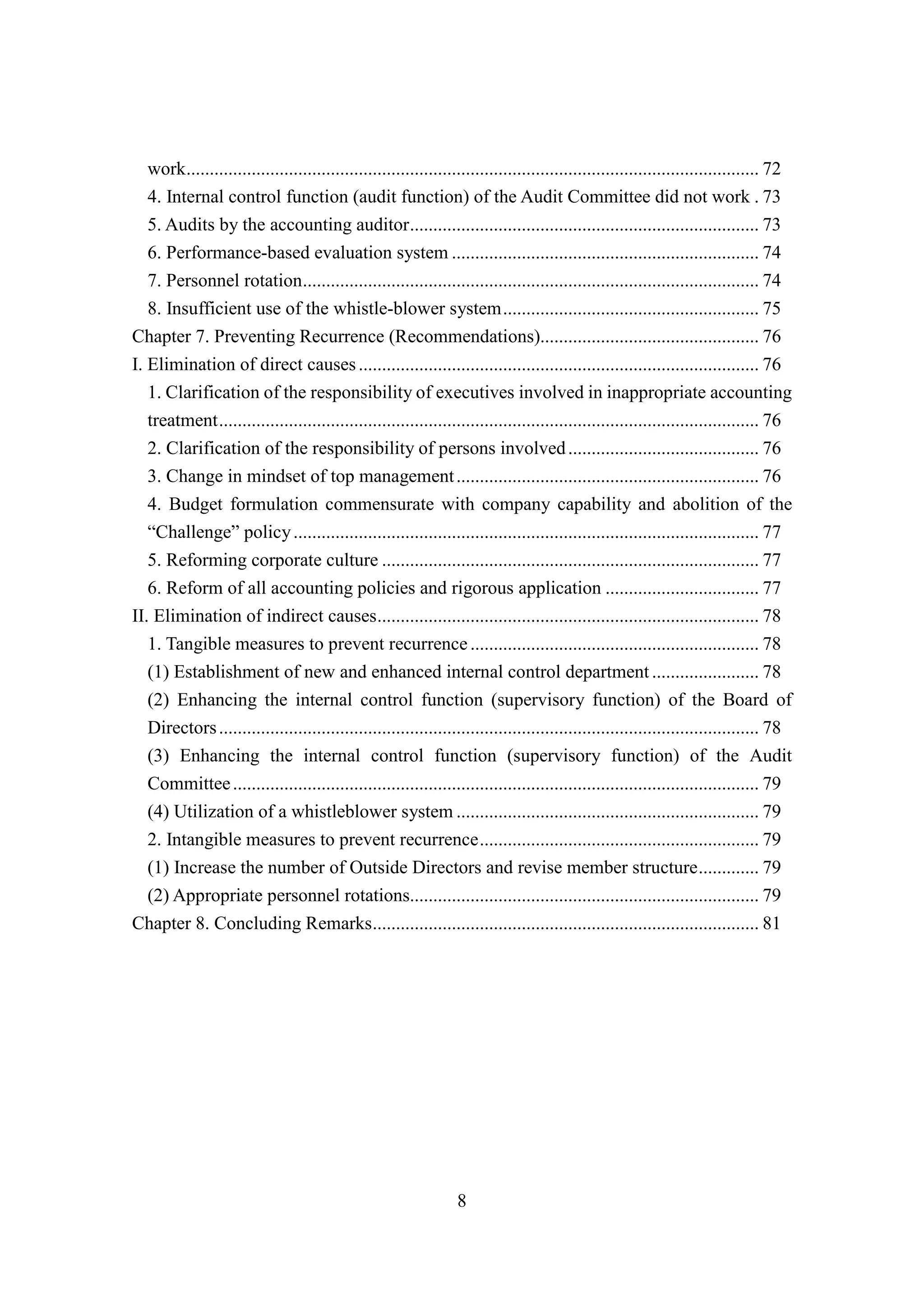
work........................................................................................................................... 72
4. Internal control function (audit function) of the Audit Committee did not work . 73
5. Audits by the accounting auditor........................................................................... 73
6. Performance-based evaluation system .................................................................. 74
7. Personnel rotation.................................................................................................. 74
8. Insufficient use of the whistle-blower system....................................................... 75
Chapter 7. Preventing Recurrence (Recommendations)............................................... 76
I. Elimination of direct causes...................................................................................... 76
1. Clarification of the responsibility of executives involved in inappropriate accounting
treatment.................................................................................................................... 76
2. Clarification of the responsibility of persons involved......................................... 76
3. Change in mindset of top management................................................................. 76
4. Budget formulation commensurate with company capability and abolition of the
“Challenge” policy.................................................................................................... 77
5. Reforming corporate culture ................................................................................. 77
6. Reform of all accounting policies and rigorous application ................................. 77
II. Elimination of indirect causes.................................................................................. 78
1. Tangible measures to prevent recurrence.............................................................. 78
(1) Establishment of new and enhanced internal control department ....................... 78
(2) Enhancing the internal control function (supervisory function) of the Board of
Directors.................................................................................................................... 78
(3) Enhancing the internal control function (supervisory function) of the Audit
Committee................................................................................................................. 79
(4) Utilization of a whistleblower system ................................................................. 79
2. Intangible measures to prevent recurrence............................................................ 79
(1) Increase the number of Outside Directors and revise member structure............. 79
(2) Appropriate personnel rotations........................................................................... 79
Chapter 8. Concluding Remarks................................................................................... 81
9
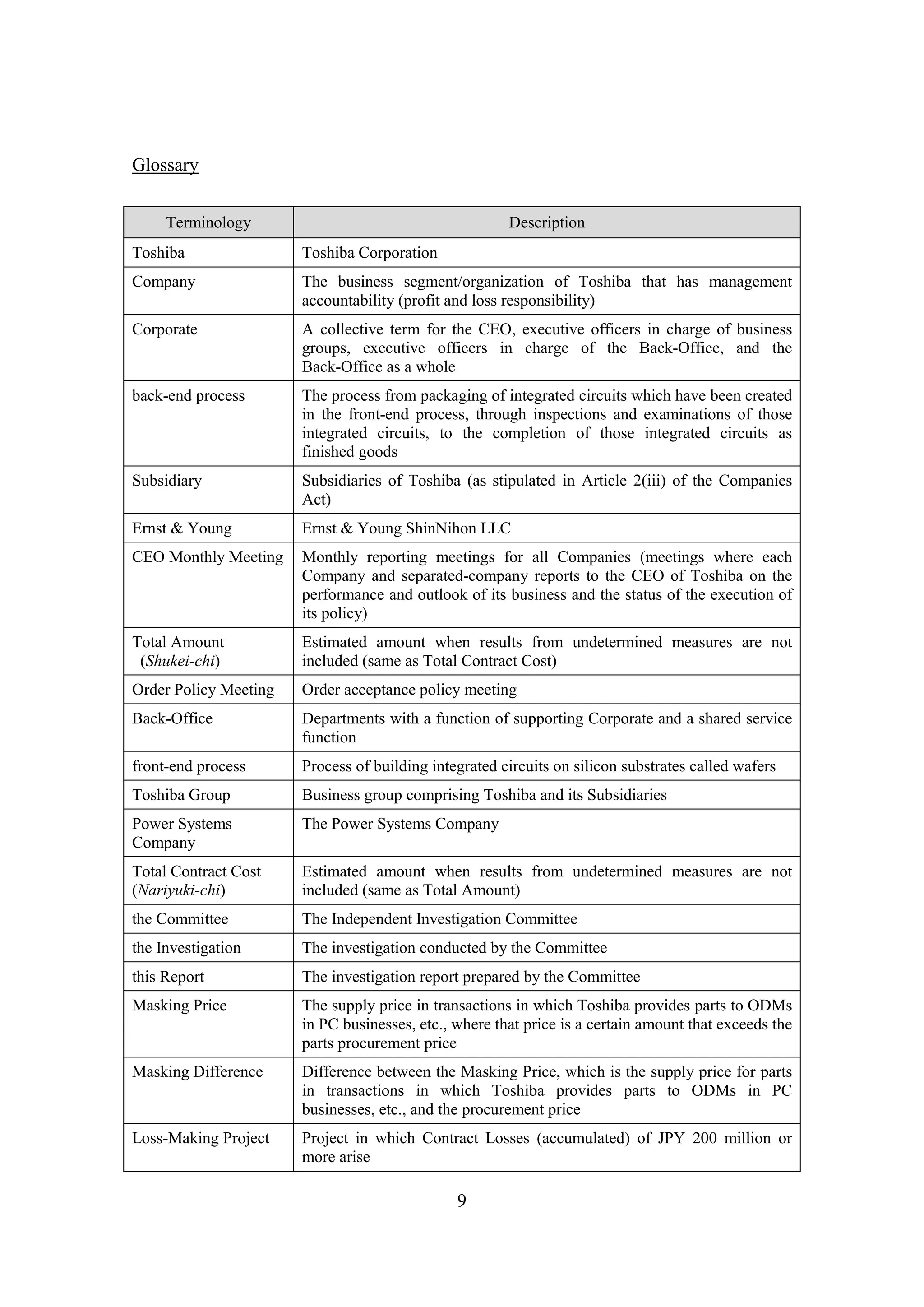
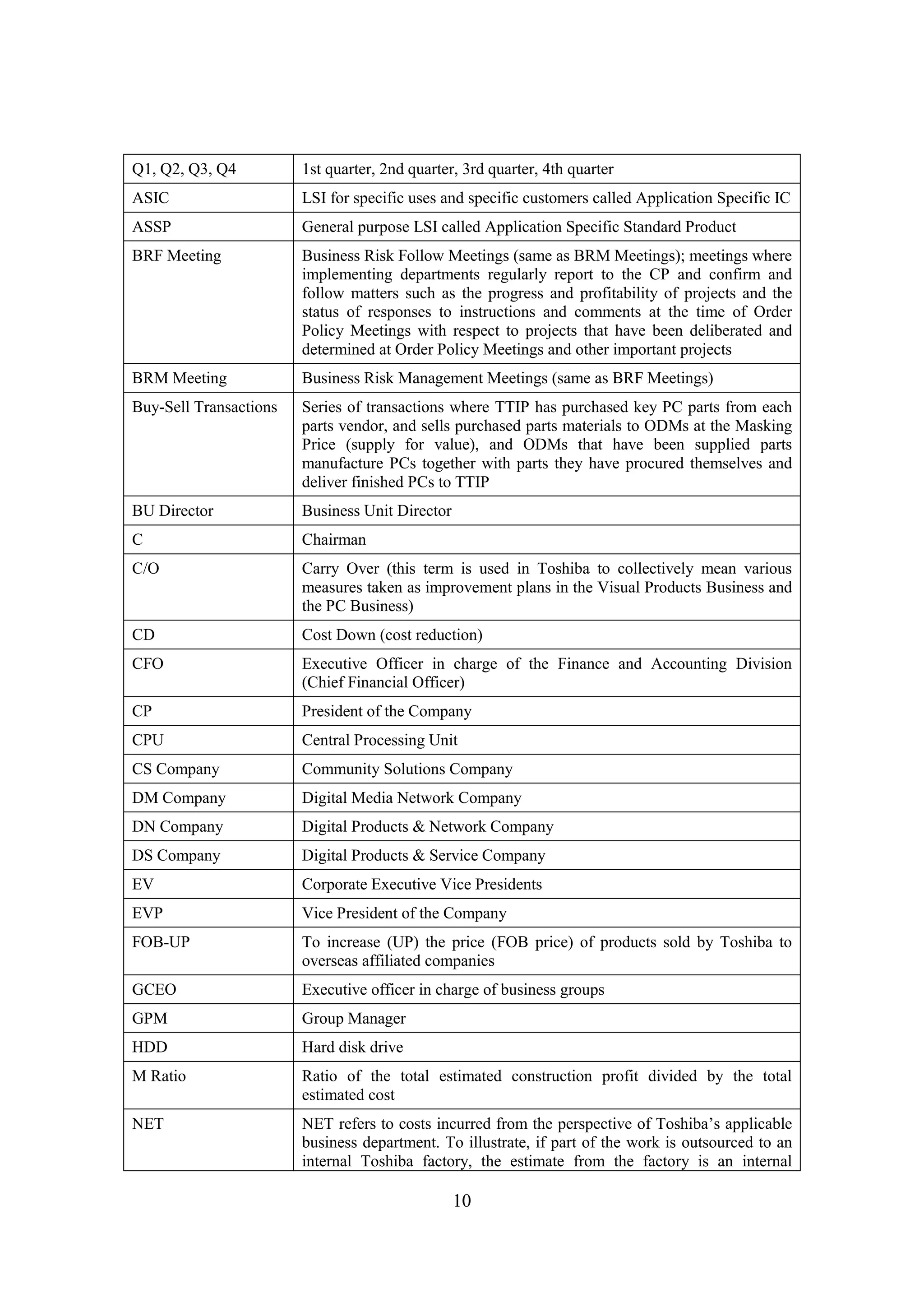
Glossary
Terminology Description
Toshiba Toshiba Corporation
Company The business segment/organization of Toshiba that has management
accountability (profit and loss responsibility)
Corporate A collective term for the CEO, executive officers in charge of business
groups, executive officers in charge of the Back-Office, and the
Back-Office as a whole
back-end process The process from packaging of integrated circuits which have been created
in the front-end process, through inspections and examinations of those
integrated circuits, to the completion of those integrated circuits as
finished goods
Subsidiary Subsidiaries of Toshiba (as stipulated in Article 2(iii) of the Companies
Act)
Ernst & Young Ernst & Young ShinNihon LLC
CEO Monthly Meeting Monthly reporting meetings for all Companies (meetings where each
Company and separated-company reports to the CEO of Toshiba on the
performance and outlook of its business and the status of the execution of
its policy)
Total Amount
(Shukei-chi)
Estimated amount when results from undetermined measures are not
included (same as Total Contract Cost)
Order Policy Meeting Order acceptance policy meeting
Back-Office Departments with a function of supporting Corporate and a shared service
function
front-end process Process of building integrated circuits on silicon substrates called wafers
Toshiba Group Business group comprising Toshiba and its Subsidiaries
Power Systems
Company
The Power Systems Company
Total Contract Cost
(Nariyuki-chi)
Estimated amount when results from undetermined measures are not
included (same as Total Amount)
the Committee The Independent Investigation Committee
the Investigation The investigation conducted by the Committee
this Report The investigation report prepared by the Committee
Masking Price The supply price in transactions in which Toshiba provides parts to ODMs
in PC businesses, etc., where that price is a certain amount that exceeds the
parts procurement price
Masking Difference Difference between the Masking Price, which is the supply price for parts
in transactions in which Toshiba provides parts to ODMs in PC
businesses, etc., and the procurement price
Loss-Making Project Project in which Contract Losses (accumulated) of JPY 200 million or
more arise
10
Q1, Q2, Q3, Q4 1st quarter, 2nd quarter, 3rd quarter, 4th quarter
ASIC LSI for specific uses and specific customers called Application Specific IC
ASSP General purpose LSI called Application Specific Standard Product
BRF Meeting Business Risk Follow Meetings (same as BRM Meetings); meetings where
implementing departments regularly report to the CP and confirm and
follow matters such as the progress and profitability of projects and the
status of responses to instructions and comments at the time of Order
Policy Meetings with respect to projects that have been deliberated and
determined at Order Policy Meetings and other important projects
BRM Meeting Business Risk Management Meetings (same as BRF Meetings)
Buy-Sell Transactions Series of transactions where TTIP has purchased key PC parts from each
parts vendor, and sells purchased parts materials to ODMs at the Masking
Price (supply for value), and ODMs that have been supplied parts
manufacture PCs together with parts they have procured themselves and
deliver finished PCs to TTIP
BU Director Business Unit Director
C Chairman
C/O Carry Over (this term is used in Toshiba to collectively mean various
measures taken as improvement plans in the Visual Products Business and
the PC Business)
CD Cost Down (cost reduction)
CFO Executive Officer in charge of the Finance and Accounting Division
(Chief Financial Officer)
CP President of the Company
CPU Central Processing Unit
CS Company Community Solutions Company
DM Company Digital Media Network Company
DN Company Digital Products & Network Company
DS Company Digital Products & Service Company
EV Corporate Executive Vice Presidents
EVP Vice President of the Company
FOB-UP To increase (UP) the price (FOB price) of products sold by Toshiba to
overseas affiliated companies
GCEO Executive officer in charge of business groups
GPM Group Manager
HDD Hard disk drive
M Ratio Ratio of the total estimated construction profit divided by the total
estimated cost
NET NET refers to costs incurred from the perspective of Toshiba’s applicable
business department. To illustrate, if part of the work is outsourced to an
internal Toshiba factory, the estimate from the factory is an internal
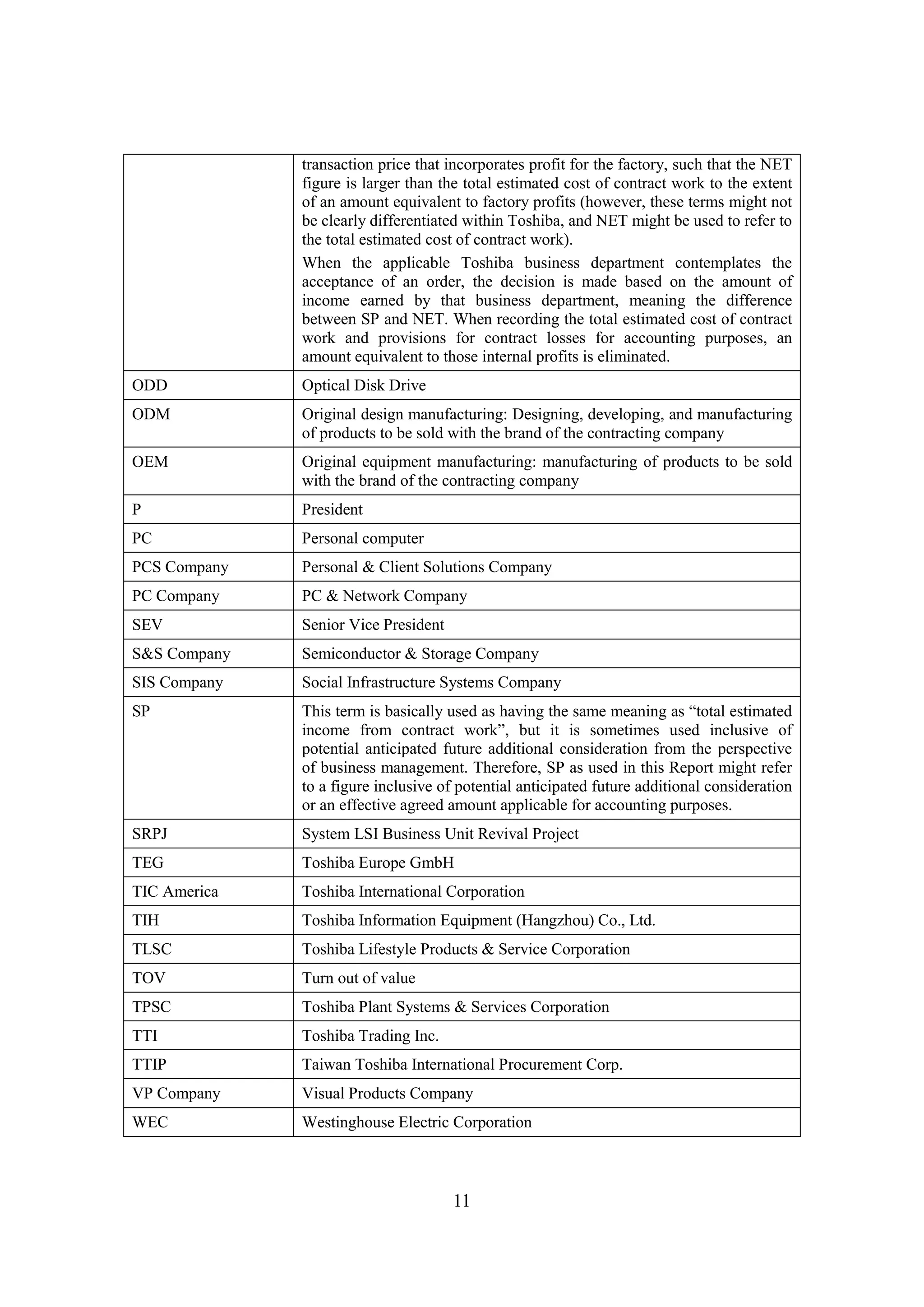
11
transaction price that incorporates profit for the factory, such that the NET
figure is larger than the total estimated cost of contract work to the extent
of an amount equivalent to factory profits (however, these terms might not
be clearly differentiated within Toshiba, and NET might be used to refer to
the total estimated cost of contract work).
When the applicable Toshiba business department contemplates the
acceptance of an order, the decision is made based on the amount of
income earned by that business department, meaning the difference
between SP and NET. When recording the total estimated cost of contract
work and provisions for contract losses for accounting purposes, an
amount equivalent to those internal profits is eliminated.
ODD Optical Disk Drive
ODM Original design manufacturing: Designing, developing, and manufacturing
of products to be sold with the brand of the contracting company
OEM Original equipment manufacturing: manufacturing of products to be sold
with the brand of the contracting company
P President
PC Personal computer
PCS Company Personal & Client Solutions Company
PC Company PC & Network Company
SEV Senior Vice President
S&S Company Semiconductor & Storage Company
SIS Company Social Infrastructure Systems Company
SP This term is basically used as having the same meaning as “total estimated
income from contract work”, but it is sometimes used inclusive of
potential anticipated future additional consideration from the perspective
of business management. Therefore, SP as used in this Report might refer
to a figure inclusive of potential anticipated future additional consideration
or an effective agreed amount applicable for accounting purposes.
SRPJ System LSI Business Unit Revival Project
TEG Toshiba Europe GmbH
TIC America Toshiba International Corporation
TIH Toshiba Information Equipment (Hangzhou) Co., Ltd.
TLSC Toshiba Lifestyle Products & Service Corporation
TOV Turn out of value
TPSC Toshiba Plant Systems & Services Corporation
TTI Toshiba Trading Inc.
TTIP Taiwan Toshiba International Procurement Corp.
VP Company Visual Products Company
WEC Westinghouse Electric Corporation
12
13
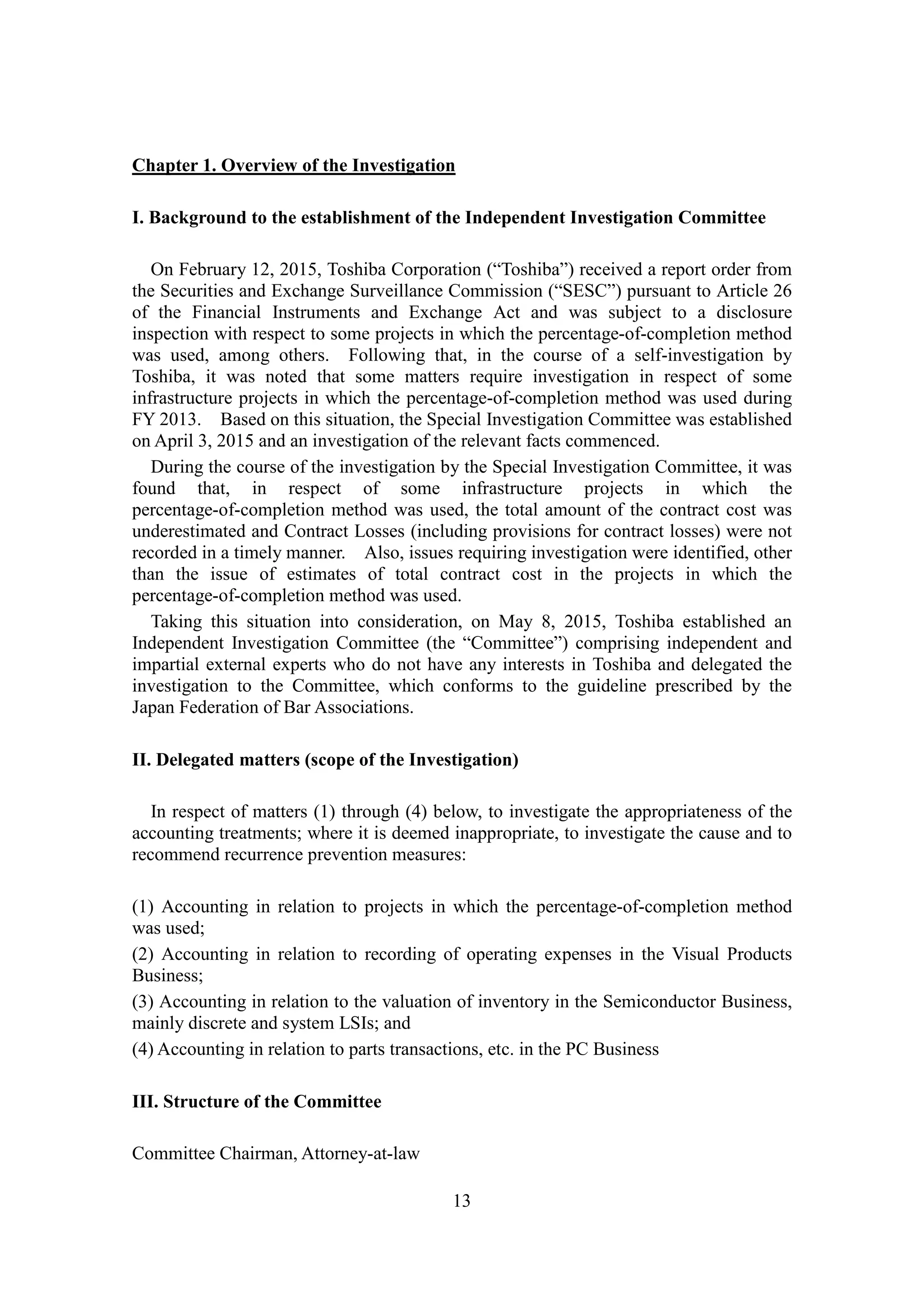
Chapter 1. Overview of the Investigation
I. Background to the establishment of the Independent Investigation Committee
On February 12, 2015, Toshiba Corporation (“Toshiba”) received a report order from
the Securities and Exchange Surveillance Commission (“SESC”) pursuant to Article 26
of the Financial Instruments and Exchange Act and was subject to a disclosure
inspection with respect to some projects in which the percentage-of-completion method
was used, among others. Following that, in the course of a self-investigation by
Toshiba, it was noted that some matters require investigation in respect of some
infrastructure projects in which the percentage-of-completion method was used during
FY 2013. Based on this situation, the Special Investigation Committee was established
on April 3, 2015 and an investigation of the relevant facts commenced.
During the course of the investigation by the Special Investigation Committee, it was
found that, in respect of some infrastructure projects in which the
percentage-of-completion method was used, the total amount of the contract cost was
underestimated and Contract Losses (including provisions for contract losses) were not
recorded in a timely manner. Also, issues requiring investigation were identified, other
than the issue of estimates of total contract cost in the projects in which the
percentage-of-completion method was used.
Taking this situation into consideration, on May 8, 2015, Toshiba established an
Independent Investigation Committee (the “Committee”) comprising independent and
impartial external experts who do not have any interests in Toshiba and delegated the
investigation to the Committee, which conforms to the guideline prescribed by the
Japan Federation of Bar Associations.
II. Delegated matters (scope of the Investigation)
In respect of matters (1) through (4) below, to investigate the appropriateness of the
accounting treatments; where it is deemed inappropriate, to investigate the cause and to
recommend recurrence prevention measures:
(1) Accounting in relation to projects in which the percentage-of-completion method
was used;
(2) Accounting in relation to recording of operating expenses in the Visual Products
Business;
(3) Accounting in relation to the valuation of inventory in the Semiconductor Business,
mainly discrete and system LSIs; and
(4) Accounting in relation to parts transactions, etc. in the PC Business
III. Structure of the Committee
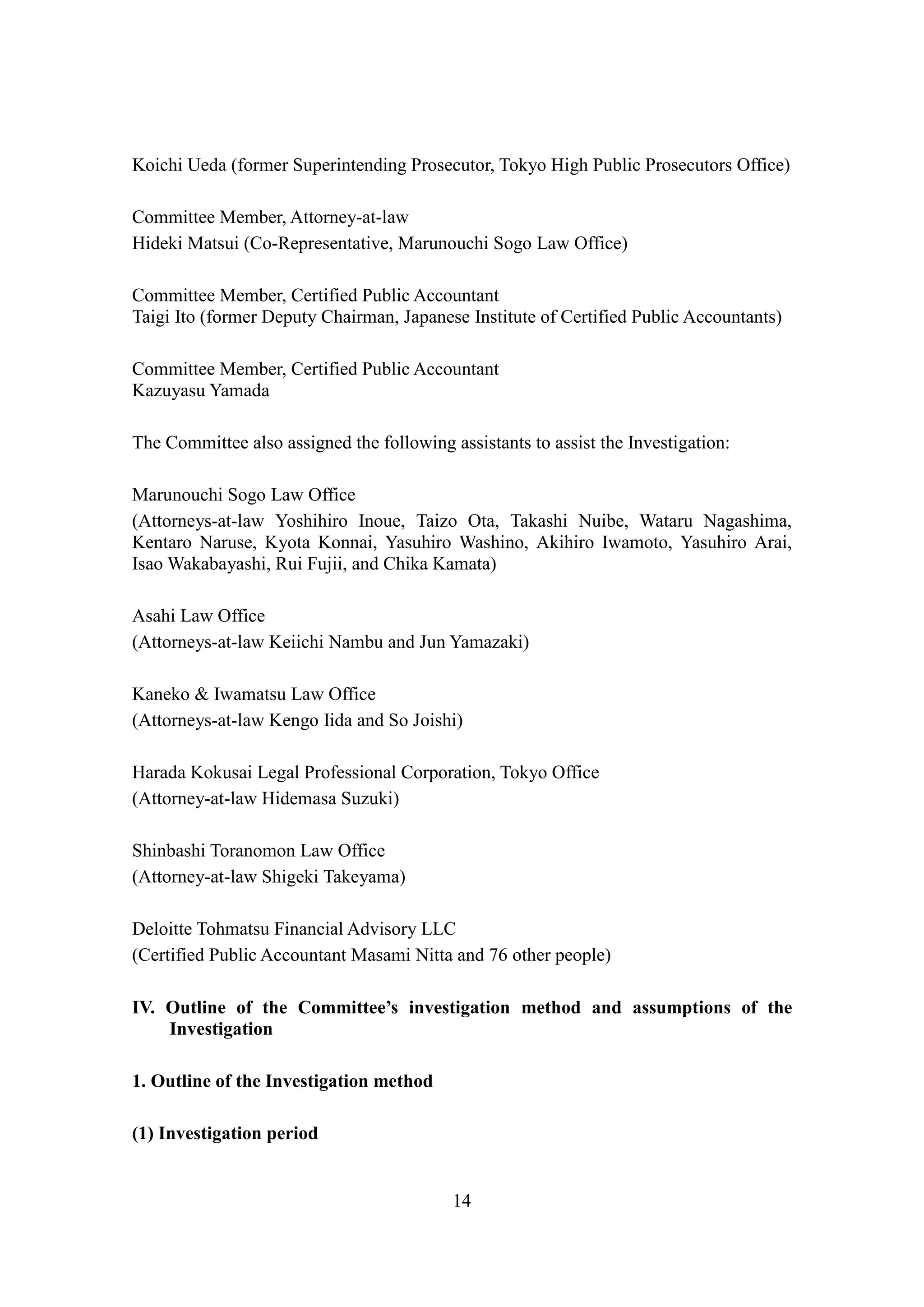
Committee Chairman, Attorney-at-law
14
Koichi Ueda (former Superintending Prosecutor, Tokyo High Public Prosecutors Office)
Committee Member, Attorney-at-law
Hideki Matsui (Co-Representative, Marunouchi Sogo Law Office)
Committee Member, Certified Public Accountant
Taigi Ito (former Deputy Chairman, Japanese Institute of Certified Public Accountants)
Committee Member, Certified Public Accountant
Kazuyasu Yamada
The Committee also assigned the following assistants to assist the Investigation:
Marunouchi Sogo Law Office
(Attorneys-at-law Yoshihiro Inoue, Taizo Ota, Takashi Nuibe, Wataru Nagashima,
Kentaro Naruse, Kyota Konnai, Yasuhiro Washino, Akihiro Iwamoto, Yasuhiro Arai,
Isao Wakabayashi, Rui Fujii, and Chika Kamata)
Asahi Law Office
(Attorneys-at-law Keiichi Nambu and Jun Yamazaki)
Kaneko & Iwamatsu Law Office
(Attorneys-at-law Kengo Iida and So Joishi)
Harada Kokusai Legal Professional Corporation, Tokyo Office
(Attorney-at-law Hidemasa Suzuki)
Shinbashi Toranomon Law Office
(Attorney-at-law Shigeki Takeyama)
Deloitte Tohmatsu Financial Advisory LLC
(Certified Public Accountant Masami Nitta and 76 other people)
IV. Outline of the Committee’s investigation method and assumptions of the
Investigation
1. Outline of the Investigation method
(1) Investigation period
15
The Committee conducted its Investigation and deliberated on the findings of the
Investigation from May 15, 2015 to July 20, 2015. However, the Committee’s
investigation is based on information mainly obtained before July 17, 2015.
(2) Subject period of investigation
The period subject to the Investigation is from FY 2009 to the third quarter of FY
2014 (however, FY 2008 is also included, as it represents a comparison year in the FY
2009 securities report).
(3) Outline of the investigation method
The outline of the method of the Investigation conducted by the Committee is as
follows, in addition to the inspection and verification of information received from the
Special Investigation Committee mentioned above (please refer to the respective
sections for descriptions of the inspection methods for each matter subject to
investigation).
(A) Interviews with officers and employees
In the course of the Investigation, the Committee conducted one or multiple
interviews with the directors, representative executive officers, executive officers, and
employees of Toshiba (“Officers and Employees”, including previous titles). A total of
210 Officers and Employees were subject to interviews.
(B) Interviews with the accounting auditor
In the course of the Investigation, the Committee conducted multiple interviews with
the audit team (those responsible for the audit and those assisting in the audit) of Ernst
& Young ShinNihon LLC, which is Toshiba’s accounting auditor.
(C) Inspection and verification of information
In the course of the Investigation, the Committee requested the disclosure of
information from Toshiba (including accounting information, internal rules, meeting
documents, meeting minutes, and other information) which was possibly related to the
matters subject to investigation, and it inspected and verified that information received
from Toshiba.
(D) Digital forensics
In the course of the Investigation, the Committee conducted digital forensics of PCs
16
used for work by Officers and Employees who might be connected to the matters
subject to the Investigation.
An outline of the digital forensics is set out in Exhibit 1.
(E) Establishment of a whistleblower system
The Committee established a whistleblower system through which the Committee
can be contacted, and it received reports and accumulated information related to the
matters subject to the Investigation through telephone calls, post, and e-mail.
2. Assumptions of the Investigation
The Investigation and the investigation results of the Committee (including this Report,
hereinafter the same in this Section 2), are subject to the following general limitations
and qualifications (see the relevant sections for limitations and qualifications applicable
to each matter to be investigated).
(1) While the Committee feels that sincere cooperation was provided by Toshiba, it
should be noted that the Committee’s investigation is based on the voluntary
cooperation of Toshiba’s Officers and Employees, with no compulsory investigative
authority afforded to the Committee. As such, the Committee’s investigation findings
cannot be completely devoid of fault or oversight.
(2) In response to the Committee’s requests for information disclosure including
documentation, etc., it is the Committee’s understanding that Toshiba provided timely
and appropriate disclosure. Also, except where specifically stated in this Report, it is
the Committee’s understanding that Toshiba has not withheld information that might
have possibly had a material impact on the Investigation and its findings.
(3) It is the Committee’s understanding that originals exist for all documents and
electronic records disclosed to the Committee. Also, it is the Committee’s
understanding that the contents of all copies obtained are identical to the originals and
that the originals are all genuine.
(4) The Investigation and findings of the Committee are intended to be used for the
confirmation of facts concerning the matters subject to investigation at Toshiba, and to
investigate the causes and to formulate and evaluate remedies to prevent recurrence, in
the event that the accounting treatment is considered inappropriate, and it is not
anticipated that they be used for any other purpose.
(5) The Investigation and the results of the Investigation by the Committee have been
undertaken based on the delegation from Toshiba and solely on behalf of Toshiba. As
such, it is not anticipated that the results of the Investigation of the Committee be relied
17
on by any third party and the Committee is not liable to a third party in any respect
whatsoever.
(6) This Report has been prepared in Japanese. Even if an English translation of this
Report is prepared, the Committee assumes no responsibility in respect of the English
version of this Report.
(7) The Investigation has been conducted solely by the methods described in 1(3) above,
and no other method of investigation has been used. Also, no verification has been
undertaken using any information other than the information obtained through the
methods described in 1(3) above.
(8) When the Committee obtained information in the course of the Investigation
pertaining to matters other than the matters subject to the Investigation that have been
agreed on and confirmed with Toshiba, the Committee promptly informed Toshiba of
those matters and asked Toshiba to confirm whether Toshiba should respond in relation
to such information. The Committee has not investigated or checked any matters other
than those that have been delegated under the agreement with Toshiba, except for the
matters contained in this Report.
(9) Through the Investigation of the delegated matters, items in annual securities reports
from previous years (including items referenced in securities registration statements)
that need to be restated have been identified. The Committee has not considered
secondary effects that might result from restatement of those items. For example,
secondary effects might occur in relation to the following items:
(a) Matters pertaining to inventory valuation
(b) Matters pertaining to fixed asset impairment
(c) Matters pertaining to the recoverability of deferred tax assets
(10) Unless stated otherwise, job titles mentioned in this Report refer to titles held at
that time.
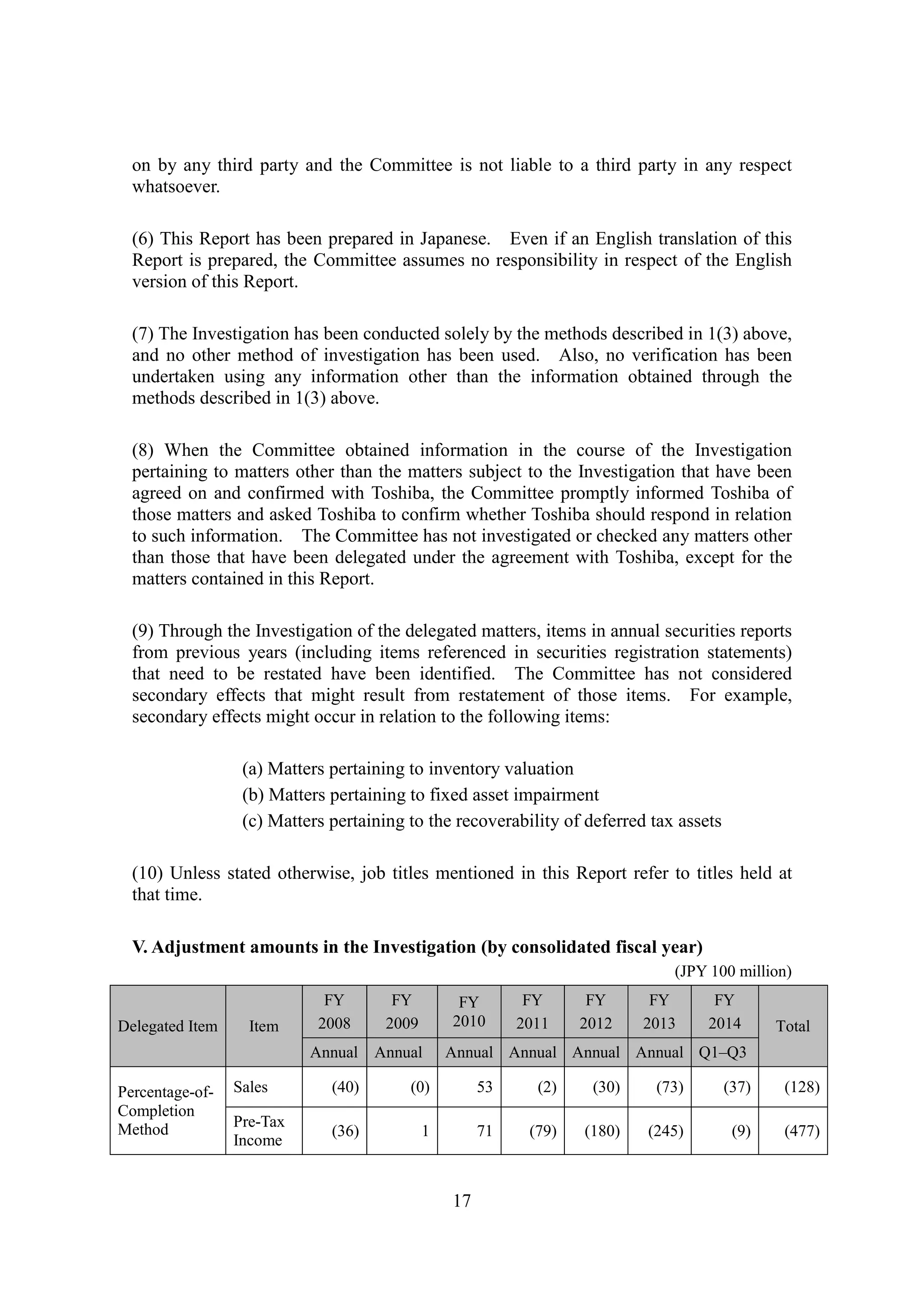
V. Adjustment amounts in the Investigation (by consolidated fiscal year)
(JPY 100 million)
Delegated Item Item
FY
2008
FY
2009
FY
2010
FY
2011
FY
2012
FY
2013
FY
2014 Total
Annual Annual Annual Annual Annual Annual Q1–Q3
Percentage-of-
Completion
Method
Sales (40) (0) 53 (2) (30) (73) (37) (128)
Pre-Tax
Income
(36) 1 71 (79) (180) (245) (9) (477)
18
Parts
Transactions1
Sales - - - - - - - -
Pre-Tax
Income
(193) (291) 112 (161) (310) (3) 255 (592)
Recording of
Operating
Expenses2
Sales - - - (3) 2 (5) (15) (21)
Pre-Tax
Income
(53) (78) (82) 32 (1) 30 64 (88)
Semiconductor
Inventory
Sales - - - - - - - -
Pre-Tax
Income
- (32) (16) (104) (368) 165 (5) (360)
Total
Sales (40) (0) 53 (5) (28) (78) (52) (149)
Pre-Tax
Income
(282) (400) 84 (312) (858) (54) 304 (1,518)
1
Total amount of revisions related to parts transactions of the Visual Products Business and the PC
Business
2
Total amount of revisions related to recording of operating expenses of the Visual Products
Business and the PC Business
19
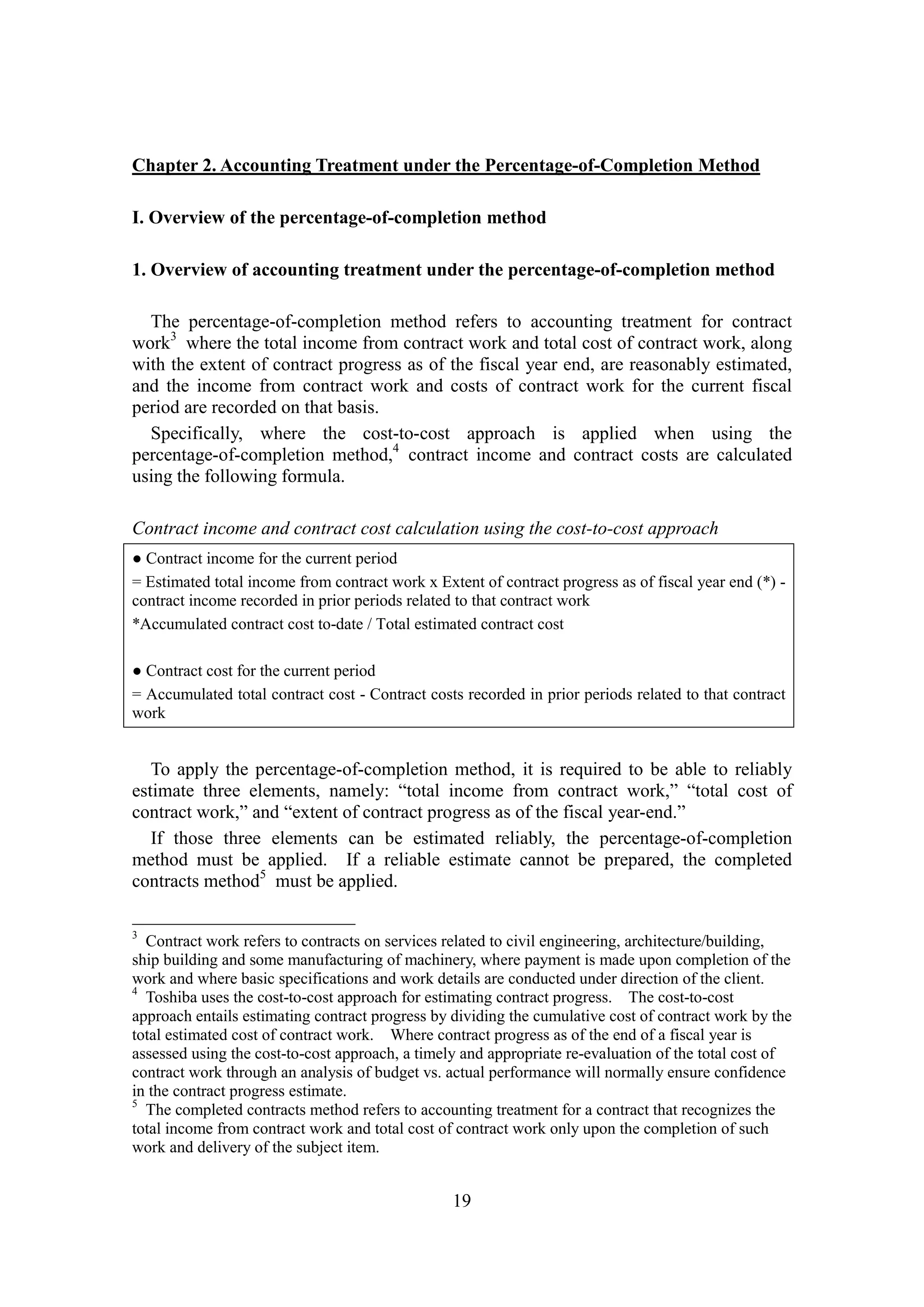
Chapter 2. Accounting Treatment under the Percentage-of-Completion Method
I. Overview of the percentage-of-completion method
1. Overview of accounting treatment under the percentage-of-completion method
The percentage-of-completion method refers to accounting treatment for contract
work3
where the total income from contract work and total cost of contract work, along
with the extent of contract progress as of the fiscal year end, are reasonably estimated,
and the income from contract work and costs of contract work for the current fiscal
period are recorded on that basis.
Specifically, where the cost-to-cost approach is applied when using the
percentage-of-completion method,4
contract income and contract costs are calculated
using the following formula.
Contract income and contract cost calculation using the cost-to-cost approach
● Contract income for the current period
= Estimated total income from contract work x Extent of contract progress as of fiscal year end (*) -
contract income recorded in prior periods related to that contract work
*Accumulated contract cost to-date / Total estimated contract cost
● Contract cost for the current period
= Accumulated total contract cost - Contract costs recorded in prior periods related to that contract
work
To apply the percentage-of-completion method, it is required to be able to reliably
estimate three elements, namely: “total income from contract work,” “total cost of
contract work,” and “extent of contract progress as of the fiscal year-end.”
If those three elements can be estimated reliably, the percentage-of-completion
method must be applied. If a reliable estimate cannot be prepared, the completed
contracts method5
must be applied.
3
Contract work refers to contracts on services related to civil engineering, architecture/building,
ship building and some manufacturing of machinery, where payment is made upon completion of the
work and where basic specifications and work details are conducted under direction of the client.
4
Toshiba uses the cost-to-cost approach for estimating contract progress. The cost-to-cost
approach entails estimating contract progress by dividing the cumulative cost of contract work by the
total estimated cost of contract work. Where contract progress as of the end of a fiscal year is
assessed using the cost-to-cost approach, a timely and appropriate re-evaluation of the total cost of
contract work through an analysis of budget vs. actual performance will normally ensure confidence
in the contract progress estimate.
5
The completed contracts method refers to accounting treatment for a contract that recognizes the
total income from contract work and total cost of contract work only upon the completion of such
work and delivery of the subject item.
20
Further, where the “total cost of contract work” is likely to exceed the “total income
from contract work,” and if those amounts can be reasonably estimated, that expected
excess amount (“Contract Loss”) should be recorded as a provision for contract losses
in the period in which Contract Loss is expected. That treatment must be applied
under both the percentage-of-completion method and the completed contracts method.
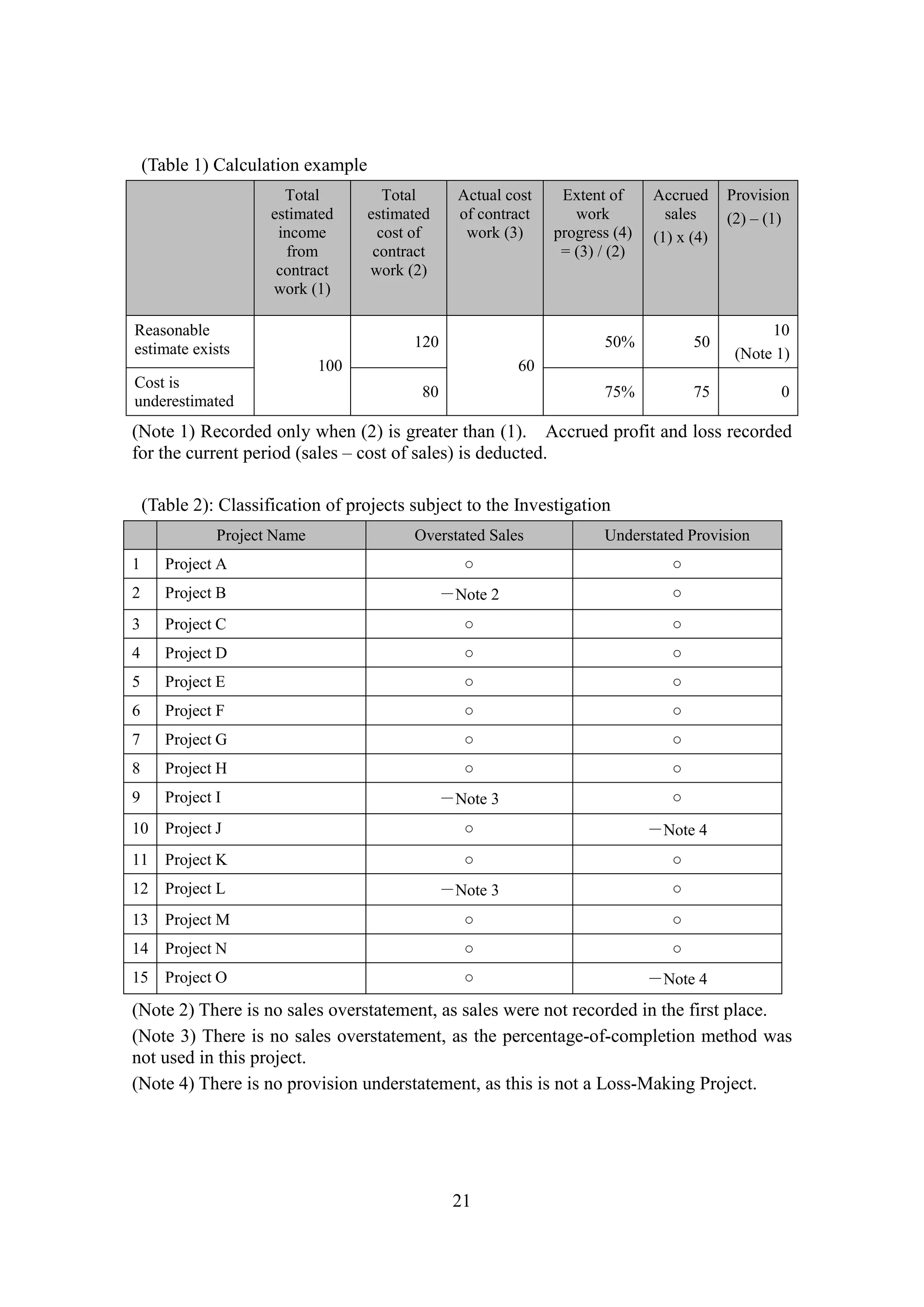
Provision for Contract Losses to be recorded
= Total estimated cost of contract work - Total estimated income from contract work - Recorded
cumulative profit and loss for the current period
2. General risks associated with the percentage-of-completion method
As explained above, the application of the percentage-of-completion method requires
an estimation of the “total income from contract work” and the “total cost of contract
work” and the quantification of “incurred contract cost” on a quarterly basis. It should
be noted that, while “total income from contract work” is an estimate, it is determined
by negotiating with the customer, and contract cost is an accumulation of actual costs
incurred, so there is a risk of misstatement associated with the “total estimated cost of
contract work,” which is in fact determined internally. Specifically, if the “total cost of
contract work” is underestimated, the following misstatements will arise in accounting.
(1) Overstated sales
If the “total cost of contract work” at the end of a quarter is understated, the extent of
work progress will be overstated, resulting in overstated sales.
(2) Understated provision for contract losses (provision for loss-making contracts)
For loss-making contract work, if the “total cost of contract work” at the end of a
quarter is underestimated, the “provision for contract losses” (provision for loss-making
contracts) will be understated.
21
(Table 1) Calculation example
Total
estimated
income
from
contract
work (1)
Total
estimated
cost of
contract
work (2)
Actual cost
of contract
work (3)
Extent of
work
progress (4)
= (3) / (2)
Accrued
sales
(1) x (4)
Provision
(2) – (1)
Reasonable
estimate exists
100
120
60
50% 50
10
(Note 1)
Cost is
underestimated
80 75% 75 0
(Note 1) Recorded only when (2) is greater than (1). Accrued profit and loss recorded
for the current period (sales – cost of sales) is deducted.
(Table 2): Classification of projects subject to the Investigation
(Note 2) There is no sales overstatement, as sales were not recorded in the first place.
(Note 3) There is no sales overstatement, as the percentage-of-completion method was
not used in this project.
(Note 4) There is no provision understatement, as this is not a Loss-Making Project.
Project Name Overstated Sales Understated Provision
1 Project A ○ ○
2 Project B -Note 2 ○
3 Project C ○ ○
4 Project D ○ ○
5 Project E ○ ○
6 Project F ○ ○
7 Project G ○ ○
8 Project H ○ ○
9 Project I -Note 3 ○
10 Project J ○ -Note 4
11 Project K ○ ○
12 Project L -Note 3 ○
13 Project M ○ ○
14 Project N ○ ○
15 Project O ○ -Note 4
22
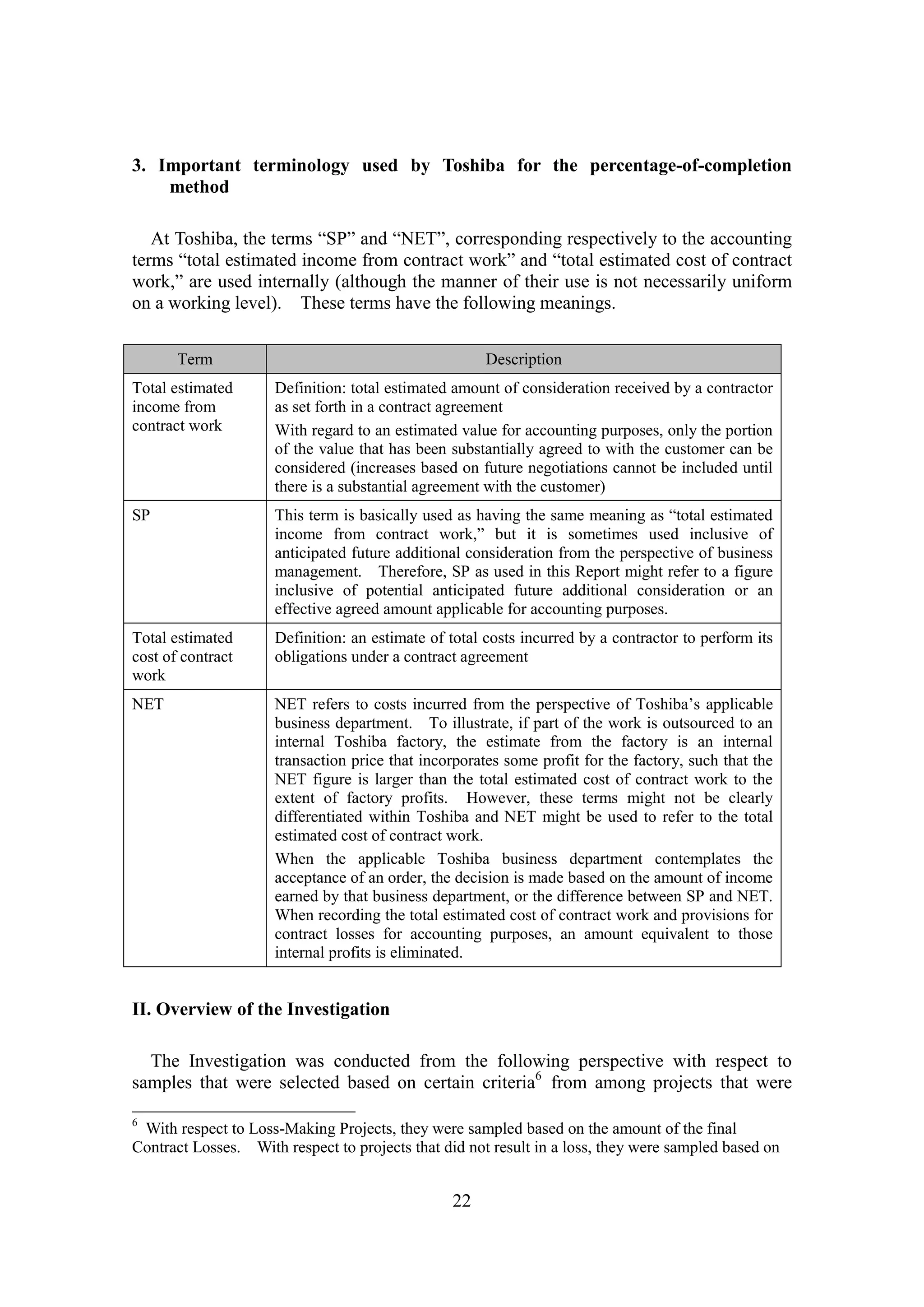
3. Important terminology used by Toshiba for the percentage-of-completion
method
At Toshiba, the terms “SP” and “NET”, corresponding respectively to the accounting
terms “total estimated income from contract work” and “total estimated cost of contract
work,” are used internally (although the manner of their use is not necessarily uniform
on a working level). These terms have the following meanings.
II. Overview of the Investigation
The Investigation was conducted from the following perspective with respect to
samples that were selected based on certain criteria6
from among projects that were
6
With respect to Loss-Making Projects, they were sampled based on the amount of the final
Contract Losses. With respect to projects that did not result in a loss, they were sampled based on
Term Description
Total estimated
income from
contract work
Definition: total estimated amount of consideration received by a contractor
as set forth in a contract agreement
With regard to an estimated value for accounting purposes, only the portion
of the value that has been substantially agreed to with the customer can be
considered (increases based on future negotiations cannot be included until
there is a substantial agreement with the customer)
SP This term is basically used as having the same meaning as “total estimated
income from contract work,” but it is sometimes used inclusive of
anticipated future additional consideration from the perspective of business
management. Therefore, SP as used in this Report might refer to a figure
inclusive of potential anticipated future additional consideration or an
effective agreed amount applicable for accounting purposes.
Total estimated
cost of contract
work
Definition: an estimate of total costs incurred by a contractor to perform its
obligations under a contract agreement
NET NET refers to costs incurred from the perspective of Toshiba’s applicable
business department. To illustrate, if part of the work is outsourced to an
internal Toshiba factory, the estimate from the factory is an internal
transaction price that incorporates some profit for the factory, such that the
NET figure is larger than the total estimated cost of contract work to the
extent of factory profits. However, these terms might not be clearly
differentiated within Toshiba and NET might be used to refer to the total
estimated cost of contract work.
When the applicable Toshiba business department contemplates the
acceptance of an order, the decision is made based on the amount of income
earned by that business department, or the difference between SP and NET.
When recording the total estimated cost of contract work and provisions for
contract losses for accounting purposes, an amount equivalent to those
internal profits is eliminated.
23
either identified as having a material amount of recorded sales under the
percentage-of-completion method or companies that have had notable Contract Losses
in the past, while taking project size and the extent of Contract Losses into
consideration.
(1) Projects recognized by Toshiba or a Subsidiary as having notable business risks,
based on a review of various managerial documents
(2) Through an analysis of accounting figures,7
projects in which losses over a certain
threshold were recorded in the latter half of the work period or projects exhibiting
unusual movement in the total estimated construction cost
the amount under estimation of the estimated total contract cost that is expected to have an impact in
the profit and loss statement as equivalent to JPY 500 million or more.
7
The analysis of accounting figures was conducted on the accounting records of Toshiba and eight
Subsidiaries that regularly record sales of over JPY 10 billion or companies having projects
incurring loss in an amount equivalent to JPY 500 million or more.
24
III. Facts identified in the Investigation
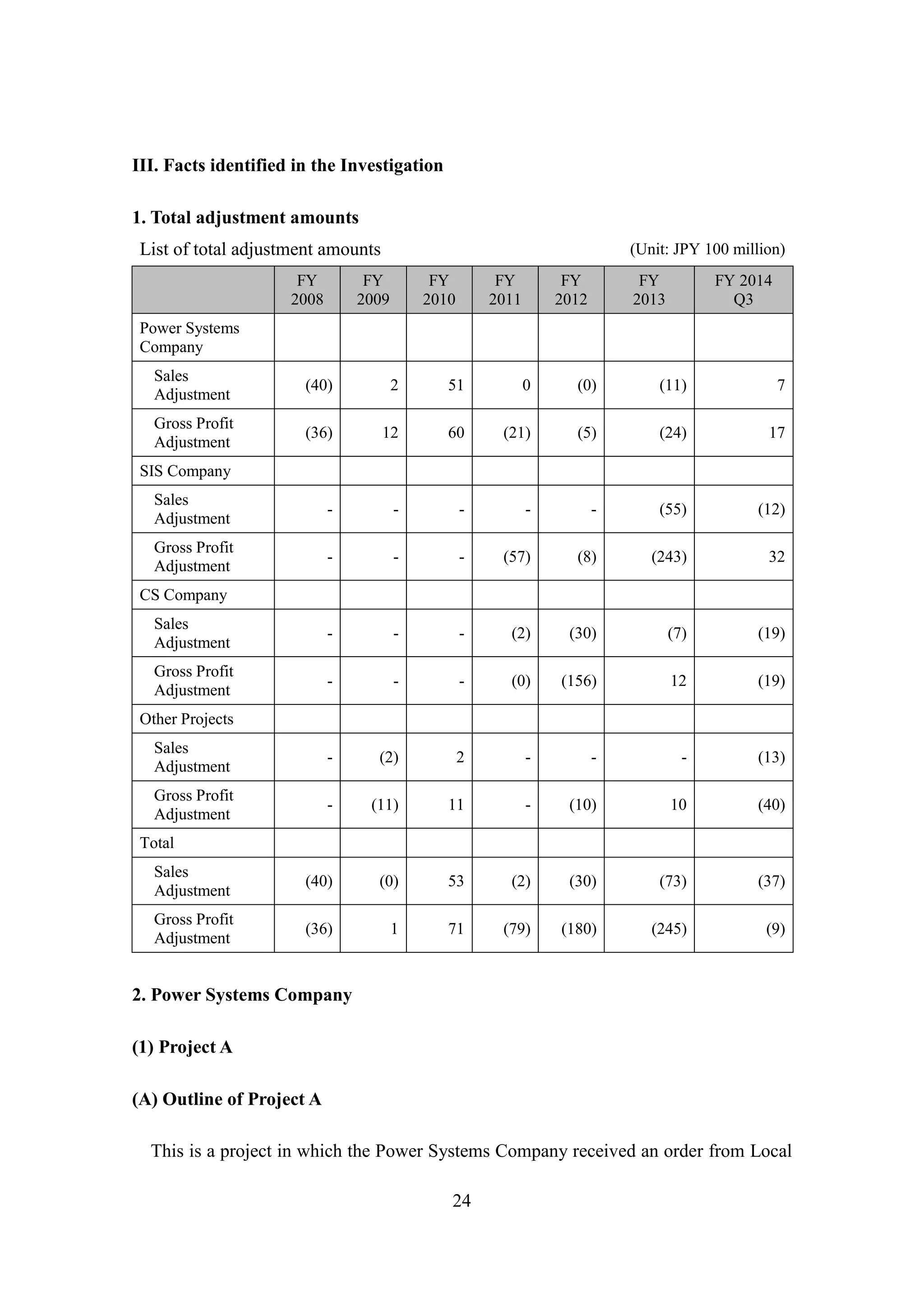
1. Total adjustment amounts
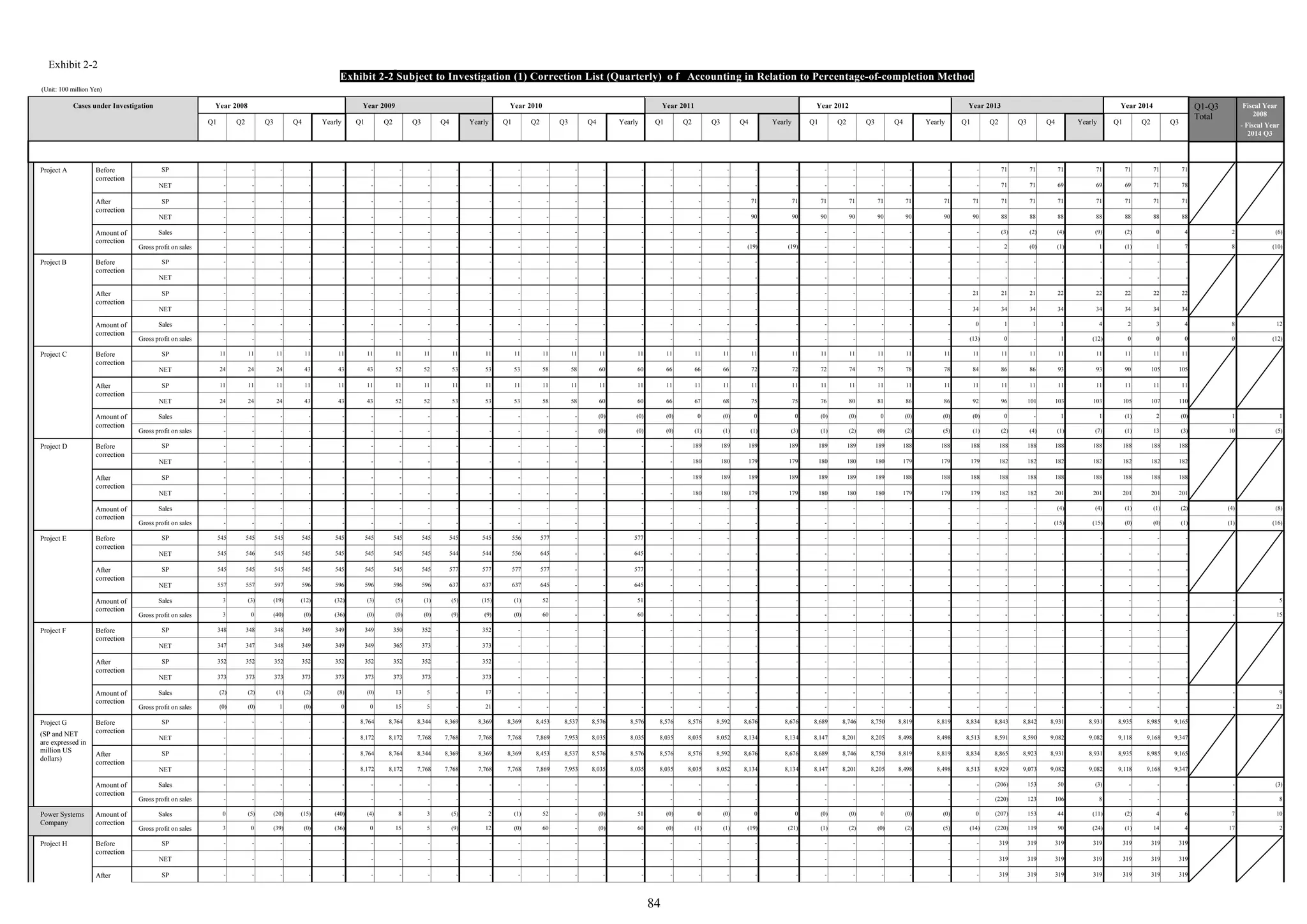
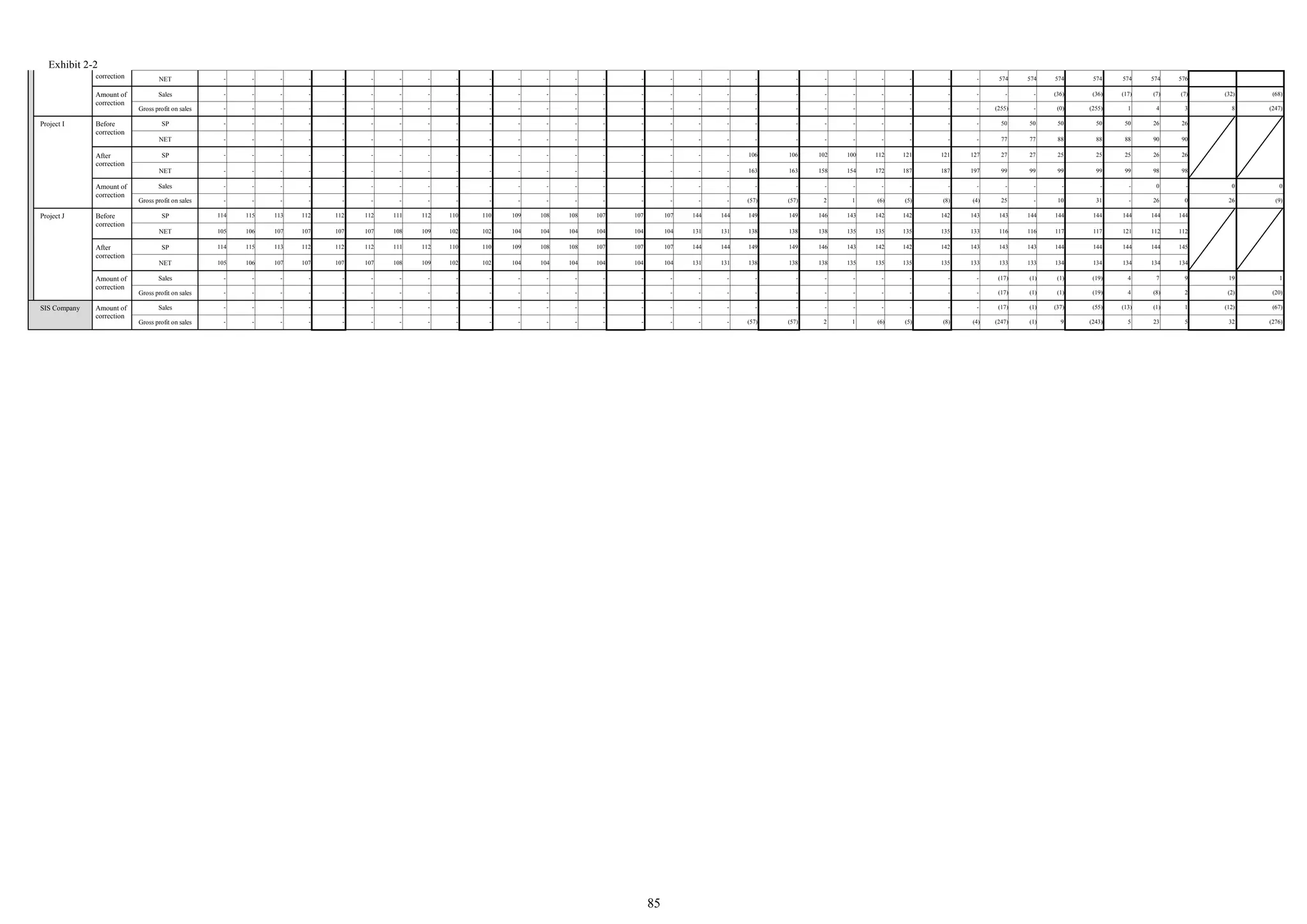
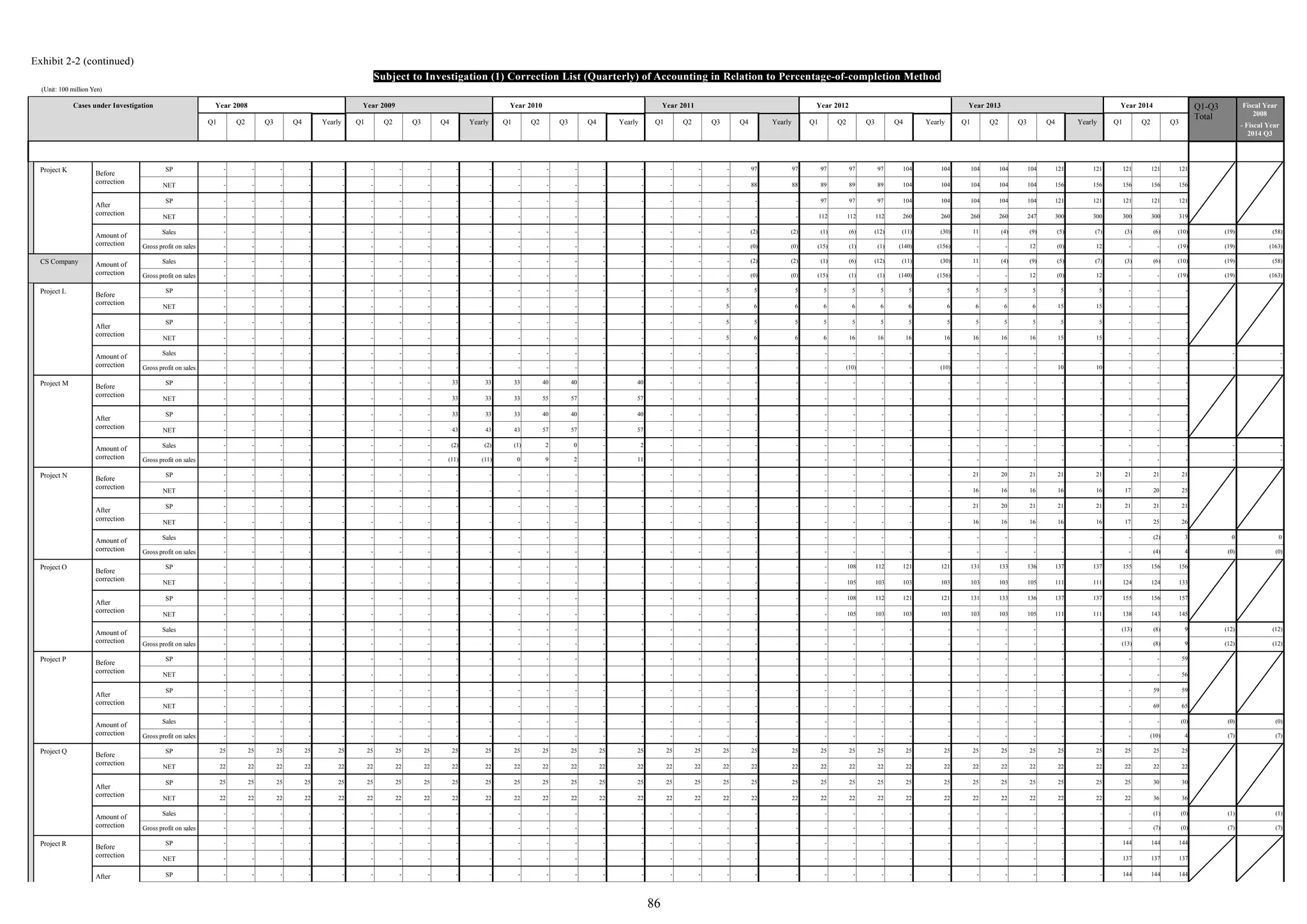
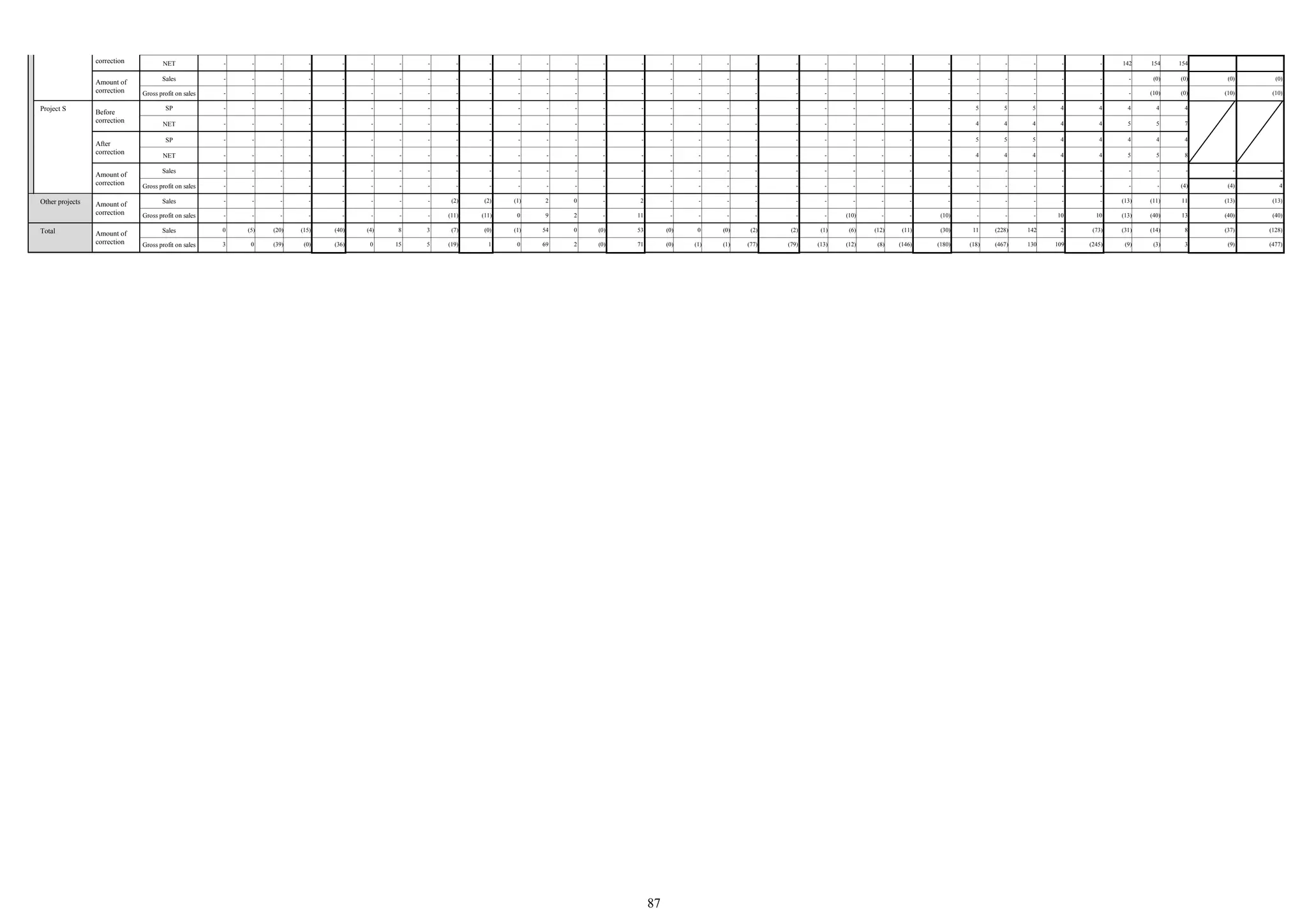
List of total adjustment amounts (Unit: JPY 100 million)
FY
2008
FY
2009
FY
2010
FY
2011
FY
2012
FY
2013
FY 2014
Q3
Power Systems
Company
Sales
Adjustment
(40) 2 51 0 (0) (11) 7
Gross Profit
Adjustment
(36) 12 60 (21) (5) (24) 17
SIS Company
Sales
Adjustment
- - - - - (55) (12)
Gross Profit
Adjustment
- - - (57) (8) (243) 32
CS Company
Sales
Adjustment
- - - (2) (30) (7) (19)
Gross Profit
Adjustment
- - - (0) (156) 12 (19)
Other Projects
Sales
Adjustment
- (2) 2 - - - (13)
Gross Profit
Adjustment
- (11) 11 - (10) 10 (40)
Total
Sales
Adjustment
(40) (0) 53 (2) (30) (73) (37)
Gross Profit
Adjustment
(36) 1 71 (79) (180) (245) (9)
2. Power Systems Company
(1) Project A
(A) Outline of Project A
This is a project in which the Power Systems Company received an order from Local
25
Government A in January 2012 with a contract amount of JPY 7.1 billion to
manufacture system equipment with an (initial) delivery date of March 2016.
(B) Accounting treatment in question and appropriateness thereof
Regarding Project A, the NET before bidding was JPY 9 billion, but in order to win
the bid, which was necessary in terms of business strategy, a “challenge value” (NET),
which included unsubstantiated cost reductions, was set at JPY 7 billion and the bid
price (SP) was set at JPY 7.1 billion. As a result, the Power Systems Company
received the order, but a provision for contract losses was not recorded at the outset of
the contract.
In the second quarter of FY 2013, the NET was estimated to be JPY 8.8 billion, but
the recording of sales under the percentage-of-completion method commenced at JPY
7.1 billion, which was the same amount as the SP. Following that, an increase in the
NET was recognized in the third quarter of FY 2014 and a provision for contract losses
was recorded for the first time.
While the Power Systems Company has recorded a provision for contract losses since
FY 2014, it should have recorded a provision for contract losses for the amount
exceeding the total estimated cost of contract work over the order amount (total
estimated income from the contract work) at the time it received the contract. With
that correction, the total estimated cost of contract work would be JPY 9 billion for the
fourth quarter of FY 2011, resulting in a negative profit impact of JPY 1.9 billion.
Also, even after being awarded the contract, the total estimated cost of the contract
work should have continued to be revised on a timely basis, with the resultant provision
for contract losses likewise recorded based on the updated total estimated cost of the
contract work.
Furthermore, profits and losses resulting from the application of the
percentage-of-completion method from the second quarter of FY 2013 should have been
recorded based on a regularly updated total estimated contract cost.
(C) Cause of inappropriate accounting treatment
Project A was projected to generate losses from the outset, with losses forecasted
even in subsequent CD considerations. Nonetheless, the total estimated cost of
contract work was not revised in a timely manner and a provision for contract losses
based on that was not recorded. It can be surmised that the cause is that the Project
Department and Plant Business Management Department thought that recording a
provision for contract losses would not be accepted by Yasuharu Igarashi CP as long as
there was no moral certainty of loss or firm loss figure.
(2) Project B
(A) Outline of Project B
26
This is a project in which the Power Systems Company received an order from
National Research and Development Corporation B in May 2013 with a contract
amount of JPY 2.1 billion for detailed design and production of system equipment with
an (initial) delivery date of March 2015.
(B) Accounting treatment in question and appropriateness thereof
In Project B, with the total cost of contract work estimated at JPY 3.4 billion at the
Order Policy Meeting in April 2013, a Contract Loss was expected from the outset of
the order, but the Power Systems Company did not record a provision for contract losses
at that time or thereafter. Further, even though it was possible in this project to produce
a reliable estimate of the total estimated cost of contract work at the outset of the order,
the Power Systems Company did not apply the percentage-of-completion method.
In respect of Project B, the Power Systems Company should have recorded a
provision for contract losses for the first quarter of FY 2013 upon securing the order.
Also, the Power Systems Company should have started recording sales using the
percentage-of-completion method from the first quarter of FY 2013, when it received
the order for Project B.
(C) Cause of inappropriate accounting treatment
A provision for contract losses was not recorded after Project B was awarded, and it
can be surmised that the cause of such treatment is that the Project Department and the
Plant Business Management Department thought that recording a provision for contract
losses would not be accepted by Yasuharu Igarashi CP as long as there was no moral
certainty of loss or firm loss figure.
The percentage-of-completion method was not applied at the outset of the project. It
can be surmised that the Project Department and the Plant Business Management
Department deliberately delayed recording a provision for contract losses because they
understood that recording a provision for contract losses would be inevitable once they
started to record sales using the percentage-of-completion method, and they used the
possibility of CD and the possibility of securing additional income as a reason to delay
recording a provision for contract losses.
(3) Project C
(A) Outline of Project C
This is a project where the Power Systems Company received an order from prime
contractor C in June 2001 with a contract amount of JPY 1.1 billion for the design,
construction, and repair and maintenance of the equipment and facilities attached to a
power plant with an (initial) delivery date of December 2009, which was related to the
27
construction of the equipment and facilities attached to the power plant.
(B) Accounting treatment in question and appropriateness thereof
With respect to Project C, while an acceptance inspection was conducted in
December 2009, there were ongoing problems with the equipment and facilities
attached to the power plant at the time of the acceptance inspection, and remediation
work continued based on an agreement with prime contractor C even after the receipt of
an inspection acceptance document. Some of that remediation work was outsourced to
TPSC, a Subsidiary (that remediation work for which TPSC was requested is hereinafter
referred to as the “TPSC Remediation Work”), with the remediation work including the
TPSC Remediation Work being conducted intermittently from FY 2010 to FY 2014.
However, the Power Systems Company did not issue an official work order to TPSC in
respect of the TPSC Remediation Work during the term from FY 2010 to the first
quarter of FY 2014, and it did not include the TPSC Remediation Work in the total
estimated cost of contract work of Project C, citing reasons such as ongoing pricing
negotiations with TPSC as the basis for not doing so.
In reality, the construction work was ordered by the Power Systems Company to
TPSC, and that work was actually undertaken by TPSC. So, the Power Systems
Company should have included the costs for the TPSC Remediation Work in the total
estimated cost of contract work and should have recorded sales and a provision for
contract losses using the percentage-of-completion method for FY 2010 and each fiscal
year thereafter.
(C) Cause of inappropriate accounting treatment
The construction costs associated with the work undertaken by TPSC were not
included in the total estimated cost of contract work, and it can be surmised that there is
a certain amount of possibility that the cause of such treatment is that the Sales
Department and the Plant Business Management Department, which should have
updated the total estimated cost of contract work, neglected to update the total estimated
cost of contract work in a timely and adequate manner with the excuse that negotiations
with TPSC were ongoing, with the intention to delay recording an additional provision
to Projects C, which had already incurred significant losses.
(4) Project D
(A) Outline of Project D
This is a project where the Power Systems Company received an order from client D
in July 2011 with a contract amount of JPY 18.9 billion to construct Power Plant D with
an (initial) delivery date of August 2016.
28
(B) Accounting treatment in question and appropriateness thereof
With respect to this project, the contract costs pertaining to foreign currency
purchases included in the total estimated cost of contract work were foreign currency
denominated, but the exchange rate prevailing at the time of the order receipt (1 USD =
85.0 JPY) continued to be used from FY 2011 to the third quarter of FY 2014 in
recording sales and cost of sales.
According to the accounting rules of Toshiba, if foreign currency purchases are
included in the total estimated cost of contract work and the foreign currency has not
been procured, those foreign currency purchases are to be converted using the most
recent monthly rate and the total estimated cost of contract work is to be revised.
As of the end of FY 2013, the total estimated cost of contract work was in excess of
the total estimated income from contract work due to exchange rate fluctuations and
other factors, but since the Power Systems Company believed that there was a
possibility of cost reductions including regaining the amount equivalent to increased
costs through exchange rate differences, it did not revise the total estimated cost of
contract work or record a provision for contract losses. Even in subsequent quarters,
the Power Systems Company did not record any provision for contract losses until the
third quarter of FY 2014.
There are no specific grounds to support the cost reduction mentioned above, and the
Power Systems Company should have revised the total estimated cost of contract work
and recorded a provision for contract losses at the end of FY 2013.
(C) Cause of inappropriate accounting treatment
The possibility cannot be completely denied that the cause of the above accounting
treatment not being conducted from the fourth quarter of FY 2013 is that the division
heads and other related people thought that profitability might improve through
measures such as CDs. However, there is reasonable degree of possibility that those
people intended to delay recording a provision for contract losses under heavy pressure
to achieve their sales target in light of the fact that there was no evidence of any specific
consideration of whether it would be possible to avoid incurring losses through
measures such as CDs, and it is not possible to eliminate the doubt that those people
intended to postpone recording losses.
(5) Project E
(A) Outline of Project E
This is a project where the Power Systems Company received an order from client E
in February 2007 with a contact price of JPY 54.5 billion for a set of boilers, turbines,
and generators for Power Plant E with an (initial) delivery date of August 2010.
29
(B) Accounting treatment in question and appropriateness thereof
With respect to Project E, there was an increase in material costs following the
execution of the contract, and it was anticipated that Contract Losses of JPY 1.2 billion
would arise in December 2007, but a provision for contract losses was not recorded
despite the absence of any reasonable grounds. Even following that, no provision for
contract losses was recorded until a loss of JPY 6.9 billion was recorded upon
completion of the contract in August 2010.
As losses were anticipated as of December 2007, a provision for contract losses
should have been recorded in the third quarter of FY 2007.
Also, as costs further increased thereafter, the total estimated cost of contract work
consequently should have increased and a provision for contract losses should have
been recorded.
(C) Cause of inappropriate accounting treatment
From January 17, 2008 to March 26, 2008, the sales managers for the Thermal Power
Plant Division discussed the possibility of recording a provision for contract losses with
Hideo Kitamura CP, but in the end Hideo Kitamura CP did not give approval for doing
so. As such, a provision for contract losses was not recorded from the third quarter to
the fourth quarter of FY 2007. It can be surmised that Hideo Kitamura CP did not give
approval for recording a provision for contract losses because he intended to postpone
recording losses. During the CEO Monthly Meeting for January 2008, Atsutoshi
Nishida P received a report that Contract Losses would arise, but he believed that report
was based on a presumption that a provision for contract losses would be recorded, and
there is no indication that shows that he gave an objection to the recording of a
provision for contract losses.
Further, it can be surmised that the sales managers did not take any procedures
necessary to record a provision for contract losses after the first quarter of FY 2008
because, in addition to the fact that Hideo Kitamura CP did not approve the recording of
a provision for contract losses, they thought that they would probably not receive
approval even if the division head and other managers were to request approval as there
was pressure from Yasutoshi Igarashi CP to meet budget targets.
(6) Project F
(A) Outline of Project F
This is a project where the Power Systems Company received an order from client F
in March 2006 with a contract price of JPY 30.6 billion to build two power plant units at
Power Plant F with an (initial) delivery date of October 2009.
(B) Accounting treatment in question and appropriateness thereof
30
With respect to Project F, it was anticipated that in the fourth quarter of FY 2007
Contract Losses of JPY 2 billion would arise due to additional costs following the
execution of the contract, but a provision for contract losses was not recorded through
the incorporation of unsubstantiated cost reductions. No provision for contract losses
was recorded thereafter.
Most of the CD measures were unsubstantiated and could only be regarded as lacking
reasonable grounds, so there should have been an increase in the total estimated cost of
contract work and a provision for contract losses should have been recorded for that
fiscal period.
(C) Cause of inappropriate accounting treatment
It can be surmised that the causes that a provision for contract losses was not
recorded in the fourth quarter of FY 2007 were that the sales managers expected to
acquire additional SP and to realize additional CDs that would turn the financial
situation in their favor. In addition, it can be surmised that, based on the fact that the
request to record a provision for contract losses was not approved by CP for Project E,
which had been carried out at the same business department as Project F, the sales
managers were convinced that it would not be possible to receive approval to record a
provision for contract losses for Project F.
(7) Project G
(A) Outline of Project G
This is a project where WEC,8
which is a consolidated subsidiary of Toshiba,
received orders during the period from 2007 to 2009 with a total contract amount of
USD 7.6 billion (as of the period ended March 2009) to build, etc. Power Plant G with
(initial) delivery dates from 2013 to 2019.
(B) Accounting treatment in question and appropriateness thereof
With respect to the increased estimated amount of the total estimated cost of contract
work9
due to factors such as design changes and delayed construction work in Project
8
WEC is a Limited Liability Company under U.S. Law with its headquarters in Pennsylvania, USA
and with a principal business of designing, manufacturing, and maintaining nuclear fuel and nuclear
power generating facilities. WEC is a consolidated subsidiary of Toshiba, with all of its equity
effectively held by Toshiba Nuclear Energy Holdings (US) Inc. (“TNEH”), and Toshiba holding 87%
of the voting rights of TNEH.
9
The increased estimate amount of the total estimated cost of contract work in Project G was
discussed by the people involved based on an amount net of increased estimate value of SP.
31
G, WEC reported additional recognized risks of USD 385 million and USD 401 million
in the second quarter and the third quarter of FY 2013, respectively. As a result of
further evaluation by Toshiba, the accounting records reflected USD 69 million and
USD 293 million, respectively.
With respect to the fourth quarter, Toshiba and WEC agreed to reflect USD 401
million in the accounting records.
However, there are not sufficient grounds for the reduction evaluation of the
increased estimate amount of the total estimated cost of contract work undertaken by
Toshiba in the second quarter, so the figure of USD 385 million reported by WEC
should have been reflected.
In the third quarter, Ernst & Young ShinNihon, the accounting auditor, insisted that
with respect to the increased estimate amount of the total estimated cost of contract
work, the amount of USD 401 million (profit and loss impact was negative USD 332
million) reported by WEC should be recorded, but Toshiba adopted USD 293 million
(profit and loss impact was negative USD 225 million). However, there were no
specific grounds for the figure adopted by Toshiba, so the figure of USD 401 million
reported by WEC should have been adopted. A discrepancy in profit and loss impact
of negative USD 107 million arose in those amounts, but Ernst & Young ShinNihon
eventually treated this discrepancy as an uncorrected misstatement.10
It should be noted, however, that the adjustments mentioned above represent those on
a quarterly basis and they do not impact year-end financial statements. The profit and
loss impact was negative USD 225 million for the second quarter, positive USD 123
million for the third quarter, and positive USD 102 million for the fourth quarter.
(C) Cause of inappropriate accounting treatment
In the FY 2013 second quarter consolidated financial statements, Toshiba recorded an
increased estimate amount of the total estimated cost of contract work of Project G of
USD 69 million adopting its own increased estimate amount, instead of adopting an
increased estimate amount of USD 385 million reported by WEC. There is a high
possibility that the causes of such treatment are that Yasuharu Igarashi CP, who gave an
instruction for a cost review upon receipt of a report on the increased estimate amount
from WEC in October 2013 (after the last day of that quarter), and that the Company
Finance and Accounting division and the Corporate Finance and Accounting division,
which were tasked with compiling the financial reports, concluded that it was possible
Accordingly, in the note regarding Project G in this Report, the term “increased estimate amount of
the total estimated cost of contract work” is used as an estimate amount net of that increased
estimate amount of SP. Also, the quarterly estimates are stated as total estimates.
10
“Uncorrected misstatement” means a misstatement that was discovered in a financial statement
audit (difference between an amount in a financial statement item to be recorded and an amount of a
financial statement item requested based on the framework of a financial report to be applied). The
purpose of a financial statement audit is not to discover all misstatements, but it is to obtain
reasonable assurance that there is no material misstatement on the whole, so even if an uncorrected
misstatement is discovered in the process of an audit, the financial statement does not necessarily
need to be corrected if that uncorrected misstatement is not material.
32
to reduce the increased estimate amount reported by WEC through unsubstantiated cost
reduction measures, based on an intention to avoid recording losses in the consolidated
financial statements of that quarter and postpone that until a subsequent period. Further,
at that time Hisao Tanaka P and Makoto Kubo CFO also received a report of the
increased estimate amount of the total estimated cost of contract work of Project G, and
they gave an instruction for a review of the estimated amount and an implementation to
contain the cost increase to within USD 69 million. It cannot be denied that there is a
possibility that they did not give instructions to the Company Finance and Accounting
division, etc. to operate appropriate accounting treatment with an intention to avoid
negative consequences that would result from reflecting the increased estimated amount
reported by WEC in the consolidated financial statements for that quarter.
With respect to the FY 2013 third quarter consolidated financial statement, Toshiba
did not adopt WEC’s estimated increase of the total estimated cost of contract work of
Project G of negative USD 332 million (amount based on profit and loss impact; the
same with respect to figures below), but adopted a figure of negative USD 225 million
(amount calculated by adding negative USD 150 million to Toshiba’s estimated increase
amount of negative USD 75 million). There is a high possibility that the cause of this
treatment was that Hisao Tanaka P and Makoto Kubo CFO, with an intention to avoid a
substantial negative impact that would result from recording losses in the consolidated
financial statements for that quarter based on a large increase in the total estimated cost
of contract work of Project G in accordance with the estimated increase amount
reported by WEC and to postpone that until a subsequent period, used an
unsubstantiated figure of negative USD 225 million without a detailed statement as
grounds for that as an increase in the total estimated cost of contract work. While
there is a difference in opinions between Makoto Kubo CFO and Ernst & Young
ShinNihon regarding the contents of discussions regarding the background of the
calculation of the estimated increase amount of negative USD 225 million, it is
surmised that with Ernst & Young ShinNihon seeking to finalize the third quarter
figures in a short period of time, Makoto Kubo CFO thought that, with a back
calculation of such figure, it could be recognized as an uncorrected misstatement (i.e., it
would not need to be corrected) and that figure was reflected in Toshiba’s consolidated
financial statements with the approval of Hisao Tanaka P.
3. SIS Company
(1) Project H
(A) Outline of Project H
This is a project where SIS Company received an order in September 2013, with a
contract amount of JPY 31.9 billion11
from client H to develop a communication
11
The substantiated amount of the order was JPY 31.9 billion; however, the total income for
contract work was submitted at an estimated JPY 39.9 billion, including JPY 8.0 billion for Smart
Meter installation work to be undertaken by client H.
33
system for Smart Meters (approximately 27 million units) to be installed within client
H’s jurisdiction, and to manufacture, install and maintain the Smart Meter equipment,
with an (original) delivery deadline of March 2024 (hereinafter this project with the
contract scope above mentioned, “Project H”).
The manufacturing part of the Smart Meter equipment was recorded in accounting on
an inspection basis (contract amount of JPY 17.8 billion), while the other parts
(development, installation and maintenance) were recorded under the
percentage-of-completion method (contract amount of JPY 14.1 billion).
(B) Accounting treatment in question and appropriateness thereof
With respect to Project H, SIS Company already anticipated contract losses of
approximately JPY 8 billion at the Order Policy Meeting held in September 2013, even
after considering an increased contract amount and additional cost reduction measures.
Nonetheless, despite the absence of any reasonable grounds, no provision for contract
losses was recorded at the time the project was awarded, and no provisions for contract
losses were recorded in the third quarter of FY 2013 and thereafter.
As a loss of JPY 8 billion (even after considering cost reduction measures) was
forecasted at the time the order was received in September 2013, a provision for
contract losses should have been recorded in the second quarter of FY 2013. In
addition, as Project H was a new type of project for SIS Company in which they had no
experience, only robust cost reduction measures should have been reflected in the total
estimated cost of contract work for each period.
The increase in the total estimated cost of contract work in the second quarter of FY
2013 was JPY 25.5 billion, with the impact on profit and loss also being negative JPY
25.5 billion.
Given the lack of precision in the estimates at the time, we made certain adjustments
with respect to Project H by referring to the later estimates made in a subsequent period.
(C) Cause of inappropriate accounting treatment
The provision for contract losses was not recorded in FY 2013 because SIS Company
was not cognizant of a reasonable estimate for losses associated with Project H, due to
reasons such as that the original estimate as of the receipt of the order for Project H
lacked precision. Also, while SIS Company recognized that it would be necessary to
record a provision for contract losses of at least JPY 4.2 billion based on this estimate
and sought an approval for recording this provision in FY 2013 before the project was
awarded, Hisao Tanaka P and Hideo Kitamura GCEO did not give such approval. It
can be surmised that both Hisao Tanaka P and Hideo Kitamura GCEO intended to
postpone recording a loss. It can also be surmised that no provision for contract losses
was recorded in the second quarter of FY 2014 because SIS Company understood from
prior statements by P and others that, from the perspective of budgetary control, it
would be necessary to generate profits equivalent to such provision to be recorded. In
addition, Hisao Tanaka P and Toshio Masaki GCEO did not give any appropriate
instructions to record a provision of contract losses immediately (i.e., within the second
34
quarter of FY 2014) when they received a report from SIS Company that it would like
to record such provision in the fourth quarter of FY 2014, which it can also be surmised
to be the result of an intent to postpone recording a loss.
As for the accounting division of SIS Company and the finance division of Corporate
(including the CFO), the accounting manager attended the Order Policy Meeting, and
Makoto Kubo CFO was informed of the same information as Hisao Tanaka P and others
before the receipt of the order, and thus were fully aware of the need to record
provisions for contract losses in each quarter from the second quarter of FY 2013.
Given the fact that no appropriate instructions were given to record provisions in such
situation, it is presumable that they believed that prioritizing improving profitability
over appropriateness of accounting could not be avoided. Although Makoto Kubo
CFO was appointed to chair the Audit Committee in June 2014, no instructions were
given in respect of accounting treatment, such that it cannot be evaluated that the Audit
Committee was properly performing the function of internal control.
(2) Project I
(A) Outline of Project I
This is a project where TIC America, a U.S.-based subsidiary of Toshiba, received an
order in December 2010, with a contract amount of USD 129 million from client I
subsidiary, a U.S.-based subsidiary of client I, to provide electric equipment used for the
subway trains for customers of client I subsidiary), with an (original) delivery period of
July 2013 through July 2015.12
SIS Company undertook the design and a certain part of the manufacturing of the
electric equipment from TIC America, while TIC America undertook the assembly.
The contract between TIC America and client I subsidiary sets forth the obligation of
TIC America to deliver the electric equipment for 364 vehicles for the price of USD 129
million (the “Base Contract”) as described above, with a further option by client I
subsidiary to order additional electric equipment for up to 384 vehicles for the price of
USD 122 million. SIS Company applied inspection basis accounting to Project I, with
sales recorded at the time of inspection of the electric equipment.13
Project I was
nonetheless included in the scope of the Investigation, considering the importance
placed on the estimation of the total cost of contract work, just the same as under the
percentage-of-completion method.14
12
The initial delivery period is for mass produced vehicles (360 vehicles). The initial delivery
period for prototype vehicles (1 vehicle) was January 2012, and that for pilot type vehicles (4
vehicles) was October 2012.
13
Projects subject to the percentage-of-completion method are construction contracts and software
development projects. Project I is neither of these project types.
14
Project I is not a construction contract under the accounting rule. Therefore, expressions such as
the total contract cost and the total contract income do not strictly apply. That said, this report has
not differentiated between these expressions.
35
(B) Accounting treatment in question and appropriateness thereof
With respect to Project I, as of March 2012, SIS Company was planning to hold a
final meeting on specifications called a “Final Design Review” in the following month,
such that the specifications had been largely determined and a reasonable estimate was
able to be prepared. Also the possibility of a loss, such as the total estimated cost of
USD 207 million exceeding the order amount of USD 129 million regarding the Base
Contract, was recognized at that time. However, despite the absence of any reasonable
grounds, no provision for losses was recorded on receipt of the order.15
As the occurrence of the loss was reasonably anticipated as of March 2012, a
provision for such a loss should have been recorded at the end of FY 2011. Also,
additional losses should have been recorded in subsequent periods from FY 2012.
(C) Cause of inappropriate accounting treatment
While it can be found that provisions for losses were not recorded for Project I in FY
2011 based on a decision made on March 16, 2012 by Hideo Kitamura GCEO and
Makoto Kubo CFO, it can be surmised that Hideo Kitamura GCEO and Makoto Kubo
CFO intended to postpone recording a loss in this period. Norio Sasaki P was also
aware of both the multi-billion yen of anticipated losses and the lack of provisions for
losses regarding Project I, and should have either instructed or demanded the recording
of provisions for losses, but there is no evidence that he did so. Rather, it is presumed
that he did not instruct or demand the recording of provisions in order to avoid
recording losses regarding Project I for that period.
SIS Company did not record a provision for contract losses regarding Project I in FY
2012. It can be surmised that they intended to avoid recording a provision because
recording a provision would have amounted to a self-admission by SIS Company of
taking on a contract for Project I that would result in a loss from the outset, leading to
the Company needing to assume responsibility for accepting such an order at a loss.
Both Norio Sasaki P and Hideo Kitamura GCEO were aware of the extensive expected
losses for Project I, which gives rise to the appearance that a lack of instructions may
have emanated from a desire to avoid recording losses for that period.
At the end of the first half of FY 2013, SIS Company had only recorded a portion of
the required provision for losses for Project I. The reason for this can be surmised to
lie in the tough stance taken by Corporate in respect of recording loss provisions for
Project I and also in the fact that, while SIS Company recognized from the previous
comments made by P and others that from the perspective of budgetary control, it would
be necessary to generate profits to offset any provisions to be taken, given the bleak
financial outlook for the first half of FY 2013 they had the intention to postpone
recording losses. In July 2013, Hisao Tanaka P and Hideo Kitamura GCEO were
informed by SIS Company of the need to record a provision for losses and approved the
recording of such provision for a loss of JPY 2 billion based on that information. It
15
Because accounting standards for construction contracts do not apply to this project, the account
titles also differ from other transactions, and the title for provisions for contract losses is not used.
36
was highly probable that both of them were able to recognize that the figure of such
provision was not adequate to cover the reasonably expected loss for Project I and
therefore it can be surmised that both of them had the intention to postpone recording
losses.
At the end of FY 2013, SIS Company had only recorded a portion of the required
provision for losses for Project I. The reason for this treatment can be surmised to lie
in the fact that, while SIS Company recognized from the previous comments made by P
and others that from the perspective of budgetary control, it would be necessary to
generate profits to offset any provisions to be taken, given the bleak financial outlook
for FY 2013 they had the intention to postpone recording losses. During the CEO
Monthly Meetings and quarterly reporting sessions for the second half of FY 2013,
Hisao Tanaka P and Hideo Kitamura GCEO were informed that Project I posed a risk of
a loss of JPY 6 billion against the FY 2013 operating profits but that provisions
recorded during the first half of FY 2013 only amounted to JPY 2.5 billion. There is
no evidence of instruction or demand to record provisions. It can be surmised that
there is a high possibility that Hisao Tanaka P and Hideo Kitamura GCEO intended to
postpone recording losses for that period.
As for the accounting division of SIS Company and the finance division of Corporate
(including the CFO), they deliberated the accounting treatment at the end of FY 2011,
including the need to record a provision for losses, but Makoto Kubo CFO made the
decision not to record provisions and no appropriate instructions were given since the
end of FY 2011 despite an awareness of the need to record provisions for losses every
quarter. Given these facts it is presumable both the Finance and Accounting divisions
believed that prioritizing improved profitability over appropriateness of accounting
could not be avoided. The Audit Committee was also aware of the possibility of losses
on Project I, but took no action beyond a general cursory notice to the finance division
at Corporate, so it can only be regarded that the internal control systems of the Audit
Committee were not functioning properly.
(3) Project J
(A) Outline of Project J
This is a project where SIS Company received an order in October 2008 with a
contract amount of JPY 11.8 billion from client J for construction work on a power plant
for an overseas electric power company with the (original) delivery date of October
2013.
(B) Accounting treatment in question and appropriateness thereof
The total estimated cost of contract work for Project J was reviewed during the
second quarter of FY 2013, where the incorporation of cost reduction measures of JPY
1.7 billion resulted in profits of roughly the same amount.
The cost reduction was not based on the substantiated action plans and the amount of
37
cost which was actually reduced was only JPY 0.1 billion. Thus, the incorporation of
cost reduction measures cannot be considered reasonable and SIS Company should have
recognized the initial estimated cost of contract work before such reduction was made.
(C) Cause of inappropriate accounting treatment
The cause of reduction of the total estimated cost of contract work in the second
quarter of FY 2013 can be found in that the Overseas Sales & Marketing Department in
the Transmission & Distribution Systems Division intended to prioritize improved
profitability over appropriateness of accounting for the sake of achieving the budget,
due to excessive pressure from Corporate to SIS Company, and then to the business
units from SIS Company (CP) to achieve the budget.
While the cost injection ratio (i.e., the ratio of accrued actual costs to the estimated
total cost of contract work) reached 100% in the fourth quarter of FY 2014, further cost
increases were expected. Therefore, the department should have revised the total
estimated cost of contract work upward, but they did not do so. This gives rise to the
appearance that the department had the intention to postpone recording losses for that
period.
4. CS Company
(1) Project K
(A) Outline of Project K
This is a project where SIS Company received an order in November 2012 with a
contract amount of JPY 9.7 billion from client K to update the aged ETC facility, with
an (original) delivery date in March 2016. Upon the subsequent foundation of the CS
Company, the whole project was transferred to the CS Company.
(B) Accounting treatment in question and appropriateness thereof
Project K was a technically challenging project from the outset, given the need to
change over from the concurrent operations with the existing system, the complex toll
structure, large-scale construction amidst a large volume of traffic, and unique
specification adjustments. Project K also experienced significant cost escalations after
commencement of construction by SIS Company due to delays in specifications
approval, staff shortages, and system troubles, such that the total contract cost continued
to mount, resulting in provisions recorded for contract losses of JPY 3.5 billion for FY
2013, and a provision for contract losses of JPY 1.1 billion.
SIS Company commenced application of the percentage-of-completion method for
Project K from the fourth quarter of FY 2011. However, as they could not make a
reliable estimate for the fourth quarter of FY 2011 given delays in preparing detailed
38
specifications subsequent to receiving the order, the percentage-of-completion method
should not have been applied for that period such that sales of JPY 200 million and
gross profits of JPY 20 million recorded for the fourth quarter of FY 2011 should not
have been recorded.
The creation of detailed specifications gave rise to a situation where cost increases
were inevitable, with the sales manager for Project K reporting a forecast total estimated
cost of contract work (JPY 11.2 billion) exceeding the total estimated income from
contract work (JPY 9.7 billion) as a result of such cost increase at the steering meeting
held in the first quarter of FY 2012. According to this report, after increasing the
amount of the NET on the internal system a provision for contract losses (JPY 1.5
billion) should also have been recorded at that time.
Moreover, while the aforementioned issues led to further increases in costs for the
fourth quarter of FY 2012 after commencement of construction, this was only partially
offset by an increase in the contract amount, and the total increased amount in costs
could not be absorbed. As such, after increasing the total estimated income from
contract work and the total estimated cost of contract work in that quarter, a provision
for additional contract losses (JPY 14.1 billion) should have been recorded.
(C) Cause of inappropriate accounting treatment
It can be found that the reason why sales and gross profits were recorded in the fourth
quarter of FY 2011 under the percentage-of-completion method relying on unreliable
estimates lies in the fact that SIS Company was not aware that the estimates were
indeed unreliable.
In the first quarter of FY 2012, the Automation Products & Facility Solution Division
was informed that a contract loss of JPY 1.5 billion was expected to occur during the
steering meeting, but did not record a provision for contract losses. Given the project
was approved by Toshio Masaki CP on condition of achieving an M Ratio of 110%, it
gives rise to the appearance that such division recognized that further approval from
Toshio Masaki CP as to a provision for contract losses would not be given at a stage
where only six months had passed from the time of receipt of the order and came to
have the intention to postpone recording a provision for contract losses for that period.
From the fourth quarter of FY 2012 to the second quarter of FY 2013, Toshio Masaki
CP was regularly informed of the possibility of incurring losses. Hisao Tanaka P and
Hideo Kitamura GCEO were informed of possible losses in the range of JPY 3.6 to 10.1
billion in July 2013, with a request put forward in August 2013 for approval to record a
provision for losses of JPY 4.5 billion from the third quarter of FY 2013. No
provisions were recorded from the fourth quarter of FY 2012 through the second quarter
of FY 2013. It is highly possible that the financial performance of SIS Company for
the first half of FY 2013 may have led to the desire to postpone recording of provisions
for contract losses. Hisao Tanaka P and Hideo Kitamura GCEO were informed of the
situation at the time, but there is no evidence of instruction or demand for SIS Company
to record provisions for contract losses in that period. Given this situation, it can be
surmised that there was an intention to postpone recording of the provision for contract
losses for that period.
39
In the third quarter of FY 2013, Hisao Tanaka P was informed that the target for
Project K would result in prospective losses of JPY 8.7 billion even if all improvement
initiatives were achieved, and was asked to approve recording a provision of JPY 3.5
billion for contract losses. However, Hisao Tanaka P did not instruct or demand the
recording of the total contract losses of JPY 8.7 billion, but indicated a course of action
to the effect that the contract losses of JPY 3.5 billion be recorded in the fourth quarter
of FY 2013 rather than in the third quarter of FY 2013. It can be surmised that the
instruction of Hisao Tanaka P is rooted in the fact that recording contract losses for
Project K would have made CS Company fall short of its third quarter profit target in
FY 2013, leading to the intention to limit the amount of provisions for contract losses
for that period and to postpone recording the remainder of the contract losses for that
period.
As for the accounting divisions of SIS Company and CS Company, and the finance
division of Corporate as well as Makoto Kubo CFO, the accounting divisions of SIS
Company and CS Company participated in the meeting to report in the fourth quarter of
FY 2012 to Toshio Masaki CP and received continuous reports thereafter. Also,
Makoto Kubo CFO and the finance manager were informed of the outlook of contract
losses of JPY 8.7 billion for the third quarter of FY 2013 and were aware of the need to
record a provision for contract losses, but no appropriate instructions were given to
record this figure. From the response taken by Makoto Kubo CFO and the finance
manager, it can be perceived that they were concerned that executives might be held to
account for recording a large amount of provisions, as well as about the impact on the
company’s overall profitability. The Corporate Audit Department and the Audit
Committee were also aware of the possibility of large-scale losses on Project K but
raised no issue regarding accounting treatment, based on which fact it can be surmised
that internal control was not effectively functioning.
5. Other projects
(1) Projects where adjustments would amount to less than JPY 1 billion
(A) Project L
(a) Outline of the project and details of adjustments
In 2011, SIS Company received an additional order (the “Additional Contract”) with
the contract amount of JPY 0.5 billion from client L for construction to address
specification changes regarding construction for which orders had already been received
(the “Main Contract”), with an initial delivery date of March 2014.
SIS Company was planning to enter into a separate contract with client L for the
Additional Contract aside from the Main Contract, and the Additional Contract was
actually independent of the Main Contract, such that SIS Company recognized the
Additional Contract as a separate contract unit from the Main Contract for accounting
purposes as well.
40
While the percentage-of-completion method was applied to the Main Contract, the
method was not applied to the Additional Contract as it was below the monetary
threshold (JPY 1 billion) for applying the percentage-of-completion method based on
internal rules. After application of the completed contracts method, sales of JPY 0.5
billion and a loss of JPY 1 billion were recorded as of the completion of the contract.
However, SIS Company was in a position to be able to estimate the total cost of
contract work of JPY 1.5 billion as of the second quarter of FY 2012 for the Additional
Contract and to be able to recognize the possibility of contract losses, such that a
provision for contract losses should have been recorded at that juncture.
(b) Cause of inappropriate accounting treatment
A provision for contract losses was not recorded from the second quarter of FY 2012
based on a misunderstanding by the sales manager that there was no need to handle the
Additional Contract independently as a loss-making project as there would be no loss if
the Main Contract and the Additional Contract were totaled. It can be found that the
main cause of inappropriate accounting treatment was due to a lack of requisite
accounting knowledge of the sales manager.
(B) Project M
(a) Outline of the project and details of adjustments
This is a project where Densan Co., Ltd. (now SIS Company) received an order in
January 2010 with a contract amount of JPY 3.3 billion from client M, to install a power
generation system, with an (original) delivery date of October 2010.
While it was expected to incur losses from the time of receipt of the order, a provision
for contract losses was not recorded, despite the absence of any reasonable grounds,
before the second quarter of FY 2010, immediately before the contract completion.
However, a provision for contract losses should have been recorded upon the order
receipt, and also thereafter the total estimated cost of contract work should have been
revised in a timely manner following specification changes and material cost
movements.
(b) Cause of inappropriate accounting treatment
SIS Company took no steps to record a provision for contract losses. Ryuichi
Nakata CP and other SIS Company personnel stated that they expected improvement in
profitability from subsequent cost reductions, but in reality, improved profitability was
not expected that was based on any objective grounds, and there is an appearance that
the cause of not taking any steps to record a provision for contract losses was that SIS
Company personnel had the intention to postpone recording losses.
41
(C) Project N
(a) Outline of the project and details of adjustments
This is a project where SIS Company received an order in March 2013 with a
contract amount of USD 20 million (JPY 2 billion) from client N for work regarding
overseas electrical substation facilities and related equipment, with an (original)
delivery date of May 2014. The project scope is primarily the production and sale of
equipment, and excludes installation work on the project site.
Based on the completion of shipment of the main components at the end of
September 2014, SIS Company treated Project N as being complete despite the fact that
not all work had yet been completed, and recorded the entire unrecognized amount of
the total estimated income from contract work.
As not all work had been completed as of the second quarter of FY 2014, a certain
portion of the sales recorded by treating the contract as complete should have been
recorded as sales in the third quarter of FY 2014, upon actual completion of all work.
Also, with respect to the profitability deterioration for Project N, additional costs
were expected to arise in the second quarter of FY 2014 such that a provision for
contract losses should have been recorded after revising the total estimated cost of
contract work.
(b) Cause of inappropriate accounting treatment
It can be found that the project was deemed complete in the second quarter of FY
2014 based on a misunderstanding by the sales manager that it could be treated as
complete when the major part of equipment was shipped, even though there was
actually work remaining and the project could not be considered completed. It is
presumed that the total estimated cost of contract work was not increased or a provision
for contract losses was not recorded in the second quarter of FY 2014 because the sales
manager omitted the necessary accounting treatment based on his own belief that a
significant cost increase was unlikely without any amendment to the specifications
based on the nature of the project related to the manufacture and sale of equipment.
(D) Project O
(a) Outline of the project and details of adjustments
This is a project where SIS Company received an order in September 2012 with the
contract amount of JPY 14.1 billion (converted to Japanese yen) from government
office O, for the production and installation of transformers and other equipment for
electrical substation facilities and construction and civil engineering works for
associated buildings, with an (original) delivery date of January 2014.
With respect to Project O, an increase in the total estimated cost of contract work was
42
anticipated in both the first quarter and second quarter of FY 2014, and these costs
could have been reasonably estimated at that time. While they were not reflected in
the accounting records, they should have been reflected as revisions to the total
estimated cost of contract work in a timely manner.
(b) Cause of inappropriate accounting treatment
While an increase in the total estimated cost of contract work was anticipated in both
the first quarter and second quarter of FY 2014, this was not appropriately revised. It
can be found that the causes of such treatment are in that the sales manager believed that
it was not necessary to update NET unless the estimated cost increase was fully
substantiated by supporting evidence, and in that he believed that the additional costs
other than those already determined could be recorded by the end of FY 2014 (March
2015) as the project was expected to be completed in December 2014.
In other words, it can be surmised that the main cause of inappropriate accounting
treatment in this project have arisen from the low level of awareness of the sales
manager about accounting treatment.
(2) Projects announced by Toshiba to be adjusted
With regard to Projects P, Q, R and S, Toshiba announced that they would make
adjustments. While these projects are outside the scope of investigation by the
Committee, their impact on the financial statements are set out in Exhibit 2.
43
Chapter 3. Accounting Treatment in relation to Recording Operating Expenses in
the Visual Products Business
I. Accounting treatment in question
1. Outline
In the Visual Products Business of Toshiba and TLSC (collectively “Toshiba” in this
chapter), by way of an attempt to meet profit targets, they implemented a mechanism
known as C/O (Carry-Over) to overstate current year profits by adjusting profits and
losses since 200816
at the latest. Specifically, whereas it had been a general custom
for each business unit to aggregate their profit outlook by region in each quarter period
and to formulate and carry out sales improvement initiatives for the purpose of adjusting
the gap with target sales, C/O has been used for implementation to adjust the gap not
covered through usual sales initiatives, such as increased revenue and CD.
In the Investigation, of the C/O Balances17
that the business departments of the
Visual Products Business were aware of, those deemed to involve inappropriate
accounting treatment (“Inappropriate C/O”) were examined.
2. Accounting treatment in question and appropriateness thereof
Methods (Items) on Inappropriate C/O are classified under the following four (4)
methods.
Item Main method
A Methods related
to provisions
For purposes of Toshiba’s consolidated accounting, using the cash-based
method even though the accrual-based method should be used
B Methods related
to delayed timing
of recording
operating
expense
Where services that involve advertising or logistics expenses have already
been provided, requesting vendors to delay the issuance of invoices until
the next quarter to record expenses in the next quarter
C Methods related
to inventory
valuation (mainly
Utilizing the fact that Toshiba’s consolidation on its accounting systems
does not eliminate unrealized profits and losses where Toshiba’s gross
margins are negative in transactions with consolidated group companies,
16
The subject period of this investigation was from FY 2008 to the third quarter of FY 2014.
However, as for FY 2010 and earlier (FY 2008 to FY 2010), as there was insufficient information to
understand the details of the C/O for those periods, it has only been confirmed that an inappropriate
C/O as described below was carried out from FY 2008 and inappropriate C/O had been carried out
by the Company engaged in the Visual Products Business from FY 2011 with consent from CP.
17
The amount of C/O implemented in the Visual Products Business as at the end of each relevant
period was called the “C/O Balance.”
44
FOB-UP) increasing the product price (FOB price) to overseas affiliated companies
(to the extent that still maintains Toshiba’s negative gross margin) at the
end of the relevant period
D Methods related
to early recording
of CR
CR (cost reduction: requesting panel makers and ODM/OEM
manufacturers to reduce their selling price to Toshiba) (“CR” throughout
this chapter) to be reflected in the purchase prices even in cases where
there is low possibility of achieving CR
For each of the above four methods, adjustment amounts for accounting purposes are
as follows.18
Breakdown of required adjustment
(JPY 100 million)
Item
FY
2008
FY
2009
FY
2010
FY
2011
FY
2012
FY
2013
FY 2014
Q3
A. Methods related to
provisions (total)
- - 20 20 23 37
B. Methods related to delayed
timing of recording operating
expense (total)
- - 9 4 8 7
C. Methods related to the
inventory valuation (total)
- - 32 39 9 3
D. Methods related to early
recording of CR (total)
- - - - 24 38 11
Other methods (details
unknown)
53 131 196 21 31 27 -
C/O balance (total) 53 131 196 81 118 105 58
Amount of impact on profit and
loss
(53) (78) (65) 115 (37) 13 47
II. Cause of inappropriate accounting treatment
1. Corporate pressure in business downturns
Toshiba’s Visual Product Business has continued to experience a slump in their
overseas business. Especially, after FY 2007, through the recession that emanated
from the financial crisis, the harsh conditions of business profits and losses persisted,
18
In the course of this investigation, a number of C/Os were discovered, the details of which are not
identified. Such C/Os are included in adjustment amounts of profits and losses herein for ease of
reference given that the reason for not requiring any adjustment was not adequately made and that
most C/Os whose details are identified are considered Inappropriate C/O.
45
and from FY 2011, the situation became extremely harsh. Against this backdrop, since
sometime before FY 2010, Corporate had made requests at CEO Monthly Meetings and
the like to CP, business division heads, and executives from the accounting department
of the Company that operates the visual products business, and subsidiaries (the “Visual
Product Company”) to achieve the profits and losses required by each budget and to
meet improvements in the profits and losses mandated during each relevant period
(these targets were called “Challenges” at Toshiba). The Visual Products Business
continued to generate losses, and the Challenges set by Corporate became more severe.
From FY 2011 at the latest, the CEO Monthly Meetings and individual exchanges often
featured stern rebukes and Challenges from the CEO of Corporate, directed at the Visual
Product Company executives. In particular, from 2013, certain top management at
Corporate level strongly insisted on the achievement of Challenges while suggesting
possible withdrawal from the entire visual products business.
Therefore, profits were intentionally overstated at the Visual Products Company
through Inappropriate C/O to adjust profits, as the usual measures such as revenue
increases and CD were insufficient to meet Challenges and B/E (break-even) for the
purpose of avoiding booking losses for any fiscal period.
What was fundamentally merely an estimate to be seen as a budget or goal amount
from Corporate to the Visual Products Company was transformed into a mandatory
profit and loss figure that needed to be achieved within Toshiba at some stage, driving
the Visual Product Company to be in the situation where it had no choice but to push
forward and achieve those figures. Furthermore, the profit target to be achieved was
not derived from the long-term perspective of an earnings target or similar, but an
over-riding current profit policy to maximize profits for each quarter or fiscal year.
Under these circumstances, the Visual Product Company used any means available to
prioritize financial achievement, resulting in prioritizing the budget control figures
based on overstated profits after conducting Inappropriate C/O, over financial
accounting. More specifically, through the process in which Challenges from
Corporate imposed upon CP and the business division heads were allocated to the
relevant area managers and the instructions from P were conveyed, a culture came to be
established in the Visual Products Company of using every available means to meet
Challenges or avoid losses.
From FY 2011 at the latest, with further deterioration in the performance of the
Visual Products Business, the business division heads commenced with instructions
explicitly stating Inappropriate C/O amounts to the area managers in conjunction with
concrete improvement items and amounts, with authorization from CP, the top
management of the Company.
As described above, the root cause of the Inappropriate C/O stems from excessive
demands to meet Challenges from certain top management at Corporate level.
2. Omissions by the top management at Corporate (based on an over-riding
current profit policy)
No information was found indicating the top management from Corporate such as P
giving instruction on or having involvement in the execution of the Inappropriate C/Os.
46
However, according to C/O reports provided to Corporate, it is evident that Norio
Sasaki P was aware that C/Os were conducted to overstate the profit in the Visual
Products Company by November 2011 at the latest, while Hisao Tanaka P was aware by
either August 2013 or March 2014 at the latest. Therefore, even if the top management
of Corporate was not aware of the detailed breakdown of the C/Os or the clearly
inappropriate nature of accounting, they should have confirmed the content of the
Inappropriate C/Os that were being conducted to overstate profits and given
encouragement or instruction to improve, or at the very least confirm, the accounting
appropriateness thereof.
It is considered that both Norio Sasaki P and Hisao Tanaka P were aware that the C/O
adjustments including Inappropriate C/Os were conducted to overstate profits, but took
no action to address this issue.
Admittedly, it can be perceived that the top management from Corporate was of the
basic view that the C/O was to be eliminated, and they did in fact make remarks to that
effect. However, Norio Sasaki P stated that the C/O should not be eliminated while the
group financial situation showed a net loss, such that there was no intent to eliminate
the C/O, including Inappropriate C/O should this result in a loss.
On the other hand, after Hisao Tanaka P assumed position as president, from around
2014, Corporate announced a policy not to further increase the C/O balance, and all C/O
balances were eliminated in the fourth quarter of FY 2014. It can be surmised that one
of the reasons for this lies in the fact that Inappropriate C/O would be difficult to
continue because of the spin-off of the Visual Products Business causing an issue with
respect to auditing and also because of the substantial withdrawal from overseas
business (transition to a brand license business and specialization on domestic business)
upon the cessation of development, production, and sales in all overseas business
scheduled for FY 2015.
3. Lack of awareness of appropriate accounting
The overstatement of profits through the use of Inappropriate C/Os is an
“overstatement” of current profits in excess of real attainability and it can generally be
understood by anyone without any accounting expertise that this sort of treatment is a
diversion from appropriate accounting practice. In spite of this, the fact that such
activities were continued by a large number of people in charge and other participants
with the acknowledgement from CP, the top management of the Visual Products
Company is indicative of the lack of awareness about appropriate accounting treatment.
4. Inadequacy of internal controls in the visual products company
In order to conduct appropriate accounting treatment, the Accounting Department of
the Visual Product Company was expected to perform a checks and balances function
independently from the business department, as part of the internal controls.
However, the internal controls of the accounting department did not function as
envisaged with regard to Inappropriate C/O, and rather they gradually came to take on a
proactive role. In other words, the C/O balances including the Inappropriate C/Os
47
managed by the business department at the Visual Product Company were shared with
the accounting department, which recognized that Inappropriate C/Os were conducted,
but no evidence indicates that the accounting department tried to stop or prevent the
implementation of Inappropriate C/Os. From 2012 at the latest, the accounting
department itself played a proactive role by examining and proposing Inappropriate C/O
items, assessing the possibility of Inappropriate C/Os and communicating that to the
accounting managers at overseas affiliated companies, or preparing explanations for
audit corporations.
48
5. Inadequacy in internal controls at Corporate
(1) Finance division
The finance division gathered and recognized actual and forecast amounts produced
by the accounting departments of the Visual Products Company and took on the role of
conveying to the accounting department instructions from Corporate regarding financial
matters.
However, not only did the finance division provide no such control over the
accounting department, but also the finance division was in close contact with the
accounting department and gave advice with regard to Inappropriate C/Os. It was
clear that the internal controls by the finance division were not effectively functioning at
all.
(2) Corporate audit department
Some members of the corporate audit department were aware of the existence of the
C/O practice in the process of their investigation.
However, the Visual Product Company explained to those people that the C/Os were
mere technical adjustments of gaps between different fiscal periods, and the amounts
noted were not material enough to warrant any specific mention on Inappropriate C/O in
the audit report. This situation is considered to be influenced by the fact that the audit
by the Corporate audit department used to put emphasis on advising how to improve the
business performance and the internal control by the Corporate audit department is can
be found to have not functioned adequately.
(3) Audit committee
No evidence was found to suggest that the audit committee reported or commented
on the Inappropriate C/O.
The audit by the audit committee was performed mainly through interviews with CPs,
and while information received at the time of the interviews included management
reports, there were no descriptions implying the existence of the C/Os, such as
“attainable amount,” “disclosed amount” or “C/O” as included in the CEO Monthly
Meeting materials. Also, the interviews conducted by the audit committee with CPs
mainly focused on securing the effectiveness and efficiency of operations, and it is
difficult to say that checks of the appropriateness of the accounting and financial reports
were sufficiently implemented.
Makoto Kubo, chairman of the audit committee, was CFO from June 2011 to June
2014, and is presumed to have an appropriate amount of knowledge of the details of the
C/Os existing at the Visual Product Company, but he never indicated Inappropriate C/Os
as an issue upon becoming chairman of the audit committee in June 2014.
Based on the above, it is difficult to say that the internal controls by the Corporate audit
49
committee functioned as expected with regard to the visual products business.
(4) Audit by the accounting auditors
In the course of the audit by accounting auditors, they performed a monthly P/L
analysis, periodical comparison by company and account items, sample-checks to verify
the appropriateness of the assigned periods, and to verify the reasonableness based on
those matters, but no responses were obtained to suggest existence of C/Os. In past
audits, no materials were found indicating C/O monitoring charts or the concepts of
“disclosed amounts” and “attainable amounts” which existed at the Visual Products
Company, and they did not discover C/Os undertaken in the Visual Products Business.
This can be surmised to be attributable to the fact that the Visual Products Company
did not disclose to the accounting auditors materials or information indicating the
existence of C/Os, and devised explanations so that the existence of C/Os would not be
revealed to the accounting auditors.
III. Accounting treatment in relation to parts transactions in the Visual Products
Business
During the course of the Investigation, it has been found that there were issues of
inappropriate accounting treatments related to parts transactions in the Visual Products
Business, and they were examined as stated below.
1. Overview of the accounting treatments in question
As for the overview of the parts transactions (buy-sell transactions) and accounting
treatment in the Visual Products Business, please refer to the section regarding parts
transactions in the PC Business, as the same applies to both transactions19
.
2. Accounting treatments in question and appropriateness thereof
In the Visual Products Business, parts transactions with ODMs were undertaken to
supplement the production volumes from self-manufacture, depending on actual
demand. This differs from the practices at the PC Business (described later in the
report), with no evidence found to suggest that profits were intentionally overstated by
19
However, in the parts transaction in the PC Business, while the Masking Price was fixed, the Masking
Ratio increased significantly every year and was eventually set at over five (5) times the procurement
price.
In contrast, the Masking Price was not set in the parts transactions in the Visual Products Business; it was
calculated by adding an amount equal to the procurement price multiplied by the Masking Ratio. (The
Masking Ratios used for each year were as follows: FY 2008- 2011: 30%, FY 2012: 20%, after FY 2013:
50%)
50
intentionally increasing transaction volume or by other means.
However, despite being “normal” parts transactions, it was inappropriate accounting
treatment to recognize the Masking Difference as negative costs of manufactured goods
at the time of supply of the parts to ODMs.
The impact resulting from such accounting treatment is as follows:
(JPY 100 million)
Item FY 2008 FY 2009 FY 2010 FY 2011 FY 2012 FY 2013
FY
2014 Q3
The amount of
impact on
profits and
losses
5 (6) 7 5 (14) (3) 8
51
Chapter 4. Accounting Treatment in the Parts Transactions in the PC Business
I. Outline of the accounting treatment in question
1. Parts transactions in general (TTIP to ODM)
Toshiba outsources the design, development, and production of PCs to overseas
ODMs. Since 2004, TTIP, a fully owned overseas subsidiary of Toshiba, has
purchased the main parts such as memory storage and HDDs and supplied these to
ODMs for charge. The price of these parts supplied for charge are the Masking Price
which is higher than the procurement price so as to prevent Toshiba’s procurement price
from becoming clear to ODMs and from being leaked to competitors (the difference
between the procurement price from suppliers and the supply price to ODMs is called
the “Masking Difference”). ODMs that received the supply of parts assemble PCs
together with parts they procure themselves and deliver the completed PCs to Toshiba
via TTIP (this series of transactions is referred to as a “Buy-Sell Transaction”).
In these parts transactions, Toshiba records an amount equal to the Masking
Difference as an account receivable from TTIP so that the Masking Difference can be
deducted from the product price when the completed PCs are delivered from TTIP, and
simultaneously records profits by deducting costs of manufactured goods. When
Toshiba subsequently purchased the completed PC from TTIP, the Masking Difference
added by TTIP (the factor of an increase in costs of manufactured goods) offsets the
negative amount of costs of manufactured goods recorded at the time of the parts
transaction. As a result, the purchased product price becomes a figure from which the
Masking Difference has been deducted. Recently, the Masking Difference of parts to
be supplied to ODMs was almost five (5) times as TTIP’s procurement price.
In this manner, Toshiba records profits by recording negative costs of manufactured
goods on the parts transactions, and the appropriateness of this accounting treatment is
an issue.
52
Example
In this example, TTIP procures the parts at 50 and supplies them to ODM at 300,
and the completed product is delivered with an addition of processing costs of 20
incurred at the ODM.
Charge 10
Procurement Manufacturing Sales
Toshiba
TTIP
ODM TTIP Toshiba
Parts transaction
(Subject of
investigation)
Completed products
transaction
Within the
Group External
DistributorVendor
Procurement
price
50
Masking
Difference
250
TTIP
Inventory
50
ODM
Inventory
300
Procurement
price
50
Toshiba
Manufacturing
cost
(250)
Toshiba Inventory 80
Masking
Difference
250
Procurement
price
50
Processing
costs 20
Manufactu
ring cost
(250)
TTIP
Inventory
320
Masking
Difference
250
Procurement
price
50
Processing
costs 20
Procurement
price
50
Processing
costs 20
Charge 10
Charge 10
2. Transactions between September 2012 to March 2013
(Toshiba→TTI→TIH→TTIP→ODM)
Toshiba produces PCs through TIH, its manufacturing subsidiary. Moreover, in
order to supply parts to TIH, either TTIP purchases major parts from the vendors or
Toshiba purchases the parts and supplies them to TIH via TTI.
As for the parts supplied in the last months of each quarter during the term from the
second quarter through the fourth quarter of FY 2012, the parts were supplied by
Toshiba to TTI at the Masking Price which was four to eight times Toshiba’s original
procurement price. Toshiba recorded the Masking Difference for these transactions as
an account receivable from TTI and recorded profits by deducting costs of
manufactured goods. TTI purchased the parts with the Masking Price and delivered
them over to TIH by adding the charge. TIH retained these inventories at period end,
and TIH subsequently transferred them to TTIP at the same price in the subsequent
period. TTIP supplied them to ODMs. The appropriateness of recording profits in this
manner is an issue.
53
Procurement Manufacturing Sales
Within the
Group External
Procurement
price
50
Masking
Difference
250
Toshiba TTI
Procurement
price
50
Toshiba’s books
Manufacturi
ng cost
(250)
Normal
transaction
Toshiba
TTI
TTIP Toshiba
Parts transaction
Completed
products
transaction
Distrib
utor
Vendor
TIH
TTIP
Transactions conducted from Sep. 2012 – Mar. 2013
Procurement Manufacturing Sales
Tosh
iba
TTI
OD
M
TTIP
Tosh
iba
Masking
Price
Completed
products
transaction
Dist
ribut
or
TIH
(closing
inventory)
TTIP
Parts transaction
Vendor
II. The appropriateness of the accounting treatments and its impact on profits and
losses (amount requiring adjustment)
1. Parts transactions in general (TTIP→ODM)
Under the contracts with ODMs, Toshiba is obliged to purchase the completed
inventories, the work-in-progress inventories, and parts for a part of the planned
production volume within a certain term from the production volume instructed to
ODMs. Given that Toshiba has in fact purchased inconvertible extra inventories every
term, the parts transactions are premised on the future production transactions, and
therefore the transactions can effectively be considered to be transactions with
repurchase conditions. Recording profits at the time that the parts are supplied does
not appropriately represent the actual series of transactions.
Therefore, at the settlement for each period, it is necessary to delete the amount
equivalent to the amount of the profits that were recognized at the time of the parts
transaction (the negative costs of manufactured goods relating to the relevant Masking
Difference) for the parts and completed inventories for which transactions of completed
products have not been consummated after the parts transactions -- i.e., the ODM
inventories.
2. Transactions from September 2012 to March 2013
(Toshiba→TTI→TIH→TTIP→ODM)
In addition, it is also necessary to delete the profits (the negative costs of
54
manufactured goods ) that were recorded at the time of the parts transactions between
Toshiba and TTI from the second to the fourth quarters of FY 2012 because they would
be repurchased by Toshiba as completed products supplied to ODMs.
The impact on profits and losses (amount requiring adjustment) resulting from the
transactions above is as follows;
(JPY 100 million)
III. Cause of inappropriate accounting treatments
The inappropriate accounting treatments in the Buy-Sell Transactions consist of two
factors as follows; (1) the appropriateness of the accounting treatments to recognize the
negative costs of manufactured goods as Masking Difference at Toshiba at the time
when parts are supplied to ODMs in a normal parts transaction, and (2) misusing this
accounting treatments in overstating the current-period profit by selling a higher volume
of parts than the amount requiring for normal production to ODMs at the end of the
quarter (“Channel Stuffing of ODM Parts”), causing the ODM to hold the inventory,
and causing the Masking Difference for those parts to be recognized as the negative
costs of manufactured goods for that quarter. Below, relevant facts and causes of
inappropriate accounting treatment will mainly concern issue (2), as issue (1) cannot
really be considered to have been done to overstate the profit.
1. Channel stuffing of ODM parts was intentionally conducted to overstate the
current-period profit in an institutional manner involving certain top
management
Channel Stuffing of ODM Parts to ODM was intentionally conducted to overstate the
current-period profit in an institutional manner involving certain top management.
Specifically, in the first half of FY 2008, due to the global economic recession
triggered by the subprime mortgage crisis, concerns about the deteriorating performance
of the entire company were increasing at Toshiba as well. In the quarterly reporting
meeting in July and the CEO Monthly Meeting in August of FY 2008, Atsutoshi
Nishida P demanded to integrate an additional operating profit of JPY 5 billion on top of
the forecast first half budget of PC Company as a “Challenge.” To achieve the
“Challenge”, the PC Company executed Channel Stuffing of ODM Parts to overstate
the profit in September of FY 2008. As a result of this Channel Stuffing of ODM Parts,
the total amount, which is calculated as the quantity of unused Toshiba-supplied parts
held by ODMs (including those subject to normal parts transactions) multiplied by the
Item
FY
2008
FY
2009
FY
2010
FY
2011
FY
2012
FY
2013
FY
2014 Q3
The amount
of impact on
profits and
losses
(198) (286) 105 (166) (296) (1) 247
55
Masking Difference, was estimated to reach to JPY 14.3 billion at the end of September
(the cumulative amount of this amount at the end of each quarter is referred to below as
the “Balance of Buy-Sell Profit Recorded”). This Balance of Buy-Sell Profit Recorded
is mostly presumed to be the overstated current-period profit achieved by Channel
Stuffing of ODM Parts. Subsequently, PC Company continued Channel Stuffing of
ODM Parts, and the Balance of Buy-Sell Profit Recorded reached an estimated JPY
27.3 billion in the first quarter of 2009 just after Atsutoshi Nishida P resigned from his
position as the CEO.
Even after Norio Sasaki P took over the CEO position, Channel Stuffing of ODM
Parts continued to take place at the end of every quarter. Norio Sasaki P thought that
the amount of overstated current-period profit based on Channel Stuffing of ODM Parts
should basically be decreased, but he thought that it should be decreased using the PC
Business excess profit and did not believe that the amount should be reduced when the
PC Business recorded a loss. In addition, because he made strong demands for the
Company to improve profits, especially when the profit and loss situation was not very
good, this induced Channel Stuffing of ODM Parts and the overstating of profits did not
decrease, but instead increased. For example, in the CEO Monthly Meeting on
September 27, 2012, Norio Sasaki P strongly demanded an improvement of JPY 12
billion in the operating profit of the PC Business conducted by DS Company within
three days, and also demanded a report on the plan of action the next day, September 28,
2012. As a result, DS Company explained that, as a result of their considerations, they
would implement a JPY 11.9 billion improvement plan which included JPY 3.9 billion
of Buy-Sell and JPY 6.5 billion of C/O (making up a combined JPY 10.4 billion) by the
end of September and the plan was accepted by Norio Sasaki P and the Corporate
executives. However, since there was not enough time to negotiate with ODMs about
Channel Stuffing of ODM Parts by the end of September, instead, Toshiba sold parts
held as inventory by Toshiba at the Masking Price to TTI and TIH, its fully owned
subsidiaries to which there was no need to sell the parts at the Masking Price, and
recorded the profits equivalent to the Masking Difference (the negative costs of
manufactured goods). As a result of these transactions, the Balance of Buy-Sell Profit
Recorded was estimated to reach JPY65.4 billion when Norio Sasaki P resigned from
his position as the CEO.
Channel Stuffing of ODM Parts continued even after Hisao Tanaka P took over the
position as the CEO. However, since the end of FY 2013, Hisao Tanaka P and the
Company considered measures to resolve the overstated profit from Channel Stuffing of
ODM Parts, and the amount of the overstated profit was decreased from the second
quarter of FY 2014. By the end of the third quarter of FY 2014, the Balance of
Buy-Sell Profit Recorded was estimated to have been reduced to JPY 39.2 billion.
As a result of enormous amounts of Channel Stuffing of ODM Parts from 2008 until
recently, monthly profits in the PC business were in an abnormal state to the extent that
the operating profit of the last months of the quarter sometimes exceeded the sales for
that month.
It can be found that, against the above backdrop, the Company was forced to embark
on Channel Stuffing of ODM Parts because Atsutoshi Nishida P and Norio Sasaki P
demanded the Company to be sure to reach the Challenge with high profit improvement.
Moreover, although Atsutoshi Nishida P and Hisao Tanaka P were aware that the profit
56
was overstated by Channel Stuffing of ODM Parts, they did not take action such as
giving instructions to immediately correct this, and instead allowed the situation to
continue.
CP, as the head of the Company, made the decision to conduct Channel Stuffing of
ODM Parts and the decision regarding the amounts of Channel Stuffing of ODM Parts.
Based on these decisions of CP, the production and procurement department of the
Company and the procurement department of the Corporate, together with TTIP,
negotiated with ODMs to have them purchase the ODM parts and Channel Stuffing of
ODM Parts was implemented in this way.
As set forth above, Channel Stuffing of ODM Parts was conducted in an institutional
manner by Toshiba, involving certain top management, and can therefore be surmised to
be an inappropriate accounting treatment based on acts intentionally conducted with the
firm aim of overstating the current-period profit. As a result of this, Toshiba’s internal
control system had no force and correcting the situation was very difficult.
2. The over-riding current profit policy and strong pressure to achieve the budget
targets
Among others, when Atsutoshi Nishida P and Norio Sasaki P were CEO, in the CEO
Monthly Meetings, they demanded each of the CPs of the Company conducting the PC
Business to be sure to achieve the budget (and even when the original budget was
achieved, they would set a new target), and CPs were subjected to strong pressure under
the name of “Challenge.”
The Challenge was often set in the CEO Monthly Meetings, etc. held when there was
only a short time left until the end of that quarter. Since it was difficult for the
Company issued with the Challenge to achieve such large amounts of profit
improvement during the short time remaining until the end of the quarter, even if they
made every effort in sales, it seems that they were often forced to use the inappropriate
method of Channel Stuffing of ODM Parts in order to overstate profits as the only way
available to them to achieve the Challenge.
In addition, the Challenge could be considered an over-riding current profit policy
as it was set with the goal of maximizing profit for that period (quarter). Therefore,
while Norio Sasaki P was CEO, even though the Company conducting the PC Business
wanted to resolve the overstating of profits by Channel Stuffing of ODM Parts, P clearly
expressed that he would not approve doing so unless an operating profit in the PC
Business was recorded, and if a profit was not recorded for that period he would not
allow the resolution of overstated profits by Channel Stuffing of ODM Parts.
For these reasons, the inappropriate method of overstating profit by using Channel
Stuffing of ODM Parts continued to be used for a long period of time.
3. Inadequacy of internal control function provided by the Internal Control
Department
(1) Inadequacy of internal control function provided by the Company’s Finance
57
and Accounting Division
Finance and Accounting Division, which should have been responsible for ensuring
appropriate accounting treatment in the Company, wanted to resolve the overstating
profit by way of Channel Stuffing of ODM Parts, but the situation did not allow them to
take such action. Instead, they intentionally provided insufficient explanations to the
accounting auditors so that they would not be criticized by them, and acted in ways that
could be seen to conceal the issues in an institutional manner.
(2) Inadequacy of internal control function in Corporate
(A) CFO and Finance and Accounting Division
Successive CFOs and Finance and Accounting Division heads and managers were
aware that the Company had recorded a large profit at the end of every quarter since
2009 and that a large portion of such profit was overstated by using Channel Stuffing of
ODM Parts.
It is found that they believed that the amount of overstated profit created by Channel
Stuffing of ODM Parts should not be increased and it should be decreased, and alerted
this issue to the Company, and in some cases to P when they had the opportunity.
However, especially during the era when Norio Sasaki P was CEO, correction of the
overstated profit was only allowed when there was profit from the PC Business (and,
therefore, continuing overstating of profit by way of Channel Stuffing of ODM Parts in
order to achieve the budget was allowed). In these circumstances, the CFO and
Finance and Accounting Division were unable to exercise their internal control function
and correct the situation, and they continued to “tolerate” the situation.
(B) Corporate Audit Department
Regarding the audits for FYs 2009, 2011, and 2013 conducted by the Corporate Audit
Department, they noted that there was a possibility that Buy-Sell Transactions were
being used to cause ODMs to retain excess volumes of parts, but they did not go so far
as to make any clear comment regarding the intentional Channel Stuffing of ODM Parts.
Therefore, the Channel Stuffing of ODM Parts was not resolved and it can be evaluated
that Corporate Audit Department did not fulfill its internal control function.
4. Inadequacy of internal control function by the Audit Committee
Former CFO Mr. Tomio Muraoka was the chair of the Audit Committee from June
2011 to June 2014 and fellow former CFO Mr. Makoto Kubo was assumed the same
position from June 2014.
As former CFOs, they were both aware of the fact of the Channel Stuffing of ODM
Parts but no evidence was found to suggest that they took any action, such as making
58
any kind of report by the Audit Committee. In contrast, on January 26, 2015 Audit
Committee member Mr. Seiya Shimaoka suggested to Makoto Kubo, chairman of the
Audit Committee that a thorough examination be conducted regarding the accounting
treatment for the restructuring of the PC Business resolved at the meeting of the Board
of Directors in September 2014 (the losses from reducing the Channel Stuffing of ODM
Parts were secretly included in this accounting treatment) to review whether or not there
was inappropriate accounting treatment and that it should be confirmed that there were
no issues with the accounting treatment for the third quarter upon seeking an opinion
from legal and accounting experts. Seiya Shimaoka made this request repeatedly to
Makoto Kubo, chairman of the Audit Committee, as well as to executive officers
including Hisao Tanaka P, but such request was not taken up by the Audit Committee.
Based on the situation above, it must be found that the Audit Committee did not
exercise its internal control function either.
5. The correction was not made by the control function of the accounting auditor
No evidence was found to suggest that the auditors raised any issues regarding the
intentional Channel Stuffing of ODM Parts. It can be surmised that this is one of the
reasons why the overstating of profit resulting from Channel Stuffing of ODM Parts
continued for a long period of time.
The accounting auditor confirmed that the cost of manufactured goods at the Ome
Plant were reduced on the final day of the quarter, giving rise to a large gross profit, and
that from FY 2012 that amount was higher than that for production, but received
insufficient explanation that the reason the gross profit rate improved was because the
production profit was secured by CR (cost reduction) which was given as a result of
negotiations held every quarter.
Compared to the aforementioned, the audit report by the Corporate Audit Department
for FY 2013 states “Under the accounting policies, the resale profit from Buy-Sell
cannot be realized until it becomes sales revenue after shifting to products. However,
Buy-Sell parts held by ODMs as inventory are ordinarily equivalent to three days’ worth
of production. Therefore, it was explained to the auditor that the impact on unrealized
profit and loss from this situation would be very limited and approval of the current
accounting treatment was obtained”, but it has not been confirmed whether Toshiba and
Ernst & Young ShinNihon actually did communicate to such effect.
Based on these events, it cannot be considered that the control function of the
accounting auditor was functioning sufficiently.
IV. Accounting treatment concerning recording of operating expenses in the PC
Business
1. Accounting treatment in question concerning recording of operating expenses in
the PC Business and the amount of the impact
In the process of investigating the appropriateness of the accounting treatment
59
concerning parts transactions in the PC Business, a situation was found where the
accounting period attribution in the calculation of profits and losses was inappropriate
in relation to C/O in the same manner as in the Visual Products Business.
For the PC Business, C/O has been recognized in the same manner as in the Visual
Products Business, but they were in principle being carried out for the purpose of
adjusting Toshiba’s profits and losses (overstating apparent profit). Also, the large part
of the C/Os that were being carried out for the purpose of profit and loss adjustment
were inappropriate accounting treatment (hereinafter, “inappropriate C/O”).
Three kinds of inappropriate C/O for the PC Business were identified as follows.
(1) C/O used for the adjustment of profits and losses by intentionally postponing
the timing of recording of operating expenses
From April 2011, for operating expenses that should have been recorded in the
concerned term, the business unit handling the domestic PC Business delayed recording
of such expenses to the next term by asking clients to delay the issue of their invoices
until the next term, when they were in a difficult condition in terms of profits and losses.
(2) C/O used for the adjustment of profits and losses by intentionally increasing the
price of products sold to overseas distributors
From June 2011 at the latest, FOB-UP20
was carried out for the PC Business as well.
In the first quarter of FY 2011, it was found that FOB-UP of about JPY 4.3 billion had
been carried out and that apparent profits had been overstated in that quarter. After
that, in the PC Business, FOB-UP continued to be carried out until the second quarter of
FY 2014 to improve the apparent profits and losses.
(3) Other details-unknown
The details-unknown C/O balance is included in the adjustment amount of profits and
losses of each term for the same reason as mentioned in the Visual Products Business.
The amount of impact by these inappropriate C/O is as follows:
20
The method for FOB-UP in the PC business is the same as the inappropriate FOB-UP method
used for C/O by the Visual Product Business.
60
(Unit: JPY 100 million)
Item
FY
2008
FY
2009
FY
2010
FY
2011
FY
2012
FY
2013
FY
2014 Q3
(1) Matters related to delayed
expense recognition (total)
- - 2 5 10 9
Japan
Deferred invoice,
recording of
operating expenses
using amount under
negotiation
- - - 2 5 9 8
Asia
Amount of
unrecorded
operating expenses
due to delayed
arrival of invoice
- - - - - 1 1
(2) Inventory valuation (total) - - 43 26 3 -
Europe,
Middle
East,
Africa, and
Russia
Intentional increase
of price of products
sold to overseas
distributors
- - - 43 26 3 -
(3) Others (unknown) - - 17 55 33 35 22
Total of C/O balance - - 17 100 64 47 31
The amount of impact on profits
and losses
- - (17) (83) 36 17 17
2. Cause of inappropriate accounting treatment
It was identified that the inappropriate C/O in the PC Business started when DN
Company, which engaged in the PC Business, and VP Company, which engaged in the
Visual Products Business, were merged into DS Company in April 2011. Since then,
C/O was recognized to have been intentionally carried out on an ongoing basis in an
institutional manner. Therefore, it is surmised that the cause for the occurrence of the
inappropriate C/O in the PC Business is the same as that described in relation to the
Visual Products Business in Chapter 3.
61
Chapter 5. Accounting Treatment in relation to Valuation of Inventory in the
Semiconductor Business, Mainly Discrete and System LSIs
I. Accounting treatment for FY 2013 inventory disposals
1. Transaction overview
During FY 2013, S&S Company recorded a total loss of approximately JPY 8.0
billion, made up of approximately JPY 4.5 billion of disposed inventory of products for
specific customers / specific uses (ASIC inventory), and approximately JPY 3.4 billion
of inventory (SRPJ inventory) for B parts manufacturer (companies that manufacture
parts to be used in the final product B based on X parts delivered by Toshiba). For
most of this inventory, losses were recognized for accounting purposes for the first time
at the time of disposal, and the valuation loss was not recorded before then. So we
carried out an investigation into the appropriateness of the accounting treatment relating
to the valuation of inventory
2. Accounting treatment in question and its appropriateness
(1) JPY 4.5 billion of ASIC inventory for specific customers / specific uses
The ASIC inventory was retained due to changes of parts for use in products
manufactured by customers, discrepancies in estimates on customer demands, and
conversion from Toshiba products, etc. (while the inventory was targeted for specific
customers/specific uses, sales activities for them continued because some products
could be distributed for use by other customers or for other uses). Approximately JPY
4.5 billion of retained inventory as of the end of the second quarter of FY 2013 was
finally disposed of. Apart from this, there is still approximately JPY 0.6 billion of
retained inventory that has not been disposed of.
As for these inventories, including both those disposed of and those not disposed of,
although the sales inventory had been devalued pursuant to S&S Company’s
devaluation rules (described below), the manufacturing inventory had not gone through
any devaluation procedure whatsoever. Once sales of those products became no longer
expected in light of their sales/marketing plan, losses should have been recorded by
devaluing such retained inventories to a zero book value or the memorandum value.
(2) JPY 3.4 billion of SRPJ inventory for B parts manufacturers
The retained SRPJ inventory was generated due to a mistake in demand forecasts when
producing extra inventory of X parts in connection with the closure of Toshiba’s
Kita-Kyushu Plant. Specifically, Toshiba made a decision to close the Kita-Kyushu
Plant in FY 2008, and to transfer a major portion of manufacturing of X parts at the
Plant to the Oita Plant, and to continue the production of such X parts. On the other
62
hand, production of those products required certification of the manufacturer of final
products B, and getting the certification for the Oita Plant was expected to take a
considerable amount of time. Thus, Toshiba decided to manufacture a considerable
amount of extra products based on an estimate for future sales, and produced those
products in that number. However, actual sales were considerably less than the
forecasted volume, and unsold products became retained inventory. Subsequently, as a
result of confirmations with its customers, Toshiba disposed of approximately JPY 3.4
billion of retained inventory as of the end of FY 2013. Also, separate to that there
remains SRPJ inventory of approximately JPY 3.0 billion that has not been disposed of.
As for these inventories, including both those disposed of and those not disposed of,
although the sales inventory had been devalued pursuant to S&S Company’s
devaluation rules (described below), the manufacturing inventory had not gone through
any devaluation procedure whatsoever. However, the internal retained inventory
devaluation rule should have been applied to devalue the manufacturing inventory as
well, and a loss should have been recorded after the devaluation. While S&S
Company’s devaluation rule (described below) does not contemplate excess inventory
such as the SRPJ inventory, the application of S&S Company’s devaluation rule as a
means of devaluation may be justified as reasonable.
3. Cause of inappropriate accounting treatment
While the S&S Company has established its own devaluation rule for slow-moving
inventories (the S&S Company’s devaluation rule), this rule is, as set out below,
different from general corporate accounting rules, and this can be identified as the direct
cause of the inappropriate accounting for the ASIC inventory and the SPRJ inventory.
Specifically, the valuation of slow-moving inventory is provided for in general
corporate accounting rules, under which, for inventory outside of the normal operating
cycle or inventory planned for disposal, where it is difficult to derive a reasonably
assessed value, in lieu of writing the inventory down to a net sales price, one of the
following methods should be applied, depending on the situation:
(1) A method of devaluating book value to expected disposal value (including zero or a
memorandum value); or
(2) A method of regularly devaluing the book value where the turnover period exceeds a
certain threshold level
On the other hand, the S&S Company’s devaluation rule for determining the assets
subject to devaluation and the method for calculating the devaluation amount is
inappropriate in relation to the following points:
(i) Assets subject to devaluation
Under general corporate accounting rules, assets subject to devaluation (including both
manufacturing inventory and sales inventory) are “slow-moving inventory that is out of
the operating cycle process or planned for disposal,” but under the S&S Company’s
63
devaluation rule, manufacturing inventory is excluded from the scope of devaluation,
and on that point it can be regarded as inappropriate.
(ii) Method of calculating the devaluation amount
S&S Company’s devaluation rule provides for only a method of devaluation, calculated
by multiplying the ratio of devaluation based on the holding period (corresponding to
(2) above), and does not provide for the method of “devaluating book value to expected
disposal value (including zero or a memorandum value)” (corresponding to (1) above),
which should be applied where there is almost no prospects for selling it, and it is in this
respect that it can be regarded as not appropriate.
II. Cost calculation based on revised front-end TOV during accounting period
1. Overview of the transaction subject to investigation
The manufacturing process of S&S Company’s semiconductor business is divided into
two phases: front-end and back-end.
S&S Company has adopted a cost accounting that uses standard cost (“TOV”), which
is calculated based on the planned plant utilization rate, material cost, and labor cost,
etc., per budget. The TOV is determined for each process, and cost variances
(difference between standard cost and cost actually accrued) also arise for each process.
However, the cost variance allocation calculation (quarterly basis)21
at S&S Company
is not undertaken by allocating the difference in costs to each process, but instead by a
simple and easy method of allocating the total sum of the cost variance arose during the
front-end and back-end processes in a lump sum to “front-end term-end inventory,”
“back-end term-end inventory” and “cost of goods sold”22
(the “Combined Allocation
Method”).
Historically, the TOV had been regularly revised on a semi-annual basis. Since FY
2011, given that the reduction in plant utilization was anticipated to be far less than that
stipulated in the budget, the amount of TOV for the front-end process was temporarily
revised upward during the period. Thereafter, up until FY 2014, the TOV was
temporarily revised upward many times during the applicable period, but in all cases the
revision was reflected only in the front-end TOV, and not in the back-end TOV.
2. Accounting treatment in question
S&S Company employs a Combined Allocation Method, where cost variances are
21
“Cost variance allocation calculation” is an accounting treatment where the standard cost is
adjusted to actual cost by allocating (distributing) the variance between standard cost calculated
based on a budget and the costs actual incurred (variance on cost) to inventory and cost on revenue
(calculated based on standard cost as of the closing of accounts).
22
The proportional amount for each respective amount calculated based on standard cost for
“front-end term-end inventory,” “back-end term-end inventory” and “cost on revenue” is allocated.
64
combined and not allocated separately to front-end and back-end at the time of
calculating the allocation of cost variance. On the other hand, because the TOV, which
is the basis for this allocation calculation, was lacking consistency between the
front-end and the back-end as a result of the revision of front-end TOV not being
reflected in the back-end, the book values of the front-end term-end inventory (term-end
intermediate product), the back-end term-end inventory (term-end completed product),
and the cost of goods sold (cost of completed product) on the book ended up becoming
amounts that cannot be regarded as appropriate.
Specifically, while a large amount of cost variance arose for the back-end due to the
TOV revision to only the front-end, this led to the result that a cost variance exceeding
the original amount and including the back-end cost variance was allocated to the
front-end term-end inventory, whereas a cost variance below the original amount was
allocated to back-end term-end inventory and to cost of goods sold.
Originally, when revising TOV for the front-end, in order to conduct an appropriate
accounting treatment, 1) TOV for the back-end must also have been revised, or 2) if
TOV for the back-end was not revised, the variance in costs must have been allocated to
each process, based on the specific process allocation method (“Process-Specific
Allocation Method”). However, S&S Company took neither of these procedures.
The amount of the impact (the amount of the impact resulting from the inappropriate
accounting treatment) assuming that TOV for back-end had been revised together with
TOV for the front-end is as set out in the table at the end of this Report. In the
calculation of the amount of the impact, we did not revise the TOV for the back-end, but
applied the Process-Specific Allocation Method.
65
3. Cause of the inappropriate accounting treatment
The overstating of quarterly profit by revising TOV for only the front-end in that
period (and the loss in a subsequent period on the overstated portion) has occurred due
to the situation described in section 2 above, and while there might be a reason for the
CP and others in Company to permit that, such as a dramatic reduction in plant
Term-end
completed products
200
400
Completed
products cost
Term-end
intermediate products
Intermediate
products cost
Term-end
completed products
Completed
products cost
Vol. 200
Vol. 100Vol. 200
Term-end
intermediate products
Vol. 300
Intermediate
products cost
Vol. 200
Term-end
completed products
143
286
Completed
products cost
Term-end
intermediate products
Intermediate
products cost
Term-end
completed products
Completed
products cost
Term-end
intermediate products
Intermediate
products cost
Correction (change of CV allocation method)
By correcting the CV allocation method, the result matches that in
the "treatment that ordinarily shouldbe carried out shown on the
left.
Allocate
CV
TOV is in italics
CV
Input
1,000
@2
Volume
500
Vol. 300
600
@2
Front-end
400
@2
● Front-end TOV is revised, but back-end TOV is not revised
Input
600
@2
Volume
300
200
@1
Back-end
100
@1
(300)
CV
Input
1,000
600
Front-end
400
● Uniform allocation of CV without differentiating between
front-end and back-end
Input
600
200
Back-end
100
(300) *4
171 *1 43 *2
86 *3
*1. Amount allocated for intermediate products 171 = CV 300 ÷ (intermediateproducts 400 +
completed products 100 + completed products cost 200) x intermediate products 400
*2. Amount allocated for completed products 43 = CV 300 ÷ (intermediate products 400 + completed
products 100 + completed products cost 200) x completed products 100
*3. Amount allocated for completed products cost 86 = CV 300 - amount allocated for intermediate
products 171 - amount allocated for completed products 43
*4. Because the CV arises dueto TOV being less than actual cost, it is an upwards adjustment in the
allocation calculation (adjustment fromTOV to actual cost).
Allocate
CV
CV
Input
1,000
@2
Vol. 500
600
@2
Front-end
400
@2
● Revise front-end TOV and revise back-end TOV as
well
Input
600
@2
Vol. 300
400
@2
Back-end
200
@2
0
CV
Input
1,000
600
Front-end
400
● Allocate CV by differentiating back-end from front-end
(more precise method)
Input
600
@2
Vol. 300
200
Back-end
100
(300) *3
100 *1
200 *2
*1. Amount allocated for completed products 100 = CV 300 ÷ (completed products 100 + completed
products cost 200) x completed products 100
*2. Amount allocated for completed products cost 200 = CV 300 - amount allocated for completed
products 100
*3. Because the CV arises dueto TOV being less than actual cost, it is an upwards adjustment in the
1. Toshiba's treatment in question
2. Treatment that ordinarily should be
carried out
The sales volume was estimatedto be lower than as contemplatedin the plan (sales vollume of 200 units
vs 700 units), anda reduction in operation capacity was expected in connection with that, so a front-end
TOV revision was carried out during the term (to avoid cost variance (CV) arising at the front-end,
front-end TOV was changed from @1 to @2)
Front-end Back-end
Input
1,000
@1
Volume 1,000
Intermediate
products cost
800
@1
Volume 800
Term-end
intermediate
products
200
@1
Volume 200
・Cost is only thedepreciation cost at the front-endprocess plant of1,000
・Plan to sell 700 completedproducts tocustomers andfor100completedproducts and200intermediate products to be left at term-end
・Under this plan, the input of the front-endis equivalent to1,000 units so the cost per unit is 1 (1,000depreciation cost ÷ 1,000units)
Input
800
@1
Volume
800 units
Completed
products cost
700
@1
Volume 700
Term-end
completed
products
100
@1
Volume 100
Example: Plan at the beginning of the term
Portiontobe sold
to customers
Vol. 300
Vol. 200 571
66
utilization, it cannot be denied that there is a possibility they also did it for the purpose
of overstating quarterly profits.
While it can be found that Norio Sasaki P and Hisao Tanaka SEV of Corporate were
aware of the fact that the apparent quarterly profits had been overstated as a result of
revising TOV only for the front-end, the doubt remains that they might intend to
overstate apparent profits for that quarter at least from March or April 2012, regardless
of whether or not they were aware that it was inappropriate accounting treatment to do
so.
The reason why this inappropriate accounting treatment continued to be carried out is
as follows:
(i) With the supremacy of profit of the current term exhibited by successive Presidents,
the fact that the CP and other executives at S&S Company faced strong demands
from successive Presidents at CEO Monthly Meetings, etc., to achieve “Challenges”
in the form of targets for profit improvement and felt pressured could be regarded
as an incentive for TOV revisions of only the front-end process during the period,
which would lead to overstating the apparent current term profit;
(ii) The accounting treatment was effected in such a way that made it difficult to detect
from outside the Company;
(iii) Top management at the P, SEV, and CP level had limited awareness as to the
appropriate accounting treatment; and
(iv) The internal control carried out by the Internal Control Department did not function
sufficiently.
67
Chapter 6. Summary of the Analysis of Causes
I. Direct causes
1. Institutional behavior involving top management
(1) Corporate-level involvement
For some projects, it has been found that certain members of top management were
aware of the intentional overstating of apparent current-period profits and the
postponement of recording expenses and losses, or the continuation thereof, but did not
give instructions to stop or correct them. Moreover, with regard to some projects for
which the percentage-of-completion method was used, it has been recognized that,
although the Company requested approval to record provisions for contract losses,
certain top management either rejected it or instructed the recording to be postponed.
In addition, with regard to the PC Business, it has also been recognized that, while
certain top management was aware that this would inevitably lead to a situation where
Channel Stuffing of ODM Parts was necessary, still they imposed strict “Challenges”
onto the Company and drove it into such situation, or showed reluctance when the
Company expressed its intent to eliminate the overstating of apparent profits by way of
the Channel Stuffing of ODM Parts.
The inappropriate accounting treatment that was carried out or continued in a number
of Companies simultaneously and in an institutional manner with the involvement of
Corporate-level top management, etc., as stated above should be considered a
management decision, and correcting such situation was practically impossible.
Furthermore, Toshiba did not anticipate or have a risk management structure for cases
where this kind of inappropriate accounting treatment is carried out continually in an
institutional way involving top management, and, as described below, the supervisory
functions of various departments did not work sufficiently.
(2) Company-level involvement
For some projects, it has been recognized that certain Company-level top management
like the CP and business unit heads were involved in carrying out or the continuation of
inappropriate accounting treatments. Furthermore, it has been recognized that,
regarding some of those projects, the CP, as Company-level top management, actively
instructed that inappropriate accounting treatments be carried out.
It was practically impossible for the Companies to correct by themselves the
inappropriate accounting treatments carried out or continued in an institutional manner
involving Company-level heads as stated above.
68
2. The certain top management’s objective of overstating of apparent
current-period profit
For some projects, it has been recognized that certain Corporate or Company-level
top management had the objective to carry out the “overstating of apparent
current-period profits.” It can also be recognized that the people in charge of these
projects, such as executive officials, carried out or continued inappropriate accounting
treatments under such objective of certain top management.
3. Over-riding current profit policy, and strong pressure to achieve the budget
target
At the CEO Monthly Meetings, etc., P indicated targets for improved income set as
“Challenges” to each CP, with the strong suggestion that those targets needed to be
achieved, and sometimes implied that under-performing Companies would have to
withdraw from their business if they did not improve their profit. In particular, from
FY 2011 to FY 2012 when inappropriate accounting treatments were carried out broadly,
those Companies were required by P to set out strict Challenges (excessive targets) in
order to achieve budget. Therefore, the CP of each Company was faced with strong
pressure to achieve these targets.
Most of the Challenges indicated by P were based not on long-term profit targets, but
on target values to achieve, set with a view to maximizing current year or current
quarter profits (over-riding current profit policy). Also, toward the end of each quarter,
when it was difficult to achieve a large amount of profit improvement even with a
concerted sales effort, a “Challenge” was given to achieve an overstated budget that
exceeded the capabilities of the Company. Given this management policy, in order to
achieve the Challenge, each Company was driven into a situation where it was forced to
engage in inappropriate accounting treatments, instead of carrying out accounting
treatment reflective of performance at the end of the applicable period, by way of
bringing apparent current-period profits closer to the budget and Challenge values
substantially with pre-emption of profits for subsequent accounting periods or with
postponement of recording of current losses and expenses to subsequent accounting
periods. Even though pre-empting profits or postponing the recording of expenses and
losses in order to overstate apparent profits in one period would make the recording of
profits in subsequent periods difficult, an excessive Challenge was set for that
subsequent period as well, and this resulted in Companies being forced to carry out
inappropriate accounting treatment in an even larger amount in order to achieve it, the
repetition of which caused the inappropriate accounting treatments to continue and
expand in scale.
4. Corporate cultures where employees cannot act contrary to the intent of
superiors
A corporate culture existed at Toshiba whereby employees could not act contrary to
the intent of their superiors. For this reason, when certain top management established
69
a “Challenge”, the CPs, who were subject to the will of such top management, the
business division heads under the CPs, and in turn the employees under the heads
continuously engaged in inappropriate accounting treatments to achieve the targets in
line with the will of their superiors. Moreover, under this corporate culture, a de facto
rule existed for Toshiba accounting practices, whereby approval from a progressively
senior personnel was required before making an accounting treatment in accordance
with an express rule provided for in the Company’s accounting rules, etc., with respect
to any matter that entailed a significant amount of impact, such that if at any point a
superior’s approval was not obtained, then the appropriate accounting treatment itself,
based on an express rule, would not be carried out.
5. Lack of awareness and knowledge among top management about appropriate
accounting treatment
In some projects, it was found that excessive attention to profit figures led the persons
in charge of accounting, their business division heads, their CPs, and even Corporate P,
GCEO, and CFO to have a weak awareness or a lack of an awareness about the
appropriate accounting treatment.
Also, in some projects in these cases, it was found that the persons who actually
carried out the accounting treatment, their business division heads, or CPs who were the
top of the Companies did not have sufficient knowledge of accounting standards that are
generally accepted as fair and appropriate. Therefore, while they were aware of the
occurrence of the fact requiring an accounting treatment, such as the recording of
provisions, they would still fail to undertake the appropriate accounting treatments, with
no reasonable or convincing grounds for not doing so.
In this manner, the lack of awareness of appropriate accounting treatment or the lack
of requisite knowledge among Toshiba executives and employees is one of the reasons
why appropriate accounting treatment was not carried out.
6. Issues with Toshiba’s accounting policy and its application
In some projects, inappropriate accounting treatments were undertaken on the
grounds that Toshiba’s accounting policy was inappropriate. In other projects,
inappropriate accounting treatments were carried out on the grounds that the accounting
policies specified at Toshiba were not appropriately applied.
7. Inappropriate accounting treatment undertaken in a subtle manner that is
difficult to detect externally
Looking at the instances of inappropriate accounting treatment subject to this
investigation many of them were continuously carried out. One reason they continue
to be carried out is that adequate and genuine explanations on inappropriate accounting
treatments were not provided to the related persons, and subtle methods were used
which are difficult for external parties to identify.
70
II. Indirect causes
As noted below, it has been recognized that each internal control system at Toshiba
did not function sufficiently.
1. Internal controls at the Company-level did not function
(1) Internal control by the Accounting Division
In the case subject to this investigation, accounting personnel knew of a fact that
made an accounting treatment necessary, such as recording a provision, but did not take
any action, or although they easily could have known of a fact that made a certain
accounting treatment necessary, they did not take any action, and further, there were
many projects where no action was taken in accordance with the instruction of a
superior such as a business unit head or CPs, etc., and the internal control by the
Accounting Division was not functioning.
(2) Internal controls by the Internal Audit Department
There was no Internal Audit Department at any Company, other than the Accounting
Division, such as could check for inappropriate accounting treatment.
2. Internal control at the Corporate-level did not function
(1) Internal control over risk of inappropriate conduct by management
At Toshiba, the involvement of certain top management and key executives led to the
deviation from and ineffectiveness of the internal control function for financial
reporting, with inappropriate accounting treatments then being carried out by
instructions, etc. from outside of the internal control framework. It also must be noted
that an internal control (risk management) structure that anticipates inappropriate
accounting treatment being carried out by such persons’ involvement had not been
established.
(2) Internal control in each corporate division
(A) Finance Division
In terms of involvement in processing the closing of accounts, the Finance Division’s
function was primarily limited to accumulating financial information prepared by each
of the Companies and taking action for the purpose of the consolidated accounts, and it
71
did not play a role in checking whether or not an accounting treatment at any of the
Companies was inappropriate.
Instead, the Finance Division was in charge of creating the first draft of the
“Challenges” for the CEO Monthly Meetings, and so was involved in the process of
pressuring the Companies to achieve targets in line with the over-riding current-term
profit policy.
Also, in some projects, it was found that persons in charge at the Finance Division
themselves knew that inappropriate accounting treatment was being carried out but did
not take any sort of action such as to point that out or correct the situation.
Furthermore, where the CFO, who is the executive officer in charge of the Finance
Division, was involved in an inappropriate accounting treatment, the internal control by
the Finance Division did not function at all.
(B) Corporate Audit Division
According to the division of duties rules of Toshiba, the Corporate Audit Division is in
charge of auditing the Corporate Divisions, the Companies, branch companies, and
affiliated companies. However, in reality the Corporate Audit Division mainly
provided consultation services for the “management” being carried out at each of the
Companies, etc. (as part of the business operations audit), and it rarely conducted any
services from the perspective of an accounting audit into whether or not an accounting
treatment was appropriate.
As such, despite the fact that, as a result of its audits, the Corporate Audit Division
was actually aware that in several projects subject to its audits there was a possibility
that inappropriate accounting treatments were being carried out or at least that there
were things requiring certain accounting treatments to be made, no evidence was found
that the Corporate Audit Division had made any indications, etc., in relation to such
accounting treatment.
There were some projects where the Corporate Audit Division requested the
improvement of some situations that were the cause of inappropriate accounting
treatments (although the Division did not instruct the correction of any inappropriate
accounting treatment itself), and although executives prepared improvement plans
accordingly, they were not carried out. The Corporate Audit Division did not follow
up such situation.
Moreover, given that P as top management was in charge of the Corporate Audit
Division, there is doubt as to whether the Division was able to make the necessary
indications, etc., in respect of any matters that the persons in the Division considered to
be contrary to P’s will.
Based on these circumstances, the evaluation cannot be avoided that the internal audit
by the Corporate Audit Division had inadequacies, and its control was not functioning
sufficiently.
(C) Risk Management Division
72
According to the division of duties rules of Toshiba, the Risk Management Division
was in charge of establishing fundamental policy for the assessment of the effectiveness
of the internal controls relating to financial reporting (“J-SOX Compliance”), planning
and creating proposals for measures relating to J-SOX Compliance, and implementing,
supporting, and following up J-SOX Compliance at the Company-level, etc.. However,
in reality, the Risk Management Division does not check whether the internal controls
relating to financial reporting at each Company, etc. are functioning appropriately.
(D) Securities Report, Etc., Disclosure Committee
The Securities Report, Etc., Disclosure Committee’s role is to carry out final
confirmation of the results of the evaluation of the effectiveness of the internal control
system relating to financial reporting, to advise the CEO on the contents of internal
control reports, and so forth. However, the Securities Report, Etc., Disclosure
Committee was actually only carrying out some Q&As, such as asking for explanations
from personnel of Legal Division and Financial Division based on materials prepared
by them, and no evidence was found that it was making any independent confirmation
or examination with respect to the effectiveness of the internal control system relating to
financial reporting.
3. Internal control function (supervisory function) of the Board of Directors did
not work
According to Toshiba’s Board of Directors Regulations, the results of the Corporate
Management Meeting and the matters for the decision of the President by Corporate
Management Decision Note must be reported at the Board of Directors’ meetings, but
the acceptance of construction orders that the percentage-of-completion method would
apply to and the occurrence of contract losses in such constructions are not matters that
must be reported at the Board of Directors’ meetings.
Moreover, Toshiba’s Practice Guideline for the Board of Directors provides that the
Company CPs and GCEOs are to report on “business results and the state of operations”
at the Board of Directors’ meetings for closing every quarter’s accounts. However,
despite the fact that there was a project where a contract loss of more than 1 billion yen
was expected from the outset and a project where it was found that a contract loss of
tens of billions of yen were anticipated to occur after acceptance of the project, no
evidence was found that any report was made to the Board of Directors of the
occurrence of contract losses in these important projects.
Furthermore, although it can be found, in some projects subject to the investigation,
that reports had been made to P, etc., at the CEO Monthly Meetings base on materials
with which inappropriate accounting treatments could be recognized as being carried
out, no evidence was found of any such report being made at the Board of Directors’
meeting.
73
4. Internal control function (audit function) of the Audit Committee did not work
As noted above, although several members of the Audit Committee were aware that
inappropriate accounting treatments were being carried out with respect to several
projects, and that there were things for which accounting treatments must be made, such
as the recording of provisions, no action was taken to discuss the issues on the Audit
Committee or to point out these issues at the Audit Committee to the executive persons.
With respect to the issue of the Channel Stuffing of ODM Parts in the PC Business,
although one member of the Audit Committee expressed concerns to other Audit
Committee members and to the executive persons, there was no action taken to discuss
the issues on the Audit Committee or to point out the issue at the Audit Committee to
the executing persons.
In fact, there was only one full time member who was in charge of finance and
accounting audits in the Audit Committee, and none of the three external Audit
Committee members had an adequate knowledge of finance and accounting. Also,
there were not many supporting staff members assigned to the Audit Committee with
detailed knowledge of finance and accounting. Given this situation, it was difficult for
the members of the Audit Committee, except the one full-time member in charge of
auditing the finance and accounting functions, to be aware of inappropriate accounting
treatments being carried out and continued at Toshiba. Moreover, the full time
member of the Audit Committee who was mainly in charge of finance and accounting
audit was a former CFO during the timeframe that inappropriate accounting treatments
occurred, so that may also be a reason that it was not possible to discover the
inappropriate accounting treatments.
Considering these facts above, it must be noted that the internal control by the Audit
Committee did not function.
5. Audits by the accounting auditor
Most of the accounting treatment issues that were the scope of this investigation were
not noted in the course of the audit (including the quarterly review) undertaken by the
accounting auditor. As a result, the control via external audit did not function
sufficiently. One of the reasons for that is that most of the instances of accounting
treatment in question were the intentional operation of internal accounting treatment,
and were instances of inappropriate accounting treatment carried out in an institutional
manner, and skillfully utilizing circumstances where confirming the facts based on
external evidence was difficult, such as by using methods that were difficult for the
accounting auditor to detect and, in response to questions and requests for materials
from the accounting auditor, hiding facts and providing explanations by presenting
materials creating stories different from the facts.
In particular, in the case of projects where the basis of the accounting treatment is an
estimate based on internal data prepared by someone with detailed knowledge of the
individual details of the construction, such as accounting treatment based on the
percentage-of-completion method, it is very difficult for an outside accounting auditor
to independently evaluate the reasonableness of those estimates, and basically such
74
evaluations are premised on the effective functioning of the internal processes and
internal controls for assuring appropriate estimates. Internal controls cannot function
effectively without the will of the company’s top management that would cause it to
work effectively and support from relevant organizations. Under circumstances where
the inappropriate involvement of certain top management or of the organization
precludes the effective functioning of the internal control, an opportunity arises for the
whole organization to try to protect itself by hiding facts or by undertaking
inappropriate operations. It is very difficult for an accounting auditor in many cases,
which is an independent third party, to obtain strong evidence to overturn the
concealment of facts or the creation of explanations different from the facts by a
company’s organization.
The purpose of this investigation is to find out the facts, such as the details, causes,
and background, etc., relating to the inappropriate accounting treatments undertaken by
the company, and this investigation has not been conducted for the purpose of
evaluating the appropriateness of the audit by the accounting auditor, which represents
its audit opinion with respect to the overall financial statements of the company, in other
words, for the purpose of investigating whether or not there was an issue in the
procedures for that audit or any decisions in that audit. Attempting to evaluate the
entirety of the audit of the accounting auditor based only on the focused results of an
investigation limited to individual aspects of problematic projects could lead to an
incorrect evaluation of that audit and, in turn, could distort stakeholders’ decisions. In
order to evaluate whether or not an audit was appropriate as an external independent
accounting auditor, it would be necessary to carry out a detailed investigation in an
institutional manner from the perspective of the overall structure and processes of the
audit business, and this Committee does not carry out any such evaluation; it only
carries out an investigation in line with its delegated matters.
6. Performance-based evaluation system
Toshiba employs a performance-based evaluation system in relation to the
compensation and wages of officers and employees. For example, the compensation
of Executive Officers comprises a base compensation based on title and a role
compensation based on work content. 40% to 45% of the role compensation is based
on performance as of term-end of the overall company or business department of which
the Officer is in charge, and can range from 0x (no compensation) to 2x, and with the
high degree by which it is linked to performance, there is a high possibility that it led to
incentive or pressure to achieve budgets or “Challenges” based on the “over-riding
current-term profit policy.”
7. Personnel rotation
Employees assigned to the Finance or Accounting Division continuously work in the
same division from hiring until retirement. As a result, it can be surmised that even if
such an employee notices that an inappropriate accounting treatment has been carried
out with the involvement of another employee of the Finance or Accounting Division in
75
the past, it could be difficult for the employee to actually correct the situation, due to a
sense of camaraderie.
8. Insufficient use of the whistle-blower system
A whistle-blower system was put in place at Toshiba, and there had been dozens of
reports made annually. However, no report was made regarding this case.
Considering the size of Toshiba, the number of cases where the whistle-blower system
has been used is not significant, and it can be surmised that the whistle-blower system
has not been sufficiently used for some reason.
76
Chapter 7. Preventing Recurrence (Recommendations)
I. Elimination of direct causes
1. Clarification of the responsibility of executives involved in inappropriate
accounting treatment
As already described, it can be found that certain senior management including the P,
GCEO, CFO and CP at Companies has been involved in inappropriate accounting
treatment in some cases.
Also, even if there was no direct involvement, it can be found that there were
directors and executive officers who were aware of and accepting of intentional
initiatives to “overstate current-period profits” through inappropriate accounting
treatment.
It will be necessary for each of these directors and executive officers to recognize his
or her own level of responsibility depending on the extent of his or her involvement and
the role he or she played, and that appropriate measures be carried out regarding such
personnel.
2. Clarification of the responsibility of persons involved
Aside from directors and executive officers, there are also officers and employees
who were involved in inappropriate accounting treatments or those who were aware of
and accepting of intentional initiatives to “overstate current-period profits” through
inappropriate accounting treatments.
Of these officers and employees, it would be desirable to carry out measures
(potentially including disciplinary proceedings) against at least some executive officials
(for example, those in or above the role of general manager) upon adequate verification
of the extent of their involvement.
3. Change in mindset of top management
First and foremost, top management needs to maintain a strict compliance attitude
and have self-awareness of the importance of undertaking appropriate financial
reporting as a listed company, as well as to sufficiently understand that incidents such as
the current inappropriate accounting treatments lead to a loss of credibility from the
markets and stakeholders, which will significantly damage the corporate value, and to
formulate and structure strict corporate ethics (a corporate philosophy).
In addition, top management should communicate in its message to all officers and
employees the emphasis that it puts on compliance and the importance of appropriate
accounting treatments, and the strict adherence thereto, as well as develop a fair and
transparent corporate culture. Not only executives such as directors and executive
officers, but also employees, should make efforts in personnel development, by carrying
77
out training, instructions and supervision on a continual basis, in order to enhance
awareness of compliance, and to cultivate and improve the understanding of the
importance of appropriate financial reporting as a listed company and of appropriate
accounting treatments.
4. Budget formulation commensurate with company capability and abolition of the
“Challenge” policy
The existence of the “Challenge” based on an overstated budget in excess of the
corporate capability has been found as a cause of this series of inappropriate accounting
treatments. While budgets and long-term business plans should be formulated based
on local data that has been accumulated, adjustments through increases or decreases to
such accumulated amounts should be planned from the viewpoint of the company
overall and long-term management. However, a feasible and reasonable budget and
long-term business plan must be formulated in line with company’s capabilities.
While the corporate behavior of establishing targets to achieve budget in itself should
not be denied, Toshiba’s “Challenge” practice as described created inappropriate
pressure (directions and orders) that falls outside of the scope of the internal control
system, and as already described, was treated as compulsory targets that were strongly
enforced. Particularly regarding “Challenge” initiatives in which the intent was to
make a certain item achieve budget even if, as the quarter-end approached, it was
difficult to improve income with a concerted sales effort, “Challenge” initiatives of such
a nature and timing should be abolished.
At the same time, there needs to be a change in the mindset permeating from top
management to all officers and employees, from the position of forsaking a singular
focus on current term profits to adopting a long-term perspective and recording and
appropriately disclosing the profits actually achieved.
5. Reforming corporate culture
The corporate culture in which employees cannot go against the intent of their
superiors should be reformed.
Also, with regard to rules pertaining to the various types of accounting treatments
prescribed to construct the internal controls at Toshiba mainly regarding financial
reporting, all executives and employees should be informed that such rules must be
complied with, regardless of the intent of any superior. When carrying out accounting
treatments in accordance with these rules, any de facto rules should be abolished which
cannot be executed when the immediate superior’s prior approval is sought but cannot
be obtained. Accounting treatments should be carried out based on the original rules.
6. Reform of all accounting policies and rigorous application
Considering that accounting policies established at Toshiba were not appropriate and
that the cause of inappropriate accounting treatments was in that accounting was not
78
carried out compliant with accounting policies, there should be reforms in all
accounting policies, including the percentage-of-completion method, as well as
enforcement of the rigorous application thereof.
II. Elimination of indirect causes
1. Tangible measures to prevent recurrence
(1) Establishment of new and enhanced internal control department
One proposal for measures to improve the Internal Control Department at the
in-house companies is that the Accounting Department of the in-house companies shall
increase the number of personnel in the human resources structures in the Accounting
Departments that can perform sufficient checks and balances, and establish an Internal
Audit Department that is independent from CP’s instructions and orders system within
the in-house companies.
Simply improving the Internal Control Department within the in-house companies
may not be adequate in countering inappropriate instructions from corporate top
management, such as P and CP. For this reason, it is considered effective to abolish
the Corporate Audit Department and to newly establish a powerful Internal Audit
Department that targets internal audits of Toshiba and all group companies. The new
Internal Control Department should be independent from each business unit, in-house
company, etc., acting as a large-scale unit made up of people who are proficient in the
content of the business of each in-house company and group company, people who have
knowledge of the law and compliance, and people who are sufficiently aware of finance
and accounting matters, and carry out an integrated internal audit of all companies
through persons who have highly expert knowledge of Toshiba and all group companies.
This department should not report to top management such as P or CFO, but should
ensure its independence from top management by reporting to the likes of outside
directors, such that its auditing authority can be appropriately exercised even in the
event of any wrongful act by top management. Furthermore, in order to enable the
department to undertake an adequate and effective audit, it should be granted influential
authority, such as the authority to request as much information as required from
executives and employees. In addition, it will be effective to gain support from
external auditors and legal experts as required. As such, budget measures should be
established therefor.
(2) Enhancing the internal control function (supervisory function) of the Board of
Directors
In order to enhance the supervisory function of the Board of Directors by increasing
the volume of information provided to the Board, the matters to be reported at the Board
of Directors meeting should be clarified and expanded.
Also, at least for an interim period, materials prepared for the CEO Monthly
79
Meetings should also be used as material for reports to the Board of Directors.
(3) Enhancing the internal control function (supervisory function) of the Audit
Committee
Given the size of the Toshiba Group, enhancement of the structure such as the
increase in the number of members of the Audit Committee who are familiar with
finance and accounting, together with the nomination of an Audit Committee member
who is an External Director to be the chair of the Audit Committee, is desirable. Also,
the human resource structures should be increased and enhanced as the support staff in
the Audit Committee with knowledge of finance and accounting, and there should be
enhanced cooperation with the Audit Committee members who are External Directors.
As for the method of auditing, heavy emphasis should be placed on carrying out
interviews with departments that are noted as having a high need for auditing.
(4) Utilization of a whistleblower system
A whistleblower system can also be referred to as the last line of defense in the internal
control system. The system should be revised and sufficiently utilized so that
whistleblowers can trust it and state their opinions safely.
Therefore, the entire Toshiba group should be thoroughly informed about the existence
and function of a whistleblower system, various measures taken to revise such
whistleblower system into one that whistleblowers can trust and state their opinions
safely, and the use of the whistleblower system promoted.
2. Intangible measures to prevent recurrence
(1) Increase the number of Outside Directors and revise member structure
Efforts are being made to enhance the corporate governance system and further
confirm the independence of Outside Directors by increasing the number of Outside
Directors, and it is necessary to revise the member structure in light of the variety of
expertise required of Outside Directors. In particular, it is considered necessary to
appoint personnel that have legal knowledge and personnel that have knowledge of
finance and accounting as Outside Directors that form the Audit Committee.
(2) Appropriate personnel rotations
The responsible people in the internal audit department and Audit Committee
members should implement appropriate personnel rotations, and strive to make changes
such as listening to the opinions of external experts.
In addition, appropriate personnel that are familiar with accounting ideas and auditing
business should be appointed as the personnel group of the internal audit department
80
and other departments that govern audits.
81
Chapter 8. Concluding Remarks
As a result of the Investigation conducted by the Committee, it has come to light that
inappropriate accounting treatments were continuously undertaken at Toshiba.
Toshiba, with a 140 year history, is recognized as one of Japan’s leading companies.
Toshiba also became a “company with committees, etc.” (iinkai-to secchi kaisha) early
on, and has been recognized as a front runner in establishing a corporate governance
structure and having an advanced corporate governance structure, and therefore should
serve as a role model for many other companies.
Nevertheless, the discovery of continual inappropriate accounting treatments for
significant amounts comes as a genuine surprise, and the betrayal of trust for so many
stakeholders is truly a disappointment.
In the course of the Investigation by this Committee, many Toshiba executives and
employees were interviewed, who by and large came across as devoted and sincere in
undertaking their jobs. In the course of our interviews, in addition to the regret
expressed by many of the officers and employees, there was remorse regarding the
inappropriate accounting treatments, as well as a heart-felt desire to see Toshiba’s
regeneration. Similar messages were also received through the whistleblower system
established by the Committee. It is the Committee’s belief that the continued hopes
and expectations bestowed upon Toshiba by the personnel from Toshiba and the various
stakeholders will empower Toshiba’s regeneration.
The Committee sincerely hopes that Toshiba will accomplish true regeneration with
the help of this Report.
End of report
82
Exhibit 1 Overview of Digital Forensics
1. Overview of work related to computer forensics
Computer forensics is the collection and maintenance of electronic data without
losing admissibility as evidence, and the viewing of the content of the electronic data
that has been gathered. Specifically, computer forensics is classified under the
following two categories:
(1) Securing and recovering data
Collection and preparation of reproductions of subject data and recovery of deleted
data from PCs, file servers, and mail servers using specialized tools
(2) Viewing data
Storage of secured and recovered data in the viewing system, narrowing down of data
subject to viewing using keywords, and viewing of content
2. Securing data
Electronic data (emails and various files) that was related to cases subject to
investigation and stored on the PCs of 17 company personnel who failed to take
measures to secure the data during the digital forensics carried out by the Special
Investigation Committee was collected and secured.
FTK Imager Lite and Encase Forensic were used for the collection and securing of
electronic data.
3. Electronic data viewing
The secured electronic data is stored within Nuix, classified into the various
categories of each application. That electronic data is uploaded to Relativity and
converted into electronic data that can be viewed by the viewers. This time, the
viewing implementation target for the data based on the approval of the Independent
Investigation Committee was 31 people, including the data taken over from the Special
Investigation Committee.
[Tentative Translation]
Quarterly Correction List
(Unit: 100 million Yen)
Cases under Investigation Year 2008 Year 2009 Year 2010 Year 2011 Year 2012 Year 2013 Year 2014 Fiscal Year
2008
- Fiscal
Year 2014
Q3
Q1 Q2 Q3 Q4 Yearly Q1 Q2 Q3 Q4 Yearly Q1 Q2 Q3 Q4 Yearly Q1 Q2 Q3 Q4 Yearly Q1 Q2 Q3 Q4 Yearly Q1 Q2 Q3 Q4 Yearly Q1 Q2 Q3 Q1-Q3
Total
Percentage-of-co
mpletion method Amount of
correction
Sales 0 (5) (20) (15) (40) (4) 8 3 (7) (0) (1) 54 0 (0) 53 (0) 0 (0) (2) (2) (1) (6) (12) (11) (30) 11 (228) 142 2 (73) (31) (14) 8 (37) (128)
Net profit before taxes
and other adjustments 3 0 (39) (0) (36) 0 15 5 (19) 1 0 69 2 (0) 71 (0) (1) (1) (77) (79) (13) (12) (8) (146) (180) (18) (467) 130 109 (245) (9) (3) 3 (9) (477)
Parts transactions
Amount of
correction
Sales
- - - - - - - - - - - - - - - - - - - - - - - - - - - - - - - - - - -
Net profit before taxes
and other adjustments (34) (142) (51) 33 (193) (91) (122) (73) (6) (291) (136) 129 89 30 112 (154) (76) 88 (19) (161) (79) (34) (37) (160) (310) 42 29 10 (84) (3) 65 95 94 255 (592)
Expense
processing Amount of
correction
Sales
- - - - - - - - - - - - - - - (43) 10 0 30 (3) (31) 1 4 27 2 (0) (24) (3) 23 (5) (28) 14 (1) (15) (21)
Net profit before taxes
and other adjustments - - - (53) (53) (40) (40) 80 (78) (78) (65) (84) 97 (30) (82) (70) (81) 78 104 32 (67) (10) 24 52 (1) 4 (65) (48) 139 30 12 9 43 64 (88)
Semiconductor
Amount of
correction
Sales
- - - - - - - - - - - - - - - - - - - - - - - - - - - - - - - - - - -
Net profit before taxes
and other adjustments - - - - - - (20) - (12) (32) - (20) - 4 (16) - (0) (54) (50) (104) (81) (60) (110) (116) (368) 106 32 104 (78) 165 0 (18) 13 (5) (360)
Total
Amount of
correction
Sales
0 (5) (20) (15) (40) (4) 8 3 (7) (0) (1) 54 0 (0) 53 (43) 10 0 28 (5) (32) (5) (8) 16 (28) 11 (252) 139 24 (78) (59) 0 7 (52) (149)
Net profit before taxes
and other adjustments (31) (142) (90) (20) (282) (131) (167) 13 (115) (400) (201) 94 187 4 84 (224) (157) 112 (42) (312) (240) (116) (131) (371) (858) 134 (471) 196 87 (54) 69 83 152 304 (1,518)
Exhibit 2-2
84
Exhibit 2-2 Subject to Investigation (1) Correction List (Quarterly) o f Accounting in Relation to Percentage-of-completion Method
(Unit: 100 million Yen)
Cases under Investigation Year 2008 Year 2009 Year 2010 Year 2011 Year 2012 Year 2013 Year 2014 Q1-Q3
Total
Fiscal Year
2008
- Fiscal Year
2014 Q3
Q1 Q2 Q3 Q4 Yearly Q1 Q2 Q3 Q4 Yearly Q1 Q2 Q3 Q4 Yearly Q1 Q2 Q3 Q4 Yearly Q1 Q2 Q3 Q4 Yearly Q1 Q2 Q3 Q4 Yearly Q1 Q2 Q3
Project A Before
correction
SP - - - - - - - - - - - - - - - - - - - - - - - - - - 71 71 71 71 71 71 71
NET - - - - - - - - - - - - - - - - - - - - - - - - - - 71 71 69 69 69 71 78
After
correction
SP - - - - - - - - - - - - - - - - - - 71 71 71 71 71 71 71 71 71 71 71 71 71 71 71
NET - - - - - - - - - - - - - - - - - - 90 90 90 90 90 90 90 90 88 88 88 88 88 88 88
Amount of
correction
Sales - - - - - - - - - - - - - - - - - - - - - - - - - - (3) (2) (4) (9) (2) 0 4 2 (6)
Gross profit on sales - - - - - - - - - - - - - - - - - - (19) (19) - - - - - - 2 (0) (1) 1 (1) 1 7 8 (10)
Project B Before
correction
SP - - - - - - - - - - - - - - - - - - - - - - - - - - - - - - - - -
NET - - - - - - - - - - - - - - - - - - - - - - - - - - - - - - - - -
After
correction
SP - - - - - - - - - - - - - - - - - - - - - - - - - 21 21 21 22 22 22 22 22
NET - - - - - - - - - - - - - - - - - - - - - - - - - 34 34 34 34 34 34 34 34
Amount of
correction
Sales - - - - - - - - - - - - - - - - - - - - - - - - - 0 1 1 1 4 2 3 4 8 12
Gross profit on sales - - - - - - - - - - - - - - - - - - - - - - - - - (13) 0 - 1 (12) 0 0 0 0 (12)
Project C Before
correction
SP 11 11 11 11 11 11 11 11 11 11 11 11 11 11 11 11 11 11 11 11 11 11 11 11 11 11 11 11 11 11 11 11 11
NET 24 24 24 43 43 43 52 52 53 53 53 58 58 60 60 66 66 66 72 72 72 74 75 78 78 84 86 86 93 93 90 105 105
After
correction
SP 11 11 11 11 11 11 11 11 11 11 11 11 11 11 11 11 11 11 11 11 11 11 11 11 11 11 11 11 11 11 11 11 11
NET 24 24 24 43 43 43 52 52 53 53 53 58 58 60 60 66 67 68 75 75 76 80 81 86 86 92 96 101 103 103 105 107 110
Amount of
correction
Sales - - - - - - - - - - - - - (0) (0) (0) 0 (0) 0 0 (0) (0) 0 (0) (0) (0) 0 - 1 1 (1) 2 (0) 1 1
Gross profit on sales - - - - - - - - - - - - - (0) (0) (0) (1) (1) (1) (3) (1) (2) (0) (2) (5) (1) (2) (4) (1) (7) (1) 13 (3) 10 (5)
Project D Before
correction
SP - - - - - - - - - - - - - - - - 189 189 189 189 189 189 189 188 188 188 188 188 188 188 188 188 188
NET - - - - - - - - - - - - - - - - 180 180 179 179 180 180 180 179 179 179 182 182 182 182 182 182 182
After
correction
SP - - - - - - - - - - - - - - - - 189 189 189 189 189 189 189 188 188 188 188 188 188 188 188 188 188
NET - - - - - - - - - - - - - - - - 180 180 179 179 180 180 180 179 179 179 182 182 201 201 201 201 201
Amount of
correction
Sales - - - - - - - - - - - - - - - - - - - - - - - - - - - - (4) (4) (1) (1) (2) (4) (8)
Gross profit on sales - - - - - - - - - - - - - - - - - - - - - - - - - - - - (15) (15) (0) (0) (1) (1) (16)
Project E Before
correction
SP 545 545 545 545 545 545 545 545 545 545 556 577 - - 577 - - - - - - - - - - - - - - - - - -
NET 545 546 545 545 545 545 545 545 544 544 556 645 - - 645 - - - - - - - - - - - - - - - - - -
After
correction
SP 545 545 545 545 545 545 545 545 577 577 577 577 - - 577 - - - - - - - - - - - - - - - - - -
NET 557 557 597 596 596 596 596 596 637 637 637 645 - - 645 - - - - - - - - - - - - - - - - - -
Amount of
correction
Sales 3 (3) (19) (12) (32) (3) (5) (1) (5) (15) (1) 52 - - 51 - - - - - - - - - - - - - - - - - - - 5
Gross profit on sales 3 0 (40) (0) (36) (0) (0) (0) (9) (9) (0) 60 - - 60 - - - - - - - - - - - - - - - - - - - 15
Project F Before
correction
SP 348 348 348 349 349 349 350 352 - 352 - - - - - - - - - - - - - - - - - - - - - - -
NET 347 347 348 349 349 349 365 373 - 373 - - - - - - - - - - - - - - - - - - - - - - -
After
correction
SP 352 352 352 352 352 352 352 352 - 352 - - - - - - - - - - - - - - - - - - - - - - -
NET 373 373 373 373 373 373 373 373 - 373 - - - - - - - - - - - - - - - - - - - - - - -
Amount of
correction
Sales (2) (2) (1) (2) (8) (0) 13 5 - 17 - - - - - - - - - - - - - - - - - - - - - - - - 9
Gross profit on sales (0) (0) 1 (0) 0 0 15 5 - 21 - - - - - - - - - - - - - - - - - - - - - - - - 21
Project G
(SP and NET
are expressed in
million US
dollars)
Before
correction
SP - - - - - 8,764 8,764 8,344 8,369 8,369 8,369 8,453 8,537 8,576 8,576 8,576 8,576 8,592 8,676 8,676 8,689 8,746 8,750 8,819 8,819 8,834 8,843 8,842 8,931 8,931 8,935 8,985 9,165
NET - - - - - 8,172 8,172 7,768 7,768 7,768 7,768 7,869 7,953 8,035 8,035 8,035 8,035 8,052 8,134 8,134 8,147 8,201 8,205 8,498 8,498 8,513 8,591 8,590 9,082 9,082 9,118 9,168 9,347
After
correction
SP - - - - - 8,764 8,764 8,344 8,369 8,369 8,369 8,453 8,537 8,576 8,576 8,576 8,576 8,592 8,676 8,676 8,689 8,746 8,750 8,819 8,819 8,834 8,865 8,923 8,931 8,931 8,935 8,985 9,165
NET - - - - - 8,172 8,172 7,768 7,768 7,768 7,768 7,869 7,953 8,035 8,035 8,035 8,035 8,052 8,134 8,134 8,147 8,201 8,205 8,498 8,498 8,513 8,929 9,073 9,082 9,082 9,118 9,168 9,347
Amount of
correction
Sales - - - - - - - - - - - - - - - - - - - - - - - - - - (206) 153 50 (3) - - - - (3)
Gross profit on sales - - - - - - - - - - - - - - - - - - - - - - - - - - (220) 123 106 8 - - - - 8
Power Systems
Company
Amount of
correction
Sales 0 (5) (20) (15) (40) (4) 8 3 (5) 2 (1) 52 - (0) 51 (0) 0 (0) 0 0 (0) (0) 0 (0) (0) 0 (207) 153 44 (11) (2) 4 6 7 10
Gross profit on sales 3 0 (39) (0) (36) 0 15 5 (9) 12 (0) 60 - (0) 60 (0) (1) (1) (19) (21) (1) (2) (0) (2) (5) (14) (220) 119 90 (24) (1) 14 4 17 2
Project H Before
correction
SP - - - - - - - - - - - - - - - - - - - - - - - - - - 319 319 319 319 319 319 319
NET - - - - - - - - - - - - - - - - - - - - - - - - - - 319 319 319 319 319 319 319
After SP - - - - - - - - - - - - - - - - - - - - - - - - - - 319 319 319 319 319 319 319
Exhibit 2-2
85
correction NET - - - - - - - - - - - - - - - - - - - - - - - - - - 574 574 574 574 574 574 576
Amount of
correction
Sales - - - - - - - - - - - - - - - - - - - - - - - - - - - - (36) (36) (17) (7) (7) (32) (68)
Gross profit on sales - - - - - - - - - - - - - - - - - - - - - - - - - - (255) - (0) (255) 1 4 3 8 (247)
Project I Before
correction
SP - - - - - - - - - - - - - - - - - - - - - - - - - - 50 50 50 50 50 26 26
NET - - - - - - - - - - - - - - - - - - - - - - - - - - 77 77 88 88 88 90 90
After
correction
SP - - - - - - - - - - - - - - - - - - 106 106 102 100 112 121 121 127 27 27 25 25 25 26 26
NET - - - - - - - - - - - - - - - - - - 163 163 158 154 172 187 187 197 99 99 99 99 99 98 98
Amount of
correction
Sales - - - - - - - - - - - - - - - - - - - - - - - - - - - - - - - 0 - 0 0
Gross profit on sales - - - - - - - - - - - - - - - - - - (57) (57) 2 1 (6) (5) (8) (4) 25 - 10 31 - 26 0 26 (9)
Project J Before
correction
SP 114 115 113 112 112 112 111 112 110 110 109 108 108 107 107 107 144 144 149 149 146 143 142 142 142 143 143 144 144 144 144 144 144
NET 105 106 107 107 107 107 108 109 102 102 104 104 104 104 104 104 131 131 138 138 138 135 135 135 135 133 116 116 117 117 121 112 112
After
correction
SP 114 115 113 112 112 112 111 112 110 110 109 108 108 107 107 107 144 144 149 149 146 143 142 142 142 143 143 143 144 144 144 144 145
NET 105 106 107 107 107 107 108 109 102 102 104 104 104 104 104 104 131 131 138 138 138 135 135 135 135 133 133 133 134 134 134 134 134
Amount of
correction
Sales - - - - - - - - - - - - - - - - - - - - - - - - - - (17) (1) (1) (19) 4 7 9 19 1
Gross profit on sales - - - - - - - - - - - - - - - - - - - - - - - - - - (17) (1) (1) (19) 4 (8) 2 (2) (20)
SIS Company Amount of
correction
Sales - - - - - - - - - - - - - - - - - - - - - - - - - - (17) (1) (37) (55) (13) (1) 1 (12) (67)
Gross profit on sales - - - - - - - - - - - - - - - - - - (57) (57) 2 1 (6) (5) (8) (4) (247) (1) 9 (243) 5 23 5 32 (276)
86
Exhibit 2-2 (continued)
Subject to Investigation (1) Correction List (Quarterly) of Accounting in Relation to Percentage-of-completion Method
(Unit: 100 million Yen)
Cases under Investigation Year 2008 Year 2009 Year 2010 Year 2011 Year 2012 Year 2013 Year 2014 Q1-Q3
Total
Fiscal Year
2008
- Fiscal Year
2014 Q3
Q1 Q2 Q3 Q4 Yearly Q1 Q2 Q3 Q4 Yearly Q1 Q2 Q3 Q4 Yearly Q1 Q2 Q3 Q4 Yearly Q1 Q2 Q3 Q4 Yearly Q1 Q2 Q3 Q4 Yearly Q1 Q2 Q3
Project K
Before
correction
SP - - - - - - - - - - - - - - - - - - 97 97 97 97 97 104 104 104 104 104 121 121 121 121 121
NET - - - - - - - - - - - - - - - - - - 88 88 89 89 89 104 104 104 104 104 156 156 156 156 156
After
correction
SP - - - - - - - - - - - - - - - - - - - - 97 97 97 104 104 104 104 104 121 121 121 121 121
NET - - - - - - - - - - - - - - - - - - - - 112 112 112 260 260 260 260 247 300 300 300 300 319
Amount of
correction
Sales - - - - - - - - - - - - - - - - - - (2) (2) (1) (6) (12) (11) (30) 11 (4) (9) (5) (7) (3) (6) (10) (19) (58)
Gross profit on sales - - - - - - - - - - - - - - - - - - (0) (0) (15) (1) (1) (140) (156) - - 12 (0) 12 - - (19) (19) (163)
CS Company Amount of
correction
Sales - - - - - - - - - - - - - - - - - - (2) (2) (1) (6) (12) (11) (30) 11 (4) (9) (5) (7) (3) (6) (10) (19) (58)
Gross profit on sales - - - - - - - - - - - - - - - - - - (0) (0) (15) (1) (1) (140) (156) - - 12 (0) 12 - - (19) (19) (163)
Project L Before
correction
SP - - - - - - - - - - - - - - - - - 5 5 5 5 5 5 5 5 5 5 5 5 5 - - -
NET - - - - - - - - - - - - - - - - - 5 6 6 6 6 6 6 6 6 6 6 15 15 - - -
After
correction
SP - - - - - - - - - - - - - - - - - 5 5 5 5 5 5 5 5 5 5 5 5 5 - - -
NET - - - - - - - - - - - - - - - - - 5 6 6 6 16 16 16 16 16 16 16 15 15 - - -
Amount of
correction
Sales - - - - - - - - - - - - - - - - - - - - - - - - - - - - - - - - - - -
Gross profit on sales - - - - - - - - - - - - - - - - - - - - - (10) - - (10) - - - 10 10 - - - - -
Project M Before
correction
SP - - - - - - - - 33 33 33 40 40 - 40 - - - - - - - - - - - - - - - - - -
NET - - - - - - - - 33 33 33 55 57 - 57 - - - - - - - - - - - - - - - - - -
After
correction
SP - - - - - - - - 33 33 33 40 40 - 40 - - - - - - - - - - - - - - - - - -
NET - - - - - - - - 43 43 43 57 57 - 57 - - - - - - - - - - - - - - - - - -
Amount of
correction
Sales - - - - - - - - (2) (2) (1) 2 0 - 2 - - - - - - - - - - - - - - - - - - - -
Gross profit on sales - - - - - - - - (11) (11) 0 9 2 - 11 - - - - - - - - - - - - - - - - - - - -
Project N Before
correction
SP - - - - - - - - - - - - - - - - - - - - - - - - - 21 20 21 21 21 21 21 21
NET - - - - - - - - - - - - - - - - - - - - - - - - - 16 16 16 16 16 17 20 25
After
correction
SP - - - - - - - - - - - - - - - - - - - - - - - - - 21 20 21 21 21 21 21 21
NET - - - - - - - - - - - - - - - - - - - - - - - - - 16 16 16 16 16 17 25 26
Amount of
correction
Sales - - - - - - - - - - - - - - - - - - - - - - - - - - - - - - - (2) 3 0 0
Gross profit on sales - - - - - - - - - - - - - - - - - - - - - - - - - - - - - - - (4) 4 (0) (0)
Project O
Before
correction
SP - - - - - - - - - - - - - - - - - - - - - 108 112 121 121 131 133 136 137 137 155 156 156
NET - - - - - - - - - - - - - - - - - - - - - 105 103 103 103 103 103 105 111 111 124 124 133
After
correction
SP - - - - - - - - - - - - - - - - - - - - - 108 112 121 121 131 133 136 137 137 155 156 157
NET - - - - - - - - - - - - - - - - - - - - - 105 103 103 103 103 103 105 111 111 138 143 145
Amount of
correction
Sales - - - - - - - - - - - - - - - - - - - - - - - - - - - - - - (13) (8) 9 (12) (12)
Gross profit on sales - - - - - - - - - - - - - - - - - - - - - - - - - - - - - - (13) (8) 9 (12) (12)
Project P
Before
correction
SP - - - - - - - - - - - - - - - - - - - - - - - - - - - - - - - - 59
NET - - - - - - - - - - - - - - - - - - - - - - - - - - - - - - - - 56
After
correction
SP - - - - - - - - - - - - - - - - - - - - - - - - - - - - - - - 59 59
NET - - - - - - - - - - - - - - - - - - - - - - - - - - - - - - - 69 65
Amount of
correction
Sales - - - - - - - - - - - - - - - - - - - - - - - - - - - - - - - - (0) (0) (0)
Gross profit on sales - - - - - - - - - - - - - - - - - - - - - - - - - - - - - - - (10) 4 (7) (7)
Project Q
Before
correction
SP 25 25 25 25 25 25 25 25 25 25 25 25 25 25 25 25 25 25 25 25 25 25 25 25 25 25 25 25 25 25 25 25 25
NET 22 22 22 22 22 22 22 22 22 22 22 22 22 22 22 22 22 22 22 22 22 22 22 22 22 22 22 22 22 22 22 22 22
After
correction
SP 25 25 25 25 25 25 25 25 25 25 25 25 25 25 25 25 25 25 25 25 25 25 25 25 25 25 25 25 25 25 25 30 30
NET 22 22 22 22 22 22 22 22 22 22 22 22 22 22 22 22 22 22 22 22 22 22 22 22 22 22 22 22 22 22 22 36 36
Amount of
correction
Sales - - - - - - - - - - - - - - - - - - - - - - - - - - - - - - - (1) (0) (1) (1)
Gross profit on sales - - - - - - - - - - - - - - - - - - - - - - - - - - - - - - - (7) (0) (7) (7)
Project R Before
correction
SP - - - - - - - - - - - - - - - - - - - - - - - - - - - - - - 144 144 144
NET - - - - - - - - - - - - - - - - - - - - - - - - - - - - - - 137 137 137
After SP - - - - - - - - - - - - - - - - - - - - - - - - - - - - - - 144 144 144
87
correction NET - - - - - - - - - - - - - - - - - - - - - - - - - - - - - - 142 154 154
Amount of
correction
Sales - - - - - - - - - - - - - - - - - - - - - - - - - - - - - - - (0) (0) (0) (0)
Gross profit on sales - - - - - - - - - - - - - - - - - - - - - - - - - - - - - - - (10) (0) (10) (10)
Project S
Before
correction
SP - - - - - - - - - - - - - - - - - - - - - - - - - 5 5 5 4 4 4 4 4
NET - - - - - - - - - - - - - - - - - - - - - - - - - 4 4 4 4 4 5 5 7
After
correction
SP - - - - - - - - - - - - - - - - - - - - - - - - - 5 5 5 4 4 4 4 4
NET - - - - - - - - - - - - - - - - - - - - - - - - - 4 4 4 4 4 5 5 8
Amount of
correction
Sales - - - - - - - - - - - - - - - - - - - - - - - - - - - - - - - - - - -
Gross profit on sales - - - - - - - - - - - - - - - - - - - - - - - - - - - - - - - - (4) (4) 4
Other projects Amount of
correction
Sales - - - - - - - - (2) (2) (1) 2 0 - 2 - - - - - - - - - - - - - - - (13) (11) 11 (13) (13)
Gross profit on sales - - - - - - - - (11) (11) 0 9 2 - 11 - - - - - - (10) - - (10) - - - 10 10 (13) (40) 13 (40) (40)
Total Amount of
correction
Sales 0 (5) (20) (15) (40) (4) 8 3 (7) (0) (1) 54 0 (0) 53 (0) 0 (0) (2) (2) (1) (6) (12) (11) (30) 11 (228) 142 2 (73) (31) (14) 8 (37) (128)
Gross profit on sales 3 0 (39) (0) (36) 0 15 5 (19) 1 0 69 2 (0) 71 (0) (1) (1) (77) (79) (13) (12) (8) (146) (180) (18) (467) 130 109 (245) (9) (3) 3 (9) (477)
88
Exhibit 2-3
Subject to Investigation (2) Accounting in Relation to Parts Transactions in PC Business and Visual Products Business
(Unit: 100 million Yen)
Cases under Investigation Year 2008 Year 2009 Year 2010 Year 2011 Year 2012 Year 2013 Year 2014
Q1-Q3
Total
Fiscal Year
2008
- Fiscal
Year 2014
Q3
Q1 Q2 Q3 Q4 Yearly Q1 Q2 Q3 Q4 Yearly Q1 Q2 Q3 Q4 Yearly Q1 Q2 Q3 Q4 Yearly Q1 Q2 Q3 Q4 Yearly Q1 Q2 Q3 Q4 Yearly Q1 Q2 Q3
PC Business
Amount of
correction
Sales - - - - - - - - - - - - - - - - - - - - - - - - - - - - - - - - - - -
Current profit before
taxes
(32) (138) (58) 31 (198) (87) (118) (76) (5) (286) (139) 135 81 28 105 (151) (85) 89 (20) (166) (72) (31) (47) (145) (296) 58 26 (4) (80) (1) 65 96 86 247 (594)
Visual Products
Business Amount of
correction
Sales - - - - - - - - - - - - - - - - - - - - - - - - - - - - - - - - - - -
Current profit before
taxes
(1) (4) 7 3 5 (4) (4) 3 (1) (6) 3 (5) 8 2 7 (3) 9 (1) 1 5 (7) (3) 11 (14) (14) (16) 3 13 (3) (3) 0 (0) 8 8 3
Total of PC and
Visual Products
Businesses
Amount of
correction
Sales - - - - - - - - - - - - - - - - - - - - - - - - - - - - - - - - - - -
Current profit before
taxes
(34) (142) (51) 33 (193) (91) (122) (73) (6) (291) (136) 129 89 30 112 (154) (76) 88 (19) (161) (79) (34) (37) (160) (310) 42 29 10 (84) (3) 65 95 94 255 (592)
Subject to Investigation (3) Accounting in Relation to Recording of Operating Expenses in PC Business and Visual Products Business
Cases under Investigation Year 2008 Year 2009 Year 2010 Year 2011 Year 2012 Year 2013 Year 2014
Q1-Q3
Total
Fiscal Year
2008
- Fiscal
Year 2014
Q3
Q1 Q2 Q3 Q4 Yearly Q1 Q2 Q3 Q4 Yearly Q1 Q2 Q3 Q4 Yearly Q1 Q2 Q3 Q4 Yearly Q1 Q2 Q3 Q4 Yearly Q1 Q2 Q3 Q4 Yearly Q1 Q2 Q3
PC Business
(Correction
required)
Amount of
correction
Sales - - - - - - - - - - - - - - - - - - - - - - - - - - - - - - - - - - -
Current profit before
taxes
- - - - - - - - - - (6) (7) 7 6 - (54) (16) 5 20 (45) (7) (6) 14 13 14 (13) (3) (16) 52 19 (0) 1 2 3 (9)
PC Business
(Details
unknown)
Amount of
correction
Sales - - - - - - - - - - - - - - - - - - - - - - - - - - - - - - - - - - -
Current profit before
taxes
- - - - - - - - - - (12) (38) 2 30 (17) (28) (31) 11 11 (37) (25) 11 6 29 22 (14) (14) 16 9 (2) (5) 17 3 14 (22)
Visual Products
Business
(Correction
required)
Amount of
correction
Sales
- - - - - - - - - - - - - - - (43) 10 0 30 (3) (31) 1 4 27 2 (0) (24) (3) 23 (5) (28) 14 (1) (15) (21)
Current profit before
taxes
- - - - - - - - - - - - - - - (140) (32) 33 78 (60) (43) (15) 15 17 (26) 26 (49) (40) 72 9 (4) (14) 38 20 (58)
Visual Products
Business
(Details
unknown)
Amount of
correction
Sales
- - - - - - - - - - - - - - - - - - - - - - - - - - - - - - - - - - -
Current profit before
taxes
- - - (53) (53) (40) (40) 80 (78) (78) (47) (39) 87 (66) (65) 152 (2) 30 (5) 175 9 (0) (11) (8) (11) 5 1 (8) 6 4 22 5 1 27 -
Total of PC and
Visual Products
Businesses
Amount of
correction
Sales - - - - - - - - - - - - - - - (43) 10 0 30 (3) (31) 1 4 27 2 (0) (24) (3) 23 (5) (28) 14 (1) (15) (21)
Current profit before
taxes
- - - (53) (53) (40) (40) 80 (78) (78) (65) (84) 97 (30) (82) (70) (81) 78 104 32 (67) (10) 24 52 (1) 4 (65) (48) 139 30 12 9 43 64 (88)
Subject to Investigation (4) Accounting in Relation to Valuation of Inventory in Semiconductor Business, Mainly Discrete and System LSIs
Cases under Investigation Year 2008 Year 2009 Year 2010 Year 2011 Year 2012 Year 2013 Year 2014
Q1-Q3
Total
Fiscal Year
2008
- Fiscal
Year
2014 Q3
Q1 Q2 Q3 Q4 Yearly Q1 Q2 Q3 Q4 Yearly Q1 Q2 Q3 Q4 Yearly Q1 Q2 Q3 Q4 Yearly Q1 Q2 Q3 Q4 Yearly Q1 Q2 Q3 Q4 Yearly Q1 Q2 Q3
ASIC inventory Amount of
correction
Sales - - - - - - - - - - - - - - - - - - - - - - - - - - - - - - - - - - -
Current profit before
taxes
- - - - - - (20) - (12) (32) - (20) - 4 (16) - (0) - (1) (1) - 3 - (3) (0) - 44 - - 44 - - - - (6)
In-vehicle
product
Amount of
correction
Sales - - - - - - - - - - - - - - - - - - - - - - - - - - - - - - - - - - -
Current profit before
taxes
- - - - - - - - - - - - - - - - - - - - - (10) 1 1 (8) 0 (7) (1) 10 2 1 (2) 0 (1) (6)
TOV Amount of
correction
Sales - - - - - - - - - - - - - - - - - - - - - - - - - - - - - - - - - - -
Current profit before
taxes
- - - - - - - - - - - - - - - - - (54) (49) (103) (81) (53) (111) (115) (359) 106 (6) 106 (87) 119 (1) (16) 13 (5) (348)
Semiconductor
Business
Amount of
correction
Sales - - - - - - - - - - - - - - - - - - - - - - - - - - - - - - - - - - -
Current profit before
taxes
- - - - - - (20) - (12) (32) - (20) - 4 (16) - (0) (54) (50) (104) (81) (60) (110) (116) (368) 106 32 104 (78) 165 0 (18) 13 (5) (360)
89
Exhibit 3
Changes in Monthly Sales/Operating Profit of PC Business (April 2005 - March 2015)
1000
500
0
-500
-1000
Changes in Sales of PC Business Changes in Operating Profit of PC Business
Changes in Sales of PC Business
Unit: 100 million Yen
April May June July August September October November December January February March Yearly
Fiscal Year 2005 465 468 737 669 726 773 631 742 867 601 803 1,046 8,527
Fiscal Year 2006 601 632 828 769 786 896 880 920 626 947 858 975 9,718
Fiscal Year 2007 742 714 933 1,021 826 897 915 908 926 940 778 805 10,404
Fiscal Year 2008 628 896 872 855 983 954 738 785 822 553 586 883 9,553
Fiscal Year 2009 617 609 674 686 726 747 711 847 819 681 733 1,032 8,881
Fiscal Year 2010 631 698 986 660 727 957 805 888 826 597 548 837 9,160
Fiscal Year 2011 584 561 754 613 683 862 564 832 724 494 671 887 8,229
Fiscal Year 2012 502 582 673 495 547 624 520 631 637 456 616 767 7,051
Fiscal Year 2013 362 479 714 461 595 712 637 650 733 535 591 869 7,339
Fiscal Year 2014 412 599 665 482 526 639 492 547 649 380 529 737 6,658
Unit:100
millionYen
90
Changes in Operating Profit of PC Business
Unit: 100 million Yen
April May June July August September October November December January February March Yearly
Fiscal Year 2005 8 (2) 17 (5) (12) 9 (37) (8) 55 (43) 15 37 34
Fiscal Year 2006 (19) (10) 33 (76) (17) 15 (6) 17 28 25 56 22 69
Fiscal Year 2007 12 51 33 16 11 50 35 31 58 15 50 50 412
Fiscal Year 2008 (53) 41 102 (33) 31 149 (148) (55) 207 (192) (84) 179 145
Fiscal Year 2009 (188) (34) 270 (284) (107) 379 (326) (96) 384 (330) (157) 389 (99)
Fiscal Year 2010 (286) (232) 527 (451) (86) 534 (268) (66) 381 (292) (172) 484 73
Fiscal Year 2011 (277 (112) 440 (386) (86) 521 (514) (114) 630 (479) (136) 626 114
Fiscal Year 2012 (463) (165) 663 (500) (110) 651 (573) (215) 806 (597) (266) 850 82
Fiscal Year 2013 (515) (401) 827 (742) (153) 859 (835) (243) 1,031 (824) (276) 1,072 (199)
Fiscal Year 2014 (515) (377) 895 (642) (247) 690 (577) (365) 689 (553) (97) 585 (515)

Toshiba Investigation Report (Summary)

  • 1.
    [Tentative Translation] Investigation Report SummaryVersion 20 July 2015 Independent Investigation Committee For Toshiba Corporation TRANSLATION FOR REFERENCE PURPOSE ONLY This document is an English language translation of a document originally prepared in the Japanese language and is prepared for reference purpose only. If there is any discrepancy between the content of this translation and the content of the original Japanese document, the content of the original Japanese document will prevail.
  • 2.
    2 To Toshiba Corporation IndependentInvestigation Committee For Toshiba Corporation Committee Chairman Koichi Ueda Committee Member Hideki Matsui Committee Member Taigi Ito Committee Member Kazuyasu Yamada
  • 3.
    3 Chapter 1. Overviewof the Investigation..................................................................... 13 I. Background to the establishment of the Independent Investigation Committee....... 13 II. Delegated matters (scope of the Investigation)........................................................ 13 III. Structure of the Committee..................................................................................... 13 IV. Outline of the Committee’s investigation method and assumptions of the Investigation ...................................................................................................................................... 14 1. Outline of the Investigation method...................................................................... 14 (1) Investigation period............................................................................................. 14 (2) Subject period of investigation............................................................................ 15 (3) Outline of the investigation method .................................................................... 15 (A) Interviews with officers and employees.......................................................... 15 (B) Interviews with the accounting auditor ........................................................... 15 (C) Inspection and verification of information...................................................... 15 (D) Digital forensics .............................................................................................. 15 (E) Establishment of a whistleblower system........................................................ 16 2. Assumptions of the Investigation.......................................................................... 16 V. Adjustment amounts in the Investigation (by consolidated fiscal year) .................. 17 Chapter 2. Accounting Treatment under the Percentage-of-Completion Method........ 19 I. Overview of the percentage-of-completion method.................................................. 19 1. Overview of accounting treatment under the percentage-of-completion method. 19 2. General risks associated with the percentage-of-completion method................... 20 3. Important terminology used by Toshiba for the percentage-of-completion method22 II. Overview of the Investigation.................................................................................. 22 III. Facts identified in the Investigation........................................................................ 24 1. Total adjustment amounts...................................................................................... 24 2. Power Systems Company...................................................................................... 24 (1) Project A .............................................................................................................. 24 (A) Outline of Project A......................................................................................... 24 (B) Accounting treatment in question and appropriateness thereof....................... 25 (C) Cause of inappropriate accounting treatment.................................................. 25 (2) Project B .............................................................................................................. 25 (A) Outline of Project B......................................................................................... 25 (B) Accounting treatment in question and appropriateness thereof....................... 26 (C) Cause of inappropriate accounting treatment.................................................. 26 (3) Project C .............................................................................................................. 26
  • 4.
    4 (A) Outline ofProject C......................................................................................... 26 (B) Accounting treatment in question and appropriateness thereof....................... 27 (C) Cause of inappropriate accounting treatment.................................................. 27 (4) Project D.............................................................................................................. 27 (A) Outline of Project D ........................................................................................ 27 (B) Accounting treatment in question and appropriateness thereof....................... 28 (C) Cause of inappropriate accounting treatment.................................................. 28 (5) Project E .............................................................................................................. 28 (A) Outline of Project E......................................................................................... 28 (B) Accounting treatment in question and appropriateness thereof....................... 29 (C) Cause of inappropriate accounting treatment.................................................. 29 (6) Project F............................................................................................................... 29 (A) Outline of Project F......................................................................................... 29 (B) Accounting treatment in question and appropriateness thereof....................... 29 (C) Cause of inappropriate accounting treatment.................................................. 30 (7) Project G.............................................................................................................. 30 (A) Outline of Project G ........................................................................................ 30 (B) Accounting treatment in question and appropriateness thereof....................... 30 (C) Cause of inappropriate accounting treatment.................................................. 31 3. SIS Company......................................................................................................... 32 (1) Project H.............................................................................................................. 32 (A) Outline of Project H ........................................................................................ 32 (B) Accounting treatment in question and appropriateness thereof....................... 33 (C) Cause of inappropriate accounting treatment.................................................. 33 (2) Project I................................................................................................................ 34 (A) Outline of Project I.......................................................................................... 34 (B) Accounting treatment in question and appropriateness thereof....................... 35 (C) Cause of inappropriate accounting treatment.................................................. 35 (3) Project J ............................................................................................................... 36 (A) Outline of Project J.......................................................................................... 36 (B) Accounting treatment in question and appropriateness thereof....................... 36 (C) Cause of inappropriate accounting treatment.................................................. 37 4. CS Company ......................................................................................................... 37 (1) Project K.............................................................................................................. 37 (A) Outline of Project K ........................................................................................ 37 (B) Accounting treatment in question and appropriateness thereof....................... 37
  • 5.
    5 (C) Cause ofinappropriate accounting treatment.................................................. 38 5. Other projects........................................................................................................ 39 (1) Projects where adjustments would amount to less than JPY 1 billion ................ 39 (A) Project L .......................................................................................................... 39 (a) Outline of the project and details of adjustments............................................. 39 (b) Cause of inappropriate accounting treatment................................................... 40 (B) Project M ......................................................................................................... 40 (a) Outline of the project and details of adjustments............................................. 40 (b) Cause of inappropriate accounting treatment................................................... 40 (C) Project N.......................................................................................................... 41 (a) Outline of the project and details of adjustments............................................. 41 (b) Cause of inappropriate accounting treatment................................................... 41 (D) Project O.......................................................................................................... 41 (a) Outline of the project and details of adjustments............................................. 41 (b) Cause of inappropriate accounting treatment................................................... 42 (2) Projects announced by Toshiba to be adjusted .................................................... 42 Chapter 3. Accounting Treatment in relation to Recording Operating Expenses in the Visual Products Business.............................................................................................. 43 I. Accounting treatment in question.............................................................................. 43 1. Outline................................................................................................................... 43 2. Accounting treatment in question and appropriateness thereof ............................ 43 II. Cause of inappropriate accounting treatment .......................................................... 44 1. Corporate pressure in business downturns............................................................ 44 2. Omissions by the top management at Corporate (based on an over-riding current profit policy).............................................................................................................. 45 3. Lack of awareness of appropriate accounting....................................................... 46 4. Inadequacy of internal controls in the visual products company.......................... 46 5. Inadequacy in internal controls at Corporate ........................................................ 48 (1) Finance division................................................................................................... 48 (2) Corporate audit department ................................................................................. 48 (3) Audit committee .................................................................................................. 48 (4) Audit by the accounting auditors......................................................................... 49 III. Accounting treatment in relation to parts transactions in the Visual Products Business ...................................................................................................................................... 49 1. Overview of the accounting treatments in question.............................................. 49 2. Accounting treatments in question and appropriateness thereof........................... 49
  • 6.
    6 Chapter 4. AccountingTreatment in the Parts Transactions in the PC Business ......... 51 I. Outline of the accounting treatment in question ....................................................... 51 1. Parts transactions in general (TTIP to ODM) ....................................................... 51 2. Transactions between September 2012 to March 2013 (Toshiba→TTI→TIH→TTIP→ODM)..................................................................... 52 II. The appropriateness of the accounting treatments and its impact on profits and losses (amount requiring adjustment) ..................................................................................... 53 1. Parts transactions in general (TTIP→ODM) ........................................................ 53 2. Transactions from September 2012 to March 2013 (Toshiba→TTI→TIH→TTIP→ODM)..................................................................... 53 III. Cause of inappropriate accounting treatments........................................................ 54 1. Channel stuffing of ODM parts was intentionally conducted to overstate the current-period profit in an institutional manner involving certain top management 54 2. The over-riding current profit policy and strong pressure to achieve the budget targets ........................................................................................................................ 56 3. Inadequacy of internal control function provided by the Internal Control Department ................................................................................................................................... 56 (1) Inadequacy of internal control function provided by the Company’s Finance and Accounting Division ................................................................................................. 56 (2) Inadequacy of internal control function in Corporate ......................................... 57 (A) CFO and Finance and Accounting Division.................................................... 57 (B) Corporate Audit Department ........................................................................... 57 4. Inadequacy of internal control function by the Audit Committee......................... 57 5. The correction was not made by the control function of the accounting auditor.. 58 IV. Accounting treatment concerning recording of operating expenses in the PC Business ...................................................................................................................................... 58 1. Accounting treatment in question concerning recording of operating expenses in the PC Business and the amount of the impact............................................................... 58 (1) C/O used for the adjustment of profits and losses by intentionally postponing the timing of recording of operating expenses................................................................ 59 (2) C/O used for the adjustment of profits and losses by intentionally increasing the price of products sold to overseas distributors.......................................................... 59 (3) Other details-unknown ........................................................................................ 59 2. Cause of inappropriate accounting treatment........................................................ 60 Chapter 5. Accounting Treatment in relation to Valuation of Inventory in the Semiconductor Business, Mainly Discrete and System LSIs....................................... 61
  • 7.
    7 I. Accounting treatmentfor FY 2013 inventory disposals............................................ 61 1. Transaction overview ............................................................................................ 61 2. Accounting treatment in question and its appropriateness.................................... 61 (1) JPY 4.5 billion of ASIC inventory for specific customers / specific uses........... 61 (2) JPY 3.4 billion of SRPJ inventory for B parts manufacturers............................. 61 3. Cause of inappropriate accounting treatment........................................................ 62 II. Cost calculation based on revised front-end TOV during accounting period.......... 63 1. Overview of the transaction subject to investigation ............................................ 63 2. Accounting treatment in question.......................................................................... 63 3. Cause of the inappropriate accounting treatment.................................................. 65 Chapter 6. Summary of the Analysis of Causes ........................................................... 67 I. Direct causes ............................................................................................................. 67 1. Institutional behavior involving top management................................................. 67 (1) Corporate-level involvement............................................................................... 67 (2) Company-level involvement................................................................................ 67 2. The certain top management’s objective of overstating of apparent current-period profit.......................................................................................................................... 68 3. Over-riding current profit policy, and strong pressure to achieve the budget target68 4. Corporate cultures where employees cannot act contrary to the intent of superiors68 5. Lack of awareness and knowledge among top management about appropriate accounting treatment ................................................................................................. 69 6. Issues with Toshiba’s accounting policy and its application................................. 69 7. Inappropriate accounting treatment undertaken in a subtle manner that is difficult to detect externally ........................................................................................................ 69 II. Indirect causes.......................................................................................................... 70 1. Internal controls at the Company-level did not function....................................... 70 (1) Internal control by the Accounting Division ....................................................... 70 (2) Internal controls by the Internal Audit Department............................................. 70 2. Internal control at the Corporate-level did not function........................................ 70 (1) Internal control over risk of inappropriate conduct by management................... 70 (2) Internal control in each corporate division.......................................................... 70 (A) Finance Division ............................................................................................. 70 (B) Corporate Audit Division ................................................................................ 71 (C) Risk Management Division............................................................................. 71 (D) Securities Report, Etc., Disclosure Committee............................................... 72 3. Internal control function (supervisory function) of the Board of Directors did not
  • 8.
    8 work........................................................................................................................... 72 4. Internalcontrol function (audit function) of the Audit Committee did not work . 73 5. Audits by the accounting auditor........................................................................... 73 6. Performance-based evaluation system .................................................................. 74 7. Personnel rotation.................................................................................................. 74 8. Insufficient use of the whistle-blower system....................................................... 75 Chapter 7. Preventing Recurrence (Recommendations)............................................... 76 I. Elimination of direct causes...................................................................................... 76 1. Clarification of the responsibility of executives involved in inappropriate accounting treatment.................................................................................................................... 76 2. Clarification of the responsibility of persons involved......................................... 76 3. Change in mindset of top management................................................................. 76 4. Budget formulation commensurate with company capability and abolition of the “Challenge” policy.................................................................................................... 77 5. Reforming corporate culture ................................................................................. 77 6. Reform of all accounting policies and rigorous application ................................. 77 II. Elimination of indirect causes.................................................................................. 78 1. Tangible measures to prevent recurrence.............................................................. 78 (1) Establishment of new and enhanced internal control department ....................... 78 (2) Enhancing the internal control function (supervisory function) of the Board of Directors.................................................................................................................... 78 (3) Enhancing the internal control function (supervisory function) of the Audit Committee................................................................................................................. 79 (4) Utilization of a whistleblower system ................................................................. 79 2. Intangible measures to prevent recurrence............................................................ 79 (1) Increase the number of Outside Directors and revise member structure............. 79 (2) Appropriate personnel rotations........................................................................... 79 Chapter 8. Concluding Remarks................................................................................... 81
  • 9.
    9 Glossary Terminology Description Toshiba ToshibaCorporation Company The business segment/organization of Toshiba that has management accountability (profit and loss responsibility) Corporate A collective term for the CEO, executive officers in charge of business groups, executive officers in charge of the Back-Office, and the Back-Office as a whole back-end process The process from packaging of integrated circuits which have been created in the front-end process, through inspections and examinations of those integrated circuits, to the completion of those integrated circuits as finished goods Subsidiary Subsidiaries of Toshiba (as stipulated in Article 2(iii) of the Companies Act) Ernst & Young Ernst & Young ShinNihon LLC CEO Monthly Meeting Monthly reporting meetings for all Companies (meetings where each Company and separated-company reports to the CEO of Toshiba on the performance and outlook of its business and the status of the execution of its policy) Total Amount (Shukei-chi) Estimated amount when results from undetermined measures are not included (same as Total Contract Cost) Order Policy Meeting Order acceptance policy meeting Back-Office Departments with a function of supporting Corporate and a shared service function front-end process Process of building integrated circuits on silicon substrates called wafers Toshiba Group Business group comprising Toshiba and its Subsidiaries Power Systems Company The Power Systems Company Total Contract Cost (Nariyuki-chi) Estimated amount when results from undetermined measures are not included (same as Total Amount) the Committee The Independent Investigation Committee the Investigation The investigation conducted by the Committee this Report The investigation report prepared by the Committee Masking Price The supply price in transactions in which Toshiba provides parts to ODMs in PC businesses, etc., where that price is a certain amount that exceeds the parts procurement price Masking Difference Difference between the Masking Price, which is the supply price for parts in transactions in which Toshiba provides parts to ODMs in PC businesses, etc., and the procurement price Loss-Making Project Project in which Contract Losses (accumulated) of JPY 200 million or more arise
  • 10.
    10 Q1, Q2, Q3,Q4 1st quarter, 2nd quarter, 3rd quarter, 4th quarter ASIC LSI for specific uses and specific customers called Application Specific IC ASSP General purpose LSI called Application Specific Standard Product BRF Meeting Business Risk Follow Meetings (same as BRM Meetings); meetings where implementing departments regularly report to the CP and confirm and follow matters such as the progress and profitability of projects and the status of responses to instructions and comments at the time of Order Policy Meetings with respect to projects that have been deliberated and determined at Order Policy Meetings and other important projects BRM Meeting Business Risk Management Meetings (same as BRF Meetings) Buy-Sell Transactions Series of transactions where TTIP has purchased key PC parts from each parts vendor, and sells purchased parts materials to ODMs at the Masking Price (supply for value), and ODMs that have been supplied parts manufacture PCs together with parts they have procured themselves and deliver finished PCs to TTIP BU Director Business Unit Director C Chairman C/O Carry Over (this term is used in Toshiba to collectively mean various measures taken as improvement plans in the Visual Products Business and the PC Business) CD Cost Down (cost reduction) CFO Executive Officer in charge of the Finance and Accounting Division (Chief Financial Officer) CP President of the Company CPU Central Processing Unit CS Company Community Solutions Company DM Company Digital Media Network Company DN Company Digital Products & Network Company DS Company Digital Products & Service Company EV Corporate Executive Vice Presidents EVP Vice President of the Company FOB-UP To increase (UP) the price (FOB price) of products sold by Toshiba to overseas affiliated companies GCEO Executive officer in charge of business groups GPM Group Manager HDD Hard disk drive M Ratio Ratio of the total estimated construction profit divided by the total estimated cost NET NET refers to costs incurred from the perspective of Toshiba’s applicable business department. To illustrate, if part of the work is outsourced to an internal Toshiba factory, the estimate from the factory is an internal
  • 11.
    11 transaction price thatincorporates profit for the factory, such that the NET figure is larger than the total estimated cost of contract work to the extent of an amount equivalent to factory profits (however, these terms might not be clearly differentiated within Toshiba, and NET might be used to refer to the total estimated cost of contract work). When the applicable Toshiba business department contemplates the acceptance of an order, the decision is made based on the amount of income earned by that business department, meaning the difference between SP and NET. When recording the total estimated cost of contract work and provisions for contract losses for accounting purposes, an amount equivalent to those internal profits is eliminated. ODD Optical Disk Drive ODM Original design manufacturing: Designing, developing, and manufacturing of products to be sold with the brand of the contracting company OEM Original equipment manufacturing: manufacturing of products to be sold with the brand of the contracting company P President PC Personal computer PCS Company Personal & Client Solutions Company PC Company PC & Network Company SEV Senior Vice President S&S Company Semiconductor & Storage Company SIS Company Social Infrastructure Systems Company SP This term is basically used as having the same meaning as “total estimated income from contract work”, but it is sometimes used inclusive of potential anticipated future additional consideration from the perspective of business management. Therefore, SP as used in this Report might refer to a figure inclusive of potential anticipated future additional consideration or an effective agreed amount applicable for accounting purposes. SRPJ System LSI Business Unit Revival Project TEG Toshiba Europe GmbH TIC America Toshiba International Corporation TIH Toshiba Information Equipment (Hangzhou) Co., Ltd. TLSC Toshiba Lifestyle Products & Service Corporation TOV Turn out of value TPSC Toshiba Plant Systems & Services Corporation TTI Toshiba Trading Inc. TTIP Taiwan Toshiba International Procurement Corp. VP Company Visual Products Company WEC Westinghouse Electric Corporation
  • 12.
  • 13.
    13 Chapter 1. Overviewof the Investigation I. Background to the establishment of the Independent Investigation Committee On February 12, 2015, Toshiba Corporation (“Toshiba”) received a report order from the Securities and Exchange Surveillance Commission (“SESC”) pursuant to Article 26 of the Financial Instruments and Exchange Act and was subject to a disclosure inspection with respect to some projects in which the percentage-of-completion method was used, among others. Following that, in the course of a self-investigation by Toshiba, it was noted that some matters require investigation in respect of some infrastructure projects in which the percentage-of-completion method was used during FY 2013. Based on this situation, the Special Investigation Committee was established on April 3, 2015 and an investigation of the relevant facts commenced. During the course of the investigation by the Special Investigation Committee, it was found that, in respect of some infrastructure projects in which the percentage-of-completion method was used, the total amount of the contract cost was underestimated and Contract Losses (including provisions for contract losses) were not recorded in a timely manner. Also, issues requiring investigation were identified, other than the issue of estimates of total contract cost in the projects in which the percentage-of-completion method was used. Taking this situation into consideration, on May 8, 2015, Toshiba established an Independent Investigation Committee (the “Committee”) comprising independent and impartial external experts who do not have any interests in Toshiba and delegated the investigation to the Committee, which conforms to the guideline prescribed by the Japan Federation of Bar Associations. II. Delegated matters (scope of the Investigation) In respect of matters (1) through (4) below, to investigate the appropriateness of the accounting treatments; where it is deemed inappropriate, to investigate the cause and to recommend recurrence prevention measures: (1) Accounting in relation to projects in which the percentage-of-completion method was used; (2) Accounting in relation to recording of operating expenses in the Visual Products Business; (3) Accounting in relation to the valuation of inventory in the Semiconductor Business, mainly discrete and system LSIs; and (4) Accounting in relation to parts transactions, etc. in the PC Business III. Structure of the Committee Committee Chairman, Attorney-at-law
  • 14.
    14 Koichi Ueda (formerSuperintending Prosecutor, Tokyo High Public Prosecutors Office) Committee Member, Attorney-at-law Hideki Matsui (Co-Representative, Marunouchi Sogo Law Office) Committee Member, Certified Public Accountant Taigi Ito (former Deputy Chairman, Japanese Institute of Certified Public Accountants) Committee Member, Certified Public Accountant Kazuyasu Yamada The Committee also assigned the following assistants to assist the Investigation: Marunouchi Sogo Law Office (Attorneys-at-law Yoshihiro Inoue, Taizo Ota, Takashi Nuibe, Wataru Nagashima, Kentaro Naruse, Kyota Konnai, Yasuhiro Washino, Akihiro Iwamoto, Yasuhiro Arai, Isao Wakabayashi, Rui Fujii, and Chika Kamata) Asahi Law Office (Attorneys-at-law Keiichi Nambu and Jun Yamazaki) Kaneko & Iwamatsu Law Office (Attorneys-at-law Kengo Iida and So Joishi) Harada Kokusai Legal Professional Corporation, Tokyo Office (Attorney-at-law Hidemasa Suzuki) Shinbashi Toranomon Law Office (Attorney-at-law Shigeki Takeyama) Deloitte Tohmatsu Financial Advisory LLC (Certified Public Accountant Masami Nitta and 76 other people) IV. Outline of the Committee’s investigation method and assumptions of the Investigation 1. Outline of the Investigation method (1) Investigation period
  • 15.
    15 The Committee conductedits Investigation and deliberated on the findings of the Investigation from May 15, 2015 to July 20, 2015. However, the Committee’s investigation is based on information mainly obtained before July 17, 2015. (2) Subject period of investigation The period subject to the Investigation is from FY 2009 to the third quarter of FY 2014 (however, FY 2008 is also included, as it represents a comparison year in the FY 2009 securities report). (3) Outline of the investigation method The outline of the method of the Investigation conducted by the Committee is as follows, in addition to the inspection and verification of information received from the Special Investigation Committee mentioned above (please refer to the respective sections for descriptions of the inspection methods for each matter subject to investigation). (A) Interviews with officers and employees In the course of the Investigation, the Committee conducted one or multiple interviews with the directors, representative executive officers, executive officers, and employees of Toshiba (“Officers and Employees”, including previous titles). A total of 210 Officers and Employees were subject to interviews. (B) Interviews with the accounting auditor In the course of the Investigation, the Committee conducted multiple interviews with the audit team (those responsible for the audit and those assisting in the audit) of Ernst & Young ShinNihon LLC, which is Toshiba’s accounting auditor. (C) Inspection and verification of information In the course of the Investigation, the Committee requested the disclosure of information from Toshiba (including accounting information, internal rules, meeting documents, meeting minutes, and other information) which was possibly related to the matters subject to investigation, and it inspected and verified that information received from Toshiba. (D) Digital forensics In the course of the Investigation, the Committee conducted digital forensics of PCs
  • 16.
    16 used for workby Officers and Employees who might be connected to the matters subject to the Investigation. An outline of the digital forensics is set out in Exhibit 1. (E) Establishment of a whistleblower system The Committee established a whistleblower system through which the Committee can be contacted, and it received reports and accumulated information related to the matters subject to the Investigation through telephone calls, post, and e-mail. 2. Assumptions of the Investigation The Investigation and the investigation results of the Committee (including this Report, hereinafter the same in this Section 2), are subject to the following general limitations and qualifications (see the relevant sections for limitations and qualifications applicable to each matter to be investigated). (1) While the Committee feels that sincere cooperation was provided by Toshiba, it should be noted that the Committee’s investigation is based on the voluntary cooperation of Toshiba’s Officers and Employees, with no compulsory investigative authority afforded to the Committee. As such, the Committee’s investigation findings cannot be completely devoid of fault or oversight. (2) In response to the Committee’s requests for information disclosure including documentation, etc., it is the Committee’s understanding that Toshiba provided timely and appropriate disclosure. Also, except where specifically stated in this Report, it is the Committee’s understanding that Toshiba has not withheld information that might have possibly had a material impact on the Investigation and its findings. (3) It is the Committee’s understanding that originals exist for all documents and electronic records disclosed to the Committee. Also, it is the Committee’s understanding that the contents of all copies obtained are identical to the originals and that the originals are all genuine. (4) The Investigation and findings of the Committee are intended to be used for the confirmation of facts concerning the matters subject to investigation at Toshiba, and to investigate the causes and to formulate and evaluate remedies to prevent recurrence, in the event that the accounting treatment is considered inappropriate, and it is not anticipated that they be used for any other purpose. (5) The Investigation and the results of the Investigation by the Committee have been undertaken based on the delegation from Toshiba and solely on behalf of Toshiba. As such, it is not anticipated that the results of the Investigation of the Committee be relied
  • 17.
    17 on by anythird party and the Committee is not liable to a third party in any respect whatsoever. (6) This Report has been prepared in Japanese. Even if an English translation of this Report is prepared, the Committee assumes no responsibility in respect of the English version of this Report. (7) The Investigation has been conducted solely by the methods described in 1(3) above, and no other method of investigation has been used. Also, no verification has been undertaken using any information other than the information obtained through the methods described in 1(3) above. (8) When the Committee obtained information in the course of the Investigation pertaining to matters other than the matters subject to the Investigation that have been agreed on and confirmed with Toshiba, the Committee promptly informed Toshiba of those matters and asked Toshiba to confirm whether Toshiba should respond in relation to such information. The Committee has not investigated or checked any matters other than those that have been delegated under the agreement with Toshiba, except for the matters contained in this Report. (9) Through the Investigation of the delegated matters, items in annual securities reports from previous years (including items referenced in securities registration statements) that need to be restated have been identified. The Committee has not considered secondary effects that might result from restatement of those items. For example, secondary effects might occur in relation to the following items: (a) Matters pertaining to inventory valuation (b) Matters pertaining to fixed asset impairment (c) Matters pertaining to the recoverability of deferred tax assets (10) Unless stated otherwise, job titles mentioned in this Report refer to titles held at that time. V. Adjustment amounts in the Investigation (by consolidated fiscal year) (JPY 100 million) Delegated Item Item FY 2008 FY 2009 FY 2010 FY 2011 FY 2012 FY 2013 FY 2014 Total Annual Annual Annual Annual Annual Annual Q1–Q3 Percentage-of- Completion Method Sales (40) (0) 53 (2) (30) (73) (37) (128) Pre-Tax Income (36) 1 71 (79) (180) (245) (9) (477)
  • 18.
    18 Parts Transactions1 Sales - -- - - - - - Pre-Tax Income (193) (291) 112 (161) (310) (3) 255 (592) Recording of Operating Expenses2 Sales - - - (3) 2 (5) (15) (21) Pre-Tax Income (53) (78) (82) 32 (1) 30 64 (88) Semiconductor Inventory Sales - - - - - - - - Pre-Tax Income - (32) (16) (104) (368) 165 (5) (360) Total Sales (40) (0) 53 (5) (28) (78) (52) (149) Pre-Tax Income (282) (400) 84 (312) (858) (54) 304 (1,518) 1 Total amount of revisions related to parts transactions of the Visual Products Business and the PC Business 2 Total amount of revisions related to recording of operating expenses of the Visual Products Business and the PC Business
  • 19.
    19 Chapter 2. AccountingTreatment under the Percentage-of-Completion Method I. Overview of the percentage-of-completion method 1. Overview of accounting treatment under the percentage-of-completion method The percentage-of-completion method refers to accounting treatment for contract work3 where the total income from contract work and total cost of contract work, along with the extent of contract progress as of the fiscal year end, are reasonably estimated, and the income from contract work and costs of contract work for the current fiscal period are recorded on that basis. Specifically, where the cost-to-cost approach is applied when using the percentage-of-completion method,4 contract income and contract costs are calculated using the following formula. Contract income and contract cost calculation using the cost-to-cost approach ● Contract income for the current period = Estimated total income from contract work x Extent of contract progress as of fiscal year end (*) - contract income recorded in prior periods related to that contract work *Accumulated contract cost to-date / Total estimated contract cost ● Contract cost for the current period = Accumulated total contract cost - Contract costs recorded in prior periods related to that contract work To apply the percentage-of-completion method, it is required to be able to reliably estimate three elements, namely: “total income from contract work,” “total cost of contract work,” and “extent of contract progress as of the fiscal year-end.” If those three elements can be estimated reliably, the percentage-of-completion method must be applied. If a reliable estimate cannot be prepared, the completed contracts method5 must be applied. 3 Contract work refers to contracts on services related to civil engineering, architecture/building, ship building and some manufacturing of machinery, where payment is made upon completion of the work and where basic specifications and work details are conducted under direction of the client. 4 Toshiba uses the cost-to-cost approach for estimating contract progress. The cost-to-cost approach entails estimating contract progress by dividing the cumulative cost of contract work by the total estimated cost of contract work. Where contract progress as of the end of a fiscal year is assessed using the cost-to-cost approach, a timely and appropriate re-evaluation of the total cost of contract work through an analysis of budget vs. actual performance will normally ensure confidence in the contract progress estimate. 5 The completed contracts method refers to accounting treatment for a contract that recognizes the total income from contract work and total cost of contract work only upon the completion of such work and delivery of the subject item.
  • 20.
    20 Further, where the“total cost of contract work” is likely to exceed the “total income from contract work,” and if those amounts can be reasonably estimated, that expected excess amount (“Contract Loss”) should be recorded as a provision for contract losses in the period in which Contract Loss is expected. That treatment must be applied under both the percentage-of-completion method and the completed contracts method. Provision for Contract Losses to be recorded = Total estimated cost of contract work - Total estimated income from contract work - Recorded cumulative profit and loss for the current period 2. General risks associated with the percentage-of-completion method As explained above, the application of the percentage-of-completion method requires an estimation of the “total income from contract work” and the “total cost of contract work” and the quantification of “incurred contract cost” on a quarterly basis. It should be noted that, while “total income from contract work” is an estimate, it is determined by negotiating with the customer, and contract cost is an accumulation of actual costs incurred, so there is a risk of misstatement associated with the “total estimated cost of contract work,” which is in fact determined internally. Specifically, if the “total cost of contract work” is underestimated, the following misstatements will arise in accounting. (1) Overstated sales If the “total cost of contract work” at the end of a quarter is understated, the extent of work progress will be overstated, resulting in overstated sales. (2) Understated provision for contract losses (provision for loss-making contracts) For loss-making contract work, if the “total cost of contract work” at the end of a quarter is underestimated, the “provision for contract losses” (provision for loss-making contracts) will be understated.
  • 21.
    21 (Table 1) Calculationexample Total estimated income from contract work (1) Total estimated cost of contract work (2) Actual cost of contract work (3) Extent of work progress (4) = (3) / (2) Accrued sales (1) x (4) Provision (2) – (1) Reasonable estimate exists 100 120 60 50% 50 10 (Note 1) Cost is underestimated 80 75% 75 0 (Note 1) Recorded only when (2) is greater than (1). Accrued profit and loss recorded for the current period (sales – cost of sales) is deducted. (Table 2): Classification of projects subject to the Investigation (Note 2) There is no sales overstatement, as sales were not recorded in the first place. (Note 3) There is no sales overstatement, as the percentage-of-completion method was not used in this project. (Note 4) There is no provision understatement, as this is not a Loss-Making Project. Project Name Overstated Sales Understated Provision 1 Project A ○ ○ 2 Project B -Note 2 ○ 3 Project C ○ ○ 4 Project D ○ ○ 5 Project E ○ ○ 6 Project F ○ ○ 7 Project G ○ ○ 8 Project H ○ ○ 9 Project I -Note 3 ○ 10 Project J ○ -Note 4 11 Project K ○ ○ 12 Project L -Note 3 ○ 13 Project M ○ ○ 14 Project N ○ ○ 15 Project O ○ -Note 4
  • 22.
    22 3. Important terminologyused by Toshiba for the percentage-of-completion method At Toshiba, the terms “SP” and “NET”, corresponding respectively to the accounting terms “total estimated income from contract work” and “total estimated cost of contract work,” are used internally (although the manner of their use is not necessarily uniform on a working level). These terms have the following meanings. II. Overview of the Investigation The Investigation was conducted from the following perspective with respect to samples that were selected based on certain criteria6 from among projects that were 6 With respect to Loss-Making Projects, they were sampled based on the amount of the final Contract Losses. With respect to projects that did not result in a loss, they were sampled based on Term Description Total estimated income from contract work Definition: total estimated amount of consideration received by a contractor as set forth in a contract agreement With regard to an estimated value for accounting purposes, only the portion of the value that has been substantially agreed to with the customer can be considered (increases based on future negotiations cannot be included until there is a substantial agreement with the customer) SP This term is basically used as having the same meaning as “total estimated income from contract work,” but it is sometimes used inclusive of anticipated future additional consideration from the perspective of business management. Therefore, SP as used in this Report might refer to a figure inclusive of potential anticipated future additional consideration or an effective agreed amount applicable for accounting purposes. Total estimated cost of contract work Definition: an estimate of total costs incurred by a contractor to perform its obligations under a contract agreement NET NET refers to costs incurred from the perspective of Toshiba’s applicable business department. To illustrate, if part of the work is outsourced to an internal Toshiba factory, the estimate from the factory is an internal transaction price that incorporates some profit for the factory, such that the NET figure is larger than the total estimated cost of contract work to the extent of factory profits. However, these terms might not be clearly differentiated within Toshiba and NET might be used to refer to the total estimated cost of contract work. When the applicable Toshiba business department contemplates the acceptance of an order, the decision is made based on the amount of income earned by that business department, or the difference between SP and NET. When recording the total estimated cost of contract work and provisions for contract losses for accounting purposes, an amount equivalent to those internal profits is eliminated.
  • 23.
    23 either identified ashaving a material amount of recorded sales under the percentage-of-completion method or companies that have had notable Contract Losses in the past, while taking project size and the extent of Contract Losses into consideration. (1) Projects recognized by Toshiba or a Subsidiary as having notable business risks, based on a review of various managerial documents (2) Through an analysis of accounting figures,7 projects in which losses over a certain threshold were recorded in the latter half of the work period or projects exhibiting unusual movement in the total estimated construction cost the amount under estimation of the estimated total contract cost that is expected to have an impact in the profit and loss statement as equivalent to JPY 500 million or more. 7 The analysis of accounting figures was conducted on the accounting records of Toshiba and eight Subsidiaries that regularly record sales of over JPY 10 billion or companies having projects incurring loss in an amount equivalent to JPY 500 million or more.
  • 24.
    24 III. Facts identifiedin the Investigation 1. Total adjustment amounts List of total adjustment amounts (Unit: JPY 100 million) FY 2008 FY 2009 FY 2010 FY 2011 FY 2012 FY 2013 FY 2014 Q3 Power Systems Company Sales Adjustment (40) 2 51 0 (0) (11) 7 Gross Profit Adjustment (36) 12 60 (21) (5) (24) 17 SIS Company Sales Adjustment - - - - - (55) (12) Gross Profit Adjustment - - - (57) (8) (243) 32 CS Company Sales Adjustment - - - (2) (30) (7) (19) Gross Profit Adjustment - - - (0) (156) 12 (19) Other Projects Sales Adjustment - (2) 2 - - - (13) Gross Profit Adjustment - (11) 11 - (10) 10 (40) Total Sales Adjustment (40) (0) 53 (2) (30) (73) (37) Gross Profit Adjustment (36) 1 71 (79) (180) (245) (9) 2. Power Systems Company (1) Project A (A) Outline of Project A This is a project in which the Power Systems Company received an order from Local
  • 25.
    25 Government A inJanuary 2012 with a contract amount of JPY 7.1 billion to manufacture system equipment with an (initial) delivery date of March 2016. (B) Accounting treatment in question and appropriateness thereof Regarding Project A, the NET before bidding was JPY 9 billion, but in order to win the bid, which was necessary in terms of business strategy, a “challenge value” (NET), which included unsubstantiated cost reductions, was set at JPY 7 billion and the bid price (SP) was set at JPY 7.1 billion. As a result, the Power Systems Company received the order, but a provision for contract losses was not recorded at the outset of the contract. In the second quarter of FY 2013, the NET was estimated to be JPY 8.8 billion, but the recording of sales under the percentage-of-completion method commenced at JPY 7.1 billion, which was the same amount as the SP. Following that, an increase in the NET was recognized in the third quarter of FY 2014 and a provision for contract losses was recorded for the first time. While the Power Systems Company has recorded a provision for contract losses since FY 2014, it should have recorded a provision for contract losses for the amount exceeding the total estimated cost of contract work over the order amount (total estimated income from the contract work) at the time it received the contract. With that correction, the total estimated cost of contract work would be JPY 9 billion for the fourth quarter of FY 2011, resulting in a negative profit impact of JPY 1.9 billion. Also, even after being awarded the contract, the total estimated cost of the contract work should have continued to be revised on a timely basis, with the resultant provision for contract losses likewise recorded based on the updated total estimated cost of the contract work. Furthermore, profits and losses resulting from the application of the percentage-of-completion method from the second quarter of FY 2013 should have been recorded based on a regularly updated total estimated contract cost. (C) Cause of inappropriate accounting treatment Project A was projected to generate losses from the outset, with losses forecasted even in subsequent CD considerations. Nonetheless, the total estimated cost of contract work was not revised in a timely manner and a provision for contract losses based on that was not recorded. It can be surmised that the cause is that the Project Department and Plant Business Management Department thought that recording a provision for contract losses would not be accepted by Yasuharu Igarashi CP as long as there was no moral certainty of loss or firm loss figure. (2) Project B (A) Outline of Project B
  • 26.
    26 This is aproject in which the Power Systems Company received an order from National Research and Development Corporation B in May 2013 with a contract amount of JPY 2.1 billion for detailed design and production of system equipment with an (initial) delivery date of March 2015. (B) Accounting treatment in question and appropriateness thereof In Project B, with the total cost of contract work estimated at JPY 3.4 billion at the Order Policy Meeting in April 2013, a Contract Loss was expected from the outset of the order, but the Power Systems Company did not record a provision for contract losses at that time or thereafter. Further, even though it was possible in this project to produce a reliable estimate of the total estimated cost of contract work at the outset of the order, the Power Systems Company did not apply the percentage-of-completion method. In respect of Project B, the Power Systems Company should have recorded a provision for contract losses for the first quarter of FY 2013 upon securing the order. Also, the Power Systems Company should have started recording sales using the percentage-of-completion method from the first quarter of FY 2013, when it received the order for Project B. (C) Cause of inappropriate accounting treatment A provision for contract losses was not recorded after Project B was awarded, and it can be surmised that the cause of such treatment is that the Project Department and the Plant Business Management Department thought that recording a provision for contract losses would not be accepted by Yasuharu Igarashi CP as long as there was no moral certainty of loss or firm loss figure. The percentage-of-completion method was not applied at the outset of the project. It can be surmised that the Project Department and the Plant Business Management Department deliberately delayed recording a provision for contract losses because they understood that recording a provision for contract losses would be inevitable once they started to record sales using the percentage-of-completion method, and they used the possibility of CD and the possibility of securing additional income as a reason to delay recording a provision for contract losses. (3) Project C (A) Outline of Project C This is a project where the Power Systems Company received an order from prime contractor C in June 2001 with a contract amount of JPY 1.1 billion for the design, construction, and repair and maintenance of the equipment and facilities attached to a power plant with an (initial) delivery date of December 2009, which was related to the
  • 27.
    27 construction of theequipment and facilities attached to the power plant. (B) Accounting treatment in question and appropriateness thereof With respect to Project C, while an acceptance inspection was conducted in December 2009, there were ongoing problems with the equipment and facilities attached to the power plant at the time of the acceptance inspection, and remediation work continued based on an agreement with prime contractor C even after the receipt of an inspection acceptance document. Some of that remediation work was outsourced to TPSC, a Subsidiary (that remediation work for which TPSC was requested is hereinafter referred to as the “TPSC Remediation Work”), with the remediation work including the TPSC Remediation Work being conducted intermittently from FY 2010 to FY 2014. However, the Power Systems Company did not issue an official work order to TPSC in respect of the TPSC Remediation Work during the term from FY 2010 to the first quarter of FY 2014, and it did not include the TPSC Remediation Work in the total estimated cost of contract work of Project C, citing reasons such as ongoing pricing negotiations with TPSC as the basis for not doing so. In reality, the construction work was ordered by the Power Systems Company to TPSC, and that work was actually undertaken by TPSC. So, the Power Systems Company should have included the costs for the TPSC Remediation Work in the total estimated cost of contract work and should have recorded sales and a provision for contract losses using the percentage-of-completion method for FY 2010 and each fiscal year thereafter. (C) Cause of inappropriate accounting treatment The construction costs associated with the work undertaken by TPSC were not included in the total estimated cost of contract work, and it can be surmised that there is a certain amount of possibility that the cause of such treatment is that the Sales Department and the Plant Business Management Department, which should have updated the total estimated cost of contract work, neglected to update the total estimated cost of contract work in a timely and adequate manner with the excuse that negotiations with TPSC were ongoing, with the intention to delay recording an additional provision to Projects C, which had already incurred significant losses. (4) Project D (A) Outline of Project D This is a project where the Power Systems Company received an order from client D in July 2011 with a contract amount of JPY 18.9 billion to construct Power Plant D with an (initial) delivery date of August 2016.
  • 28.
    28 (B) Accounting treatmentin question and appropriateness thereof With respect to this project, the contract costs pertaining to foreign currency purchases included in the total estimated cost of contract work were foreign currency denominated, but the exchange rate prevailing at the time of the order receipt (1 USD = 85.0 JPY) continued to be used from FY 2011 to the third quarter of FY 2014 in recording sales and cost of sales. According to the accounting rules of Toshiba, if foreign currency purchases are included in the total estimated cost of contract work and the foreign currency has not been procured, those foreign currency purchases are to be converted using the most recent monthly rate and the total estimated cost of contract work is to be revised. As of the end of FY 2013, the total estimated cost of contract work was in excess of the total estimated income from contract work due to exchange rate fluctuations and other factors, but since the Power Systems Company believed that there was a possibility of cost reductions including regaining the amount equivalent to increased costs through exchange rate differences, it did not revise the total estimated cost of contract work or record a provision for contract losses. Even in subsequent quarters, the Power Systems Company did not record any provision for contract losses until the third quarter of FY 2014. There are no specific grounds to support the cost reduction mentioned above, and the Power Systems Company should have revised the total estimated cost of contract work and recorded a provision for contract losses at the end of FY 2013. (C) Cause of inappropriate accounting treatment The possibility cannot be completely denied that the cause of the above accounting treatment not being conducted from the fourth quarter of FY 2013 is that the division heads and other related people thought that profitability might improve through measures such as CDs. However, there is reasonable degree of possibility that those people intended to delay recording a provision for contract losses under heavy pressure to achieve their sales target in light of the fact that there was no evidence of any specific consideration of whether it would be possible to avoid incurring losses through measures such as CDs, and it is not possible to eliminate the doubt that those people intended to postpone recording losses. (5) Project E (A) Outline of Project E This is a project where the Power Systems Company received an order from client E in February 2007 with a contact price of JPY 54.5 billion for a set of boilers, turbines, and generators for Power Plant E with an (initial) delivery date of August 2010.
  • 29.
    29 (B) Accounting treatmentin question and appropriateness thereof With respect to Project E, there was an increase in material costs following the execution of the contract, and it was anticipated that Contract Losses of JPY 1.2 billion would arise in December 2007, but a provision for contract losses was not recorded despite the absence of any reasonable grounds. Even following that, no provision for contract losses was recorded until a loss of JPY 6.9 billion was recorded upon completion of the contract in August 2010. As losses were anticipated as of December 2007, a provision for contract losses should have been recorded in the third quarter of FY 2007. Also, as costs further increased thereafter, the total estimated cost of contract work consequently should have increased and a provision for contract losses should have been recorded. (C) Cause of inappropriate accounting treatment From January 17, 2008 to March 26, 2008, the sales managers for the Thermal Power Plant Division discussed the possibility of recording a provision for contract losses with Hideo Kitamura CP, but in the end Hideo Kitamura CP did not give approval for doing so. As such, a provision for contract losses was not recorded from the third quarter to the fourth quarter of FY 2007. It can be surmised that Hideo Kitamura CP did not give approval for recording a provision for contract losses because he intended to postpone recording losses. During the CEO Monthly Meeting for January 2008, Atsutoshi Nishida P received a report that Contract Losses would arise, but he believed that report was based on a presumption that a provision for contract losses would be recorded, and there is no indication that shows that he gave an objection to the recording of a provision for contract losses. Further, it can be surmised that the sales managers did not take any procedures necessary to record a provision for contract losses after the first quarter of FY 2008 because, in addition to the fact that Hideo Kitamura CP did not approve the recording of a provision for contract losses, they thought that they would probably not receive approval even if the division head and other managers were to request approval as there was pressure from Yasutoshi Igarashi CP to meet budget targets. (6) Project F (A) Outline of Project F This is a project where the Power Systems Company received an order from client F in March 2006 with a contract price of JPY 30.6 billion to build two power plant units at Power Plant F with an (initial) delivery date of October 2009. (B) Accounting treatment in question and appropriateness thereof
  • 30.
    30 With respect toProject F, it was anticipated that in the fourth quarter of FY 2007 Contract Losses of JPY 2 billion would arise due to additional costs following the execution of the contract, but a provision for contract losses was not recorded through the incorporation of unsubstantiated cost reductions. No provision for contract losses was recorded thereafter. Most of the CD measures were unsubstantiated and could only be regarded as lacking reasonable grounds, so there should have been an increase in the total estimated cost of contract work and a provision for contract losses should have been recorded for that fiscal period. (C) Cause of inappropriate accounting treatment It can be surmised that the causes that a provision for contract losses was not recorded in the fourth quarter of FY 2007 were that the sales managers expected to acquire additional SP and to realize additional CDs that would turn the financial situation in their favor. In addition, it can be surmised that, based on the fact that the request to record a provision for contract losses was not approved by CP for Project E, which had been carried out at the same business department as Project F, the sales managers were convinced that it would not be possible to receive approval to record a provision for contract losses for Project F. (7) Project G (A) Outline of Project G This is a project where WEC,8 which is a consolidated subsidiary of Toshiba, received orders during the period from 2007 to 2009 with a total contract amount of USD 7.6 billion (as of the period ended March 2009) to build, etc. Power Plant G with (initial) delivery dates from 2013 to 2019. (B) Accounting treatment in question and appropriateness thereof With respect to the increased estimated amount of the total estimated cost of contract work9 due to factors such as design changes and delayed construction work in Project 8 WEC is a Limited Liability Company under U.S. Law with its headquarters in Pennsylvania, USA and with a principal business of designing, manufacturing, and maintaining nuclear fuel and nuclear power generating facilities. WEC is a consolidated subsidiary of Toshiba, with all of its equity effectively held by Toshiba Nuclear Energy Holdings (US) Inc. (“TNEH”), and Toshiba holding 87% of the voting rights of TNEH. 9 The increased estimate amount of the total estimated cost of contract work in Project G was discussed by the people involved based on an amount net of increased estimate value of SP.
  • 31.
    31 G, WEC reportedadditional recognized risks of USD 385 million and USD 401 million in the second quarter and the third quarter of FY 2013, respectively. As a result of further evaluation by Toshiba, the accounting records reflected USD 69 million and USD 293 million, respectively. With respect to the fourth quarter, Toshiba and WEC agreed to reflect USD 401 million in the accounting records. However, there are not sufficient grounds for the reduction evaluation of the increased estimate amount of the total estimated cost of contract work undertaken by Toshiba in the second quarter, so the figure of USD 385 million reported by WEC should have been reflected. In the third quarter, Ernst & Young ShinNihon, the accounting auditor, insisted that with respect to the increased estimate amount of the total estimated cost of contract work, the amount of USD 401 million (profit and loss impact was negative USD 332 million) reported by WEC should be recorded, but Toshiba adopted USD 293 million (profit and loss impact was negative USD 225 million). However, there were no specific grounds for the figure adopted by Toshiba, so the figure of USD 401 million reported by WEC should have been adopted. A discrepancy in profit and loss impact of negative USD 107 million arose in those amounts, but Ernst & Young ShinNihon eventually treated this discrepancy as an uncorrected misstatement.10 It should be noted, however, that the adjustments mentioned above represent those on a quarterly basis and they do not impact year-end financial statements. The profit and loss impact was negative USD 225 million for the second quarter, positive USD 123 million for the third quarter, and positive USD 102 million for the fourth quarter. (C) Cause of inappropriate accounting treatment In the FY 2013 second quarter consolidated financial statements, Toshiba recorded an increased estimate amount of the total estimated cost of contract work of Project G of USD 69 million adopting its own increased estimate amount, instead of adopting an increased estimate amount of USD 385 million reported by WEC. There is a high possibility that the causes of such treatment are that Yasuharu Igarashi CP, who gave an instruction for a cost review upon receipt of a report on the increased estimate amount from WEC in October 2013 (after the last day of that quarter), and that the Company Finance and Accounting division and the Corporate Finance and Accounting division, which were tasked with compiling the financial reports, concluded that it was possible Accordingly, in the note regarding Project G in this Report, the term “increased estimate amount of the total estimated cost of contract work” is used as an estimate amount net of that increased estimate amount of SP. Also, the quarterly estimates are stated as total estimates. 10 “Uncorrected misstatement” means a misstatement that was discovered in a financial statement audit (difference between an amount in a financial statement item to be recorded and an amount of a financial statement item requested based on the framework of a financial report to be applied). The purpose of a financial statement audit is not to discover all misstatements, but it is to obtain reasonable assurance that there is no material misstatement on the whole, so even if an uncorrected misstatement is discovered in the process of an audit, the financial statement does not necessarily need to be corrected if that uncorrected misstatement is not material.
  • 32.
    32 to reduce theincreased estimate amount reported by WEC through unsubstantiated cost reduction measures, based on an intention to avoid recording losses in the consolidated financial statements of that quarter and postpone that until a subsequent period. Further, at that time Hisao Tanaka P and Makoto Kubo CFO also received a report of the increased estimate amount of the total estimated cost of contract work of Project G, and they gave an instruction for a review of the estimated amount and an implementation to contain the cost increase to within USD 69 million. It cannot be denied that there is a possibility that they did not give instructions to the Company Finance and Accounting division, etc. to operate appropriate accounting treatment with an intention to avoid negative consequences that would result from reflecting the increased estimated amount reported by WEC in the consolidated financial statements for that quarter. With respect to the FY 2013 third quarter consolidated financial statement, Toshiba did not adopt WEC’s estimated increase of the total estimated cost of contract work of Project G of negative USD 332 million (amount based on profit and loss impact; the same with respect to figures below), but adopted a figure of negative USD 225 million (amount calculated by adding negative USD 150 million to Toshiba’s estimated increase amount of negative USD 75 million). There is a high possibility that the cause of this treatment was that Hisao Tanaka P and Makoto Kubo CFO, with an intention to avoid a substantial negative impact that would result from recording losses in the consolidated financial statements for that quarter based on a large increase in the total estimated cost of contract work of Project G in accordance with the estimated increase amount reported by WEC and to postpone that until a subsequent period, used an unsubstantiated figure of negative USD 225 million without a detailed statement as grounds for that as an increase in the total estimated cost of contract work. While there is a difference in opinions between Makoto Kubo CFO and Ernst & Young ShinNihon regarding the contents of discussions regarding the background of the calculation of the estimated increase amount of negative USD 225 million, it is surmised that with Ernst & Young ShinNihon seeking to finalize the third quarter figures in a short period of time, Makoto Kubo CFO thought that, with a back calculation of such figure, it could be recognized as an uncorrected misstatement (i.e., it would not need to be corrected) and that figure was reflected in Toshiba’s consolidated financial statements with the approval of Hisao Tanaka P. 3. SIS Company (1) Project H (A) Outline of Project H This is a project where SIS Company received an order in September 2013, with a contract amount of JPY 31.9 billion11 from client H to develop a communication 11 The substantiated amount of the order was JPY 31.9 billion; however, the total income for contract work was submitted at an estimated JPY 39.9 billion, including JPY 8.0 billion for Smart Meter installation work to be undertaken by client H.
  • 33.
    33 system for SmartMeters (approximately 27 million units) to be installed within client H’s jurisdiction, and to manufacture, install and maintain the Smart Meter equipment, with an (original) delivery deadline of March 2024 (hereinafter this project with the contract scope above mentioned, “Project H”). The manufacturing part of the Smart Meter equipment was recorded in accounting on an inspection basis (contract amount of JPY 17.8 billion), while the other parts (development, installation and maintenance) were recorded under the percentage-of-completion method (contract amount of JPY 14.1 billion). (B) Accounting treatment in question and appropriateness thereof With respect to Project H, SIS Company already anticipated contract losses of approximately JPY 8 billion at the Order Policy Meeting held in September 2013, even after considering an increased contract amount and additional cost reduction measures. Nonetheless, despite the absence of any reasonable grounds, no provision for contract losses was recorded at the time the project was awarded, and no provisions for contract losses were recorded in the third quarter of FY 2013 and thereafter. As a loss of JPY 8 billion (even after considering cost reduction measures) was forecasted at the time the order was received in September 2013, a provision for contract losses should have been recorded in the second quarter of FY 2013. In addition, as Project H was a new type of project for SIS Company in which they had no experience, only robust cost reduction measures should have been reflected in the total estimated cost of contract work for each period. The increase in the total estimated cost of contract work in the second quarter of FY 2013 was JPY 25.5 billion, with the impact on profit and loss also being negative JPY 25.5 billion. Given the lack of precision in the estimates at the time, we made certain adjustments with respect to Project H by referring to the later estimates made in a subsequent period. (C) Cause of inappropriate accounting treatment The provision for contract losses was not recorded in FY 2013 because SIS Company was not cognizant of a reasonable estimate for losses associated with Project H, due to reasons such as that the original estimate as of the receipt of the order for Project H lacked precision. Also, while SIS Company recognized that it would be necessary to record a provision for contract losses of at least JPY 4.2 billion based on this estimate and sought an approval for recording this provision in FY 2013 before the project was awarded, Hisao Tanaka P and Hideo Kitamura GCEO did not give such approval. It can be surmised that both Hisao Tanaka P and Hideo Kitamura GCEO intended to postpone recording a loss. It can also be surmised that no provision for contract losses was recorded in the second quarter of FY 2014 because SIS Company understood from prior statements by P and others that, from the perspective of budgetary control, it would be necessary to generate profits equivalent to such provision to be recorded. In addition, Hisao Tanaka P and Toshio Masaki GCEO did not give any appropriate instructions to record a provision of contract losses immediately (i.e., within the second
  • 34.
    34 quarter of FY2014) when they received a report from SIS Company that it would like to record such provision in the fourth quarter of FY 2014, which it can also be surmised to be the result of an intent to postpone recording a loss. As for the accounting division of SIS Company and the finance division of Corporate (including the CFO), the accounting manager attended the Order Policy Meeting, and Makoto Kubo CFO was informed of the same information as Hisao Tanaka P and others before the receipt of the order, and thus were fully aware of the need to record provisions for contract losses in each quarter from the second quarter of FY 2013. Given the fact that no appropriate instructions were given to record provisions in such situation, it is presumable that they believed that prioritizing improving profitability over appropriateness of accounting could not be avoided. Although Makoto Kubo CFO was appointed to chair the Audit Committee in June 2014, no instructions were given in respect of accounting treatment, such that it cannot be evaluated that the Audit Committee was properly performing the function of internal control. (2) Project I (A) Outline of Project I This is a project where TIC America, a U.S.-based subsidiary of Toshiba, received an order in December 2010, with a contract amount of USD 129 million from client I subsidiary, a U.S.-based subsidiary of client I, to provide electric equipment used for the subway trains for customers of client I subsidiary), with an (original) delivery period of July 2013 through July 2015.12 SIS Company undertook the design and a certain part of the manufacturing of the electric equipment from TIC America, while TIC America undertook the assembly. The contract between TIC America and client I subsidiary sets forth the obligation of TIC America to deliver the electric equipment for 364 vehicles for the price of USD 129 million (the “Base Contract”) as described above, with a further option by client I subsidiary to order additional electric equipment for up to 384 vehicles for the price of USD 122 million. SIS Company applied inspection basis accounting to Project I, with sales recorded at the time of inspection of the electric equipment.13 Project I was nonetheless included in the scope of the Investigation, considering the importance placed on the estimation of the total cost of contract work, just the same as under the percentage-of-completion method.14 12 The initial delivery period is for mass produced vehicles (360 vehicles). The initial delivery period for prototype vehicles (1 vehicle) was January 2012, and that for pilot type vehicles (4 vehicles) was October 2012. 13 Projects subject to the percentage-of-completion method are construction contracts and software development projects. Project I is neither of these project types. 14 Project I is not a construction contract under the accounting rule. Therefore, expressions such as the total contract cost and the total contract income do not strictly apply. That said, this report has not differentiated between these expressions.
  • 35.
    35 (B) Accounting treatmentin question and appropriateness thereof With respect to Project I, as of March 2012, SIS Company was planning to hold a final meeting on specifications called a “Final Design Review” in the following month, such that the specifications had been largely determined and a reasonable estimate was able to be prepared. Also the possibility of a loss, such as the total estimated cost of USD 207 million exceeding the order amount of USD 129 million regarding the Base Contract, was recognized at that time. However, despite the absence of any reasonable grounds, no provision for losses was recorded on receipt of the order.15 As the occurrence of the loss was reasonably anticipated as of March 2012, a provision for such a loss should have been recorded at the end of FY 2011. Also, additional losses should have been recorded in subsequent periods from FY 2012. (C) Cause of inappropriate accounting treatment While it can be found that provisions for losses were not recorded for Project I in FY 2011 based on a decision made on March 16, 2012 by Hideo Kitamura GCEO and Makoto Kubo CFO, it can be surmised that Hideo Kitamura GCEO and Makoto Kubo CFO intended to postpone recording a loss in this period. Norio Sasaki P was also aware of both the multi-billion yen of anticipated losses and the lack of provisions for losses regarding Project I, and should have either instructed or demanded the recording of provisions for losses, but there is no evidence that he did so. Rather, it is presumed that he did not instruct or demand the recording of provisions in order to avoid recording losses regarding Project I for that period. SIS Company did not record a provision for contract losses regarding Project I in FY 2012. It can be surmised that they intended to avoid recording a provision because recording a provision would have amounted to a self-admission by SIS Company of taking on a contract for Project I that would result in a loss from the outset, leading to the Company needing to assume responsibility for accepting such an order at a loss. Both Norio Sasaki P and Hideo Kitamura GCEO were aware of the extensive expected losses for Project I, which gives rise to the appearance that a lack of instructions may have emanated from a desire to avoid recording losses for that period. At the end of the first half of FY 2013, SIS Company had only recorded a portion of the required provision for losses for Project I. The reason for this can be surmised to lie in the tough stance taken by Corporate in respect of recording loss provisions for Project I and also in the fact that, while SIS Company recognized from the previous comments made by P and others that from the perspective of budgetary control, it would be necessary to generate profits to offset any provisions to be taken, given the bleak financial outlook for the first half of FY 2013 they had the intention to postpone recording losses. In July 2013, Hisao Tanaka P and Hideo Kitamura GCEO were informed by SIS Company of the need to record a provision for losses and approved the recording of such provision for a loss of JPY 2 billion based on that information. It 15 Because accounting standards for construction contracts do not apply to this project, the account titles also differ from other transactions, and the title for provisions for contract losses is not used.
  • 36.
    36 was highly probablethat both of them were able to recognize that the figure of such provision was not adequate to cover the reasonably expected loss for Project I and therefore it can be surmised that both of them had the intention to postpone recording losses. At the end of FY 2013, SIS Company had only recorded a portion of the required provision for losses for Project I. The reason for this treatment can be surmised to lie in the fact that, while SIS Company recognized from the previous comments made by P and others that from the perspective of budgetary control, it would be necessary to generate profits to offset any provisions to be taken, given the bleak financial outlook for FY 2013 they had the intention to postpone recording losses. During the CEO Monthly Meetings and quarterly reporting sessions for the second half of FY 2013, Hisao Tanaka P and Hideo Kitamura GCEO were informed that Project I posed a risk of a loss of JPY 6 billion against the FY 2013 operating profits but that provisions recorded during the first half of FY 2013 only amounted to JPY 2.5 billion. There is no evidence of instruction or demand to record provisions. It can be surmised that there is a high possibility that Hisao Tanaka P and Hideo Kitamura GCEO intended to postpone recording losses for that period. As for the accounting division of SIS Company and the finance division of Corporate (including the CFO), they deliberated the accounting treatment at the end of FY 2011, including the need to record a provision for losses, but Makoto Kubo CFO made the decision not to record provisions and no appropriate instructions were given since the end of FY 2011 despite an awareness of the need to record provisions for losses every quarter. Given these facts it is presumable both the Finance and Accounting divisions believed that prioritizing improved profitability over appropriateness of accounting could not be avoided. The Audit Committee was also aware of the possibility of losses on Project I, but took no action beyond a general cursory notice to the finance division at Corporate, so it can only be regarded that the internal control systems of the Audit Committee were not functioning properly. (3) Project J (A) Outline of Project J This is a project where SIS Company received an order in October 2008 with a contract amount of JPY 11.8 billion from client J for construction work on a power plant for an overseas electric power company with the (original) delivery date of October 2013. (B) Accounting treatment in question and appropriateness thereof The total estimated cost of contract work for Project J was reviewed during the second quarter of FY 2013, where the incorporation of cost reduction measures of JPY 1.7 billion resulted in profits of roughly the same amount. The cost reduction was not based on the substantiated action plans and the amount of
  • 37.
    37 cost which wasactually reduced was only JPY 0.1 billion. Thus, the incorporation of cost reduction measures cannot be considered reasonable and SIS Company should have recognized the initial estimated cost of contract work before such reduction was made. (C) Cause of inappropriate accounting treatment The cause of reduction of the total estimated cost of contract work in the second quarter of FY 2013 can be found in that the Overseas Sales & Marketing Department in the Transmission & Distribution Systems Division intended to prioritize improved profitability over appropriateness of accounting for the sake of achieving the budget, due to excessive pressure from Corporate to SIS Company, and then to the business units from SIS Company (CP) to achieve the budget. While the cost injection ratio (i.e., the ratio of accrued actual costs to the estimated total cost of contract work) reached 100% in the fourth quarter of FY 2014, further cost increases were expected. Therefore, the department should have revised the total estimated cost of contract work upward, but they did not do so. This gives rise to the appearance that the department had the intention to postpone recording losses for that period. 4. CS Company (1) Project K (A) Outline of Project K This is a project where SIS Company received an order in November 2012 with a contract amount of JPY 9.7 billion from client K to update the aged ETC facility, with an (original) delivery date in March 2016. Upon the subsequent foundation of the CS Company, the whole project was transferred to the CS Company. (B) Accounting treatment in question and appropriateness thereof Project K was a technically challenging project from the outset, given the need to change over from the concurrent operations with the existing system, the complex toll structure, large-scale construction amidst a large volume of traffic, and unique specification adjustments. Project K also experienced significant cost escalations after commencement of construction by SIS Company due to delays in specifications approval, staff shortages, and system troubles, such that the total contract cost continued to mount, resulting in provisions recorded for contract losses of JPY 3.5 billion for FY 2013, and a provision for contract losses of JPY 1.1 billion. SIS Company commenced application of the percentage-of-completion method for Project K from the fourth quarter of FY 2011. However, as they could not make a reliable estimate for the fourth quarter of FY 2011 given delays in preparing detailed
  • 38.
    38 specifications subsequent toreceiving the order, the percentage-of-completion method should not have been applied for that period such that sales of JPY 200 million and gross profits of JPY 20 million recorded for the fourth quarter of FY 2011 should not have been recorded. The creation of detailed specifications gave rise to a situation where cost increases were inevitable, with the sales manager for Project K reporting a forecast total estimated cost of contract work (JPY 11.2 billion) exceeding the total estimated income from contract work (JPY 9.7 billion) as a result of such cost increase at the steering meeting held in the first quarter of FY 2012. According to this report, after increasing the amount of the NET on the internal system a provision for contract losses (JPY 1.5 billion) should also have been recorded at that time. Moreover, while the aforementioned issues led to further increases in costs for the fourth quarter of FY 2012 after commencement of construction, this was only partially offset by an increase in the contract amount, and the total increased amount in costs could not be absorbed. As such, after increasing the total estimated income from contract work and the total estimated cost of contract work in that quarter, a provision for additional contract losses (JPY 14.1 billion) should have been recorded. (C) Cause of inappropriate accounting treatment It can be found that the reason why sales and gross profits were recorded in the fourth quarter of FY 2011 under the percentage-of-completion method relying on unreliable estimates lies in the fact that SIS Company was not aware that the estimates were indeed unreliable. In the first quarter of FY 2012, the Automation Products & Facility Solution Division was informed that a contract loss of JPY 1.5 billion was expected to occur during the steering meeting, but did not record a provision for contract losses. Given the project was approved by Toshio Masaki CP on condition of achieving an M Ratio of 110%, it gives rise to the appearance that such division recognized that further approval from Toshio Masaki CP as to a provision for contract losses would not be given at a stage where only six months had passed from the time of receipt of the order and came to have the intention to postpone recording a provision for contract losses for that period. From the fourth quarter of FY 2012 to the second quarter of FY 2013, Toshio Masaki CP was regularly informed of the possibility of incurring losses. Hisao Tanaka P and Hideo Kitamura GCEO were informed of possible losses in the range of JPY 3.6 to 10.1 billion in July 2013, with a request put forward in August 2013 for approval to record a provision for losses of JPY 4.5 billion from the third quarter of FY 2013. No provisions were recorded from the fourth quarter of FY 2012 through the second quarter of FY 2013. It is highly possible that the financial performance of SIS Company for the first half of FY 2013 may have led to the desire to postpone recording of provisions for contract losses. Hisao Tanaka P and Hideo Kitamura GCEO were informed of the situation at the time, but there is no evidence of instruction or demand for SIS Company to record provisions for contract losses in that period. Given this situation, it can be surmised that there was an intention to postpone recording of the provision for contract losses for that period.
  • 39.
    39 In the thirdquarter of FY 2013, Hisao Tanaka P was informed that the target for Project K would result in prospective losses of JPY 8.7 billion even if all improvement initiatives were achieved, and was asked to approve recording a provision of JPY 3.5 billion for contract losses. However, Hisao Tanaka P did not instruct or demand the recording of the total contract losses of JPY 8.7 billion, but indicated a course of action to the effect that the contract losses of JPY 3.5 billion be recorded in the fourth quarter of FY 2013 rather than in the third quarter of FY 2013. It can be surmised that the instruction of Hisao Tanaka P is rooted in the fact that recording contract losses for Project K would have made CS Company fall short of its third quarter profit target in FY 2013, leading to the intention to limit the amount of provisions for contract losses for that period and to postpone recording the remainder of the contract losses for that period. As for the accounting divisions of SIS Company and CS Company, and the finance division of Corporate as well as Makoto Kubo CFO, the accounting divisions of SIS Company and CS Company participated in the meeting to report in the fourth quarter of FY 2012 to Toshio Masaki CP and received continuous reports thereafter. Also, Makoto Kubo CFO and the finance manager were informed of the outlook of contract losses of JPY 8.7 billion for the third quarter of FY 2013 and were aware of the need to record a provision for contract losses, but no appropriate instructions were given to record this figure. From the response taken by Makoto Kubo CFO and the finance manager, it can be perceived that they were concerned that executives might be held to account for recording a large amount of provisions, as well as about the impact on the company’s overall profitability. The Corporate Audit Department and the Audit Committee were also aware of the possibility of large-scale losses on Project K but raised no issue regarding accounting treatment, based on which fact it can be surmised that internal control was not effectively functioning. 5. Other projects (1) Projects where adjustments would amount to less than JPY 1 billion (A) Project L (a) Outline of the project and details of adjustments In 2011, SIS Company received an additional order (the “Additional Contract”) with the contract amount of JPY 0.5 billion from client L for construction to address specification changes regarding construction for which orders had already been received (the “Main Contract”), with an initial delivery date of March 2014. SIS Company was planning to enter into a separate contract with client L for the Additional Contract aside from the Main Contract, and the Additional Contract was actually independent of the Main Contract, such that SIS Company recognized the Additional Contract as a separate contract unit from the Main Contract for accounting purposes as well.
  • 40.
    40 While the percentage-of-completionmethod was applied to the Main Contract, the method was not applied to the Additional Contract as it was below the monetary threshold (JPY 1 billion) for applying the percentage-of-completion method based on internal rules. After application of the completed contracts method, sales of JPY 0.5 billion and a loss of JPY 1 billion were recorded as of the completion of the contract. However, SIS Company was in a position to be able to estimate the total cost of contract work of JPY 1.5 billion as of the second quarter of FY 2012 for the Additional Contract and to be able to recognize the possibility of contract losses, such that a provision for contract losses should have been recorded at that juncture. (b) Cause of inappropriate accounting treatment A provision for contract losses was not recorded from the second quarter of FY 2012 based on a misunderstanding by the sales manager that there was no need to handle the Additional Contract independently as a loss-making project as there would be no loss if the Main Contract and the Additional Contract were totaled. It can be found that the main cause of inappropriate accounting treatment was due to a lack of requisite accounting knowledge of the sales manager. (B) Project M (a) Outline of the project and details of adjustments This is a project where Densan Co., Ltd. (now SIS Company) received an order in January 2010 with a contract amount of JPY 3.3 billion from client M, to install a power generation system, with an (original) delivery date of October 2010. While it was expected to incur losses from the time of receipt of the order, a provision for contract losses was not recorded, despite the absence of any reasonable grounds, before the second quarter of FY 2010, immediately before the contract completion. However, a provision for contract losses should have been recorded upon the order receipt, and also thereafter the total estimated cost of contract work should have been revised in a timely manner following specification changes and material cost movements. (b) Cause of inappropriate accounting treatment SIS Company took no steps to record a provision for contract losses. Ryuichi Nakata CP and other SIS Company personnel stated that they expected improvement in profitability from subsequent cost reductions, but in reality, improved profitability was not expected that was based on any objective grounds, and there is an appearance that the cause of not taking any steps to record a provision for contract losses was that SIS Company personnel had the intention to postpone recording losses.
  • 41.
    41 (C) Project N (a)Outline of the project and details of adjustments This is a project where SIS Company received an order in March 2013 with a contract amount of USD 20 million (JPY 2 billion) from client N for work regarding overseas electrical substation facilities and related equipment, with an (original) delivery date of May 2014. The project scope is primarily the production and sale of equipment, and excludes installation work on the project site. Based on the completion of shipment of the main components at the end of September 2014, SIS Company treated Project N as being complete despite the fact that not all work had yet been completed, and recorded the entire unrecognized amount of the total estimated income from contract work. As not all work had been completed as of the second quarter of FY 2014, a certain portion of the sales recorded by treating the contract as complete should have been recorded as sales in the third quarter of FY 2014, upon actual completion of all work. Also, with respect to the profitability deterioration for Project N, additional costs were expected to arise in the second quarter of FY 2014 such that a provision for contract losses should have been recorded after revising the total estimated cost of contract work. (b) Cause of inappropriate accounting treatment It can be found that the project was deemed complete in the second quarter of FY 2014 based on a misunderstanding by the sales manager that it could be treated as complete when the major part of equipment was shipped, even though there was actually work remaining and the project could not be considered completed. It is presumed that the total estimated cost of contract work was not increased or a provision for contract losses was not recorded in the second quarter of FY 2014 because the sales manager omitted the necessary accounting treatment based on his own belief that a significant cost increase was unlikely without any amendment to the specifications based on the nature of the project related to the manufacture and sale of equipment. (D) Project O (a) Outline of the project and details of adjustments This is a project where SIS Company received an order in September 2012 with the contract amount of JPY 14.1 billion (converted to Japanese yen) from government office O, for the production and installation of transformers and other equipment for electrical substation facilities and construction and civil engineering works for associated buildings, with an (original) delivery date of January 2014. With respect to Project O, an increase in the total estimated cost of contract work was
  • 42.
    42 anticipated in boththe first quarter and second quarter of FY 2014, and these costs could have been reasonably estimated at that time. While they were not reflected in the accounting records, they should have been reflected as revisions to the total estimated cost of contract work in a timely manner. (b) Cause of inappropriate accounting treatment While an increase in the total estimated cost of contract work was anticipated in both the first quarter and second quarter of FY 2014, this was not appropriately revised. It can be found that the causes of such treatment are in that the sales manager believed that it was not necessary to update NET unless the estimated cost increase was fully substantiated by supporting evidence, and in that he believed that the additional costs other than those already determined could be recorded by the end of FY 2014 (March 2015) as the project was expected to be completed in December 2014. In other words, it can be surmised that the main cause of inappropriate accounting treatment in this project have arisen from the low level of awareness of the sales manager about accounting treatment. (2) Projects announced by Toshiba to be adjusted With regard to Projects P, Q, R and S, Toshiba announced that they would make adjustments. While these projects are outside the scope of investigation by the Committee, their impact on the financial statements are set out in Exhibit 2.
  • 43.
    43 Chapter 3. AccountingTreatment in relation to Recording Operating Expenses in the Visual Products Business I. Accounting treatment in question 1. Outline In the Visual Products Business of Toshiba and TLSC (collectively “Toshiba” in this chapter), by way of an attempt to meet profit targets, they implemented a mechanism known as C/O (Carry-Over) to overstate current year profits by adjusting profits and losses since 200816 at the latest. Specifically, whereas it had been a general custom for each business unit to aggregate their profit outlook by region in each quarter period and to formulate and carry out sales improvement initiatives for the purpose of adjusting the gap with target sales, C/O has been used for implementation to adjust the gap not covered through usual sales initiatives, such as increased revenue and CD. In the Investigation, of the C/O Balances17 that the business departments of the Visual Products Business were aware of, those deemed to involve inappropriate accounting treatment (“Inappropriate C/O”) were examined. 2. Accounting treatment in question and appropriateness thereof Methods (Items) on Inappropriate C/O are classified under the following four (4) methods. Item Main method A Methods related to provisions For purposes of Toshiba’s consolidated accounting, using the cash-based method even though the accrual-based method should be used B Methods related to delayed timing of recording operating expense Where services that involve advertising or logistics expenses have already been provided, requesting vendors to delay the issuance of invoices until the next quarter to record expenses in the next quarter C Methods related to inventory valuation (mainly Utilizing the fact that Toshiba’s consolidation on its accounting systems does not eliminate unrealized profits and losses where Toshiba’s gross margins are negative in transactions with consolidated group companies, 16 The subject period of this investigation was from FY 2008 to the third quarter of FY 2014. However, as for FY 2010 and earlier (FY 2008 to FY 2010), as there was insufficient information to understand the details of the C/O for those periods, it has only been confirmed that an inappropriate C/O as described below was carried out from FY 2008 and inappropriate C/O had been carried out by the Company engaged in the Visual Products Business from FY 2011 with consent from CP. 17 The amount of C/O implemented in the Visual Products Business as at the end of each relevant period was called the “C/O Balance.”
  • 44.
    44 FOB-UP) increasing theproduct price (FOB price) to overseas affiliated companies (to the extent that still maintains Toshiba’s negative gross margin) at the end of the relevant period D Methods related to early recording of CR CR (cost reduction: requesting panel makers and ODM/OEM manufacturers to reduce their selling price to Toshiba) (“CR” throughout this chapter) to be reflected in the purchase prices even in cases where there is low possibility of achieving CR For each of the above four methods, adjustment amounts for accounting purposes are as follows.18 Breakdown of required adjustment (JPY 100 million) Item FY 2008 FY 2009 FY 2010 FY 2011 FY 2012 FY 2013 FY 2014 Q3 A. Methods related to provisions (total) - - 20 20 23 37 B. Methods related to delayed timing of recording operating expense (total) - - 9 4 8 7 C. Methods related to the inventory valuation (total) - - 32 39 9 3 D. Methods related to early recording of CR (total) - - - - 24 38 11 Other methods (details unknown) 53 131 196 21 31 27 - C/O balance (total) 53 131 196 81 118 105 58 Amount of impact on profit and loss (53) (78) (65) 115 (37) 13 47 II. Cause of inappropriate accounting treatment 1. Corporate pressure in business downturns Toshiba’s Visual Product Business has continued to experience a slump in their overseas business. Especially, after FY 2007, through the recession that emanated from the financial crisis, the harsh conditions of business profits and losses persisted, 18 In the course of this investigation, a number of C/Os were discovered, the details of which are not identified. Such C/Os are included in adjustment amounts of profits and losses herein for ease of reference given that the reason for not requiring any adjustment was not adequately made and that most C/Os whose details are identified are considered Inappropriate C/O.
  • 45.
    45 and from FY2011, the situation became extremely harsh. Against this backdrop, since sometime before FY 2010, Corporate had made requests at CEO Monthly Meetings and the like to CP, business division heads, and executives from the accounting department of the Company that operates the visual products business, and subsidiaries (the “Visual Product Company”) to achieve the profits and losses required by each budget and to meet improvements in the profits and losses mandated during each relevant period (these targets were called “Challenges” at Toshiba). The Visual Products Business continued to generate losses, and the Challenges set by Corporate became more severe. From FY 2011 at the latest, the CEO Monthly Meetings and individual exchanges often featured stern rebukes and Challenges from the CEO of Corporate, directed at the Visual Product Company executives. In particular, from 2013, certain top management at Corporate level strongly insisted on the achievement of Challenges while suggesting possible withdrawal from the entire visual products business. Therefore, profits were intentionally overstated at the Visual Products Company through Inappropriate C/O to adjust profits, as the usual measures such as revenue increases and CD were insufficient to meet Challenges and B/E (break-even) for the purpose of avoiding booking losses for any fiscal period. What was fundamentally merely an estimate to be seen as a budget or goal amount from Corporate to the Visual Products Company was transformed into a mandatory profit and loss figure that needed to be achieved within Toshiba at some stage, driving the Visual Product Company to be in the situation where it had no choice but to push forward and achieve those figures. Furthermore, the profit target to be achieved was not derived from the long-term perspective of an earnings target or similar, but an over-riding current profit policy to maximize profits for each quarter or fiscal year. Under these circumstances, the Visual Product Company used any means available to prioritize financial achievement, resulting in prioritizing the budget control figures based on overstated profits after conducting Inappropriate C/O, over financial accounting. More specifically, through the process in which Challenges from Corporate imposed upon CP and the business division heads were allocated to the relevant area managers and the instructions from P were conveyed, a culture came to be established in the Visual Products Company of using every available means to meet Challenges or avoid losses. From FY 2011 at the latest, with further deterioration in the performance of the Visual Products Business, the business division heads commenced with instructions explicitly stating Inappropriate C/O amounts to the area managers in conjunction with concrete improvement items and amounts, with authorization from CP, the top management of the Company. As described above, the root cause of the Inappropriate C/O stems from excessive demands to meet Challenges from certain top management at Corporate level. 2. Omissions by the top management at Corporate (based on an over-riding current profit policy) No information was found indicating the top management from Corporate such as P giving instruction on or having involvement in the execution of the Inappropriate C/Os.
  • 46.
    46 However, according toC/O reports provided to Corporate, it is evident that Norio Sasaki P was aware that C/Os were conducted to overstate the profit in the Visual Products Company by November 2011 at the latest, while Hisao Tanaka P was aware by either August 2013 or March 2014 at the latest. Therefore, even if the top management of Corporate was not aware of the detailed breakdown of the C/Os or the clearly inappropriate nature of accounting, they should have confirmed the content of the Inappropriate C/Os that were being conducted to overstate profits and given encouragement or instruction to improve, or at the very least confirm, the accounting appropriateness thereof. It is considered that both Norio Sasaki P and Hisao Tanaka P were aware that the C/O adjustments including Inappropriate C/Os were conducted to overstate profits, but took no action to address this issue. Admittedly, it can be perceived that the top management from Corporate was of the basic view that the C/O was to be eliminated, and they did in fact make remarks to that effect. However, Norio Sasaki P stated that the C/O should not be eliminated while the group financial situation showed a net loss, such that there was no intent to eliminate the C/O, including Inappropriate C/O should this result in a loss. On the other hand, after Hisao Tanaka P assumed position as president, from around 2014, Corporate announced a policy not to further increase the C/O balance, and all C/O balances were eliminated in the fourth quarter of FY 2014. It can be surmised that one of the reasons for this lies in the fact that Inappropriate C/O would be difficult to continue because of the spin-off of the Visual Products Business causing an issue with respect to auditing and also because of the substantial withdrawal from overseas business (transition to a brand license business and specialization on domestic business) upon the cessation of development, production, and sales in all overseas business scheduled for FY 2015. 3. Lack of awareness of appropriate accounting The overstatement of profits through the use of Inappropriate C/Os is an “overstatement” of current profits in excess of real attainability and it can generally be understood by anyone without any accounting expertise that this sort of treatment is a diversion from appropriate accounting practice. In spite of this, the fact that such activities were continued by a large number of people in charge and other participants with the acknowledgement from CP, the top management of the Visual Products Company is indicative of the lack of awareness about appropriate accounting treatment. 4. Inadequacy of internal controls in the visual products company In order to conduct appropriate accounting treatment, the Accounting Department of the Visual Product Company was expected to perform a checks and balances function independently from the business department, as part of the internal controls. However, the internal controls of the accounting department did not function as envisaged with regard to Inappropriate C/O, and rather they gradually came to take on a proactive role. In other words, the C/O balances including the Inappropriate C/Os
  • 47.
    47 managed by thebusiness department at the Visual Product Company were shared with the accounting department, which recognized that Inappropriate C/Os were conducted, but no evidence indicates that the accounting department tried to stop or prevent the implementation of Inappropriate C/Os. From 2012 at the latest, the accounting department itself played a proactive role by examining and proposing Inappropriate C/O items, assessing the possibility of Inappropriate C/Os and communicating that to the accounting managers at overseas affiliated companies, or preparing explanations for audit corporations.
  • 48.
    48 5. Inadequacy ininternal controls at Corporate (1) Finance division The finance division gathered and recognized actual and forecast amounts produced by the accounting departments of the Visual Products Company and took on the role of conveying to the accounting department instructions from Corporate regarding financial matters. However, not only did the finance division provide no such control over the accounting department, but also the finance division was in close contact with the accounting department and gave advice with regard to Inappropriate C/Os. It was clear that the internal controls by the finance division were not effectively functioning at all. (2) Corporate audit department Some members of the corporate audit department were aware of the existence of the C/O practice in the process of their investigation. However, the Visual Product Company explained to those people that the C/Os were mere technical adjustments of gaps between different fiscal periods, and the amounts noted were not material enough to warrant any specific mention on Inappropriate C/O in the audit report. This situation is considered to be influenced by the fact that the audit by the Corporate audit department used to put emphasis on advising how to improve the business performance and the internal control by the Corporate audit department is can be found to have not functioned adequately. (3) Audit committee No evidence was found to suggest that the audit committee reported or commented on the Inappropriate C/O. The audit by the audit committee was performed mainly through interviews with CPs, and while information received at the time of the interviews included management reports, there were no descriptions implying the existence of the C/Os, such as “attainable amount,” “disclosed amount” or “C/O” as included in the CEO Monthly Meeting materials. Also, the interviews conducted by the audit committee with CPs mainly focused on securing the effectiveness and efficiency of operations, and it is difficult to say that checks of the appropriateness of the accounting and financial reports were sufficiently implemented. Makoto Kubo, chairman of the audit committee, was CFO from June 2011 to June 2014, and is presumed to have an appropriate amount of knowledge of the details of the C/Os existing at the Visual Product Company, but he never indicated Inappropriate C/Os as an issue upon becoming chairman of the audit committee in June 2014. Based on the above, it is difficult to say that the internal controls by the Corporate audit
  • 49.
    49 committee functioned asexpected with regard to the visual products business. (4) Audit by the accounting auditors In the course of the audit by accounting auditors, they performed a monthly P/L analysis, periodical comparison by company and account items, sample-checks to verify the appropriateness of the assigned periods, and to verify the reasonableness based on those matters, but no responses were obtained to suggest existence of C/Os. In past audits, no materials were found indicating C/O monitoring charts or the concepts of “disclosed amounts” and “attainable amounts” which existed at the Visual Products Company, and they did not discover C/Os undertaken in the Visual Products Business. This can be surmised to be attributable to the fact that the Visual Products Company did not disclose to the accounting auditors materials or information indicating the existence of C/Os, and devised explanations so that the existence of C/Os would not be revealed to the accounting auditors. III. Accounting treatment in relation to parts transactions in the Visual Products Business During the course of the Investigation, it has been found that there were issues of inappropriate accounting treatments related to parts transactions in the Visual Products Business, and they were examined as stated below. 1. Overview of the accounting treatments in question As for the overview of the parts transactions (buy-sell transactions) and accounting treatment in the Visual Products Business, please refer to the section regarding parts transactions in the PC Business, as the same applies to both transactions19 . 2. Accounting treatments in question and appropriateness thereof In the Visual Products Business, parts transactions with ODMs were undertaken to supplement the production volumes from self-manufacture, depending on actual demand. This differs from the practices at the PC Business (described later in the report), with no evidence found to suggest that profits were intentionally overstated by 19 However, in the parts transaction in the PC Business, while the Masking Price was fixed, the Masking Ratio increased significantly every year and was eventually set at over five (5) times the procurement price. In contrast, the Masking Price was not set in the parts transactions in the Visual Products Business; it was calculated by adding an amount equal to the procurement price multiplied by the Masking Ratio. (The Masking Ratios used for each year were as follows: FY 2008- 2011: 30%, FY 2012: 20%, after FY 2013: 50%)
  • 50.
    50 intentionally increasing transactionvolume or by other means. However, despite being “normal” parts transactions, it was inappropriate accounting treatment to recognize the Masking Difference as negative costs of manufactured goods at the time of supply of the parts to ODMs. The impact resulting from such accounting treatment is as follows: (JPY 100 million) Item FY 2008 FY 2009 FY 2010 FY 2011 FY 2012 FY 2013 FY 2014 Q3 The amount of impact on profits and losses 5 (6) 7 5 (14) (3) 8
  • 51.
    51 Chapter 4. AccountingTreatment in the Parts Transactions in the PC Business I. Outline of the accounting treatment in question 1. Parts transactions in general (TTIP to ODM) Toshiba outsources the design, development, and production of PCs to overseas ODMs. Since 2004, TTIP, a fully owned overseas subsidiary of Toshiba, has purchased the main parts such as memory storage and HDDs and supplied these to ODMs for charge. The price of these parts supplied for charge are the Masking Price which is higher than the procurement price so as to prevent Toshiba’s procurement price from becoming clear to ODMs and from being leaked to competitors (the difference between the procurement price from suppliers and the supply price to ODMs is called the “Masking Difference”). ODMs that received the supply of parts assemble PCs together with parts they procure themselves and deliver the completed PCs to Toshiba via TTIP (this series of transactions is referred to as a “Buy-Sell Transaction”). In these parts transactions, Toshiba records an amount equal to the Masking Difference as an account receivable from TTIP so that the Masking Difference can be deducted from the product price when the completed PCs are delivered from TTIP, and simultaneously records profits by deducting costs of manufactured goods. When Toshiba subsequently purchased the completed PC from TTIP, the Masking Difference added by TTIP (the factor of an increase in costs of manufactured goods) offsets the negative amount of costs of manufactured goods recorded at the time of the parts transaction. As a result, the purchased product price becomes a figure from which the Masking Difference has been deducted. Recently, the Masking Difference of parts to be supplied to ODMs was almost five (5) times as TTIP’s procurement price. In this manner, Toshiba records profits by recording negative costs of manufactured goods on the parts transactions, and the appropriateness of this accounting treatment is an issue.
  • 52.
    52 Example In this example,TTIP procures the parts at 50 and supplies them to ODM at 300, and the completed product is delivered with an addition of processing costs of 20 incurred at the ODM. Charge 10 Procurement Manufacturing Sales Toshiba TTIP ODM TTIP Toshiba Parts transaction (Subject of investigation) Completed products transaction Within the Group External DistributorVendor Procurement price 50 Masking Difference 250 TTIP Inventory 50 ODM Inventory 300 Procurement price 50 Toshiba Manufacturing cost (250) Toshiba Inventory 80 Masking Difference 250 Procurement price 50 Processing costs 20 Manufactu ring cost (250) TTIP Inventory 320 Masking Difference 250 Procurement price 50 Processing costs 20 Procurement price 50 Processing costs 20 Charge 10 Charge 10 2. Transactions between September 2012 to March 2013 (Toshiba→TTI→TIH→TTIP→ODM) Toshiba produces PCs through TIH, its manufacturing subsidiary. Moreover, in order to supply parts to TIH, either TTIP purchases major parts from the vendors or Toshiba purchases the parts and supplies them to TIH via TTI. As for the parts supplied in the last months of each quarter during the term from the second quarter through the fourth quarter of FY 2012, the parts were supplied by Toshiba to TTI at the Masking Price which was four to eight times Toshiba’s original procurement price. Toshiba recorded the Masking Difference for these transactions as an account receivable from TTI and recorded profits by deducting costs of manufactured goods. TTI purchased the parts with the Masking Price and delivered them over to TIH by adding the charge. TIH retained these inventories at period end, and TIH subsequently transferred them to TTIP at the same price in the subsequent period. TTIP supplied them to ODMs. The appropriateness of recording profits in this manner is an issue.
  • 53.
    53 Procurement Manufacturing Sales Withinthe Group External Procurement price 50 Masking Difference 250 Toshiba TTI Procurement price 50 Toshiba’s books Manufacturi ng cost (250) Normal transaction Toshiba TTI TTIP Toshiba Parts transaction Completed products transaction Distrib utor Vendor TIH TTIP Transactions conducted from Sep. 2012 – Mar. 2013 Procurement Manufacturing Sales Tosh iba TTI OD M TTIP Tosh iba Masking Price Completed products transaction Dist ribut or TIH (closing inventory) TTIP Parts transaction Vendor II. The appropriateness of the accounting treatments and its impact on profits and losses (amount requiring adjustment) 1. Parts transactions in general (TTIP→ODM) Under the contracts with ODMs, Toshiba is obliged to purchase the completed inventories, the work-in-progress inventories, and parts for a part of the planned production volume within a certain term from the production volume instructed to ODMs. Given that Toshiba has in fact purchased inconvertible extra inventories every term, the parts transactions are premised on the future production transactions, and therefore the transactions can effectively be considered to be transactions with repurchase conditions. Recording profits at the time that the parts are supplied does not appropriately represent the actual series of transactions. Therefore, at the settlement for each period, it is necessary to delete the amount equivalent to the amount of the profits that were recognized at the time of the parts transaction (the negative costs of manufactured goods relating to the relevant Masking Difference) for the parts and completed inventories for which transactions of completed products have not been consummated after the parts transactions -- i.e., the ODM inventories. 2. Transactions from September 2012 to March 2013 (Toshiba→TTI→TIH→TTIP→ODM) In addition, it is also necessary to delete the profits (the negative costs of
  • 54.
    54 manufactured goods )that were recorded at the time of the parts transactions between Toshiba and TTI from the second to the fourth quarters of FY 2012 because they would be repurchased by Toshiba as completed products supplied to ODMs. The impact on profits and losses (amount requiring adjustment) resulting from the transactions above is as follows; (JPY 100 million) III. Cause of inappropriate accounting treatments The inappropriate accounting treatments in the Buy-Sell Transactions consist of two factors as follows; (1) the appropriateness of the accounting treatments to recognize the negative costs of manufactured goods as Masking Difference at Toshiba at the time when parts are supplied to ODMs in a normal parts transaction, and (2) misusing this accounting treatments in overstating the current-period profit by selling a higher volume of parts than the amount requiring for normal production to ODMs at the end of the quarter (“Channel Stuffing of ODM Parts”), causing the ODM to hold the inventory, and causing the Masking Difference for those parts to be recognized as the negative costs of manufactured goods for that quarter. Below, relevant facts and causes of inappropriate accounting treatment will mainly concern issue (2), as issue (1) cannot really be considered to have been done to overstate the profit. 1. Channel stuffing of ODM parts was intentionally conducted to overstate the current-period profit in an institutional manner involving certain top management Channel Stuffing of ODM Parts to ODM was intentionally conducted to overstate the current-period profit in an institutional manner involving certain top management. Specifically, in the first half of FY 2008, due to the global economic recession triggered by the subprime mortgage crisis, concerns about the deteriorating performance of the entire company were increasing at Toshiba as well. In the quarterly reporting meeting in July and the CEO Monthly Meeting in August of FY 2008, Atsutoshi Nishida P demanded to integrate an additional operating profit of JPY 5 billion on top of the forecast first half budget of PC Company as a “Challenge.” To achieve the “Challenge”, the PC Company executed Channel Stuffing of ODM Parts to overstate the profit in September of FY 2008. As a result of this Channel Stuffing of ODM Parts, the total amount, which is calculated as the quantity of unused Toshiba-supplied parts held by ODMs (including those subject to normal parts transactions) multiplied by the Item FY 2008 FY 2009 FY 2010 FY 2011 FY 2012 FY 2013 FY 2014 Q3 The amount of impact on profits and losses (198) (286) 105 (166) (296) (1) 247
  • 55.
    55 Masking Difference, wasestimated to reach to JPY 14.3 billion at the end of September (the cumulative amount of this amount at the end of each quarter is referred to below as the “Balance of Buy-Sell Profit Recorded”). This Balance of Buy-Sell Profit Recorded is mostly presumed to be the overstated current-period profit achieved by Channel Stuffing of ODM Parts. Subsequently, PC Company continued Channel Stuffing of ODM Parts, and the Balance of Buy-Sell Profit Recorded reached an estimated JPY 27.3 billion in the first quarter of 2009 just after Atsutoshi Nishida P resigned from his position as the CEO. Even after Norio Sasaki P took over the CEO position, Channel Stuffing of ODM Parts continued to take place at the end of every quarter. Norio Sasaki P thought that the amount of overstated current-period profit based on Channel Stuffing of ODM Parts should basically be decreased, but he thought that it should be decreased using the PC Business excess profit and did not believe that the amount should be reduced when the PC Business recorded a loss. In addition, because he made strong demands for the Company to improve profits, especially when the profit and loss situation was not very good, this induced Channel Stuffing of ODM Parts and the overstating of profits did not decrease, but instead increased. For example, in the CEO Monthly Meeting on September 27, 2012, Norio Sasaki P strongly demanded an improvement of JPY 12 billion in the operating profit of the PC Business conducted by DS Company within three days, and also demanded a report on the plan of action the next day, September 28, 2012. As a result, DS Company explained that, as a result of their considerations, they would implement a JPY 11.9 billion improvement plan which included JPY 3.9 billion of Buy-Sell and JPY 6.5 billion of C/O (making up a combined JPY 10.4 billion) by the end of September and the plan was accepted by Norio Sasaki P and the Corporate executives. However, since there was not enough time to negotiate with ODMs about Channel Stuffing of ODM Parts by the end of September, instead, Toshiba sold parts held as inventory by Toshiba at the Masking Price to TTI and TIH, its fully owned subsidiaries to which there was no need to sell the parts at the Masking Price, and recorded the profits equivalent to the Masking Difference (the negative costs of manufactured goods). As a result of these transactions, the Balance of Buy-Sell Profit Recorded was estimated to reach JPY65.4 billion when Norio Sasaki P resigned from his position as the CEO. Channel Stuffing of ODM Parts continued even after Hisao Tanaka P took over the position as the CEO. However, since the end of FY 2013, Hisao Tanaka P and the Company considered measures to resolve the overstated profit from Channel Stuffing of ODM Parts, and the amount of the overstated profit was decreased from the second quarter of FY 2014. By the end of the third quarter of FY 2014, the Balance of Buy-Sell Profit Recorded was estimated to have been reduced to JPY 39.2 billion. As a result of enormous amounts of Channel Stuffing of ODM Parts from 2008 until recently, monthly profits in the PC business were in an abnormal state to the extent that the operating profit of the last months of the quarter sometimes exceeded the sales for that month. It can be found that, against the above backdrop, the Company was forced to embark on Channel Stuffing of ODM Parts because Atsutoshi Nishida P and Norio Sasaki P demanded the Company to be sure to reach the Challenge with high profit improvement. Moreover, although Atsutoshi Nishida P and Hisao Tanaka P were aware that the profit
  • 56.
    56 was overstated byChannel Stuffing of ODM Parts, they did not take action such as giving instructions to immediately correct this, and instead allowed the situation to continue. CP, as the head of the Company, made the decision to conduct Channel Stuffing of ODM Parts and the decision regarding the amounts of Channel Stuffing of ODM Parts. Based on these decisions of CP, the production and procurement department of the Company and the procurement department of the Corporate, together with TTIP, negotiated with ODMs to have them purchase the ODM parts and Channel Stuffing of ODM Parts was implemented in this way. As set forth above, Channel Stuffing of ODM Parts was conducted in an institutional manner by Toshiba, involving certain top management, and can therefore be surmised to be an inappropriate accounting treatment based on acts intentionally conducted with the firm aim of overstating the current-period profit. As a result of this, Toshiba’s internal control system had no force and correcting the situation was very difficult. 2. The over-riding current profit policy and strong pressure to achieve the budget targets Among others, when Atsutoshi Nishida P and Norio Sasaki P were CEO, in the CEO Monthly Meetings, they demanded each of the CPs of the Company conducting the PC Business to be sure to achieve the budget (and even when the original budget was achieved, they would set a new target), and CPs were subjected to strong pressure under the name of “Challenge.” The Challenge was often set in the CEO Monthly Meetings, etc. held when there was only a short time left until the end of that quarter. Since it was difficult for the Company issued with the Challenge to achieve such large amounts of profit improvement during the short time remaining until the end of the quarter, even if they made every effort in sales, it seems that they were often forced to use the inappropriate method of Channel Stuffing of ODM Parts in order to overstate profits as the only way available to them to achieve the Challenge. In addition, the Challenge could be considered an over-riding current profit policy as it was set with the goal of maximizing profit for that period (quarter). Therefore, while Norio Sasaki P was CEO, even though the Company conducting the PC Business wanted to resolve the overstating of profits by Channel Stuffing of ODM Parts, P clearly expressed that he would not approve doing so unless an operating profit in the PC Business was recorded, and if a profit was not recorded for that period he would not allow the resolution of overstated profits by Channel Stuffing of ODM Parts. For these reasons, the inappropriate method of overstating profit by using Channel Stuffing of ODM Parts continued to be used for a long period of time. 3. Inadequacy of internal control function provided by the Internal Control Department (1) Inadequacy of internal control function provided by the Company’s Finance
  • 57.
    57 and Accounting Division Financeand Accounting Division, which should have been responsible for ensuring appropriate accounting treatment in the Company, wanted to resolve the overstating profit by way of Channel Stuffing of ODM Parts, but the situation did not allow them to take such action. Instead, they intentionally provided insufficient explanations to the accounting auditors so that they would not be criticized by them, and acted in ways that could be seen to conceal the issues in an institutional manner. (2) Inadequacy of internal control function in Corporate (A) CFO and Finance and Accounting Division Successive CFOs and Finance and Accounting Division heads and managers were aware that the Company had recorded a large profit at the end of every quarter since 2009 and that a large portion of such profit was overstated by using Channel Stuffing of ODM Parts. It is found that they believed that the amount of overstated profit created by Channel Stuffing of ODM Parts should not be increased and it should be decreased, and alerted this issue to the Company, and in some cases to P when they had the opportunity. However, especially during the era when Norio Sasaki P was CEO, correction of the overstated profit was only allowed when there was profit from the PC Business (and, therefore, continuing overstating of profit by way of Channel Stuffing of ODM Parts in order to achieve the budget was allowed). In these circumstances, the CFO and Finance and Accounting Division were unable to exercise their internal control function and correct the situation, and they continued to “tolerate” the situation. (B) Corporate Audit Department Regarding the audits for FYs 2009, 2011, and 2013 conducted by the Corporate Audit Department, they noted that there was a possibility that Buy-Sell Transactions were being used to cause ODMs to retain excess volumes of parts, but they did not go so far as to make any clear comment regarding the intentional Channel Stuffing of ODM Parts. Therefore, the Channel Stuffing of ODM Parts was not resolved and it can be evaluated that Corporate Audit Department did not fulfill its internal control function. 4. Inadequacy of internal control function by the Audit Committee Former CFO Mr. Tomio Muraoka was the chair of the Audit Committee from June 2011 to June 2014 and fellow former CFO Mr. Makoto Kubo was assumed the same position from June 2014. As former CFOs, they were both aware of the fact of the Channel Stuffing of ODM Parts but no evidence was found to suggest that they took any action, such as making
  • 58.
    58 any kind ofreport by the Audit Committee. In contrast, on January 26, 2015 Audit Committee member Mr. Seiya Shimaoka suggested to Makoto Kubo, chairman of the Audit Committee that a thorough examination be conducted regarding the accounting treatment for the restructuring of the PC Business resolved at the meeting of the Board of Directors in September 2014 (the losses from reducing the Channel Stuffing of ODM Parts were secretly included in this accounting treatment) to review whether or not there was inappropriate accounting treatment and that it should be confirmed that there were no issues with the accounting treatment for the third quarter upon seeking an opinion from legal and accounting experts. Seiya Shimaoka made this request repeatedly to Makoto Kubo, chairman of the Audit Committee, as well as to executive officers including Hisao Tanaka P, but such request was not taken up by the Audit Committee. Based on the situation above, it must be found that the Audit Committee did not exercise its internal control function either. 5. The correction was not made by the control function of the accounting auditor No evidence was found to suggest that the auditors raised any issues regarding the intentional Channel Stuffing of ODM Parts. It can be surmised that this is one of the reasons why the overstating of profit resulting from Channel Stuffing of ODM Parts continued for a long period of time. The accounting auditor confirmed that the cost of manufactured goods at the Ome Plant were reduced on the final day of the quarter, giving rise to a large gross profit, and that from FY 2012 that amount was higher than that for production, but received insufficient explanation that the reason the gross profit rate improved was because the production profit was secured by CR (cost reduction) which was given as a result of negotiations held every quarter. Compared to the aforementioned, the audit report by the Corporate Audit Department for FY 2013 states “Under the accounting policies, the resale profit from Buy-Sell cannot be realized until it becomes sales revenue after shifting to products. However, Buy-Sell parts held by ODMs as inventory are ordinarily equivalent to three days’ worth of production. Therefore, it was explained to the auditor that the impact on unrealized profit and loss from this situation would be very limited and approval of the current accounting treatment was obtained”, but it has not been confirmed whether Toshiba and Ernst & Young ShinNihon actually did communicate to such effect. Based on these events, it cannot be considered that the control function of the accounting auditor was functioning sufficiently. IV. Accounting treatment concerning recording of operating expenses in the PC Business 1. Accounting treatment in question concerning recording of operating expenses in the PC Business and the amount of the impact In the process of investigating the appropriateness of the accounting treatment
  • 59.
    59 concerning parts transactionsin the PC Business, a situation was found where the accounting period attribution in the calculation of profits and losses was inappropriate in relation to C/O in the same manner as in the Visual Products Business. For the PC Business, C/O has been recognized in the same manner as in the Visual Products Business, but they were in principle being carried out for the purpose of adjusting Toshiba’s profits and losses (overstating apparent profit). Also, the large part of the C/Os that were being carried out for the purpose of profit and loss adjustment were inappropriate accounting treatment (hereinafter, “inappropriate C/O”). Three kinds of inappropriate C/O for the PC Business were identified as follows. (1) C/O used for the adjustment of profits and losses by intentionally postponing the timing of recording of operating expenses From April 2011, for operating expenses that should have been recorded in the concerned term, the business unit handling the domestic PC Business delayed recording of such expenses to the next term by asking clients to delay the issue of their invoices until the next term, when they were in a difficult condition in terms of profits and losses. (2) C/O used for the adjustment of profits and losses by intentionally increasing the price of products sold to overseas distributors From June 2011 at the latest, FOB-UP20 was carried out for the PC Business as well. In the first quarter of FY 2011, it was found that FOB-UP of about JPY 4.3 billion had been carried out and that apparent profits had been overstated in that quarter. After that, in the PC Business, FOB-UP continued to be carried out until the second quarter of FY 2014 to improve the apparent profits and losses. (3) Other details-unknown The details-unknown C/O balance is included in the adjustment amount of profits and losses of each term for the same reason as mentioned in the Visual Products Business. The amount of impact by these inappropriate C/O is as follows: 20 The method for FOB-UP in the PC business is the same as the inappropriate FOB-UP method used for C/O by the Visual Product Business.
  • 60.
    60 (Unit: JPY 100million) Item FY 2008 FY 2009 FY 2010 FY 2011 FY 2012 FY 2013 FY 2014 Q3 (1) Matters related to delayed expense recognition (total) - - 2 5 10 9 Japan Deferred invoice, recording of operating expenses using amount under negotiation - - - 2 5 9 8 Asia Amount of unrecorded operating expenses due to delayed arrival of invoice - - - - - 1 1 (2) Inventory valuation (total) - - 43 26 3 - Europe, Middle East, Africa, and Russia Intentional increase of price of products sold to overseas distributors - - - 43 26 3 - (3) Others (unknown) - - 17 55 33 35 22 Total of C/O balance - - 17 100 64 47 31 The amount of impact on profits and losses - - (17) (83) 36 17 17 2. Cause of inappropriate accounting treatment It was identified that the inappropriate C/O in the PC Business started when DN Company, which engaged in the PC Business, and VP Company, which engaged in the Visual Products Business, were merged into DS Company in April 2011. Since then, C/O was recognized to have been intentionally carried out on an ongoing basis in an institutional manner. Therefore, it is surmised that the cause for the occurrence of the inappropriate C/O in the PC Business is the same as that described in relation to the Visual Products Business in Chapter 3.
  • 61.
    61 Chapter 5. AccountingTreatment in relation to Valuation of Inventory in the Semiconductor Business, Mainly Discrete and System LSIs I. Accounting treatment for FY 2013 inventory disposals 1. Transaction overview During FY 2013, S&S Company recorded a total loss of approximately JPY 8.0 billion, made up of approximately JPY 4.5 billion of disposed inventory of products for specific customers / specific uses (ASIC inventory), and approximately JPY 3.4 billion of inventory (SRPJ inventory) for B parts manufacturer (companies that manufacture parts to be used in the final product B based on X parts delivered by Toshiba). For most of this inventory, losses were recognized for accounting purposes for the first time at the time of disposal, and the valuation loss was not recorded before then. So we carried out an investigation into the appropriateness of the accounting treatment relating to the valuation of inventory 2. Accounting treatment in question and its appropriateness (1) JPY 4.5 billion of ASIC inventory for specific customers / specific uses The ASIC inventory was retained due to changes of parts for use in products manufactured by customers, discrepancies in estimates on customer demands, and conversion from Toshiba products, etc. (while the inventory was targeted for specific customers/specific uses, sales activities for them continued because some products could be distributed for use by other customers or for other uses). Approximately JPY 4.5 billion of retained inventory as of the end of the second quarter of FY 2013 was finally disposed of. Apart from this, there is still approximately JPY 0.6 billion of retained inventory that has not been disposed of. As for these inventories, including both those disposed of and those not disposed of, although the sales inventory had been devalued pursuant to S&S Company’s devaluation rules (described below), the manufacturing inventory had not gone through any devaluation procedure whatsoever. Once sales of those products became no longer expected in light of their sales/marketing plan, losses should have been recorded by devaluing such retained inventories to a zero book value or the memorandum value. (2) JPY 3.4 billion of SRPJ inventory for B parts manufacturers The retained SRPJ inventory was generated due to a mistake in demand forecasts when producing extra inventory of X parts in connection with the closure of Toshiba’s Kita-Kyushu Plant. Specifically, Toshiba made a decision to close the Kita-Kyushu Plant in FY 2008, and to transfer a major portion of manufacturing of X parts at the Plant to the Oita Plant, and to continue the production of such X parts. On the other
  • 62.
    62 hand, production ofthose products required certification of the manufacturer of final products B, and getting the certification for the Oita Plant was expected to take a considerable amount of time. Thus, Toshiba decided to manufacture a considerable amount of extra products based on an estimate for future sales, and produced those products in that number. However, actual sales were considerably less than the forecasted volume, and unsold products became retained inventory. Subsequently, as a result of confirmations with its customers, Toshiba disposed of approximately JPY 3.4 billion of retained inventory as of the end of FY 2013. Also, separate to that there remains SRPJ inventory of approximately JPY 3.0 billion that has not been disposed of. As for these inventories, including both those disposed of and those not disposed of, although the sales inventory had been devalued pursuant to S&S Company’s devaluation rules (described below), the manufacturing inventory had not gone through any devaluation procedure whatsoever. However, the internal retained inventory devaluation rule should have been applied to devalue the manufacturing inventory as well, and a loss should have been recorded after the devaluation. While S&S Company’s devaluation rule (described below) does not contemplate excess inventory such as the SRPJ inventory, the application of S&S Company’s devaluation rule as a means of devaluation may be justified as reasonable. 3. Cause of inappropriate accounting treatment While the S&S Company has established its own devaluation rule for slow-moving inventories (the S&S Company’s devaluation rule), this rule is, as set out below, different from general corporate accounting rules, and this can be identified as the direct cause of the inappropriate accounting for the ASIC inventory and the SPRJ inventory. Specifically, the valuation of slow-moving inventory is provided for in general corporate accounting rules, under which, for inventory outside of the normal operating cycle or inventory planned for disposal, where it is difficult to derive a reasonably assessed value, in lieu of writing the inventory down to a net sales price, one of the following methods should be applied, depending on the situation: (1) A method of devaluating book value to expected disposal value (including zero or a memorandum value); or (2) A method of regularly devaluing the book value where the turnover period exceeds a certain threshold level On the other hand, the S&S Company’s devaluation rule for determining the assets subject to devaluation and the method for calculating the devaluation amount is inappropriate in relation to the following points: (i) Assets subject to devaluation Under general corporate accounting rules, assets subject to devaluation (including both manufacturing inventory and sales inventory) are “slow-moving inventory that is out of the operating cycle process or planned for disposal,” but under the S&S Company’s
  • 63.
    63 devaluation rule, manufacturinginventory is excluded from the scope of devaluation, and on that point it can be regarded as inappropriate. (ii) Method of calculating the devaluation amount S&S Company’s devaluation rule provides for only a method of devaluation, calculated by multiplying the ratio of devaluation based on the holding period (corresponding to (2) above), and does not provide for the method of “devaluating book value to expected disposal value (including zero or a memorandum value)” (corresponding to (1) above), which should be applied where there is almost no prospects for selling it, and it is in this respect that it can be regarded as not appropriate. II. Cost calculation based on revised front-end TOV during accounting period 1. Overview of the transaction subject to investigation The manufacturing process of S&S Company’s semiconductor business is divided into two phases: front-end and back-end. S&S Company has adopted a cost accounting that uses standard cost (“TOV”), which is calculated based on the planned plant utilization rate, material cost, and labor cost, etc., per budget. The TOV is determined for each process, and cost variances (difference between standard cost and cost actually accrued) also arise for each process. However, the cost variance allocation calculation (quarterly basis)21 at S&S Company is not undertaken by allocating the difference in costs to each process, but instead by a simple and easy method of allocating the total sum of the cost variance arose during the front-end and back-end processes in a lump sum to “front-end term-end inventory,” “back-end term-end inventory” and “cost of goods sold”22 (the “Combined Allocation Method”). Historically, the TOV had been regularly revised on a semi-annual basis. Since FY 2011, given that the reduction in plant utilization was anticipated to be far less than that stipulated in the budget, the amount of TOV for the front-end process was temporarily revised upward during the period. Thereafter, up until FY 2014, the TOV was temporarily revised upward many times during the applicable period, but in all cases the revision was reflected only in the front-end TOV, and not in the back-end TOV. 2. Accounting treatment in question S&S Company employs a Combined Allocation Method, where cost variances are 21 “Cost variance allocation calculation” is an accounting treatment where the standard cost is adjusted to actual cost by allocating (distributing) the variance between standard cost calculated based on a budget and the costs actual incurred (variance on cost) to inventory and cost on revenue (calculated based on standard cost as of the closing of accounts). 22 The proportional amount for each respective amount calculated based on standard cost for “front-end term-end inventory,” “back-end term-end inventory” and “cost on revenue” is allocated.
  • 64.
    64 combined and notallocated separately to front-end and back-end at the time of calculating the allocation of cost variance. On the other hand, because the TOV, which is the basis for this allocation calculation, was lacking consistency between the front-end and the back-end as a result of the revision of front-end TOV not being reflected in the back-end, the book values of the front-end term-end inventory (term-end intermediate product), the back-end term-end inventory (term-end completed product), and the cost of goods sold (cost of completed product) on the book ended up becoming amounts that cannot be regarded as appropriate. Specifically, while a large amount of cost variance arose for the back-end due to the TOV revision to only the front-end, this led to the result that a cost variance exceeding the original amount and including the back-end cost variance was allocated to the front-end term-end inventory, whereas a cost variance below the original amount was allocated to back-end term-end inventory and to cost of goods sold. Originally, when revising TOV for the front-end, in order to conduct an appropriate accounting treatment, 1) TOV for the back-end must also have been revised, or 2) if TOV for the back-end was not revised, the variance in costs must have been allocated to each process, based on the specific process allocation method (“Process-Specific Allocation Method”). However, S&S Company took neither of these procedures. The amount of the impact (the amount of the impact resulting from the inappropriate accounting treatment) assuming that TOV for back-end had been revised together with TOV for the front-end is as set out in the table at the end of this Report. In the calculation of the amount of the impact, we did not revise the TOV for the back-end, but applied the Process-Specific Allocation Method.
  • 65.
    65 3. Cause ofthe inappropriate accounting treatment The overstating of quarterly profit by revising TOV for only the front-end in that period (and the loss in a subsequent period on the overstated portion) has occurred due to the situation described in section 2 above, and while there might be a reason for the CP and others in Company to permit that, such as a dramatic reduction in plant Term-end completed products 200 400 Completed products cost Term-end intermediate products Intermediate products cost Term-end completed products Completed products cost Vol. 200 Vol. 100Vol. 200 Term-end intermediate products Vol. 300 Intermediate products cost Vol. 200 Term-end completed products 143 286 Completed products cost Term-end intermediate products Intermediate products cost Term-end completed products Completed products cost Term-end intermediate products Intermediate products cost Correction (change of CV allocation method) By correcting the CV allocation method, the result matches that in the "treatment that ordinarily shouldbe carried out shown on the left. Allocate CV TOV is in italics CV Input 1,000 @2 Volume 500 Vol. 300 600 @2 Front-end 400 @2 ● Front-end TOV is revised, but back-end TOV is not revised Input 600 @2 Volume 300 200 @1 Back-end 100 @1 (300) CV Input 1,000 600 Front-end 400 ● Uniform allocation of CV without differentiating between front-end and back-end Input 600 200 Back-end 100 (300) *4 171 *1 43 *2 86 *3 *1. Amount allocated for intermediate products 171 = CV 300 ÷ (intermediateproducts 400 + completed products 100 + completed products cost 200) x intermediate products 400 *2. Amount allocated for completed products 43 = CV 300 ÷ (intermediate products 400 + completed products 100 + completed products cost 200) x completed products 100 *3. Amount allocated for completed products cost 86 = CV 300 - amount allocated for intermediate products 171 - amount allocated for completed products 43 *4. Because the CV arises dueto TOV being less than actual cost, it is an upwards adjustment in the allocation calculation (adjustment fromTOV to actual cost). Allocate CV CV Input 1,000 @2 Vol. 500 600 @2 Front-end 400 @2 ● Revise front-end TOV and revise back-end TOV as well Input 600 @2 Vol. 300 400 @2 Back-end 200 @2 0 CV Input 1,000 600 Front-end 400 ● Allocate CV by differentiating back-end from front-end (more precise method) Input 600 @2 Vol. 300 200 Back-end 100 (300) *3 100 *1 200 *2 *1. Amount allocated for completed products 100 = CV 300 ÷ (completed products 100 + completed products cost 200) x completed products 100 *2. Amount allocated for completed products cost 200 = CV 300 - amount allocated for completed products 100 *3. Because the CV arises dueto TOV being less than actual cost, it is an upwards adjustment in the 1. Toshiba's treatment in question 2. Treatment that ordinarily should be carried out The sales volume was estimatedto be lower than as contemplatedin the plan (sales vollume of 200 units vs 700 units), anda reduction in operation capacity was expected in connection with that, so a front-end TOV revision was carried out during the term (to avoid cost variance (CV) arising at the front-end, front-end TOV was changed from @1 to @2) Front-end Back-end Input 1,000 @1 Volume 1,000 Intermediate products cost 800 @1 Volume 800 Term-end intermediate products 200 @1 Volume 200 ・Cost is only thedepreciation cost at the front-endprocess plant of1,000 ・Plan to sell 700 completedproducts tocustomers andfor100completedproducts and200intermediate products to be left at term-end ・Under this plan, the input of the front-endis equivalent to1,000 units so the cost per unit is 1 (1,000depreciation cost ÷ 1,000units) Input 800 @1 Volume 800 units Completed products cost 700 @1 Volume 700 Term-end completed products 100 @1 Volume 100 Example: Plan at the beginning of the term Portiontobe sold to customers Vol. 300 Vol. 200 571
  • 66.
    66 utilization, it cannotbe denied that there is a possibility they also did it for the purpose of overstating quarterly profits. While it can be found that Norio Sasaki P and Hisao Tanaka SEV of Corporate were aware of the fact that the apparent quarterly profits had been overstated as a result of revising TOV only for the front-end, the doubt remains that they might intend to overstate apparent profits for that quarter at least from March or April 2012, regardless of whether or not they were aware that it was inappropriate accounting treatment to do so. The reason why this inappropriate accounting treatment continued to be carried out is as follows: (i) With the supremacy of profit of the current term exhibited by successive Presidents, the fact that the CP and other executives at S&S Company faced strong demands from successive Presidents at CEO Monthly Meetings, etc., to achieve “Challenges” in the form of targets for profit improvement and felt pressured could be regarded as an incentive for TOV revisions of only the front-end process during the period, which would lead to overstating the apparent current term profit; (ii) The accounting treatment was effected in such a way that made it difficult to detect from outside the Company; (iii) Top management at the P, SEV, and CP level had limited awareness as to the appropriate accounting treatment; and (iv) The internal control carried out by the Internal Control Department did not function sufficiently.
  • 67.
    67 Chapter 6. Summaryof the Analysis of Causes I. Direct causes 1. Institutional behavior involving top management (1) Corporate-level involvement For some projects, it has been found that certain members of top management were aware of the intentional overstating of apparent current-period profits and the postponement of recording expenses and losses, or the continuation thereof, but did not give instructions to stop or correct them. Moreover, with regard to some projects for which the percentage-of-completion method was used, it has been recognized that, although the Company requested approval to record provisions for contract losses, certain top management either rejected it or instructed the recording to be postponed. In addition, with regard to the PC Business, it has also been recognized that, while certain top management was aware that this would inevitably lead to a situation where Channel Stuffing of ODM Parts was necessary, still they imposed strict “Challenges” onto the Company and drove it into such situation, or showed reluctance when the Company expressed its intent to eliminate the overstating of apparent profits by way of the Channel Stuffing of ODM Parts. The inappropriate accounting treatment that was carried out or continued in a number of Companies simultaneously and in an institutional manner with the involvement of Corporate-level top management, etc., as stated above should be considered a management decision, and correcting such situation was practically impossible. Furthermore, Toshiba did not anticipate or have a risk management structure for cases where this kind of inappropriate accounting treatment is carried out continually in an institutional way involving top management, and, as described below, the supervisory functions of various departments did not work sufficiently. (2) Company-level involvement For some projects, it has been recognized that certain Company-level top management like the CP and business unit heads were involved in carrying out or the continuation of inappropriate accounting treatments. Furthermore, it has been recognized that, regarding some of those projects, the CP, as Company-level top management, actively instructed that inappropriate accounting treatments be carried out. It was practically impossible for the Companies to correct by themselves the inappropriate accounting treatments carried out or continued in an institutional manner involving Company-level heads as stated above.
  • 68.
    68 2. The certaintop management’s objective of overstating of apparent current-period profit For some projects, it has been recognized that certain Corporate or Company-level top management had the objective to carry out the “overstating of apparent current-period profits.” It can also be recognized that the people in charge of these projects, such as executive officials, carried out or continued inappropriate accounting treatments under such objective of certain top management. 3. Over-riding current profit policy, and strong pressure to achieve the budget target At the CEO Monthly Meetings, etc., P indicated targets for improved income set as “Challenges” to each CP, with the strong suggestion that those targets needed to be achieved, and sometimes implied that under-performing Companies would have to withdraw from their business if they did not improve their profit. In particular, from FY 2011 to FY 2012 when inappropriate accounting treatments were carried out broadly, those Companies were required by P to set out strict Challenges (excessive targets) in order to achieve budget. Therefore, the CP of each Company was faced with strong pressure to achieve these targets. Most of the Challenges indicated by P were based not on long-term profit targets, but on target values to achieve, set with a view to maximizing current year or current quarter profits (over-riding current profit policy). Also, toward the end of each quarter, when it was difficult to achieve a large amount of profit improvement even with a concerted sales effort, a “Challenge” was given to achieve an overstated budget that exceeded the capabilities of the Company. Given this management policy, in order to achieve the Challenge, each Company was driven into a situation where it was forced to engage in inappropriate accounting treatments, instead of carrying out accounting treatment reflective of performance at the end of the applicable period, by way of bringing apparent current-period profits closer to the budget and Challenge values substantially with pre-emption of profits for subsequent accounting periods or with postponement of recording of current losses and expenses to subsequent accounting periods. Even though pre-empting profits or postponing the recording of expenses and losses in order to overstate apparent profits in one period would make the recording of profits in subsequent periods difficult, an excessive Challenge was set for that subsequent period as well, and this resulted in Companies being forced to carry out inappropriate accounting treatment in an even larger amount in order to achieve it, the repetition of which caused the inappropriate accounting treatments to continue and expand in scale. 4. Corporate cultures where employees cannot act contrary to the intent of superiors A corporate culture existed at Toshiba whereby employees could not act contrary to the intent of their superiors. For this reason, when certain top management established
  • 69.
    69 a “Challenge”, theCPs, who were subject to the will of such top management, the business division heads under the CPs, and in turn the employees under the heads continuously engaged in inappropriate accounting treatments to achieve the targets in line with the will of their superiors. Moreover, under this corporate culture, a de facto rule existed for Toshiba accounting practices, whereby approval from a progressively senior personnel was required before making an accounting treatment in accordance with an express rule provided for in the Company’s accounting rules, etc., with respect to any matter that entailed a significant amount of impact, such that if at any point a superior’s approval was not obtained, then the appropriate accounting treatment itself, based on an express rule, would not be carried out. 5. Lack of awareness and knowledge among top management about appropriate accounting treatment In some projects, it was found that excessive attention to profit figures led the persons in charge of accounting, their business division heads, their CPs, and even Corporate P, GCEO, and CFO to have a weak awareness or a lack of an awareness about the appropriate accounting treatment. Also, in some projects in these cases, it was found that the persons who actually carried out the accounting treatment, their business division heads, or CPs who were the top of the Companies did not have sufficient knowledge of accounting standards that are generally accepted as fair and appropriate. Therefore, while they were aware of the occurrence of the fact requiring an accounting treatment, such as the recording of provisions, they would still fail to undertake the appropriate accounting treatments, with no reasonable or convincing grounds for not doing so. In this manner, the lack of awareness of appropriate accounting treatment or the lack of requisite knowledge among Toshiba executives and employees is one of the reasons why appropriate accounting treatment was not carried out. 6. Issues with Toshiba’s accounting policy and its application In some projects, inappropriate accounting treatments were undertaken on the grounds that Toshiba’s accounting policy was inappropriate. In other projects, inappropriate accounting treatments were carried out on the grounds that the accounting policies specified at Toshiba were not appropriately applied. 7. Inappropriate accounting treatment undertaken in a subtle manner that is difficult to detect externally Looking at the instances of inappropriate accounting treatment subject to this investigation many of them were continuously carried out. One reason they continue to be carried out is that adequate and genuine explanations on inappropriate accounting treatments were not provided to the related persons, and subtle methods were used which are difficult for external parties to identify.
  • 70.
    70 II. Indirect causes Asnoted below, it has been recognized that each internal control system at Toshiba did not function sufficiently. 1. Internal controls at the Company-level did not function (1) Internal control by the Accounting Division In the case subject to this investigation, accounting personnel knew of a fact that made an accounting treatment necessary, such as recording a provision, but did not take any action, or although they easily could have known of a fact that made a certain accounting treatment necessary, they did not take any action, and further, there were many projects where no action was taken in accordance with the instruction of a superior such as a business unit head or CPs, etc., and the internal control by the Accounting Division was not functioning. (2) Internal controls by the Internal Audit Department There was no Internal Audit Department at any Company, other than the Accounting Division, such as could check for inappropriate accounting treatment. 2. Internal control at the Corporate-level did not function (1) Internal control over risk of inappropriate conduct by management At Toshiba, the involvement of certain top management and key executives led to the deviation from and ineffectiveness of the internal control function for financial reporting, with inappropriate accounting treatments then being carried out by instructions, etc. from outside of the internal control framework. It also must be noted that an internal control (risk management) structure that anticipates inappropriate accounting treatment being carried out by such persons’ involvement had not been established. (2) Internal control in each corporate division (A) Finance Division In terms of involvement in processing the closing of accounts, the Finance Division’s function was primarily limited to accumulating financial information prepared by each of the Companies and taking action for the purpose of the consolidated accounts, and it
  • 71.
    71 did not playa role in checking whether or not an accounting treatment at any of the Companies was inappropriate. Instead, the Finance Division was in charge of creating the first draft of the “Challenges” for the CEO Monthly Meetings, and so was involved in the process of pressuring the Companies to achieve targets in line with the over-riding current-term profit policy. Also, in some projects, it was found that persons in charge at the Finance Division themselves knew that inappropriate accounting treatment was being carried out but did not take any sort of action such as to point that out or correct the situation. Furthermore, where the CFO, who is the executive officer in charge of the Finance Division, was involved in an inappropriate accounting treatment, the internal control by the Finance Division did not function at all. (B) Corporate Audit Division According to the division of duties rules of Toshiba, the Corporate Audit Division is in charge of auditing the Corporate Divisions, the Companies, branch companies, and affiliated companies. However, in reality the Corporate Audit Division mainly provided consultation services for the “management” being carried out at each of the Companies, etc. (as part of the business operations audit), and it rarely conducted any services from the perspective of an accounting audit into whether or not an accounting treatment was appropriate. As such, despite the fact that, as a result of its audits, the Corporate Audit Division was actually aware that in several projects subject to its audits there was a possibility that inappropriate accounting treatments were being carried out or at least that there were things requiring certain accounting treatments to be made, no evidence was found that the Corporate Audit Division had made any indications, etc., in relation to such accounting treatment. There were some projects where the Corporate Audit Division requested the improvement of some situations that were the cause of inappropriate accounting treatments (although the Division did not instruct the correction of any inappropriate accounting treatment itself), and although executives prepared improvement plans accordingly, they were not carried out. The Corporate Audit Division did not follow up such situation. Moreover, given that P as top management was in charge of the Corporate Audit Division, there is doubt as to whether the Division was able to make the necessary indications, etc., in respect of any matters that the persons in the Division considered to be contrary to P’s will. Based on these circumstances, the evaluation cannot be avoided that the internal audit by the Corporate Audit Division had inadequacies, and its control was not functioning sufficiently. (C) Risk Management Division
  • 72.
    72 According to thedivision of duties rules of Toshiba, the Risk Management Division was in charge of establishing fundamental policy for the assessment of the effectiveness of the internal controls relating to financial reporting (“J-SOX Compliance”), planning and creating proposals for measures relating to J-SOX Compliance, and implementing, supporting, and following up J-SOX Compliance at the Company-level, etc.. However, in reality, the Risk Management Division does not check whether the internal controls relating to financial reporting at each Company, etc. are functioning appropriately. (D) Securities Report, Etc., Disclosure Committee The Securities Report, Etc., Disclosure Committee’s role is to carry out final confirmation of the results of the evaluation of the effectiveness of the internal control system relating to financial reporting, to advise the CEO on the contents of internal control reports, and so forth. However, the Securities Report, Etc., Disclosure Committee was actually only carrying out some Q&As, such as asking for explanations from personnel of Legal Division and Financial Division based on materials prepared by them, and no evidence was found that it was making any independent confirmation or examination with respect to the effectiveness of the internal control system relating to financial reporting. 3. Internal control function (supervisory function) of the Board of Directors did not work According to Toshiba’s Board of Directors Regulations, the results of the Corporate Management Meeting and the matters for the decision of the President by Corporate Management Decision Note must be reported at the Board of Directors’ meetings, but the acceptance of construction orders that the percentage-of-completion method would apply to and the occurrence of contract losses in such constructions are not matters that must be reported at the Board of Directors’ meetings. Moreover, Toshiba’s Practice Guideline for the Board of Directors provides that the Company CPs and GCEOs are to report on “business results and the state of operations” at the Board of Directors’ meetings for closing every quarter’s accounts. However, despite the fact that there was a project where a contract loss of more than 1 billion yen was expected from the outset and a project where it was found that a contract loss of tens of billions of yen were anticipated to occur after acceptance of the project, no evidence was found that any report was made to the Board of Directors of the occurrence of contract losses in these important projects. Furthermore, although it can be found, in some projects subject to the investigation, that reports had been made to P, etc., at the CEO Monthly Meetings base on materials with which inappropriate accounting treatments could be recognized as being carried out, no evidence was found of any such report being made at the Board of Directors’ meeting.
  • 73.
    73 4. Internal controlfunction (audit function) of the Audit Committee did not work As noted above, although several members of the Audit Committee were aware that inappropriate accounting treatments were being carried out with respect to several projects, and that there were things for which accounting treatments must be made, such as the recording of provisions, no action was taken to discuss the issues on the Audit Committee or to point out these issues at the Audit Committee to the executive persons. With respect to the issue of the Channel Stuffing of ODM Parts in the PC Business, although one member of the Audit Committee expressed concerns to other Audit Committee members and to the executive persons, there was no action taken to discuss the issues on the Audit Committee or to point out the issue at the Audit Committee to the executing persons. In fact, there was only one full time member who was in charge of finance and accounting audits in the Audit Committee, and none of the three external Audit Committee members had an adequate knowledge of finance and accounting. Also, there were not many supporting staff members assigned to the Audit Committee with detailed knowledge of finance and accounting. Given this situation, it was difficult for the members of the Audit Committee, except the one full-time member in charge of auditing the finance and accounting functions, to be aware of inappropriate accounting treatments being carried out and continued at Toshiba. Moreover, the full time member of the Audit Committee who was mainly in charge of finance and accounting audit was a former CFO during the timeframe that inappropriate accounting treatments occurred, so that may also be a reason that it was not possible to discover the inappropriate accounting treatments. Considering these facts above, it must be noted that the internal control by the Audit Committee did not function. 5. Audits by the accounting auditor Most of the accounting treatment issues that were the scope of this investigation were not noted in the course of the audit (including the quarterly review) undertaken by the accounting auditor. As a result, the control via external audit did not function sufficiently. One of the reasons for that is that most of the instances of accounting treatment in question were the intentional operation of internal accounting treatment, and were instances of inappropriate accounting treatment carried out in an institutional manner, and skillfully utilizing circumstances where confirming the facts based on external evidence was difficult, such as by using methods that were difficult for the accounting auditor to detect and, in response to questions and requests for materials from the accounting auditor, hiding facts and providing explanations by presenting materials creating stories different from the facts. In particular, in the case of projects where the basis of the accounting treatment is an estimate based on internal data prepared by someone with detailed knowledge of the individual details of the construction, such as accounting treatment based on the percentage-of-completion method, it is very difficult for an outside accounting auditor to independently evaluate the reasonableness of those estimates, and basically such
  • 74.
    74 evaluations are premisedon the effective functioning of the internal processes and internal controls for assuring appropriate estimates. Internal controls cannot function effectively without the will of the company’s top management that would cause it to work effectively and support from relevant organizations. Under circumstances where the inappropriate involvement of certain top management or of the organization precludes the effective functioning of the internal control, an opportunity arises for the whole organization to try to protect itself by hiding facts or by undertaking inappropriate operations. It is very difficult for an accounting auditor in many cases, which is an independent third party, to obtain strong evidence to overturn the concealment of facts or the creation of explanations different from the facts by a company’s organization. The purpose of this investigation is to find out the facts, such as the details, causes, and background, etc., relating to the inappropriate accounting treatments undertaken by the company, and this investigation has not been conducted for the purpose of evaluating the appropriateness of the audit by the accounting auditor, which represents its audit opinion with respect to the overall financial statements of the company, in other words, for the purpose of investigating whether or not there was an issue in the procedures for that audit or any decisions in that audit. Attempting to evaluate the entirety of the audit of the accounting auditor based only on the focused results of an investigation limited to individual aspects of problematic projects could lead to an incorrect evaluation of that audit and, in turn, could distort stakeholders’ decisions. In order to evaluate whether or not an audit was appropriate as an external independent accounting auditor, it would be necessary to carry out a detailed investigation in an institutional manner from the perspective of the overall structure and processes of the audit business, and this Committee does not carry out any such evaluation; it only carries out an investigation in line with its delegated matters. 6. Performance-based evaluation system Toshiba employs a performance-based evaluation system in relation to the compensation and wages of officers and employees. For example, the compensation of Executive Officers comprises a base compensation based on title and a role compensation based on work content. 40% to 45% of the role compensation is based on performance as of term-end of the overall company or business department of which the Officer is in charge, and can range from 0x (no compensation) to 2x, and with the high degree by which it is linked to performance, there is a high possibility that it led to incentive or pressure to achieve budgets or “Challenges” based on the “over-riding current-term profit policy.” 7. Personnel rotation Employees assigned to the Finance or Accounting Division continuously work in the same division from hiring until retirement. As a result, it can be surmised that even if such an employee notices that an inappropriate accounting treatment has been carried out with the involvement of another employee of the Finance or Accounting Division in
  • 75.
    75 the past, itcould be difficult for the employee to actually correct the situation, due to a sense of camaraderie. 8. Insufficient use of the whistle-blower system A whistle-blower system was put in place at Toshiba, and there had been dozens of reports made annually. However, no report was made regarding this case. Considering the size of Toshiba, the number of cases where the whistle-blower system has been used is not significant, and it can be surmised that the whistle-blower system has not been sufficiently used for some reason.
  • 76.
    76 Chapter 7. PreventingRecurrence (Recommendations) I. Elimination of direct causes 1. Clarification of the responsibility of executives involved in inappropriate accounting treatment As already described, it can be found that certain senior management including the P, GCEO, CFO and CP at Companies has been involved in inappropriate accounting treatment in some cases. Also, even if there was no direct involvement, it can be found that there were directors and executive officers who were aware of and accepting of intentional initiatives to “overstate current-period profits” through inappropriate accounting treatment. It will be necessary for each of these directors and executive officers to recognize his or her own level of responsibility depending on the extent of his or her involvement and the role he or she played, and that appropriate measures be carried out regarding such personnel. 2. Clarification of the responsibility of persons involved Aside from directors and executive officers, there are also officers and employees who were involved in inappropriate accounting treatments or those who were aware of and accepting of intentional initiatives to “overstate current-period profits” through inappropriate accounting treatments. Of these officers and employees, it would be desirable to carry out measures (potentially including disciplinary proceedings) against at least some executive officials (for example, those in or above the role of general manager) upon adequate verification of the extent of their involvement. 3. Change in mindset of top management First and foremost, top management needs to maintain a strict compliance attitude and have self-awareness of the importance of undertaking appropriate financial reporting as a listed company, as well as to sufficiently understand that incidents such as the current inappropriate accounting treatments lead to a loss of credibility from the markets and stakeholders, which will significantly damage the corporate value, and to formulate and structure strict corporate ethics (a corporate philosophy). In addition, top management should communicate in its message to all officers and employees the emphasis that it puts on compliance and the importance of appropriate accounting treatments, and the strict adherence thereto, as well as develop a fair and transparent corporate culture. Not only executives such as directors and executive officers, but also employees, should make efforts in personnel development, by carrying
  • 77.
    77 out training, instructionsand supervision on a continual basis, in order to enhance awareness of compliance, and to cultivate and improve the understanding of the importance of appropriate financial reporting as a listed company and of appropriate accounting treatments. 4. Budget formulation commensurate with company capability and abolition of the “Challenge” policy The existence of the “Challenge” based on an overstated budget in excess of the corporate capability has been found as a cause of this series of inappropriate accounting treatments. While budgets and long-term business plans should be formulated based on local data that has been accumulated, adjustments through increases or decreases to such accumulated amounts should be planned from the viewpoint of the company overall and long-term management. However, a feasible and reasonable budget and long-term business plan must be formulated in line with company’s capabilities. While the corporate behavior of establishing targets to achieve budget in itself should not be denied, Toshiba’s “Challenge” practice as described created inappropriate pressure (directions and orders) that falls outside of the scope of the internal control system, and as already described, was treated as compulsory targets that were strongly enforced. Particularly regarding “Challenge” initiatives in which the intent was to make a certain item achieve budget even if, as the quarter-end approached, it was difficult to improve income with a concerted sales effort, “Challenge” initiatives of such a nature and timing should be abolished. At the same time, there needs to be a change in the mindset permeating from top management to all officers and employees, from the position of forsaking a singular focus on current term profits to adopting a long-term perspective and recording and appropriately disclosing the profits actually achieved. 5. Reforming corporate culture The corporate culture in which employees cannot go against the intent of their superiors should be reformed. Also, with regard to rules pertaining to the various types of accounting treatments prescribed to construct the internal controls at Toshiba mainly regarding financial reporting, all executives and employees should be informed that such rules must be complied with, regardless of the intent of any superior. When carrying out accounting treatments in accordance with these rules, any de facto rules should be abolished which cannot be executed when the immediate superior’s prior approval is sought but cannot be obtained. Accounting treatments should be carried out based on the original rules. 6. Reform of all accounting policies and rigorous application Considering that accounting policies established at Toshiba were not appropriate and that the cause of inappropriate accounting treatments was in that accounting was not
  • 78.
    78 carried out compliantwith accounting policies, there should be reforms in all accounting policies, including the percentage-of-completion method, as well as enforcement of the rigorous application thereof. II. Elimination of indirect causes 1. Tangible measures to prevent recurrence (1) Establishment of new and enhanced internal control department One proposal for measures to improve the Internal Control Department at the in-house companies is that the Accounting Department of the in-house companies shall increase the number of personnel in the human resources structures in the Accounting Departments that can perform sufficient checks and balances, and establish an Internal Audit Department that is independent from CP’s instructions and orders system within the in-house companies. Simply improving the Internal Control Department within the in-house companies may not be adequate in countering inappropriate instructions from corporate top management, such as P and CP. For this reason, it is considered effective to abolish the Corporate Audit Department and to newly establish a powerful Internal Audit Department that targets internal audits of Toshiba and all group companies. The new Internal Control Department should be independent from each business unit, in-house company, etc., acting as a large-scale unit made up of people who are proficient in the content of the business of each in-house company and group company, people who have knowledge of the law and compliance, and people who are sufficiently aware of finance and accounting matters, and carry out an integrated internal audit of all companies through persons who have highly expert knowledge of Toshiba and all group companies. This department should not report to top management such as P or CFO, but should ensure its independence from top management by reporting to the likes of outside directors, such that its auditing authority can be appropriately exercised even in the event of any wrongful act by top management. Furthermore, in order to enable the department to undertake an adequate and effective audit, it should be granted influential authority, such as the authority to request as much information as required from executives and employees. In addition, it will be effective to gain support from external auditors and legal experts as required. As such, budget measures should be established therefor. (2) Enhancing the internal control function (supervisory function) of the Board of Directors In order to enhance the supervisory function of the Board of Directors by increasing the volume of information provided to the Board, the matters to be reported at the Board of Directors meeting should be clarified and expanded. Also, at least for an interim period, materials prepared for the CEO Monthly
  • 79.
    79 Meetings should alsobe used as material for reports to the Board of Directors. (3) Enhancing the internal control function (supervisory function) of the Audit Committee Given the size of the Toshiba Group, enhancement of the structure such as the increase in the number of members of the Audit Committee who are familiar with finance and accounting, together with the nomination of an Audit Committee member who is an External Director to be the chair of the Audit Committee, is desirable. Also, the human resource structures should be increased and enhanced as the support staff in the Audit Committee with knowledge of finance and accounting, and there should be enhanced cooperation with the Audit Committee members who are External Directors. As for the method of auditing, heavy emphasis should be placed on carrying out interviews with departments that are noted as having a high need for auditing. (4) Utilization of a whistleblower system A whistleblower system can also be referred to as the last line of defense in the internal control system. The system should be revised and sufficiently utilized so that whistleblowers can trust it and state their opinions safely. Therefore, the entire Toshiba group should be thoroughly informed about the existence and function of a whistleblower system, various measures taken to revise such whistleblower system into one that whistleblowers can trust and state their opinions safely, and the use of the whistleblower system promoted. 2. Intangible measures to prevent recurrence (1) Increase the number of Outside Directors and revise member structure Efforts are being made to enhance the corporate governance system and further confirm the independence of Outside Directors by increasing the number of Outside Directors, and it is necessary to revise the member structure in light of the variety of expertise required of Outside Directors. In particular, it is considered necessary to appoint personnel that have legal knowledge and personnel that have knowledge of finance and accounting as Outside Directors that form the Audit Committee. (2) Appropriate personnel rotations The responsible people in the internal audit department and Audit Committee members should implement appropriate personnel rotations, and strive to make changes such as listening to the opinions of external experts. In addition, appropriate personnel that are familiar with accounting ideas and auditing business should be appointed as the personnel group of the internal audit department
  • 80.
    80 and other departmentsthat govern audits.
  • 81.
    81 Chapter 8. ConcludingRemarks As a result of the Investigation conducted by the Committee, it has come to light that inappropriate accounting treatments were continuously undertaken at Toshiba. Toshiba, with a 140 year history, is recognized as one of Japan’s leading companies. Toshiba also became a “company with committees, etc.” (iinkai-to secchi kaisha) early on, and has been recognized as a front runner in establishing a corporate governance structure and having an advanced corporate governance structure, and therefore should serve as a role model for many other companies. Nevertheless, the discovery of continual inappropriate accounting treatments for significant amounts comes as a genuine surprise, and the betrayal of trust for so many stakeholders is truly a disappointment. In the course of the Investigation by this Committee, many Toshiba executives and employees were interviewed, who by and large came across as devoted and sincere in undertaking their jobs. In the course of our interviews, in addition to the regret expressed by many of the officers and employees, there was remorse regarding the inappropriate accounting treatments, as well as a heart-felt desire to see Toshiba’s regeneration. Similar messages were also received through the whistleblower system established by the Committee. It is the Committee’s belief that the continued hopes and expectations bestowed upon Toshiba by the personnel from Toshiba and the various stakeholders will empower Toshiba’s regeneration. The Committee sincerely hopes that Toshiba will accomplish true regeneration with the help of this Report. End of report
  • 82.
    82 Exhibit 1 Overviewof Digital Forensics 1. Overview of work related to computer forensics Computer forensics is the collection and maintenance of electronic data without losing admissibility as evidence, and the viewing of the content of the electronic data that has been gathered. Specifically, computer forensics is classified under the following two categories: (1) Securing and recovering data Collection and preparation of reproductions of subject data and recovery of deleted data from PCs, file servers, and mail servers using specialized tools (2) Viewing data Storage of secured and recovered data in the viewing system, narrowing down of data subject to viewing using keywords, and viewing of content 2. Securing data Electronic data (emails and various files) that was related to cases subject to investigation and stored on the PCs of 17 company personnel who failed to take measures to secure the data during the digital forensics carried out by the Special Investigation Committee was collected and secured. FTK Imager Lite and Encase Forensic were used for the collection and securing of electronic data. 3. Electronic data viewing The secured electronic data is stored within Nuix, classified into the various categories of each application. That electronic data is uploaded to Relativity and converted into electronic data that can be viewed by the viewers. This time, the viewing implementation target for the data based on the approval of the Independent Investigation Committee was 31 people, including the data taken over from the Special Investigation Committee.
  • 83.
    [Tentative Translation] Quarterly CorrectionList (Unit: 100 million Yen) Cases under Investigation Year 2008 Year 2009 Year 2010 Year 2011 Year 2012 Year 2013 Year 2014 Fiscal Year 2008 - Fiscal Year 2014 Q3 Q1 Q2 Q3 Q4 Yearly Q1 Q2 Q3 Q4 Yearly Q1 Q2 Q3 Q4 Yearly Q1 Q2 Q3 Q4 Yearly Q1 Q2 Q3 Q4 Yearly Q1 Q2 Q3 Q4 Yearly Q1 Q2 Q3 Q1-Q3 Total Percentage-of-co mpletion method Amount of correction Sales 0 (5) (20) (15) (40) (4) 8 3 (7) (0) (1) 54 0 (0) 53 (0) 0 (0) (2) (2) (1) (6) (12) (11) (30) 11 (228) 142 2 (73) (31) (14) 8 (37) (128) Net profit before taxes and other adjustments 3 0 (39) (0) (36) 0 15 5 (19) 1 0 69 2 (0) 71 (0) (1) (1) (77) (79) (13) (12) (8) (146) (180) (18) (467) 130 109 (245) (9) (3) 3 (9) (477) Parts transactions Amount of correction Sales - - - - - - - - - - - - - - - - - - - - - - - - - - - - - - - - - - - Net profit before taxes and other adjustments (34) (142) (51) 33 (193) (91) (122) (73) (6) (291) (136) 129 89 30 112 (154) (76) 88 (19) (161) (79) (34) (37) (160) (310) 42 29 10 (84) (3) 65 95 94 255 (592) Expense processing Amount of correction Sales - - - - - - - - - - - - - - - (43) 10 0 30 (3) (31) 1 4 27 2 (0) (24) (3) 23 (5) (28) 14 (1) (15) (21) Net profit before taxes and other adjustments - - - (53) (53) (40) (40) 80 (78) (78) (65) (84) 97 (30) (82) (70) (81) 78 104 32 (67) (10) 24 52 (1) 4 (65) (48) 139 30 12 9 43 64 (88) Semiconductor Amount of correction Sales - - - - - - - - - - - - - - - - - - - - - - - - - - - - - - - - - - - Net profit before taxes and other adjustments - - - - - - (20) - (12) (32) - (20) - 4 (16) - (0) (54) (50) (104) (81) (60) (110) (116) (368) 106 32 104 (78) 165 0 (18) 13 (5) (360) Total Amount of correction Sales 0 (5) (20) (15) (40) (4) 8 3 (7) (0) (1) 54 0 (0) 53 (43) 10 0 28 (5) (32) (5) (8) 16 (28) 11 (252) 139 24 (78) (59) 0 7 (52) (149) Net profit before taxes and other adjustments (31) (142) (90) (20) (282) (131) (167) 13 (115) (400) (201) 94 187 4 84 (224) (157) 112 (42) (312) (240) (116) (131) (371) (858) 134 (471) 196 87 (54) 69 83 152 304 (1,518)
  • 84.
    Exhibit 2-2 84 Exhibit 2-2Subject to Investigation (1) Correction List (Quarterly) o f Accounting in Relation to Percentage-of-completion Method (Unit: 100 million Yen) Cases under Investigation Year 2008 Year 2009 Year 2010 Year 2011 Year 2012 Year 2013 Year 2014 Q1-Q3 Total Fiscal Year 2008 - Fiscal Year 2014 Q3 Q1 Q2 Q3 Q4 Yearly Q1 Q2 Q3 Q4 Yearly Q1 Q2 Q3 Q4 Yearly Q1 Q2 Q3 Q4 Yearly Q1 Q2 Q3 Q4 Yearly Q1 Q2 Q3 Q4 Yearly Q1 Q2 Q3 Project A Before correction SP - - - - - - - - - - - - - - - - - - - - - - - - - - 71 71 71 71 71 71 71 NET - - - - - - - - - - - - - - - - - - - - - - - - - - 71 71 69 69 69 71 78 After correction SP - - - - - - - - - - - - - - - - - - 71 71 71 71 71 71 71 71 71 71 71 71 71 71 71 NET - - - - - - - - - - - - - - - - - - 90 90 90 90 90 90 90 90 88 88 88 88 88 88 88 Amount of correction Sales - - - - - - - - - - - - - - - - - - - - - - - - - - (3) (2) (4) (9) (2) 0 4 2 (6) Gross profit on sales - - - - - - - - - - - - - - - - - - (19) (19) - - - - - - 2 (0) (1) 1 (1) 1 7 8 (10) Project B Before correction SP - - - - - - - - - - - - - - - - - - - - - - - - - - - - - - - - - NET - - - - - - - - - - - - - - - - - - - - - - - - - - - - - - - - - After correction SP - - - - - - - - - - - - - - - - - - - - - - - - - 21 21 21 22 22 22 22 22 NET - - - - - - - - - - - - - - - - - - - - - - - - - 34 34 34 34 34 34 34 34 Amount of correction Sales - - - - - - - - - - - - - - - - - - - - - - - - - 0 1 1 1 4 2 3 4 8 12 Gross profit on sales - - - - - - - - - - - - - - - - - - - - - - - - - (13) 0 - 1 (12) 0 0 0 0 (12) Project C Before correction SP 11 11 11 11 11 11 11 11 11 11 11 11 11 11 11 11 11 11 11 11 11 11 11 11 11 11 11 11 11 11 11 11 11 NET 24 24 24 43 43 43 52 52 53 53 53 58 58 60 60 66 66 66 72 72 72 74 75 78 78 84 86 86 93 93 90 105 105 After correction SP 11 11 11 11 11 11 11 11 11 11 11 11 11 11 11 11 11 11 11 11 11 11 11 11 11 11 11 11 11 11 11 11 11 NET 24 24 24 43 43 43 52 52 53 53 53 58 58 60 60 66 67 68 75 75 76 80 81 86 86 92 96 101 103 103 105 107 110 Amount of correction Sales - - - - - - - - - - - - - (0) (0) (0) 0 (0) 0 0 (0) (0) 0 (0) (0) (0) 0 - 1 1 (1) 2 (0) 1 1 Gross profit on sales - - - - - - - - - - - - - (0) (0) (0) (1) (1) (1) (3) (1) (2) (0) (2) (5) (1) (2) (4) (1) (7) (1) 13 (3) 10 (5) Project D Before correction SP - - - - - - - - - - - - - - - - 189 189 189 189 189 189 189 188 188 188 188 188 188 188 188 188 188 NET - - - - - - - - - - - - - - - - 180 180 179 179 180 180 180 179 179 179 182 182 182 182 182 182 182 After correction SP - - - - - - - - - - - - - - - - 189 189 189 189 189 189 189 188 188 188 188 188 188 188 188 188 188 NET - - - - - - - - - - - - - - - - 180 180 179 179 180 180 180 179 179 179 182 182 201 201 201 201 201 Amount of correction Sales - - - - - - - - - - - - - - - - - - - - - - - - - - - - (4) (4) (1) (1) (2) (4) (8) Gross profit on sales - - - - - - - - - - - - - - - - - - - - - - - - - - - - (15) (15) (0) (0) (1) (1) (16) Project E Before correction SP 545 545 545 545 545 545 545 545 545 545 556 577 - - 577 - - - - - - - - - - - - - - - - - - NET 545 546 545 545 545 545 545 545 544 544 556 645 - - 645 - - - - - - - - - - - - - - - - - - After correction SP 545 545 545 545 545 545 545 545 577 577 577 577 - - 577 - - - - - - - - - - - - - - - - - - NET 557 557 597 596 596 596 596 596 637 637 637 645 - - 645 - - - - - - - - - - - - - - - - - - Amount of correction Sales 3 (3) (19) (12) (32) (3) (5) (1) (5) (15) (1) 52 - - 51 - - - - - - - - - - - - - - - - - - - 5 Gross profit on sales 3 0 (40) (0) (36) (0) (0) (0) (9) (9) (0) 60 - - 60 - - - - - - - - - - - - - - - - - - - 15 Project F Before correction SP 348 348 348 349 349 349 350 352 - 352 - - - - - - - - - - - - - - - - - - - - - - - NET 347 347 348 349 349 349 365 373 - 373 - - - - - - - - - - - - - - - - - - - - - - - After correction SP 352 352 352 352 352 352 352 352 - 352 - - - - - - - - - - - - - - - - - - - - - - - NET 373 373 373 373 373 373 373 373 - 373 - - - - - - - - - - - - - - - - - - - - - - - Amount of correction Sales (2) (2) (1) (2) (8) (0) 13 5 - 17 - - - - - - - - - - - - - - - - - - - - - - - - 9 Gross profit on sales (0) (0) 1 (0) 0 0 15 5 - 21 - - - - - - - - - - - - - - - - - - - - - - - - 21 Project G (SP and NET are expressed in million US dollars) Before correction SP - - - - - 8,764 8,764 8,344 8,369 8,369 8,369 8,453 8,537 8,576 8,576 8,576 8,576 8,592 8,676 8,676 8,689 8,746 8,750 8,819 8,819 8,834 8,843 8,842 8,931 8,931 8,935 8,985 9,165 NET - - - - - 8,172 8,172 7,768 7,768 7,768 7,768 7,869 7,953 8,035 8,035 8,035 8,035 8,052 8,134 8,134 8,147 8,201 8,205 8,498 8,498 8,513 8,591 8,590 9,082 9,082 9,118 9,168 9,347 After correction SP - - - - - 8,764 8,764 8,344 8,369 8,369 8,369 8,453 8,537 8,576 8,576 8,576 8,576 8,592 8,676 8,676 8,689 8,746 8,750 8,819 8,819 8,834 8,865 8,923 8,931 8,931 8,935 8,985 9,165 NET - - - - - 8,172 8,172 7,768 7,768 7,768 7,768 7,869 7,953 8,035 8,035 8,035 8,035 8,052 8,134 8,134 8,147 8,201 8,205 8,498 8,498 8,513 8,929 9,073 9,082 9,082 9,118 9,168 9,347 Amount of correction Sales - - - - - - - - - - - - - - - - - - - - - - - - - - (206) 153 50 (3) - - - - (3) Gross profit on sales - - - - - - - - - - - - - - - - - - - - - - - - - - (220) 123 106 8 - - - - 8 Power Systems Company Amount of correction Sales 0 (5) (20) (15) (40) (4) 8 3 (5) 2 (1) 52 - (0) 51 (0) 0 (0) 0 0 (0) (0) 0 (0) (0) 0 (207) 153 44 (11) (2) 4 6 7 10 Gross profit on sales 3 0 (39) (0) (36) 0 15 5 (9) 12 (0) 60 - (0) 60 (0) (1) (1) (19) (21) (1) (2) (0) (2) (5) (14) (220) 119 90 (24) (1) 14 4 17 2 Project H Before correction SP - - - - - - - - - - - - - - - - - - - - - - - - - - 319 319 319 319 319 319 319 NET - - - - - - - - - - - - - - - - - - - - - - - - - - 319 319 319 319 319 319 319 After SP - - - - - - - - - - - - - - - - - - - - - - - - - - 319 319 319 319 319 319 319
  • 85.
    Exhibit 2-2 85 correction NET- - - - - - - - - - - - - - - - - - - - - - - - - - 574 574 574 574 574 574 576 Amount of correction Sales - - - - - - - - - - - - - - - - - - - - - - - - - - - - (36) (36) (17) (7) (7) (32) (68) Gross profit on sales - - - - - - - - - - - - - - - - - - - - - - - - - - (255) - (0) (255) 1 4 3 8 (247) Project I Before correction SP - - - - - - - - - - - - - - - - - - - - - - - - - - 50 50 50 50 50 26 26 NET - - - - - - - - - - - - - - - - - - - - - - - - - - 77 77 88 88 88 90 90 After correction SP - - - - - - - - - - - - - - - - - - 106 106 102 100 112 121 121 127 27 27 25 25 25 26 26 NET - - - - - - - - - - - - - - - - - - 163 163 158 154 172 187 187 197 99 99 99 99 99 98 98 Amount of correction Sales - - - - - - - - - - - - - - - - - - - - - - - - - - - - - - - 0 - 0 0 Gross profit on sales - - - - - - - - - - - - - - - - - - (57) (57) 2 1 (6) (5) (8) (4) 25 - 10 31 - 26 0 26 (9) Project J Before correction SP 114 115 113 112 112 112 111 112 110 110 109 108 108 107 107 107 144 144 149 149 146 143 142 142 142 143 143 144 144 144 144 144 144 NET 105 106 107 107 107 107 108 109 102 102 104 104 104 104 104 104 131 131 138 138 138 135 135 135 135 133 116 116 117 117 121 112 112 After correction SP 114 115 113 112 112 112 111 112 110 110 109 108 108 107 107 107 144 144 149 149 146 143 142 142 142 143 143 143 144 144 144 144 145 NET 105 106 107 107 107 107 108 109 102 102 104 104 104 104 104 104 131 131 138 138 138 135 135 135 135 133 133 133 134 134 134 134 134 Amount of correction Sales - - - - - - - - - - - - - - - - - - - - - - - - - - (17) (1) (1) (19) 4 7 9 19 1 Gross profit on sales - - - - - - - - - - - - - - - - - - - - - - - - - - (17) (1) (1) (19) 4 (8) 2 (2) (20) SIS Company Amount of correction Sales - - - - - - - - - - - - - - - - - - - - - - - - - - (17) (1) (37) (55) (13) (1) 1 (12) (67) Gross profit on sales - - - - - - - - - - - - - - - - - - (57) (57) 2 1 (6) (5) (8) (4) (247) (1) 9 (243) 5 23 5 32 (276)
  • 86.
    86 Exhibit 2-2 (continued) Subjectto Investigation (1) Correction List (Quarterly) of Accounting in Relation to Percentage-of-completion Method (Unit: 100 million Yen) Cases under Investigation Year 2008 Year 2009 Year 2010 Year 2011 Year 2012 Year 2013 Year 2014 Q1-Q3 Total Fiscal Year 2008 - Fiscal Year 2014 Q3 Q1 Q2 Q3 Q4 Yearly Q1 Q2 Q3 Q4 Yearly Q1 Q2 Q3 Q4 Yearly Q1 Q2 Q3 Q4 Yearly Q1 Q2 Q3 Q4 Yearly Q1 Q2 Q3 Q4 Yearly Q1 Q2 Q3 Project K Before correction SP - - - - - - - - - - - - - - - - - - 97 97 97 97 97 104 104 104 104 104 121 121 121 121 121 NET - - - - - - - - - - - - - - - - - - 88 88 89 89 89 104 104 104 104 104 156 156 156 156 156 After correction SP - - - - - - - - - - - - - - - - - - - - 97 97 97 104 104 104 104 104 121 121 121 121 121 NET - - - - - - - - - - - - - - - - - - - - 112 112 112 260 260 260 260 247 300 300 300 300 319 Amount of correction Sales - - - - - - - - - - - - - - - - - - (2) (2) (1) (6) (12) (11) (30) 11 (4) (9) (5) (7) (3) (6) (10) (19) (58) Gross profit on sales - - - - - - - - - - - - - - - - - - (0) (0) (15) (1) (1) (140) (156) - - 12 (0) 12 - - (19) (19) (163) CS Company Amount of correction Sales - - - - - - - - - - - - - - - - - - (2) (2) (1) (6) (12) (11) (30) 11 (4) (9) (5) (7) (3) (6) (10) (19) (58) Gross profit on sales - - - - - - - - - - - - - - - - - - (0) (0) (15) (1) (1) (140) (156) - - 12 (0) 12 - - (19) (19) (163) Project L Before correction SP - - - - - - - - - - - - - - - - - 5 5 5 5 5 5 5 5 5 5 5 5 5 - - - NET - - - - - - - - - - - - - - - - - 5 6 6 6 6 6 6 6 6 6 6 15 15 - - - After correction SP - - - - - - - - - - - - - - - - - 5 5 5 5 5 5 5 5 5 5 5 5 5 - - - NET - - - - - - - - - - - - - - - - - 5 6 6 6 16 16 16 16 16 16 16 15 15 - - - Amount of correction Sales - - - - - - - - - - - - - - - - - - - - - - - - - - - - - - - - - - - Gross profit on sales - - - - - - - - - - - - - - - - - - - - - (10) - - (10) - - - 10 10 - - - - - Project M Before correction SP - - - - - - - - 33 33 33 40 40 - 40 - - - - - - - - - - - - - - - - - - NET - - - - - - - - 33 33 33 55 57 - 57 - - - - - - - - - - - - - - - - - - After correction SP - - - - - - - - 33 33 33 40 40 - 40 - - - - - - - - - - - - - - - - - - NET - - - - - - - - 43 43 43 57 57 - 57 - - - - - - - - - - - - - - - - - - Amount of correction Sales - - - - - - - - (2) (2) (1) 2 0 - 2 - - - - - - - - - - - - - - - - - - - - Gross profit on sales - - - - - - - - (11) (11) 0 9 2 - 11 - - - - - - - - - - - - - - - - - - - - Project N Before correction SP - - - - - - - - - - - - - - - - - - - - - - - - - 21 20 21 21 21 21 21 21 NET - - - - - - - - - - - - - - - - - - - - - - - - - 16 16 16 16 16 17 20 25 After correction SP - - - - - - - - - - - - - - - - - - - - - - - - - 21 20 21 21 21 21 21 21 NET - - - - - - - - - - - - - - - - - - - - - - - - - 16 16 16 16 16 17 25 26 Amount of correction Sales - - - - - - - - - - - - - - - - - - - - - - - - - - - - - - - (2) 3 0 0 Gross profit on sales - - - - - - - - - - - - - - - - - - - - - - - - - - - - - - - (4) 4 (0) (0) Project O Before correction SP - - - - - - - - - - - - - - - - - - - - - 108 112 121 121 131 133 136 137 137 155 156 156 NET - - - - - - - - - - - - - - - - - - - - - 105 103 103 103 103 103 105 111 111 124 124 133 After correction SP - - - - - - - - - - - - - - - - - - - - - 108 112 121 121 131 133 136 137 137 155 156 157 NET - - - - - - - - - - - - - - - - - - - - - 105 103 103 103 103 103 105 111 111 138 143 145 Amount of correction Sales - - - - - - - - - - - - - - - - - - - - - - - - - - - - - - (13) (8) 9 (12) (12) Gross profit on sales - - - - - - - - - - - - - - - - - - - - - - - - - - - - - - (13) (8) 9 (12) (12) Project P Before correction SP - - - - - - - - - - - - - - - - - - - - - - - - - - - - - - - - 59 NET - - - - - - - - - - - - - - - - - - - - - - - - - - - - - - - - 56 After correction SP - - - - - - - - - - - - - - - - - - - - - - - - - - - - - - - 59 59 NET - - - - - - - - - - - - - - - - - - - - - - - - - - - - - - - 69 65 Amount of correction Sales - - - - - - - - - - - - - - - - - - - - - - - - - - - - - - - - (0) (0) (0) Gross profit on sales - - - - - - - - - - - - - - - - - - - - - - - - - - - - - - - (10) 4 (7) (7) Project Q Before correction SP 25 25 25 25 25 25 25 25 25 25 25 25 25 25 25 25 25 25 25 25 25 25 25 25 25 25 25 25 25 25 25 25 25 NET 22 22 22 22 22 22 22 22 22 22 22 22 22 22 22 22 22 22 22 22 22 22 22 22 22 22 22 22 22 22 22 22 22 After correction SP 25 25 25 25 25 25 25 25 25 25 25 25 25 25 25 25 25 25 25 25 25 25 25 25 25 25 25 25 25 25 25 30 30 NET 22 22 22 22 22 22 22 22 22 22 22 22 22 22 22 22 22 22 22 22 22 22 22 22 22 22 22 22 22 22 22 36 36 Amount of correction Sales - - - - - - - - - - - - - - - - - - - - - - - - - - - - - - - (1) (0) (1) (1) Gross profit on sales - - - - - - - - - - - - - - - - - - - - - - - - - - - - - - - (7) (0) (7) (7) Project R Before correction SP - - - - - - - - - - - - - - - - - - - - - - - - - - - - - - 144 144 144 NET - - - - - - - - - - - - - - - - - - - - - - - - - - - - - - 137 137 137 After SP - - - - - - - - - - - - - - - - - - - - - - - - - - - - - - 144 144 144
  • 87.
    87 correction NET -- - - - - - - - - - - - - - - - - - - - - - - - - - - - - 142 154 154 Amount of correction Sales - - - - - - - - - - - - - - - - - - - - - - - - - - - - - - - (0) (0) (0) (0) Gross profit on sales - - - - - - - - - - - - - - - - - - - - - - - - - - - - - - - (10) (0) (10) (10) Project S Before correction SP - - - - - - - - - - - - - - - - - - - - - - - - - 5 5 5 4 4 4 4 4 NET - - - - - - - - - - - - - - - - - - - - - - - - - 4 4 4 4 4 5 5 7 After correction SP - - - - - - - - - - - - - - - - - - - - - - - - - 5 5 5 4 4 4 4 4 NET - - - - - - - - - - - - - - - - - - - - - - - - - 4 4 4 4 4 5 5 8 Amount of correction Sales - - - - - - - - - - - - - - - - - - - - - - - - - - - - - - - - - - - Gross profit on sales - - - - - - - - - - - - - - - - - - - - - - - - - - - - - - - - (4) (4) 4 Other projects Amount of correction Sales - - - - - - - - (2) (2) (1) 2 0 - 2 - - - - - - - - - - - - - - - (13) (11) 11 (13) (13) Gross profit on sales - - - - - - - - (11) (11) 0 9 2 - 11 - - - - - - (10) - - (10) - - - 10 10 (13) (40) 13 (40) (40) Total Amount of correction Sales 0 (5) (20) (15) (40) (4) 8 3 (7) (0) (1) 54 0 (0) 53 (0) 0 (0) (2) (2) (1) (6) (12) (11) (30) 11 (228) 142 2 (73) (31) (14) 8 (37) (128) Gross profit on sales 3 0 (39) (0) (36) 0 15 5 (19) 1 0 69 2 (0) 71 (0) (1) (1) (77) (79) (13) (12) (8) (146) (180) (18) (467) 130 109 (245) (9) (3) 3 (9) (477)
  • 88.
    88 Exhibit 2-3 Subject toInvestigation (2) Accounting in Relation to Parts Transactions in PC Business and Visual Products Business (Unit: 100 million Yen) Cases under Investigation Year 2008 Year 2009 Year 2010 Year 2011 Year 2012 Year 2013 Year 2014 Q1-Q3 Total Fiscal Year 2008 - Fiscal Year 2014 Q3 Q1 Q2 Q3 Q4 Yearly Q1 Q2 Q3 Q4 Yearly Q1 Q2 Q3 Q4 Yearly Q1 Q2 Q3 Q4 Yearly Q1 Q2 Q3 Q4 Yearly Q1 Q2 Q3 Q4 Yearly Q1 Q2 Q3 PC Business Amount of correction Sales - - - - - - - - - - - - - - - - - - - - - - - - - - - - - - - - - - - Current profit before taxes (32) (138) (58) 31 (198) (87) (118) (76) (5) (286) (139) 135 81 28 105 (151) (85) 89 (20) (166) (72) (31) (47) (145) (296) 58 26 (4) (80) (1) 65 96 86 247 (594) Visual Products Business Amount of correction Sales - - - - - - - - - - - - - - - - - - - - - - - - - - - - - - - - - - - Current profit before taxes (1) (4) 7 3 5 (4) (4) 3 (1) (6) 3 (5) 8 2 7 (3) 9 (1) 1 5 (7) (3) 11 (14) (14) (16) 3 13 (3) (3) 0 (0) 8 8 3 Total of PC and Visual Products Businesses Amount of correction Sales - - - - - - - - - - - - - - - - - - - - - - - - - - - - - - - - - - - Current profit before taxes (34) (142) (51) 33 (193) (91) (122) (73) (6) (291) (136) 129 89 30 112 (154) (76) 88 (19) (161) (79) (34) (37) (160) (310) 42 29 10 (84) (3) 65 95 94 255 (592) Subject to Investigation (3) Accounting in Relation to Recording of Operating Expenses in PC Business and Visual Products Business Cases under Investigation Year 2008 Year 2009 Year 2010 Year 2011 Year 2012 Year 2013 Year 2014 Q1-Q3 Total Fiscal Year 2008 - Fiscal Year 2014 Q3 Q1 Q2 Q3 Q4 Yearly Q1 Q2 Q3 Q4 Yearly Q1 Q2 Q3 Q4 Yearly Q1 Q2 Q3 Q4 Yearly Q1 Q2 Q3 Q4 Yearly Q1 Q2 Q3 Q4 Yearly Q1 Q2 Q3 PC Business (Correction required) Amount of correction Sales - - - - - - - - - - - - - - - - - - - - - - - - - - - - - - - - - - - Current profit before taxes - - - - - - - - - - (6) (7) 7 6 - (54) (16) 5 20 (45) (7) (6) 14 13 14 (13) (3) (16) 52 19 (0) 1 2 3 (9) PC Business (Details unknown) Amount of correction Sales - - - - - - - - - - - - - - - - - - - - - - - - - - - - - - - - - - - Current profit before taxes - - - - - - - - - - (12) (38) 2 30 (17) (28) (31) 11 11 (37) (25) 11 6 29 22 (14) (14) 16 9 (2) (5) 17 3 14 (22) Visual Products Business (Correction required) Amount of correction Sales - - - - - - - - - - - - - - - (43) 10 0 30 (3) (31) 1 4 27 2 (0) (24) (3) 23 (5) (28) 14 (1) (15) (21) Current profit before taxes - - - - - - - - - - - - - - - (140) (32) 33 78 (60) (43) (15) 15 17 (26) 26 (49) (40) 72 9 (4) (14) 38 20 (58) Visual Products Business (Details unknown) Amount of correction Sales - - - - - - - - - - - - - - - - - - - - - - - - - - - - - - - - - - - Current profit before taxes - - - (53) (53) (40) (40) 80 (78) (78) (47) (39) 87 (66) (65) 152 (2) 30 (5) 175 9 (0) (11) (8) (11) 5 1 (8) 6 4 22 5 1 27 - Total of PC and Visual Products Businesses Amount of correction Sales - - - - - - - - - - - - - - - (43) 10 0 30 (3) (31) 1 4 27 2 (0) (24) (3) 23 (5) (28) 14 (1) (15) (21) Current profit before taxes - - - (53) (53) (40) (40) 80 (78) (78) (65) (84) 97 (30) (82) (70) (81) 78 104 32 (67) (10) 24 52 (1) 4 (65) (48) 139 30 12 9 43 64 (88) Subject to Investigation (4) Accounting in Relation to Valuation of Inventory in Semiconductor Business, Mainly Discrete and System LSIs Cases under Investigation Year 2008 Year 2009 Year 2010 Year 2011 Year 2012 Year 2013 Year 2014 Q1-Q3 Total Fiscal Year 2008 - Fiscal Year 2014 Q3 Q1 Q2 Q3 Q4 Yearly Q1 Q2 Q3 Q4 Yearly Q1 Q2 Q3 Q4 Yearly Q1 Q2 Q3 Q4 Yearly Q1 Q2 Q3 Q4 Yearly Q1 Q2 Q3 Q4 Yearly Q1 Q2 Q3 ASIC inventory Amount of correction Sales - - - - - - - - - - - - - - - - - - - - - - - - - - - - - - - - - - - Current profit before taxes - - - - - - (20) - (12) (32) - (20) - 4 (16) - (0) - (1) (1) - 3 - (3) (0) - 44 - - 44 - - - - (6) In-vehicle product Amount of correction Sales - - - - - - - - - - - - - - - - - - - - - - - - - - - - - - - - - - - Current profit before taxes - - - - - - - - - - - - - - - - - - - - - (10) 1 1 (8) 0 (7) (1) 10 2 1 (2) 0 (1) (6) TOV Amount of correction Sales - - - - - - - - - - - - - - - - - - - - - - - - - - - - - - - - - - - Current profit before taxes - - - - - - - - - - - - - - - - - (54) (49) (103) (81) (53) (111) (115) (359) 106 (6) 106 (87) 119 (1) (16) 13 (5) (348) Semiconductor Business Amount of correction Sales - - - - - - - - - - - - - - - - - - - - - - - - - - - - - - - - - - - Current profit before taxes - - - - - - (20) - (12) (32) - (20) - 4 (16) - (0) (54) (50) (104) (81) (60) (110) (116) (368) 106 32 104 (78) 165 0 (18) 13 (5) (360)
  • 89.
    89 Exhibit 3 Changes inMonthly Sales/Operating Profit of PC Business (April 2005 - March 2015) 1000 500 0 -500 -1000 Changes in Sales of PC Business Changes in Operating Profit of PC Business Changes in Sales of PC Business Unit: 100 million Yen April May June July August September October November December January February March Yearly Fiscal Year 2005 465 468 737 669 726 773 631 742 867 601 803 1,046 8,527 Fiscal Year 2006 601 632 828 769 786 896 880 920 626 947 858 975 9,718 Fiscal Year 2007 742 714 933 1,021 826 897 915 908 926 940 778 805 10,404 Fiscal Year 2008 628 896 872 855 983 954 738 785 822 553 586 883 9,553 Fiscal Year 2009 617 609 674 686 726 747 711 847 819 681 733 1,032 8,881 Fiscal Year 2010 631 698 986 660 727 957 805 888 826 597 548 837 9,160 Fiscal Year 2011 584 561 754 613 683 862 564 832 724 494 671 887 8,229 Fiscal Year 2012 502 582 673 495 547 624 520 631 637 456 616 767 7,051 Fiscal Year 2013 362 479 714 461 595 712 637 650 733 535 591 869 7,339 Fiscal Year 2014 412 599 665 482 526 639 492 547 649 380 529 737 6,658 Unit:100 millionYen
  • 90.
    90 Changes in OperatingProfit of PC Business Unit: 100 million Yen April May June July August September October November December January February March Yearly Fiscal Year 2005 8 (2) 17 (5) (12) 9 (37) (8) 55 (43) 15 37 34 Fiscal Year 2006 (19) (10) 33 (76) (17) 15 (6) 17 28 25 56 22 69 Fiscal Year 2007 12 51 33 16 11 50 35 31 58 15 50 50 412 Fiscal Year 2008 (53) 41 102 (33) 31 149 (148) (55) 207 (192) (84) 179 145 Fiscal Year 2009 (188) (34) 270 (284) (107) 379 (326) (96) 384 (330) (157) 389 (99) Fiscal Year 2010 (286) (232) 527 (451) (86) 534 (268) (66) 381 (292) (172) 484 73 Fiscal Year 2011 (277 (112) 440 (386) (86) 521 (514) (114) 630 (479) (136) 626 114 Fiscal Year 2012 (463) (165) 663 (500) (110) 651 (573) (215) 806 (597) (266) 850 82 Fiscal Year 2013 (515) (401) 827 (742) (153) 859 (835) (243) 1,031 (824) (276) 1,072 (199) Fiscal Year 2014 (515) (377) 895 (642) (247) 690 (577) (365) 689 (553) (97) 585 (515)