Introduction to Accounting 120 Mr. Binet / Moncton High School Class #6: Accounting Cycle, Various Accounting Careers, Assignments
We will briefly go over the Accounting Cycle and Accounting Careers. We will have a chance to finish Chapter 1 Textbook Questions and the Enron/Accounting Scandal Questions In Today’s Class…
Accounting procedures occur in a cycle, meaning the events are performed routinely during a business' fiscal period. Fiscal period is the interval of time for which financial change is measured. The normal fiscal period is equivalent to a calendar year but does not necessarily run from January through December. The fiscal period of a business begins on the first day of operation. This date then remains the first day of this business' fiscal period. The measurement of business activity over a specific period of time is necessary to determine growth and profitability. The Accounting Cycle
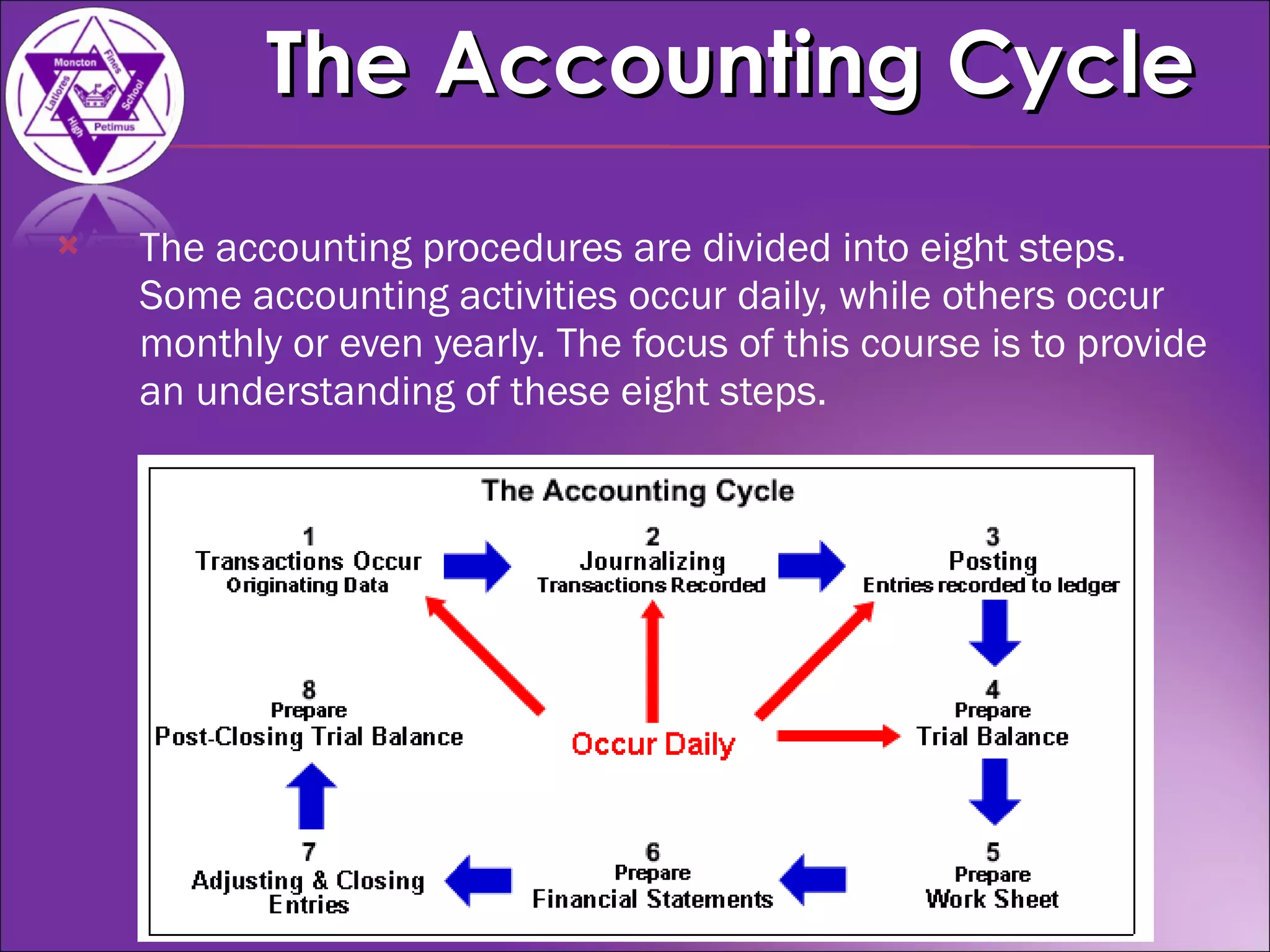
The accounting procedures are divided into eight steps. Some accounting activities occur daily, while others occur monthly or even yearly. The focus of this course is to provide an understanding of these eight steps.  The Accounting Cycle
There are numerous accounting jobs. Some are entry-level positions and may be learned through on-the-job training or through some degree of schooling. Other advanced accounting careers require extensive post-secondary education. An individual with an entry-level accounting position is often referred to as an a ccounting clerk  or a  bookkeeper . Duties are generally routine procedures but are essential to the successful operation of a business.  Accounting Careers
Some of the duties of an accounting clerk may include: Recording daily financial changes or events, such as a deposit to the bank or the sale of merchandise  Determining amounts and preparing payroll cheques  Providing financial information for other accounting clerks  Duties of Accounting Clerk
A higher-level professional accountant may be responsible for some or all of the following activities: Maintaining an entire accounting system  Supervising employees  Analyzing financial information  Preparing formal financial documents  Contributing to strategic planning  Evaluating, implementing and measuring the effectiveness of processes  Accounting Manager
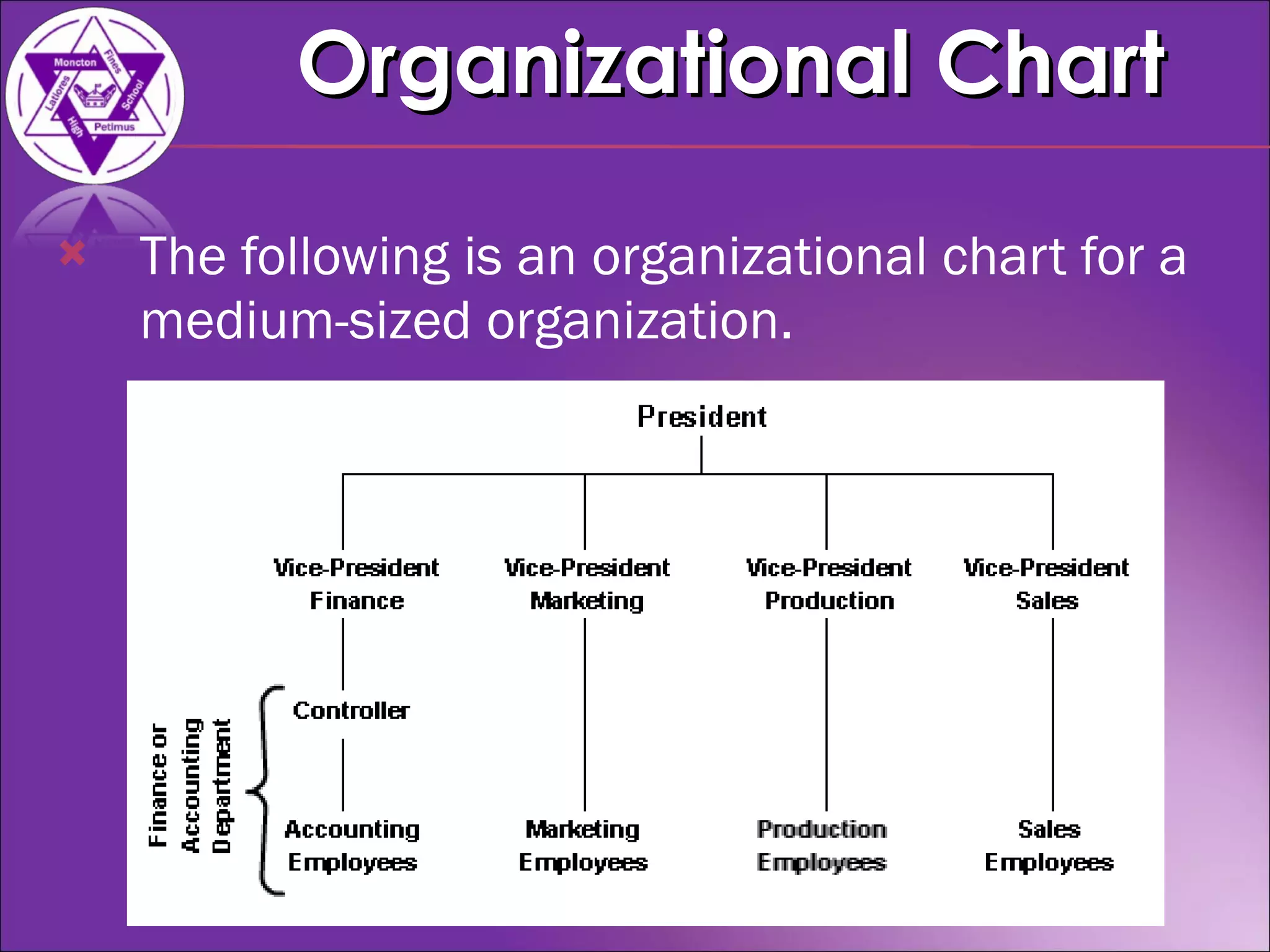
The following is an organizational chart for a medium-sized organization.  Organizational Chart
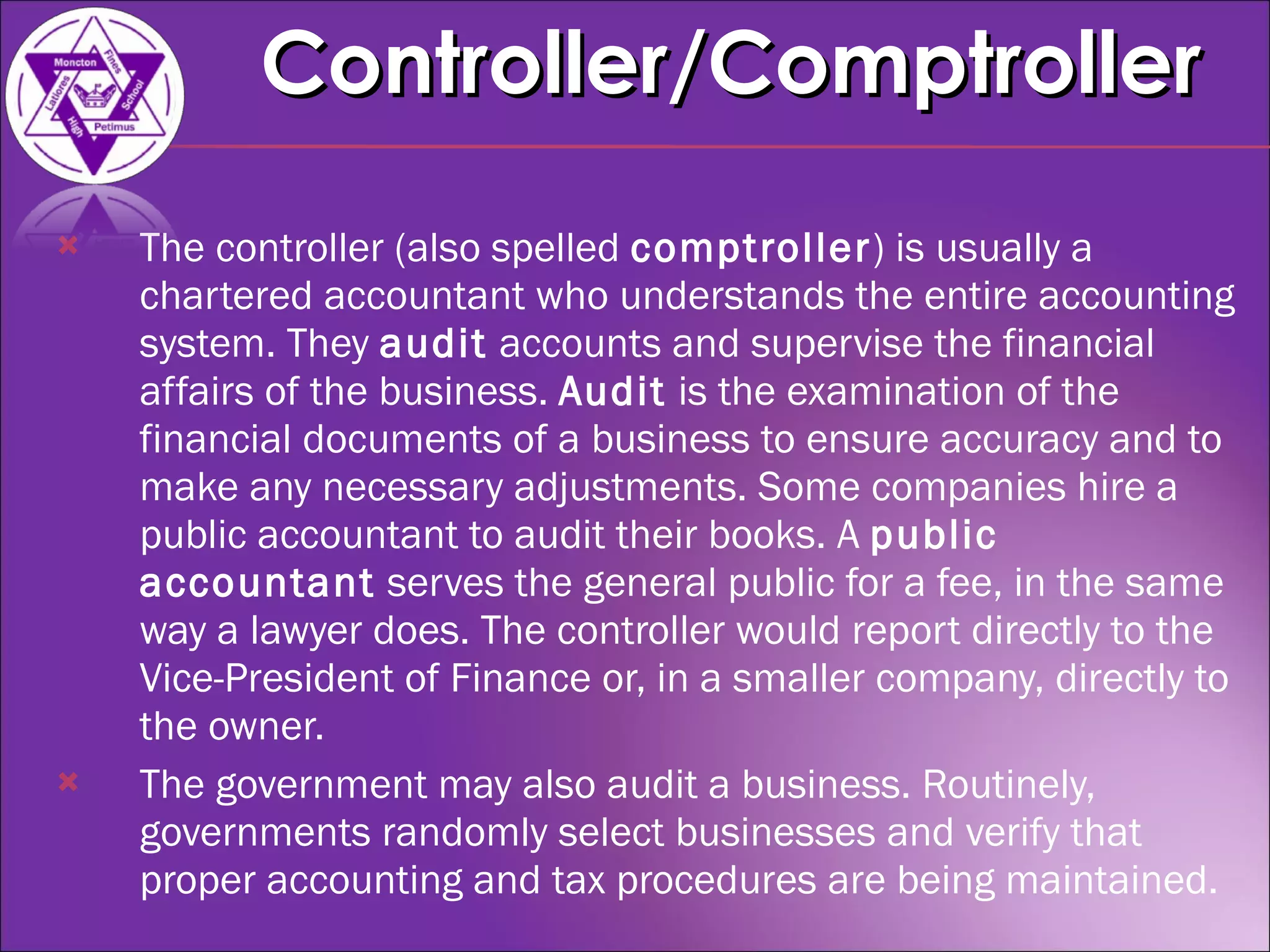
The controller (also spelled  comptroller ) is usually a chartered accountant who understands the entire accounting system. They  audit  accounts and supervise the financial affairs of the business.  Audit  is the examination of the financial documents of a business to ensure accuracy and to make any necessary adjustments. Some companies hire a public accountant to audit their books. A  public accountant  serves the general public for a fee, in the same way a lawyer does. The controller would report directly to the Vice-President of Finance or, in a smaller company, directly to the owner. The government may also audit a business. Routinely, governments randomly select businesses and verify that proper accounting and tax procedures are being maintained. Controller/Comptroller
Other Accounting Careers
Please complete all definitions and textbook questions for Chapter 1 on page 10. These will be do, at the latest on Monday, Feb 15 th . Enron response + scandal questions due (q. 1 & 2) by Friday, Feb 12 th   as well!) Please try to type up all answers and keep files on your U drive (ex: Chapter 1 Answers.doc) – this will be hugely beneficial when studying! Textbook Questions

Acct120 Class #6 The Accounting Cycle, Accounting Careers

  • 1.
    Introduction to Accounting120 Mr. Binet / Moncton High School Class #6: Accounting Cycle, Various Accounting Careers, Assignments
  • 2.
    We will brieflygo over the Accounting Cycle and Accounting Careers. We will have a chance to finish Chapter 1 Textbook Questions and the Enron/Accounting Scandal Questions In Today’s Class…
  • 3.
    Accounting procedures occurin a cycle, meaning the events are performed routinely during a business' fiscal period. Fiscal period is the interval of time for which financial change is measured. The normal fiscal period is equivalent to a calendar year but does not necessarily run from January through December. The fiscal period of a business begins on the first day of operation. This date then remains the first day of this business' fiscal period. The measurement of business activity over a specific period of time is necessary to determine growth and profitability. The Accounting Cycle
  • 4.
    The accounting proceduresare divided into eight steps. Some accounting activities occur daily, while others occur monthly or even yearly. The focus of this course is to provide an understanding of these eight steps. The Accounting Cycle
  • 5.
    There are numerousaccounting jobs. Some are entry-level positions and may be learned through on-the-job training or through some degree of schooling. Other advanced accounting careers require extensive post-secondary education. An individual with an entry-level accounting position is often referred to as an a ccounting clerk or a bookkeeper . Duties are generally routine procedures but are essential to the successful operation of a business. Accounting Careers
  • 6.
    Some of theduties of an accounting clerk may include: Recording daily financial changes or events, such as a deposit to the bank or the sale of merchandise Determining amounts and preparing payroll cheques Providing financial information for other accounting clerks Duties of Accounting Clerk
  • 7.
    A higher-level professionalaccountant may be responsible for some or all of the following activities: Maintaining an entire accounting system Supervising employees Analyzing financial information Preparing formal financial documents Contributing to strategic planning Evaluating, implementing and measuring the effectiveness of processes Accounting Manager
  • 8.
    The following isan organizational chart for a medium-sized organization. Organizational Chart
  • 9.
    The controller (alsospelled comptroller ) is usually a chartered accountant who understands the entire accounting system. They audit accounts and supervise the financial affairs of the business. Audit is the examination of the financial documents of a business to ensure accuracy and to make any necessary adjustments. Some companies hire a public accountant to audit their books. A public accountant serves the general public for a fee, in the same way a lawyer does. The controller would report directly to the Vice-President of Finance or, in a smaller company, directly to the owner. The government may also audit a business. Routinely, governments randomly select businesses and verify that proper accounting and tax procedures are being maintained. Controller/Comptroller
  • 10.
  • 11.
  • 12.
    Please complete alldefinitions and textbook questions for Chapter 1 on page 10. These will be do, at the latest on Monday, Feb 15 th . Enron response + scandal questions due (q. 1 & 2) by Friday, Feb 12 th as well!) Please try to type up all answers and keep files on your U drive (ex: Chapter 1 Answers.doc) – this will be hugely beneficial when studying! Textbook Questions