Toshiba Fraud!
A long way to go before Toshiba regains
market trust
Table of Content
 Fraud of Toshiba
 How they did Fraud?
 Why they did Fraud?
 Loss of that Fraud.
 How Toshiba regains market trust?
Fraud of Toshiba
 On July 21, 2015, Toshiba CEO Hisao Tanaka announced his resignation in the
face of an accounting scandal tied to about $1.2 billion in overstated operating
profits. Details of the scandal emerged the day before when an independent
investigative panel released a report describing the accounting improprieties in
detail.
Findings of the Investigative Report
 Investigators found direct evidence of inappropriate accounting practices and
overstated profits in multiple Toshiba business units, including the visual products
unit, the PC unit and the semiconductor unit. The accounting misconduct began
under CEO Atsutoshi Nishida in 2008 amid a global financial crisis that cut
deeply into Toshiba's profitability. It continued unabated under the next CEO,
Norio Sasaki, and eventually ended in scandal under Tanaka.
Independent panel of auditors and investigators found that in Toshiba International
the following illegals and unethical things were occurring:
 Booking future profits early
 Pushing back losses
 Pushing back charges
 Changing revenue and labilities side by side
How they did Fraud
Booking future profits early
 It is the act of putting revenue onto the books before it is actually earned. This
inflates net profit and artificially creates the illusion of improved revenue and
profits.
Pushing back losses
 The expense of one year is being settled in the Income statement of previous year
instead of the Fiscal year in which it is accrued to show the profit of the
organization which will directly attract the investors.
Pushing back charges
 A billing made to collect an expense incurred in a previous billing period. A back
charge may be an adjustment due to an error, or it may be to collect an expense
that was not billable until a later period due to timing issues
 When possible it is best to avoid having to back charge for products or services.
Because back charges may be unexpected by customers and can be confused
with billing errors, they often take longer to collect. In general, the more promptly
a company can bill a customer, the higher the probability of collecting the
amount billed in a timely manner.
Changing revenue and labilities side by side
 In this technique the unearned revenue is (a liability account) is converted into
revenue earned.
Why they did Fraud?
 Investigators describe how Toshiba's corporate leadership handed down strict
profit targets, known as Challenges, to business unit presidents, often with the
implication that failure would not be accepted. In some cases, quarterly
Challenges were handed down near the end of the quarter when there was no
time left to materially affect unit performance. It soon became clear within
individual business units that the only way to achieve these Challenges was to do
so through the use of irregular accounting techniques.
Why they did Fraud?
 The investigative panel concluded that Toshiba's corporate culture, which
demanded obedience to superiors, was an important factor enabling the
emergence of fraudulent accounting practices. The culture operated on the level
of business unit presidents and on every level of authority down the chain to the
accountants who ultimately employed the accounting techniques.
Loss of that Fraud.
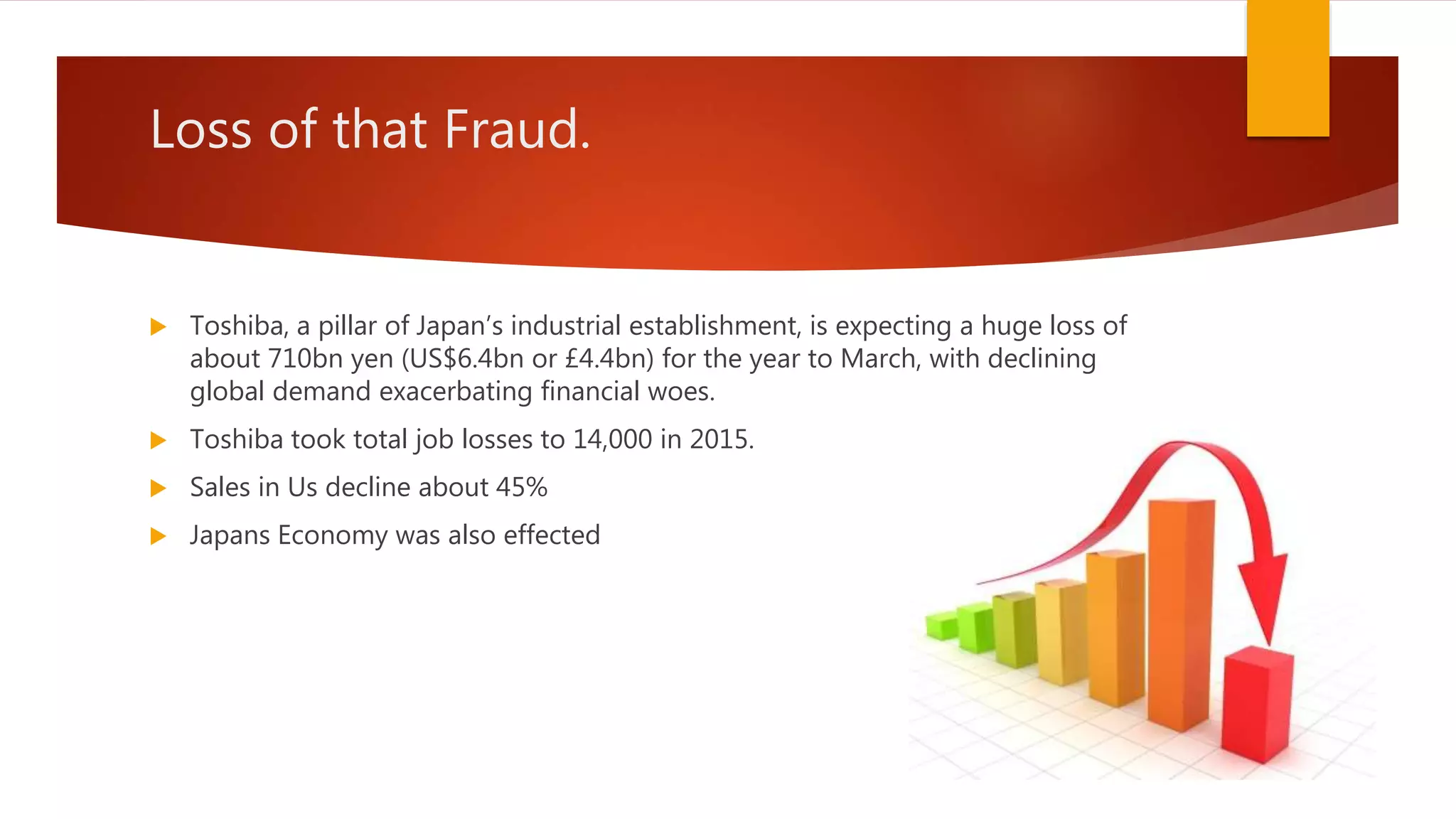
 Toshiba, a pillar of Japan’s industrial establishment, is expecting a huge loss of
about 710bn yen (US$6.4bn or £4.4bn) for the year to March, with declining
global demand exacerbating financial woes.
 Toshiba took total job losses to 14,000 in 2015.
 Sales in Us decline about 45%
 Japans Economy was also effected
How Toshiba regains market trust?
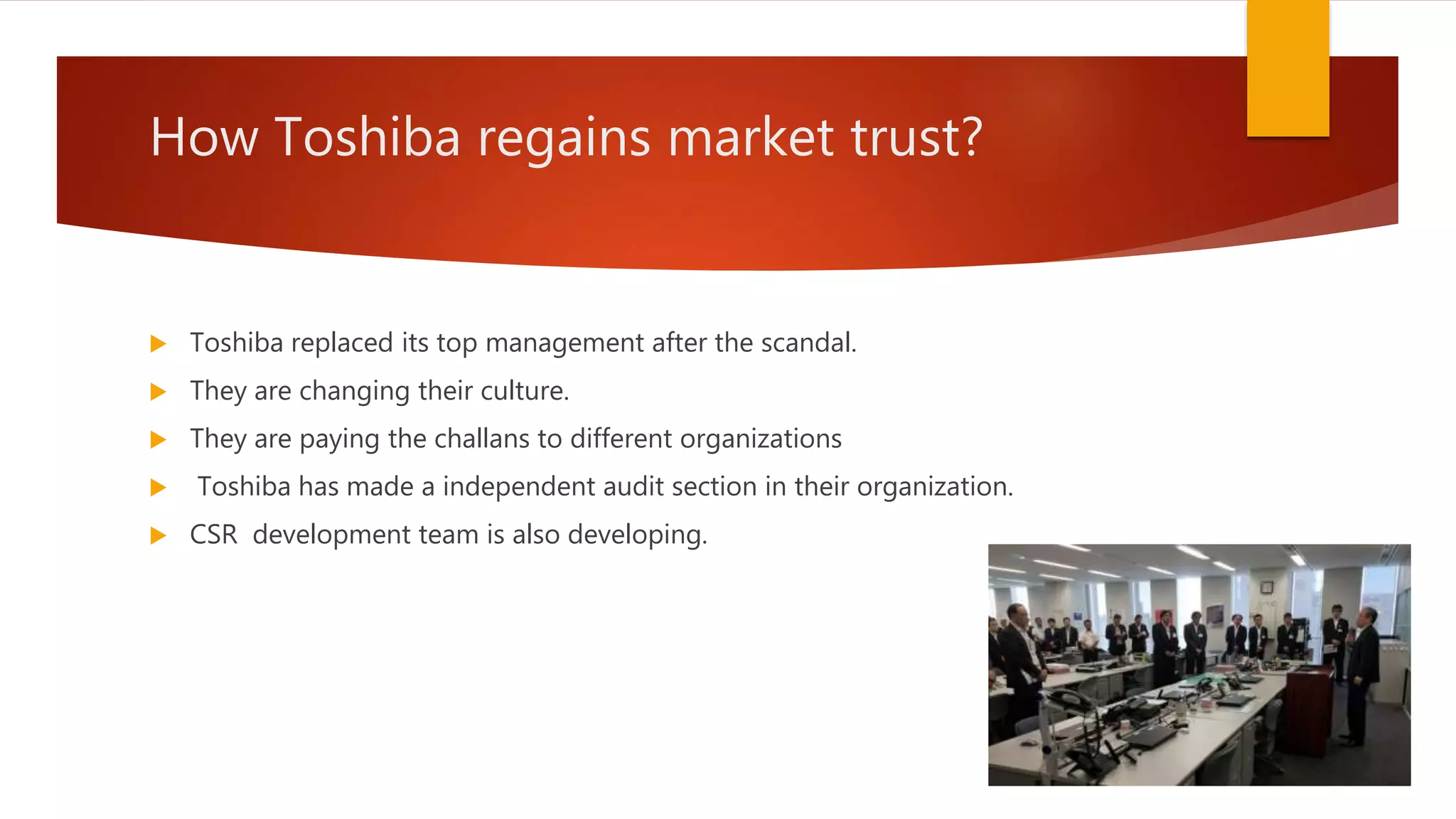
 Toshiba replaced its top management after the scandal.
 They are changing their culture.
 They are paying the challans to different organizations
 Toshiba has made a independent audit section in their organization.
 CSR development team is also developing.
Thank You

Toshiba Fraud!

  • 2.
    Toshiba Fraud! A longway to go before Toshiba regains market trust
  • 3.
    Table of Content Fraud of Toshiba  How they did Fraud?  Why they did Fraud?  Loss of that Fraud.  How Toshiba regains market trust?
  • 4.
    Fraud of Toshiba On July 21, 2015, Toshiba CEO Hisao Tanaka announced his resignation in the face of an accounting scandal tied to about $1.2 billion in overstated operating profits. Details of the scandal emerged the day before when an independent investigative panel released a report describing the accounting improprieties in detail.
  • 5.
    Findings of theInvestigative Report  Investigators found direct evidence of inappropriate accounting practices and overstated profits in multiple Toshiba business units, including the visual products unit, the PC unit and the semiconductor unit. The accounting misconduct began under CEO Atsutoshi Nishida in 2008 amid a global financial crisis that cut deeply into Toshiba's profitability. It continued unabated under the next CEO, Norio Sasaki, and eventually ended in scandal under Tanaka.
  • 6.
    Independent panel ofauditors and investigators found that in Toshiba International the following illegals and unethical things were occurring:  Booking future profits early  Pushing back losses  Pushing back charges  Changing revenue and labilities side by side How they did Fraud
  • 7.
    Booking future profitsearly  It is the act of putting revenue onto the books before it is actually earned. This inflates net profit and artificially creates the illusion of improved revenue and profits.
  • 8.
    Pushing back losses The expense of one year is being settled in the Income statement of previous year instead of the Fiscal year in which it is accrued to show the profit of the organization which will directly attract the investors.
  • 9.
    Pushing back charges A billing made to collect an expense incurred in a previous billing period. A back charge may be an adjustment due to an error, or it may be to collect an expense that was not billable until a later period due to timing issues  When possible it is best to avoid having to back charge for products or services. Because back charges may be unexpected by customers and can be confused with billing errors, they often take longer to collect. In general, the more promptly a company can bill a customer, the higher the probability of collecting the amount billed in a timely manner.
  • 10.
    Changing revenue andlabilities side by side  In this technique the unearned revenue is (a liability account) is converted into revenue earned.
  • 11.
    Why they didFraud?  Investigators describe how Toshiba's corporate leadership handed down strict profit targets, known as Challenges, to business unit presidents, often with the implication that failure would not be accepted. In some cases, quarterly Challenges were handed down near the end of the quarter when there was no time left to materially affect unit performance. It soon became clear within individual business units that the only way to achieve these Challenges was to do so through the use of irregular accounting techniques.
  • 12.
    Why they didFraud?  The investigative panel concluded that Toshiba's corporate culture, which demanded obedience to superiors, was an important factor enabling the emergence of fraudulent accounting practices. The culture operated on the level of business unit presidents and on every level of authority down the chain to the accountants who ultimately employed the accounting techniques.
  • 13.
    Loss of thatFraud.  Toshiba, a pillar of Japan’s industrial establishment, is expecting a huge loss of about 710bn yen (US$6.4bn or £4.4bn) for the year to March, with declining global demand exacerbating financial woes.  Toshiba took total job losses to 14,000 in 2015.  Sales in Us decline about 45%  Japans Economy was also effected
  • 14.
    How Toshiba regainsmarket trust?  Toshiba replaced its top management after the scandal.  They are changing their culture.  They are paying the challans to different organizations  Toshiba has made a independent audit section in their organization.  CSR development team is also developing.
  • 15.