Downloaded 133 times
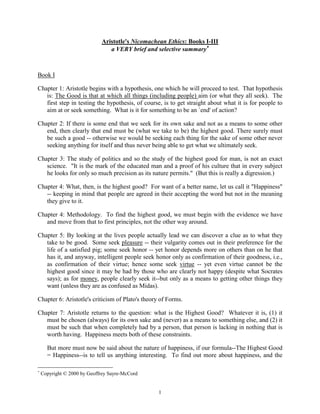
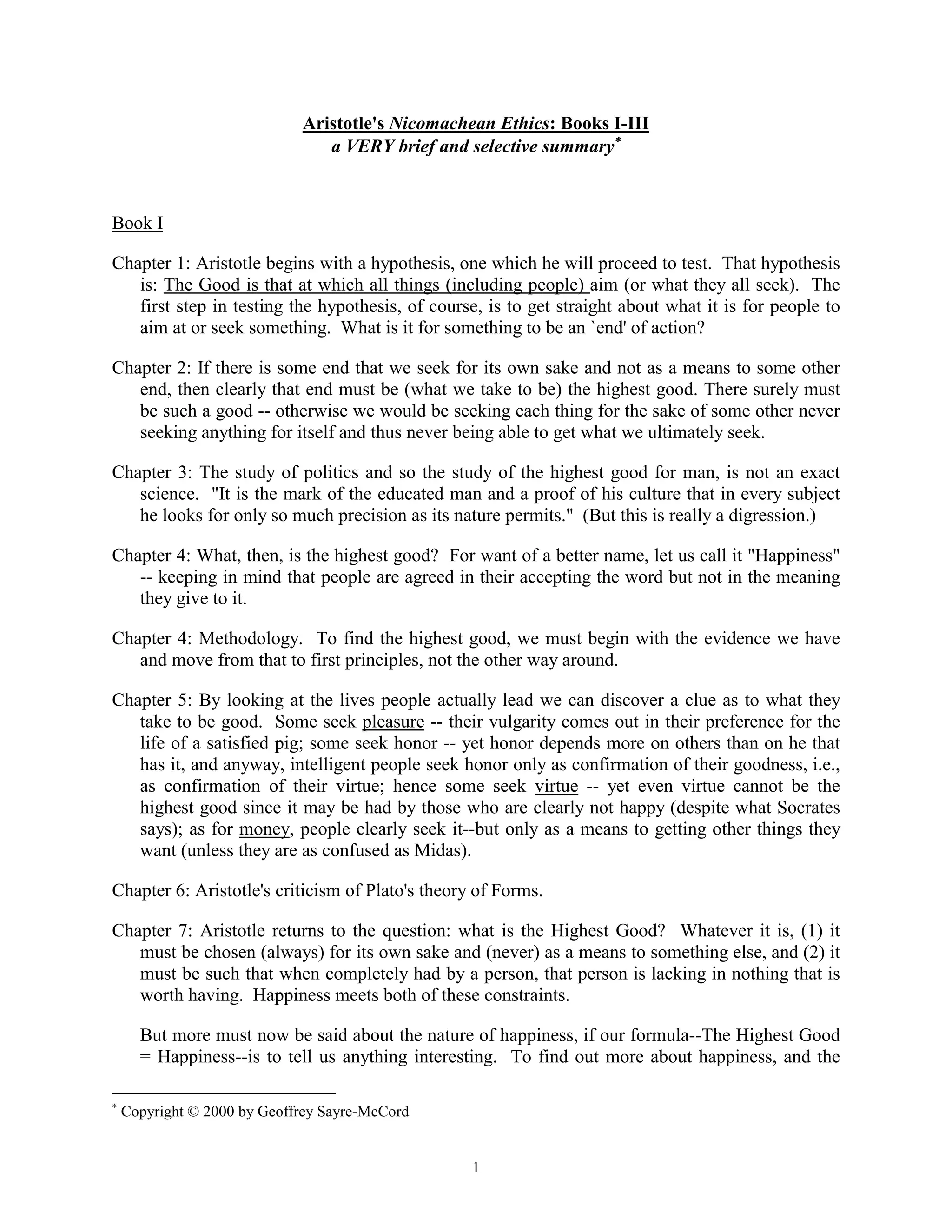
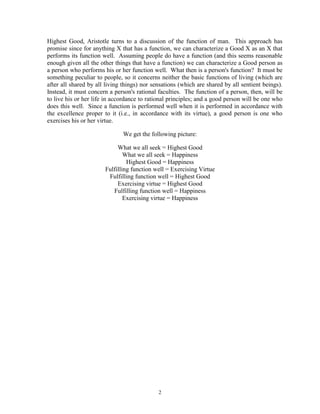
![3
Book II
Chapter 1: Intellectual virtue comes from learning, while moral virtue comes from habit. Hence
none of the moral virtues are implanted by nature, for what is implanted by nature cannot be
influenced by habit, whereas moral virtue can be. It is in the course of our dealings with our
companions that we become just or unjust. It is our behavior in a crisis and our habitual
reactions to danger that make us brave or cowardly. Since like activities produce
dispositions, "It is not unimportant, then, to acquire one sort of habit or another, right from
our youth. On the contrary, it is very important, indeed all-important." (1103a25)
Chapter 2: Keeping in mind that we should not require more exactness of ethics than its nature
allows, we may start with this observation: moral virtues are such that they are destroyed
both by deficiency and by excess. (Think of health, and how it is built by the right amount of
exercise -- neither too much nor too little.) Moral virtues are built by performing the actions
a virtuous person would. (It is by refraining from pleasure that we become temperate, and it
is in being temperate that we become most able to resist the lure of pleasure.)
Chapter 3: Virtue and Pleasure. The test of someone's having a particular virtue is whether he or
she takes pleasure in performing the virtuous action. (A person is temperate who abstaining
from bodily pleasures finds this abstinence itself pleasant.) Not only is the test of virtue the
taking of pleasure in its performance, pleasure (and pain) also have a great many other things
to do with virtue. For instance, (1) pleasure and pain often lead people astray, (2) the
performance of actions (virtuous or not) are accompanied (always, Aristotle says) by
pleasure or pain, (3) pain is a successful instrument of punishment. Conclusions of this
chapter: (i) virtue is concerned with pleasure and pain, (ii) the actions which produce virtue
are identical with those which increase it, (iii) differently performed these actions destroy
virtue, (iv) the actions which produced virtue are identical with those in which it finds its
expression.
Chapter 4: But how can one perform (say) a just action unless one is already just? Answer: we
must distinguish the performance of actions of a certain kind (e.g., just or temperate actions)
from the way in which they are performed. An action is truly virtuous only if three
conditions are met: (1) the agent must act in full consciousness of what she is doing; (2) she
must `will' her action, and will it for its own sake, and (3) the act must proceed from a fixed
and settled disposition. (Since we are especially concerned with being moral, and not just
with knowing about it, it is the second two conditions that are the most important.) [Note a
different problem: if a just action is defined in terms of what the just person would do, and a
just person is defined as s/he who from a settled disposition performs just actions, how are
we to avoid circularity?]
Chapter 5: The Formal Definition of Virtue: The Genus. The human soul has (i) emotions
(feelings), (ii) capacities, and (iii) states (i.e. characteristics or dispositions). Virtues are not
feelings, as we can tell from the fact that we are good or bad according to our virtues and
vices, but not according to our feelings; we are praised or blamed for our virtues and vices,
but not for our feelings alone (but only for having them in a particular way); our virtues and](https://image.slidesharecdn.com/nicomacheanethicsbyaristotlesummary-101024093134-phpapp01/85/Nicomachean-ethics-by-aristotle-summary-3-320.jpg)
![4
vices are expressions of our will, but feelings are not; and finally, we are said to be moved by
our feelings, whereas with regard to our virtues and vices we are said instead to be disposed
this way or that. Similar arguments show that virtues and vices are not capacities either.
Thus, virtues and vices must be states.
Chapter 6: The Formal Definition of Virtue; The Differentia. Excellence of whatever kind
affects that of which it is the excellence in two ways: the excellence (i.e. virtue) makes what
has it good-of-its-kind and it enables it to perform its function well. Hence virtue in a person
will be what makes that person a good person and what enables him or her to perform his or
her function well.
We must distinguish what is the mean relative to the object from what is the mean relative to
us. (6 is the mean between 2 and 10 relative to the object, but may not be relative to us; 10 is
a lot more relative to us than 2 is less relative to us.) With this said, we can define virtue as a
disposition of the soul in which, when it has to choose among actions and feelings, it
observes the mean relative to us (this being determined by such a rule or principle as would
take shape in the mind of a man of sense and practical wisdom). Of course, not all actions
admit of a mean relative to us -- consider malice, shamelessness, murder.
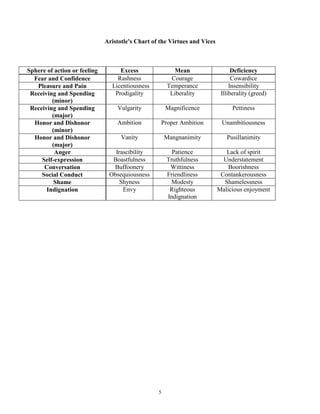
Chapter 7: The chart of the virtues. These have to do with feelings (fear and confidence,
pleasure and pain), with external goods (money in small amounts, money in large amounts,
honor and dishonor), and with social life (anger, truth-telling [pride], and humor). The
corresponding virtues are: bravery, temperance, generosity, magnificence, magnanimity,
mildness, truthfulness, wit, and friendliness.
Chapter 8: Keep in mind that the relevant mean is the mean relative to us. Unlike the mean in
the object, the mean relative to us is often very difficult to discover.
Chapter 9: Some practical guidance. Keep away from that extreme which is the more opposed to
the mean. Note the errors into which you personally are most liable to fall. Always be
particularly on your guard against the temptations of pleasure and pleasant things.](https://image.slidesharecdn.com/nicomacheanethicsbyaristotlesummary-101024093134-phpapp01/85/Nicomachean-ethics-by-aristotle-summary-4-320.jpg)
![6
Book III
Chapter 1: One of the conclusions of Book II is that virtue has to do with both feelings and (most
directly) with actions. Actions, though, may be divided into those that are voluntary (for
which people are praised and blamed) and those that are involuntary (for which people are
pardoned or pitied, and certainly not praised).
Actions that are not voluntary are those performed under (i) force [compulsion] or (ii)
ignorance (of a certain kind).
Although force makes an action not voluntary, threats and offers do not -- even though they
may turn what would otherwise seem an involuntary of action into a voluntary one (under the
circumstances). We may define an action done under force as one that is caused from the
outside and to which the agent contributes nothing. Pleasant things, while external to us and
in a sense often the cause of our actions, are nonetheless not the sort of things that can render
an action not voluntary; for an action forced, and done unwillingly, is an action that we find
painful.
While many kinds of ignorance may make an action not voluntary, not all ignorance will
make an action involuntary. For instance, those actions done in ignorance that bring no
regret in their wake are not actions done involuntarily (for they bring no pain), although they
are not done voluntarily. Also, action done in ignorance (say, by a person who is willingly
drunk) but not caused by ignorance will not for that reason be involuntary. Even so, some
ignorance does make an action not voluntary -- action caused by ignorance of particulars (as
opposed to ignorance of universals, for which we are blamed). There are at least six kinds of
particulars of which one might be ignorant. They are: (1) who is acting, (2) what is being
done, (3) what it is being done to, (4) what the instrument of the action is, (5) what the
consequences of the action are, and (6) what the manner of the action is. While ignorance of
any of these kinds of particulars can make an action involuntary, even they will do so only if
after the action the agent feels regret for what has happened. Otherwise such ignorance
merely renders the action not voluntary.
A voluntary action, then, is one that finds its origin in the agent when the agent is acting
without ignorance of particulars.
Chapter 2: With the definition of voluntary action in hand, we turn now to figuring out the nature
of decision [or choice as it is sometimes translated] for it is decision that is the most reliable
guide to the nature of one's character.
All acts decided upon are voluntary, but not all voluntary acts are the result of decision --
after all, animals and even the youngest of children often act voluntarily, but they do not
make decisions.](https://image.slidesharecdn.com/nicomacheanethicsbyaristotlesummary-101024093134-phpapp01/85/Nicomachean-ethics-by-aristotle-summary-6-320.jpg)
![7
What is it to make a decision? It is not: an appetite, or emotion, or wish, or even some sort of
belief.
Not appetite: for appetite is shared with animals, while decision is not. Similarly for
emotion.
Not wish: for we can wish for the impossible but we cannot choose to do the impossible.
Not a belief in general: for we can have beliefs about anything, while we cannot decide just
anything.
Not a specific kind of belief: for decisions have effects and are praised and blamed in ways
beliefs do not and are not.
What is it to make a decision? It is to voluntarily perform an action that is preceded by
deliberation.
Chapter 3: To understand decision, then, we must understand deliberation. First of all,
deliberation can only be about that which we think we can influence through our actions.
And, second of all, deliberation is always of means to ends (which themselves are not
deliberated about except to the extent that they themselves are means to some further end).
“…we lay down the end, and then examine the ways and means to achieve it.” (Another
translation: "We take the end for granted, and then consider in what manner and by what
means it can be realized.") [1112b 15]
Chapter 4: We decide on the means and wish for the end. Thinking back to Aristotle's claim that
what we all seek is the good (and ultimately the highest good) we may ask: Do we wish for
what is really good or only for what seems (to us) to be good? Well, both: “without
qualification and in reality, what is wished is the good, but for each person what is wished is
the apparent good” (Another translation: "in an unqualified sense and from the standpoint of
truth the object of wish is the good, but ...for each individual it is whatever seems good to
him.") [1113a 20].
Chapter 5: According to Aristotle we are responsible for whether we are virtuous or not, for
virtues (and vices) find their expression in our voluntary actions: “But if doing,, and likewise
not doing, fine or shameful actions is up to us, and if, as we saw, [doing or not doing them] is
[what it is] to be a good or bad person, being decent or base is up to us.” (Another
translation: "it depends on us whether we are decent or worthless individuals.") [1113b 10].
This conclusion finds support in our legal system, which punishes evil-doers (unless they
have acted under constraint or in ignorance when they themselves are not responsible for that
constraint or ignorance).
One might object that people should not be held responsible for their voluntary actions
because being negligent or evil may be part of their character. But that is no excuse; a person
is responsible, Aristotle holds, for his or her character as well as for the particular actions to
which the character gives rise. This is because a person's character is the result of his or her
voluntary actions. “…he is himself responsible for becoming this sort of person, because he
has lived carelessly. Similarly, an individual is responsible for being unjust, because he has](https://image.slidesharecdn.com/nicomacheanethicsbyaristotlesummary-101024093134-phpapp01/85/Nicomachean-ethics-by-aristotle-summary-7-320.jpg)
![8
cheated, and for being intemperate, because he has passed his time in drinking and the like;
for each type of activity produces the corresponding sort of person.” (Another translation: "A
man is himself responsible for becoming careless, because he lives in a loose and carefree
manner; he is likewise responsible for being unjust or self-indulgent... For a given kind of
activity produces a corresponding character.") [1114a 5].
Although an unjust person has become so voluntarily (because his or her unjust character is
the result of voluntary actions), he or she may no longer be able to change. “the person who
is [now] unjust or intemperate was originally free not to acquire this character, so that he has
it willingly, though once he has acquired the character, he is no longer free not to have it
[now].” (Another translation:"...since an unjust or a self-indulgent man initially had the
possibility not to become unjust or self-indulgent, he has acquired these traits voluntarily; but
one he has acquired them it is no longer possible for him not to be what he is.") [1114a 20].
Given Aristotle's theory of how actions are determined by ends that are not of our own
choosing (although they are of course our ends), there is another argument one might offer
for thinking people are not responsible for their actions: “everyone aims at the apparent good,
and does not control how it appears.” (Another translation: "All men seek what appears good
to them, but they have no control over how things appear to them.") [1114a 30]. In response,
Aristotle argues that “we are ourselves in a way jointly responsible for our states of character,
and the sort of character we have determines the sort of end we lay down. Hence the vices
will also be voluntary, since the same is true of them.” (Another translation: "we share in
some way the responsibility for our own characteristics and because the ends we set up for
ourselves are determined by the kind of persons we are, it follows that the vices, too, are
voluntary; for the same is true of them.") [1114b 25].](https://image.slidesharecdn.com/nicomacheanethicsbyaristotlesummary-101024093134-phpapp01/85/Nicomachean-ethics-by-aristotle-summary-8-320.jpg)

1) Aristotle begins his Nicomachean Ethics by hypothesizing that all people aim for the highest good or happiness. He aims to test this hypothesis by examining human action and determining what constitutes the highest good. 2) Aristotle analyzes different conceptions of the good life, such as a life of pleasure or honor. He determines that virtue must be the highest good since it alone is good in itself. 3) Aristotle defines virtue as a mean between deficiencies and excesses of emotions and actions. He provides a chart of intellectual and moral virtues. Developing virtue requires habituating good actions and avoiding deficiency and excess.


![Ethical theories[1]](https://cdn.slidesharecdn.com/ss_thumbnails/ethicaltheories1-150205060146-conversion-gate01-thumbnail.jpg?width=640&height=640&fit=bounds)


