PROGRAMMING
IF STATEMENTS &
RELATIONAL
OPERATORS
By: John Paul Espino
De La Salle University – Dasmarinas
Facebook.com/Johnpaul.dss
CONDITIONAL STATEMENTS
• A conditional statement allows us to control whether a program segment is executed or not.
• Two constructs
• if statement
• if
• if-else
• if-else-if
• switch statement
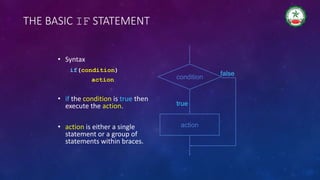
THE BASIC IF STATEMENT
• Syntax
if(condition)
action
• if the condition is true then
execute the action.
• action is either a single
statement or a group of
statements within braces.
condition
action
true
false
CHOICE (IF)
 Put multiple action statements
within braces
if (it's raining){
printf(“take umbrella”);
printf(“wear raincoat”);
}
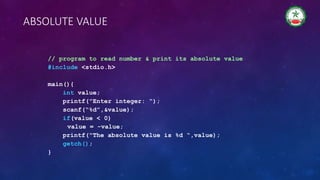
ABSOLUTE VALUE
// program to read number & print its absolute value
#include <stdio.h>
main(){
int value;
printf("Enter integer: “);
scanf(“%d”,&value);
if(value < 0)
value = -value;
printf("The absolute value is %d “,value);
getch();
}
RELATIONAL OPERATORS
Relational operators are used to compare two values to form a
condition.
Math C Plain English
= == equals [example: if(a==b) ]
[ (a=b) means put the value of b into a ]
< < less than
 <= less than or equal to
> > greater than
 >= greater than or equal to
 != not equal to
CONDITIONS
Examples:
Number_of_Students < 200
10 > 20
20 * j == 10 + i
THE BOOLEAN TYPE
• C contains a type named bool for conditions.
• A condition can have one of two values:
• true (corresponds to a non-zero value)
• false (corresponds to zero value)
• Boolean operators can be used to form more complex conditional
expressions.
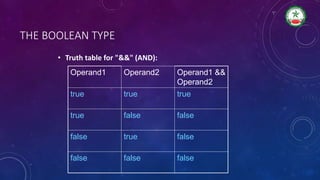
• The and operator is &&
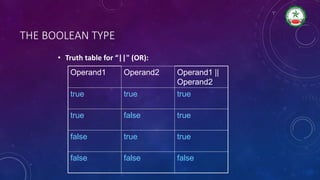
• The or operator is ||
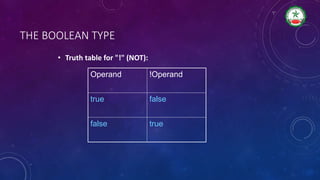
• The not operator is !
THE BOOLEAN TYPE
• Truth table for "&&" (AND):
Operand1 Operand2 Operand1 &&
Operand2
true true true
true false false
false true false
false false false
THE BOOLEAN TYPE
• Truth table for “||" (OR):
Operand1 Operand2 Operand1 ||
Operand2
true true true
true false true
false true true
false false false
THE BOOLEAN TYPE
• Truth table for "!" (NOT):
Operand !Operand
true false
false true
A BOOLEAN TYPE
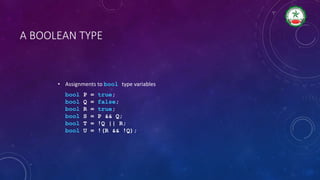
• Assignments to bool type variables
bool P = true;
bool Q = false;
bool R = true;
bool S = P && Q;
bool T = !Q || R;
bool U = !(R && !Q);
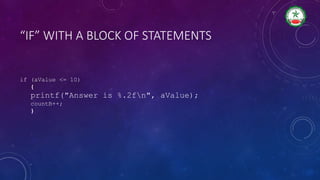
“IF” WITH A BLOCK OF STATEMENTS
if (aValue <= 10)
{
printf("Answer is %.2fn", aValue);
countB++;
}
POSITIVE OR NEGATIVE
#include <stdio.h>
main()
{
int number;
clrscr();
printf(“Enter a number”);
scanf(“%d”,&number);
if (number>0)
printf(“It is Positive”);
getch();
}
IF-ELSE STATEMENT
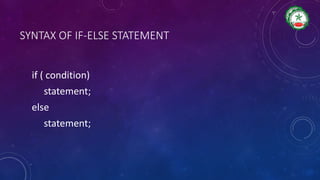
SYNTAX OF IF-ELSE STATEMENT
if ( condition)
statement;
else
statement;
IF – ELSE WITH A BLOCK OF STATEMENTS
if (aValue <= 10)
{
printf("Answer is %.2fn", aValue);
countB++;
} End if
else
{
printf("Error occurredn");
countC++;
} End else
TO VOTE OR NOT TO VOTE
#include<stdio.h>
main()
{
int age;
clrscr();
printf(“Enter your age”);
scanf(“%d”,&age);
if (age>=18)
printf(“You are qualified to vote”);
else
printf(“Not qualified to vote”);
getch();
}
POSITIVE OR NEGATIVE
#include <stdio.h>
main()
{
int number;
clrscr();
printf(“Enter a number”);
scanf(“%d”,&number);
if (number>0)
printf(“Positive number”);
else
printf(“Negative number”);
getch();
}

Computer Programming - if Statements & Relational Operators

  • 1.
    PROGRAMMING IF STATEMENTS & RELATIONAL OPERATORS By:John Paul Espino De La Salle University – Dasmarinas Facebook.com/Johnpaul.dss
  • 3.
    CONDITIONAL STATEMENTS • Aconditional statement allows us to control whether a program segment is executed or not. • Two constructs • if statement • if • if-else • if-else-if • switch statement
  • 4.
    THE BASIC IFSTATEMENT • Syntax if(condition) action • if the condition is true then execute the action. • action is either a single statement or a group of statements within braces. condition action true false
  • 5.
    CHOICE (IF)  Putmultiple action statements within braces if (it's raining){ printf(“take umbrella”); printf(“wear raincoat”); }
  • 6.
    ABSOLUTE VALUE // programto read number & print its absolute value #include <stdio.h> main(){ int value; printf("Enter integer: “); scanf(“%d”,&value); if(value < 0) value = -value; printf("The absolute value is %d “,value); getch(); }
  • 7.
    RELATIONAL OPERATORS Relational operatorsare used to compare two values to form a condition. Math C Plain English = == equals [example: if(a==b) ] [ (a=b) means put the value of b into a ] < < less than  <= less than or equal to > > greater than  >= greater than or equal to  != not equal to
  • 8.
  • 9.
    THE BOOLEAN TYPE •C contains a type named bool for conditions. • A condition can have one of two values: • true (corresponds to a non-zero value) • false (corresponds to zero value) • Boolean operators can be used to form more complex conditional expressions. • The and operator is && • The or operator is || • The not operator is !
  • 10.
    THE BOOLEAN TYPE •Truth table for "&&" (AND): Operand1 Operand2 Operand1 && Operand2 true true true true false false false true false false false false
  • 11.
    THE BOOLEAN TYPE •Truth table for “||" (OR): Operand1 Operand2 Operand1 || Operand2 true true true true false true false true true false false false
  • 12.
    THE BOOLEAN TYPE •Truth table for "!" (NOT): Operand !Operand true false false true
  • 13.
    A BOOLEAN TYPE •Assignments to bool type variables bool P = true; bool Q = false; bool R = true; bool S = P && Q; bool T = !Q || R; bool U = !(R && !Q);
  • 14.
    “IF” WITH ABLOCK OF STATEMENTS if (aValue <= 10) { printf("Answer is %.2fn", aValue); countB++; }
  • 15.
    POSITIVE OR NEGATIVE #include<stdio.h> main() { int number; clrscr(); printf(“Enter a number”); scanf(“%d”,&number); if (number>0) printf(“It is Positive”); getch(); }
  • 16.
  • 17.
    SYNTAX OF IF-ELSESTATEMENT if ( condition) statement; else statement;
  • 18.
    IF – ELSEWITH A BLOCK OF STATEMENTS if (aValue <= 10) { printf("Answer is %.2fn", aValue); countB++; } End if else { printf("Error occurredn"); countC++; } End else
  • 19.
    TO VOTE ORNOT TO VOTE #include<stdio.h> main() { int age; clrscr(); printf(“Enter your age”); scanf(“%d”,&age); if (age>=18) printf(“You are qualified to vote”); else printf(“Not qualified to vote”); getch(); }
  • 20.
    POSITIVE OR NEGATIVE #include<stdio.h> main() { int number; clrscr(); printf(“Enter a number”); scanf(“%d”,&number); if (number>0) printf(“Positive number”); else printf(“Negative number”); getch(); }