ETHICAL BAHAVIOUR 
Ethical behavior is a subset of human behavior. Human behaviour means the 
attitudes, disposition and actions, exhibited by a person in a particular 
circumstance. Ethical behaviour is human conduct that is guided by the moral 
principles of what is good or bad in a particular circumstance, 
Accountants are normally expected to behave ethically in the conduct of their 
professional works. Behaving ethically means that accountants are expected to 
comply with fundamental principles, standards, guidelines, rules and 
regulations stipulated by the professional institute (ICAN) as well as complying 
with the legal framework within their business environment. More 
importantly, the accountants are expected to desist from any misconduct that 
will bring the names of their institute and other members into disrepute. 
Generally, it is however important to note that, ethical behaviour of a person 
depends on the individual/personal influences and situational influences: 
INFLUENCES ON ETHICAL BEHAVIOUR/FACTORS AFFECTING 
BEHAVIOURS 
A. PERSONAL INFLUENCES 
There are various influences that shape individual ethical decision and 
behaviours, namely 
1. The Age and Gender: The age and gender of person are factors 
that may influence his/her ethical decision also studies have shown 
that women are more emotional on moral issues than men. However 
we must note that Kohlberg has shown in his ethical moral
development theory that age has low correlation with ascendance 
on ethical development level 
2. Family Influence: This defines what is right or wrong for an 
individual at early age in life. 
3. Educational Institution: As person passes through primary, 
secondary and tertiary institutions, he learned a lot and his ethical 
perception varied. This consequently has that has direct effect on his 
ethical decisions and behaviours. 
4. Religious Organs: Institution like church, churches, shrines 
attended by person influence their ethical behaviours through 
various religious indoctrinations and acceptance of their faiths. 
5. Peer Group : This includes the age mate, school mates, colleagues 
etc. that can influence a person’s ethical behavior through acceptable 
norms; failure to abide, he/she faces peer sanctions. 
6. Institution/Organization Affiliation: Organization/Institution to 
which are of affiliated define the acceptable and unacceptable 
behaviours and values. Some employing organizations have ethical 
codes for their employees. 
7. Culture and Tradition: The norms and values of the society indicate 
what is right and acceptable for people in the community. Otherwise, 
he/she faces social sanctions 
8. LAW: This defines what is legally right and wrong within a particular 
business environment which a person is under a duty to comply with; 
otherwise he/she faces legal sanctions.
B. SITUATIONAL INFLUENCES 
The situational influences explain why an individual manifest different 
ethical selfs in different situations. An individual ethical decision and 
behaviors changes with situations, this observation can be explained by 
a. Issues -related factors 
b. Context-related factors 
A. Issues related factors 
These are issues on the moral considerations and moral framing, such 
as: 
i. Magnitude of Consequences: The degree of harms or benefits 
that will result from a particular ethical decision. If either of the 
consequences is high, the ethical decision is significant and if low, 
it is not. 
ii. Social consequences The degree at which the society with 
accept or reject the ethical decision of a particular person(s). If 
either of the consequences is high, the ethical decision is 
significant and if low, it is not. 
iii. Proximity to those affected The closer or nearer the decision 
maker is close/related to those affected, the more significant the 
issues involved are. 
iv. Depthness/Degree of effect: Whether more people will be 
affected by the ethical decision it is significant; otherwise it 
insignificant.
v. Temporal Factor effect: If the effect of the ethical decision on 
the issue is immediate, it is significant but if such effect will be 
in future it is insignificant. 
i. Also –Moral Framing 
In work place, moral considerations of issues are usually based on 
corporate interest. Managers of business organizations usually 
avoid issues of morals while taking decision that promote corporate 
objectives. 
However, where the approach to moral dilemmas tends to the 
‘principles-based’ (i.e ethical words like integrity, honesty, fairness, 
etc are mentioned) then reframing moral decisions is inappropriate. 
There are no rules to follow, therefore ethics must be discussed 
and actions justified based on sound ethical judgment. 
B. Context related factor 
This explains how particular issues will be viewed within certain 
context. The context-related factors are: 
1. System or Reward 
Where rewards are based oh achievement (e.g. number of sales 
made) then ethical decision making may be affected. Unethical 
decision may also increase where unethical behaviour is 
unpunished or even supported by the organization. 
2. Authority 
Junior managers tend to follow instructions from senior 
managers. Where senior managers make unethical decisions
these are likely to be followed by juniors. Senior management 
may also provoke a climate where unethical decision making is 
accepted. 
Bureaucracy 
Bureaucracies tend to make employees follow rules rather than 
think about the ethics of decisions being made. More 
bureaucracy may therefore mean a lower level of ethical 
decision making — although this depends on authority — see 
above. 
Work Roles 
Managers tend to follow the ‘work role’ expected — hence an 
ethical role such as an accountant will normally find managers 
behaving ethically — because that is expected. In other roles 
where ethics are believed to be compromised regularly, 
managers will usually also behave less ethically. 
Organizational group norms and culture 
Managers tend to share the norms of the group they are in, so 
what may be described as unethical behaviour overall may be 
‘ethical’ for the group. E.g. A group may decide that copying 
work-related software at home is ‘ethical’ and therefore all 
members of the group participate in this behaviour. 
National and cultural context 
Different countries or cultures will have different ethics. 
Whether a decision is ethically correct or not may therefore 
depend on the specific culture.
CONSEQUENCES OF UNETHICAL BEHAVIOURS 
Consequences of unethical behaviours fall not only on the individual but also 
on the profession and the society at large. Unethical behaviours include: 
a. Any act or behaviour which is not in agreement with professional 
conduct 
b. Bahaviour outside the moral principles or ethics of a profession 
c. Any act which does not follows the norms of a profession. 
d. A bahaviour that negates the code of conduct guiding on operation 
e. Any attitude that is not in consonance with the accepted norms 
f. Conduct that is adjudged wrong, unbecoming and below expectation 
g. Behaviour that is not based on moral principles 
h. Deviation from standards and known norms 
i. Any act that is not normally right. 
See enforcement of ethical standards – P.79-80 of ICAN member book 
SANCTIONS FOR UNETHICAL BEHAVIOUR 
Sanction that are usually imposed on members for unethical behaviours are as 
follows 
(a) Reprimand/ Warning 
(b) Payment of cost 
(c) Fine 
(d) Withdrawal of practicing license 
(e) Suspension from Member List 
(f) Expulsion from Member List
DISADVANTAGE TO THE PROFESSIONAL INSTITUTE AND SOCIETY 
1. Ripple effect of unethical behaviours and sanction of that by family, 
business & economy. 
2. Negative consequence of the form stakeholders (creditors, supplier,etc. 
3. Economy suffer (loss of tax, income to workers, partnership, collapse, etc 
4. Negative effect on the professional and the institute 
5. Society at large suffer to consequences generally
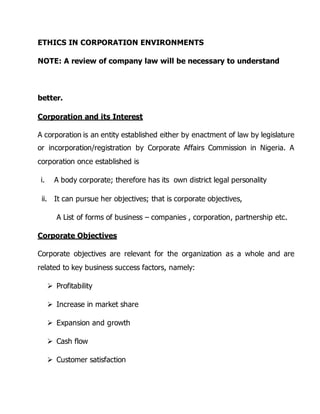
ETHICS IN CORPORATION ENVIRONMENTS 
NOTE: A review of company law will be necessary to understand 
better. 
Corporation and its Interest 
A corporation is an entity established either by enactment of law by legislature 
or incorporation/registration by Corporate Affairs Commission in Nigeria. A 
corporation once established is 
i. A body corporate; therefore has its own district legal personality 
ii. It can pursue her objectives; that is corporate objectives, 
A List of forms of business – companies , corporation, partnership etc. 
Corporate Objectives 
Corporate objectives are relevant for the organization as a whole and are 
related to key business success factors, namely: 
 Profitability 
 Increase in market share 
 Expansion and growth 
 Cash flow 
 Customer satisfaction
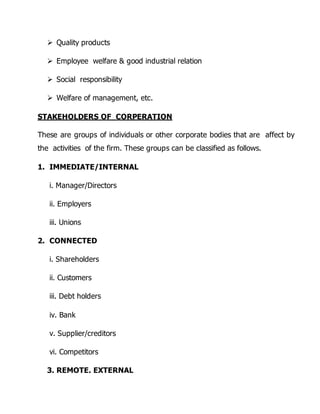
 Quality products 
 Employee welfare & good industrial relation 
 Social responsibility 
 Welfare of management, etc. 
STAKEHOLDERS OF CORPERATION 
These are groups of individuals or other corporate bodies that are affect by 
the activities of the firm. These groups can be classified as follows. 
1. IMMEDIATE/INTERNAL 
i. Manager/Directors 
ii. Employers 
iii. Unions 
2. CONNECTED 
i. Shareholders 
ii. Customers 
iii. Debt holders 
iv. Bank 
v. Supplier/creditors 
vi. Competitors 
3. REMOTE. EXTERNAL
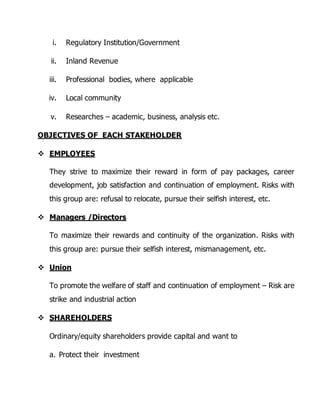
i. Regulatory Institution/Government 
ii. Inland Revenue 
iii. Professional bodies, where applicable 
iv. Local community 
v. Researches – academic, business, analysis etc. 
OBJECTIVES OF EACH STAKEHOLDER 
 EMPLOYEES 
They strive to maximize their reward in form of pay packages, career 
development, job satisfaction and continuation of employment. Risks with 
this group are: refusal to relocate, pursue their selfish interest, etc. 
 Managers /Directors 
To maximize their rewards and continuity of the organization. Risks with 
this group are: pursue their selfish interest, mismanagement, etc. 
 Union 
To promote the welfare of staff and continuation of employment – Risk are 
strike and industrial action 
 SHAREHOLDERS 
Ordinary/equity shareholders provide capital and want to 
a. Protect their investment
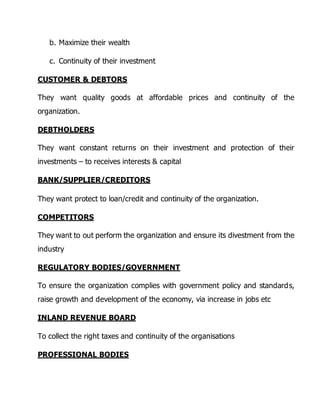
b. Maximize their wealth 
c. Continuity of their investment 
CUSTOMER & DEBTORS 
They want quality goods at affordable prices and continuity of the 
organization. 
DEBTHOLDERS 
They want constant returns on their investment and protection of their 
investments – to receives interests & capital 
BANK/SUPPLIER/CREDITORS 
They want protect to loan/credit and continuity of the organization. 
COMPETITORS 
They want to out perform the organization and ensure its divestment from the 
industry 
REGULATORY BODIES/GOVERNMENT 
To ensure the organization complies with government policy and standards, 
raise growth and development of the economy, via increase in jobs etc 
INLAND REVENUE BOARD 
To collect the right taxes and continuity of the organisations 
PROFESSIONAL BODIES
To ensure members complies with standards and ethical principles 
LOCAL COMMUNITY 
To ensure the organization is socially responsible to the people and her 
environment 
RESEARCHER 
To gain an increased knowledge and ensure the organization promotes the 
interest of her environment; both immediate and remote. 
INFLUENCE OF STAKEHOLDERS 
Each stakeholder can exert pressure on corporate objectives, strategy and 
operations. The greater the power of a particular stakeholders, the greater her 
influence on the corporate actions 
STAKEHOLDERS & CONFLICT & AGENCY 
Each stakeholder group have different objectives and expectations and these 
sometime conflict with one another. 
1. SHAREHOLDERS & MANAGEMENT 
Shareholders are the owners of the corporate entity but the management 
power are given to directors by law. Hence there exist conflict of interest 
between 
Entity Owners Management
1. Company Stakeholders Directors 
2. Government 
Parastatal Public Board appointed 
This separation of ownership & management creates agency problems. This is 
because directors may use their positions to reward themselves rather more 
than increase shareholders’ wealth 
AREAS MANIPULATION BY DIRECTORS 
1. By making efforts to increase the profit or share price in the short term 
in order to increase their rewards at the expense of long term benefits. 
2. By making efforts to increase sales/revenue to show artificial 
performance but without profits and there could be many debtors. 
3. By embarking on empire building- creating many offices with many 
staffs, this increase overhead & decrease profit 
4. By resisting good takeover bid beneficial to shareholders, because that 
will threaten their positions or lead to loss of their offices. 
5. By embarking on creative Accounting or window dressing 
ENCORAGING GOAL CONCURANCE BETWEEN DIRECTORS & 
SHAREHOLDERS 
i. By making performance related pay to the directors
ii. By rewarding management with shares especially when a private 
company goes public at an attractive offer price 
iii. By giving management share option: that to subscribe to no of company 
shares at fixed price in future. The vale of the option goes up if the 
shares prices of the company goes up 
iv. By providing Share qualification scheme for all directors 
2. SHAREHOLDER MANAGER & DEBTHOLDERS 
When Management raises funds from long term creditors that will 
increase the firm’s financial gearing - i.e the risk of its insolvency 
increases. The debt financé requires positive cash flow to meet firm’ s 
obligations of as they fall due; otherwise the securities they pledged, the 
restrictive covenants they signed or the manager- receivership 
agreement they signed will be invoked. 
However when there is enough cash flow, the shareholders and manager 
gain in form of the increase in dividends, retained profit and increase in 
director remunerations. 
CONFLICT AREAS BETWEEN MANAGEMENT/SHAREHOLDERS 
AND DEBT HOLDERS 
- Management may be interested in risky projects, using debt holders’ 
funds, where it succeeds they shareholders/directors gain more. Where 
otherwise they will all loss their investments.
- Prolong the life of the firm is the wish of the shareholders/managers, 
while debtors may wish to liquidate the firm for their return of their 
capital and interest. Managers may seek further loan and increase the 
company’s gearing and risk at the expenses of the debtholders and 
increase the operating leverage. 
- Even through, there are loans restrictions/convenants, the manager may 
pay high dividends to shareholders just to maintain/secure their 
appointments but at the expense of the debtholders interest. Whereas 
the company’s capital undermined/reduced. 
SHAREHOLDER MANAGERS & GOVERNMENDT 
Government may not have direct interest in corporate entities, but have 
strong interest in the company affairs as follows: 
i. Taxation; Tax on profit, VAT and Withholding Tax 
ii. Government funds/grants; Government provides funds/grants and 
give tax incentives in some priority sectors, 
iii. Wider Spread of members through privatizations and regulations of 
public companies 
iv. Legislation: Government may influence to relationship among 
stakeholder via legislation & regulation 
v. Economic Policy: Government economic Policy acting affect corporate 
interest i.e monetary fiscal policy affect interest rate inflation economic 
growth employment etc.

Ethical bahaviour and corporate ethics

  • 1.
    ETHICAL BAHAVIOUR Ethicalbehavior is a subset of human behavior. Human behaviour means the attitudes, disposition and actions, exhibited by a person in a particular circumstance. Ethical behaviour is human conduct that is guided by the moral principles of what is good or bad in a particular circumstance, Accountants are normally expected to behave ethically in the conduct of their professional works. Behaving ethically means that accountants are expected to comply with fundamental principles, standards, guidelines, rules and regulations stipulated by the professional institute (ICAN) as well as complying with the legal framework within their business environment. More importantly, the accountants are expected to desist from any misconduct that will bring the names of their institute and other members into disrepute. Generally, it is however important to note that, ethical behaviour of a person depends on the individual/personal influences and situational influences: INFLUENCES ON ETHICAL BEHAVIOUR/FACTORS AFFECTING BEHAVIOURS A. PERSONAL INFLUENCES There are various influences that shape individual ethical decision and behaviours, namely 1. The Age and Gender: The age and gender of person are factors that may influence his/her ethical decision also studies have shown that women are more emotional on moral issues than men. However we must note that Kohlberg has shown in his ethical moral
  • 2.
    development theory thatage has low correlation with ascendance on ethical development level 2. Family Influence: This defines what is right or wrong for an individual at early age in life. 3. Educational Institution: As person passes through primary, secondary and tertiary institutions, he learned a lot and his ethical perception varied. This consequently has that has direct effect on his ethical decisions and behaviours. 4. Religious Organs: Institution like church, churches, shrines attended by person influence their ethical behaviours through various religious indoctrinations and acceptance of their faiths. 5. Peer Group : This includes the age mate, school mates, colleagues etc. that can influence a person’s ethical behavior through acceptable norms; failure to abide, he/she faces peer sanctions. 6. Institution/Organization Affiliation: Organization/Institution to which are of affiliated define the acceptable and unacceptable behaviours and values. Some employing organizations have ethical codes for their employees. 7. Culture and Tradition: The norms and values of the society indicate what is right and acceptable for people in the community. Otherwise, he/she faces social sanctions 8. LAW: This defines what is legally right and wrong within a particular business environment which a person is under a duty to comply with; otherwise he/she faces legal sanctions.
  • 3.
    B. SITUATIONAL INFLUENCES The situational influences explain why an individual manifest different ethical selfs in different situations. An individual ethical decision and behaviors changes with situations, this observation can be explained by a. Issues -related factors b. Context-related factors A. Issues related factors These are issues on the moral considerations and moral framing, such as: i. Magnitude of Consequences: The degree of harms or benefits that will result from a particular ethical decision. If either of the consequences is high, the ethical decision is significant and if low, it is not. ii. Social consequences The degree at which the society with accept or reject the ethical decision of a particular person(s). If either of the consequences is high, the ethical decision is significant and if low, it is not. iii. Proximity to those affected The closer or nearer the decision maker is close/related to those affected, the more significant the issues involved are. iv. Depthness/Degree of effect: Whether more people will be affected by the ethical decision it is significant; otherwise it insignificant.
  • 4.
    v. Temporal Factoreffect: If the effect of the ethical decision on the issue is immediate, it is significant but if such effect will be in future it is insignificant. i. Also –Moral Framing In work place, moral considerations of issues are usually based on corporate interest. Managers of business organizations usually avoid issues of morals while taking decision that promote corporate objectives. However, where the approach to moral dilemmas tends to the ‘principles-based’ (i.e ethical words like integrity, honesty, fairness, etc are mentioned) then reframing moral decisions is inappropriate. There are no rules to follow, therefore ethics must be discussed and actions justified based on sound ethical judgment. B. Context related factor This explains how particular issues will be viewed within certain context. The context-related factors are: 1. System or Reward Where rewards are based oh achievement (e.g. number of sales made) then ethical decision making may be affected. Unethical decision may also increase where unethical behaviour is unpunished or even supported by the organization. 2. Authority Junior managers tend to follow instructions from senior managers. Where senior managers make unethical decisions
  • 5.
    these are likelyto be followed by juniors. Senior management may also provoke a climate where unethical decision making is accepted. Bureaucracy Bureaucracies tend to make employees follow rules rather than think about the ethics of decisions being made. More bureaucracy may therefore mean a lower level of ethical decision making — although this depends on authority — see above. Work Roles Managers tend to follow the ‘work role’ expected — hence an ethical role such as an accountant will normally find managers behaving ethically — because that is expected. In other roles where ethics are believed to be compromised regularly, managers will usually also behave less ethically. Organizational group norms and culture Managers tend to share the norms of the group they are in, so what may be described as unethical behaviour overall may be ‘ethical’ for the group. E.g. A group may decide that copying work-related software at home is ‘ethical’ and therefore all members of the group participate in this behaviour. National and cultural context Different countries or cultures will have different ethics. Whether a decision is ethically correct or not may therefore depend on the specific culture.
  • 6.
    CONSEQUENCES OF UNETHICALBEHAVIOURS Consequences of unethical behaviours fall not only on the individual but also on the profession and the society at large. Unethical behaviours include: a. Any act or behaviour which is not in agreement with professional conduct b. Bahaviour outside the moral principles or ethics of a profession c. Any act which does not follows the norms of a profession. d. A bahaviour that negates the code of conduct guiding on operation e. Any attitude that is not in consonance with the accepted norms f. Conduct that is adjudged wrong, unbecoming and below expectation g. Behaviour that is not based on moral principles h. Deviation from standards and known norms i. Any act that is not normally right. See enforcement of ethical standards – P.79-80 of ICAN member book SANCTIONS FOR UNETHICAL BEHAVIOUR Sanction that are usually imposed on members for unethical behaviours are as follows (a) Reprimand/ Warning (b) Payment of cost (c) Fine (d) Withdrawal of practicing license (e) Suspension from Member List (f) Expulsion from Member List
  • 7.
    DISADVANTAGE TO THEPROFESSIONAL INSTITUTE AND SOCIETY 1. Ripple effect of unethical behaviours and sanction of that by family, business & economy. 2. Negative consequence of the form stakeholders (creditors, supplier,etc. 3. Economy suffer (loss of tax, income to workers, partnership, collapse, etc 4. Negative effect on the professional and the institute 5. Society at large suffer to consequences generally
  • 8.
    ETHICS IN CORPORATIONENVIRONMENTS NOTE: A review of company law will be necessary to understand better. Corporation and its Interest A corporation is an entity established either by enactment of law by legislature or incorporation/registration by Corporate Affairs Commission in Nigeria. A corporation once established is i. A body corporate; therefore has its own district legal personality ii. It can pursue her objectives; that is corporate objectives, A List of forms of business – companies , corporation, partnership etc. Corporate Objectives Corporate objectives are relevant for the organization as a whole and are related to key business success factors, namely:  Profitability  Increase in market share  Expansion and growth  Cash flow  Customer satisfaction
  • 9.
     Quality products  Employee welfare & good industrial relation  Social responsibility  Welfare of management, etc. STAKEHOLDERS OF CORPERATION These are groups of individuals or other corporate bodies that are affect by the activities of the firm. These groups can be classified as follows. 1. IMMEDIATE/INTERNAL i. Manager/Directors ii. Employers iii. Unions 2. CONNECTED i. Shareholders ii. Customers iii. Debt holders iv. Bank v. Supplier/creditors vi. Competitors 3. REMOTE. EXTERNAL
  • 10.
    i. Regulatory Institution/Government ii. Inland Revenue iii. Professional bodies, where applicable iv. Local community v. Researches – academic, business, analysis etc. OBJECTIVES OF EACH STAKEHOLDER  EMPLOYEES They strive to maximize their reward in form of pay packages, career development, job satisfaction and continuation of employment. Risks with this group are: refusal to relocate, pursue their selfish interest, etc.  Managers /Directors To maximize their rewards and continuity of the organization. Risks with this group are: pursue their selfish interest, mismanagement, etc.  Union To promote the welfare of staff and continuation of employment – Risk are strike and industrial action  SHAREHOLDERS Ordinary/equity shareholders provide capital and want to a. Protect their investment
  • 11.
    b. Maximize theirwealth c. Continuity of their investment CUSTOMER & DEBTORS They want quality goods at affordable prices and continuity of the organization. DEBTHOLDERS They want constant returns on their investment and protection of their investments – to receives interests & capital BANK/SUPPLIER/CREDITORS They want protect to loan/credit and continuity of the organization. COMPETITORS They want to out perform the organization and ensure its divestment from the industry REGULATORY BODIES/GOVERNMENT To ensure the organization complies with government policy and standards, raise growth and development of the economy, via increase in jobs etc INLAND REVENUE BOARD To collect the right taxes and continuity of the organisations PROFESSIONAL BODIES
  • 12.
    To ensure memberscomplies with standards and ethical principles LOCAL COMMUNITY To ensure the organization is socially responsible to the people and her environment RESEARCHER To gain an increased knowledge and ensure the organization promotes the interest of her environment; both immediate and remote. INFLUENCE OF STAKEHOLDERS Each stakeholder can exert pressure on corporate objectives, strategy and operations. The greater the power of a particular stakeholders, the greater her influence on the corporate actions STAKEHOLDERS & CONFLICT & AGENCY Each stakeholder group have different objectives and expectations and these sometime conflict with one another. 1. SHAREHOLDERS & MANAGEMENT Shareholders are the owners of the corporate entity but the management power are given to directors by law. Hence there exist conflict of interest between Entity Owners Management
  • 13.
    1. Company StakeholdersDirectors 2. Government Parastatal Public Board appointed This separation of ownership & management creates agency problems. This is because directors may use their positions to reward themselves rather more than increase shareholders’ wealth AREAS MANIPULATION BY DIRECTORS 1. By making efforts to increase the profit or share price in the short term in order to increase their rewards at the expense of long term benefits. 2. By making efforts to increase sales/revenue to show artificial performance but without profits and there could be many debtors. 3. By embarking on empire building- creating many offices with many staffs, this increase overhead & decrease profit 4. By resisting good takeover bid beneficial to shareholders, because that will threaten their positions or lead to loss of their offices. 5. By embarking on creative Accounting or window dressing ENCORAGING GOAL CONCURANCE BETWEEN DIRECTORS & SHAREHOLDERS i. By making performance related pay to the directors
  • 14.
    ii. By rewardingmanagement with shares especially when a private company goes public at an attractive offer price iii. By giving management share option: that to subscribe to no of company shares at fixed price in future. The vale of the option goes up if the shares prices of the company goes up iv. By providing Share qualification scheme for all directors 2. SHAREHOLDER MANAGER & DEBTHOLDERS When Management raises funds from long term creditors that will increase the firm’s financial gearing - i.e the risk of its insolvency increases. The debt financé requires positive cash flow to meet firm’ s obligations of as they fall due; otherwise the securities they pledged, the restrictive covenants they signed or the manager- receivership agreement they signed will be invoked. However when there is enough cash flow, the shareholders and manager gain in form of the increase in dividends, retained profit and increase in director remunerations. CONFLICT AREAS BETWEEN MANAGEMENT/SHAREHOLDERS AND DEBT HOLDERS - Management may be interested in risky projects, using debt holders’ funds, where it succeeds they shareholders/directors gain more. Where otherwise they will all loss their investments.
  • 15.
    - Prolong thelife of the firm is the wish of the shareholders/managers, while debtors may wish to liquidate the firm for their return of their capital and interest. Managers may seek further loan and increase the company’s gearing and risk at the expenses of the debtholders and increase the operating leverage. - Even through, there are loans restrictions/convenants, the manager may pay high dividends to shareholders just to maintain/secure their appointments but at the expense of the debtholders interest. Whereas the company’s capital undermined/reduced. SHAREHOLDER MANAGERS & GOVERNMENDT Government may not have direct interest in corporate entities, but have strong interest in the company affairs as follows: i. Taxation; Tax on profit, VAT and Withholding Tax ii. Government funds/grants; Government provides funds/grants and give tax incentives in some priority sectors, iii. Wider Spread of members through privatizations and regulations of public companies iv. Legislation: Government may influence to relationship among stakeholder via legislation & regulation v. Economic Policy: Government economic Policy acting affect corporate interest i.e monetary fiscal policy affect interest rate inflation economic growth employment etc.