Business Ethics
III Sem B.Com
Prepared by:
Veena R
Assistant Professor
UNIT 1
Business Ethics
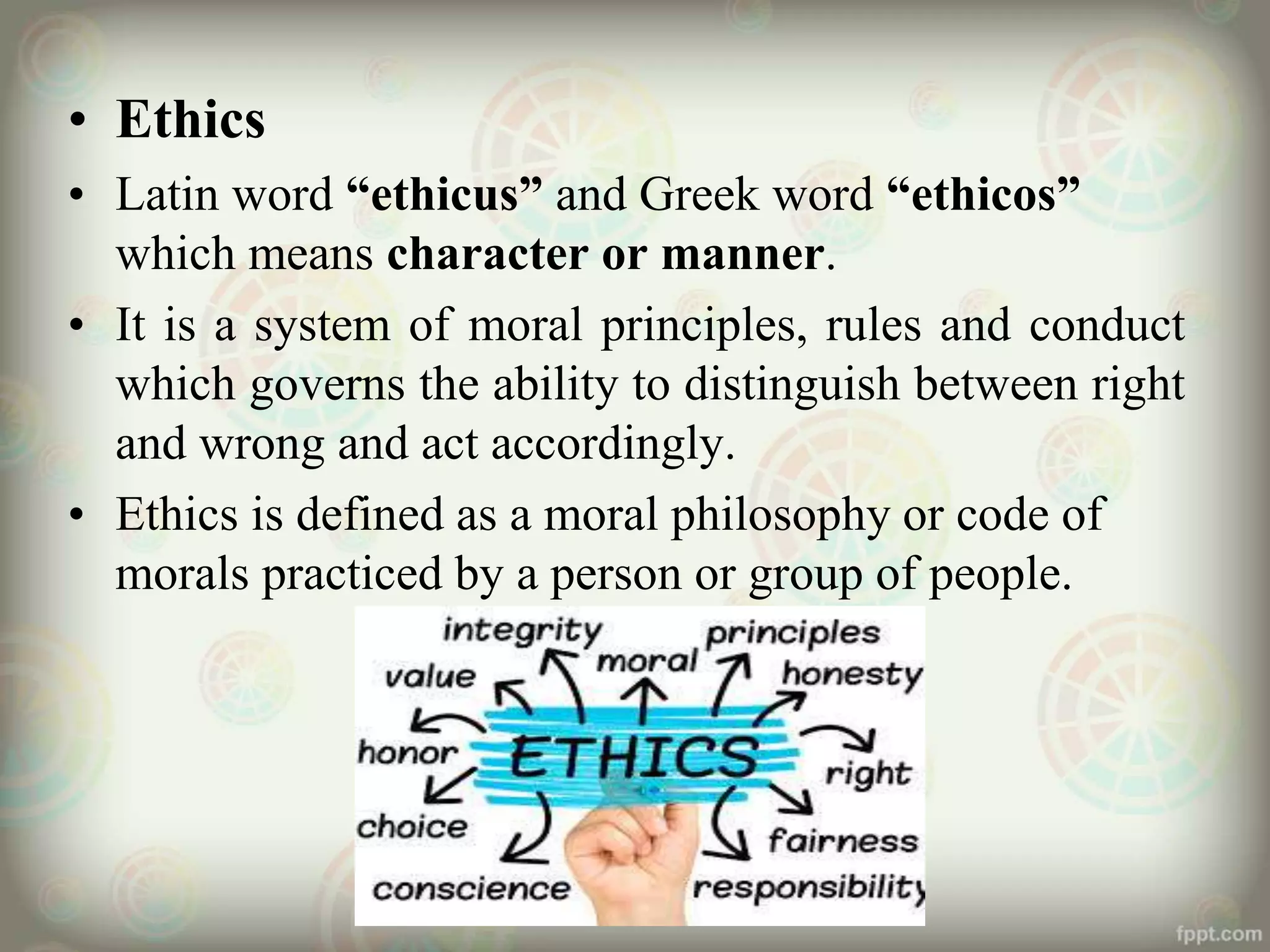
• Ethics
• Latin word “ethicus” and Greek word “ethicos”
which means character or manner.
• It is a system of moral principles, rules and conduct
which governs the ability to distinguish between right
and wrong and act accordingly.
• Ethics is defined as a moral philosophy or code of
morals practiced by a person or group of people.
Nature of ethics
• Ethics is the study of human conduct
• Ethics is a science
• Ethics is not an art.
• Ethics is a branch of philosophy and moral
philosophy
• Ethics is derived from religions, philosophies
and culture
Business Ethics
• Business ethics can be defined as written and
unwritten codes of principles and values that govern
decisions and actions within a company.
• Definition of business ethics
• According to ICAI-The principles and standards that
determine acceptable conduct in business
organization.
• It is an application of general ethical rules to business
behaviour.
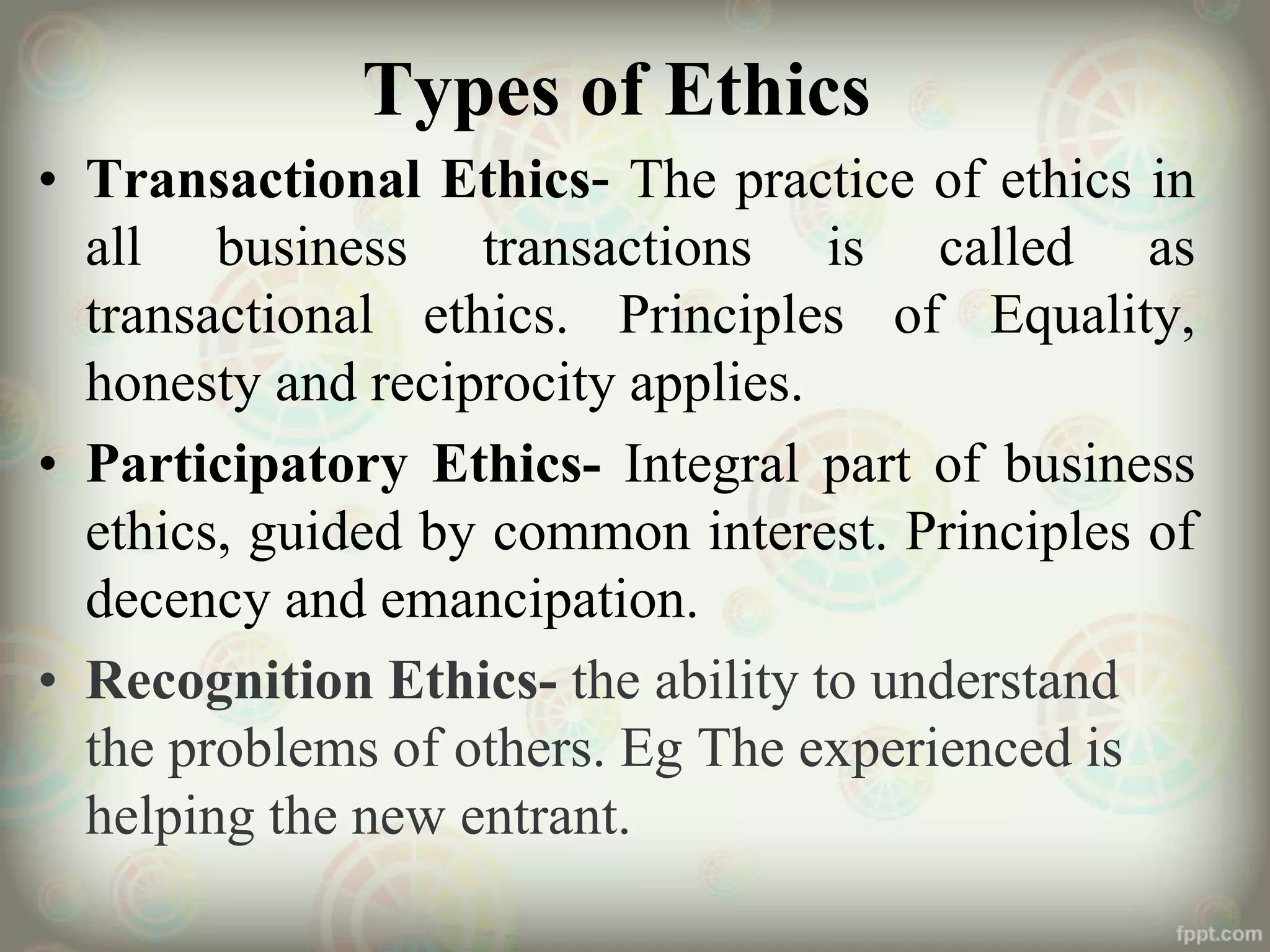
• Ethics, Moral and Law.
Types of Ethics
• Transactional Ethics- The practice of ethics in
all business transactions is called as
transactional ethics. Principles of Equality,
honesty and reciprocity applies.
• Participatory Ethics- Integral part of business
ethics, guided by common interest. Principles of
decency and emancipation.
• Recognition Ethics- the ability to understand
the problems of others. Eg The experienced is
helping the new entrant.
• Applied ethics
• It refers to the practical application of
moral values and principles with respect to
real work action in areas of private, public
and professional life.
• Normative ethics
• It is a branch of ethics which is concerned
with what is morally right and wrong. It
includes formulation of moral values
• Meta-ethics : It refers to the nature of
ethical terms and concepts and to the
attempt to understand the underlying
assumptions behind moral theories
Characteristics or Features of
business ethics
• Code of conduct
• Based on moral and social values
• Gives protection to social groups
• Provides basic framework
• Voluntary- self discipline
• Requires education and guidance
• Relative Term-changes from business to
business
• Not limited to oneself
Factors Influencing Business
Ethics
1. Leadership-Where there are good leaders there will be good ethical
practices in business. Eg. JRD Tata, Dhirubhai Ambani, N.R. Narayana
Murthy.
2. Individual Characteristics- Attitude, Lifestyle etc
3. Environment- sustainable development
4. Corporate Culture- Set of shared values, beliefs, goals, norms that
prevail within an organization.
5. Strategy and performance- What do we stand for? What is our
purpose? What values do we have?
6. Corporate governance- It is a set of systems and processes that a
company follows to ensure that it is in the best interest of the stake holders.
7. The extent of responsibility of business- Product quality,
equality in dealing with stakeholders.
Need/Importance/Advantages/Arguments
for Business Ethics
• Goodwill
• Profitability
• Stop business malpractices
• Improve customers' confidence
• Survival of business
• Safeguarding consumers' rights
• Protecting employees and shareholders
• Consumer satisfaction
• Smooth functioning
• Healthy competition
Disadvantages of business ethics/
Arguments against business ethics
• Business ethics reduce a company's freedom
to maximize its profit
• Customer to bear costs
• People, Planet, Profit
Scope/Purpose of Business Ethics
• Ethics in Compliance
• Ethics in Finance
• Ethics in Marketing
• Ethics in Human Resources
• Ethics of Production
• Ethics of Intellectual property, knowledge
and skills
• Ethics in Technology
Rules or Principles of Business Ethics
• Avoid exploitation of consumers
• Encourage healthy competition
• Ensure accuracy
• Pay taxes regularly
• Get accounts audited
• Fair treatment to employees
• Keep investors informed
• No bribe and corruption
• Discourage secret agreement
• Fullfill customers expectations
• Respect consumers rights
• Service motive
• Optimum utilisation of resources
Individual Principles that form
the basis of business ethics
• Honesty
• Integrity
• Loyalty
• Fair
• Caring
• Keeping Your Promises
• Respect
• Obeying Law
• Excellence
• Accountable
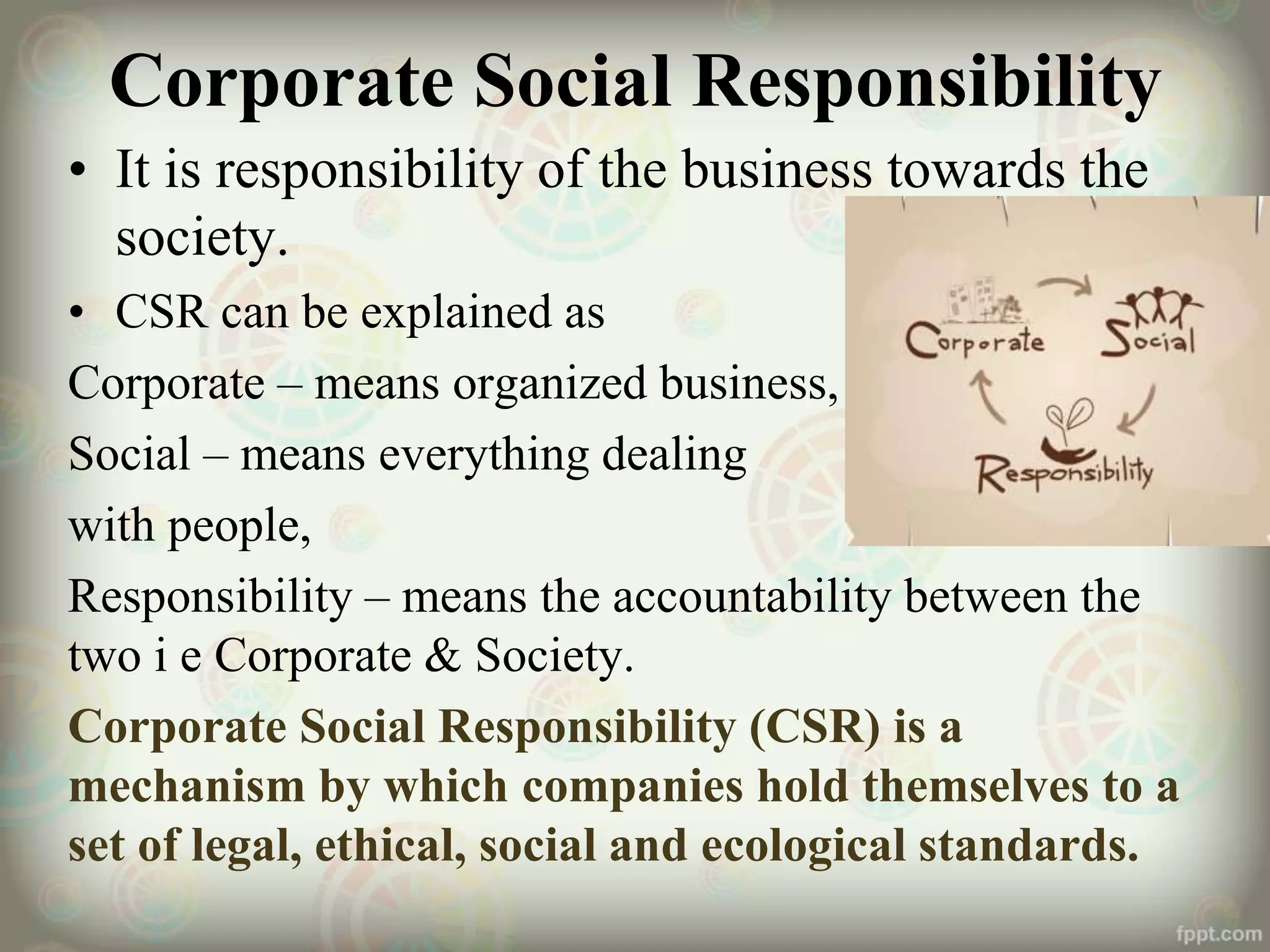
Corporate Social Responsibility
• It is responsibility of the business towards the
society.
• CSR can be explained as
Corporate – means organized business,
Social – means everything dealing
with people,
Responsibility – means the accountability between the
two i e Corporate & Society.
Corporate Social Responsibility (CSR) is a
mechanism by which companies hold themselves to a
set of legal, ethical, social and ecological standards.
Core elements of CSR Policy
• Care for all stakeholders
• Ethical functioning
• Respect for Workers rights and welfare
• Respect for human rights
• Respect for environment
• Activities for social and inclusive
development
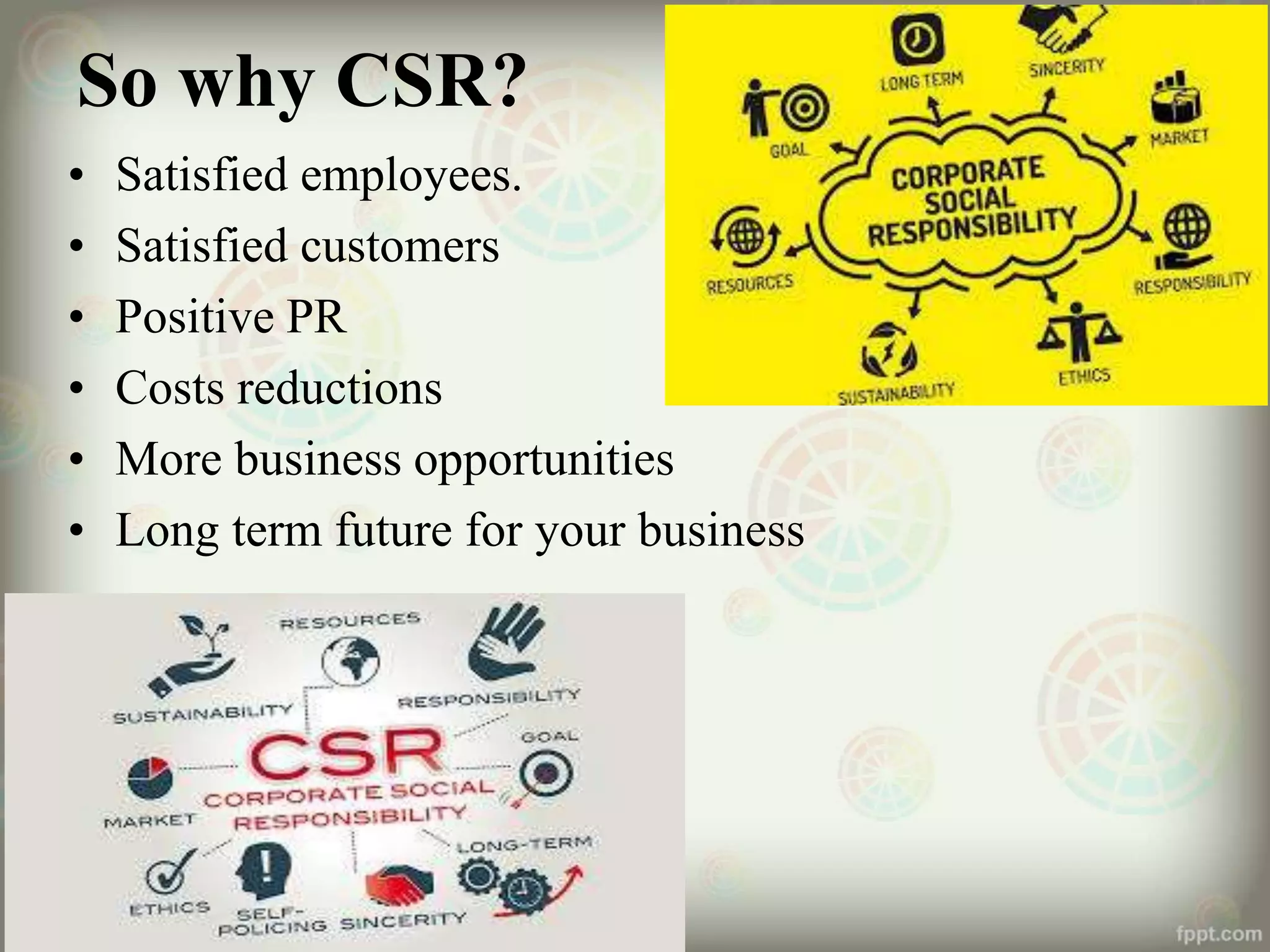
So why CSR?
• Satisfied employees.
• Satisfied customers
• Positive PR
• Costs reductions
• More business opportunities
• Long term future for your business
Types of CSR
• Environment-Focused Corporate Social
Responsibility (CSR)
• Community-Based Corporate Social
Responsibility (CSR)
• Human Resource (HR)-Based Corporate Social
Responsibility (CSR)
• Charity Based Corporate Social Responsibility
(CSR)
Advantages and disadvantage of CSR
• Improvement in the image of the Corporation
• Increased Attraction and Retention of Employees
• Regulatory Authorities become less hostile
• Attracts more Capital Inflow from Various Sources
• Generation of Clean and Renewable Energy from Environmental CSR
• Positive Publicity
• Reduced Operating costs
• Increased sales and customer loyality
• Disadvantage
• Company reputation takes a hit
• Shift from the Profit-Making Objective
• Customer Conviction
Issues of management
• Corporate Social Responsibility (CSR)
• Business ethics
• Corporate Governance
• Quality of Work life of employees.
• Workforce Treatment and Workforce Discrimination
• Transparency
• Economic issues
• Competitive issues
• Legal and regulatory issues, and
• Philanthropic issues
Crisis Management
• What is Crisis?
• Crisis is defined as any emergency situation
which disturbs the employees as well as leads to
instability in the organization. Crisis affects an
individual, group, organization or society on the
whole.
• Characteristics of Crisis
 Crisis is a sequence of sudden disturbing events
harming the organization.
 Crisis generally arises on a short notice.
 Crisis triggers a feeling of fear and threat amongst the
individuals.
Why Crisis?
• Technological failure
• Indifference opinions of employees
• Fail to pay creditors
• Illegal behaviour
• Violence, theft and terrorism at the place
Crisis Management
• The process of handling unexpected and sudden
changes in organization culture is called as crisis
management.
• Need for Crisis Management
• Prepares the individuals to face unexpected developments
• Employees adjust well
• can understand and analyze the causes of crisis
• helps the managers to devise strategies
Crisis Management Team?
• A Crisis Management Team is formed to protect an organization
against the adverse effects of crisis. Crisis Management team
prepares an organization for inevitable threats.
Crisis Management Process
• Step 1: Establish a planning team
• Step 2: Analyze capabilities and hazards
• Step 3: Develop a plan
• Step 4: Implement the plan
Types of Crisis
• Natural crisis
• Technological crisis
• Confrontation Crisis- employees fight
• Crisis of Malevolence- criminal acts of employees
• Crisis of Organizational Misdeeds
• Crisis Due to Rumours
• Crisis of Management Misconduct
• Bankruptcy

Introduction to ethics, business ethics and csr

  • 1.
    Business Ethics III SemB.Com Prepared by: Veena R Assistant Professor
  • 2.
  • 3.
    • Ethics • Latinword “ethicus” and Greek word “ethicos” which means character or manner. • It is a system of moral principles, rules and conduct which governs the ability to distinguish between right and wrong and act accordingly. • Ethics is defined as a moral philosophy or code of morals practiced by a person or group of people.
  • 4.
    Nature of ethics •Ethics is the study of human conduct • Ethics is a science • Ethics is not an art. • Ethics is a branch of philosophy and moral philosophy • Ethics is derived from religions, philosophies and culture
  • 5.
    Business Ethics • Businessethics can be defined as written and unwritten codes of principles and values that govern decisions and actions within a company. • Definition of business ethics • According to ICAI-The principles and standards that determine acceptable conduct in business organization. • It is an application of general ethical rules to business behaviour. • Ethics, Moral and Law.
  • 6.
    Types of Ethics •Transactional Ethics- The practice of ethics in all business transactions is called as transactional ethics. Principles of Equality, honesty and reciprocity applies. • Participatory Ethics- Integral part of business ethics, guided by common interest. Principles of decency and emancipation. • Recognition Ethics- the ability to understand the problems of others. Eg The experienced is helping the new entrant.
  • 7.
    • Applied ethics •It refers to the practical application of moral values and principles with respect to real work action in areas of private, public and professional life. • Normative ethics • It is a branch of ethics which is concerned with what is morally right and wrong. It includes formulation of moral values
  • 8.
    • Meta-ethics :It refers to the nature of ethical terms and concepts and to the attempt to understand the underlying assumptions behind moral theories
  • 9.
    Characteristics or Featuresof business ethics • Code of conduct • Based on moral and social values • Gives protection to social groups • Provides basic framework • Voluntary- self discipline • Requires education and guidance • Relative Term-changes from business to business • Not limited to oneself
  • 10.
    Factors Influencing Business Ethics 1.Leadership-Where there are good leaders there will be good ethical practices in business. Eg. JRD Tata, Dhirubhai Ambani, N.R. Narayana Murthy. 2. Individual Characteristics- Attitude, Lifestyle etc 3. Environment- sustainable development 4. Corporate Culture- Set of shared values, beliefs, goals, norms that prevail within an organization. 5. Strategy and performance- What do we stand for? What is our purpose? What values do we have? 6. Corporate governance- It is a set of systems and processes that a company follows to ensure that it is in the best interest of the stake holders. 7. The extent of responsibility of business- Product quality, equality in dealing with stakeholders.
  • 11.
    Need/Importance/Advantages/Arguments for Business Ethics •Goodwill • Profitability • Stop business malpractices • Improve customers' confidence • Survival of business • Safeguarding consumers' rights • Protecting employees and shareholders • Consumer satisfaction • Smooth functioning • Healthy competition
  • 12.
    Disadvantages of businessethics/ Arguments against business ethics • Business ethics reduce a company's freedom to maximize its profit • Customer to bear costs • People, Planet, Profit
  • 13.
    Scope/Purpose of BusinessEthics • Ethics in Compliance • Ethics in Finance • Ethics in Marketing • Ethics in Human Resources • Ethics of Production • Ethics of Intellectual property, knowledge and skills • Ethics in Technology
  • 14.
    Rules or Principlesof Business Ethics • Avoid exploitation of consumers • Encourage healthy competition • Ensure accuracy • Pay taxes regularly • Get accounts audited • Fair treatment to employees • Keep investors informed • No bribe and corruption • Discourage secret agreement • Fullfill customers expectations • Respect consumers rights • Service motive • Optimum utilisation of resources
  • 15.
    Individual Principles thatform the basis of business ethics • Honesty • Integrity • Loyalty • Fair • Caring • Keeping Your Promises • Respect • Obeying Law • Excellence • Accountable
  • 16.
    Corporate Social Responsibility •It is responsibility of the business towards the society. • CSR can be explained as Corporate – means organized business, Social – means everything dealing with people, Responsibility – means the accountability between the two i e Corporate & Society. Corporate Social Responsibility (CSR) is a mechanism by which companies hold themselves to a set of legal, ethical, social and ecological standards.
  • 17.
    Core elements ofCSR Policy • Care for all stakeholders • Ethical functioning • Respect for Workers rights and welfare • Respect for human rights • Respect for environment • Activities for social and inclusive development
  • 18.
    So why CSR? •Satisfied employees. • Satisfied customers • Positive PR • Costs reductions • More business opportunities • Long term future for your business
  • 19.
    Types of CSR •Environment-Focused Corporate Social Responsibility (CSR) • Community-Based Corporate Social Responsibility (CSR) • Human Resource (HR)-Based Corporate Social Responsibility (CSR) • Charity Based Corporate Social Responsibility (CSR)
  • 20.
    Advantages and disadvantageof CSR • Improvement in the image of the Corporation • Increased Attraction and Retention of Employees • Regulatory Authorities become less hostile • Attracts more Capital Inflow from Various Sources • Generation of Clean and Renewable Energy from Environmental CSR • Positive Publicity • Reduced Operating costs • Increased sales and customer loyality • Disadvantage • Company reputation takes a hit • Shift from the Profit-Making Objective • Customer Conviction
  • 21.
    Issues of management •Corporate Social Responsibility (CSR) • Business ethics • Corporate Governance • Quality of Work life of employees. • Workforce Treatment and Workforce Discrimination • Transparency • Economic issues • Competitive issues • Legal and regulatory issues, and • Philanthropic issues
  • 22.
    Crisis Management • Whatis Crisis? • Crisis is defined as any emergency situation which disturbs the employees as well as leads to instability in the organization. Crisis affects an individual, group, organization or society on the whole. • Characteristics of Crisis  Crisis is a sequence of sudden disturbing events harming the organization.  Crisis generally arises on a short notice.  Crisis triggers a feeling of fear and threat amongst the individuals.
  • 23.
    Why Crisis? • Technologicalfailure • Indifference opinions of employees • Fail to pay creditors • Illegal behaviour • Violence, theft and terrorism at the place
  • 24.
    Crisis Management • Theprocess of handling unexpected and sudden changes in organization culture is called as crisis management. • Need for Crisis Management • Prepares the individuals to face unexpected developments • Employees adjust well • can understand and analyze the causes of crisis • helps the managers to devise strategies Crisis Management Team? • A Crisis Management Team is formed to protect an organization against the adverse effects of crisis. Crisis Management team prepares an organization for inevitable threats.
  • 25.
    Crisis Management Process •Step 1: Establish a planning team • Step 2: Analyze capabilities and hazards • Step 3: Develop a plan • Step 4: Implement the plan
  • 26.
    Types of Crisis •Natural crisis • Technological crisis • Confrontation Crisis- employees fight • Crisis of Malevolence- criminal acts of employees • Crisis of Organizational Misdeeds • Crisis Due to Rumours • Crisis of Management Misconduct • Bankruptcy