Ethical AI: Can We Trust
Machines?
Exploring the promise, perils, and ethical dimensions of artificial
intelligence in our modern world.
by Ozías Rondón
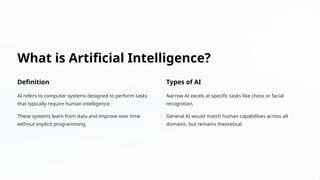
What is Artificial Intelligence?
Definition
AI refers to computer systems designed to perform tasks
that typically require human intelligence.
These systems learn from data and improve over time
without explicit programming.
Types of AI
Narrow AI excels at specific tasks like chess or facial
recognition.
General AI would match human capabilities across all
domains, but remains theoretical.
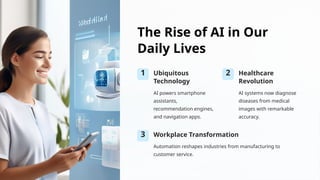
The Rise of AI in Our
Daily Lives
1 Ubiquitous
Technology
AI powers smartphone
assistants,
recommendation engines,
and navigation apps.
2 Healthcare
Revolution
AI systems now diagnose
diseases from medical
images with remarkable
accuracy.
3 Workplace Transformation
Automation reshapes industries from manufacturing to
customer service.
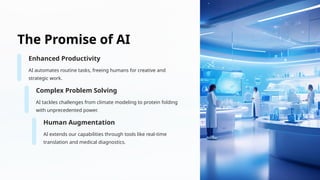
The Promise of AI
Enhanced Productivity
AI automates routine tasks, freeing humans for creative and
strategic work.
Complex Problem Solving
AI tackles challenges from climate modeling to protein folding
with unprecedented power.
Human Augmentation
AI extends our capabilities through tools like real-time
translation and medical diagnostics.
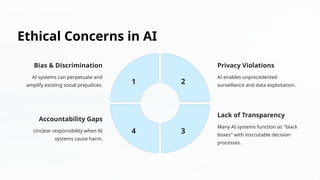
Ethical Concerns in AI
Bias & Discrimination
AI systems can perpetuate and
amplify existing social prejudices.
1
Privacy Violations
AI enables unprecedented
surveillance and data exploitation.
2
Lack of Transparency
Many AI systems function as "black
boxes" with inscrutable decision
processes.
3
Accountability Gaps
Unclear responsibility when AI
systems cause harm.
4
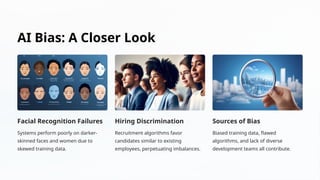
AI Bias: A Closer Look
Facial Recognition Failures
Systems perform poorly on darker-
skinned faces and women due to
skewed training data.
Hiring Discrimination
Recruitment algorithms favor
candidates similar to existing
employees, perpetuating imbalances.
Sources of Bias
Biased training data, flawed
algorithms, and lack of diverse
development teams all contribute.
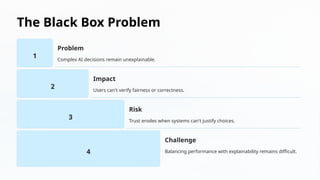
The Black Box Problem
1
Problem
Complex AI decisions remain unexplainable.
2
Impact
Users can't verify fairness or correctness.
3
Risk
Trust erodes when systems can't justify choices.
4
Challenge
Balancing performance with explainability remains difficult.
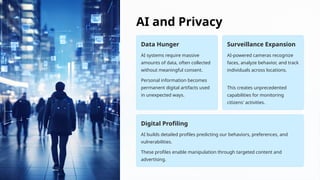
AI and Privacy
Data Hunger
AI systems require massive
amounts of data, often collected
without meaningful consent.
Personal information becomes
permanent digital artifacts used
in unexpected ways.
Surveillance Expansion
AI-powered cameras recognize
faces, analyze behavior, and track
individuals across locations.
This creates unprecedented
capabilities for monitoring
citizens' activities.
Digital Profiling
AI builds detailed profiles predicting our behaviors, preferences, and
vulnerabilities.
These profiles enable manipulation through targeted content and
advertising.
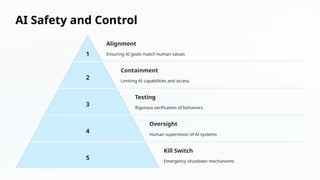
AI Safety and Control
1
Alignment
Ensuring AI goals match human values
2
Containment
Limiting AI capabilities and access
3
Testing
Rigorous verification of behaviors
4
Oversight
Human supervision of AI systems
5
Kill Switch
Emergency shutdown mechanisms
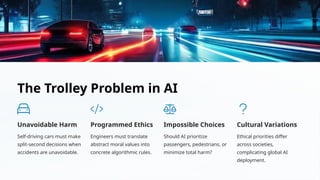
The Trolley Problem in AI
Unavoidable Harm
Self-driving cars must make
split-second decisions when
accidents are unavoidable.
Programmed Ethics
Engineers must translate
abstract moral values into
concrete algorithmic rules.
Impossible Choices
Should AI prioritize
passengers, pedestrians, or
minimize total harm?
Cultural Variations
Ethical priorities differ
across societies,
complicating global AI
deployment.
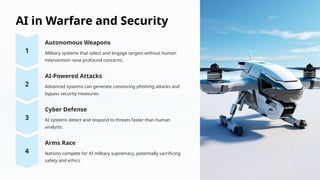
AI in Warfare and Security
Autonomous Weapons
Military systems that select and engage targets without human
intervention raise profound concerns.
AI-Powered Attacks
Advanced systems can generate convincing phishing attacks and
bypass security measures.
Cyber Defense
AI systems detect and respond to threats faster than human
analysts.
Arms Race
Nations compete for AI military supremacy, potentially sacrificing
safety and ethics.
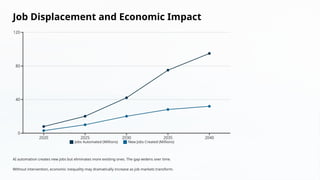
Job Displacement and Economic Impact
Jobs Automated (Millions) New Jobs Created (Millions)
AI automation creates new jobs but eliminates more existing ones. The gap widens over time.
Without intervention, economic inequality may dramatically increase as job markets transform.
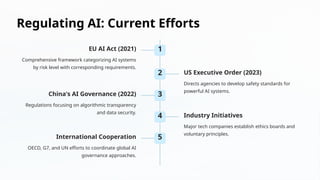
Regulating AI: Current Efforts
1
EU AI Act (2021)
Comprehensive framework categorizing AI systems
by risk level with corresponding requirements.
2 US Executive Order (2023)
Directs agencies to develop safety standards for
powerful AI systems.
3
China's AI Governance (2022)
Regulations focusing on algorithmic transparency
and data security.
4 Industry Initiatives
Major tech companies establish ethics boards and
voluntary principles.
5
International Cooperation
OECD, G7, and UN efforts to coordinate global AI
governance approaches.
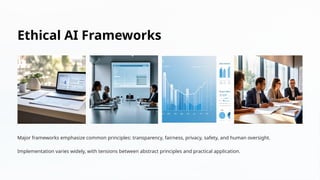
Ethical AI Frameworks
Major frameworks emphasize common principles: transparency, fairness, privacy, safety, and human oversight.
Implementation varies widely, with tensions between abstract principles and practical application.
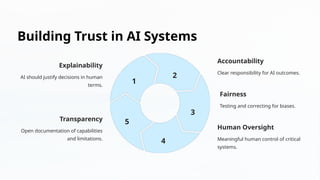
Building Trust in AI Systems
Explainability
AI should justify decisions in human
terms.
1
Accountability
Clear responsibility for AI outcomes.
2
Fairness
Testing and correcting for biases.
3
Human Oversight
Meaningful human control of critical
systems.
4
Transparency
Open documentation of capabilities
and limitations.
5
The Role of Education
85%
Digital Literacy Gap
Percentage of adults who cannot explain how AI influences their lives.
2.1M
Developer Shortage
Projected global shortage of AI-skilled workers by 2030.
38%
Ethics Training
Computer science programs that include mandatory ethics curriculum.
10x
Knowledge Acceleration
Rate at which AI knowledge requirements are growing versus educational updates.
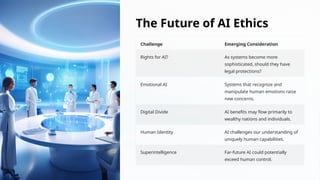
The Future of AI Ethics
Challenge Emerging Consideration
Rights for AI? As systems become more
sophisticated, should they have
legal protections?
Emotional AI Systems that recognize and
manipulate human emotions raise
new concerns.
Digital Divide AI benefits may flow primarily to
wealthy nations and individuals.
Human Identity AI challenges our understanding of
uniquely human capabilities.
Superintelligence Far-future AI could potentially
exceed human control.
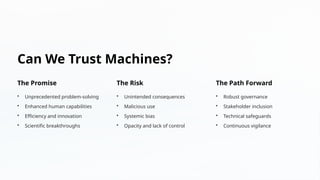
Can We Trust Machines?
The Promise
• Unprecedented problem-solving
• Enhanced human capabilities
• Efficiency and innovation
• Scientific breakthroughs
The Risk
• Unintended consequences
• Malicious use
• Systemic bias
• Opacity and lack of control
The Path Forward
• Robust governance
• Stakeholder inclusion
• Technical safeguards
• Continuous vigilance
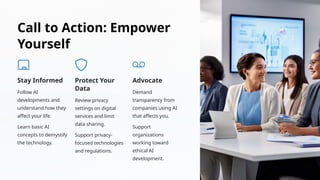
Call to Action: Empower
Yourself
Stay Informed
Follow AI
developments and
understand how they
affect your life.
Learn basic AI
concepts to demystify
the technology.
Protect Your
Data
Review privacy
settings on digital
services and limit
data sharing.
Support privacy-
focused technologies
and regulations.
Advocate
Demand
transparency from
companies using AI
that affects you.
Support
organizations
working toward
ethical AI
development.
Six Figure Side Hustle Opportunity
Earn $10,000 Monthly
Our proven system helps ordinary
people generate extraordinary
income.
Work just 2 hours weekly with our
streamlined approach.
No Technical Skills Required
We've eliminated the learning curve
with our step-by-step guidance.
Complete beginners are succeeding
with our proven framework.
Get Started Today
Learn more at:
https://warriorplus.com/o2/a/jtzxn8c/
0
Limited spots available for our next
training cohort.