Introduction
This presentation exploresthe ethical imperatives surrounding the
development, deployment, and governance of Artificial Intelligence
(AI). AI enables machines to perform tasks requiring human
intelligence, transforming industries like healthcare, education, and
transportation. However, rapid AI advancements raise challenges in
bias, accountability, transparency, and privacy, necessitating strong
ethical frameworks and governance to protect society.
3.
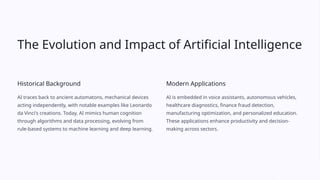
The Evolution andImpact of Artificial Intelligence
Historical Background
AI traces back to ancient automatons, mechanical devices
acting independently, with notable examples like Leonardo
da Vinci's creations. Today, AI mimics human cognition
through algorithms and data processing, evolving from
rule-based systems to machine learning and deep learning.
Modern Applications
AI is embedded in voice assistants, autonomous vehicles,
healthcare diagnostics, finance fraud detection,
manufacturing optimization, and personalized education.
These applications enhance productivity and decision-
making across sectors.
4.
Ethics and MoralPhilosophy in Technology
Ethics in Technology
Ethics applies moral principles
to technology development and
use, ensuring innovations are
socially responsible and just.
Moral Philosophy
Frameworks
Utilitarianism, deontology, and
virtue ethics provide distinct
perspectives guiding ethical AI
decisions, balancing outcomes,
duties, and character.
Significance
Ethics addresses right and
wrong behavior in technology,
influencing business practices
and societal impact.
5.
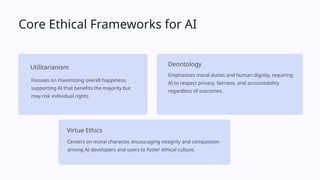
Core Ethical Frameworksfor AI
Utilitarianism
Focuses on maximizing overall happiness,
supporting AI that benefits the majority but
may risk individual rights.
Deontology
Emphasizes moral duties and human dignity, requiring
AI to respect privacy, fairness, and accountability
regardless of outcomes.
Virtue Ethics
Centers on moral character, encouraging integrity and compassion
among AI developers and users to foster ethical culture.
6.
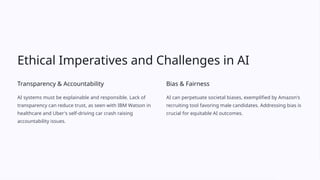
Ethical Imperatives andChallenges in AI
Transparency & Accountability
AI systems must be explainable and responsible. Lack of
transparency can reduce trust, as seen with IBM Watson in
healthcare and Uber's self-driving car crash raising
accountability issues.
Bias & Fairness
AI can perpetuate societal biases, exemplified by Amazon's
recruiting tool favoring male candidates. Addressing bias is
crucial for equitable AI outcomes.
7.
Privacy, Security, and
HumanOversight
Privacy & Security
AI surveillance raises
privacy issues, prompting
bans like San Francisco's
facial recognition police
use due to misuse risks.
Human Oversight
AI should augment, not
replace, human judgment,
especially in critical areas
like judicial decisions where
fairness and accuracy are
vital.
8.
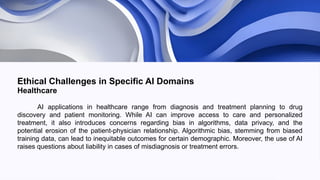
Ethical Challenges inSpecific AI Domains
Healthcare
AI applications in healthcare range from diagnosis and treatment planning to drug
discovery and patient monitoring. While AI can improve access to care and personalized
treatment, it also introduces concerns regarding bias in algorithms, data privacy, and the
potential erosion of the patient-physician relationship. Algorithmic bias, stemming from biased
training data, can lead to inequitable outcomes for certain demographic. Moreover, the use of AI
raises questions about liability in cases of misdiagnosis or treatment errors.
9.
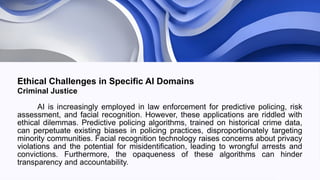
Ethical Challenges inSpecific AI Domains
Criminal Justice
AI is increasingly employed in law enforcement for predictive policing, risk
assessment, and facial recognition. However, these applications are riddled with
ethical dilemmas. Predictive policing algorithms, trained on historical crime data,
can perpetuate existing biases in policing practices, disproportionately targeting
minority communities. Facial recognition technology raises concerns about privacy
violations and the potential for misidentification, leading to wrongful arrests and
convictions. Furthermore, the opaqueness of these algorithms can hinder
transparency and accountability.
10.
Ethical Challenges inSpecific AI Domains
Employment
AI-powered tools are being used for recruitment, hiring, and performance
management. While AI can streamline these processes, it also raises concerns
about algorithmic bias, job displacement, and the deskilling of human workers. AI-
driven recruitment tools can perpetuate existing biases based on gender, race, or
other protected characteristics, leading to discriminatory hiring practices.
Moreover, the automation of tasks previously performed by humans can lead to
job losses and exacerbate income inequality.
11.
Ethical Challenges inSpecific AI Domains
Employment
AI-powered tools are being used for recruitment, hiring, and performance
management. While AI can streamline these processes, it also raises concerns
about algorithmic bias, job displacement, and the deskilling of human workers. AI-
driven recruitment tools can perpetuate existing biases based on gender, race, or
other protected characteristics, leading to discriminatory hiring practices.
Moreover, the automation of tasks previously performed by humans can lead to
job losses and exacerbate income inequality.
12.
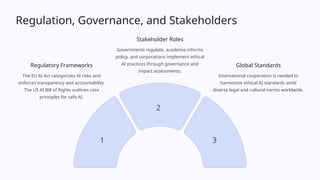
Regulation, Governance, andStakeholders
1
2
3
Regulatory Frameworks
The EU AI Act categorizes AI risks and
enforces transparency and accountability.
The US AI Bill of Rights outlines core
principles for safe AI.
Stakeholder Roles
Governments regulate, academia informs
policy, and corporations implement ethical
AI practices through governance and
impact assessments.
Global Standards
International cooperation is needed to
harmonize ethical AI standards amid
diverse legal and cultural norms worldwide.
13.
The Future ofEthical AI
Interdisciplinary Cooperation
AI ethics requires collaboration across technology, law,
philosophy, social sciences, and policy to address complex
challenges.
Ongoing Ethical Process
Ethical AI is a continuous journey involving real-time
monitoring, auditing, and adapting to evolving societal
values and technologies.
14.
Conclusion
As artificial intelligence(AI) continues to shape various sectors of society, including healthcare, law
enforcement, employment, and national defense, it becomes increasingly clear that the technology must be
guided by strong ethical foundations. AI's pot
Embedding ethics throughout AI's lifecycle ensures technology serves humanity responsibly, upholding
dignity, fairness, and accountability As the field continues to evolve, the concept of ethical AI should be
viewed not as a final destination but as a continuous process of reflection, monitoring, and adaptation. Only
by embedding ethics into every stage of the AI lifecycle can we build a futu
 Most read

 Most read


 Most read