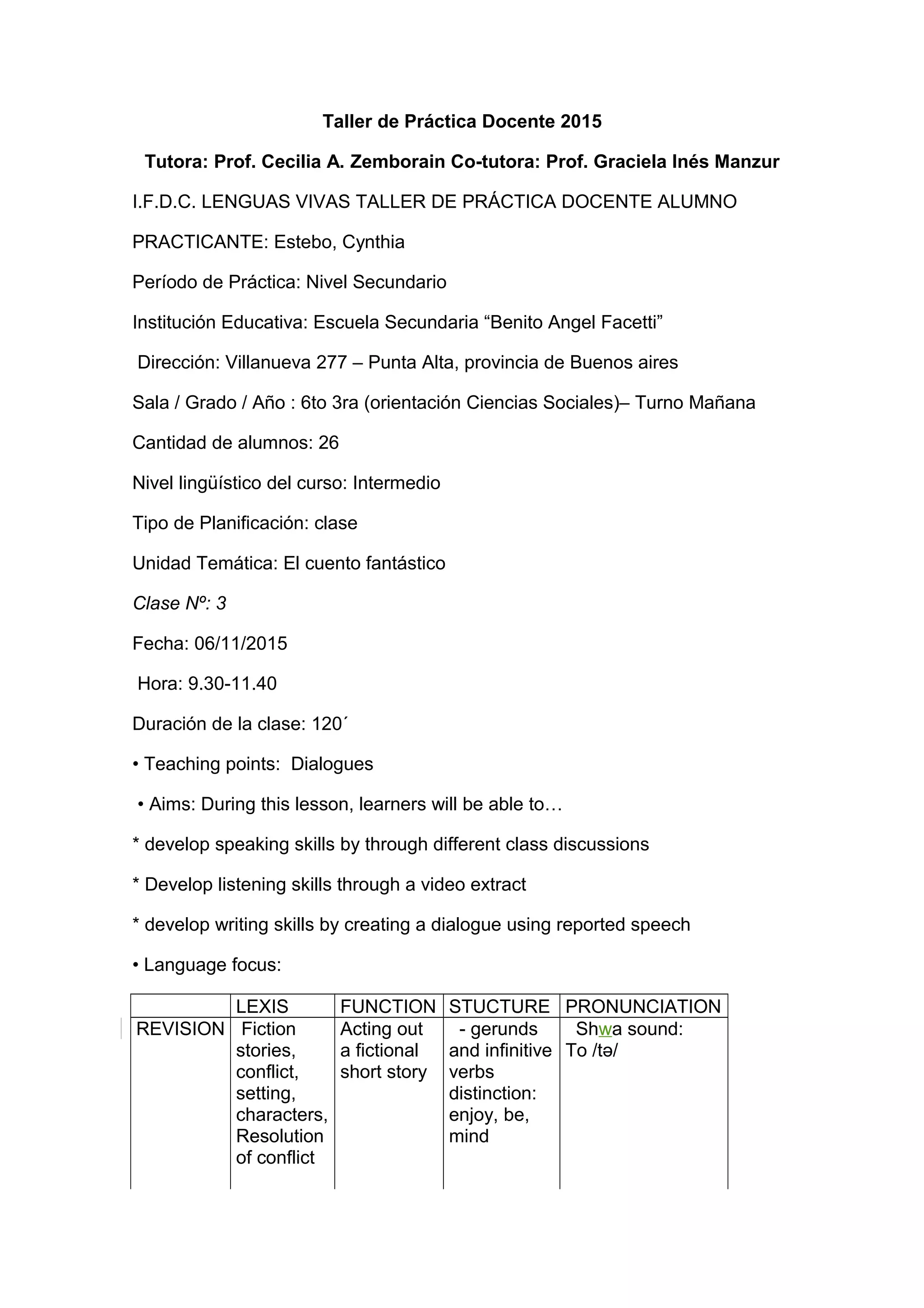
Taller de Práctica Docente 2015
Tutora: Prof. Cecilia A. Zemborain Co-tutora: Prof. Graciela Inés Manzur
I.F.D.C. LENGUAS VIVAS TALLER DE PRÁCTICA DOCENTE ALUMNO
PRACTICANTE: Estebo, Cynthia
Período de Práctica: Nivel Secundario
Institución Educativa: Escuela Secundaria “Benito Angel Facetti”
Dirección: Villanueva 277 – Punta Alta, provincia de Buenos aires
Sala / Grado / Año : 6to 3ra (orientación Ciencias Sociales)– Turno Mañana
Cantidad de alumnos: 26
Nivel lingüístico del curso: Intermedio
Tipo de Planificación: clase
Unidad Temática: El cuento fantástico
Clase Nº: 3
Fecha: 06/11/2015
Hora: 9.30-11.40
Duración de la clase: 120´
• Teaching points: Dialogues
• Aims: During this lesson, learners will be able to…
* develop speaking skills by through different class discussions
* Develop listening skills through a video extract
* develop writing skills by creating a dialogue using reported speech
• Language focus:
LEXIS FUNCTION STUCTURE PRONUNCIATION
REVISION Fiction
stories,
conflict,
setting,
characters,
Resolution
of conflict
Acting out
a fictional
short story
- gerunds
and infinitive
verbs
distinction:
enjoy, be,
mind
Shwa sound:
To /tə/
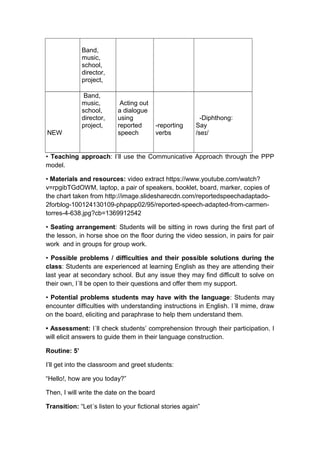
Band,
music,
school,
director,
project,
NEW
Band,
music,
school,
director,
project,
Acting out
a dialogue
using
reported
speech
-reporting
verbs
-Diphthong:
Say
/se /ɪ
• Teaching approach: I’ll use the Communicative Approach through the PPP
model.
• Materials and resources: video extract https://www.youtube.com/watch?
v=rpgibTGdOWM, laptop, a pair of speakers, booklet, board, marker, copies of
the chart taken from http://image.slidesharecdn.com/reportedspeechadaptado-
2forblog-100124130109-phpapp02/95/reported-speech-adapted-from-carmen-
torres-4-638.jpg?cb=1369912542
• Seating arrangement: Students will be sitting in rows during the first part of
the lesson, in horse shoe on the floor during the video session, in pairs for pair
work and in groups for group work.
• Possible problems / difficulties and their possible solutions during the
class: Students are experienced at learning English as they are attending their
last year at secondary school. But any issue they may find difficult to solve on
their own, I´ll be open to their questions and offer them my support.
• Potential problems students may have with the language: Students may
encounter difficulties with understanding instructions in English. I´ll mime, draw
on the board, eliciting and paraphrase to help them understand them.
• Assessment: I´ll check students’ comprehension through their participation. I
will elicit answers to guide them in their language construction.
Routine: 5’
I’ll get into the classroom and greet students:
“Hello!, how are you today?”
Then, I will write the date on the board
Transition: “Let´s listen to your fictional stories again”
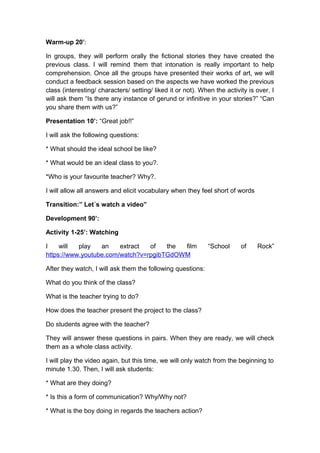
Warm-up 20’:
In groups, they will perform orally the fictional stories they have created the
previous class. I will remind them that intonation is really important to help
comprehension. Once all the groups have presented their works of art, we will
conduct a feedback session based on the aspects we have worked the previous
class (interesting/ characters/ setting/ liked it or not). When the activity is over, I
will ask them “Is there any instance of gerund or infinitive in your stories?” “Can
you share them with us?”
Presentation 10’: “Great job!!”
I will ask the following questions:
* What should the ideal school be like?
* What would be an ideal class to you?.
*Who is your favourite teacher? Why?.
I will allow all answers and elicit vocabulary when they feel short of words
Transition:” Let´s watch a video”
Development 90’:
Activity 1-25’: Watching
I will play an extract of the film “School of Rock”
https://www.youtube.com/watch?v=rpgibTGdOWM
After they watch, I will ask them the following questions:
What do you think of the class?
What is the teacher trying to do?
How does the teacher present the project to the class?
Do students agree with the teacher?
They will answer these questions in pairs. When they are ready, we will check
them as a whole class activity.
I will play the video again, but this time, we will only watch from the beginning to
minute 1.30. Then, I will ask students:
* What are they doing?
* Is this a form of communication? Why/Why not?
* What is the boy doing in regards the teachers action?
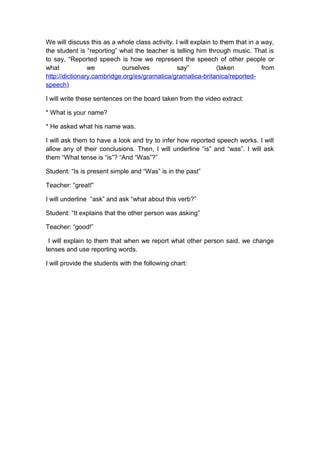
We will discuss this as a whole class activity. I will explain to them that in a way,
the student is “reporting” what the teacher is telling him through music. That is
to say, “Reported speech is how we represent the speech of other people or
what we ourselves say” (taken from
http://dictionary.cambridge.org/es/gramatica/gramatica-britanica/reported-
speech)
I will write these sentences on the board taken from the video extract:
* What is your name?
* He asked what his name was.
I will ask them to have a look and try to infer how reported speech works. I will
allow any of their conclusions. Then, I will underline “is” and “was”. I will ask
them “What tense is “is”? “And “Was”?”
Student: “Is is present simple and “Was” is in the past”
Teacher: “great!”
I will underline “ask” and ask “what about this verb?”
Student: “It explains that the other person was asking”
Teacher: “good!”
I will explain to them that when we report what other person said, we change
tenses and use reporting words.
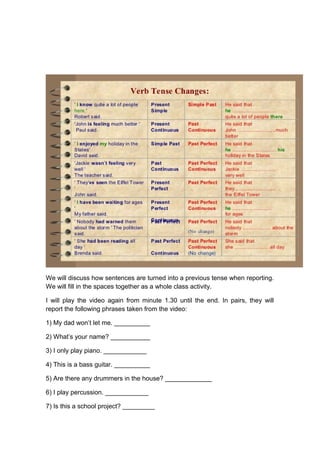
I will provide the students with the following chart:
We will discuss how sentences are turned into a previous tense when reporting.
We will fill in the spaces together as a whole class activity.
I will play the video again from minute 1.30 until the end. In pairs, they will
report the following phrases taken from the video:
1) My dad won’t let me. __________
2) What’s your name? ___________
3) I only play piano. ____________
4) This is a bass guitar. __________
5) Are there any drummers in the house? _____________
6) I play percussion. ____________
7) Is this a school project? _________
8) What’s the prize? ________
9) Can we tell our parents?__________
10) Who can sing? ________
11) I can sing. _________
When they are ready, we will check them as whole class activity. We will
discuss how questions are transformed and deal with any doubt students have.
Activity 2: Working on grammar 20´
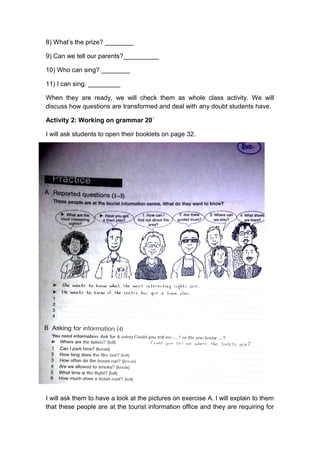
I will ask students to open their booklets on page 32.
I will ask them to have a look at the pictures on exercise A. I will explain to them
that these people are at the tourist information office and they are requiring for
information about their town. They will have to report these questions. They will
work in pairs. When they have finished, we will check the activity as a whole
class activity. Then, they will answer the questions orally about our city.
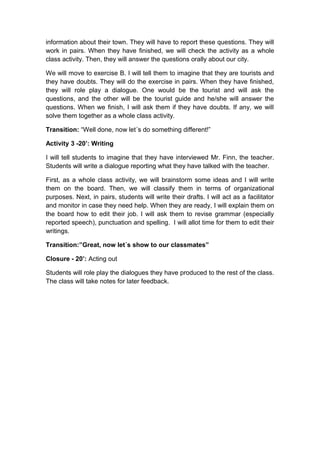
We will move to exercise B. I will tell them to imagine that they are tourists and
they have doubts. They will do the exercise in pairs. When they have finished,
they will role play a dialogue. One would be the tourist and will ask the
questions, and the other will be the tourist guide and he/she will answer the
questions. When we finish, I will ask them if they have doubts. If any, we will
solve them together as a whole class activity.
Transition: “Well done, now let´s do something different!”
Activity 3 -20’: Writing
I will tell students to imagine that they have interviewed Mr. Finn, the teacher.
Students will write a dialogue reporting what they have talked with the teacher.
First, as a whole class activity, we will brainstorm some ideas and I will write
them on the board. Then, we will classify them in terms of organizational
purposes. Next, in pairs, students will write their drafts. I will act as a facilitator
and monitor in case they need help. When they are ready, I will explain them on
the board how to edit their job. I will ask them to revise grammar (especially
reported speech), punctuation and spelling. I will allot time for them to edit their
writings.
Transition:”Great, now let´s show to our classmates”
Closure - 20’: Acting out
Students will role play the dialogues they have produced to the rest of the class.
The class will take notes for later feedback.

Estebo tpd- lesson plan nº 3 secondary practicum

  • 1.
    Taller de PrácticaDocente 2015 Tutora: Prof. Cecilia A. Zemborain Co-tutora: Prof. Graciela Inés Manzur I.F.D.C. LENGUAS VIVAS TALLER DE PRÁCTICA DOCENTE ALUMNO PRACTICANTE: Estebo, Cynthia Período de Práctica: Nivel Secundario Institución Educativa: Escuela Secundaria “Benito Angel Facetti” Dirección: Villanueva 277 – Punta Alta, provincia de Buenos aires Sala / Grado / Año : 6to 3ra (orientación Ciencias Sociales)– Turno Mañana Cantidad de alumnos: 26 Nivel lingüístico del curso: Intermedio Tipo de Planificación: clase Unidad Temática: El cuento fantástico Clase Nº: 3 Fecha: 06/11/2015 Hora: 9.30-11.40 Duración de la clase: 120´ • Teaching points: Dialogues • Aims: During this lesson, learners will be able to… * develop speaking skills by through different class discussions * Develop listening skills through a video extract * develop writing skills by creating a dialogue using reported speech • Language focus: LEXIS FUNCTION STUCTURE PRONUNCIATION REVISION Fiction stories, conflict, setting, characters, Resolution of conflict Acting out a fictional short story - gerunds and infinitive verbs distinction: enjoy, be, mind Shwa sound: To /tə/
  • 2.
    Band, music, school, director, project, NEW Band, music, school, director, project, Acting out a dialogue using reported speech -reporting verbs -Diphthong: Say /se/ɪ • Teaching approach: I’ll use the Communicative Approach through the PPP model. • Materials and resources: video extract https://www.youtube.com/watch? v=rpgibTGdOWM, laptop, a pair of speakers, booklet, board, marker, copies of the chart taken from http://image.slidesharecdn.com/reportedspeechadaptado- 2forblog-100124130109-phpapp02/95/reported-speech-adapted-from-carmen- torres-4-638.jpg?cb=1369912542 • Seating arrangement: Students will be sitting in rows during the first part of the lesson, in horse shoe on the floor during the video session, in pairs for pair work and in groups for group work. • Possible problems / difficulties and their possible solutions during the class: Students are experienced at learning English as they are attending their last year at secondary school. But any issue they may find difficult to solve on their own, I´ll be open to their questions and offer them my support. • Potential problems students may have with the language: Students may encounter difficulties with understanding instructions in English. I´ll mime, draw on the board, eliciting and paraphrase to help them understand them. • Assessment: I´ll check students’ comprehension through their participation. I will elicit answers to guide them in their language construction. Routine: 5’ I’ll get into the classroom and greet students: “Hello!, how are you today?” Then, I will write the date on the board Transition: “Let´s listen to your fictional stories again”
  • 3.
    Warm-up 20’: In groups,they will perform orally the fictional stories they have created the previous class. I will remind them that intonation is really important to help comprehension. Once all the groups have presented their works of art, we will conduct a feedback session based on the aspects we have worked the previous class (interesting/ characters/ setting/ liked it or not). When the activity is over, I will ask them “Is there any instance of gerund or infinitive in your stories?” “Can you share them with us?” Presentation 10’: “Great job!!” I will ask the following questions: * What should the ideal school be like? * What would be an ideal class to you?. *Who is your favourite teacher? Why?. I will allow all answers and elicit vocabulary when they feel short of words Transition:” Let´s watch a video” Development 90’: Activity 1-25’: Watching I will play an extract of the film “School of Rock” https://www.youtube.com/watch?v=rpgibTGdOWM After they watch, I will ask them the following questions: What do you think of the class? What is the teacher trying to do? How does the teacher present the project to the class? Do students agree with the teacher? They will answer these questions in pairs. When they are ready, we will check them as a whole class activity. I will play the video again, but this time, we will only watch from the beginning to minute 1.30. Then, I will ask students: * What are they doing? * Is this a form of communication? Why/Why not? * What is the boy doing in regards the teachers action?
  • 4.
    We will discussthis as a whole class activity. I will explain to them that in a way, the student is “reporting” what the teacher is telling him through music. That is to say, “Reported speech is how we represent the speech of other people or what we ourselves say” (taken from http://dictionary.cambridge.org/es/gramatica/gramatica-britanica/reported- speech) I will write these sentences on the board taken from the video extract: * What is your name? * He asked what his name was. I will ask them to have a look and try to infer how reported speech works. I will allow any of their conclusions. Then, I will underline “is” and “was”. I will ask them “What tense is “is”? “And “Was”?” Student: “Is is present simple and “Was” is in the past” Teacher: “great!” I will underline “ask” and ask “what about this verb?” Student: “It explains that the other person was asking” Teacher: “good!” I will explain to them that when we report what other person said, we change tenses and use reporting words. I will provide the students with the following chart:
  • 5.
    We will discusshow sentences are turned into a previous tense when reporting. We will fill in the spaces together as a whole class activity. I will play the video again from minute 1.30 until the end. In pairs, they will report the following phrases taken from the video: 1) My dad won’t let me. __________ 2) What’s your name? ___________ 3) I only play piano. ____________ 4) This is a bass guitar. __________ 5) Are there any drummers in the house? _____________ 6) I play percussion. ____________ 7) Is this a school project? _________
  • 6.
    8) What’s theprize? ________ 9) Can we tell our parents?__________ 10) Who can sing? ________ 11) I can sing. _________ When they are ready, we will check them as whole class activity. We will discuss how questions are transformed and deal with any doubt students have. Activity 2: Working on grammar 20´ I will ask students to open their booklets on page 32. I will ask them to have a look at the pictures on exercise A. I will explain to them that these people are at the tourist information office and they are requiring for
  • 7.
    information about theirtown. They will have to report these questions. They will work in pairs. When they have finished, we will check the activity as a whole class activity. Then, they will answer the questions orally about our city. We will move to exercise B. I will tell them to imagine that they are tourists and they have doubts. They will do the exercise in pairs. When they have finished, they will role play a dialogue. One would be the tourist and will ask the questions, and the other will be the tourist guide and he/she will answer the questions. When we finish, I will ask them if they have doubts. If any, we will solve them together as a whole class activity. Transition: “Well done, now let´s do something different!” Activity 3 -20’: Writing I will tell students to imagine that they have interviewed Mr. Finn, the teacher. Students will write a dialogue reporting what they have talked with the teacher. First, as a whole class activity, we will brainstorm some ideas and I will write them on the board. Then, we will classify them in terms of organizational purposes. Next, in pairs, students will write their drafts. I will act as a facilitator and monitor in case they need help. When they are ready, I will explain them on the board how to edit their job. I will ask them to revise grammar (especially reported speech), punctuation and spelling. I will allot time for them to edit their writings. Transition:”Great, now let´s show to our classmates” Closure - 20’: Acting out Students will role play the dialogues they have produced to the rest of the class. The class will take notes for later feedback.