A guide to establishing Social Communities at
work
© Julian Stodd 2015
Overview
When we talk about establishing Social communities to support learning at work, we are aiming for
some specific outcomes:
1. To develop a sense of identity and trust
2. To carry out 'sense making' activities
3. To share their wisdom out of the community through stories, to build the tribal knowledge of the
organisation
4. To enable those individuals involved to be more effective as a result
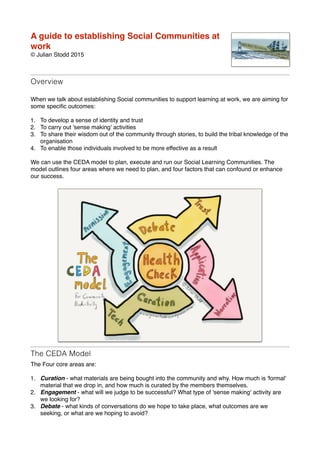
We can use the CEDA model to plan, execute and run our Social Learning Communities. The
model outlines four areas where we need to plan, and four factors that can confound or enhance
our success.
The CEDA Model
The Four core areas are:
1. Curation - what materials are being bought into the community and why. How much is 'formal'
material that we drop in, and how much is curated by the members themselves.
2. Engagement - what will we judge to be successful? What type of 'sense making' activity are
we looking for?
3. Debate - what kinds of conversations do we hope to take place, what outcomes are we
seeking, or what are we hoping to avoid?
4. Application - if the community is successful, what difference do we want it to make back in the
organisation itself. What do we hope to achieve?
Around the four core areas are four confounding or enabling factors:
1. Technology - will it facilitate the curation activities, or is it distracting?
2. Trust - do community members trust each other and the organisation. Are they willing to
engage with authenticity?
3. Permission - are we seeing argument, debates, dialogue or pathos? What permission do
people have to dissent or engage?
4. Narrative - when people apply what they learn, where are they telling our stories? How does
the organisation learn as a result?
How to use the CEDA Model
When planning a community, ask these questions:
CURATION AND TECHNOLOGY
1. Is there a defined learning outcome for this group, or will it set it's own objectives?
If YES then create a Scaffolding for the learning
If NO then give formal ownership of the space to the community
2. Do you want to contribute 'formal' materials to this group or just let them chose their own
'socially' curated material
If you want to include FORMAL elements, contextualise them with questions e.g. 'What do you
think about this', rather than just dropping them in.
If you want to allow SOCIAL curation, then encourage people to INTERPRET what they share to
make it relevant to others in the community.
3. Do you want the community to operate in your own technology (social space)?
If YES then co-create the rules of engagement, so that everyone is clear
If NO then be clear that they can chose their own space, but set any ground rules e.g. no client
data
ENGAGEMENT AND PERMISSION
1. Do you want everyone to contribute?
If YES then think about how you will recognise and reward engagement: where will you recognise
contributions and how will you use Social Authority to reward?
If NO then consider what other factors will drive engagement and consider whether you are just
creating a 'tell' space, pushing data out to people?
2. Do you want to quantify engagement?
If YES, then what measures will you use? Consider how you will triangulate your assessment of
engagement through:
[a] Self reported measures of learning
[b] A co-created story, written by the community
[c] Formal measures of engagement e.g. contribution levels
If NO then consider other measures you can use to encourage engagement e.g. social recognition
and reward
3. Is permission to challenge implicit or explicit?
If permission to challenge is IMPLICIT then consider making it explicit: how will people know what
the rules are if we are not clear?
If permission is EXPLICIT then you have no right to come back to people if they challenge the
formal voice in a fair and reasoned manner. So chose how to set the rules wisely.
DEBATE AND TRUST
1. Does the organisation want to own the story?
If YES, then create formal elements to feed into the community that give your organisational view
and make that clear.
If NO then co-create the meaning with the community and find a way to share the story out of it.
2. Are you sure that people have enough trust to engage in debate and dialogue?
If YES, test your theory and explore the subject within the community.
If NO take steps to build trust, such as co-creating rules, being explicit about moderation and
creating a community based advisory group.
3. Will you actively moderate the space?
If YES, do you have the guidelines written as to how? And have you shared them so everyone is
clear?
If NO, are you clear how you will respond when challenging questions are raised? Do you want to
co-create some guidance with the group?
APPLICATION AND NARRATIVE
1. Are you going to measure or capture how people apply what they learn in the Community?
If YES, how?
If NO, why not? How will you ensure that the community has a purpose beyond purely social
connection? Or is that enough?
2. Where will you share stories of application?
Where can community members share their stories? How will you recognise and reward them?
How will you link these back to the tribe itself?
3. Is the community open ended?
If YES, when will you hand over control and relinquish formal ownership?
If NO, how will you manage graduation, or future enrolment, to ensure it retains purpose and
energy?

Establishing Social Learning Communities - a guide v1

  • 1.
    A guide toestablishing Social Communities at work © Julian Stodd 2015 Overview When we talk about establishing Social communities to support learning at work, we are aiming for some specific outcomes: 1. To develop a sense of identity and trust 2. To carry out 'sense making' activities 3. To share their wisdom out of the community through stories, to build the tribal knowledge of the organisation 4. To enable those individuals involved to be more effective as a result We can use the CEDA model to plan, execute and run our Social Learning Communities. The model outlines four areas where we need to plan, and four factors that can confound or enhance our success. The CEDA Model The Four core areas are: 1. Curation - what materials are being bought into the community and why. How much is 'formal' material that we drop in, and how much is curated by the members themselves. 2. Engagement - what will we judge to be successful? What type of 'sense making' activity are we looking for? 3. Debate - what kinds of conversations do we hope to take place, what outcomes are we seeking, or what are we hoping to avoid?
  • 2.
    4. Application -if the community is successful, what difference do we want it to make back in the organisation itself. What do we hope to achieve? Around the four core areas are four confounding or enabling factors: 1. Technology - will it facilitate the curation activities, or is it distracting? 2. Trust - do community members trust each other and the organisation. Are they willing to engage with authenticity? 3. Permission - are we seeing argument, debates, dialogue or pathos? What permission do people have to dissent or engage? 4. Narrative - when people apply what they learn, where are they telling our stories? How does the organisation learn as a result? How to use the CEDA Model When planning a community, ask these questions: CURATION AND TECHNOLOGY 1. Is there a defined learning outcome for this group, or will it set it's own objectives? If YES then create a Scaffolding for the learning If NO then give formal ownership of the space to the community 2. Do you want to contribute 'formal' materials to this group or just let them chose their own 'socially' curated material If you want to include FORMAL elements, contextualise them with questions e.g. 'What do you think about this', rather than just dropping them in. If you want to allow SOCIAL curation, then encourage people to INTERPRET what they share to make it relevant to others in the community. 3. Do you want the community to operate in your own technology (social space)? If YES then co-create the rules of engagement, so that everyone is clear If NO then be clear that they can chose their own space, but set any ground rules e.g. no client data ENGAGEMENT AND PERMISSION 1. Do you want everyone to contribute? If YES then think about how you will recognise and reward engagement: where will you recognise contributions and how will you use Social Authority to reward? If NO then consider what other factors will drive engagement and consider whether you are just creating a 'tell' space, pushing data out to people? 2. Do you want to quantify engagement? If YES, then what measures will you use? Consider how you will triangulate your assessment of engagement through: [a] Self reported measures of learning [b] A co-created story, written by the community
  • 3.
    [c] Formal measuresof engagement e.g. contribution levels If NO then consider other measures you can use to encourage engagement e.g. social recognition and reward 3. Is permission to challenge implicit or explicit? If permission to challenge is IMPLICIT then consider making it explicit: how will people know what the rules are if we are not clear? If permission is EXPLICIT then you have no right to come back to people if they challenge the formal voice in a fair and reasoned manner. So chose how to set the rules wisely. DEBATE AND TRUST 1. Does the organisation want to own the story? If YES, then create formal elements to feed into the community that give your organisational view and make that clear. If NO then co-create the meaning with the community and find a way to share the story out of it. 2. Are you sure that people have enough trust to engage in debate and dialogue? If YES, test your theory and explore the subject within the community. If NO take steps to build trust, such as co-creating rules, being explicit about moderation and creating a community based advisory group. 3. Will you actively moderate the space? If YES, do you have the guidelines written as to how? And have you shared them so everyone is clear? If NO, are you clear how you will respond when challenging questions are raised? Do you want to co-create some guidance with the group? APPLICATION AND NARRATIVE 1. Are you going to measure or capture how people apply what they learn in the Community? If YES, how? If NO, why not? How will you ensure that the community has a purpose beyond purely social connection? Or is that enough? 2. Where will you share stories of application? Where can community members share their stories? How will you recognise and reward them? How will you link these back to the tribe itself? 3. Is the community open ended? If YES, when will you hand over control and relinquish formal ownership? If NO, how will you manage graduation, or future enrolment, to ensure it retains purpose and energy?